
Kart launches and paid sim content set the spending base
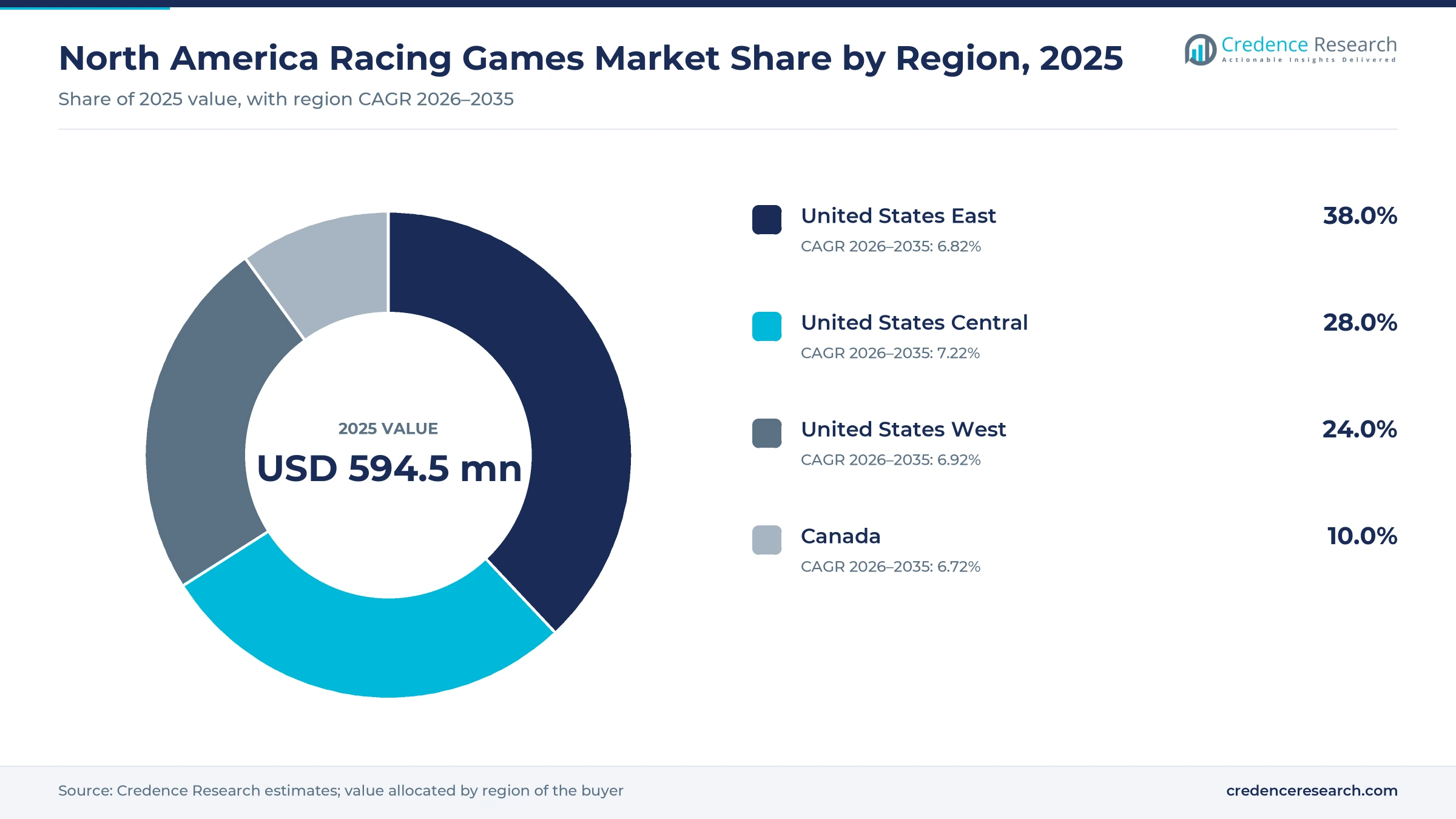
The North America racing games market was valued at USD 594.5 million in 2025 and is projected to increase from USD 636.6 million in 2026 to USD 1.17 billion by 2035, registering a CAGR of 6.95% during 2026–2035. Demand rests on a family franchise on Nintendo hardware, open-world releases from Microsoft and paid simulation content from Sony and iRacing. United States East held the largest regional share, 38.0% in 2025, because 148.3 million residents live in those census divisions. United States Central is the fastest-growing region at 7.22% a year, helped by 1.02% population growth in its West South Central division. Commercially, the market is moving away from annual full-price releases, since Electronic Arts replaced a 2026 Formula One game with a paid expansion and iRacing raised subscription prices in August 2026 for only the second time in nearly 20 years. Rising console prices remain the main constraint on new household entry.
What do buyers actually pay for in this market?
The estimate counts consumer spending on racing software in the United States and Canada, including full-game purchases, paid expansions, in-game items and racing subscriptions. Spending is grouped across circuit simulation, arcade, kart and off-road rally titles, and it is reached through console, PC and mobile storefronts, publisher accounts and physical retail.
The estimate excludes consoles, wheels, pedals, cockpits and location-based simulators, because those purchases sit in hardware budgets. General subscription fees count only for the portion attributed to racing play, which is why that access line is treated as a Credence Research estimate.
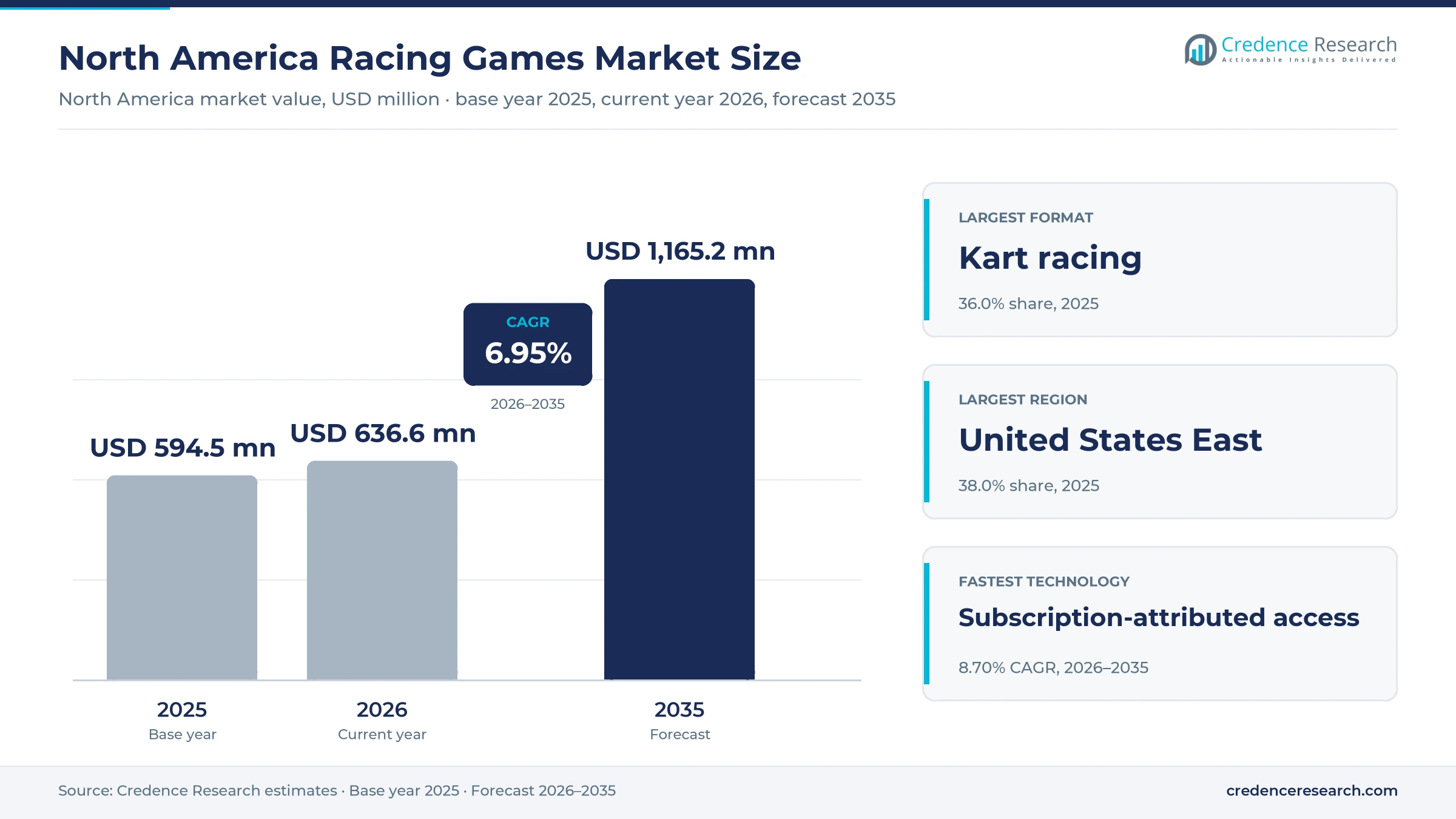
North America Racing Games Market Insights
- The market grows from USD 594.5 million in 2025 to USD 1.17 billion by 2035, at a 6.95% CAGR, as simulation content and racing services add to franchise sales.
- United States East held 38.0% of 2025 value, the largest share, reflecting 148.3 million residents across its census divisions according to the Census Bureau.
- Kart racing led with 36.0% of 2025 value after Mario Kart World reached 14.03 million units worldwide by Dec. 31, 2025, according to Nintendo sales data.
- Electronic Arts announced in November 2025 that a paid expansion would carry the 2026 Formula One season, with its next full game planned for 2027.
- iRacing raised its monthly plan to $14.75 from $13.00 on Aug. 18, 2026, showing how enthusiast buyers now carry a larger part of category pricing.
Kart titles lead value while simulation grows fastest
Why does kart racing out-earn simulation today?
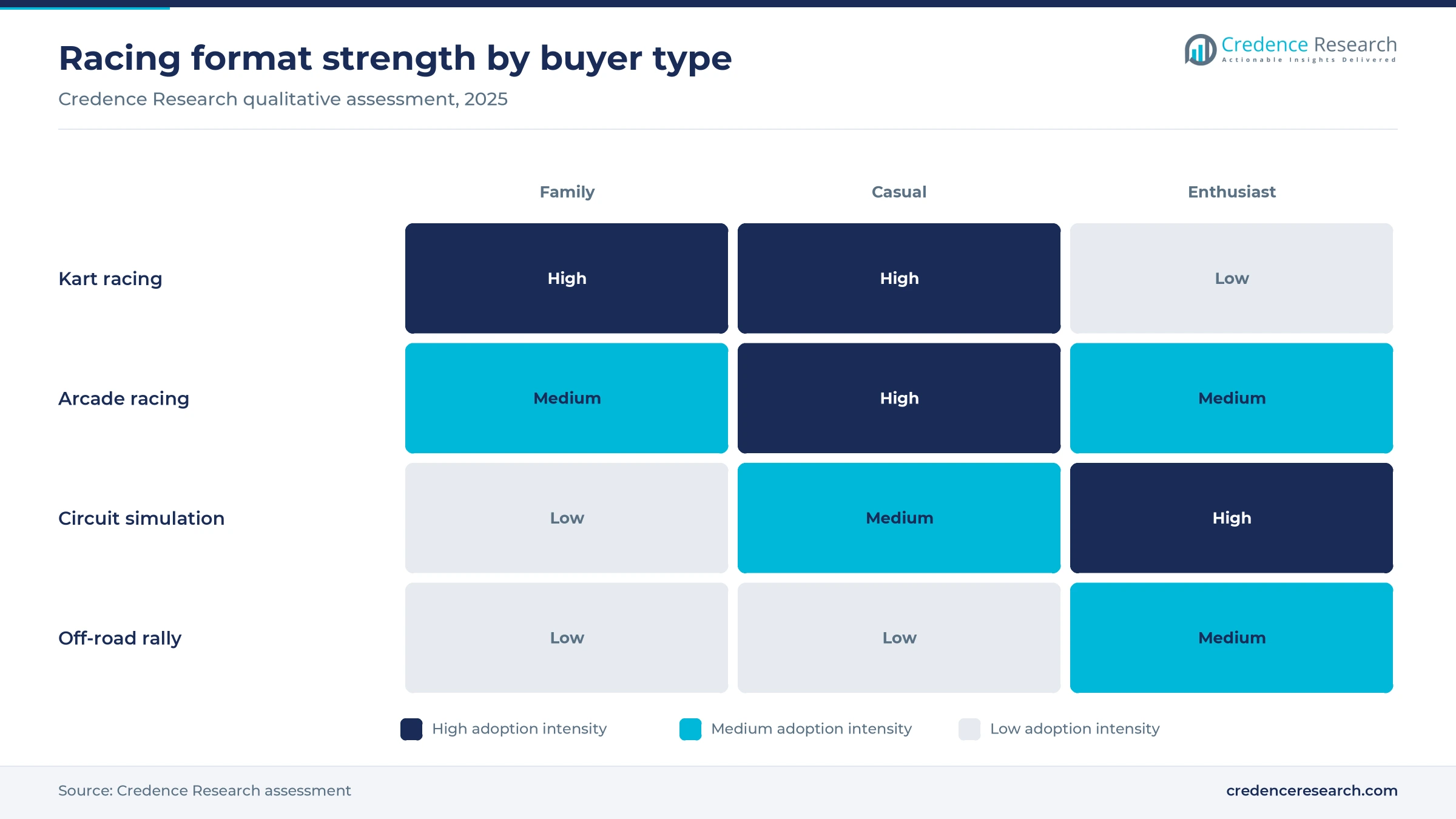
Based on product type, the market is categorized into circuit simulation, arcade racing, kart racing and off-road rally. Kart racing led with 36.0% of 2025 value because Mario Kart World reached 14.03 million units worldwide by Dec. 31, 2025, according to Nintendo sales data. Circuit simulation grows fastest at 7.93% a year as iRacing Studios and Electronic Arts widen licensed series coverage. The Drive reported in August 2025 that the INDYCAR title, now due in early 2027 according to iRacing, would be the series' first dedicated game in over 20 years.
How much value still flows through consoles?
Based on technology, the market is categorized into console direct, PC direct, mobile direct and subscription-attributed access. Console direct led with 61.0% of 2025 value because Switch 2 sold 1.6 million U.S. units in June 2025, a launch-month hardware record reported by Windows Central, with Mario Kart World among the top sellers. Subscription-attributed access grows fastest at 8.70% a year as subscribers reached Forza Horizon 6 without buying it. GamingBolt reported in October 2026 that over 10 million players had seemingly tried the title through Game Pass, in a story it labeled a rumor.
Which buyers are shifting the mix toward higher spending?
Based on customer type, the market is categorized into family buyers, casual buyers and enthusiast buyers. Family buyers led with 41.0% of 2025 value because the 2026 ESA study, reported by TechSpot, puts play above 80% among Gen Alpha and Gen Z, the households kart titles target. Enthusiast buyers grow fastest at 7.93% a year as a small group sets pricing. Gamepressure reported in October 2025 that 14% of U.S. players buy at least one new game monthly, while Forza Horizon 6 sold a $120 Premium Edition with early access, according to Gizchina.
Where do racing buyers complete the purchase?
Based on distribution channel, the market is categorized into platform stores, publisher direct and physical retail. Platform stores led with 74.0% of 2025 value because even a large launch now sells mainly digitally, with Gizchina reporting third-party estimates of about 2.8 million Steam and 2.1 million Xbox copies of Forza Horizon 6 in week one. Publisher direct grows fastest at 7.92% a year as iRacing bills members directly on its own accounts. Physical retail keeps shrinking, since PYMNTS reported GameStop planned more than 430 U.S. closures in January 2026.
| Segment Group | Leading Sub-segment | Share, 2025 | Fastest-growing Sub-segment | CAGR, 2026–2035 |
|---|---|---|---|---|
| By Product Type | Kart racing | 36.0% | Circuit simulation | 7.93% |
| By Technology | Console direct | 61.0% | Subscription-attributed access | 8.70% |
| By Customer Type | Family buyers | 41.0% | Enthusiast buyers | 7.93% |
| By Distribution Channel | Platform stores | 74.0% | Publisher direct | 7.92% |
Request a Free Sample
Fill in your details and we'll send you a free sample report.
- Sample data tables & charts
- Research methodology
Franchises, paid content and services lift racing spend
Franchise-led family demand anchors unit volume
A single family franchise sets the volume floor for the category, and it is tied closely to new hardware. Mario Kart World reached 16.48 million units worldwide by Sept. 30, 2026, the top seller on Switch 2 according to Nintendo. Its predecessor adds a long tail, because Shacknews reported Mario Kart 8 Deluxe has passed 70 million lifetime units and sold 2.39 million more in the nine months to December 2025. Nintendo also renewed the bundle route in late September 2026 with a $549.99 Switch 2 package, Nintendo Wire reported. With 14.03 million of those units sold by Dec. 31, 2025, Kart racing held 36.0% of 2025 value, and each new Switch 2 household becomes a likely buyer of racing games.
Simulation content monetization raises spend per player
Simulation publishers are earning more from existing players, which lifts spending without requiring new households. iRacing charges for cars and tracks on top of a subscription, and its base package now includes more than 30 cars and over 25 tracks. Sony followed a similar path on Dec. 4, 2025, when the Gran Turismo 7 Power Pack added about 50 career races and Gran Turismo Sophy 3.0 as paid content on PS5, GTPlanet reported. Electronic Arts had already confirmed in November 2025 that the 2026 Formula One season would arrive as a paid F1 25 expansion. These moves explain why Circuit simulation is the fastest-growing format in this estimate through 2035.
Racing service expansion widens access to premium titles
Subscription catalogs are bringing premium racing titles to players who would not pay full price at launch. U.S. subscription spending rose 20% in 2025, according to the Entertainment Software Association, and TweakTown reported non-mobile services reached $3.6 billion by July of that year. Microsoft made the strongest racing case when Forza Horizon 6 launched on May 19, 2026, with Gizchina reporting an unconfirmed estimate of over 3 million Game Pass players in launch week. Pricing moved at the same time, since The Game Business reported Game Pass Ultimate rising 50% to $29.99 a month in October 2025. Consequently, Subscription-attributed access is the fastest-growing technology line in this estimate, even from a small base.
Licensed American series return to consoles and PC
Domestic motorsport licenses are gaining new standalone titles, which gives publishers of racing games a clearly local audience. iRacing Studios released NASCAR 25, its first standalone NASCAR title, on Xbox and PS5 on Oct. 14, 2025, Windows Central reported, with a Steam version following. iRacing said on July 10, 2026, that INDYCAR Racing The Game will arrive in early 2027, and The Drive reported in August 2025 that it would carry licensed NTT INDYCAR SERIES and INDY NXT drivers. Demand also has a wide base, because 212.3 million Americans play at least one hour a week, TechSpot reported from the 2026 ESA study. Buyers of these titles also spend on PC gaming peripherals, though that spending sits outside this estimate.
Multiplatform launches reshape how racing titles earn
Shift from platform exclusivity to multiplatform racing
Exclusivity is weakening as publishers look for buyers on rival hardware, and racing has become a visible test case. Forza Horizon 5 debuted on PS5 in April 2025, and Pure Xbox reported third-party estimates of about 5 million copies in its first year, though Microsoft has not confirmed them. Forza Horizon 6 launched in May 2026 on Xbox and Steam with a PS5 version still to come, while GamingBolt reported a third-party estimate of 8.8 million copies in October 2026, in a story it labeled a rumor. NASCAR 25 likewise arrived on Xbox and PS5 on the same day. This pattern lets a single title reach households that own different gaming hardware, which lengthens sales well beyond the launch window, as the 5 million PS5 estimate for a four-year-old game shows.
Rise of expansions over annual racing releases
Annual full-price releases are giving way to longer-lived games with paid additions, especially in licensed motorsport. Electronic Arts said on Nov. 18, 2025, that no new full F1 game would arrive in 2026, with a paid F1 25 expansion covering that season and the next full release planned for 2027. Sony extended Gran Turismo 7 in a similar way, adding its Power Pack on Dec. 4, 2025, more than three years after the game launched in March 2022. iRacing also kept car and track prices unchanged in its 2026 update while raising subscription fees about 13%. As a result, continuing engagement accounts for more of the annual spending of Enthusiast buyers, the fastest-growing buyer group.
Opening for simulation career modes aimed at newer players
Single-player career modes offer simulation publishers an opening with buyers who avoid competitive online racing. iRacing named single-player Career Mode among its upcoming projects in its July 2026 notice, alongside a new graphics engine, and that notice took the monthly plan to $14.75 from $13.00 on Aug. 18, 2026. The Gran Turismo 7 Power Pack added about 50 career races in December 2025, including endurance events and qualifying, the latter absent since Gran Turismo 4 according to GTPlanet. Age is also favorable, because The Star reported in June 2026 that the average U.S. player is 37. Older buyers with limited weekly time are a natural audience for offline careers, which supports long-term growth in Circuit simulation.
Opening in mobile after a major simulation title closed
Mobile racing has a visible gap that competing publishers can fill with premium-quality simulation content. Electronic Arts delisted Real Racing 3 on Dec. 18, 2025, and shut its servers on March 19, 2026, Operation Sports reported, ending a 12-year run for that mobile simulation title. Spending capacity is plainly large, since mobile gaming reached $26.7 billion in the United States in 2025, up 1%, according to the Entertainment Software Association. Mobile is also the most common platform at 80% of players across age groups, TechSpot reported from the 2026 ESA study. However, Console direct still held 61.0% of 2025 value, so racing remains underweight on phones compared with its console position.
Price rises and license gaps test racing publishers
Console price rises slow entry for family households
Hardware inflation directly affects kart demand, because a new family buyer must first buy the console. Nintendo raised the U.S. Switch 2 price to $499.99 from $449.99 on Sept. 1, 2026, and the Canadian price to C$679.99 from C$629.99, Technobezz reported. Together with a $79.99 digital Mario Kart World, first-time entry is now costly for households. Publishers can respond through bundles and discounts on older titles, though software margins narrow when they do.
Subscriptions can cannibalize premium racing sales
Catalog access lowers the price of entry but also takes buyers away from full-price sales. Gizchina reported third-party estimates in May 2026 that Forza Horizon 6 drew over 3 million Game Pass players in launch week, alongside about 4.9 million paid copies on Steam and Xbox. An analyst quoted there described that access as cannibalizing sales. Publishers outside the large platform owners are most exposed, so many will likely use early-access premium editions to protect launch value.
Rally titles lack a committed major publisher
Off-road rally has lost its most established publisher, which limits new content for that format. Electronic Arts said on April 30, 2025, that it was pausing future rally titles, and that the 2024 season would be the last expansion for EA Sports WRC. Rally fans are therefore left with an aging catalog and few current licensed options. Smaller studios may fill the gap, although licensing and physics costs make a premium replacement a slow prospect for players.
Few buyers purchase new games each year
Most U.S. players buy very few new titles, which concentrates pressure on a small group of committed buyers. Gamepressure reported in October 2025 that 63% of U.S. players buy two or fewer new games a year, leaving limited room for a racing purchase alongside larger franchises. The list of top 2025 titles published by the Entertainment Software Association also held no racing game. Publishers therefore lean on catalog offers, while streaming delivered through cloud gaming backend services offers one route to lower-cost access.
Eastern states lead while central states grow fastest
| Region | Value, 2025 (USD million) | Share, 2025 | CAGR, 2026–2035 |
|---|---|---|---|
| United States East | 225.9 | 38.0% | 6.82% |
| United States Central | 166.5 | 28.0% | 7.22% |
| United States West | 142.7 | 24.0% | 6.92% |
| Canada | 59.5 | 10.0% | 6.72% |
United States East has the largest buyer base
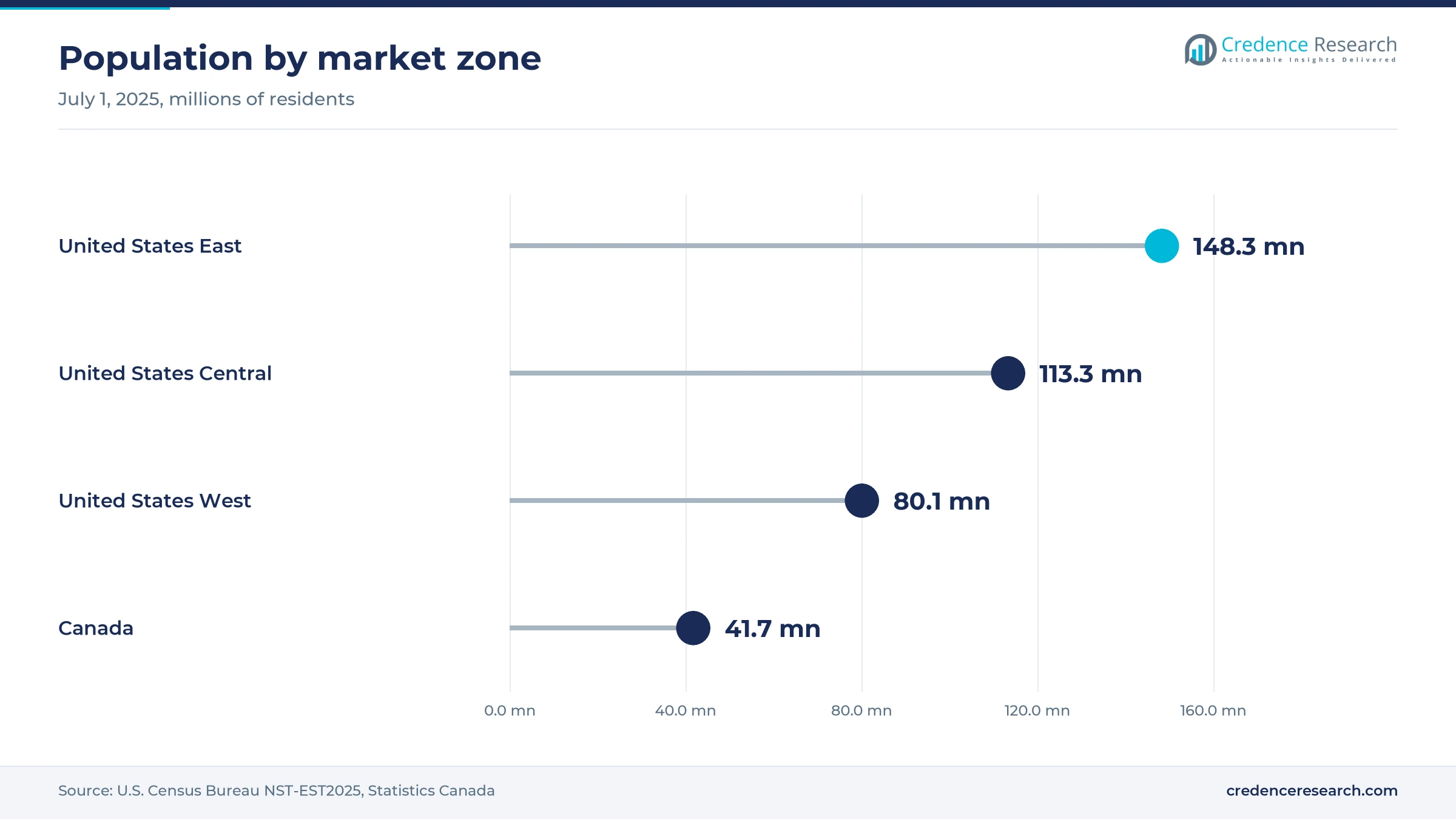
United States East held 38.0% of 2025 value and grows at 6.82% a year. The zone covers the New England, Middle Atlantic, South Atlantic and East South Central divisions, which held 148.3 million residents in 2025 according to the Census Bureau. South Atlantic population grew 0.88% that year, the strongest rate inside the zone, even as national population growth slowed to 0.5% according to the same agency. That scale makes the zone the largest source of family console spending on racing games.
1.02% population growth drives the fastest-growing zone
United States Central held 28.0% of 2025 value and grows at 7.22% a year, the fastest rate among the four zones. The Census Bureau counted 113.3 million residents across its three central divisions in 2025, with West South Central population up 1.02% in a year. That is faster than the 0.5% national rate, and it adds new households who may buy racing games each year. Spending per head is assumed to sit slightly below the national average.
United States West pairs income with PC spending
United States West held 24.0% of 2025 value and grows at 6.92% a year. The zone has only 80.1 million residents according to the Census Bureau, so its share runs above its 20.9% of the four zones' combined population, reflecting higher incomes in Pacific states. Population growth is slower, at 0.74% in the Mountain division and 0.13% in the Pacific division. Electronic Arts, based in Redwood City, California, shapes licensed simulation supply from this zone.
Canada buys premium open-world racing despite higher prices
Canada held 10.0% of 2025 value and grows at 6.72% a year, with 41.7 million residents on July 1, 2025, according to Statistics Canada. The Entertainment Software Association of Canada ranked Forza Horizon 5 15th among the country's best-selling games of 2025, as reported by iPhone in Canada. Higher local prices limit growth, because the Switch 2 now costs C$679.99 and blogTO reported an Xbox Series X 1TB at C$729.99 after May 2025 price changes.
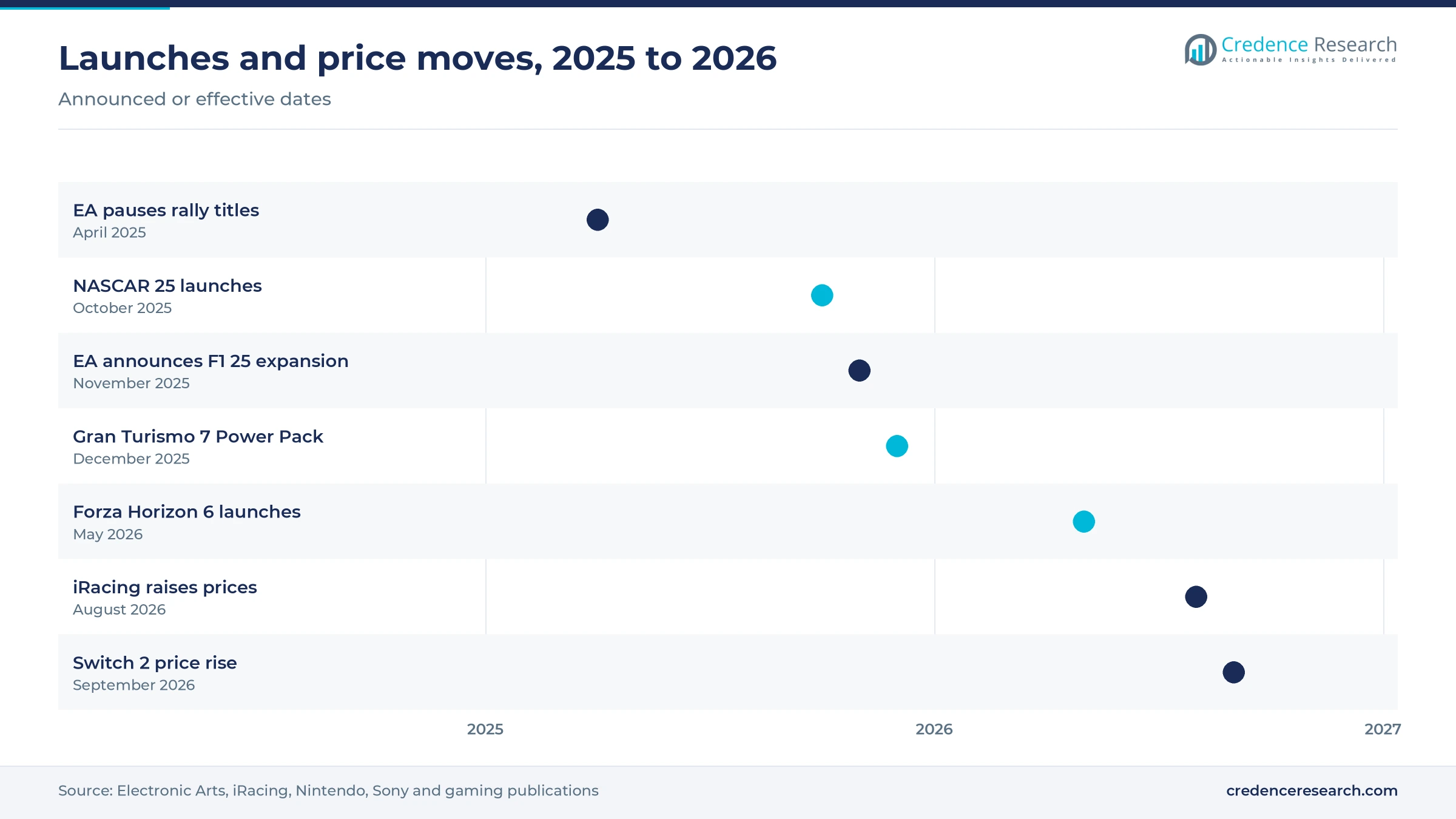
Dated launches and repricing moves since April 2025
| Development | Status and market relevance |
|---|---|
| In April 2025, Electronic Arts announced it was pausing future rally titles and ending new content for EA Sports WRC. | Leaves off-road rally without a major publisher program |
| In October 2025, iRacing Studios launched NASCAR 25 on Xbox and PS5, its first standalone NASCAR title. | Gives licensed stock-car racing an iRacing title on current consoles |
| In November 2025, Electronic Arts announced a paid F1 25 expansion for the 2026 season and a new full game for 2027. | Replaces the annual release with paid content for one season |
| In May 2026, Microsoft launched Forza Horizon 6 on Xbox and Steam, with Premium Edition early access at $120. | Microsoft cited over 6 million players, including Game Pass access |
| In September 2026, Nintendo raised the U.S. Switch 2 price to $499.99 and introduced a $549.99 Mario Kart World bundle. | Raises the entry cost for new family buyers |
Engines and AI drivers separate premium racing titles
- Gran Turismo Sophy 3.0 gives PS5 owners a new AI opponent in the Power Pack, and it is the reason GTPlanet says the pack runs only on PS5.
- Unreal Engine 5 powers NASCAR 25, which Monster Games built for iRacing, according to The Drive, bringing the license onto a current commercial engine.
- The Orontes engine underlies ExoCross and, in an enhanced version, the planned INDYCAR title, which lets iRacing Studios reuse physics work across several licenses.
- A new graphics engine is in development for iRacing, according to its July 2026 notice, which ties the higher subscription price to more development investment.
Need a Custom Version of This Report?
Tailor the scope, geography, or segments to your exact requirements.
- Custom geography or segment scope
- Direct access to our analyst team
Five publishers split family, open-world and sim buyers
Competition splits along buyer type rather than price alone, so the five leading publishers rarely meet head to head. Nintendo holds the family buyer through Mario Kart and its console bundles, with 16.48 million Mario Kart World units sold worldwide. Microsoft competes for broad open-world demand with Forza Horizon and placed its 2026 release in Game Pass at launch. Sony sells the Gran Turismo 7 Power Pack only on PS5 and adds paid content years after launch. Electronic Arts relies on the Formula One license, having paused future rally titles in April 2025. iRacing serves committed enthusiasts through paid subscriptions and paid content, and it now also sells a licensed standalone NASCAR title and is developing one for INDYCAR. As a result, barriers center on licenses, physics and franchise history. The pause in rally development leaves off-road racing games open to smaller studios, where licenses matter less.
Who serves each racing buyer group
| Company | Type | Role in the market |
|---|---|---|
| Nintendo | Platform owner and publisher | Publishes Mario Kart World and Mario Kart 8 Deluxe and sells Switch 2 bundles in the United States |
| Microsoft | Platform owner and publisher | Publishes Forza Horizon on Xbox, Steam and PS5 and offers it through Game Pass |
| Sony Interactive Entertainment | Platform owner and publisher | Publishes Gran Turismo 7 and sold the Power Pack as paid PS5 content from December 2025 |
| Electronic Arts | Licensed publisher | Publishes F1 25 and its 2026 season expansion and ended new EA Sports WRC content in 2025 |
| iRacing | Subscription simulation publisher | Runs the subscription service and, through iRacing Studios, sells NASCAR 25 and develops an INDYCAR title |
Sim depth is the better margin bet than unit volume
Credence Research's view is that simulation depth offers publishers a better margin path than chasing unit volume against Nintendo. Kart demand follows console cycles, and Mario Kart World has already absorbed much of the launch-household base. By contrast, iRacing could raise subscription fees about 13% on Aug. 18, 2026, while Sony and Electronic Arts both turned to paid expansions. The most assumption-heavy estimate here is subscription-attributed access, because no publisher reports racing play within its catalog. Readers of this report should therefore treat that line as a modeled allocation rather than reported spending.
Model inputs, public sources and limits of the estimate
The report uses 2025 as the base year and 2035 as the forecast year, with values from the Credence Research market model. Segment and regional shares for racing games are Credence Research estimates throughout. Sources are publisher and platform releases, trade association data, national statistics and named gaming publications, and regional shares rest on population data from the Census Bureau and Statistics Canada. No interviews or surveys were conducted for this edition of the report. Unit sales from independent estimators are identified as estimates and are not confirmed by publishers.
Racing spend depends on franchise timing to 2035
The market is forecast to rise from USD 636.6 million in 2026 to USD 1.17 billion by 2035, at a 6.95% CAGR over 2026–2035. Spending will not rise evenly, because kart demand depends on Nintendo's release timing and licensed motorsport now moves on longer cycles, with the next full Formula One game planned for 2027. Simulation and subscription-attributed lines should gain share, while physical retail keeps shrinking as store closures continue. United States Central should gradually narrow the gap with United States East, though the eastern states are likely to stay the largest zone through 2035.
Frequently Asked Questions
How big is the North America racing games market?
Which racing format holds the largest share?
Which region leads the market?
Which region is growing fastest?
Why did Electronic Arts skip a 2026 Formula One game?
How much does iRacing cost after the 2026 price change?
Does Game Pass affect racing game sales?
Which companies lead racing games in North America?
Table of Content
Chapter 1 Market Segmentation
- 1.1 Segmentation Framework
- 1.1.1 Product and Service Classification
- 1.1.2 Application and End-Use Classification
- 1.1.3 Technology and Solution Classification
- 1.1.4 Customer and Distribution Channel Classification
- 1.1.5 Geographic Segmentation
- 1.1.6 Market Segment Definitions and Boundaries
- 1.2 By Product Type
- 1.2.1 Kart racing
- 1.2.2 Arcade racing
- 1.2.3 Circuit simulation
- 1.2.4 Off-road rally
- 1.3 By Technology
- 1.3.1 Console direct
- 1.3.2 PC direct
- 1.3.3 Mobile direct
- 1.3.4 Subscription-attributed access
- 1.4 By Customer Type
- 1.4.1 Family buyers
- 1.4.2 Casual buyers
- 1.4.3 Enthusiast buyers
Chapter 2 Introduction
- 2.1 Report Objectives and Scope
- 2.2 Product Definition and Industry Terminology
- 2.3 Market Inclusions and Exclusions
- 2.4 Research Process
- 2.4.1 Primary Research and Expert Interviews
- 2.4.2 Secondary Research and Source Review
- 2.4.3 Top-Down and Bottom-Up Estimation
- 2.4.4 Data Triangulation and Verification
- 2.5 Market Size Measurement Basis
- 2.5.1 2025: USD 594.5 million → 2035: USD 1.17 billion
- 2.6 Historical and Forecast Reference Periods
- 2.6.1 Historical Period: 2018-2025
- 2.6.2 Base Year: 2025
- 2.6.3 Forecast Period: 2025-2035
- 2.7 Research Assumptions and Limitations
Chapter 3 Executive Summary
- 3.1 Market Snapshot and Key Findings
- 3.2 Base-Year Market Size, 2025
- 3.3 Forecast Market Size, 2035
- 3.4 Revenue and Volume Growth Outlook
- 3.5 Key Demand and Supply Indicators
- 3.6 Leading Market Segments
- 3.7 Fastest-Growing Market Opportunities
- 3.8 Regional Performance Highlights
- 3.9 Technology and Industry Transformation
- 3.10 Competitive Landscape Summary
- 3.11 Analyst View and Strategic Implications
Chapter 4 North America Racing Games Market Trends and Developments
- 4.1 Historical Industry Development, 2018-2025
- 4.2 Recent Market Trends and Developments
- 4.3 Demand and Customer Behavior Trends
- 4.4 Technology and Product Innovation
- 4.5 Artificial Intelligence, Automation and Digitalization
- 4.6 Local Manufacturing and Supply Chain Realignment
- 4.7 Industry Partnerships, Mergers and Acquisitions
- 4.8 Sustainability and Circular Economy Developments
- 4.9 Government and Private Sector Investment Trends
- 4.10 Emerging Business Models and Commercialization
- 4.11 Industry Developments and Announcements
Chapter 5 North America Racing Games Market Production, Supply and Demand Analysis
- 5.1 Demand Trend and Consumption Analysis, 2018-2025
- 5.2 Demand Forecast, 2025-2035
- 5.3 Production and Output Trend, 2018-2025
- 5.4 Production and Output Forecast, 2025-2035
- 5.5 Installed Capacity and Capacity Utilization
- 5.6 Company-Wise Production Plants and Statistics
- 5.6.1 Installed Production Capacity
- 5.6.2 Actual Production
- 5.6.3 Planned Capacity and Expansion Targets
- 5.7 Supply Chain Structure and Procurement Trends
- 5.8 Supply-Demand Gap and Bottlenecks
- 5.9 Import Dependence and Sourcing Structure
- 5.10 Contract Manufacturing and Outsourcing
- 5.11 Regional Supply and Demand Concentration
Chapter 6 North America Racing Games Market Pricing Analysis
- 6.1 Pricing Structure and Measurement
- 6.2 Historical Pricing Trends, 2018-2025
- 6.3 Pricing Outlook, 2025-2035
- 6.4 Average Selling Price and Unit Economics
- 6.5 Pricing by Product and Market Segment
- 6.6 Geographic Pricing Differences
- 6.7 Key Input, Energy, Labor and Logistics Costs
- 6.8 Contract Pricing and Purchasing Models
- 6.9 Pricing Sensitivity and Competitive Positioning
- 6.10 Price, Margin and Profitability Implications
Chapter 7 North America Racing Games Market Dynamics
- 7.1 Market Growth Drivers
- 7.1.1 Demand-Side Drivers
- 7.1.2 Technology and Innovation Drivers
- 7.1.3 Infrastructure and Investment Drivers
- 7.1.4 Regulatory and Policy Drivers
- 7.2 Market Restraints
- 7.2.1 Cost and Affordability Constraints
- 7.2.2 Technology and Adoption Barriers
- 7.2.3 Supply Chain and Operational Constraints
- 7.3 Market Challenges
- 7.3.1 Competitive Pressure and Margin Erosion
- 7.3.2 Skills, Infrastructure and Implementation Gaps
- 7.4 Emerging Market Opportunities
- 7.5 Market Dynamics Impact and Time-Horizon Assessment
Chapter 8 North America Racing Games Value Chain Analysis
- 8.1 Industry Value Chain Overview
- 8.2 Upstream Suppliers and Critical Inputs
- 8.3 Technology and Component Providers
- 8.4 Manufacturing or Service Delivery
- 8.5 Distribution, Channel Partners and Integrators
- 8.6 Downstream Applications and End Users
- 8.7 Value Addition and Profit Pools
- 8.8 Vertical Integration and Outsourcing
- 8.9 Supplier Concentration and Risk
- 8.10 Supply Chain Localization and Resilience
Chapter 9 North America Racing Games Market Regulations and Policies
- 9.1 Relevant Laws, Standards and Compliance Frameworks
- 9.2 Product, Service, Safety and Quality Requirements
- 9.3 Government Policies, Incentives and Subsidies
- 9.4 Imports, Exports and Trade Barriers
- 9.5 Public Procurement and Local Content Requirements
- 9.6 Environmental and Sustainability Compliance
- 9.7 Data Protection, AI and Cybersecurity Compliance
- 9.8 Upcoming Policy Changes and Market Implications
Chapter 10 North America Racing Games Market Hotspots and Opportunities
- 10.1 Market Opportunity Mapping and Growth Hotspots
- 10.2 High-Growth Applications and Customer Groups
- 10.3 Underserved Markets and White-Space Opportunities
- 10.4 Emerging Technology and Product Opportunities
- 10.5 New Capacity and Investment Hotspots
- 10.6 Market Entry and Expansion Opportunities
- 10.7 Distribution and Partnership Opportunities
- 10.8 Near-Term and Long-Term Commercial Potential
- 10.9 Opportunity Attractiveness and Execution Risks
Chapter 11 North America Racing Games Market Outlook, 2025-2035
- 11.1 Market Size and Analysis
- 11.1.1 Revenue (Market Measurement: 2025: USD 594.5 million → 2035: USD 1.17 billion)
- 11.1.2 Market Volume and Quantity Sold
- 11.1.3 Historical Market Size, 2018-2025
- 11.1.4 Base-Year Market Size, 2025
- 11.2 Market Forecast, 2025-2035
- 11.2.1 Revenue Forecast to 2035
- 11.2.2 Volume Forecast to 2035
- 11.2.3 CAGR and Year-on-Year Growth
- 11.2.4 Incremental Revenue Opportunity
- 11.3 Forecast Assumptions and Scenario Analysis
- 11.3.1 Base-Case Forecast
- 11.3.2 Optimistic and Conservative Scenarios
- 11.3.3 Technology, Pricing and Policy Sensitivities
- 11.4 Market Attractiveness and Growth Outlook
Chapter 12 North America Racing Games Market Segmentation and Outlook
- 12.1 Segmentation Summary and Market Shares, 2025
- 12.2 Largest and Fastest-Growing Segments
- 12.3 By Product Type - Market Size and Forecast, 2025-2035
- 12.3.1 Segment Definition and Scope
- 12.3.2 Historical Market Size, 2018-2025
- 12.3.3 Revenue Forecast, 2025-2035
- 12.3.4 Volume Forecast, 2025-2035
- 12.3.5 Base-Year Market Share, 2025
- 12.3.6 Segment CAGR and Growth Drivers
- 12.3.7 Subsegment Market Size and Forecast
- 12.3.7.1 Kart racing
- 12.3.7.2 Arcade racing
- 12.3.7.3 Circuit simulation
- 12.3.7.4 Off-road rally
- 12.3.8 Subsegment Pricing and Adoption Trends
- 12.3.9 Leading Suppliers and Competition
- 12.3.10 Regional Demand and Opportunities
- 12.4 By Technology - Market Size and Forecast, 2025-2035
- 12.4.1 Segment Definition and Scope
- 12.4.2 Historical Market Size, 2018-2025
- 12.4.3 Revenue Forecast, 2025-2035
- 12.4.4 Volume Forecast, 2025-2035
- 12.4.5 Base-Year Market Share, 2025
- 12.4.6 Segment CAGR and Growth Drivers
- 12.4.7 Subsegment Market Size and Forecast
- 12.4.7.1 Console direct
- 12.4.7.2 PC direct
- 12.4.7.3 Mobile direct
- 12.4.7.4 Subscription-attributed access
- 12.4.8 Subsegment Pricing and Adoption Trends
- 12.4.9 Leading Suppliers and Competition
- 12.4.10 Regional Demand and Opportunities
- 12.5 By Customer Type - Market Size and Forecast, 2025-2035
- 12.5.1 Segment Definition and Scope
- 12.5.2 Historical Market Size, 2018-2025
- 12.5.3 Revenue Forecast, 2025-2035
- 12.5.4 Volume Forecast, 2025-2035
- 12.5.5 Base-Year Market Share, 2025
- 12.5.6 Segment CAGR and Growth Drivers
- 12.5.7 Subsegment Market Size and Forecast
- 12.5.7.1 Family buyers
- 12.5.7.2 Casual buyers
- 12.5.7.3 Enthusiast buyers
- 12.5.8 Subsegment Pricing and Adoption Trends
- 12.5.9 Leading Suppliers and Competition
- 12.5.10 Regional Demand and Opportunities
- 12.6 Segment Growth Comparison
- 12.7 Segment Attractiveness and Priority Matrix
Chapter 13 North America Racing Games End-Use and Application Market Outlook
- 13.1 End-Use Industry and Customer Demand Structure
- 13.2 Leading Applications and Customer Groups
- 13.3 End-Use Market Size, Share and Forecast
- 13.4 Major End-Use Industry Deep Dives
- 13.4.1 Customer Requirements and Use Cases
- 13.4.2 Demand and Replacement Cycles
- 13.4.3 Technical and Regulatory Considerations
- 13.4.4 Purchasing and Procurement Models
- 13.4.5 Leading Vendors and Distribution Channels
- 13.4.6 Forecast and Commercial Opportunities
- 13.5 Emerging Applications and Cross-Segment Demand
- 13.6 End-Use Industry Investment Priorities
Chapter 14 North America Racing Games Geographic Market Outlook, 2025-2035
- 14.1 Regional Market Size and Country-Level Shares, 2025
- 14.2 Country Market Size Comparison, 2025
- 14.3 Country Market Forecasts, 2025-2035
- 14.4 Subregional Industrial and Demand Clusters
- 14.5 Intra-Regional Pricing and Cost Differences
- 14.6 Cross-Border Trade and Supply Networks
- 14.7 Regional Supply and Demand Balances
- 14.8 Country Opportunity Comparison and Prioritization
Note: Every listed country is covered on the structure shown under the first country.
Chapter 15 North America Racing Games Technology, Innovation and Sustainability Outlook
- 15.1 Technology Landscape and Maturity
- 15.2 Product, Process and Service Innovation
- 15.3 AI, Automation and Digital Tools in the Industry
- 15.4 Technology Adoption and Performance Benchmarking
- 15.5 Innovation Pipeline and R&D Investment
- 15.6 Patent and Intellectual Property Trends
- 15.7 Energy Efficiency and Resource Management
- 15.8 Sustainability, Recycling and Circularity
- 15.9 Technology Roadmap, 2025-2035
- 15.10 Risks of Obsolescence and Technology Substitution
Chapter 16 North America Racing Games Market Key Strategic Imperatives
- 16.1 Growth and Market Entry Priorities
- 16.2 High-Return Products and Segments
- 16.3 Pricing, Profitability and Cost Optimization
- 16.4 Technology Investment and Product Differentiation
- 16.5 Supply Chain Localization and Resilience
- 16.6 Distribution and Customer Acquisition
- 16.7 Partnership, Acquisition and Capacity Strategy
- 16.8 Regional Expansion Priorities
- 16.9 Short-, Medium- and Long-Term Actions
Chapter 17 Competition Outlook
- 17.1 Industry Competition Characteristics
- 17.2 Market Structure and Concentration
- 17.3 Market Share and Competitive Positioning, 2025
- 17.4 Company-Wise Revenue and Product Benchmarking
- 17.5 Production and Service Capacity Benchmarking
- 17.6 Technology, Pricing and Differentiation
- 17.7 Regional Footprint and Distribution Strength
- 17.8 Mergers, Acquisitions and Strategic Alliances
- 17.9 New Entrants and Competitive Threats
- 17.10 Porter's Five Forces and Industry Attractiveness
- 17.11 Competitive Outlook, 2025-2035
Chapter 18 Company Profiles
- 18.1 Company Coverage and Selection Criteria
- 18.2 Electronic Arts
- 18.2.1 Business Description
- 18.2.2 Company Ownership and Geographic Presence
- 18.2.3 Product and Service Portfolio
- 18.2.4 Manufacturing and Operating Footprint
- 18.2.5 Production Capacity and Expansion Plans
- 18.2.6 Financial Performance and Investment
- 18.2.7 Market Share and Competitive Position
- 18.2.8 Technology and Innovation Capabilities
- 18.2.9 Strategic Alliances or Partnerships
- 18.2.10 Recent Developments
- 18.2.11 Growth Strategy and Outlook
- 18.3 Microsoft
- 18.4 Nintendo
- 18.5 iRacing
- 18.6 Sony Interactive Entertainment
- 18.7 Other Relevant Market Participants
Note: Every listed company is profiled on the structure shown under the first company. The company list is preliminary and may change based on research findings, market developments, data availability and client requirements.
Chapter 19 Disclaimer
- 19.1 Research and Forecast Disclaimer
- 19.2 Data Source and Estimation Limitations
Note: The depth of individual sections depends on data availability for this market. Volume, capacity, trade and other unit-based metrics are included where applicable.

