
Market Overview
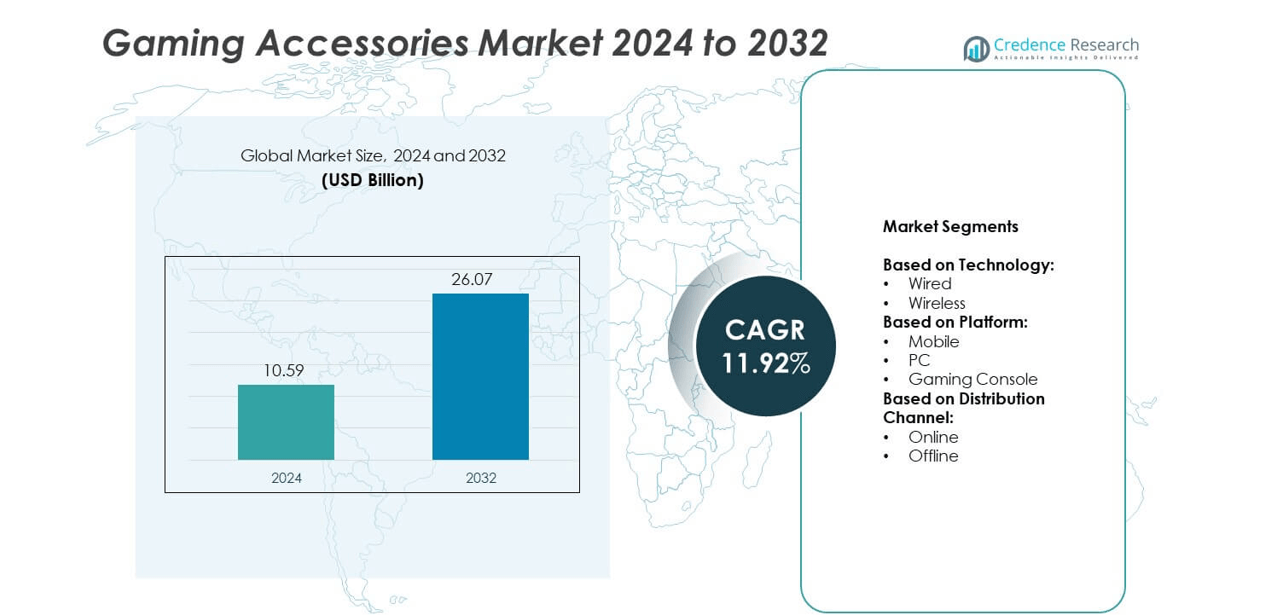
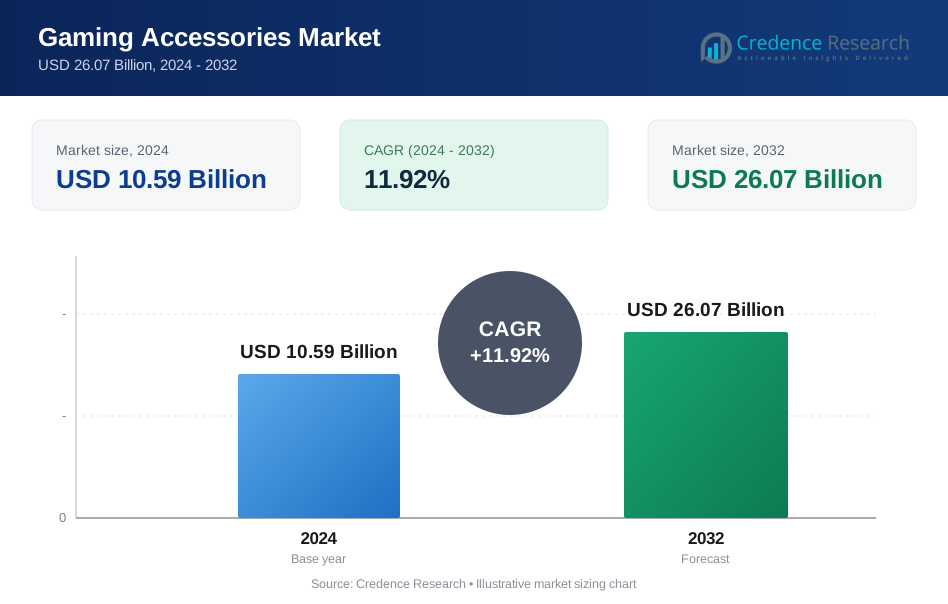
The Gaming Accessories Market size was valued at USD 10.59 Billion in 2024 and is projected to reach USD 26.07 Billion by 2032. The market is expected to grow at a CAGR of 11.92% during the forecast period.
| REPORT ATTRIBUTE | DETAILS |
|---|---|
| Historical Period | 2020-2023 |
| Base Year | 2024 |
| Forecast Period | 2025-2032 |
| Gaming Accessories Market Size 2024 | USD 10.59 Billion |
| Gaming Accessories Market, CAGR | 11.92% |
| Gaming Accessories Market Size 2032 | USD 26.07 Billion |
The Gaming Accessories market is driven by rising esports popularity, growing online gaming platforms, and increasing demand for immersive experiences. Wireless technology adoption, cross-platform compatibility, and innovations in VR and AR accessories fuel strong growth. It benefits from expanding gaming communities, influencer-driven promotions, and higher disposable incomes supporting premium product purchases. Manufacturers focus on personalization, eco-friendly designs, and advanced performance features to meet evolving consumer expectations. These drivers and trends collectively strengthen the market’s global expansion and long-term growth potential.
North America leads the Gaming Accessories market, supported by strong esports culture and high consumer spending on premium products. Europe follows with steady demand across console and PC gaming, while Asia Pacific shows the fastest growth with expanding mobile and online gaming communities. Latin America and the Middle East & Africa present emerging opportunities driven by rising internet access and gaming adoption. Key players shaping the market include Logitech G, Razer Inc., Corsair, and ASUS, focusing on innovation and global reach.
Market Insights
- The Gaming Accessories market was valued at USD 10.59 Billion in 2024 and is projected to reach USD 26.07 Billion by 2032, growing at a CAGR of 11.92%.
- Rising esports popularity and expansion of online gaming platforms drive consistent demand for advanced peripherals.
- Wireless technology, cross-platform compatibility, and adoption of VR and AR accessories shape current trends in product development.
- The market is highly competitive with leading players such as Logitech G, Razer Inc., Corsair, SteelSeries, and ASUS focusing on innovation and brand influence.
- High cost of premium accessories and short product life cycles act as restraints, limiting adoption among price-sensitive and casual gamers.
- North America leads the market with strong consumer spending and esports infrastructure, while Europe maintains steady growth with diverse gaming cultures.
- Asia Pacific emerges as the fastest-growing region, supported by mobile gaming adoption and a young demographic, whereas Latin America and the Middle East & Africa provide untapped opportunities through e-commerce expansion and increasing internet access.
Market Drivers
Rising Popularity of Esports and Online Gaming Platforms
The Gaming Accessories market benefits from the growing popularity of esports and online platforms. Competitive gaming attracts millions of viewers globally and drives investment in advanced peripherals. Players demand high-performance accessories that deliver precision, speed, and comfort during extended sessions. Headsets, controllers, and gaming mice become essential for achieving competitive advantages. It also encourages continuous upgrades, as gamers seek the latest innovations. The rise of global esports tournaments further expands accessory adoption across diverse demographics.
- For instance, The Logitech G PRO X SUPERLIGHT 2 DEX mouse features the advanced HERO 2 sensor and LIGHTSPEED wireless technology. It supports a wireless polling rate of up to 8,000 Hz (0.125 ms) for responsive and reliable performance in competitive gaming. The mouse is capable of tracking at speeds of over 888 IPS (inches per second) and a maximum acceleration of 88G, with a maximum DPI of 44,000. The mouse is also incredibly lightweight at 60 grams.
Technological Advancements in Gaming Hardware and Peripherals
Innovations in hardware and peripheral design fuel consistent growth within the Gaming Accessories market. Manufacturers integrate features such as haptic feedback, adaptive triggers, and customizable lighting. These improvements enhance user experience and support immersive gameplay across multiple devices. It creates demand for premium accessories that align with next-generation consoles and PCs. Wireless technology adoption also improves convenience and performance reliability. Integration with virtual reality and augmented reality further broadens product demand among tech-savvy consumers.
- For instance, Razer released the BlackShark V3 Pro wireless headset featuring Gen-2 HyperSpeed Wireless tech achieving latency as low as 10 milliseconds, with a detachable 12 mm mic sampling voice at 48 kHz.
Expanding Gaming Communities and Consumer Engagement
The Gaming Accessories market gains momentum through expanding gaming communities and interactive platforms. Social media, streaming services, and community forums drive awareness and influence purchase decisions. Gamers often look for accessories endorsed by influencers and professionals. It encourages companies to collaborate with gaming personalities to boost product visibility. The growing culture of live streaming also elevates demand for high-quality microphones and headsets. Wider community interaction ensures constant interest in product innovation and upgrades.
Increasing Availability of Affordable and Premium Product Lines
The Gaming Accessories market is shaped by availability across both affordable and premium segments. Entry-level devices attract casual players seeking reliable performance at lower costs. Premium products cater to enthusiasts who value superior build quality and advanced features. It provides opportunities for brands to diversify offerings across multiple price tiers. Expanding retail presence and e-commerce platforms make these products accessible globally. The balance between affordability and innovation supports sustained market penetration and customer loyalty.
Market Trends
Growing Integration of Wireless and Cloud-Based Technologies
The Gaming Accessories market is witnessing rapid adoption of wireless and cloud-based solutions. Gamers prefer accessories with reduced latency and greater mobility for seamless experiences. Companies design controllers, keyboards, and headsets with advanced wireless connectivity to meet these needs. It also aligns with cloud gaming services, which require reliable peripherals for smooth operation. The shift improves flexibility for players across consoles, PCs, and mobile devices. This trend continues to influence both product design and consumer expectations.
- For instance, The Logitech G305 LIGHTSPEED wireless gaming mouse offers up to 250 hours of continuous gameplay on a single AA battery. It is powered by the highly energy-efficient HERO sensor, which provides precise and accurate tracking with sensitivity ranging from 200 to 12,000 DPI. Using LIGHTSPEED wireless technology, the mouse delivers a super-fast 1 ms report rate for a responsive connection. The mouse is also lightweight, weighing only 99 grams.
Rising Influence of Personalization and Customization Features
The Gaming Accessories market highlights personalization as a core purchasing factor. Consumers demand customizable designs, lighting options, and adjustable ergonomics for individual preferences. Companies introduce software-driven personalization tools to allow unique setups. It enhances engagement by giving players more control over performance and style. Customization also helps accessories stand out in a highly competitive environment. Growing consumer focus on unique gaming identities strengthens this trend across global markets.
- For instance, Corsair’s HS80 Max headset offers up to 65 hours of wireless battery life with low-latency 2.4 GHz Slipstream wireless, giving competitive players long sessions without interruptions.
Expansion of Eco-Friendly and Sustainable Product Designs
The Gaming Accessories market is moving toward sustainable designs driven by environmental awareness. Manufacturers explore recycled materials, reduced packaging waste, and energy-efficient production methods. This aligns with consumer interest in eco-conscious brands and long-lasting products. It helps companies gain trust among environmentally aware buyers. Premium accessories with sustainable credentials attract younger demographics seeking responsible consumption. Eco-friendly innovation continues to influence strategies for long-term competitiveness.
Increasing Adoption of Multi-Platform Compatibility and Cross-Play Support
The Gaming Accessories market benefits from the rise of multi-platform gaming and cross-play features. Players seek accessories compatible across PCs, consoles, and mobile devices. Companies introduce universal controllers, adaptable headsets, and software integrations to address this demand. It ensures seamless transitions for users playing on multiple systems. Multi-platform support also encourages higher adoption among casual and professional gamers alike. Growing cross-play acceptance continues to shape the direction of product innovation.
Market Challenges Analysis
High Cost of Advanced Accessories and Price Sensitivity Among Consumers
The Gaming Accessories market faces challenges due to the high cost of advanced peripherals. Premium accessories with features such as haptic feedback, adaptive triggers, and wireless technology remain expensive. It limits adoption among casual gamers and price-sensitive buyers in emerging economies. Companies must balance innovation with affordability to maintain market reach. Growing competition intensifies pricing pressure, as low-cost alternatives attract budget-conscious consumers. Fluctuations in raw material costs and supply chain expenses further complicate pricing strategies for manufacturers.
Rapid Technological Changes and Short Product Life Cycles
The Gaming Accessories market is challenged by fast-paced innovation and shorter product cycles. New console launches and hardware updates quickly make older accessories less relevant. It forces manufacturers to accelerate product development and invest heavily in research. Frequent upgrades create difficulties for consumers who hesitate to replace devices too often. Compatibility issues across different platforms also impact long-term product adoption. Intense pressure to innovate while maintaining durability and performance standards remains a key challenge for industry players.
Market Opportunities
Expanding Demand from Emerging Markets and Untapped Demographics
The Gaming Accessories market holds significant opportunities in emerging regions with growing digital adoption. Rising internet penetration and smartphone availability increase interest in both mobile and console gaming. It creates strong demand for affordable yet reliable peripherals suited for new players. Younger demographics in Asia, Latin America, and Africa represent a large untapped customer base. Manufacturers targeting localized designs and pricing can capture substantial growth. Strategic distribution through online platforms further supports accessibility across diverse regions.
Growing Role of Immersive Technologies and Next-Generation Gaming Platforms
The Gaming Accessories market is positioned to benefit from the rise of immersive technologies. Virtual reality and augmented reality integration requires specialized peripherals that enhance user engagement. It drives opportunities for headsets, controllers, and motion-sensing devices tailored for advanced platforms. Expanding popularity of cloud gaming also fuels demand for versatile and high-performance accessories. Cross-platform compatibility strengthens adoption among both casual and competitive gamers. Continuous innovation in immersive experiences ensures new revenue streams for manufacturers in the coming years.
Market Segmentation Analysis:
By Technology:
The Gaming Accessories market divides into wired and wireless products. Wired accessories maintain relevance due to consistent performance, low latency, and affordability, making them popular among budget-conscious gamers. Wireless accessories gain momentum with advances in connectivity, offering greater flexibility and convenience. It supports immersive experiences with reduced cable clutter, appealing strongly to premium users. Manufacturers continue to expand wireless portfolios, driven by demand from competitive gamers and integration with modern gaming platforms.
- For instance, SteelSeries, in collaboration with top esports professionals and influencers, designed the Arctis Nova Pro Wireless gaming headset to provide a high-end audio experience with the Nova Pro Acoustic System. The headset is engineered with a multi-system connect featuring dual-wireless capabilities, including simultaneous 2.4G wireless for lossless gaming audio and Bluetooth 5.0 for mobile devices. It is equipped with an Infinity Power System, which includes two hot-swappable batteries. Each battery provides up to 22 hours of usage, for a total of 44 hours of continuous playtime, as one battery charges in the base station while the other is in use.
By Platform:
The Gaming Accessories market includes mobile, PC, and gaming console segments. Mobile gaming shows strong growth with rising smartphone penetration and adoption of casual and competitive titles. It boosts demand for compact controllers, gaming earphones, and mobile-compatible headsets. PC gaming remains a stronghold due to high adoption of performance-driven accessories like mechanical keyboards, gaming mice, and VR-enabled devices. Console gaming maintains dominance, supported by launches of advanced platforms from Sony, Microsoft, and Nintendo. Cross-platform accessories further enhance demand across all categories.
- For instance, HyperX launched the Cloud Alpha Wireless with 300 hours of battery life on a single charge, meeting wireless cloud-gaming needs
By Distribution Channel:
The Gaming Accessories market splits into online and offline channels. Online platforms dominate with wide product availability, competitive pricing, and global reach. It supports market penetration by offering access to both budget and premium products. Offline channels retain importance due to consumer preference for hands-on testing before purchase. Specialty gaming stores and retail outlets play a role in brand promotion and customer engagement. Hybrid strategies combining online efficiency with offline presence continue to strengthen overall distribution.
Segments:
Based on Technology:
- Wired
- Wireless
Based on Platform:
- Mobile
- PC
- Gaming Console
Based on Distribution Channel:
- Online
- Offline
Based on the Geography:
- North America
- U.S.
- Canada
- Mexico
- Europe
- UK
- France
- Germany
- Italy
- Spain
- Russia
- Belgium
- Netherlands
- Austria
- Sweden
- Poland
- Denmark
- Switzerland
- Rest of Europe
- Asia Pacific
- China
- Japan
- South Korea
- India
- Australia
- Thailand
- Indonesia
- Vietnam
- Malaysia
- Philippines
- Taiwan
- Rest of Asia Pacific
- Latin America
- Brazil
- Argentina
- Peru
- Chile
- Colombia
- Rest of Latin America
- Middle East
- UAE
- KSA
- Israel
- Turkey
- Iran
- Rest of Middle East
- Africa
- Egypt
- Nigeria
- Algeria
- Morocco
- Rest of Africa
Regional Analysis
North America
North America holds the largest share of the Gaming Accessories market, accounting for 36% in 2024. The region benefits from a strong presence of console manufacturers, advanced PC gaming culture, and a well-established esports ecosystem. High consumer spending power enables widespread adoption of premium accessories such as wireless controllers, VR headsets, and advanced gaming keyboards. It also benefits from robust infrastructure for online gaming, supported by leading platforms and high-speed internet penetration. The United States drives the majority of demand, fueled by the growing popularity of competitive esports tournaments and extensive live-streaming culture. Canada contributes with a steady rise in mobile gaming adoption and growing preference for accessories compatible with cross-platform gaming. The strong base of accessory manufacturers and continuous product launches ensures North America remains a dominant market throughout the forecast period.
Europe
Europe represents the second-largest regional market, holding 28% of the Gaming Accessories market in 2024. The region is shaped by diverse gaming cultures across countries such as Germany, the United Kingdom, France, and Nordic nations. Strong console adoption and steady PC gaming demand continue to fuel accessory sales. It is supported by a growing esports audience and increasing adoption of VR and AR-enabled peripherals. Western Europe demonstrates high demand for premium devices, while Eastern Europe shows growing adoption of affordable accessories. Cross-border e-commerce platforms expand accessibility and product variety across the region. Europe’s regulatory focus on sustainable electronics also influences manufacturers to adopt eco-friendly materials in product design, which enhances brand positioning among environmentally conscious consumers.
Asia Pacific
Asia Pacific accounts for 24% of the Gaming Accessories market in 2024 and is the fastest-growing region. Rising internet penetration and affordable smartphone availability accelerate mobile gaming adoption across China, India, Japan, and Southeast Asia. It supports strong demand for mobile-compatible controllers, gaming headsets, and accessories tailored for compact devices. Japan and South Korea continue to lead in console and PC gaming, with gamers seeking high-performance accessories for competitive play. China remains a critical market with its growing esports industry, large gaming population, and increasing focus on premium accessories. Expanding e-commerce platforms and local manufacturing capacity also make products widely accessible at competitive prices. Asia Pacific’s young demographic profile and rising disposable incomes create opportunities for both global brands and domestic players.
Latin America
Latin America holds 7% of the Gaming Accessories market in 2024, showing steady expansion. Brazil and Mexico are the leading contributors, driven by rising interest in esports and console gaming. It benefits from increased smartphone penetration, which expands the mobile gaming segment. Price sensitivity remains a challenge, but affordable accessory ranges gain traction among casual gamers. Regional demand for headsets, controllers, and wireless peripherals continues to grow through online platforms. Local distributors and retail networks help bridge gaps in offline sales channels, enhancing market penetration. The region’s gaming culture is also boosted by community-driven platforms and rising engagement on streaming services.
Middle East and Africa
The Middle East and Africa represent 5% of the Gaming Accessories market in 2024, reflecting the smallest share among regions but offering long-term potential. Gulf countries such as the UAE and Saudi Arabia drive regional demand with rising investments in esports infrastructure and gaming hubs. It is supported by a young population with increasing interest in competitive gaming. Africa, particularly South Africa and Nigeria, shows growth in mobile gaming accessories due to smartphone adoption. Limited affordability challenges wider adoption of premium accessories, but mid-range and entry-level products gain traction. E-commerce growth in urban centers improves access to international brands, supporting regional expansion. Global manufacturers view the region as an emerging growth hub with untapped opportunities for localized product strategies.
Key Player Analysis
- Turtle Beach
- Razer Inc.
- Xbox
- Corsair
- Logitech G
- SteelSeries
- Micro-Star INT'L CO., LTD
- HyperX
- ASUS
- Thrustmaster
Competitive Analysis
The leading players in the Gaming Accessories market include Turtle Beach, Razer Inc., Xbox, Corsair, Logitech G, SteelSeries, Micro-Star INT'L CO., LTD, HyperX, ASUS, and Thrustmaster. These companies compete strongly by focusing on product innovation, brand positioning, and expanding their distribution networks across global markets. Each player emphasizes delivering accessories that enhance user experience, whether through advanced audio, precision controls, or compatibility with multiple platforms. The market is highly competitive, with companies targeting both premium and affordable segments to capture diverse consumer bases. Competition is further shaped by rapid technological advancement, where wireless connectivity, cross-platform support, and immersive technologies define differentiation. Companies invest heavily in research and development to align with the evolving demands of esports, professional gaming, and casual users. It places pressure on players to consistently launch updated models that match next-generation consoles and gaming PCs. Strategic collaborations with game developers, esports organizations, and streaming platforms also strengthen brand influence and consumer reach. The market’s future competitiveness will rely on balancing affordability with innovation, as well as meeting sustainability expectations. This environment ensures continuous rivalry among global leaders while creating opportunities for new entrants with disruptive technologies.
Recent Developments
- In 2025, Razer introduced the Pro Click V2 and Pro Click V2 Vertical Edition mice, moving toward more ergonomic designs and productivity-focused features.
- In 2024, Logitech G launched its new PRO Series gear at the Logi PLAY event, introducing the PRO X SUPERLIGHT 2 DEX mouse, PRO 2 LIGHTSPEED mice.
- In 2023, Corsair launched the NIGHTSABRE WIRELESS gaming mouse and K65 PRO MINI Optical-Mechanical Gaming Keyboard, delivering high responsiveness and multiple programmable buttons.
Report Coverage
The research report offers an in-depth analysis based on Technology, Platform, Distribution Channel and Geography. It details leading market players, providing an overview of their business, product offerings, investments, revenue streams, and key applications. Additionally, the report includes insights into the competitive environment, SWOT analysis, current market trends, as well as the primary drivers and constraints. Furthermore, it discusses various factors that have driven market expansion in recent years. The report also explores market dynamics, regulatory scenarios, and technological advancements that are shaping the industry. It assesses the impact of external factors and global economic changes on market growth. Lastly, it provides strategic recommendations for new entrants and established companies to navigate the complexities of the market.
Future Outlook
- The market will continue to expand with strong demand from esports and online gaming.
- Wireless accessories will dominate due to better connectivity and convenience for players.
- Mobile gaming will drive demand for compact and versatile peripherals.
- Virtual reality and augmented reality will boost sales of immersive accessories.
- Cross-platform compatibility will become a standard feature in most products.
- Sustainable designs will gain importance with eco-friendly materials in manufacturing.
- Online sales channels will lead growth, supported by global e-commerce expansion.
- Premium accessories will attract professional gamers seeking advanced performance.
- Emerging markets will provide opportunities with rising smartphone and internet adoption.
- Innovation in AI-enabled and smart accessories will shape future product development.
Request a Free Sample
Fill in your details and we'll send you a free sample report.
- Sample data tables & charts
- Research methodology
Need a Custom Version of This Report?
Tailor the scope, geography, or segments to your exact requirements.
- Custom geography or segment scope
- Direct access to our analyst team
Frequently Asked Questions
What is the current market size for Gaming Accessories market, and what is its projected size in 2032?
Which Gaming Accessories market segment held the largest share in 2024?
What are the primary factors fueling the growth of the Gaming Accessories market?
Who are the leading companies in the Gaming Accessories Market?
Table of Content
Chapter 1. Report Introduction
- 1.1 Report Description & Purpose
- 1.1.1 Report Title & Market Definition
- 1.1.2 Unique Selling Propositions (USP) & Key Differentiators
- 1.1.3 Value Proposition for Stakeholders
- 1.2 Research Objectives
- 1.2.1 Market Sizing Objectives (Volume & Revenue)
- 1.2.2 Segmentation Objectives
- 1.2.3 Competitive Intelligence Objectives
- 1.2.4 Forecast & Scenario Objectives
- 1.3 Report Scope
- 1.3.1 Gaming Accessories Scope – Types & Subtypes Covered
- 1.3.2 Geographic Scope – Regions & Countries Covered
- 1.3.3 Historical Period, Base Year & Forecast Period (2024; forecast to 2032)
- 1.3.4 Inclusions & Exclusions
- 1.4 HS Code & Classification Framework
- 1.5 Currency, Units & Pricing Basis
- 1.6 Target Stakeholders
- 1.7 Limitations & Assumptions
Chapter 2. Executive Summary
- 2.1 Global Gaming Accessories Market Snapshot
- 2.1.1 Market Size – Historical (2024) & Forecast (2024-2032) (2024: USD 10.59 Billion → 2032: USD 26.07 Billion)
- 2.1.2 Volume & Revenue – Global Totals
- 2.1.3 Key Market Highlights – Top Five Facts
- 2.2 Gaming Accessories Market Segmentation Snapshot
- 2.2.1 Market Split by Region – 2024 vs. 2032
- 2.3 Competitive Snapshot
- 2.3.1 Top 10 Players by Revenue Share – 2024
- 2.3.2 Top 10 Players by Volume Share – 2024
- 2.3.3 Recent Strategic Developments (18-Month Summary)
- 2.4 Key Investment Highlights & Strategic Conclusions
Chapter 3. Gaming Accessories Market Dynamics & Industry Analysis
- 3.1 Market Overview & Context
- 3.1.1 Gaming Accessories Market Position in the Broader Automotive Value Chain
- 3.1.2 OEM vs. Replacement Market Dynamics
- 3.1.3 Market Maturity & Development Stage by Region
- 3.2 Gaming Accessories Market Drivers
- 3.3 Gaming Accessories Market Restraints & Challenges
- 3.4 Gaming Accessories Market Opportunities
- 3.5 Porter's Five Forces Analysis
- 3.5.1 Threat of New Entrants
- 3.5.2 Bargaining Power of Suppliers
- 3.5.3 Bargaining Power of Buyers
- 3.5.4 Threat of Substitutes
- 3.5.5 Competitive Rivalry – Intensity Assessment
- 3.6 Gaming Accessories Value Chain Analysis
- 3.6.1 Upstream – Raw Material/Input Suppliers
- 3.6.1.1 Raw Material/Input 1
- 3.6.1.2 Raw Material/Input 2
- 3.6.1.3 Raw Material/Input 3
- 3.6.2 Midstream – Production/Manufacturing/Service Delivery
- 3.6.2.1 Production/Process Overview
- 3.6.2.2 Key Facility Locations & Capacity by Manufacturer
- 3.6.3 Downstream – Distribution & End Consumer
- 3.6.3.1 Primary Channel – B2B/OEM
- 3.6.3.2 Secondary Channels – Dealer, Retail, Online, Direct
- 3.6.4 Value Chain Profitability Analysis
- 3.6.1 Upstream – Raw Material/Input Suppliers
- 3.7 PESTEL Analysis
- 3.7.1 Political Factors
- 3.7.2 Economic Factors
- 3.7.3 Social Factors
- 3.7.4 Technological Factors
- 3.7.5 Environmental Factors
- 3.7.6 Legal Factors
- 3.8 Gaming Accessories Supply Chain Analysis
- 3.8.1 Raw Material/Input Supply Risk Assessment
- 3.8.2 Manufacturing Concentration Risk (Geographic Exposure)
- 3.8.3 Trade Disruption Impact Analysis
- 3.9 Regulatory & Policy Landscape
Note: The regulatory and policy landscape section covers regulations based on their applicability to the market, Gaming Accessories category, geography, and scope of the study. Only regulatory frameworks with a material impact on operations, compliance, trade, sustainability, or market access are analyzed in detail.
Chapter 4. Key Investment Pockets & Opportunity Analysis
- 4.1 Gaming Accessories Market Attractiveness Analysis
- 4.1.1 By Region – Investment Attractiveness Matrix (Volume × CAGR)
- 4.2 Absolute Revenue Growth Opportunity
- 4.2.1 By Region – Absolute USD Growth Through 2032
- 4.3 Incremental Volume Opportunity
- 4.3.1 By Region – Incremental Volume Through 2032
- 4.3.2 Segment – Incremental Volume
- 4.4 Emerging Submarket Opportunity Deep Dive (Subject to Applicability)
- 4.5 Emerging Market Opportunity Scorecards
- 4.5.1 United States
- 4.5.2 Europe
- 4.5.3 Asia
- 4.5.4 Middle East & Africa
Note: Emerging Market Opportunity Scorecards will be included based on relevance and strategic importance. Regions listed are indicative and may vary depending on data availability and market dynamics.
Chapter 5. Gaming Accessories Import-Export Analysis & Trade Flows
- 5.1 Global Trade Overview
- 5.1.1 Global Export Value by Country (2024)
- 5.1.2 Global Export Volume by Country (2024)
- 5.1.3 Global Import Value by Country (2024)
- 5.1.4 Global Import Volume by Country (2024)
- 5.1.5 Net Trade Balance by Country (2024)
- 5.2 Export Analysis – Segment
- 5.2.1 Type 1 (HS Code)
- 5.2.2 Type 2 (HS Code)
- 5.2.3 Type 3 (HS Code)
- 5.2.4 Type 4 (HS Code)
- 5.2.5 Type 5 (HS Code)
- 5.3 Import Analysis – Segment
- 5.3.1 Type 1 (HS Code)
- 5.3.2 Type 2 (HS Code)
- 5.3.3 Type 3 (HS Code)
- 5.3.4 Type 4 (HS Code)
- 5.3.5 Type 5 (HS Code)
- 5.4 Average Unit Trade Prices
- 5.4.1 Average Export Price – Segment & Country
- 5.4.2 Average Import Price – Segment & Source Country
- 5.4.3 Price Trends (2024)
- 5.5 Key Trade Route Analysis
- 5.5.1 Trade Route 1
- 5.5.2 Trade Route 2
- 5.5.3 Trade Route 3
- 5.5.4 Trade Route 4
- 5.5.5 Trade Route 5
- 5.6 Trade Policy Impact Assessment
- 5.6.1 US Anti-Dumping & Section 301 Tariffs
- 5.6.2 EU Customs Union Impact
- 5.6.3 Major Free Trade Agreements
- 5.6.4 USMCA Rules of Origin
Note: Trade policy analysis will be included only where relevant to the Gaming Accessories market.
Chapter 6. Competitive Landscape & Company Benchmarking
- 6.1 Gaming Accessories Market Concentration & Structure
- 6.1.1 Herfindahl-Hirschman Index (HHI) – vs. 2024
- 6.1.2 Tier 1, Tier 2 & Tier 3 Market Structure
- 6.1.3 Global, Regional & Local Player Dynamics
- 6.2 Gaming Accessories Market Share Analysis – 2024
- 6.2.1 Global Revenue Share by Company
- 6.2.2 Global Volume Share by Company
- 6.2.3 Regional Revenue Share
- 6.2.4 Market Share Evolution ( vs. 2024)
- 6.2.5 OEM Segment Share by Company
- 6.2.6 Replacement Segment Share by Company
- 6.3 Production/Delivery Capacity & Facility Analysis
- 6.3.1 Global Installed Capacity
- 6.3.2 Capacity Utilization Rates
- 6.3.3 Production/Output Volume
- 6.3.4 Facility Locations & Capacity Map
- 6.3.5 Planned Capacity Additions
- 6.4 Gaming Accessories Competitive Benchmarking Matrix
- 6.4.1 Revenue, Volume, CAGR & Profitability Comparison
- 6.4.2 Channel Revenue Mix
- 6.4.3 Geographic Revenue Exposure
- 6.4.4 R&D Intensity
- 6.4.5 Sustainability Maturity
- 6.5 Strategic Developments in Gaming Accessories (Last 24 Months)
- 6.5.1 Mergers, Acquisitions & Divestments
- 6.5.2 New Gaming Accessories Launches
- 6.5.3 Facility Expansions
- 6.5.4 Strategic Alliances, Joint Ventures & Partnerships
- 6.5.5 Distribution Expansion & Market Entry
- 6.5.6 Sustainability & ESG Initiatives
- 6.6 Competitive Strategy Mapping
- 6.6.1 Leader, Challenger, Follower & Niche Classification
- 6.6.2 Pricing Strategy Comparison
- 6.6.3 Channel Strategy Matrix
Note: Strategic developments are included based on their materiality and the availability of reliable information.
Chapter 7. Global Gaming Accessories Market – By Distribution Channel
- 7.1 Segment Overview
- 7.1.1 Volume & Revenue Split by Channel (2024 & 2032)
- 7.1.2 Channel Mix Evolution (2024-2032)
Chapter 8. Regional Market Analysis – Global Overview
- 8.1 Global Regional Overview
- 8.1.1 Regional Volume Share
- 8.1.2 Regional Revenue Share
- 8.1.3 Regional Volume by Region
- 8.1.4 Regional Revenue by Region
- 8.1.5 Regional Forecast Through 2032
- 8.2 Cross-Regional Segment Analysis
- 8.2.1 By Distribution Channel
- 8.2.2 By Brand/Price Tier
Chapter 9. North America Gaming Accessories Market
- 9.1 United States
- 9.2 Canada
- 9.3 Mexico
Chapter 10. Europe Gaming Accessories Market
- 10.1 Germany
- 10.2 France
- 10.3 Italy
- 10.4 United Kingdom
- 10.5 Spain
- 10.6 Poland
- 10.7 Russia
- 10.8 Netherlands
- 10.9 Belgium
- 10.10 Sweden
- 10.11 Denmark
- 10.12 Norway
- 10.13 Rest of Europe
Chapter 11. Asia Pacific Gaming Accessories Market
- 11.1 China
- 11.2 India
- 11.3 Japan
- 11.4 South Korea
- 11.5 Thailand
- 11.6 Indonesia
- 11.7 Vietnam
- 11.8 Malaysia
- 11.9 Australia
- 11.10 Rest of Asia Pacific
Chapter 12. Latin America Gaming Accessories Market
- 12.1 Brazil
- 12.2 Argentina
- 12.3 Colombia
- 12.4 Chile
- 12.5 Rest of Latin America
Chapter 13. Middle East Gaming Accessories Market
- 13.1 Saudi Arabia
- 13.2 United Arab Emirates
- 13.3 Turkey
- 13.4 Israel
- 13.5 Iran
- 13.6 Rest of the Middle East
Chapter 14. Africa Gaming Accessories Market
- 14.1 South Africa
- 14.2 Egypt
- 14.3 Nigeria
- 14.4 Morocco
- 14.5 Rest of Africa
Chapter 15. Gaming Accessories Company Profiles
- 15.1 [Company 01]
- 15.1.1 Company Overview
- 15.1.2 Key Management Personnel
- 15.1.3 Products & Services Portfolio
- 15.1.4 Financial Performance
- 15.1.5 Key Market Focus & Geographic Presence
- 15.1.6 Recent Developments & Strategic Initiatives
Note: The company profile list is preliminary and may change based on research findings, market developments, data availability, and client requirements.
Chapter 16. Appendices
- Appendix A – List of Abbreviations & Acronyms
- Appendix B – Industry Classification Code Reference – Full Series
- Appendix C – Production & Capacity Data Tables
- Appendix D – End-Use & Demand Base Tables
- Appendix E – Consumption & Replacement Rate Assumptions
- Appendix F – ASP Reference Tables
- Appendix G – Manufacturing & Facility Database
- Appendix H – Import-Export Data Tables
- Appendix I – Regulatory Summary Tables
- Appendix J – Primary Research Participant List (Anonymized)
- Appendix K – Primary Research Questionnaire Framework
- Appendix L – Data Sources & Bibliography
- Appendix M – Market Size Divergence & Source Comparison
Chapter 17. Research Methodology
- 17.1 Research Framework & Philosophy
- 17.2 Secondary Research – Sources, Hierarchy & Data Extraction
- 17.3 Data Modeling – Bottom-Up & Top-Down Market Sizing
- 17.4 Primary Research – Stakeholder Framework, LOI & Sample Sizes
- 17.5 Forecast Methodology – Regression, Scenario & Sensitivity Analysis
- 17.6 Quality Control – Four-Layer Validation Framework
- 17.7 Limitations & Standard Assumptions
- 17.8 Disclaimer
