
Grocers and loyalty data set the pace of U.K. adoption
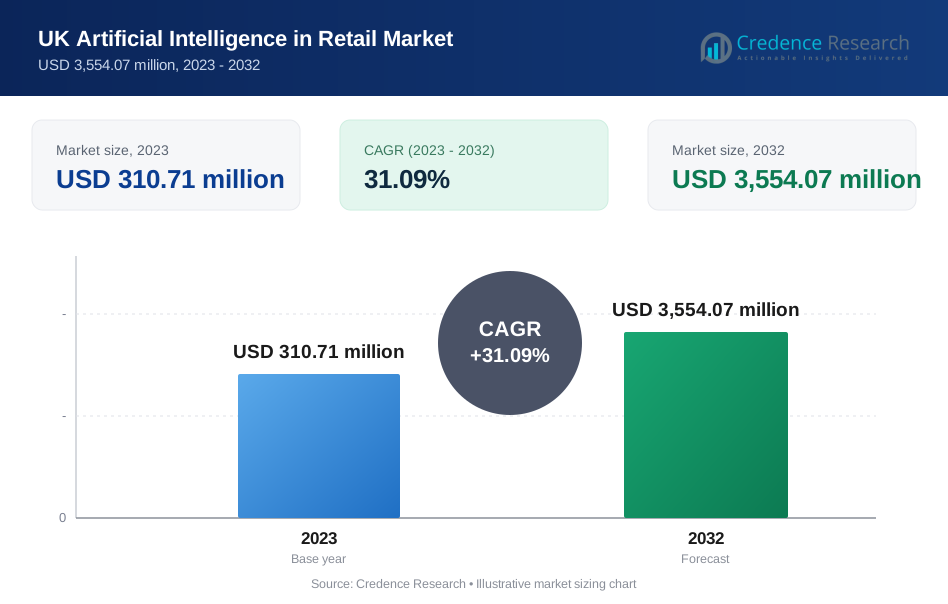
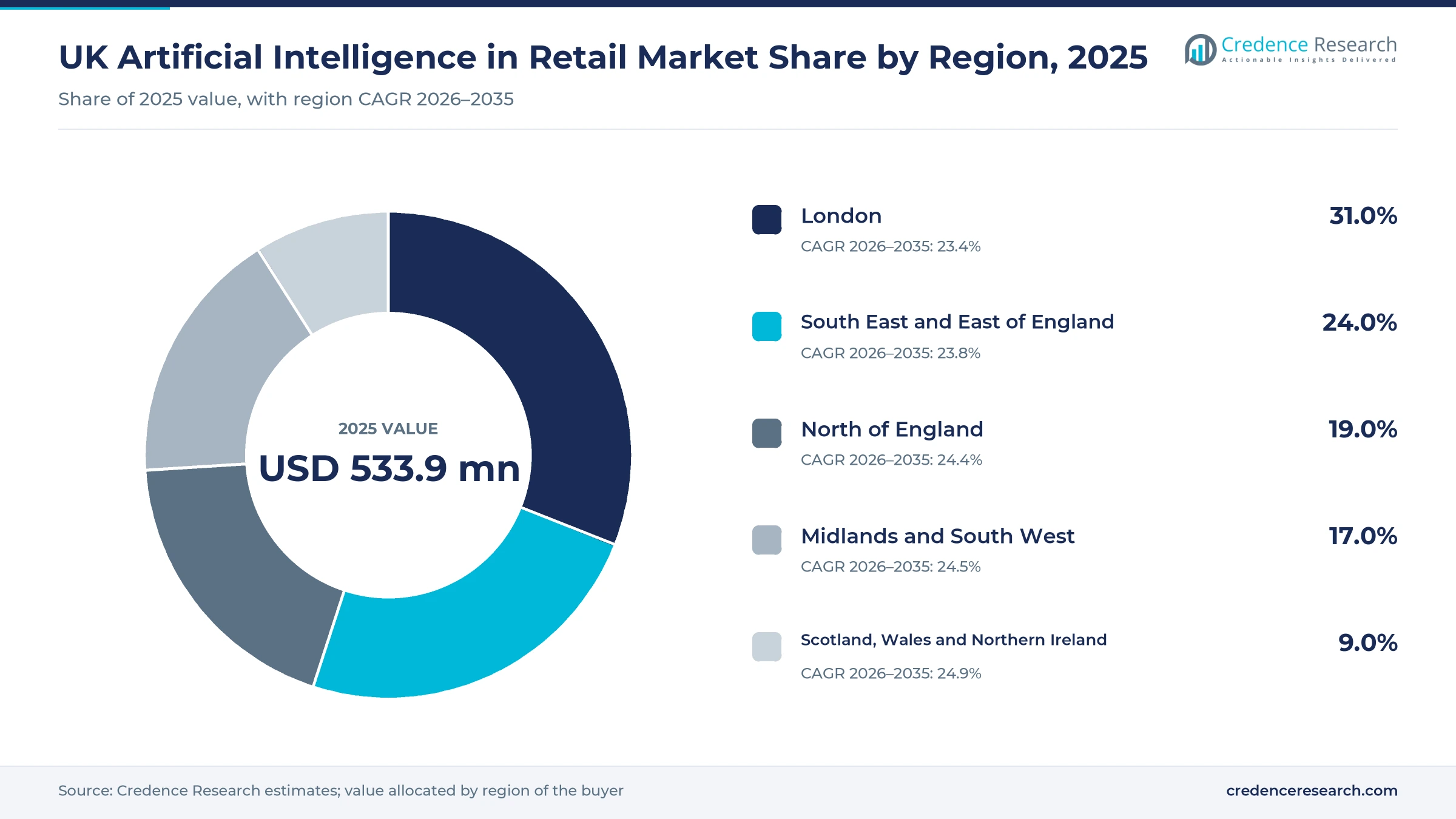
The U.K. artificial intelligence in retail market was valued at USD 533.9 million in 2025 and is projected to increase from USD 662.1 million in 2026 to USD 4.59 billion by 2035, registering a CAGR of 24.00% during 2026–2035. Demand comes from large grocers and fashion sellers using machine learning for loyalty pricing, stock replenishment, shrink control and customer service. London held the largest regional share, 31.0% in 2025, because national head offices and most AI suppliers sit there. Scotland, Wales and Northern Ireland is the fastest-growing region at 24.9% a year as regional chains and independents start from a lower base. Employment costs add urgency, with store labor now a central concern for finance chiefs across the sector. Regulation is moving too, as U.K. competition and data regulators published guidance and draft guidance on AI agents and automated decisions during March 2026. As a result, buyers are shifting from isolated pilots toward company-wide programs with named governance and supplier contracts.
What does AI in U.K. retail cover, and what is excluded?
The market counts spending by U.K. retailers on AI software, models, cloud AI services and the integration and managed services that put them to work. Typical purchases include demand forecasting, personalized offers, shelf and security video analytics, conversational assistants and fraud screening, bought through multi-year platform contracts or specialist subscriptions.
General IT, store hardware, payment terminals and staff costs are excluded unless they are sold as part of an AI system. The value chain runs from model developers and cloud platforms through specialist retail suppliers and integrators to the retailers themselves, whose own loyalty and sales data is often the deciding asset.
UK Artificial Intelligence in Retail Market Insights
- The market grows from USD 533.9 million in 2025 to USD 4.59 billion by 2035, a 24.00% CAGR over 2026–2035, as large chains move from pilots to company-wide programs.
- London held 31.0% of 2025 value, since national head offices and just over half of U.K. AI company registered offices are located there.
- Solution led component spending with 68.0% of value in 2025, because retailers mostly buy platforms and subscriptions before paying for integration work.
- ONS survey data from June 2026 show 15.7% of wholesale and retail businesses using AI, well behind the roughly 35% rate for the wider economy.
- Grocers set the direction, with Tesco signing a three-year Mistral AI agreement in December 2025 and Sainsbury's citing more than 200 live use cases in April 2026.
Software, store operations and vision systems hold the value
Why do solutions outweigh services in retail AI budgets?
Based on component, the market is categorized into solution and services. Solution led with 68.0% of 2025 value because large chains buy platforms first, as shown by the five-year Sainsbury's and Microsoft partnership reported by ITPro in May 2024. Services grow fastest at 25.0% a year as integration work catches up with those purchases. Research by PMC, reported in October 2026, found 41% of senior commerce leaders naming data integration for AI readiness as their top investment area, while 36% named systems integration among their leading priorities for the year ahead.
Which retail functions spend the most on AI?
Based on business function, the market is categorized into marketing and sales, human resources, finance and accounting, operations and cybersecurity. Operations led with 34.0% of 2025 value because improving operations is the most common purpose across U.K. firms, cited by close to 60% of AI users in the ONS article of July 2026. Cybersecurity grows fastest at 25.5% a year as attacks reset priorities. Marks & Spencer told investors in May 2025 that its breach would cost about 300 million pounds, and PMC research found 36% of commerce leaders now prioritize cyber security.
Why does machine learning remain the core retail technology?
Based on technology, the market is categorized into machine learning, natural language processing, chatbots, image and video analytics and swarm intelligence. Machine Learning led with 38.0% of 2025 value because replenishment and pricing depend on it, as Iceland Foods showed when Diginomica reported in April 2026 that invent.ai software gives forecasts and guidance for every SKU across its network. Image and Video Analytics grows fastest at 25.6% a year as computer vision spreads through stores. Facewatch recorded 516,739 retail offender alerts during 2025, up from 252,943 a year earlier, according to Biometric Update in January 2026.
How do omnichannel and store-based retailers differ?
Based on sales channel, the market is categorized into omnichannel and brick and mortar. Omnichannel led with 64.0% of 2025 value because online and hybrid retailers hold AI budgets up to 50% higher than store-based retailers, according to Eversheds Sutherland research published in December 2025. Brick and Mortar grows fastest at 24.6% a year from its lower base as store tools mature. The same research shows store operations account for 55% of U.K. retail employment, and nearly three-fifths of those tasks could be affected by AI by 2035.
| Segment Group | Leading Sub-segment | Share, 2025 | Fastest-growing Sub-segment | CAGR, 2026–2035 |
|---|---|---|---|---|
| By Component | Solution | 68.0% | Services | 25.0% |
| By Business Function | Operations | 34.0% | Cybersecurity | 25.5% |
| By Technology | Machine Learning | 38.0% | Image and Video Analytics | 25.6% |
| By Sales Channel | Omnichannel | 64.0% | Brick and Mortar | 24.6% |
Request a Free Sample
Fill in your details and we'll send you a free sample report.
- Sample data tables & charts
- Research methodology
Labor costs, theft and loyalty data push budgets higher
Employment costs make automation a finance priority
Labor cost pressure is now the strongest argument for AI budgets at U.K. retailers. The British Retail Consortium said in February 2026 that employment costs rose by 5 billion pounds during 2025, while the National Living Wage was due to rise a further 4.1% that April. In its survey of finance chiefs, 61% intended to invest in automation to offset workforce reductions and 68% planned to drive higher productivity from existing teams. Retail Gazette reported sector employment at 2.76 million, the lowest on record. As a result, Eversheds Sutherland project U.K. sales per employee growing 4.9% annually to 2030 and 6.4% later, which gives finance teams a measurable return to underwrite.
Grocery loyalty data funds personalization at scale
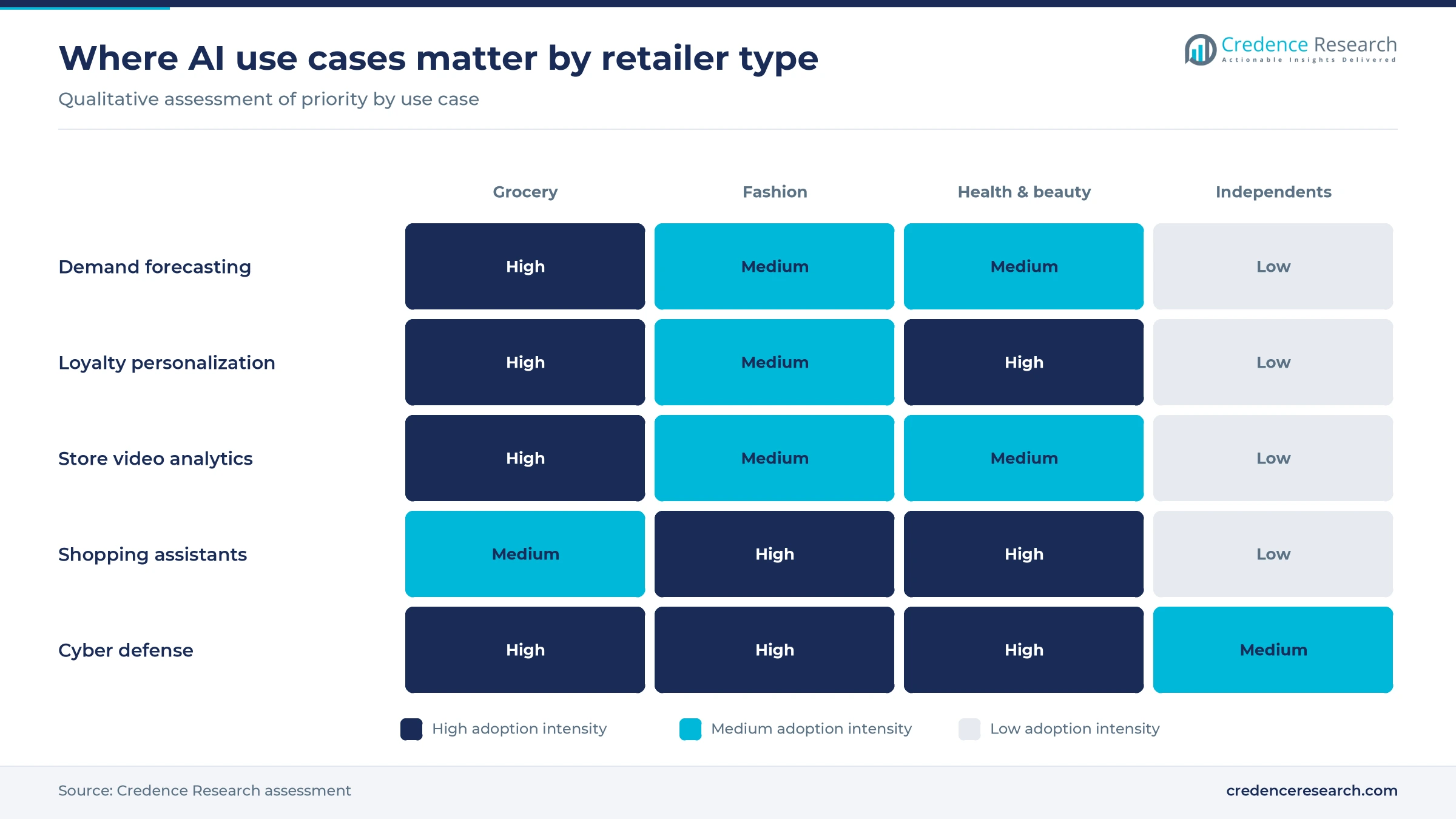
Loyalty programs give the largest grocers data that competitors cannot easily copy, and this drives heavy model spending. According to Diginomica reporting from April 2026, Sainsbury's is aiming for 500 million personalized offers each week through its own decisioning engine. Tesco launched Your Clubcard Prices to 1.5 million customers, with a wider rollout planned later in 2026, and it signed a three-year agreement with Mistral AI on Dec. 18, 2025 to rework offers and speed loyalty analysis, according to Retail Systems. That loyalty work sits in Marketing & Sales budgets, while Operations holds 34.0% of function spending. Sainsbury's also measures incremental sales across channels through Nectar360 Pollen, its unified retail media platform.
Record shop theft pulls vision systems into stores
Retail crime has turned video analytics from a trial into a store-level purchase across several U.K. chains. The British Retail Consortium Crime Survey 2026 counted 5.45 million theft incidents and about 1,600 daily cases of violence and abuse against staff, according to Detertech's summary. Biometric Update reported in January 2026 that Facewatch alerts more than doubled to 516,739 during 2025, averaging 1,415 a day. Sainsbury's reported a 46% reduction in theft, harm, aggression and antisocial behavior from its trial, and it had live facial recognition in more than 55 stores by July 2026, with about 150 more planned before Christmas.
Digital budgets are tilting toward AI work
Retail technology budgets have already moved, which supports continued double-digit spending growth through the forecast period. Eversheds Sutherland found in December 2025 that U.K. retailers spend 30% of digital budgets on AI-aligned innovation, and 76% expect to raise AI investment over the next two years. Retail Week's tracker recorded 38 AI examples among major retailers during 2026, up from 26 in 2025. Practical use is widening as well, with The Grocer reporting that Iceland Foods is deploying invent.ai forecasting and replenishment across every store and distribution center. This work also lifts demand for supply chain analytics, since better forecasts depend on cleaner inventory data.
Chat-based shopping and store task tools open new spending
Shift to chat-based and agent-led shopping journeys
Product discovery is starting to move out of retailer websites and into AI assistants, which changes where retailers must invest. Metapack reported in February 2026 that chat-based platforms generated 50.2 million monthly shopping-intent visits in the U.K., and 30% of U.K. adults were open to an AI shopping agent. ASOS launched its AI Stylist inside ChatGPT for U.K. and U.S. shoppers in May 2026, according to Pulse. Tesco has an app assistant in a large-scale trial with around 280,000 colleagues ahead of a wider launch. Because these tools rely on generative models, suppliers of product-data and content tooling stand to benefit first.
Shift from scattered pilots to governed programs
Large retailers are consolidating experiments into single programs with central oversight, which favors bigger supplier contracts. Tesco has folded nearly 250 individual work streams into one AI strategy covering customers, colleagues, suppliers and operations, as its chief executive explained in April 2026. Sainsbury's now runs more than 200 live use cases under an AI center of excellence. However, depth remains limited across the economy, because the Office for National Statistics reported in July 2026 that only 10% of AI-using businesses with 10 or more employees report extensive use. Eversheds Sutherland add that larger retailers with turnover above 500 million pounds are leading adoption. Across the European market, Metapack found 17% of retailers with AI embedded and scaled, against 28% in North America.
Opening among smaller retailers still on free tools
The widest untapped opportunity lies with smaller retailers that have not yet paid for AI at all. Retail Week's reading of the June 2026 ONS survey shows 15.7% of wholesale and retail businesses using at least one AI technology and only 4.8% using several, against 58.3% adoption among information and communication firms. That category covers 396,000 businesses, of which 54% are retailers. ONS also notes that wholesale and retail firms most commonly reach AI through free-to-use software, so paid conversion is still ahead. Metapack research adds that 35% of retailers with turnover under 100 million pounds cite high development costs, which creates an opening for packaged subscriptions priced below enterprise contracts.
Opening for store task and colleague tools
Store colleagues represent a large opportunity because most retail labor sits in shops and little of it is yet supported by AI tools. Eversheds Sutherland estimate that store operations make up 55% of U.K. retail employment and that nearly three-fifths of those tasks could be affected by 2035. Sainsbury's already uses an optimized price reductions tool to centralize expiry-date markdown decisions, which cuts store workload and waste. Training is the gap suppliers can fill, since ONS found only 11% of businesses with 10 or more employees have trained more than half their workforce on AI. Tesco invested in over 1 million hours of training for U.K. store colleagues last year, which signals where budgets may follow.
Legacy systems, trust and new rules slow the rollout
Why do legacy systems hold back AI integration in retail?
Old systems are the most expensive barrier, because AI models need joined-up product, stock and customer data. PMC estimated in October 2026 that modernizing legacy technology would cost U.K. retailers 25 billion pounds, or 5.3% of annual retail revenue. Eversheds Sutherland research found 42% of retailers citing system integration as a barrier. Mid-sized chains feel this most, since projects compete with wage bills. Phased data-layer projects and managed services are the usual ways to reduce that risk.
How does shopper unease affect store surveillance projects?
Public trust can slow store deployments even where theft results look strong. A VoCoVo survey reported by The Grocer found 59% of shoppers uncomfortable with facial recognition and similar AI tracking in stores. On Aug. 6, 2026, a Sainsbury's customer in East Dulwich was wrongly challenged after staff misread an alert, and the store switched off the system, according to IBTimes U.K. Big Brother Watch is challenging the technology in the High Court, which adds legal risk to further rollouts.
What do new U.K. rules require from retailers using AI?
Compliance duties are becoming more specific, which raises supplier and legal costs for pricing and personalization projects. Reed Smith's review notes that the Competition and Markets Authority confirmed on March 9, 2026 that consumer law applies to AI agents, with fines of up to 10% of global turnover. The Information Commissioner's Office opened a consultation on automated decision guidance on March 31, 2026. Retailers therefore need human review and disclosure built into each system from the start.
Why do skills and cost gaps limit smaller chains?
Skills shortages keep many retailers at the pilot stage, even when budgets have been approved. Metapack found 54% of retailers above 500 million pounds in turnover point to skills gaps and legacy integration, while 40% of retailers in the Eversheds Sutherland survey cite skills shortages. In addition, ONS reports expertise as a barrier for about 18% of firms with 100 to 249 employees. Smaller chains are affected most, so many are likely to rely on suppliers and managed services.
London buys first as regional retail groups follow
| Region | Value, 2025 (USD million) | Share, 2025 | CAGR, 2026–2035 |
|---|---|---|---|
| London | 165.5 | 31.0% | 23.4% |
| South East and East of England | 128.1 | 24.0% | 23.8% |
| North of England | 101.4 | 19.0% | 24.4% |
| Midlands and South West | 90.8 | 17.0% | 24.5% |
| Scotland, Wales and Northern Ireland | 48.1 | 9.0% | 24.9% |
Why does London lead AI buying among U.K. retailers?
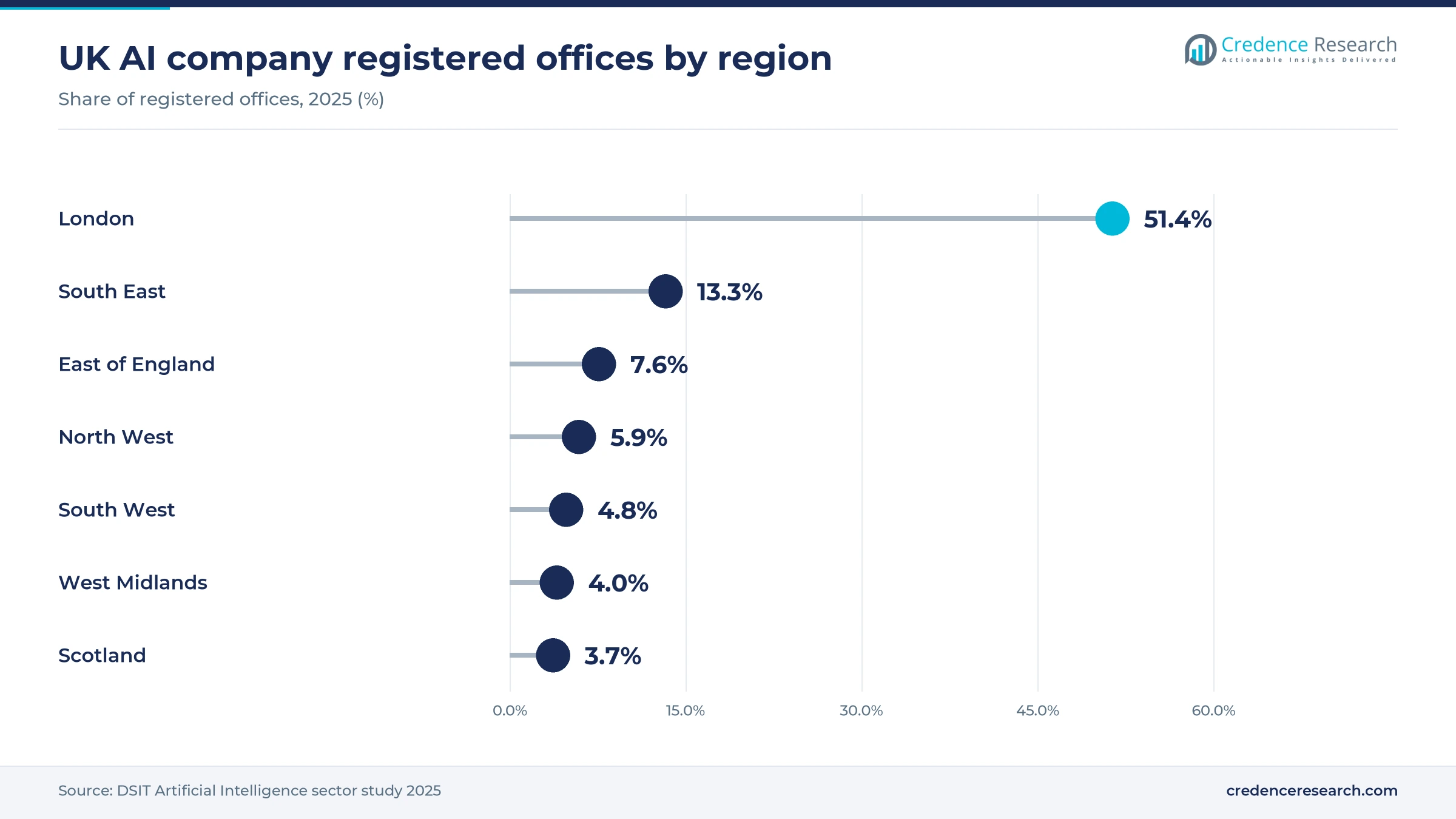
London held a 31.0% share of 2025 value and grows at 23.4% a year, the slowest pace because adoption is most advanced there. The government's AI sector study of October 2026 places 51.4% of U.K. AI company registered offices in the capital, so suppliers and head office buyers sit close together. Government adoption data published in June 2026 also show 20% of London businesses using AI against a 16% U.K. average. This combination keeps the largest contracts and most integration work concentrated in the city.
South East and East of England host major buying centers
The South East and East of England held a 24.0% share of 2025 value and grow at 23.8% a year. The two regions together host 20.9% of U.K. AI company registered offices, according to the government's sector study, with 13.3% in the South East and 7.6% in the East of England. These suppliers are close to London buyers, which helps explain why spending here tracks the capital. Grocery logistics and national distribution work add further demand for forecasting and replenishment tools across both regions.
North of England grows on grocery and supply work
The North of England held a 19.0% share of 2025 value and grows at 24.4% a year. Bradford-based Morrisons offers the clearest regional example, since its chief executive said in June 2026 that a tech-driven vision materially contributed to 940 million pounds of savings over three years, according to Retail Gazette, without attributing that sum to AI alone. Local supply is thinner, however, because the North West, Yorkshire and the Humber and the North East together hold 10.1% of U.K. AI company offices. As a result, northern chains often buy from suppliers based in the South.
Midlands and South West buy through national groups
The Midlands and South West held a 17.0% share of 2025 value and grow at 24.5% a year. These regions hold 11.3% of U.K. AI company registered offices, with 4.8% in the South West, 4.0% in the West Midlands and 2.5% in the East Midlands, according to the government's sector study. Much of the spending follows national chains and distribution sites rather than local suppliers. Independent retailers here remain a smaller opportunity, and packaged subscriptions are the more likely entry route for them.
Why are Scotland, Wales and Northern Ireland growing fastest?
Scotland, Wales and Northern Ireland held a 9.0% share of 2025 value and grow fastest at 24.9% a year from the smallest base. Together they host 6.3% of U.K. AI company offices, led by Scotland with 3.7%. Government data from June 2026 show Scotland had the lowest regional adoption, with 84% of firms neither using nor planning to use AI, so any early spending there is more likely to start with advice than with platforms. Only 34% of Welsh adopters felt ready to scale, so advisory and integration work should lead early spending.
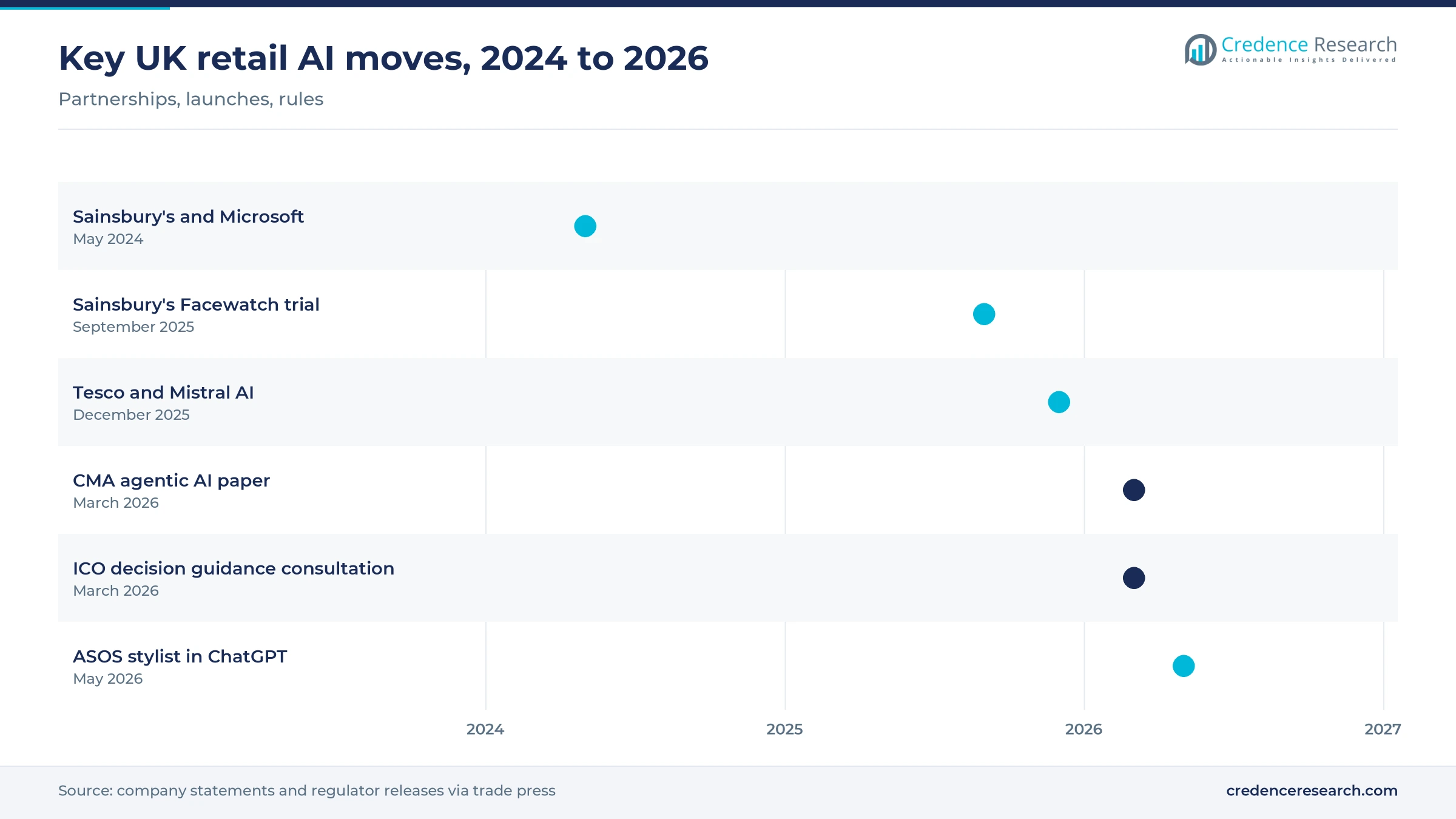
Dated moves by grocers, fashion sellers and regulators
| Development | Status and market relevance |
|---|---|
| In May 2024, Sainsbury's and Microsoft agreed a five-year partnership covering online search, shelf-edge cameras and colleague support tools. | Active and supports the grocer's store and online AI work. |
| In September 2025, Sainsbury's began a two-store live facial recognition trial with Facewatch and later reported a 46% reduction in recorded incidents. | Expanded to more than 55 stores by July 2026. |
| In December 2025, Tesco signed a three-year agreement with Mistral AI that includes a joint lab for generative AI tools. | Active and focused on Clubcard offers and loyalty analysis. |
| In March 2026, the Competition and Markets Authority published agentic AI research and compliance guidance for businesses. | In effect, since existing consumer law already applies to agents. |
| In May 2026, ASOS launched its AI Stylist inside ChatGPT for shoppers in the U.K. and the U.S. | Live and adds shoppable video previews to the service. |
Which tools retailers are putting into daily use
- Demand forecasting sets store and depot orders automatically, as Iceland Foods is doing with invent.ai across its estate.
- Offer decisioning chooses the price or coupon for each loyalty member, as with Nectar Prices at Sainsbury's and Clubcard Challenges at Tesco.
- Video analytics watches for known offenders and basket risk, with Sainsbury's also using SmartShop re-scanning algorithms on high-risk baskets.
- Shopping assistants help with meal planning inside retailer apps, and Tesco has trialed its app assistant with around 280,000 colleagues.
Need a Custom Version of This Report?
Tailor the scope, geography, or segments to your exact requirements.
- Custom geography or segment scope
- Direct access to our analyst team
Platform vendors and specialists compete for grocer deals
Competition splits into three distinct layers that rarely meet head-on. Cloud and model providers such as Microsoft and Mistral AI win multi-year, chain-wide agreements because they sit under many separate applications. Specialist retail suppliers such as Blue Yonder, invent.ai and Facewatch compete on narrow outcomes, including replenishment accuracy, forecast quality and shrink reduction, and they sell mainly to operations and loss prevention teams. Retailer-owned capability forms the third layer, with dunnhumby working on Tesco ranging decisions and Sainsbury's building its own decisioning engine and Nectar360 Pollen media platform. Adobe supplies the content software behind real-time personalized content at Tesco, while UiPath's Manchester-based Peak unit sells AI inventory and pricing decisions. As a result, independent suppliers usually compete for tasks the big grocers do not want to build. Contract length, access to loyalty data and evidence of measured savings decide most awards, while supplier resilience has drawn more scrutiny since the Marks & Spencer breach in 2025.
Companies profiled and their roles in this market
| Company | Type | Role in the market |
|---|---|---|
| Microsoft | Cloud and AI platform | Five-year Sainsbury's partnership announced in May 2024 and a long-standing partner of Boots |
| Mistral AI | Model developer | Three-year Tesco agreement signed in December 2025, including a joint AI lab |
| Blue Yonder | Supply chain software | Replenishment optimization across all 491 Morrisons stores, as last reported by Retail Systems in March 2017 |
| Facewatch | Facial recognition supplier | Sainsbury's rollout and 516,739 retail alerts during 2025 |
| invent.ai | Forecasting software | Forecasting and replenishment across Iceland Foods stores and distribution centers |
| dunnhumby | Retail data science | Tesco-owned unit that moved ranging decisions from weeks to minutes |
| Adobe | Content and marketing software | Strategic partner for real-time personalized content at Tesco |
| UiPath (Peak) | Decision intelligence software | Manchester-based Peak sells AI inventory planning and pricing decision apps |
Adoption is wide among large chains and thin elsewhere
Credence Research's view is that U.K. artificial intelligence in retail is two markets moving at different speeds. Large grocers already run hundreds of use cases and can show results, while the broader sector sits at 15.7% adoption on the latest ONS survey data. The forecast depends on that second group starting to pay for tools, and on stores getting systems that staff trust. The East Dulwich incident shows that weak staff training can undo strong model performance. Suppliers that combine integration, governance and clear savings evidence are best placed to win contracts.
How the estimates in this report were built
The report uses 2025 as the base year and 2035 as the forecast year, with growth stated for 2026–2035. The 2025 value comes from the Credence Research market model, updated from its earlier 2023 estimate and checked against retail revenue and U.K. AI sector revenue. Segment and regional shares are Credence Research estimates informed by public data on adoption and supplier location. Sources include Office for National Statistics and government publications, regulator material, trade associations, company statements and trade press. No interviews or primary surveys were conducted for this edition.
Store rollouts and agents shape spending through 2035
Spending should rise fastest where retailers can link AI directly to labor hours, shrink or loyalty margin. Sainsbury's planned expansion of about 150 more stores and Tesco's wider assistant launch will show whether large rollouts hold up under public scrutiny. Regulation will shape design choices, particularly once the Information Commissioner's Office completes its statutory code on AI and automated decisions. By 2035, the market reaches USD 4.59 billion, with growth depending on smaller retailers moving from free tools to paid services and on legacy modernization progressing across mid-sized chains.
Frequently Asked Questions
How big is the U.K. artificial intelligence in retail market?
Which segment holds the largest market share?
How widely is AI used in the U.K. retail industry?
How does the U.K. compare with the wider European market?
What are the main AI integration issues in the retail sector?
How is AI changing e-commerce in the U.K.?
Is there demand for retail AI consulting in Scotland?
Who are the main companies in this market?
Table of Content
Chapter 1 Market Segmentation
- 1.1 Segmentation Framework
- 1.1.1 Product and Service Classification
- 1.1.2 Application and End-Use Classification
- 1.1.3 Technology and Solution Classification
- 1.1.4 Customer and Distribution Channel Classification
- 1.1.5 Geographic Segmentation
- 1.1.6 Market Segment Definitions and Boundaries
- 1.2 By Component
- 1.2.1 Solution
- 1.2.2 Services
- 1.3 By Business Function
- 1.3.1 Operations
- 1.3.2 Marketing & Sales
- 1.3.3 Cybersecurity
- 1.3.4 Finance & Accounting
- 1.3.5 Human Resources
- 1.4 By Technology
- 1.4.1 Machine Learning
- 1.4.2 Image and Video Analytics
- 1.4.3 Natural Language Processing
- 1.4.4 Chatbots
- 1.4.5 Swarm Intelligence
- 1.5 By Sales Channel
- 1.5.1 Omnichannel
- 1.5.2 Brick and Mortar
Chapter 2 Introduction
- 2.1 Report Objectives and Scope
- 2.2 Product Definition and Industry Terminology
- 2.3 Market Inclusions and Exclusions
- 2.4 Research Process
- 2.4.1 Primary Research and Expert Interviews
- 2.4.2 Secondary Research and Source Review
- 2.4.3 Top-Down and Bottom-Up Estimation
- 2.4.4 Data Triangulation and Verification
- 2.5 Market Size Measurement Basis
- 2.5.1 2025: USD 533.9 million → 2035: USD 4.59 billion
- 2.6 Historical and Forecast Reference Periods
- 2.6.1 Historical Period: 2018-2025
- 2.6.2 Base Year: 2025
- 2.6.3 Forecast Period: 2025-2035
- 2.7 Research Assumptions and Limitations
Chapter 3 Executive Summary
- 3.1 Market Snapshot and Key Findings
- 3.2 Base-Year Market Size, 2025
- 3.3 Forecast Market Size, 2035
- 3.4 Revenue and Volume Growth Outlook
- 3.5 Key Demand and Supply Indicators
- 3.6 Leading Market Segments
- 3.7 Fastest-Growing Market Opportunities
- 3.8 Regional Performance Highlights
- 3.9 Technology and Industry Transformation
- 3.10 Competitive Landscape Summary
- 3.11 Analyst View and Strategic Implications
Chapter 4 UK Artificial Intelligence in Retail Market Trends and Developments
- 4.1 Historical Industry Development, 2018-2025
- 4.2 Recent Market Trends and Developments
- 4.3 Demand and Customer Behavior Trends
- 4.4 Technology and Product Innovation
- 4.5 Artificial Intelligence, Automation and Digitalization
- 4.6 Local Manufacturing and Supply Chain Realignment
- 4.7 Industry Partnerships, Mergers and Acquisitions
- 4.8 Sustainability and Circular Economy Developments
- 4.9 Government and Private Sector Investment Trends
- 4.10 Emerging Business Models and Commercialization
- 4.11 Industry Developments and Announcements
Chapter 5 UK Artificial Intelligence in Retail Market Production, Supply and Demand Analysis
- 5.1 Demand Trend and Consumption Analysis, 2018-2025
- 5.2 Demand Forecast, 2025-2035
- 5.3 Production and Output Trend, 2018-2025
- 5.4 Production and Output Forecast, 2025-2035
- 5.5 Installed Capacity and Capacity Utilization
- 5.6 Company-Wise Production Plants and Statistics
- 5.6.1 Installed Production Capacity
- 5.6.2 Actual Production
- 5.6.3 Planned Capacity and Expansion Targets
- 5.7 Supply Chain Structure and Procurement Trends
- 5.8 Supply-Demand Gap and Bottlenecks
- 5.9 Import Dependence and Sourcing Structure
- 5.10 Contract Manufacturing and Outsourcing
- 5.11 Regional Supply and Demand Concentration
Chapter 6 UK Artificial Intelligence in Retail Market Pricing Analysis
- 6.1 Pricing Structure and Measurement
- 6.2 Historical Pricing Trends, 2018-2025
- 6.3 Pricing Outlook, 2025-2035
- 6.4 Average Selling Price and Unit Economics
- 6.5 Pricing by Product and Market Segment
- 6.6 Geographic Pricing Differences
- 6.7 Key Input, Energy, Labor and Logistics Costs
- 6.8 Contract Pricing and Purchasing Models
- 6.9 Pricing Sensitivity and Competitive Positioning
- 6.10 Price, Margin and Profitability Implications
Chapter 7 UK Artificial Intelligence in Retail Market Dynamics
- 7.1 Market Growth Drivers
- 7.1.1 Demand-Side Drivers
- 7.1.2 Technology and Innovation Drivers
- 7.1.3 Infrastructure and Investment Drivers
- 7.1.4 Regulatory and Policy Drivers
- 7.2 Market Restraints
- 7.2.1 Cost and Affordability Constraints
- 7.2.2 Technology and Adoption Barriers
- 7.2.3 Supply Chain and Operational Constraints
- 7.3 Market Challenges
- 7.3.1 Competitive Pressure and Margin Erosion
- 7.3.2 Skills, Infrastructure and Implementation Gaps
- 7.4 Emerging Market Opportunities
- 7.5 Market Dynamics Impact and Time-Horizon Assessment
Chapter 8 UK Artificial Intelligence in Retail Value Chain Analysis
- 8.1 Industry Value Chain Overview
- 8.2 Upstream Suppliers and Critical Inputs
- 8.3 Technology and Component Providers
- 8.4 Manufacturing or Service Delivery
- 8.5 Distribution, Channel Partners and Integrators
- 8.6 Downstream Applications and End Users
- 8.7 Value Addition and Profit Pools
- 8.8 Vertical Integration and Outsourcing
- 8.9 Supplier Concentration and Risk
- 8.10 Supply Chain Localization and Resilience
Chapter 9 UK Artificial Intelligence in Retail Market Regulations and Policies
- 9.1 Relevant Laws, Standards and Compliance Frameworks
- 9.2 Product, Service, Safety and Quality Requirements
- 9.3 Government Policies, Incentives and Subsidies
- 9.4 Imports, Exports and Trade Barriers
- 9.5 Public Procurement and Local Content Requirements
- 9.6 Environmental and Sustainability Compliance
- 9.7 Data Protection, AI and Cybersecurity Compliance
- 9.8 Upcoming Policy Changes and Market Implications
Chapter 10 UK Artificial Intelligence in Retail Market Hotspots and Opportunities
- 10.1 Market Opportunity Mapping and Growth Hotspots
- 10.2 High-Growth Applications and Customer Groups
- 10.3 Underserved Markets and White-Space Opportunities
- 10.4 Emerging Technology and Product Opportunities
- 10.5 New Capacity and Investment Hotspots
- 10.6 Market Entry and Expansion Opportunities
- 10.7 Distribution and Partnership Opportunities
- 10.8 Near-Term and Long-Term Commercial Potential
- 10.9 Opportunity Attractiveness and Execution Risks
Chapter 11 UK Artificial Intelligence in Retail Market Outlook, 2025-2035
- 11.1 Market Size and Analysis
- 11.1.1 Revenue (Market Measurement: 2025: USD 533.9 million → 2035: USD 4.59 billion)
- 11.1.2 Market Volume and Quantity Sold
- 11.1.3 Historical Market Size, 2018-2025
- 11.1.4 Base-Year Market Size, 2025
- 11.2 Market Forecast, 2025-2035
- 11.2.1 Revenue Forecast to 2035
- 11.2.2 Volume Forecast to 2035
- 11.2.3 CAGR and Year-on-Year Growth
- 11.2.4 Incremental Revenue Opportunity
- 11.3 Forecast Assumptions and Scenario Analysis
- 11.3.1 Base-Case Forecast
- 11.3.2 Optimistic and Conservative Scenarios
- 11.3.3 Technology, Pricing and Policy Sensitivities
- 11.4 Market Attractiveness and Growth Outlook
Chapter 12 UK Artificial Intelligence in Retail Market Segmentation and Outlook
- 12.1 Segmentation Summary and Market Shares, 2025
- 12.2 Largest and Fastest-Growing Segments
- 12.3 By Component - Market Size and Forecast, 2025-2035
- 12.3.1 Segment Definition and Scope
- 12.3.2 Historical Market Size, 2018-2025
- 12.3.3 Revenue Forecast, 2025-2035
- 12.3.4 Volume Forecast, 2025-2035
- 12.3.5 Base-Year Market Share, 2025
- 12.3.6 Segment CAGR and Growth Drivers
- 12.3.7 Subsegment Market Size and Forecast
- 12.3.7.1 Solution
- 12.3.7.2 Services
- 12.3.8 Subsegment Pricing and Adoption Trends
- 12.3.9 Leading Suppliers and Competition
- 12.3.10 Regional Demand and Opportunities
- 12.4 By Business Function - Market Size and Forecast, 2025-2035
- 12.4.1 Segment Definition and Scope
- 12.4.2 Historical Market Size, 2018-2025
- 12.4.3 Revenue Forecast, 2025-2035
- 12.4.4 Volume Forecast, 2025-2035
- 12.4.5 Base-Year Market Share, 2025
- 12.4.6 Segment CAGR and Growth Drivers
- 12.4.7 Subsegment Market Size and Forecast
- 12.4.7.1 Operations
- 12.4.7.2 Marketing & Sales
- 12.4.7.3 Cybersecurity
- 12.4.7.4 Finance & Accounting
- 12.4.7.5 Human Resources
- 12.4.8 Subsegment Pricing and Adoption Trends
- 12.4.9 Leading Suppliers and Competition
- 12.4.10 Regional Demand and Opportunities
- 12.5 By Technology - Market Size and Forecast, 2025-2035
- 12.5.1 Segment Definition and Scope
- 12.5.2 Historical Market Size, 2018-2025
- 12.5.3 Revenue Forecast, 2025-2035
- 12.5.4 Volume Forecast, 2025-2035
- 12.5.5 Base-Year Market Share, 2025
- 12.5.6 Segment CAGR and Growth Drivers
- 12.5.7 Subsegment Market Size and Forecast
- 12.5.7.1 Machine Learning
- 12.5.7.2 Image and Video Analytics
- 12.5.7.3 Natural Language Processing
- 12.5.7.4 Chatbots
- 12.5.7.5 Swarm Intelligence
- 12.5.8 Subsegment Pricing and Adoption Trends
- 12.5.9 Leading Suppliers and Competition
- 12.5.10 Regional Demand and Opportunities
- 12.6 By Sales Channel - Market Size and Forecast, 2025-2035
- 12.6.1 Segment Definition and Scope
- 12.6.2 Historical Market Size, 2018-2025
- 12.6.3 Revenue Forecast, 2025-2035
- 12.6.4 Volume Forecast, 2025-2035
- 12.6.5 Base-Year Market Share, 2025
- 12.6.6 Segment CAGR and Growth Drivers
- 12.6.7 Subsegment Market Size and Forecast
- 12.6.7.1 Omnichannel
- 12.6.7.2 Brick and Mortar
- 12.6.8 Subsegment Pricing and Adoption Trends
- 12.6.9 Leading Suppliers and Competition
- 12.6.10 Regional Demand and Opportunities
- 12.7 Segment Growth Comparison
- 12.8 Segment Attractiveness and Priority Matrix
Chapter 13 UK Artificial Intelligence in Retail Geographic Market Outlook, 2025-2035
- 13.1 Domestic Market Distribution and Demand Clusters
- 13.2 State- or Province-Wise Market Size and Forecast, 2025-2035
- 13.3 City and Metropolitan Market Outlook
- 13.4 Industrial, Manufacturing and Commercial Clusters
- 13.5 Geographic Concentration of Key End Users
- 13.6 Local Pricing and Purchasing Differences
- 13.7 Domestic Production Facilities and Capacity Map
- 13.8 Local Infrastructure and Project Pipeline
- 13.9 State-Level Policy and Incentive Differences
- 13.10 Subnational Investment Hotspots and Opportunities
- 13.11 Distribution and Logistics Networks
- 13.12 Domestic Competitive Footprint
Chapter 14 UK Artificial Intelligence in Retail Technology, Innovation and Sustainability Outlook
- 14.1 Technology Landscape and Maturity
- 14.2 Product, Process and Service Innovation
- 14.3 AI, Automation and Digital Tools in the Industry
- 14.4 Technology Adoption and Performance Benchmarking
- 14.5 Innovation Pipeline and R&D Investment
- 14.6 Patent and Intellectual Property Trends
- 14.7 Energy Efficiency and Resource Management
- 14.8 Sustainability, Recycling and Circularity
- 14.9 Technology Roadmap, 2025-2035
- 14.10 Risks of Obsolescence and Technology Substitution
Chapter 15 UK Artificial Intelligence in Retail Market Key Strategic Imperatives
- 15.1 Growth and Market Entry Priorities
- 15.2 High-Return Products and Segments
- 15.3 Pricing, Profitability and Cost Optimization
- 15.4 Technology Investment and Product Differentiation
- 15.5 Supply Chain Localization and Resilience
- 15.6 Distribution and Customer Acquisition
- 15.7 Partnership, Acquisition and Capacity Strategy
- 15.8 Regional Expansion Priorities
- 15.9 Short-, Medium- and Long-Term Actions
Chapter 16 Competition Outlook
- 16.1 Industry Competition Characteristics
- 16.2 Market Structure and Concentration
- 16.3 Market Share and Competitive Positioning, 2025
- 16.4 Company-Wise Revenue and Product Benchmarking
- 16.5 Production and Service Capacity Benchmarking
- 16.6 Technology, Pricing and Differentiation
- 16.7 Regional Footprint and Distribution Strength
- 16.8 Mergers, Acquisitions and Strategic Alliances
- 16.9 New Entrants and Competitive Threats
- 16.10 Porter's Five Forces and Industry Attractiveness
- 16.11 Competitive Outlook, 2025-2035
Chapter 17 Company Profiles
- 17.1 Company Coverage and Selection Criteria
- 17.2 Microsoft
- 17.2.1 Business Description
- 17.2.2 Company Ownership and Geographic Presence
- 17.2.3 Product and Service Portfolio
- 17.2.4 Manufacturing and Operating Footprint
- 17.2.5 Production Capacity and Expansion Plans
- 17.2.6 Financial Performance and Investment
- 17.2.7 Market Share and Competitive Position
- 17.2.8 Technology and Innovation Capabilities
- 17.2.9 Strategic Alliances or Partnerships
- 17.2.10 Recent Developments
- 17.2.11 Growth Strategy and Outlook
- 17.3 Mistral AI
- 17.4 Blue Yonder
- 17.5 Facewatch
- 17.6 invent.ai
- 17.7 dunnhumby
- 17.8 Adobe
- 17.9 UiPath (Peak)
- 17.10 Other Relevant Market Participants
Note: Every listed company is profiled on the structure shown under the first company. The company list is preliminary and may change based on research findings, market developments, data availability and client requirements.
Chapter 18 Disclaimer
- 18.1 Research and Forecast Disclaimer
- 18.2 Data Source and Estimation Limitations
Note: The depth of individual sections depends on data availability for this market. Volume, capacity, trade and other unit-based metrics are included where applicable.

