
Bundled AI assistants pull small firms into paid AI
The global artificial intelligence in small and medium businesses market was valued at USD 40.62 billion in 2025 and is projected to increase from USD 48.54 billion in 2026 to USD 241.22 billion by 2035, registering a CAGR of 19.50% during 2026–2035. Spending comes from subscriptions to AI features inside office suites, accounting, CRM, help-desk and payroll software, plus cloud AI services that smaller firms buy per seat or per use. North America held the largest regional share, 38.5% in 2025, because the leading suite and accounting vendors launch their small-business AI features there first. Asia Pacific is the fastest-growing region at 20.47% a year as public compute programs and local language models lower the cost of entry. The biggest commercial change came in 2025, when office-suite vendors folded AI assistants into standard business plans and cut separate add-on prices for firms with fewer than 300 users, turning AI from a pilot purchase into a routine line on the software bill.
How many small and medium enterprises use AI today?
The market covers spending by firms with fewer than 250 employees on AI software, AI features sold inside business applications, AI platform and cloud services, and the integration work needed to deploy them. Eurostat reported that 13.5% of EU enterprises with 10 or more employees used AI in 2024, up from 8.0% in 2023, while the OECD found that 31% of SMEs in a seven-country survey published in November 2025 used generative AI. These figures show that adoption is broadening quickly, but most smaller firms still use AI for a few tasks rather than across the business.
Spending by large enterprises with 250 or more employees, consumer AI subscriptions and AI chips bought by hyperscalers are excluded. The value chain runs from model developers and cloud providers through application vendors such as accounting, CRM and help-desk suppliers, then through resellers, managed service providers and accountants who set up tools for owner-managed businesses.
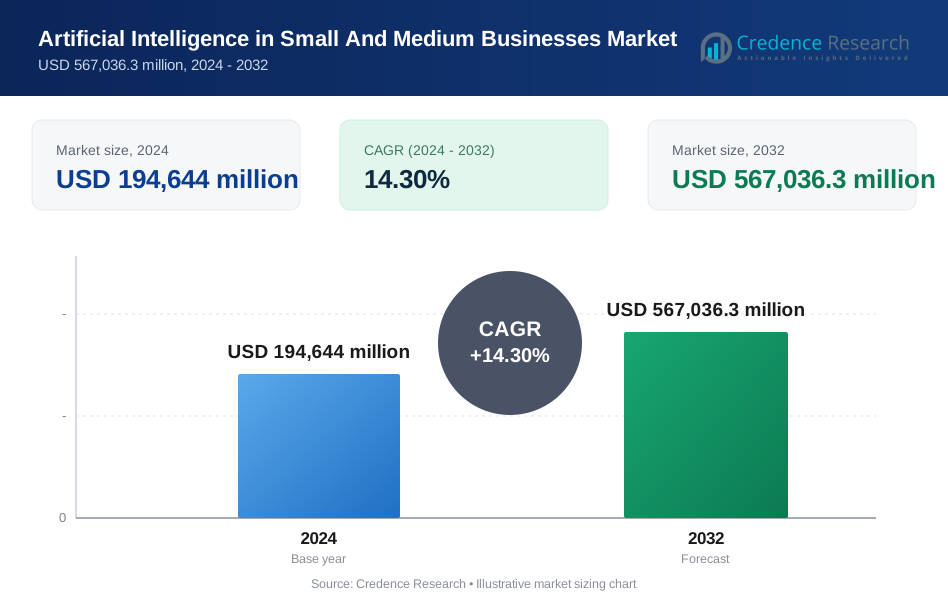
Artificial Intelligence in Small And Medium Businesses Market Insights
- AI spending by small and medium businesses is projected to grow from USD 40.62 billion in 2025 to USD 241.22 billion by 2035 at a 19.50% CAGR as AI moves into standard software plans.
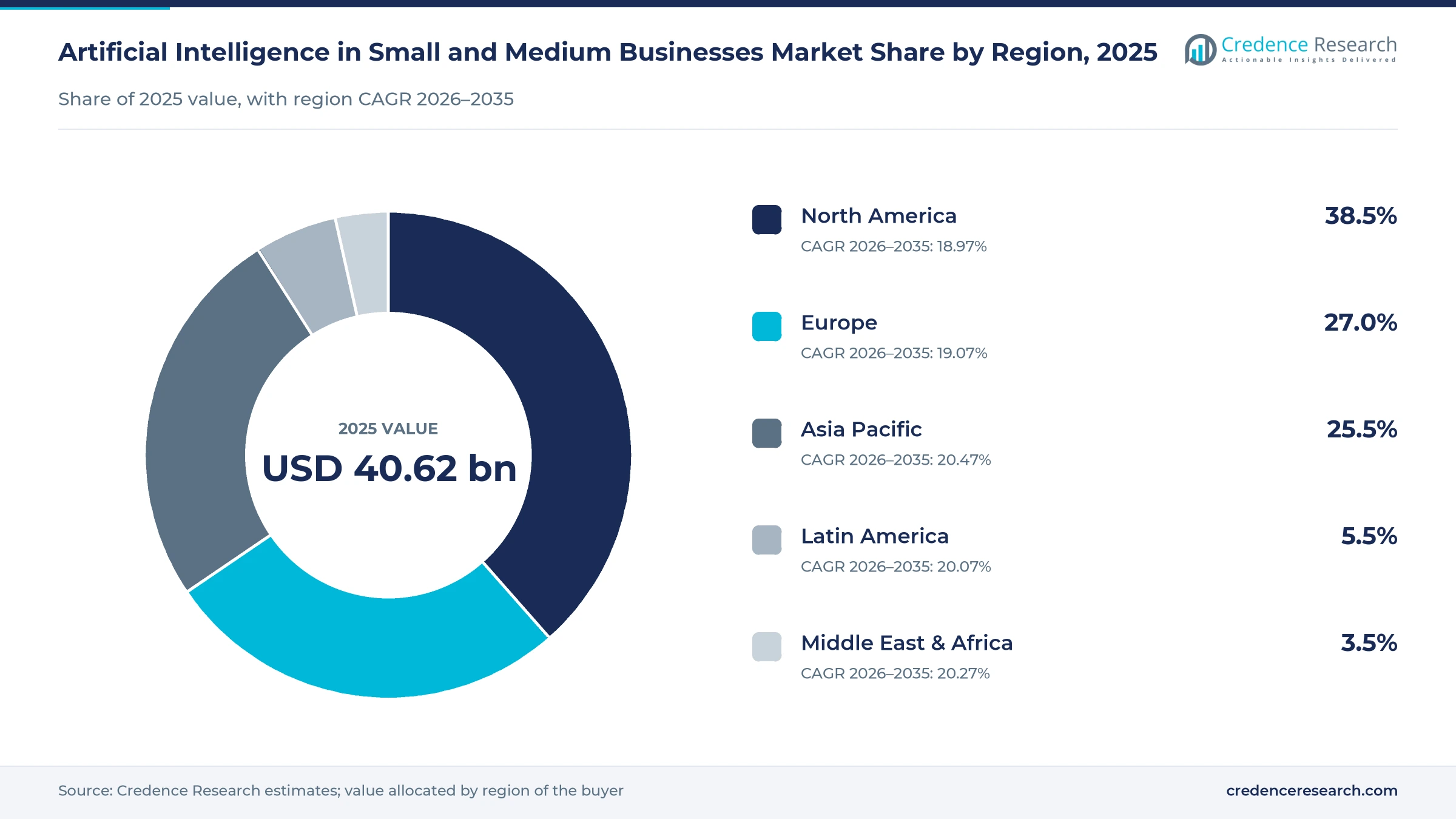
- North America held 38.5% of 2025 value, supported by early United States launches of accounting, payroll and CRM agents for small firms.
- Customer Service Automation led applications with 29.0% of 2025 value because help-desk agents resolve routine tickets without added staff.
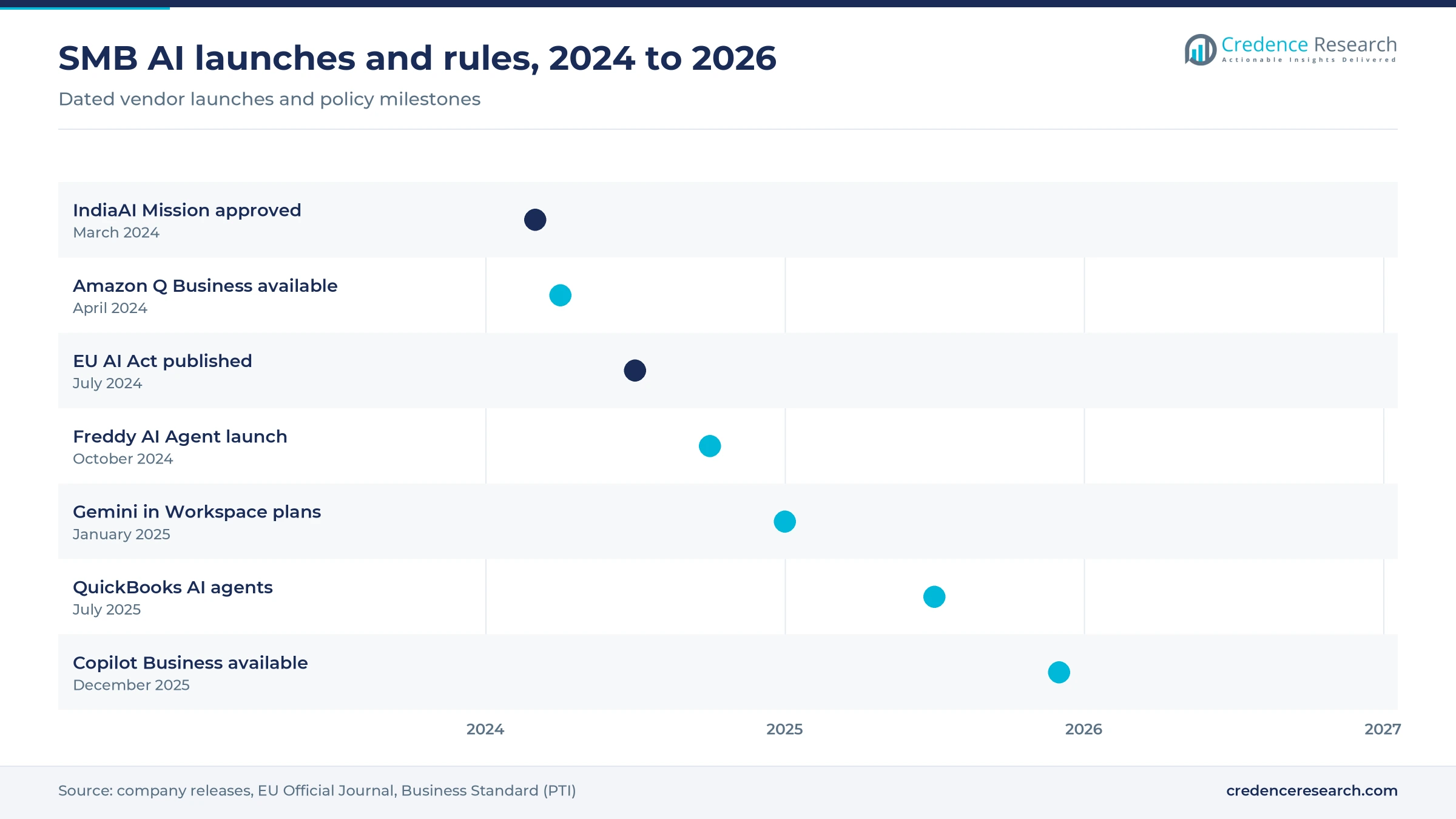
- Microsoft made Copilot Business available worldwide on Dec. 1, 2025 at USD 21 per user a month for firms with fewer than 300 users.
- Suite vendors compete by bundling AI into existing subscriptions, which shifts value toward platforms that already hold SMB customer data.
Customer service bots lead SMB AI spending
Customer service automation leads, finance tools grow fastest
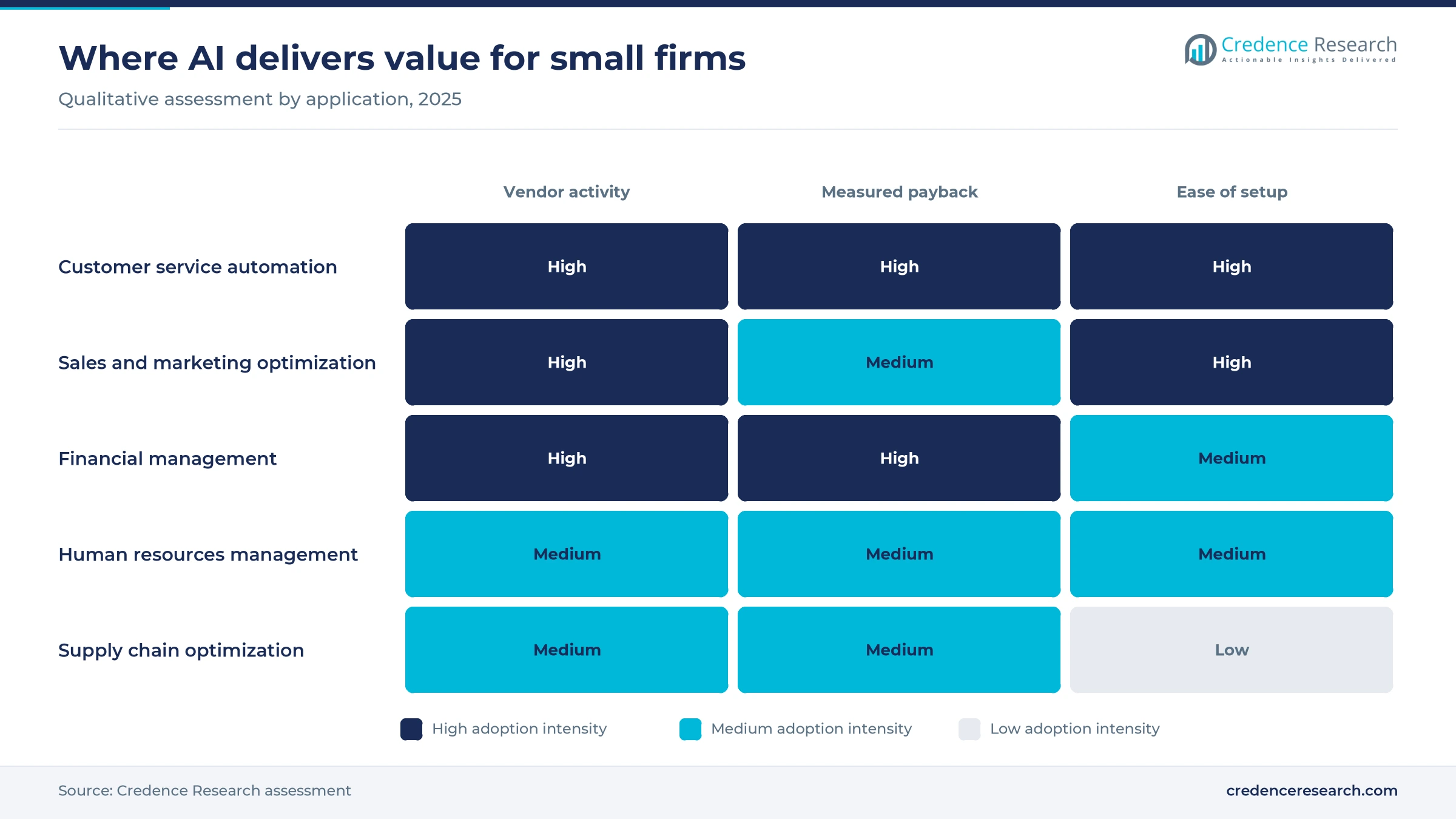
Based on application, the market is categorized into customer service automation, sales and marketing optimization, financial management, human resources management and supply chain optimization. Customer Service Automation led with 29.0% of 2025 value because help-desk chatbots cut ticket volumes quickly, and Freshworks reported in October 2024 that its Freddy AI Agent resolved an average 45% of support requests for beta users. Financial Management grows fastest at 20.41% a year as accounting agents spread, with Intuit stating on July 1, 2025 that QuickBooks agents save some users up to 12 hours a month.
Cloud subscriptions carry most SMB AI deployments
Based on deployment type, the market is categorized into cloud-based and on-premise deployments. Cloud-Based led with 76.0% of 2025 value because smaller firms buy AI as a per-seat subscription, and Microsoft priced Copilot Business at USD 21 per user a month for organizations with fewer than 300 users from Dec. 1, 2025. Cloud-Based also grows fastest at 19.87% a year as Google included Gemini in Workspace Business plans from Jan. 16, 2025, raising Business Standard from USD 12 to USD 14. On-premise use persists in regulated firms that keep data in house.
Medium enterprises spend most, small firms catch up
Based on business size, the market is categorized into micro enterprises, small enterprises and medium enterprises. Medium Enterprises led with 46.0% of 2025 value because adoption rises with headcount, and the U.S. Census Bureau found that 32% of firms with 100 to 249 employees used AI by May 2026. Small Enterprises grow fastest at 20.05% a year as vendors remove seat minimums for them, with Copilot Business now sold to any organization with fewer than 300 users. Micro firms trail, since fewer than 20% of firms with four or fewer employees used AI.
| Segment Group | Leading Sub-segment | Share, 2025 | Fastest-growing Sub-segment | CAGR, 2026–2035 |
|---|---|---|---|---|
| By Application | Customer Service Automation | 29.0% | Financial Management | 20.41% |
| By Deployment Type | Cloud-Based | 76.0% | Cloud-Based | 19.87% |
| By Business Size | Medium Enterprises | 46.0% | Small Enterprises | 20.05% |
Request a Free Sample
Fill in your details and we'll send you a free sample report.
- Sample data tables & charts
- Research methodology
Per-seat pricing and embedded agents widen SMB uptake
AI bundled into standard SMB software plans
The strongest driver is that AI now arrives inside software that small and medium businesses already pay for, so adoption no longer requires a separate purchase decision. Google included Gemini in Workspace Business plans from Jan. 16, 2025 and lifted Business Standard from USD 12 to USD 14 per user, turning AI into part of the base subscription. Microsoft followed with Copilot Business at USD 21 per user a month for firms with fewer than 300 users, available worldwide from Dec. 1, 2025. Xero said 73% of its customers had used AI across its platform since March 2025. As a result, cloud-based deployment held 76.0% of 2025 value, because bundled pricing moves spending into recurring per-seat fees.
Measured time savings in bookkeeping and payments
Owner-managed firms adopt AI fastest where it returns hours, and finance tasks offer the clearest payback. Intuit stated on July 1, 2025 that 45% of QuickBooks Online customers using its AI bank feed save 12 hours a month on bookkeeping. The same release said businesses using AI-drafted invoice reminders were paid an average of five days faster. Xero launched new JAX features on Sept. 3, 2025 to handle bank reconciliation and data entry for millions of small firms. Because these gains show up directly in cash flow, financial management grows at 20.41% a year, the fastest rate among applications, and pulls adjacent accounting software upgrades.
Rising AI use among firms with 10 to 249 employees
Adoption is now spreading beyond early users, which widens the paying base each year. Eurostat reported that 13.5% of EU enterprises with 10 or more employees used AI in 2024, up 5.5 percentage points from 8.0% in 2023, and every member state recorded an increase. In the U.K., the Office for National Statistics found that AI use among businesses with 10 or more employees rose from about 12% in late 2023 to about 35% by July 2026. These shifts favor medium enterprises, which held 46.0% of 2025 value because they have the data and staff to deploy several tools at once.
Public compute and adoption programs for smaller firms
Governments now fund AI adoption for smaller firms directly, which lowers trial costs and brings new buyers into the market. Singapore's Enterprise Compute Initiative, a S$150 million program, gives participating companies cloud credits and subsidized consultancy to build a minimum viable AI product. India approved the IndiaAI Mission on March 7, 2024 with an outlay of Rs 10,372 crore and a target of more than 10,000 GPUs open to startups and industry. Brazil's national AI plan, presented on July 30, 2024, earmarked R$23 billion for AI development. These programs help explain why Asia Pacific is the fastest-growing region over the forecast period.
Agents move from chat answers to finished bookkeeping
Shift from chat assistants to task-completing agents
A clear shift is under way from assistants that answer questions to agents that complete work and ask the owner to confirm. Intuit introduced payments, accounting, finance and customer agents for U.S. QuickBooks Online customers on July 1, 2025. Zoho announced more than 25 ready-to-deploy Zia Agents and a no-code agent builder on July 17, 2025, with access to over 700 actions across its products. Oracle NetSuite unveiled NetSuite Next on Oct. 7, 2025, adding workflows that can act on their own or with user approval for more than 43,000 customers. This shift lifts customer service automation, which held 29.0% of 2025 value, because agents handle tickets end to end.
Rise of generative AI as the first AI tool for SMEs
Generative AI has become the entry point for most first-time adopters, replacing earlier predictive analytics projects. The OECD survey of more than 5,000 SMEs in seven countries, published on Nov. 4, 2025, found that 31% used generative AI. Eurostat data show that text mining (6.9% of EU firms) and natural language generation (5.4%) were the most used AI technologies in 2024, each rising more than 3 percentage points in a year. Japan's Ministry of Internal Affairs and Communications reported that 86.4% of surveyed Japanese firms used generative AI for some work in its FY2025 survey. As a result, sales and marketing tools that draft text keep a large share of spending.
Opportunity in AI for micro businesses below 10 staff
Micro businesses are the largest untapped pool, which gives vendors with simple, low-cost tools a clear opening. The U.S. Census Bureau reported that fewer than 20% of firms with four or fewer employees used AI in the period to May 3, 2026, compared with 37% of firms with 250 or more. Its December 2024 analysis showed AI use among firms with one to four employees rising only from 4.6% to 5.8% between 2023 and 2024. In the U.K., ONS put AI use among firms with zero to nine employees at 28%. Vendors that package AI inside payroll or invoicing apps, as Gusto does with its Gus assistant, are best placed to reach these owners.
Opportunity in local language and small models
Smaller and local language models open markets where English-first tools and high inference costs held back adoption. Zoho built Zia LLM in 1.3 billion, 2.6 billion and 7 billion parameter sizes and released English and Hindi speech recognition models on July 17, 2025, serving more than 130 million users. India counted more than 7.3 crore Udyam-registered MSMEs in its 2025 year-end review, a large base of firms that work in regional languages. In Saudi Arabia, Monsha'at graduated 33 startups from its first AI Incubator Program on June 23, 2026. These openings support Asia Pacific, which held 25.5% of 2025 value, and the Middle East & Africa at 20.27% a year.
Skills gaps and security risk slow smaller adopters
Shortage of AI skills inside small firms
Skills, not tool prices, are the main barrier for smaller adopters. The U.K. government AI adoption survey published on Oct. 29, 2026 found that limited AI skills or knowledge affected 67% of adopters and 78% of firms planning to adopt. Owners without technical staff struggle to choose tools, prepare data and check outputs. As a result, projects stall after the first use case. Vendors and accountants are responding with guided setup and managed services sold alongside software.
Per-seat costs add up across small teams
AI add-ons raise software bills for firms with thin margins. At Microsoft's list price, a 20-person firm pays about USD 5,040 a year for Copilot Business before training or integration. Google's January 2025 change also lifted Workspace Business Standard from USD 12 to USD 14 per user. Owners therefore license AI for a few staff rather than the whole team. Bundled plans and promotional pricing help, but budget caps still slow wider rollout.
Data security and cyber risk
AI tools need access to customer, payroll and financial records, which raises the cost of a breach for firms with little security staff. The U.K. government's Cyber Security Breaches Survey 2025, published on April 10, 2025, found that 43% of businesses and 67% of medium businesses identified a breach or attack in the previous 12 months. Smaller firms often lack the expertise to assess vendor data practices. Many therefore limit AI to low-risk tasks such as drafting text. Clear vendor controls and audit logs make adoption easier for owners.
Compliance duties under new AI rules
New AI rules add documentation work that small firms find hard to absorb. The EU AI Act, published in the Official Journal on July 12, 2024, directs member states under Article 62 to give SMEs priority access to regulatory sandboxes and to scale conformity fees to company size. These measures show that legislators expect compliance to weigh on smaller providers. Firms building AI into their own products face the heaviest load, while firms buying finished tools rely on vendor compliance.
North America leads while Asia Pacific grows fastest
| Region | Value, 2025 (USD billion) | Share, 2025 | CAGR, 2026–2035 |
|---|---|---|---|
| North America | 15.64 | 38.5% | 18.97% |
| Europe | 10.97 | 27.0% | 19.07% |
| Asia Pacific | 10.36 | 25.5% | 20.47% |
| Latin America | 2.23 | 5.5% | 20.07% |
| Middle East & Africa | 1.42 | 3.5% | 20.27% |
North America leads on early agent launches
North America held 38.5% of 2025 value and grows at 18.97% a year. The region leads because vendors such as Intuit release small-business agents to U.S. customers first, as with QuickBooks agents on July 1, 2025. Oracle NetSuite also said NetSuite Next will reach North American customers first within 12 months of its October 2025 launch. Census data show AI use is already high in larger U.S. firms, so growth now depends on firms below 20 employees.
Europe grows on broad adoption across member states
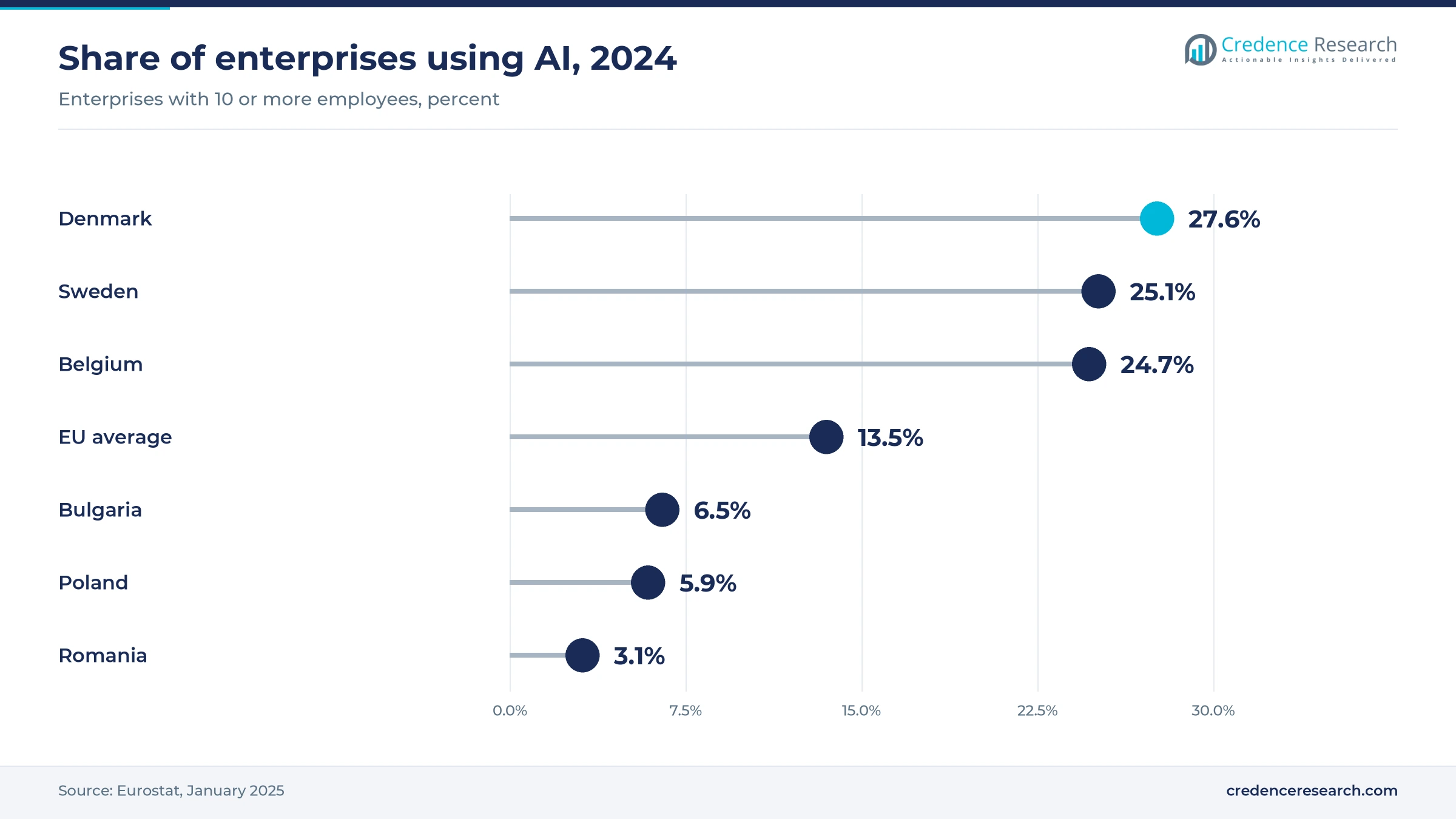
Europe held 27.0% of 2025 value and grows at 19.07% a year. Eurostat recorded the highest 2024 adoption in Denmark at 27.6%, Sweden at 25.1% and Belgium at 24.7%, against 3.1% in Romania and 5.9% in Poland. That 24.5-point gap between Denmark and Romania leaves large room for demand growth in Central and Eastern Europe. The EU AI Act adds compliance duties but also sandbox access for SMEs, and U.K. adoption among firms with 10 or more employees reached about 35%.
Asia Pacific grows fastest on public compute programs
Asia Pacific held 25.5% of 2025 value and is the fastest-growing region at 20.47% a year. Growth comes from public programs such as Singapore's S$150 million Enterprise Compute Initiative and India's Rs 10,372 crore IndiaAI Mission. Japan's ministry survey found 86.4% of surveyed firms using generative AI, though fewer had changed processes. Local vendors such as Zoho add small language models for regional languages.
Brazil's national AI plan lifts Latin America
Latin America held 5.5% of 2025 value and grows at 20.07% a year. Brazil presented a national AI plan on July 30, 2024 with R$23 billion earmarked for AI development and adoption. Small firms in the region buy AI mainly through global cloud suites and local resellers. Currency swings make per-seat USD pricing a barrier, which favors bundled plans priced in local currency.
Middle East & Africa grows from a small base
The Middle East & Africa held 3.5% of 2025 value and grows at 20.27% a year. Dubai Chambers launched an AI Integration Program for SMEs in May 2026 with an initial cohort of more than 100 local companies. In Saudi Arabia, Monsha'at graduated 33 startups from its AI Incubator Program in June 2026. Adoption in Africa remains limited by connectivity and software costs.
Vendors shipped SMB agents across 2024 and 2025
| Development | Status and market relevance |
|---|---|
| In December 2025, Microsoft made Copilot Business available worldwide at USD 21 per user a month for organizations with fewer than 300 users. | Launched; lowers the entry price for small teams |
| In October 2025, Oracle NetSuite unveiled NetSuite Next with AI workflows and the Ask Oracle assistant. | Rolling out to North American customers first |
| In September 2025, Xero launched new JAX features for bank reconciliation, data entry and insights. | Live; extends agents in small-business accounting |
| In July 2025, Intuit introduced a team of AI agents for QuickBooks Online customers in the United States. | Live; focuses on payments and bookkeeping |
| In July 2025, Zoho launched Zia LLM, more than 25 Zia Agents and a no-code agent builder. | Announced; pricing due at general availability |
Small language models and agents reshape SMB tools
- Task agents complete invoicing, reconciliation and ticket handling, then ask the owner to approve changes before they post.
- Small language models with a few billion parameters run at lower cost and can be hosted in a vendor's own data centers for privacy.
- Embedded copilots sit inside office, CRM and accounting apps, drawing on generative AI models to draft text and summarize records.
- No-code agent builders let owners link actions across apps without developers, which Zoho and HubSpot now offer to SMB customers.
Need a Custom Version of This Report?
Tailor the scope, geography, or segments to your exact requirements.
- Custom geography or segment scope
- Direct access to our analyst team
Suite vendors compete by bundling AI into plans
Competition centers on software platforms that already hold the records of small and medium businesses. Microsoft and Google bundle assistants into office suites, while Amazon Web Services sells Amazon Q Business, made generally available on April 30, 2024, to firms that build on its cloud. Accounting and payroll vendors, led by Intuit, Xero and Gusto, compete by turning bookkeeping and HR chores into agents that finish tasks after owner approval. CRM and help-desk vendors, including HubSpot with Breeze in September 2024 and Freshworks with the Freddy AI Agent in October 2024, compete on resolution rates and ease of setup, while open-source CRM tools give cost-sensitive firms a lower-priced route. Zoho competes on price and data privacy with its own models, and Oracle NetSuite targets growing firms that need AI inside ERP. Pricing has shifted from separate add-ons toward bundled plans, so vendors with large installed bases gain an advantage, while smaller specialists win on vertical depth.
Companies profiled and their roles in this market
| Company | Type | Role in the market |
|---|---|---|
| Microsoft | Suite vendor | Copilot Business for firms with fewer than 300 users |
| Suite vendor | Gemini included in Workspace Business plans | |
| Amazon Web Services | Cloud platform | Amazon Q Business assistant and AI services |
| Intuit | Accounting software | QuickBooks payments, accounting and finance agents |
| Xero | Accounting software | JAX financial agent for small firms |
| Zoho | Business suite | Zia LLM and Zia Agents |
| Freshworks | Service software | Freddy AI Agent for support tickets |
| HubSpot | CRM software | Breeze copilot and agents |
| Oracle NetSuite | ERP software | NetSuite Next AI workflows |
| Gusto | Payroll and HR | Gus AI assistant for payroll and HR tasks |
Adoption breadth now matters more than pilots
Credence Research's view is that AI in small and medium businesses has moved past the pilot stage, because AI now arrives inside software these firms already buy. The main question is no longer whether owners try AI but how many seats and tasks they extend it to. Vendors with accounting, payroll or CRM data hold the advantage, since agents need trusted records to act on. The most underrated risk is the skills gap, which keeps many firms at one or two use cases. Buyers should start with finance and service tasks that show measured time savings, then expand.
How Credence Research sized SMB AI spending
The report uses 2025 as the base year and forecasts to 2035, with the CAGR measured over 2026–2035. Market values come from the Credence Research model, built top down from published AI spending data and checked against SMB adoption rates and per-seat prices. Regional, application, deployment and size splits are Credence Research estimates. Sources include Eurostat, OECD, U.S. Census Bureau, U.K. ONS and government publications, plus company press releases and product pages. No interviews or primary surveys were conducted by Credence Research for this edition.
SMB AI spending scales with agent-based software
By 2035, AI is expected to be a standard part of software used by small and medium businesses, with spending reaching USD 241.22 billion. Growth will come from agents that handle full tasks in accounting, payroll and customer service, and from wider seat counts as bundled pricing spreads. Asia Pacific should gain share as public compute programs and local language models lower costs, while North America keeps the lead. Compliance rules such as the EU AI Act will shape vendor design more than buyer demand. Firms that close skills gaps early will capture most of the productivity gains.
Frequently Asked Questions
How big is the artificial intelligence in small and medium businesses market?
What share of small and medium enterprises used AI in 2024?
How many SMEs use generative AI?
Which application leads AI spending by small firms?
Which region leads the market?
Which region grows fastest?
What is the main barrier to AI adoption for small businesses?
Which companies are active in this market?
Table of Content
Chapter 1 Market Segmentation
- 1.1 Segmentation Framework
- 1.1.1 Product and Service Classification
- 1.1.2 Application and End-Use Classification
- 1.1.3 Technology and Solution Classification
- 1.1.4 Customer and Distribution Channel Classification
- 1.1.5 Geographic Segmentation
- 1.1.6 Market Segment Definitions and Boundaries
- 1.2 By Application
- 1.2.1 Customer Service Automation
- 1.2.2 Sales and Marketing Optimization
- 1.2.3 Financial Management
- 1.2.4 Human Resources Management
- 1.2.5 Supply Chain Optimization
- 1.3 By Deployment Type
- 1.3.1 Cloud-Based
- 1.3.2 On-Premise
- 1.4 By Business Size
- 1.4.1 Medium Enterprises
- 1.4.2 Small Enterprises
- 1.4.3 Micro Enterprises
Chapter 2 Introduction
- 2.1 Report Objectives and Scope
- 2.2 Product Definition and Industry Terminology
- 2.3 Market Inclusions and Exclusions
- 2.4 Research Process
- 2.4.1 Primary Research and Expert Interviews
- 2.4.2 Secondary Research and Source Review
- 2.4.3 Top-Down and Bottom-Up Estimation
- 2.4.4 Data Triangulation and Verification
- 2.5 Market Size Measurement Basis
- 2.5.1 2025: USD 40.62 billion → 2035: USD 241.22 billion
- 2.6 Historical and Forecast Reference Periods
- 2.6.1 Historical Period: 2018-2025
- 2.6.2 Base Year: 2025
- 2.6.3 Forecast Period: 2025-2035
- 2.7 Research Assumptions and Limitations
Chapter 3 Executive Summary
- 3.1 Market Snapshot and Key Findings
- 3.2 Base-Year Market Size, 2025
- 3.3 Forecast Market Size, 2035
- 3.4 Revenue and Volume Growth Outlook
- 3.5 Key Demand and Supply Indicators
- 3.6 Leading Market Segments
- 3.7 Fastest-Growing Market Opportunities
- 3.8 Regional Performance Highlights
- 3.9 Technology and Industry Transformation
- 3.10 Competitive Landscape Summary
- 3.11 Analyst View and Strategic Implications
Chapter 4 Global Artificial Intelligence in Small And Medium Businesses Market Trends and Developments
- 4.1 Historical Industry Development, 2018-2025
- 4.2 Recent Market Trends and Developments
- 4.3 Demand and Customer Behavior Trends
- 4.4 Technology and Product Innovation
- 4.5 Artificial Intelligence, Automation and Digitalization
- 4.6 Local Manufacturing and Supply Chain Realignment
- 4.7 Industry Partnerships, Mergers and Acquisitions
- 4.8 Sustainability and Circular Economy Developments
- 4.9 Government and Private Sector Investment Trends
- 4.10 Emerging Business Models and Commercialization
- 4.11 Industry Developments and Announcements
Chapter 5 Global Artificial Intelligence in Small And Medium Businesses Market Production, Supply and Demand Analysis
- 5.1 Demand Trend and Consumption Analysis, 2018-2025
- 5.2 Demand Forecast, 2025-2035
- 5.3 Production and Output Trend, 2018-2025
- 5.4 Production and Output Forecast, 2025-2035
- 5.5 Installed Capacity and Capacity Utilization
- 5.6 Company-Wise Production Plants and Statistics
- 5.6.1 Installed Production Capacity
- 5.6.2 Actual Production
- 5.6.3 Planned Capacity and Expansion Targets
- 5.7 Supply Chain Structure and Procurement Trends
- 5.8 Supply-Demand Gap and Bottlenecks
- 5.9 Import Dependence and Sourcing Structure
- 5.10 Contract Manufacturing and Outsourcing
- 5.11 Regional Supply and Demand Concentration
Chapter 6 Global Artificial Intelligence in Small And Medium Businesses Market Pricing Analysis
- 6.1 Pricing Structure and Measurement
- 6.2 Historical Pricing Trends, 2018-2025
- 6.3 Pricing Outlook, 2025-2035
- 6.4 Average Selling Price and Unit Economics
- 6.5 Pricing by Product and Market Segment
- 6.6 Geographic Pricing Differences
- 6.7 Key Input, Energy, Labor and Logistics Costs
- 6.8 Contract Pricing and Purchasing Models
- 6.9 Pricing Sensitivity and Competitive Positioning
- 6.10 Price, Margin and Profitability Implications
Chapter 7 Global Artificial Intelligence in Small And Medium Businesses Market Dynamics
- 7.1 Market Growth Drivers
- 7.1.1 Demand-Side Drivers
- 7.1.2 Technology and Innovation Drivers
- 7.1.3 Infrastructure and Investment Drivers
- 7.1.4 Regulatory and Policy Drivers
- 7.2 Market Restraints
- 7.2.1 Cost and Affordability Constraints
- 7.2.2 Technology and Adoption Barriers
- 7.2.3 Supply Chain and Operational Constraints
- 7.3 Market Challenges
- 7.3.1 Competitive Pressure and Margin Erosion
- 7.3.2 Skills, Infrastructure and Implementation Gaps
- 7.4 Emerging Market Opportunities
- 7.5 Market Dynamics Impact and Time-Horizon Assessment
Chapter 8 Global Artificial Intelligence in Small And Medium Businesses Value Chain Analysis
- 8.1 Industry Value Chain Overview
- 8.2 Upstream Suppliers and Critical Inputs
- 8.3 Technology and Component Providers
- 8.4 Manufacturing or Service Delivery
- 8.5 Distribution, Channel Partners and Integrators
- 8.6 Downstream Applications and End Users
- 8.7 Value Addition and Profit Pools
- 8.8 Vertical Integration and Outsourcing
- 8.9 Supplier Concentration and Risk
- 8.10 Supply Chain Localization and Resilience
Chapter 9 Global Artificial Intelligence in Small And Medium Businesses Market Regulations and Policies
- 9.1 Relevant Laws, Standards and Compliance Frameworks
- 9.2 Product, Service, Safety and Quality Requirements
- 9.3 Government Policies, Incentives and Subsidies
- 9.4 Imports, Exports and Trade Barriers
- 9.5 Public Procurement and Local Content Requirements
- 9.6 Environmental and Sustainability Compliance
- 9.7 Data Protection, AI and Cybersecurity Compliance
- 9.8 Upcoming Policy Changes and Market Implications
Chapter 10 Global Artificial Intelligence in Small And Medium Businesses Market Hotspots and Opportunities
- 10.1 Market Opportunity Mapping and Growth Hotspots
- 10.2 High-Growth Applications and Customer Groups
- 10.3 Underserved Markets and White-Space Opportunities
- 10.4 Emerging Technology and Product Opportunities
- 10.5 New Capacity and Investment Hotspots
- 10.6 Market Entry and Expansion Opportunities
- 10.7 Distribution and Partnership Opportunities
- 10.8 Near-Term and Long-Term Commercial Potential
- 10.9 Opportunity Attractiveness and Execution Risks
Chapter 11 Global Artificial Intelligence in Small And Medium Businesses Market Outlook, 2025-2035
- 11.1 Market Size and Analysis
- 11.1.1 Revenue (Market Measurement: 2025: USD 40.62 billion → 2035: USD 241.22 billion)
- 11.1.2 Market Volume and Quantity Sold
- 11.1.3 Historical Market Size, 2018-2025
- 11.1.4 Base-Year Market Size, 2025
- 11.2 Market Forecast, 2025-2035
- 11.2.1 Revenue Forecast to 2035
- 11.2.2 Volume Forecast to 2035
- 11.2.3 CAGR and Year-on-Year Growth
- 11.2.4 Incremental Revenue Opportunity
- 11.3 Forecast Assumptions and Scenario Analysis
- 11.3.1 Base-Case Forecast
- 11.3.2 Optimistic and Conservative Scenarios
- 11.3.3 Technology, Pricing and Policy Sensitivities
- 11.4 Market Attractiveness and Growth Outlook
Chapter 12 Global Artificial Intelligence in Small And Medium Businesses Market Segmentation and Outlook
- 12.1 Segmentation Summary and Market Shares, 2025
- 12.2 Largest and Fastest-Growing Segments
- 12.3 By Application - Market Size and Forecast, 2025-2035
- 12.3.1 Segment Definition and Scope
- 12.3.2 Historical Market Size, 2018-2025
- 12.3.3 Revenue Forecast, 2025-2035
- 12.3.4 Volume Forecast, 2025-2035
- 12.3.5 Base-Year Market Share, 2025
- 12.3.6 Segment CAGR and Growth Drivers
- 12.3.7 Subsegment Market Size and Forecast
- 12.3.7.1 Customer Service Automation
- 12.3.7.2 Sales and Marketing Optimization
- 12.3.7.3 Financial Management
- 12.3.7.4 Human Resources Management
- 12.3.7.5 Supply Chain Optimization
- 12.3.8 Subsegment Pricing and Adoption Trends
- 12.3.9 Leading Suppliers and Competition
- 12.3.10 Regional Demand and Opportunities
- 12.4 By Deployment Type - Market Size and Forecast, 2025-2035
- 12.4.1 Segment Definition and Scope
- 12.4.2 Historical Market Size, 2018-2025
- 12.4.3 Revenue Forecast, 2025-2035
- 12.4.4 Volume Forecast, 2025-2035
- 12.4.5 Base-Year Market Share, 2025
- 12.4.6 Segment CAGR and Growth Drivers
- 12.4.7 Subsegment Market Size and Forecast
- 12.4.7.1 Cloud-Based
- 12.4.7.2 On-Premise
- 12.4.8 Subsegment Pricing and Adoption Trends
- 12.4.9 Leading Suppliers and Competition
- 12.4.10 Regional Demand and Opportunities
- 12.5 By Business Size - Market Size and Forecast, 2025-2035
- 12.5.1 Segment Definition and Scope
- 12.5.2 Historical Market Size, 2018-2025
- 12.5.3 Revenue Forecast, 2025-2035
- 12.5.4 Volume Forecast, 2025-2035
- 12.5.5 Base-Year Market Share, 2025
- 12.5.6 Segment CAGR and Growth Drivers
- 12.5.7 Subsegment Market Size and Forecast
- 12.5.7.1 Medium Enterprises
- 12.5.7.2 Small Enterprises
- 12.5.7.3 Micro Enterprises
- 12.5.8 Subsegment Pricing and Adoption Trends
- 12.5.9 Leading Suppliers and Competition
- 12.5.10 Regional Demand and Opportunities
- 12.6 Segment Growth Comparison
- 12.7 Segment Attractiveness and Priority Matrix
Chapter 13 Global Artificial Intelligence in Small And Medium Businesses End-Use and Application Market Outlook
- 13.1 End-Use Industry and Customer Demand Structure
- 13.2 Leading Applications and Customer Groups
- 13.3 End-Use Market Size, Share and Forecast
- 13.4 Major End-Use Industry Deep Dives
- 13.4.1 Customer Requirements and Use Cases
- 13.4.2 Demand and Replacement Cycles
- 13.4.3 Technical and Regulatory Considerations
- 13.4.4 Purchasing and Procurement Models
- 13.4.5 Leading Vendors and Distribution Channels
- 13.4.6 Forecast and Commercial Opportunities
- 13.5 Emerging Applications and Cross-Segment Demand
- 13.6 End-Use Industry Investment Priorities
Chapter 14 Global Artificial Intelligence in Small And Medium Businesses Geographic Market Outlook, 2025-2035
- 14.1 Regional Market Size and Share, 2025
- 14.2 Regional Market Forecast, 2025-2035
- 14.3 Regional Pricing, Production and Demand Differences
- 14.4 North America
- 14.4.1 United States
- 14.4.2 Canada
- 14.4.3 Mexico
- 14.5 Europe
- 14.5.1 Germany
- 14.5.2 France
- 14.5.3 Italy
- 14.5.4 United Kingdom
- 14.5.5 Spain
- 14.5.6 Poland
- 14.5.7 Russia
- 14.5.8 Netherlands
- 14.5.9 Belgium
- 14.5.10 Sweden
- 14.5.11 Denmark
- 14.5.12 Norway
- 14.5.13 Rest of Europe
- 14.6 Asia Pacific
- 14.6.1 China
- 14.6.2 India
- 14.6.3 Japan
- 14.6.4 South Korea
- 14.6.5 Thailand
- 14.6.6 Indonesia
- 14.6.7 Vietnam
- 14.6.8 Malaysia
- 14.6.9 Australia
- 14.6.10 Rest of Asia Pacific
- 14.7 Latin America
- 14.7.1 Brazil
- 14.7.2 Argentina
- 14.7.3 Colombia
- 14.7.4 Chile
- 14.7.5 Rest of Latin America
- 14.8 Middle East
- 14.8.1 Saudi Arabia
- 14.8.2 United Arab Emirates
- 14.8.3 Turkey
- 14.8.4 Israel
- 14.8.5 Iran
- 14.8.6 Rest of the Middle East
- 14.9 Africa
- 14.9.1 South Africa
- 14.9.2 Egypt
- 14.9.3 Nigeria
- 14.9.4 Morocco
- 14.9.5 Rest of Africa
- 14.10 Regional Investment, Policy and Supply Chain Differences
- 14.11 Regional Competitive Landscape
- 14.12 Geographic Growth Hotspots
Chapter 15 Global Artificial Intelligence in Small And Medium Businesses Technology, Innovation and Sustainability Outlook
- 15.1 Technology Landscape and Maturity
- 15.2 Product, Process and Service Innovation
- 15.3 AI, Automation and Digital Tools in the Industry
- 15.4 Technology Adoption and Performance Benchmarking
- 15.5 Innovation Pipeline and R&D Investment
- 15.6 Patent and Intellectual Property Trends
- 15.7 Energy Efficiency and Resource Management
- 15.8 Sustainability, Recycling and Circularity
- 15.9 Technology Roadmap, 2025-2035
- 15.10 Risks of Obsolescence and Technology Substitution
Chapter 16 Global Artificial Intelligence in Small And Medium Businesses Market Key Strategic Imperatives
- 16.1 Growth and Market Entry Priorities
- 16.2 High-Return Products and Segments
- 16.3 Pricing, Profitability and Cost Optimization
- 16.4 Technology Investment and Product Differentiation
- 16.5 Supply Chain Localization and Resilience
- 16.6 Distribution and Customer Acquisition
- 16.7 Partnership, Acquisition and Capacity Strategy
- 16.8 Regional Expansion Priorities
- 16.9 Short-, Medium- and Long-Term Actions
Chapter 17 Competition Outlook
- 17.1 Industry Competition Characteristics
- 17.2 Market Structure and Concentration
- 17.3 Market Share and Competitive Positioning, 2025
- 17.4 Company-Wise Revenue and Product Benchmarking
- 17.5 Production and Service Capacity Benchmarking
- 17.6 Technology, Pricing and Differentiation
- 17.7 Regional Footprint and Distribution Strength
- 17.8 Mergers, Acquisitions and Strategic Alliances
- 17.9 New Entrants and Competitive Threats
- 17.10 Porter's Five Forces and Industry Attractiveness
- 17.11 Competitive Outlook, 2025-2035
Chapter 18 Company Profiles
- 18.1 Company Coverage and Selection Criteria
- 18.2 Microsoft
- 18.2.1 Business Description
- 18.2.2 Company Ownership and Geographic Presence
- 18.2.3 Product and Service Portfolio
- 18.2.4 Manufacturing and Operating Footprint
- 18.2.5 Production Capacity and Expansion Plans
- 18.2.6 Financial Performance and Investment
- 18.2.7 Market Share and Competitive Position
- 18.2.8 Technology and Innovation Capabilities
- 18.2.9 Strategic Alliances or Partnerships
- 18.2.10 Recent Developments
- 18.2.11 Growth Strategy and Outlook
- 18.3 Amazon Web Services
- 18.4 Google
- 18.5 Intuit
- 18.6 Oracle NetSuite
- 18.7 Zoho
- 18.8 Freshworks
- 18.9 HubSpot
- 18.10 Xero
- 18.11 Gusto
- 18.12 Other Relevant Market Participants
Note: Every listed company is profiled on the structure shown under the first company. The company list is preliminary and may change based on research findings, market developments, data availability and client requirements.
Chapter 19 Disclaimer
- 19.1 Research and Forecast Disclaimer
- 19.2 Data Source and Estimation Limitations
Note: The depth of individual sections depends on data availability for this market. Volume, capacity, trade and other unit-based metrics are included where applicable.

