
Market Overview
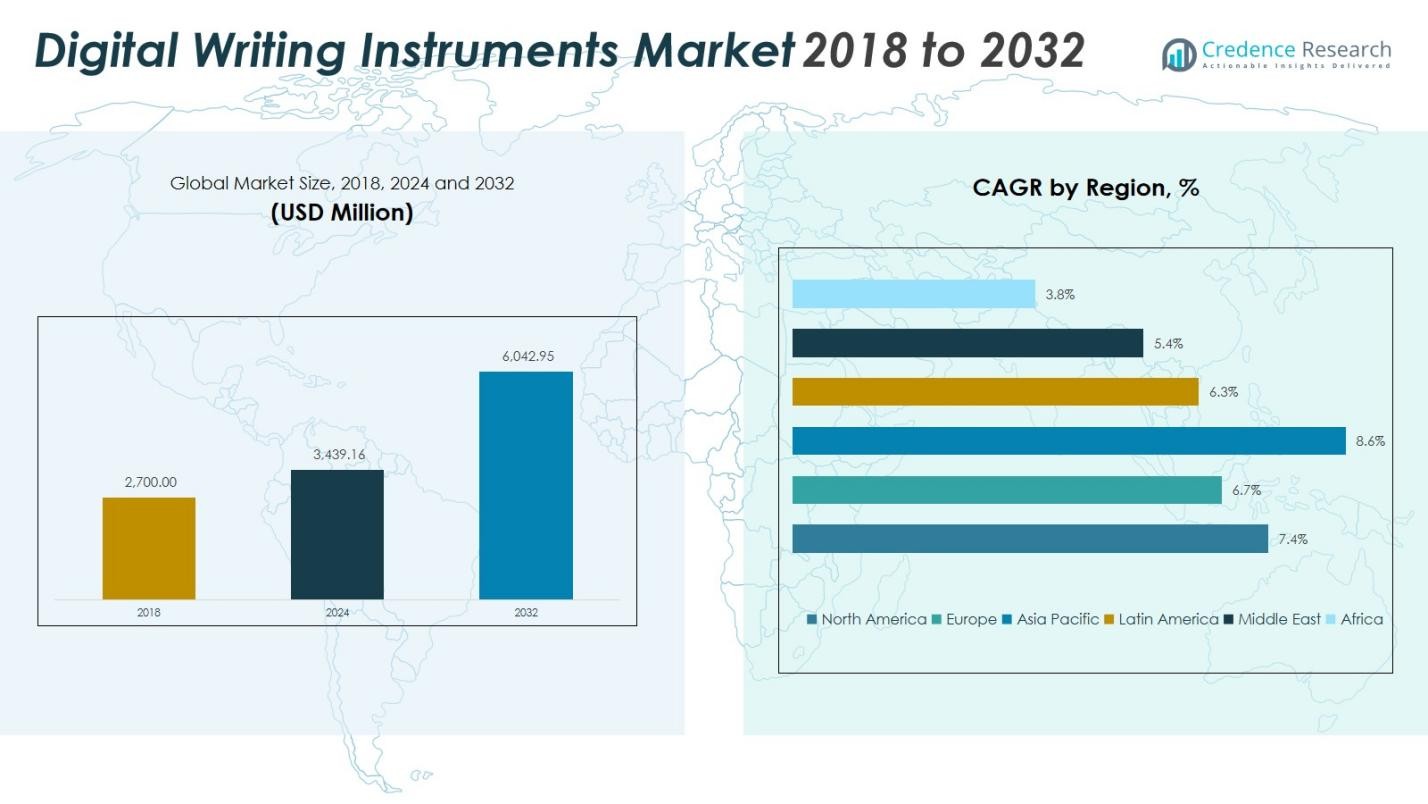
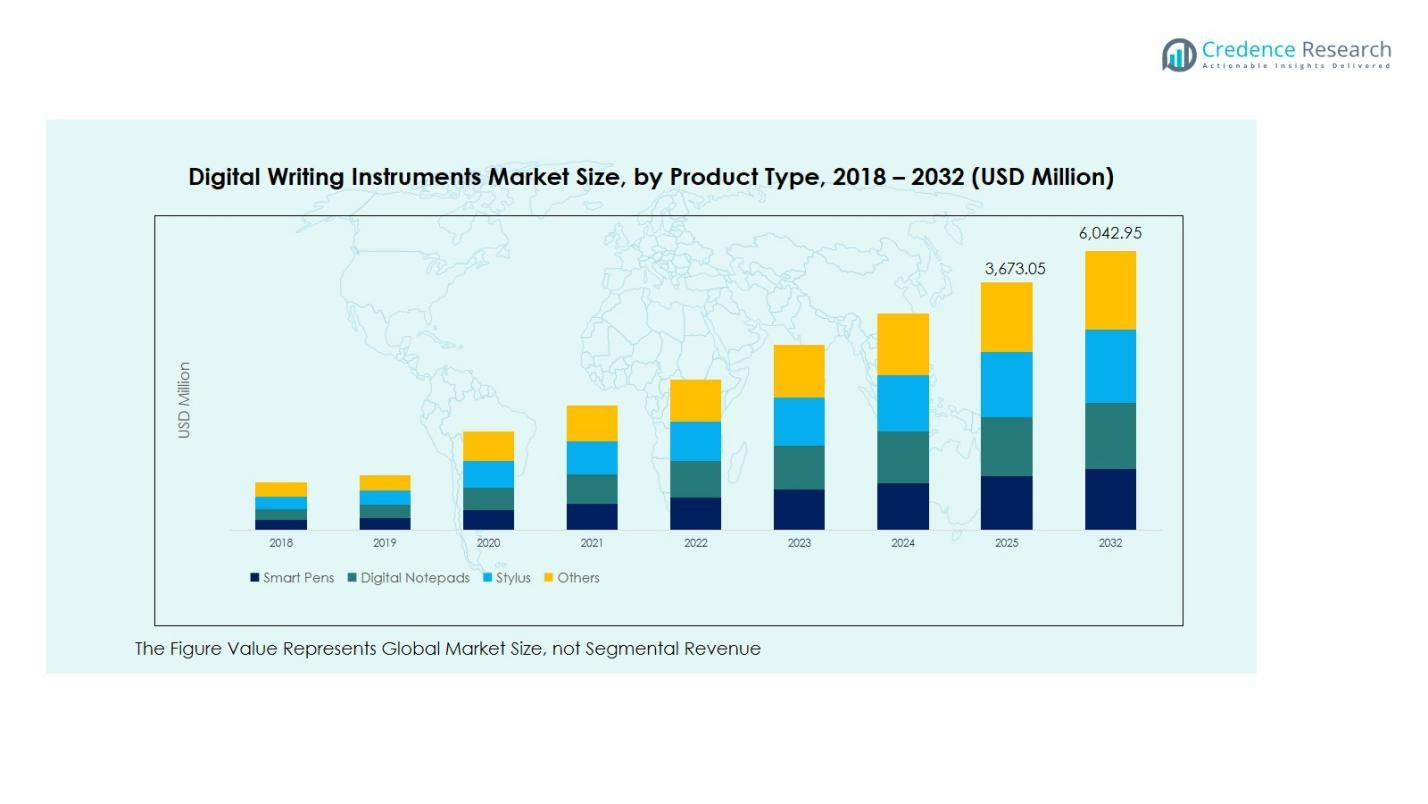
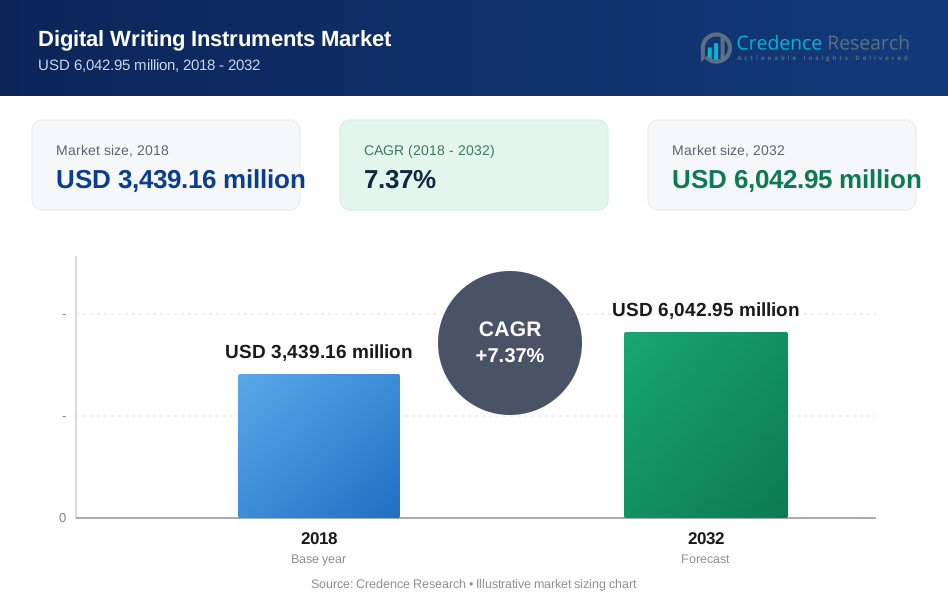
The Digital Writing Instruments Market size was valued at USD 2,700.00 million in 2018, increasing to USD 3,439.16 million in 2024, and is anticipated to reach USD 6,042.95 million by 2032, growing at a CAGR of 7.37% during the forecast period.
| REPORT ATTRIBUTE | DETAILS |
|---|---|
| Historical Period | 2020-2023 |
| Base Year | 2024 |
| Forecast Period | 2025-2032 |
| Digital Writing Instruments Market Size 2024 | USD 3,439.16 Million |
| Digital Writing Instruments Market, CAGR | 7.37% |
| Digital Writing Instruments Market Size 2032 | USD 6,042.95 Million |
The Digital Writing Instruments Market is highly competitive, with key players including Wacom Co., Ltd., Apple Inc., Microsoft Corporation, Samsung Electronics Co., Ltd., Lenovo Group Limited, HP Development Company, L.P., and Dell Technologies Inc. These companies dominate the market through continuous innovation, ecosystem integration, and strategic expansion across education and business sectors. Wacom leads in professional creative tools, while Apple and Microsoft leverage advanced stylus technology and device synergy. Regionally, North America remains the leading market, holding around 35% of the global share in 2024, supported by strong technology adoption, digital education initiatives, and high consumer preference for premium smart writing devices.
Market Insights
- The Digital Writing Instruments Market was valued at USD 3,439.16 million in 2024 and is projected to reach USD 6,042.95 million by 2032, growing at a CAGR of 7.37% during the forecast period.
- Growing demand for digital learning tools and the adoption of smart devices in education and business sectors are driving market expansion globally.
- The market is witnessing strong trends in AI-enabled writing, cloud integration, and eco-friendly digital solutions enhancing convenience and sustainability.
- Key players such as Wacom, Apple, Microsoft, Samsung, and Lenovo dominate the competitive landscape through innovation, advanced stylus technology, and product integration across ecosystems.
- North America leads with a 35% share, followed by Europe (26%) and Asia Pacific (27%), while Smart Pens remain the leading product segment with around 42% share driven by growing usage in digital education and professional applications.
Market Segmentation Analysis:
By Product Type:
The digital writing instruments market by product type is dominated by smart pens, accounting for around 42% of the total market share in 2024. Smart pens are widely adopted for their ability to digitize handwritten notes, integrate with cloud platforms, and enhance productivity in both educational and professional settings. The demand is driven by advancements in Bluetooth and AI technologies, improving real-time transcription accuracy. Digital notepads and stylus devices follow closely, supported by rising creative applications and the growing trend of digital classrooms and remote work environments.
For instance, Livescribe Inc. sold 400,000 smart pens between March 2008 and July 2010, illustrating early large-scale adoption of smart-pen technology.
By Application:
The education segment holds the largest market share, contributing approximately 38% of the global digital writing instruments market in 2024. This dominance is fueled by the increasing adoption of smart learning tools and e-learning platforms in schools and universities. Governments and institutions promoting digital literacy further strengthen this segment. Meanwhile, the business segment is expanding steadily due to corporate digitalization, while art and design applications witness growing demand for precise stylus devices supporting creativity and design workflows across digital platforms.
For instance, in 2023 the “Branded Business” of Wacom (creative pen displays for art/design) generated net sales of ¥29,170 million, highlighting demand in design/creative workflows.
By Distribution Channel:
Online stores represent the dominant distribution channel, capturing about 46% of the market share in 2024, reflecting the rising consumer preference for e-commerce convenience and product variety. Major brands are enhancing their digital presence and offering exclusive online deals, further driving this segment. Specialty stores continue to serve professionals seeking high-end, premium devices, while supermarkets and hypermarkets contribute to the accessibility of entry-level digital writing tools. The rapid shift toward online retail and global direct-to-consumer strategies remains a key driver of market expansion.
Key Growth Drivers
Rising Adoption of Smart Learning and Digital Education
The rapid integration of digital tools in education is a major growth driver for the digital writing instruments market. Schools and universities increasingly adopt smart pens and digital notepads to support interactive learning and remote education. Governments worldwide are investing in digital literacy programs, while students prefer connected, portable tools for note-taking and sharing. This shift toward technology-enabled classrooms significantly boosts demand for digital writing devices, enhancing collaboration and productivity in modern learning environments.
For instance, the Livescribe Echo smart pen is used in higher education institutions to help students with learning disabilities improve retention and organization.
Technological Advancements in Writing Devices
Continuous innovation in sensor accuracy, Bluetooth connectivity, and AI-based handwriting recognition enhances the performance and usability of digital writing instruments. Manufacturers are integrating advanced pressure sensitivity and real-time data synchronization features, improving user experience across professional and creative applications. The fusion of smart technology with ergonomic designs enables seamless digital-physical workflow transitions, appealing to students, professionals, and artists alike. These advancements are fostering the global adoption of digital writing tools as essential components of hybrid work and learning ecosystems.
For instance, MyScript developed AI-based handwriting recognition capable of interpreting handwritten content in over 70 languages, based on “over 20 years of research and development”.
Increasing Demand from Creative Professionals
Creative sectors, including design, animation, and digital art, are increasingly driving the growth of the digital writing instruments market. Professionals rely on stylus pens and tablets that offer precision, control, and pressure sensitivity, replicating traditional drawing experiences. The expansion of digital content creation across platforms like gaming, illustration, and advertising boosts the use of smart writing tools. Companies continue to develop specialized stylus models catering to professional-grade performance, fueling market expansion within the growing creative economy.
Key Trends & Opportunities
Integration with Cloud and AI Ecosystems
One of the most notable trends is the integration of digital writing instruments with cloud-based and AI-driven platforms. Users can automatically upload, organize, and share handwritten notes or sketches across multiple devices, enhancing workflow efficiency. AI algorithms further improve transcription accuracy and offer predictive writing suggestions. This synergy between hardware and software presents a strong opportunity for manufacturers to create value-added ecosystems, expanding revenue streams through subscription-based services and smart connectivity features.
For instance, the InkShare AI Pen claims handwriting-recognition accuracy of 99.74% on a specified benchmarking dataset.
Rising Popularity of Eco-Friendly and Sustainable Devices
As environmental awareness grows, consumers increasingly prefer digital writing solutions that minimize paper use and promote sustainability. The market sees a rising opportunity in eco-friendly digital notebooks and rechargeable smart pens that reduce electronic waste. Companies investing in sustainable materials and energy-efficient manufacturing practices gain competitive advantage. This trend aligns with global sustainability goals and offers a pathway for brands to attract environmentally conscious consumers, creating long-term value in both developed and emerging markets.
For instance, the Scooboo Eco Friendly Notebook A5 offers a reusable notebook format, sold at a retail price of ₹112.50, indicating a move toward affordable sustainable stationery.
Key Challenges
High Product Costs and Limited Accessibility
Despite technological progress, the high cost of advanced digital writing devices remains a significant barrier to widespread adoption. Premium smart pens and tablets are often unaffordable for students and users in developing regions. Additionally, limited product availability and after-sales support in certain markets restrict penetration. To overcome this challenge, manufacturers must focus on cost optimization, localization strategies, and partnerships with educational institutions to enhance affordability and accessibility across broader user segments.
Data Security and Compatibility Issues
As digital writing instruments increasingly connect with cloud platforms and mobile devices, data privacy and compatibility concerns arise. Users face risks related to unauthorized data access and synchronization errors across diverse operating systems. Lack of universal standards for device integration also hampers seamless performance. These challenges necessitate stronger cybersecurity protocols and collaboration among hardware and software providers to ensure secure data handling, cross-platform compatibility, and user trust in digital ecosystems.
Regional Analysis
North America:
North America dominates the global digital writing instruments market, accounting for around 35% of the total share in 2024. The market grew from USD 966.60 million in 2018 to USD 1,216.07 million in 2024, and it is projected to reach USD 2,133.78 million by 2032, expanding at a CAGR of 7.4%. Growth is driven by the high adoption of advanced digital tools in education, business, and creative industries. The presence of leading technology firms and strong consumer demand for innovative smart pens and digital notepads continue to reinforce the region’s dominant market position.
Europe:
Europe holds a significant 26% share of the global digital writing instruments market in 2024. Valued at USD 741.15 million in 2018, the market increased to USD 908.88 million in 2024 and is forecasted to reach USD 1,512.26 million by 2032, growing at a CAGR of 6.7%. The region’s expansion is fueled by growing investments in digital education and creative industries. Strong adoption of e-learning tools in schools and universities, coupled with consumer interest in design-focused stylus and notepad solutions, supports market growth across Germany, the UK, France, and Italy.
Asia Pacific:
Asia Pacific represents the most dynamic region, contributing around 27% of the global market share in 2024. The market expanded from USD 725.49 million in 2018 to USD 961.40 million in 2024, and it is expected to reach USD 1,849.15 million by 2032, registering the highest CAGR of 8.6%. Rapid digitization in education and business sectors, coupled with the presence of major manufacturers in China, Japan, and South Korea, is driving growth. Increasing adoption of e-learning, remote work, and affordable smart devices positions Asia Pacific as the fastest-growing digital writing instruments market globally.
Latin America:
Latin America accounts for about 6% of the global market share in 2024, with a steady growth trajectory. The market was valued at USD 156.60 million in 2018, rising to USD 197.37 million in 2024, and is projected to reach USD 319.49 million by 2032, at a CAGR of 6.3%. Expanding educational reforms and increasing awareness of digital tools are boosting adoption, particularly in Brazil and Mexico. The region benefits from the gradual digital transformation in schools and small businesses, though limited affordability and access remain challenges in rural areas.
Middle East:
The Middle East digital writing instruments market captures around 4% of the global share in 2024. It was valued at USD 75.60 million in 2018, increased to USD 88.02 million in 2024, and is anticipated to reach USD 133.58 million by 2032, with a CAGR of 5.4%. Growth is supported by the region’s expanding educational technology initiatives, especially in GCC countries and Israel. Rising government investments in smart classrooms and increased digital literacy among younger populations contribute to the region’s moderate but steady expansion.
Africa:
Africa holds a minor yet emerging share of around 2% in the global digital writing instruments market in 2024. The market grew from USD 34.56 million in 2018 to USD 67.42 million in 2024, and it is projected to reach USD 94.69 million by 2032, at a CAGR of 3.8%. The region’s growth is primarily driven by rising educational development programs and gradual technology adoption in schools. However, limited infrastructure, affordability issues, and low digital penetration continue to constrain market growth compared to other regions.
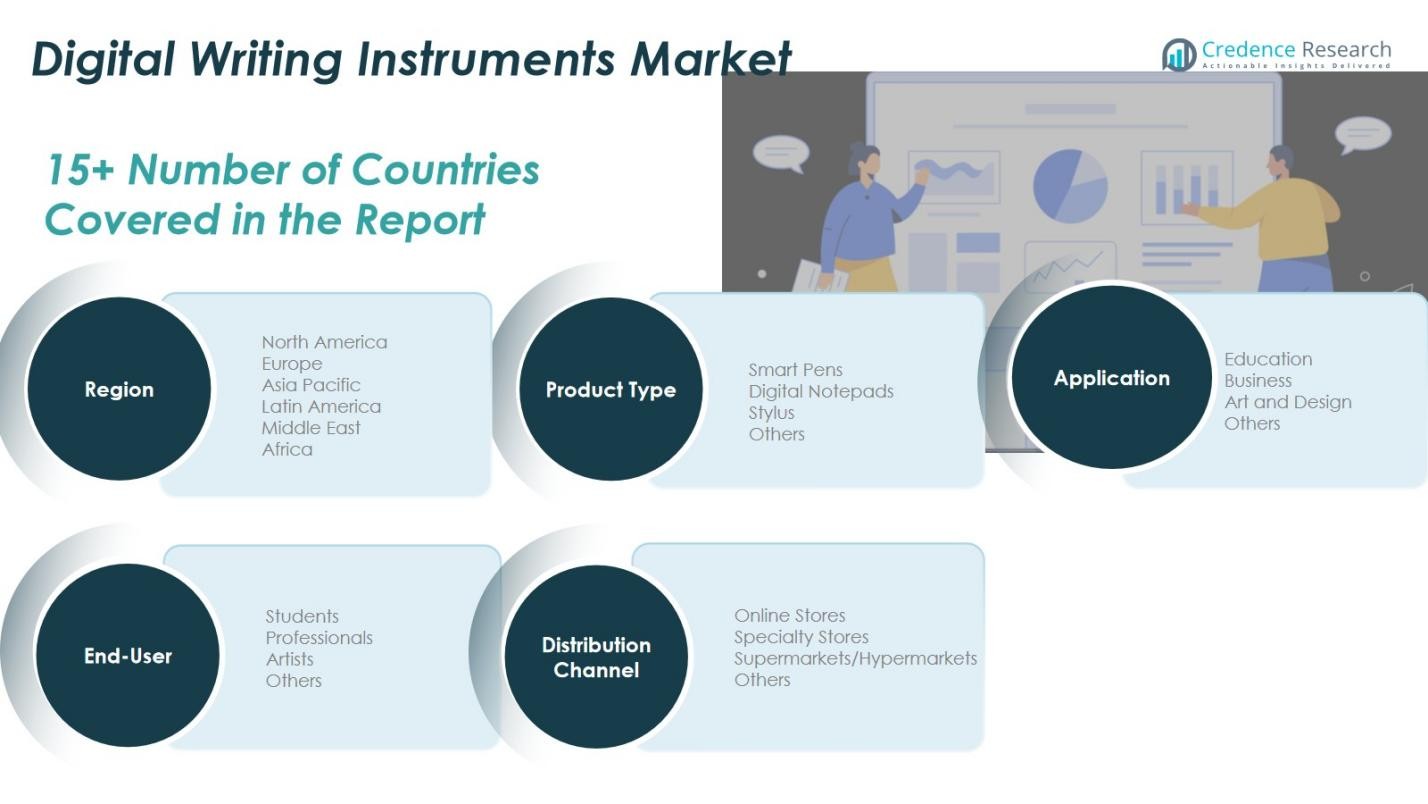
Market Segmentations:
By Product Type
- Smart Pens
- Digital Notepads
- Stylus
- Others
By Application
- Education
- Business
- Art and Design
- Others
By Distribution Channel:
- Online Stores
- Specialty Stores
- Supermarkets/Hypermarkets
- Others
By End-User:
- Students
- Professionals
- Artists
- Others
By Region
- North America
- U.S.
- Canada
- Mexico
- Europe
- Germany
- France
- U.K.
- Italy
- Spain
- Rest of Europe
- Asia Pacific
- China
- Japan
- India
- South Korea
- South-east Asia
- Rest of Asia Pacific
- Latin America
- Brazil
- Argentina
- Rest of Latin America
- Middle East & Africa
- GCC Countries
- South Africa
- Rest of the Middle East and Africa
Competitive Landscape
The competitive landscape of the Digital Writing Instruments Market features leading players such as Wacom Co., Ltd., Apple Inc., Microsoft Corporation, Samsung Electronics Co., Ltd., Lenovo Group Limited, HP Development Company, L.P., and Dell Technologies Inc. These companies dominate the market through continuous innovation, strong product portfolios, and strategic partnerships. Wacom remains a pioneer in stylus and tablet technology, while Apple and Microsoft leverage ecosystem integration to enhance user experience across devices. Samsung and Lenovo focus on expanding accessibility through multi-functional smart pens integrated with mobile devices and tablets. Emerging players like Huion, XP-Pen, and Adonit are strengthening their presence with cost-effective, high-performance tools targeting the creative and educational sectors. The competitive dynamics are marked by rapid product launches, advancements in AI and Bluetooth connectivity, and growing investments in R&D to improve precision, responsiveness, and sustainability, enabling brands to capture diverse consumer segments globally.
Key Player Analysis
- Wacom Co., Ltd.
- Apple Inc.
- Microsoft Corporation
- Samsung Electronics Co., Ltd.
- Lenovo Group Limited
- Hewlett-Packard Development Company, L.P.
- Dell Technologies Inc.
- Google LLC
- Sony Corporation
- Huion Animation Technology Co., Ltd.
- XP-Pen Technology Co., Ltd.
- Adonit
- Staedtler Mars GmbH & Co. KG
- Livescribe Inc.
- NeoLAB Convergence Inc.
- Hanvon Technology Co., Ltd.
- Kensington Computer Products Group
Recent Developments
- In August 2025, Wacom entered a strategic partnership with Blender to enhance pen and touch tools for 3D creation across major digital platforms.
- In September 2025, Hanvon Ugee Technology Co., Ltd. unveiled several innovations at IFA 2025 including the AI-driven Aink Note smart recorder and the compact EMR Mini stylus for smartphones.
- In September 2025, Wacom Co., Ltd. announced that its pen and digital-ink technologies were adopted by Montblanc for the “Montblanc Digital Paper” product, combining luxury writing heritage with digital capabilities.
Report Coverage
The research report offers an in-depth analysis based on Product Type, Application, Distribution Channel, End User and Region. It details leading market players, providing an overview of their business, product offerings, investments, revenue streams, and key applications. Additionally, the report includes insights into the competitive environment, SWOT analysis, current market trends, as well as the primary drivers and constraints. Furthermore, it discusses various factors that have driven market expansion in recent years. The report also explores market dynamics, regulatory scenarios, and technological advancements that are shaping the industry. It assesses the impact of external factors and global economic changes on market growth. Lastly, it provides strategic recommendations for new entrants and established companies to navigate the complexities of the market.
Future Outlook
- The market will experience steady growth driven by the increasing adoption of digital learning and smart education tools.
- Advancements in AI and handwriting recognition will enhance user experience and device efficiency.
- Integration of digital writing instruments with cloud and mobile ecosystems will expand connectivity and data accessibility.
- Demand for eco-friendly and paperless writing solutions will strengthen as sustainability gains importance.
- Growth in creative industries and digital content creation will fuel demand for precision stylus devices.
- Manufacturers will focus on cost-effective and multifunctional devices to capture emerging markets.
- Expansion of e-commerce platforms will continue to boost global product accessibility.
- Partnerships between tech companies and educational institutions will accelerate market penetration.
- Wireless and rechargeable digital writing tools will gain popularity for convenience and durability.
- Continuous innovation and design improvements will sustain competition among leading global players.
Request a Free Sample
Fill in your details and we'll send you a free sample report.
- Sample data tables & charts
- Research methodology
Need a Custom Version of This Report?
Tailor the scope, geography, or segments to your exact requirements.
- Custom geography or segment scope
- Direct access to our analyst team
Frequently Asked Questions
What is the current market size for the Digital Writing Instruments Market, and what is its projected size in 2032?
At what Compound Annual Growth Rate is the Digital Writing Instruments Market projected to grow between 2025 and 2032?
Which Digital Writing Instruments Market segment held the largest share in 2024?
What are the primary factors fueling the growth of the Digital Writing Instruments Market?
Who are the leading companies in the Digital Writing Instruments Market?
Which region commanded the largest share of the Digital Writing Instruments Market in 2024?
Table of Content
Chapter 1. Report Introduction
- 1.1 Report Description & Purpose
- 1.1.1 Report Title & Market Definition
- 1.1.2 Unique Selling Propositions (USP) & Key Differentiators
- 1.1.3 Value Proposition for Stakeholders
- 1.2 Research Objectives
- 1.2.1 Market Sizing Objectives (Volume & Revenue) (Volume Where Applicable)
- 1.2.2 Segmentation Objectives
- 1.2.3 Competitive Intelligence Objectives
- 1.2.4 Forecast & Scenario Objectives
- 1.3 Report Scope
- 1.3.1 Digital Writing Instruments Scope – Segments & Subsegments Covered
- 1.3.2 Geographic Scope – Regions & Countries Covered
- 1.3.3 Historical Period, Base Year & Forecast Period (2018; forecast to 2032)
- 1.3.4 Inclusions & Exclusions
- 1.4 Industry Classification & Applicable Codes
- 1.5 Currency, Measurement Units & Valuation Basis
- 1.6 Target Stakeholders
- 1.7 Limitations & Assumptions
Chapter 2. Executive Summary
- 2.1 Global Digital Writing Instruments Market Snapshot
- 2.1.1 Market Size – Historical (2018) & Forecast (2018-2032) (2018: USD 3,439.16 million → 2032: USD 6,042.95 million)
- 2.1.2 Volume & Revenue – Global Totals (Volume Where Applicable)
- 2.1.3 Key Market Highlights – Top Five Facts
- 2.2 Digital Writing Instruments Market Segmentation Snapshot
- 2.2.1 Market Split by Region – 2018 vs. 2032
- 2.3 Competitive Snapshot
- 2.3.1 Top 10 Players by Revenue Share – 2018
- 2.3.2 Top 10 Players by Volume Share – 2018 (Volume Where Applicable)
- 2.3.3 Recent Strategic Developments (18-Month Summary)
- 2.4 Key Investment Highlights & Strategic Conclusions
Chapter 3. Digital Writing Instruments Market Dynamics & Industry Analysis
- 3.1 Market Overview & Context
- 3.1.1 Digital Writing Instruments Market Position in the Broader Industry Value Chain
- 3.1.2 Demand Structure & Purchasing Dynamics
- 3.1.3 Market Maturity & Development Stage by Region
- 3.2 Digital Writing Instruments Market Drivers
- 3.3 Digital Writing Instruments Market Restraints & Challenges
- 3.4 Digital Writing Instruments Market Opportunities
- 3.5 Porter's Five Forces Analysis
- 3.5.1 Threat of New Entrants
- 3.5.2 Bargaining Power of Suppliers
- 3.5.3 Bargaining Power of Buyers
- 3.5.4 Threat of Substitutes
- 3.5.5 Competitive Rivalry – Intensity Assessment
- 3.6 Digital Writing Instruments Value Chain Analysis
- 3.6.1 Upstream – Key Inputs, Resources & Suppliers
- 3.6.1.1 Key Input/Resource 1
- 3.6.1.2 Key Input/Resource 2
- 3.6.1.3 Key Input/Resource 3
- 3.6.2 Midstream – Core Operations & Value Creation
- 3.6.2.1 Operating Model & Process Overview
- 3.6.2.2 Key Operating Locations & Capabilities by Company
- 3.6.3 Downstream – Market Channels & End Users
- 3.6.3.1 Direct Sales & Customer Engagement Channels
- 3.6.3.2 Indirect Sales, Intermediaries & Partner Channels
- 3.6.4 Value Chain Profitability Analysis
- 3.6.1 Upstream – Key Inputs, Resources & Suppliers
- 3.7 PESTEL Analysis
- 3.7.1 Political Factors
- 3.7.2 Economic Factors
- 3.7.3 Social Factors
- 3.7.4 Technological Factors
- 3.7.5 Environmental Factors
- 3.7.6 Legal Factors
- 3.8 Digital Writing Instruments Supply Chain Analysis
- 3.8.1 Critical Input & Resource Availability Risk Assessment
- 3.8.2 Supplier & Operational Concentration Risk (Geographic Exposure)
- 3.8.3 Supply & Service Disruption Impact Analysis
- 3.9 Regulatory & Policy Landscape
Note: The regulatory and policy landscape section covers regulations based on their applicability to the market, Digital Writing Instruments category, geography, and scope of the study. Only regulatory frameworks with a material impact on operations, compliance, trade, sustainability, or market access are analyzed in detail.
Chapter 4. Key Investment Pockets & Opportunity Analysis
- 4.1 Digital Writing Instruments Market Attractiveness Analysis
- 4.1.1 By Region – Investment Attractiveness Matrix (Market Size × CAGR)
- 4.2 Absolute Revenue Growth Opportunity
- 4.2.1 By Region – Absolute Revenue Growth Through 2032
- 4.3 Incremental Demand Opportunity
- 4.3.1 By Region – Incremental Demand Through 2032
- 4.3.2 Segment – Incremental Demand
- 4.4 Emerging Submarket Opportunity Deep Dive (Subject to Applicability)
- 4.5 Priority Market Opportunity Scorecards
- 4.5.1 United States
- 4.5.2 Europe
- 4.5.3 Asia
- 4.5.4 Middle East & Africa
Note: Priority market opportunity scorecards reflect the geographic scope and strategic relevance of the study. Listed markets are indicative and may be adapted to the industry.
Chapter 5. Digital Writing Instruments Cross-Border Trade & Market Access Analysis
- 5.1 International Trade & Cross-Border Activity Overview
- 5.1.1 Global Export Value by Country (2018)
- 5.1.2 Global Export Volume by Country (2018) (Volume Where Applicable)
- 5.1.3 Global Import Value by Country (2018)
- 5.1.4 Global Import Volume by Country (2018) (Volume Where Applicable)
- 5.1.5 Net Trade Balance by Country (2018)
- 5.2 Export Analysis – Segment
- 5.2.1 Category 1 (Applicable Classification Code)
- 5.2.2 Category 2 (Applicable Classification Code)
- 5.2.3 Category 3 (Applicable Classification Code)
- 5.2.4 Category 4 (Applicable Classification Code)
- 5.2.5 Category 5 (Applicable Classification Code)
- 5.3 Import Analysis – Segment
- 5.3.1 Category 1 (Applicable Classification Code)
- 5.3.2 Category 2 (Applicable Classification Code)
- 5.3.3 Category 3 (Applicable Classification Code)
- 5.3.4 Category 4 (Applicable Classification Code)
- 5.3.5 Category 5 (Applicable Classification Code)
- 5.4 Cross-Border Pricing & Transaction Benchmarks
- 5.4.1 Export Pricing – Segment & Country
- 5.4.2 Import Pricing – Segment & Source Country
- 5.4.3 Price Trends (2018)
- 5.5 Key Cross-Border Trade & Delivery Routes
- 5.5.1 Cross-Border Trade/Delivery Route 1
- 5.5.2 Cross-Border Trade/Delivery Route 2
- 5.5.3 Cross-Border Trade/Delivery Route 3
- 5.5.4 Cross-Border Trade/Delivery Route 4
- 5.5.5 Cross-Border Trade/Delivery Route 5
- 5.6 Trade Policy & Market Access Impact Assessment
- 5.6.1 Tariff & Non-Tariff Barriers
- 5.6.2 Regional Trade & Economic Integration Frameworks
- 5.6.3 Bilateral & Multilateral Trade Agreements
- 5.6.4 Cross-Border Operating, Licensing & Localization Requirements
Note: This chapter applies where cross-border trade or delivery is relevant to Digital Writing Instruments. Goods, services, and digital offerings are assessed using applicable classifications and transaction measures. Import-export volumes, trade balances, and route analyses are included only where meaningful to the market.
Chapter 6. Competitive Landscape & Company Benchmarking
- 6.1 Digital Writing Instruments Market Concentration & Structure
- 6.1.1 Herfindahl-Hirschman Index (HHI) – the historical period vs. 2018
- 6.1.2 Leading, Mid-Sized & Emerging Player Structure
- 6.1.3 Global, Regional & Local Player Dynamics
- 6.2 Digital Writing Instruments Market Share Analysis – 2018
- 6.2.1 Global Revenue Share by Company
- 6.2.2 Global Volume Share by Company (Volume Where Applicable)
- 6.2.3 Regional Revenue Share
- 6.2.4 Market Share Evolution (the historical period vs. 2018)
- 6.2.5 Company Market Share by Key Segment
- 6.2.6 Company Market Share by Customer Group
- 6.3 Operating Scale, Capacity & Infrastructure Analysis
- 6.3.1 Global Operating Scale & Supply Capacity
- 6.3.2 Resource Utilization & Operating Efficiency
- 6.3.3 Output, Service Delivery & Activity Metrics
- 6.3.4 Operating Footprint & Infrastructure Map
- 6.3.5 Planned Operational & Capacity Expansion
- 6.4 Digital Writing Instruments Competitive Benchmarking Matrix
- 6.4.1 Revenue, Growth, Profitability & Operating Metric Comparison
- 6.4.2 Channel Revenue Mix
- 6.4.3 Geographic Revenue Exposure
- 6.4.4 R&D Intensity
- 6.4.5 Sustainability Maturity
- 6.5 Strategic Developments in Digital Writing Instruments (Last 24 Months)
- 6.5.1 Mergers, Acquisitions & Divestments
- 6.5.2 New Products, Services & Solutions in Digital Writing Instruments
- 6.5.3 Operational & Infrastructure Expansions
- 6.5.4 Strategic Alliances, Joint Ventures & Partnerships
- 6.5.5 Distribution Expansion & Market Entry
- 6.5.6 Sustainability & ESG Initiatives
- 6.6 Competitive Strategy Mapping
- 6.6.1 Leader, Challenger, Follower & Niche Classification
- 6.6.2 Pricing Strategy Comparison
- 6.6.3 Channel Strategy Matrix
Note: Strategic developments are included based on their materiality and the availability of reliable information.
Chapter 7. Global Digital Writing Instruments Market – By Sales & Delivery Channel
- 7.1 Segment Overview
- 7.1.1 Volume & Revenue Split by Channel (2018 & 2032) (Volume Where Applicable)
- 7.1.2 Channel Mix Evolution (2018-2032)
Chapter 8. Regional Market Analysis – Global Overview
- 8.1 Global Regional Overview
- 8.1.1 Regional Volume Share (Volume Where Applicable)
- 8.1.2 Regional Revenue Share
- 8.1.3 Regional Volume by Region (Volume Where Applicable)
- 8.1.4 Regional Revenue by Region
- 8.1.5 Regional Forecast Through 2032
- 8.2 Cross-Regional Segment Analysis
- 8.2.1 By Sales & Delivery Channel
- 8.2.2 By Competitive Positioning & Price Tier
Chapter 9. North America Digital Writing Instruments Market
- 9.1 United States
- 9.2 Canada
- 9.3 Mexico
Chapter 10. Europe Digital Writing Instruments Market
- 10.1 Germany
- 10.2 France
- 10.3 Italy
- 10.4 United Kingdom
- 10.5 Spain
- 10.6 Poland
- 10.7 Russia
- 10.8 Netherlands
- 10.9 Belgium
- 10.10 Sweden
- 10.11 Denmark
- 10.12 Norway
- 10.13 Rest of Europe
Chapter 11. Asia Pacific Digital Writing Instruments Market
- 11.1 China
- 11.2 India
- 11.3 Japan
- 11.4 South Korea
- 11.5 Thailand
- 11.6 Indonesia
- 11.7 Vietnam
- 11.8 Malaysia
- 11.9 Australia
- 11.10 Rest of Asia Pacific
Chapter 12. Latin America Digital Writing Instruments Market
- 12.1 Brazil
- 12.2 Argentina
- 12.3 Colombia
- 12.4 Chile
- 12.5 Rest of Latin America
Chapter 13. Middle East Digital Writing Instruments Market
- 13.1 Saudi Arabia
- 13.2 United Arab Emirates
- 13.3 Turkey
- 13.4 Israel
- 13.5 Iran
- 13.6 Rest of the Middle East
Chapter 14. Africa Digital Writing Instruments Market
- 14.1 South Africa
- 14.2 Egypt
- 14.3 Nigeria
- 14.4 Morocco
- 14.5 Rest of Africa
Chapter 15. Digital Writing Instruments Company Profiles
- 15.1 [Company 01]
- 15.1.1 Company Overview
- 15.1.2 Key Management Personnel
- 15.1.3 Products & Services Portfolio
- 15.1.4 Financial Performance
- 15.1.5 Key Market Focus & Geographic Presence
- 15.1.6 Recent Developments & Strategic Initiatives
Note: The company profile list is preliminary and may change based on research findings, market developments, data availability, and client requirements.
Chapter 16. Appendices
- Appendix A – List of Abbreviations & Acronyms
- Appendix B – Industry Classification Code Reference – Full Series
- Appendix C – Supply, Output & Operating Capacity Data Tables
- Appendix D – End-Use & Demand Base Tables
- Appendix E – Demand, Adoption & Usage Assumptions
- Appendix F – Pricing & Revenue Metric Reference Tables
- Appendix G – Company Operations & Infrastructure Database
- Appendix H – Cross-Border Trade & Activity Data Tables (Where Applicable)
- Appendix I – Regulatory Summary Tables
- Appendix J – Primary Research Participant List (Anonymized)
- Appendix K – Primary Research Questionnaire Framework
- Appendix L – Data Sources & Bibliography
- Appendix M – Market Size Divergence & Source Comparison
Chapter 17. Research Methodology
- 17.1 Research Framework & Philosophy
- 17.2 Secondary Research – Sources, Hierarchy & Data Extraction
- 17.3 Data Modeling – Bottom-Up & Top-Down Market Sizing
- 17.4 Primary Research – Stakeholder Framework, LOI & Sample Sizes
- 17.5 Forecast Methodology – Regression, Scenario & Sensitivity Analysis
- 17.6 Quality Control – Four-Layer Validation Framework
- 17.7 Limitations & Standard Assumptions
- 17.8 Disclaimer
