Market Overview
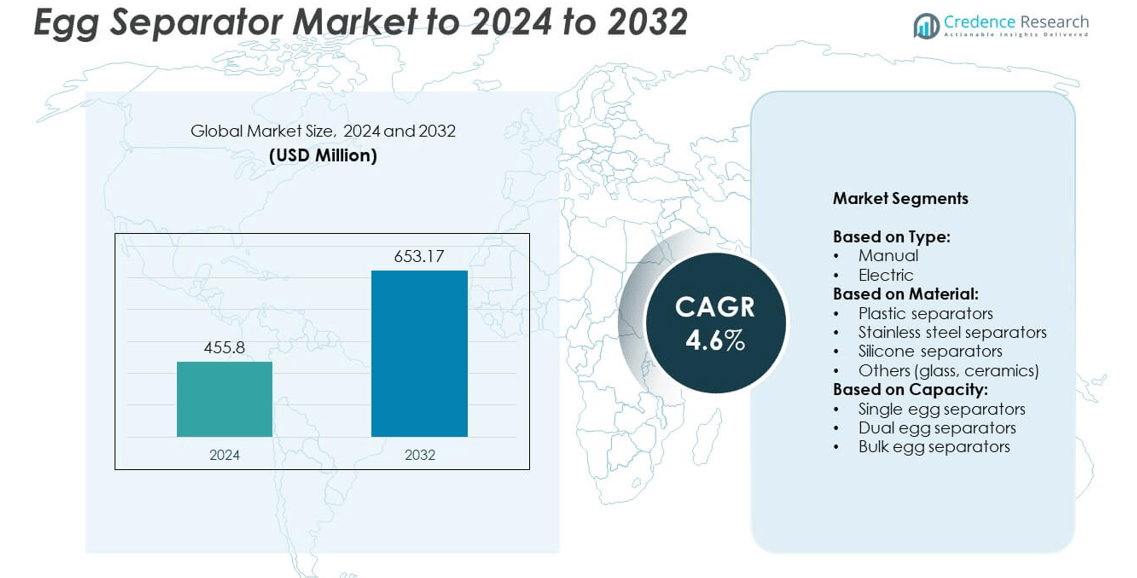
Egg Separator Market size was valued at USD 455.8 million in 2024 and is anticipated to reach USD 653.17 million by 2032, at a CAGR of 4.6% during the forecast period.
| REPORT ATTRIBUTE | DETAILS |
|---|---|
| Historical Period | 2020-2023 |
| Base Year | 2024 |
| Forecast Period | 2025-2032 |
| Egg Separator Market Size 2024 | USD 455.8 million |
| Egg Separator Market, CAGR | 4.6% |
| Egg Separator Market Size 2032 | USD 653.17 million |
The egg separator market is led by key players such as KitchenAid, Joseph Joseph, Oxo, Cuisinart, Sanovo, Rösle, Tovolo, Le Creuset, Moba, and Cuisipro. These companies focus on enhancing design efficiency, hygiene standards, and material durability to meet both household and commercial needs. Innovation in automated and high-capacity separators continues to strengthen their global presence. North America emerged as the leading region in 2024, accounting for 34% of the global market share, supported by strong demand from food processing facilities and home kitchens. Europe and Asia-Pacific followed, driven by expanding bakery industries and rising automation adoption.
Market Insights
- The egg separator market was valued at USD 455.8 million in 2024 and is projected to reach USD 653.17 million by 2032, growing at a CAGR of 4.6%.
- Rising demand from the food processing and bakery industries is driving market growth, supported by the adoption of automated and hygienic separation tools.
- Technological advancements in electric separators and the growing trend of home baking are shaping market dynamics.
- The market is moderately competitive, with major players focusing on product innovation, ergonomic designs, and eco-friendly materials to strengthen brand positioning.
- North America led the market with a 34% share in 2024, followed by Europe at 28% and Asia-Pacific at 25%, while the electric separator segment held the dominant 60% share globally.
Market Segmentation Analysis:
By Type
The electric egg separator segment dominated the market in 2024, accounting for around 60% of the total share. Electric separators are preferred in commercial kitchens and food processing facilities due to their high speed and precision. They minimize manual handling, ensuring better hygiene and consistency in large-scale operations. Growing automation in the food industry and the rising demand for ready-to-eat products further boost their adoption. Manual separators remain popular among households and small bakeries due to affordability and ease of use, but their share continues to decline with the expansion of automated systems.
- For instance, Gondor Machinery’s automatic egg breaker & yolk separator machine offers outputs from 2,700 to 10,800 eggs per hour, enabling continuous operation in food processing plants.
By Material
Stainless steel separators held the largest market share of approximately 45% in 2024, driven by their durability, corrosion resistance, and easy maintenance. Their hygienic properties make them ideal for professional kitchens and food manufacturing plants. Stainless steel models also meet food safety standards, reducing contamination risks. Plastic separators, although cheaper and lighter, are more common in home use but face sustainability concerns. Silicone separators are gaining attention for their flexibility and non-stick features, while glass and ceramic options serve niche users focused on aesthetic appeal and eco-friendly materials.
- For instance, the ALEB-4 eggshell & liquid separating machine uses food-grade 304 stainless steel and achieves a liquid egg gain rate of 99 % in operation.
By Capacity
Bulk egg separators dominated the market in 2024, capturing nearly 55% of the global share. Their ability to process large egg volumes quickly makes them essential in bakeries, confectionery units, and large-scale food production. These separators enhance operational efficiency and reduce labor dependency, aligning with the growing trend of industrial food automation. Single and dual egg separators serve domestic and small business users where smaller capacities suffice. Rising commercial food demand and catering services continue to drive bulk separator sales, supported by technological innovations that improve speed and separation accuracy.
Key Growth Drivers
Rising Demand from Food Processing Industry
The expansion of the food processing industry is a primary growth driver for the egg separator market. Increasing demand for processed and bakery products has boosted the adoption of automatic egg separators to improve efficiency and hygiene. Commercial kitchens and large-scale manufacturers prefer electric models for their precision and reduced labor dependency. As global bakery, confectionery, and ready-to-eat product consumption continues to rise, the need for automated egg separation systems is expected to grow steadily.
- For instance, an egg breaker & separator system can be cleaned automatically, feature Schneider electrical parts, and handle 24,000 eggs per hour.
Growing Focus on Food Safety and Hygiene
Heightened awareness of food safety regulations has increased the use of hygienic food-handling tools. Stainless steel and silicone-based egg separators are gaining traction due to their easy cleaning and non-contaminating properties. Food manufacturers are shifting to automated separators to meet hygiene certifications and avoid manual contact during egg handling. This shift aligns with strict quality assurance standards imposed by food safety authorities, especially in North America and Europe.
- For instance, some industrial separators achieve capacities of 20,000 to 25,000 eggs per hour in liquid-egg and shell separation.
Rising Household Baking and Home Cooking Trends
The growth in home baking and cooking culture, fueled by social media and e-commerce, has boosted manual and small electric separator demand. Consumers prefer tools that simplify egg handling, especially in home baking, confectionery, and DIY food preparation. Manufacturers are launching compact, affordable, and dishwasher-safe separators to cater to these needs. The growing popularity of home-based food businesses and online baking influencers further supports this trend.
Key Trends & Opportunities
Technological Advancements in Automation
Automation is reshaping the egg separator market through the introduction of high-speed, sensor-based systems. Manufacturers are developing machines that can separate eggs with greater accuracy and minimal breakage. Integration of IoT-enabled monitoring in industrial separators improves productivity and quality control. The shift toward smart kitchen appliances in both commercial and residential sectors offers growth opportunities for advanced egg separation devices.
- For instance, some integrated egg processing lines, which incorporate multiple machines working together, can achieve daily throughputs exceeding 2 million eggs in commercial production.
Sustainability and Material Innovation
Eco-friendly materials like recyclable plastics, stainless steel, and food-grade silicone are driving innovation. Manufacturers are reducing the use of non-recyclable components to meet environmental standards and consumer expectations. Sustainable packaging and long-lasting materials enhance product value and brand reputation. This trend also supports the broader movement toward sustainable kitchen tools, offering differentiation opportunities for premium brands.
- For instance, a high-efficiency egg liquid & shell separator by HENTO uses 304 stainless steel with separation rates of 97–99 %.
Expansion in E-commerce Distribution
The rapid rise of e-commerce platforms has opened new opportunities for egg separator sales globally. Online retail offers access to a wider consumer base, particularly in emerging economies. Product reviews, demonstration videos, and direct-to-consumer marketing improve visibility and trust. The trend supports both established brands and new entrants by lowering distribution costs and increasing global reach.
Key Challenges
High Competition from Low-Cost Alternatives
The presence of inexpensive, low-quality separators from unorganized manufacturers poses a major challenge. These products attract budget-conscious consumers, particularly in developing markets, affecting brand profitability. Leading companies face pressure to balance quality with competitive pricing while maintaining durability standards. This competition limits market penetration for premium electric and stainless-steel separators.
Limited Awareness in Emerging Regions
Lack of product awareness and low adoption rates in rural or developing areas restrict market expansion. Many small-scale bakeries and households continue to rely on manual egg separation methods. Insufficient marketing and high initial costs of electric models further slow adoption. Manufacturers must invest in awareness campaigns and affordable product variants to capture untapped regional markets.
Regional Analysis
North America
North America held the largest share of 34% in the egg separator market in 2024. The region’s dominance is driven by advanced food processing infrastructure and strong demand for automated kitchen appliances. The United States leads consumption, supported by a thriving bakery and packaged food industry. High adoption of electric and stainless-steel separators in commercial kitchens enhances efficiency and hygiene. Increasing home baking activities and strong online retail networks further boost sales. Favorable food safety regulations and continuous innovation in kitchen technology continue to strengthen the regional market outlook.
Europe
Europe accounted for 28% of the global market share in 2024, supported by a mature food processing sector and strict hygiene standards. Countries such as Germany, France, and the UK have a well-established bakery and confectionery industry that drives electric separator demand. Manufacturers focus on high-quality stainless-steel and silicone models to meet EU safety requirements. Rising adoption of sustainable materials aligns with Europe’s environmental policies. Growing popularity of small home appliances and increased consumer preference for efficient kitchen tools sustain steady growth across residential and commercial applications.
Asia-Pacific
Asia-Pacific captured around 25% of the egg separator market in 2024, emerging as the fastest-growing region. Rapid urbanization, rising disposable incomes, and expanding bakery and restaurant chains drive product demand. China, Japan, and India lead adoption due to increasing food production automation and home cooking trends. Affordable plastic and silicone separators dominate household use, while electric bulk models are gaining traction in commercial settings. Local manufacturers are enhancing product quality and distribution networks, supported by strong e-commerce growth and rising awareness of hygiene standards.
Latin America
Latin America held an 8% share of the egg separator market in 2024. The region’s growth is supported by expanding bakery and confectionery industries in Brazil, Mexico, and Argentina. Affordable manual and plastic separators dominate, though electric models are gaining attention in urban areas. Increasing investment in food processing and small commercial kitchens supports moderate market expansion. However, limited consumer awareness and lower automation rates hinder wider adoption. The growth of retail chains and online marketplaces is expected to gradually improve product penetration and regional competitiveness.
Middle East & Africa
The Middle East & Africa accounted for a 5% share of the global market in 2024. Growth is driven by rising demand from the hospitality and catering industries in Gulf countries and South Africa. Food safety regulations and the expansion of modern restaurants are encouraging the use of hygienic egg separation tools. Manual and mid-capacity separators remain prevalent, but electric models are gaining popularity in commercial kitchens. Limited local manufacturing and higher import dependence restrain rapid growth, though improving awareness and food sector investments support a steady market outlook.
Market Segmentations:
By Type:
- Manual
- Electric
By Material:
- Plastic separators
- Stainless steel separators
- Silicone separators
- Others (glass, ceramics)
By Capacity:
- Single egg separators
- Dual egg separators
- Bulk egg separators
By Geography
- North America
- U.S.
- Canada
- Mexico
- Europe
- UK
- France
- Germany
- Italy
- Spain
- Russia
- Rest of Europe
- Asia Pacific
- China
- Japan
- South Korea
- India
- Australia
- Southeast Asia
- Rest of Asia Pacific
- Latin America
- Brazil
- Argentina
- Rest of Latin America
- Middle East
- GCC Countries
- Israel
- Turkey
- Rest of Middle East
- Africa
- South Africa
- Egypt
- Rest of Africa
Competitive Landscape
The egg separator market is highly competitive, with leading players such as KitchenAid, Joseph Joseph, Oxo, Cuisinart, Sanovo, Rösle, Tovolo, Le Creuset, Moba, Cuisipro, Trudeau, Kuhn Rikon, Good Cook, Pelbo, MSC International, IKEA, Norpro, Prepworks by Progressive, and Chef’n driving innovation and market expansion. The competition is shaped by product differentiation, material innovation, and pricing strategies across both manual and electric segments. Companies emphasize design improvements, ergonomic handling, and hygienic materials to meet evolving consumer preferences. Many players focus on expanding product availability through e-commerce and retail partnerships. Technological advancements, such as automated and high-capacity separators, are helping brands strengthen their foothold in commercial applications. Meanwhile, sustainability initiatives, including recyclable materials and long-lasting product designs, are becoming key factors influencing market positioning. The market remains fragmented, with global brands competing alongside regional manufacturers targeting affordability and accessibility in emerging economies.
Key Player Analysis
- KitchenAid
- Joseph Joseph
- Oxo
- Cuisinart
- Sanovo
- Rösle
- Tovolo
- Le Creuset
- Moba
- Cuisipro
- Trudeau
- Kuhn Rikon
- Good Cook
- Pelbo
- MSC International
- IKEA
- Norpro
- Prepworks by Progressive
- Chef'n
Recent Developments
- In 2025, Moba announced the launch of its vision-based weighing system for the unwashed egg market, leveraging the success of the washed market launch.
- In 2023, Sanovo continued to provide its advanced egg processing equipment globally, including high-capacity egg breaking and separating systems.
- In 2023, Pelbo continued to supply industrial-grade egg breaking and separating machines to large-scale egg processors.
Report Coverage
The research report offers an in-depth analysis based on Type, Material, Capacity and Geography. It details leading market players, providing an overview of their business, product offerings, investments, revenue streams, and key applications. Additionally, the report includes insights into the competitive environment, SWOT analysis, current market trends, as well as the primary drivers and constraints. Furthermore, it discusses various factors that have driven market expansion in recent years. The report also explores market dynamics, regulatory scenarios, and technological advancements that are shaping the industry. It assesses the impact of external factors and global economic changes on market growth. Lastly, it provides strategic recommendations for new entrants and established companies to navigate the complexities of the market.
Future Outlook
- The egg separator market will experience steady growth driven by rising food automation.
- Increasing adoption of electric separators will enhance efficiency in commercial kitchens.
- Demand for hygienic and stainless-steel models will grow with stricter food safety norms.
- Home baking and small food business expansion will boost sales of manual separators.
- E-commerce platforms will continue to widen product access and consumer reach.
- Innovation in smart and sensor-based separators will improve accuracy and usability.
- Manufacturers will focus on eco-friendly, durable, and recyclable material designs.
- Asia-Pacific will emerge as a key growth hub due to industrial and household adoption.
- Partnerships with food equipment distributors will strengthen global market presence.
- Product customization and compact designs will attract household and professional users alike.

Request a Free Sample
Fill in your details and we'll send you a free sample report.
- Sample data tables & charts
- Research methodology
Need a Custom Version of This Report?
Tailor the scope, geography, or segments to your exact requirements.
- Custom geography or segment scope
- Direct access to our analyst team
Frequently Asked Questions
What is the current market size for Egg Separator Market, and what is its projected size in 2032?
At what Compound Annual Growth Rate is the Egg Separator Market projected to grow between 2025 and 2032?
Which Egg Separator Market segment held the largest share in 2024?
What are the primary factors fueling the growth of the Egg Separator Market?
Who are the leading companies in the Egg Separator Market?
Table of Content
Chapter 1 Market Segmentation
- 1.1 Segmentation Framework
- 1.1.1 Product and Service Classification
- 1.1.2 Application and End-Use Classification
- 1.1.3 Technology and Solution Classification
- 1.1.4 Customer and Distribution Channel Classification
- 1.1.5 Geographic Segmentation
- 1.1.6 Market Segment Definitions and Boundaries
Chapter 2 Introduction
- 2.1 Report Objectives and Scope
- 2.2 Product Definition and Industry Terminology
- 2.3 Market Inclusions and Exclusions
- 2.4 Research Process
- 2.4.1 Primary Research and Expert Interviews
- 2.4.2 Secondary Research and Source Review
- 2.4.3 Top-Down and Bottom-Up Estimation
- 2.4.4 Data Triangulation and Verification
- 2.5 Market Size Measurement Basis
- 2.5.1 2024: USD 455.8 million → 2032: USD 653.17 million
- 2.6 Historical and Forecast Reference Periods
- 2.6.1 Base Year: 2024
- 2.6.2 Forecast Period: 2024-2032
- 2.7 Research Assumptions and Limitations
Chapter 3 Executive Summary
- 3.1 Market Snapshot and Key Findings
- 3.2 Base-Year Market Size, 2024
- 3.3 Forecast Market Size, 2032
- 3.4 Revenue and Volume Growth Outlook
- 3.5 Key Demand and Supply Indicators
- 3.6 Leading Market Segments
- 3.7 Fastest-Growing Market Opportunities
- 3.8 Regional Performance Highlights
- 3.9 Technology and Industry Transformation
- 3.10 Competitive Landscape Summary
- 3.11 Analyst View and Strategic Implications
Chapter 4 Global Egg Separator Market Trends and Developments
- 4.1 Historical Industry Development
- 4.2 Recent Market Trends and Developments
- 4.3 Demand and Customer Behavior Trends
- 4.4 Technology and Product Innovation
- 4.5 Artificial Intelligence, Automation and Digitalization
- 4.6 Local Manufacturing and Supply Chain Realignment
- 4.7 Industry Partnerships, Mergers and Acquisitions
- 4.8 Sustainability and Circular Economy Developments
- 4.9 Government and Private Sector Investment Trends
- 4.10 Emerging Business Models and Commercialization
- 4.11 Industry Developments and Announcements
Chapter 5 Global Egg Separator Market Production, Supply and Demand Analysis
- 5.1 Demand Trend and Consumption Analysis
- 5.2 Demand Forecast, 2024-2032
- 5.3 Production and Output Trend
- 5.4 Production and Output Forecast, 2024-2032
- 5.5 Installed Capacity and Capacity Utilization
- 5.6 Company-Wise Production Plants and Statistics
- 5.6.1 Installed Production Capacity
- 5.6.2 Actual Production
- 5.6.3 Planned Capacity and Expansion Targets
- 5.7 Supply Chain Structure and Procurement Trends
- 5.8 Supply-Demand Gap and Bottlenecks
- 5.9 Import Dependence and Sourcing Structure
- 5.10 Contract Manufacturing and Outsourcing
- 5.11 Regional Supply and Demand Concentration
Chapter 6 Global Egg Separator Market Pricing Analysis
- 6.1 Pricing Structure and Measurement
- 6.2 Historical Pricing Trends
- 6.3 Pricing Outlook, 2024-2032
- 6.4 Average Selling Price and Unit Economics
- 6.5 Pricing by Product and Market Segment
- 6.6 Geographic Pricing Differences
- 6.7 Key Input, Energy, Labor and Logistics Costs
- 6.8 Contract Pricing and Purchasing Models
- 6.9 Pricing Sensitivity and Competitive Positioning
- 6.10 Price, Margin and Profitability Implications
Chapter 7 Global Egg Separator Market Dynamics
- 7.1 Market Growth Drivers
- 7.1.1 Demand-Side Drivers
- 7.1.2 Technology and Innovation Drivers
- 7.1.3 Infrastructure and Investment Drivers
- 7.1.4 Regulatory and Policy Drivers
- 7.2 Market Restraints
- 7.2.1 Cost and Affordability Constraints
- 7.2.2 Technology and Adoption Barriers
- 7.2.3 Supply Chain and Operational Constraints
- 7.3 Market Challenges
- 7.3.1 Competitive Pressure and Margin Erosion
- 7.3.2 Skills, Infrastructure and Implementation Gaps
- 7.4 Emerging Market Opportunities
- 7.5 Market Dynamics Impact and Time-Horizon Assessment
Chapter 8 Global Egg Separator Value Chain Analysis
- 8.1 Industry Value Chain Overview
- 8.2 Upstream Suppliers and Critical Inputs
- 8.3 Technology and Component Providers
- 8.4 Manufacturing or Service Delivery
- 8.5 Distribution, Channel Partners and Integrators
- 8.6 Downstream Applications and End Users
- 8.7 Value Addition and Profit Pools
- 8.8 Vertical Integration and Outsourcing
- 8.9 Supplier Concentration and Risk
- 8.10 Supply Chain Localization and Resilience
Chapter 9 Global Egg Separator Market Regulations and Policies
- 9.1 Relevant Laws, Standards and Compliance Frameworks
- 9.2 Product, Service, Safety and Quality Requirements
- 9.3 Government Policies, Incentives and Subsidies
- 9.4 Imports, Exports and Trade Barriers
- 9.5 Public Procurement and Local Content Requirements
- 9.6 Environmental and Sustainability Compliance
- 9.7 Upcoming Policy Changes and Market Implications
Chapter 10 Global Egg Separator Market Hotspots and Opportunities
- 10.1 Market Opportunity Mapping and Growth Hotspots
- 10.2 High-Growth Applications and Customer Groups
- 10.3 Underserved Markets and White-Space Opportunities
- 10.4 Emerging Technology and Product Opportunities
- 10.5 New Capacity and Investment Hotspots
- 10.6 Market Entry and Expansion Opportunities
- 10.7 Distribution and Partnership Opportunities
- 10.8 Near-Term and Long-Term Commercial Potential
- 10.9 Opportunity Attractiveness and Execution Risks
Chapter 11 Global Egg Separator Market Outlook, 2024-2032
- 11.1 Market Size and Analysis
- 11.1.1 Revenue (Market Measurement: 2024: USD 455.8 million → 2032: USD 653.17 million)
- 11.1.2 Market Volume and Quantity Sold
- 11.1.3 Historical Market Size
- 11.1.4 Base-Year Market Size, 2024
- 11.2 Market Forecast, 2024-2032
- 11.2.1 Revenue Forecast to 2032
- 11.2.2 Volume Forecast to 2032
- 11.2.3 CAGR and Year-on-Year Growth
- 11.2.4 Incremental Revenue Opportunity
- 11.3 Forecast Assumptions and Scenario Analysis
- 11.3.1 Base-Case Forecast
- 11.3.2 Optimistic and Conservative Scenarios
- 11.3.3 Technology, Pricing and Policy Sensitivities
- 11.4 Market Attractiveness and Growth Outlook
Chapter 12 Global Egg Separator Market Segmentation and Outlook
- 12.1 Segmentation Summary and Market Shares, 2024
- 12.2 Largest and Fastest-Growing Segments
- 12.3 Segment Growth Comparison
- 12.4 Segment Attractiveness and Priority Matrix
Chapter 13 Global Egg Separator Geographic Market Outlook, 2024-2032
- 13.1 Regional Market Size and Share, 2024
- 13.2 Regional Market Forecast, 2024-2032
- 13.3 Regional Pricing, Production and Demand Differences
- 13.4 North America
- 13.4.1 United States
- 13.4.2 Canada
- 13.4.3 Mexico
- 13.5 Europe
- 13.5.1 Germany
- 13.5.2 France
- 13.5.3 Italy
- 13.5.4 United Kingdom
- 13.5.5 Spain
- 13.5.6 Poland
- 13.5.7 Russia
- 13.5.8 Netherlands
- 13.5.9 Belgium
- 13.5.10 Sweden
- 13.5.11 Denmark
- 13.5.12 Norway
- 13.5.13 Rest of Europe
- 13.6 Asia Pacific
- 13.6.1 China
- 13.6.2 India
- 13.6.3 Japan
- 13.6.4 South Korea
- 13.6.5 Thailand
- 13.6.6 Indonesia
- 13.6.7 Vietnam
- 13.6.8 Malaysia
- 13.6.9 Australia
- 13.6.10 Rest of Asia Pacific
- 13.7 Latin America
- 13.7.1 Brazil
- 13.7.2 Argentina
- 13.7.3 Colombia
- 13.7.4 Chile
- 13.7.5 Rest of Latin America
- 13.8 Middle East
- 13.8.1 Saudi Arabia
- 13.8.2 United Arab Emirates
- 13.8.3 Turkey
- 13.8.4 Israel
- 13.8.5 Iran
- 13.8.6 Rest of the Middle East
- 13.9 Africa
- 13.9.1 South Africa
- 13.9.2 Egypt
- 13.9.3 Nigeria
- 13.9.4 Morocco
- 13.9.5 Rest of Africa
- 13.10 Regional Investment, Policy and Supply Chain Differences
- 13.11 Regional Competitive Landscape
- 13.12 Geographic Growth Hotspots
Chapter 14 Global Egg Separator Technology, Innovation and Sustainability Outlook
- 14.1 Technology Landscape and Maturity
- 14.2 Product, Process and Service Innovation
- 14.3 AI, Automation and Digital Tools in the Industry
- 14.4 Technology Adoption and Performance Benchmarking
- 14.5 Innovation Pipeline and R&D Investment
- 14.6 Patent and Intellectual Property Trends
- 14.7 Energy Efficiency and Resource Management
- 14.8 Sustainability, Recycling and Circularity
- 14.9 Technology Roadmap, 2024-2032
- 14.10 Risks of Obsolescence and Technology Substitution
Chapter 15 Global Egg Separator Market Key Strategic Imperatives
- 15.1 Growth and Market Entry Priorities
- 15.2 High-Return Products and Segments
- 15.3 Pricing, Profitability and Cost Optimization
- 15.4 Technology Investment and Product Differentiation
- 15.5 Supply Chain Localization and Resilience
- 15.6 Distribution and Customer Acquisition
- 15.7 Partnership, Acquisition and Capacity Strategy
- 15.8 Regional Expansion Priorities
- 15.9 Short-, Medium- and Long-Term Actions
Chapter 16 Competition Outlook
- 16.1 Industry Competition Characteristics
- 16.2 Market Structure and Concentration
- 16.3 Market Share and Competitive Positioning, 2024
- 16.4 Company-Wise Revenue and Product Benchmarking
- 16.5 Production and Service Capacity Benchmarking
- 16.6 Technology, Pricing and Differentiation
- 16.7 Regional Footprint and Distribution Strength
- 16.8 Mergers, Acquisitions and Strategic Alliances
- 16.9 New Entrants and Competitive Threats
- 16.10 Porter's Five Forces and Industry Attractiveness
- 16.11 Competitive Outlook, 2024-2032
Chapter 17 Company Profiles
- 17.1 Company Coverage and Selection Criteria
- 17.2 Leading Market Participants – Standard Profile Structure
- 17.2.1 Business Description
- 17.2.2 Company Ownership and Geographic Presence
- 17.2.3 Product and Service Portfolio
- 17.2.4 Manufacturing and Operating Footprint
- 17.2.5 Production Capacity and Expansion Plans
- 17.2.6 Financial Performance and Investment
- 17.2.7 Market Share and Competitive Position
- 17.2.8 Technology and Innovation Capabilities
- 17.2.9 Strategic Alliances or Partnerships
- 17.2.10 Recent Developments
- 17.2.11 Growth Strategy and Outlook
- 17.3 Other Relevant Market Participants
Note: Every listed company is profiled on the structure shown under the first company. The company list is preliminary and may change based on research findings, market developments, data availability and client requirements.
Chapter 18 Disclaimer
- 18.1 Research and Forecast Disclaimer
- 18.2 Data Source and Estimation Limitations
Note: The depth of individual sections depends on data availability for this market. Volume, capacity, trade and other unit-based metrics are included where applicable.