
Market Overview
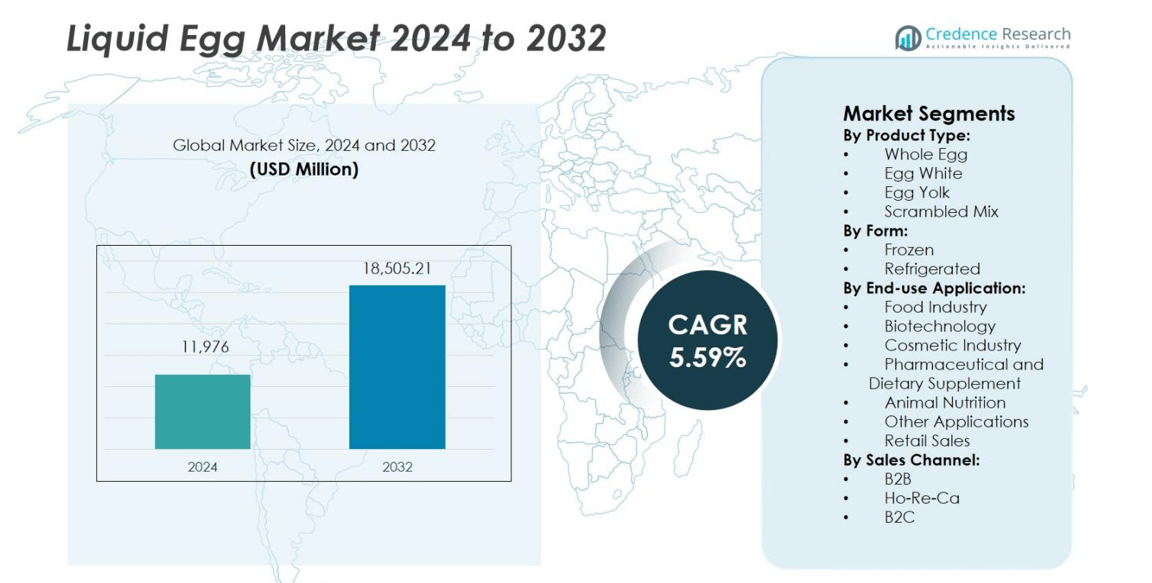
The Liquid Egg Market size was valued at USD 11,976 million in 2024 and is anticipated to reach USD 18,505.21 million by 2032, growing at a CAGR of 5.59% during the forecast period.
| REPORT ATTRIBUTE | DETAILS |
|---|---|
| Historical Period | 2020-2023 |
| Base Year | 2024 |
| Forecast Period | 2025-2032 |
| Liquid Egg Market Size 2024 | USD 11,976 million |
| Liquid Egg Market, CAGR | 5.59% |
| Liquid Egg Market Size 2032 | USD 18,505.21 million |
The Liquid Egg Market features established players including Cargill, Michael Foods, Cal-Maine Foods, Rembrandt Foods, Rose Acre Farms, Eggland’s Best, Vital Farms, Global Food Group, Nature’s Yoke, and Nest Fresh Eggs. Vendors compete on integrated sourcing, pasteurization capability, and portfolio breadth spanning cage-free, organic, and fortified lines. Strategic partnerships with bakeries, QSR chains, and retailers strengthen volume visibility and distribution reach. North America leads the market with a 34% share in 2024, supported by mature food processing and stringent safety standards. Europe follows with 28%, driven by certified and welfare-compliant supply. Asia Pacific holds 24%, benefiting from rapid urbanization, cold-chain expansion, and rising demand for convenience foods across major consuming economies.
Market Insights
- The Liquid Egg Market size was valued at USD 11,976 million in 2024 and is anticipated to reach USD 18,505.21 million by 2032, expanding at a CAGR of 5.59% during the forecast period.
- Growing demand for processed and convenience foods, especially in bakery, confectionery, and ready-meal segments, is the key driver supporting liquid egg consumption worldwide.
- Manufacturers are focusing on sustainable sourcing, organic variants, and advanced packaging innovations to extend shelf life and ensure food safety compliance.
- The market is moderately consolidated with major players such as Cargill, Michael Foods, and Cal-Maine Foods competing through product diversification, capacity expansion, and partnerships with food service and retail chains.
- Regionally, North America leads with a 34% share, followed by Europe with 28% and Asia Pacific with 24%; by product type, whole eggs dominate with 46% share due to their versatility and strong adoption in industrial food production.
Market Segmentation Analysis:
By Product Type:
The whole egg segment dominates the Liquid Egg Market, accounting for over 46% of total revenue in 2024. Its popularity stems from broad use in bakery, confectionery, and ready-to-eat meals. Food manufacturers prefer whole liquid eggs for their versatility, easy handling, and consistent quality compared to shell eggs. Growing demand for processed and convenient food products continues to drive segment growth. The egg white segment follows, supported by health-conscious consumers and rising applications in sports nutrition and low-cholesterol formulations.
- For instance, EggSolutions offers a pasteurized liquid whole egg product with extended shelf life, emphasizing convenience and food safety through pasteurization and homogenization processes.
By Form:
The refrigerated segment holds the largest share of around 58% in 2024, driven by its widespread use in food service and commercial kitchens. Refrigerated liquid eggs offer freshness, extended shelf life, and easy portion control, making them ideal for bulk use in restaurants and bakeries. Frozen liquid eggs, while smaller in share, are gaining traction in long-distance exports and industrial-scale food manufacturing due to their convenience and lower spoilage risk, supporting steady growth in global trade and logistics networks.
- For instance, Charoen Pokphand Foods (CP Foods) from Thailand has pioneered frozen pasteurized liquid whole egg exports to Japan, demonstrating the growing global trade and acceptance of frozen liquid eggs in industrial-scale food manufacturing.
By End-use Application:
The food industry segment leads the market, capturing about 61% share in 2024, as liquid eggs are essential in bakery, confectionery, sauces, and ready-meal production. Their convenience and uniform texture streamline operations for large-scale food manufacturers. The pharmaceutical and dietary supplement segment is expanding steadily, driven by the use of egg-derived bioactive compounds in nutritional and medical formulations. Biotechnology and cosmetic industries also contribute to growth, leveraging egg proteins for enzyme production, skincare, and research purposes.
Key Growth Drivers
Rising Demand for Processed and Convenience Foods
Growing consumer preference for ready-to-eat and easy-to-cook products is a major driver for the liquid egg market. Food manufacturers favor liquid eggs due to their time-saving benefits, consistent quality, and ease of integration into large-scale production. The surge in demand from bakeries, quick-service restaurants, and catering sectors supports continued adoption. Urbanization, changing lifestyles, and dual-income households are further accelerating the consumption of processed food products, driving strong market growth globally.
- For instance, Cargill Incorporated provides liquid egg products to numerous bakery and foodservice clients, enhancing product consistency and preparation efficiency.
Health and Nutritional Awareness Among Consumers
Increasing awareness about protein-rich and cholesterol-controlled diets is boosting liquid egg consumption. The product provides high-quality protein with essential amino acids while offering flexible use in fitness and diet plans. Consumers seeking alternatives to traditional shell eggs prefer pasteurized liquid eggs for hygiene and safety benefits. The popularity of egg whites in low-fat and high-protein meal plans reinforces steady demand among health-conscious individuals and athletes worldwide.
- For instance, Tsunami Nutrition's Egg White Pure Professional offers a gluten- and lactose-free egg white protein powder designed to support muscle mass development with its pure album protein formulation.
Expanding Applications Across Industries
Beyond food processing, liquid eggs are gaining traction across pharmaceutical, biotechnology, and cosmetic industries. Egg-derived compounds are used in enzyme production, vaccine formulation, and skincare ingredients. Biotech firms utilize albumin and other egg proteins for research and industrial applications. This cross-industry utilization diversifies revenue streams and enhances product demand. The growing global focus on biologically sourced materials and natural ingredients strengthens the market’s long-term outlook.
Key Trends and Opportunities
Innovation in Packaging and Shelf-Life Extension
Technological advancements in aseptic packaging and cold-chain logistics are extending product shelf life and ensuring safety. Companies are introducing resealable and portion-controlled containers to meet retail and institutional needs. These innovations enhance product convenience and minimize waste. The development of eco-friendly and recyclable packaging materials also aligns with sustainability goals, creating new opportunities for market expansion in environmentally conscious regions.
- For instance, SelectSeal Packaging Machinery offers GMP-compliant aseptic tray sealers and rollstock systems that streamline packaging in the medical and food sectors, enhancing product sterility and shelf stability.
Rising Penetration of Online and Retail Channels
E-commerce and organized retail networks are expanding access to liquid eggs across emerging markets. Consumers increasingly purchase liquid eggs through online platforms for home use, driven by convenience and product availability. Retail chains are introducing private-label brands and fortified variants to capture health-oriented customers. The rapid digitalization of grocery shopping and efficient last-mile delivery systems are further supporting retail sales growth in urban areas.
- For instance, Noble Foods expanded its liquid egg product line from foodservice to retail with its brand "The Great British Egg Co.," offering 500g cartons equivalent to 10 shell eggs. This move was aimed to capture consumer demand, especially during the pandemic when more meals were prepared at home.
Key Challenges
Short Shelf Life and Cold Chain Dependence
Despite advancements, liquid eggs remain highly perishable and dependent on temperature-controlled storage. Inadequate cold-chain infrastructure, especially in developing regions, leads to spoilage and supply disruptions. This limitation restricts expansion in rural and export markets. Maintaining product quality during long-distance transportation adds logistical complexity and operational costs, posing a major hurdle for market players aiming for global reach.
Fluctuating Raw Material Prices and Disease Outbreaks
Price volatility in raw eggs significantly affects production costs for liquid egg manufacturers. Supply chain instability caused by bird flu or avian influenza outbreaks can lead to sharp price hikes and production delays. These biological and economic risks hinder consistent market performance. Ensuring stable sourcing and disease-free poultry operations remains essential to maintaining profitability and safeguarding product availability worldwide.
Regional Analysis
North America
North America dominates the Liquid Egg Market with a market share of 34% in 2024. Strong demand from the bakery, confectionery, and food service industries supports this leadership. The U.S. remains the largest contributor, driven by widespread adoption of pasteurized liquid eggs in restaurants and industrial food processing. Consumers’ growing preference for convenience and protein-rich diets further stimulates market growth. Strict food safety regulations and innovations in packaging and cold-chain logistics ensure consistent quality and extended shelf life, strengthening regional competitiveness in both domestic and export markets.
Europe
Europe holds a market share of 28% in 2024, supported by well-established bakery and processed food industries. The region emphasizes food safety, animal welfare, and sustainable production, driving demand for certified and cage-free liquid egg products. Countries such as Germany, France, and the U.K. are key markets with rising adoption in ready-to-eat and confectionery sectors. The presence of advanced cold storage facilities and established distribution networks further facilitates market growth. Ongoing innovations in packaging and increasing consumer awareness about high-protein diets continue to strengthen the regional demand outlook.
Asia Pacific
The Asia Pacific region accounts for a market share of 24% in 2024 and is expected to witness the fastest growth during the forecast period. Rapid urbanization, rising disposable incomes, and growing demand for processed foods drive strong market expansion. China, Japan, and India lead consumption, fueled by evolving dietary habits and a shift toward convenience-based meals. The region’s expanding food manufacturing sector and growing interest in protein-enriched products support long-term growth. Investments in cold-chain logistics and modernization of poultry processing facilities are further enhancing the availability and affordability of liquid eggs.
Latin America
Latin America represents a market share of 8% in 2024, primarily driven by rising adoption of processed and convenience food products. Brazil and Mexico dominate regional demand due to their expanding bakery and food service industries. The region’s growing middle-class population, increasing protein awareness, and improved food distribution infrastructure are supporting steady growth. However, limited cold storage capacity and fluctuating poultry supply remain key challenges. Manufacturers are increasingly investing in domestic production and export-oriented facilities to capture emerging opportunities in neighboring markets and strengthen the regional supply chain.
Middle East & Africa
The Middle East & Africa hold a market share of 6% in 2024, driven by rising demand from the hospitality, catering, and retail sectors. The United Arab Emirates, Saudi Arabia, and South Africa are leading markets supported by urbanization and a growing tourism industry. Increasing imports of processed eggs to meet domestic consumption needs highlight supply gaps in local production. Expanding food service chains and improved logistics infrastructure are creating opportunities for regional market players. Ongoing efforts to enhance food security and local poultry processing are expected to strengthen market growth over time.
Market Segmentations:
By Product Type:
- Whole Egg
- Egg White
- Egg Yolk
- Scrambled Mix
By Form:
- Frozen
- Refrigerated
By End-use Application:
- Food Industry
- Biotechnology
- Cosmetic Industry
- Pharmaceutical and Dietary Supplement
- Animal Nutrition
- Other Applications
- Retail Sales
By Sales Channel:
- B2B
- Ho-Re-Ca
- B2C
By Region
- North America
- U.S.
- Canada
- Mexico
- Europe
- Germany
- France
- U.K.
- Italy
- Spain
- Rest of Europe
- Asia Pacific
- China
- Japan
- India
- South Korea
- South-east Asia
- Rest of Asia Pacific
- Latin America
- Brazil
- Argentina
- Rest of Latin America
- Middle East & Africa
- GCC Countries
- South Africa
- Rest of the Middle East and Africa
Competitive Landscape
The competitive landscape of the Liquid Egg Market features major players such as Cargill, Rembrandt Foods, Eggland’s Best, Vital Farms, Rose Acre Farms, Michael Foods, Cal-Maine Foods, Global Food Group, Nature’s Yoke, and Nest Fresh Eggs. The market is moderately consolidated, with established producers focusing on large-scale operations and integrated supply chains. Companies compete through innovations in packaging, shelf-life enhancement, and product diversification, including organic, cage-free, and fortified liquid egg variants. Strategic partnerships with food manufacturers and retail chains strengthen market penetration. Continuous investment in cold-chain logistics, food safety certifications, and sustainability initiatives further enhances brand credibility. Rising consumer preference for high-protein, convenience-based, and ethically sourced products is pushing key manufacturers to expand processing capacity and adopt eco-friendly production practices to maintain a competitive edge globally.
Key Player Analysis
- Cargill
- Rembrandt Foods
- Eggland’s Best
- Vital Farms
- Rose Acre Farms
- Michael Foods
- Cal-Maine Foods
- Global Food Group
- Nature’s Yoke
- Nest Fresh Eggs
Recent Developments
- In June 2025, Cal-Maine Foods finalized an agreement to acquire Echo Lake Foods for $258 million, strengthening its presence in the value-added egg segment. The acquisition enhances Cal-Maine’s retail and foodservice relationships and is expected to positively influence its 2026 performance.
- In June 2025, Hardeman Egg Group acquired Bumble Hole Foods, creating a fully integrated leader in the UK egg products market and expanding its offerings across liquid whole egg, yolk, and white categories.
- In November 2024, APF Holdings inaugurated a new production facility focused on liquid egg mass, egg white, yolk, and whole-egg blend products, boosting its production capacity and support for the food manufacturing sector
Report Coverage
The research report offers an in-depth analysis based on Product Type, Form, End Use Application, Sales Channel and Region. It details leading market players, providing an overview of their business, product offerings, investments, revenue streams, and key applications. Additionally, the report includes insights into the competitive environment, SWOT analysis, current market trends, as well as the primary drivers and constraints. Furthermore, it discusses various factors that have driven market expansion in recent years. The report also explores market dynamics, regulatory scenarios, and technological advancements that are shaping the industry. It assesses the impact of external factors and global economic changes on market growth. Lastly, it provides strategic recommendations for new entrants and established companies to navigate the complexities of the market.
Future Outlook
- The liquid egg market will grow steadily with increasing demand for processed and convenience foods.
- Rising health awareness will drive consumption of protein-rich and low-cholesterol egg products.
- Technological advancements in packaging will extend product shelf life and improve distribution efficiency.
- Expanding cold-chain infrastructure will enhance product availability in emerging markets.
- Growing adoption of cage-free and organic eggs will influence product innovation and labeling trends.
- Food service and bakery sectors will continue to dominate market demand worldwide.
- Online retail platforms will play a larger role in expanding consumer access to liquid eggs.
- Partnerships between egg producers and food processors will strengthen global supply chains.
- Increasing applications in biotechnology, pharmaceuticals, and cosmetics will open new growth avenues.
- Sustainability-focused production and eco-friendly packaging will remain key strategic priorities for leading companies.

Request a Free Sample
Fill in your details and we'll send you a free sample report.
- Sample data tables & charts
- Research methodology
Need a Custom Version of This Report?
Tailor the scope, geography, or segments to your exact requirements.
- Custom geography or segment scope
- Direct access to our analyst team
Frequently Asked Questions
What is the current market size for the Liquid Egg Market, and what is its projected size in 2032?
At what Compound Annual Growth Rate is the Liquid Egg Market projected to grow between 2025 and 2032?
Which Liquid Egg Market segment held the largest share in 2024?
What are the primary factors fueling the growth of the Liquid Egg Market?
Who are the leading companies in the Liquid Egg Market?
Which region commanded the largest share of the Liquid Egg Market in 2024?
Table of Content
Chapter 1 Market Segmentation
- 1.1 Segmentation Framework
- 1.1.1 Product and Service Classification
- 1.1.2 Application and End-Use Classification
- 1.1.3 Technology and Solution Classification
- 1.1.4 Customer and Distribution Channel Classification
- 1.1.5 Geographic Segmentation
- 1.1.6 Market Segment Definitions and Boundaries
Chapter 2 Introduction
- 2.1 Report Objectives and Scope
- 2.2 Product Definition and Industry Terminology
- 2.3 Market Inclusions and Exclusions
- 2.4 Research Process
- 2.4.1 Primary Research and Expert Interviews
- 2.4.2 Secondary Research and Source Review
- 2.4.3 Top-Down and Bottom-Up Estimation
- 2.4.4 Data Triangulation and Verification
- 2.5 Market Size Measurement Basis
- 2.5.1 2024: USD 11,976 million → 2032: USD 18,505.21 million
- 2.6 Historical and Forecast Reference Periods
- 2.6.1 Base Year: 2024
- 2.6.2 Forecast Period: 2024-2032
- 2.7 Research Assumptions and Limitations
Chapter 3 Executive Summary
- 3.1 Market Snapshot and Key Findings
- 3.2 Base-Year Market Size, 2024
- 3.3 Forecast Market Size, 2032
- 3.4 Revenue and Volume Growth Outlook
- 3.5 Key Demand and Supply Indicators
- 3.6 Leading Market Segments
- 3.7 Fastest-Growing Market Opportunities
- 3.8 Regional Performance Highlights
- 3.9 Technology and Industry Transformation
- 3.10 Competitive Landscape Summary
- 3.11 Analyst View and Strategic Implications
Chapter 4 Global Liquid Egg Market Trends and Developments
- 4.1 Historical Industry Development
- 4.2 Recent Market Trends and Developments
- 4.3 Demand and Customer Behavior Trends
- 4.4 Technology and Product Innovation
- 4.5 Artificial Intelligence, Automation and Digitalization
- 4.6 Local Manufacturing and Supply Chain Realignment
- 4.7 Industry Partnerships, Mergers and Acquisitions
- 4.8 Sustainability and Circular Economy Developments
- 4.9 Government and Private Sector Investment Trends
- 4.10 Emerging Business Models and Commercialization
- 4.11 Industry Developments and Announcements
Chapter 5 Global Liquid Egg Market Production, Supply and Demand Analysis
- 5.1 Demand Trend and Consumption Analysis
- 5.2 Demand Forecast, 2024-2032
- 5.3 Production and Output Trend
- 5.4 Production and Output Forecast, 2024-2032
- 5.5 Installed Capacity and Capacity Utilization
- 5.6 Company-Wise Production Plants and Statistics
- 5.6.1 Installed Production Capacity
- 5.6.2 Actual Production
- 5.6.3 Planned Capacity and Expansion Targets
- 5.7 Supply Chain Structure and Procurement Trends
- 5.8 Supply-Demand Gap and Bottlenecks
- 5.9 Import Dependence and Sourcing Structure
- 5.10 Contract Manufacturing and Outsourcing
- 5.11 Regional Supply and Demand Concentration
Chapter 6 Global Liquid Egg Market Pricing Analysis
- 6.1 Pricing Structure and Measurement
- 6.2 Historical Pricing Trends
- 6.3 Pricing Outlook, 2024-2032
- 6.4 Average Selling Price and Unit Economics
- 6.5 Pricing by Product and Market Segment
- 6.6 Geographic Pricing Differences
- 6.7 Key Input, Energy, Labor and Logistics Costs
- 6.8 Contract Pricing and Purchasing Models
- 6.9 Pricing Sensitivity and Competitive Positioning
- 6.10 Price, Margin and Profitability Implications
Chapter 7 Global Liquid Egg Market Dynamics
- 7.1 Market Growth Drivers
- 7.1.1 Demand-Side Drivers
- 7.1.2 Technology and Innovation Drivers
- 7.1.3 Infrastructure and Investment Drivers
- 7.1.4 Regulatory and Policy Drivers
- 7.2 Market Restraints
- 7.2.1 Cost and Affordability Constraints
- 7.2.2 Technology and Adoption Barriers
- 7.2.3 Supply Chain and Operational Constraints
- 7.3 Market Challenges
- 7.3.1 Competitive Pressure and Margin Erosion
- 7.3.2 Skills, Infrastructure and Implementation Gaps
- 7.4 Emerging Market Opportunities
- 7.5 Market Dynamics Impact and Time-Horizon Assessment
Chapter 8 Global Liquid Egg Value Chain Analysis
- 8.1 Industry Value Chain Overview
- 8.2 Upstream Suppliers and Critical Inputs
- 8.3 Technology and Component Providers
- 8.4 Manufacturing or Service Delivery
- 8.5 Distribution, Channel Partners and Integrators
- 8.6 Downstream Applications and End Users
- 8.7 Value Addition and Profit Pools
- 8.8 Vertical Integration and Outsourcing
- 8.9 Supplier Concentration and Risk
- 8.10 Supply Chain Localization and Resilience
Chapter 9 Global Liquid Egg Market Regulations and Policies
- 9.1 Relevant Laws, Standards and Compliance Frameworks
- 9.2 Product, Service, Safety and Quality Requirements
- 9.3 Government Policies, Incentives and Subsidies
- 9.4 Imports, Exports and Trade Barriers
- 9.5 Public Procurement and Local Content Requirements
- 9.6 Environmental and Sustainability Compliance
- 9.7 Upcoming Policy Changes and Market Implications
Chapter 10 Global Liquid Egg Market Hotspots and Opportunities
- 10.1 Market Opportunity Mapping and Growth Hotspots
- 10.2 High-Growth Applications and Customer Groups
- 10.3 Underserved Markets and White-Space Opportunities
- 10.4 Emerging Technology and Product Opportunities
- 10.5 New Capacity and Investment Hotspots
- 10.6 Market Entry and Expansion Opportunities
- 10.7 Distribution and Partnership Opportunities
- 10.8 Near-Term and Long-Term Commercial Potential
- 10.9 Opportunity Attractiveness and Execution Risks
Chapter 11 Global Liquid Egg Market Outlook, 2024-2032
- 11.1 Market Size and Analysis
- 11.1.1 Revenue (Market Measurement: 2024: USD 11,976 million → 2032: USD 18,505.21 million)
- 11.1.2 Market Volume and Quantity Sold
- 11.1.3 Historical Market Size
- 11.1.4 Base-Year Market Size, 2024
- 11.2 Market Forecast, 2024-2032
- 11.2.1 Revenue Forecast to 2032
- 11.2.2 Volume Forecast to 2032
- 11.2.3 CAGR and Year-on-Year Growth
- 11.2.4 Incremental Revenue Opportunity
- 11.3 Forecast Assumptions and Scenario Analysis
- 11.3.1 Base-Case Forecast
- 11.3.2 Optimistic and Conservative Scenarios
- 11.3.3 Technology, Pricing and Policy Sensitivities
- 11.4 Market Attractiveness and Growth Outlook
Chapter 12 Global Liquid Egg Market Segmentation and Outlook
- 12.1 Segmentation Summary and Market Shares, 2024
- 12.2 Largest and Fastest-Growing Segments
- 12.3 Segment Growth Comparison
- 12.4 Segment Attractiveness and Priority Matrix
Chapter 13 Global Liquid Egg Geographic Market Outlook, 2024-2032
- 13.1 Regional Market Size and Share, 2024
- 13.2 Regional Market Forecast, 2024-2032
- 13.3 Regional Pricing, Production and Demand Differences
- 13.4 North America
- 13.4.1 United States
- 13.4.2 Canada
- 13.4.3 Mexico
- 13.5 Europe
- 13.5.1 Germany
- 13.5.2 France
- 13.5.3 Italy
- 13.5.4 United Kingdom
- 13.5.5 Spain
- 13.5.6 Poland
- 13.5.7 Russia
- 13.5.8 Netherlands
- 13.5.9 Belgium
- 13.5.10 Sweden
- 13.5.11 Denmark
- 13.5.12 Norway
- 13.5.13 Rest of Europe
- 13.6 Asia Pacific
- 13.6.1 China
- 13.6.2 India
- 13.6.3 Japan
- 13.6.4 South Korea
- 13.6.5 Thailand
- 13.6.6 Indonesia
- 13.6.7 Vietnam
- 13.6.8 Malaysia
- 13.6.9 Australia
- 13.6.10 Rest of Asia Pacific
- 13.7 Latin America
- 13.7.1 Brazil
- 13.7.2 Argentina
- 13.7.3 Colombia
- 13.7.4 Chile
- 13.7.5 Rest of Latin America
- 13.8 Middle East
- 13.8.1 Saudi Arabia
- 13.8.2 United Arab Emirates
- 13.8.3 Turkey
- 13.8.4 Israel
- 13.8.5 Iran
- 13.8.6 Rest of the Middle East
- 13.9 Africa
- 13.9.1 South Africa
- 13.9.2 Egypt
- 13.9.3 Nigeria
- 13.9.4 Morocco
- 13.9.5 Rest of Africa
- 13.10 Regional Investment, Policy and Supply Chain Differences
- 13.11 Regional Competitive Landscape
- 13.12 Geographic Growth Hotspots
Chapter 14 Global Liquid Egg Technology, Innovation and Sustainability Outlook
- 14.1 Technology Landscape and Maturity
- 14.2 Product, Process and Service Innovation
- 14.3 AI, Automation and Digital Tools in the Industry
- 14.4 Technology Adoption and Performance Benchmarking
- 14.5 Innovation Pipeline and R&D Investment
- 14.6 Patent and Intellectual Property Trends
- 14.7 Energy Efficiency and Resource Management
- 14.8 Sustainability, Recycling and Circularity
- 14.9 Technology Roadmap, 2024-2032
- 14.10 Risks of Obsolescence and Technology Substitution
Chapter 15 Global Liquid Egg Market Key Strategic Imperatives
- 15.1 Growth and Market Entry Priorities
- 15.2 High-Return Products and Segments
- 15.3 Pricing, Profitability and Cost Optimization
- 15.4 Technology Investment and Product Differentiation
- 15.5 Supply Chain Localization and Resilience
- 15.6 Distribution and Customer Acquisition
- 15.7 Partnership, Acquisition and Capacity Strategy
- 15.8 Regional Expansion Priorities
- 15.9 Short-, Medium- and Long-Term Actions
Chapter 16 Competition Outlook
- 16.1 Industry Competition Characteristics
- 16.2 Market Structure and Concentration
- 16.3 Market Share and Competitive Positioning, 2024
- 16.4 Company-Wise Revenue and Product Benchmarking
- 16.5 Production and Service Capacity Benchmarking
- 16.6 Technology, Pricing and Differentiation
- 16.7 Regional Footprint and Distribution Strength
- 16.8 Mergers, Acquisitions and Strategic Alliances
- 16.9 New Entrants and Competitive Threats
- 16.10 Porter's Five Forces and Industry Attractiveness
- 16.11 Competitive Outlook, 2024-2032
Chapter 17 Company Profiles
- 17.1 Company Coverage and Selection Criteria
- 17.2 Leading Market Participants – Standard Profile Structure
- 17.2.1 Business Description
- 17.2.2 Company Ownership and Geographic Presence
- 17.2.3 Product and Service Portfolio
- 17.2.4 Manufacturing and Operating Footprint
- 17.2.5 Production Capacity and Expansion Plans
- 17.2.6 Financial Performance and Investment
- 17.2.7 Market Share and Competitive Position
- 17.2.8 Technology and Innovation Capabilities
- 17.2.9 Strategic Alliances or Partnerships
- 17.2.10 Recent Developments
- 17.2.11 Growth Strategy and Outlook
- 17.3 Other Relevant Market Participants
Note: Every listed company is profiled on the structure shown under the first company. The company list is preliminary and may change based on research findings, market developments, data availability and client requirements.
Chapter 18 Disclaimer
- 18.1 Research and Forecast Disclaimer
- 18.2 Data Source and Estimation Limitations
Note: The depth of individual sections depends on data availability for this market. Volume, capacity, trade and other unit-based metrics are included where applicable.

