
Menthol drops and medicated tablets drive throat lozenges
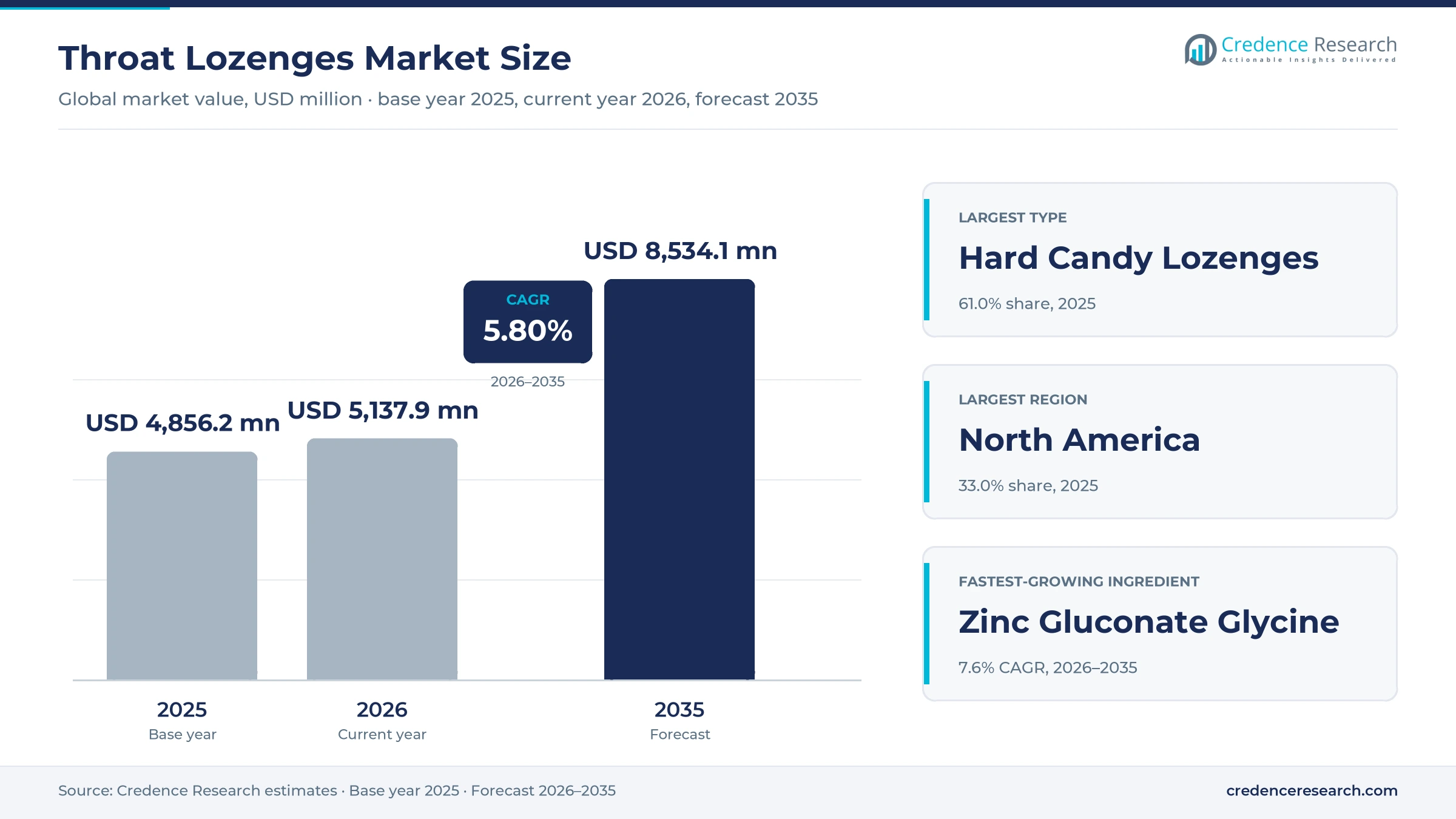
The global throat lozenges market was valued at USD 4.86 billion in 2025 and is projected to increase from USD 5.14 billion in 2026 to USD 8.53 billion by 2035, registering a CAGR of 5.80% during 2026–2035. Demand comes from adults and children who treat sore throats, coughs and colds without a doctor, buying through pharmacies, grocery shelves and online stores. Menthol hard drops make up most volume, while medicated anesthetic or antiseptic lozenges carry the highest unit prices. North America held the largest regional share, 33.0% in 2025, because U.S. shoppers buy cough drops in large bags across food, drug and mass retail. Asia Pacific is the fastest-growing region at 7.0% a year, supported by daily throat-care habits in China, Japan and South Korea. The main commercial shift is pricing, as Reckitt's Self Care price and mix rose 4.7% in 2025 while volume fell 1.7%, showing that brand owners grow value faster than packs. Mild cold seasons remain the main restraint, because lozenge sales follow infection rates closely.
Menthol drops and licensed medicated tablets bought for self-care
The market counts hard candy, soft and compressed lozenges sold to relieve sore throats, coughs and throat irritation, both as non-medicated cough drops and as licensed medicines with antiseptic, anesthetic or anti-inflammatory actives. Value is measured at manufacturer selling prices across pharmacies, grocery and convenience stores and online retail.
Throat sprays, cough syrups, nicotine replacement lozenges and ordinary breath mints are excluded from the count. Branded consumer health companies and confectionery makers sell most volume, while contract manufacturers and private label suppliers fill pharmacy and supermarket own-brand ranges.
Throat Lozenges Market Insights
- The global throat lozenges market rises from USD 4.86 billion in 2025 to USD 8.53 billion by 2035, a 5.80% CAGR during 2026–2035, as self-care and premium medicated packs lift value.
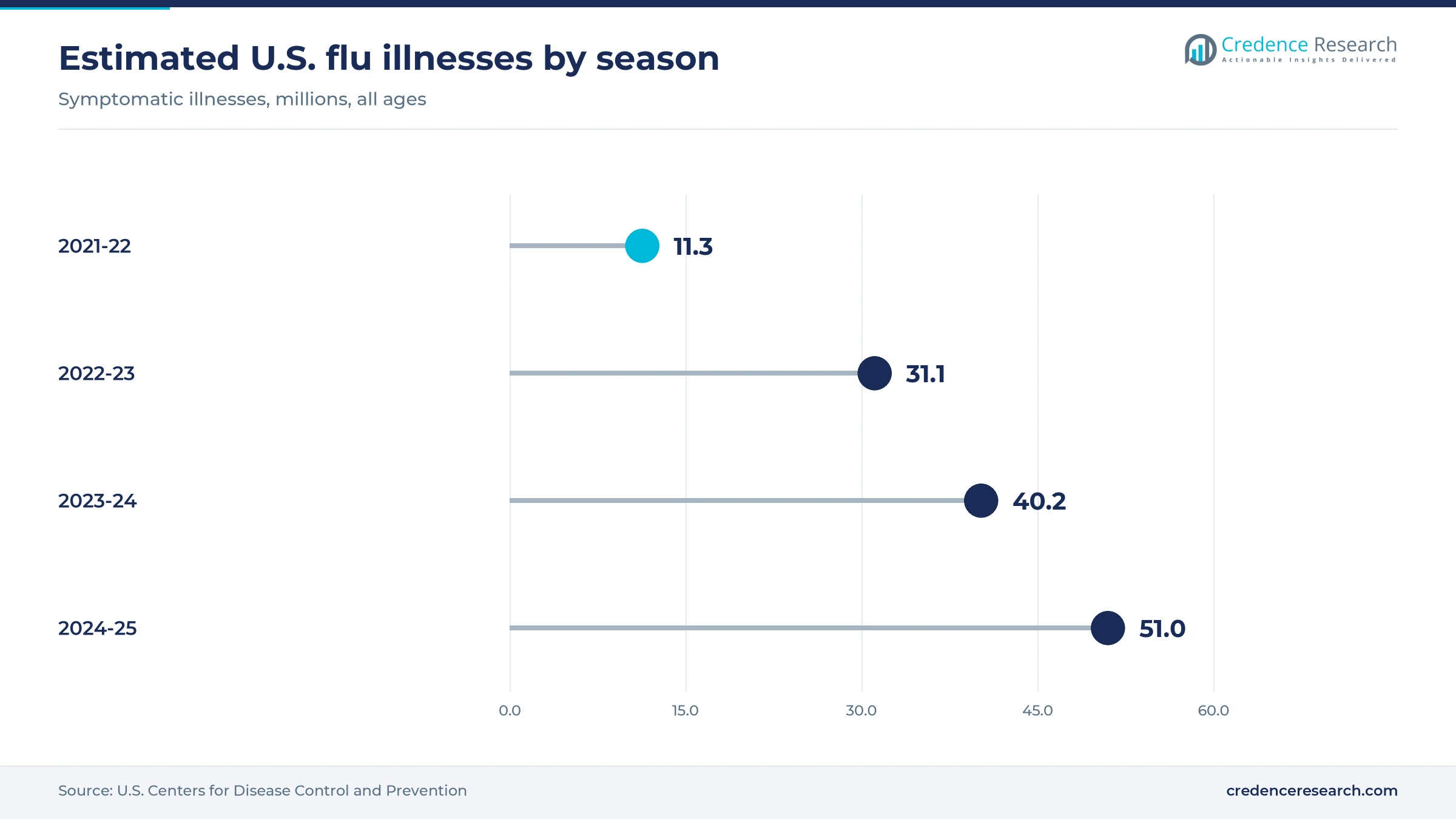
- North America held 33.0% of 2025 value, after the CDC estimated 51 million U.S. flu illnesses in the high-severity 2024-25 season.
- Hard Candy Lozenges led formats with 61.0% of 2025 value, because menthol drops such as Halls and Vicks sell in large bags across mass retail.
- Since January 2024, more than 10,000 English pharmacies can treat sore throats in patients aged 5 and over under NHS Pharmacy First.
- Reckitt said Strepsils fell at a high-single-digit rate in the fourth quarter of 2025, showing how quickly mild seasons cut lozenge demand.
Hard candy and menthol lead as zinc and online sales grow
Hard candy drops lead while compressed tablets grow fastest
Based on type, the market is categorized into hard candy lozenges, soft lozenges and compressed lozenges. Hard Candy Lozenges led with 61.0% of 2025 value because high-volume menthol drops are cooked and deposited at low cost and sold in large bags, such as the 45-count Vicks VapoCOOL Severe pack that Target lists at USD 4.99 with 20 mg of menthol per drop. Compressed Lozenges grow fastest at 6.7% a year, as pharmacy brands press fixed doses of medicine into slow-dissolving tablets, and German labeling for Angelini's Tantum Verde lists 3 mg of benzydamine per lozenge for adults and children over six.
Menthol leads while zinc gluconate glycine grows fastest
Based on ingredient, the market is categorized into menthol, pectin, zinc gluconate glycine and others, which include antiseptic, anesthetic and herbal actives. Menthol led with 49.0% of 2025 value because it is the cooling active in most mass-market cough drops, and the Halls Honey Lemon label lists 7.5 mg per drop. Suppliers of natural menthol crystals therefore see orders rise and fall with winter demand. Zinc Gluconate Glycine grows fastest at 7.6% a year, as a May 2024 Cochrane review of 34 trials with about 8,500 people found zinc may shorten cold symptoms by about two days, at low certainty.
Pharmacies lead while online retail grows fastest
Based on distribution channel, the market is categorized into pharmacies and drugstores, supermarkets and convenience stores, and online retail. Pharmacies and Drugstores led with 52.0% of 2025 value because licensed medicated lozenges carry the highest unit prices, and Thornton & Ross launched Covonia lidocaine and chlorhexidine lozenges as a pharmacy-only medicine in September 2019 at a recommended GBP 5.99 a pack. Online Retail grows fastest at 8.3% a year, as online pharmacies such as Apollo Pharmacy in India add cough drops to home-delivery baskets, which lets shoppers stock up before symptoms rather than buy single packs when ill.
| Segment Group | Leading Sub-segment | Share, 2025 | Fastest-growing Sub-segment | CAGR, 2026–2035 |
|---|---|---|---|---|
| By Type | Hard Candy Lozenges | 61.0% | Compressed Lozenges | 6.7% |
| By Ingredient | Menthol | 49.0% | Zinc Gluconate Glycine | 7.6% |
| By Distribution Channel | Pharmacies and Drugstores | 52.0% | Online Retail | 8.3% |
Medicated packs earn premiums over bagged menthol drops
Lozenges are priced per pack, and the gap between medicated pharmacy packs and bagged menthol drops is wide. Strepsils in a U.K. pharmacy costs about GBP 0.18 per lozenge, while Vicks VapoCOOL drops at Target cost about USD 0.11 each. Licensed actives, pharmacist advice and smaller packs justify the premium, while grocery drops compete on count and flavor. Recent price moves come mainly from list increases by leading brands rather than lighter promotion, as Golden Throat's higher 2025 box price in the table shows. For buyers, the price per lozenge is the clearest comparison across formats and channels.
| Product or pack | Typical price or fee | Basis |
|---|---|---|
| Strepsils Honey & Lemon, 36 lozenges, U.K. pharmacy | GBP 6.30, about GBP 0.18 each | Boots listing, November 2026 |
| Strepsils Honey & Lemon, 36 lozenges, Australia | AUD 12.99 | Chemist Warehouse listing, November 2026 |
| Vicks VapoCOOL Severe drops, 45 count, U.S. | USD 4.99, about USD 0.11 each | Target listing, November 2026 |
| Covonia Strong Original sugar-free, 30 g, U.K. | GBP 1.20 | Tesco listing, November 2026 |
| Vicks cough drops, 25 count, India | INR 50, INR 2 each | Apollo Pharmacy listing, November 2026 |
| Golden Throat OTC lozenges, average price per box | RMB 8.5 in 2025, up from RMB 7.5 | Golden Throat 2025 annual results |
Request a Free Sample
Fill in your details and we'll send you a free sample report.
- Sample data tables & charts
- Research methodology
Flu seasons, pharmacy self-care and Asia lift lozenge demand
High-severity flu seasons lift cough and sore throat buying
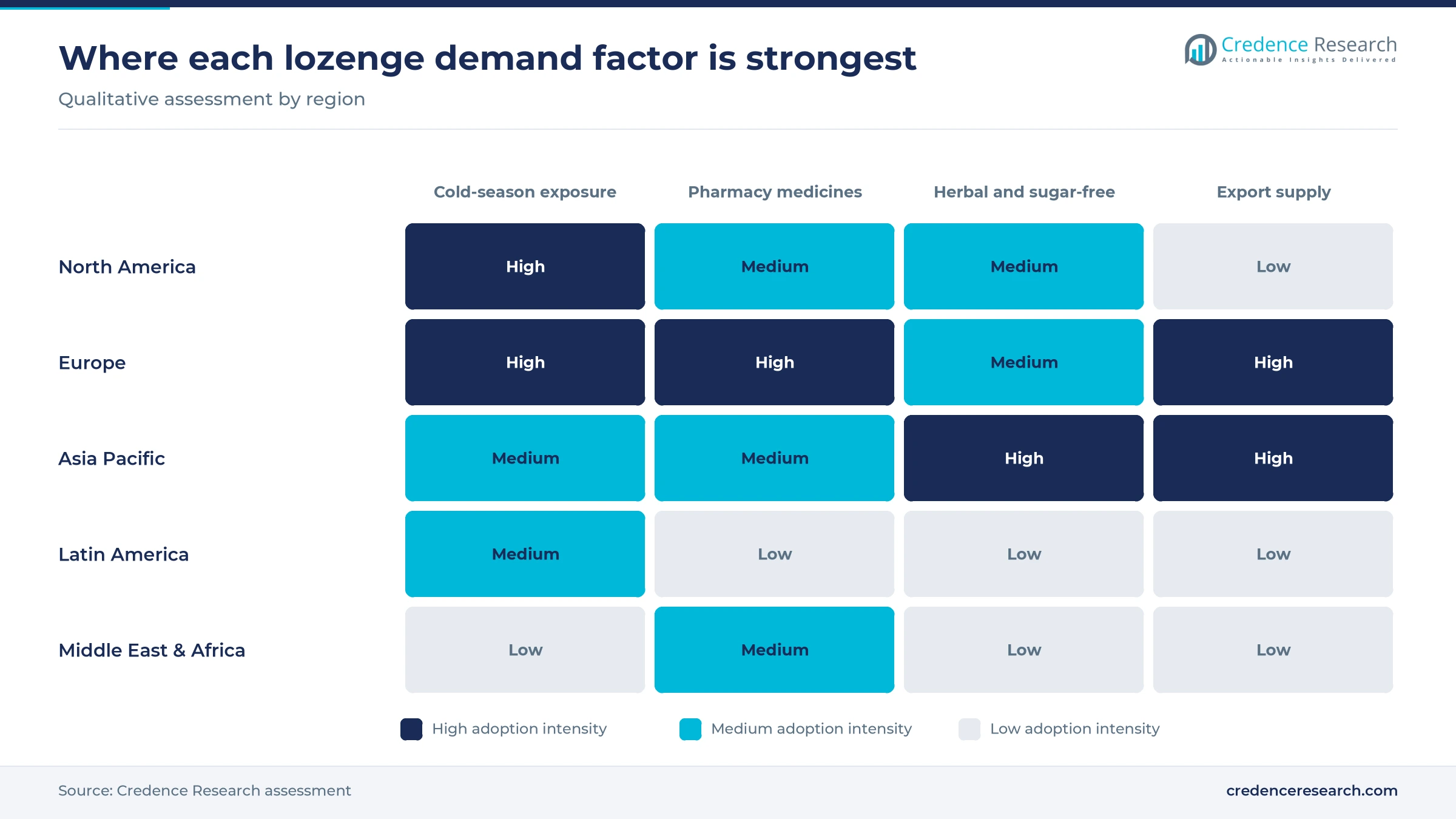
Respiratory infection rates set the base of lozenge demand, because most purchases follow a sore throat or cough within days. The U.S. Centers for Disease Control and Prevention estimates 51 million flu illnesses and 23 million medical visits in the 2024-25 season, the first season rated high severity across all ages since 2017-18. CDC point estimates rose from about 11 million illnesses in 2021-22 to 40 million in 2023-24, a steady rebound from the low 2021-22 season. Prestige Consumer Healthcare concentrates advertising for Chloraseptic and Luden's in early winter, its 2025 annual report says. Brands with broad mass-retail distribution gain most in strong seasons, while smaller labels struggle to secure shelf space when demand peaks.
Pharmacist-led self-care moves sore throats out of clinics
Health systems are steering minor throat infections toward pharmacies, so more patients leave with a lozenge or spray rather than an antibiotic. NHS England launched Pharmacy First on Jan. 31, 2024, letting pharmacists treat sore throats in patients aged 5 and over. More than 10,000 pharmacies had registered at launch, and NHS England expects the service to free up to 10 million general practice appointments a year. In Germany, Tantum Verde benzydamine lozenges are sold as pharmacy-only medicines, so pharmacist advice stays part of the purchase. Brands with licensed anesthetic or anti-inflammatory actives gain from this shift, while grocery-only confectionery drops capture less of the clinical traffic.
Throat-care habits in China, Japan and Korea widen demand
Many Asian consumers treat throat discomfort as a daily self-care need rather than only a winter symptom, which keeps lozenge demand steadier through the year. Golden Throat Holdings told investors in March 2026 that long periods of unhealthy PM2.5 in major Chinese cities contribute to pharyngitis and throat discomfort. Ricola reported double-digit growth in South Korea, Taiwan and Thailand in 2024, along with a higher share in China, its largest Asian market. In Japan, Kanro held 19.5% of hard candy sales in 2025, Mynavi News reported, and sells fruit nodoame throat candy among its lines. Local herbal brands and Swiss and Japanese exporters gain from this demand, while brands built on Western cold seasons find it harder to win shoppers.
Price increases lift value even as unit volume stalls
Value growth is coming more from price and mix than from extra packs, because established brands can pass cost increases to shoppers who rarely trade down for a sore throat. Reckitt reported that Self Care price and mix rose 4.7% in 2025 while volume fell 1.7%. Ricola said it would raise U.S. prices by 10% from Dec. 1, 2025, Swissinfo reported in September 2025, and Golden Throat lifted its average box price in 2025, as the pricing table above shows. Across consumer health products, brand owners are using the same lever to protect margins. Leading brands gain value this way, while price-sensitive buyers move toward private label and value packs.
Sugar-free herbs and refreshment drops reshape the shelf
Brands are shifting toward sugar-free and herbal bases
Lozenge makers are shifting toward sugar-free and herbal formulas to address shoppers who take several drops a day, creating openings for isomalt bases and botanical extracts across pharmacy and grocery ranges. Golden Throat said in its March 2026 results that sugar-free, natural and herbal products are gaining popularity in China. Tesco lists 30 g packs of Covonia Strong Original lozenges with an isomalt and sucralose base, and Halls sells 25-count bags of a sugar-free honey lemon menthol line in U.S. grocery stores. Ricola, which makes its drops from Swiss herbs, exports to 45 countries, it said in June 2024. Herbal and sugar-free lines win premium shelf positions, while sugar-based value drops lose appeal for diet-conscious buyers who take lozenges often.
Cough drop brands are moving into everyday refreshment
Cough drop brands are shifting toward everyday refreshment occasions to reduce their dependence on cold seasons, creating openings for functional mints and new formats across mass retail. Ricola launched lemon lime, orange and grapefruit mint drops with Swiss Alpine salt in the U.S. in July 2026, placing them on end caps at Walmart and Target rather than in the cold aisle, Retail Brew reported. Reckitt launched Strepsils cough syrup in Europe in the third quarter of 2025, stretching the brand into liquids. In Japan, gummy retail sales rose 14% to JPY 129.7 billion in 2025 and overtook hard candy at JPY 128.5 billion, Mynavi News reported, which shows how fast refreshment buyers switch formats. These moves spread sales over more months, but they put lozenge brands up against mint and candy makers.
Immune-support lines open premium pharmacy space
Immune-support lozenges offer an opening for pharmacy brands that pair throat relief with zinc or vitamin claims, because shoppers who buy at the first sign of a cold pay more for added benefits. The May 2024 Cochrane review noted above also recorded more altered taste and stomach upset with zinc lozenges than with placebo, so dose and flavor work decide repeat purchase. Boots sells 36 Strepsils Orange lozenges with 100 mg of vitamin C each for GBP 5.75, beside the brand's antiseptic range. Brands with clinical files and pharmacy shelf space gain most, while confectionery drops cannot make such health claims.
ASEAN and export routes open growth for Asian makers
Southeast Asia and other export markets offer an opening for lozenge makers with strong home brands, because import registration and distributor networks take years to build. Golden Throat exports to more than 60 countries and regions, has agency agreements with all 10 ASEAN countries and has shipped to nine of them, its 2025 results say. The company is also fitting out a second 50,000 square meter phase at its Liuzhou base, with IPO proceeds expected to be used by 2028. Kanro is expanding its U.S. business from California into neighboring states with local hiring and new flavors, Mynavi News reported in February 2026. Makers that pair export registrations with new capacity gain reach, while local ASEAN brands face stronger imported competition.
Mild winters, safety rules and tariffs squeeze brands
Mild cold seasons cut lozenge sales quickly
Lozenge sales fall fast when infections are mild, because few households stock drops before they need them. Reckitt reported that Strepsils fell at a high-single-digit rate in the fourth quarter of 2025, with double-digit declines in Europe after a slow start to the cold season. U.S. sore throat product sales fell 8.1% in the 2026 peak season, NutraIngredients reported in September 2026. Seasonal brands and retailers holding winter stock of cold and cough remedies are most exposed.
Benzocaine safety rules narrow pediatric use
Safety rules on anesthetic actives limit who can use some medicated lozenges, which caps demand for numbing formats. On May 23, 2018, the U.S. Food and Drug Administration warned that oral benzocaine products can cause methemoglobinemia and should not be used in children younger than 2, and it asked makers to add warnings to labels. Cepacol lozenges, which Reckitt bought from Combe in 2011, contain benzocaine. Brands built on anesthetics carry label and pediatric limits, which favors menthol and pectin alternatives for families.
U.S. tariffs raise costs for imported Swiss drops
U.S. duties on Swiss goods raise costs for imported herbal drops, which forces exporters to choose between price increases and lower margins. Ricola postponed the opening of its new Lenzburg plant, planned with two production lines and 100 jobs, citing high U.S. duties, Swissinfo reported in September 2025. Ricola packages its Swiss-made drops in the U.S., where about 40% of added value is created, which softens the duty. Importers that cannot localize packaging are most exposed, and U.S. shoppers face higher shelf prices.
Distributor destocking hits brands sold through wholesalers
Brands that sell through distributors face sharp volume swings when wholesalers cut inventory, because sell-in can fall well below shopper demand. Golden Throat sold 102.9 million boxes of its OTC lozenges in 2025, down from 145.6 million in 2024, after a marketing strategy change led distributors to reduce purchases, its results show. Substantially all of the company's 2025 sales came through its distributor network. Asian brands with distributor-led models are most exposed, while brands with direct retail accounts read demand more clearly.
U.S. cough drop volume leads while Asian throat care grows
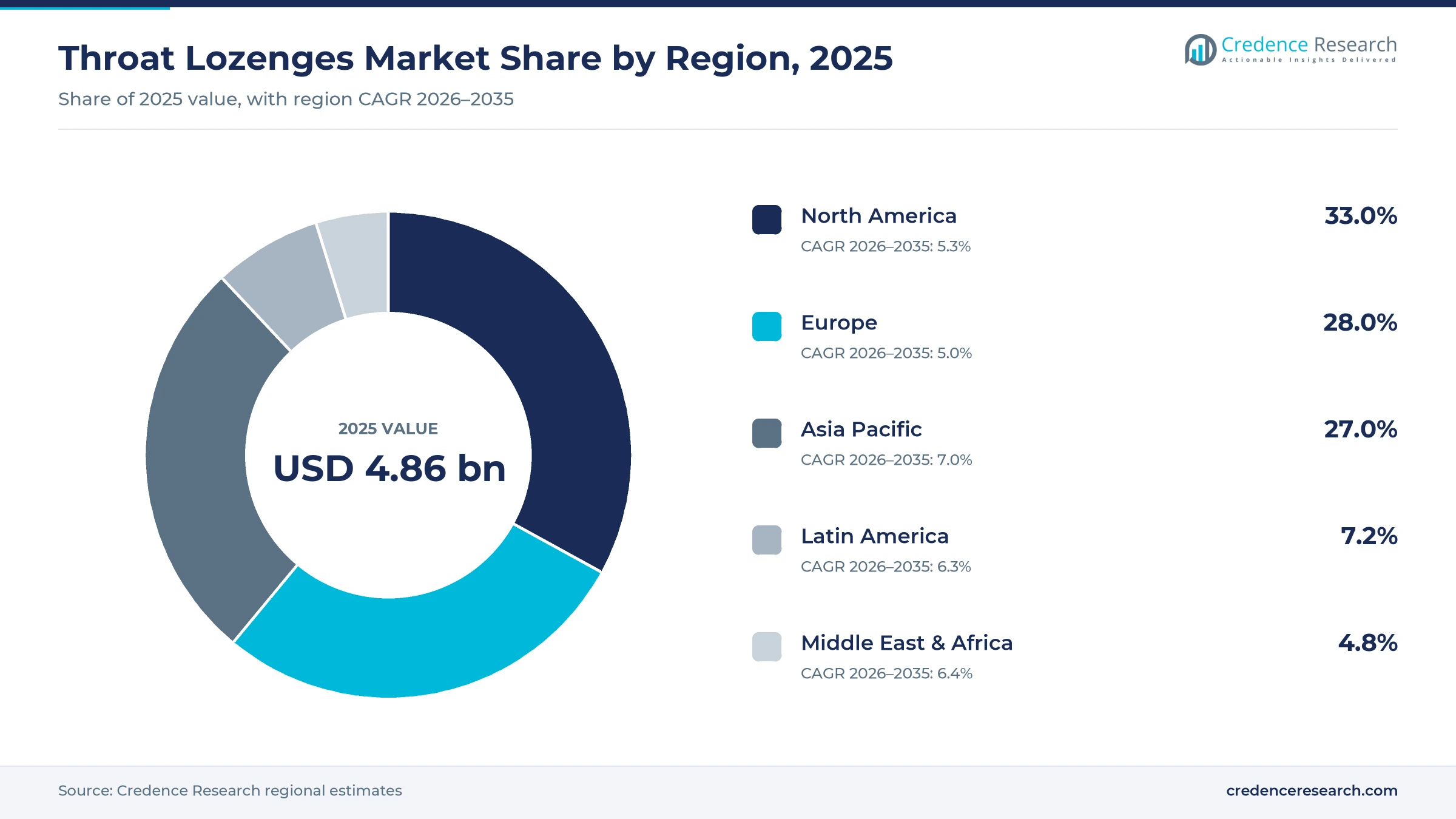
| Region | Value, 2025 (USD billion) | Share, 2025 | CAGR, 2026–2035 |
|---|---|---|---|
| North America | 1.60 | 33.0% | 5.3% |
| Europe | 1.36 | 28.0% | 5.0% |
| Asia Pacific | 1.31 | 27.0% | 7.0% |
| Latin America | 0.35 | 7.2% | 6.3% |
| Middle East & Africa | 0.23 | 4.8% | 6.4% |
Bagged cough drops and flu seasons keep North America ahead
North America held 33.0% of 2025 value and grows at 5.3% a year. U.S. shoppers buy cough drops in large bags through grocery, drug and mass stores, and Ricola calls the U.S. its largest market, where it leads the cough drop category. Prestige Consumer Healthcare ranks Chloraseptic first in U.S. medicated sore throat liquids and lozenges and Luden's third in non-medicated cough drops in its 2025 annual report. Strong flu seasons lift volume, while Swiss import duties raise some shelf prices.
Throat candy habits and herbal OTC brands lift Asia Pacific
Asia Pacific held 27.0% of 2025 value and grows fastest at 7.0% a year. Throat candy is a mainstream confectionery line in Japan, where makers compete on flavor and seasonal launches much as they do in sugar confectionery. China's market rests on herbal OTC brands such as Golden Throat, which are sold as registered medicines through distributors in every province. Indian shoppers buy single Vicks drops through small shops and online pharmacies, so unit prices stay low and volumes high.
Pharmacy medicines and mild winters shape Europe
Europe held 28.0% of 2025 value and grows at 5.0% a year, the slowest pace of the five regions. Pharmacy sales of licensed medicines carry much of the value, with Strepsils, Covonia and Tantum Verde sold as medicines rather than sweets, and Boots lists 36 Strepsils Honey & Lemon lozenges at GBP 6.30. The double-digit Strepsils decline in Europe in late 2025, noted above, shows how exposed the region is to mild winters. Ricola and Fisherman's Friend serve the confectionery side of the shelf.
Convenience-store drops define Latin America
Latin America held 7.2% of 2025 value and grows at 6.3% a year. Mass cough drops such as Mondelez's Halls sell in small rolls through convenience stores and pharmacy chains, so value per unit is likely nearer Indian than U.S. price points, although no regional shelf-price series is published. Reckitt said Strepsils performance was balanced between Europe and emerging markets in 2025. Asian brands are starting to enter, as Golden Throat added Peru and Ecuador to its export markets in 2025, its annual results show, so this share carries a wider margin than those for North America and Europe.
Imported brands and thin data define Middle East & Africa
Middle East & Africa held 4.8% of 2025 value and grows at 6.4% a year. Most lozenges sold in the Gulf, Egypt and Africa come from multinational brands, either imported or made under license. Where medicated lozenges are registered as medicines, brands that already hold those registrations have an entry advantage over new importers, because each product needs its own approval before it reaches pharmacy shelves. Golden Throat already lists the Middle East and Africa among its overseas markets. Public data on local production and retail sales are scarce, an evidence gap in this estimate.
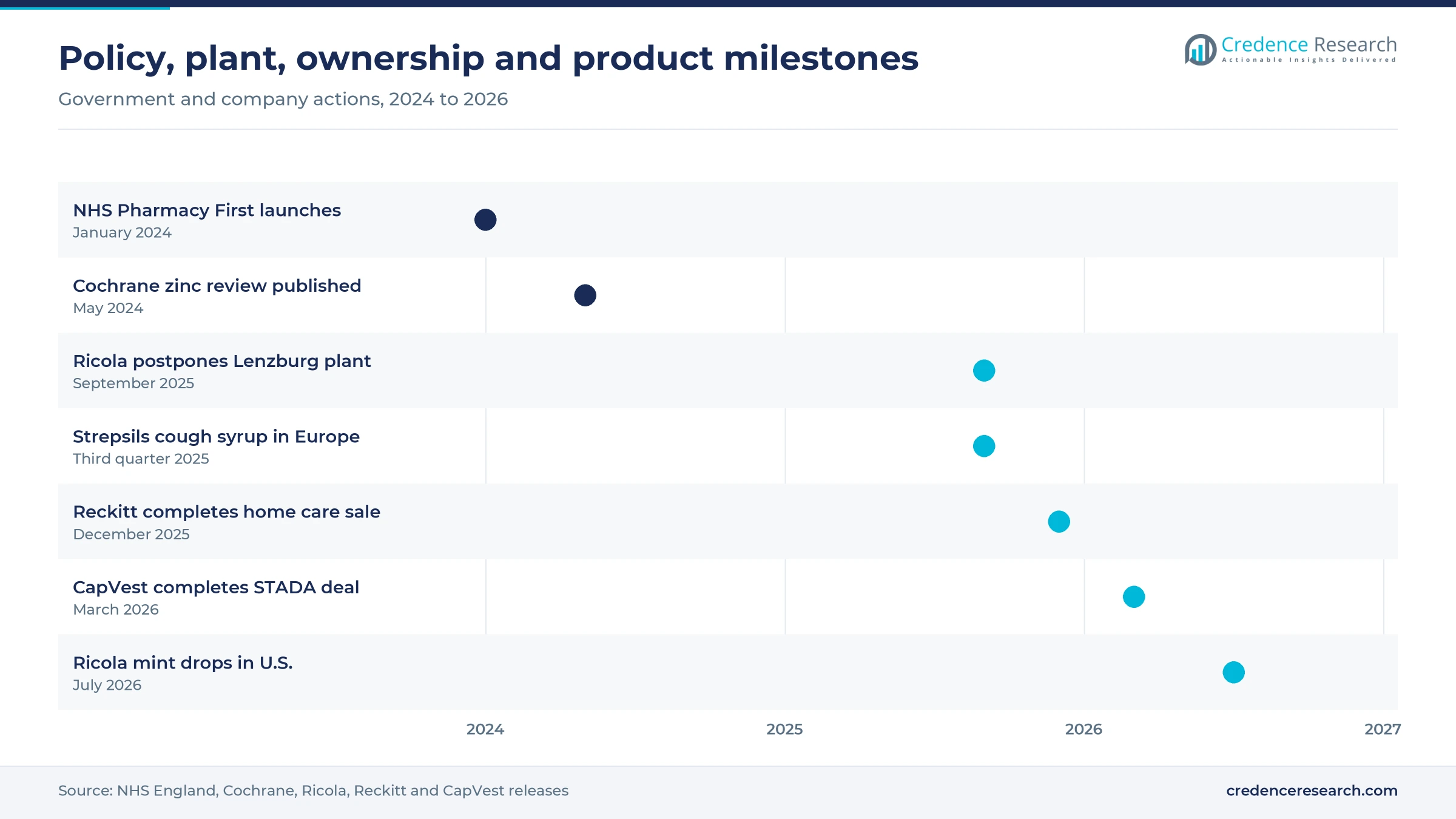
Plant delays, ownership deals and launches from 2024 to 2026
| Development | Status and market relevance |
|---|---|
| In September 2025, Ricola postponed the opening of its new Lenzburg plant in Switzerland, citing high U.S. duties. | Plan on hold; two production lines and 100 jobs delayed |
| In December 2025, Reckitt completed the sale of its Essential Home business to Advent International. | Completed divestment; the Strepsils and Cepacol owner now focuses on health and hygiene |
| In March 2026, CapVest completed its majority acquisition of STADA, parent of Thornton & Ross and its Covonia brand. | Completed acquisition; new owner for a U.K. pharmacy lozenge maker |
| In July 2026, Ricola launched three mint drops with Swiss Alpine salt in the U.S. | Product launch; moves the brand beyond the cold and flu aisle |
Boiling, compression and active choice set lozenge cost
- Hard-boiled depositing cooks sugar or isomalt syrup, adds menthol and flavors, then deposits drops into molds, which keeps cost per drop low.
- Direct compression presses actives with fillers into slow-dissolving tablets, a common route for medicated lozenges with fixed doses.
- Sugar-free bases replace sucrose with isomalt and sweeteners such as sucralose, which suits shoppers who take several drops a day.
- Anesthetic and antiseptic actives such as lidocaine, benzocaine and chlorhexidine numb pain or act on bacteria, and they require medicine licensing.
Need a Custom Version of This Report?
Tailor the scope, geography, or segments to your exact requirements.
- Custom geography or segment scope
- Direct access to our analyst team
Consumer health owners and candy makers split the market
Competition in the throat lozenges market splits between consumer health owners of licensed medicines and confectionery makers of cough drops. Reckitt sells Strepsils worldwide and Cepacol in the U.S., and its exit from home care leaves it focused on health brands. Mondelez sells Halls, and Procter & Gamble sells Vicks drops in the U.S. and India. Ricola sells Swiss herbal drops in 45 export markets, while Lofthouse of Fleetwood exports Fisherman's Friend from Lancashire. Prestige Consumer Healthcare holds Chloraseptic and Luden's in the U.S., STADA owns Thornton & Ross and Covonia in the U.K., and Angelini sells Tantum Verde benzydamine lozenges in Europe. Golden Throat leads herbal OTC lozenges in China, and Kanro sells nodoame throat candy in Japan. Brands compete on licensed actives, flavor range, pharmacy relationships and retail coverage more than on list price.
Licensed medicines and cough drops form two supply tiers
Supply splits into two groups that compete for the same shopper but under different rules. Consumer health companies such as Reckitt, Prestige Consumer Healthcare, STADA and Angelini hold licensed medicated lozenges, where marketing authorizations and pharmacist relationships form the main barrier to entry. Confectionery and herbal makers such as Mondelez, Ricola, Lofthouse of Fleetwood and Kanro, along with Procter & Gamble's Vicks, compete in cough drops, where scale in sugar boiling, flavor development and mass-retail coverage decide share. Margins are highest in licensed medicated lines and lowest in bagged drops, where private label competes on price.
Health brands and candy makers that buyers shortlist
| Company | Type | Role in the market |
|---|---|---|
| Reckitt Benckiser Group plc | Consumer health leader | Sells Strepsils medicated lozenges worldwide and Cepacol benzocaine lozenges in the U.S. |
| Mondelez International, Inc. | Confectionery major | Makes Halls menthol cough drops, including sugar-free lines |
| Ricola AG | Herbal specialist | Makes Swiss herbal cough drops and mint drops for 45 export markets |
| The Procter & Gamble Company | Consumer health brand owner | Sells Vicks VapoDrops and VapoCOOL drops in the U.S. and Vicks drops in India |
| Prestige Consumer Healthcare Inc. | OTC brand owner | Sells Chloraseptic medicated lozenges and Luden's cough drops in the U.S. |
| STADA Arzneimittel AG (Thornton & Ross) | OTC manufacturer | Makes Covonia medicated and sugar-free lozenges in the U.K. |
| Lofthouse of Fleetwood Ltd. | Lozenge specialist | Makes Fisherman's Friend menthol lozenges in Fleetwood for export |
| Golden Throat Holdings Group Co., Ltd. | Herbal OTC maker | Makes Golden Throat OTC lozenges in China and exports to ASEAN |
| Angelini Pharma S.p.A. | Pharmaceutical company | Sells Tantum Verde benzydamine lozenges through European pharmacies |
| Kanro Co., Ltd. | Confectionery maker | Makes nodoame throat candy for Japanese retail and U.S. expansion |
Pricing power, not volume, drives value to 2035
Credence Research's view is that pricing power, not volume, will drive most value growth in the throat lozenges market to 2035. Unit demand rises and falls with cold seasons, as the late-2025 Strepsils decline showed, but leading brands keep lifting prices and moving shoppers to sugar-free, herbal and medicated packs. Hard Candy Lozenges keep their volume lead, while Asia Pacific adds the most new demand. Buyers and retailers should plan inventory around season severity and hold a range across price tiers, because a mild winter hits slow-selling premium packs first.
Brand filings, shelf prices and volumes anchor the estimate
The report uses 2025 as the base year and 2026 to 2035 as the forecast period. Market values come from the Credence Research model, and the type, ingredient, channel and regional splits are Credence Research estimates. The previous edition's 2024 value was carried to 2025 at its own growth rate and checked against brand-level disclosures, filed volumes and shelf prices in the main markets. Sources include CDC, FDA and NHS England records, company annual reports and results, retailer listings and trade press, and no interviews or surveys were used.
Price gains and Asian demand set the path to 2035
Credence Research expects the market to rise from USD 5.14 billion in 2026 to USD 8.53 billion by 2035 as price and mix gains, pharmacy self-care and Asian demand offset flat volumes in mature markets. Asia Pacific should keep the fastest regional pace, while Europe grows slowest because its medicated sales depend most on winter severity. Zinc gluconate glycine lozenges should grow at 7.6% a year from a small base. Mild seasons and import duties remain the main restraints, and wider pharmacist-led treatment of minor illness forms the main upside.
Cold-season strength and pricing set the range to 2035
The path to 2035 depends on infection seasons, how far brands can keep raising prices, and how quickly Asian demand and pharmacy self-care grow. The base case assumes average cold seasons and steady price and mix gains. A downside follows if several mild winters coincide with shoppers trading down to private label drops. An upside follows if pharmacist-led treatment of minor illness spreads beyond England and Asian exporters scale their regional networks.
| Scenario | CAGR, 2026–2035 | Value, 2035 | What has to hold |
|---|---|---|---|
| Downside | 4.4% | USD 7.57 billion | Several mild cold seasons and trading down to private label value drops |
| Base | 5.80% | USD 8.53 billion | Average infection seasons and steady price and mix gains for leading brands |
| Upside | 6.8% | USD 9.29 billion | Pharmacy self-care schemes spread and Asian brands scale export distribution |
Frequently Asked Questions
How big is the throat lozenges market?
Which region leads the market?
Which lozenge type holds the largest share?
Do zinc lozenges shorten a cold?
Can pharmacists in England treat sore throats?
Are benzocaine lozenges safe for young children?
Why did lozenge sales fall in late 2025 and 2026?
Which companies lead the throat lozenges market?
Table of Content
Chapter 1 Market Segmentation
- 1.1 Segmentation Framework
- 1.1.1 Product and Service Classification
- 1.1.2 Application and End-Use Classification
- 1.1.3 Technology and Solution Classification
- 1.1.4 Customer and Distribution Channel Classification
- 1.1.5 Geographic Segmentation
- 1.1.6 Market Segment Definitions and Boundaries
- 1.2 By Type
- 1.2.1 Hard Candy Lozenges
- 1.2.2 Compressed Lozenges
- 1.2.3 Soft Lozenges
- 1.3 By Ingredient
- 1.3.1 Menthol
- 1.3.2 Others
- 1.3.3 Pectin
- 1.3.4 Zinc Gluconate Glycine
Chapter 2 Introduction
- 2.1 Report Objectives and Scope
- 2.2 Product Definition and Industry Terminology
- 2.3 Market Inclusions and Exclusions
- 2.4 Research Process
- 2.4.1 Primary Research and Expert Interviews
- 2.4.2 Secondary Research and Source Review
- 2.4.3 Top-Down and Bottom-Up Estimation
- 2.4.4 Data Triangulation and Verification
- 2.5 Market Size Measurement Basis
- 2.5.1 2025: USD 4.86 billion → 2035: USD 8.53 billion
- 2.6 Historical and Forecast Reference Periods
- 2.6.1 Historical Period: 2018-2025
- 2.6.2 Base Year: 2025
- 2.6.3 Forecast Period: 2025-2035
- 2.7 Research Assumptions and Limitations
Chapter 3 Executive Summary
- 3.1 Market Snapshot and Key Findings
- 3.2 Base-Year Market Size, 2025
- 3.3 Forecast Market Size, 2035
- 3.4 Revenue and Volume Growth Outlook
- 3.5 Key Demand and Supply Indicators
- 3.6 Leading Market Segments
- 3.7 Fastest-Growing Market Opportunities
- 3.8 Regional Performance Highlights
- 3.9 Technology and Industry Transformation
- 3.10 Competitive Landscape Summary
- 3.11 Analyst View and Strategic Implications
Chapter 4 Global Throat Lozenges Market Trends and Developments
- 4.1 Historical Industry Development, 2018-2025
- 4.2 Recent Market Trends and Developments
- 4.3 Demand and Customer Behavior Trends
- 4.4 Technology and Product Innovation
- 4.5 Artificial Intelligence, Automation and Digitalization
- 4.6 Local Manufacturing and Supply Chain Realignment
- 4.7 Industry Partnerships, Mergers and Acquisitions
- 4.8 Sustainability and Circular Economy Developments
- 4.9 Government and Private Sector Investment Trends
- 4.10 Emerging Business Models and Commercialization
- 4.11 Industry Developments and Announcements
Chapter 5 Global Throat Lozenges Market Production, Supply and Demand Analysis
- 5.1 Demand Trend and Consumption Analysis, 2018-2025
- 5.2 Demand Forecast, 2025-2035
- 5.3 Production and Output Trend, 2018-2025
- 5.4 Production and Output Forecast, 2025-2035
- 5.5 Installed Capacity and Capacity Utilization
- 5.6 Company-Wise Production Plants and Statistics
- 5.6.1 Installed Production Capacity
- 5.6.2 Actual Production
- 5.6.3 Planned Capacity and Expansion Targets
- 5.7 Supply Chain Structure and Procurement Trends
- 5.8 Supply-Demand Gap and Bottlenecks
- 5.9 Import Dependence and Sourcing Structure
- 5.10 Contract Manufacturing and Outsourcing
- 5.11 Regional Supply and Demand Concentration
Chapter 6 Global Throat Lozenges Market Pricing Analysis
- 6.1 Pricing Structure and Measurement
- 6.2 Historical Pricing Trends, 2018-2025
- 6.3 Pricing Outlook, 2025-2035
- 6.4 Average Selling Price and Unit Economics
- 6.5 Pricing by Product and Market Segment
- 6.6 Geographic Pricing Differences
- 6.7 Key Input, Energy, Labor and Logistics Costs
- 6.8 Contract Pricing and Purchasing Models
- 6.9 Pricing Sensitivity and Competitive Positioning
- 6.10 Price, Margin and Profitability Implications
Chapter 7 Global Throat Lozenges Market Dynamics
- 7.1 Market Growth Drivers
- 7.1.1 Demand-Side Drivers
- 7.1.2 Technology and Innovation Drivers
- 7.1.3 Infrastructure and Investment Drivers
- 7.1.4 Regulatory and Policy Drivers
- 7.2 Market Restraints
- 7.2.1 Cost and Affordability Constraints
- 7.2.2 Technology and Adoption Barriers
- 7.2.3 Supply Chain and Operational Constraints
- 7.3 Market Challenges
- 7.3.1 Competitive Pressure and Margin Erosion
- 7.3.2 Skills, Infrastructure and Implementation Gaps
- 7.4 Emerging Market Opportunities
- 7.5 Market Dynamics Impact and Time-Horizon Assessment
Chapter 8 Global Throat Lozenges Value Chain Analysis
- 8.1 Industry Value Chain Overview
- 8.2 Upstream Suppliers and Critical Inputs
- 8.3 Technology and Component Providers
- 8.4 Manufacturing or Service Delivery
- 8.5 Distribution, Channel Partners and Integrators
- 8.6 Downstream Applications and End Users
- 8.7 Value Addition and Profit Pools
- 8.8 Vertical Integration and Outsourcing
- 8.9 Supplier Concentration and Risk
- 8.10 Supply Chain Localization and Resilience
Chapter 9 Global Throat Lozenges Market Regulations and Policies
- 9.1 Relevant Laws, Standards and Compliance Frameworks
- 9.2 Product, Service, Safety and Quality Requirements
- 9.3 Government Policies, Incentives and Subsidies
- 9.4 Imports, Exports and Trade Barriers
- 9.5 Public Procurement and Local Content Requirements
- 9.6 Environmental and Sustainability Compliance
- 9.7 Upcoming Policy Changes and Market Implications
Chapter 10 Global Throat Lozenges Market Hotspots and Opportunities
- 10.1 Market Opportunity Mapping and Growth Hotspots
- 10.2 High-Growth Applications and Customer Groups
- 10.3 Underserved Markets and White-Space Opportunities
- 10.4 Emerging Technology and Product Opportunities
- 10.5 New Capacity and Investment Hotspots
- 10.6 Market Entry and Expansion Opportunities
- 10.7 Distribution and Partnership Opportunities
- 10.8 Near-Term and Long-Term Commercial Potential
- 10.9 Opportunity Attractiveness and Execution Risks
Chapter 11 Global Throat Lozenges Market Outlook, 2025-2035
- 11.1 Market Size and Analysis
- 11.1.1 Revenue (Market Measurement: 2025: USD 4.86 billion → 2035: USD 8.53 billion)
- 11.1.2 Market Volume and Quantity Sold
- 11.1.3 Historical Market Size, 2018-2025
- 11.1.4 Base-Year Market Size, 2025
- 11.2 Market Forecast, 2025-2035
- 11.2.1 Revenue Forecast to 2035
- 11.2.2 Volume Forecast to 2035
- 11.2.3 CAGR and Year-on-Year Growth
- 11.2.4 Incremental Revenue Opportunity
- 11.3 Forecast Assumptions and Scenario Analysis
- 11.3.1 Base-Case Forecast
- 11.3.2 Optimistic and Conservative Scenarios
- 11.3.3 Technology, Pricing and Policy Sensitivities
- 11.4 Market Attractiveness and Growth Outlook
Chapter 12 Global Throat Lozenges Market Segmentation and Outlook
- 12.1 Segmentation Summary and Market Shares, 2025
- 12.2 Largest and Fastest-Growing Segments
- 12.3 By Type - Market Size and Forecast, 2025-2035
- 12.3.1 Segment Definition and Scope
- 12.3.2 Historical Market Size, 2018-2025
- 12.3.3 Revenue Forecast, 2025-2035
- 12.3.4 Volume Forecast, 2025-2035
- 12.3.5 Base-Year Market Share, 2025
- 12.3.6 Segment CAGR and Growth Drivers
- 12.3.7 Subsegment Market Size and Forecast
- 12.3.7.1 Hard Candy Lozenges
- 12.3.7.2 Compressed Lozenges
- 12.3.7.3 Soft Lozenges
- 12.3.8 Subsegment Pricing and Adoption Trends
- 12.3.9 Leading Suppliers and Competition
- 12.3.10 Regional Demand and Opportunities
- 12.4 By Ingredient - Market Size and Forecast, 2025-2035
- 12.4.1 Segment Definition and Scope
- 12.4.2 Historical Market Size, 2018-2025
- 12.4.3 Revenue Forecast, 2025-2035
- 12.4.4 Volume Forecast, 2025-2035
- 12.4.5 Base-Year Market Share, 2025
- 12.4.6 Segment CAGR and Growth Drivers
- 12.4.7 Subsegment Market Size and Forecast
- 12.4.7.1 Menthol
- 12.4.7.2 Others
- 12.4.7.3 Pectin
- 12.4.7.4 Zinc Gluconate Glycine
- 12.4.8 Subsegment Pricing and Adoption Trends
- 12.4.9 Leading Suppliers and Competition
- 12.4.10 Regional Demand and Opportunities
- 12.5 Segment Growth Comparison
- 12.6 Segment Attractiveness and Priority Matrix
Chapter 13 Global Throat Lozenges Geographic Market Outlook, 2025-2035
- 13.1 Regional Market Size and Share, 2025
- 13.2 Regional Market Forecast, 2025-2035
- 13.3 Regional Pricing, Production and Demand Differences
- 13.4 North America
- 13.4.1 United States
- 13.4.2 Canada
- 13.4.3 Mexico
- 13.5 Europe
- 13.5.1 Germany
- 13.5.2 France
- 13.5.3 Italy
- 13.5.4 United Kingdom
- 13.5.5 Spain
- 13.5.6 Poland
- 13.5.7 Russia
- 13.5.8 Netherlands
- 13.5.9 Belgium
- 13.5.10 Sweden
- 13.5.11 Denmark
- 13.5.12 Norway
- 13.5.13 Rest of Europe
- 13.6 Asia Pacific
- 13.6.1 China
- 13.6.2 India
- 13.6.3 Japan
- 13.6.4 South Korea
- 13.6.5 Thailand
- 13.6.6 Indonesia
- 13.6.7 Vietnam
- 13.6.8 Malaysia
- 13.6.9 Australia
- 13.6.10 Rest of Asia Pacific
- 13.7 Latin America
- 13.7.1 Brazil
- 13.7.2 Argentina
- 13.7.3 Colombia
- 13.7.4 Chile
- 13.7.5 Rest of Latin America
- 13.8 Middle East
- 13.8.1 Saudi Arabia
- 13.8.2 United Arab Emirates
- 13.8.3 Turkey
- 13.8.4 Israel
- 13.8.5 Iran
- 13.8.6 Rest of the Middle East
- 13.9 Africa
- 13.9.1 South Africa
- 13.9.2 Egypt
- 13.9.3 Nigeria
- 13.9.4 Morocco
- 13.9.5 Rest of Africa
- 13.10 Regional Investment, Policy and Supply Chain Differences
- 13.11 Regional Competitive Landscape
- 13.12 Geographic Growth Hotspots
Chapter 14 Global Throat Lozenges Technology, Innovation and Sustainability Outlook
- 14.1 Technology Landscape and Maturity
- 14.2 Product, Process and Service Innovation
- 14.3 AI, Automation and Digital Tools in the Industry
- 14.4 Technology Adoption and Performance Benchmarking
- 14.5 Innovation Pipeline and R&D Investment
- 14.6 Patent and Intellectual Property Trends
- 14.7 Energy Efficiency and Resource Management
- 14.8 Sustainability, Recycling and Circularity
- 14.9 Technology Roadmap, 2025-2035
- 14.10 Risks of Obsolescence and Technology Substitution
Chapter 15 Global Throat Lozenges Market Key Strategic Imperatives
- 15.1 Growth and Market Entry Priorities
- 15.2 High-Return Products and Segments
- 15.3 Pricing, Profitability and Cost Optimization
- 15.4 Technology Investment and Product Differentiation
- 15.5 Supply Chain Localization and Resilience
- 15.6 Distribution and Customer Acquisition
- 15.7 Partnership, Acquisition and Capacity Strategy
- 15.8 Regional Expansion Priorities
- 15.9 Short-, Medium- and Long-Term Actions
Chapter 16 Competition Outlook
- 16.1 Industry Competition Characteristics
- 16.2 Market Structure and Concentration
- 16.3 Market Share and Competitive Positioning, 2025
- 16.4 Company-Wise Revenue and Product Benchmarking
- 16.5 Production and Service Capacity Benchmarking
- 16.6 Technology, Pricing and Differentiation
- 16.7 Regional Footprint and Distribution Strength
- 16.8 Mergers, Acquisitions and Strategic Alliances
- 16.9 New Entrants and Competitive Threats
- 16.10 Porter's Five Forces and Industry Attractiveness
- 16.11 Competitive Outlook, 2025-2035
Chapter 17 Company Profiles
- 17.1 Company Coverage and Selection Criteria
- 17.2 Reckitt Benckiser Group plc
- 17.2.1 Business Description
- 17.2.2 Company Ownership and Geographic Presence
- 17.2.3 Product and Service Portfolio
- 17.2.4 Manufacturing and Operating Footprint
- 17.2.5 Production Capacity and Expansion Plans
- 17.2.6 Financial Performance and Investment
- 17.2.7 Market Share and Competitive Position
- 17.2.8 Technology and Innovation Capabilities
- 17.2.9 Strategic Alliances or Partnerships
- 17.2.10 Recent Developments
- 17.2.11 Growth Strategy and Outlook
- 17.3 Mondelez International, Inc.
- 17.4 Ricola AG
- 17.5 The Procter & Gamble Company
- 17.6 Prestige Consumer Healthcare Inc.
- 17.7 STADA Arzneimittel AG (Thornton & Ross)
- 17.8 Lofthouse of Fleetwood Ltd.
- 17.9 Golden Throat Holdings Group Co., Ltd.
- 17.10 Angelini Pharma S.p.A.
- 17.11 Kanro Co., Ltd.
- 17.12 Other Relevant Market Participants
Note: Every listed company is profiled on the structure shown under the first company. The company list is preliminary and may change based on research findings, market developments, data availability and client requirements.
Chapter 18 Disclaimer
- 18.1 Research and Forecast Disclaimer
- 18.2 Data Source and Estimation Limitations
Note: The depth of individual sections depends on data availability for this market. Volume, capacity, trade and other unit-based metrics are included where applicable.

