
| REPORT ATTRIBUTE | DETAILS |
|---|---|
| Historical Period | 2019-2022 |
| Base Year | 2023 |
| Forecast Period | 2024-2032 |
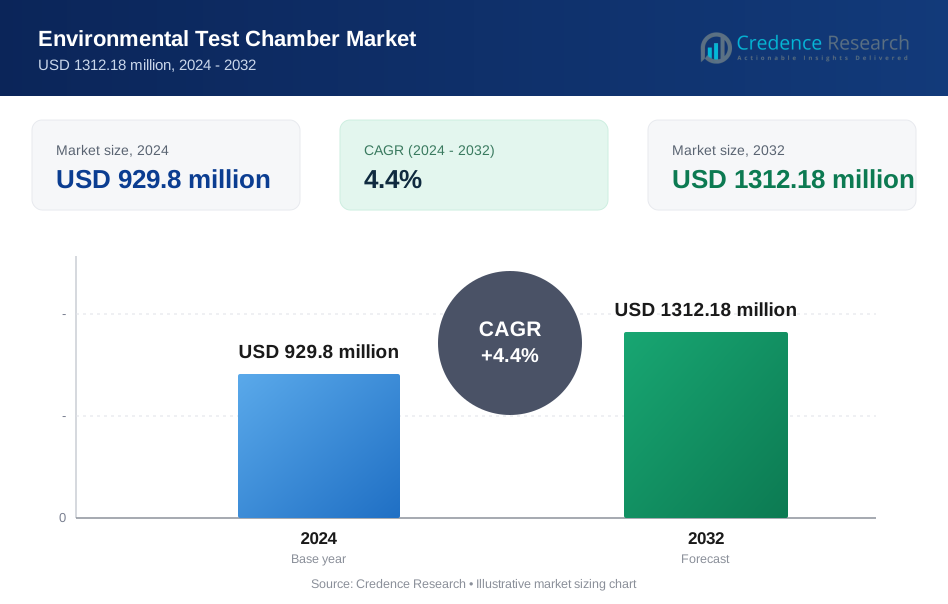
| Environmental Test Chamber Market Size 2024 | USD 929.8 Million |
| Environmental Test Chamber Market, CAGR | 4.4% |
| Environmental Test Chamber Market Size 2032 | USD 1312.18 Million |
Market Overview:
The Environmental Test Chamber Market is projected to grow from USD 929.8 million in 2024 to USD 1312.18 million by 2032, at a CAGR of 4.4% from 2024 to 2032.
Key drivers of the Environmental Test Chamber market include advancements in technology, stricter regulatory standards, and the rising need for product testing due to the growing complexity of products. As industries strive to meet higher product performance expectations and compliance requirements, the use of environmental test chambers has become critical. Additionally, the integration of IoT (Internet of Things) technologies in testing chambers is enhancing data collection and analysis, improving test accuracy. Innovations such as energy-efficient systems and multi-functional test chambers that can simulate a wide range of environmental conditions are also fueling market growth. Furthermore, the growing demand for customized solutions to meet specific industry needs is promoting new product development. Additionally, the growing focus on research and development in various sectors is leading to increased investments in environmental test chambers.
Geographically, the Environmental Test Chamber market is dominated by North America, followed by Europe and Asia-Pacific. North America holds a substantial market share due to the presence of key industry players and high demand from sectors such as aerospace and automotive. The U.S. remains a critical market, driven by its robust industrial infrastructure and ongoing technological advancements. Europe is also a major market, driven by stringent regulatory requirements and a strong industrial base. The need to comply with environmental standards in sectors like automotive and pharmaceuticals fuels demand in the region. Meanwhile, the Asia-Pacific region is expected to witness the highest growth rate, driven by rapid industrialization, growing manufacturing activities, and increasing demand for product testing in countries like China and India. The growing focus on innovation and emerging technologies in Asia-Pacific further boosts the market's expansion in this region.
Market Insights:
- The Environmental Test Chamber market is projected to grow from USD 929.8 million in 2024 to USD 1312.18 million by 2032, driven by technological advancements and rising product complexity.
- IoT integration and automation are enhancing data collection, predictive maintenance, and test accuracy, significantly contributing to market growth.
- Stricter regulatory standards in industries like automotive, aerospace, and pharmaceuticals are increasing the need for precise environmental testing.
- There is growing demand for customizable, multi-functional test chambers capable of simulating a wide range of environmental conditions for various industrial applications.
- Increased investment in research and development, particularly in electronics and pharmaceuticals, is propelling the adoption of advanced environmental test chambers.
- North America leads the market with a 40% share, driven by the presence of key industry players and high demand from aerospace and automotive sectors.
- The Asia-Pacific region is expected to experience the highest growth rate (25%), supported by rapid industrialization and growing manufacturing activities in China and India.
Market Drivers:
Technological Advancements:
Technological advancements are a key driver in the Environmental Test Chamber market. Innovations like IoT integration and automation systems are enhancing chamber performance. IoT-enabled test chambers allow for real-time data monitoring, predictive maintenance, and precise control of test parameters, enabling manufacturers to optimize testing. For example, CSZ Environmental Test Chambers can simulate temperature variations within ±0.1°C and humidity levels within ±2% RH, ensuring highly accurate testing. Additionally, advancements in materials and sensors allow for the replication of extreme conditions with greater accuracy, further driving market growth.
Regulatory Compliance:
Stricter regulatory standards across industries such as automotive, aerospace, and pharmaceuticals are another significant driver. These regulations require rigorous product testing to ensure product safety, durability, and performance under various environmental conditions. For instance, aerospace companies must comply with AS9100 standards, which demand precise environmental testing for component reliability. As industries face increasing pressure to meet compliance requirements, the demand for environmental test chambers continues to grow, particularly in sectors with stringent quality and safety standards.
Customization and Versatility:
As product complexity rises, there is an increasing demand for customizable and versatile test chambers. Industries seek chambers capable of simulating various conditions, such as temperature extremes, humidity, vibration, and altitude, all within a single system. Manufacturers like Thermotron Industries offer multi-functional chambers that can simulate up to 10 different environmental conditions simultaneously, offering greater flexibility and efficiency. For instance, Thermotron’s SE-Series Environmental Test Chambers can simulate temperature and humidity cycling, vibration, and thermal shock all at once. This trend toward customized solutions is fueling demand for more versatile and adaptable environmental test chambers.
R&D Investments:
The growing focus on research and development (R&D) is contributing significantly to market growth. With industries pushing innovation, there is a higher demand for accurate testing solutions to support new product development. Companies are investing in advanced chambers, such as those from Angelantoni Test Technologies, equipped with AI-driven control systems, enhancing testing precision and efficiency. For example, the STAM 600 series from Angelantoni offers precise temperature and humidity control, making it ideal for R&D processes in industries such as pharmaceuticals and electronics. Increased R&D spending is driving higher investments in environmental test chambers to test new materials and technologies.
Market Trends:
Integration of IoT and Automation:
A key trend in the Environmental Test Chamber market is the integration of Internet of Things (IoT) technology and automation systems. For example, Espec PR-3J IoT-enabled chambers offer real-time data and remote monitoring, while automation reduces human intervention, ensuring more consistent and reliable test results. These innovations enable real-time data collection, remote monitoring, and predictive maintenance, improving testing accuracy and operational efficiency.
Energy-Efficient Solutions:
Energy efficiency has become a priority in the market, driven by rising energy costs and environmental concerns. Manufacturers are developing energy-efficient chambers to reduce consumption while maintaining high performance. For instance, Weiss Technik's Energy-Efficient Test Chamber utilizes advanced insulation and optimized control systems, reducing energy use by up to 30% without compromising testing precision. This focus aligns with the growing global emphasis on sustainability.
Customization and Multi-Functionality:
The demand for customizable and multi-functional test chambers is increasing, as industries seek versatile solutions that can simulate a wide range of environmental conditions within a single system. For example, Thermotron’s SE-Series can simulate temperature, humidity, vibration, and altitude, providing flexibility for complex product testing. Multi-functional chambers streamline testing processes, offering cost and space savings. For example, Thermotron’s SE-Series can simulate temperature, humidity, vibration, and altitude, providing flexibility for complex product testing.
Focus on Reliability and Precision:
Reliability and precision are becoming more important as industries like aerospace and pharmaceuticals require exact environmental conditions for product testing. Environmental chambers such as the Cincinnati Sub-Zero Z-Plus are equipped with advanced sensors and precise control systems, ensuring accuracy in temperature and humidity measurements. For instance, the Z-Plus offers temperature control within ±0.1°C and humidity control within ±2% RH, which are critical for testing high-performance components. Manufacturers are enhancing their chambers with improved sensors and calibration techniques to meet these growing demands for precision.
Market Challenges Analysis:
High Initial Cost:
One of the primary challenges in the Environmental Test Chamber market is the high initial cost of purchasing and setting up these systems. Advanced chambers that offer precise control, multi-functional capabilities, and integration with IoT technologies often come with significant capital investment. This high cost can be a barrier for smaller companies or those operating with limited budgets, especially when compared to less advanced or traditional testing solutions. The need for frequent maintenance and calibration further adds to the overall cost burden, limiting market accessibility for some potential customers.
Complexity in Operation and Maintenance:
Another challenge faced by users of environmental test chambers is the complexity of operation and maintenance. These chambers require specialized knowledge and training for optimal use, including programming, system calibration, and troubleshooting. Furthermore, maintenance demands for advanced systems can be high, requiring regular servicing and updates to ensure peak performance. The reliance on skilled personnel to manage these systems can increase operational costs and affect overall efficiency, especially for businesses without dedicated in-house experts.
Environmental Impact:
As the global emphasis on sustainability and environmental impact grows, the Environmental Test Chamber market faces pressure to reduce the ecological footprint of testing systems. Many traditional chambers consume significant amounts of energy, contributing to rising operational costs and increased carbon emissions. While energy-efficient solutions are being developed, the transition to sustainable technologies often involves further investment and adaptation, which can be a challenge for companies aiming to meet both performance and environmental standards.
Regulatory Compliance and Standardization:
The environmental testing industry is subject to a range of regulatory requirements, varying by industry and region. Compliance with these evolving standards can be challenging for manufacturers and customers alike, especially when regulations change frequently or differ across markets. Meeting these requirements while balancing performance and cost remains a constant challenge in the market.
Market Opportunities:
The Environmental Test Chamber market presents several opportunities driven by emerging technologies and growing industry demands. One of the key opportunities lies in the integration of IoT and automation in environmental testing systems. As industries increasingly rely on real-time data and predictive maintenance, the adoption of IoT-enabled test chambers is on the rise. These chambers offer advanced capabilities such as remote monitoring, precise control, and data analysis, which significantly improve operational efficiency and testing accuracy. The demand for more energy-efficient systems also provides growth potential, as businesses aim to reduce costs and meet sustainability goals. Manufacturers focusing on developing energy-saving solutions that maintain high testing standards can capitalize on this trend.
Another opportunity stems from the growing need for customized and multi-functional test chambers across various industries. As product complexity increases, there is a strong demand for test chambers capable of simulating a wide range of environmental conditions in a single system. Industries such as aerospace, automotive, and electronics require versatile solutions that can accommodate multiple testing parameters like temperature, humidity, vibration, and altitude. The growing focus on research and development, particularly in the pharmaceutical and electronics sectors, also drives investments in specialized environmental test chambers. Additionally, emerging markets in regions like Asia-Pacific, with rapid industrialization and expanding manufacturing activities, offer untapped growth potential for test chamber manufacturers.
Market Segmentation Analysis:
By Test Type
The Environmental Test Chamber market is segmented by test type, including temperature testing, humidity testing, thermal shock testing, and vibration testing. Among these, temperature and humidity testing dominate the market, driven by their essential role in evaluating product durability across various industries. Thermal shock and vibration testing are also growing in demand as products become more complex and must withstand extreme environmental conditions.
By Application Key applications in the Environmental Test Chamber market include automotive, aerospace, electronics, pharmaceuticals, and consumer goods. The automotive sector leads, driven by the need for rigorous testing of components under extreme conditions. Aerospace and electronics also account for substantial market shares due to the need for reliability and performance under varied environmental conditions.
By Capacity Test chambers are also segmented by capacity, including small, medium, and large-scale systems. Small and medium chambers are widely used for testing individual components and smaller product prototypes, while large chambers are utilized for comprehensive testing of full-scale products or systems, particularly in aerospace and automotive applications.
Segmentations:
By Test Type
- Thermal Shock Testing
- Vibration Testing
- Temperature Testing
- Humidity Testing
By Application
- Automotive
- Electronics
- Pharmaceuticals
- Aerospace
- Consumer Goods
By Capacity
- Large Capacity
- Small Capacity
- Medium Capacity
By Chamber Type
- Benchtop Chambers
- Custom Chambers
- Walk-In Chambers
By Control System
- Programmable Control
- Automated Control
- Manual Control
By Region
- North America
- U.S.
- Canada
- Mexico
- Europe
- Germany
- France
- U.K.
- Italy
- Spain
- Rest of Europe
- Asia Pacific
- China
- Japan
- India
- South Korea
- South-east Asia
- Rest of Asia Pacific
- Latin America
- Brazil
- Argentina
- Rest of Latin America
- Middle East & Africa
- GCC Countries
- South Africa
- Rest of the Middle East and Africa
Regional Analysis:
North America
North America holds a dominant market share of 40% in the Environmental Test Chamber market. The region's significant share is driven by the strong presence of key industry players, such as Thermotron Industries, CSZ, and Espec, and high demand from sectors like aerospace, automotive, and electronics. The aerospace industry, in particular, is a major contributor to the growth, with stringent testing standards driving the demand for environmental test chambers. Additionally, the presence of well-established research institutions and the adoption of advanced technologies, such as IoT and automation, further fuel the market's expansion in this region.
Europe
Europe accounts for a market share of 30% in the Environmental Test Chamber market. The region is driven by robust regulatory frameworks and stringent quality control standards, especially in sectors like pharmaceuticals, automotive, and electronics. Countries such as Germany, the UK, and France lead in the adoption of advanced testing systems. The automotive and aerospace sectors in Europe place a premium on precision testing, contributing to the rising demand for environmental test chambers. Additionally, the shift towards energy-efficient and sustainable testing solutions has been a key growth factor in Europe.
Asia-Pacific
The Asia-Pacific region holds a market share of 25%, with rapid industrialization and increasing manufacturing activities being key drivers of market growth. Countries like China, Japan, and India are significant contributors to the regional market, as demand from automotive, electronics, and consumer goods industries continues to rise. The region is also seeing an increase in investments in research and development, particularly in the electronics sector, where environmental test chambers are essential for testing the reliability of products. The increasing focus on innovation and product durability further drives the market in Asia-Pacific.
Latin America
Latin America holds a smaller share of 3% in the Environmental Test Chamber market, but the market is growing steadily. Brazil and Mexico are the largest contributors, with demand primarily coming from the automotive and consumer goods industries. The expansion of manufacturing sectors in these countries, along with increasing focus on product quality, is expected to drive market growth in the coming years.
Middle East & Africa
The Middle East and Africa account for 2% of the market share. Although the market is still emerging, demand for environmental test chambers is growing due to the expansion of the industrial sector in countries like Saudi Arabia, the UAE, and South Africa. The growth is driven by increasing infrastructure development and the adoption of advanced testing technologies in various industries.
Key Player Analysis:
- Thermotron Industries
- CSZ (Cooling and Systems Technology)
- Espec Corporation
- Weiss Technik
- Angelantoni Test Technologies
- Hitachi Limited
- Binder GmbH
- Climats
- Labtech Environmental
- Yamato Scientific Co., Ltd.
Competitive Analysis:
The Environmental Test Chamber market is highly competitive, with several key players dominating the landscape. Companies such as Thermotron Industries, CSZ, and Espec Corporation lead the market, offering advanced test chambers with cutting-edge features such as IoT integration, automation, and energy efficiency. These players continuously innovate to enhance product performance, reliability, and precision. Smaller players like Weiss Technik and Binder GmbH are focusing on niche segments, providing specialized chambers for industries such as pharmaceuticals and electronics. For instance, Weiss Technik offers the Pharma 250 environmental test chamber, which is specifically designed for pharmaceutical applications, ensuring compliance with regulatory standards. Strategic partnerships, collaborations, and mergers are also common as companies seek to expand their product portfolios and regional presence. Market players are increasingly investing in research and development to meet the evolving demands of industries such as aerospace, automotive, and electronics, while focusing on sustainability and compliance with regulatory standards. This competitive landscape drives continuous innovation in product offerings.
Recent Developments:
- In October 2023, Thermotron Industries announced the addition of two new environmental chambers to their SE Series line, the SE-300-10-10 and SE-400-15-15, designed for accurate and reliable test results.
- In February 2024, Hitachi Limited was recognized on the 'A List' for the third consecutive year by the global environmental non-profit CDP for its leading efforts and transparent disclosures related to climate change.
- In January 2025, Binder GmbH unveiled its brand-new climate chambers, featuring modular equipment options and supporting new areas of application, with a focus on unmatched performance, flexibility, and possibilities.
Market Concentration & Characteristics:
The Environmental Test Chamber market is moderately to highly concentrated, with a few dominant players such as Thermotron Industries, CSZ, and Espec Corporation holding substantial market share. These key players lead the market by consistently innovating and enhancing their product offerings with advanced technologies, including IoT integration, automation, and energy-efficient systems. Their products cater to a variety of industries, including aerospace, automotive, electronics, and pharmaceuticals, where precision and reliability are crucial. While large players command a significant portion of the market, smaller players target specific niche applications, providing tailored solutions for industries with unique testing needs, such as the pharmaceutical or consumer goods sectors. This market structure is driven by a strong emphasis on improving multi-functionality, customization, and environmental sustainability. Companies invest heavily in research and development to stay competitive, driving technological advancements and responding to the increasing demand for specialized, high-performance environmental test chambers.
Report Coverage:
The research report offers an in-depth analysis based on Test Type, Application, Capacity, Chamber Type, Control System and Region. It details leading market players, providing an overview of their business, product offerings, investments, revenue streams, and key applications. Additionally, the report includes insights into the competitive environment, SWOT analysis, current market trends, as well as the primary drivers and constraints. Furthermore, it discusses various factors that have driven market expansion in recent years. The report also explores market dynamics, regulatory scenarios, and technological advancements that are shaping the industry. It assesses the impact of external factors and global economic changes on market growth. Lastly, it provides strategic recommendations for new entrants and established companies to navigate the complexities of the market.
Future Outlook:
- The demand for environmental test chambers will continue to grow as industries place more focus on product reliability and durability.
- Increased adoption of IoT and automation technologies will drive advancements in real-time monitoring and predictive maintenance capabilities.
- The growing need for energy-efficient testing solutions will push manufacturers to develop more sustainable and cost-effective chambers.
- As regulations across industries become more stringent, the demand for precise, high-quality environmental testing will increase.
- The automotive, aerospace, and electronics sectors will remain the largest contributors to market growth, requiring advanced testing solutions for complex products.
- There will be a rise in the demand for multi-functional chambers capable of simulating a range of environmental conditions in one system.
- The pharmaceuticals and biotechnology industries will increasingly rely on environmental test chambers to ensure the safety and efficacy of products.
- Customizable solutions tailored to specific industry requirements will become more prevalent, driving further product innovation.
- The expansion of industrialization in emerging economies, particularly in Asia-Pacific, will contribute to market growth.
- As research and development investments grow, the market will see more innovations in test chamber designs, control systems, and materials to meet evolving industry needs.
Request a Free Sample
Fill in your details and we'll send you a free sample report.
- Sample data tables & charts
- Research methodology
Need a Custom Version of This Report?
Tailor the scope, geography, or segments to your exact requirements.
- Custom geography or segment scope
- Direct access to our analyst team
Frequently Asked Questions
What is the projected growth of the Environmental Test Chamber market?
What are the key drivers of growth in the Environmental Test Chamber market?
Which regions are leading the Environmental Test Chamber market?
How are IoT technologies impacting the Environmental Test Chamber market?
What sectors are contributing to the demand for Environmental Test Chambers?
Table of Content
Chapter 1. Report Introduction
- 1.1 Report Description & Purpose
- 1.1.1 Report Title & Market Definition
- 1.1.2 Unique Selling Propositions (USP) & Key Differentiators
- 1.1.3 Value Proposition for Stakeholders
- 1.2 Research Objectives
- 1.2.1 Market Sizing Objectives (Volume & Revenue)
- 1.2.2 Segmentation Objectives
- 1.2.3 Competitive Intelligence Objectives
- 1.2.4 Forecast & Scenario Objectives
- 1.3 Report Scope
- 1.3.1 Environmental Test Chamber Scope – Types & Subtypes Covered
- 1.3.2 Geographic Scope – Regions & Countries Covered
- 1.3.3 Historical Period, Base Year & Forecast Period (2024; forecast to 2032)
- 1.3.4 Inclusions & Exclusions
- 1.4 HS Code & Classification Framework
- 1.5 Currency, Units & Pricing Basis
- 1.6 Target Stakeholders
- 1.7 Limitations & Assumptions
Chapter 2. Executive Summary
- 2.1 Global Environmental Test Chamber Market Snapshot
- 2.1.1 Market Size – Historical (2024) & Forecast (2024-2032) (2024: USD 929.8 million → 2032: USD 1312.18 million)
- 2.1.2 Volume & Revenue – Global Totals
- 2.1.3 Key Market Highlights – Top Five Facts
- 2.2 Environmental Test Chamber Market Segmentation Snapshot
- 2.2.1 Market Split by Region – 2024 vs. 2032
- 2.3 Competitive Snapshot
- 2.3.1 Top 10 Players by Revenue Share – 2024
- 2.3.2 Top 10 Players by Volume Share – 2024
- 2.3.3 Recent Strategic Developments (18-Month Summary)
- 2.4 Key Investment Highlights & Strategic Conclusions
Chapter 3. Environmental Test Chamber Market Dynamics & Industry Analysis
- 3.1 Market Overview & Context
- 3.1.1 Environmental Test Chamber Market Position in the Broader Automotive Value Chain
- 3.1.2 OEM vs. Replacement Market Dynamics
- 3.1.3 Market Maturity & Development Stage by Region
- 3.2 Environmental Test Chamber Market Drivers
- 3.3 Environmental Test Chamber Market Restraints & Challenges
- 3.4 Environmental Test Chamber Market Opportunities
- 3.5 Porter's Five Forces Analysis
- 3.5.1 Threat of New Entrants
- 3.5.2 Bargaining Power of Suppliers
- 3.5.3 Bargaining Power of Buyers
- 3.5.4 Threat of Substitutes
- 3.5.5 Competitive Rivalry – Intensity Assessment
- 3.6 Environmental Test Chamber Value Chain Analysis
- 3.6.1 Upstream – Raw Material/Input Suppliers
- 3.6.1.1 Raw Material/Input 1
- 3.6.1.2 Raw Material/Input 2
- 3.6.1.3 Raw Material/Input 3
- 3.6.2 Midstream – Production/Manufacturing/Service Delivery
- 3.6.2.1 Production/Process Overview
- 3.6.2.2 Key Facility Locations & Capacity by Manufacturer
- 3.6.3 Downstream – Distribution & End Consumer
- 3.6.3.1 Primary Channel – B2B/OEM
- 3.6.3.2 Secondary Channels – Dealer, Retail, Online, Direct
- 3.6.4 Value Chain Profitability Analysis
- 3.6.1 Upstream – Raw Material/Input Suppliers
- 3.7 PESTEL Analysis
- 3.7.1 Political Factors
- 3.7.2 Economic Factors
- 3.7.3 Social Factors
- 3.7.4 Technological Factors
- 3.7.5 Environmental Factors
- 3.7.6 Legal Factors
- 3.8 Environmental Test Chamber Supply Chain Analysis
- 3.8.1 Raw Material/Input Supply Risk Assessment
- 3.8.2 Manufacturing Concentration Risk (Geographic Exposure)
- 3.8.3 Trade Disruption Impact Analysis
- 3.9 Regulatory & Policy Landscape
Note: The regulatory and policy landscape section covers regulations based on their applicability to the market, Environmental Test Chamber category, geography, and scope of the study. Only regulatory frameworks with a material impact on operations, compliance, trade, sustainability, or market access are analyzed in detail.
Chapter 4. Key Investment Pockets & Opportunity Analysis
- 4.1 Environmental Test Chamber Market Attractiveness Analysis
- 4.1.1 By Region – Investment Attractiveness Matrix (Volume × CAGR)
- 4.2 Absolute Revenue Growth Opportunity
- 4.2.1 By Region – Absolute USD Growth Through 2032
- 4.3 Incremental Volume Opportunity
- 4.3.1 By Region – Incremental Volume Through 2032
- 4.3.2 Segment – Incremental Volume
- 4.4 Emerging Submarket Opportunity Deep Dive (Subject to Applicability)
- 4.5 Emerging Market Opportunity Scorecards
- 4.5.1 United States
- 4.5.2 Europe
- 4.5.3 Asia
- 4.5.4 Middle East & Africa
Note: Emerging Market Opportunity Scorecards will be included based on relevance and strategic importance. Regions listed are indicative and may vary depending on data availability and market dynamics.
Chapter 5. Environmental Test Chamber Import-Export Analysis & Trade Flows
- 5.1 Global Trade Overview
- 5.1.1 Global Export Value by Country (2024)
- 5.1.2 Global Export Volume by Country (2024)
- 5.1.3 Global Import Value by Country (2024)
- 5.1.4 Global Import Volume by Country (2024)
- 5.1.5 Net Trade Balance by Country (2024)
- 5.2 Export Analysis – Segment
- 5.2.1 Type 1 (HS Code)
- 5.2.2 Type 2 (HS Code)
- 5.2.3 Type 3 (HS Code)
- 5.2.4 Type 4 (HS Code)
- 5.2.5 Type 5 (HS Code)
- 5.3 Import Analysis – Segment
- 5.3.1 Type 1 (HS Code)
- 5.3.2 Type 2 (HS Code)
- 5.3.3 Type 3 (HS Code)
- 5.3.4 Type 4 (HS Code)
- 5.3.5 Type 5 (HS Code)
- 5.4 Average Unit Trade Prices
- 5.4.1 Average Export Price – Segment & Country
- 5.4.2 Average Import Price – Segment & Source Country
- 5.4.3 Price Trends (2024)
- 5.5 Key Trade Route Analysis
- 5.5.1 Trade Route 1
- 5.5.2 Trade Route 2
- 5.5.3 Trade Route 3
- 5.5.4 Trade Route 4
- 5.5.5 Trade Route 5
- 5.6 Trade Policy Impact Assessment
- 5.6.1 US Anti-Dumping & Section 301 Tariffs
- 5.6.2 EU Customs Union Impact
- 5.6.3 Major Free Trade Agreements
- 5.6.4 USMCA Rules of Origin
Note: Trade policy analysis will be included only where relevant to the Environmental Test Chamber market.
Chapter 6. Competitive Landscape & Company Benchmarking
- 6.1 Environmental Test Chamber Market Concentration & Structure
- 6.1.1 Herfindahl-Hirschman Index (HHI) – vs. 2024
- 6.1.2 Tier 1, Tier 2 & Tier 3 Market Structure
- 6.1.3 Global, Regional & Local Player Dynamics
- 6.2 Environmental Test Chamber Market Share Analysis – 2024
- 6.2.1 Global Revenue Share by Company
- 6.2.2 Global Volume Share by Company
- 6.2.3 Regional Revenue Share
- 6.2.4 Market Share Evolution ( vs. 2024)
- 6.2.5 OEM Segment Share by Company
- 6.2.6 Replacement Segment Share by Company
- 6.3 Production/Delivery Capacity & Facility Analysis
- 6.3.1 Global Installed Capacity
- 6.3.2 Capacity Utilization Rates
- 6.3.3 Production/Output Volume
- 6.3.4 Facility Locations & Capacity Map
- 6.3.5 Planned Capacity Additions
- 6.4 Environmental Test Chamber Competitive Benchmarking Matrix
- 6.4.1 Revenue, Volume, CAGR & Profitability Comparison
- 6.4.2 Channel Revenue Mix
- 6.4.3 Geographic Revenue Exposure
- 6.4.4 R&D Intensity
- 6.4.5 Sustainability Maturity
- 6.5 Strategic Developments in Environmental Test Chamber (Last 24 Months)
- 6.5.1 Mergers, Acquisitions & Divestments
- 6.5.2 New Environmental Test Chamber Launches
- 6.5.3 Facility Expansions
- 6.5.4 Strategic Alliances, Joint Ventures & Partnerships
- 6.5.5 Distribution Expansion & Market Entry
- 6.5.6 Sustainability & ESG Initiatives
- 6.6 Competitive Strategy Mapping
- 6.6.1 Leader, Challenger, Follower & Niche Classification
- 6.6.2 Pricing Strategy Comparison
- 6.6.3 Channel Strategy Matrix
Note: Strategic developments are included based on their materiality and the availability of reliable information.
Chapter 7. Global Environmental Test Chamber Market – By Distribution Channel
- 7.1 Segment Overview
- 7.1.1 Volume & Revenue Split by Channel (2024 & 2032)
- 7.1.2 Channel Mix Evolution (2024-2032)
Chapter 8. Regional Market Analysis – Global Overview
- 8.1 Global Regional Overview
- 8.1.1 Regional Volume Share
- 8.1.2 Regional Revenue Share
- 8.1.3 Regional Volume by Region
- 8.1.4 Regional Revenue by Region
- 8.1.5 Regional Forecast Through 2032
- 8.2 Cross-Regional Segment Analysis
- 8.2.1 By Distribution Channel
- 8.2.2 By Brand/Price Tier
Chapter 9. North America Environmental Test Chamber Market
- 9.1 United States
- 9.2 Canada
- 9.3 Mexico
Chapter 10. Europe Environmental Test Chamber Market
- 10.1 Germany
- 10.2 France
- 10.3 Italy
- 10.4 United Kingdom
- 10.5 Spain
- 10.6 Poland
- 10.7 Russia
- 10.8 Netherlands
- 10.9 Belgium
- 10.10 Sweden
- 10.11 Denmark
- 10.12 Norway
- 10.13 Rest of Europe
Chapter 11. Asia Pacific Environmental Test Chamber Market
- 11.1 China
- 11.2 India
- 11.3 Japan
- 11.4 South Korea
- 11.5 Thailand
- 11.6 Indonesia
- 11.7 Vietnam
- 11.8 Malaysia
- 11.9 Australia
- 11.10 Rest of Asia Pacific
Chapter 12. Latin America Environmental Test Chamber Market
- 12.1 Brazil
- 12.2 Argentina
- 12.3 Colombia
- 12.4 Chile
- 12.5 Rest of Latin America
Chapter 13. Middle East Environmental Test Chamber Market
- 13.1 Saudi Arabia
- 13.2 United Arab Emirates
- 13.3 Turkey
- 13.4 Israel
- 13.5 Iran
- 13.6 Rest of the Middle East
Chapter 14. Africa Environmental Test Chamber Market
- 14.1 South Africa
- 14.2 Egypt
- 14.3 Nigeria
- 14.4 Morocco
- 14.5 Rest of Africa
Chapter 15. Environmental Test Chamber Company Profiles
- 15.1 [Company 01]
- 15.1.1 Company Overview
- 15.1.2 Key Management Personnel
- 15.1.3 Products & Services Portfolio
- 15.1.4 Financial Performance
- 15.1.5 Key Market Focus & Geographic Presence
- 15.1.6 Recent Developments & Strategic Initiatives
Note: The company profile list is preliminary and may change based on research findings, market developments, data availability, and client requirements.
Chapter 16. Appendices
- Appendix A – List of Abbreviations & Acronyms
- Appendix B – Industry Classification Code Reference – Full Series
- Appendix C – Production & Capacity Data Tables
- Appendix D – End-Use & Demand Base Tables
- Appendix E – Consumption & Replacement Rate Assumptions
- Appendix F – ASP Reference Tables
- Appendix G – Manufacturing & Facility Database
- Appendix H – Import-Export Data Tables
- Appendix I – Regulatory Summary Tables
- Appendix J – Primary Research Participant List (Anonymized)
- Appendix K – Primary Research Questionnaire Framework
- Appendix L – Data Sources & Bibliography
- Appendix M – Market Size Divergence & Source Comparison
Chapter 17. Research Methodology
- 17.1 Research Framework & Philosophy
- 17.2 Secondary Research – Sources, Hierarchy & Data Extraction
- 17.3 Data Modeling – Bottom-Up & Top-Down Market Sizing
- 17.4 Primary Research – Stakeholder Framework, LOI & Sample Sizes
- 17.5 Forecast Methodology – Regression, Scenario & Sensitivity Analysis
- 17.6 Quality Control – Four-Layer Validation Framework
- 17.7 Limitations & Standard Assumptions
- 17.8 Disclaimer
