
Market Overview:
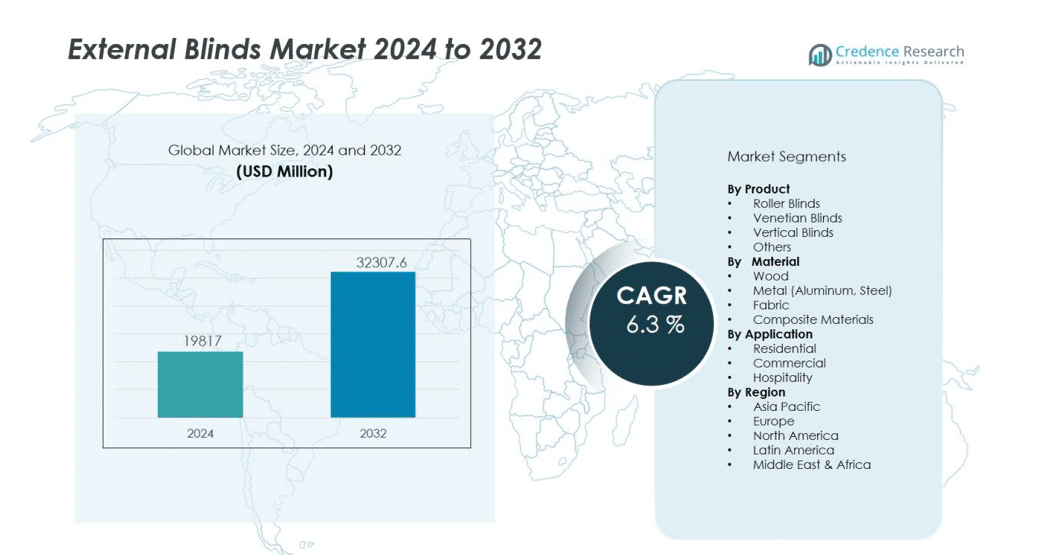
The external blinds market size was valued at USD 19817 million in 2024 and is anticipated to reach USD 32307.6 million by 2032, at a CAGR of 6.3 % during the forecast period (2024-2032).
| REPORT ATTRIBUTE | DETAILS |
|---|---|
| Historical Period | 2020-2023 |
| Base Year | 2024 |
| Forecast Period | 2025-2032 |
| External Blinds Market Size 2024 | USD 19817 million |
| External Blinds Market, CAGR | 6.3% |
| External Blinds Market Size 2032 | USD 32307.6 million |
Key drivers of the external blinds market include growing urbanization, rising construction activities, and the need for enhanced comfort in living and working spaces. Increasing consumer awareness of sustainable materials and energy-saving solutions is encouraging manufacturers to innovate with automated, smart, and eco-friendly blind systems. Advancements such as motorized operations and integration with home automation platforms further strengthen adoption among tech-savvy consumers, while the hospitality and retail sectors increasingly utilize blinds for both energy efficiency and design appeal.
Regionally, Europe leads the external blinds market, driven by stringent energy-efficiency regulations, architectural trends, and strong demand for climate-adaptive solutions. Asia-Pacific is witnessing rapid growth due to expanding urban infrastructure in countries such as China, India, and Japan, coupled with rising disposable incomes. North America remains a key market, with strong emphasis on smart home integration and outdoor living trends.
Market Insights:
- The external blinds market was valued at USD 19,817 million in 2024 and is projected to reach USD 32,307.6 million by 2032, growing at a CAGR of 6.3% during 2024–2032.
- Rising demand for energy-efficient solutions supports adoption, with external blinds helping reduce heat gain, lower cooling costs, and enhance indoor comfort.
- Increasing penetration of smart and automated shading systems, including motorized and sensor-based blinds, is reshaping consumer preferences.
- Rapid urbanization and expansion of residential, commercial, and hospitality infrastructure continue to drive strong market growth worldwide.
- Europe leads with a 38% share, backed by strict energy regulations, eco-friendly building practices, and widespread demand for automated shading.
- Asia-Pacific holds 32% share, fueled by urban growth in China, India, and Japan, alongside rising disposable incomes and smart city projects.
- North America accounts for 22% share, with demand supported by smart home integration, outdoor living trends, and growing renovation activities.
Market Drivers:
Rising Demand for Energy Efficiency and Cost Savings
The external blinds market benefits from the increasing emphasis on energy efficiency in both residential and commercial spaces. External blinds reduce solar heat gain, lower cooling costs, and improve indoor comfort, making them an attractive alternative to traditional shading solutions. It aligns with global sustainability goals, encouraging households and businesses to adopt products that help cut energy consumption. This factor positions external blinds as a practical investment in modern building design.
- For instance, Parata Solutions LLC's automated insulating window shades achieved 25 percent energy consumption reduction during both heating and cooling seasons at Willis Tower.
Growing Adoption of Smart and Automated Shading Systems
Advancements in automation and smart home technology are driving strong adoption of motorized and sensor-based external blinds. Consumers prefer convenience, remote control, and integration with home automation platforms, which enhances the appeal of modern shading systems. The external blinds market responds with solutions that adapt to weather conditions, offering both functional and aesthetic benefits. It strengthens adoption in premium housing and commercial projects where technology integration is a key differentiator.
- For instance, Lutron Electronics' Palladiom Wire-Free Shading System covers single shades up to 12 feet (3.66 meters) wide by 14 feet (4.27 meters) tall while maintaining symmetrical light gaps as small as 12 millimeters and operating at whisper-quiet sound levels of 35 dBA.
Expansion of Urban Construction and Infrastructure Development
Rapid urbanization and infrastructure projects worldwide fuel demand for external blinds in residential complexes, office buildings, and hospitality facilities. Architects and developers incorporate blinds to balance aesthetics with energy-efficient performance. The external blinds market gains traction in cities where high-rise construction and modern design standards require adaptable shading solutions. It benefits from the increasing use of outdoor spaces such as patios and balconies, where blinds enhance usability.
Rising Consumer Focus on Sustainability and Design Versatility
Consumers show growing interest in eco-friendly and durable products, pushing manufacturers to innovate with sustainable materials and versatile designs. The external blinds market adapts by offering recyclable, weather-resistant, and customizable options to meet diverse architectural needs. It also benefits from the increasing consumer preference for outdoor living spaces that combine comfort with environmental responsibility. The dual role of external blinds in providing energy savings and design appeal reinforces long-term market growth.
Market Trends:
Integration of Smart Technology and Automation in Modern Shading Solutions
The external blinds market is witnessing a strong trend toward automation and smart control systems that enhance convenience and energy efficiency. Motorized blinds equipped with sensors respond automatically to sunlight, wind, or temperature, creating adaptive comfort in residential and commercial settings. Consumers increasingly favor products compatible with smart home platforms, reflecting a broader shift toward connected living solutions. It drives innovation in wireless control systems, app-based management, and voice-assisted operations. The integration of artificial intelligence and IoT-based features also allows predictive shading, optimizing energy savings and user experience. This trend elevates external blinds from simple shading products to intelligent components of sustainable building design.
- For instance, Somfy's Sonesse ULTRA 50 AC motor provides 6Nm of power while maintaining acoustic performance below 38dB, enabling multi-band installation of up to 6 shades on a single motor.
Growing Preference for Sustainable Materials and Versatile Aesthetic Designs
The external blinds market is also shaped by the rising consumer demand for eco-friendly and visually appealing products. Manufacturers are focusing on recyclable, UV-resistant, and weatherproof materials that extend product life while aligning with environmental priorities. It reinforces the role of external blinds in supporting sustainable construction practices and green certifications. Customization in colors, patterns, and designs has gained momentum, catering to diverse architectural styles across residential, hospitality, and office projects. Blinds that complement outdoor living spaces, such as patios and balconies, reflect the growing emphasis on lifestyle-oriented design. The combination of sustainability, durability, and design flexibility strengthens the position of external blinds as both functional and decorative solutions.
- For instance, Helioscreen's external blinds repel up to 90% of the sun's heat while maintaining visibility and reducing air conditioning costs, featuring over 30 fabric colors and stainless steel guide systems for enhanced durability.
Market Challenges Analysis:
High Installation Costs and Maintenance Concerns
The external blinds market faces challenges related to high upfront costs and complex installation requirements. Consumers often perceive external blinds as premium products, which limits adoption in price-sensitive regions. It also encounters hesitation from buyers who are concerned about long-term maintenance, especially in areas with harsh weather conditions that may cause wear and tear. Regular servicing or part replacement increases ownership costs, reducing appeal among cost-conscious customers. These factors create barriers for widespread adoption, particularly in developing markets where affordability remains a key consideration.
Limited Awareness and Market Fragmentation Across Regions
The external blinds market also struggles with limited consumer awareness and fragmented supply channels in emerging economies. Many customers are unfamiliar with the energy-saving and design benefits of external blinds, leading to slower penetration compared to conventional shading solutions. It is further challenged by the presence of numerous regional and local players offering inconsistent product quality, which affects consumer trust. The lack of standardized regulations and certifications complicates product differentiation and competitive positioning. These issues collectively slow down global expansion and hinder the ability of manufacturers to capture broader market share.
Market Opportunities:
Expanding Demand for Smart and Energy-Efficient Building Solutions
The external blinds market has significant opportunities in the growing adoption of smart homes and energy-efficient buildings. Consumers and businesses are increasingly investing in automated shading systems that integrate with IoT platforms, creating demand for advanced and connected blinds. It benefits from government initiatives promoting sustainable construction and energy conservation, encouraging wider acceptance of eco-friendly solutions. The ability of external blinds to reduce cooling costs and enhance indoor comfort positions them as essential components of green building certifications. Rising awareness of climate adaptation also strengthens the case for blinds that optimize daylight control and thermal performance. These factors create a strong pathway for long-term market growth.
Rising Urbanization and Lifestyle-Oriented Outdoor Spaces
The external blinds market is well-positioned to capitalize on increasing urbanization and the expansion of outdoor living spaces in residential and commercial projects. Growing demand for stylish and functional shading in patios, balconies, restaurants, and hospitality spaces drives product adoption. It gains further momentum from the rising consumer preference for customizable, durable, and weather-resistant designs that suit modern architectural trends. Expanding middle-class populations with higher disposable incomes in Asia-Pacific and Latin America present new revenue opportunities. The integration of sustainable materials also opens avenues for brands to differentiate through eco-conscious offerings. Together, these trends highlight untapped potential for market expansion across diverse regions.
Market Segmentation Analysis:
By Product:
The external blinds market by product includes roller blinds, Venetian blinds, vertical blinds, and others. Roller blinds dominate demand due to their simplicity, durability, and suitability for both residential and commercial spaces. Venetian blinds remain popular for adjustable light control and modern aesthetics, while vertical blinds cater to larger window panels in offices and retail environments. It reflects growing adoption of motorized product variants across these categories to meet rising demand for convenience and automation.
- For instance, Warema's WMS control system integrates with over 3,000 devices from 128 manufacturers, enabling bi-directional wireless control of external venetian blinds with automatic weather-based positioning across 50 countries with 60 years of experience.
By Material:
The external blinds market by material is segmented into wood, metal, fabric, and composite materials. Fabric blinds lead due to their lightweight structure, versatility, and cost-effectiveness. Metal blinds, particularly aluminum, are valued for their durability and weather resistance, making them suitable for commercial and outdoor applications. Wood blinds appeal to premium residential buyers seeking aesthetic appeal and natural finishes. It is increasingly shaped by composite and eco-friendly materials that align with sustainability priorities.
- For instance, Hunter Douglas manufactures 1-inch aluminum blinds with slats containing 95% pre-consumer recycled content and features their Dust Shield™ finish technology that inhibits dust build-up for easier maintenance.
By Application:
The external blinds market by application spans residential, commercial, and hospitality sectors. Residential use leads adoption, driven by energy efficiency needs and demand for stylish, functional shading in homes. Commercial buildings adopt blinds to improve energy performance and create professional indoor environments. Hospitality spaces, including hotels and restaurants, use external blinds to enhance comfort and extend usability of outdoor areas. It continues to expand with rising construction activities and the growth of lifestyle-oriented spaces.
Segmentations:
By Product:
- Roller Blinds
- Venetian Blinds
- Vertical Blinds
- Others
By Material:
- Wood
- Metal (Aluminum, Steel)
- Fabric
- Composite Materials
By Application:
- Residential
- Commercial
- Hospitality
By Region:
- North America
- U.S.
- Canada
- Mexico
- Europe
- Germany
- France
- U.K.
- Italy
- Spain
- Rest of Europe
- Asia Pacific
- China
- Japan
- India
- South Korea
- South-east Asia
- Rest of Asia Pacific
- Latin America
- Brazil
- Argentina
- Rest of Latin America
- Middle East & Africa
- GCC Countries
- South Africa
- Rest of the Middle East and Africa
Regional Analysis:
Europe:
Europe holds the largest market share of 38% in the external blinds market, supported by strict energy efficiency regulations and high consumer awareness. The region benefits from strong demand in countries such as Germany, France, and Italy, where architectural aesthetics align with sustainable building practices. It gains momentum from renovation projects focused on energy conservation and climate adaptation. Demand for motorized and climate-responsive blinds is particularly strong in commercial buildings and luxury housing. Growing adoption of eco-friendly materials also supports long-term market growth. The well-established distribution networks across Europe further strengthen product accessibility and consumer trust.
Asia-Pacific:
Asia-Pacific accounts for a market share of 32% in the external blinds market, driven by rapid urbanization, infrastructure growth, and increasing disposable incomes. The region is witnessing robust demand in China, India, and Japan, where expanding residential complexes and commercial projects adopt modern shading solutions. It benefits from a growing middle-class population seeking energy-efficient and aesthetically appealing products. Rising construction of smart cities and government initiatives promoting green buildings further accelerate adoption. Local and international manufacturers are investing in innovative, weather-resistant blinds tailored to diverse climates. The region’s dynamic construction sector continues to provide substantial growth opportunities.
North America:
North America represents a market share of 22% in the external blinds market, fueled by the rising popularity of smart homes and outdoor living trends. The United States leads demand, supported by consumer preference for technology-integrated blinds and energy-saving solutions. It also benefits from a growing emphasis on home renovation and the expansion of premium residential projects. Demand for blinds in hospitality, retail, and office spaces is further boosting market penetration. The integration of IoT-based controls and voice-assisted features resonates with tech-savvy consumers. Canada contributes with steady adoption driven by energy-conscious households and sustainable construction practices. Strong marketing and distribution channels continue to support regional expansion.
Key Player Analysis:
- Alulux GmbH
- Country Blinds Pty Ltd
- Griesser AG
- Hunter Douglas
- NEVA
- MHZ Hachtel GmbH & Co. KG
- Schenker Storen
- Verano
- Serge Ferrari S.A.S.
- WAREMA Renkhoff SE
Competitive Analysis:
The external blinds market is highly competitive, led by global and regional players focusing on innovation, sustainability, and automation. Key participants include Alulux GmbH, Country Blinds Pty Ltd, Griesser AG, Hunter Douglas, NEVA, MHZ Hachtel GmbH & Co. KG, Schenker Storen, and Verano. It reflects strong rivalry where established brands emphasize advanced motorized systems, integration with smart home platforms, and energy-efficient designs to strengthen market position. Companies compete by expanding product portfolios, enhancing distribution networks, and offering customization to meet diverse architectural needs. Sustainability remains a core strategy, with increasing use of recyclable and eco-friendly materials aligning with consumer preferences. Regional players leverage cost-effective manufacturing and localized designs to attract price-sensitive customers while competing against premium global brands. The market is defined by continuous product differentiation, strong brand positioning, and an increasing focus on durability, weather resistance, and design versatility to capture long-term growth opportunities.
Recent Developments:
- In April 2025, DSV completed its acquisition of Schenker Storen, integrating the company into its global logistics operations beginning May 1, 2025.
- In Feb 2025, WAREMA introduced the GrandSlide insect screen, which provides reliable protection over large glass areas, including lift and slide doors. The screen is suitable for both new and retrofit installations.
Market Concentration & Characteristics:
The external blinds market is moderately concentrated, with a mix of global players and strong regional manufacturers competing on technology, design, and sustainability. Leading companies focus on innovation in automation, eco-friendly materials, and customizable designs to meet diverse consumer demands. It reflects a balance between premium offerings from established brands and cost-effective solutions from local suppliers. The market is characterized by rising demand for smart shading systems, strong influence of energy efficiency regulations, and increasing adoption in residential and commercial projects. Competitive differentiation often depends on product durability, weather resistance, and integration with smart home technologies.
Report Coverage:
The research report offers an in-depth analysis based on Product, Material, Application and Region. It details leading Market players, providing an overview of their business, product offerings, investments, revenue streams, and key applications. Additionally, the report includes insights into the competitive environment, SWOT analysis, current Market trends, as well as the primary drivers and constraints. Furthermore, it discusses various factors that have driven Market expansion in recent years. The report also explores Market dynamics, regulatory scenarios, and technological advancements that are shaping the industry. It assesses the impact of external factors and global economic changes on Market growth. Lastly, it provides strategic recommendations for new entrants and established companies to navigate the complexities of the Market.
Future Outlook:
- The external blinds market will continue to expand as demand for energy-efficient shading solutions strengthens across residential and commercial spaces.
- Rising adoption of smart home technology will drive wider use of motorized and sensor-based blinds that enhance user convenience.
- Manufacturers will invest in sustainable and recyclable materials to align with global environmental priorities and consumer demand.
- Growing urbanization and infrastructure projects will create opportunities for external blinds in high-rise apartments, offices, and hospitality facilities.
- Customizable designs and versatile aesthetics will gain prominence, catering to diverse architectural preferences.
- Integration with IoT platforms and voice-controlled systems will increase product appeal among tech-savvy consumers.
- The outdoor living trend will boost demand for blinds in patios, balconies, and recreational spaces, especially in urban areas.
- Government incentives for green building initiatives will encourage the adoption of energy-saving shading solutions.
- Competitive dynamics will intensify as regional manufacturers introduce affordable alternatives to global premium brands.
- Expanding construction activities in emerging economies will present significant growth opportunities, positioning external blinds as essential elements of modern building design.

Request a Free Sample
Fill in your details and we'll send you a free sample report.
- Sample data tables & charts
- Research methodology
Market Dynamics
Emphasis on Energy Efficiency and Cost Savings
External blinds help reduce solar heat gain and lower cooling costs, making them attractive for both residential and commercial buildings seeking to improve energy efficiency and meet sustainability goals. This aligns with global trends toward reducing energy consumption and supports adoption in new construction and renovation projects.
Adoption of Smart and Automated Shading Systems
The integration of motorized, sensor-based, and IoT-enabled external blinds appeals to tech-savvy consumers and commercial users seeking convenience, remote control, and adaptive comfort. This trend is driving innovation and increasing the appeal of external blinds as part of modern smart home and building solutions.
Rapid Urbanization and Infrastructure Development
Expanding urban populations and increased construction of residential complexes, office buildings, and hospitality facilities are fueling demand for external blinds. These products are increasingly specified by architects and developers to balance aesthetics with energy-efficient performance in new and renovated structures.
Rising Consumer Focus on Sustainability and Design Versatility
Growing awareness of environmental issues and demand for eco-friendly, durable, and customizable products are pushing manufacturers to innovate with recyclable materials and versatile designs. This supports the market's growth as consumers seek solutions that combine energy savings with aesthetic appeal.
Government Regulations and Green Building Initiatives
Stringent energy efficiency regulations, especially in Europe, and incentives for green building certifications are encouraging the adoption of external blinds. These policies drive both commercial and residential sectors to invest in advanced shading solutions that contribute to climate adaptation and sustainability targets.
Need a Custom Version of This Report?
Tailor the scope, geography, or segments to your exact requirements.
- Custom geography or segment scope
- Direct access to our analyst team
Frequently Asked Questions
What is the current market size for the external blinds market, and what is its projected size in 2032?
Which external blinds market segment held the largest share in 2024?
What are the primary factors fueling the growth of the external blinds market?
Who are the leading companies in the external blinds market?
Table of Content
Chapter 1 Market Segmentation
- 1.1 Segmentation Framework
- 1.1.1 Product and Service Classification
- 1.1.2 Application and End-Use Classification
- 1.1.3 Technology and Solution Classification
- 1.1.4 Customer and Distribution Channel Classification
- 1.1.5 Geographic Segmentation
- 1.1.6 Market Segment Definitions and Boundaries
- 1.2 By Product
- 1.2.1 Roller Blinds
- 1.2.2 Venetian Blinds
- 1.2.3 Vertical Blinds
- 1.2.4 Others
- 1.3 By Material
- 1.3.1 Wood
- 1.3.2 Metal (Aluminum, Steel)
- 1.3.3 Fabric
- 1.3.4 Composite Materials
- 1.4 By Application
- 1.4.1 Residential
- 1.4.2 Commercial
- 1.4.3 Hospitality
Chapter 2 Introduction
- 2.1 Report Objectives and Scope
- 2.2 Product Definition and Industry Terminology
- 2.3 Market Inclusions and Exclusions
- 2.4 Research Process
- 2.4.1 Primary Research and Expert Interviews
- 2.4.2 Secondary Research and Source Review
- 2.4.3 Top-Down and Bottom-Up Estimation
- 2.4.4 Data Triangulation and Verification
- 2.5 Market Size Measurement Basis
- 2.5.1 2024: USD 19,817 million → 2032: USD 32,307.6 million
- 2.6 Historical and Forecast Reference Periods
- 2.6.1 Base Year: 2024
- 2.6.2 Forecast Period: 2024-2032
- 2.7 Research Assumptions and Limitations
Chapter 3 Executive Summary
- 3.1 Market Snapshot and Key Findings
- 3.2 Base-Year Market Size, 2024
- 3.3 Forecast Market Size, 2032
- 3.4 Revenue and Volume Growth Outlook
- 3.5 Key Demand and Supply Indicators
- 3.6 Leading Market Segments
- 3.7 Fastest-Growing Market Opportunities
- 3.8 Regional Performance Highlights
- 3.9 Technology and Industry Transformation
- 3.10 Competitive Landscape Summary
- 3.11 Analyst View and Strategic Implications
Chapter 4 Global External Blinds Market Trends and Developments
- 4.1 Historical Industry Development
- 4.2 Recent Market Trends and Developments
- 4.3 Demand and Customer Behavior Trends
- 4.4 Technology and Product Innovation
- 4.5 Artificial Intelligence, Automation and Digitalization
- 4.6 Local Manufacturing and Supply Chain Realignment
- 4.7 Industry Partnerships, Mergers and Acquisitions
- 4.8 Sustainability and Circular Economy Developments
- 4.9 Government and Private Sector Investment Trends
- 4.10 Emerging Business Models and Commercialization
- 4.11 Industry Developments and Announcements
Chapter 5 Global External Blinds Market Production, Supply and Demand Analysis
- 5.1 Demand Trend and Consumption Analysis
- 5.2 Demand Forecast, 2024-2032
- 5.3 Production and Output Trend
- 5.4 Production and Output Forecast, 2024-2032
- 5.5 Installed Capacity and Capacity Utilization
- 5.6 Company-Wise Production Plants and Statistics
- 5.6.1 Installed Production Capacity
- 5.6.2 Actual Production
- 5.6.3 Planned Capacity and Expansion Targets
- 5.7 Supply Chain Structure and Procurement Trends
- 5.8 Supply-Demand Gap and Bottlenecks
- 5.9 Import Dependence and Sourcing Structure
- 5.10 Contract Manufacturing and Outsourcing
- 5.11 Regional Supply and Demand Concentration
Chapter 6 Global External Blinds Market Pricing Analysis
- 6.1 Pricing Structure and Measurement
- 6.2 Historical Pricing Trends
- 6.3 Pricing Outlook, 2024-2032
- 6.4 Average Selling Price and Unit Economics
- 6.5 Pricing by Product and Market Segment
- 6.6 Geographic Pricing Differences
- 6.7 Key Input, Energy, Labor and Logistics Costs
- 6.8 Contract Pricing and Purchasing Models
- 6.9 Pricing Sensitivity and Competitive Positioning
- 6.10 Price, Margin and Profitability Implications
Chapter 7 Global External Blinds Market Dynamics
- 7.1 Market Growth Drivers
- 7.1.1 Demand-Side Drivers
- 7.1.2 Technology and Innovation Drivers
- 7.1.3 Infrastructure and Investment Drivers
- 7.1.4 Regulatory and Policy Drivers
- 7.2 Market Restraints
- 7.2.1 Cost and Affordability Constraints
- 7.2.2 Technology and Adoption Barriers
- 7.2.3 Supply Chain and Operational Constraints
- 7.3 Market Challenges
- 7.3.1 Competitive Pressure and Margin Erosion
- 7.3.2 Skills, Infrastructure and Implementation Gaps
- 7.4 Emerging Market Opportunities
- 7.5 Market Dynamics Impact and Time-Horizon Assessment
Chapter 8 Global External Blinds Value Chain Analysis
- 8.1 Industry Value Chain Overview
- 8.2 Upstream Suppliers and Critical Inputs
- 8.3 Technology and Component Providers
- 8.4 Manufacturing or Service Delivery
- 8.5 Distribution, Channel Partners and Integrators
- 8.6 Downstream Applications and End Users
- 8.7 Value Addition and Profit Pools
- 8.8 Vertical Integration and Outsourcing
- 8.9 Supplier Concentration and Risk
- 8.10 Supply Chain Localization and Resilience
Chapter 9 Global External Blinds Market Regulations and Policies
- 9.1 Relevant Laws, Standards and Compliance Frameworks
- 9.2 Product, Service, Safety and Quality Requirements
- 9.3 Government Policies, Incentives and Subsidies
- 9.4 Imports, Exports and Trade Barriers
- 9.5 Public Procurement and Local Content Requirements
- 9.6 Environmental and Sustainability Compliance
- 9.7 Upcoming Policy Changes and Market Implications
Chapter 10 Global External Blinds Market Hotspots and Opportunities
- 10.1 Market Opportunity Mapping and Growth Hotspots
- 10.2 High-Growth Applications and Customer Groups
- 10.3 Underserved Markets and White-Space Opportunities
- 10.4 Emerging Technology and Product Opportunities
- 10.5 New Capacity and Investment Hotspots
- 10.6 Market Entry and Expansion Opportunities
- 10.7 Distribution and Partnership Opportunities
- 10.8 Near-Term and Long-Term Commercial Potential
- 10.9 Opportunity Attractiveness and Execution Risks
Chapter 11 Global External Blinds Market Outlook, 2024-2032
- 11.1 Market Size and Analysis
- 11.1.1 Revenue (Market Measurement: 2024: USD 19,817 million → 2032: USD 32,307.6 million)
- 11.1.2 Market Volume and Quantity Sold
- 11.1.3 Historical Market Size
- 11.1.4 Base-Year Market Size, 2024
- 11.2 Market Forecast, 2024-2032
- 11.2.1 Revenue Forecast to 2032
- 11.2.2 Volume Forecast to 2032
- 11.2.3 CAGR and Year-on-Year Growth
- 11.2.4 Incremental Revenue Opportunity
- 11.3 Forecast Assumptions and Scenario Analysis
- 11.3.1 Base-Case Forecast
- 11.3.2 Optimistic and Conservative Scenarios
- 11.3.3 Technology, Pricing and Policy Sensitivities
- 11.4 Market Attractiveness and Growth Outlook
Chapter 12 Global External Blinds Market Segmentation and Outlook
- 12.1 Segmentation Summary and Market Shares, 2024
- 12.2 Largest and Fastest-Growing Segments
- 12.3 By Product - Market Size and Forecast, 2024-2032
- 12.3.1 Segment Definition and Scope
- 12.3.2 Historical Market Size
- 12.3.3 Revenue Forecast, 2024-2032
- 12.3.4 Volume Forecast, 2024-2032
- 12.3.5 Base-Year Market Share, 2024
- 12.3.6 Segment CAGR and Growth Drivers
- 12.3.7 Subsegment Market Size and Forecast
- 12.3.7.1 Roller Blinds
- 12.3.7.2 Venetian Blinds
- 12.3.7.3 Vertical Blinds
- 12.3.7.4 Others
- 12.3.8 Subsegment Pricing and Adoption Trends
- 12.3.9 Leading Suppliers and Competition
- 12.3.10 Regional Demand and Opportunities
- 12.4 By Material - Market Size and Forecast, 2024-2032
- 12.4.1 Segment Definition and Scope
- 12.4.2 Historical Market Size
- 12.4.3 Revenue Forecast, 2024-2032
- 12.4.4 Volume Forecast, 2024-2032
- 12.4.5 Base-Year Market Share, 2024
- 12.4.6 Segment CAGR and Growth Drivers
- 12.4.7 Subsegment Market Size and Forecast
- 12.4.7.1 Wood
- 12.4.7.2 Metal (Aluminum, Steel)
- 12.4.7.3 Fabric
- 12.4.7.4 Composite Materials
- 12.4.8 Subsegment Pricing and Adoption Trends
- 12.4.9 Leading Suppliers and Competition
- 12.4.10 Regional Demand and Opportunities
- 12.5 By Application - Market Size and Forecast, 2024-2032
- 12.5.1 Segment Definition and Scope
- 12.5.2 Historical Market Size
- 12.5.3 Revenue Forecast, 2024-2032
- 12.5.4 Volume Forecast, 2024-2032
- 12.5.5 Base-Year Market Share, 2024
- 12.5.6 Segment CAGR and Growth Drivers
- 12.5.7 Subsegment Market Size and Forecast
- 12.5.7.1 Residential
- 12.5.7.2 Commercial
- 12.5.7.3 Hospitality
- 12.5.8 Subsegment Pricing and Adoption Trends
- 12.5.9 Leading Suppliers and Competition
- 12.5.10 Regional Demand and Opportunities
- 12.6 Segment Growth Comparison
- 12.7 Segment Attractiveness and Priority Matrix
Chapter 13 Global External Blinds End-Use and Application Market Outlook
- 13.1 End-Use Industry and Customer Demand Structure
- 13.2 Leading Applications and Customer Groups
- 13.3 End-Use Market Size, Share and Forecast
- 13.4 Major End-Use Industry Deep Dives
- 13.4.1 Customer Requirements and Use Cases
- 13.4.2 Demand and Replacement Cycles
- 13.4.3 Technical and Regulatory Considerations
- 13.4.4 Purchasing and Procurement Models
- 13.4.5 Leading Vendors and Distribution Channels
- 13.4.6 Forecast and Commercial Opportunities
- 13.5 Emerging Applications and Cross-Segment Demand
- 13.6 End-Use Industry Investment Priorities
Chapter 14 Global External Blinds Geographic Market Outlook, 2024-2032
- 14.1 Regional Market Size and Share, 2024
- 14.2 Regional Market Forecast, 2024-2032
- 14.3 Regional Pricing, Production and Demand Differences
- 14.4 North America
- 14.4.1 United States
- 14.4.2 Canada
- 14.4.3 Mexico
- 14.5 Europe
- 14.5.1 Germany
- 14.5.2 France
- 14.5.3 Italy
- 14.5.4 United Kingdom
- 14.5.5 Spain
- 14.5.6 Poland
- 14.5.7 Russia
- 14.5.8 Netherlands
- 14.5.9 Belgium
- 14.5.10 Sweden
- 14.5.11 Denmark
- 14.5.12 Norway
- 14.5.13 Rest of Europe
- 14.6 Asia Pacific
- 14.6.1 China
- 14.6.2 India
- 14.6.3 Japan
- 14.6.4 South Korea
- 14.6.5 Thailand
- 14.6.6 Indonesia
- 14.6.7 Vietnam
- 14.6.8 Malaysia
- 14.6.9 Australia
- 14.6.10 Rest of Asia Pacific
- 14.7 Latin America
- 14.7.1 Brazil
- 14.7.2 Argentina
- 14.7.3 Colombia
- 14.7.4 Chile
- 14.7.5 Rest of Latin America
- 14.8 Middle East
- 14.8.1 Saudi Arabia
- 14.8.2 United Arab Emirates
- 14.8.3 Turkey
- 14.8.4 Israel
- 14.8.5 Iran
- 14.8.6 Rest of the Middle East
- 14.9 Africa
- 14.9.1 South Africa
- 14.9.2 Egypt
- 14.9.3 Nigeria
- 14.9.4 Morocco
- 14.9.5 Rest of Africa
- 14.10 Regional Investment, Policy and Supply Chain Differences
- 14.11 Regional Competitive Landscape
- 14.12 Geographic Growth Hotspots
Chapter 15 Global External Blinds Technology, Innovation and Sustainability Outlook
- 15.1 Technology Landscape and Maturity
- 15.2 Product, Process and Service Innovation
- 15.3 AI, Automation and Digital Tools in the Industry
- 15.4 Technology Adoption and Performance Benchmarking
- 15.5 Innovation Pipeline and R&D Investment
- 15.6 Patent and Intellectual Property Trends
- 15.7 Energy Efficiency and Resource Management
- 15.8 Sustainability, Recycling and Circularity
- 15.9 Technology Roadmap, 2024-2032
- 15.10 Risks of Obsolescence and Technology Substitution
Chapter 16 Global External Blinds Market Key Strategic Imperatives
- 16.1 Growth and Market Entry Priorities
- 16.2 High-Return Products and Segments
- 16.3 Pricing, Profitability and Cost Optimization
- 16.4 Technology Investment and Product Differentiation
- 16.5 Supply Chain Localization and Resilience
- 16.6 Distribution and Customer Acquisition
- 16.7 Partnership, Acquisition and Capacity Strategy
- 16.8 Regional Expansion Priorities
- 16.9 Short-, Medium- and Long-Term Actions
Chapter 17 Competition Outlook
- 17.1 Industry Competition Characteristics
- 17.2 Market Structure and Concentration
- 17.3 Market Share and Competitive Positioning, 2024
- 17.4 Company-Wise Revenue and Product Benchmarking
- 17.5 Production and Service Capacity Benchmarking
- 17.6 Technology, Pricing and Differentiation
- 17.7 Regional Footprint and Distribution Strength
- 17.8 Mergers, Acquisitions and Strategic Alliances
- 17.9 New Entrants and Competitive Threats
- 17.10 Porter's Five Forces and Industry Attractiveness
- 17.11 Competitive Outlook, 2024-2032
Chapter 18 Company Profiles
- 18.1 Company Coverage and Selection Criteria
- 18.2 Alulux GmbH
- 18.2.1 Business Description
- 18.2.2 Company Ownership and Geographic Presence
- 18.2.3 Product and Service Portfolio
- 18.2.4 Manufacturing and Operating Footprint
- 18.2.5 Production Capacity and Expansion Plans
- 18.2.6 Financial Performance and Investment
- 18.2.7 Market Share and Competitive Position
- 18.2.8 Technology and Innovation Capabilities
- 18.2.9 Strategic Alliances or Partnerships
- 18.2.10 Recent Developments
- 18.2.11 Growth Strategy and Outlook
- 18.3 Country Blinds Pty Ltd
- 18.4 Griesser AG
- 18.5 Hunter Douglas
- 18.6 NEVA
- 18.7 MHZ Hachtel GmbH & Co. KG
- 18.8 Schenker Storen
- 18.9 Verano
- 18.10 Serge Ferrari S.A.S.
- 18.11 WAREMA Renkhoff SE
- 18.12 Other Relevant Market Participants
Note: Every listed company is profiled on the structure shown under the first company. The company list is preliminary and may change based on research findings, market developments, data availability and client requirements.
Chapter 19 Disclaimer
- 19.1 Research and Forecast Disclaimer
- 19.2 Data Source and Estimation Limitations
Note: The depth of individual sections depends on data availability for this market. Volume, capacity, trade and other unit-based metrics are included where applicable.

