Market Overview:
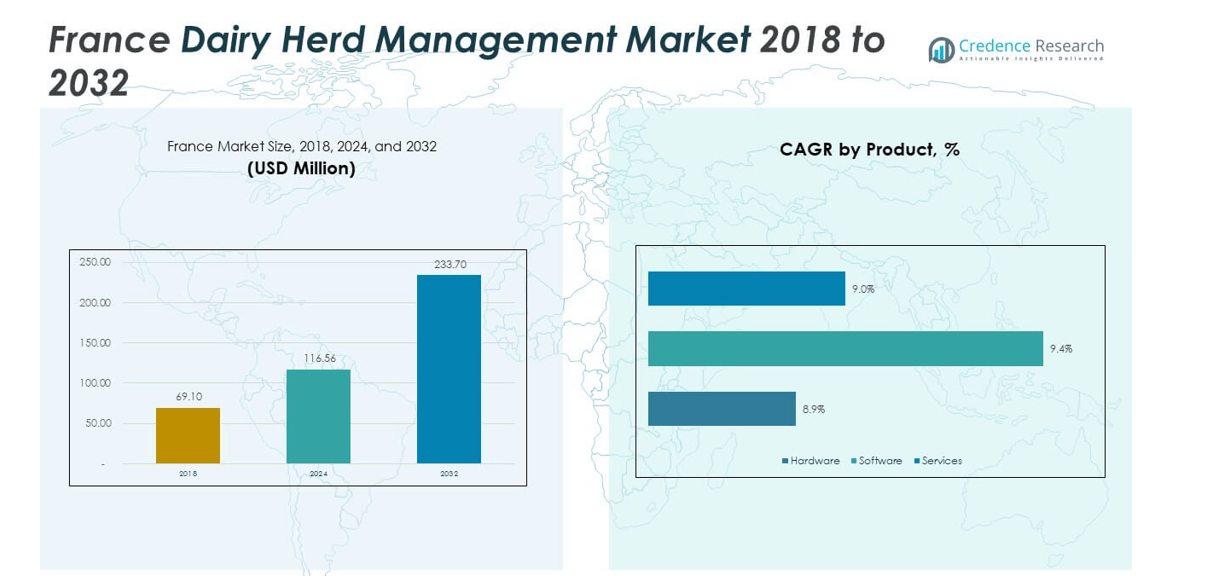
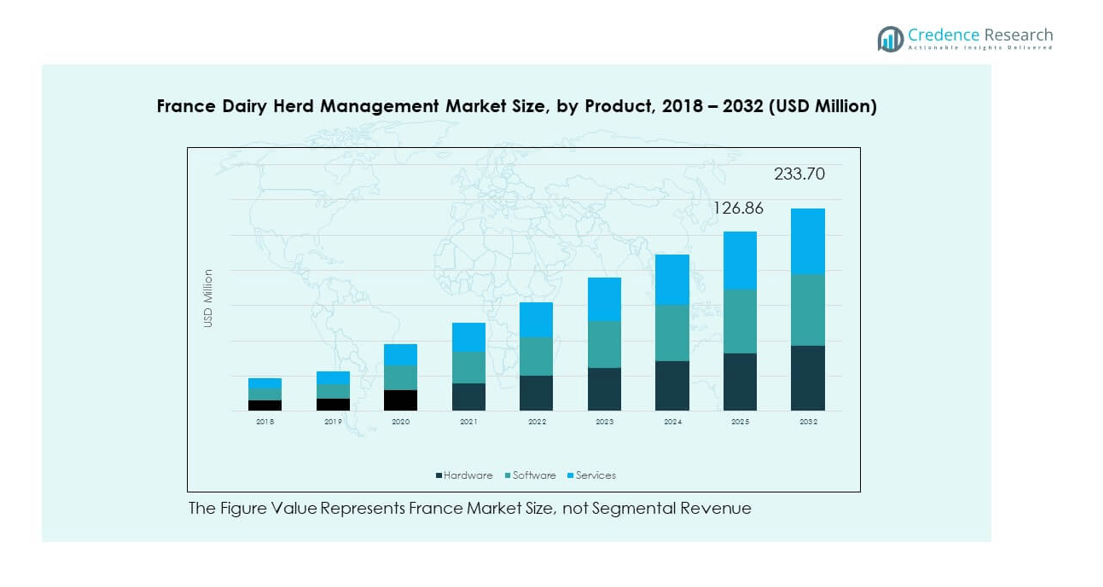
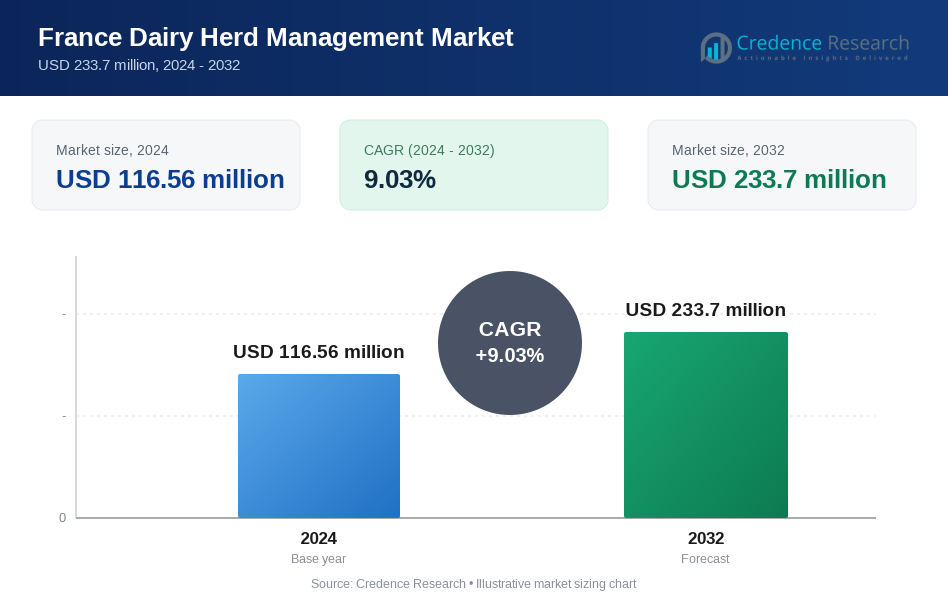
The France Dairy Herd Management Market size was valued at USD 69.1 million in 2018 to USD 116.56 million in 2024 and is anticipated to reach USD 233.7 million by 2032, at a CAGR of 9.03% during the forecast period.
| REPORT ATTRIBUTE | DETAILS |
|---|---|
| Historical Period | 2020-2023 |
| Base Year | 2024 |
| Forecast Period | 2025-2032 |
| France Dairy Herd Management Market Size 2024 | USD 116.56 million |
| France Dairy Herd Management Market, CAGR | 9.03% |
| France Dairy Herd Management Market Size 2032 | USD 233.7 million |
The market growth is driven by increasing adoption of precision farming technologies, rising focus on automation, and the need to enhance milk productivity. Farmers in France are investing in advanced herd monitoring solutions to optimize efficiency, reduce costs, and improve animal welfare. Growing consumer demand for traceable and high-quality dairy products encourages the use of data-driven tools. Supportive government policies and subsidies for technology adoption further accelerate market expansion. Rising awareness about sustainable practices also contributes to steady demand for modern herd management systems.
France remains a strong market within Europe due to its large-scale dairy production and technological readiness. Northern and western regions lead adoption, supported by established dairy farms and advanced infrastructure. Emerging growth is seen in smaller farming regions, where modernization initiatives are expanding. These areas are increasingly investing in automation and smart dairy technologies to improve competitiveness. The country’s strategic focus on digital agriculture and sustainable farming ensures regional balance in market penetration, making it a hub for dairy innovation in Europe.
Market Insights:
- The France Dairy Herd Management Market was valued at USD 69.1 million in 2018, reached USD 116.56 million in 2024, and is projected to hit USD 233.7 million by 2032, growing at a CAGR of 9.03%.
- Northern France led with 38% share in 2024, supported by advanced infrastructure and high milk output. Western France followed with 32% share, driven by large-scale farms and cooperatives. Southern and Eastern France together accounted for 30%, reflecting modernization efforts in smaller farms.
- Southern and Eastern France represent the fastest-growing regions, contributing 30% of the market. Their expansion is supported by modernization programs, government incentives, and rising adoption of digital solutions among medium and small-scale farms.
- Hardware dominated the market, accounting for about 45% share, reflecting demand for milking systems, monitoring devices, and sensors.
- Software and services together captured around 55%, with software expanding rapidly due to AI, cloud platforms, and integrated data solutions, while services supported adoption through training, maintenance, and customization.
Market Drivers:
Growing Need for Precision and Productivity in Dairy Farming
The France Dairy Herd Management Market is driven by the rising demand for precision farming tools. Farmers are focusing on adopting smart systems to maximize milk yield and improve cattle health. Automation reduces manual labor and increases operational efficiency in large-scale farms. It enables early detection of diseases through real-time monitoring and advanced analytics. Growing concerns about productivity losses from untreated conditions encourage adoption of data-based tools. Farmers value systems that integrate nutrition, fertility, and herd tracking. It ensures higher profitability and sustainable dairy operations.
- For instance, DeLaval's Milking Automation MA500 model enables real-time milk yield measurement and automatic cluster detachment, allowing farmers to monitor cow-level milk output instantly, with reported accuracy at 3%, significantly improving parlor efficiency without replacing existing equipment.
Government Support and Incentives Encouraging Technology Adoption
Public policies play a crucial role in advancing the adoption of herd management solutions. Subsidies and financial aid provided to farmers reduce the burden of high initial costs. Programs encourage the transition toward advanced technologies that improve livestock welfare. The France Dairy Herd Management Market benefits from such initiatives, enabling modernization across regions. Farmers gain access to resources that enhance productivity and long-term competitiveness. Regulatory support also ensures compliance with animal health and food safety standards. These measures foster confidence among producers and strengthen investment in automation.
- For example, France’s government-supported modernization aligns with deployment of GEA Group’s Body Condition Scoring (BCS) system launched in November 2024, which uses AI to assess lameness and body condition scores in real-time, maximizing health management on large-scale dairy farms.
Rising Consumer Expectations for Traceability and High-Quality Products
The demand for premium and traceable dairy products fuels the use of herd management solutions. Consumers want assurance about animal welfare and the source of their food. Retailers and processors pressure farmers to adopt reliable systems that provide real-time data. It creates opportunities for innovation in monitoring, data storage, and traceability. Enhanced transparency drives higher adoption across dairy supply chains in France. Farmers see technology as a tool to meet quality standards and market requirements. This driver aligns consumer needs with operational efficiency and dairy modernization.
Focus on Sustainability and Environmental Responsibility in Farming Practices
The growing push for sustainable agriculture encourages the use of eco-friendly herd management technologies. Farmers adopt solutions that minimize environmental impact through efficient resource use. It supports waste management, water conservation, and energy efficiency in dairy operations. The France Dairy Herd Management Market gains momentum by aligning with environmental policies. Green certifications and eco-conscious consumer behavior reinforce the shift toward sustainability. Farmers increasingly prefer automated systems that reduce emissions and optimize feed usage. These practices contribute to long-term resilience and market competitiveness.
Market Trends:
Integration of Artificial Intelligence and Data Analytics in Dairy Operations
The France Dairy Herd Management Market is witnessing strong adoption of AI and analytics-driven solutions. Farmers are relying on predictive models to identify health issues before they escalate. Data-driven insights help optimize breeding schedules and improve feed management efficiency. It supports precision-based decision-making that enhances profitability across dairy farms. AI tools also assist in automating repetitive tasks, reducing dependency on manual labor. Farmers value integrated platforms that provide comprehensive dashboards for herd monitoring. The trend toward digital farming accelerates the shift toward smarter dairy practices.
- For instance, Lely’s Horizon health model continuously evaluates cow health using parameters like milk production, rumination, and somatic cell count, delivering a sick chance rating from 0 to 99 to prioritize interventions, providing 24/7 real-time alerts on health deviations to farmers.
Rising Popularity of Cloud-Based and Remote Monitoring Platforms
Cloud-enabled platforms are becoming integral to modern herd management systems in France. They provide real-time access to critical farm data across devices. Farmers and veterinarians can collaborate seamlessly through connected systems that track herd health. The France Dairy Herd Management Market benefits from scalable cloud solutions designed for small and large farms. It ensures data security, remote accessibility, and smooth integration with existing equipment. Such platforms also allow historical data analysis for long-term herd performance improvement. Growing demand for convenience drives the adoption of cloud-based herd management services.
- For instance, GEA Group offers a cloud-based platform integrated with their Farm Technologies IoT devices, enabling real-time condition monitoring including health alerts and milk yield tracking, implemented across over 70 service organizations worldwide.
Expansion of Automation in Milking and Feeding Systems
Milking robots and automated feeding systems are transforming traditional dairy operations in France. Automation ensures consistency, reduces stress on animals, and improves milk quality. The France Dairy Herd Management Market embraces these technologies to meet labor shortages. Farmers adopt automated feeders to ensure precise distribution of nutrients to herds. It reduces wastage and enhances animal well-being through balanced nutrition. Smart systems also monitor performance and adjust settings in real time. This trend drives modernization of both small-scale and large-scale dairy operations.
Adoption of IoT-Enabled Wearables for Real-Time Monitoring
Wearable devices are gaining traction for advanced livestock monitoring and health tracking. Sensors embedded in collars or ear tags capture continuous data on activity levels and temperature. The France Dairy Herd Management Market benefits from this innovation by improving disease prevention. IoT-based solutions help detect fertility cycles and reduce calving intervals. Farmers gain access to timely insights that improve decision-making accuracy. The popularity of wearables reflects the trend toward individualized animal care. This advancement positions France as a leader in smart dairy farming technologies.
Market Challenges Analysis:
High Implementation Costs and Limited Access for Small-Scale Farmers
The France Dairy Herd Management Market faces barriers due to the high cost of advanced systems. Small and medium farms struggle with upfront investments in automation and AI-driven tools. It limits adoption among traditional farmers who prioritize cost savings over modernization. Training costs and the need for specialized knowledge add further challenges. Financial constraints slow down technology penetration in rural and less-developed areas. Despite subsidies, accessibility remains an issue for farmers with lower income levels. Bridging this gap is critical to ensure inclusive market growth across regions.
Data Management, Connectivity, and Resistance to Change in Farming Practices
Another challenge is the handling of vast data generated by herd management systems. Farmers require reliable internet connectivity, which is limited in some rural areas of France. It creates inefficiencies in real-time monitoring and system performance. The France Dairy Herd Management Market also faces resistance from farmers hesitant to change. Concerns over data privacy and trust in technology hinder wider adoption. Integrating new solutions with existing infrastructure creates technical difficulties. Overcoming these issues requires awareness programs and stronger rural connectivity initiatives.
Market Opportunities:
Expansion of Smart Farming Solutions Through Digitalization and IoT Adoption
The France Dairy Herd Management Market holds opportunities in the rapid adoption of IoT and digital platforms. Farmers are showing strong interest in cloud-based systems that streamline operations. It creates scope for providers to design user-friendly platforms tailored for different farm sizes. Companies can expand by offering cost-effective solutions for small-scale farmers. Growth of smart farming encourages the development of mobile apps for real-time herd tracking. Such tools simplify operations and expand accessibility for farmers across regions. This opportunity supports market growth through inclusive digitalization.
Sustainability-Oriented Technologies Creating Growth Prospects in Dairy Operations
Sustainability opens new opportunities for eco-friendly herd management practices. Farmers are seeking systems that lower emissions, optimize energy use, and reduce waste. The France Dairy Herd Management Market can expand by aligning with environmental goals. Companies investing in green technologies will gain traction among eco-conscious buyers. Solutions focused on animal welfare, resource efficiency, and traceability will find high demand. These advancements strengthen the role of sustainable farming as a growth driver. It positions France as a model for responsible dairy production in Europe.
Market Segmentation Analysis:
By Product
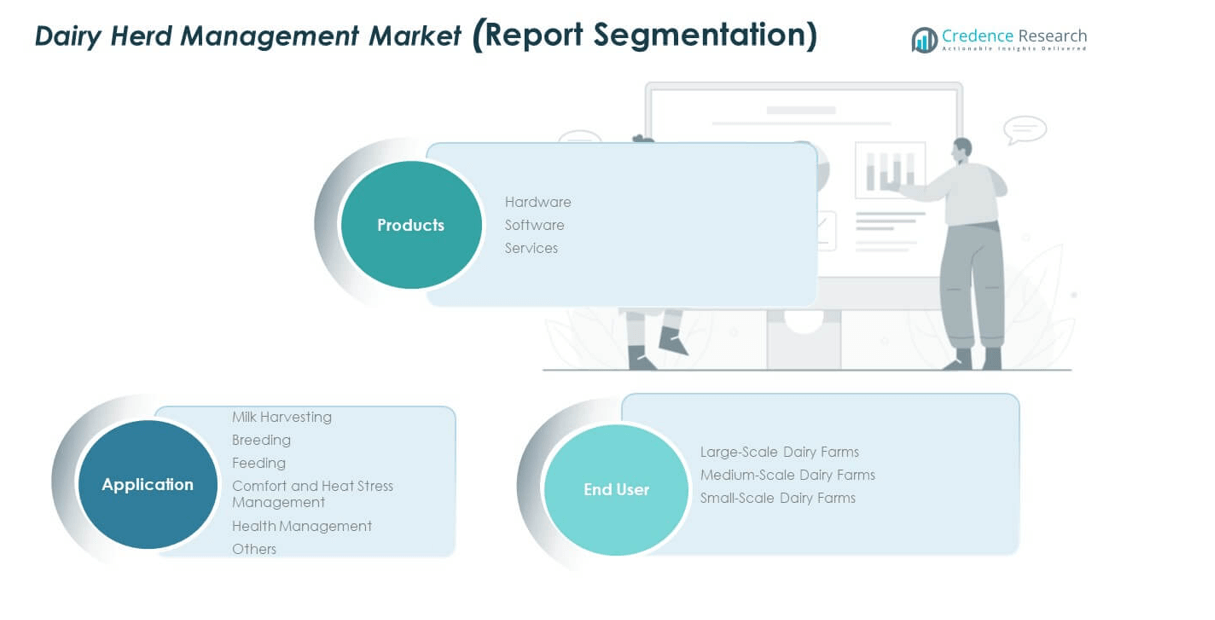
The France Dairy Herd Management Market is segmented into hardware, software, and services. Hardware dominates due to strong adoption of milking equipment, sensors, and monitoring devices. Software is gaining importance with advanced analytics, cloud-based platforms, and data integration tools. Services support installation, maintenance, and training, ensuring smooth adoption across farm sizes. Each segment plays a crucial role in improving farm efficiency and productivity.
- For example, DeLaval’s ICAR-approved milk meters such as the MM27BC provide data on milk flow and yield with a 3% accuracy variance, enabling precise monitoring of individual cow performance and early detection of abnormalities.
By Application
Key applications include milk harvesting, breeding, feeding, comfort and heat stress management, health management, and others. Milk harvesting leads due to high demand for automated systems that improve yield and quality. Breeding solutions enhance reproductive efficiency, while feeding applications optimize nutrition distribution. Comfort and heat stress management is expanding with climate adaptation needs. Health management solutions are widely used for disease prevention and animal welfare. Other applications provide flexible tools supporting overall herd operations.
- For instance, Afimilk’s reproductive management technology offers precise heat detection through activity sensors, improving conception rates and enabling timely insemination with over 90% accuracy reported in field use.
By End User
End users are divided into large-scale, medium-scale, and small-scale dairy farms. Large-scale farms lead adoption with strong investment capacity and advanced infrastructure. Medium-scale farms increasingly adopt automation to remain competitive in regional markets. Small-scale farms show gradual uptake, driven by low-cost solutions and government support. It reflects a diverse adoption pattern where digital transformation reaches farms of different sizes across France.
Segmentation:
By Product Segment
- Hardware
- Software
- Services
By Application Segment
- Milk Harvesting
- Breeding
- Feeding
- Comfort and Heat Stress Management
- Health Management
- Others
By End User Segment
- Large-Scale Dairy Farms
- Medium-Scale Dairy Farms
- Small-Scale Dairy Farms
Regional Analysis:
Northern France – Leading Share with Advanced Dairy Infrastructure
Northern France holds the largest share of the France Dairy Herd Management Market, accounting for nearly 38%. The region benefits from its strong dairy tradition, advanced farm infrastructure, and high milk production capacity. Farmers in this area have been early adopters of automation and precision technologies, ensuring consistent productivity gains. Investment in research and development for dairy practices also strengthens its leadership. It continues to expand with the integration of AI-enabled systems and robotics. The focus on high-quality dairy exports enhances regional competitiveness.
Western France – Strong Growth Supported by Large-Scale Farms
Western France represents around 32% of the market, driven by the dominance of large-scale farms and cooperatives. The area is well known for its high milk output and organized farming clusters. Adoption of herd management solutions is supported by cooperative-led investments and training programs. Farmers prefer integrated solutions for breeding, feeding, and health monitoring. It shows strong momentum in sustainability practices, aligning with environmental goals. The region continues to expand with emphasis on efficiency and global dairy supply chain integration.
Southern and Eastern France – Emerging Adoption with Modernization Initiatives
Southern and Eastern France together contribute nearly 30% of the France Dairy Herd Management Market. Adoption in these regions is still emerging, but modernization programs are driving higher interest in automated systems. Medium and small-scale farms are gradually investing in digital platforms to improve herd productivity. Government initiatives and subsidies encourage technology uptake among traditional farmers. It shows strong potential for growth with rising awareness of animal welfare and traceability. The regional balance highlights opportunities for suppliers targeting developing dairy areas.
Key Player Analysis:
- DeLaval
- MilkingCloud
- VAS
- Merck & Co., Inc.
- Afimilk Ltd.
- UNIFORM-Agri
- GEA Group Aktiengesellschaft
- Fullwood JOZ
- Illumina, Inc.
- Pearson Milking Technology
- Lely
Competitive Analysis:
The France Dairy Herd Management Market is highly competitive, shaped by global leaders and regional specialists. Key players such as DeLaval, GEA Group, Afimilk, Lely, and UNIFORM-Agri dominate through strong product portfolios and advanced technologies. It is defined by continuous investment in automation, data analytics, and sustainability-focused solutions. Companies differentiate themselves through innovation in milking systems, health monitoring, and IoT-enabled platforms. Strategic alliances with cooperatives and local distributors enhance market penetration. Rising demand for cloud-based and AI-driven systems further intensifies competition among vendors. The market structure reflects a blend of established multinationals and emerging innovators targeting niche applications.
Recent Developments:
- In September 2025, DeLaval marked a significant innovation milestone by completing a major expansion at its Hamra Farm research and training center, nearly doubling the milking cow capacity from 260 to 550 and integrating the latest AI-powered herd health and behavior technologies.
- In late March 2025, UNIFORM-Agri made headlines by acquiring the Egam and BelExpert software from Elda, reinforcing its presence in France and supporting local dairy farmers with continuous improvements in herd management solutions and expanded service offerings.
- In July 2025, GEA was selected to supply innovative processing solutions for the world’s largest dairy facility, a model now referenced in France for next-generation herd and milk management, showcasing GEA’s cutting-edge automation and digitalization capabilities.
Report Coverage:
The research report offers an in-depth analysis based on product, application, and end-user segments. It details leading market players, providing an overview of their business, product offerings, investments, revenue streams, and key applications. Additionally, the report includes insights into the competitive environment, SWOT analysis, current market trends, as well as the primary drivers and constraints. Furthermore, it discusses various factors that have driven market expansion in recent years. The report also explores market dynamics, regulatory scenarios, and technological advancements that are shaping the industry. It assesses the impact of external factors and global economic changes on market growth. Lastly, it provides strategic recommendations for new entrants and established companies to navigate the complexities of the market.
Future Outlook:
- Strong adoption of precision farming technologies will reshape dairy herd management.
- AI and data-driven analytics will enhance decision-making for farmers.
- Cloud platforms will dominate, offering scalability across diverse farm sizes.
- Sustainability goals will drive eco-friendly solutions and green certifications.
- Wearable IoT devices will gain prominence in animal health monitoring.
- Large-scale farms will lead investments, influencing market direction.
- Small and medium farms will adopt low-cost and modular solutions.
- Strategic alliances with cooperatives will expand technology access.
- Integration of robotics will transform milking and feeding operations.
- Continuous R&D will strengthen France’s role in Europe’s dairy innovation hub.
Request a Free Sample
Fill in your details and we'll send you a free sample report.
- Sample data tables & charts
- Research methodology
Market Dynamics
Adoption of Precision Farming Technologies
French dairy farmers are increasingly investing in precision farming tools such as automated milking systems, sensors, and data analytics platforms to maximize milk yield, improve herd health, and reduce operational costs. This shift is driven by the need for higher productivity and efficiency in a competitive dairy sector.
Government Support and Subsidies
Supportive government policies, including subsidies and modernization incentives, are making advanced herd management technologies more accessible, especially for medium and small-scale farms. These initiatives lower the financial barriers to adoption and accelerate the digital transformation of the dairy industry.
Rising Demand for Traceability and High-Quality Dairy Products
Consumers and retailers in France are demanding greater transparency, traceability, and assurance of animal welfare in dairy production. This is pushing farms to adopt data-driven herd management systems that can provide real-time monitoring and documentation throughout the supply chain.
Focus on Sustainability and Environmental Responsibility
Growing awareness of sustainable farming practices and environmental regulations is encouraging the adoption of eco-friendly herd management solutions. Technologies that optimize resource use, reduce emissions, and support animal welfare are increasingly favored, aligning with France’s strategic goals for green agriculture.
Expansion of Automation and IoT Integration
The integration of IoT devices, wearables, and cloud-based platforms is transforming herd management by enabling real-time monitoring, predictive analytics, and remote farm management. This trend is particularly strong in regions with advanced infrastructure and is spreading to smaller farms through modular, scalable solutions.
Need a Custom Version of This Report?
Tailor the scope, geography, or segments to your exact requirements.
- Custom geography or segment scope
- Direct access to our analyst team
Frequently Asked Questions
What is the current market size for France Dairy Herd Management Market, and what is its projected size in 2032?
At what Compound Annual Growth Rate is the France Dairy Herd Management Market projected to grow between 2024 and 2032?
Which France Dairy Herd Management Market segment held the largest share in 2024?
What are the primary factors fueling the growth of the France Dairy Herd Management Market?
Who are the leading companies in the France Dairy Herd Management Market?
Table of Content
Chapter 1 Market Segmentation
- 1.1 Segmentation Framework
- 1.1.1 Product and Service Classification
- 1.1.2 Application and End-Use Classification
- 1.1.3 Technology and Solution Classification
- 1.1.4 Customer and Distribution Channel Classification
- 1.1.5 Geographic Segmentation
- 1.1.6 Market Segment Definitions and Boundaries
- 1.2 By Product
- 1.2.1 Hardware
- 1.2.2 Software
- 1.2.3 Services
- 1.3 By End User
- 1.3.1 Large-Scale Dairy Farms
- 1.3.2 Medium-Scale Dairy Farms
- 1.3.3 Small-Scale Dairy Farms
- 1.4 By Application
- 1.4.1 Milk Harvesting
- 1.4.2 Breeding
- 1.4.3 Feeding
- 1.4.4 Comfort and Heat Stress Management
- 1.4.5 Health Management
- 1.4.6 Others
Chapter 2 Introduction
- 2.1 Report Objectives and Scope
- 2.2 Product Definition and Industry Terminology
- 2.3 Market Inclusions and Exclusions
- 2.4 Research Process
- 2.4.1 Primary Research and Expert Interviews
- 2.4.2 Secondary Research and Source Review
- 2.4.3 Top-Down and Bottom-Up Estimation
- 2.4.4 Data Triangulation and Verification
- 2.5 Market Size Measurement Basis
- 2.5.1 2024: USD 116.56 million → 2032: USD 233.7 million
- 2.6 Historical and Forecast Reference Periods
- 2.6.1 Base Year: 2024
- 2.6.2 Forecast Period: 2024-2032
- 2.7 Research Assumptions and Limitations
Chapter 3 Executive Summary
- 3.1 Market Snapshot and Key Findings
- 3.2 Base-Year Market Size, 2024
- 3.3 Forecast Market Size, 2032
- 3.4 Revenue and Volume Growth Outlook
- 3.5 Key Demand and Supply Indicators
- 3.6 Leading Market Segments
- 3.7 Fastest-Growing Market Opportunities
- 3.8 Regional Performance Highlights
- 3.9 Technology and Industry Transformation
- 3.10 Competitive Landscape Summary
- 3.11 Analyst View and Strategic Implications
Chapter 4 France Dairy Herd Management Market Trends and Developments
- 4.1 Historical Industry Development
- 4.2 Recent Market Trends and Developments
- 4.3 Demand and Customer Behavior Trends
- 4.4 Technology and Product Innovation
- 4.5 Artificial Intelligence, Automation and Digitalization
- 4.6 Local Manufacturing and Supply Chain Realignment
- 4.7 Industry Partnerships, Mergers and Acquisitions
- 4.8 Sustainability and Circular Economy Developments
- 4.9 Government and Private Sector Investment Trends
- 4.10 Emerging Business Models and Commercialization
- 4.11 Industry Developments and Announcements
Chapter 5 France Dairy Herd Management Market Production, Supply and Demand Analysis
- 5.1 Demand Trend and Consumption Analysis
- 5.2 Demand Forecast, 2024-2032
- 5.3 Production and Output Trend
- 5.4 Production and Output Forecast, 2024-2032
- 5.5 Installed Capacity and Capacity Utilization
- 5.6 Company-Wise Production Plants and Statistics
- 5.6.1 Installed Production Capacity
- 5.6.2 Actual Production
- 5.6.3 Planned Capacity and Expansion Targets
- 5.7 Supply Chain Structure and Procurement Trends
- 5.8 Supply-Demand Gap and Bottlenecks
- 5.9 Import Dependence and Sourcing Structure
- 5.10 Contract Manufacturing and Outsourcing
- 5.11 Regional Supply and Demand Concentration
Chapter 6 France Dairy Herd Management Market Pricing Analysis
- 6.1 Pricing Structure and Measurement
- 6.2 Historical Pricing Trends
- 6.3 Pricing Outlook, 2024-2032
- 6.4 Average Selling Price and Unit Economics
- 6.5 Pricing by Product and Market Segment
- 6.6 Geographic Pricing Differences
- 6.7 Key Input, Energy, Labor and Logistics Costs
- 6.8 Contract Pricing and Purchasing Models
- 6.9 Pricing Sensitivity and Competitive Positioning
- 6.10 Price, Margin and Profitability Implications
Chapter 7 France Dairy Herd Management Market Dynamics
- 7.1 Market Growth Drivers
- 7.1.1 Demand-Side Drivers
- 7.1.2 Technology and Innovation Drivers
- 7.1.3 Infrastructure and Investment Drivers
- 7.1.4 Regulatory and Policy Drivers
- 7.2 Market Restraints
- 7.2.1 Cost and Affordability Constraints
- 7.2.2 Technology and Adoption Barriers
- 7.2.3 Supply Chain and Operational Constraints
- 7.3 Market Challenges
- 7.3.1 Competitive Pressure and Margin Erosion
- 7.3.2 Skills, Infrastructure and Implementation Gaps
- 7.4 Emerging Market Opportunities
- 7.5 Market Dynamics Impact and Time-Horizon Assessment
Chapter 8 France Dairy Herd Management Value Chain Analysis
- 8.1 Industry Value Chain Overview
- 8.2 Upstream Suppliers and Critical Inputs
- 8.3 Technology and Component Providers
- 8.4 Manufacturing or Service Delivery
- 8.5 Distribution, Channel Partners and Integrators
- 8.6 Downstream Applications and End Users
- 8.7 Value Addition and Profit Pools
- 8.8 Vertical Integration and Outsourcing
- 8.9 Supplier Concentration and Risk
- 8.10 Supply Chain Localization and Resilience
Chapter 9 France Dairy Herd Management Market Regulations and Policies
- 9.1 Relevant Laws, Standards and Compliance Frameworks
- 9.2 Product, Service, Safety and Quality Requirements
- 9.3 Government Policies, Incentives and Subsidies
- 9.4 Imports, Exports and Trade Barriers
- 9.5 Public Procurement and Local Content Requirements
- 9.6 Environmental and Sustainability Compliance
- 9.7 Upcoming Policy Changes and Market Implications
Chapter 10 France Dairy Herd Management Market Hotspots and Opportunities
- 10.1 Market Opportunity Mapping and Growth Hotspots
- 10.2 High-Growth Applications and Customer Groups
- 10.3 Underserved Markets and White-Space Opportunities
- 10.4 Emerging Technology and Product Opportunities
- 10.5 New Capacity and Investment Hotspots
- 10.6 Market Entry and Expansion Opportunities
- 10.7 Distribution and Partnership Opportunities
- 10.8 Near-Term and Long-Term Commercial Potential
- 10.9 Opportunity Attractiveness and Execution Risks
Chapter 11 France Dairy Herd Management Market Outlook, 2024-2032
- 11.1 Market Size and Analysis
- 11.1.1 Revenue (Market Measurement: 2024: USD 116.56 million → 2032: USD 233.7 million)
- 11.1.2 Market Volume and Quantity Sold
- 11.1.3 Historical Market Size
- 11.1.4 Base-Year Market Size, 2024
- 11.2 Market Forecast, 2024-2032
- 11.2.1 Revenue Forecast to 2032
- 11.2.2 Volume Forecast to 2032
- 11.2.3 CAGR and Year-on-Year Growth
- 11.2.4 Incremental Revenue Opportunity
- 11.3 Forecast Assumptions and Scenario Analysis
- 11.3.1 Base-Case Forecast
- 11.3.2 Optimistic and Conservative Scenarios
- 11.3.3 Technology, Pricing and Policy Sensitivities
- 11.4 Market Attractiveness and Growth Outlook
Chapter 12 France Dairy Herd Management Market Segmentation and Outlook
- 12.1 Segmentation Summary and Market Shares, 2024
- 12.2 Largest and Fastest-Growing Segments
- 12.3 By Product - Market Size and Forecast, 2024-2032
- 12.3.1 Segment Definition and Scope
- 12.3.2 Historical Market Size
- 12.3.3 Revenue Forecast, 2024-2032
- 12.3.4 Volume Forecast, 2024-2032
- 12.3.5 Base-Year Market Share, 2024
- 12.3.6 Segment CAGR and Growth Drivers
- 12.3.7 Subsegment Market Size and Forecast
- 12.3.7.1 Hardware
- 12.3.7.2 Software
- 12.3.7.3 Services
- 12.3.8 Subsegment Pricing and Adoption Trends
- 12.3.9 Leading Suppliers and Competition
- 12.3.10 Regional Demand and Opportunities
- 12.4 By End User - Market Size and Forecast, 2024-2032
- 12.4.1 Segment Definition and Scope
- 12.4.2 Historical Market Size
- 12.4.3 Revenue Forecast, 2024-2032
- 12.4.4 Volume Forecast, 2024-2032
- 12.4.5 Base-Year Market Share, 2024
- 12.4.6 Segment CAGR and Growth Drivers
- 12.4.7 Subsegment Market Size and Forecast
- 12.4.7.1 Large-Scale Dairy Farms
- 12.4.7.2 Medium-Scale Dairy Farms
- 12.4.7.3 Small-Scale Dairy Farms
- 12.4.8 Subsegment Pricing and Adoption Trends
- 12.4.9 Leading Suppliers and Competition
- 12.4.10 Regional Demand and Opportunities
- 12.5 By Application - Market Size and Forecast, 2024-2032
- 12.5.1 Segment Definition and Scope
- 12.5.2 Historical Market Size
- 12.5.3 Revenue Forecast, 2024-2032
- 12.5.4 Volume Forecast, 2024-2032
- 12.5.5 Base-Year Market Share, 2024
- 12.5.6 Segment CAGR and Growth Drivers
- 12.5.7 Subsegment Market Size and Forecast
- 12.5.7.1 Milk Harvesting
- 12.5.7.2 Breeding
- 12.5.7.3 Feeding
- 12.5.7.4 Comfort and Heat Stress Management
- 12.5.7.5 Health Management
- 12.5.7.6 Others
- 12.5.8 Subsegment Pricing and Adoption Trends
- 12.5.9 Leading Suppliers and Competition
- 12.5.10 Regional Demand and Opportunities
- 12.6 Segment Growth Comparison
- 12.7 Segment Attractiveness and Priority Matrix
Chapter 13 France Dairy Herd Management End-Use and Application Market Outlook
- 13.1 End-Use Industry and Customer Demand Structure
- 13.2 Leading Applications and Customer Groups
- 13.3 End-Use Market Size, Share and Forecast
- 13.4 Major End-Use Industry Deep Dives
- 13.4.1 Customer Requirements and Use Cases
- 13.4.2 Demand and Replacement Cycles
- 13.4.3 Technical and Regulatory Considerations
- 13.4.4 Purchasing and Procurement Models
- 13.4.5 Leading Vendors and Distribution Channels
- 13.4.6 Forecast and Commercial Opportunities
- 13.5 Emerging Applications and Cross-Segment Demand
- 13.6 End-Use Industry Investment Priorities
Chapter 14 France Dairy Herd Management Geographic Market Outlook, 2024-2032
- 14.1 Domestic Market Distribution and Demand Clusters
- 14.2 State- or Province-Wise Market Size and Forecast, 2024-2032
- 14.3 City and Metropolitan Market Outlook
- 14.4 Industrial, Manufacturing and Commercial Clusters
- 14.5 Geographic Concentration of Key End Users
- 14.6 Local Pricing and Purchasing Differences
- 14.7 Domestic Production Facilities and Capacity Map
- 14.8 Local Infrastructure and Project Pipeline
- 14.9 State-Level Policy and Incentive Differences
- 14.10 Subnational Investment Hotspots and Opportunities
- 14.11 Distribution and Logistics Networks
- 14.12 Domestic Competitive Footprint
Chapter 15 France Dairy Herd Management Technology, Innovation and Sustainability Outlook
- 15.1 Technology Landscape and Maturity
- 15.2 Product, Process and Service Innovation
- 15.3 AI, Automation and Digital Tools in the Industry
- 15.4 Technology Adoption and Performance Benchmarking
- 15.5 Innovation Pipeline and R&D Investment
- 15.6 Patent and Intellectual Property Trends
- 15.7 Energy Efficiency and Resource Management
- 15.8 Sustainability, Recycling and Circularity
- 15.9 Technology Roadmap, 2024-2032
- 15.10 Risks of Obsolescence and Technology Substitution
Chapter 16 France Dairy Herd Management Market Key Strategic Imperatives
- 16.1 Growth and Market Entry Priorities
- 16.2 High-Return Products and Segments
- 16.3 Pricing, Profitability and Cost Optimization
- 16.4 Technology Investment and Product Differentiation
- 16.5 Supply Chain Localization and Resilience
- 16.6 Distribution and Customer Acquisition
- 16.7 Partnership, Acquisition and Capacity Strategy
- 16.8 Regional Expansion Priorities
- 16.9 Short-, Medium- and Long-Term Actions
Chapter 17 Competition Outlook
- 17.1 Industry Competition Characteristics
- 17.2 Market Structure and Concentration
- 17.3 Market Share and Competitive Positioning, 2024
- 17.4 Company-Wise Revenue and Product Benchmarking
- 17.5 Production and Service Capacity Benchmarking
- 17.6 Technology, Pricing and Differentiation
- 17.7 Regional Footprint and Distribution Strength
- 17.8 Mergers, Acquisitions and Strategic Alliances
- 17.9 New Entrants and Competitive Threats
- 17.10 Porter's Five Forces and Industry Attractiveness
- 17.11 Competitive Outlook, 2024-2032
Chapter 18 Company Profiles
- 18.1 Company Coverage and Selection Criteria
- 18.2 DeLaval
- 18.2.1 Business Description
- 18.2.2 Company Ownership and Geographic Presence
- 18.2.3 Product and Service Portfolio
- 18.2.4 Manufacturing and Operating Footprint
- 18.2.5 Production Capacity and Expansion Plans
- 18.2.6 Financial Performance and Investment
- 18.2.7 Market Share and Competitive Position
- 18.2.8 Technology and Innovation Capabilities
- 18.2.9 Strategic Alliances or Partnerships
- 18.2.10 Recent Developments
- 18.2.11 Growth Strategy and Outlook
- 18.3 GEA Group Aktiengesellschaft
- 18.4 Afimilk Ltd.
- 18.5 Lely
- 18.6 UNIFORM-Agri
- 18.7 MilkingCloud
- 18.8 VAS
- 18.9 Merck & Co., Inc.
- 18.10 Fullwood JOZ
- 18.11 Pearson Milking Technology
- 18.12 Other Relevant Market Participants
Note: Every listed company is profiled on the structure shown under the first company. The company list is preliminary and may change based on research findings, market developments, data availability and client requirements.
Chapter 19 Disclaimer
- 19.1 Research and Forecast Disclaimer
- 19.2 Data Source and Estimation Limitations
Note: The depth of individual sections depends on data availability for this market. Volume, capacity, trade and other unit-based metrics are included where applicable.