Visitors and French workshops anchor luxury spending
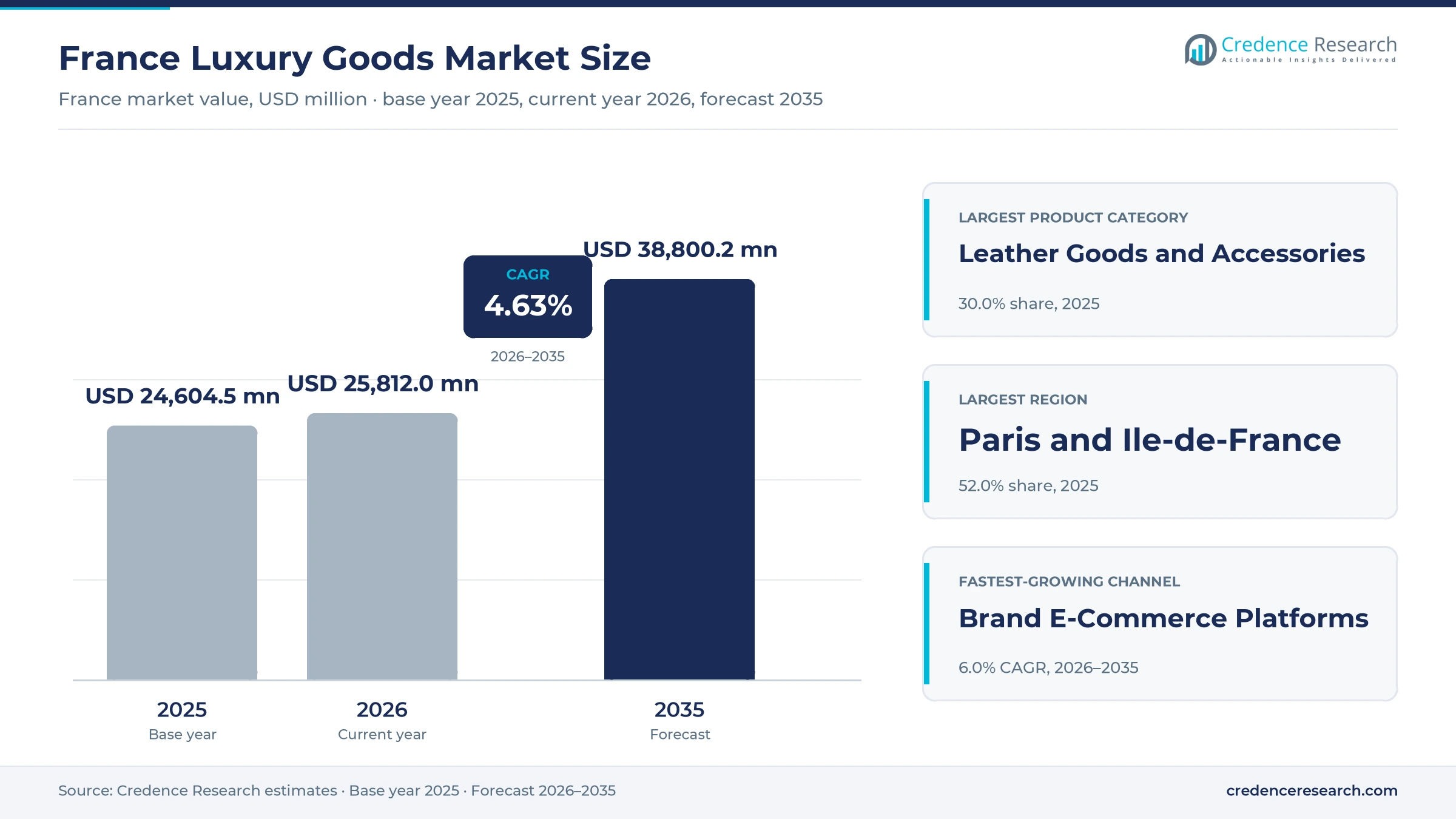
The France luxury goods market was valued at USD 24.60 billion in 2025 and is projected to increase from USD 25.81 billion in 2026 to USD 38.80 billion by 2035, registering a CAGR of 4.63% during 2026–2035. Demand comes from international visitors who buy at Paris flagships and claim VAT refunds, from affluent French households buying fragrance, small leather goods and ready-to-wear, and from wealthy clients who buy watches and high jewelry by appointment. Paris and Ile-de-France held the largest regional share, 52.0% in 2025, because the main flagships and department stores cluster on a handful of Paris streets. French Riviera and Provence-Alpes-Cote d'Azur is the fastest-growing region at 5.0% a year, as long-haul and business aviation traffic into the coast keeps rising. The main commercial change is supply-side, as French maisons keep adding domestic leather workshops and buying the buildings that house their stores, which ties growth to French production and to Paris real estate.
Handbags, watches, fragrance and couture bought in French stores
The market counts the retail value of personal luxury goods sold in France, from ready-to-wear and handbags to watches, fine jewelry, prestige fragrance and skin care, and designer eyewear. Buyers purchase through brand boutiques, department stores, multi-brand designer shops, brand websites and airport stores, and non-EU visitors can reclaim VAT.
Luxury hospitality, cars, wine and spirits, and second-hand resale are excluded, as are goods made in France but sold abroad. Value moves from French and Italian workshops and Swiss watch factories through brand-owned stores, so the brand owner keeps most of the retail margin.
France Luxury Goods Market Insights
- The France luxury goods market rises from USD 24.60 billion in 2025 to USD 38.80 billion by 2035, a 4.63% CAGR during 2026–2035, with tourist spending and domestic clienteling carrying growth.
- Paris and Ile-de-France held 52.0% of 2025 value, because flagships, department stores and most tax-free buying sit on a few Paris streets.
- Leather Goods and Accessories held 30.0% of 2025 value, as French maisons make most of these bags in domestic workshops and sell them in their own stores.
- France welcomed more than 102 million international visitors in 2025, which widens the tourist buyer base for Paris flagships and Riviera boutiques.
- L'Oréal completed its purchase of Kering Beauté on March 31, 2026, which moves Creed and long fashion-house fragrance licences into one beauty group.
Leather goods lead while watches and jewelry grow fastest
Leather goods hold the core of product value
Based on product category, the market is categorized into luxury fashion and apparel, leather goods and accessories, watches and fine jewellery, prestige beauty and fragrances, and luxury eyewear and other accessories. Leather Goods and Accessories led with 30.0% of 2025 value because the best-known handbags are made and sold by French maisons, and Hermès has opened 13 leather goods workshops in France since 2010, FashionUnited reported in January 2026. Watches and Fine Jewellery grows fastest at 5.5% a year, as Swiss watch exports to France rose 1.3% in 2025 while total Swiss exports fell 1.7%, according to the Federation of the Swiss Watch Industry.
Accessible luxury leads while couture grows fastest
Based on price tier, the market is categorized into accessible luxury, premium luxury, high luxury and ultra-luxury and couture. Accessible Luxury led with 34.0% of 2025 value because fragrance, beauty and small leather goods bring the most shoppers through the door, and Paris saw six high-perfumery boutique openings in 2025, according to Cushman and Wakefield, which widens entry-price access to the maisons. Ultra-Luxury / Couture grows fastest at 5.4% a year, as Global Blue found that watches priced above 35,000 euros made up 44% of European tax-free watch spending in 2025, with spending in that band up 36%.
International tourists lead while wealthy residents grow fastest
Based on customer type, the market is categorized into mass-affluent French residents, French HNWIs and UHNWIs, resident expatriates, international tourists and corporate gift buyers. International Tourists led with 44.0% of 2025 value because international tourism receipts reached a record 77.5 billion euros in 2025, up 9%, Atout France said. French HNWIs and UHNWIs grows fastest at 5.4% a year, as maisons add appointment-only space for resident top clients, with Dior keeping a private apartment for them at 30 avenue Montaigne, and Le Bon Marché now runs a six-person personal shopping team.
Brand boutiques lead while brand websites grow fastest
Based on distribution channel, the market is categorized into mono-brand boutiques, luxury department stores, multi-brand designer retailers, brand e-commerce platforms and travel retail. Mono-Brand Boutiques led with 51.0% of 2025 value because maisons sell their core lines mainly in their own stores, and Paris recorded 22 luxury store openings in 2025, up from 7 in 2024, according to Cushman and Wakefield. Brand E-Commerce Platforms grows fastest at 6.0% a year, as French online sales of goods and services neared 200 billion euros in 2025, up 7%, the e-commerce federation Fevad reported. Brand sites still carry a small part of luxury value, because maisons keep their most sought-after bags offline.
| Segment Group | Leading Sub-segment | Share, 2025 | Fastest-growing Sub-segment | CAGR, 2026–2035 |
|---|---|---|---|---|
| By Product Category | Leather Goods and Accessories | 30.0% | Watches and Fine Jewellery | 5.5% |
| By Price Tier | Accessible Luxury | 34.0% | Ultra-Luxury / Couture | 5.4% |
| By Customer Type | International Tourists | 44.0% | French HNWIs and UHNWIs | 5.4% |
| By Distribution Channel | Mono-Brand Boutiques | 51.0% | Brand E-Commerce Platforms | 6.0% |
List prices rise in steps while refunds cut the tourist bill
Luxury prices in France are set by the maisons, which raise list prices in steps once or twice a year and rarely discount core lines. Chanel raised its medium Classic Flap bag in Paris to 10,300 euros in March 2024, up about 6.2% from 9,700 euros earlier that year, Bloomberg reported. Visitors from outside the EU can reclaim the VAT included in these prices, so the same bag costs them less than a French buyer pays. Credence Research finds that margin sits in leather goods and watches, while fragrance carries lower prices but wider reach.
| Product or price point | Typical price or fee | Basis |
|---|---|---|
| Classic Flap bag, medium size (Chanel), Paris | 10,300 euros | Bloomberg, March 2024 |
| Average tax-free watch spend per shopper, Europe | About 7,100 euros | Global Blue via IGDS, May 2026 |
| Niche fragrance and private collection bottles | Above 175 euros | Premium Beauty News, March 2025 |
| Minimum purchase for a VAT refund | Above 100 euros at one retailer on one day | France.fr tax refund guide |
Request a Free Sample
Fill in your details and we'll send you a free sample report.
- Sample data tables & charts
- Research methodology
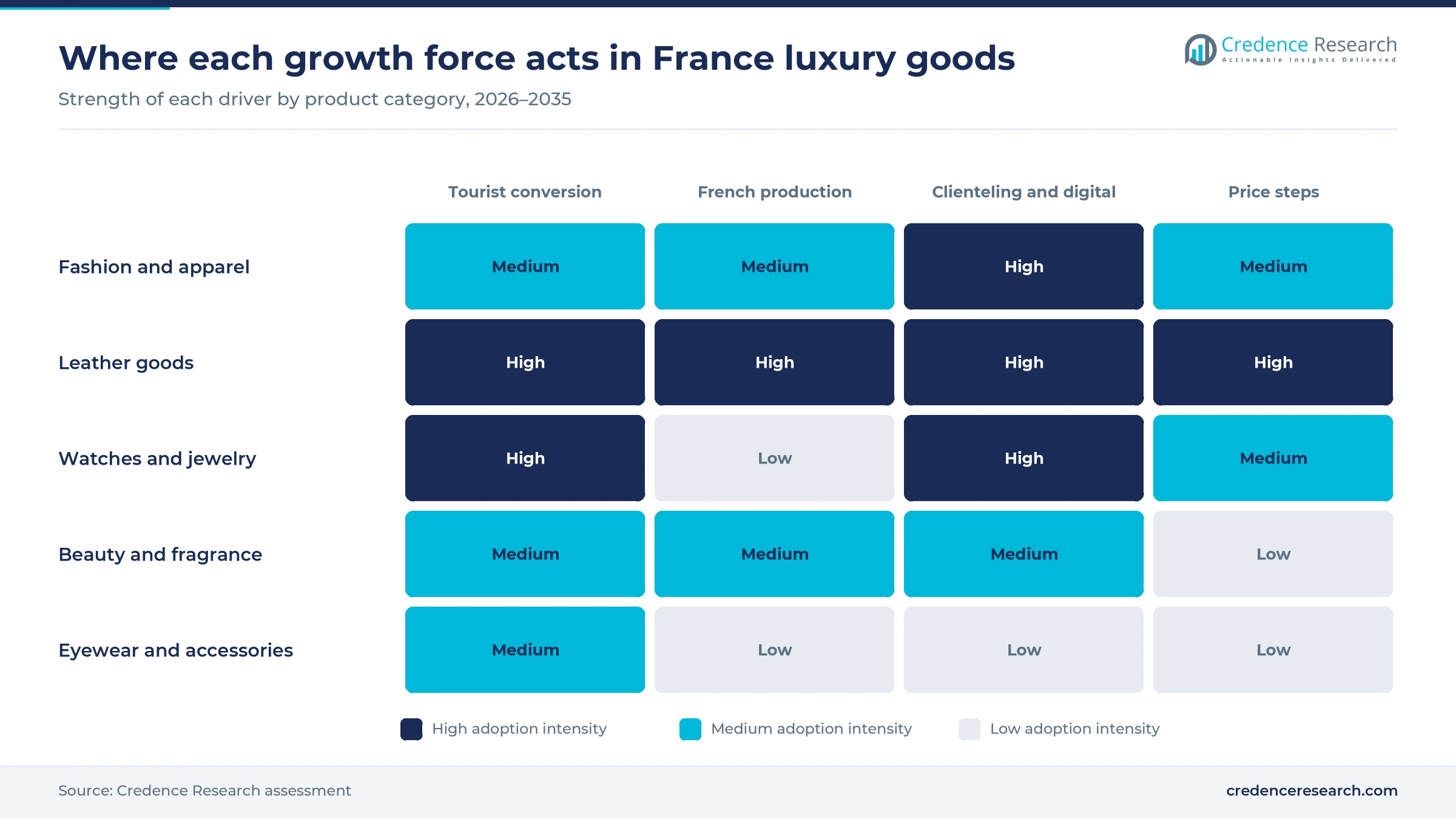
Tourist conversion and French craft drive demand
Tourism conversion and tax-refund economics lift Paris sales
Visitors who reclaim VAT get a lower effective price than at home, so record arrivals turn quickly into luxury purchases. France welcomed more than 102 million international visitors in 2025, the EU Tourism Platform reported. International visitors spent nearly 16 billion euros in Paris and Ile-de-France in 2025, up 5%, according to Visit Paris Region. A CCI Paris Ile-de-France study put average spending per stay at 1,561 euros for American visitors and 1,592 euros for Gulf visitors in 2024. Global Blue also found that Middle Eastern tax-free spending in Europe rose 34% in 2025. Flagships near refund counters and airports capture most of this, while regional stores see far less of it.
French brand equity and savoir-faire scale sustain supply
Luxury buyers pay for goods made in France, so domestic production capacity sets how many bags and accessories maisons can sell. Hermès opened its 24th French leather goods workshop at L'Isle-d'Espagnac in Charente in September 2025, with 260 artisans planned, FashionUnited reported. LVMH said in January 2026 that it runs 117 production facilities and craft workshops in France and employs more than 40,000 people there directly. Recruits for the next Hermès workshop in Normandy will train at its School of Know-How in Louviers. This capacity lets the largest maisons hold waiting lists and price increases at the same time, while smaller brands that subcontract production compete for the same scarce artisans.
Omnichannel clienteling and digital commerce deepen loyalty
Much high-ticket buying in Paris now runs through sales staff who know the client by name, and online tools keep that relationship alive between store visits. Cartier rebuilt its rue de la Paix flagship in 2022 across six floors and 3,000 square meters, with private salons on most floors and a residence floor for events, IADS reported. French shoppers made up 40% of sales at Galeries Lafayette Haussmann in 2025, up from 33% in 2019, FashionUnited reported, a resident base that department stores now serve through personal shopping and private appointments. Maisons that link these salons to client records gain repeat spending, while wholesale-led brands hold less client data.
Prestige fragrance gives shoppers an entry point to the maisons
Fragrance and beauty give shoppers a first luxury purchase at a few hundred euros, which feeds later spending on bags and ready-to-wear. L'Oréal completed its acquisition of Kering Beauté on March 31, 2026, including Creed and 50-year licences for Bottega Veneta and Balenciaga beauty. The new Paris perfume boutiques noted in the segments add own-brand counters for these lines. Niche fragrances priced above 175 euros grew 36% in value in French prestige stores in 2024, while the wider category rose only 2%, Premium Beauty News reported in March 2025. Brands with their own perfume boutiques gain margin, while department store counters carry more of the slow mass prestige lines.
Owned flagships and resort stores reshape the shop map
Maisons shift toward owning their Paris flagship buildings
Maisons are shifting from leasing toward owning their main Paris addresses, because prime space is scarce and the store is now the brand's main showroom. Kering agreed in January 2025 to sell about 60% of the Hôtel de Nocé on Place Vendôme and two avenue Montaigne buildings to Ardian while keeping 40%. Luxury street rents in Europe rose 3.5% in 2025, and eight of 20 tracked streets had no vacancy, Cushman and Wakefield said. Louis Vuitton is preparing a brand destination of nearly 6,000 square meters at 103-111 Champs-Élysées, with an opening expected in 2027 that the company has not confirmed. Owners of buildings lock in their addresses, while newer brands pay more for side streets and upper floors.
Seasonal boutiques spread across ski and Riviera resorts
Brands are shifting toward temporary boutiques in ski and beach resorts, where wealthy clients spend long holidays and buy outside Paris. Chanel ran a ski-season boutique in Courchevel from mid-December 2024 to mid-March 2025, with an enlarged watch and high jewelry area, The Impression reported. LVMH ran 37 pop-up initiatives in 2024, 27 of them in Europe and mainly in Italy, Greece and France, FashionUnited reported in July 2025. The same report noted a 340-square-meter Chanel perfume and beauty boutique in Saint-Tropez from June to October 2024. Business aviation movements at Nice, Cannes Mandelieu and Saint-Tropez airports rose 4% in 2025, according to the airports' operator. Seasonal formats favor maisons with large inventories and traveling sales teams.
High-end watch buying by visitors and collectors
Watch spending by visitors offers an opening for retailers that can secure allocations of the most wanted models. Global Blue found that tax-free watch spending in Europe rose 20% in 2025, as the average spend per shopper climbed 15% to 7,100 euros. Rolex's own retailer Bucherer won Paris City Hall approval in spring 2026 for a two-story Rolex boutique at the corner of rue Royale and rue Saint-Honoré, Coronet reported in April 2026. American shoppers accounted for 26% of all European tax-free spending in 2025, Global Blue said. Sellers of high-end watches with brand allocations in Paris and the Riviera gain most, while multi-brand jewelers without Swiss allocations struggle to compete.
Wedding, celebration and formal buying by French residents
Domestic celebrations give sellers an opening that does not depend on tourist flows or exchange rates. INSEE counted about 251,000 marriages in France in 2025, up 1.4% on 2024, each one a likely purchase of rings, jewelry, watches or formal wear. Galeries Lafayette plans to spend 25 million euros renovating its Boulevard Haussmann menswear building in 2026 and 2027, a bet on business and formal dressing by local shoppers. IADS reported in June 2026 that the group had completed a 6 million euro renovation of its Nice Masséna store, adding about 30 designer brands for Riviera shoppers. Jewelers and maisons that run bridal and appointment services in regional cities gain steady spending outside the tourist season.
A strong euro, weaker China demand and fakes weigh
A stronger euro narrows the price gap for visitors
A stronger euro cuts the price advantage that pulls American and Asian buyers to Paris. The euro rose 13.1% against the U.S. dollar from the end of 2024 through 2025, according to the European Central Bank. Planet's 2026 tax-free report said currency shifts reduced the purchasing power of American travelers and limited their basket sizes. Maisons that set prices close to U.S. levels and Paris flagships that rely on dollar-based visitors are the most exposed if the euro stays high.
Chinese spending has not returned to its 2019 level
Chinese buyers no longer carry Paris luxury spending as they did before 2020, which leaves flagships more exposed to other markets. Chinese shoppers made up 22% of sales at Galeries Lafayette Haussmann in 2025, down from 33% in 2019, FashionUnited reported in April 2026. Global Blue found the Chinese share of European luxury tax-free spending fell from 32% to 13%. Department stores and leather goods brands built around Chinese tour groups carry the greatest risk.
Counterfeits erode price integrity and brand trust
Counterfeits erode price integrity and take entry-level sales from genuine perfume and accessories. French customs withdrew 20.22 million counterfeit articles from the market in 2025, including perfumes, the customs service said in February 2026. Fragrance and small leather goods brands are the most exposed, because fake versions sell online and in tourist areas at a small fraction of retail prices. Maisons respond with product traceability, legal action and lists of authorized resellers.
Travel disruption and a weaker leather cycle hit flagships
Travel shocks and slower leather goods sales hurt stores that depend on high-spending visitors. The French Treasury said in April 2026 that flight restrictions still in force in the Middle East were reducing visitors from and through the region. LVMH said its fashion and leather goods sales fell 5% on an organic basis in 2025, and its revenue in Europe declined in the second half. Paris flagships and Riviera boutiques that serve Gulf clients are the most exposed if air links stay limited.
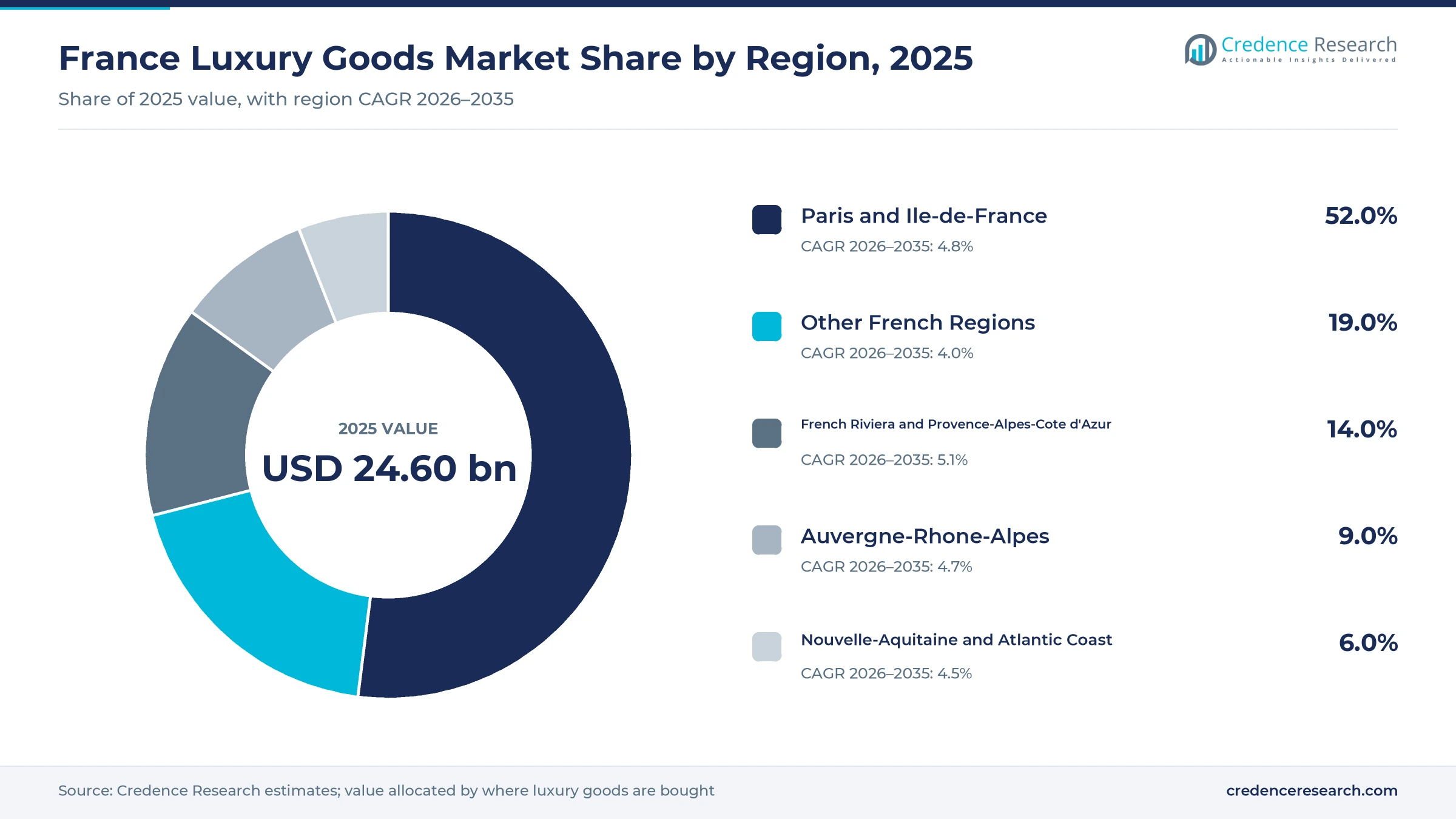
Paris holds half the value while the Riviera grows fastest
| Region | Value, 2025 (USD billion) | Share, 2025 | CAGR, 2026–2035 |
|---|---|---|---|
| Paris and Ile-de-France | 12.79 | 52.0% | 4.8% |
| Other French Regions | 4.67 | 19.0% | 4.0% |
| French Riviera and Provence-Alpes-Cote d'Azur | 3.44 | 14.0% | 5.0% |
| Auvergne-Rhone-Alpes | 2.21 | 9.0% | 4.7% |
| Nouvelle-Aquitaine and Atlantic Coast | 1.48 | 6.0% | 4.5% |
Paris and Ile-de-France leads on flagships and visitors
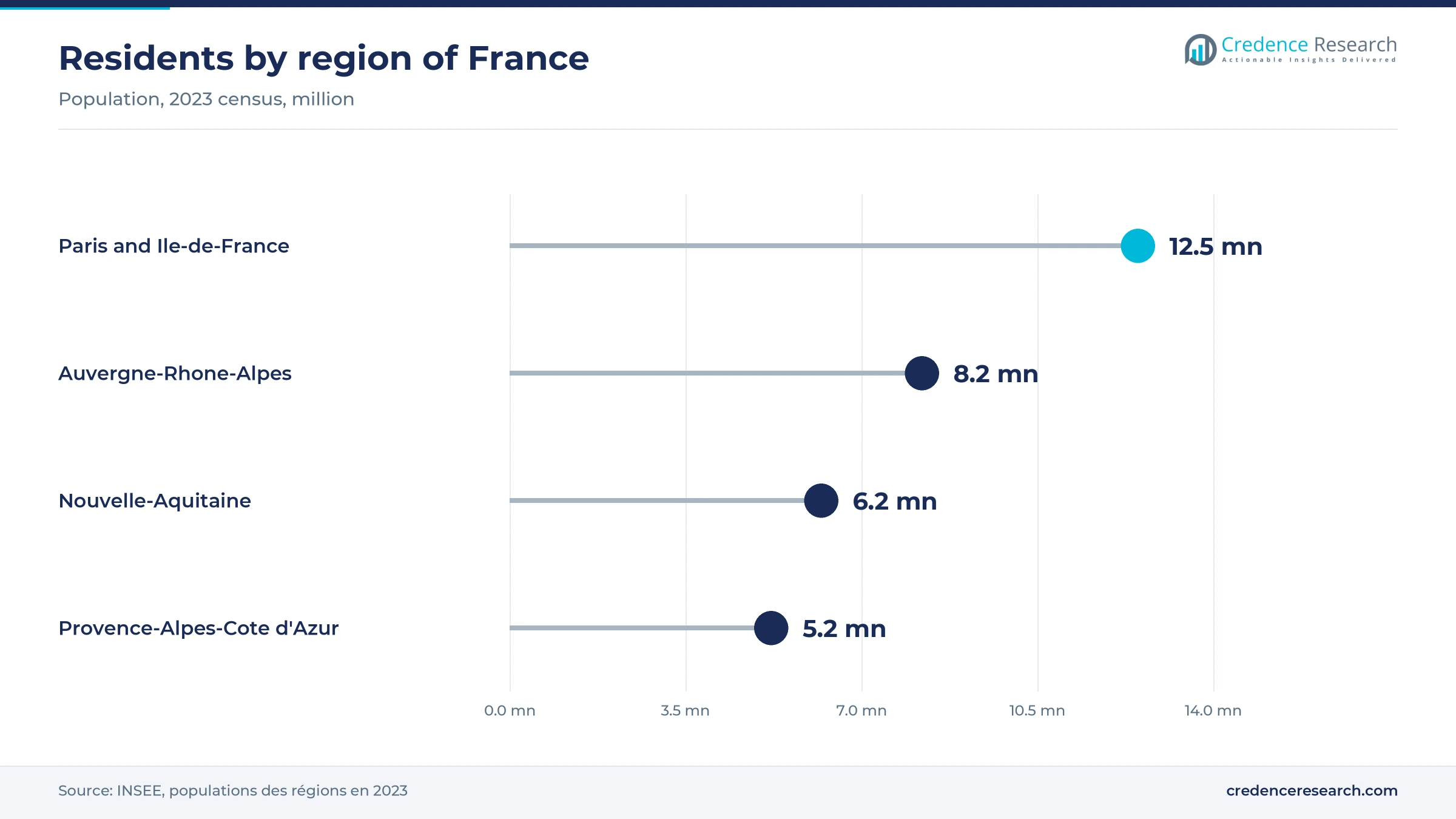
Paris and Ile-de-France held 52.0% of 2025 value and grows at 4.8% a year. The region had 12.46 million residents in 2023, according to INSEE, and received more than 23 million international visitors in 2025, Visit Paris Region said. The United States was its top foreign market with 2.8 million visitors. Galeries Lafayette Haussmann alone drew about 35 million visits in 2025. The value share sits far above the population share because flagships and tax-free buying concentrate here, a Credence Research estimate.
Long-haul and private flights lift the Riviera fastest
French Riviera and Provence-Alpes-Cote d'Azur held 14.0% of 2025 value and is the fastest-growing region at 5.0% a year. Nice airport handled a record 15.23 million passengers in 2025, up 3.2%, and long-haul traffic rose 5.8% after a new Washington route. The Côte d'Azur tourist board said the United States became its top foreign market, with more than 15% of international nights. FashionUnited described the Gulf of Saint-Tropez as the second luxury consumption area in France after Paris.
Auvergne-Rhone-Alpes pairs Lyon stores with ski resorts
Auvergne-Rhone-Alpes held 9.0% of 2025 value and grows at 4.7% a year. The region had 8.21 million residents in 2023, according to INSEE, the second-largest population in France. Lyon supplies a resident buyer base, and Hermès reopened its Lyon store of more than 300 square meters after a 2021 renovation. Courchevel adds seasonal spending through the ski boutiques described in the trends, so value peaks in winter.
Nouvelle-Aquitaine and Atlantic Coast mixes workshops and buyers
Nouvelle-Aquitaine and Atlantic Coast held 6.0% of 2025 value and grows at 4.5% a year. The region had 6.15 million residents in 2023, according to INSEE. Bordeaux is its main retail center, and Cartier runs a boutique at 59 cours de l'Intendance that books client appointments online. The region is also a production base, as the Charente workshop noted in the drivers shows. Credence Research assumes resident buyers carry most of the value, so growth runs below the national rate.
Other French Regions rely on resident buyers
Other French Regions held 19.0% of 2025 value and grows at 4.0% a year, the slowest regional rate. About 37 million of the 69.1 million residents counted in January 2026 live outside the four named regions, a Credence Research calculation from INSEE data that mixes census and estimate years. Hermès announced a Normandy workshop at Les Andelys in January 2026, which adds jobs but little local retail demand. Spending here leans on department stores in large cities and on weddings and gifting.
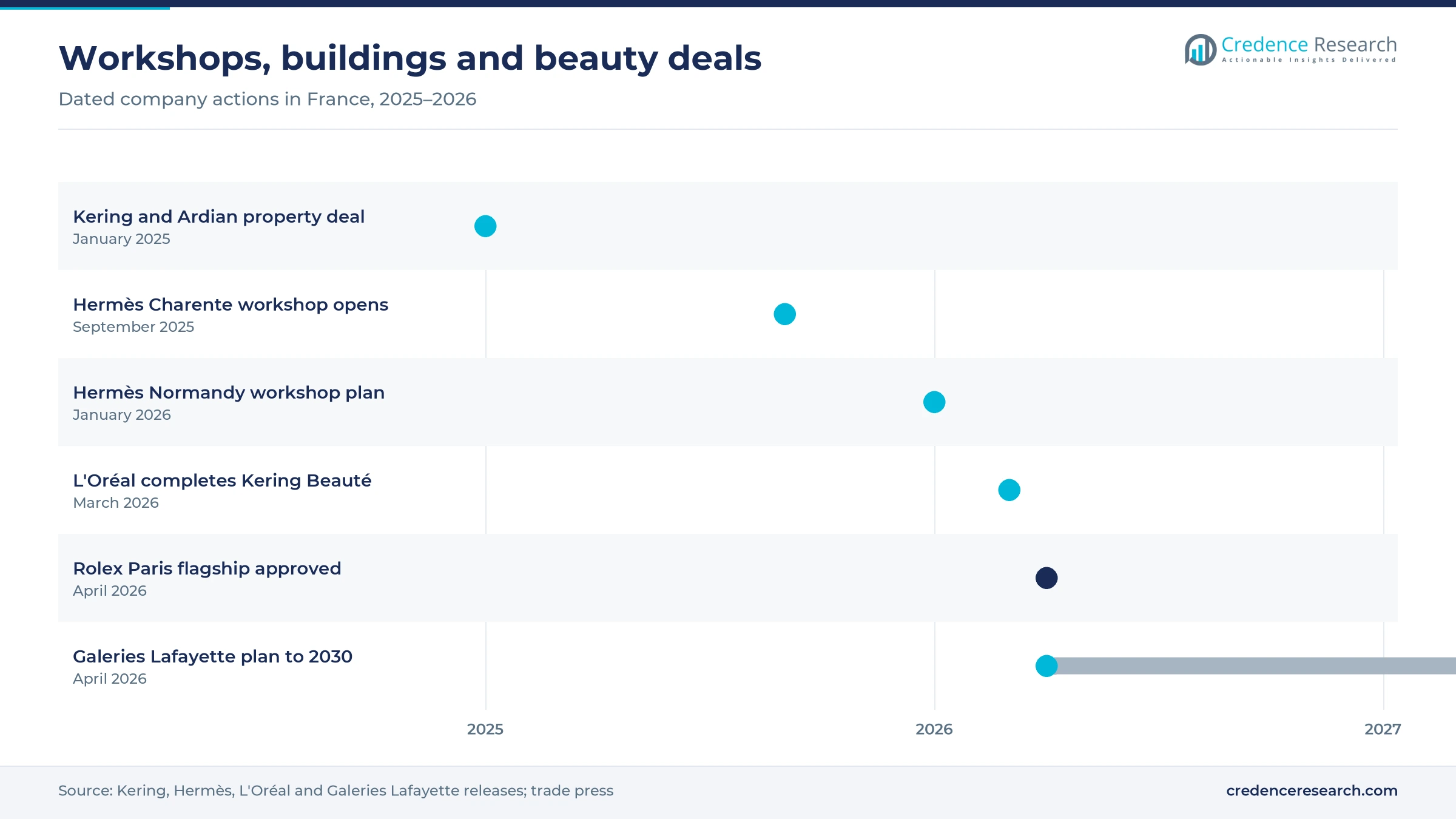
Workshops, real estate and beauty deals in 2025–26
| Development | Status and market relevance |
|---|---|
| In January 2025, Kering agreed to sell about 60% of three Paris buildings on Place Vendôme and avenue Montaigne to Ardian, keeping 40%. | Agreement announced with completion scheduled for the first quarter of 2025; it secures flagship addresses while freeing capital. |
| In September 2025, Hermès opened its 24th French leather goods workshop at L'Isle-d'Espagnac in Charente, with 260 artisans planned. | Operational launch; it adds domestic capacity for handbags and small leather goods. |
| In January 2026, Hermès announced a leather goods workshop at Les Andelys in Normandy, on a former glassworks site, for about 260 artisans. | Plan announced; recruitment and training run through France Travail and the Hermès School of Know-How. |
| In March 2026, L'Oréal completed its acquisition of Kering Beauté, including Creed and 50-year beauty licences for Bottega Veneta and Balenciaga. | Completed; prestige fragrance for three Kering houses now sits inside L'Oréal Luxe. |
| In April 2026, Galeries Lafayette announced a 260 million euro investment plan to 2030, including a 2026–2027 menswear renovation on Boulevard Haussmann. | Plan announced; it targets local and visiting shoppers at the largest Paris department store. |
Traceability, refund kiosks and salons shape the sale
- Electronic VAT refund validation through the PABLO kiosks at airports lets visitors confirm their refund without a customs counter, and since June 2, 2025, customs no longer validates sales notes the kiosk does not recognize.
- Product traceability uses serial numbers, tags and digital certificates so maisons and customs can separate genuine goods from counterfeits.
- Clienteling software stores purchase histories and preferences so sales staff can invite clients to private salons and send new pieces before launch.
- Optical and lens fitting lets maisons sell designer eyewear with prescription lenses in their own stores rather than leaving the sale to opticians.
Need a Custom Version of This Report?
Tailor the scope, geography, or segments to your exact requirements.
- Custom geography or segment scope
- Direct access to our analyst team
French groups own the workshops and the best addresses
French groups dominate the market because they own the workshops, the brands and the best Paris addresses. LVMH competes through Louis Vuitton, Dior and its other maisons, and its Paris building projects keep it visible on the Champs-Élysées and avenue Montaigne. Hermès competes on scarcity and French-made leather goods, adding workshops in Charente and Normandy. Chanel sells ready-to-wear and bags only in its own boutiques and moves prices in regular steps. Kering competes through Saint Laurent, Gucci and Bottega Veneta, after selling its beauty unit to L'Oréal. Richemont and Rolex lead in watches and jewelry through place Vendôme and rue de la Paix boutiques and the Bucherer network. Prada, Moncler and Burberry compete for tourists through flagships in the Golden Triangle.
How is supply organized between French groups and foreign houses?
Supply in France is concentrated in a few integrated groups that design, make and sell their own goods. LVMH, Hermès, Chanel and Kering own workshops in France and most of their stores, which keeps retail margin in house and makes prime addresses and trained artisans the main barriers to entry. Swiss watch groups such as Rolex, which now owns the retailer Bucherer, and Richemont control watch and jewelry allocations. Italian and British houses such as Prada, Moncler and Burberry compete through Paris boutiques, while L'Oréal Luxe makes and sells fragrance under licence for many fashion houses.
Maisons, watch groups and beauty licensees on buyer shortlists
| Company | Type | Role in the market |
|---|---|---|
| LVMH Moët Hennessy Louis Vuitton SE | Integrated luxury group | Louis Vuitton, Dior and other maisons in fashion, leather goods, watches and beauty |
| Hermès International SCA | Integrated maison | French-made leather goods, silk, ready-to-wear and fragrance in its own stores |
| Chanel Limited | Integrated maison | Ready-to-wear, bags, fine jewelry, watches and fragrance through Chanel boutiques |
| Kering SA | Integrated luxury group | Saint Laurent, Gucci, Bottega Veneta and Balenciaga fashion and leather goods |
| L'Oréal Luxe (L'Oréal Groupe) | Prestige beauty licensee | Fragrance and skin care for Saint Laurent, Prada, Valentino and Creed |
| Compagnie Financière Richemont SA | Jewelry and watch group | Cartier, Van Cleef & Arpels and other jewelry and watch houses |
| Rolex SA | Watch manufacturer and retailer | Rolex and Tudor watches, sold through dealers including its own Bucherer |
| Prada S.p.A. | Italian luxury group | Prada, Miu Miu and Versace fashion and leather goods boutiques |
| Burberry Group plc | British luxury brand | Outerwear, leather goods and accessories through Paris stores |
| Moncler S.p.A. | Italian luxury group | Moncler outerwear and Stone Island in boutiques and resort stores |
Paris flagships decide who wins the tourist euro
Credence Research's view is that the France luxury goods market is now a contest for the tourist euro on a few Paris streets, backed by domestic clients who buy by appointment. Maisons that own their buildings and their workshops, such as Hermès, Chanel and the LVMH houses, are best placed to hold prices while visitor mix shifts away from China. Brands that depend on department store counters and Chinese groups face the hardest adjustment. The main evidence gap is regional, since no official series splits luxury sales by region of France.
Estimates rest on tourism, customs and company data
The report uses 2025 as the base year and forecasts value to 2035. Market values come from the Credence Research model, cross-checked against tourism receipts, visitor spending and population data. Segment and regional shares are Credence Research estimates built from INSEE population figures, regional tourism and airport statistics, customs data and company releases. Sources include government agencies, tourism boards, trade bodies, company releases and trade press, and no interviews or surveys were conducted for this report.
Steady mid-single-digit growth as tourist mix shifts
Through 2035, luxury spending in France should grow at a steady mid-single-digit pace, as record visitor numbers, new leather workshops and private clienteling lift sales. Value grows a little faster from 2025 to 2026 than the decade average, because tourist arrivals and spending per stay both rose in 2025. After that, growth depends on the euro, on whether air links to the Gulf normalize and on how quickly Chinese travel recovers. Watch allocations and high jewelry sales are likely to add the most value per client.
Visitor flows and the euro set the range of outcomes
The outcome depends mainly on visitor numbers, the euro and leather goods demand. If air links to the Gulf stay limited and the euro remains high, tourist spending slows and Paris flagships carry the loss. If Chinese travel recovers and U.S. visitors keep growing, the tourist share of sales rises again. Domestic clienteling and fragrance add value in every case, which narrows the downside.
| Scenario | CAGR, 2026–2035 | Value, 2035 | What has to hold |
|---|---|---|---|
| Downside | 3.1% | USD 34.06 billion | Gulf flights stay restricted, the euro stays strong and leather goods demand keeps falling |
| Base | 4.63% | USD 38.80 billion | Visitor numbers grow gradually, price steps stay modest and domestic clienteling expands |
| Upside | 5.6% | USD 42.26 billion | Chinese travel recovers, U.S. visitors keep rising and watch allocations widen |
Frequently Asked Questions
How big is the France luxury goods market?
Which region leads luxury sales in France?
Which region grows fastest?
Which product category leads the market?
How do tax refunds affect luxury buying in France?
Why is French production capacity important?
What are the main risks to the market?
Who are the leading companies in the market?
Table of Content
Chapter 1 Market Segmentation
- 1.1 Segmentation Framework
- 1.1.1 Product and Service Classification
- 1.1.2 Application and End-Use Classification
- 1.1.3 Technology and Solution Classification
- 1.1.4 Customer and Distribution Channel Classification
- 1.1.5 Geographic Segmentation
- 1.1.6 Market Segment Definitions and Boundaries
- 1.2 By Product Category
- 1.2.1 Luxury Fashion and Apparel
- 1.2.2 Leather Goods and Accessories
- 1.2.3 Watches and Fine Jewellery
- 1.2.4 Prestige Beauty and Fragrances
- 1.2.5 Luxury Eyewear and Other Accessories
- 1.3 By Price Tier
- 1.3.1 Accessible Luxury
- 1.3.2 Premium Luxury
- 1.3.3 High Luxury
- 1.3.4 Ultra-Luxury / Couture
- 1.4 By Customer Type
- 1.4.1 Mass-Affluent French Residents
- 1.4.2 French HNWIs and UHNWIs
- 1.4.3 Resident Expatriates
- 1.4.4 International Tourists
- 1.4.5 Corporate Gift Buyers
Chapter 2 Introduction
- 2.1 Report Objectives and Scope
- 2.2 Product Definition and Industry Terminology
- 2.3 Market Inclusions and Exclusions
- 2.4 Research Process
- 2.4.1 Primary Research and Expert Interviews
- 2.4.2 Secondary Research and Source Review
- 2.4.3 Top-Down and Bottom-Up Estimation
- 2.4.4 Data Triangulation and Verification
- 2.5 Market Size Measurement Basis
- 2.5.1 2025: USD 24.60 billion → 2035: USD 38.80 billion
- 2.6 Historical and Forecast Reference Periods
- 2.6.1 Historical Period: 2018-2025
- 2.6.2 Base Year: 2025
- 2.6.3 Forecast Period: 2025-2035
- 2.7 Research Assumptions and Limitations
Chapter 3 Executive Summary
- 3.1 Market Snapshot and Key Findings
- 3.2 Base-Year Market Size, 2025
- 3.3 Forecast Market Size, 2035
- 3.4 Revenue and Volume Growth Outlook
- 3.5 Key Demand and Supply Indicators
- 3.6 Leading Market Segments
- 3.7 Fastest-Growing Market Opportunities
- 3.8 Regional Performance Highlights
- 3.9 Technology and Industry Transformation
- 3.10 Competitive Landscape Summary
- 3.11 Analyst View and Strategic Implications
Chapter 4 France Luxury Goods Market Trends and Developments
- 4.1 Historical Industry Development, 2018-2025
- 4.2 Recent Market Trends and Developments
- 4.3 Demand and Customer Behavior Trends
- 4.4 Technology and Product Innovation
- 4.5 Artificial Intelligence, Automation and Digitalization
- 4.6 Local Manufacturing and Supply Chain Realignment
- 4.7 Industry Partnerships, Mergers and Acquisitions
- 4.8 Sustainability and Circular Economy Developments
- 4.9 Government and Private Sector Investment Trends
- 4.10 Emerging Business Models and Commercialization
- 4.11 Industry Developments and Announcements
Chapter 5 France Luxury Goods Market Production, Supply and Demand Analysis
- 5.1 Demand Trend and Consumption Analysis, 2018-2025
- 5.2 Demand Forecast, 2025-2035
- 5.3 Production and Output Trend, 2018-2025
- 5.4 Production and Output Forecast, 2025-2035
- 5.5 Installed Capacity and Capacity Utilization
- 5.6 Company-Wise Production Plants and Statistics
- 5.6.1 Installed Production Capacity
- 5.6.2 Actual Production
- 5.6.3 Planned Capacity and Expansion Targets
- 5.7 Supply Chain Structure and Procurement Trends
- 5.8 Supply-Demand Gap and Bottlenecks
- 5.9 Import Dependence and Sourcing Structure
- 5.10 Contract Manufacturing and Outsourcing
- 5.11 Regional Supply and Demand Concentration
Chapter 6 France Luxury Goods Market Pricing Analysis
- 6.1 Pricing Structure and Measurement
- 6.2 Historical Pricing Trends, 2018-2025
- 6.3 Pricing Outlook, 2025-2035
- 6.4 Average Selling Price and Unit Economics
- 6.5 Pricing by Product and Market Segment
- 6.6 Geographic Pricing Differences
- 6.7 Key Input, Energy, Labor and Logistics Costs
- 6.8 Contract Pricing and Purchasing Models
- 6.9 Pricing Sensitivity and Competitive Positioning
- 6.10 Price, Margin and Profitability Implications
Chapter 7 France Luxury Goods Market Dynamics
- 7.1 Market Growth Drivers
- 7.1.1 Demand-Side Drivers
- 7.1.2 Technology and Innovation Drivers
- 7.1.3 Infrastructure and Investment Drivers
- 7.1.4 Regulatory and Policy Drivers
- 7.2 Market Restraints
- 7.2.1 Cost and Affordability Constraints
- 7.2.2 Technology and Adoption Barriers
- 7.2.3 Supply Chain and Operational Constraints
- 7.3 Market Challenges
- 7.3.1 Competitive Pressure and Margin Erosion
- 7.3.2 Skills, Infrastructure and Implementation Gaps
- 7.4 Emerging Market Opportunities
- 7.5 Market Dynamics Impact and Time-Horizon Assessment
Chapter 8 France Luxury Goods Value Chain Analysis
- 8.1 Industry Value Chain Overview
- 8.2 Upstream Suppliers and Critical Inputs
- 8.3 Technology and Component Providers
- 8.4 Manufacturing or Service Delivery
- 8.5 Distribution, Channel Partners and Integrators
- 8.6 Downstream Applications and End Users
- 8.7 Value Addition and Profit Pools
- 8.8 Vertical Integration and Outsourcing
- 8.9 Supplier Concentration and Risk
- 8.10 Supply Chain Localization and Resilience
Chapter 9 France Luxury Goods Market Regulations and Policies
- 9.1 Relevant Laws, Standards and Compliance Frameworks
- 9.2 Product, Service, Safety and Quality Requirements
- 9.3 Government Policies, Incentives and Subsidies
- 9.4 Imports, Exports and Trade Barriers
- 9.5 Public Procurement and Local Content Requirements
- 9.6 Environmental and Sustainability Compliance
- 9.7 Upcoming Policy Changes and Market Implications
Chapter 10 France Luxury Goods Market Hotspots and Opportunities
- 10.1 Market Opportunity Mapping and Growth Hotspots
- 10.2 High-Growth Applications and Customer Groups
- 10.3 Underserved Markets and White-Space Opportunities
- 10.4 Emerging Technology and Product Opportunities
- 10.5 New Capacity and Investment Hotspots
- 10.6 Market Entry and Expansion Opportunities
- 10.7 Distribution and Partnership Opportunities
- 10.8 Near-Term and Long-Term Commercial Potential
- 10.9 Opportunity Attractiveness and Execution Risks
Chapter 11 France Luxury Goods Market Outlook, 2025-2035
- 11.1 Market Size and Analysis
- 11.1.1 Revenue (Market Measurement: 2025: USD 24.60 billion → 2035: USD 38.80 billion)
- 11.1.2 Market Volume and Quantity Sold
- 11.1.3 Historical Market Size, 2018-2025
- 11.1.4 Base-Year Market Size, 2025
- 11.2 Market Forecast, 2025-2035
- 11.2.1 Revenue Forecast to 2035
- 11.2.2 Volume Forecast to 2035
- 11.2.3 CAGR and Year-on-Year Growth
- 11.2.4 Incremental Revenue Opportunity
- 11.3 Forecast Assumptions and Scenario Analysis
- 11.3.1 Base-Case Forecast
- 11.3.2 Optimistic and Conservative Scenarios
- 11.3.3 Technology, Pricing and Policy Sensitivities
- 11.4 Market Attractiveness and Growth Outlook
Chapter 12 France Luxury Goods Market Segmentation and Outlook
- 12.1 Segmentation Summary and Market Shares, 2025
- 12.2 Largest and Fastest-Growing Segments
- 12.3 By Product Category - Market Size and Forecast, 2025-2035
- 12.3.1 Segment Definition and Scope
- 12.3.2 Historical Market Size, 2018-2025
- 12.3.3 Revenue Forecast, 2025-2035
- 12.3.4 Volume Forecast, 2025-2035
- 12.3.5 Base-Year Market Share, 2025
- 12.3.6 Segment CAGR and Growth Drivers
- 12.3.7 Subsegment Market Size and Forecast
- 12.3.7.1 Luxury Fashion and Apparel
- 12.3.7.2 Leather Goods and Accessories
- 12.3.7.3 Watches and Fine Jewellery
- 12.3.7.4 Prestige Beauty and Fragrances
- 12.3.7.5 Luxury Eyewear and Other Accessories
- 12.3.8 Subsegment Pricing and Adoption Trends
- 12.3.9 Leading Suppliers and Competition
- 12.3.10 Regional Demand and Opportunities
- 12.4 By Price Tier - Market Size and Forecast, 2025-2035
- 12.4.1 Segment Definition and Scope
- 12.4.2 Historical Market Size, 2018-2025
- 12.4.3 Revenue Forecast, 2025-2035
- 12.4.4 Volume Forecast, 2025-2035
- 12.4.5 Base-Year Market Share, 2025
- 12.4.6 Segment CAGR and Growth Drivers
- 12.4.7 Subsegment Market Size and Forecast
- 12.4.7.1 Accessible Luxury
- 12.4.7.2 Premium Luxury
- 12.4.7.3 High Luxury
- 12.4.7.4 Ultra-Luxury / Couture
- 12.4.8 Subsegment Pricing and Adoption Trends
- 12.4.9 Leading Suppliers and Competition
- 12.4.10 Regional Demand and Opportunities
- 12.5 By Customer Type - Market Size and Forecast, 2025-2035
- 12.5.1 Segment Definition and Scope
- 12.5.2 Historical Market Size, 2018-2025
- 12.5.3 Revenue Forecast, 2025-2035
- 12.5.4 Volume Forecast, 2025-2035
- 12.5.5 Base-Year Market Share, 2025
- 12.5.6 Segment CAGR and Growth Drivers
- 12.5.7 Subsegment Market Size and Forecast
- 12.5.7.1 Mass-Affluent French Residents
- 12.5.7.2 French HNWIs and UHNWIs
- 12.5.7.3 Resident Expatriates
- 12.5.7.4 International Tourists
- 12.5.7.5 Corporate Gift Buyers
- 12.5.8 Subsegment Pricing and Adoption Trends
- 12.5.9 Leading Suppliers and Competition
- 12.5.10 Regional Demand and Opportunities
- 12.6 Segment Growth Comparison
- 12.7 Segment Attractiveness and Priority Matrix
Chapter 13 France Luxury Goods End-Use and Application Market Outlook
- 13.1 End-Use Industry and Customer Demand Structure
- 13.2 Leading Applications and Customer Groups
- 13.3 End-Use Market Size, Share and Forecast
- 13.4 Major End-Use Industry Deep Dives
- 13.4.1 Customer Requirements and Use Cases
- 13.4.2 Demand and Replacement Cycles
- 13.4.3 Technical and Regulatory Considerations
- 13.4.4 Purchasing and Procurement Models
- 13.4.5 Leading Vendors and Distribution Channels
- 13.4.6 Forecast and Commercial Opportunities
- 13.5 Emerging Applications and Cross-Segment Demand
- 13.6 End-Use Industry Investment Priorities
Chapter 14 France Luxury Goods Geographic Market Outlook, 2025-2035
- 14.1 Domestic Market Distribution and Demand Clusters
- 14.2 State- or Province-Wise Market Size and Forecast, 2025-2035
- 14.3 City and Metropolitan Market Outlook
- 14.4 Industrial, Manufacturing and Commercial Clusters
- 14.5 Geographic Concentration of Key End Users
- 14.6 Local Pricing and Purchasing Differences
- 14.7 Domestic Production Facilities and Capacity Map
- 14.8 Local Infrastructure and Project Pipeline
- 14.9 State-Level Policy and Incentive Differences
- 14.10 Subnational Investment Hotspots and Opportunities
- 14.11 Distribution and Logistics Networks
- 14.12 Domestic Competitive Footprint
Chapter 15 France Luxury Goods Technology, Innovation and Sustainability Outlook
- 15.1 Technology Landscape and Maturity
- 15.2 Product, Process and Service Innovation
- 15.3 AI, Automation and Digital Tools in the Industry
- 15.4 Technology Adoption and Performance Benchmarking
- 15.5 Innovation Pipeline and R&D Investment
- 15.6 Patent and Intellectual Property Trends
- 15.7 Energy Efficiency and Resource Management
- 15.8 Sustainability, Recycling and Circularity
- 15.9 Technology Roadmap, 2025-2035
- 15.10 Risks of Obsolescence and Technology Substitution
Chapter 16 France Luxury Goods Market Key Strategic Imperatives
- 16.1 Growth and Market Entry Priorities
- 16.2 High-Return Products and Segments
- 16.3 Pricing, Profitability and Cost Optimization
- 16.4 Technology Investment and Product Differentiation
- 16.5 Supply Chain Localization and Resilience
- 16.6 Distribution and Customer Acquisition
- 16.7 Partnership, Acquisition and Capacity Strategy
- 16.8 Regional Expansion Priorities
- 16.9 Short-, Medium- and Long-Term Actions
Chapter 17 Competition Outlook
- 17.1 Industry Competition Characteristics
- 17.2 Market Structure and Concentration
- 17.3 Market Share and Competitive Positioning, 2025
- 17.4 Company-Wise Revenue and Product Benchmarking
- 17.5 Production and Service Capacity Benchmarking
- 17.6 Technology, Pricing and Differentiation
- 17.7 Regional Footprint and Distribution Strength
- 17.8 Mergers, Acquisitions and Strategic Alliances
- 17.9 New Entrants and Competitive Threats
- 17.10 Porter's Five Forces and Industry Attractiveness
- 17.11 Competitive Outlook, 2025-2035
Chapter 18 Company Profiles
- 18.1 Company Coverage and Selection Criteria
- 18.2 LVMH Moët Hennessy Louis Vuitton SE
- 18.2.1 Business Description
- 18.2.2 Company Ownership and Geographic Presence
- 18.2.3 Product and Service Portfolio
- 18.2.4 Manufacturing and Operating Footprint
- 18.2.5 Production Capacity and Expansion Plans
- 18.2.6 Financial Performance and Investment
- 18.2.7 Market Share and Competitive Position
- 18.2.8 Technology and Innovation Capabilities
- 18.2.9 Strategic Alliances or Partnerships
- 18.2.10 Recent Developments
- 18.2.11 Growth Strategy and Outlook
- 18.3 Hermès International SCA
- 18.4 Chanel Limited
- 18.5 Kering SA
- 18.6 L'Oréal Luxe (L'Oréal Groupe)
- 18.7 Compagnie Financière Richemont SA
- 18.8 Rolex SA
- 18.9 Prada S.p.A.
- 18.10 Burberry Group plc
- 18.11 Moncler S.p.A.
- 18.12 Other Relevant Market Participants
Note: Every listed company is profiled on the structure shown under the first company. The company list is preliminary and may change based on research findings, market developments, data availability and client requirements.
Chapter 19 Disclaimer
- 19.1 Research and Forecast Disclaimer
- 19.2 Data Source and Estimation Limitations
Note: The depth of individual sections depends on data availability for this market. Volume, capacity, trade and other unit-based metrics are included where applicable.