Nigeria FMCG modern trade grows on local chains and cards
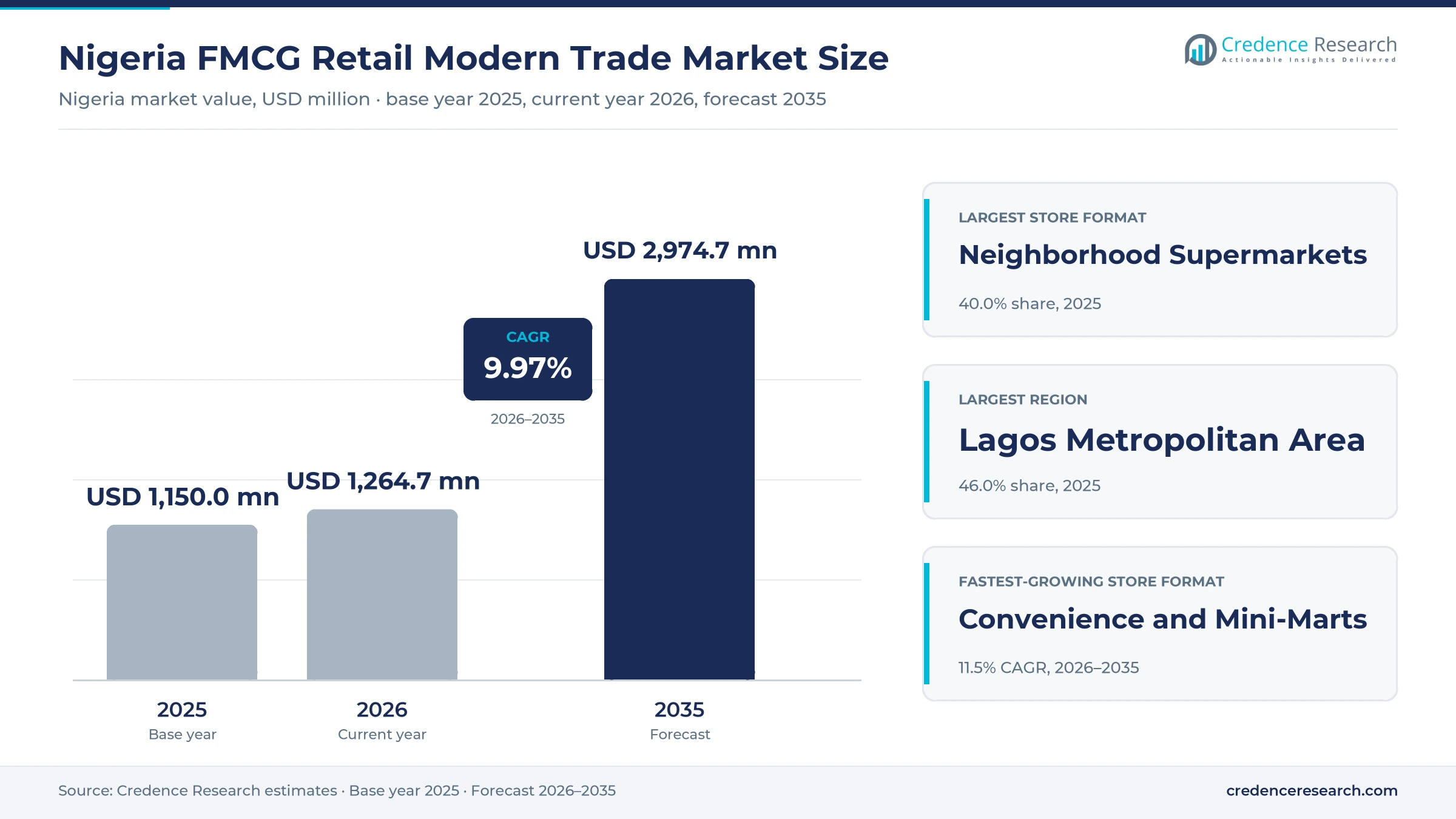
The Nigeria FMCG retail modern trade market was valued at USD 1.15 billion in 2025 and is projected to increase from USD 1.26 billion in 2026 to USD 2.97 billion by 2035, registering a CAGR of 9.97% during 2026–2035. Demand comes from urban households that buy packaged food, drinks, toiletries and cleaning products in supermarkets, hypermarkets, mini-marts and wholesale clubs, and from small businesses that restock there. Lagos Metropolitan Area held the largest regional share, 46.0% in 2025, because most chain stores, mall space and higher-income shoppers sit in and around the commercial capital. South West Urban Corridor is the fastest-growing region at 11.0% a year, as chains such as FoodCo and Justrite open outlets in Ibadan, Abeokuta and Ogun towns. The main commercial change is ownership, because Nigerian-owned chains now run most organized stores, while the Shoprite franchise is restructuring into smaller neighborhood formats.
Chain stores still sell a small slice of packaged goods
The market counts the value of food and beverages, personal care and beauty products, home care and cleaning goods, and baby, health and pet essentials sold to shoppers in Nigeria through organized retail chains. It covers hypermarkets, neighborhood supermarkets, convenience stores and mini-marts, cash-and-carry outlets and wholesale clubs, plus orders placed through retailer apps, third-party delivery platforms and click-and-collect services.
Open-air markets, independent kiosks and roadside traders, pharmacies selling only medicines, restaurant meals and fresh produce sold outside chain stores are excluded. Value moves from local manufacturers, importers and distributors through chain warehouses to the shelf, and most packaged goods still reach consumers through traditional traders rather than these stores.
Nigeria FMCG Retail Modern Trade Market Insights
- The Nigeria FMCG retail modern trade market rises from USD 1.15 billion in 2025 to USD 2.97 billion by 2035, a 9.97% CAGR during 2026–2035, as local chains add stores beyond Lagos.
- Lagos Metropolitan Area held 46.0% of 2025 value, as most chain outlets, mall space and higher-income shoppers sit in and around the commercial capital.
- Neighborhood Supermarkets led store formats with 40.0% of 2025 value, as chains such as Market Square run dozens of mid-sized outlets.
- Bokku Mart reached 124 stores by March 2025, the largest count of any chain in the country, using small hard-discount boxes.
- Carrefour and HyperCity plan 20 stores nationwide by 2028 under a franchise deal announced in April 2026, adding a bulk discount format.
Neighborhood supermarkets lead while mini-marts grow fastest
Food and drinks dominate baskets while personal care grows fastest
Based on product category, the market is categorized into food and beverages, personal care and beauty, home care and cleaning, and baby, health and pet essentials. Food and Beverages led with 64.2% share of 2025 value, because staples dominate every chain store basket. Food carries 40% of the weight in the rebased NBS consumer price index, the largest of any spending group, The Guardian reported in February 2025. Personal Care and Beauty grows fastest at 10.8% a year, as Procter & Gamble closed its Ibadan plant in 2023 and moved to imports, and Kimberly-Clark planned to stop production at Ikorodu in 2024, Nairametrics reported, which shifts imported brands toward chains that can hold stock.
Neighborhood supermarkets lead while mini-marts grow fastest
Based on store format, the market is categorized into hypermarkets and large supermarkets, neighborhood supermarkets, convenience stores and mini-marts, and cash-and-carry and wholesale clubs. Neighborhood Supermarkets led with 40.0% of 2025 value because mid-sized stores fit available sites, and Market Square ran 36 outlets in 12 states after opening Lekki and Gbagada stores in February 2025, Brand Spur reported. Convenience Stores and Mini-Marts grow fastest at 11.5% a year, as Bokku Mart reached 124 small-format stores by March 2025, according to Nairametrics, ahead of every larger chain.
Mainstream brands lead while value ranges grow fastest
Based on price tier, the market is categorized into economy and value, mainstream mass, affordable premium and premium and imported. Mainstream Mass led with 42.0% share of 2025 value, because chain shelves are stocked mostly with local mass brands. Shoprite Nigeria now targets more than 80% local sourcing, Premium Times reported in October 2025. Economy and Value grows fastest at 10.7% a year, as nearly six in ten shoppers switched from their preferred brands in the past year, The Sun reported in November 2025, which pushes households toward discount stores and private labels.
Physical stores lead while delivery platforms grow fastest
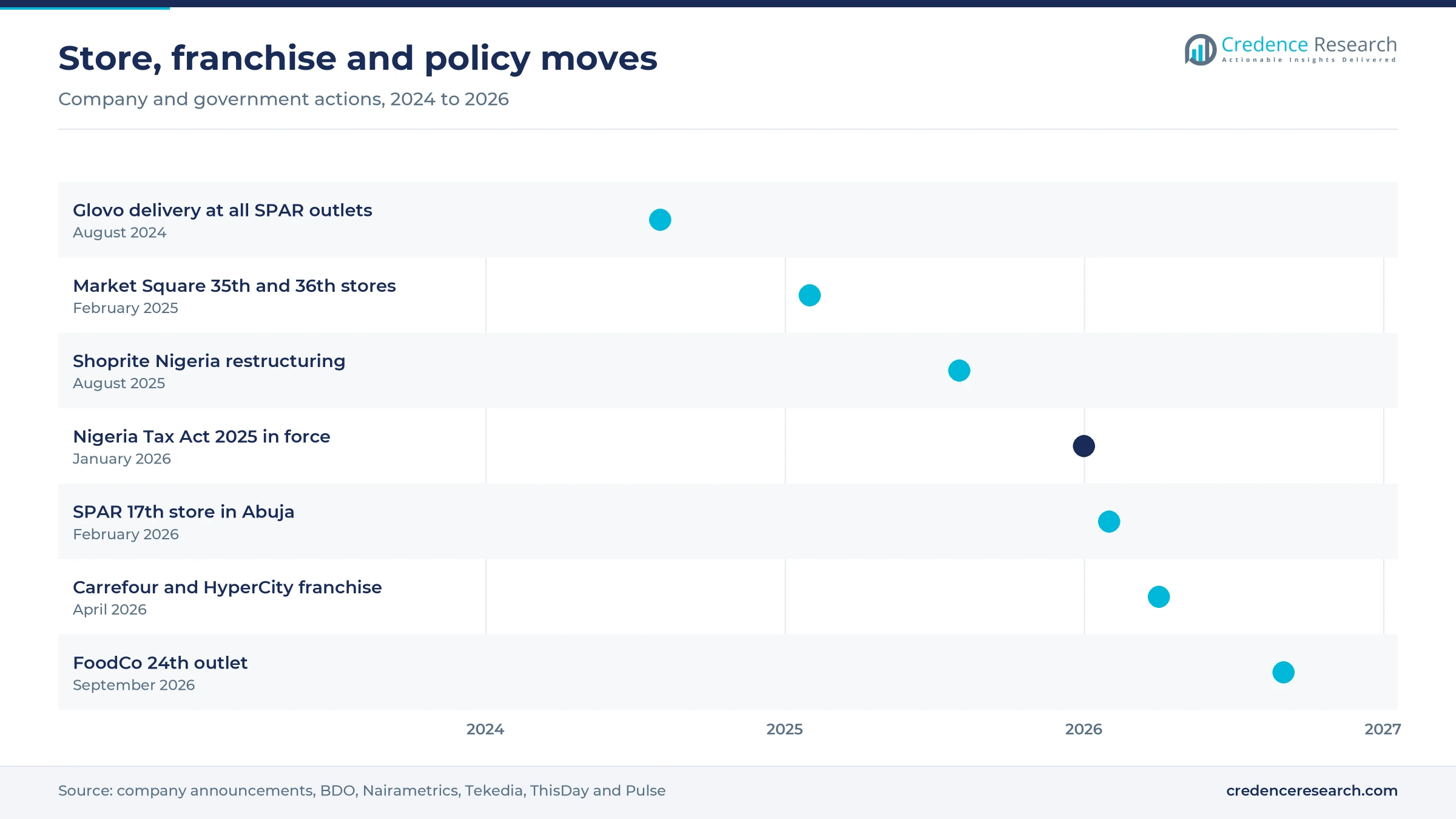
Based on distribution channel, the market is categorized into physical chain stores, retailer-owned e-commerce, third-party marketplaces and click-and-collect and assisted ordering. Physical Chain Stores led with 88.0% share of 2025 value, as shoppers buy most packaged goods in person. SPAR opened its 17th Nigerian store at Novare Central Mall in Abuja in February 2026, Pulse reported. Third-Party Marketplaces grow fastest at 13.8% a year, as Glovo extended grocery delivery to all 10 SPAR outlets in Lagos and Abuja by August 2024, ThisDay reported, after a five-store pilot.
| Segment Group | Leading Sub-segment | Share, 2025 | Fastest-growing Sub-segment | CAGR, 2026–2035 |
|---|---|---|---|---|
| By Product Category | Food and Beverages | 64.2% | Personal Care and Beauty | 10.8% |
| By Store Format | Neighborhood Supermarkets | 40.0% | Convenience Stores and Mini-Marts | 11.5% |
| By Price Tier | Mainstream Mass | 42.0% | Economy and Value | 10.7% |
| By Distribution Channel | Physical Chain Stores | 88.0% | Third-Party Marketplaces | 13.8% |
Shelf prices track open markets with a narrow discount
Chain stores in Nigeria price staples close to open-market levels, because shoppers compare a bag of rice or beans across both channels before buying. The NBS figures in the table are national averages across all outlets, so they show the staple price level chains must match rather than chain shelf prices. Imported brands, chilled goods and premium ranges carry wider markups, since they carry dollar, power and rent costs. FoodCo has said shoppers can save 8% to 15% on some supermarket items, BusinessDay reported in May 2024. Credence Research finds that margins are thinnest on rice, beans and garri, which chains use to draw traffic, and widest on beauty and personal care ranges, beverages and private labels.
| Item or cost | Typical price or fee | Basis |
|---|---|---|
| Local rice, 1 kg, national average | N1,913.78 | NBS price survey, October 2025 |
| Brown beans, 1 kg, national average | N1,760.53 | NBS price survey, October 2025 |
| White garri, 1 kg, national average | N846.69 | NBS price survey, October 2025 |
| Loose tomatoes, 1 kg, national average | N1,269.17 | NBS price survey, October 2025 |
| Store rent, share of supermarket revenue | 8% to 10% | MBO Capital executive cited by Tekedia, October 2026 |
Request a Free Sample
Fill in your details and we'll send you a free sample report.
- Sample data tables & charts
- Research methodology
City households, local chains and cards lift basket value
A large and urbanizing consumer base widens the shopper pool
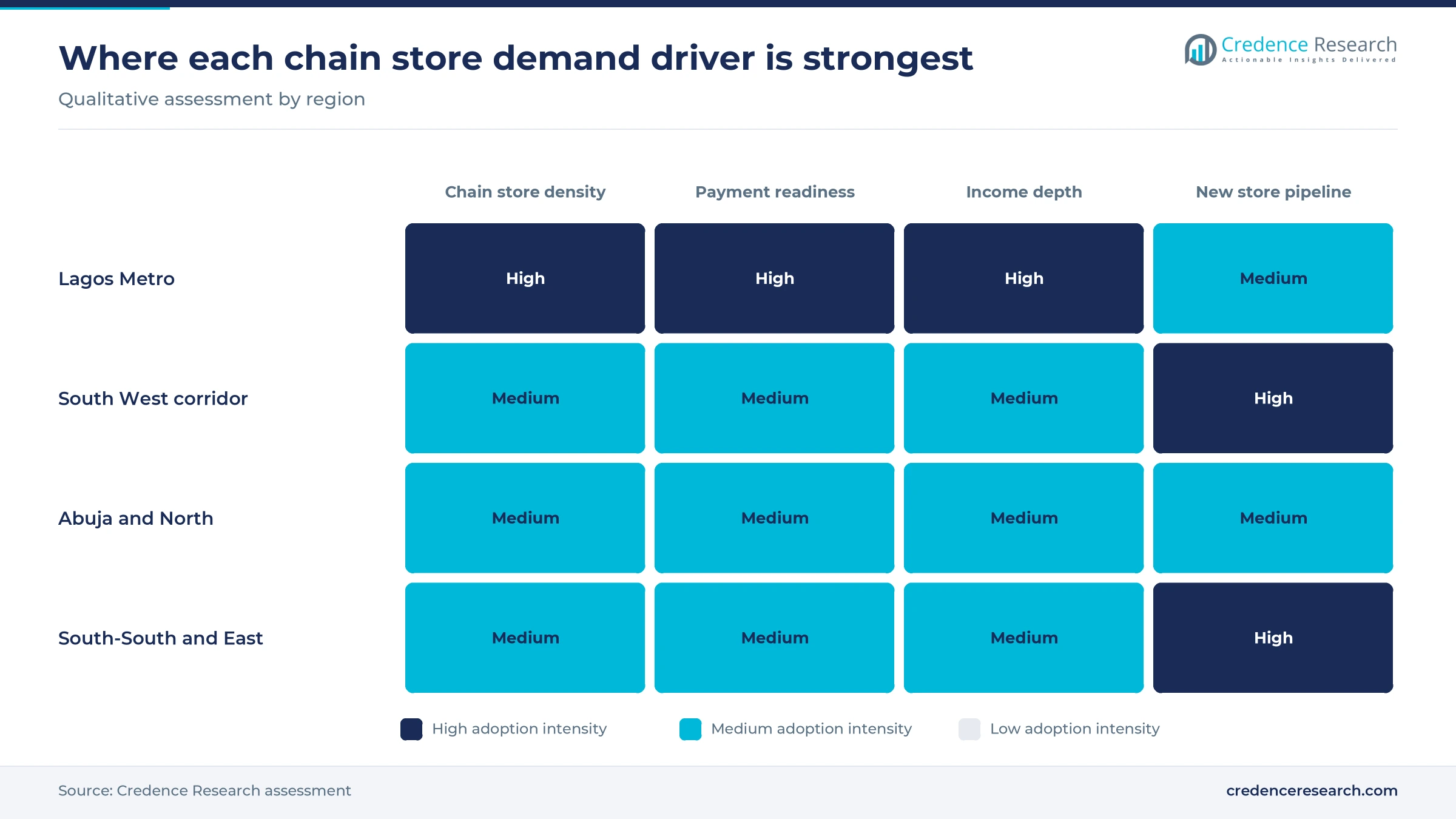
Chain stores depend on dense urban catchments, so the pace of city growth sets how many viable store sites Nigeria can support. The population reached about 237.5 million in 2025, and urban residents made up 63.8% of it, according to World Bank data, with the urban population growing 3.3% that year. Figures cited in the Omni FMCG Industry Report 2026 show FMCG volumes rose 5.4% in 2025 after falling 10.7% in 2024, so baskets are filling again. Lagos alone accounted for about a third of all state revenue in 2024, according to NBS data, which shows where formal spending clusters. Chains that open stores close to new housing estates and commuter routes gain the most from this growth.
Indigenous chains expand store networks across states
Nigerian-owned chains now drive store growth, filling the gap left as South African groups retreated and local investors took over their stores. FoodCo reached 24 outlets when it opened at Awakan in Ibadan, ThisDay reported in September 2026, and its chief executive said each outlet is designed around its neighborhood. Justrite, which ran 31 stores in Lagos, Ogun and Oyo by March 2025, according to Nairametrics, has taken a minority investment from AfricInvest, Nairametrics reported in July 2026. Sundry Markets chief executive Ebele Enunwa said in a June 2023 interview that local retailers outperform foreign ones by about 90 to 10. Suppliers gain more shelf points from this spread, while landlords outside Lagos gain anchor tenants for new malls.
Deepening electronic payment infrastructure eases store checkout
Card and transfer payments let shoppers spend without carrying cash, which lifts basket size and lowers cash-handling costs for chains. Registered POS terminals reached 8.355 million by the end of March 2025, with 5.9 million deployed, or one terminal for every 41 people, according to NIBSS data reported by Leadership. NIBSS instant payment transfers reached N284.99 trillion in the first quarter of 2025, up 21.5% from a year earlier. More than three quarters of retailers surveyed by Omni in 2026 already used digital payment tools. Chains that accept transfers at the till and in delivery apps convert more of this cashless spending into store sales.
Slower inflation and zero-rated food restore real spending power
Lower price growth gives households room to return to branded packs and planned weekly shops after two years of downtrading. Headline inflation fell to 14.06% in October 2026 from 14.63% in September, and food inflation eased to 19.13%, according to NBS figures. The Nigeria Tax Act 2025 took effect on Jan. 1, 2026, keeping VAT at 7.5% and zero-rating basic food, according to BDO, so staples stay outside the VAT charge while chains can still offset input VAT. The share of Nigerians who felt worse off financially fell from 75% in 2024 to 36% in 2025, The Guardian reported, which signals steadier shopping habits. Supermarkets that compete on staples pricing stand to recover lost shopping trips first.
Small-box discounters and delivery apps reshape grocery
Chains are shifting toward small-box discount stores
Retailers are shifting toward small, low-rent stores close to homes, because big mall boxes carry high rent, power and diesel costs. Bokku Mart had 124 stores and Addide 44 by March 2025, both far more than any large-format chain. Shoprite Nigeria, now run by Retail Supermarkets Nigeria for local owners, plans standalone neighborhood stores after a restructuring that began in August 2025, Tekedia reported in October 2026. Premium Times reported in October 2025 that the franchise now targets more than 80% local sourcing and affordable private-label goods. Local manufacturers that can supply private-label staples in small packs gain new volume from this shift.
Grocery delivery is moving onto food-delivery platforms
Supermarkets are shifting part of their online sales onto delivery platforms, because building own fleets is costly in congested cities. Nigeria became Glovo's fastest-growing market in 2025, and the company has invested more than N37 billion there and delivered 38 million items in a year, TechCabal reported. Chowdeck raised a USD 9 million Series A led by Novastar Ventures in August 2025 to launch quick commerce and widen its grocery range. Glovo still operates in only four Nigerian cities, so the shift is concentrated in Lagos and Abuja. Chains with accurate stock data gain the most orders from these apps, adding to online sales of packaged consumer goods.
Bulk formats for small traders are an open gap
Wholesale clubs that combine bulk packs with trade credit could win the restocking spend of small shops, which most chains do not serve today. Carrefour plans to enter Nigeria through a franchise with Port Harcourt retailer HyperCity, which runs four large stores, and both aim for 20 outlets by 2028, including the Atacadao bulk discount format, Food Business MEA reported in April 2026. About 56% of retailers report working capital gaps that affect restocking, and few can reach formal lending, ThisDay reported in June 2026, citing the Omni FMCG Industry Report 2026. More than 40 million small businesses drive roughly four in five retail transactions, a federal minister said at the June 2026 report launch, Nairametrics reported. Operators pairing bulk pricing with supplier credit can win these traders.
Secondary cities outside Lagos offer room for new stores
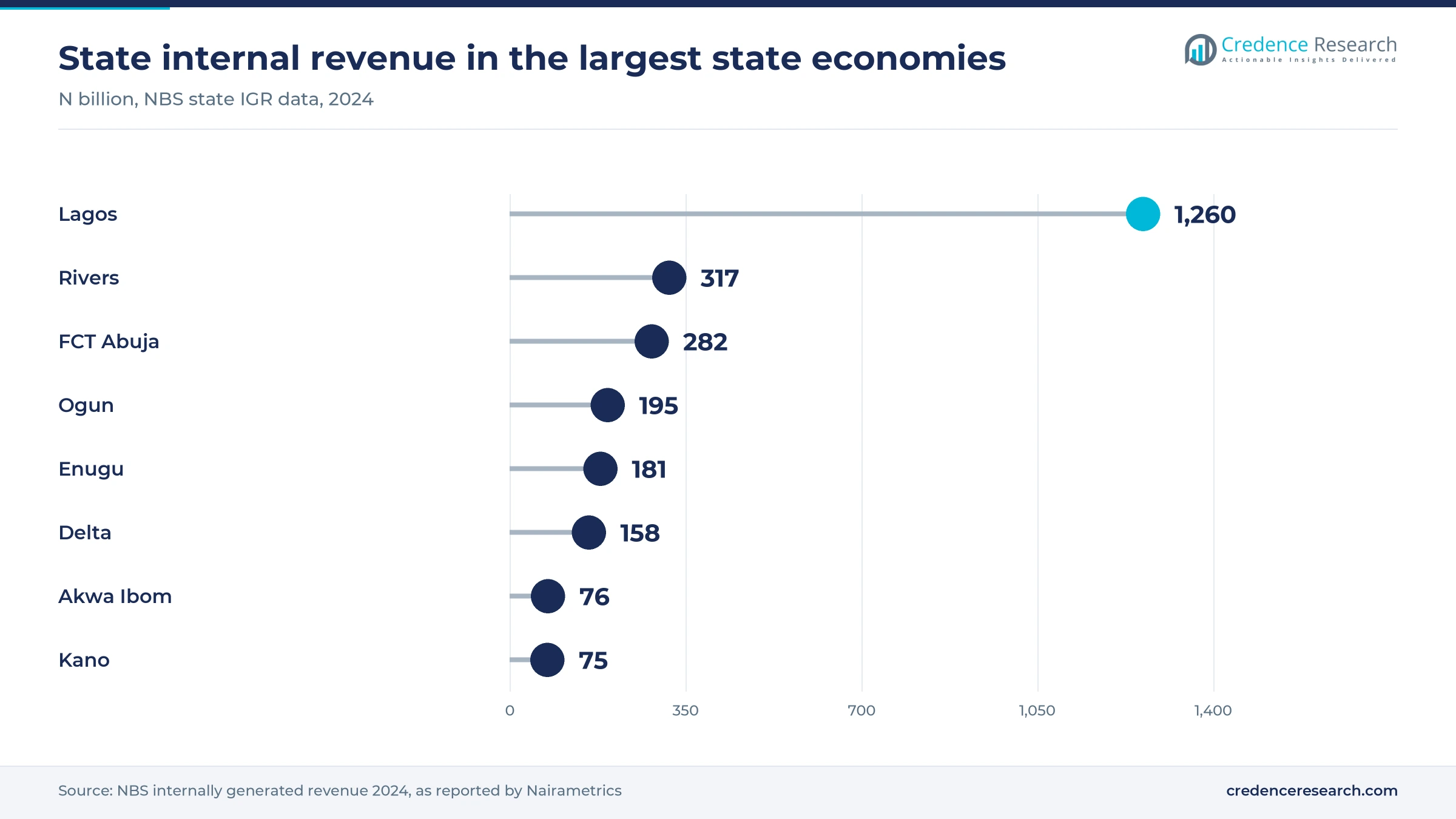
Store density remains thin outside Lagos and Abuja, even in states with large formal economies, in the Credence Research assessment. Rivers collected N317.3 billion in internal revenue in 2024, Ogun N194.93 billion and Enugu N180.5 billion, according to NBS data reported by Nairametrics. Ebele Enunwa said Lagos and Abuja hold under 10% of the population and called Lagos saturated, pointing chains toward industrial cities in other states. Roban Stores runs about 10 outlets in the South East, and Market Square operates in Port Harcourt, Enugu and Aba. Chains that build their own sites in these cities can secure catchments before rivals arrive.
Dollar rents, diesel and supplier exits squeeze margins
Dollar-linked rents and naira losses strain large stores
Rents fixed in dollars rose sharply in naira terms after devaluation, which hits mall-based hypermarkets hardest. About 17 of the 28 Shoprite Nigeria stores carried dollar rents at the time of the local takeover, and rent normally runs 8% to 10% of a supermarket's revenue, an MBO Capital executive said. The naira traded at N1,475.35 per dollar on Oct. 17, 2025, after losing over two-thirds of its value since mid-2023, Premium Times reported. Operators respond by renegotiating leases or moving into smaller standalone sites.
Grid shortfalls and diesel costs raise store operating bills
Chain stores need steady power for cold rooms, lighting and tills, and grid outages force them onto costly generators. Premium Times reported in October 2025 that Shoprite outlets in Festac and Jakande closed when power failed, with fuel near N1,000 per liter. Kimberly-Clark spent about N100 million a month on power generation before halting Lagos production, Nairametrics reported in May 2024. Stores selling chilled and frozen ranges carry the highest exposure, which links shelf availability to cold chain and agro logistics capacity.
Multinational supplier exits thin branded shelves
Several global manufacturers have cut local production, which leaves chains more dependent on imports priced in dollars. GSK also switched to imports after the Procter & Gamble and Kimberly-Clark exits noted in the product segment, Nairametrics reported, so more of each branded shelf is now priced off the dollar. Kimberly-Clark had invested about USD 100 million in its Lagos plant before halting output, the same outlet reported in May 2024. Retailers with thin working capital face empty shelves before anyone else. Chains respond by sourcing more local brands and private labels.
Weak purchasing power keeps shoppers in open markets
Many households still buy staples in open markets because prices there are lower and quantities can be split. About 70% of food shopping happens in traditional open markets, according to a December 2025 USDA Foreign Agricultural Service report. The World Bank estimated that 104 million Nigerians lived in poverty in 2023, BusinessDay reported in May 2024. Premium chains with mall rents face the most pressure from this behavior. Discount formats and smaller pack sizes help retain cost-sensitive shoppers.
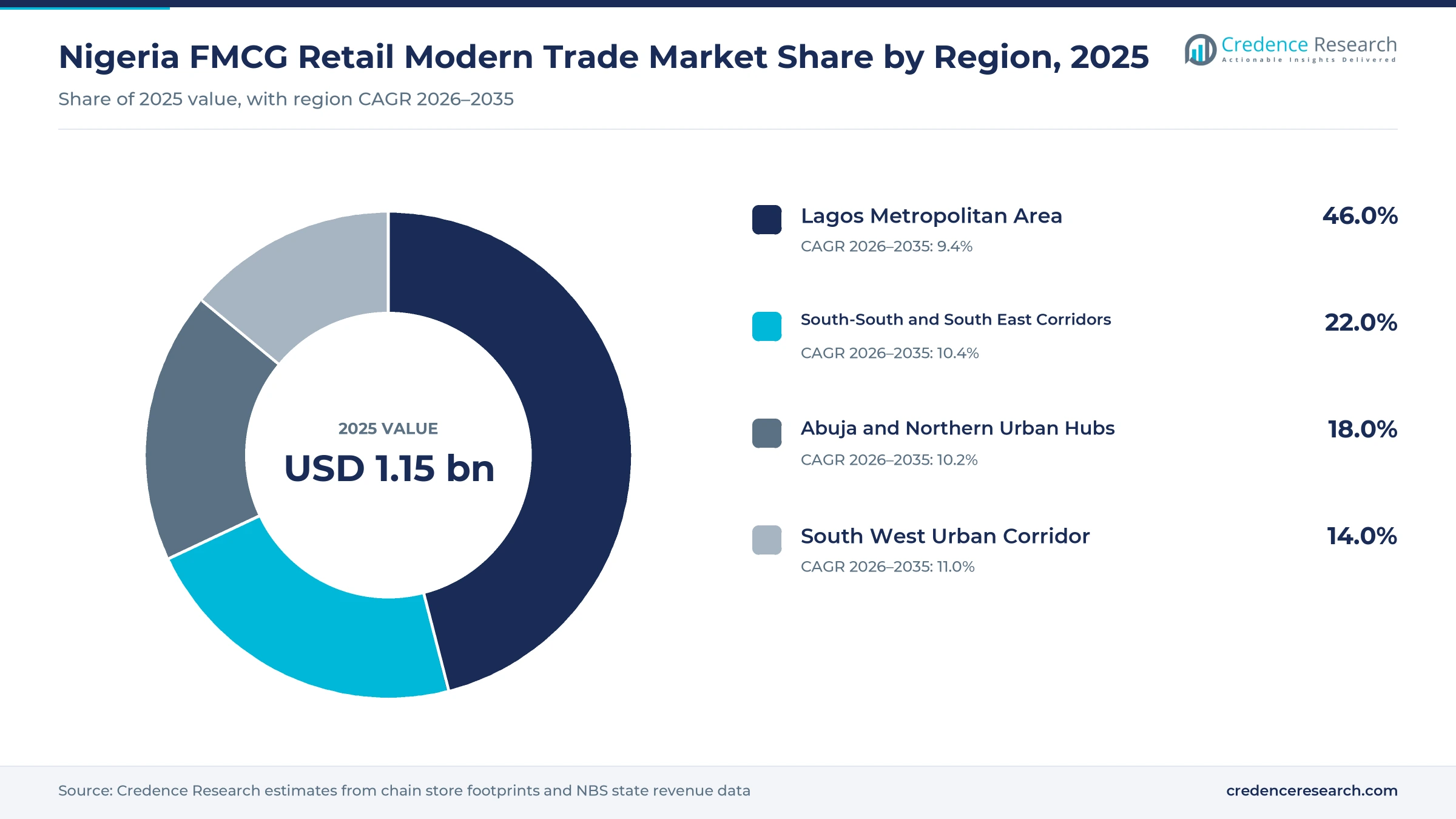
Lagos leads while the South West corridor gains fastest
| Region | Value, 2025 (USD billion) | Share, 2025 | CAGR, 2026–2035 |
|---|---|---|---|
| Lagos Metropolitan Area | 0.53 | 46.0% | 9.4% |
| South-South and South East Corridors | 0.25 | 22.0% | 10.4% |
| Abuja and Northern Urban Hubs | 0.21 | 18.0% | 10.2% |
| South West Urban Corridor | 0.16 | 14.0% | 11.0% |
Income depth and store density keep Lagos ahead
Lagos Metropolitan Area held 46.0% of 2025 value and grows at 9.4% a year. Lagos State collected N1.26 trillion of the N3.63 trillion in state internal revenue recorded in 2024, according to NBS data, and Bokku Mart and Addide built most of their outlets there. Globus Supermarket also runs more than a dozen Lagos stores, Brand Spur reported in May 2026. Growth trails other zones in the Credence Research estimate, because prime sites are scarce and new stores often split existing catchments.
Why does the South West Urban Corridor grow fastest?
South West Urban Corridor held 14.0% of 2025 value and grows fastest at 11.0% a year. FoodCo opened its fourth Abeokuta store, at Asero, in October 2025, ThisDay reported, and both FoodCo and Justrite now reach Ibadan and Ogun towns from Lagos. Ogun's revenue base, noted in the trends, reflects factories and commuter towns along the Lagos-Ibadan route. Chains can supply these stores from Lagos warehouses, which keeps their distribution costs low as they add outlets.
Government incomes support Abuja and northern hubs
Abuja and Northern Urban Hubs held 18.0% of 2025 value and grows at 10.2% a year. The Federal Capital Territory collected N282.36 billion in internal revenue in 2024, while Kano collected N74.77 billion, according to NBS data. SPAR opened its fourth Abuja store in February 2026, yet Shoprite closed its Kano store in January 2024, Premium Times reported. Demand concentrates in Abuja, while large northern cities remain served mainly by open markets and wholesalers.
Oil-region incomes and trading hubs anchor the south
South-South and South East Corridors held 22.0% of 2025 value and grows at 10.4% a year. Rivers and Enugu, whose revenue bases are noted in the trends, anchor formal spending across the two southern zones. HyperCity's Port Harcourt stores are due to carry the Carrefour brand under the franchise noted above, which adds a bulk format aimed at traders in the oil city. Roban Stores serves Enugu, Anambra and Ebonyi shoppers from about 10 outlets in the region.
Store openings, franchise deals and resets in 2025 and 2026
| Development | Status and market relevance |
|---|---|
| In February 2025, Market Square opened its 35th and 36th stores in Lekki and Gbagada, reaching 12 states. | Stores opened; widens a Nigerian-owned network |
| In August 2025, Chowdeck raised a USD 9 million Series A to launch quick commerce and expand groceries. | Funding completed; adds platform demand for chain stock |
| In February 2026, SPAR opened its 17th Nigerian store, a hypermarket at Novare Central Mall in Abuja. | Store opened; fourth SPAR outlet in Abuja |
| In April 2026, Carrefour and HyperCity announced a franchise to open 20 stores in Nigeria by 2028. | Plan announced; four existing stores to be rebranded first |
| In September 2026, FoodCo opened its Awakan outlet in Ibadan, taking its network to 24 stores. | Store opened; deepens South West coverage |
POS terminals, delivery apps and store systems in use
- POS terminals and bank transfers let shoppers pay without cash at the till, which lifts basket size and cuts cash-handling losses for stores.
- Delivery platform integrations connect store inventory to apps such as Glovo and Chowdeck, which lets chains sell to customers who never enter a store.
- Retail ERP and stock systems track inventory across outlets, and Shoprite Nigeria spent billions of naira replacing the system it lost after its former parent left.
- Solar and hybrid power units reduce generator hours for lighting and cold rooms, which lowers operating costs in stores that face frequent grid outages.
Need a Custom Version of This Report?
Tailor the scope, geography, or segments to your exact requirements.
- Custom geography or segment scope
- Direct access to our analyst team
Indigenous chains outgrow the foreign-branded stores
Competition in the Nigeria FMCG retail modern trade market runs between Nigerian-owned chains, a few franchise operators and the open markets that still sell most packaged goods. Bokku Mart and Addide compete on price and proximity with many small stores in Lagos. Market Square, run by Sundry Markets, competes on reach across 12 states, while SPAR, run by Artee, competes with large hypermarkets in Lagos, Abuja and Port Harcourt. FoodCo and Justrite hold strong positions in Ibadan, Ogun and Lagos, and Ebeano serves higher-income shoppers in Lagos and Abuja. Roban Stores leads in the South East, Globus runs more than a dozen Lagos outlets, and Jendol Superstores runs 14 stores in Lagos suburbs. Shoprite, now run by Retail Supermarkets Nigeria for local owners, is shrinking toward neighborhood formats after its 2025 shutdown. Suppliers manage shelf placement through consumer goods distribution networks that also serve open markets. Buyers weigh price, location and stock reliability, so chains with their own sites and steady supply hold the strongest position.
Fragmented chains, few national networks
Supply is split between many regional chains and almost no national network. Bokku Mart and Addide lead on store count with small boxes, Market Square and SPAR run mid-sized and large stores in several states, and FoodCo, Justrite, Ebeano, Roban and Globus each dominate a home region. Entry barriers are high in large formats, where operators must build their own sites, secure dollar supply and run generators, but low for small neighborhood stores. Margins sit with chains that control rent, buy directly from manufacturers and sell private labels, while fee-paying franchisees carry more cost.
Chains that Nigerian shoppers and suppliers deal with
| Company | Type | Role in the market |
|---|---|---|
| Sundry Markets Limited (Market Square) | Supermarket chain | Runs 36 Market Square stores across 12 states, including Lagos, Abuja and Enugu |
| Artee Industries Limited (SPAR Nigeria) | Franchise operator | Operates 17 SPAR stores, mostly hypermarkets, in five cities under licence |
| Justrite Limited | Discount supermarket chain | Runs 31 value supermarkets in Lagos, Ogun and Oyo, backed by AfricInvest |
| FoodCo Nigeria Limited | Supermarket chain | Runs 24 supermarkets with bakeries and grills in Ibadan, Lagos and Ogun |
| Ebeano Supermarket | Supermarket chain | Runs nine Prince Ebeano supermarkets in Lagos and Abuja |
| Addide Limited | Neighborhood supermarket chain | Runs 44 small-format supermarkets, mainly in Lagos |
| Bokku! Mart | Hard-discount chain | Runs more than 120 small hard-discount stores, the largest store count |
| Globus Supermarket | Supermarket chain | Runs more than a dozen supermarkets in Lagos |
| Roban Stores Limited | Regional supermarket chain | Runs about 10 supermarkets in Enugu, Anambra and Ebonyi |
| Retail Supermarkets Nigeria Limited (Shoprite) | Franchise operator | Runs Shoprite supermarkets and hypermarkets, restructuring toward smaller neighborhood stores |
| Jendol Superstores | Regional supermarket chain | Runs 14 supermarkets in Lagos, including Egbeda, Ikotun and Abule-Egba |
Small formats and secondary cities decide the next decade
Credence Research's view is that chain store value in Nigeria will grow through many small stores and new cities rather than large mall hypermarkets. Neighborhood Supermarkets remain the core of the market, but discount boxes, bulk formats for traders and delivery apps reward operators that keep rent and power costs low. Nigerian-owned chains have already overtaken foreign-branded stores, and the Carrefour franchise will test whether bulk discounting can work at scale. Chains that buy directly from local manufacturers, accept every payment type and control their own sites hold the strongest position, while mall-dependent stores face the most pressure.
Store counts, prices and payment data anchor the estimate
The report uses 2025 as the base year and 2026 to 2035 as the forecast period. Market values come from the Credence Research model, and the regional, product, store format, price tier and channel splits are Credence Research estimates informed by public data. The 2025 value was checked against a bottom-up build from chain store sales, store counts and price growth, and against a top-down share of total packaged goods spending. Regional shares were set from chain store footprints and NBS state revenue data, because no official statistic tracks chain store sales by zone, so they carry wider ranges. Sources include the NBS, the World Bank, NIBSS data, the USDA Foreign Agricultural Service, company announcements and Nigerian business press. No interviews or surveys were used to build these estimates.
Chain store rollouts carry value toward 2035
Credence Research expects the market to reach USD 2.97 billion by 2035, rising from USD 1.26 billion in 2026, as chains open small stores near homes and expand into secondary cities. The South West Urban Corridor should keep the fastest regional pace, while Lagos Metropolitan Area remains the largest source of value. Discount formats, bulk clubs and delivery platforms form the main upside, especially if the naira stays stable and inflation keeps easing. Dollar-linked rents, generator costs and weak household incomes remain the main restraints on how fast shoppers leave open markets.
Currency stability and store rollouts set the range of outcomes
The range to 2035 depends mainly on whether the naira stays stable, how fast chains open stores outside Lagos and whether power costs ease. The base case assumes steady store openings and moderate inflation. A downside follows if the currency weakens again and diesel prices rise, which would close more mall stores and push shoppers back to open markets. An upside follows if the Carrefour rollout, discount chains and delivery apps all scale, drawing more households into organized stores.
| Scenario | CAGR, 2026–2035 | Value, 2035 | What has to hold |
|---|---|---|---|
| Downside | 8.0% | USD 2.52 billion | The naira weakens again and diesel costs force more large-store closures |
| Base | 9.97% | USD 2.97 billion | Chains keep adding small stores while inflation stays near current levels |
| Upside | 11.5% | USD 3.36 billion | Bulk formats, discount chains and delivery platforms scale in secondary cities |
Frequently Asked Questions
How big is the Nigeria FMCG retail modern trade market?
Which region leads chain store spending in Nigeria?
Which region grows fastest?
Which store format holds the largest share?
Which store format grows fastest?
How do Nigerian shoppers pay in chain stores?
Is Carrefour entering Nigeria?
Which companies run chain stores in Nigeria?
Table of Content
Chapter 1 Market Segmentation
- 1.1 Segmentation Framework
- 1.1.1 Product and Service Classification
- 1.1.2 Application and End-Use Classification
- 1.1.3 Technology and Solution Classification
- 1.1.4 Customer and Distribution Channel Classification
- 1.1.5 Geographic Segmentation
- 1.1.6 Market Segment Definitions and Boundaries
- 1.2 By Product Category
- 1.2.1 Food and Beverages
- 1.2.2 Personal Care and Beauty
- 1.2.3 Home Care and Cleaning
- 1.2.4 Baby, Health and Pet Essentials
- 1.3 By Store Format
- 1.3.1 Hypermarkets and Large Supermarkets
- 1.3.2 Neighborhood Supermarkets
- 1.3.3 Convenience Stores and Mini-Marts
- 1.3.4 Cash-and-Carry and Wholesale Clubs
- 1.4 By Price Tier
- 1.4.1 Economy and Value
- 1.4.2 Mainstream Mass
- 1.4.3 Affordable Premium
- 1.4.4 Premium and Imported
Chapter 2 Introduction
- 2.1 Report Objectives and Scope
- 2.2 Product Definition and Industry Terminology
- 2.3 Market Inclusions and Exclusions
- 2.4 Research Process
- 2.4.1 Primary Research and Expert Interviews
- 2.4.2 Secondary Research and Source Review
- 2.4.3 Top-Down and Bottom-Up Estimation
- 2.4.4 Data Triangulation and Verification
- 2.5 Market Size Measurement Basis
- 2.5.1 2025: USD 1.15 billion → 2035: USD 2.97 billion
- 2.6 Historical and Forecast Reference Periods
- 2.6.1 Historical Period: 2018-2025
- 2.6.2 Base Year: 2025
- 2.6.3 Forecast Period: 2025-2035
- 2.7 Research Assumptions and Limitations
Chapter 3 Executive Summary
- 3.1 Market Snapshot and Key Findings
- 3.2 Base-Year Market Size, 2025
- 3.3 Forecast Market Size, 2035
- 3.4 Revenue and Volume Growth Outlook
- 3.5 Key Demand and Supply Indicators
- 3.6 Leading Market Segments
- 3.7 Fastest-Growing Market Opportunities
- 3.8 Regional Performance Highlights
- 3.9 Technology and Industry Transformation
- 3.10 Competitive Landscape Summary
- 3.11 Analyst View and Strategic Implications
Chapter 4 Nigeria FMCG Retail Modern Trade Market Trends and Developments
- 4.1 Historical Industry Development, 2018-2025
- 4.2 Recent Market Trends and Developments
- 4.3 Demand and Customer Behavior Trends
- 4.4 Technology and Product Innovation
- 4.5 Artificial Intelligence, Automation and Digitalization
- 4.6 Local Manufacturing and Supply Chain Realignment
- 4.7 Industry Partnerships, Mergers and Acquisitions
- 4.8 Sustainability and Circular Economy Developments
- 4.9 Government and Private Sector Investment Trends
- 4.10 Emerging Business Models and Commercialization
- 4.11 Industry Developments and Announcements
Chapter 5 Nigeria FMCG Retail Modern Trade Market Production, Supply and Demand Analysis
- 5.1 Demand Trend and Consumption Analysis, 2018-2025
- 5.2 Demand Forecast, 2025-2035
- 5.3 Production and Output Trend, 2018-2025
- 5.4 Production and Output Forecast, 2025-2035
- 5.5 Installed Capacity and Capacity Utilization
- 5.6 Company-Wise Production Plants and Statistics
- 5.6.1 Installed Production Capacity
- 5.6.2 Actual Production
- 5.6.3 Planned Capacity and Expansion Targets
- 5.7 Supply Chain Structure and Procurement Trends
- 5.8 Supply-Demand Gap and Bottlenecks
- 5.9 Import Dependence and Sourcing Structure
- 5.10 Contract Manufacturing and Outsourcing
- 5.11 Regional Supply and Demand Concentration
Chapter 6 Nigeria FMCG Retail Modern Trade Market Pricing Analysis
- 6.1 Pricing Structure and Measurement
- 6.2 Historical Pricing Trends, 2018-2025
- 6.3 Pricing Outlook, 2025-2035
- 6.4 Average Selling Price and Unit Economics
- 6.5 Pricing by Product and Market Segment
- 6.6 Geographic Pricing Differences
- 6.7 Key Input, Energy, Labor and Logistics Costs
- 6.8 Contract Pricing and Purchasing Models
- 6.9 Pricing Sensitivity and Competitive Positioning
- 6.10 Price, Margin and Profitability Implications
Chapter 7 Nigeria FMCG Retail Modern Trade Market Dynamics
- 7.1 Market Growth Drivers
- 7.1.1 Demand-Side Drivers
- 7.1.2 Technology and Innovation Drivers
- 7.1.3 Infrastructure and Investment Drivers
- 7.1.4 Regulatory and Policy Drivers
- 7.2 Market Restraints
- 7.2.1 Cost and Affordability Constraints
- 7.2.2 Technology and Adoption Barriers
- 7.2.3 Supply Chain and Operational Constraints
- 7.3 Market Challenges
- 7.3.1 Competitive Pressure and Margin Erosion
- 7.3.2 Skills, Infrastructure and Implementation Gaps
- 7.4 Emerging Market Opportunities
- 7.5 Market Dynamics Impact and Time-Horizon Assessment
Chapter 8 Nigeria FMCG Retail Modern Trade Value Chain Analysis
- 8.1 Industry Value Chain Overview
- 8.2 Upstream Suppliers and Critical Inputs
- 8.3 Technology and Component Providers
- 8.4 Manufacturing or Service Delivery
- 8.5 Distribution, Channel Partners and Integrators
- 8.6 Downstream Applications and End Users
- 8.7 Value Addition and Profit Pools
- 8.8 Vertical Integration and Outsourcing
- 8.9 Supplier Concentration and Risk
- 8.10 Supply Chain Localization and Resilience
Chapter 9 Nigeria FMCG Retail Modern Trade Market Regulations and Policies
- 9.1 Relevant Laws, Standards and Compliance Frameworks
- 9.2 Product, Service, Safety and Quality Requirements
- 9.3 Government Policies, Incentives and Subsidies
- 9.4 Imports, Exports and Trade Barriers
- 9.5 Public Procurement and Local Content Requirements
- 9.6 Environmental and Sustainability Compliance
- 9.7 Upcoming Policy Changes and Market Implications
Chapter 10 Nigeria FMCG Retail Modern Trade Market Hotspots and Opportunities
- 10.1 Market Opportunity Mapping and Growth Hotspots
- 10.2 High-Growth Applications and Customer Groups
- 10.3 Underserved Markets and White-Space Opportunities
- 10.4 Emerging Technology and Product Opportunities
- 10.5 New Capacity and Investment Hotspots
- 10.6 Market Entry and Expansion Opportunities
- 10.7 Distribution and Partnership Opportunities
- 10.8 Near-Term and Long-Term Commercial Potential
- 10.9 Opportunity Attractiveness and Execution Risks
Chapter 11 Nigeria FMCG Retail Modern Trade Market Outlook, 2025-2035
- 11.1 Market Size and Analysis
- 11.1.1 Revenue (Market Measurement: 2025: USD 1.15 billion → 2035: USD 2.97 billion)
- 11.1.2 Market Volume and Quantity Sold
- 11.1.3 Historical Market Size, 2018-2025
- 11.1.4 Base-Year Market Size, 2025
- 11.2 Market Forecast, 2025-2035
- 11.2.1 Revenue Forecast to 2035
- 11.2.2 Volume Forecast to 2035
- 11.2.3 CAGR and Year-on-Year Growth
- 11.2.4 Incremental Revenue Opportunity
- 11.3 Forecast Assumptions and Scenario Analysis
- 11.3.1 Base-Case Forecast
- 11.3.2 Optimistic and Conservative Scenarios
- 11.3.3 Technology, Pricing and Policy Sensitivities
- 11.4 Market Attractiveness and Growth Outlook
Chapter 12 Nigeria FMCG Retail Modern Trade Market Segmentation and Outlook
- 12.1 Segmentation Summary and Market Shares, 2025
- 12.2 Largest and Fastest-Growing Segments
- 12.3 By Product Category - Market Size and Forecast, 2025-2035
- 12.3.1 Segment Definition and Scope
- 12.3.2 Historical Market Size, 2018-2025
- 12.3.3 Revenue Forecast, 2025-2035
- 12.3.4 Volume Forecast, 2025-2035
- 12.3.5 Base-Year Market Share, 2025
- 12.3.6 Segment CAGR and Growth Drivers
- 12.3.7 Subsegment Market Size and Forecast
- 12.3.7.1 Food and Beverages
- 12.3.7.2 Personal Care and Beauty
- 12.3.7.3 Home Care and Cleaning
- 12.3.7.4 Baby, Health and Pet Essentials
- 12.3.8 Subsegment Pricing and Adoption Trends
- 12.3.9 Leading Suppliers and Competition
- 12.3.10 Regional Demand and Opportunities
- 12.4 By Store Format - Market Size and Forecast, 2025-2035
- 12.4.1 Segment Definition and Scope
- 12.4.2 Historical Market Size, 2018-2025
- 12.4.3 Revenue Forecast, 2025-2035
- 12.4.4 Volume Forecast, 2025-2035
- 12.4.5 Base-Year Market Share, 2025
- 12.4.6 Segment CAGR and Growth Drivers
- 12.4.7 Subsegment Market Size and Forecast
- 12.4.7.1 Hypermarkets and Large Supermarkets
- 12.4.7.2 Neighborhood Supermarkets
- 12.4.7.3 Convenience Stores and Mini-Marts
- 12.4.7.4 Cash-and-Carry and Wholesale Clubs
- 12.4.8 Subsegment Pricing and Adoption Trends
- 12.4.9 Leading Suppliers and Competition
- 12.4.10 Regional Demand and Opportunities
- 12.5 By Price Tier - Market Size and Forecast, 2025-2035
- 12.5.1 Segment Definition and Scope
- 12.5.2 Historical Market Size, 2018-2025
- 12.5.3 Revenue Forecast, 2025-2035
- 12.5.4 Volume Forecast, 2025-2035
- 12.5.5 Base-Year Market Share, 2025
- 12.5.6 Segment CAGR and Growth Drivers
- 12.5.7 Subsegment Market Size and Forecast
- 12.5.7.1 Economy and Value
- 12.5.7.2 Mainstream Mass
- 12.5.7.3 Affordable Premium
- 12.5.7.4 Premium and Imported
- 12.5.8 Subsegment Pricing and Adoption Trends
- 12.5.9 Leading Suppliers and Competition
- 12.5.10 Regional Demand and Opportunities
- 12.6 Segment Growth Comparison
- 12.7 Segment Attractiveness and Priority Matrix
Chapter 13 Nigeria FMCG Retail Modern Trade Geographic Market Outlook, 2025-2035
- 13.1 Domestic Market Distribution and Demand Clusters
- 13.2 State- or Province-Wise Market Size and Forecast, 2025-2035
- 13.3 City and Metropolitan Market Outlook
- 13.4 Industrial, Manufacturing and Commercial Clusters
- 13.5 Geographic Concentration of Key End Users
- 13.6 Local Pricing and Purchasing Differences
- 13.7 Domestic Production Facilities and Capacity Map
- 13.8 Local Infrastructure and Project Pipeline
- 13.9 State-Level Policy and Incentive Differences
- 13.10 Subnational Investment Hotspots and Opportunities
- 13.11 Distribution and Logistics Networks
- 13.12 Domestic Competitive Footprint
Chapter 14 Nigeria FMCG Retail Modern Trade Technology, Innovation and Sustainability Outlook
- 14.1 Technology Landscape and Maturity
- 14.2 Product, Process and Service Innovation
- 14.3 AI, Automation and Digital Tools in the Industry
- 14.4 Technology Adoption and Performance Benchmarking
- 14.5 Innovation Pipeline and R&D Investment
- 14.6 Patent and Intellectual Property Trends
- 14.7 Energy Efficiency and Resource Management
- 14.8 Sustainability, Recycling and Circularity
- 14.9 Technology Roadmap, 2025-2035
- 14.10 Risks of Obsolescence and Technology Substitution
Chapter 15 Nigeria FMCG Retail Modern Trade Market Key Strategic Imperatives
- 15.1 Growth and Market Entry Priorities
- 15.2 High-Return Products and Segments
- 15.3 Pricing, Profitability and Cost Optimization
- 15.4 Technology Investment and Product Differentiation
- 15.5 Supply Chain Localization and Resilience
- 15.6 Distribution and Customer Acquisition
- 15.7 Partnership, Acquisition and Capacity Strategy
- 15.8 Regional Expansion Priorities
- 15.9 Short-, Medium- and Long-Term Actions
Chapter 16 Competition Outlook
- 16.1 Industry Competition Characteristics
- 16.2 Market Structure and Concentration
- 16.3 Market Share and Competitive Positioning, 2025
- 16.4 Company-Wise Revenue and Product Benchmarking
- 16.5 Production and Service Capacity Benchmarking
- 16.6 Technology, Pricing and Differentiation
- 16.7 Regional Footprint and Distribution Strength
- 16.8 Mergers, Acquisitions and Strategic Alliances
- 16.9 New Entrants and Competitive Threats
- 16.10 Porter's Five Forces and Industry Attractiveness
- 16.11 Competitive Outlook, 2025-2035
Chapter 17 Company Profiles
- 17.1 Company Coverage and Selection Criteria
- 17.2 Sundry Markets Limited (Market Square)
- 17.2.1 Business Description
- 17.2.2 Company Ownership and Geographic Presence
- 17.2.3 Product and Service Portfolio
- 17.2.4 Manufacturing and Operating Footprint
- 17.2.5 Production Capacity and Expansion Plans
- 17.2.6 Financial Performance and Investment
- 17.2.7 Market Share and Competitive Position
- 17.2.8 Technology and Innovation Capabilities
- 17.2.9 Strategic Alliances or Partnerships
- 17.2.10 Recent Developments
- 17.2.11 Growth Strategy and Outlook
- 17.3 Artee Industries Limited (SPAR Nigeria)
- 17.4 Justrite Limited
- 17.5 FoodCo Nigeria Limited
- 17.6 Ebeano Supermarket
- 17.7 Hubmart Stores Limited
- 17.8 Addide Limited
- 17.9 Bokku! Mart
- 17.10 Globus Supermarket
- 17.11 Roban Stores Limited
- 17.12 Retail Supermarkets Nigeria Limited (Shoprite)
- 17.13 Jendol Superstores
- 17.14 Other Relevant Market Participants
Note: Every listed company is profiled on the structure shown under the first company. The company list is preliminary and may change based on research findings, market developments, data availability and client requirements.
Chapter 18 Disclaimer
- 18.1 Research and Forecast Disclaimer
- 18.2 Data Source and Estimation Limitations
Note: The depth of individual sections depends on data availability for this market. Volume, capacity, trade and other unit-based metrics are included where applicable.