
Market Overview:
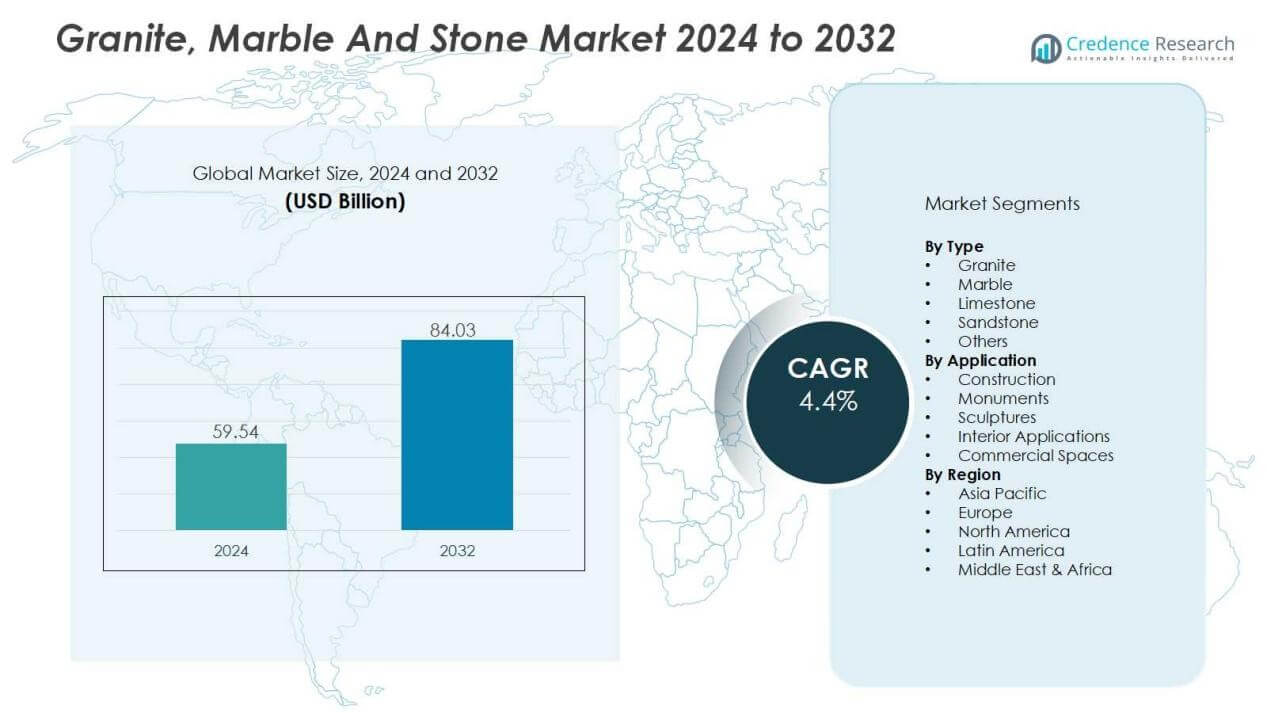
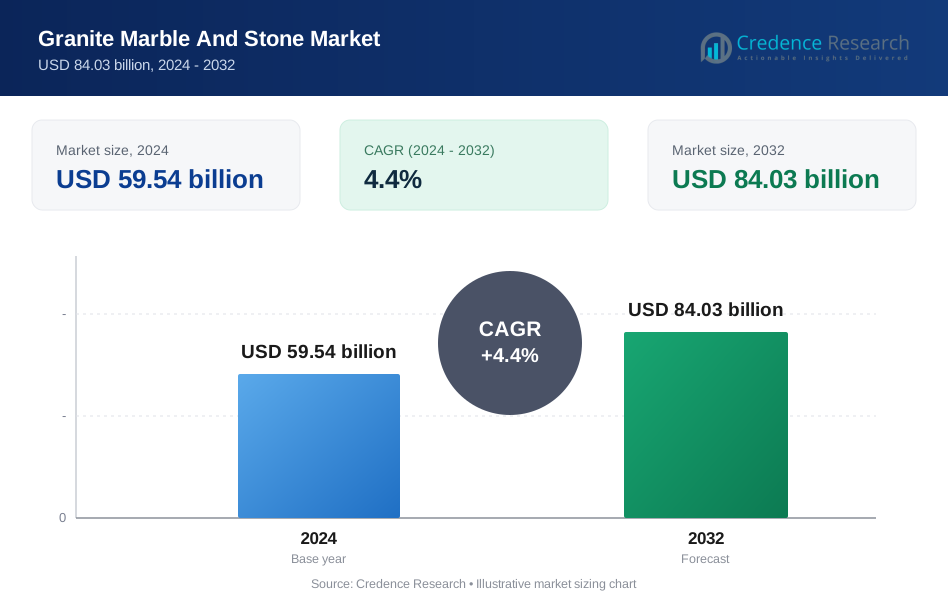
The granite, marble and stone market size was valued at USD 59.54 billion in 2024 and is anticipated to reach USD 84.03 billion by 2032, at a CAGR of 4.4% during the forecast period (2024-2032).
| REPORT ATTRIBUTE | DETAILS |
|---|---|
| Historical Period | 2020-2023 |
| Base Year | 2024 |
| Forecast Period | 2025-2032 |
| Granite, Marble And Stone Market Size 2024 | USD 59.54 Billion |
| Granite, Marble And Stone Market, CAGR | 4.4% |
| Granite, Marble And Stone Market Size 2032 | USD 84.03 Billion |
Key drivers shaping the industry include the rising preference for durable, aesthetic building materials and the widespread adoption of natural stone in flooring, countertops, and cladding. Sustainability awareness and advanced quarrying technologies have enhanced efficiency and reduced waste, improving supply dynamics. In addition, growing disposable income in emerging markets fuels luxury housing demand, boosting the consumption of high-quality marble and granite.
Regionally, Asia Pacific dominates the market owing to rapid construction growth in China, India, and Southeast Asia. Europe remains a major consumer, driven by architectural heritage restoration and premium interior applications. North America sustains solid demand through residential remodeling and commercial real estate development. Meanwhile, Latin America and the Middle East & Africa present untapped growth potential, supported by rising urban infrastructure investments and luxury lifestyle adoption.
 Market Insights:
- The granite, marble and stone market was valued at USD 59.54 billion in 2024 and is projected to reach USD 84.03 billion by 2032, at a CAGR of 4.4% between 2024 and 2032.
- Rising demand from the construction and infrastructure sector drives growth, with large-scale urbanization projects boosting the use of natural stone in flooring, cladding, and structural applications.
- The market is gaining momentum in interior design and home renovation, with increasing use of granite countertops, marble flooring, and decorative stone features enhancing property value and aesthetics.
- Technological advancements in quarrying and processing, including precision cutting and polishing, improve efficiency, reduce waste, and expand applications in both functional and decorative projects.
- Sustainability trends support long-term growth, as natural stone offers recyclability, long lifecycle value, and alignment with global green building certifications.
- Challenges include high quarrying, processing, and transportation costs, alongside supply chain disruptions and environmental regulations that raise compliance costs.
- Asia Pacific leads with 45% share, supported by construction growth in China and India, while Europe holds 25% share through heritage restoration and luxury housing, and North America captures 20% with strong remodeling and commercial real estate demand.
Market Drivers:
Rising Demand from the Construction and Infrastructure Sector:
The granite, marble and stone market benefits significantly from global infrastructure expansion and real estate growth. Large-scale urbanization projects in Asia Pacific and the Middle East have boosted the consumption of natural stone for flooring, cladding, and structural use. It remains a preferred choice for its durability, strength, and timeless appeal in modern and traditional architecture. Continuous investment in commercial buildings, airports, and public infrastructure keeps demand stable.
- For Instance, NEOM is exploring sustainable and modular building methods, and a definite figure of 500,000 square meters cannot be confirmed.
Growing Popularity in Interior Design and Home Renovation:
The market gains momentum from the increasing use of premium materials in residential interiors. Consumers are opting for marble countertops, granite flooring, and decorative stone elements to enhance property value and aesthetics. It has become a symbol of luxury and modern living, driving adoption in home renovation and remodeling. Rising disposable income, coupled with a strong trend of personalized interiors, strengthens demand in urban households.
- For instance, MSI introduced advanced LumaLuxe® and LumaLuxe Ultra® technology in 2024, enhancing light interaction and depth clarity in their Q™ Premium Natural Quartz countertops, showcasing 10 new colors to meet diverse design preferences
Technological Advancements in Quarrying and Processing:
The granite, marble and stone market benefits from modern quarrying and processing technologies that improve efficiency and reduce production waste. Advanced machinery allows precise cutting, polishing, and customization, which expands the range of applications. It helps manufacturers deliver high-quality finishes suitable for both functional and decorative use. Enhanced processing techniques also support cost-effective large-scale projects in global construction.
Sustainability and Preference for Natural Materials:
Growing environmental awareness and preference for sustainable building materials support the market’s long-term growth. Natural stone offers recyclability, long lifecycle value, and reduced maintenance costs compared to alternatives. It aligns with green building certifications and sustainable construction standards worldwide. Increasing awareness among architects and developers ensures continued integration of stone in eco-friendly designs.
Market Trends:
Integration of Stone in Sustainable and Smart Construction Practices:
The granite, marble and stone market is witnessing strong adoption driven by sustainable construction practices and eco-friendly design preferences. Developers and architects are increasingly choosing natural stone for projects that target green building certifications. It offers durability, recyclability, and lower maintenance compared to synthetic alternatives, which makes it an attractive choice for long-term applications. Rising global investment in smart cities and eco-conscious infrastructure reinforces this trend. It is also being integrated with modern technologies such as water-jet cutting and CNC machining, enabling customized patterns and finishes. These innovations expand usage across high-end residential, commercial, and public infrastructure projects.
- For Instance, Implementing Computer Numerical Control (CNC) technology in stone processing operations has enabled significant improvements in precision and sustainability across the industry. CNC technology is known to reduce material waste, and it facilitates the recycling of stone remnants.
Growing Demand for Premium Aesthetics and Customization:
Consumer preferences for luxury interiors and personalized design are shaping new opportunities for the granite, marble and stone market. Rising income levels and lifestyle upgrades have created strong demand for stone in countertops, flooring, wall cladding, and decorative elements. It has gained importance in luxury housing, hotels, and office spaces where aesthetics drive value. Digital design tools and advanced fabrication methods now allow greater customization, supporting unique finishes and tailored products. The trend of blending traditional stone with contemporary design is strengthening global acceptance. Growing e-commerce platforms are also making premium stone products more accessible to residential buyers worldwide.
- For Instance, Caesarstone, a leader in engineered surfaces, leveraged advanced digital design and fabrication technology to offer customizable quartz and porcelain surfaces to customers in 2024. In its 2024 annual report, the company reported a total revenue of $443.2 million.
Market Challenges Analysis:
High Production Costs and Supply Chain Constraints:
The granite, marble and stone market faces significant challenges due to high quarrying, processing, and transportation costs. Energy-intensive extraction and processing raise operational expenses, especially in regions with strict labor and environmental regulations. It also struggles with supply chain disruptions caused by geopolitical tensions, rising fuel prices, and raw material shortages. Seasonal fluctuations in construction activity further impact demand consistency. These factors increase overall project costs and limit affordability for price-sensitive markets.
Environmental Concerns and Competition from Alternatives:
Environmental regulations around quarrying practices present another obstacle for the granite, marble and stone market. Stone extraction often leads to land degradation, dust emissions, and waste generation, making regulatory compliance costly. It also faces rising competition from engineered stone and ceramic tiles that offer lower costs, easier installation, and diverse design options. Limited awareness of sustainable quarrying practices weakens acceptance in some regions. These issues restrain market growth and pressure producers to adopt greener technologies and innovations.
Market Opportunities:
Expansion in Luxury Housing and Commercial Infrastructure:
The granite, marble and stone market holds strong opportunities in premium residential and commercial projects. Rising income levels and lifestyle upgrades are increasing demand for natural stone in flooring, countertops, and decorative applications. It benefits from being seen as a symbol of elegance and durability in modern design. Global investments in luxury housing, hotels, office complexes, and retail spaces continue to expand its applications. Emerging urban centers across Asia Pacific, the Middle East, and Latin America create fresh growth avenues. The market can leverage this trend by offering innovative finishes and tailored solutions for diverse architectural needs.
Sustainability and Technological Advancements in Design:
Opportunities are expanding through the alignment of natural stone with green construction and sustainability initiatives. The granite, marble and stone market is well positioned to benefit from eco-friendly building certifications and recycling practices. It can attract environmentally conscious buyers by promoting long lifecycle value and low maintenance. Advances in digital fabrication, water-jet cutting, and CNC technology enable greater customization and design flexibility. These capabilities expand its use in modern interiors and large-scale infrastructure projects. Growing adoption of e-commerce and digital platforms further strengthens access to global buyers, creating long-term growth prospects.
Market Segmentation Analysis:
By Type:
The granite, marble and stone market is segmented into granite, marble, limestone, sandstone, and others. Granite dominates due to its durability, scratch resistance, and wide use in countertops and flooring. Marble retains strong demand for luxury interiors and decorative applications. Limestone and sandstone find significant adoption in construction and landscaping projects. It benefits from varied applications across both premium and functional categories. Growing investments in infrastructure and residential projects expand opportunities for all stone types.
- For Instance, Cosentino confirmed that in 2024, they reached 100% of their Silestone® production with a content of less than 40% silica, utilizing their Hybriq+® technology.
By Application:
The market is divided into construction, monuments, sculptures, and interior applications. Construction remains the largest segment, supported by strong demand for flooring, cladding, and countertops. Interior applications are gaining traction due to rising interest in premium finishes for homes and offices. Monuments and sculptures continue to represent traditional uses, especially in regions with strong cultural and religious influence. It also finds adoption in commercial spaces like hotels, malls, and corporate offices. The steady rise in renovation and remodeling drives further expansion of interior-focused applications.
- For instance, Granite Construction, a leader in civil and infrastructure projects, employs advanced downhole survey technology to ensure precision in large-scale construction, contributing to over 50 years of continuous project execution excellence globally with exact borehole deviation data that enhances project accuracy.
Segmentations:
By Type:
- Granite
- Marble
- Limestone
- Sandstone
- Others
By Application:
- Construction
- Monuments
- Sculptures
- Interior Applications
- Commercial Spaces
By Region:
- North America
- U.S.
- Canada
- Mexico
- Europe
- UK
- France
- Germany
- Italy
- Spain
- Russia
- Rest of Europe
- Asia Pacific
- China
- Japan
- South Korea
- India
- Australia
- Southeast Asia
- Rest of Asia Pacific
- Latin America
- Brazil
- Argentina
- Rest of Latin America
- Middle East
- GCC Countries
- Israel
- Turkey
- Rest of Middle East
- Africa
- South Africa
- Egypt
- Rest of Africa
Regional Analysis:
Asia Pacific:
Asia Pacific holds 45% market share in the granite, marble and stone market, making it the largest regional contributor. China, India, and Southeast Asia drive consumption through rapid urbanization, infrastructure projects, and real estate growth. It benefits from large-scale quarrying operations, cost advantages, and growing demand for luxury interiors. Expanding residential complexes and commercial hubs further strengthen its position. Government-backed housing initiatives and smart city projects continue to boost adoption of natural stone. Rising disposable incomes also support premium applications in countertops, flooring, and wall cladding.
Europe:
Europe accounts for 25% market share, supported by its heritage restoration, luxury housing, and architectural design industries. The granite, marble and stone market in this region is driven by Italy, Spain, and Turkey, which also act as key exporters. It gains strong traction in high-end interior design and commercial spaces. Strict environmental regulations encourage sustainable quarrying and eco-friendly applications of natural stone. Demand is further strengthened by the use of marble and granite in hospitality and tourism projects. Continued investment in decorative and functional stone keeps the region a leading consumer of premium finishes.
North America:
North America holds 20% market share with steady consumption driven by remodeling and commercial construction. The granite, marble and stone market here benefits from rising demand for countertops, flooring, and decorative use in residential spaces. It also finds opportunities in office spaces, retail complexes, and hospitality infrastructure. The United States dominates consumption, supported by advanced fabrication facilities and strong retail distribution. Sustainability awareness and preference for long-lasting materials support wider adoption across green building projects. Continued investments in real estate and remodeling projects are expected to sustain growth momentum.
Key Player Analysis:
- Antolini Luigi & C SpA
- Topalidis SA
- Levantina y Asociados de Minerales, S.A.
- Fox Marble
- BC Marble Products Ltd
- Kangli stone group
- HELLENIC GRANITE Co.
- Kingstone Mining Holdings Ltd.
- Best Cheer Stone
- China Kingstone Mining Holdings Ltd.
- Daltile
- Santucci Group Srl
Competitive Analysis:
The granite, marble and stone market is highly competitive with the presence of global and regional players. Leading companies include Antolini Luigi & C SpA, Topalidis SA, Levantina y Asociados de Minerales, S.A., Fox Marble, BC Marble Products Ltd, Kangli Stone Group, HELLENIC GRANITE Co., Kingstone Mining Holdings Ltd., and Best Cheer Stone. It is characterized by intense rivalry as firms focus on product quality, quarrying efficiency, and distribution reach. Players invest in advanced processing technologies to deliver customized finishes and meet evolving design preferences. Strategic expansion into emerging markets allows companies to capture rising demand from construction and luxury housing. It also encourages sustainability-focused practices to comply with regulations and attract eco-conscious buyers. Partnerships, acquisitions, and international trade remain key strategies for strengthening market position and improving supply capabilities.
Recent Developments:
- In August 2025, Topalidis SA maintained its reputation for quality and artisanal craftsmanship while advancing research and development on marble finishes targeting luxury markets.
- In April 2025, China Kingstone Mining Holdings Limited terminated the acquisition of seven mining rights pertaining to the Pureo project in southern Chile, which had been originally signed in October 2024.
Report Coverage:
The research report offers an in-depth analysis based on Type, Application and Region. It details leading Market players, providing an overview of their business, product offerings, investments, revenue streams, and key applications. Additionally, the report includes insights into the competitive environment, SWOT analysis, current Market trends, as well as the primary drivers and constraints. Furthermore, it discusses various factors that have driven Market expansion in recent years. The report also explores Market dynamics, regulatory scenarios, and technological advancements that are shaping the industry. It assesses the impact of external factors and global economic changes on Market growth. Lastly, it provides strategic recommendations for new entrants and established companies to navigate the complexities of the Market.
Future Outlook:
- Growing adoption of granite, marble and stone in luxury residential and commercial interiors will drive demand.
- Sustainability-focused construction projects will encourage wider use of recyclable and durable natural stone materials.
- Advancements in quarrying and processing technologies will enhance efficiency, reduce waste, and improve product quality.
- Rising urbanization in emerging economies will boost large-scale consumption across infrastructure and housing projects.
- E-commerce platforms will expand accessibility of premium stone products, supporting growth in residential remodeling.
- Customization through digital fabrication and advanced cutting will create opportunities in high-end architectural designs.
- Competition from engineered stone and ceramics will push natural stone producers toward innovation and differentiation.
- Environmental compliance requirements will accelerate adoption of eco-friendly extraction and processing methods.
- Growing investments in hospitality and tourism infrastructure will increase demand for premium marble and granite.
- Global design trends blending traditional aesthetics with modern finishes will sustain long-term growth momentum.
Request a Free Sample
Fill in your details and we'll send you a free sample report.
- Sample data tables & charts
- Research methodology
Need a Custom Version of This Report?
Tailor the scope, geography, or segments to your exact requirements.
- Custom geography or segment scope
- Direct access to our analyst team
Frequently Asked Questions
What is the current market size for the granite, marble and stone market, and what is its projected size in 2032?
At what Compound Annual Growth Rate is the granite, marble and stone market projected to grow between 2024 and 2032?
Which granite, marble and stone market segment held the largest share in 2024?
What are the primary factors fueling the growth of the granite, marble and stone market?
Who are the leading companies in the granite, marble and stone market?
Which region commanded the largest share of the granite, marble and stone market in 2024?
Table of Content
Chapter 1. Report Introduction
- 1.1 Report Description & Purpose
- 1.1.1 Report Title & Market Definition
- 1.1.2 Unique Selling Propositions (USP) & Key Differentiators
- 1.1.3 Value Proposition for Stakeholders
- 1.2 Research Objectives
- 1.2.1 Market Sizing Objectives (Volume & Revenue) (Volume Where Applicable)
- 1.2.2 Segmentation Objectives
- 1.2.3 Competitive Intelligence Objectives
- 1.2.4 Forecast & Scenario Objectives
- 1.3 Report Scope
- 1.3.1 Granite Marble And Stone Scope – Segments & Subsegments Covered
- 1.3.2 Geographic Scope – Regions & Countries Covered
- 1.3.3 Historical Period, Base Year & Forecast Period (2024; forecast to 2032)
- 1.3.4 Inclusions & Exclusions
- 1.4 Industry Classification & Applicable Codes
- 1.5 Currency, Measurement Units & Valuation Basis
- 1.6 Target Stakeholders
- 1.7 Limitations & Assumptions
Chapter 2. Executive Summary
- 2.1 Global Granite Marble And Stone Market Snapshot
- 2.1.1 Market Size – Historical (2024) & Forecast (2024-2032) (2024: USD 59.54 billion → 2032: USD 84.03 billion)
- 2.1.2 Volume & Revenue – Global Totals (Volume Where Applicable)
- 2.1.3 Key Market Highlights – Top Five Facts
- 2.2 Granite Marble And Stone Market Segmentation Snapshot
- 2.2.1 Market Split by Region – 2024 vs. 2032
- 2.3 Competitive Snapshot
- 2.3.1 Top 10 Players by Revenue Share – 2024
- 2.3.2 Top 10 Players by Volume Share – 2024 (Volume Where Applicable)
- 2.3.3 Recent Strategic Developments (18-Month Summary)
- 2.4 Key Investment Highlights & Strategic Conclusions
Chapter 3. Granite Marble And Stone Market Dynamics & Industry Analysis
- 3.1 Market Overview & Context
- 3.1.1 Granite Marble And Stone Market Position in the Broader Industry Value Chain
- 3.1.2 Demand Structure & Purchasing Dynamics
- 3.1.3 Market Maturity & Development Stage by Region
- 3.2 Granite Marble And Stone Market Drivers
- 3.3 Granite Marble And Stone Market Restraints & Challenges
- 3.4 Granite Marble And Stone Market Opportunities
- 3.5 Porter's Five Forces Analysis
- 3.5.1 Threat of New Entrants
- 3.5.2 Bargaining Power of Suppliers
- 3.5.3 Bargaining Power of Buyers
- 3.5.4 Threat of Substitutes
- 3.5.5 Competitive Rivalry – Intensity Assessment
- 3.6 Granite Marble And Stone Value Chain Analysis
- 3.6.1 Upstream – Key Inputs, Resources & Suppliers
- 3.6.1.1 Key Input/Resource 1
- 3.6.1.2 Key Input/Resource 2
- 3.6.1.3 Key Input/Resource 3
- 3.6.2 Midstream – Core Operations & Value Creation
- 3.6.2.1 Operating Model & Process Overview
- 3.6.2.2 Key Operating Locations & Capabilities by Company
- 3.6.3 Downstream – Market Channels & End Users
- 3.6.3.1 Direct Sales & Customer Engagement Channels
- 3.6.3.2 Indirect Sales, Intermediaries & Partner Channels
- 3.6.4 Value Chain Profitability Analysis
- 3.6.1 Upstream – Key Inputs, Resources & Suppliers
- 3.7 PESTEL Analysis
- 3.7.1 Political Factors
- 3.7.2 Economic Factors
- 3.7.3 Social Factors
- 3.7.4 Technological Factors
- 3.7.5 Environmental Factors
- 3.7.6 Legal Factors
- 3.8 Granite Marble And Stone Supply Chain Analysis
- 3.8.1 Critical Input & Resource Availability Risk Assessment
- 3.8.2 Supplier & Operational Concentration Risk (Geographic Exposure)
- 3.8.3 Supply & Service Disruption Impact Analysis
- 3.9 Regulatory & Policy Landscape
Note: The regulatory and policy landscape section covers regulations based on their applicability to the market, Granite Marble And Stone category, geography, and scope of the study. Only regulatory frameworks with a material impact on operations, compliance, trade, sustainability, or market access are analyzed in detail.
Chapter 4. Key Investment Pockets & Opportunity Analysis
- 4.1 Granite Marble And Stone Market Attractiveness Analysis
- 4.1.1 By Region – Investment Attractiveness Matrix (Market Size × CAGR)
- 4.2 Absolute Revenue Growth Opportunity
- 4.2.1 By Region – Absolute Revenue Growth Through 2032
- 4.3 Incremental Demand Opportunity
- 4.3.1 By Region – Incremental Demand Through 2032
- 4.3.2 Segment – Incremental Demand
- 4.4 Emerging Submarket Opportunity Deep Dive (Subject to Applicability)
- 4.5 Priority Market Opportunity Scorecards
- 4.5.1 United States
- 4.5.2 Europe
- 4.5.3 Asia
- 4.5.4 Middle East & Africa
Note: Priority market opportunity scorecards reflect the geographic scope and strategic relevance of the study. Listed markets are indicative and may be adapted to the industry.
Chapter 5. Granite Marble And Stone Cross-Border Trade & Market Access Analysis
- 5.1 International Trade & Cross-Border Activity Overview
- 5.1.1 Global Export Value by Country (2024)
- 5.1.2 Global Export Volume by Country (2024) (Volume Where Applicable)
- 5.1.3 Global Import Value by Country (2024)
- 5.1.4 Global Import Volume by Country (2024) (Volume Where Applicable)
- 5.1.5 Net Trade Balance by Country (2024)
- 5.2 Export Analysis – Segment
- 5.2.1 Category 1 (Applicable Classification Code)
- 5.2.2 Category 2 (Applicable Classification Code)
- 5.2.3 Category 3 (Applicable Classification Code)
- 5.2.4 Category 4 (Applicable Classification Code)
- 5.2.5 Category 5 (Applicable Classification Code)
- 5.3 Import Analysis – Segment
- 5.3.1 Category 1 (Applicable Classification Code)
- 5.3.2 Category 2 (Applicable Classification Code)
- 5.3.3 Category 3 (Applicable Classification Code)
- 5.3.4 Category 4 (Applicable Classification Code)
- 5.3.5 Category 5 (Applicable Classification Code)
- 5.4 Cross-Border Pricing & Transaction Benchmarks
- 5.4.1 Export Pricing – Segment & Country
- 5.4.2 Import Pricing – Segment & Source Country
- 5.4.3 Price Trends (2024)
- 5.5 Key Cross-Border Trade & Delivery Routes
- 5.5.1 Cross-Border Trade/Delivery Route 1
- 5.5.2 Cross-Border Trade/Delivery Route 2
- 5.5.3 Cross-Border Trade/Delivery Route 3
- 5.5.4 Cross-Border Trade/Delivery Route 4
- 5.5.5 Cross-Border Trade/Delivery Route 5
- 5.6 Trade Policy & Market Access Impact Assessment
- 5.6.1 Tariff & Non-Tariff Barriers
- 5.6.2 Regional Trade & Economic Integration Frameworks
- 5.6.3 Bilateral & Multilateral Trade Agreements
- 5.6.4 Cross-Border Operating, Licensing & Localization Requirements
Note: This chapter applies where cross-border trade or delivery is relevant to Granite Marble And Stone. Goods, services, and digital offerings are assessed using applicable classifications and transaction measures. Import-export volumes, trade balances, and route analyses are included only where meaningful to the market.
Chapter 6. Competitive Landscape & Company Benchmarking
- 6.1 Granite Marble And Stone Market Concentration & Structure
- 6.1.1 Herfindahl-Hirschman Index (HHI) – vs. 2024
- 6.1.2 Leading, Mid-Sized & Emerging Player Structure
- 6.1.3 Global, Regional & Local Player Dynamics
- 6.2 Granite Marble And Stone Market Share Analysis – 2024
- 6.2.1 Global Revenue Share by Company
- 6.2.2 Global Volume Share by Company (Volume Where Applicable)
- 6.2.3 Regional Revenue Share
- 6.2.4 Market Share Evolution ( vs. 2024)
- 6.2.5 Company Market Share by Key Segment
- 6.2.6 Company Market Share by Customer Group
- 6.3 Operating Scale, Capacity & Infrastructure Analysis
- 6.3.1 Global Operating Scale & Supply Capacity
- 6.3.2 Resource Utilization & Operating Efficiency
- 6.3.3 Output, Service Delivery & Activity Metrics
- 6.3.4 Operating Footprint & Infrastructure Map
- 6.3.5 Planned Operational & Capacity Expansion
- 6.4 Granite Marble And Stone Competitive Benchmarking Matrix
- 6.4.1 Revenue, Growth, Profitability & Operating Metric Comparison
- 6.4.2 Channel Revenue Mix
- 6.4.3 Geographic Revenue Exposure
- 6.4.4 R&D Intensity
- 6.4.5 Sustainability Maturity
- 6.5 Strategic Developments in Granite Marble And Stone (Last 24 Months)
- 6.5.1 Mergers, Acquisitions & Divestments
- 6.5.2 New Products, Services & Solutions in Granite Marble And Stone
- 6.5.3 Operational & Infrastructure Expansions
- 6.5.4 Strategic Alliances, Joint Ventures & Partnerships
- 6.5.5 Distribution Expansion & Market Entry
- 6.5.6 Sustainability & ESG Initiatives
- 6.6 Competitive Strategy Mapping
- 6.6.1 Leader, Challenger, Follower & Niche Classification
- 6.6.2 Pricing Strategy Comparison
- 6.6.3 Channel Strategy Matrix
Note: Strategic developments are included based on their materiality and the availability of reliable information.
Chapter 7. Global Granite Marble And Stone Market – By Sales & Delivery Channel
- 7.1 Segment Overview
- 7.1.1 Volume & Revenue Split by Channel (2024 & 2032) (Volume Where Applicable)
- 7.1.2 Channel Mix Evolution (2024-2032)
Chapter 8. Regional Market Analysis – Global Overview
- 8.1 Global Regional Overview
- 8.1.1 Regional Volume Share (Volume Where Applicable)
- 8.1.2 Regional Revenue Share
- 8.1.3 Regional Volume by Region (Volume Where Applicable)
- 8.1.4 Regional Revenue by Region
- 8.1.5 Regional Forecast Through 2032
- 8.2 Cross-Regional Segment Analysis
- 8.2.1 By Sales & Delivery Channel
- 8.2.2 By Competitive Positioning & Price Tier
Chapter 9. North America Granite Marble And Stone Market
- 9.1 United States
- 9.2 Canada
- 9.3 Mexico
Chapter 10. Europe Granite Marble And Stone Market
- 10.1 Germany
- 10.2 France
- 10.3 Italy
- 10.4 United Kingdom
- 10.5 Spain
- 10.6 Poland
- 10.7 Russia
- 10.8 Netherlands
- 10.9 Belgium
- 10.10 Sweden
- 10.11 Denmark
- 10.12 Norway
- 10.13 Rest of Europe
Chapter 11. Asia Pacific Granite Marble And Stone Market
- 11.1 China
- 11.2 India
- 11.3 Japan
- 11.4 South Korea
- 11.5 Thailand
- 11.6 Indonesia
- 11.7 Vietnam
- 11.8 Malaysia
- 11.9 Australia
- 11.10 Rest of Asia Pacific
Chapter 12. Latin America Granite Marble And Stone Market
- 12.1 Brazil
- 12.2 Argentina
- 12.3 Colombia
- 12.4 Chile
- 12.5 Rest of Latin America
Chapter 13. Middle East Granite Marble And Stone Market
- 13.1 Saudi Arabia
- 13.2 United Arab Emirates
- 13.3 Turkey
- 13.4 Israel
- 13.5 Iran
- 13.6 Rest of the Middle East
Chapter 14. Africa Granite Marble And Stone Market
- 14.1 South Africa
- 14.2 Egypt
- 14.3 Nigeria
- 14.4 Morocco
- 14.5 Rest of Africa
Chapter 15. Granite Marble And Stone Company Profiles
- 15.1 [Company 01]
- 15.1.1 Company Overview
- 15.1.2 Key Management Personnel
- 15.1.3 Products & Services Portfolio
- 15.1.4 Financial Performance
- 15.1.5 Key Market Focus & Geographic Presence
- 15.1.6 Recent Developments & Strategic Initiatives
Note: The company profile list is preliminary and may change based on research findings, market developments, data availability, and client requirements.
Chapter 16. Appendices
- Appendix A – List of Abbreviations & Acronyms
- Appendix B – Industry Classification Code Reference – Full Series
- Appendix C – Supply, Output & Operating Capacity Data Tables
- Appendix D – End-Use & Demand Base Tables
- Appendix E – Demand, Adoption & Usage Assumptions
- Appendix F – Pricing & Revenue Metric Reference Tables
- Appendix G – Company Operations & Infrastructure Database
- Appendix H – Cross-Border Trade & Activity Data Tables (Where Applicable)
- Appendix I – Regulatory Summary Tables
- Appendix J – Primary Research Participant List (Anonymized)
- Appendix K – Primary Research Questionnaire Framework
- Appendix L – Data Sources & Bibliography
- Appendix M – Market Size Divergence & Source Comparison
Chapter 17. Research Methodology
- 17.1 Research Framework & Philosophy
- 17.2 Secondary Research – Sources, Hierarchy & Data Extraction
- 17.3 Data Modeling – Bottom-Up & Top-Down Market Sizing
- 17.4 Primary Research – Stakeholder Framework, LOI & Sample Sizes
- 17.5 Forecast Methodology – Regression, Scenario & Sensitivity Analysis
- 17.6 Quality Control – Four-Layer Validation Framework
- 17.7 Limitations & Standard Assumptions
- 17.8 Disclaimer
