
Market Overviews
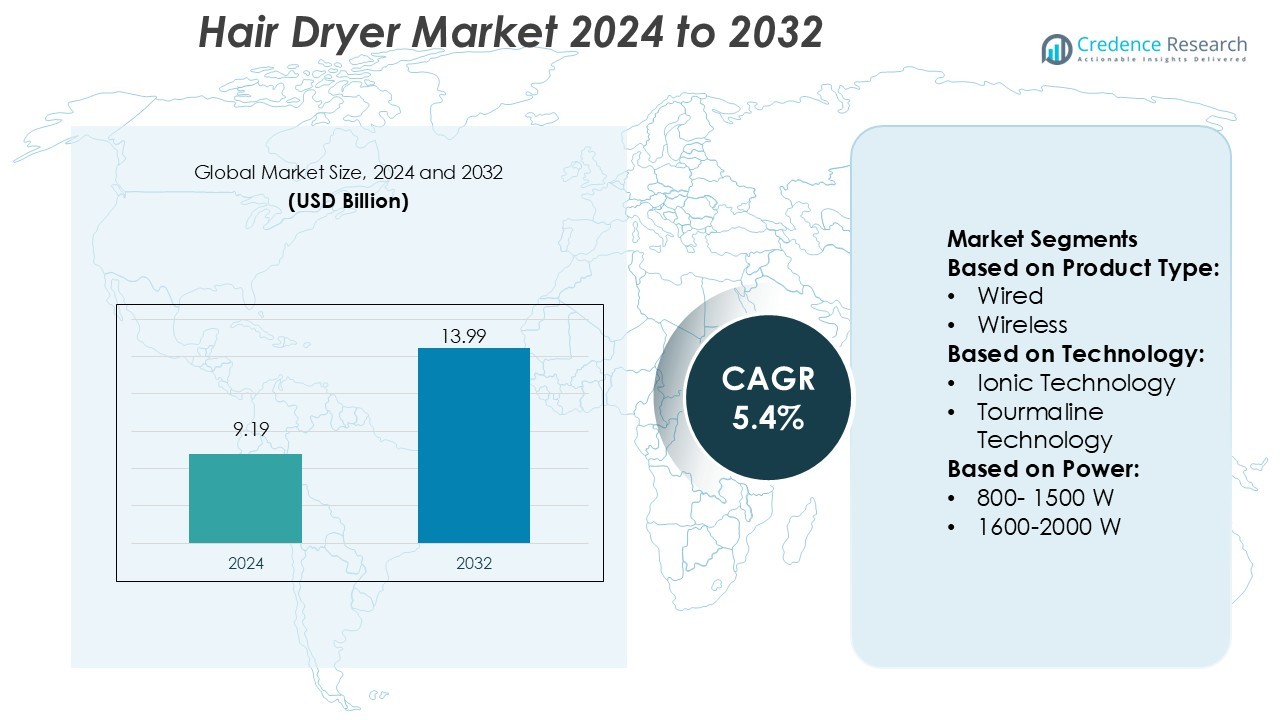
Hair Dryer Market size was valued USD 9.19 billion in 2024 and is anticipated to reach USD 13.99 billion by 2032, at a CAGR of 5.4% during the forecast period.
| REPORT ATTRIBUTE | DETAILS |
|---|---|
| Historical Period | 2020-2023 |
| Base Year | 2024 |
| Forecast Period | 2025-2032 |
| Hair Dryer Market Size 2024 | USD 9.19 Billion |
| Hair Dryer Market, CAGR | 5.4% |
| Hair Dryer Market Size 2032 | USD 13.99 Billion |
The hair dryer market features leading companies such as Harry Josh Pro Tools, Dyson Limited, Braun GmbH, Helen of Troy Limited, Revlon Inc., Spectrum Brands Inc. (Remington), Conair Corporation, Ghd hair (Jemella Ltd.), Koninklijke Philips N.V., and Panasonic Holdings Corporation. These firms invest heavily in new technologies and distribution channels to gain competitive advantage. The North American region leads the global market with a share of approximately 33.6 %, supported by strong consumer demand for premium and professional‑grade hair styling tools and widespread retail penetration.
Market Insights
- The hair dryer market was valued at USD 9.19 billion in 2024 and is anticipated to reach USD 13.99 billion by 2032, growing at a CAGR of 5.4% during the forecast period.
- The market is driven by increasing consumer demand for high‑quality, durable hair dryers with advanced technologies like ionic and ceramic heating systems, which reduce damage and enhance performance.
- Key trends include the growing adoption of smart hair dryers, with features such as temperature control, automatic shutoff, and mobile app integration, which offer a more personalized user experience.
- North America leads the market with approximately 33.6% share, fueled by strong demand for premium, professional‑grade dryers and established distribution networks.
- The market faces challenges such as high product costs and increasing competition, which could limit the growth of lower‑priced models. However, innovation and new product features are expected to drive long‑term growth.
Market Segmentation Analysis:
By Product Type
The wired hair dryer segment leads the market, holding the largest share due to its consistent power and performance. Wired dryers provide a reliable airflow, which is essential for achieving fast and effective drying, especially for thick or long hair. They are commonly used in both households and professional settings due to their stability and stronger power output. On the other hand, wireless hair dryers are gaining traction for their convenience and portability. These models are particularly appealing for people who travel frequently or have limited space, as they offer flexibility and ease of use. However, their shorter battery life and lower power output compared to wired models still limit their market share.
- For instance, Helios Lifestyle Private Limited supplies grooming tools under the Bombay Shaving Company brand that use stainless-steel blades, and many models feature rechargeable lithium-ion batteries supporting 90 minutes or more of continuous trimming.
By Technology
In terms of technology, ionic hair dryers dominate the market, as they are highly effective at reducing frizz and enhancing shine. The negative ions produced by ionic technology break down water droplets quickly, which speeds up the drying process and leaves hair smoother and less static. Tourmaline and ceramic technologies are also growing in popularity. Tourmaline dryers emit both negative ions and infrared heat, making them effective at drying hair faster while minimizing damage. Ceramic dryers, which evenly distribute heat, are favored for their gentler approach to drying, making them ideal for those with fine or color-treated hair. The demand for these technologies is driven by consumers' growing preference for faster, more efficient drying solutions that also protect hair health.
- For instance, P&G’s Braun SkinPro 2.0 technology for this specific model (also sometimes referred to as the Pro 5 series). Official product documentation and marketing materials consistently confirm that the sensor checks the skin tone 80 times per second.
By Power
In the power segment, hair dryers with a power range of 1600–2000 W hold the largest share due to their optimal combination of drying speed and heat control. These models are suitable for most hair types, providing an efficient drying process without causing excessive heat damage. They are commonly used in households and salons for their balance of performance and affordability. Hair dryers with lower power, in the 800–1500 W range, are less effective for thick or long hair, leading to longer drying times. On the other hand, high‑power models above 2100 W are suitable for professional or high‑demand environments, offering fast drying but often at the cost of higher energy consumption and a premium price. This limits their widespread adoption among average consumers, as they are considered more energy‑intensive and costly.
Key Growth Drivers
Rising Demand for Premium Hair Care Solutions
Consumers are increasingly willing to invest in high-end hair dryers that offer advanced features like ionic technology, heat protection, and faster drying times. This shift is driven by the growing awareness of hair health and the desire for salon-quality results at home. As consumers prioritize hair care, especially those with thick, long, or damaged hair, the demand for premium dryers continues to rise, driving growth in the market.
- For instance, Sally Hansen’s “Complete Salon Manicure” formula incorporates a keratin complex that delivers up to 64 % stronger nails and up to 10 days of chip-resistant wear.
Technological Advancements in Hair Drying Technology
The continuous advancement of hair dryer technology is a significant growth driver. The integration of features like ceramic, tourmaline, and infrared technologies helps improve drying time while minimizing heat damage. Additionally, the introduction of smart hair dryers that automatically adjust temperature and speed settings based on hair type is attracting consumers seeking more customized solutions. These innovations improve product efficiency and appeal to a broader customer base.
- For instance, Emjoi eRase e6 is specifically marketed as a "revolutionary compact epilator designed to remove the shortest (0.3 mm) and finest hairs with pinpoint precision". Product documentation and highlights consistently state that the device's tweezers "open and close 180 times a second".
Increasing Consumer Awareness of Hair Health
There is a growing trend towards consumers prioritizing hair health, which is boosting the demand for hair dryers that minimize heat damage. The use of ionic technology, which reduces frizz and promotes smoother hair, is particularly popular among those with sensitive or damaged hair. As consumers become more informed about the potential harm of excessive heat, the market is seeing a shift toward products that balance performance with hair protection, contributing to sustained growth.
Key Trends & Opportunities
Sustainability and Eco-friendly Products
Sustainability is becoming a major trend in the hair dryer market. Consumers are increasingly concerned about the environmental impact of their purchases, leading manufacturers to develop more energy-efficient and eco-friendly products. Hair dryers made from recyclable materials, with energy-saving features and reduced plastic usage, are gaining popularity. Companies that emphasize sustainability in their product designs and manufacturing processes can tap into the growing market of environmentally conscious consumers.
- For instance, Nair™ Hair Remover Cream with Aloe & Lanolin (Material No. 42016528) from Church & Dwight uses Potassium Thioglycolate as a depilating agent plus Aloe barbadensis leaf juice as a botanical skin-conditioning component.
Rise of Smart and Connected Hair Dryers
Smart hair dryers that integrate with mobile apps or have built-in sensors to adjust heat and speed based on hair type are becoming more prevalent. These devices allow for a personalized drying experience, offering consumers control and convenience. As consumers increasingly value convenience and technological integration, smart hair dryers present a significant opportunity for market growth, especially as more people embrace connected devices in their daily lives.
- For instance, the Philips Bodygroom 7000 (BG7030/49) offers 80 minutes of cordless use from a 1-hour charge, supports 5 trim-length settings (3 mm to 11 mm), and uses a 4-direction pivoting head with hypo-allergenic foil for skin comfort.
Key Challenges
High Cost of Premium Hair Dryers
The rising demand for high-performance hair dryers with advanced technologies such as ionic and ceramic features often comes with a higher price tag. This makes premium models less accessible to budget-conscious consumers, limiting market expansion in certain demographics. Manufacturers must balance advanced features with affordability to capture a broader audience while maintaining profitability.
Intense Market Competition
The hair dryer market is highly competitive, with numerous brands offering a wide range of products at varying price points. This intense competition can lead to price wars, limiting the ability of companies to maintain strong profit margins. Additionally, with so many choices available, consumer loyalty is harder to secure, and brands must continually innovate to stand out in a crowded marketplace.
Regional Analysis
North America The North American hair dryer market holds approximately 35% of global share, making it the largest regional segment. High disposable income, strong salon culture and rapid uptake of premium, technology‑rich dryers support its dominance. Major retail channels and robust e‑commerce infrastructure further accelerate reach. Demand for cordless and smart models is rising, particularly among younger consumers. Manufacturers benefit from the region’s readiness to invest in high‑end hair care tools, positioning North America as a key market for innovation, service, and growth. Europe Europe commands around 34% share of the global hair dryer market, positioning it as a significant region. Growing interest in sustainable, energy‑efficient appliances and demand for salon‑grade tools in home settings drive growth. Consumers in key markets such as Germany, France and the UK favour brands that merge performance with eco‑credentials, which makes innovation in materials and design especially important in Europe. The region’s matured distribution networks and well‑established professional hair care sector reinforce its strong position. Asia‑Pacific The Asia‑Pacific region accounts for about 23% of the global hair dryer market, representing strong growth potential. Rapid urbanisation, rising middle‑class incomes and increasing awareness of styling and grooming trends underpin its growth. Countries like China and India are expanding adoption of premium and mid‑market hair dryers as salons proliferate and home styling becomes more common. Manufacturers aiming for volume growth focus heavily on Asia‑Pacific, tailoring products to regional preferences and affordability. Latin America Latin America contributes roughly 5% of the global hair dryer market share. Growth in this region is driven by urbanisation, rising interest in personal grooming and increasing retail penetration. However, price sensitivity and limited access to premium brands moderate adoption rates. Brands success depends on offering value‑oriented models and building distribution in growing markets like Brazil and Mexico. As consumers’ styling habits evolve, Latin America presents emerging opportunities despite its smaller current share. Middle East & Africa (MEA) The Middle East & Africa region holds around 3% of the global hair dryer market share. Growth is supported by rising demand for personal care appliances among young urban consumers and expanding retail infrastructure. Challenges such as economic instability, lower brand awareness outside major cities and less mature distribution networks limit higher growth. However, the region presents niche prospects for lightweight, portable and travel‑friendly hair dryers catering to mobile lifestyles and expatriate populations.Market Segmentations:
By Product Type:- Wired
- Wireless
- Ionic Technology
- Tourmaline Technology
- 800- 1500 W
- 1600-2000 W
- North America
- U.S.
- Canada
- Mexico
- Europe
- Germany
- France
- U.K.
- Italy
- Spain
- Rest of Europe
- Asia Pacific
- China
- Japan
- India
- South Korea
- South-east Asia
- Rest of Asia Pacific
- Latin America
- Brazil
- Argentina
- Rest of Latin America
- Middle East & Africa
- GCC Countries
- South Africa
- Rest of the Middle East and Africa
Competitive Landscape
The hair dryer market is highly competitive, with key players such as Harry Josh Pro Tools, Dyson Limited, Braun GmbH, Helen of Troy Limited, Revlon Inc., Spectrum Brands Inc. (Remington), Conair Corporation, Ghd hair (Jemella Ltd.), Koninklijke Philips N.V., and Panasonic Holdings Corporation. The hair dryer market is characterized by intense competition, with companies continuously innovating to enhance product performance, design, and technology. Manufacturers are focusing on improving drying efficiency, reducing heat damage, and incorporating features such as ionic and ceramic technologies to promote healthier hair. The growing consumer demand for high-performance, lightweight, and eco-friendly models is driving product development. Additionally, the rise of smart features such as temperature control, heat protection, and noise reduction is gaining traction. Companies are also targeting specific consumer segments, offering both professional-grade and affordable models to meet the needs of various demographics. As a result, the market is evolving with a diverse range of products catering to both high-end and budget-conscious consumers.-
-
Key Player Analysis
- Harry Josh Pro Tools
- Dyson Limited
- Braun GmbH
- Helen of Troy Limited
- Revlon Inc.
- Spectrum Brands Inc. (Remington)
- Conair Corporation
- Ghd hair (Jemella Ltd.)
- Koninklijke Philips N.V.
- Panasonic Holdings Corporation
Report Coverage
-
-
The research report offers an in-depth analysis based on Product Type, Technology, Power and Geography. It details leading market players, providing an overview of their business, product offerings, investments, revenue streams, and key applications. Additionally, the report includes insights into the competitive environment, SWOT analysis, current market trends, as well as the primary drivers and constraints. Furthermore, it discusses various factors that have driven market expansion in recent years. The report also explores market dynamics, regulatory scenarios, and technological advancements that are shaping the industry. It assesses the impact of external factors and global economic changes on market growth. Lastly, it provides strategic recommendations for new entrants and established companies to navigate the complexities of the market.
Future Outlook
- The hair dryer market will continue expanding as personal grooming and styling become daily priorities for consumers across demographics.
- Innovation around heat‑damage reduction and protective technologies will drive adoption of premium hair dryers incorporating ionic, ceramic, and infrared systems.
- Smart connectivity features-such as app control, voice commands, and adaptive heat sensors-will emerge as key differentiators in next‑generation hair dryers.
- Eco‑friendly designs, energy‑efficient motors, and sustainable materials will appeal to consumers increasingly concerned about environmental impact and product lifecycle.
- Emerging markets in Asia‑Pacific and Latin America will present major expansion opportunities as middle‑income populations increase spending on styling tools.
- Travel‑friendly and compact models will gain popularity as consumers prioritise portability and convenience along with performance.
- Single‑use and professional‑grade appliances will converge, with salon‑quality features becoming accessible for home users seeking high performance.
- Subscription services, product bundles, and direct‑to‑consumer platforms will reshape how hair dryers are sold and distributed.
- Mounting raw‑material costs and global supply‑chain disruptions will push manufacturers to optimise production and explore modular, upgradable designs.
- Competitive pressure will stimulate value‑oriented innovations, requiring brands to balance advanced features with cost‑effectiveness for wider market penetration.

Request a Free Sample
Fill in your details and we'll send you a free sample report.
- Sample data tables & charts
- Research methodology
Need a Custom Version of This Report?
Tailor the scope, geography, or segments to your exact requirements.
- Custom geography or segment scope
- Direct access to our analyst team
Frequently Asked Questions
What is the current market size for the Hair Dryer Market, and what is its projected size in 2032?
At what Compound Annual Growth Rate is the Hair Dryer Market projected to grow between 2025 and 2032?
Which Hair Dryer Market segment held the largest share in 2024?
What are the primary factors fueling the growth of the Hair Dryer Market?
Who are the leading companies in the Hair Dryer Market?
Which region commanded the largest share of the Hair Dryer Market in 2024?
Table of Content
Chapter 1 Market Segmentation
- 1.1 Segmentation Framework
- 1.1.1 Product and Service Classification
- 1.1.2 Application and End-Use Classification
- 1.1.3 Technology and Solution Classification
- 1.1.4 Customer and Distribution Channel Classification
- 1.1.5 Geographic Segmentation
- 1.1.6 Market Segment Definitions and Boundaries
Chapter 2 Introduction
- 2.1 Report Objectives and Scope
- 2.2 Product Definition and Industry Terminology
- 2.3 Market Inclusions and Exclusions
- 2.4 Research Process
- 2.4.1 Primary Research and Expert Interviews
- 2.4.2 Secondary Research and Source Review
- 2.4.3 Top-Down and Bottom-Up Estimation
- 2.4.4 Data Triangulation and Verification
- 2.5 Market Size Measurement Basis
- 2.5.1 2024: USD 9.19 billion → 2032: USD 13.99 billion
- 2.6 Historical and Forecast Reference Periods
- 2.6.1 Base Year: 2024
- 2.6.2 Forecast Period: 2024-2032
- 2.7 Research Assumptions and Limitations
Chapter 3 Executive Summary
- 3.1 Market Snapshot and Key Findings
- 3.2 Base-Year Market Size, 2024
- 3.3 Forecast Market Size, 2032
- 3.4 Revenue and Volume Growth Outlook
- 3.5 Key Demand and Supply Indicators
- 3.6 Leading Market Segments
- 3.7 Fastest-Growing Market Opportunities
- 3.8 Regional Performance Highlights
- 3.9 Technology and Industry Transformation
- 3.10 Competitive Landscape Summary
- 3.11 Analyst View and Strategic Implications
Chapter 4 Global Hair Dryer Market Trends and Developments
- 4.1 Historical Industry Development
- 4.2 Recent Market Trends and Developments
- 4.3 Demand and Customer Behavior Trends
- 4.4 Technology and Product Innovation
- 4.5 Artificial Intelligence, Automation and Digitalization
- 4.6 Local Manufacturing and Supply Chain Realignment
- 4.7 Industry Partnerships, Mergers and Acquisitions
- 4.8 Sustainability and Circular Economy Developments
- 4.9 Government and Private Sector Investment Trends
- 4.10 Emerging Business Models and Commercialization
- 4.11 Industry Developments and Announcements
Chapter 5 Global Hair Dryer Market Production, Supply and Demand Analysis
- 5.1 Demand Trend and Consumption Analysis
- 5.2 Demand Forecast, 2024-2032
- 5.3 Production and Output Trend
- 5.4 Production and Output Forecast, 2024-2032
- 5.5 Installed Capacity and Capacity Utilization
- 5.6 Company-Wise Production Plants and Statistics
- 5.6.1 Installed Production Capacity
- 5.6.2 Actual Production
- 5.6.3 Planned Capacity and Expansion Targets
- 5.7 Supply Chain Structure and Procurement Trends
- 5.8 Supply-Demand Gap and Bottlenecks
- 5.9 Import Dependence and Sourcing Structure
- 5.10 Contract Manufacturing and Outsourcing
- 5.11 Regional Supply and Demand Concentration
Chapter 6 Global Hair Dryer Market Pricing Analysis
- 6.1 Pricing Structure and Measurement
- 6.2 Historical Pricing Trends
- 6.3 Pricing Outlook, 2024-2032
- 6.4 Average Selling Price and Unit Economics
- 6.5 Pricing by Product and Market Segment
- 6.6 Geographic Pricing Differences
- 6.7 Key Input, Energy, Labor and Logistics Costs
- 6.8 Contract Pricing and Purchasing Models
- 6.9 Pricing Sensitivity and Competitive Positioning
- 6.10 Price, Margin and Profitability Implications
Chapter 7 Global Hair Dryer Market Dynamics
- 7.1 Market Growth Drivers
- 7.1.1 Demand-Side Drivers
- 7.1.2 Technology and Innovation Drivers
- 7.1.3 Infrastructure and Investment Drivers
- 7.1.4 Regulatory and Policy Drivers
- 7.2 Market Restraints
- 7.2.1 Cost and Affordability Constraints
- 7.2.2 Technology and Adoption Barriers
- 7.2.3 Supply Chain and Operational Constraints
- 7.3 Market Challenges
- 7.3.1 Competitive Pressure and Margin Erosion
- 7.3.2 Skills, Infrastructure and Implementation Gaps
- 7.4 Emerging Market Opportunities
- 7.5 Market Dynamics Impact and Time-Horizon Assessment
Chapter 8 Global Hair Dryer Value Chain Analysis
- 8.1 Industry Value Chain Overview
- 8.2 Upstream Suppliers and Critical Inputs
- 8.3 Technology and Component Providers
- 8.4 Manufacturing or Service Delivery
- 8.5 Distribution, Channel Partners and Integrators
- 8.6 Downstream Applications and End Users
- 8.7 Value Addition and Profit Pools
- 8.8 Vertical Integration and Outsourcing
- 8.9 Supplier Concentration and Risk
- 8.10 Supply Chain Localization and Resilience
Chapter 9 Global Hair Dryer Market Regulations and Policies
- 9.1 Relevant Laws, Standards and Compliance Frameworks
- 9.2 Product, Service, Safety and Quality Requirements
- 9.3 Government Policies, Incentives and Subsidies
- 9.4 Imports, Exports and Trade Barriers
- 9.5 Public Procurement and Local Content Requirements
- 9.6 Environmental and Sustainability Compliance
- 9.7 Upcoming Policy Changes and Market Implications
Chapter 10 Global Hair Dryer Market Hotspots and Opportunities
- 10.1 Market Opportunity Mapping and Growth Hotspots
- 10.2 High-Growth Applications and Customer Groups
- 10.3 Underserved Markets and White-Space Opportunities
- 10.4 Emerging Technology and Product Opportunities
- 10.5 New Capacity and Investment Hotspots
- 10.6 Market Entry and Expansion Opportunities
- 10.7 Distribution and Partnership Opportunities
- 10.8 Near-Term and Long-Term Commercial Potential
- 10.9 Opportunity Attractiveness and Execution Risks
Chapter 11 Global Hair Dryer Market Outlook, 2024-2032
- 11.1 Market Size and Analysis
- 11.1.1 Revenue (Market Measurement: 2024: USD 9.19 billion → 2032: USD 13.99 billion)
- 11.1.2 Market Volume and Quantity Sold
- 11.1.3 Historical Market Size
- 11.1.4 Base-Year Market Size, 2024
- 11.2 Market Forecast, 2024-2032
- 11.2.1 Revenue Forecast to 2032
- 11.2.2 Volume Forecast to 2032
- 11.2.3 CAGR and Year-on-Year Growth
- 11.2.4 Incremental Revenue Opportunity
- 11.3 Forecast Assumptions and Scenario Analysis
- 11.3.1 Base-Case Forecast
- 11.3.2 Optimistic and Conservative Scenarios
- 11.3.3 Technology, Pricing and Policy Sensitivities
- 11.4 Market Attractiveness and Growth Outlook
Chapter 12 Global Hair Dryer Market Segmentation and Outlook
- 12.1 Segmentation Summary and Market Shares, 2024
- 12.2 Largest and Fastest-Growing Segments
- 12.3 Segment Growth Comparison
- 12.4 Segment Attractiveness and Priority Matrix
Chapter 13 Global Hair Dryer Geographic Market Outlook, 2024-2032
- 13.1 Regional Market Size and Share, 2024
- 13.2 Regional Market Forecast, 2024-2032
- 13.3 Regional Pricing, Production and Demand Differences
- 13.4 North America
- 13.4.1 United States
- 13.4.2 Canada
- 13.4.3 Mexico
- 13.5 Europe
- 13.5.1 Germany
- 13.5.2 France
- 13.5.3 Italy
- 13.5.4 United Kingdom
- 13.5.5 Spain
- 13.5.6 Poland
- 13.5.7 Russia
- 13.5.8 Netherlands
- 13.5.9 Belgium
- 13.5.10 Sweden
- 13.5.11 Denmark
- 13.5.12 Norway
- 13.5.13 Rest of Europe
- 13.6 Asia Pacific
- 13.6.1 China
- 13.6.2 India
- 13.6.3 Japan
- 13.6.4 South Korea
- 13.6.5 Thailand
- 13.6.6 Indonesia
- 13.6.7 Vietnam
- 13.6.8 Malaysia
- 13.6.9 Australia
- 13.6.10 Rest of Asia Pacific
- 13.7 Latin America
- 13.7.1 Brazil
- 13.7.2 Argentina
- 13.7.3 Colombia
- 13.7.4 Chile
- 13.7.5 Rest of Latin America
- 13.8 Middle East
- 13.8.1 Saudi Arabia
- 13.8.2 United Arab Emirates
- 13.8.3 Turkey
- 13.8.4 Israel
- 13.8.5 Iran
- 13.8.6 Rest of the Middle East
- 13.9 Africa
- 13.9.1 South Africa
- 13.9.2 Egypt
- 13.9.3 Nigeria
- 13.9.4 Morocco
- 13.9.5 Rest of Africa
- 13.10 Regional Investment, Policy and Supply Chain Differences
- 13.11 Regional Competitive Landscape
- 13.12 Geographic Growth Hotspots
Chapter 14 Global Hair Dryer Technology, Innovation and Sustainability Outlook
- 14.1 Technology Landscape and Maturity
- 14.2 Product, Process and Service Innovation
- 14.3 AI, Automation and Digital Tools in the Industry
- 14.4 Technology Adoption and Performance Benchmarking
- 14.5 Innovation Pipeline and R&D Investment
- 14.6 Patent and Intellectual Property Trends
- 14.7 Energy Efficiency and Resource Management
- 14.8 Sustainability, Recycling and Circularity
- 14.9 Technology Roadmap, 2024-2032
- 14.10 Risks of Obsolescence and Technology Substitution
Chapter 15 Global Hair Dryer Market Key Strategic Imperatives
- 15.1 Growth and Market Entry Priorities
- 15.2 High-Return Products and Segments
- 15.3 Pricing, Profitability and Cost Optimization
- 15.4 Technology Investment and Product Differentiation
- 15.5 Supply Chain Localization and Resilience
- 15.6 Distribution and Customer Acquisition
- 15.7 Partnership, Acquisition and Capacity Strategy
- 15.8 Regional Expansion Priorities
- 15.9 Short-, Medium- and Long-Term Actions
Chapter 16 Competition Outlook
- 16.1 Industry Competition Characteristics
- 16.2 Market Structure and Concentration
- 16.3 Market Share and Competitive Positioning, 2024
- 16.4 Company-Wise Revenue and Product Benchmarking
- 16.5 Production and Service Capacity Benchmarking
- 16.6 Technology, Pricing and Differentiation
- 16.7 Regional Footprint and Distribution Strength
- 16.8 Mergers, Acquisitions and Strategic Alliances
- 16.9 New Entrants and Competitive Threats
- 16.10 Porter's Five Forces and Industry Attractiveness
- 16.11 Competitive Outlook, 2024-2032
Chapter 17 Company Profiles
- 17.1 Company Coverage and Selection Criteria
- 17.2 Leading Market Participants – Standard Profile Structure
- 17.2.1 Business Description
- 17.2.2 Company Ownership and Geographic Presence
- 17.2.3 Product and Service Portfolio
- 17.2.4 Manufacturing and Operating Footprint
- 17.2.5 Production Capacity and Expansion Plans
- 17.2.6 Financial Performance and Investment
- 17.2.7 Market Share and Competitive Position
- 17.2.8 Technology and Innovation Capabilities
- 17.2.9 Strategic Alliances or Partnerships
- 17.2.10 Recent Developments
- 17.2.11 Growth Strategy and Outlook
- 17.3 Other Relevant Market Participants
Note: Every listed company is profiled on the structure shown under the first company. The company list is preliminary and may change based on research findings, market developments, data availability and client requirements.
Chapter 18 Disclaimer
- 18.1 Research and Forecast Disclaimer
- 18.2 Data Source and Estimation Limitations
Note: The depth of individual sections depends on data availability for this market. Volume, capacity, trade and other unit-based metrics are included where applicable.

