
Housing and hotel supply set Egypt bedding demand
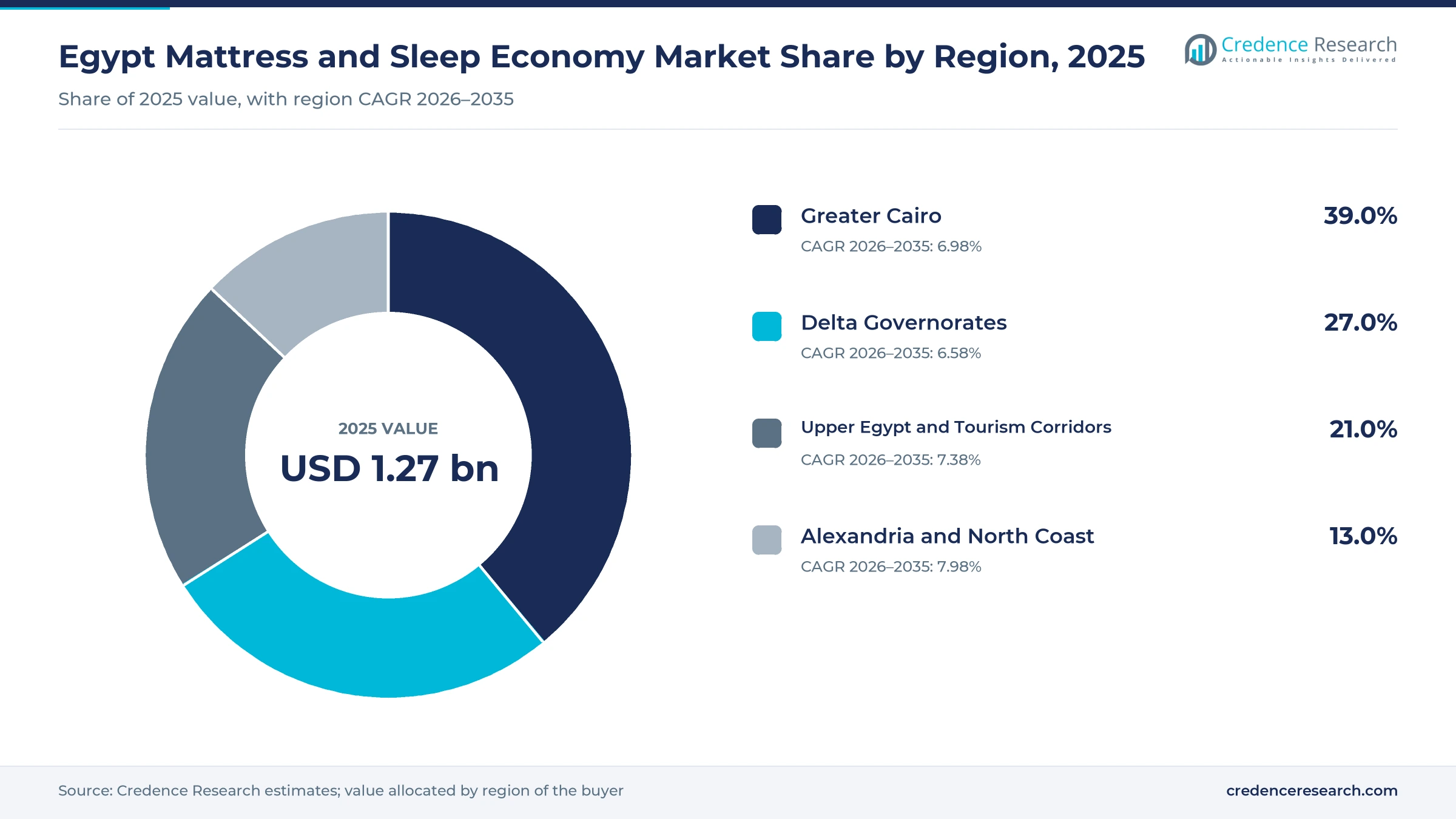
The Egypt mattress and sleep economy market was valued at USD 1.27 billion in 2025 and is projected to increase from USD 1.37 billion in 2026 to USD 2.54 billion by 2035, registering a CAGR of 7.09% during 2026–2035. Demand rests on new housing, a hotel pipeline of 45,984 rooms and installment selling that brings branded mattresses within reach of middle-income households. Greater Cairo held the largest regional share, 39.0% in 2025, because it combines the densest urban population with the largest share of planned hotel rooms. Alexandria and North Coast is the fastest-growing region at 7.98% a year as Ras El Hekma and Alam Al Roum move toward resort fit-out. On the supply side, Bed Janssen extended its Englander license for five years on April 4, 2025, which keeps a domestic factory base behind international brand names. Cost pressure remains the main caution, since furnishing prices rose 15.2% in the year to July 2026.
What does the Egypt sleep economy include and who buys it?
The market counts retail and contract sales in Egypt of mattresses, pillows, toppers, bedding sets and sleep accessories, including adjustable and connected sleep products. Households buy mainly through furniture retailers and brand showrooms, often on six or nine month installment plans, while hotels, hospitals and developers buy in volume through direct project contracts.
Bed frames, general furniture and medical sleep therapy equipment sit outside the count, as do exports from Egyptian factories. The value chain runs from foam, spring wire, felt and quilted fabric through domestic mattress plants in Cairo and the 10th of Ramadan industrial zone, then to retailers, online marketplaces and project buyers.
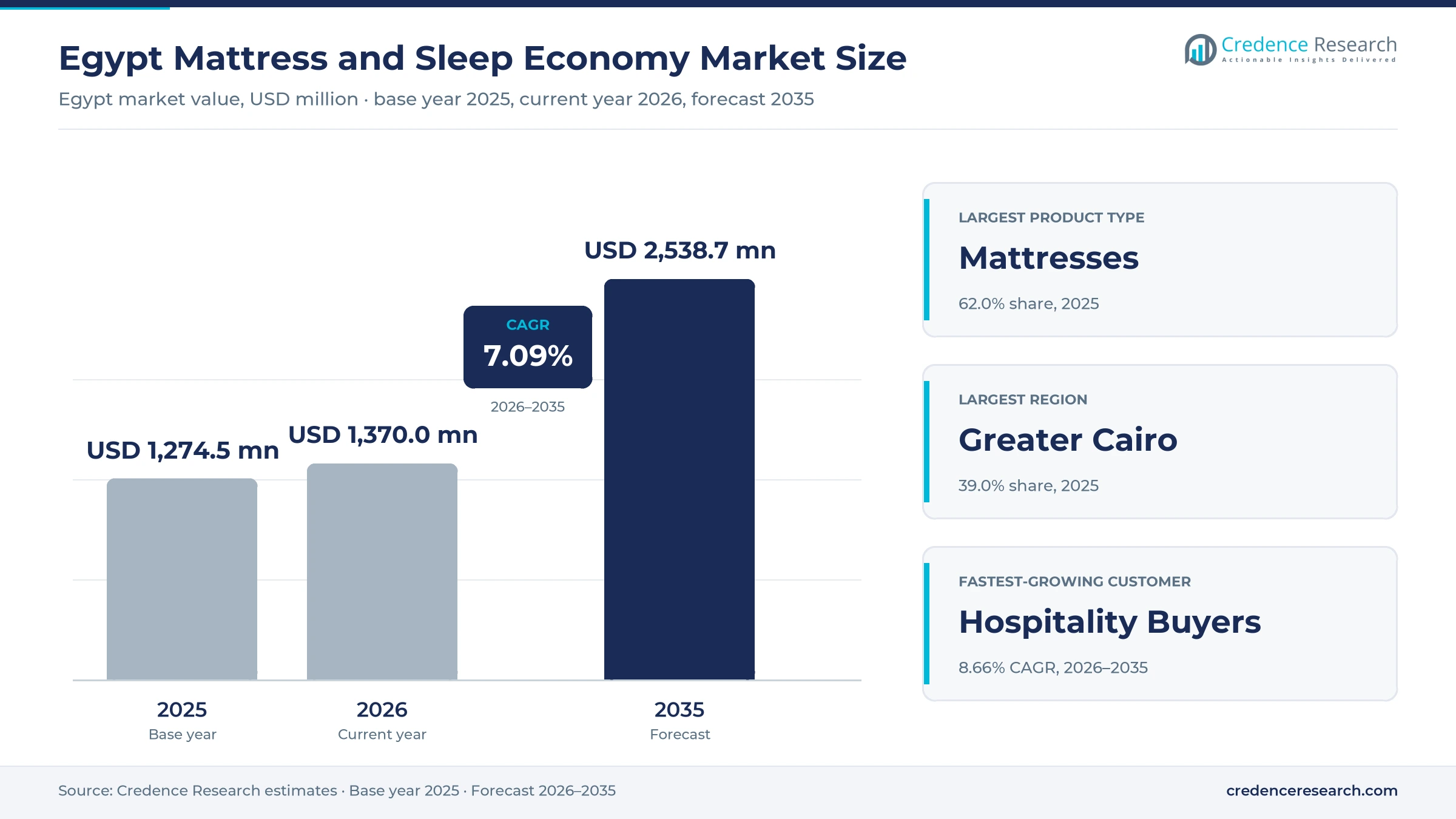
Egypt Mattress and Sleep Economy Market Insights
- Spending rises from USD 1.27 billion in 2025 to USD 2.54 billion by 2035, a 7.09% CAGR, as new homes and hotel rooms add first-time bedding purchases to replacement demand.
- Greater Cairo held 39.0% of 2025 value, supported by a planned 22,111 hotel rooms and by the largest concentration of urban households and retail showrooms.
- Mattresses accounted for 62.0% of 2025 spending, and Households made up 78.0% of buying across all channels, ahead of hotels and institutions.
- Egypt moved from net importer to net exporter of bedding articles by 2023, when exports reached USD 9.8 million against imports of USD 4.07 million.
- Bed Janssen and Masterbed show the competitive split, with one holding Englander and Spring Air licenses and the other reporting over 60,000 furnished hotel rooms.
Mattresses and mid-range tiers anchor Egyptian spending
Why do mattresses dominate Egyptian sleep spending?
Based on product type, the market is categorized into mattresses, pillows and toppers, bedding sets and sleep accessories and devices. Mattresses led with 62.0% of 2025 value because one purchase carries a far higher ticket than any textile, with Nexttgo listing Habitat Gold from about LE 4,139 and Dorra Hilton Crystal from about LE 15,177 in November 2026. Sleep accessories and devices grow fastest at 8.36% a year as makers widen their ranges beyond the core bed. In November 2026, Bed Janssen’s online store listed a Waterproof Mattress Protector from LE 430 in a separate mattress accessories range, an add-on that buyers can pick up with a new bed.
How do price tiers divide a market under inflation?
Based on price tier, the market is categorized into economy, mid-range, premium and luxury. Mid-Range led with 41.0% of 2025 value because shoppers trading up from cotton and fiber beds meet branded models at attainable prices, such as the Janssen Cataract from about LE 6,101 on Nexttgo in November 2026, usually with interest-free installments. Luxury grows fastest at 8.43% a year as high-end housing and hotels widen the pool of buyers. Amwal Al Ghad reported that the Zilal project offers 40,000 luxury units across 17 cities, which adds owners who furnish at the upper end of the range.
Which buyers beyond households are shaping demand?
Based on customer type, the market is categorized into households, hospitality buyers, healthcare and institutional buyers, and developers and corporate buyers. Households led with 78.0% of 2025 value because a population of about 118.4 million, as counted by the World Bank, generates steady replacement and new-home purchases. Hospitality buyers grow fastest at 8.66% a year as hotels open, and FTN News reports that 51.4% of 45,984 pipeline rooms are under construction. Institutional demand is smaller but real, since Daily News Egypt reports that Minya University runs nine hospitals with 1,700 beds ahead of universal insurance.
Where do Egyptian shoppers actually buy bedding?
Based on distribution channel, the market is categorized into brand showrooms, multi-brand furniture retail, e-commerce marketplaces and direct B2B and project sales. Multi-Brand Furniture Retail led with 44.0% of 2025 value because even large makers keep small store networks, and Bedtimes reported in April 2025 that Bed Janssen runs six retail locations and relies on wholesale. E-commerce marketplaces grow fastest at 9.14% a year from a low base, as the U.S. International Trade Administration counts 96.3 million internet users in January 2025 but says only 8.3% of Egyptians buy online regularly.
| Segment Group | Leading Sub-segment | Share, 2025 | Fastest-growing Sub-segment | CAGR, 2026–2035 |
|---|---|---|---|---|
| By Product Type | Mattresses | 62.0% | Sleep Accessories and Devices | 8.36% |
| By Price Tier | Mid-Range | 41.0% | Luxury | 8.43% |
| By Customer Type | Households | 78.0% | Hospitality Buyers | 8.66% |
| By Distribution Channel | Multi-Brand Furniture Retail | 44.0% | E-commerce Marketplaces | 9.14% |
Request a Free Sample
Fill in your details and we'll send you a free sample report.
- Sample data tables & charts
- Research methodology
Homes, hotel rooms and payments lift bedding sales
Housing formation and residential expansion
State housing supply creates the most predictable bedding demand, because each delivered apartment needs at least one new mattress set soon after handover. The cabinet counted over 790,000 social units delivered and 1.72 million built or planned on Jan. 13, 2026, according to Ahram Online. Housing Minister Sherif El-Sherbiny also announced 115,000 Sakan Kol El Masryeen units and 261,253 Housing and Development Bank units on March 27, 2025, as Amwal Al Ghad reported. Underlying pressure comes from a population of about 118.4 million in 2025, according to the World Bank. As a result, Households hold 78.0% of spending, and new household setup often arrives in bulk once projects reach handover in Greater Cairo and the new cities.
Hospitality expansion and replacement demand
Hotel growth adds contract volumes that also repeat, because operators replace bedding on planned cycles to protect star ratings. Egypt received 18.8 million tourists in 2025, up by nearly a fifth from a year earlier, according to Enterprise. FTN News reports a pipeline of 185 hotels and 45,984 rooms in early 2026, up 35.5% in one year, with 22,111 rooms planned in Greater Cairo. Tourism Minister Sherif Fathi said in May 2025 that the country needs about 250,000 more rooms to host 30 million visitors, as Skift reported. Domestic suppliers already serve this demand, and Masterbed reports furnishing over 60,000 rooms, much of it through the contract furniture channel.
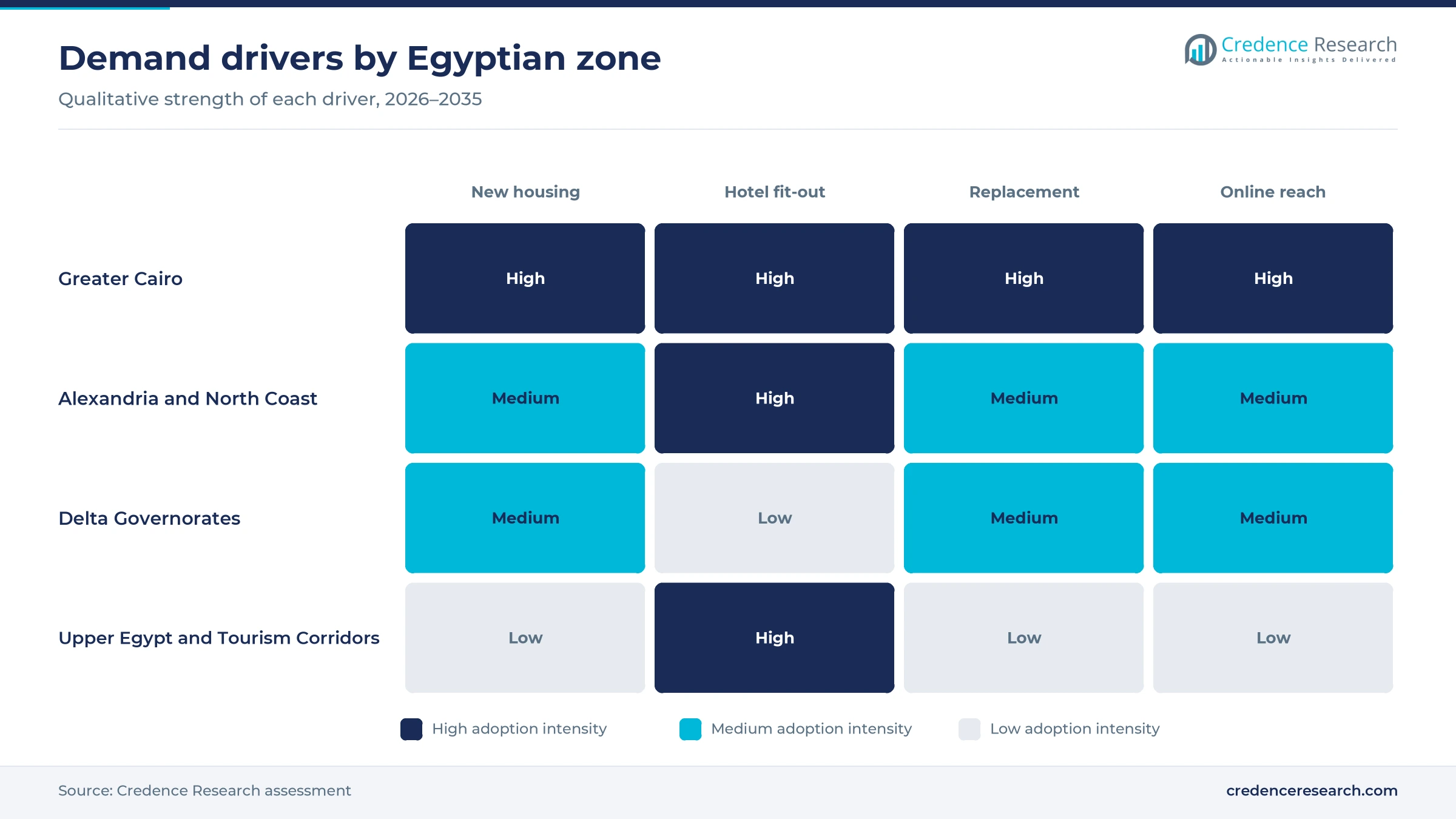
Digital commerce and payment infrastructure
Digital payments and consumer credit make a large ticket easier to afford and easier to pay for from home. The Central Bank of Egypt recorded about 263 million InstaPay transactions worth over EGP 1.2 trillion in the first quarter of 2025, according to Arab Finance. Bed Janssen’s own online store shows payment logos for ValU, Sympl, Forsa and halan beside the sale price of LE 8,820 on its Medi-Pedic model. Nexttgo advertises six and nine month buy-now-pay-later plans with no down payment and no interest. This matters because the U.S. International Trade Administration estimates only 10 million to 12 million Egyptians hold bank cards, so wallet and installment routes reach buyers that cards alone would miss.
Domestic manufacturing replaces imported bedding
Local production keeps branded bedding available despite a weaker pound, since factories buy fewer finished goods from abroad. UN Comtrade data published by TrendEconomy show HS 9404 bedding imports falling from USD 11.04 million in 2021 to USD 4.07 million in 2023, while exports rose from USD 7.36 million to USD 9.80 million. Bed Janssen operates three factories and produces 14 Englander models, according to Bedtimes in April 2025. Family Bed, founded in 2014, lists its address in the 10th of Ramadan industrial zone in Sharqia, and Forbed runs a plant in Al Obour making springs, felt and mattresses. Because of this base, makers can stock mid-range lines locally, which supports Mid-Range at 41.0% of value.
Hybrid builds and resort fit-outs reshape the category
Shift toward pocket-spring and memory-foam hybrids
Egyptian brands are moving their upper ranges from bonnell and cotton beds to pocket springs topped with dense foam, a change buyers can see on the price tag. Bed Janssen’s Medi-Pedic combines 255 pocket springs per square meter, density 30 foam and a 4-centimeter memory foam layer, as its product page states. Its 35-centimeter Royalty adds a pillow top at a sale price of LE 10,700, while Habitat’s Heaven 28-centimeter memory foam model starts near LE 9,661 as listed on Nexttgo in November 2026. Masterbed promotes 18 models, including pocket spring and memory foam combinations, according to its company profile on Village. As this shift continues, spending moves upward and Luxury grows at 8.43% a year from a small base.
Rise of international licenses on Egyptian factory lines
Global brand names increasingly reach Egyptian bedrooms through local plants rather than imports, which keeps prices in pounds while adding marketing weight. Englander extended its Egyptian license for five years on April 4, 2025, continuing an 18-year partnership, according to Bedtimes. Bed Janssen has also held a Spring Air license since 2009, and the magazine reported in April 2020 that its Cairo factory covers 430,500 square feet. Bedtimes reported in April 2025 that the same licensee made products for IHG and Four Seasons hotels and that the Englander license covers Algeria and Morocco, so licensing also opens contract and export work. In turn, smaller local brands such as Wonderland and Habitat compete on price, with Wonderland’s Heaven listed from about LE 3,769 on Nexttgo in November 2026.
Opportunity in North Coast and Red Sea resort fit-outs
Coastal megaprojects open a large contract opening for suppliers able to deliver thousands of matched rooms on a fixed schedule. According to Enterprise, Modon’s USD 35 billion Ras El Hekma plans about 25,000 high-end hotel units, and Qatari Diar’s Alam Al Roum plans 4,500 rooms. Marassi Red Sea, announced in September 2025, adds 12 luxury hotels, while FTN News counts 14 resorts at Marsa Alam, with 53% due to open in 2026 or 2027, and 15 projects at Ain Sokhna. Suppliers that win early specifications should gain from Hospitality Buyers at 8.66% a year. Resort owners can also become long-term replacement accounts, since a first fit-out usually sets the approved mattress specification.
Opportunity in rural and Upper Egypt retail reach
Rural governorates give brands an opening that urban showroom networks barely touch, because most Egyptians live outside cities. World Bank data put the urban share at only 42.9% of the population in 2025. Decent Life spending exceeded EGP 450 billion in its first phase across more than 1,450 villages and roughly 20 million citizens, and Gharbia village wastewater coverage rose from 26% to 77%, according to Daily News Egypt in August 2026. Upgraded villages and wider internet access favor wholesale partners and delivered online orders. Brands that pair installment credit with delivery in Sohag, Qena and Minya can reach first-time buyers, which supports Upper Egypt and the tourism corridors at 7.38% a year.
Foam costs and price inflation squeeze Egyptian makers
Furnishing price inflation delays replacement purchases
Household budgets remain the main brake, because furniture and household equipment prices rose 15.2% in the year to July 2026, according to CAPMAS data reported by Daily News Egypt. Annual urban inflation reached 14.9% that month, so families can postpone a replacement mattress more easily than food or rent. Economy buyers feel this first, and retailers answer with longer installment plans and smaller entry models, which narrows margins across the chain.
Global foam shortages raise input costs
Foam makers depend on chemical inputs priced in dollars, and a global propylene oxide shortage pushed suppliers to raise prices by 12% to over 20%, Interior Daily reported on April 7, 2026. Costs of flexible polyurethane foam can therefore reach Egyptian plants quickly, particularly for high-density lines. Smaller workshops have little purchasing power, so they absorb the increase or cut foam density, while larger makers can spread purchases across suppliers and reprice in stages.
High interest rates limit credit and project funding
Credit remains expensive even after easing, since the Central Bank of Egypt lowered its overnight lending rate only to 20% on Feb. 12, 2026, according to Daily News Egypt. Retailers offering interest-free plans carry that financing cost, so high rates raise the real cost of each sale. Developers face similar pressure, and Ahram Online reported an estimated 8% loss per private social housing unit, which could delay handovers and the bedding orders that follow.
Low online purchasing limits e-commerce scale
Online sales face a structural limit, because only 8.3% of Egyptians shop online regularly, the U.S. International Trade Administration reports, despite 81.9% internet penetration as of January 2025. Mattresses add a further barrier, since shoppers want to test firmness and bulky delivery costs more outside the main cities. Marketplaces must therefore fund showrooms, trial periods or local delivery partners, and this keeps the online channel smaller than its reach would suggest for several more years.
Greater Cairo leads while the North Coast grows fastest
| Region | Value, 2025 (USD billion) | Share, 2025 | CAGR, 2026–2035 |
|---|---|---|---|
| Greater Cairo | 0.50 | 39.0% | 6.98% |
| Delta Governorates | 0.34 | 27.0% | 6.58% |
| Upper Egypt and Tourism Corridors | 0.27 | 21.0% | 7.38% |
| Alexandria and North Coast | 0.17 | 13.0% | 7.98% |
Greater Cairo holds the largest buying base
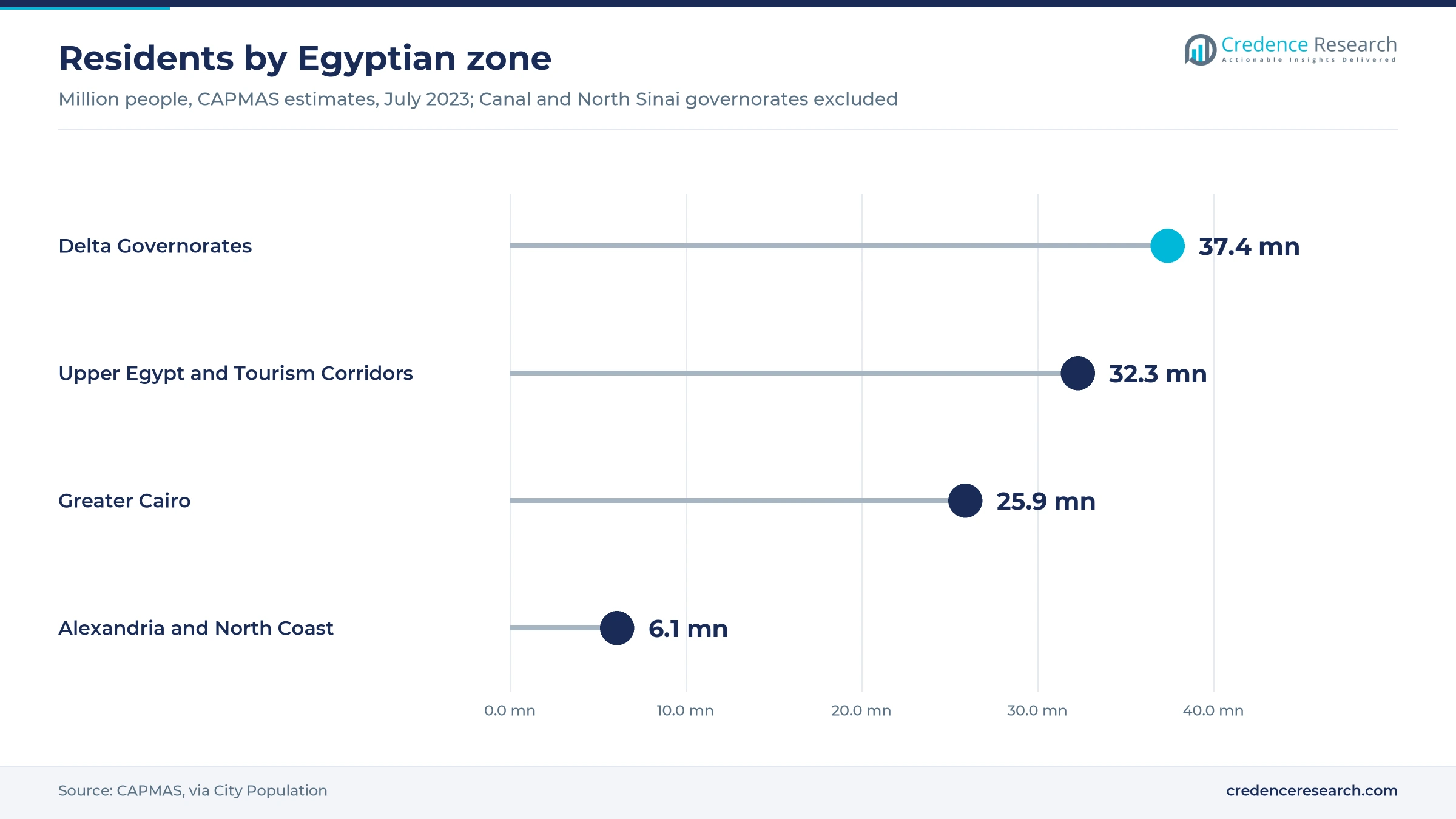
Greater Cairo held 39.0% of 2025 value and grows at 6.98% a year, helped by about 25.9 million residents in Cairo, Giza and Qalyubia, according to CAPMAS estimates for July 2023. FTN News places 22,111 planned hotel rooms here, nearly half the national pipeline, and Enterprise reports that hotels reached 100% occupancy during the Grand Egyptian Museum opening week. Factories in Cairo and Al Obour also shorten delivery times for retailers and contract buyers.
Delta governorates buy on price and family occasions
Delta Governorates held 27.0% of 2025 value and grow at 6.58% a year, the slowest pace because rural incomes limit trading up. The zone still counts about 37.4 million residents across seven governorates in CAPMAS estimates. Family Bed lists its base in Sharqia, which places a domestic supplier inside the zone. Decent Life upgrades in Gharbia, where the first phase finished in August 2026, should gradually improve household conditions and support delivery into smaller towns.
Upper Egypt pairs tourist hubs with first-time buyers
Upper Egypt and Tourism Corridors held 21.0% of 2025 value and grow at 7.38% a year. The zone mixes about 32.3 million residents, mostly in Minya, Sohag and Asyut, with resort towns on the Red Sea and in South Sinai. FTN News counts nine Sharm El Sheikh projects averaging 539 rooms each. Minya also matters for institutional buyers, because universal health insurance will start there as a one-year trial.
The North Coast turns from summer homes to hotels
Alexandria and North Coast held 13.0% of 2025 value and is the fastest-growing zone at 7.98% a year. Alexandria and Matrouh have only about 6.1 million residents, yet Enterprise reports that the NUCA master plan covers 400 kilometers of coastline. Ras El Hekma alone plans about 25,000 hotel units on that coast. Qatari Diar’s Alam Al Roum adds 4,500 rooms, so growth should come mainly from new coastal resorts rather than from Alexandria’s existing housing stock.
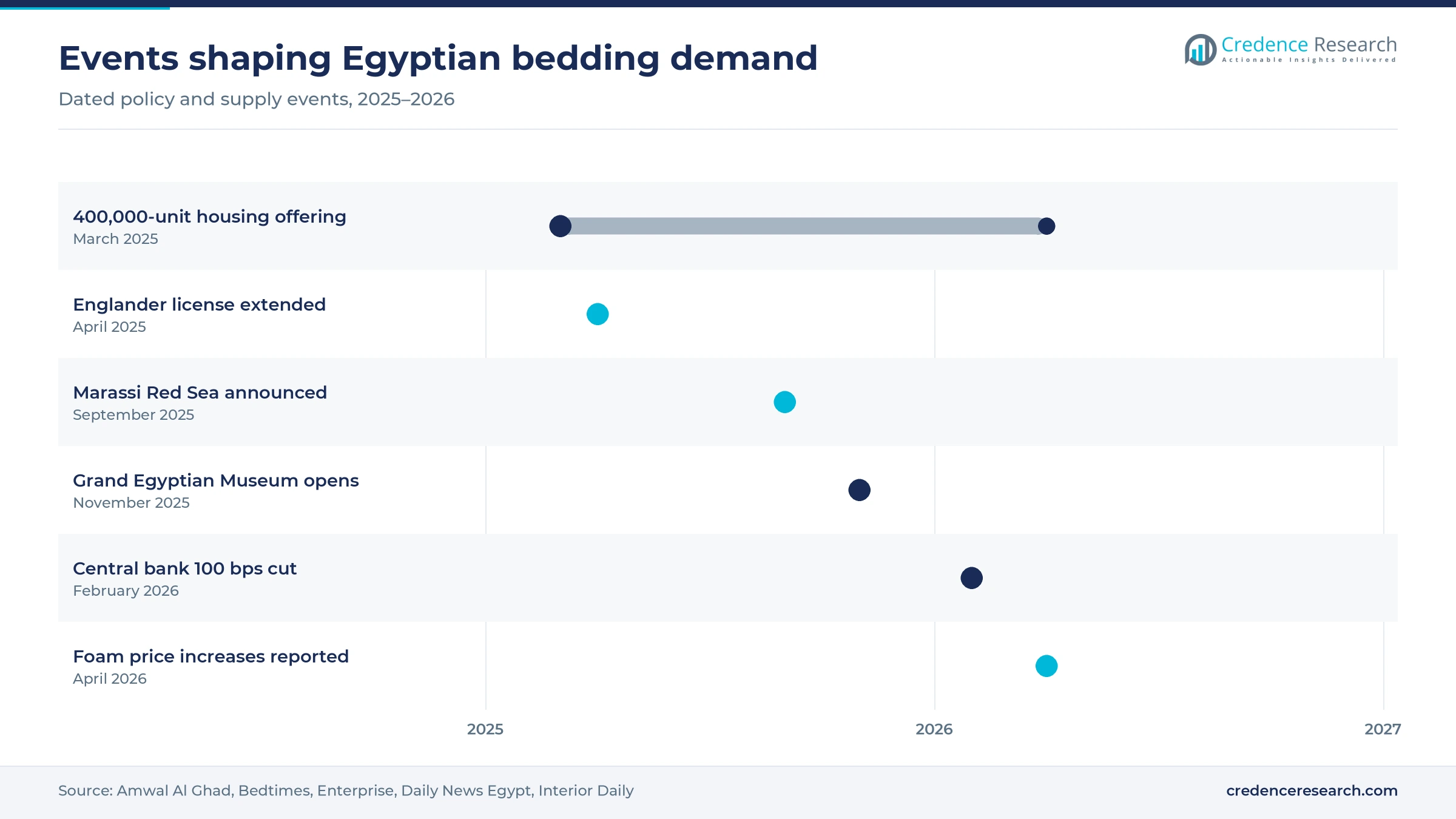
Licensing, housing and resort deals mark 2025 and 2026
| Development | Status and market relevance |
|---|---|
| In March 2025, Housing Minister Sherif El-Sherbiny announced nearly 400,000 housing units for sale in what Amwal Al Ghad called the largest offering yet. | Phased releases ran into April 2026 and set up new household demand |
| In April 2025, Englander extended its license with Bed Janssen for five years, continuing an 18-year partnership covering 14 models. | Active and supports domestic branded supply |
| In September 2025, Emaar Misr and Citystars Properties announced Marassi Red Sea with plans for 12 luxury hotels. | Planned and a future fit-out source for contract suppliers |
| In November 2025, the Grand Egyptian Museum opened and Cairo and Giza hotels reached full occupancy during the opening week. | Open and expected to draw 5 million visitors a year |
| In February 2026, the Central Bank of Egypt cut key rates by 100 basis points and lowered bank reserve requirements. | Easing under way, although credit costs remain high |
Pocket springs and dense foam define the local upgrade
- Pocket springs isolate movement by wrapping each coil, and Bed Janssen specifies 255 springs per square meter on its Medi-Pedic and Royalty models.
- Viscoelastic foam layers add pressure relief at the top of hybrid beds, with Bed Janssen using a 4-centimeter layer at density 70.
- Bonnell springs offer a simpler interconnected coil for lower price points, and Family Bed lists them next to pocket spring, memory foam and roll-up mattresses.
- Roll-up packaging cuts the bulk of a delivered mattress, which helps online orders, and Family Bed includes roll-up models in its current range.
- Electronic warranty checks let buyers activate cover after delivery, as Bed Janssen does through its e-warranty page, which helps counter doubts about online purchases.
Need a Custom Version of This Report?
Tailor the scope, geography, or segments to your exact requirements.
- Custom geography or segment scope
- Direct access to our analyst team
Local factories and licensed brands compete on reach
Competition is split between established domestic factories, licensed international names and value brands sold mainly through furniture dealers. Bed Janssen holds the widest position, combining three factories, Englander and Spring Air licenses, six stores and hotel supply to IHG and Four Seasons, according to Bedtimes in April 2025. Masterbed competes through its own network, reporting 30 company-managed points of sale and over 60,000 furnished hotel rooms. Family Bed and Forbed add depth lower in the supply chain, with Forbed also making springs and felt used in mattress production. Habitat, Taki and Wonderland reach shoppers through online sellers such as Nexttgo, where installment terms matter as much as specification. Because raw materials cost the same for all, scale in foam buying and access to hotel contracts increasingly decide margins.
Companies profiled and their roles in this market
| Company | Type | Role in the market |
|---|---|---|
| Bed Janssen | Domestic manufacturer and licensee | Three factories, six stores, hotel supply and Spring Air production |
| Englander Egypt | Licensed brand | Englander line made and sold by Bed Janssen, with 14 models |
| Masterbed | Domestic manufacturer and retailer | Reports 30 points of sale and over 60,000 hotel rooms furnished |
| Family Bed | Domestic mattress and home bedding brand | Spring, memory foam and roll-up models plus textiles |
| Forbed | Manufacturer and component maker | Al Obour plant making mattresses, springs, felt and quilting |
| Habitat | Mattress brand | Value and memory foam models listed from about LE 4,139 |
| Wonderland | Mattress brand | Value models listed on Nexttgo from about LE 3,769 |
| Taki | Mattress brand | Mattress models 20 to 26 centimeters thick listed by online sellers such as Nexttgo |
Contract fit-outs will test domestic factory capacity
Credence Research's view is that the next stage of the Egyptian sleep economy will be decided by contract capacity rather than retail branding alone. A pipeline of 45,984 rooms, plus coastal plans several times larger, asks for matched deliveries that few Egyptian plants have handled at once. Makers with hotel references and foam purchasing scale should gain share, while workshops without either may be squeezed by input costs. Household demand remains the volume base, and its pace depends on whether inflation falls enough for replacement purchases to return earlier.
How the Egyptian bedding estimates were built
The report uses 2025 as the base year and forecasts to 2035. Market values come from the Credence Research model, checked against a bottom-up calculation of units and shelf prices. Regional and segment shares and growth rates are Credence Research estimates based on public data, including CAPMAS population figures, hotel pipeline reports, company pages, trade statistics and press coverage. No interviews or surveys were carried out for this edition.
Resort supply and installment retail shape 2035 demand
Sleep economy spending is forecast to reach USD 2.54 billion by 2035, at a 7.09% CAGR across 2026–2035. Early years will depend on inflation and interest rates, because households can defer replacement when prices climb quickly. Later growth should come from resort openings on the North Coast and the Red Sea, deliveries from the state housing program, and wider use of installment credit outside Cairo. Domestic plants are likely to hold most of the market, and pocket spring and foam hybrids should move from premium novelty to a normal mid-range choice.
Frequently Asked Questions
How big is the Egypt mattress and sleep economy market?
Which product type leads the market?
Which region holds the largest share in Egypt?
Which region is growing fastest?
How does tourism affect mattress demand in Egypt?
Do Egyptian shoppers buy mattresses online?
Which companies are active in the market?
What are the main risks for suppliers?
Table of Content
Chapter 1 Market Segmentation
- 1.1 Segmentation Framework
- 1.1.1 Product and Service Classification
- 1.1.2 Application and End-Use Classification
- 1.1.3 Technology and Solution Classification
- 1.1.4 Customer and Distribution Channel Classification
- 1.1.5 Geographic Segmentation
- 1.1.6 Market Segment Definitions and Boundaries
- 1.2 By Product Type
- 1.2.1 Mattresses
- 1.2.2 Bedding Sets
- 1.2.3 Pillows and Toppers
- 1.2.4 Sleep Accessories and Devices
- 1.3 By Price Tier
- 1.3.1 Mid-Range
- 1.3.2 Economy
- 1.3.3 Premium
- 1.3.4 Luxury
- 1.4 By Customer Type
- 1.4.1 Households
- 1.4.2 Hospitality Buyers
- 1.4.3 Healthcare and Institutional Buyers
- 1.4.4 Developers and Corporate Buyers
Chapter 2 Introduction
- 2.1 Report Objectives and Scope
- 2.2 Product Definition and Industry Terminology
- 2.3 Market Inclusions and Exclusions
- 2.4 Research Process
- 2.4.1 Primary Research and Expert Interviews
- 2.4.2 Secondary Research and Source Review
- 2.4.3 Top-Down and Bottom-Up Estimation
- 2.4.4 Data Triangulation and Verification
- 2.5 Market Size Measurement Basis
- 2.5.1 2025: USD 1.27 billion → 2035: USD 2.54 billion
- 2.6 Historical and Forecast Reference Periods
- 2.6.1 Historical Period: 2018-2025
- 2.6.2 Base Year: 2025
- 2.6.3 Forecast Period: 2025-2035
- 2.7 Research Assumptions and Limitations
Chapter 3 Executive Summary
- 3.1 Market Snapshot and Key Findings
- 3.2 Base-Year Market Size, 2025
- 3.3 Forecast Market Size, 2035
- 3.4 Revenue and Volume Growth Outlook
- 3.5 Key Demand and Supply Indicators
- 3.6 Leading Market Segments
- 3.7 Fastest-Growing Market Opportunities
- 3.8 Regional Performance Highlights
- 3.9 Technology and Industry Transformation
- 3.10 Competitive Landscape Summary
- 3.11 Analyst View and Strategic Implications
Chapter 4 Egypt Mattress and Sleep Economy Market Trends and Developments
- 4.1 Historical Industry Development, 2018-2025
- 4.2 Recent Market Trends and Developments
- 4.3 Demand and Customer Behavior Trends
- 4.4 Technology and Product Innovation
- 4.5 Artificial Intelligence, Automation and Digitalization
- 4.6 Local Manufacturing and Supply Chain Realignment
- 4.7 Industry Partnerships, Mergers and Acquisitions
- 4.8 Sustainability and Circular Economy Developments
- 4.9 Government and Private Sector Investment Trends
- 4.10 Emerging Business Models and Commercialization
- 4.11 Industry Developments and Announcements
Chapter 5 Egypt Mattress and Sleep Economy Market Production, Supply and Demand Analysis
- 5.1 Demand Trend and Consumption Analysis, 2018-2025
- 5.2 Demand Forecast, 2025-2035
- 5.3 Production and Output Trend, 2018-2025
- 5.4 Production and Output Forecast, 2025-2035
- 5.5 Installed Capacity and Capacity Utilization
- 5.6 Company-Wise Production Plants and Statistics
- 5.6.1 Installed Production Capacity
- 5.6.2 Actual Production
- 5.6.3 Planned Capacity and Expansion Targets
- 5.7 Supply Chain Structure and Procurement Trends
- 5.8 Supply-Demand Gap and Bottlenecks
- 5.9 Import Dependence and Sourcing Structure
- 5.10 Contract Manufacturing and Outsourcing
- 5.11 Regional Supply and Demand Concentration
Chapter 6 Egypt Mattress and Sleep Economy Market Pricing Analysis
- 6.1 Pricing Structure and Measurement
- 6.2 Historical Pricing Trends, 2018-2025
- 6.3 Pricing Outlook, 2025-2035
- 6.4 Average Selling Price and Unit Economics
- 6.5 Pricing by Product and Market Segment
- 6.6 Geographic Pricing Differences
- 6.7 Key Input, Energy, Labor and Logistics Costs
- 6.8 Contract Pricing and Purchasing Models
- 6.9 Pricing Sensitivity and Competitive Positioning
- 6.10 Price, Margin and Profitability Implications
Chapter 7 Egypt Mattress and Sleep Economy Market Dynamics
- 7.1 Market Growth Drivers
- 7.1.1 Demand-Side Drivers
- 7.1.2 Technology and Innovation Drivers
- 7.1.3 Infrastructure and Investment Drivers
- 7.1.4 Regulatory and Policy Drivers
- 7.2 Market Restraints
- 7.2.1 Cost and Affordability Constraints
- 7.2.2 Technology and Adoption Barriers
- 7.2.3 Supply Chain and Operational Constraints
- 7.3 Market Challenges
- 7.3.1 Competitive Pressure and Margin Erosion
- 7.3.2 Skills, Infrastructure and Implementation Gaps
- 7.4 Emerging Market Opportunities
- 7.5 Market Dynamics Impact and Time-Horizon Assessment
Chapter 8 Egypt Mattress and Sleep Economy Value Chain Analysis
- 8.1 Industry Value Chain Overview
- 8.2 Upstream Suppliers and Critical Inputs
- 8.3 Technology and Component Providers
- 8.4 Manufacturing or Service Delivery
- 8.5 Distribution, Channel Partners and Integrators
- 8.6 Downstream Applications and End Users
- 8.7 Value Addition and Profit Pools
- 8.8 Vertical Integration and Outsourcing
- 8.9 Supplier Concentration and Risk
- 8.10 Supply Chain Localization and Resilience
Chapter 9 Egypt Mattress and Sleep Economy Market Regulations and Policies
- 9.1 Relevant Laws, Standards and Compliance Frameworks
- 9.2 Product, Service, Safety and Quality Requirements
- 9.3 Government Policies, Incentives and Subsidies
- 9.4 Imports, Exports and Trade Barriers
- 9.5 Public Procurement and Local Content Requirements
- 9.6 Environmental and Sustainability Compliance
- 9.7 Upcoming Policy Changes and Market Implications
Chapter 10 Egypt Mattress and Sleep Economy Market Hotspots and Opportunities
- 10.1 Market Opportunity Mapping and Growth Hotspots
- 10.2 High-Growth Applications and Customer Groups
- 10.3 Underserved Markets and White-Space Opportunities
- 10.4 Emerging Technology and Product Opportunities
- 10.5 New Capacity and Investment Hotspots
- 10.6 Market Entry and Expansion Opportunities
- 10.7 Distribution and Partnership Opportunities
- 10.8 Near-Term and Long-Term Commercial Potential
- 10.9 Opportunity Attractiveness and Execution Risks
Chapter 11 Egypt Mattress and Sleep Economy Market Outlook, 2025-2035
- 11.1 Market Size and Analysis
- 11.1.1 Revenue (Market Measurement: 2025: USD 1.27 billion → 2035: USD 2.54 billion)
- 11.1.2 Market Volume and Quantity Sold
- 11.1.3 Historical Market Size, 2018-2025
- 11.1.4 Base-Year Market Size, 2025
- 11.2 Market Forecast, 2025-2035
- 11.2.1 Revenue Forecast to 2035
- 11.2.2 Volume Forecast to 2035
- 11.2.3 CAGR and Year-on-Year Growth
- 11.2.4 Incremental Revenue Opportunity
- 11.3 Forecast Assumptions and Scenario Analysis
- 11.3.1 Base-Case Forecast
- 11.3.2 Optimistic and Conservative Scenarios
- 11.3.3 Technology, Pricing and Policy Sensitivities
- 11.4 Market Attractiveness and Growth Outlook
Chapter 12 Egypt Mattress and Sleep Economy Market Segmentation and Outlook
- 12.1 Segmentation Summary and Market Shares, 2025
- 12.2 Largest and Fastest-Growing Segments
- 12.3 By Product Type - Market Size and Forecast, 2025-2035
- 12.3.1 Segment Definition and Scope
- 12.3.2 Historical Market Size, 2018-2025
- 12.3.3 Revenue Forecast, 2025-2035
- 12.3.4 Volume Forecast, 2025-2035
- 12.3.5 Base-Year Market Share, 2025
- 12.3.6 Segment CAGR and Growth Drivers
- 12.3.7 Subsegment Market Size and Forecast
- 12.3.7.1 Mattresses
- 12.3.7.2 Bedding Sets
- 12.3.7.3 Pillows and Toppers
- 12.3.7.4 Sleep Accessories and Devices
- 12.3.8 Subsegment Pricing and Adoption Trends
- 12.3.9 Leading Suppliers and Competition
- 12.3.10 Regional Demand and Opportunities
- 12.4 By Price Tier - Market Size and Forecast, 2025-2035
- 12.4.1 Segment Definition and Scope
- 12.4.2 Historical Market Size, 2018-2025
- 12.4.3 Revenue Forecast, 2025-2035
- 12.4.4 Volume Forecast, 2025-2035
- 12.4.5 Base-Year Market Share, 2025
- 12.4.6 Segment CAGR and Growth Drivers
- 12.4.7 Subsegment Market Size and Forecast
- 12.4.7.1 Mid-Range
- 12.4.7.2 Economy
- 12.4.7.3 Premium
- 12.4.7.4 Luxury
- 12.4.8 Subsegment Pricing and Adoption Trends
- 12.4.9 Leading Suppliers and Competition
- 12.4.10 Regional Demand and Opportunities
- 12.5 By Customer Type - Market Size and Forecast, 2025-2035
- 12.5.1 Segment Definition and Scope
- 12.5.2 Historical Market Size, 2018-2025
- 12.5.3 Revenue Forecast, 2025-2035
- 12.5.4 Volume Forecast, 2025-2035
- 12.5.5 Base-Year Market Share, 2025
- 12.5.6 Segment CAGR and Growth Drivers
- 12.5.7 Subsegment Market Size and Forecast
- 12.5.7.1 Households
- 12.5.7.2 Hospitality Buyers
- 12.5.7.3 Healthcare and Institutional Buyers
- 12.5.7.4 Developers and Corporate Buyers
- 12.5.8 Subsegment Pricing and Adoption Trends
- 12.5.9 Leading Suppliers and Competition
- 12.5.10 Regional Demand and Opportunities
- 12.6 Segment Growth Comparison
- 12.7 Segment Attractiveness and Priority Matrix
Chapter 13 Egypt Mattress and Sleep Economy End-Use and Application Market Outlook
- 13.1 End-Use Industry and Customer Demand Structure
- 13.2 Leading Applications and Customer Groups
- 13.3 End-Use Market Size, Share and Forecast
- 13.4 Major End-Use Industry Deep Dives
- 13.4.1 Customer Requirements and Use Cases
- 13.4.2 Demand and Replacement Cycles
- 13.4.3 Technical and Regulatory Considerations
- 13.4.4 Purchasing and Procurement Models
- 13.4.5 Leading Vendors and Distribution Channels
- 13.4.6 Forecast and Commercial Opportunities
- 13.5 Emerging Applications and Cross-Segment Demand
- 13.6 End-Use Industry Investment Priorities
Chapter 14 Egypt Mattress and Sleep Economy Geographic Market Outlook, 2025-2035
- 14.1 Domestic Market Distribution and Demand Clusters
- 14.2 State- or Province-Wise Market Size and Forecast, 2025-2035
- 14.3 City and Metropolitan Market Outlook
- 14.4 Industrial, Manufacturing and Commercial Clusters
- 14.5 Geographic Concentration of Key End Users
- 14.6 Local Pricing and Purchasing Differences
- 14.7 Domestic Production Facilities and Capacity Map
- 14.8 Local Infrastructure and Project Pipeline
- 14.9 State-Level Policy and Incentive Differences
- 14.10 Subnational Investment Hotspots and Opportunities
- 14.11 Distribution and Logistics Networks
- 14.12 Domestic Competitive Footprint
Chapter 15 Egypt Mattress and Sleep Economy Technology, Innovation and Sustainability Outlook
- 15.1 Technology Landscape and Maturity
- 15.2 Product, Process and Service Innovation
- 15.3 AI, Automation and Digital Tools in the Industry
- 15.4 Technology Adoption and Performance Benchmarking
- 15.5 Innovation Pipeline and R&D Investment
- 15.6 Patent and Intellectual Property Trends
- 15.7 Energy Efficiency and Resource Management
- 15.8 Sustainability, Recycling and Circularity
- 15.9 Technology Roadmap, 2025-2035
- 15.10 Risks of Obsolescence and Technology Substitution
Chapter 16 Egypt Mattress and Sleep Economy Market Key Strategic Imperatives
- 16.1 Growth and Market Entry Priorities
- 16.2 High-Return Products and Segments
- 16.3 Pricing, Profitability and Cost Optimization
- 16.4 Technology Investment and Product Differentiation
- 16.5 Supply Chain Localization and Resilience
- 16.6 Distribution and Customer Acquisition
- 16.7 Partnership, Acquisition and Capacity Strategy
- 16.8 Regional Expansion Priorities
- 16.9 Short-, Medium- and Long-Term Actions
Chapter 17 Competition Outlook
- 17.1 Industry Competition Characteristics
- 17.2 Market Structure and Concentration
- 17.3 Market Share and Competitive Positioning, 2025
- 17.4 Company-Wise Revenue and Product Benchmarking
- 17.5 Production and Service Capacity Benchmarking
- 17.6 Technology, Pricing and Differentiation
- 17.7 Regional Footprint and Distribution Strength
- 17.8 Mergers, Acquisitions and Strategic Alliances
- 17.9 New Entrants and Competitive Threats
- 17.10 Porter's Five Forces and Industry Attractiveness
- 17.11 Competitive Outlook, 2025-2035
Chapter 18 Company Profiles
- 18.1 Company Coverage and Selection Criteria
- 18.2 Taki
- 18.2.1 Business Description
- 18.2.2 Company Ownership and Geographic Presence
- 18.2.3 Product and Service Portfolio
- 18.2.4 Manufacturing and Operating Footprint
- 18.2.5 Production Capacity and Expansion Plans
- 18.2.6 Financial Performance and Investment
- 18.2.7 Market Share and Competitive Position
- 18.2.8 Technology and Innovation Capabilities
- 18.2.9 Strategic Alliances or Partnerships
- 18.2.10 Recent Developments
- 18.2.11 Growth Strategy and Outlook
- 18.3 Bed Janssen
- 18.4 Forbed
- 18.5 Habitat
- 18.6 Masterbed
- 18.7 Englander Egypt
- 18.8 City Foam
- 18.9 Wonderland
- 18.10 Family Bed
- 18.11 Mass Mattresses
- 18.12 Other Relevant Market Participants
Note: Every listed company is profiled on the structure shown under the first company. The company list is preliminary and may change based on research findings, market developments, data availability and client requirements.
Chapter 19 Disclaimer
- 19.1 Research and Forecast Disclaimer
- 19.2 Data Source and Estimation Limitations
Note: The depth of individual sections depends on data availability for this market. Volume, capacity, trade and other unit-based metrics are included where applicable.

