
Home trade-ups and café fleets set value across Europe
The Europe coffee machine market was valued at USD 6.35 billion in 2025 and is projected to increase from USD 6.63 billion in 2026 to USD 9.49 billion by 2035, registering a CAGR of 4.07% during 2026–2035. Demand rests on households trading up to bean-to-cup machines, on a branded café network of more than 51,000 outlets, and on self-service fleets that operators now manage remotely. Western Europe held the largest regional share, 46.8% in 2025, because Germany alone took 34% of EU coffee imports by volume that year, according to Eurostat. Central and Eastern Europe is the fastest-growing region at 5.14% a year, as Groupe SEB reported consumer sales growth of about 10% in Eastern Europe in 2025. One commercial change stands out, since De'Longhi agreed in October 2026 to raise its stake in its La Marzocco and Eversys professional division, concentrating premium equipment ownership further.
Which machines, buyers and channels does this report count?
The market counts the sale of new electric coffee machines to households, offices, cafés, hotels, restaurants, institutions and vending operators across the five European regions in this report. Buyers purchase through mass retailers, specialty stores, online shops, dealers and leasing or managed service contracts, and professional buyers usually add installation and maintenance agreements.
The figures exclude coffee beans, capsules, grinders sold separately, stovetop brewers and manual pour-over equipment. The value chain runs from component suppliers and assemblers in Italy, Switzerland, Germany and other manufacturing bases to brand owners, then to retailers, dealers and service technicians who keep machines running in the field.
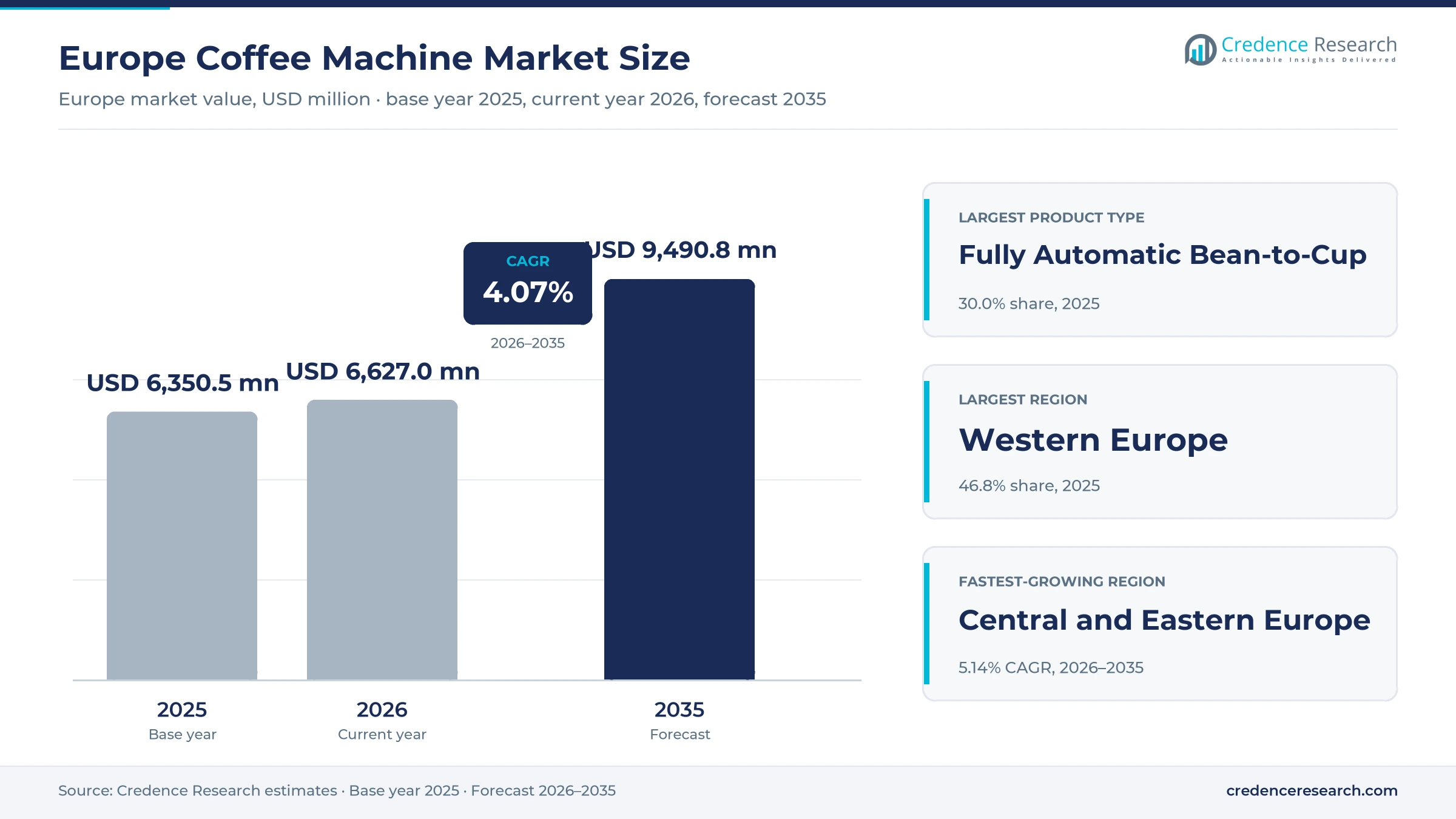
Europe Coffee Machine Market Insights
- The Europe coffee machine market grows from USD 6.35 billion in 2025 to USD 9.49 billion by 2035, a 4.07% CAGR built on replacement and trading up.
- Western Europe held 46.8% of value in 2025, while Central and Eastern Europe grows fastest at 5.14% a year through 2035.
- Fully Automatic Bean-to-Cup Machines led product types with 30.0% of 2025 value, as households pay more for automatic grinding and brewing at home.
- Capsules came fully within EU packaging rules on Aug. 12, 2026, and must be recyclable to reach the EU market from Jan. 1, 2030.
- De'Longhi agreed in October 2026 to lift its professional division stake to 88.02%, which signals the capital now moving toward premium commercial equipment.
Bean-to-cup units, homes and mid-market prices lead value
Why do bean-to-cup machines lead product demand?
Based on product type, the market is categorized into filter and drip coffee machines, capsule and pod coffee machines, manual and semi-automatic espresso machines, fully automatic bean-to-cup machines, and professional and vending coffee machines. Fully Automatic Bean-to-Cup Machines led with 30.0% of 2025 value because buyers now pay for automatic grinding, and Groupe SEB named full automatic machines as particularly dynamic in Eastern Europe that year. Professional and Vending Coffee Machines grow fastest at 4.85% a year as Costa Coffee upgraded more than 13,000 U.K. Express units by October 2026, while De'Longhi kept investing in its La Marzocco and Eversys division.
Which applications buy the most machines?
Based on application, the market is categorized into household brewing, office coffee service, cafés and specialty coffee, hotels and restaurants, and self-service vending. Household Brewing led with 62.0% of 2025 value because home buyers attract most model launches, with JURA alone listing new E8, Z10, C9 and J10 twin machines between October and November 2025. Cafés and Specialty Coffee grows fastest at 5.03% a year as branded shop numbers keep rising, reaching 51,042 outlets in April 2025, according to Tea & Coffee Trade Journal, and each new site needs commercial equipment and regular servicing.
How wide is the price ladder for buyers?
Based on price tier, the market is categorized into entry tier, mid-market tier, premium household tier, professional tier and high-capacity commercial tier. Mid-Market Tier led with 34.0% of 2025 value because mainstream launches cluster at this level, with Versuni setting a recommended EUR 499.99 for the Philips Baristina Plus in Germany in October 2025. Premium Household Tier grows fastest at 4.81% a year as buyers accept far higher prices for barista-style control, shown by the EUR 3,099 Siemens EQ900 iAroma introduced in March 2026 with six adjustable brewing parameters.
Where do European buyers purchase their machines?
Based on distribution channel, the market is categorized into mass retail and electronics, specialty appliance and coffee retail, e-commerce, direct B2B and dealer networks, and leasing and managed coffee service. Mass Retail and Electronics led with 40.0% of 2025 value because store buying stays strong in several large markets, and Eurostat data reported by Ecommerce News show 61.7% of Italian internet users bought online in 2025. E-Commerce grows fastest at 5.20% a year as the EU average reached about 78% that year, with Ireland at 95.3%, and Versuni already sells custom colors through its Baristina online shop.
| Segment Group | Leading Sub-segment | Share, 2025 | Fastest-growing Sub-segment | CAGR, 2026–2035 |
|---|---|---|---|---|
| By Product Type | Fully Automatic Bean-to-Cup Machines | 30.0% | Professional and Vending Coffee Machines | 4.85% |
| By Application | Household Brewing | 62.0% | Cafés and Specialty Coffee | 5.03% |
| By Price Tier | Mid-Market Tier | 34.0% | Premium Household Tier | 4.81% |
| By Distribution Channel | Mass Retail and Electronics | 40.0% | E-Commerce | 5.20% |
Request a Free Sample
Fill in your details and we'll send you a free sample report.
- Sample data tables & charts
- Research methodology
Trade-ups, outlet growth and fleet automation lift sales
Premiumization of at-home coffee preparation
Households are paying more for machines because a café drink has become the price reference for the kitchen counter. Tea & Coffee Trade Journal reported an average regular cappuccino price of EUR 3.69 in April 2025, up 7.6% in a year. That gap supports pricier hardware, and Siemens set a recommended price of EUR 3,099 for its EQ900 iAroma models in March 2026. JURA widened its range as well, listing a new Z10 with 51 specialties in October 2025 and an S10 with a cold brew feature in September 2026. As a result, Fully Automatic Bean-to-Cup Machines held 30.0% of 2025 value, and these purchases sit alongside wider spending on smart kitchen appliances.
Expansion of out-of-home coffee networks
Café operators buy professional equipment each time a chain opens a site, so outlet counts feed directly into machine orders. Tea & Coffee Trade Journal reported 51,042 branded coffee shops across Europe in April 2025, up 4.7% in 12 months. The United Kingdom had 11,456 branded outlets in early 2025, up 5.2% over the year, while Germany had 7,428 and Turkey had 3,819, according to Qahwa World in July 2025, despite Turkish consumer inflation above 44% in 2024. Because each new site adds equipment and a service need, Cafés and Specialty Coffee grows fastest at 5.03% a year, and operators also lift demand for roasted beans.
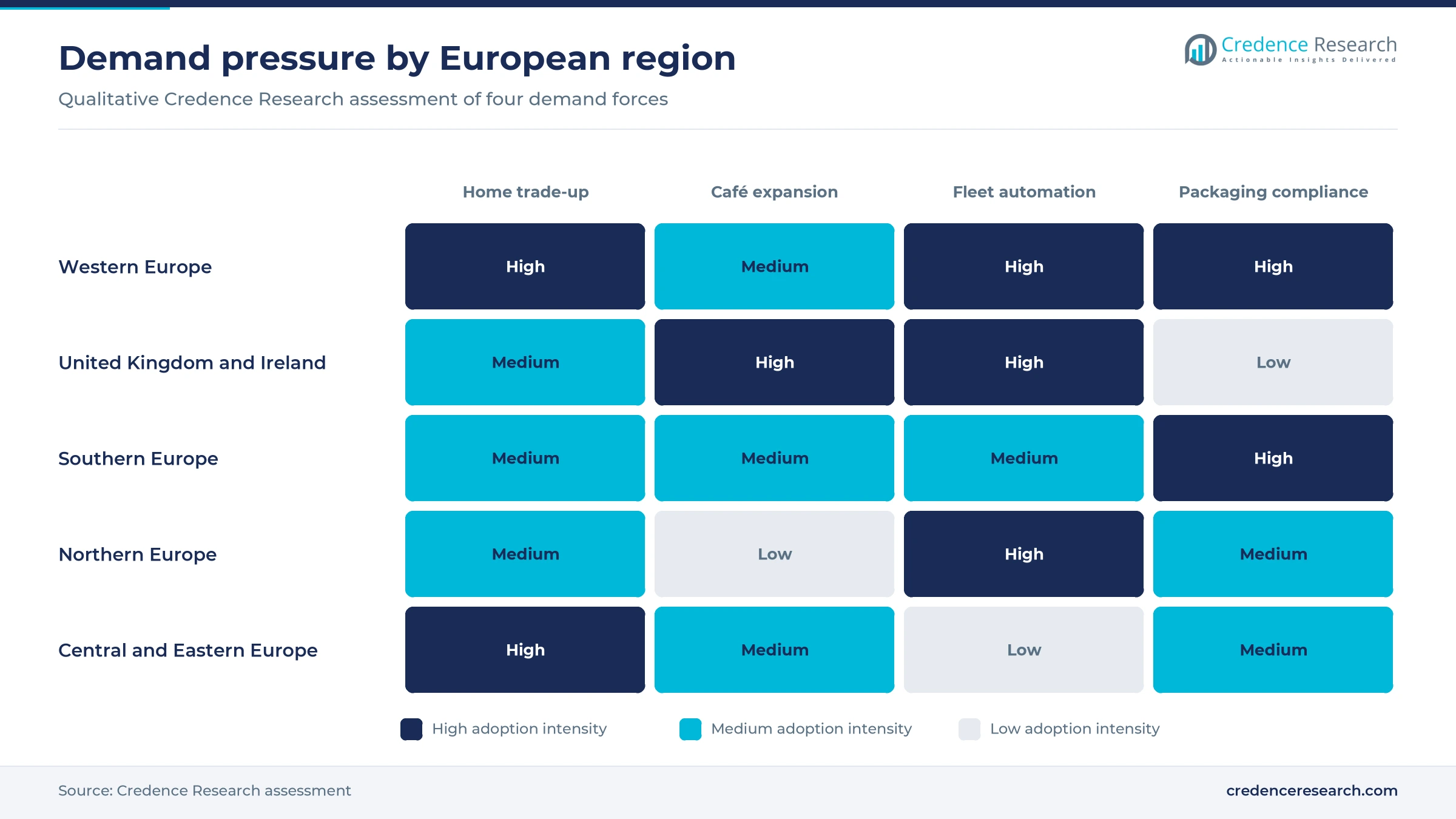
Automation and connected fleet economics
Automation pays back where labor is expensive and sites are scattered. Eurostat put average EU hourly labor costs at EUR 34.90 in 2025, up 4.1% from a year earlier, and as high as EUR 51.70 in Denmark. Franke responded at HostMilano in October 2025 with the A600 and A800, whose FrankeConnect cloud access manages menus, recipes and prices across sites. Costa Coffee said in October 2026 that it had upgraded more than 13,000 of its 15,800 U.K. Express self-serve machines, or 82% of the network. In January 2026, Lexington launched a robotic barista at BT's Snowhill office in Birmingham that can serve up to 450 cups a day, at an average of 98 seconds a drink.
Fresh capital is reaching professional equipment makers
Manufacturers are investing because professional equipment is outgrowing household lines. De'Longhi agreed on Oct. 15, 2026, to raise its stake in the La Marzocco and Eversys division from 61.56% to 88.02%, paying about EUR 662.5 million to DLI Limited, according to Teleborsa. Division sales have grown more than 50% worldwide since the combination was announced in December 2023, the same report said. De'Longhi also reported double-digit professional growth worldwide in the first half of 2026 in its July 2026 release. Groupe SEB reported good machine deliveries in Germany and strong service growth in the second half of 2025, which shows the same pull at a rival. This capital supports the professional tier, where buyers value uptime and service coverage.
Compact grinders and capsule recycling reshape the range
Compact bean-to-cup formats are emerging at lower prices
Compact grinding machines are shifting the entry point for fresh-bean coffee downward. Versuni listed the Philips Baristina Plus in Germany in October 2025 with 16 bar pump pressure and brewing in under 60 seconds. The company then took the original Baristina and the Café Aromis Serie 8000 to Coffee Fest Madrid in February 2026, and Alimarket reported that both were arriving in Spain. JURA moved in the same direction with a new compact C9 in October 2025 and a compact A8 in September 2026. This shift gives capsule owners a route to beans without a flagship price, which supports Mid-Market Tier at 34.0% of 2025 value. It also widens the range of small electrical appliances on retail shelves.
Recycling rules are shifting capsule system design
Capsule systems are shifting toward verifiable recycling because the rules now carry dates. Regulation (EU) 2025/40 brought capsules fully within EU packaging obligations on Aug. 12, 2026, and they must be recyclable to reach the EU market from Jan. 1, 2030, according to Italian Food News. Biorepack figures cited in that article put Italian use at about 2.8 billion capsules a year, which shows the volume involved. Nespresso already reports about 14,000 collection points in more than 30 countries, including 280 in Portugal. Costa Coffee has also run a five-month Podback trial at 142 U.K. locations, accepting Nespresso, Tassimo and Nescafe pods. System owners therefore compete on take-back as well as machine price, which shapes demand for pods and capsules.
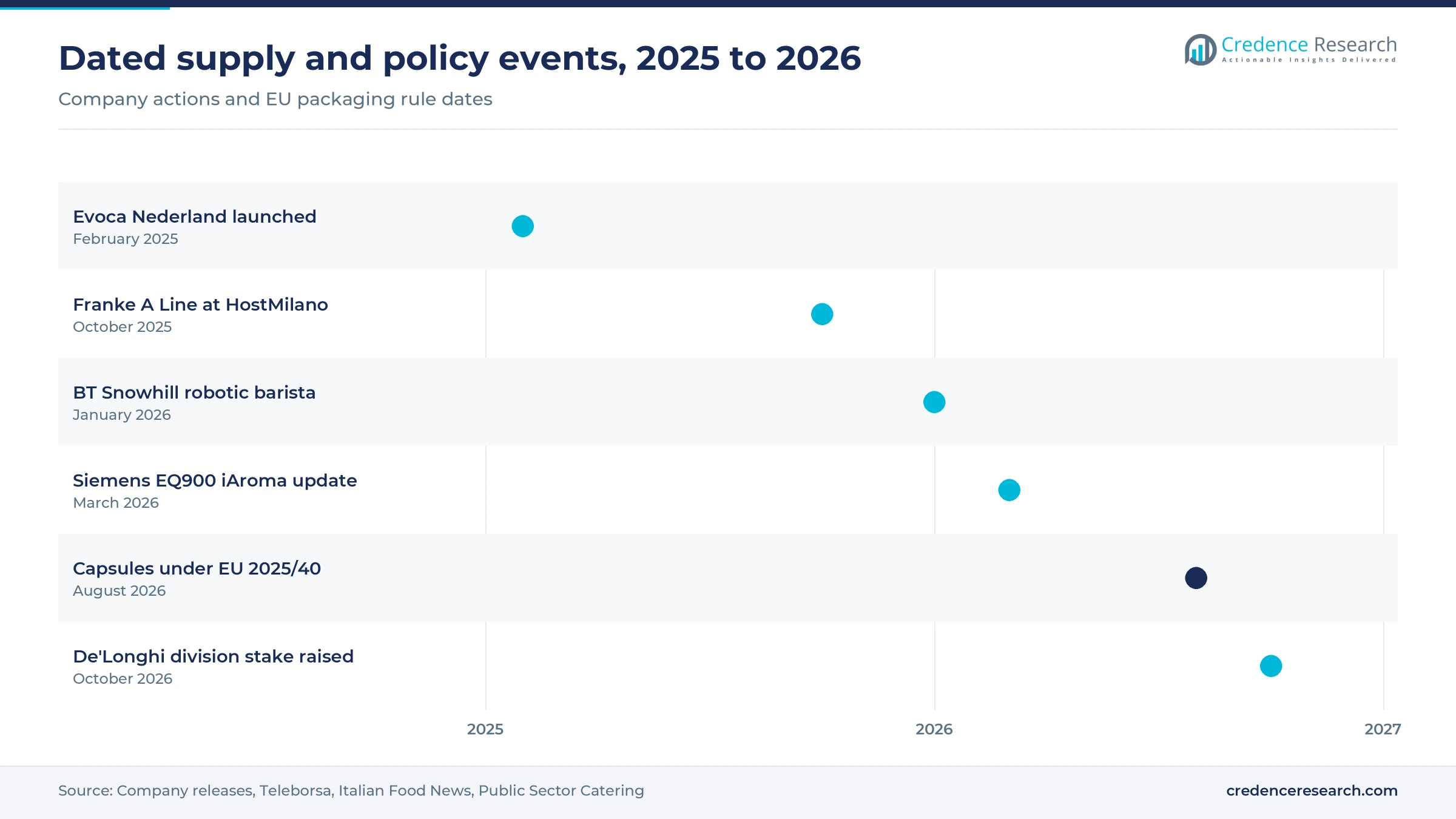
Eastern Europe offers an opening for fully automatic brands
Eastern Europe offers manufacturers a clear opening because sales are growing faster there than in the west. Groupe SEB reported consumer sales up about 10% in Eastern Europe in 2025, against 1.0% in Western Europe, and it named full automatic coffee machines as particularly dynamic. Its professional sales in Eastern Europe and the Middle East also grew at double-digit rates. Online access allows entry without a large retail estate, since the share of Romanian internet users buying online rose 46 percentage points from 2015 to almost 64% in 2025, based on Eurostat data. Wage pressure adds a case for commercial automation, with Romanian labor costs up 10.6% and Polish costs up 8.8% in 2025. Central and Eastern Europe therefore grows faster than any other region in this report.
Managed coffee service offers an opening in changing workplaces
Managed service contracts offer suppliers an opening as workplaces change where staff buy coffee. The European Vending and Coffee Service Association reported in October 2025 that workplaces hold 70% of machine placements, down from 80% before the pandemic, while micro-markets grew 15% and smart fridges 95% since its last report. Suppliers are adapting, since Evoca Group launched Evoca Nederland in Gorinchem on Feb. 25, 2025, to improve service for clients of its Gaggia, Necta and Saeco brands. JURA added models with a permanent water connection, the X10c in April 2025 and the X4c in July 2025, plus the W4 professional machine in March 2025. Groupe SEB also reported strong growth in services during late 2025, so recurring income is a growing prize around food and beverage vending.
Bean costs and packaging law test buyers and suppliers
Green coffee costs squeeze machine budgets
Green coffee costs squeeze the café and vending operators who buy machines. Eurostat data reported by Eunews in October 2026 show EU coffee imports cost EUR 18.7 billion in 2025, against EUR 8.6 billion in 2015, while volume rose only from 2.7 million to 2.9 million metric tons. Cafés and vending operators absorb part of that rise, and Qahwa World reported in July 2025 that 38% of industry leaders said some consumers were being priced out of daily coffee. Consequently, smaller operators can defer equipment replacement or turn to leased machines.
Capsule makers must prove that recycling works
Capsule system owners face a stricter recycling test after 2030. Under Regulation (EU) 2025/40, capsules must be recycled through operational supply chains and facilities from Jan. 1, 2035, according to Italian Food News, so recyclability in principle will not be enough. Non-permeable formats carry extra uncertainty because their compostability rules depend on national choices and local collection. Smaller brands without take-back networks are most exposed, since Nespresso alone reports about 14,000 collection points. Shared schemes such as Podback offer the main route to lower that risk.
Uneven café growth leaves gaps in professional demand
Café expansion is uneven, which makes professional demand harder to forecast by country. Qahwa World reported in July 2025 that Poland closed a net 26 outlets in its first contraction in five years, while Sweden fell 5.7%. Major markets including the United Kingdom, Germany, Russia and France each added more than 100 outlets over the same period, according to Tea & Coffee Trade Journal, which shows how wide the gap between countries has become. Dealers with national service teams therefore carry fixed costs where site openings stall, and they need maintenance income to cover the gap.
Workplace vending loses ground as office patterns change
Workplace placements have lost ground as office attendance changed after the pandemic. The European Vending and Coffee Service Association reported that workplaces fell to 70% of machine placements from 80%, with data to the end of 2024. Italy, which has the most machines at 809,000, was the only covered market with falling product revenue, down 2.9%. Vending operators can therefore face thinner volume at older office sites, so they must move equipment toward public locations and micro-markets.
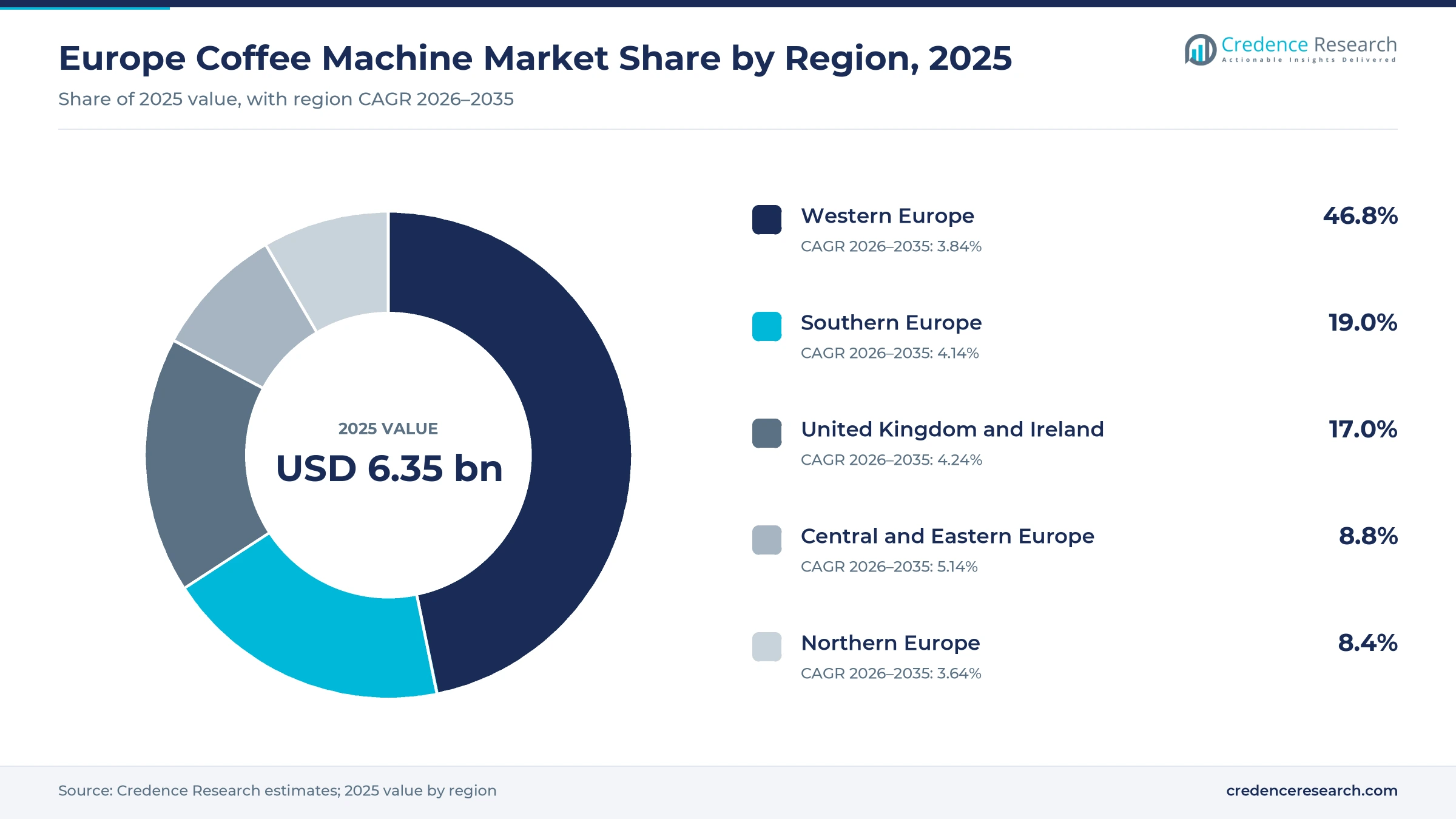
Western Europe leads while the east grows fastest
| Region | Value, 2025 (USD billion) | Share, 2025 | CAGR, 2026–2035 |
|---|---|---|---|
| Western Europe | 2.97 | 46.8% | 3.84% |
| Southern Europe | 1.21 | 19.0% | 4.14% |
| United Kingdom and Ireland | 1.08 | 17.0% | 4.24% |
| Central and Eastern Europe | 0.56 | 8.8% | 5.14% |
| Northern Europe | 0.53 | 8.4% | 3.64% |
Western Europe leads on German and French demand
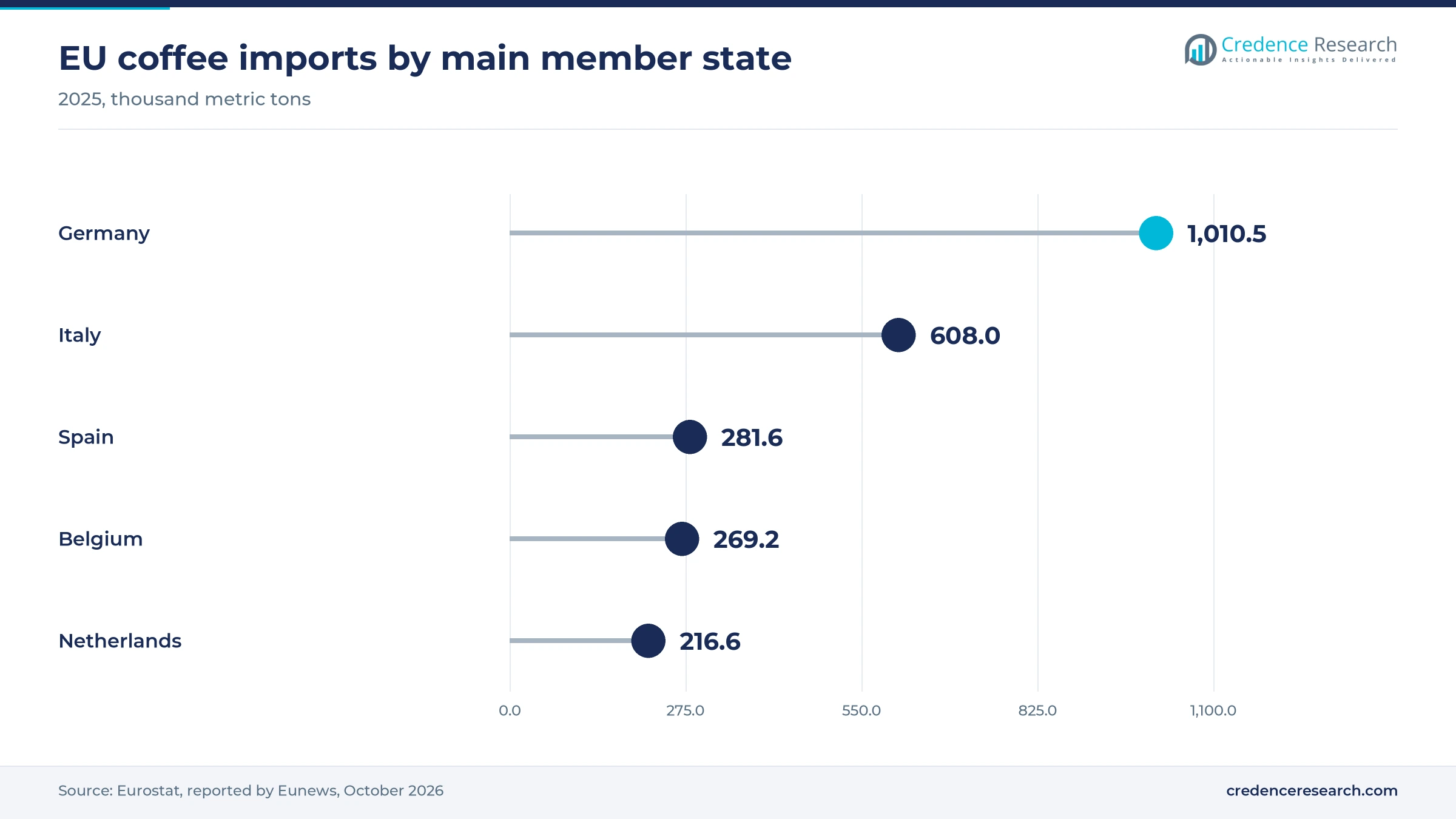
Western Europe held 46.8% of 2025 value and grows at 3.84% a year, anchored by Germany, which imported 1,010,500 metric tons of coffee in 2025, according to Eurostat data reported by Eunews. France is now the largest vending market by product revenue at EUR 3.69 billion, as the European Vending and Coffee Service Association reported in October 2025. Demand is mature, however, because Groupe SEB's Western European consumer sales rose just 1.0% in 2025. Replacement and trading up therefore supply most of the region's added value.
Southern Europe pairs espresso habits with launches
Southern Europe held 19.0% of 2025 value and grows at 4.14% a year, led by Italy, which imported 608,000 metric tons of coffee in 2025, and Spain, which imported 281,600 metric tons, according to Eurostat. Italy is also Europe's largest vending base at 809,000 machines, and Biorepack puts national capsule use near 2.8 billion a year. Spain is an active launch market, since Versuni presented the Café Aromis Serie 8000 at Coffee Fest Madrid in February 2026. Online buying is lower in Italy, which keeps stores important.
United Kingdom and Ireland rely on self-service reach
The United Kingdom and Ireland held 17.0% of 2025 value and grow at 4.24% a year, supported by a branded café sector valued at GBP 6.1 billion in January 2025, according to Tea & Coffee Trade Journal. Self-service is unusually developed, since Costa's Express network alone runs 15,800 machines across the United Kingdom. Workplace automation is advancing too, as the BT Snowhill robotic counter in Birmingham shows. Ireland adds a strong online route, because Eurostat data show it has the EU's highest share of internet users buying online.
Northern Europe has high use but slower growth
Northern Europe held 8.4% of 2025 value and grows at 3.64% a year, the slowest rate, because heavy existing use leaves less room for first-time ownership. StoneX reported in May 2023, citing World Population Review, annual consumption of 12 kg a person in Finland, 9.9 kg in Norway and 8.2 kg in Sweden. High Danish labor costs strengthen the case for automation in commercial sites. However, branded café outlets in Sweden fell over the year to April 2025, so suppliers depend more on offices and households.
Central and Eastern Europe grows from a smaller base
Central and Eastern Europe held 8.8% of 2025 value and grows fastest at 5.14% a year. Groupe SEB reported strong consumer sales in Eastern Europe in 2025 and singled out full automatic coffee machines as a dynamic category. Labor costs remain low but are climbing, with Bulgaria at EUR 12.00 an hour in 2025, up 13.1%, according to Eurostat. Progress is uneven, because Poland recorded a net loss of branded cafés in the year to April 2025. Price-sensitive buyers therefore keep entry models relevant across much of the region.
Launches, deals and rules marked 2025 and 2026
| Development | Status and market relevance |
|---|---|
| In February 2025, Evoca Group launched Evoca Nederland B.V. in Gorinchem to strengthen client service for its Gaggia, Necta and Saeco brands. | Operating; extends direct B2B coverage in the Netherlands |
| In October 2025, Franke presented the A600 and A800 fully automatic machines at HostMilano, built on FrankeOS with FrankeConnect cloud management. | Global rollout planned through 2026 |
| In January 2026, Lexington launched a robotic barista counter with Elior Vending support at BT's Snowhill office in Birmingham. | Operating; further BT sites planned |
| In August 2026, coffee capsules came fully within the packaging obligations of Regulation (EU) 2025/40. | In force; recyclability test applies from 2030 |
| In October 2026, De'Longhi agreed to raise its stake in the La Marzocco and Eversys division to 88.02% from 61.56%. | Closing was scheduled for Oct. 16, 2026 |
Sensors and cloud tools change how machines are run
- Fully automatic bean-to-cup systems now adjust brewing to the beans used, as the beanIdent system and separate eGrinders do on Siemens EQ900 iAroma models available from March 2026.
- Connected and IoT-enabled systems allow remote setup, software updates and central price changes across sites through FrankeConnect on the Franke A600 and A800.
- Pump espresso systems are reaching compact home formats, with the Philips Baristina Plus pairing 16 bar pressure with a ceramic grinder.
- Insulated boilers reduce idle heat loss by up to 44% in the Franke HeatGuard design compared with the earlier A600 NM, according to Franke.
Need a Custom Version of This Report?
Tailor the scope, geography, or segments to your exact requirements.
- Custom geography or segment scope
- Direct access to our analyst team
Household brands and professional makers compete apart
Competition splits along two lines, with household brands fighting for retail shelf space and professional makers competing on uptime, service reach and drink quality. De'Longhi spans both, pairing household machines with its La Marzocco and Eversys division, while Groupe SEB combines consumer brands with a professional coffee unit. JURA concentrates on fully automatic machines and refreshed much of its range across 2025 and 2026. Versuni uses Philips, Saeco and Gaggia to cover household price points, and BSH reaches premium buyers through Siemens models. Nestlé Nespresso defends its capsule system with its own recycling network. In commercial equipment, Evoca Group serves vending and office customers, Franke sells connected fully automatic machines, and Cimbali Group supplies café operators, including bean-to-cup machines used by Craft House Coffee in the U.K. Service coverage increasingly decides professional contracts.
Companies profiled and their roles in this market
| Company | Type | Role in the market |
|---|---|---|
| De'Longhi Group | Household and professional maker | Raised its La Marzocco and Eversys division stake in October 2026 |
| Groupe SEB | Household and professional maker | Reported dynamic full automatic sales in Eastern Europe in 2025 |
| Nestlé Nespresso S.A. | Capsule system owner | Runs about 14,000 capsule collection points, including 280 in Portugal |
| Versuni | Household appliance maker | Launched Philips Baristina Plus in Germany in October 2025 |
| JURA Elektroapparate AG | Fully automatic specialist | Listed new household and professional models across 2025 and 2026 |
| Evoca Group | Professional and vending maker | Launched Evoca Nederland in Gorinchem in February 2025 |
| BSH Hausgeräte GmbH | Household appliance maker | Released updated Siemens EQ900 iAroma models in March 2026 |
| Franke Coffee Systems | Professional machine maker | Showed connected A600 and A800 machines at HostMilano in October 2025 |
| Cimbali Group | Professional machine maker | Supplies bean-to-cup machines used by Craft House Coffee in the U.K. |
Professional service income is the prize to watch
Credence Research's view is that professional service income deserves more attention than unit counts in this market. Household growth looks steady but replacement-led, whereas the De'Longhi stake deal, Costa's fleet upgrade and Franke's cloud platform all point to value moving toward managed equipment. The main assumption behind this view is the split between household and commercial value, because public data does not separate them by region. Suppliers should therefore treat the 2025 segment shares as estimates and test them against local dealer data before committing field service capacity.
How Credence Research built these estimates
The report uses 2025 as the base year and 2035 as the forecast year, with market values from the Credence Research model. Segment and regional splits are Credence Research estimates informed by public sources, including Eurostat, trade association reports, company releases and trade publications opened during research. No interviews or surveys were conducted for this edition of the report. Regional shares follow the Credence Research regional model and are not official statistics.
Replacement and premium mix carry growth through 2035
Through 2035, growth should come from replacement and richer product mix more than from new households. The market reaches USD 9.49 billion at a 4.07% CAGR, with Central and Eastern Europe gaining share from a small base and Western Europe still holding the largest position. Capsule systems will face their real test on Jan. 1, 2035, when capsules must be recycled through operational supply chains and facilities. Professional makers should gain from labor cost pressure and fleet software, provided café openings continue and operators can fund upgrades. Suppliers with strong service networks are best placed to hold margin as hardware differences narrow.
Frequently Asked Questions
How big is the Europe coffee machine market?
Which region leads the market?
Which region grows fastest?
Which product type holds the largest share?
What drives demand for coffee machines in Europe?
How do EU packaging rules affect capsule machines?
What are the main challenges?
Who are the key companies in this market?
Table of Content
Chapter 1 Market Segmentation
- 1.1 Segmentation Framework
- 1.1.1 Product and Service Classification
- 1.1.2 Application and End-Use Classification
- 1.1.3 Technology and Solution Classification
- 1.1.4 Customer and Distribution Channel Classification
- 1.1.5 Geographic Segmentation
- 1.1.6 Market Segment Definitions and Boundaries
- 1.2 By Product Type
- 1.2.1 Filter and Drip Coffee Machines
- 1.2.2 Capsule and Pod Coffee Machines
- 1.2.3 Manual and Semi-Automatic Espresso Machines
- 1.2.4 Fully Automatic Bean-to-Cup Machines
- 1.2.5 Professional and Vending Coffee Machines
- 1.3 By Application
- 1.3.1 Household Brewing
- 1.3.2 Office Coffee Service
- 1.3.3 Cafés and Specialty Coffee
- 1.3.4 Hotels and Restaurants
- 1.3.5 Self-Service Vending
- 1.4 By Price Tier
- 1.4.1 Entry Tier
- 1.4.2 Mid-Market Tier
- 1.4.3 Premium Household Tier
- 1.4.4 Professional Tier
- 1.4.5 High-Capacity Commercial Tier
Chapter 2 Introduction
- 2.1 Report Objectives and Scope
- 2.2 Product Definition and Industry Terminology
- 2.3 Market Inclusions and Exclusions
- 2.4 Research Process
- 2.4.1 Primary Research and Expert Interviews
- 2.4.2 Secondary Research and Source Review
- 2.4.3 Top-Down and Bottom-Up Estimation
- 2.4.4 Data Triangulation and Verification
- 2.5 Market Size Measurement Basis
- 2.5.1 2025: USD 6.35 billion → 2035: USD 9.49 billion
- 2.6 Historical and Forecast Reference Periods
- 2.6.1 Historical Period: 2018-2025
- 2.6.2 Base Year: 2025
- 2.6.3 Forecast Period: 2025-2035
- 2.7 Research Assumptions and Limitations
Chapter 3 Executive Summary
- 3.1 Market Snapshot and Key Findings
- 3.2 Base-Year Market Size, 2025
- 3.3 Forecast Market Size, 2035
- 3.4 Revenue and Volume Growth Outlook
- 3.5 Key Demand and Supply Indicators
- 3.6 Leading Market Segments
- 3.7 Fastest-Growing Market Opportunities
- 3.8 Regional Performance Highlights
- 3.9 Technology and Industry Transformation
- 3.10 Competitive Landscape Summary
- 3.11 Analyst View and Strategic Implications
Chapter 4 Europe Coffee Machine Market Trends and Developments
- 4.1 Historical Industry Development, 2018-2025
- 4.2 Recent Market Trends and Developments
- 4.3 Demand and Customer Behavior Trends
- 4.4 Technology and Product Innovation
- 4.5 Artificial Intelligence, Automation and Digitalization
- 4.6 Local Manufacturing and Supply Chain Realignment
- 4.7 Industry Partnerships, Mergers and Acquisitions
- 4.8 Sustainability and Circular Economy Developments
- 4.9 Government and Private Sector Investment Trends
- 4.10 Emerging Business Models and Commercialization
- 4.11 Industry Developments and Announcements
Chapter 5 Europe Coffee Machine Market Production, Supply and Demand Analysis
- 5.1 Demand Trend and Consumption Analysis, 2018-2025
- 5.2 Demand Forecast, 2025-2035
- 5.3 Production and Output Trend, 2018-2025
- 5.4 Production and Output Forecast, 2025-2035
- 5.5 Installed Capacity and Capacity Utilization
- 5.6 Company-Wise Production Plants and Statistics
- 5.6.1 Installed Production Capacity
- 5.6.2 Actual Production
- 5.6.3 Planned Capacity and Expansion Targets
- 5.7 Supply Chain Structure and Procurement Trends
- 5.8 Supply-Demand Gap and Bottlenecks
- 5.9 Import Dependence and Sourcing Structure
- 5.10 Contract Manufacturing and Outsourcing
- 5.11 Regional Supply and Demand Concentration
Chapter 6 Europe Coffee Machine Market Pricing Analysis
- 6.1 Pricing Structure and Measurement
- 6.2 Historical Pricing Trends, 2018-2025
- 6.3 Pricing Outlook, 2025-2035
- 6.4 Average Selling Price and Unit Economics
- 6.5 Pricing by Product and Market Segment
- 6.6 Geographic Pricing Differences
- 6.7 Key Input, Energy, Labor and Logistics Costs
- 6.8 Contract Pricing and Purchasing Models
- 6.9 Pricing Sensitivity and Competitive Positioning
- 6.10 Price, Margin and Profitability Implications
Chapter 7 Europe Coffee Machine Market Dynamics
- 7.1 Market Growth Drivers
- 7.1.1 Demand-Side Drivers
- 7.1.2 Technology and Innovation Drivers
- 7.1.3 Infrastructure and Investment Drivers
- 7.1.4 Regulatory and Policy Drivers
- 7.2 Market Restraints
- 7.2.1 Cost and Affordability Constraints
- 7.2.2 Technology and Adoption Barriers
- 7.2.3 Supply Chain and Operational Constraints
- 7.3 Market Challenges
- 7.3.1 Competitive Pressure and Margin Erosion
- 7.3.2 Skills, Infrastructure and Implementation Gaps
- 7.4 Emerging Market Opportunities
- 7.5 Market Dynamics Impact and Time-Horizon Assessment
Chapter 8 Europe Coffee Machine Value Chain Analysis
- 8.1 Industry Value Chain Overview
- 8.2 Upstream Suppliers and Critical Inputs
- 8.3 Technology and Component Providers
- 8.4 Manufacturing or Service Delivery
- 8.5 Distribution, Channel Partners and Integrators
- 8.6 Downstream Applications and End Users
- 8.7 Value Addition and Profit Pools
- 8.8 Vertical Integration and Outsourcing
- 8.9 Supplier Concentration and Risk
- 8.10 Supply Chain Localization and Resilience
Chapter 9 Europe Coffee Machine Market Regulations and Policies
- 9.1 Relevant Laws, Standards and Compliance Frameworks
- 9.2 Product, Service, Safety and Quality Requirements
- 9.3 Government Policies, Incentives and Subsidies
- 9.4 Imports, Exports and Trade Barriers
- 9.5 Public Procurement and Local Content Requirements
- 9.6 Environmental and Sustainability Compliance
- 9.7 Upcoming Policy Changes and Market Implications
Chapter 10 Europe Coffee Machine Market Hotspots and Opportunities
- 10.1 Market Opportunity Mapping and Growth Hotspots
- 10.2 High-Growth Applications and Customer Groups
- 10.3 Underserved Markets and White-Space Opportunities
- 10.4 Emerging Technology and Product Opportunities
- 10.5 New Capacity and Investment Hotspots
- 10.6 Market Entry and Expansion Opportunities
- 10.7 Distribution and Partnership Opportunities
- 10.8 Near-Term and Long-Term Commercial Potential
- 10.9 Opportunity Attractiveness and Execution Risks
Chapter 11 Europe Coffee Machine Market Outlook, 2025-2035
- 11.1 Market Size and Analysis
- 11.1.1 Revenue (Market Measurement: 2025: USD 6.35 billion → 2035: USD 9.49 billion)
- 11.1.2 Market Volume and Quantity Sold
- 11.1.3 Historical Market Size, 2018-2025
- 11.1.4 Base-Year Market Size, 2025
- 11.2 Market Forecast, 2025-2035
- 11.2.1 Revenue Forecast to 2035
- 11.2.2 Volume Forecast to 2035
- 11.2.3 CAGR and Year-on-Year Growth
- 11.2.4 Incremental Revenue Opportunity
- 11.3 Forecast Assumptions and Scenario Analysis
- 11.3.1 Base-Case Forecast
- 11.3.2 Optimistic and Conservative Scenarios
- 11.3.3 Technology, Pricing and Policy Sensitivities
- 11.4 Market Attractiveness and Growth Outlook
Chapter 12 Europe Coffee Machine Market Segmentation and Outlook
- 12.1 Segmentation Summary and Market Shares, 2025
- 12.2 Largest and Fastest-Growing Segments
- 12.3 By Product Type - Market Size and Forecast, 2025-2035
- 12.3.1 Segment Definition and Scope
- 12.3.2 Historical Market Size, 2018-2025
- 12.3.3 Revenue Forecast, 2025-2035
- 12.3.4 Volume Forecast, 2025-2035
- 12.3.5 Base-Year Market Share, 2025
- 12.3.6 Segment CAGR and Growth Drivers
- 12.3.7 Subsegment Market Size and Forecast
- 12.3.7.1 Filter and Drip Coffee Machines
- 12.3.7.2 Capsule and Pod Coffee Machines
- 12.3.7.3 Manual and Semi-Automatic Espresso Machines
- 12.3.7.4 Fully Automatic Bean-to-Cup Machines
- 12.3.7.5 Professional and Vending Coffee Machines
- 12.3.8 Subsegment Pricing and Adoption Trends
- 12.3.9 Leading Suppliers and Competition
- 12.3.10 Regional Demand and Opportunities
- 12.4 By Application - Market Size and Forecast, 2025-2035
- 12.4.1 Segment Definition and Scope
- 12.4.2 Historical Market Size, 2018-2025
- 12.4.3 Revenue Forecast, 2025-2035
- 12.4.4 Volume Forecast, 2025-2035
- 12.4.5 Base-Year Market Share, 2025
- 12.4.6 Segment CAGR and Growth Drivers
- 12.4.7 Subsegment Market Size and Forecast
- 12.4.7.1 Household Brewing
- 12.4.7.2 Office Coffee Service
- 12.4.7.3 Cafés and Specialty Coffee
- 12.4.7.4 Hotels and Restaurants
- 12.4.7.5 Self-Service Vending
- 12.4.8 Subsegment Pricing and Adoption Trends
- 12.4.9 Leading Suppliers and Competition
- 12.4.10 Regional Demand and Opportunities
- 12.5 By Price Tier - Market Size and Forecast, 2025-2035
- 12.5.1 Segment Definition and Scope
- 12.5.2 Historical Market Size, 2018-2025
- 12.5.3 Revenue Forecast, 2025-2035
- 12.5.4 Volume Forecast, 2025-2035
- 12.5.5 Base-Year Market Share, 2025
- 12.5.6 Segment CAGR and Growth Drivers
- 12.5.7 Subsegment Market Size and Forecast
- 12.5.7.1 Entry Tier
- 12.5.7.2 Mid-Market Tier
- 12.5.7.3 Premium Household Tier
- 12.5.7.4 Professional Tier
- 12.5.7.5 High-Capacity Commercial Tier
- 12.5.8 Subsegment Pricing and Adoption Trends
- 12.5.9 Leading Suppliers and Competition
- 12.5.10 Regional Demand and Opportunities
- 12.6 Segment Growth Comparison
- 12.7 Segment Attractiveness and Priority Matrix
Chapter 13 Europe Coffee Machine End-Use and Application Market Outlook
- 13.1 End-Use Industry and Customer Demand Structure
- 13.2 Leading Applications and Customer Groups
- 13.3 End-Use Market Size, Share and Forecast
- 13.4 Major End-Use Industry Deep Dives
- 13.4.1 Customer Requirements and Use Cases
- 13.4.2 Demand and Replacement Cycles
- 13.4.3 Technical and Regulatory Considerations
- 13.4.4 Purchasing and Procurement Models
- 13.4.5 Leading Vendors and Distribution Channels
- 13.4.6 Forecast and Commercial Opportunities
- 13.5 Emerging Applications and Cross-Segment Demand
- 13.6 End-Use Industry Investment Priorities
Chapter 14 Europe Coffee Machine Geographic Market Outlook, 2025-2035
- 14.1 Regional Market Size and Country-Level Shares, 2025
- 14.2 Country Market Size Comparison, 2025
- 14.3 Country Market Forecasts, 2025-2035
- 14.4 Subregional Industrial and Demand Clusters
- 14.5 Intra-Regional Pricing and Cost Differences
- 14.6 Cross-Border Trade and Supply Networks
- 14.7 Regional Supply and Demand Balances
- 14.8 Country Opportunity Comparison and Prioritization
Note: Every listed country is covered on the structure shown under the first country.
Chapter 15 Europe Coffee Machine Technology, Innovation and Sustainability Outlook
- 15.1 Technology Landscape and Maturity
- 15.2 Product, Process and Service Innovation
- 15.3 AI, Automation and Digital Tools in the Industry
- 15.4 Technology Adoption and Performance Benchmarking
- 15.5 Innovation Pipeline and R&D Investment
- 15.6 Patent and Intellectual Property Trends
- 15.7 Energy Efficiency and Resource Management
- 15.8 Sustainability, Recycling and Circularity
- 15.9 Technology Roadmap, 2025-2035
- 15.10 Risks of Obsolescence and Technology Substitution
Chapter 16 Europe Coffee Machine Market Key Strategic Imperatives
- 16.1 Growth and Market Entry Priorities
- 16.2 High-Return Products and Segments
- 16.3 Pricing, Profitability and Cost Optimization
- 16.4 Technology Investment and Product Differentiation
- 16.5 Supply Chain Localization and Resilience
- 16.6 Distribution and Customer Acquisition
- 16.7 Partnership, Acquisition and Capacity Strategy
- 16.8 Regional Expansion Priorities
- 16.9 Short-, Medium- and Long-Term Actions
Chapter 17 Competition Outlook
- 17.1 Industry Competition Characteristics
- 17.2 Market Structure and Concentration
- 17.3 Market Share and Competitive Positioning, 2025
- 17.4 Company-Wise Revenue and Product Benchmarking
- 17.5 Production and Service Capacity Benchmarking
- 17.6 Technology, Pricing and Differentiation
- 17.7 Regional Footprint and Distribution Strength
- 17.8 Mergers, Acquisitions and Strategic Alliances
- 17.9 New Entrants and Competitive Threats
- 17.10 Porter's Five Forces and Industry Attractiveness
- 17.11 Competitive Outlook, 2025-2035
Chapter 18 Company Profiles
- 18.1 Company Coverage and Selection Criteria
- 18.2 De'Longhi Group
- 18.2.1 Business Description
- 18.2.2 Company Ownership and Geographic Presence
- 18.2.3 Product and Service Portfolio
- 18.2.4 Manufacturing and Operating Footprint
- 18.2.5 Production Capacity and Expansion Plans
- 18.2.6 Financial Performance and Investment
- 18.2.7 Market Share and Competitive Position
- 18.2.8 Technology and Innovation Capabilities
- 18.2.9 Strategic Alliances or Partnerships
- 18.2.10 Recent Developments
- 18.2.11 Growth Strategy and Outlook
- 18.3 Groupe SEB
- 18.4 Nestlé Nespresso S.A.
- 18.5 Versuni
- 18.6 JURA Elektroapparate AG
- 18.7 Evoca Group
- 18.8 BSH Hausgeräte GmbH
- 18.9 Franke Coffee Systems
- 18.10 Miele
- 18.11 Cimbali Group
- 18.12 Other Relevant Market Participants
Note: Every listed company is profiled on the structure shown under the first company. The company list is preliminary and may change based on research findings, market developments, data availability and client requirements.
Chapter 19 Disclaimer
- 19.1 Research and Forecast Disclaimer
- 19.2 Data Source and Estimation Limitations
Note: The depth of individual sections depends on data availability for this market. Volume, capacity, trade and other unit-based metrics are included where applicable.

