Market Overview:
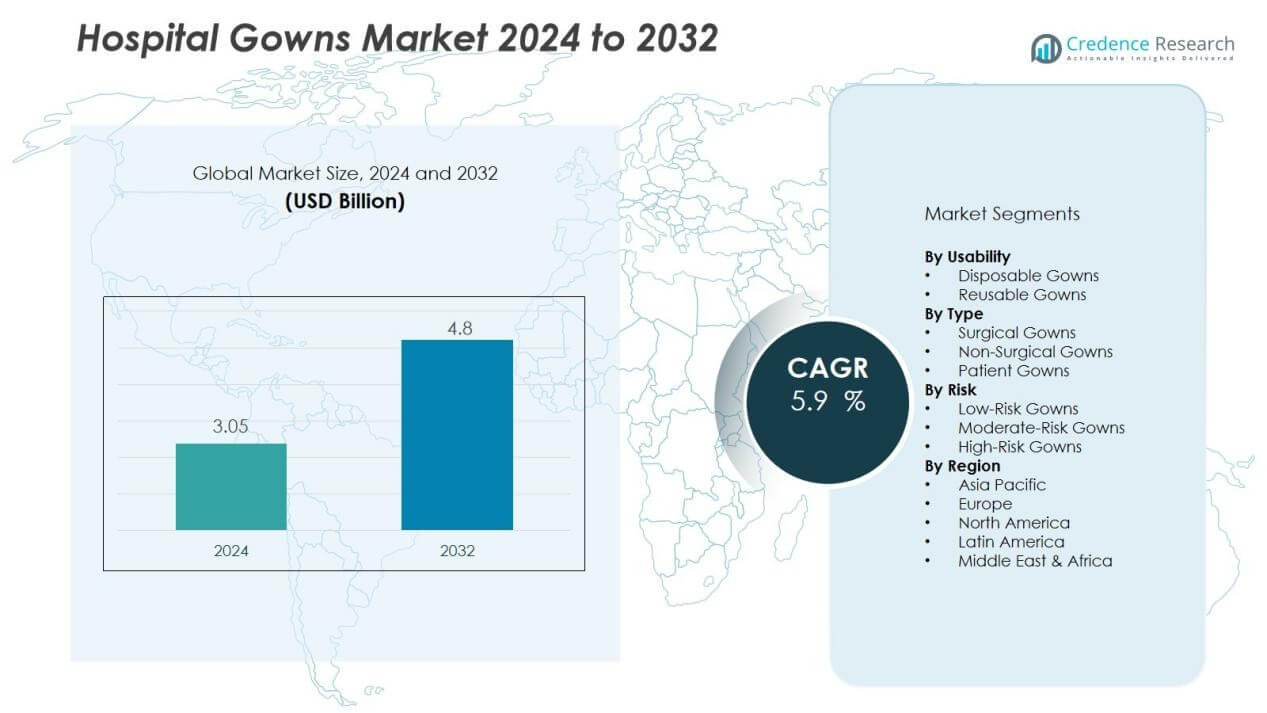
The hospital gowns market size was valued at USD 3.05 billion in 2024 and is anticipated to reach USD 4.8 billion by 2032, at a CAGR of 5.9 % during the forecast period (2024-2032).
| REPORT ATTRIBUTE | DETAILS |
|---|---|
| Historical Period | 2020-2023 |
| Base Year | 2024 |
| Forecast Period | 2025-2032 |
| Hospital Gowns Market Size 2024 | USD 3.05 Billion |
| Hospital Gowns Market, CAGR | 5.9 % |
| Hospital Gowns Market Size 2032 | USD 4.8 Billion |
Key drivers include rising hospital admissions, expanding surgical volumes, and greater focus on hygiene compliance. Demand has also grown with global health crises, which highlighted the importance of personal protective equipment. Technological advancements in fabric quality, such as fluid-resistant and antimicrobial materials, further enhance gown effectiveness. Sustainability trends are driving hospitals toward reusable options, while disposable gowns remain critical in high-infection environments.
Regionally, North America holds the largest share due to strict healthcare regulations and high patient volumes. Europe follows with strong adoption of eco-friendly and reusable gowns supported by sustainability policies. Asia-Pacific is projected to grow fastest, driven by increasing healthcare spending, expanding hospital infrastructure, and rising patient awareness. Latin America and the Middle East & Africa represent emerging opportunities, though growth remains slower compared to major regions due to limited resources and infrastructure gaps.
Market Insights:
- The hospital gowns market was valued at USD 3.05 billion in 2024 and will reach USD 4.8 billion by 2032.
- Rising hospital admissions and surgical volumes remain major drivers across wards, ICUs, and surgical units.
- Infection prevention needs and global safety guidelines continue to strengthen adoption in healthcare facilities.
- Technological advancements in antimicrobial, fluid-resistant, and breathable fabrics enhance gown quality and usability.
- Sustainability trends push hospitals toward reusable gowns, supported by strong policies in North America and Europe.
- North America led with 38% share in 2024, followed by Europe with 29% and Asia-Pacific with 24%.
- Asia-Pacific is projected to expand fastest due to rising healthcare investments, hospital infrastructure, and patient awareness.
Market Drivers:
Rising Demand for Infection Prevention and Patient Safety:
The hospital gowns market is strongly driven by the need for infection prevention and patient safety. Hospitals prioritize gowns that act as protective barriers against contaminants and infectious agents. Growing awareness of healthcare-associated infections has increased adoption across both developed and emerging economies. It is also supported by strict global guidelines that require healthcare workers and patients to use protective apparel.
- For instance, Inova Health System developed a custom reusable isolation gown that can be laundered and reused up to 100 times, currently reducing 213 tons of medical waste each year across two hospitals in its system.
Increasing Hospital Admissions and Surgical Procedures:
Higher rates of hospital admissions and surgical interventions continue to drive market growth. The hospital gowns market benefits from rising demand across general wards, ICUs, and surgical units. Increasing chronic disease prevalence and aging populations contribute to higher hospitalization rates. It is further supported by growing volumes of elective and emergency procedures that require gowns for both staff and patients.
Technological Advancements in Fabric and Design:
Innovations in gown design and material quality play a significant role in market expansion. The hospital gowns market has seen adoption of fluid-resistant, antimicrobial, and breathable fabrics that enhance comfort and protection. Manufacturers focus on lightweight yet durable textiles that meet safety and comfort needs. It is also shaped by design improvements such as adjustable fits and easy-to-wear closures that enhance usability.
- For Instance, Standard Textile's ComPel® surgical gowns utilize a patented synthetic microfilament construction and achieve AAMI PB70 Level 2 barrier protection while maintaining breathability.
Shift Toward Sustainability and Reusable Gowns:
Growing environmental concerns have encouraged hospitals to adopt eco-friendly gown solutions. The hospital gowns market is witnessing a steady shift toward reusable gowns designed with advanced laundering technology. Healthcare providers recognize the cost-effectiveness and sustainability benefits of reusables compared to disposable gowns. It is reinforced by policies in Europe and North America that promote reduced medical waste and sustainable healthcare practices.
Market Trends:
Growing Preference for Advanced Materials and Smart Textiles:
The hospital gowns market is experiencing a clear trend toward advanced materials that combine protection with comfort. Manufacturers are increasingly using antimicrobial, fluid-resistant, and breathable fabrics to meet evolving healthcare standards. Smart textiles with moisture-wicking properties and temperature regulation are gaining attention to improve patient comfort. It is also being influenced by the demand for gowns that balance durability with lightweight construction. Hospitals and clinics prefer gowns that maintain protective integrity during extended use. The integration of innovative fabrics highlights a focus on reducing infection risks while enhancing user experience.
- For Instance, Cardinal Health's SmartGown™ Surgical Gowns feature a RESPONSIVEMEMBRANE™ technology that transports moisture from the skin to the fabric's surface, helping to keep clinicians cool, dry, and comfortable during extended wear
Rising Adoption of Reusable and Sustainable Gown Solutions:
Sustainability has emerged as a defining trend across global healthcare systems. The hospital gowns market reflects this by shifting from single-use disposables to durable, reusable options. Healthcare providers view reusable gowns as a cost-effective and eco-friendly alternative that reduces medical waste. It is further supported by regulatory frameworks in Europe and North America encouraging greener practices. Hospitals adopt high-quality laundering technologies that preserve fabric integrity while maintaining safety standards. This trend demonstrates how environmental responsibility and operational efficiency are shaping purchasing decisions in the industry.
- For instance, a reusable Level 3 surgical gown from Brand B maintained a hydrostatic pressure water resistance of 1,019.72 cm even after 75 industrial laundering cycles.
Market Challenges Analysis:
Rising Cost Pressures and Supply Chain Disruptions:
The hospital gowns market faces persistent challenges from cost pressures and supply chain disruptions. Fluctuations in raw material prices, especially for specialized textiles, directly impact manufacturing expenses. It is further complicated by global shipping delays and reliance on international suppliers for fabric and components. Smaller manufacturers struggle to maintain competitive pricing while ensuring quality standards. Healthcare providers often face budget constraints that limit their ability to adopt advanced gowns. These factors create barriers for consistent supply and long-term market stability.
Balancing Safety Standards with Sustainability Goals:
Meeting strict infection control requirements while addressing sustainability expectations remains a significant hurdle. The hospital gowns market must align with regulatory demands for disposable gowns while addressing the environmental impact of medical waste. Hospitals often face difficulty in transitioning to reusable options due to high initial costs and laundering infrastructure needs. It is also constrained by varying compliance requirements across regions, complicating standardization. Some facilities hesitate to invest in innovative materials without proven long-term cost savings. This challenge continues to influence adoption patterns and slows the shift toward greener healthcare practices.
Market Opportunities:
Expansion Potential in Emerging Healthcare Markets:
The hospital gowns market holds strong opportunities in emerging healthcare markets with growing infrastructure investments. Rising hospital construction in Asia-Pacific, Latin America, and parts of Africa creates steady demand for protective apparel. It is supported by increasing government healthcare spending and efforts to improve patient safety standards. Expanding access to medical care across rural and urban regions fuels higher gown consumption. Manufacturers entering these regions can benefit from cost-effective production and untapped demand. Local partnerships and distribution networks further strengthen market penetration in developing economies.
Innovation in Sustainable and Smart Gown Solutions:
Advancements in sustainable textiles and smart healthcare apparel present significant growth avenues. The hospital gowns market is positioned to benefit from eco-friendly materials that reduce waste while maintaining safety. Hospitals are showing interest in gowns integrated with antimicrobial coatings and smart features like patient monitoring. It is supported by innovation-driven policies in North America and Europe that encourage sustainable healthcare solutions. Reusable gowns with advanced laundering compatibility attract providers focused on cost savings and environmental goals. These innovations create new opportunities for manufacturers to differentiate and capture higher-value segments.
Market Segmentation Analysis:
By Type:
The hospital gowns market is segmented into surgical gowns, non-surgical gowns, and patient gowns. Surgical gowns hold the largest share due to high demand in operating rooms and strict infection control requirements. Non-surgical gowns are widely used in general wards and outpatient departments. Patient gowns, designed for comfort and modesty, remain essential in long-term care and diagnostic settings. It continues to benefit from hospitals’ need for specialized gowns tailored to diverse applications.
- For instance, Cardinal Health™ AAMI Level 3 Non-Reinforced Gown employs 50 g/m² SMS fabric, delivering 40% lower linting than cotton blends while maintaining Level 3 barrier performance per AAMI standards.
By Usability:
By usability, the market is divided into disposable gowns and reusable gowns. Disposable gowns dominate due to their effectiveness in preventing cross-contamination in high-risk medical environments. Reusable gowns are gaining momentum supported by sustainability initiatives and cost-saving benefits. Hospitals in North America and Europe are increasing adoption of washable gowns integrated with advanced laundering technology. It shows how healthcare providers balance infection prevention with environmental goals.
- For instance, Cardinal Health manufactures disposable isolation gowns that meet AAMI Level 3 standards, offering a moderate level of fluid resistance for hospital use. These gowns are tested to withstand liquid penetration under standardized pressure and impact conditions.
By Risk:
By risk level, the market is categorized into low, moderate, and high-risk gowns. High-risk gowns capture significant demand, particularly in surgical and intensive care units where protection is critical. Moderate-risk gowns serve routine medical procedures requiring reliable but less intensive coverage. Low-risk gowns are used in non-critical environments like diagnostic imaging or patient examinations. It reflects the industry’s focus on aligning gown protection levels with specific medical procedures and patient safety needs.
Segmentations:
By Type:
- Surgical Gowns
- Non-Surgical Gowns
- Patient Gowns
By Usability:
- Disposable Gowns
- Reusable Gowns
By Risk:
- Low-Risk Gowns
- Moderate-Risk Gowns
- High-Risk Gowns
By Region:
- North America
- U.S.
- Canada
- Mexico
- Europe
- UK
- France
- Germany
- Italy
- Spain
- Russia
- Belgium
- Netherlands
- Austria
- Sweden
- Poland
- Denmark
- Switzerland
- Rest of Europe
- Asia Pacific
- China
- Japan
- South Korea
- India
- Australia
- Thailand
- Indonesia
- Vietnam
- Malaysia
- Philippines
- Taiwan
- Rest of Asia Pacific
- Latin America
- Brazil
- Argentina
- Peru
- Chile
- Colombia
- Rest of Latin America
- Middle East
- UAE
- KSA
- Israel
- Turkey
- Iran
- Rest of Middle East
- Africa
- Egypt
- Nigeria
- Algeria
- Morocco
- Rest of Africa
Regional Analysis:
North America:
North America accounted for 38% market share in 2024, making it the leading region. The hospital gowns market in this region is supported by strict infection control policies and advanced healthcare infrastructure. Hospitals adopt disposable and reusable gowns to comply with regulatory standards and improve patient safety. It is also driven by high surgical volumes and increasing awareness of hospital-acquired infections. Leading manufacturers in the United States and Canada focus on product innovation with antimicrobial and fluid-resistant fabrics. Demand is further strengthened by sustainability initiatives and investments in reusable solutions.
Europe:
Europe held 29% market share in 2024, supported by strong adoption of eco-friendly healthcare practices. The hospital gowns market benefits from strict EU directives promoting infection control and sustainable products. Hospitals emphasize reusable gowns that align with environmental goals and reduce medical waste. It is also shaped by rising demand for high-quality surgical gowns in Germany, France, and the UK. Regional players collaborate with hospitals to expand advanced laundering systems that preserve gown durability. Growing investments in smart textiles and antimicrobial coatings continue to enhance product adoption across the region.
Asia-Pacific:
Asia-Pacific represented 24% market share in 2024, positioning it as the fastest-growing region. The hospital gowns market is driven by rapid hospital expansion and rising healthcare spending in China, India, and Southeast Asia. It benefits from growing patient admissions and increasing surgical procedures across developing economies. Government initiatives to modernize healthcare facilities further accelerate demand for protective apparel. Hospitals in this region show strong interest in both cost-effective disposable gowns and durable reusable options. Manufacturers expanding production and distribution networks in Asia-Pacific are well-positioned to capture significant growth.
Key Player Analysis:
- Medline Industries Inc. (US)
- Angelica Corporation (US)
- Standard Textile Co. Inc. (US)
- AmeriPride Services Inc. (US)
- 3M (US)
- Cardinal Health (US)
- Atlas Infiniti (India)
- Priontex (South Africa)
- Bellcross Industries Pvt. Ltd. (India)
- Sara Healthcare (India)
Competitive Analysis:
The hospital gowns market is highly competitive with global and regional players focusing on innovation, cost efficiency, and sustainability. Key companies include Medline Industries Inc. (US), Angelica Corporation (US), Standard Textile Co. Inc. (US), AmeriPride Services Inc. (US), 3M (US), Cardinal Health (US), and Atlas Infiniti (India). These firms compete by offering a broad range of surgical, non-surgical, and patient gowns designed to meet diverse healthcare needs. It is driven by continuous advancements in antimicrobial fabrics, fluid-resistant materials, and reusable solutions that align with infection control standards. Companies also invest in eco-friendly production processes and reusable technologies to appeal to hospitals adopting sustainable practices. Strategic partnerships with healthcare providers and distribution network expansions strengthen competitive positions. The market remains dynamic, with established leaders maintaining dominance while emerging players expand into developing regions to capture growth opportunities.
Recent Developments:
- In August 2024, Medline acquired the global surgical solutions business of Ecolab Inc., including the Microtek product lines, expanding its offerings in sterile drape solutions and surgical products.
- In March 2024, Medline acquired manufacturing rights and intellectual property of AG Cuffill, a syringe-like airway cuff pressure and volume measuring device.
- In November 2024, Cardinal Health announced the acquisition of a majority stake in GI Alliance for $2.8 billion and Advanced Diabetes Supply Group for $1.1 billion, enhancing its specialty and at-home healthcare solutions.
Report Coverage:
The research report offers an in-depth analysis based on Type, Usability, Risk and Region. It details leading Market players, providing an overview of their business, product offerings, investments, revenue streams, and key applications. Additionally, the report includes insights into the competitive environment, SWOT analysis, current Market trends, as well as the primary drivers and constraints. Furthermore, it discusses various factors that have driven Market expansion in recent years. The report also explores Market dynamics, regulatory scenarios, and technological advancements that are shaping the industry. It assesses the impact of external factors and global economic changes on Market growth. Lastly, it provides strategic recommendations for new entrants and established companies to navigate the complexities of the Market.
Future Outlook:
- The hospital gowns market will continue to evolve with a strong focus on patient safety.
- Demand for disposable gowns will remain steady in high-infection risk environments.
- Reusable gowns will gain traction as hospitals emphasize sustainability and cost efficiency.
- Advancements in antimicrobial and fluid-resistant fabrics will shape future product development.
- Smart textiles with comfort-enhancing and monitoring features will emerge as a growth area.
- Expansion in Asia-Pacific will drive new opportunities through healthcare infrastructure investments.
- North America and Europe will focus on eco-friendly solutions backed by strict regulations.
- Rising surgical volumes and hospital admissions will sustain consistent gown requirements worldwide.
- Partnerships between manufacturers and healthcare providers will strengthen product innovation and adoption.
- Growing awareness of infection control among patients and staff will reinforce long-term market growth.

Request a Free Sample
Fill in your details and we'll send you a free sample report.
- Sample data tables & charts
- Research methodology
Market Dynamics
Infection Prevention and Patient Safety
Heightened awareness of healthcare-associated infections and strict global safety guidelines are driving hospitals to adopt gowns that provide effective barriers against contaminants, boosting market demand.
Rising Hospital Admissions and Surgical Volumes
Increasing rates of hospitalizations and surgical procedures, fueled by aging populations and chronic disease prevalence, are expanding the need for both staff and patient gowns across wards, ICUs, and surgical units.
Technological Advancements in Fabric and Design
Innovations such as antimicrobial, fluid-resistant, and breathable fabrics, along with improved gown designs for comfort and usability, are encouraging healthcare providers to upgrade to higher-quality protective apparel.
Shift Toward Sustainability and Reusable Gowns
Environmental concerns and cost-saving initiatives are prompting hospitals, especially in North America and Europe, to transition from disposable to reusable gowns, supported by advanced laundering technologies and sustainability policies.
Expansion in Emerging Healthcare Markets
Rapid healthcare infrastructure development and increased government spending in Asia-Pacific, Latin America, and Africa are creating new opportunities for gown manufacturers to meet rising demand for protective apparel in these regions.
Need a Custom Version of This Report?
Tailor the scope, geography, or segments to your exact requirements.
- Custom geography or segment scope
- Direct access to our analyst team
Frequently Asked Questions
What is the current market size for the hospital gowns market, and what is its projected size in 2032?
At what Compound Annual Growth Rate is the hospital gowns market projected to grow between 2024 and 2032?
Which hospital gowns market segment held the largest share in 2024?
What are the primary factors fueling the growth of the hospital gowns market?
Who are the leading companies in the hospital gowns market?
Which region commanded the largest share of the hospital gowns market in 2024?
Table of Content
Chapter 1 Market Segmentation
- 1.1 Segmentation Framework
- 1.1.1 Product and Service Classification
- 1.1.2 Application and End-Use Classification
- 1.1.3 Technology and Solution Classification
- 1.1.4 Customer and Distribution Channel Classification
- 1.1.5 Geographic Segmentation
- 1.1.6 Market Segment Definitions and Boundaries
- 1.2 By Risk
- 1.2.1 Low-Risk Gowns
- 1.2.2 Moderate-Risk Gowns
- 1.2.3 High-Risk Gowns
- 1.3 By Type
- 1.3.1 Surgical Gowns
- 1.3.2 Non-Surgical Gowns
- 1.3.3 Patient Gowns
- 1.4 By Usability
- 1.4.1 Disposable Gowns
- 1.4.2 Reusable Gowns
Chapter 2 Introduction
- 2.1 Report Objectives and Scope
- 2.2 Product Definition and Industry Terminology
- 2.3 Market Inclusions and Exclusions
- 2.4 Research Process
- 2.4.1 Primary Research and Expert Interviews
- 2.4.2 Secondary Research and Source Review
- 2.4.3 Top-Down and Bottom-Up Estimation
- 2.4.4 Data Triangulation and Verification
- 2.5 Market Size Measurement Basis
- 2.5.1 2024: USD 3.05 billion → 2032: USD 4.8 billion
- 2.6 Historical and Forecast Reference Periods
- 2.6.1 Base Year: 2024
- 2.6.2 Forecast Period: 2024-2032
- 2.7 Research Assumptions and Limitations
Chapter 3 Executive Summary
- 3.1 Market Snapshot and Key Findings
- 3.2 Base-Year Market Size, 2024
- 3.3 Forecast Market Size, 2032
- 3.4 Revenue and Volume Growth Outlook
- 3.5 Key Demand and Supply Indicators
- 3.6 Leading Market Segments
- 3.7 Fastest-Growing Market Opportunities
- 3.8 Regional Performance Highlights
- 3.9 Technology and Industry Transformation
- 3.10 Competitive Landscape Summary
- 3.11 Analyst View and Strategic Implications
Chapter 4 Global Hospital Gowns Market Trends and Developments
- 4.1 Historical Industry Development
- 4.2 Recent Market Trends and Developments
- 4.3 Demand and Customer Behavior Trends
- 4.4 Technology and Product Innovation
- 4.5 Artificial Intelligence, Automation and Digitalization
- 4.6 Local Manufacturing and Supply Chain Realignment
- 4.7 Industry Partnerships, Mergers and Acquisitions
- 4.8 Sustainability and Circular Economy Developments
- 4.9 Government and Private Sector Investment Trends
- 4.10 Emerging Business Models and Commercialization
- 4.11 Industry Developments and Announcements
Chapter 5 Global Hospital Gowns Market Production, Supply and Demand Analysis
- 5.1 Demand Trend and Consumption Analysis
- 5.2 Demand Forecast, 2024-2032
- 5.3 Production and Output Trend
- 5.4 Production and Output Forecast, 2024-2032
- 5.5 Installed Capacity and Capacity Utilization
- 5.6 Company-Wise Production Plants and Statistics
- 5.6.1 Installed Production Capacity
- 5.6.2 Actual Production
- 5.6.3 Planned Capacity and Expansion Targets
- 5.7 Supply Chain Structure and Procurement Trends
- 5.8 Supply-Demand Gap and Bottlenecks
- 5.9 Import Dependence and Sourcing Structure
- 5.10 Contract Manufacturing and Outsourcing
- 5.11 Regional Supply and Demand Concentration
Chapter 6 Global Hospital Gowns Market Pricing Analysis
- 6.1 Pricing Structure and Measurement
- 6.2 Historical Pricing Trends
- 6.3 Pricing Outlook, 2024-2032
- 6.4 Average Selling Price and Unit Economics
- 6.5 Pricing by Product and Market Segment
- 6.6 Geographic Pricing Differences
- 6.7 Key Input, Energy, Labor and Logistics Costs
- 6.8 Contract Pricing and Purchasing Models
- 6.9 Pricing Sensitivity and Competitive Positioning
- 6.10 Price, Margin and Profitability Implications
Chapter 7 Global Hospital Gowns Market Dynamics
- 7.1 Market Growth Drivers
- 7.1.1 Demand-Side Drivers
- 7.1.2 Technology and Innovation Drivers
- 7.1.3 Infrastructure and Investment Drivers
- 7.1.4 Regulatory and Policy Drivers
- 7.2 Market Restraints
- 7.2.1 Cost and Affordability Constraints
- 7.2.2 Technology and Adoption Barriers
- 7.2.3 Supply Chain and Operational Constraints
- 7.3 Market Challenges
- 7.3.1 Competitive Pressure and Margin Erosion
- 7.3.2 Skills, Infrastructure and Implementation Gaps
- 7.4 Emerging Market Opportunities
- 7.5 Market Dynamics Impact and Time-Horizon Assessment
Chapter 8 Global Hospital Gowns Value Chain Analysis
- 8.1 Industry Value Chain Overview
- 8.2 Upstream Suppliers and Critical Inputs
- 8.3 Technology and Component Providers
- 8.4 Manufacturing or Service Delivery
- 8.5 Distribution, Channel Partners and Integrators
- 8.6 Downstream Applications and End Users
- 8.7 Value Addition and Profit Pools
- 8.8 Vertical Integration and Outsourcing
- 8.9 Supplier Concentration and Risk
- 8.10 Supply Chain Localization and Resilience
Chapter 9 Global Hospital Gowns Market Regulations and Policies
- 9.1 Relevant Laws, Standards and Compliance Frameworks
- 9.2 Product, Service, Safety and Quality Requirements
- 9.3 Government Policies, Incentives and Subsidies
- 9.4 Imports, Exports and Trade Barriers
- 9.5 Public Procurement and Local Content Requirements
- 9.6 Environmental and Sustainability Compliance
- 9.7 Upcoming Policy Changes and Market Implications
Chapter 10 Global Hospital Gowns Market Hotspots and Opportunities
- 10.1 Market Opportunity Mapping and Growth Hotspots
- 10.2 High-Growth Applications and Customer Groups
- 10.3 Underserved Markets and White-Space Opportunities
- 10.4 Emerging Technology and Product Opportunities
- 10.5 New Capacity and Investment Hotspots
- 10.6 Market Entry and Expansion Opportunities
- 10.7 Distribution and Partnership Opportunities
- 10.8 Near-Term and Long-Term Commercial Potential
- 10.9 Opportunity Attractiveness and Execution Risks
Chapter 11 Global Hospital Gowns Market Outlook, 2024-2032
- 11.1 Market Size and Analysis
- 11.1.1 Revenue (Market Measurement: 2024: USD 3.05 billion → 2032: USD 4.8 billion)
- 11.1.2 Market Volume and Quantity Sold
- 11.1.3 Historical Market Size
- 11.1.4 Base-Year Market Size, 2024
- 11.2 Market Forecast, 2024-2032
- 11.2.1 Revenue Forecast to 2032
- 11.2.2 Volume Forecast to 2032
- 11.2.3 CAGR and Year-on-Year Growth
- 11.2.4 Incremental Revenue Opportunity
- 11.3 Forecast Assumptions and Scenario Analysis
- 11.3.1 Base-Case Forecast
- 11.3.2 Optimistic and Conservative Scenarios
- 11.3.3 Technology, Pricing and Policy Sensitivities
- 11.4 Market Attractiveness and Growth Outlook
Chapter 12 Global Hospital Gowns Market Segmentation and Outlook
- 12.1 Segmentation Summary and Market Shares, 2024
- 12.2 Largest and Fastest-Growing Segments
- 12.3 By Risk - Market Size and Forecast, 2024-2032
- 12.3.1 Segment Definition and Scope
- 12.3.2 Historical Market Size
- 12.3.3 Revenue Forecast, 2024-2032
- 12.3.4 Volume Forecast, 2024-2032
- 12.3.5 Base-Year Market Share, 2024
- 12.3.6 Segment CAGR and Growth Drivers
- 12.3.7 Subsegment Market Size and Forecast
- 12.3.7.1 Low-Risk Gowns
- 12.3.7.2 Moderate-Risk Gowns
- 12.3.7.3 High-Risk Gowns
- 12.3.8 Subsegment Pricing and Adoption Trends
- 12.3.9 Leading Suppliers and Competition
- 12.3.10 Regional Demand and Opportunities
- 12.4 By Type - Market Size and Forecast, 2024-2032
- 12.4.1 Segment Definition and Scope
- 12.4.2 Historical Market Size
- 12.4.3 Revenue Forecast, 2024-2032
- 12.4.4 Volume Forecast, 2024-2032
- 12.4.5 Base-Year Market Share, 2024
- 12.4.6 Segment CAGR and Growth Drivers
- 12.4.7 Subsegment Market Size and Forecast
- 12.4.7.1 Surgical Gowns
- 12.4.7.2 Non-Surgical Gowns
- 12.4.7.3 Patient Gowns
- 12.4.8 Subsegment Pricing and Adoption Trends
- 12.4.9 Leading Suppliers and Competition
- 12.4.10 Regional Demand and Opportunities
- 12.5 By Usability - Market Size and Forecast, 2024-2032
- 12.5.1 Segment Definition and Scope
- 12.5.2 Historical Market Size
- 12.5.3 Revenue Forecast, 2024-2032
- 12.5.4 Volume Forecast, 2024-2032
- 12.5.5 Base-Year Market Share, 2024
- 12.5.6 Segment CAGR and Growth Drivers
- 12.5.7 Subsegment Market Size and Forecast
- 12.5.7.1 Disposable Gowns
- 12.5.7.2 Reusable Gowns
- 12.5.8 Subsegment Pricing and Adoption Trends
- 12.5.9 Leading Suppliers and Competition
- 12.5.10 Regional Demand and Opportunities
- 12.6 Segment Growth Comparison
- 12.7 Segment Attractiveness and Priority Matrix
Chapter 13 Global Hospital Gowns Geographic Market Outlook, 2024-2032
- 13.1 Regional Market Size and Share, 2024
- 13.2 Regional Market Forecast, 2024-2032
- 13.3 Regional Pricing, Production and Demand Differences
- 13.4 North America
- 13.4.1 United States
- 13.4.2 Canada
- 13.4.3 Mexico
- 13.5 Europe
- 13.5.1 Germany
- 13.5.2 France
- 13.5.3 Italy
- 13.5.4 United Kingdom
- 13.5.5 Spain
- 13.5.6 Poland
- 13.5.7 Russia
- 13.5.8 Netherlands
- 13.5.9 Belgium
- 13.5.10 Sweden
- 13.5.11 Denmark
- 13.5.12 Norway
- 13.5.13 Rest of Europe
- 13.6 Asia Pacific
- 13.6.1 China
- 13.6.2 India
- 13.6.3 Japan
- 13.6.4 South Korea
- 13.6.5 Thailand
- 13.6.6 Indonesia
- 13.6.7 Vietnam
- 13.6.8 Malaysia
- 13.6.9 Australia
- 13.6.10 Rest of Asia Pacific
- 13.7 Latin America
- 13.7.1 Brazil
- 13.7.2 Argentina
- 13.7.3 Colombia
- 13.7.4 Chile
- 13.7.5 Rest of Latin America
- 13.8 Middle East
- 13.8.1 Saudi Arabia
- 13.8.2 United Arab Emirates
- 13.8.3 Turkey
- 13.8.4 Israel
- 13.8.5 Iran
- 13.8.6 Rest of the Middle East
- 13.9 Africa
- 13.9.1 South Africa
- 13.9.2 Egypt
- 13.9.3 Nigeria
- 13.9.4 Morocco
- 13.9.5 Rest of Africa
- 13.10 Regional Investment, Policy and Supply Chain Differences
- 13.11 Regional Competitive Landscape
- 13.12 Geographic Growth Hotspots
Chapter 14 Global Hospital Gowns Technology, Innovation and Sustainability Outlook
- 14.1 Technology Landscape and Maturity
- 14.2 Product, Process and Service Innovation
- 14.3 AI, Automation and Digital Tools in the Industry
- 14.4 Technology Adoption and Performance Benchmarking
- 14.5 Innovation Pipeline and R&D Investment
- 14.6 Patent and Intellectual Property Trends
- 14.7 Energy Efficiency and Resource Management
- 14.8 Sustainability, Recycling and Circularity
- 14.9 Technology Roadmap, 2024-2032
- 14.10 Risks of Obsolescence and Technology Substitution
Chapter 15 Global Hospital Gowns Market Key Strategic Imperatives
- 15.1 Growth and Market Entry Priorities
- 15.2 High-Return Products and Segments
- 15.3 Pricing, Profitability and Cost Optimization
- 15.4 Technology Investment and Product Differentiation
- 15.5 Supply Chain Localization and Resilience
- 15.6 Distribution and Customer Acquisition
- 15.7 Partnership, Acquisition and Capacity Strategy
- 15.8 Regional Expansion Priorities
- 15.9 Short-, Medium- and Long-Term Actions
Chapter 16 Competition Outlook
- 16.1 Industry Competition Characteristics
- 16.2 Market Structure and Concentration
- 16.3 Market Share and Competitive Positioning, 2024
- 16.4 Company-Wise Revenue and Product Benchmarking
- 16.5 Production and Service Capacity Benchmarking
- 16.6 Technology, Pricing and Differentiation
- 16.7 Regional Footprint and Distribution Strength
- 16.8 Mergers, Acquisitions and Strategic Alliances
- 16.9 New Entrants and Competitive Threats
- 16.10 Porter's Five Forces and Industry Attractiveness
- 16.11 Competitive Outlook, 2024-2032
Chapter 17 Company Profiles
- 17.1 Company Coverage and Selection Criteria
- 17.2 Medline Industries Inc.
- 17.2.1 Business Description
- 17.2.2 Company Ownership and Geographic Presence
- 17.2.3 Product and Service Portfolio
- 17.2.4 Manufacturing and Operating Footprint
- 17.2.5 Production Capacity and Expansion Plans
- 17.2.6 Financial Performance and Investment
- 17.2.7 Market Share and Competitive Position
- 17.2.8 Technology and Innovation Capabilities
- 17.2.9 Strategic Alliances or Partnerships
- 17.2.10 Recent Developments
- 17.2.11 Growth Strategy and Outlook
- 17.3 Angelica Corporation
- 17.4 Standard Textile Co. Inc.
- 17.5 AmeriPride Services Inc.
- 17.6 3M
- 17.7 Cardinal Health
- 17.8 Atlas Infiniti
- 17.9 Priontex
- 17.10 Bellcross Industries Pvt. Ltd.
- 17.11 Sara Healthcare
- 17.12 Other Relevant Market Participants
Note: Every listed company is profiled on the structure shown under the first company. The company list is preliminary and may change based on research findings, market developments, data availability and client requirements.
Chapter 18 Disclaimer
- 18.1 Research and Forecast Disclaimer
- 18.2 Data Source and Estimation Limitations
Note: The depth of individual sections depends on data availability for this market. Volume, capacity, trade and other unit-based metrics are included where applicable.