
Skin disease burden and steroid-free creams drive demand
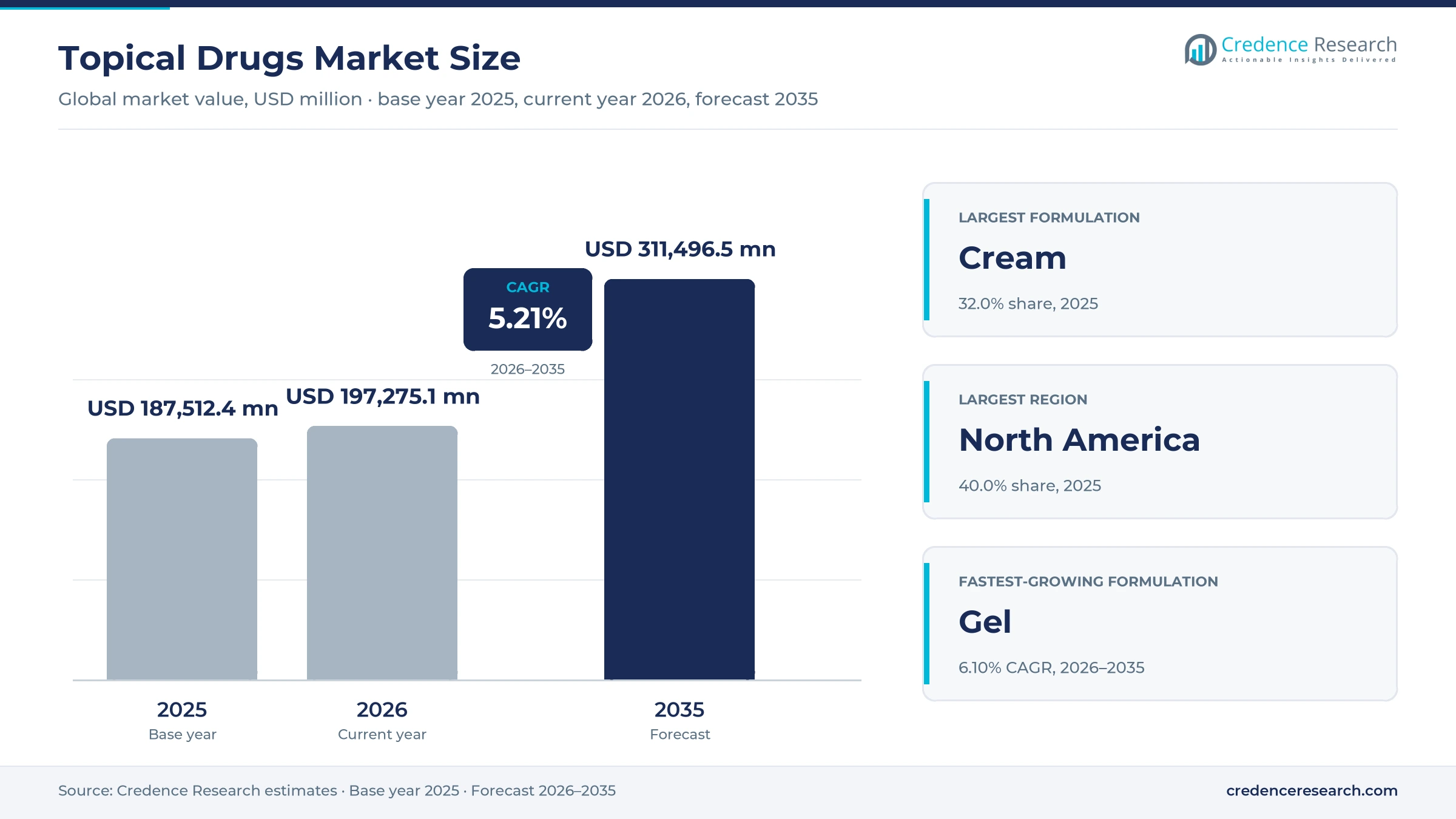
The global topical drugs market was valued at USD 187.51 billion in 2025 and is projected to increase from USD 197.28 billion in 2026 to USD 311.50 billion by 2035, registering a CAGR of 5.21% during 2026–2035. Demand comes from chronic skin conditions such as atopic dermatitis, psoriasis and acne, from pain relief gels and patches, and from anti-infective creams used at home and in clinics. North America held the largest regional share, 40.0% in 2025, because branded dermatology medicines carry high prices and broad insurance coverage. Asia Pacific is the fastest-growing region at 6.40% a year, as China, India and Southeast Asia widen access to dermatology care and local generic supply. The clinical picture changed in 2025, when U.S. regulators approved several steroid-free creams and foams for children and adults. As a result, prescribers now have more long-term options that avoid the side effects of topical steroids.
Which skin-applied medicines and care settings does this analysis cover?
The analysis counts prescription and over-the-counter medicines applied to the skin or mucosa, including creams, ointments, lotions, gels, suppositories and transdermal patches, valued at manufacturer selling prices. Patients buy most products through retail and online pharmacies for use at home, while hospitals, clinics and burn centers buy wound and procedure products directly.
Cosmetic skin care without a medical claim in 2025, medical devices without an active ingredient and contract manufacturing fees sit outside the scope of this analysis. The value chain runs from active ingredient suppliers and formulation developers through finished product makers to wholesalers, pharmacies and payers, which set formulary access and patient costs.
Topical Drugs Market Insights
- The topical drugs market grows from USD 187.51 billion in 2025 to USD 311.50 billion by 2035, a 5.21% CAGR as chronic skin disease care and home treatment expand.
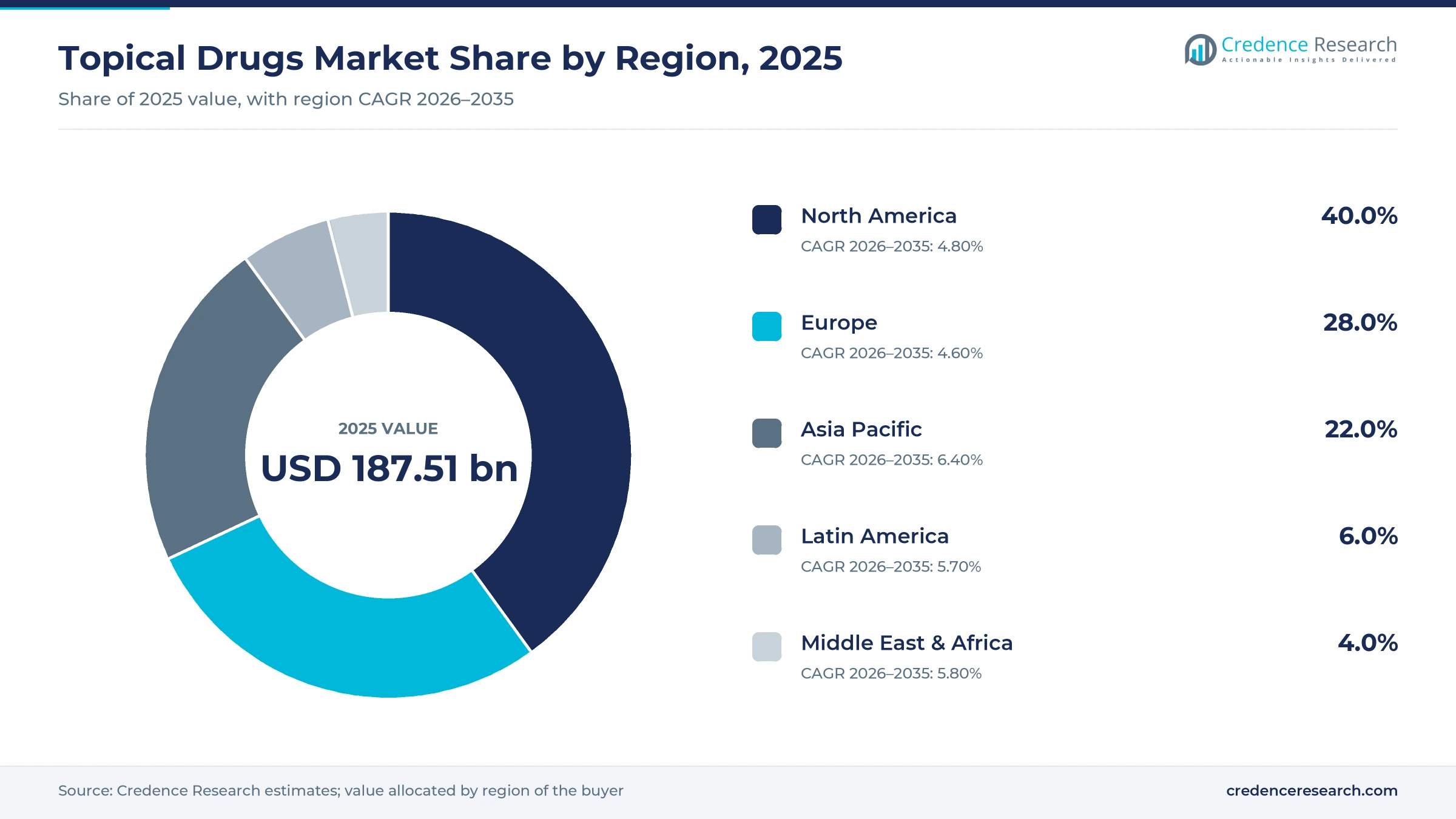
- North America held 40.0% of global value in 2025, supported by high prices for branded dermatology medicines and wide coverage.
- Creams led formulations with 32.0% of 2025 value, because they suit most chronic skin conditions and are easy to apply at home.
- In May 2025, the World Health Assembly adopted a resolution that recognizes skin diseases as a global public health priority for member states.
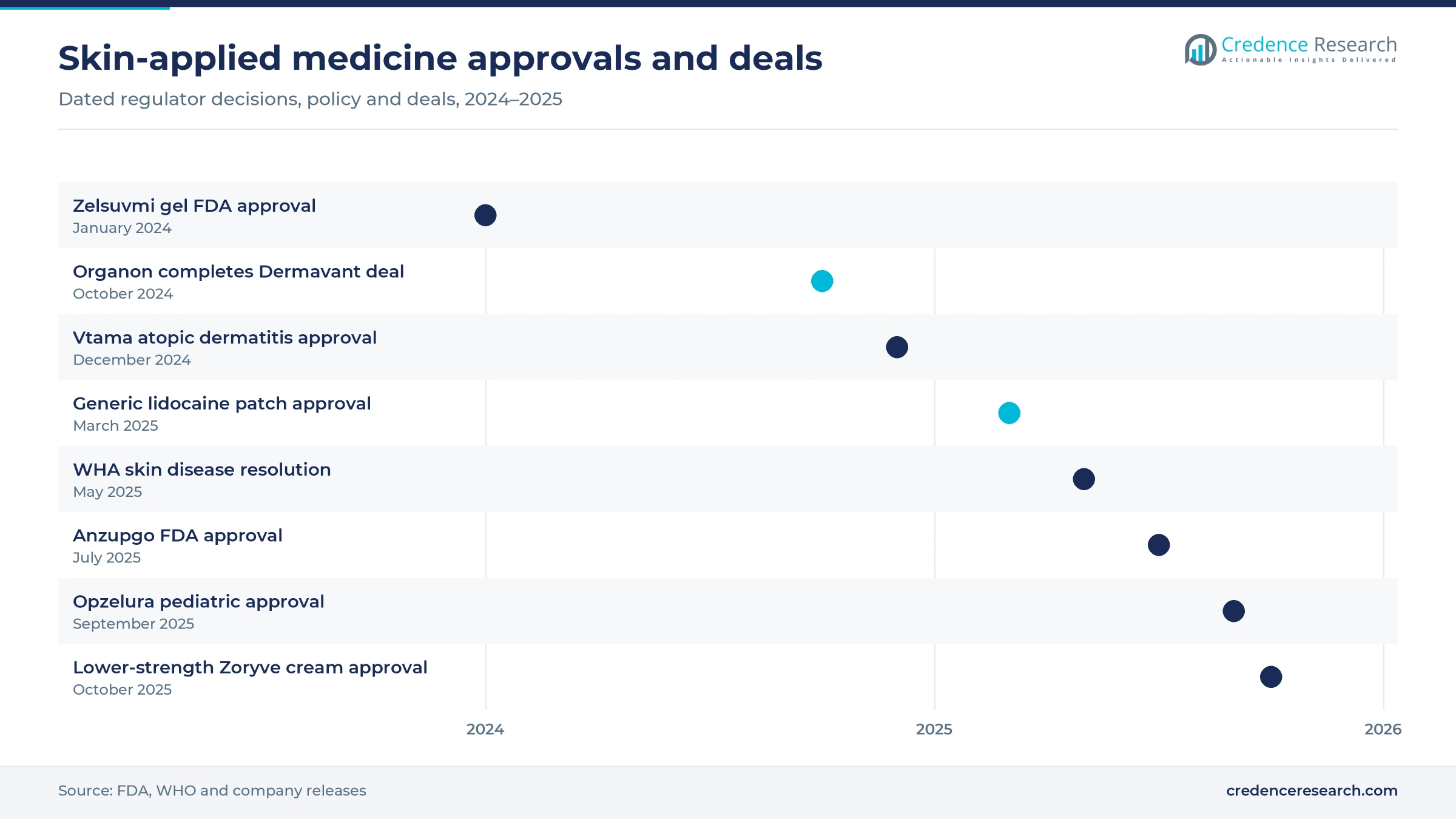
- In October 2024, Organon completed its acquisition of Dermavant, adding the non-steroidal Vtama cream to its U.S. dermatology portfolio.
Creams lead while gels gain the fastest ground
Why do creams lead skin-applied medicine spending?
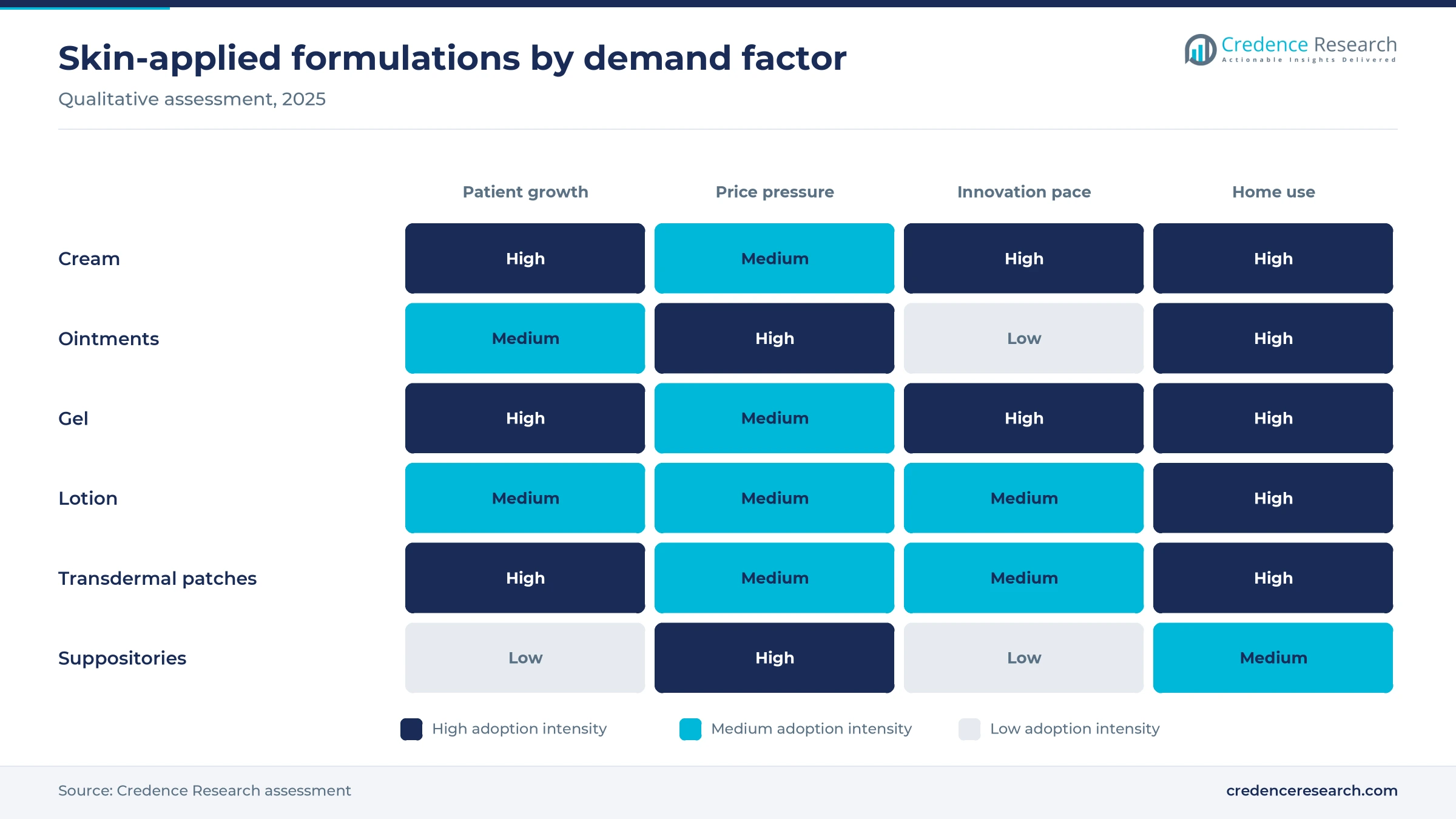
Based on formulation, the market is categorized into cream, ointments, lotion, gel, suppositories and transdermal patches. Cream led with a 32.0% share of 2025 value, because creams balance moisture and absorption for eczema, psoriasis and infection care. Gel grows fastest at 6.10% a year, as pain relief, acne and antiviral products move to light, fast-drying bases that patients prefer for daily use.
Where are skin-applied medicines used most often?
Based on end use, the market is categorized into home care settings, hospitals and clinics, burn centers and other facilities. Home Care Settings led with a 53.0% share of 2025 value, because most chronic skin and pain treatment is applied by patients themselves. Home Care Settings also grow fastest at 5.63% a year, as new steroid-free products allow long-term use without frequent clinic visits. Burn centers buy silver-based and antibiotic creams as part of burn care for severe wounds.
| Segment Group | Leading Sub-segment | Share, 2025 | Fastest-growing Sub-segment | CAGR, 2026–2035 |
|---|---|---|---|---|
| By Formulation | Cream | 32.0% | Gel | 6.10% |
| By End Use | Home Care Settings | 53.0% | Home Care Settings | 5.63% |
Request a Free Sample
Fill in your details and we'll send you a free sample report.
- Sample data tables & charts
- Research methodology
Skin disease burden and new approvals lift demand
How does the global skin disease burden sustain demand?
Eczema, psoriasis, acne and fungal infection are common in every region, so skin-applied medicines remain the first treatment for most patients. In May 2025, member states at the Seventy-eighth World Health Assembly adopted a resolution that recognizes skin diseases as a global public health priority. The resolution asks governments to improve access to affordable diagnosis and treatment through primary care services. Molluscum contagiosum alone affects an estimated 16.7 million people in the United States each year, mostly children. Fungal and bacterial skin infections add further demand for low-cost creams in warm and humid climates. As a result, creams held 32.0% of 2025 value, because they suit the largest patient groups.
Why do new steroid-free approvals widen treatment choice?
Many patients cannot use topical steroids for long periods, because repeated use can thin the skin and trigger withdrawal reactions. In September 2025, the FDA approved Opzelura ruxolitinib cream for mild to moderate atopic dermatitis in children aged two to 11. In October 2025, the FDA approved a lower-strength Zoryve roflumilast cream for children aged two to five with the same condition. In December 2024, the FDA approved Vtama tapinarof cream for atopic dermatitis in patients aged two years and older. These approvals followed earlier adult labels, which gives prescribers several mechanisms to rotate. In turn, children who start therapy early can stay on steroid-free treatment for years.
How does chronic pain lift demand for analgesic gels?
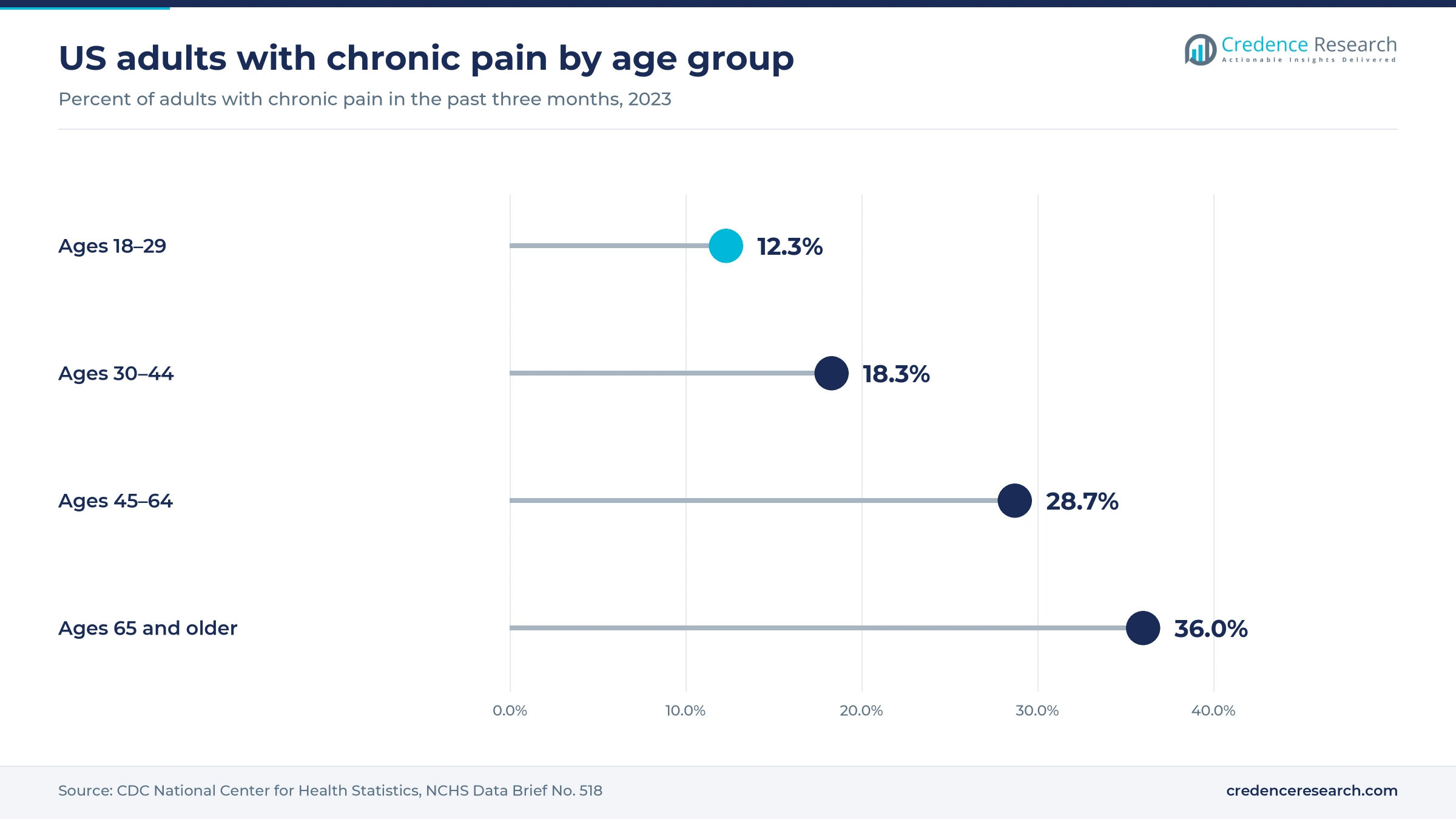
In 2023, 24.3% of U.S. adults had chronic pain in the past three months, and 8.5% had high-impact chronic pain that limited daily life. The rate rose to 36.0% among adults aged 65 and older, which ties demand for analgesic gels and patches to population aging. Doctors often prefer skin-applied options for older patients, because these products limit the stomach and dependence risks of oral painkillers. In March 2025, the FDA approved a generic lidocaine 1.8% patch from Aveva Drug Delivery Systems for post-herpetic neuralgia, a nerve pain condition. Lower-cost generic patches widen access for patients on fixed incomes. As a result, non-opioid gels and patches gain users among older adults, especially in North America.
Why does dermatology dealmaking expand commercial reach?
In October 2024, Organon completed its acquisition of Dermavant, which added the non-steroidal Vtama cream to its U.S. dermatology business. Large companies buy proven dermatology products, because their sales forces reach many more prescribers than a small developer can. In July 2025, Pelthos Therapeutics launched Zelsuvmi, the first at-home prescription gel for molluscum contagiosum, after its FDA approval in January 2024. In May 2025, Arcutis Biotherapeutics expanded its Zoryve line with a foam approved for plaque psoriasis of the scalp and body in patients aged 12 and older. In turn, wider sales networks bring new products to more patients in every major market.
Steroid-free options and home use reshape skin care
How is the shift to non-steroidal creams reshaping eczema care?
Prescribers increasingly reserve steroids for short flares and move patients to newer creams for long-term control. In July 2025, the FDA approved LEO Pharma Anzupgo delgocitinib cream for moderate to severe chronic hand eczema in adults who do not respond to steroid creams. Four topical approvals in 2025 came from three different companies, and all of them involved steroid-free products. These products can be used on the face and skin folds, where steroid side effects are most common. Janus kinase, phosphodiesterase 4 and aryl hydrocarbon receptor agents now compete for the same patients. As a result, gels and creams with new mechanisms take share from older steroid ointments in North America and Europe.
Why is home treatment rising across chronic skin conditions?
Home care settings held 53.0% of 2025 value and grow at 5.63% a year through 2035, the fastest pace of any care setting. Once-daily creams and gels let patients manage chronic disease without regular clinic visits. Zelsuvmi, which launched in July 2025, was approved in January 2024 for at-home use in patients aged one year and older. Molluscum contagiosum causes about 6 million new U.S. cases each year, mostly in children treated by parents. Newer pediatric approvals for atopic dermatitis also support care by parents at home. In turn, retail and online pharmacies handle a growing share of skin-applied prescriptions across every region.
Can pediatric labels open longer treatment journeys?
Children who start treatment early may stay on therapy for many years, which gives makers with pediatric safety data a clear opening. About 9.6 million U.S. children live with atopic dermatitis, compared with about 16.5 million adults, according to National Eczema Association figures. In September 2025, the FDA extended Opzelura to children aged two to 11, and a lower-strength Zoryve cream followed in October 2025 for ages two to five. In the trial behind the Zoryve label, 25.4% of treated children met the main response goal, compared with 10.7% on vehicle cream. Vtama cream received its eczema label for patients aged two years and older in December 2024. As a result, pediatric labels can extend brand life beyond adult markets.
Where can public coverage expand access in acne and psoriasis?
Many patients stop treatment when branded creams are not reimbursed, so public coverage creates room to expand access. In July 2025, Bausch Health announced coverage for Cabtreo, a three-ingredient gel for acne vulgaris, in the Ontario and Nova Scotia drug plans and two federal programs. The gel combines clindamycin 1.2%, adapalene 0.15% and benzoyl peroxide 3.1% in one daily application for patients aged 12 and older. In May 2025, the World Health Assembly called on governments to expand access to affordable skin treatment through primary care. Generic approvals, such as the lidocaine patch cleared in March 2025, also lower costs for payers. In turn, wider coverage can raise adherence in price-sensitive regions.
Generic pricing, skin irritation and access limit gains
Why does generic price erosion weigh on value growth?
Many older steroid, antifungal and analgesic creams are sold by dozens of makers after their reference products lose exclusivity. Retail chains and payer tenders then push prices down, which reduces value even when volumes rise each year. Generic approvals continue to arrive, such as the March 2025 lidocaine patch that competes with a branded nerve pain product. Indian and Chinese suppliers add further pressure in emerging markets with low-cost creams and gels. As a result, value growth depends heavily on new branded products with clear clinical differences.
How do skin irritation and adherence problems slow uptake?
Burning, stinging and greasy textures lead many patients to stop treatment early, even when the medicine works well. Twice-daily regimens also fit poorly with work and school routines, especially for children and older adults. Poor adherence reduces treatment success in clinical practice compared with results reported in controlled trials. Parents of young children often apply less product than prescribed, because they fear side effects. In turn, makers must invest in better vehicles and patient education, which raises development and launch costs.
Why does topical steroid safety concern limit long-term use?
Thinning skin, stretch marks and withdrawal reactions worry patients and parents who use steroid creams for months at a time. Many patients under-use prescribed steroids for this reason, which leaves disease poorly controlled between flares. Newer steroid-free creams address this concern, but their prices are much higher than generic steroids. Payers therefore often require patients to try and fail steroids before covering a newer product. As a result, demand shifts toward new agents more slowly than clinical guidance alone would suggest.
How do access gaps in low-income regions restrict demand?
Many people with skin disease in low-income regions cannot see a dermatologist or afford branded products. Rural clinics often stock only basic antifungal and antibiotic creams, which limits care for chronic inflammatory disease. The May 2025 World Health Assembly resolution highlighted these gaps and asked countries to strengthen primary care for skin health. Supply chains for newer products also remain thin outside large cities, which delays launches by several years. In turn, growth in these areas depends on primary care training and low-cost generic supply.
North America leads as Asia Pacific gains pace
| Region | Value, 2025 (USD billion) | Share, 2025 | CAGR, 2026–2035 |
|---|---|---|---|
| North America | 75.00 | 40.0% | 4.80% |
| Europe | 52.50 | 28.0% | 4.60% |
| Asia Pacific | 41.25 | 22.0% | 6.40% |
| Latin America | 11.25 | 6.0% | 5.70% |
| Middle East & Africa | 7.50 | 4.0% | 5.80% |
Why does North America hold the largest regional share?
North America held a 40.0% share of 2025 value and grows at 4.80% a year through 2035. The United States drives this position, because branded steroid-free creams and foams launch first in this market and carry high prices. All four topical approvals of 2025, including Anzupgo, the Opzelura pediatric label and a lower-strength Zoryve cream, came from the FDA. However, generic competition keeps prices low for older steroid and antifungal products.
How fast is Asia Pacific adding treated patients?
Asia Pacific held a 22.0% share of 2025 value and is the fastest-growing region at 6.40% a year. China, India and Southeast Asia are expanding public insurance and dermatology services in large cities. Japanese makers lead in medicated patches, while Indian producers supply low-cost generic creams and gels across the region. As a result, the region adds the largest number of new patients through 2035.
What shapes demand across Europe?
Europe held a 28.0% share of 2025 value and grows at 4.60% a year, the slowest pace of the five regions. Germany, France, the United Kingdom, Italy and Spain account for most spending through national formularies and pharmacy sales. Many skin products are sold over the counter, which keeps average prices lower than in the United States. However, steady demand for eczema and psoriasis care supports volume growth.
Where is Latin America adding demand?
Latin America held a 6.0% share of 2025 value and grows at 5.70% a year through 2035. Brazil and Mexico lead regional spending in 2025, while pharmacies sell many antifungal, acne and pain relief products without a prescription.
What limits growth in the Middle East and Africa?
The Middle East and Africa held a 4.0% share of 2025 value and grows at 5.80% a year through 2035, from a small 2025 base. Gulf states fund branded dermatology products, while much of Africa relies on basic creams supplied through primary care.
Approvals, launches and deals since 2024
| Development | Status and market relevance |
|---|---|
| In October 2024, Organon completed its acquisition of Dermavant, adding Vtama tapinarof cream to its U.S. dermatology portfolio. | Completed; extends a non-steroidal cream portfolio in psoriasis and eczema |
| In December 2024, the FDA approved Vtama tapinarof cream for atopic dermatitis in patients aged two years and older. | Approved; adds a second indication to a non-steroidal cream |
| In May 2025, the World Health Assembly adopted a resolution recognizing skin diseases as a global public health priority. | Adopted; prepares the ground for a global plan of action on skin health |
| In July 2025, the FDA approved LEO Pharma Anzupgo delgocitinib cream for chronic hand eczema in adults. | Approved; first cream for this condition in the United States |
| In October 2025, the FDA approved a lower-strength Zoryve roflumilast cream for children aged two to five with atopic dermatitis. | Approved; extends a steroid-free cream to younger children |
Formulation science and new targets lead innovation
- Janus kinase inhibitor creams block inflammatory signaling inside the skin, which gives steroid-free control of eczema and hand dermatitis.
- Phosphodiesterase 4 inhibitor creams and foams reduce inflammation with once-daily dosing, which suits sensitive areas and long-term use.
- Aryl hydrocarbon receptor agonists restore the skin barrier and calm inflammation, which offers a new mechanism for psoriasis and eczema.
- Nitric oxide releasing gels act against viral skin infection, which allows at-home treatment of molluscum contagiosum.
- Fixed-dose combination gels join several active ingredients in one product, which simplifies acne care and supports adherence.
Need a Custom Version of This Report?
Tailor the scope, geography, or segments to your exact requirements.
- Custom geography or segment scope
- Direct access to our analyst team
Originators and generic makers compete on formulation
Competition is led by large pharmaceutical companies with dermatology, pain and consumer health portfolios, alongside generic makers and formulation specialists. This report profiles 10 companies across originator, generic and development roles. Bayer AG, GSK plc and Johnson & Johnson Services, Inc. compete in antifungal, wound care and over-the-counter skin products, where brand trust and pharmacy reach shape choice. Novartis AG and Merck KGaA supply prescription medicines and active ingredients, while Bausch Health Companies Inc. focuses on acne and other dermatology prescriptions. Hisamitsu Pharmaceutical Co., Inc. leads in medicated pain relief patches, and Cipla Limited and Sparsha Pharma supply generic creams, gels and ointments. MedPharm Ltd. provides formulation development and manufacturing for topical products. As a result, competition increasingly centers on steroid-free mechanisms, vehicle quality and payer access.
Companies profiled and their roles in this market
| Company | Type | Role in the market |
|---|---|---|
| Bayer AG | Originator and consumer health | Antifungal and dermatology creams and ointments |
| GSK plc | Originator | Prescription dermatology and anti-infective products |
| Johnson & Johnson Services, Inc. | Originator | Dermatology and consumer skin care medicines |
| Novartis AG | Originator and generics | Prescription and generic skin-applied medicines |
| Bausch Health Companies Inc. | Originator | Acne and dermatology prescriptions including Cabtreo |
| Hisamitsu Pharmaceutical Co., Inc. | Originator | Medicated pain relief patches |
| Merck KGaA | Originator and supplier | Medicines and pharmaceutical ingredients |
| Cipla Limited | Generics | Generic creams, gels and ointments |
| Sparsha Pharma | Generics | Generic dermatology formulations |
| MedPharm Ltd. | Formulation specialist | Topical formulation development and manufacturing |
Steroid-free innovation sets the pace to 2035
Credence Research's view is that steroid-free innovation and home treatment will set the pace of change through 2035, while the skin disease burden keeps volumes rising. The overall market grows at 5.21% a year from USD 187.51 billion in 2025, supported by eczema, psoriasis and acne care and by pain relief gels and patches. Generic price erosion restrains value growth for older steroid and antifungal products in mature markets. Companies that pair well-tolerated vehicles with pediatric data and payer access will win the most patients.
How Credence Research sized skin-applied medicines
The report uses 2025 as the base year and 2026 to 2035 as the forecast period. Market values come from the Credence Research model, which builds spending by formulation, end use and region. Regional and segment splits are Credence Research estimates informed by FDA approval records, WHO publications, CDC statistics and company press releases. No primary interviews or surveys were used in preparing this edition of the report.
Skin-applied medicine spending outlook to 2035
By 2035, the topical drugs market is projected to reach USD 311.50 billion, up from USD 197.28 billion in 2026, with growth led by steroid-free creams, gels and pain relief patches. Creams will remain the largest formulation, while gels take share in acne, pain and antiviral care. North America keeps the highest spending per patient, although generic competition limits price growth for older products. Home care settings, the largest end use in 2025, will handle a larger share of chronic skin treatment over the decade. As a result, advantage will depend on new mechanisms, pediatric labels and access programs.
Frequently Asked Questions
How big is the global topical drugs market?
Which formulation leads the topical drugs market?
Which region leads skin-applied medicine spending?
Which end use setting grows fastest?
Which steroid-free creams did the FDA approve in 2025?
Why did the World Health Assembly act on skin diseases?
Who are the leading topical drug companies?
What restrains growth in topical drugs?
Table of Content
Chapter 1 Market Segmentation
- 1.1 Segmentation Framework
- 1.1.1 Product and Service Classification
- 1.1.2 Application and End-Use Classification
- 1.1.3 Technology and Solution Classification
- 1.1.4 Customer and Distribution Channel Classification
- 1.1.5 Geographic Segmentation
- 1.1.6 Market Segment Definitions and Boundaries
- 1.2 By Formulation
- 1.2.1 Cream
- 1.2.2 Ointments
- 1.2.3 Gel
- 1.2.4 Transdermal Patches
- 1.2.5 Lotion
- 1.2.6 Suppositories
- 1.3 By End Use
- 1.3.1 Home Care Settings
- 1.3.2 Hospitals & Clinics
- 1.3.3 Burn Centers
- 1.3.4 Other Facilities
Chapter 2 Introduction
- 2.1 Report Objectives and Scope
- 2.2 Product Definition and Industry Terminology
- 2.3 Market Inclusions and Exclusions
- 2.4 Research Process
- 2.4.1 Primary Research and Expert Interviews
- 2.4.2 Secondary Research and Source Review
- 2.4.3 Top-Down and Bottom-Up Estimation
- 2.4.4 Data Triangulation and Verification
- 2.5 Market Size Measurement Basis
- 2.5.1 2025: USD 187.51 billion → 2035: USD 311.50 billion
- 2.6 Historical and Forecast Reference Periods
- 2.6.1 Historical Period: 2018-2025
- 2.6.2 Base Year: 2025
- 2.6.3 Forecast Period: 2025-2035
- 2.7 Research Assumptions and Limitations
Chapter 3 Executive Summary
- 3.1 Market Snapshot and Key Findings
- 3.2 Base-Year Market Size, 2025
- 3.3 Forecast Market Size, 2035
- 3.4 Revenue and Volume Growth Outlook
- 3.5 Key Demand and Supply Indicators
- 3.6 Leading Market Segments
- 3.7 Fastest-Growing Market Opportunities
- 3.8 Regional Performance Highlights
- 3.9 Technology and Industry Transformation
- 3.10 Competitive Landscape Summary
- 3.11 Analyst View and Strategic Implications
Chapter 4 Global Topical Drugs Market Trends and Developments
- 4.1 Historical Industry Development, 2018-2025
- 4.2 Recent Market Trends and Developments
- 4.3 Demand and Customer Behavior Trends
- 4.4 Technology and Product Innovation
- 4.5 Artificial Intelligence, Automation and Digitalization
- 4.6 Local Manufacturing and Supply Chain Realignment
- 4.7 Industry Partnerships, Mergers and Acquisitions
- 4.8 Sustainability and Circular Economy Developments
- 4.9 Government and Private Sector Investment Trends
- 4.10 Emerging Business Models and Commercialization
- 4.11 Industry Developments and Announcements
Chapter 5 Global Topical Drugs Market Production, Supply and Demand Analysis
- 5.1 Demand Trend and Consumption Analysis, 2018-2025
- 5.2 Demand Forecast, 2025-2035
- 5.3 Production and Output Trend, 2018-2025
- 5.4 Production and Output Forecast, 2025-2035
- 5.5 Installed Capacity and Capacity Utilization
- 5.6 Company-Wise Production Plants and Statistics
- 5.6.1 Installed Production Capacity
- 5.6.2 Actual Production
- 5.6.3 Planned Capacity and Expansion Targets
- 5.7 Supply Chain Structure and Procurement Trends
- 5.8 Supply-Demand Gap and Bottlenecks
- 5.9 Import Dependence and Sourcing Structure
- 5.10 Contract Manufacturing and Outsourcing
- 5.11 Regional Supply and Demand Concentration
Chapter 6 Global Topical Drugs Market Pricing Analysis
- 6.1 Pricing Structure and Measurement
- 6.2 Historical Pricing Trends, 2018-2025
- 6.3 Pricing Outlook, 2025-2035
- 6.4 Average Selling Price and Unit Economics
- 6.5 Pricing by Product and Market Segment
- 6.6 Geographic Pricing Differences
- 6.7 Key Input, Energy, Labor and Logistics Costs
- 6.8 Contract Pricing and Purchasing Models
- 6.9 Pricing Sensitivity and Competitive Positioning
- 6.10 Price, Margin and Profitability Implications
Chapter 7 Global Topical Drugs Market Dynamics
- 7.1 Market Growth Drivers
- 7.1.1 Demand-Side Drivers
- 7.1.2 Technology and Innovation Drivers
- 7.1.3 Infrastructure and Investment Drivers
- 7.1.4 Regulatory and Policy Drivers
- 7.2 Market Restraints
- 7.2.1 Cost and Affordability Constraints
- 7.2.2 Technology and Adoption Barriers
- 7.2.3 Supply Chain and Operational Constraints
- 7.3 Market Challenges
- 7.3.1 Competitive Pressure and Margin Erosion
- 7.3.2 Skills, Infrastructure and Implementation Gaps
- 7.4 Emerging Market Opportunities
- 7.5 Market Dynamics Impact and Time-Horizon Assessment
Chapter 8 Global Topical Drugs Value Chain Analysis
- 8.1 Industry Value Chain Overview
- 8.2 Upstream Suppliers and Critical Inputs
- 8.3 Technology and Component Providers
- 8.4 Manufacturing or Service Delivery
- 8.5 Distribution, Channel Partners and Integrators
- 8.6 Downstream Applications and End Users
- 8.7 Value Addition and Profit Pools
- 8.8 Vertical Integration and Outsourcing
- 8.9 Supplier Concentration and Risk
- 8.10 Supply Chain Localization and Resilience
Chapter 9 Global Topical Drugs Market Regulations and Policies
- 9.1 Relevant Laws, Standards and Compliance Frameworks
- 9.2 Product, Service, Safety and Quality Requirements
- 9.3 Government Policies, Incentives and Subsidies
- 9.4 Imports, Exports and Trade Barriers
- 9.5 Public Procurement and Local Content Requirements
- 9.6 Environmental and Sustainability Compliance
- 9.7 Upcoming Policy Changes and Market Implications
Chapter 10 Global Topical Drugs Market Hotspots and Opportunities
- 10.1 Market Opportunity Mapping and Growth Hotspots
- 10.2 High-Growth Applications and Customer Groups
- 10.3 Underserved Markets and White-Space Opportunities
- 10.4 Emerging Technology and Product Opportunities
- 10.5 New Capacity and Investment Hotspots
- 10.6 Market Entry and Expansion Opportunities
- 10.7 Distribution and Partnership Opportunities
- 10.8 Near-Term and Long-Term Commercial Potential
- 10.9 Opportunity Attractiveness and Execution Risks
Chapter 11 Global Topical Drugs Market Outlook, 2025-2035
- 11.1 Market Size and Analysis
- 11.1.1 Revenue (Market Measurement: 2025: USD 187.51 billion → 2035: USD 311.50 billion)
- 11.1.2 Market Volume and Quantity Sold
- 11.1.3 Historical Market Size, 2018-2025
- 11.1.4 Base-Year Market Size, 2025
- 11.2 Market Forecast, 2025-2035
- 11.2.1 Revenue Forecast to 2035
- 11.2.2 Volume Forecast to 2035
- 11.2.3 CAGR and Year-on-Year Growth
- 11.2.4 Incremental Revenue Opportunity
- 11.3 Forecast Assumptions and Scenario Analysis
- 11.3.1 Base-Case Forecast
- 11.3.2 Optimistic and Conservative Scenarios
- 11.3.3 Technology, Pricing and Policy Sensitivities
- 11.4 Market Attractiveness and Growth Outlook
Chapter 12 Global Topical Drugs Market Segmentation and Outlook
- 12.1 Segmentation Summary and Market Shares, 2025
- 12.2 Largest and Fastest-Growing Segments
- 12.3 By Formulation - Market Size and Forecast, 2025-2035
- 12.3.1 Segment Definition and Scope
- 12.3.2 Historical Market Size, 2018-2025
- 12.3.3 Revenue Forecast, 2025-2035
- 12.3.4 Volume Forecast, 2025-2035
- 12.3.5 Base-Year Market Share, 2025
- 12.3.6 Segment CAGR and Growth Drivers
- 12.3.7 Subsegment Market Size and Forecast
- 12.3.7.1 Cream
- 12.3.7.2 Ointments
- 12.3.7.3 Gel
- 12.3.7.4 Transdermal Patches
- 12.3.7.5 Lotion
- 12.3.7.6 Suppositories
- 12.3.8 Subsegment Pricing and Adoption Trends
- 12.3.9 Leading Suppliers and Competition
- 12.3.10 Regional Demand and Opportunities
- 12.4 By End Use - Market Size and Forecast, 2025-2035
- 12.4.1 Segment Definition and Scope
- 12.4.2 Historical Market Size, 2018-2025
- 12.4.3 Revenue Forecast, 2025-2035
- 12.4.4 Volume Forecast, 2025-2035
- 12.4.5 Base-Year Market Share, 2025
- 12.4.6 Segment CAGR and Growth Drivers
- 12.4.7 Subsegment Market Size and Forecast
- 12.4.7.1 Home Care Settings
- 12.4.7.2 Hospitals & Clinics
- 12.4.7.3 Burn Centers
- 12.4.7.4 Other Facilities
- 12.4.8 Subsegment Pricing and Adoption Trends
- 12.4.9 Leading Suppliers and Competition
- 12.4.10 Regional Demand and Opportunities
- 12.5 Segment Growth Comparison
- 12.6 Segment Attractiveness and Priority Matrix
Chapter 13 Global Topical Drugs End-Use and Application Market Outlook
- 13.1 End-Use Industry and Customer Demand Structure
- 13.2 Leading Applications and Customer Groups
- 13.3 End-Use Market Size, Share and Forecast
- 13.4 Major End-Use Industry Deep Dives
- 13.4.1 Customer Requirements and Use Cases
- 13.4.2 Demand and Replacement Cycles
- 13.4.3 Technical and Regulatory Considerations
- 13.4.4 Purchasing and Procurement Models
- 13.4.5 Leading Vendors and Distribution Channels
- 13.4.6 Forecast and Commercial Opportunities
- 13.5 Emerging Applications and Cross-Segment Demand
- 13.6 End-Use Industry Investment Priorities
Chapter 14 Global Topical Drugs Geographic Market Outlook, 2025-2035
- 14.1 Regional Market Size and Share, 2025
- 14.2 Regional Market Forecast, 2025-2035
- 14.3 Regional Pricing, Production and Demand Differences
- 14.4 North America
- 14.4.1 United States
- 14.4.2 Canada
- 14.4.3 Mexico
- 14.5 Europe
- 14.5.1 Germany
- 14.5.2 France
- 14.5.3 Italy
- 14.5.4 United Kingdom
- 14.5.5 Spain
- 14.5.6 Poland
- 14.5.7 Russia
- 14.5.8 Netherlands
- 14.5.9 Belgium
- 14.5.10 Sweden
- 14.5.11 Denmark
- 14.5.12 Norway
- 14.5.13 Rest of Europe
- 14.6 Asia Pacific
- 14.6.1 China
- 14.6.2 India
- 14.6.3 Japan
- 14.6.4 South Korea
- 14.6.5 Thailand
- 14.6.6 Indonesia
- 14.6.7 Vietnam
- 14.6.8 Malaysia
- 14.6.9 Australia
- 14.6.10 Rest of Asia Pacific
- 14.7 Latin America
- 14.7.1 Brazil
- 14.7.2 Argentina
- 14.7.3 Colombia
- 14.7.4 Chile
- 14.7.5 Rest of Latin America
- 14.8 Middle East
- 14.8.1 Saudi Arabia
- 14.8.2 United Arab Emirates
- 14.8.3 Turkey
- 14.8.4 Israel
- 14.8.5 Iran
- 14.8.6 Rest of the Middle East
- 14.9 Africa
- 14.9.1 South Africa
- 14.9.2 Egypt
- 14.9.3 Nigeria
- 14.9.4 Morocco
- 14.9.5 Rest of Africa
- 14.10 Regional Investment, Policy and Supply Chain Differences
- 14.11 Regional Competitive Landscape
- 14.12 Geographic Growth Hotspots
Chapter 15 Global Topical Drugs Technology, Innovation and Sustainability Outlook
- 15.1 Technology Landscape and Maturity
- 15.2 Product, Process and Service Innovation
- 15.3 AI, Automation and Digital Tools in the Industry
- 15.4 Technology Adoption and Performance Benchmarking
- 15.5 Innovation Pipeline and R&D Investment
- 15.6 Patent and Intellectual Property Trends
- 15.7 Energy Efficiency and Resource Management
- 15.8 Sustainability, Recycling and Circularity
- 15.9 Technology Roadmap, 2025-2035
- 15.10 Risks of Obsolescence and Technology Substitution
Chapter 16 Global Topical Drugs Market Key Strategic Imperatives
- 16.1 Growth and Market Entry Priorities
- 16.2 High-Return Products and Segments
- 16.3 Pricing, Profitability and Cost Optimization
- 16.4 Technology Investment and Product Differentiation
- 16.5 Supply Chain Localization and Resilience
- 16.6 Distribution and Customer Acquisition
- 16.7 Partnership, Acquisition and Capacity Strategy
- 16.8 Regional Expansion Priorities
- 16.9 Short-, Medium- and Long-Term Actions
Chapter 17 Competition Outlook
- 17.1 Industry Competition Characteristics
- 17.2 Market Structure and Concentration
- 17.3 Market Share and Competitive Positioning, 2025
- 17.4 Company-Wise Revenue and Product Benchmarking
- 17.5 Production and Service Capacity Benchmarking
- 17.6 Technology, Pricing and Differentiation
- 17.7 Regional Footprint and Distribution Strength
- 17.8 Mergers, Acquisitions and Strategic Alliances
- 17.9 New Entrants and Competitive Threats
- 17.10 Porter's Five Forces and Industry Attractiveness
- 17.11 Competitive Outlook, 2025-2035
Chapter 18 Company Profiles
- 18.1 Company Coverage and Selection Criteria
- 18.2 Bayer AG
- 18.2.1 Business Description
- 18.2.2 Company Ownership and Geographic Presence
- 18.2.3 Product and Service Portfolio
- 18.2.4 Manufacturing and Operating Footprint
- 18.2.5 Production Capacity and Expansion Plans
- 18.2.6 Financial Performance and Investment
- 18.2.7 Market Share and Competitive Position
- 18.2.8 Technology and Innovation Capabilities
- 18.2.9 Strategic Alliances or Partnerships
- 18.2.10 Recent Developments
- 18.2.11 Growth Strategy and Outlook
- 18.3 Cipla Limited
- 18.4 GSK plc
- 18.5 Johnson & Johnson Services, Inc.
- 18.6 Novartis AG
- 18.7 Bausch Health Companies Inc.
- 18.8 Hisamitsu Pharmaceutical Co., Inc.
- 18.9 Merck KGaA
- 18.10 MedPharm Ltd.
- 18.11 Sparsha Pharma
- 18.12 Other Relevant Market Participants
Note: Every listed company is profiled on the structure shown under the first company. The company list is preliminary and may change based on research findings, market developments, data availability and client requirements.
Chapter 19 Disclaimer
- 19.1 Research and Forecast Disclaimer
- 19.2 Data Source and Estimation Limitations
Note: The depth of individual sections depends on data availability for this market. Volume, capacity, trade and other unit-based metrics are included where applicable.

