
Adult programs and new platforms lift immunization spending
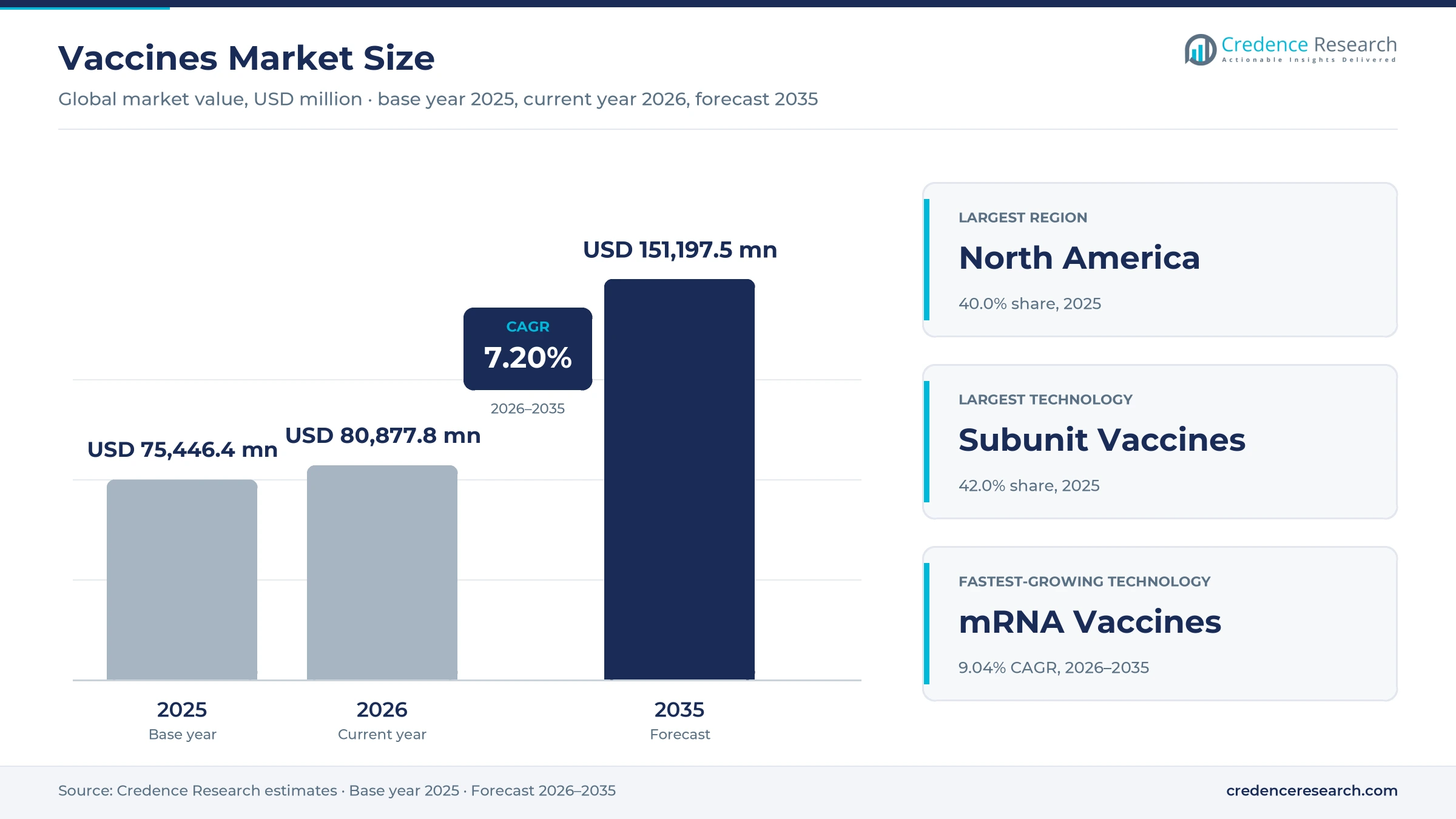
The global vaccines market was valued at USD 75.45 billion in 2025 and is projected to increase from USD 80.88 billion in 2026 to USD 151.20 billion by 2035, registering a CAGR of 7.20% during 2026–2035. Demand rises because national programs keep expanding childhood schedules, while health systems add pneumococcal, RSV, shingles and influenza shots for older adults. North America held the largest regional share, 40.0% in 2025, because the United States pays high prices for adult and newer pediatric products. Asia Pacific is the fastest-growing region at 8.28% a year, as India and China scale domestic manufacturing and add new antigens to public schedules. The commercial picture also changed in May 2024, when the first mRNA product for a disease other than COVID-19 won U.S. approval. As a result, mRNA, conjugate and combination products are taking a larger share of new spending.
Which immunization products and buyers does this analysis count?
Human prophylactic immunization products for viral and bacterial diseases, covering subunit, inactivated, live attenuated, mRNA and viral vector technologies in monovalent and multivalent forms, form the value counted here. Governments, international procurement agencies, hospitals and retail pharmacies buy these products for children and adults.
Veterinary products, therapeutic cancer immunotherapies and monoclonal antibodies given for passive protection sit outside the value counted here. The value chain runs from antigen development and fill-finish manufacturing through cold chain distribution to administration by clinics, pharmacies and public health programs.
Vaccines Market Insights
- The vaccines market grows from USD 75.45 billion in 2025 to USD 151.20 billion by 2035, a 7.20% CAGR as adult programs and new platforms widen immunization worldwide.
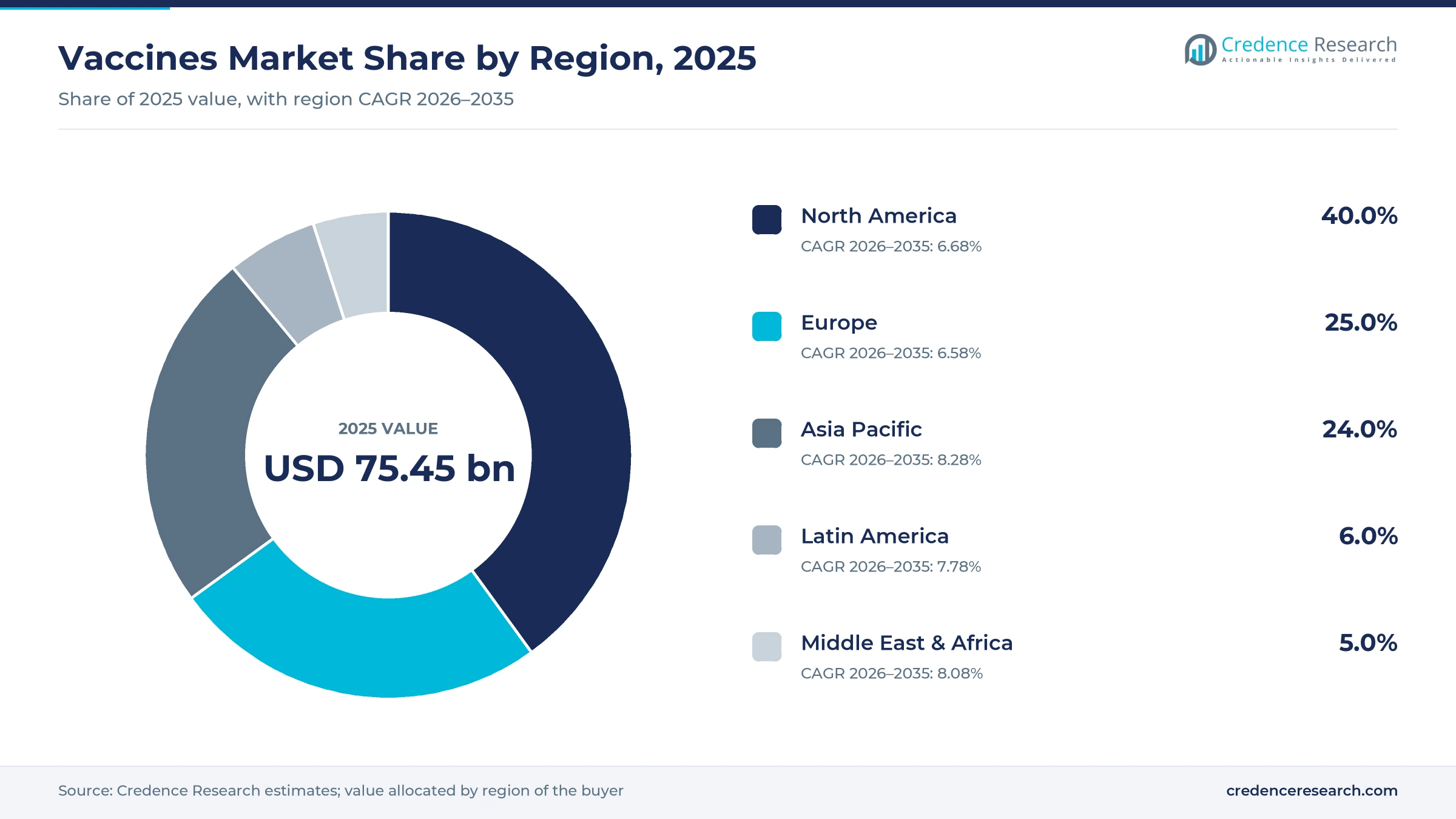
- North America held 40.0% of global value in 2025, because U.S. prices for adult and newer pediatric products remain high.
- Subunit products led technologies with 42.0% of 2025 value, while mRNA grows fastest at 9.04% a year through 2035.
- Gavi raised more than USD 9 billion at its June 2025 summit in Brussels, short of the USD 11.9 billion it sought for 2026 to 2030.
- BioNTech closed its exchange offer for CureVac in December 2025, adding mRNA design, delivery and manufacturing technologies to its platform.
Subunit products lead while mRNA grows fastest
Which technologies account for most immunization spending?
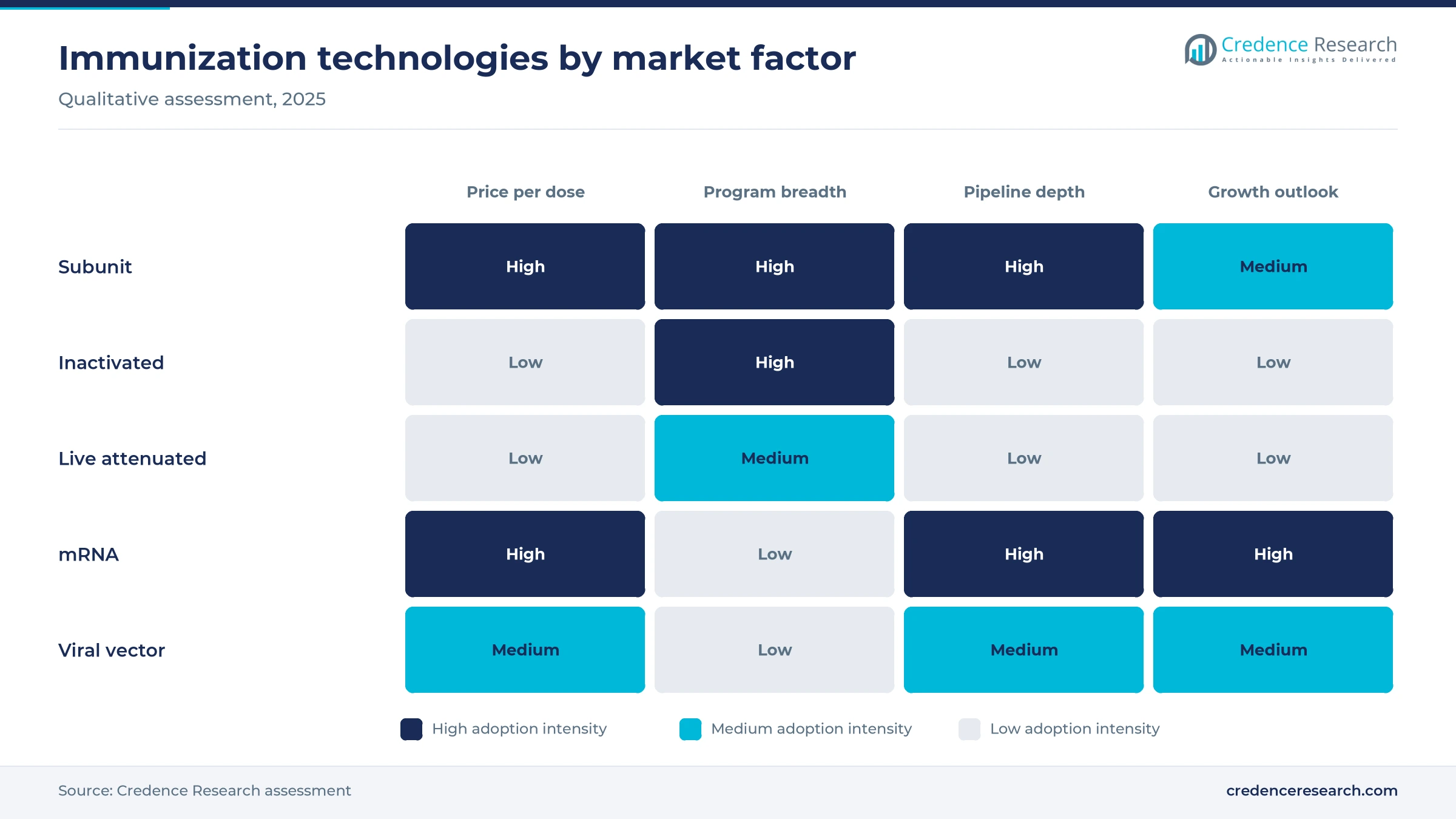
Based on technology, the market is categorized into subunit, inactivated, live attenuated, mRNA and viral vector products. The Subunit Vaccines group led with 42.0% of 2025 value, because conjugate, recombinant protein and toxoid products dominate pneumococcal, shingles, HPV and meningococcal programs. mRNA Vaccines grow fastest at 9.04% a year, as approvals extend beyond COVID-19 into RSV and other respiratory targets. Inactivated products remain central to polio, hepatitis A and influenza programs worldwide.
How do buyers procure immunization products?
Based on distribution channel, the market is categorized into hospital pharmacies, retail pharmacies and government suppliers. Government Suppliers led with 48.0% of 2025 value, because national programs, UNICEF and Gavi buy most childhood doses through tenders. Retail Pharmacies grow fastest at 8.37% a year, as pharmacists give more adult influenza, COVID-19, RSV and shingles shots. Hospital pharmacies serve birth doses, travelers and high-risk patients in specialist care.
Do adults or children account for more spending?
Based on age group, the market is categorized into adult and children. Adult led with 55.0% of 2025 value, because high-priced pneumococcal, RSV, shingles and COVID-19 products target older adults. The same group grows fastest at 7.77% a year, as more countries add adult schedules. Childhood programs still deliver most doses, though public tender prices keep their value per dose low.
| Segment Group | Leading Sub-segment | Share, 2025 | Fastest-growing Sub-segment | CAGR, 2026–2035 |
|---|---|---|---|---|
| By Technology | Subunit Vaccines | 42.0% | mRNA Vaccines | 9.04% |
| By Distribution Channel | Government Suppliers | 48.0% | Retail Pharmacies | 8.37% |
| By Age Group | Adult | 55.0% | Adult | 7.77% |
Request a Free Sample
Fill in your details and we'll send you a free sample report.
- Sample data tables & charts
- Research methodology
Coverage gaps, Gavi funding and adult products drive demand
How do childhood coverage gaps sustain program demand?
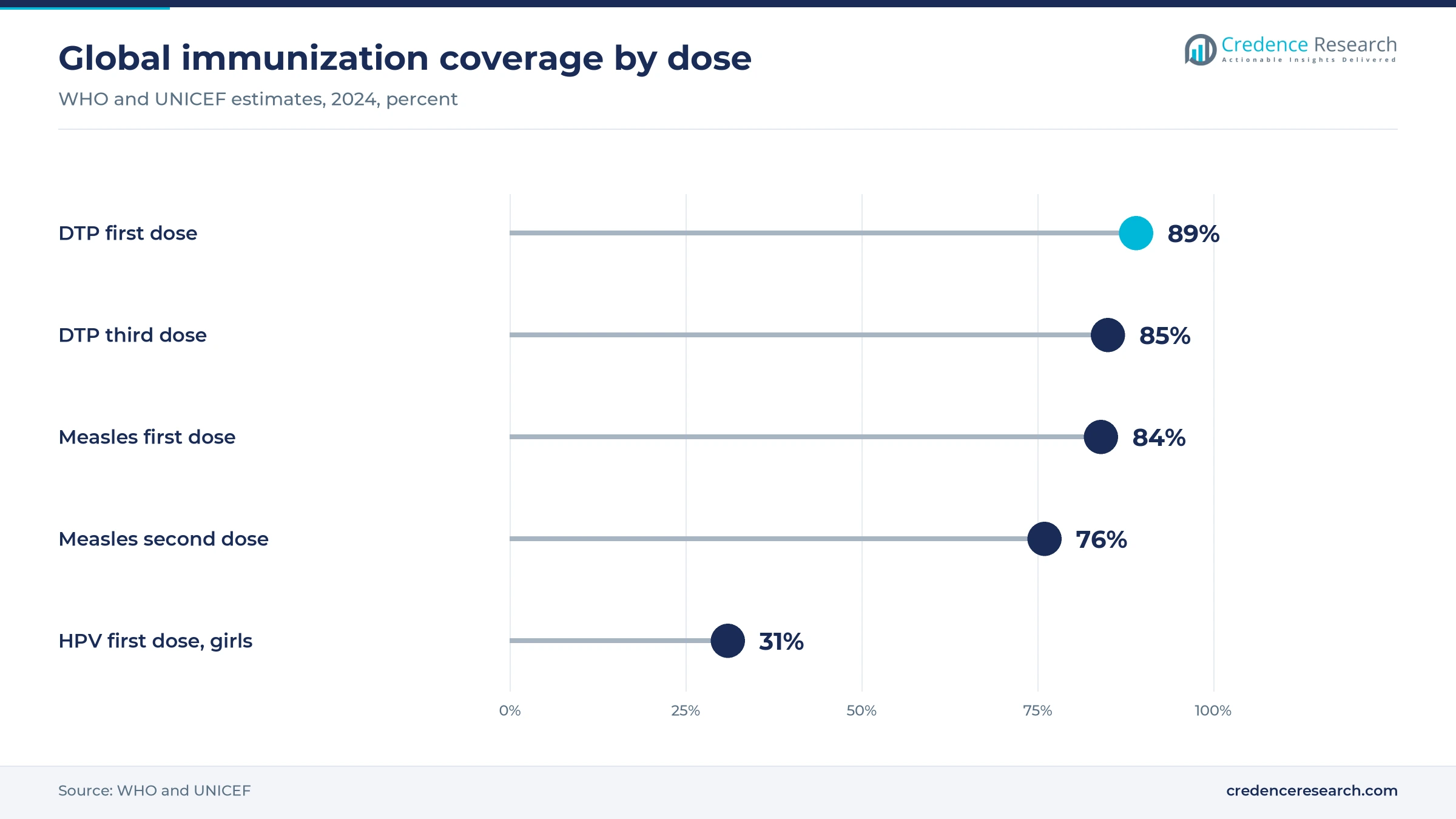
Each new birth cohort needs a full primary series, and millions of infants still miss basic doses every year in poorer countries. According to WHO and UNICEF estimates, 85% of infants, about 109 million children, completed three DTP doses in 2024. The same estimates counted 14.3 million zero-dose children who received no vaccine at all. UNICEF delivered about 2.787 billion doses to 99 countries in 2024, enough to reach roughly 45% of children under five. As a result, government suppliers held 48.0% of 2025 value, the largest channel share, and tender volumes stay high even as prices per dose remain low.
Why does Gavi funding shape demand in poorer countries?
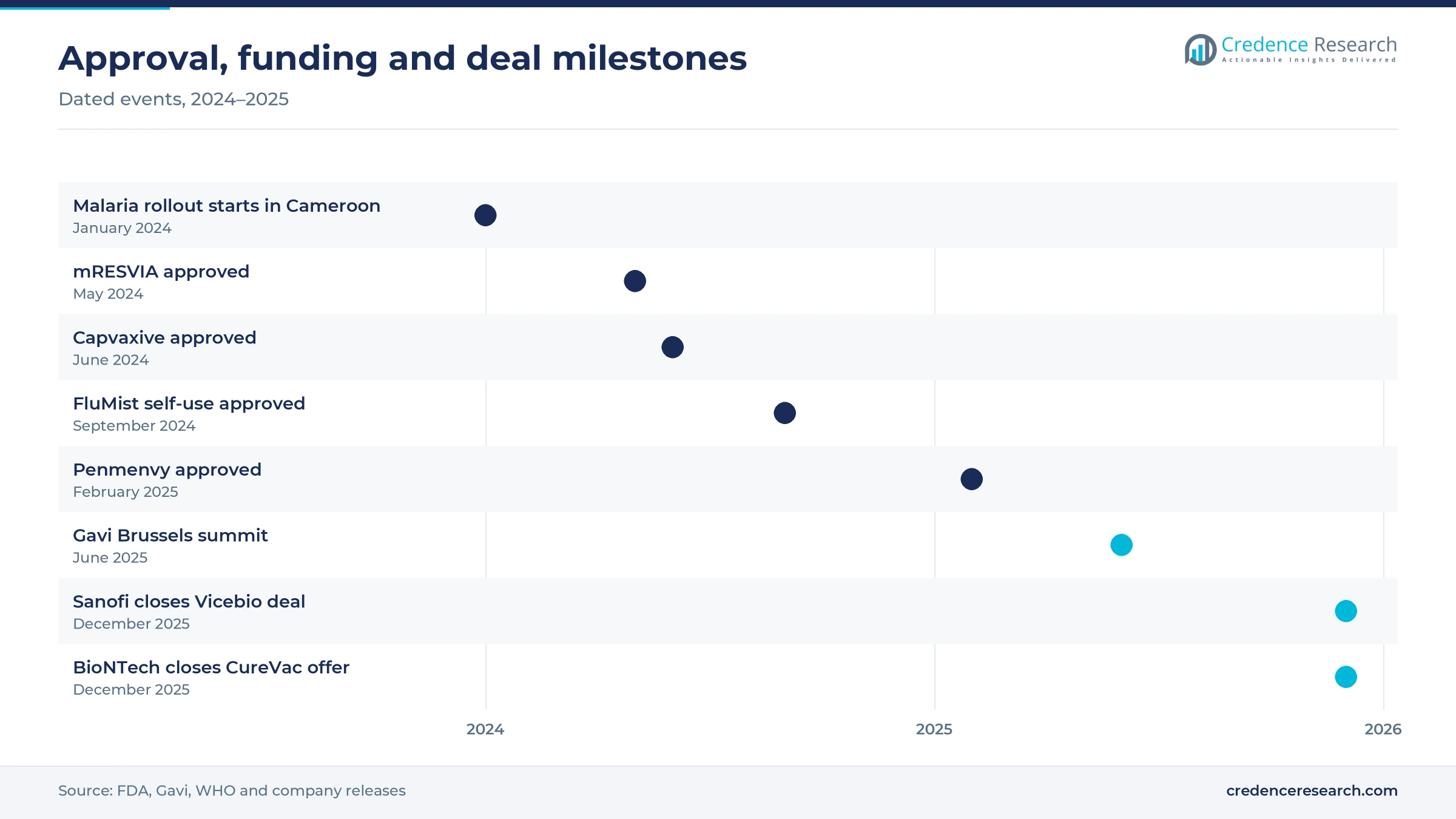
Many low-income countries depend on donor money to introduce newer antigens, and Gavi co-finances programs in 57 of them. On June 25, 2025, Gavi raised more than USD 9 billion at its Brussels summit for the 2026 to 2030 period. Gavi aims to protect 500 million children over that period and avert 8 million to 9 million future deaths. At least 17 African countries had introduced a malaria vaccine by the end of 2024, after Cameroon started in January 2024. In turn, the Middle East and Africa grows at 8.08% a year, and medical refrigerators remain essential for the cold chain.
How are adult products raising spending per person?
Older adults now receive several high-priced shots across their later years, which lifts value per person well above childhood levels. On June 17, 2024, the FDA approved Merck's Capvaxive for adults 18 and older against invasive pneumococcal disease and pneumonia. Merck said the 21-valent product covers about 84% of invasive cases in adults 50 and older, compared with about 52% for PCV20. On Oct. 22, 2024, Pfizer announced FDA approval of Abrysvo for adults 18 to 59 at increased RSV risk, widening use beyond older adults. As a result, adults led age groups with 55.0% of 2025 value, and adult demand keeps growing.
Why is mRNA technology moving beyond COVID-19?
The mRNA format allows fast design changes, so developers now aim it at RSV, influenza and other respiratory viruses with regulatory support. On May 31, 2024, the FDA approved Moderna's mRESVIA for adults 60 and older, the first mRNA product cleared for a disease other than COVID-19. On May 31, 2025, Moderna announced approval of mNEXSPIKE, which used a 10 microgram dose, one-fifth of the comparator dose in its trial. BioNTech closed its CureVac exchange offer on Dec. 18, 2025, with about 86.75% of shares tendered. In turn, mRNA products grow fastest at 9.04% a year, linked to wider mRNA therapeutics research.
Higher valency, pipeline deals and home flu spray openings
How is the rise of higher-valency products changing schedules?
Makers are packing more strains into each shot, because fewer injections ease scheduling for clinics, schools and families. On Feb. 14, 2025, the FDA approved GSK's Penmenvy for people aged 10 to 25 against meningococcal serogroups A, B, C, W and Y. The phase 3 study enrolled 3,650 participants and met all 11 primary endpoints, according to trade reports. Penmenvy became the second pentavalent meningococcal product in the United States, after Pfizer's Penbraya. Merck's 21-valent Capvaxive also covers eight serotypes not found in older adult products. As a result, multivalent products gain share in adolescent and adult schedules, and older single-strain products lose ground.
Are pipeline acquisitions reshaping the competitive field?
Large companies are buying smaller developers, because respiratory combinations and new platforms need specialist design tools and experienced research teams. On Dec. 4, 2025, Sanofi completed its acquisition of Vicebio, adding an early RSV and human metapneumovirus combination candidate. Vicebio also brought its Molecular Clamp technology, which Sanofi described as a non-mRNA design option. BioNTech completed its CureVac exchange offer two weeks later, on Dec. 18, 2025. However, Johnson & Johnson stopped its phase 3 E. coli vaccine trial in February 2025 after an interim analysis showed weak efficacy. In turn, buyers favor platforms with proven clinical data and manufacturing depth.
Can home flu spray delivery open a retail channel?
Self-administration removes the clinic visit for healthy children and adults, which creates a new path to patients who skip annual shots. On Sept. 20, 2024, the FDA approved AstraZeneca's FluMist for self-administration by adults up to age 49 and caregiver use for ages 2 to 17. Orders go through FluMist Home, an online pharmacy where a pharmacist reviews an eligibility questionnaire before shipping. FluMist became the only self-administered influenza product approved in the United States. As a result, retail pharmacies grow fastest at 8.37% a year, alongside seasonal influenza prevention and other home-delivered pharmacy services.
Where can HPV and measles catch-up campaigns add demand?
Coverage for several antigens remains far below global targets, which leaves room for large catch-up drives in many countries. In 2024, only 31% of eligible adolescent girls worldwide received at least one HPV dose, up from 17% in 2019. Measles first-dose coverage stood at 84% and second-dose coverage at 76%, below the levels needed to stop outbreaks. The number of countries with large or disruptive measles outbreaks rose to 60 in 2024, from 33 in 2022. In turn, Asia Pacific programs gain volume as India and other large countries expand HPV and measles campaigns in schools, clinics and community outreach sessions.
Aid cuts, misinformation and trial setbacks weigh on demand
How do aid cuts threaten program funding?
Many low-income countries rely on donors to buy newer antigens, so smaller aid budgets slow introductions. Gavi raised more than USD 9 billion in June 2025, below its USD 11.9 billion target for 2026 to 2030. The WHO Director-General warned that drastic aid cuts threaten decades of progress. As a result, some countries may delay introductions of malaria, HPV and pneumococcal products in the next few years, which lowers expected tender volumes for suppliers.
Why does misinformation reduce uptake?
Doubts about safety lead some parents and adults to delay or refuse shots, which lowers coverage. WHO and UNICEF named misinformation as a threat to coverage in their July 2025 release. Measles outbreaks have spread to more countries as coverage stalls below target levels. As a result, health systems must spend more on outreach and communication, which slows growth in adult programs in high-income markets and raises program costs.
How do trial failures raise development risk?
Late-stage programs consume years of spending before results arrive, so a failed study is costly for developers and partners. Johnson & Johnson stopped its phase 3 E. coli trial in February 2025 after interim data showed insufficient efficacy. Sanofi had licensed the candidate to the company in October 2023 for USD 250 million upfront. As a result, investors and partners now demand stronger early data before funding large trials, which slows the path from discovery to licensed products.
Why do conflict and fragile states limit reach?
Clinics, cold chains and trained staff are hard to maintain during crises, which leaves many children unreached for years. WHO and UNICEF reported that 26 countries affected by fragility or conflict hold half of all unvaccinated children. Supply in these areas depends on contract manufacturing capacity and donor logistics. As a result, many zero-dose children remain out of reach, and suppliers see uneven demand from these countries.
North America leads value as Asia Pacific grows fastest
| Region | Value, 2025 (USD billion) | Share, 2025 | CAGR, 2026–2035 |
|---|---|---|---|
| North America | 30.18 | 40.0% | 6.68% |
| Europe | 18.86 | 25.0% | 6.58% |
| Asia Pacific | 18.11 | 24.0% | 8.28% |
| Latin America | 4.53 | 6.0% | 7.78% |
| Middle East & Africa | 3.77 | 5.0% | 8.08% |
Why does North America hold the largest regional share?
North America held a 40.0% share of 2025 value and grows at 6.68% a year through 2035. U.S. buyers pay high prices for pneumococcal, RSV, shingles, meningococcal and COVID-19 products. Recent approvals such as Capvaxive, Abrysvo for younger at-risk adults, Penmenvy and mNEXSPIKE add new products to adult and adolescent schedules. Retail pharmacies give a large share of adult shots, which widens access across the country.
What keeps Europe the second-largest region?
Europe held a 25.0% share of 2025 value and grows at 6.58% a year through 2035. National tenders in Germany, France, the United Kingdom, Italy and Spain buy pediatric, influenza and adult pneumococcal products at negotiated prices. Public programs also buy influenza and pediatric combination products in large annual volumes. However, tender pricing keeps value per dose below U.S. levels across most product classes.
How fast is Asia Pacific expanding immunization?
Asia Pacific held a 24.0% share of 2025 value and is the fastest-growing region at 8.28% a year. Serum Institute of India supplies large volumes for domestic and UNICEF programs, while Sinovac and Chongqing Zhifei serve China's public schedule. Rising incomes support private adult immunization in China, Japan, South Korea and Australia. As a result, both public and private demand rise faster than in other regions.
Where is Latin America adding demand?
Latin America held a 6.0% share of 2025 value and grows at 7.78% a year through 2035. Brazil, Mexico and Argentina buy most doses through public programs and regional pooled procurement.
What limits growth in the Middle East and Africa?
The Middle East and Africa held a 5.0% share of 2025 value and grows at 8.08% a year through 2035. Malaria product rollouts and Gavi support add volume, though prices per dose stay low.
Approvals, funding pledges and acquisitions since 2024
| Development | Status and market relevance |
|---|---|
| In June 2024, the FDA approved Merck's Capvaxive pneumococcal 21-valent conjugate product for adults. | Approved; covers serotypes behind most adult invasive disease |
| In September 2024, the FDA approved AstraZeneca's FluMist for self-administration and caregiver use. | Approved; home delivery through FluMist Home |
| In February 2025, the FDA approved GSK's Penmenvy against five meningococcal serogroups. | Approved; second pentavalent meningococcal product in the U.S. |
| In June 2025, Gavi raised more than USD 9 billion for its 2026 to 2030 strategy at a Brussels summit. | Pledged; below the USD 11.9 billion target |
| In December 2025, Sanofi completed its Vicebio acquisition and BioNTech closed its CureVac exchange offer. | Completed; adds respiratory and mRNA platforms |
Platforms and formats reshaping immunization products
- mRNA platforms let developers change antigens quickly, which supports annual strain updates and new respiratory targets.
- Conjugate technology links sugars to carrier proteins, which raises protection against pneumococcal and meningococcal disease.
- Molecular Clamp design holds viral proteins in their prefusion shape, which supports non-mRNA RSV and metapneumovirus candidates.
- Needle-free nasal sprays allow home self-administration, which opens online pharmacy delivery for influenza protection.
- Combination formulations merge several antigens in one shot, which cuts clinic visits for adolescents and families.
Need a Custom Version of This Report?
Tailor the scope, geography, or segments to your exact requirements.
- Custom geography or segment scope
- Direct access to our analyst team
Global originators and volume makers compete for tenders
Competition in the market splits between global originators of high-priced adult and pediatric products and volume makers that supply public tenders. Merck & Co., Inc., Pfizer Inc., GSK plc and Sanofi lead in pneumococcal, RSV, meningococcal, shingles and pediatric combination products. AstraZeneca competes in influenza with its nasal spray, while BioNTech SE and Moderna compete in mRNA. The Serum Institute of India supplies large volumes of low-cost doses to UNICEF and national programs. Sinovac Biotech Ltd. and Chongqing Zhifei Biological Products Co., Ltd. serve China's large public market. Johnson & Johnson narrowed its pipeline after a failed bacterial trial in 2025. However, originators keep the advantage in adult programs, where clinical data and serotype coverage decide recommendations.
Companies profiled and their roles in this market
| Company | Type | Role in the market |
|---|---|---|
| Merck & Co., Inc. | Originator | Pneumococcal, HPV and pediatric products, including Capvaxive |
| Pfizer Inc. | Originator | Pneumococcal, RSV and meningococcal products, including Abrysvo |
| GSK plc | Originator | Shingles, RSV and meningococcal products, including Penmenvy |
| Sanofi | Originator | Influenza, pediatric and meningococcal products; acquired Vicebio in 2025 |
| AstraZeneca | Originator | FluMist nasal influenza spray with home delivery option |
| BioNTech SE | Platform developer | mRNA products; acquired CureVac in 2025 |
| Serum Institute of India Pvt. Ltd. | Volume maker | Low-cost pediatric, measles and malaria doses for public programs |
| Sinovac Biotech Ltd. | Volume maker | Inactivated products for China and export markets |
| Chongqing Zhifei Biological Products Co., Ltd. | Volume maker | Recombinant and distributed products in China |
| Johnson & Johnson | Originator | Infectious disease research; stopped its E. coli program in 2025 |
Adult immunization and new platforms carry growth to 2035
Credence Research's view is that adult immunization and new platforms, rather than childhood volume, will carry most growth through 2035. The market grows at 7.20% a year as pneumococcal, RSV and mRNA products reach older adults in high-income countries. Childhood programs remain the backbone of dose volume, but tender pricing keeps their value growth modest. The strongest openings sit in mRNA, retail administration and Asia Pacific programs, while donor funding gaps and misinformation remain the main risks for buyers and suppliers.
How Credence Research built the immunization model
The report uses 2025 as the base year and 2026 to 2035 as the forecast period. Market values come from the Credence Research model, which builds spending by technology, distribution channel and age group. Regional and segment splits are Credence Research estimates informed by WHO and UNICEF coverage estimates, Gavi announcements, FDA approvals, regulatory filings and company releases. No primary interviews or surveys were used in preparing this edition of the report.
Pediatric, adult and mRNA immunization outlook to 2035
By 2035, the vaccines market is projected to reach USD 151.20 billion, with growth led by adult products, mRNA platforms and Asia Pacific. Subunit and conjugate products will remain the largest technology group as pneumococcal and meningococcal schedules widen. Donor funding will decide how quickly malaria, HPV and pneumococcal products reach low-income countries. Retail pharmacies and home delivery will handle a larger share of adult influenza, COVID-19 and RSV shots in high-income markets by the end of the forecast.
Frequently Asked Questions
How big is the global vaccines market?
Which region leads vaccines spending?
Which technology leads the market?
How many children missed vaccines in 2024?
What did Gavi raise for 2026 to 2030?
Which channel grows fastest for immunization products?
Who are the leading vaccines companies?
What was the first mRNA product approved beyond COVID-19?
Table of Content
Chapter 1 Market Segmentation
- 1.1 Segmentation Framework
- 1.1.1 Product and Service Classification
- 1.1.2 Application and End-Use Classification
- 1.1.3 Technology and Solution Classification
- 1.1.4 Customer and Distribution Channel Classification
- 1.1.5 Geographic Segmentation
- 1.1.6 Market Segment Definitions and Boundaries
- 1.2 By Technology
- 1.2.1 Subunit Vaccines
- 1.2.2 Inactivated Vaccines
- 1.2.3 Live Attenuated Vaccines
- 1.2.4 mRNA Vaccines
- 1.2.5 Viral Vector Vaccines
- 1.3 By Age Group
- 1.3.1 Adult
- 1.3.2 Children
Chapter 2 Introduction
- 2.1 Report Objectives and Scope
- 2.2 Product Definition and Industry Terminology
- 2.3 Market Inclusions and Exclusions
- 2.4 Research Process
- 2.4.1 Primary Research and Expert Interviews
- 2.4.2 Secondary Research and Source Review
- 2.4.3 Top-Down and Bottom-Up Estimation
- 2.4.4 Data Triangulation and Verification
- 2.5 Market Size Measurement Basis
- 2.5.1 2025: USD 75.45 billion → 2035: USD 151.20 billion
- 2.6 Historical and Forecast Reference Periods
- 2.6.1 Historical Period: 2018-2025
- 2.6.2 Base Year: 2025
- 2.6.3 Forecast Period: 2025-2035
- 2.7 Research Assumptions and Limitations
Chapter 3 Executive Summary
- 3.1 Market Snapshot and Key Findings
- 3.2 Base-Year Market Size, 2025
- 3.3 Forecast Market Size, 2035
- 3.4 Revenue and Volume Growth Outlook
- 3.5 Key Demand and Supply Indicators
- 3.6 Leading Market Segments
- 3.7 Fastest-Growing Market Opportunities
- 3.8 Regional Performance Highlights
- 3.9 Technology and Industry Transformation
- 3.10 Competitive Landscape Summary
- 3.11 Analyst View and Strategic Implications
Chapter 4 Global Vaccines Market Trends and Developments
- 4.1 Historical Industry Development, 2018-2025
- 4.2 Recent Market Trends and Developments
- 4.3 Demand and Customer Behavior Trends
- 4.4 Technology and Product Innovation
- 4.5 Artificial Intelligence, Automation and Digitalization
- 4.6 Local Manufacturing and Supply Chain Realignment
- 4.7 Industry Partnerships, Mergers and Acquisitions
- 4.8 Sustainability and Circular Economy Developments
- 4.9 Government and Private Sector Investment Trends
- 4.10 Emerging Business Models and Commercialization
- 4.11 Industry Developments and Announcements
Chapter 5 Global Vaccines Market Production, Supply and Demand Analysis
- 5.1 Demand Trend and Consumption Analysis, 2018-2025
- 5.2 Demand Forecast, 2025-2035
- 5.3 Production and Output Trend, 2018-2025
- 5.4 Production and Output Forecast, 2025-2035
- 5.5 Installed Capacity and Capacity Utilization
- 5.6 Company-Wise Production Plants and Statistics
- 5.6.1 Installed Production Capacity
- 5.6.2 Actual Production
- 5.6.3 Planned Capacity and Expansion Targets
- 5.7 Supply Chain Structure and Procurement Trends
- 5.8 Supply-Demand Gap and Bottlenecks
- 5.9 Import Dependence and Sourcing Structure
- 5.10 Contract Manufacturing and Outsourcing
- 5.11 Regional Supply and Demand Concentration
Chapter 6 Global Vaccines Market Pricing Analysis
- 6.1 Pricing Structure and Measurement
- 6.2 Historical Pricing Trends, 2018-2025
- 6.3 Pricing Outlook, 2025-2035
- 6.4 Average Selling Price and Unit Economics
- 6.5 Pricing by Product and Market Segment
- 6.6 Geographic Pricing Differences
- 6.7 Key Input, Energy, Labor and Logistics Costs
- 6.8 Contract Pricing and Purchasing Models
- 6.9 Pricing Sensitivity and Competitive Positioning
- 6.10 Price, Margin and Profitability Implications
Chapter 7 Global Vaccines Market Dynamics
- 7.1 Market Growth Drivers
- 7.1.1 Demand-Side Drivers
- 7.1.2 Technology and Innovation Drivers
- 7.1.3 Infrastructure and Investment Drivers
- 7.1.4 Regulatory and Policy Drivers
- 7.2 Market Restraints
- 7.2.1 Cost and Affordability Constraints
- 7.2.2 Technology and Adoption Barriers
- 7.2.3 Supply Chain and Operational Constraints
- 7.3 Market Challenges
- 7.3.1 Competitive Pressure and Margin Erosion
- 7.3.2 Skills, Infrastructure and Implementation Gaps
- 7.4 Emerging Market Opportunities
- 7.5 Market Dynamics Impact and Time-Horizon Assessment
Chapter 8 Global Vaccines Value Chain Analysis
- 8.1 Industry Value Chain Overview
- 8.2 Upstream Suppliers and Critical Inputs
- 8.3 Technology and Component Providers
- 8.4 Manufacturing or Service Delivery
- 8.5 Distribution, Channel Partners and Integrators
- 8.6 Downstream Applications and End Users
- 8.7 Value Addition and Profit Pools
- 8.8 Vertical Integration and Outsourcing
- 8.9 Supplier Concentration and Risk
- 8.10 Supply Chain Localization and Resilience
Chapter 9 Global Vaccines Market Regulations and Policies
- 9.1 Relevant Laws, Standards and Compliance Frameworks
- 9.2 Product, Service, Safety and Quality Requirements
- 9.3 Government Policies, Incentives and Subsidies
- 9.4 Imports, Exports and Trade Barriers
- 9.5 Public Procurement and Local Content Requirements
- 9.6 Environmental and Sustainability Compliance
- 9.7 Upcoming Policy Changes and Market Implications
Chapter 10 Global Vaccines Market Hotspots and Opportunities
- 10.1 Market Opportunity Mapping and Growth Hotspots
- 10.2 High-Growth Applications and Customer Groups
- 10.3 Underserved Markets and White-Space Opportunities
- 10.4 Emerging Technology and Product Opportunities
- 10.5 New Capacity and Investment Hotspots
- 10.6 Market Entry and Expansion Opportunities
- 10.7 Distribution and Partnership Opportunities
- 10.8 Near-Term and Long-Term Commercial Potential
- 10.9 Opportunity Attractiveness and Execution Risks
Chapter 11 Global Vaccines Market Outlook, 2025-2035
- 11.1 Market Size and Analysis
- 11.1.1 Revenue (Market Measurement: 2025: USD 75.45 billion → 2035: USD 151.20 billion)
- 11.1.2 Market Volume and Quantity Sold
- 11.1.3 Historical Market Size, 2018-2025
- 11.1.4 Base-Year Market Size, 2025
- 11.2 Market Forecast, 2025-2035
- 11.2.1 Revenue Forecast to 2035
- 11.2.2 Volume Forecast to 2035
- 11.2.3 CAGR and Year-on-Year Growth
- 11.2.4 Incremental Revenue Opportunity
- 11.3 Forecast Assumptions and Scenario Analysis
- 11.3.1 Base-Case Forecast
- 11.3.2 Optimistic and Conservative Scenarios
- 11.3.3 Technology, Pricing and Policy Sensitivities
- 11.4 Market Attractiveness and Growth Outlook
Chapter 12 Global Vaccines Market Segmentation and Outlook
- 12.1 Segmentation Summary and Market Shares, 2025
- 12.2 Largest and Fastest-Growing Segments
- 12.3 By Technology - Market Size and Forecast, 2025-2035
- 12.3.1 Segment Definition and Scope
- 12.3.2 Historical Market Size, 2018-2025
- 12.3.3 Revenue Forecast, 2025-2035
- 12.3.4 Volume Forecast, 2025-2035
- 12.3.5 Base-Year Market Share, 2025
- 12.3.6 Segment CAGR and Growth Drivers
- 12.3.7 Subsegment Market Size and Forecast
- 12.3.7.1 Subunit Vaccines
- 12.3.7.2 Inactivated Vaccines
- 12.3.7.3 Live Attenuated Vaccines
- 12.3.7.4 mRNA Vaccines
- 12.3.7.5 Viral Vector Vaccines
- 12.3.8 Subsegment Pricing and Adoption Trends
- 12.3.9 Leading Suppliers and Competition
- 12.3.10 Regional Demand and Opportunities
- 12.4 By Age Group - Market Size and Forecast, 2025-2035
- 12.4.1 Segment Definition and Scope
- 12.4.2 Historical Market Size, 2018-2025
- 12.4.3 Revenue Forecast, 2025-2035
- 12.4.4 Volume Forecast, 2025-2035
- 12.4.5 Base-Year Market Share, 2025
- 12.4.6 Segment CAGR and Growth Drivers
- 12.4.7 Subsegment Market Size and Forecast
- 12.4.7.1 Adult
- 12.4.7.2 Children
- 12.4.8 Subsegment Pricing and Adoption Trends
- 12.4.9 Leading Suppliers and Competition
- 12.4.10 Regional Demand and Opportunities
- 12.5 Segment Growth Comparison
- 12.6 Segment Attractiveness and Priority Matrix
Chapter 13 Global Vaccines Geographic Market Outlook, 2025-2035
- 13.1 Regional Market Size and Share, 2025
- 13.2 Regional Market Forecast, 2025-2035
- 13.3 Regional Pricing, Production and Demand Differences
- 13.4 North America
- 13.4.1 United States
- 13.4.2 Canada
- 13.4.3 Mexico
- 13.5 Europe
- 13.5.1 Germany
- 13.5.2 France
- 13.5.3 Italy
- 13.5.4 United Kingdom
- 13.5.5 Spain
- 13.5.6 Poland
- 13.5.7 Russia
- 13.5.8 Netherlands
- 13.5.9 Belgium
- 13.5.10 Sweden
- 13.5.11 Denmark
- 13.5.12 Norway
- 13.5.13 Rest of Europe
- 13.6 Asia Pacific
- 13.6.1 China
- 13.6.2 India
- 13.6.3 Japan
- 13.6.4 South Korea
- 13.6.5 Thailand
- 13.6.6 Indonesia
- 13.6.7 Vietnam
- 13.6.8 Malaysia
- 13.6.9 Australia
- 13.6.10 Rest of Asia Pacific
- 13.7 Latin America
- 13.7.1 Brazil
- 13.7.2 Argentina
- 13.7.3 Colombia
- 13.7.4 Chile
- 13.7.5 Rest of Latin America
- 13.8 Middle East
- 13.8.1 Saudi Arabia
- 13.8.2 United Arab Emirates
- 13.8.3 Turkey
- 13.8.4 Israel
- 13.8.5 Iran
- 13.8.6 Rest of the Middle East
- 13.9 Africa
- 13.9.1 South Africa
- 13.9.2 Egypt
- 13.9.3 Nigeria
- 13.9.4 Morocco
- 13.9.5 Rest of Africa
- 13.10 Regional Investment, Policy and Supply Chain Differences
- 13.11 Regional Competitive Landscape
- 13.12 Geographic Growth Hotspots
Chapter 14 Global Vaccines Technology, Innovation and Sustainability Outlook
- 14.1 Technology Landscape and Maturity
- 14.2 Product, Process and Service Innovation
- 14.3 AI, Automation and Digital Tools in the Industry
- 14.4 Technology Adoption and Performance Benchmarking
- 14.5 Innovation Pipeline and R&D Investment
- 14.6 Patent and Intellectual Property Trends
- 14.7 Energy Efficiency and Resource Management
- 14.8 Sustainability, Recycling and Circularity
- 14.9 Technology Roadmap, 2025-2035
- 14.10 Risks of Obsolescence and Technology Substitution
Chapter 15 Global Vaccines Market Key Strategic Imperatives
- 15.1 Growth and Market Entry Priorities
- 15.2 High-Return Products and Segments
- 15.3 Pricing, Profitability and Cost Optimization
- 15.4 Technology Investment and Product Differentiation
- 15.5 Supply Chain Localization and Resilience
- 15.6 Distribution and Customer Acquisition
- 15.7 Partnership, Acquisition and Capacity Strategy
- 15.8 Regional Expansion Priorities
- 15.9 Short-, Medium- and Long-Term Actions
Chapter 16 Competition Outlook
- 16.1 Industry Competition Characteristics
- 16.2 Market Structure and Concentration
- 16.3 Market Share and Competitive Positioning, 2025
- 16.4 Company-Wise Revenue and Product Benchmarking
- 16.5 Production and Service Capacity Benchmarking
- 16.6 Technology, Pricing and Differentiation
- 16.7 Regional Footprint and Distribution Strength
- 16.8 Mergers, Acquisitions and Strategic Alliances
- 16.9 New Entrants and Competitive Threats
- 16.10 Porter's Five Forces and Industry Attractiveness
- 16.11 Competitive Outlook, 2025-2035
Chapter 17 Company Profiles
- 17.1 Company Coverage and Selection Criteria
- 17.2 Serum Institute of India Pvt. Ltd.
- 17.2.1 Business Description
- 17.2.2 Company Ownership and Geographic Presence
- 17.2.3 Product and Service Portfolio
- 17.2.4 Manufacturing and Operating Footprint
- 17.2.5 Production Capacity and Expansion Plans
- 17.2.6 Financial Performance and Investment
- 17.2.7 Market Share and Competitive Position
- 17.2.8 Technology and Innovation Capabilities
- 17.2.9 Strategic Alliances or Partnerships
- 17.2.10 Recent Developments
- 17.2.11 Growth Strategy and Outlook
- 17.3 Sanofi
- 17.4 Merck & Co., Inc.
- 17.5 Pfizer Inc.
- 17.6 AstraZeneca
- 17.7 GSK plc
- 17.8 Sinovac Biotech Ltd.
- 17.9 Chongqing Zhifei Biological Products Co., Ltd.
- 17.10 Johnson & Johnson
- 17.11 BioNTech SE
- 17.12 Other Relevant Market Participants
Note: Every listed company is profiled on the structure shown under the first company. The company list is preliminary and may change based on research findings, market developments, data availability and client requirements.
Chapter 18 Disclaimer
- 18.1 Research and Forecast Disclaimer
- 18.2 Data Source and Estimation Limitations
Note: The depth of individual sections depends on data availability for this market. Volume, capacity, trade and other unit-based metrics are included where applicable.

