
| REPORT ATTRIBUTE | DETAILS |
|---|---|
| Historical Period | 2019-2022 |
| Base Year | 2023 |
| Forecast Period | 2024-2032 |
| India Agroforestry Market Size 2023 | USD 10,249.83 million |
| India Agroforestry Market, CAGR | 7.65% |
| India Agroforestry Market Size 2032 | USD 20,003.16 million |
Market Overview
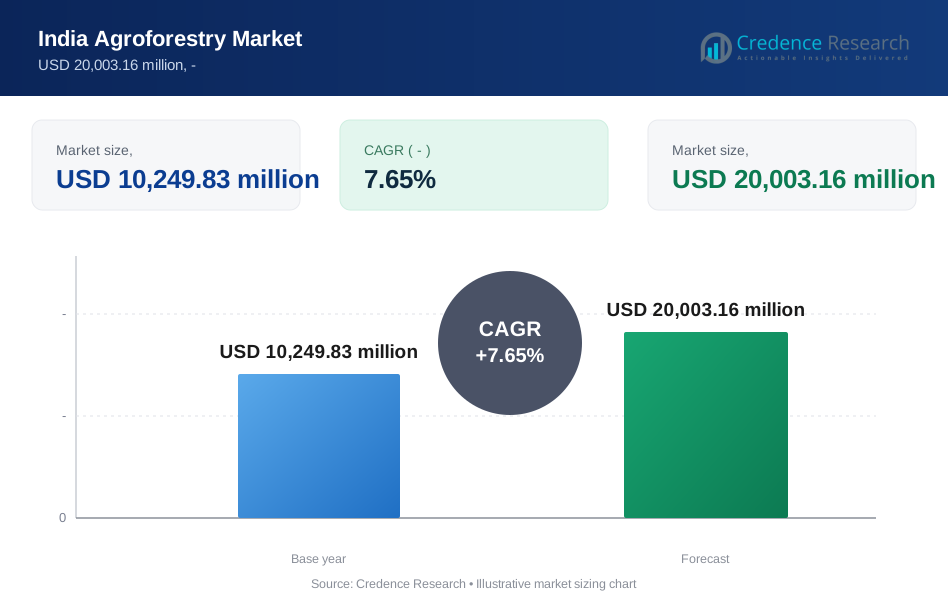
The India Agroforestry Market is projected to witness substantial growth, with its value expected to surge from USD 10,249.83 million in 2023 to USD 20,003.16 million by 2032, reflecting a notable compound annual growth rate of 7.65%.
The India Agroforestry Market is buoyed by several prominent drivers and trends. Increasing awareness of environmental sustainability coupled with government initiatives promoting agroforestry practices are driving market growth. Additionally, the rising demand for timber, fruits, and medicinal plants, along with the recognition of agroforestry's potential to enhance soil health and mitigate climate change impacts, further propel market expansion. Furthermore, technological advancements in agroforestry techniques and the integration of modern agricultural practices are shaping the market landscape, fostering productivity and profitability for stakeholders across the value chain.
In the geographical analysis of the India Agroforestry Market, various regions showcase diverse levels of adoption and growth. Northern states like Punjab and Haryana exhibit strong potential due to their agricultural prominence and favorable policy environment. Meanwhile, southern states such as Karnataka and Tamil Nadu demonstrate robust growth owing to conducive climatic conditions and proactive initiatives promoting sustainable farming practices. Key players such as Agroforestry Systems Inc., Weyerhaeuser, and the Center for Agroforestry (University of Missouri) are at the forefront, leveraging their expertise and resources to drive innovation and expand market presence across different regions in India.
Market Drivers
Government Support:
The Indian government has been actively promoting agroforestry through various initiatives like the National Agroforestry Policy 2014, Green India Missio, etc. For instance, under the National Agroforestry Policy 2014, grants have been provided to six states, covering approximately 70,000 ha in agroforestry. The Green India Mission aims to increase forest/tree cover to the extent of 5 million hectares (mha) and improve the quality of forest/tree cover on another 5 mha of forest/non-forest lands. These initiatives provide financial and technical assistance to farmers for adopting agroforestry practices, playing a pivotal role in incentivizing farmers to integrate trees into their agricultural landscapes, thereby fostering sustainable land management practices and enhancing rural livelihoods.
Growing Demand for Timber and Other Agroforestry Products:
The demand for timber, pulpwood, fodder, fruits, nuts, and other non-timber forest products (NTFPs) is rising in India due to increasing population and urbanization. For instance, the demand for roundwood in India is expected to jump nearly 70% in the next decade, from 57 million m³ in 2020 to 98 million m³ in 2030. Agroforestry provides a sustainable way to meet this growing demand. By integrating trees into agricultural systems, farmers can diversify their income streams while meeting the needs of various industries reliant on forest products, thus contributing to economic growth and rural development.
Climate Change Mitigation:
Agroforestry practices help in sequestering carbon dioxide from the atmosphere, thereby mitigating climate change. This is becoming a crucial factor for India, which is highly vulnerable to the impacts of climate change. For instance, the carbon sequestration potential of agroforestry systems in India is estimated between 0.25 – 19.14 and 0.01 to 0.60 Mg C/ha/yr for tree and crop component, respectively. By enhancing carbon sequestration through tree planting and sustainable land management, agroforestry contributes to climate resilience and helps mitigate the adverse effects of climate change on agriculture and rural communities.
Soil Conservation and Improvement:
Trees planted under agroforestry systems help in conserving soil moisture, preventing soil erosion, and improving soil fertility. This is essential for sustainable agriculture in India, where land degradation is a major challenge. Agroforestry not only protects soil health but also enhances agricultural productivity and resilience, thereby ensuring food security and sustainable land use practices.
Market Trends
Diversification Towards High-Value Products:
Farmers are increasingly opting for growing high-value crops like fruits, nuts, medicinal plants, and essential oil-yielding species alongside traditional timber trees. For instance, agroforestry involving fruit, olive, and nut trees cover about 1.05 million hectares in the EU, corresponding to about 0.2% of the territorial area. This strategic shift allows for diversification of income and caters to niche markets, meeting the evolving consumer preferences for healthier and sustainably sourced products. By integrating these high-value crops into agroforestry systems, farmers not only enhance their profitability but also contribute to the conservation of biodiversity and the preservation of traditional knowledge associated with medicinal plants.
Integration of Organic Farming Principles:
The synergy between organic farming principles and agroforestry is being recognized, leading to the emergence of sustainable production systems that fetch premium prices for certified organic agroforestry products. For instance, organic agriculture is practiced in 188 countries, and more than 96 million hectares of agricultural land are managed organically by at least 4.5 million farmers. In India, organic farming currently covers only 2.8 Mha - or two per cent of India’s net sown area of 140 Mha. By adopting organic practices such as natural fertilization, crop rotation, and pest management, agroforestry enhances soil health and biodiversity while minimizing environmental impacts. This integration not only meets the growing consumer demand for organic products but also promotes environmentally friendly agricultural practices, contributing to long-term sustainability and resilience in the agroforestry sector.
Market Challenges Analysis
Inadequate Market Infrastructure:
A well-developed market infrastructure for agroforestry products is lacking in India, encompassing collection centers, processing facilities, storage units, and efficient transportation networks. This deficiency poses significant challenges for farmers in obtaining fair prices for their produce, as the absence of proper infrastructure hampers market access and limits their bargaining power. Without adequate facilities for processing and storage, farmers may face post-harvest losses and are often compelled to sell their products at lower prices, undermining their economic viability and discouraging further investment in agroforestry.
Complex Regulatory Environment:
Regulations related to tree felling, transportation, and processing of agroforestry products can be intricate and time-consuming, posing additional barriers to adoption. Cumbersome regulatory processes not only increase administrative burdens but also contribute to delays and uncertainties in agroforestry operations. This discourages farmers from engaging in agroforestry practices, as they grapple with compliance requirements and navigate the intricacies of regulatory frameworks. Streamlining regulations and providing clearer guidelines can facilitate smoother implementation of agroforestry practices and encourage greater participation from farmers.
Market Segmentation Analysis:
By System:
The India Agroforestry Market exhibits diverse segmentations based on different agroforestry systems employed by farmers. Agrisilvicultural systems, integrating trees with agricultural crops, hold a prominent position, offering benefits like soil conservation and enhanced biodiversity. Silvopastoral systems, combining trees with pasture for livestock grazing, cater to the needs of both agriculture and animal husbandry sectors, providing fodder, shade, and shelter. Agrosilvopastoral systems, a combination of crops, trees, and livestock, offer integrated land use solutions, maximizing productivity and sustainability. Additionally, other agroforestry systems tailored to specific ecological and socio-economic contexts contribute to the market's dynamism, reflecting the diverse strategies adopted by farmers to harness the benefits of agroforestry.
By Product:
The India Agroforestry Market is further segmented based on the products derived from agroforestry practices, reflecting the multifaceted nature of agricultural landscapes. Timber & lumber and fiber crops constitute significant segments, addressing the demand for wood products and raw materials for various industries. Fruits and nuts emerge as lucrative segments, capitalizing on consumer preferences for nutritious and flavorful produce. Vegetables and herbs, grown under agroforestry systems, contribute to food security and dietary diversity. Medicinal plants represent a niche segment, offering potential for value-added products in pharmaceuticals and wellness industries. Additionally, other products derived from agroforestry, such as honey, resins, and essential oils, diversify income sources for farmers, highlighting the versatility and economic viability of agroforestry practices.
Segments:
Based on System
- Agrisilvicultural Systems
- Silvopastoral Systems
- Agrosilvopastoral Systems
- Others
Based on Product
- Timber & lumber and Fiber Crops
- Fruits and Nuts
- Vegetables and Herbs
- Medicinal Plants
- Others
Based on the Geography:
- Northern region
- Uttar Pradesh
- Punjab
- Haryana
- Southern region
- Tamil Nadu
- Andhra Pradesh
- Karnataka
- Western region
- Maharashtra
- Gujarat
- Rajasthan
- Eastern region
- West Bengal
- Odisha
- Bihar
- Northeastern region
Regional Analysis
Northern region
The northern region, comprising states like Uttar Pradesh, Punjab, and Haryana, holds the largest market share of approximately 30%. This dominance stems from the region's fertile alluvial plains, well-established agricultural infrastructure, and proactive state policies promoting sustainable farming methods. Additionally, the presence of reputed research institutions and pilot projects has facilitated agroforestry adoption in this region.
Southern region
The southern states, including Tamil Nadu, Andhra Pradesh, and Karnataka, collectively account for around 25% of the market share. This region benefits from favorable climatic conditions, coupled with a rich tradition of integrated farming systems. Moreover, the southern states have actively embraced agroforestry as a means of enhancing soil fertility, providing additional income streams, and mitigating the effects of climate change.
Key Player Analysis
- Agroforestry Systems Inc.
- Weyerhaeuser
- Green Resources
- Center for Agroforestry (University of Missouri)
- Center for International Forestry Research and World Agroforestry (CIFOR-ICRAF)
- Rainforest Alliance
- EcoPlanet Bamboo
- TerraCarbon LLC
Competitive Analysis
In the competitive landscape of the India Agroforestry Market, several leading players vie for market share and influence, each bringing unique strengths and strategies to the forefront. Agroforestry Systems Inc. stands out for its innovative approach to integrating trees with agricultural practices, offering comprehensive solutions tailored to Indian farming contexts. Weyerhaeuser, with its extensive experience in forestry and timber products, brings unparalleled expertise in sustainable land management and resource utilization. Green Resources distinguishes itself through its commitment to environmental stewardship and community development, leveraging its global presence to drive agroforestry initiatives in India.
The Center for Agroforestry (University of Missouri) and the Center for International Forestry Research and World Agroforestry (CIFOR-ICRAF) contribute invaluable research and technical support, shaping best practices and informing policy frameworks in the Indian agroforestry sector. Rainforest Alliance advocates for sustainable agricultural practices and certification standards, promoting market access and consumer trust. EcoPlanet Bamboo and TerraCarbon LLC focus on carbon sequestration and emission reduction, offering carbon credit solutions that incentivize agroforestry adoption and mitigate climate change risks.
Market Concentration & Characteristics
The India Agroforestry Market exhibits characteristics of moderate market concentration, with several key players driving industry dynamics. While the market is diverse and fragmented, with numerous small-scale farmers and enterprises participating, a handful of major companies and organizations hold significant influence. These leading entities often possess extensive expertise, resources, and networks, allowing them to shape market trends, influence policy agendas, and drive innovation in agroforestry practices. Despite the presence of dominant players, the market remains dynamic and open to new entrants, with opportunities for collaboration and partnership across the value chain. Characteristics such as increasing consumer awareness, government support, and technological advancements further contribute to the evolving nature of the market. Overall, the India Agroforestry Market demonstrates a balance between competition and collaboration, fostering growth and sustainability in the agricultural sector.
Report Coverage
The research report offers an in-depth analysis based on System, Product and Geography. It details leading market players, providing an overview of their business, product offerings, investments, revenue streams, and key applications. Additionally, the report includes insights into the competitive environment, SWOT analysis, current market trends, as well as the primary drivers and constraints. Furthermore, it discusses various factors that have driven market expansion in recent years. The report also explores market dynamics, regulatory scenarios, and technological advancements that are shaping the industry. It assesses the impact of external factors and global economic changes on market growth. Lastly, it provides strategic recommendations for new entrants and established companies to navigate the complexities of the market.
Future Outlook
- Continued Growth: The India Agroforestry Market is expected to experience sustained growth driven by increasing demand for sustainable agricultural practices.
- Government Support: Ongoing government initiatives and policies will further incentivize farmers to adopt agroforestry, contributing to market expansion.
- Technological Advancements: Continued advancements in technology, such as precision agriculture and remote sensing, will enhance productivity and efficiency in agroforestry operations.
- Climate Resilience: Agroforestry's role in climate change mitigation and adaptation will become increasingly significant, positioning it as a key solution for building climate-resilient agricultural systems.
- Market Diversification: There will be a shift towards high-value agroforestry products, including fruits, nuts, and medicinal plants, catering to changing consumer preferences and market demands.
- Carbon Trading Opportunities: The recognition of agroforestry's potential for carbon sequestration will open up opportunities for farmers to participate in carbon trading schemes, providing additional income streams.
- Sustainable Land Management: Agroforestry will play a crucial role in sustainable land management, addressing soil erosion, biodiversity loss, and water scarcity challenges.
- Adoption of Best Practices: Increased awareness and education initiatives will lead to widespread adoption of best practices in agroforestry, ensuring long-term viability and success.
- Market Integration: Agroforestry products will increasingly find their way into mainstream markets, supported by direct marketing channels and consumer demand for sustainably sourced products.
- Collaboration and Partnerships: Collaborative efforts between government agencies, NGOs, research institutions, and private companies will drive innovation and investment in the agroforestry sector, fostering a supportive ecosystem for market growth.
Request a Free Sample
Fill in your details and we'll send you a free sample report.
- Sample data tables & charts
- Research methodology
Need a Custom Version of This Report?
Tailor the scope, geography, or segments to your exact requirements.
- Custom geography or segment scope
- Direct access to our analyst team
Frequently Asked Questions
What is the projected growth of the India agroforestry market?
What factors are driving the growth of the India agroforestry market?
How are technological advancements influencing the India agroforestry market?
Which regions in India are showing significant growth in the agroforestry market?
Table of Content
Chapter 1. Report Introduction
- 1.1 Report Description & Purpose
- 1.1.1 Report Title & Market Definition
- 1.1.2 Unique Selling Propositions (USP) & Key Differentiators
- 1.1.3 Value Proposition for Stakeholders
- 1.2 Research Objectives
- 1.2.1 Market Sizing Objectives (Volume & Revenue) (Volume Where Applicable)
- 1.2.2 Segmentation Objectives
- 1.2.3 Competitive Intelligence Objectives
- 1.2.4 Forecast & Scenario Objectives
- 1.3 Report Scope
- 1.3.1 India Agroforestry Scope – Segments & Subsegments Covered
- 1.3.2 Geographic Scope – Selected Country & Subnational Markets Covered
- 1.3.3 Historical Period, Base Year & Forecast Period (the historical period; forecast to the forecast period)
- 1.3.4 Inclusions & Exclusions
- 1.4 Industry Classification & Applicable Codes
- 1.5 Currency, Measurement Units & Valuation Basis
- 1.6 Target Stakeholders
- 1.7 Limitations & Assumptions
Chapter 2. Executive Summary
- 2.1 India Agroforestry Snapshot
- 2.1.1 Market Size – Historical (the historical period) & Forecast (the forecast period) (base year: USD 10,249.83 million → forecast year: USD 20,003.16 million)
- 2.1.2 Volume & Revenue – National Totals (Volume Where Applicable)
- 2.1.3 Key Market Highlights – Top Five Facts
- 2.2 India Agroforestry Segmentation Snapshot
- 2.2.1 Market Split by Subnational Area – vs.
- 2.3 Competitive Snapshot
- 2.3.1 Top 10 Players by Revenue Share –
- 2.3.2 Top 10 Players by Volume Share – (Volume Where Applicable)
- 2.3.3 Recent Strategic Developments (18-Month Summary)
- 2.4 Key Investment Highlights & Strategic Conclusions
Chapter 3. India Agroforestry Dynamics & Industry Analysis
- 3.1 Market Overview & Context
- 3.1.1 India Agroforestry Position in the Broader Industry Value Chain
- 3.1.2 Demand Structure & Purchasing Dynamics
- 3.1.3 Market Maturity & Development Stage Across Domestic Markets
- 3.2 India Agroforestry Drivers
- 3.3 India Agroforestry Restraints & Challenges
- 3.4 India Agroforestry Opportunities
- 3.5 Porter's Five Forces Analysis
- 3.5.1 Threat of New Entrants
- 3.5.2 Bargaining Power of Suppliers
- 3.5.3 Bargaining Power of Buyers
- 3.5.4 Threat of Substitutes
- 3.5.5 Competitive Rivalry – Intensity Assessment
- 3.6 India Agroforestry Value Chain Analysis
- 3.6.1 Upstream – Key Inputs, Resources & Suppliers
- 3.6.1.1 Key Input/Resource 1
- 3.6.1.2 Key Input/Resource 2
- 3.6.1.3 Key Input/Resource 3
- 3.6.2 Midstream – Core Operations & Value Creation
- 3.6.2.1 Operating Model & Process Overview
- 3.6.2.2 Key Operating Locations & Capabilities by Company
- 3.6.3 Downstream – Market Channels & End Users
- 3.6.3.1 Direct Sales & Customer Engagement Channels
- 3.6.3.2 Indirect Sales, Intermediaries & Partner Channels
- 3.6.4 Value Chain Profitability Analysis
- 3.6.1 Upstream – Key Inputs, Resources & Suppliers
- 3.7 PESTEL Analysis
- 3.7.1 Political Factors
- 3.7.2 Economic Factors
- 3.7.3 Social Factors
- 3.7.4 Technological Factors
- 3.7.5 Environmental Factors
- 3.7.6 Legal Factors
- 3.8 India Agroforestry Supply Chain Analysis
- 3.8.1 Critical Input & Resource Availability Risk Assessment
- 3.8.2 Supplier & Operational Concentration Risk (Geographic Exposure)
- 3.8.3 Supply & Service Disruption Impact Analysis
- 3.9 National & Subnational Regulatory Landscape
Note: The regulatory and policy landscape section covers regulations based on their applicability to the market, India Agroforestry category, geography, and scope of the study. Only regulatory frameworks with a material impact on operations, compliance, trade, sustainability, or market access are analyzed in detail.
Chapter 4. Key Investment Pockets & Opportunity Analysis
- 4.1 India Agroforestry Attractiveness Analysis
- 4.1.1 By Subnational Area – Investment Attractiveness Matrix (Market Size × CAGR)
- 4.2 Absolute Revenue Growth Opportunity
- 4.2.1 By Subnational Area – Absolute Revenue Growth Through the forecast period
- 4.3 Incremental Demand Opportunity
- 4.3.1 By Subnational Area – Incremental Demand Through the forecast period
- 4.3.2 Segment – Incremental Demand
- 4.4 Emerging Submarket Opportunity Deep Dive (Subject to Applicability)
- 4.5 Priority Domestic Market Opportunity Scorecards
- 4.5.1 Priority Domestic Market 1
- 4.5.2 Priority Domestic Market 2
- 4.5.3 Priority Domestic Market 3
- 4.5.4 Priority Domestic Market 4
Note: Domestic market scorecards cover relevant states, provinces, territories, cities, or economic zones within the selected country. Numbered entries are populated with market names suited to the national administrative structure and research scope. Geographic share tables use one consistent, nonoverlapping set of areas.
Chapter 5. India Agroforestry Cross-Border Trade & Market Access Analysis
- 5.1 National Trade & International Partner Overview
- 5.1.1 Export Value by Destination Country (the historical period)
- 5.1.2 Export Volume by Destination Country (the historical period) (Where Applicable)
- 5.1.3 Import Value by Source Country (the historical period)
- 5.1.4 Import Volume by Source Country (the historical period) (Where Applicable)
- 5.1.5 National & Partner-Country Trade Balances (the historical period)
- 5.2 Export Analysis – Segment
- 5.2.1 Category 1 (Applicable Classification Code)
- 5.2.2 Category 2 (Applicable Classification Code)
- 5.2.3 Category 3 (Applicable Classification Code)
- 5.2.4 Category 4 (Applicable Classification Code)
- 5.2.5 Category 5 (Applicable Classification Code)
- 5.3 Import Analysis – Segment
- 5.3.1 Category 1 (Applicable Classification Code)
- 5.3.2 Category 2 (Applicable Classification Code)
- 5.3.3 Category 3 (Applicable Classification Code)
- 5.3.4 Category 4 (Applicable Classification Code)
- 5.3.5 Category 5 (Applicable Classification Code)
- 5.4 Cross-Border Pricing & Transaction Benchmarks
- 5.4.1 Export Pricing – Segment & Destination Country
- 5.4.2 Import Pricing – Segment & Source Country
- 5.4.3 Price Trends (the historical period)
- 5.5 Key Cross-Border Trade & Delivery Routes
- 5.5.1 Cross-Border Trade/Delivery Route 1
- 5.5.2 Cross-Border Trade/Delivery Route 2
- 5.5.3 Cross-Border Trade/Delivery Route 3
- 5.5.4 Cross-Border Trade/Delivery Route 4
- 5.5.5 Cross-Border Trade/Delivery Route 5
- 5.6 Trade Policy & Market Access Impact Assessment
- 5.6.1 Tariff & Non-Tariff Barriers
- 5.6.2 National Participation in Regional Trade & Economic Frameworks
- 5.6.3 Bilateral & Multilateral Trade Agreements
- 5.6.4 Cross-Border Operating, Licensing & Localization Requirements
Note: This chapter covers international trade relevant to India Agroforestry in the selected country. Exports are analyzed by destination and imports by source. Domestic interregional flows are excluded from international trade totals. Goods, services, and digital offerings use applicable classifications; volume and route analyses apply only where meaningful.
Chapter 6. Competitive Landscape & Company Benchmarking
- 6.1 India Agroforestry Concentration & Structure
- 6.1.1 Herfindahl-Hirschman Index (HHI) – vs.
- 6.1.2 Leading, Mid-Sized & Emerging Player Structure
- 6.1.3 Multinational, National & Local Player Dynamics
- 6.2 India Agroforestry Share Analysis –
- 6.2.1 National Revenue Share by Company
- 6.2.2 National Volume Share by Company (Volume Where Applicable)
- 6.2.3 Company Revenue Share by Subnational Area
- 6.2.4 Market Share Evolution ( vs. )
- 6.2.5 Company Market Share by Key Segment
- 6.2.6 Company Market Share by Customer Group
- 6.3 Operating Scale, Capacity & Infrastructure Analysis
- 6.3.1 National Operating Scale & Supply Capacity
- 6.3.2 Resource Utilization & Operating Efficiency
- 6.3.3 Output, Service Delivery & Activity Metrics
- 6.3.4 Operating Footprint & Infrastructure Map
- 6.3.5 Planned Operational & Capacity Expansion
- 6.4 India Agroforestry Competitive Benchmarking Matrix
- 6.4.1 Revenue, Growth, Profitability & Operating Metric Comparison
- 6.4.2 Channel Revenue Mix
- 6.4.3 Revenue Exposure Across Domestic Markets
- 6.4.4 R&D Intensity
- 6.4.5 Sustainability Maturity
- 6.5 Strategic Developments in India Agroforestry (Last 24 Months)
- 6.5.1 Mergers, Acquisitions & Divestments
- 6.5.2 New Products, Services & Solutions in India Agroforestry
- 6.5.3 Operational & Infrastructure Expansions
- 6.5.4 Strategic Alliances, Joint Ventures & Partnerships
- 6.5.5 Distribution Expansion & Market Entry
- 6.5.6 Sustainability & ESG Initiatives
- 6.6 Competitive Strategy Mapping
- 6.6.1 Leader, Challenger, Follower & Niche Classification
- 6.6.2 Pricing Strategy Comparison
- 6.6.3 Channel Strategy Matrix
Note: Strategic developments are included based on their materiality and the availability of reliable information.
Chapter 7. India Agroforestry – By Sales & Delivery Channel
- 7.1 Segment Overview
- 7.1.1 Volume & Revenue Split by Channel ( & ) (Volume Where Applicable)
- 7.1.2 Channel Mix Evolution (the forecast period)
Chapter 8. Subnational Market Analysis – Country Overview
- 8.1 Domestic Geographic Market Overview
- 8.1.1 Subnational Volume Share (Where Applicable)
- 8.1.2 Subnational Revenue Share
- 8.1.3 Market Volume by Subnational Area (Where Applicable)
- 8.1.4 Market Revenue by Subnational Area
- 8.1.5 Subnational Forecasts Through the forecast period
- 8.2 Cross-Area Segment Analysis Within the Country
- 8.2.1 By Sales & Delivery Channel
- 8.2.2 By Competitive Positioning & Price Tier
Chapter 9. India Agroforestry – Priority Domestic Market 1
Chapter 10. India Agroforestry – Priority Domestic Market 2
Chapter 11. India Agroforestry – Priority Domestic Market 3
Chapter 12. India Agroforestry – Priority Domestic Market 4
Chapter 13. India Agroforestry Company Profiles
- 13.1 [Company 01]
- 13.1.1 Company Overview
- 13.1.2 Key Management Personnel
- 13.1.3 Products & Services Portfolio
- 13.1.4 Financial Performance
- 13.1.5 Domestic Market Focus & Local Operating Presence
- 13.1.6 Recent Developments & Strategic Initiatives
Note: The company profile list is preliminary and may change based on research findings, market developments, data availability, and client requirements.
Chapter 14. Appendices
- Appendix A – List of Abbreviations & Acronyms
- Appendix B – Industry Classification Code Reference – Full Series
- Appendix C – Supply, Output & Operating Capacity Data Tables
- Appendix D – End-Use & Demand Base Tables
- Appendix E – Demand, Adoption & Usage Assumptions
- Appendix F – Pricing & Revenue Metric Reference Tables
- Appendix G – Company Operations & Infrastructure Database
- Appendix H – Cross-Border Trade & Activity Data Tables (Where Applicable)
- Appendix I – Regulatory Summary Tables
- Appendix J – Primary Research Participant List (Anonymized)
- Appendix K – Primary Research Questionnaire Framework
- Appendix L – Data Sources & Bibliography
- Appendix M – Market Size Divergence & Source Comparison
Chapter 15. Research Methodology
- 15.1 Research Framework & Philosophy
- 15.2 Secondary Research – Sources, Hierarchy & Data Extraction
- 15.3 Data Modeling – National Market Sizing & Subnational Allocation
- 15.4 Primary Research – Stakeholder Framework, LOI & Sample Sizes
- 15.5 Forecast Methodology – Regression, Scenario & Sensitivity Analysis
- 15.6 Quality Control – Four-Layer Validation Framework
- 15.7 Limitations & Standard Assumptions
- 15.8 Disclaimer
