
Poland seed demand shifts toward hybrids and certified lots
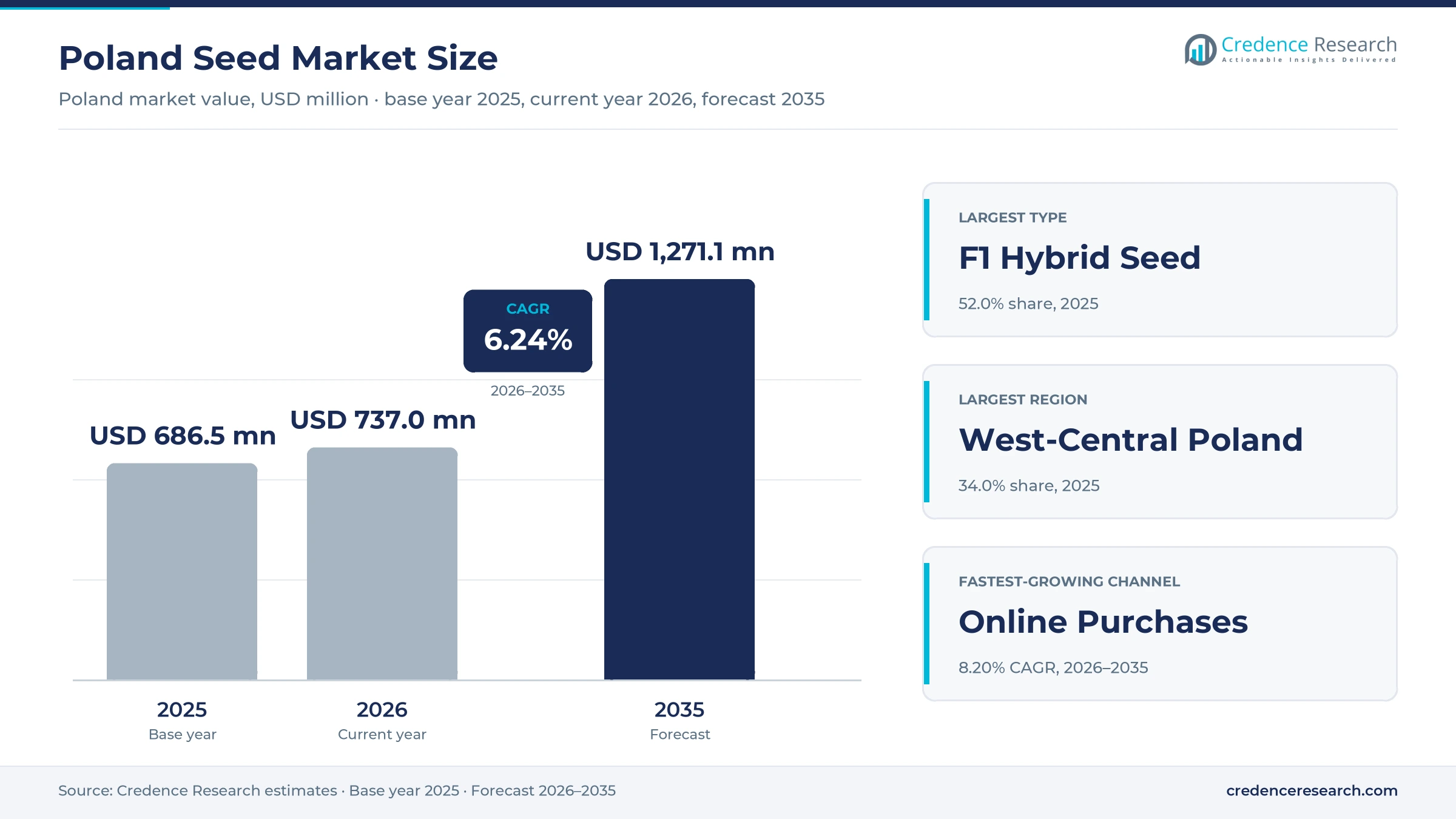
The Poland seed market was valued at USD 686.5 million in 2025 and is projected to increase from USD 737.0 million in 2026 to USD 1.27 billion by 2035, registering a CAGR of 6.24% during 2026–2035. Demand comes from arable, mixed crop-livestock and horticultural farms that buy hybrid maize and rapeseed, certified cereal seed and seed potatoes each season. West-Central Poland held the largest regional share, 34.0% in 2025, because Greater Poland and Kuyavia-Pomerania combine intensive livestock with maize and rapeseed rotations. Eastern Poland is the fastest-growing region at 6.62% a year, as smaller farms in Lublin, Masovia and Podlaskie buy more seed instead of reusing grain. Grain maize covered about 1.3 million hectares in 2025, according to GUS, which keeps F1 hybrid seed at the center of farm spending. A consolidated certified-seed aid regulation published in March 2025 and a 2025 eco-scheme payment for certified seed now reward farmers who document their purchases.
Which seed types and buyers does the estimate cover?
The estimate measures farm-level purchases of F1 hybrid seed, non-hybrid generative seed of cereals, legumes, grasses and vegetables, and certified seed potato tubers sown or planted in Poland. It covers seed bought from agrodealers, seed companies, cooperatives and online shops by arable farms, mixed crop-livestock farms and horticultural and amenity producers.
The estimate excludes farm-saved seed that is not bought, grain sold for food or feed, ornamental bulbs and young plants, and seed produced in Poland for export. The value chain runs from breeders and variety owners through seed multipliers and processing plants to distributors, dealers and cooperatives that reach farms.
Poland Seed Market Insights
- The Poland seed market was valued at USD 686.5 million in 2025 and is projected to reach USD 1.27 billion by 2035, registering a CAGR of 6.24% during 2026–2035.
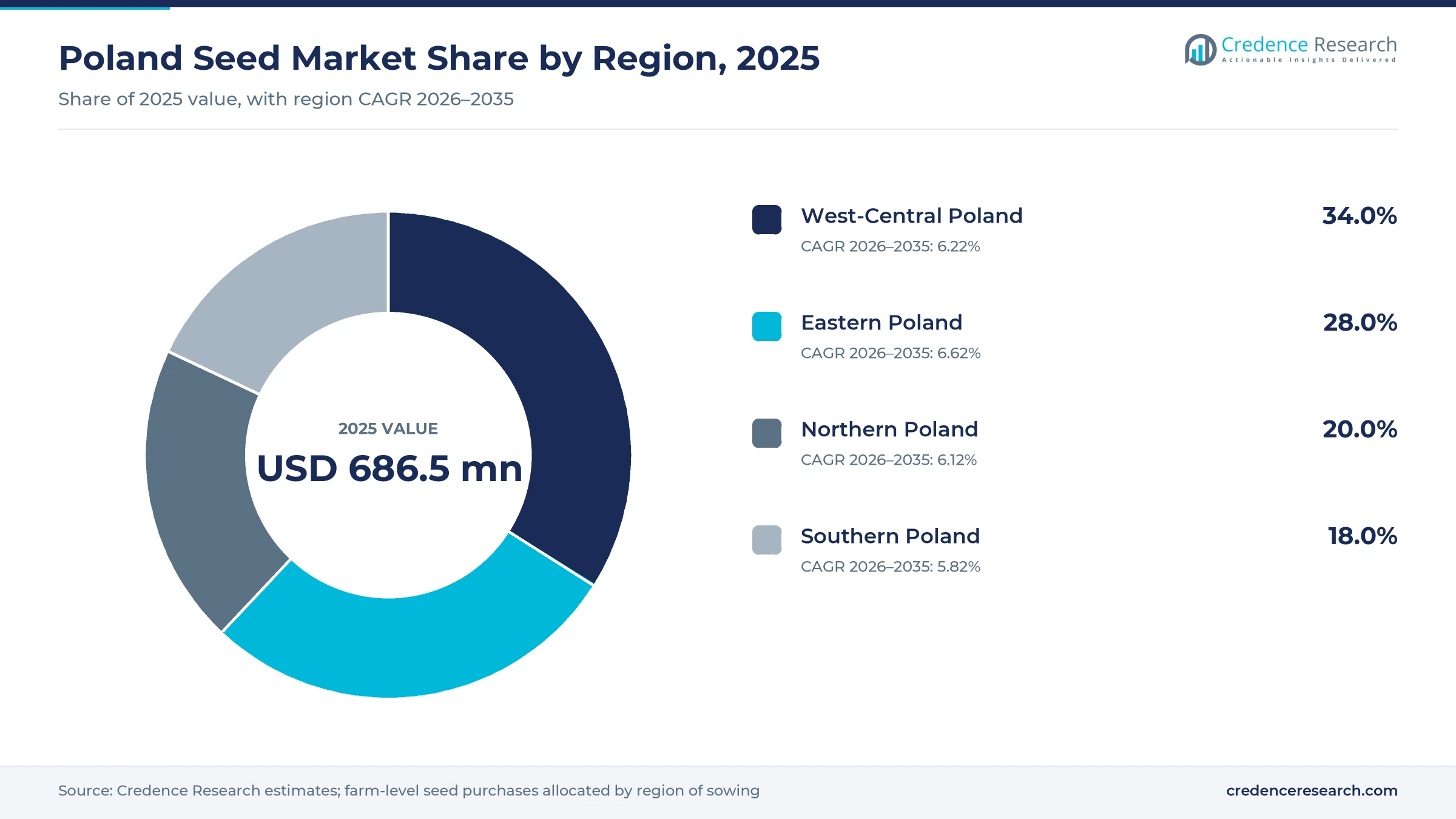
- West-Central Poland held 34.0% of 2025 value, because Greater Poland and Kuyavia-Pomerania pair livestock farming with maize and rapeseed rotations.
- F1 hybrid seed led with 52.0% of 2025 value, because grain maize covered about 1.3 million hectares in 2025 and is sown almost entirely with bought hybrids.
- The 2025 eco-scheme pays an estimated 26.74 euros per hectare for certified cereal seed and 112.13 euros per hectare for certified seed potatoes.
- Corteva added three Pioneer maize hybrids for the 2025 season, while Bayer lists about 20 DEKALB winter rapeseed hybrids for 2026.
Hybrid maize leads while online and large farms gain
Why do F1 hybrids hold the largest seed share?
Based on product type, the market is categorized into F1 hybrid seed, non-hybrid generative seed and seed potato tubers. F1 Hybrid Seed led with 52.0% of 2025 value, because grain maize alone covered about 1.3 million hectares in 2025 according to GUS, and maize growers cannot resow grain harvested from hybrids without losing yield. F1 hybrid seed is also the fastest-growing type at 6.69% a year, as the 2026 DEKALB winter rapeseed brochure from Bayer lists about 20 hybrids, including DK Exiris with a 2026 Polish registration. Non-hybrid generative seed depends on cereal renewal, while seed potato tubers follow a potato area of about 211,000 hectares in 2025.
How do maize and rapeseed shape crop-level seed value?
Based on crop type, the market is categorized into cereals, maize, oilseeds and protein crops and specialty crops. Maize led with 38.0% of 2025 value, because farmers buy seed every year for about 1.3 million hectares of grain maize plus silage fields, and hybrid maize seed costs far more per hectare than cereal seed. Oilseeds and protein crops grow fastest at 6.87% a year, as GUS estimated the 2025 winter rapeseed area at 1.1 million hectares, up 0.1 million hectares from 2024. Legumes also gain support from a certified-seed aid rate of 115 zlotys per hectare. Cereals keep a large volume base but earn less value per hectare.
Why do agrodealers still dominate seed purchases?
Based on distribution channel, the market is categorized into agrodealer purchases, direct supplier purchases, cooperative purchases and online purchases. Agrodealer Purchases led with 55.0% of 2025 value, because 55.4% of surveyed cereal growers bought seed from trading companies or distributors in a 2020 survey of 802 farms commissioned by PZPRZ, while about 20% used local seed centers. Online purchases grow fastest at 8.20% a year, as Bayer runs its own Polish agricultural e-shop and sells the DK Sequel rapeseed hybrid only through it. Direct supplier purchases rise with loyalty schemes such as the Bayer Kometa program, which pays 50 to 100 zlotys per bag.
Which farm sizes spend the most on bought seed?
Based on farm size, the market is categorized into below 10 hectares, 10 to below 100 hectares and 100 hectares and above. Farms of 10 to Below 100 Hectares led with 47.0% of 2025 value, because ARiMR put the average farm at 11.59 hectares in 2024, and averages in Greater Poland, Podlaskie and Kuyavia-Pomerania ranged from 12.96 to 17.66 hectares. Farms of 100 hectares and above grow fastest at 6.71% a year, as the 2020 agricultural census counted about 13,000 such farms using a quarter of agricultural land. Holdings below 10 hectares renew seed less often, and 70% of non-users in the 2020 survey of larger cereal farms already called certified seed too expensive.
| Segment Group | Leading Sub-segment | Share, 2025 | Fastest-growing Sub-segment | CAGR, 2026–2035 |
|---|---|---|---|---|
| By Product Type | F1 Hybrid Seed | 52.0% | F1 Hybrid Seed | 6.69% |
| By Crop Type | Maize | 38.0% | Oilseeds and Protein Crops | 6.87% |
| By Distribution Channel | Agrodealer Purchases | 55.0% | Online Purchases | 8.20% |
| By Farm Size | 10 to Below 100 Hectares | 47.0% | 100 Hectares and Above | 6.71% |
Request a Free Sample
Fill in your details and we'll send you a free sample report.
- Sample data tables & charts
- Research methodology
Seed aid, hybrid traits and maize area lift Polish demand
Certified cereal replacement raises seed renewal rates
Certified cereal replacement is the largest volume driver, because many Polish farms still reuse part of their own grain for sowing. The 2020 survey of 802 cereal farms commissioned by PZPRZ found certified seed use of 73.6% among holdings of 15 hectares or more, but use ranged from 41-50% for wheat down to nearly 20% for oats. State aid narrows that gap, and the consolidated regulation published on March 24, 2025 sets 65 zlotys per hectare for certified cereals, 115 zlotys for legumes and 350 zlotys for potatoes. Rye alone covered about 0.6 million hectares in 2025, according to GUS, so each extra point of renewal adds volume for breeders. As a result, cereal renewal supports a steady base for non-hybrid generative seed.
Hybrid portfolio premiumization lifts value per hectare
Hybrid portfolio premiumization lifts value faster than volume, because seed firms now sell traits and treatments with each bag. Corteva introduced three Pioneer maize hybrids for the 2025 season on Oct. 22, 2024, and P92440 with AQUAmax drought tolerance averaged 11.4 metric tons of dry grain per hectare over three years of Polish trials, Wieści Rolnicze reported. Bayer sells DK Excited with Acceleron Precision dressing and seed larger than two millimeters for precision drilling, and it opened an Agronomy Excellence Center in Chlewiska to develop hybrid maize and rapeseed. These premium packages raise the price of a sown hectare even when area is flat. Accordingly, F1 hybrid seed grows at 6.69% a year, the fastest rate among product types.
Documented seed-purchase incentives reward certified lots
Documented seed-purchase incentives turn invoices into payments, which pushes growers toward labeled certified lots. Under the 2025 eco-scheme for certified seed, Wieści Rolnicze reported on March 21, 2025, estimated rates of 26.74 euros per hectare for cereals, 43.37 euros for legumes and 112.13 euros for potatoes. Claimants must cover at least 25% of arable land with certified or elite seed and show documents listing the variety, category and lot number. An earlier one-off program paid 200 zlotys per hectare for cereals and 1,200 zlotys for potatoes, and nearly 49,000 farmers applied by August 2023. In turn, the paperwork rule favors agrodealers, which held 55.0% of 2025 channel value.
Grain maize expansion keeps hybrid seed demand rising
Grain maize expansion keeps hybrid demand rising, because maize has become one of the main spring crops on Polish farms. GUS estimated the 2025 grain maize area at about 1.3 million hectares, up about 5.1% from 2024, compared with averages of 0.6 million hectares in 2011-2015 and 0.7 million hectares in 2016-2020. The 2025 harvest reached about 10.5 million metric tons at a record 78.5 decitonnes per hectare, which rewards buyers of higher-yield hybrids. Corteva also positions its new P82703 hybrid for silage and biogas, so maize seed sells into dairy and energy chains. Consequently, maize held 38.0% of 2025 value, the largest share among crop types.
Virus-resistant rapeseed and gene editing reshape breeding
Shift toward virus-resistant and trait-stacked rapeseed hybrids
Rapeseed breeding is shifting toward stacked disease traits, because turnip yellows virus and clubroot now decide which hybrids farmers keep. The 2026 DEKALB winter rapeseed brochure from Bayer marks turnip yellows virus resistance on most of its roughly 20 hybrids, and DK Plener is the only one described with clubroot tolerance. DK Exiris, registered in Poland in 2026, yielded 4.88 metric tons per hectare against a 4.46-ton standard across nine official COBORU trials in 2025. Bayer also sells DK Exavance as a trap crop that flowers 10 to 12 days early and is mixed in at 7-10% to draw pollen beetles. As a result, oilseeds and protein crops grow at 6.87% a year, the fastest crop rate.
Emerging EU gene-editing rules reshape breeding plans
EU rules for new genomic techniques are emerging as a breeding shift, because they shorten the path from trait discovery to a registered variety. Parliament and the Council reached a provisional agreement in December 2025, and Agriland reported that seed bags of NGT-1 varieties must carry a label and appear in a public EU database. The rules apply two years after entry into force, which gives Polish breeders time to plan programs. That matters because a new variety takes more than 10 years and over 1 million euros to develop, according to experts quoted by Wieści Rolnicze in March 2025. The same experts said Polish licence fees are two to three times lower than German fees, because domestic varieties dominate.
Opportunity in certified seed potato renewal
Certified seed potato renewal is an opening for suppliers, because potato area is rising again while quality seed stays scarce. FreshPlaza, citing ARiMR producer declarations, put the 2025 potato area at about 211,140 hectares, up from 192,482 hectares in 2024, and noted that the availability of quality seed potatoes remains a challenge. The 2025 eco-scheme pays an estimated 112.13 euros per hectare for certified potatoes, on top of the 350-zloty national aid rate. West Pomerania already submits the largest area of seed potato plantations for official field inspection, the regional plant health inspectorate in Koszalin says. As a result, seed potato tubers grow steadily as starch and table growers replace saved tubers.
Opportunity in forage, cover and amenity seed
Forage, cover and amenity seed is a second opening, because livestock margins and soil rules both favor sown grassland and catch crops. The carbon farming eco-scheme paid 517.80 zlotys per hectare for winter catch crops or undersown crops in 2023, Wieści Rolnicze reported in February 2024. Cattle profitability also improved, and Credit Agricole put the cattle-to-feed price ratio at a record 8.42 in October 2025, up from 5.92 a year earlier. Poland remains a net importer of planting seed, and the U.S. is the main supplier of grass and clover seed for meadows and golf courses. In turn, specialty crops grow with forage and amenity sowing rather than with cereal area.
Low grain prices and farm-saved seed limit certified sales
Low grain prices squeeze certified seed budgets
Low grain prices squeeze seed budgets, because certified cereal seed is priced as a premium on top of the grain price. Credit Agricole expected Polish wheat near 800 zlotys per metric ton at the end of 2025 and again at the end of 2026. Seed producers add a margin of 15-25% over the commodity price, according to experts quoted by Wieści Rolnicze in March 2025. As a result, growers often delay renewal on feed cereals, and suppliers respond with loyalty payments and smaller packs.
Farm-saved seed and price perception slow renewal
Farm-saved seed remains the main substitute, because many growers doubt that certified lots pay back. In the 2020 survey of 802 cereal farms, 70% of non-users said certified seed is too expensive and 30% said it is not profitable. One in five non-users also linked certified seed with genetic modification, which shows a gap in basic information. Seed firms and advisers now answer with trial data and on-farm demonstrations, but changing habits on small farms takes several seasons.
Plant health problems strain seed potato supply
Plant health problems strain seed potato supply, because quarantine diseases can close markets for a whole season. Tridge reported on April 7, 2026, that ring rot still affects Polish potato trade even though official data shows fewer cases. FreshPlaza also noted in July 2025 that quality seed potatoes remain hard to source as potato area rose to about 211,140 hectares. Consequently, growers pay more for inspected lots, and seed producers must invest in testing and clean storage.
Fragmented small farms raise the cost of reaching buyers
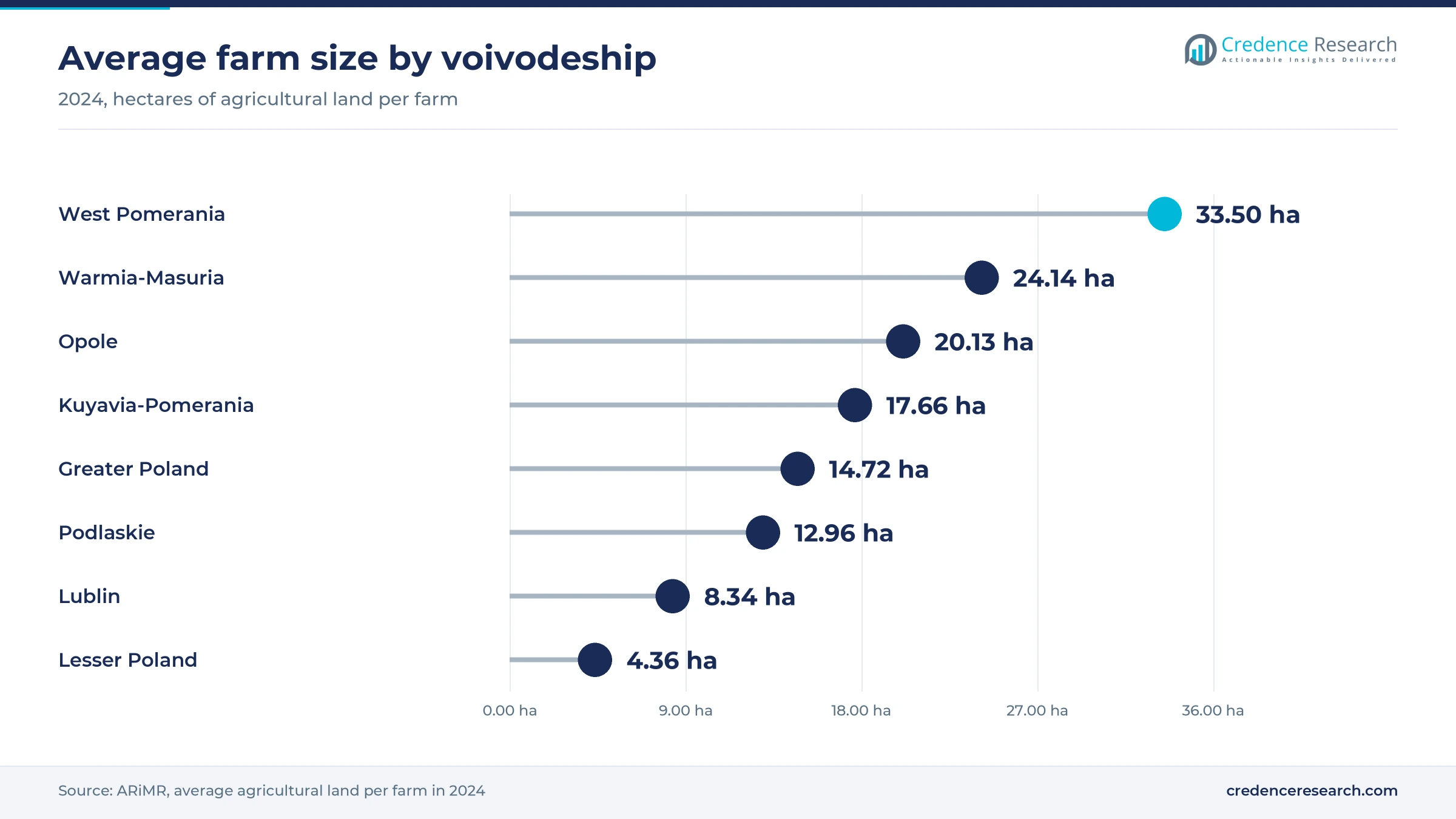
Fragmented holdings raise the cost of selling seed, because dealers must serve many small orders across the south and east. ARiMR put the average farm at 4.36 hectares in Lesser Poland and 5.21 hectares in Subcarpathia in 2024, against 33.50 hectares in West Pomerania. The 2020 census also found that more than half of about 1.317 million farms had up to five hectares. Therefore, suppliers rely on cooperatives and local seed centers to reach these buyers at a lower cost.
West-Central Poland leads while the east grows fastest
| Region | Value, 2025 (USD million) | Share, 2025 | CAGR, 2026–2035 |
|---|---|---|---|
| West-Central Poland | 233.4 | 34.0% | 6.22% |
| Eastern Poland | 192.2 | 28.0% | 6.62% |
| Northern Poland | 137.3 | 20.0% | 6.12% |
| Southern Poland | 123.6 | 18.0% | 5.82% |
West-Central Poland leads on maize and rapeseed rotations
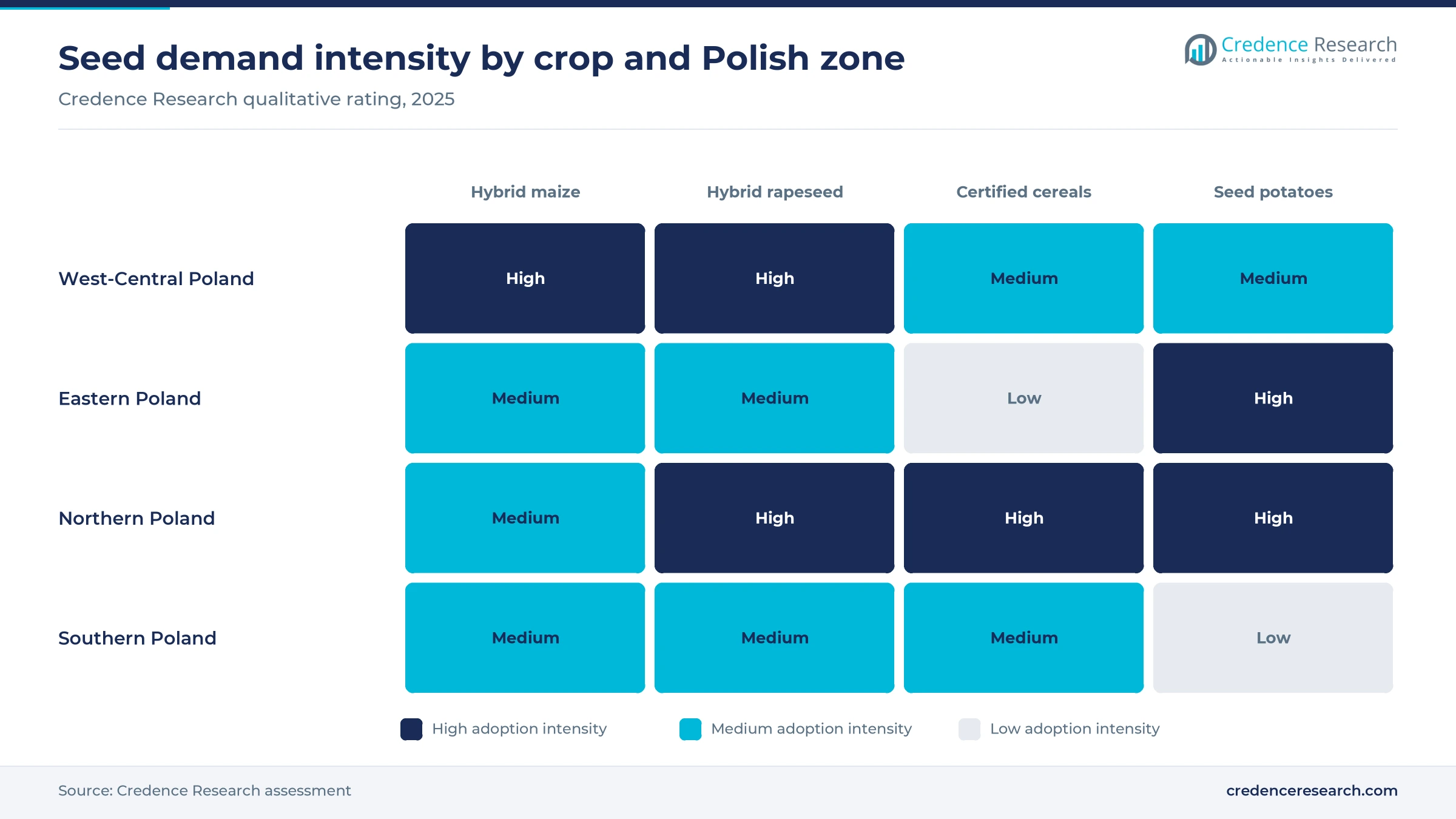
West-Central Poland held 34.0% of 2025 value and grows at 6.22% a year, because Greater Poland and Kuyavia-Pomerania run intensive livestock farms that sow maize and rapeseed every season. ARiMR put the 2024 average farm at 14.72 hectares in Greater Poland and 17.66 hectares in Kuyavia-Pomerania, above the national 11.59 hectares. Bayer opened its Agronomy Excellence Center in Chlewiska, Greater Poland, to develop hybrid maize and rapeseed. As a result, the zone buys most premium hybrids and treated seed.
Eastern Poland grows fastest as small farms buy more seed
Eastern Poland held 28.0% of 2025 value and is the fastest-growing region at 6.62% a year, because farms in Lublin, Masovia and Podlaskie are moving from saved grain toward bought seed. ARiMR put average farms at 8.34 hectares in Lublin, 9.05 hectares in Masovia and 12.96 hectares in Podlaskie in 2024. In Łomża, starch processor PEPEES said in March 2023 that it could buy over 200,000 metric tons of starch potatoes. Consequently, demand for certified seed potatoes and maize hybrids rises fastest here.
Northern Poland pairs large farms with seed potato production
Northern Poland held 20.0% of 2025 value and grows at 6.12% a year, because the zone has the largest farms in the country. ARiMR put 2024 averages at 33.50 hectares in West Pomerania, 24.14 hectares in Warmia-Masuria and 20.64 hectares in Pomerania. West Pomerania also submits the largest area of seed potato plantations for official field inspection, the plant health inspectorate in Koszalin says. Therefore, seed demand in the zone combines large cereal and rapeseed orders with seed potato multiplication on farms that average more than 20 hectares.
Southern Poland mixes large estates and very small farms
Southern Poland held 18.0% of 2025 value and grows at 5.82% a year, because it mixes large estates in Opole and Lower Silesia with very small farms in Lesser Poland. ARiMR put 2024 averages at 20.13 hectares in Opole, 18.60 hectares in Lower Silesia and 4.36 hectares in Lesser Poland. Syngenta showed rapeseed, wheat, hybrid barley and maize variety collections and herbicide programs for maize at a 350-hectare farm in Polwica, Lower Silesia, in June 2022. As a result, the zone buys premium seed on large farms but renews slowly on small ones.
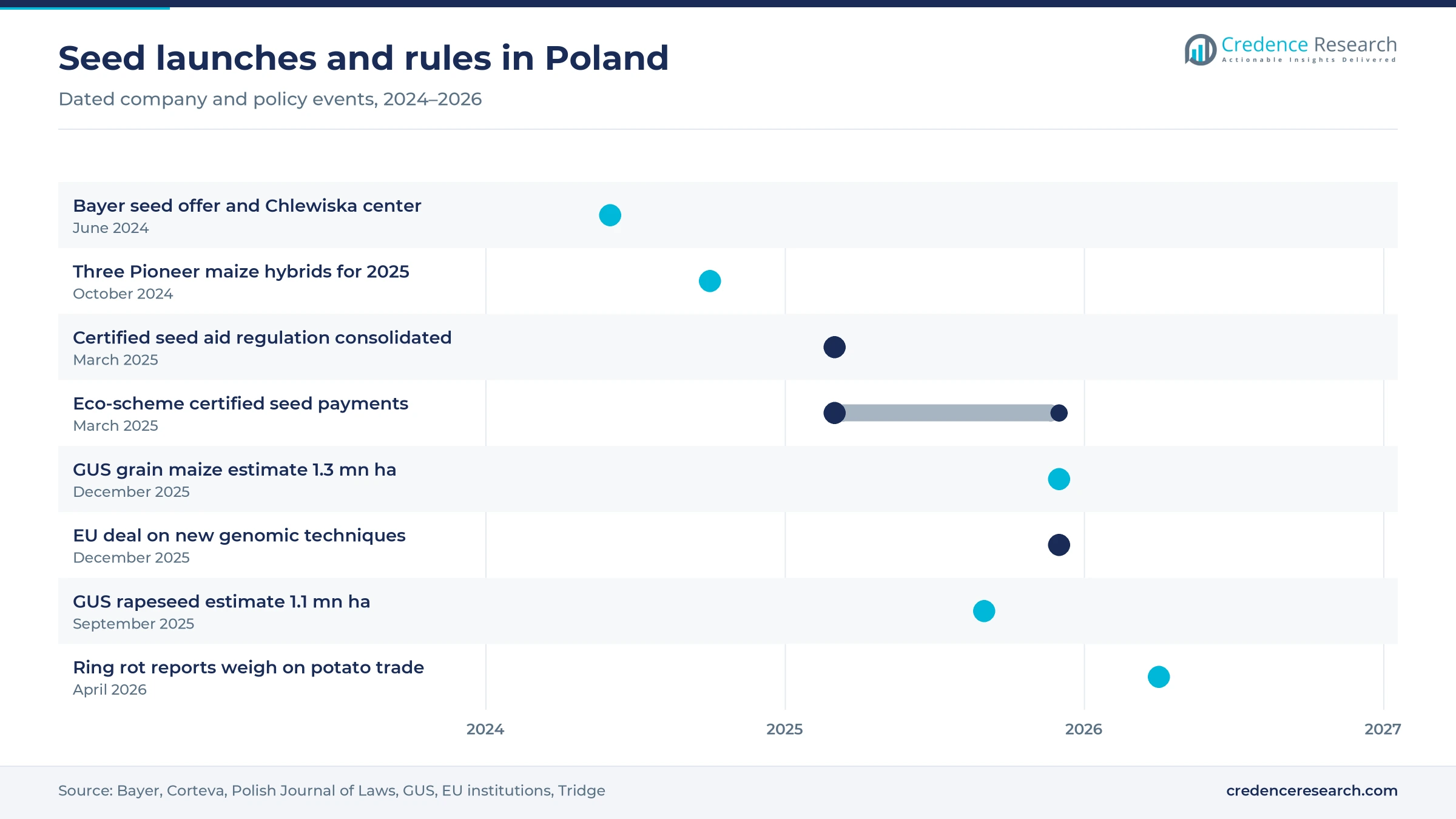
Hybrid launches, seed aid and EU breeding rules, 2024-2026
| Development | Status and market relevance |
|---|---|
| In June 2024, Bayer presented its Polish seed offer, including DEKALB rapeseed hybrids, Acceleron Precision dressing and the Agronomy Excellence Center in Chlewiska. | Active; links premium rapeseed hybrids with dressing and digital agronomy for Polish growers |
| In October 2024, Corteva Agriscience introduced three Pioneer maize hybrids for the 2025 season in Poland, P82703, P92440 and P9944. | Commercial; adds drought-tolerant and silage hybrids to the maize range |
| In March 2025, the consolidated regulation on per-hectare aid for certified seed was published, setting 65 zlotys for cereals, 115 zlotys for legumes and 350 zlotys for potatoes. | In force; supports certified cereal, legume and potato renewal |
| In December 2025, the European Parliament and the Council reached a provisional agreement on rules for plants made with new genomic techniques. | Pending application; NGT-1 seed must be labeled and listed in an EU database |
| In September 2025, GUS estimated the 2025 winter rapeseed area at 1.1 million hectares, up 0.1 million hectares from 2024. | Published; supports hybrid rapeseed seed demand for the 2026 harvest |
Hybrids, dressings and resistance traits change seed value
- F1 hybrid breeding gives maize and rapeseed growers higher, more uniform yields, so farmers buy new seed every season instead of saving grain.
- Seed dressing and sizing such as Acceleron Precision packages, protects young plants and suits precision drills that need calibrated seed.
- Virus and clubroot resistance in rapeseed hybrids reduces losses from turnip yellows virus and clubroot without adding fungicide sprays.
- New genomic techniques could shorten breeding cycles for Polish varieties once the EU rules apply two years after entry into force.
Need a Custom Version of This Report?
Tailor the scope, geography, or segments to your exact requirements.
- Custom geography or segment scope
- Direct access to our analyst team
Multinational breeders compete with strong domestic programs
Competition splits between multinational breeders that lead in hybrid maize and rapeseed and domestic breeders that dominate cereals. Seed demand from about 1.3 million hectares of grain maize gives multinational breeders their largest single prize in Poland. Corteva sells Pioneer and Brevant maize hybrids and added three Pioneer hybrids for 2025. Bayer competes with DEKALB rapeseed hybrids, seed dressings, the Kometa loyalty program and an online shop. KWS sells maize hybrids through KWS Polska and registered six new maize varieties in February 2021, while Limagrain sold LG rapeseed and maize varieties and consolidated its vegetable seed distribution under Hazera Poland in 2019. Syngenta shows rapeseed, hybrid barley, maize and sunflower collections on demonstration farms. Domestic breeders such as Hodowla Roślin Smolice and Małopolska Hodowla Roślin remain strong in maize and cereals, which keeps licence fees lower than in Germany. As a result, rivals compete on trial yields, disease traits, dealer support and payment terms rather than on list price alone.
Companies profiled and their roles in this market
| Company | Type | Role in the market |
|---|---|---|
| Corteva Agriscience | Multinational breeder | Pioneer and Brevant maize hybrids; three new Pioneer hybrids for the 2025 season |
| KWS SAAT | Multinational breeder | Maize hybrids through KWS Polska; six new maize varieties registered in February 2021 |
| Bayer CropScience | Multinational breeder | DEKALB rapeseed hybrids, Acceleron dressings, Chlewiska center and online sales |
| Syngenta | Multinational breeder | Rapeseed, wheat, hybrid barley, maize and sunflower variety collections on demo farms |
| Limagrain | Multinational breeder | LG rapeseed and maize varieties; vegetable seed through Hazera Poland |
Credence Research view on Polish seed renewal
Credence Research's view is that Polish seed value will grow mainly through hybrids and documented purchases rather than through more sown area. Grain maize at about 1.3 million hectares and winter rapeseed at 1.1 million hectares already absorb most premium hybrid spending. The bigger gain lies in cereals and potatoes, where certified renewal remains low on small farms. Aid of 65 zlotys per hectare and eco-scheme payments help, yet low wheat prices near 800 zlotys per metric ton still delay renewal. Suppliers that combine trial data, dealer credit and simple paperwork for subsidy claims should win share.
How the Polish farm-level seed estimate was built
The report uses 2025 as the base year and forecasts to 2035. Market values come from the Credence Research market model, built from crop areas, seed rates, renewal rates and seed prices by crop. Segment, channel, farm-size and regional splits are Credence Research estimates. Sources used include GUS crop statistics, ARiMR farm data, Polish regulations, EU policy releases, U.S. Department of Agriculture trade reporting, company releases and catalogs, and trade press. No interviews or surveys were conducted by Credence Research for this report.
Hybrids and documented purchases carry demand to 2035
Through 2035, hybrids and certified seed renewal will carry the Polish seed market as farms consolidate and document their purchases. Maize and rapeseed hybrids will gain value from drought tolerance, virus resistance and precision dressings. Cereal renewal should rise slowly as eco-scheme and national aid reward certified lots. Eastern Poland will grow fastest as smaller farms switch from saved grain, while online buying expands from a small base. EU rules on new genomic techniques could also bring faster breeding cycles in the second half of the period. F1 hybrid seed, which held 52.0% of 2025 value, should keep the largest product share through 2035.
Frequently Asked Questions
How big is the Poland seed market?
Which product type leads the Poland seed market?
Which region of Poland buys the most seed?
Which region of Poland grows fastest?
What aid does Poland pay for certified seed?
Which sales channel grows fastest for seed in Poland?
What holds back certified seed use in Poland?
Which companies compete in the Poland seed market?
Table of Content
Chapter 1 Market Segmentation
- 1.1 Segmentation Framework
- 1.1.1 Product and Service Classification
- 1.1.2 Application and End-Use Classification
- 1.1.3 Technology and Solution Classification
- 1.1.4 Customer and Distribution Channel Classification
- 1.1.5 Geographic Segmentation
- 1.1.6 Market Segment Definitions and Boundaries
- 1.2 By Product Type
- 1.2.1 F1 Hybrid Seed
- 1.2.2 Non-Hybrid Generative Seed
- 1.2.3 Seed Potato Tubers
- 1.3 By Crop Type
- 1.3.1 Cereals
- 1.3.2 Maize
- 1.3.3 Oilseeds and Protein Crops
- 1.3.4 Specialty Crops
- 1.4 By Farm Size
- 1.4.1 Below 10 Hectares
- 1.4.2 10 to Below 100 Hectares
- 1.4.3 100 Hectares and Above
Chapter 2 Introduction
- 2.1 Report Objectives and Scope
- 2.2 Product Definition and Industry Terminology
- 2.3 Market Inclusions and Exclusions
- 2.4 Research Process
- 2.4.1 Primary Research and Expert Interviews
- 2.4.2 Secondary Research and Source Review
- 2.4.3 Top-Down and Bottom-Up Estimation
- 2.4.4 Data Triangulation and Verification
- 2.5 Market Size Measurement Basis
- 2.5.1 2025: USD 686.5 million → 2035: USD 1.27 billion
- 2.6 Historical and Forecast Reference Periods
- 2.6.1 Historical Period: 2018-2025
- 2.6.2 Base Year: 2025
- 2.6.3 Forecast Period: 2025-2035
- 2.7 Research Assumptions and Limitations
Chapter 3 Executive Summary
- 3.1 Market Snapshot and Key Findings
- 3.2 Base-Year Market Size, 2025
- 3.3 Forecast Market Size, 2035
- 3.4 Revenue and Volume Growth Outlook
- 3.5 Key Demand and Supply Indicators
- 3.6 Leading Market Segments
- 3.7 Fastest-Growing Market Opportunities
- 3.8 Regional Performance Highlights
- 3.9 Technology and Industry Transformation
- 3.10 Competitive Landscape Summary
- 3.11 Analyst View and Strategic Implications
Chapter 4 Poland Seed Market Trends and Developments
- 4.1 Historical Industry Development, 2018-2025
- 4.2 Recent Market Trends and Developments
- 4.3 Demand and Customer Behavior Trends
- 4.4 Technology and Product Innovation
- 4.5 Artificial Intelligence, Automation and Digitalization
- 4.6 Local Manufacturing and Supply Chain Realignment
- 4.7 Industry Partnerships, Mergers and Acquisitions
- 4.8 Sustainability and Circular Economy Developments
- 4.9 Government and Private Sector Investment Trends
- 4.10 Emerging Business Models and Commercialization
- 4.11 Industry Developments and Announcements
Chapter 5 Poland Seed Market Production, Supply and Demand Analysis
- 5.1 Demand Trend and Consumption Analysis, 2018-2025
- 5.2 Demand Forecast, 2025-2035
- 5.3 Production and Output Trend, 2018-2025
- 5.4 Production and Output Forecast, 2025-2035
- 5.5 Installed Capacity and Capacity Utilization
- 5.6 Company-Wise Production Plants and Statistics
- 5.6.1 Installed Production Capacity
- 5.6.2 Actual Production
- 5.6.3 Planned Capacity and Expansion Targets
- 5.7 Supply Chain Structure and Procurement Trends
- 5.8 Supply-Demand Gap and Bottlenecks
- 5.9 Import Dependence and Sourcing Structure
- 5.10 Contract Manufacturing and Outsourcing
- 5.11 Regional Supply and Demand Concentration
Chapter 6 Poland Seed Market Pricing Analysis
- 6.1 Pricing Structure and Measurement
- 6.2 Historical Pricing Trends, 2018-2025
- 6.3 Pricing Outlook, 2025-2035
- 6.4 Average Selling Price and Unit Economics
- 6.5 Pricing by Product and Market Segment
- 6.6 Geographic Pricing Differences
- 6.7 Key Input, Energy, Labor and Logistics Costs
- 6.8 Contract Pricing and Purchasing Models
- 6.9 Pricing Sensitivity and Competitive Positioning
- 6.10 Price, Margin and Profitability Implications
Chapter 7 Poland Seed Market Dynamics
- 7.1 Market Growth Drivers
- 7.1.1 Demand-Side Drivers
- 7.1.2 Technology and Innovation Drivers
- 7.1.3 Infrastructure and Investment Drivers
- 7.1.4 Regulatory and Policy Drivers
- 7.2 Market Restraints
- 7.2.1 Cost and Affordability Constraints
- 7.2.2 Technology and Adoption Barriers
- 7.2.3 Supply Chain and Operational Constraints
- 7.3 Market Challenges
- 7.3.1 Competitive Pressure and Margin Erosion
- 7.3.2 Skills, Infrastructure and Implementation Gaps
- 7.4 Emerging Market Opportunities
- 7.5 Market Dynamics Impact and Time-Horizon Assessment
Chapter 8 Poland Seed Value Chain Analysis
- 8.1 Industry Value Chain Overview
- 8.2 Upstream Suppliers and Critical Inputs
- 8.3 Technology and Component Providers
- 8.4 Manufacturing or Service Delivery
- 8.5 Distribution, Channel Partners and Integrators
- 8.6 Downstream Applications and End Users
- 8.7 Value Addition and Profit Pools
- 8.8 Vertical Integration and Outsourcing
- 8.9 Supplier Concentration and Risk
- 8.10 Supply Chain Localization and Resilience
Chapter 9 Poland Seed Market Regulations and Policies
- 9.1 Relevant Laws, Standards and Compliance Frameworks
- 9.2 Product, Service, Safety and Quality Requirements
- 9.3 Government Policies, Incentives and Subsidies
- 9.4 Imports, Exports and Trade Barriers
- 9.5 Public Procurement and Local Content Requirements
- 9.6 Environmental and Sustainability Compliance
- 9.7 Upcoming Policy Changes and Market Implications
Chapter 10 Poland Seed Market Hotspots and Opportunities
- 10.1 Market Opportunity Mapping and Growth Hotspots
- 10.2 High-Growth Applications and Customer Groups
- 10.3 Underserved Markets and White-Space Opportunities
- 10.4 Emerging Technology and Product Opportunities
- 10.5 New Capacity and Investment Hotspots
- 10.6 Market Entry and Expansion Opportunities
- 10.7 Distribution and Partnership Opportunities
- 10.8 Near-Term and Long-Term Commercial Potential
- 10.9 Opportunity Attractiveness and Execution Risks
Chapter 11 Poland Seed Market Outlook, 2025-2035
- 11.1 Market Size and Analysis
- 11.1.1 Revenue (Market Measurement: 2025: USD 686.5 million → 2035: USD 1.27 billion)
- 11.1.2 Market Volume and Quantity Sold
- 11.1.3 Historical Market Size, 2018-2025
- 11.1.4 Base-Year Market Size, 2025
- 11.2 Market Forecast, 2025-2035
- 11.2.1 Revenue Forecast to 2035
- 11.2.2 Volume Forecast to 2035
- 11.2.3 CAGR and Year-on-Year Growth
- 11.2.4 Incremental Revenue Opportunity
- 11.3 Forecast Assumptions and Scenario Analysis
- 11.3.1 Base-Case Forecast
- 11.3.2 Optimistic and Conservative Scenarios
- 11.3.3 Technology, Pricing and Policy Sensitivities
- 11.4 Market Attractiveness and Growth Outlook
Chapter 12 Poland Seed Market Segmentation and Outlook
- 12.1 Segmentation Summary and Market Shares, 2025
- 12.2 Largest and Fastest-Growing Segments
- 12.3 By Product Type - Market Size and Forecast, 2025-2035
- 12.3.1 Segment Definition and Scope
- 12.3.2 Historical Market Size, 2018-2025
- 12.3.3 Revenue Forecast, 2025-2035
- 12.3.4 Volume Forecast, 2025-2035
- 12.3.5 Base-Year Market Share, 2025
- 12.3.6 Segment CAGR and Growth Drivers
- 12.3.7 Subsegment Market Size and Forecast
- 12.3.7.1 F1 Hybrid Seed
- 12.3.7.2 Non-Hybrid Generative Seed
- 12.3.7.3 Seed Potato Tubers
- 12.3.8 Subsegment Pricing and Adoption Trends
- 12.3.9 Leading Suppliers and Competition
- 12.3.10 Regional Demand and Opportunities
- 12.4 By Crop Type - Market Size and Forecast, 2025-2035
- 12.4.1 Segment Definition and Scope
- 12.4.2 Historical Market Size, 2018-2025
- 12.4.3 Revenue Forecast, 2025-2035
- 12.4.4 Volume Forecast, 2025-2035
- 12.4.5 Base-Year Market Share, 2025
- 12.4.6 Segment CAGR and Growth Drivers
- 12.4.7 Subsegment Market Size and Forecast
- 12.4.7.1 Cereals
- 12.4.7.2 Maize
- 12.4.7.3 Oilseeds and Protein Crops
- 12.4.7.4 Specialty Crops
- 12.4.8 Subsegment Pricing and Adoption Trends
- 12.4.9 Leading Suppliers and Competition
- 12.4.10 Regional Demand and Opportunities
- 12.5 By Farm Size - Market Size and Forecast, 2025-2035
- 12.5.1 Segment Definition and Scope
- 12.5.2 Historical Market Size, 2018-2025
- 12.5.3 Revenue Forecast, 2025-2035
- 12.5.4 Volume Forecast, 2025-2035
- 12.5.5 Base-Year Market Share, 2025
- 12.5.6 Segment CAGR and Growth Drivers
- 12.5.7 Subsegment Market Size and Forecast
- 12.5.7.1 Below 10 Hectares
- 12.5.7.2 10 to Below 100 Hectares
- 12.5.7.3 100 Hectares and Above
- 12.5.8 Subsegment Pricing and Adoption Trends
- 12.5.9 Leading Suppliers and Competition
- 12.5.10 Regional Demand and Opportunities
- 12.6 Segment Growth Comparison
- 12.7 Segment Attractiveness and Priority Matrix
Chapter 13 Poland Seed Geographic Market Outlook, 2025-2035
- 13.1 Domestic Market Distribution and Demand Clusters
- 13.2 State- or Province-Wise Market Size and Forecast, 2025-2035
- 13.3 City and Metropolitan Market Outlook
- 13.4 Industrial, Manufacturing and Commercial Clusters
- 13.5 Geographic Concentration of Key End Users
- 13.6 Local Pricing and Purchasing Differences
- 13.7 Domestic Production Facilities and Capacity Map
- 13.8 Local Infrastructure and Project Pipeline
- 13.9 State-Level Policy and Incentive Differences
- 13.10 Subnational Investment Hotspots and Opportunities
- 13.11 Distribution and Logistics Networks
- 13.12 Domestic Competitive Footprint
Chapter 14 Poland Seed Technology, Innovation and Sustainability Outlook
- 14.1 Technology Landscape and Maturity
- 14.2 Product, Process and Service Innovation
- 14.3 AI, Automation and Digital Tools in the Industry
- 14.4 Technology Adoption and Performance Benchmarking
- 14.5 Innovation Pipeline and R&D Investment
- 14.6 Patent and Intellectual Property Trends
- 14.7 Energy Efficiency and Resource Management
- 14.8 Sustainability, Recycling and Circularity
- 14.9 Technology Roadmap, 2025-2035
- 14.10 Risks of Obsolescence and Technology Substitution
Chapter 15 Poland Seed Market Key Strategic Imperatives
- 15.1 Growth and Market Entry Priorities
- 15.2 High-Return Products and Segments
- 15.3 Pricing, Profitability and Cost Optimization
- 15.4 Technology Investment and Product Differentiation
- 15.5 Supply Chain Localization and Resilience
- 15.6 Distribution and Customer Acquisition
- 15.7 Partnership, Acquisition and Capacity Strategy
- 15.8 Regional Expansion Priorities
- 15.9 Short-, Medium- and Long-Term Actions
Chapter 16 Competition Outlook
- 16.1 Industry Competition Characteristics
- 16.2 Market Structure and Concentration
- 16.3 Market Share and Competitive Positioning, 2025
- 16.4 Company-Wise Revenue and Product Benchmarking
- 16.5 Production and Service Capacity Benchmarking
- 16.6 Technology, Pricing and Differentiation
- 16.7 Regional Footprint and Distribution Strength
- 16.8 Mergers, Acquisitions and Strategic Alliances
- 16.9 New Entrants and Competitive Threats
- 16.10 Porter's Five Forces and Industry Attractiveness
- 16.11 Competitive Outlook, 2025-2035
Chapter 17 Company Profiles
- 17.1 Company Coverage and Selection Criteria
- 17.2 Corteva Agriscience
- 17.2.1 Business Description
- 17.2.2 Company Ownership and Geographic Presence
- 17.2.3 Product and Service Portfolio
- 17.2.4 Manufacturing and Operating Footprint
- 17.2.5 Production Capacity and Expansion Plans
- 17.2.6 Financial Performance and Investment
- 17.2.7 Market Share and Competitive Position
- 17.2.8 Technology and Innovation Capabilities
- 17.2.9 Strategic Alliances or Partnerships
- 17.2.10 Recent Developments
- 17.2.11 Growth Strategy and Outlook
- 17.3 KWS SAAT
- 17.4 Bayer CropScience
- 17.5 Syngenta
- 17.6 Limagrain
- 17.7 Other Relevant Market Participants
Note: Every listed company is profiled on the structure shown under the first company. The company list is preliminary and may change based on research findings, market developments, data availability and client requirements.
Chapter 18 Disclaimer
- 18.1 Research and Forecast Disclaimer
- 18.2 Data Source and Estimation Limitations
Note: The depth of individual sections depends on data availability for this market. Volume, capacity, trade and other unit-based metrics are included where applicable.

