
Public drought, hail and haze programs set seeding demand
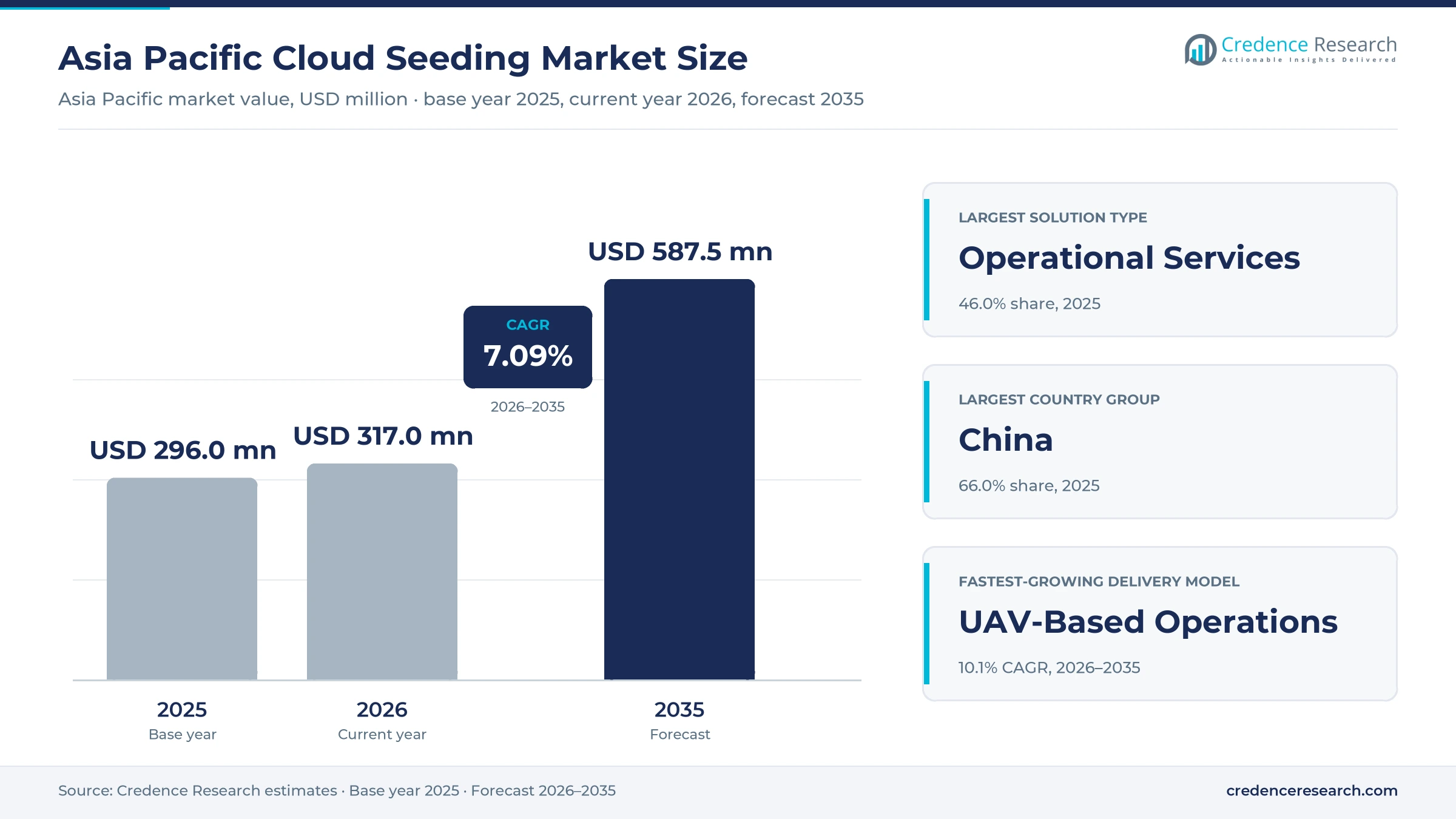
The Asia Pacific cloud seeding market was valued at USD 296.0 million in 2025 and is projected to increase from USD 317.0 million in 2026 to USD 587.5 million by 2035, registering a CAGR of 7.09% during 2026–2035. Meteorological agencies, agricultural ministries and water authorities buy most of the flying hours, rockets, flares and seeding agents, because drought relief, reservoir refill and hail protection are run as public programs. China held the largest share, 66.0% in 2025, on the strength of a national weather modification network that reaches most of its grain-producing areas. South Asia is the fastest-growing country group at 8.9% a year, as Indian states begin to contract seasonal aircraft operations from private firms. Platform choice is also changing, with large drones and purpose-built turboprops entering service alongside converted aircraft and ground rocket launchers. Weak attribution of extra rainfall, however, keeps several governments cautious, and some utilities have closed long-running programs on cost grounds.
Flight services, rockets and seeding agents define the scope
The estimate measures spending in Asia Pacific on cloud seeding work and on goods dedicated to it, counted at the price paid by the program owner. It covers aircraft, drone and ground operations sold as missions or seasonal contracts, dedicated equipment such as rocket launchers, flare racks and ground generators, consumables such as silver iodide flares and hygroscopic salt, and software used only for seeding decisions and evaluation.
The estimate excludes general weather forecasting, multipurpose aircraft that are not fitted for seeding, and the salaries of public staff who run programs in house. Value flows from rocket, flare and aircraft makers through specialist operators and research teams to meteorological, agricultural and water agencies, which remain the main buyers across the region.
Asia Pacific Cloud Seeding Market Insights
- The Asia Pacific cloud seeding market grows from USD 296.0 million in 2025 to USD 587.5 million by 2035 at a 7.09% CAGR, carried by public drought, hail and water programs.
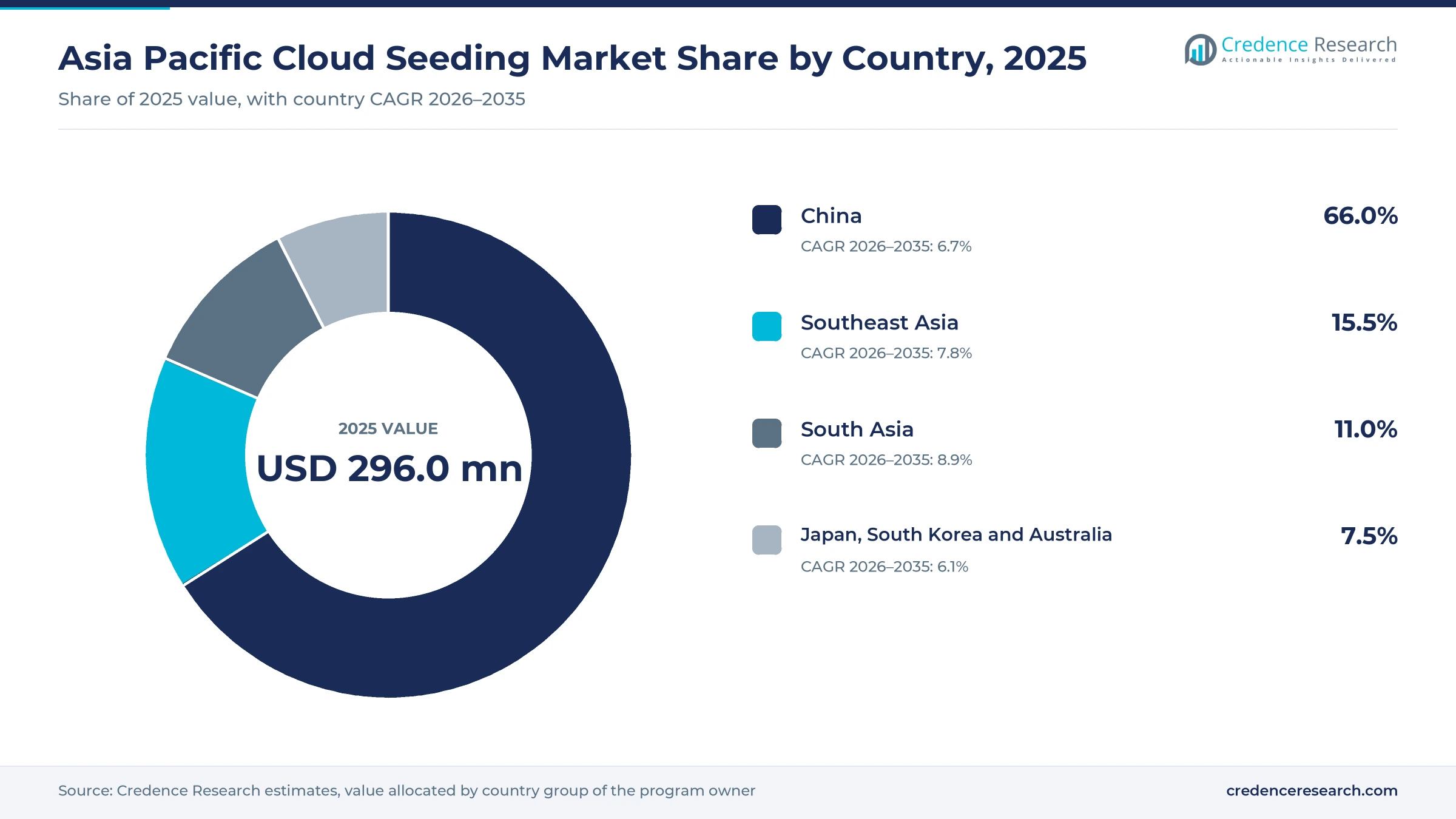
- China held 66.0% of regional value in 2025, while South Asia grows fastest at 8.9% a year as Indian states contract seasonal seeding flights.
- Operational services led solution types with 46.0% of 2025 value, because agencies buy flying hours and crews rather than owning complete fleets.
- China's weather modification work added 167.7 billion metric tons of precipitation during 2021 to 2025, China Daily reported, and a new plan covers 2026 to 2030.
- Karnataka awarded Kyathi Climate Modification Consultants a Rs 28.52 crore seeding program in September 2026, which shows Indian states now outsource full seasons.
Flight services lead while drones and software grow fastest
Flight services lead as seeding software grows fastest
Based on solution type, the market is categorized into operational services, dedicated equipment, seeding consumables and seeding-specific software. Operational Services led with 46.0% of 2025 value because agencies pay for flying hours, crews, radar watch and mission planning every season. Thailand's royal rainmaking department flew 2,065 rainmaking missions between Feb. 23 and Aug. 26, 2025, according to the Thai Public Relations Department. Seeding-Specific Software grows fastest at 9.5% a year, as programs add targeting and evaluation tools to defend their budgets. Karnataka's 2026 program refreshes cloud data every two hours from Doppler radar, IANS reported.
Farm rain enhancement leads while smog work grows fastest
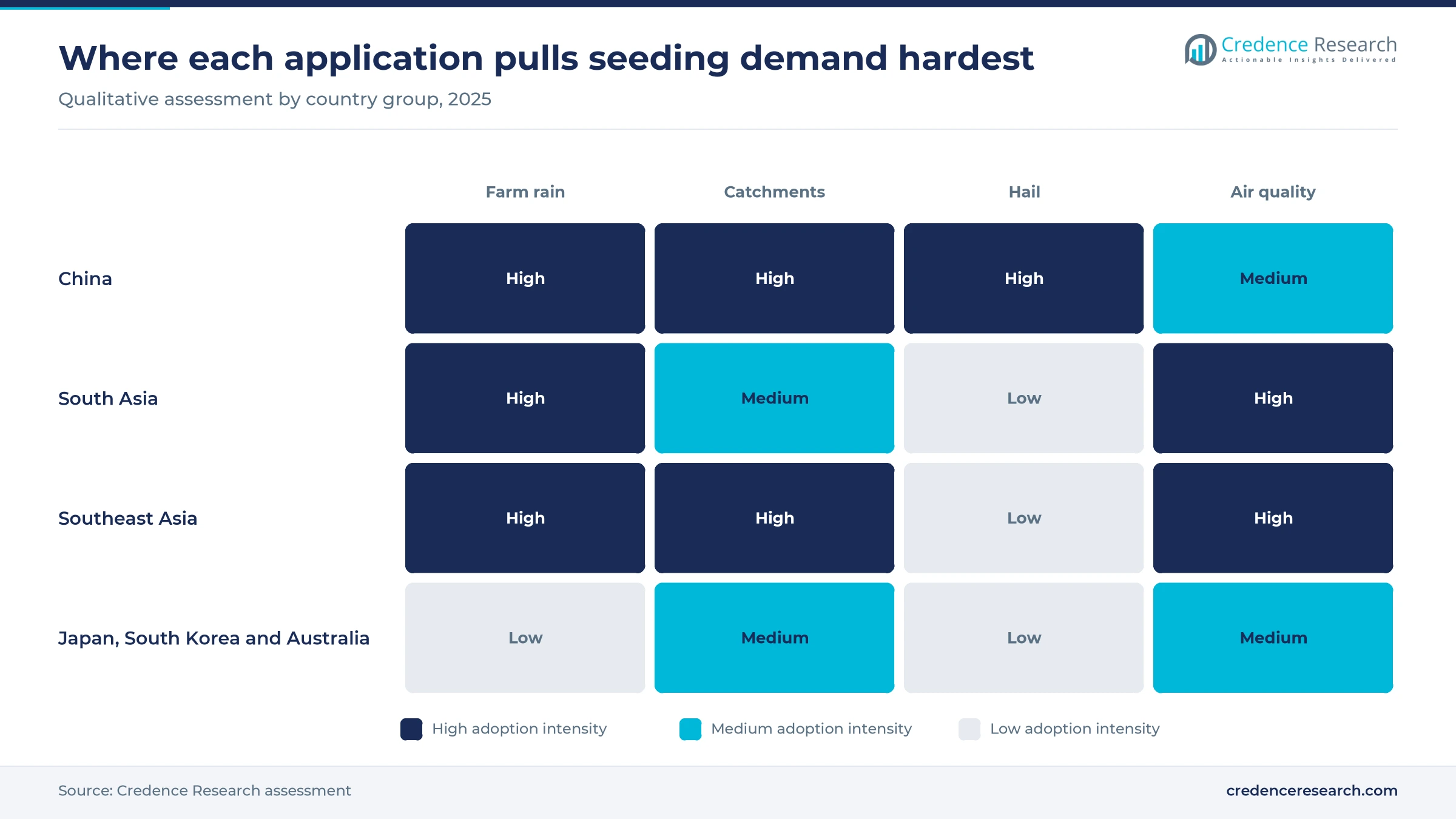
Based on application, the market is categorized into agricultural rainfall enhancement, catchment water augmentation, hail suppression and atmospheric and visibility management. Agricultural Rainfall Enhancement led with 44.0% of 2025 value because farm drought relief is the founding mandate of the largest public programs. China's weather modification work covered 68% of major grain-producing areas and 55% of orchards by 2025, China Daily reported in December 2025. Atmospheric and Visibility Management grows fastest at 9.3% a year, as governments turn seeding toward smog and haze. The Punjab government in Pakistan ran an artificial rain trial near Jhelum and Gujar Khan on Nov. 15, 2024, Arab News reported.
Aircraft lead operations while drones grow fastest
Based on delivery model, the market is categorized into aircraft-based operations, UAV-based operations and ground-based operations. Aircraft-Based Operations led with 52.0% of 2025 value because turboprops carry heavy flare and salt loads into convective clouds over wide farm areas. LET Aircraft Industries handed two L 410 NG aircraft to the Thai rainmaking department at Tak on Aug. 17, 2025, for rainfall enhancement. UAV-Based Operations grow fastest at 10.1% a year, as large drones reach altitudes that crews avoid. Chinese teams completed 23 drone rain and snow enhancement experiments in Xinjiang during 2024, logging 46 flight hours, Xinhua reported.
| Segment Group | Leading Sub-segment | Share, 2025 | Fastest-growing Sub-segment | CAGR, 2026–2035 |
|---|---|---|---|---|
| By Solution Type | Operational Services | 46.0% | Seeding-Specific Software | 9.5% |
| By Application | Agricultural Rainfall Enhancement | 44.0% | Atmospheric and Visibility Management | 9.3% |
| By Delivery Model | Aircraft-Based Operations | 52.0% | UAV-Based Operations | 10.1% |
Seeding is bought per trial, per operating day or per season
Cloud seeding is priced per trial, per operating day or per season, and season contracts account for most public spending. A single Delhi trial cost about Rs 35 to 40 lakh, while IIT Kanpur put a full winter program at Rs 25 to 30 crore, so standby crews and aircraft rather than seeding agents set the bill. Aircraft hours, ferry distance, the number of seedable days and radar support move prices most. Buyers that commit to seasons secure ready aircraft at lower daily rates, while one-off trials carry the highest unit cost.
| Contract or buyer | Typical price or fee | Basis |
|---|---|---|
| Single city trial, Delhi | Rs 35 to 40 lakh per trial | The Tribune, October 2025 |
| Full winter program, Delhi | Rs 25 to 30 crore per season | IIT Kanpur estimate reported by The Tribune, October 2025 |
| National operations add-on, Indonesia | Rp 22.09 billion for 40 operating days in 2025 | Fortune IDN on the BMKG budget, September 2024 |
| Rainmaking flight operations, Thailand (excludes staff) | More than 1 billion baht a year | The Nation, August 2023 |
Request a Free Sample
Fill in your details and we'll send you a free sample report.
- Sample data tables & charts
- Research methodology
State plans, farm water needs and trial evidence lift demand
Policy-backed procurement keeps seeding budgets in place
Multiyear state plans keep cloud seeding budgets in place through dry and wet years, which gives operators and equipment makers a predictable order book. China set a 2025 goal of more than 5.5 million square kilometers of artificial rain and snow operations and 580,000 square kilometers of hail suppression, according to the State Council. The program added 167.7 billion metric tons of precipitation during 2021 to 2025, and the 2026 to 2030 plan widens its disaster and ecological tasks, China Daily reported. South Korea set its 2024 seeding budget at 7.3 billion won, according to the Korean Culture and Information Service. Suppliers with approved rockets, aircraft and agents gain the most, because public buyers rarely switch vendors in the middle of a plan.
Institutional farm and water demand anchors purchases
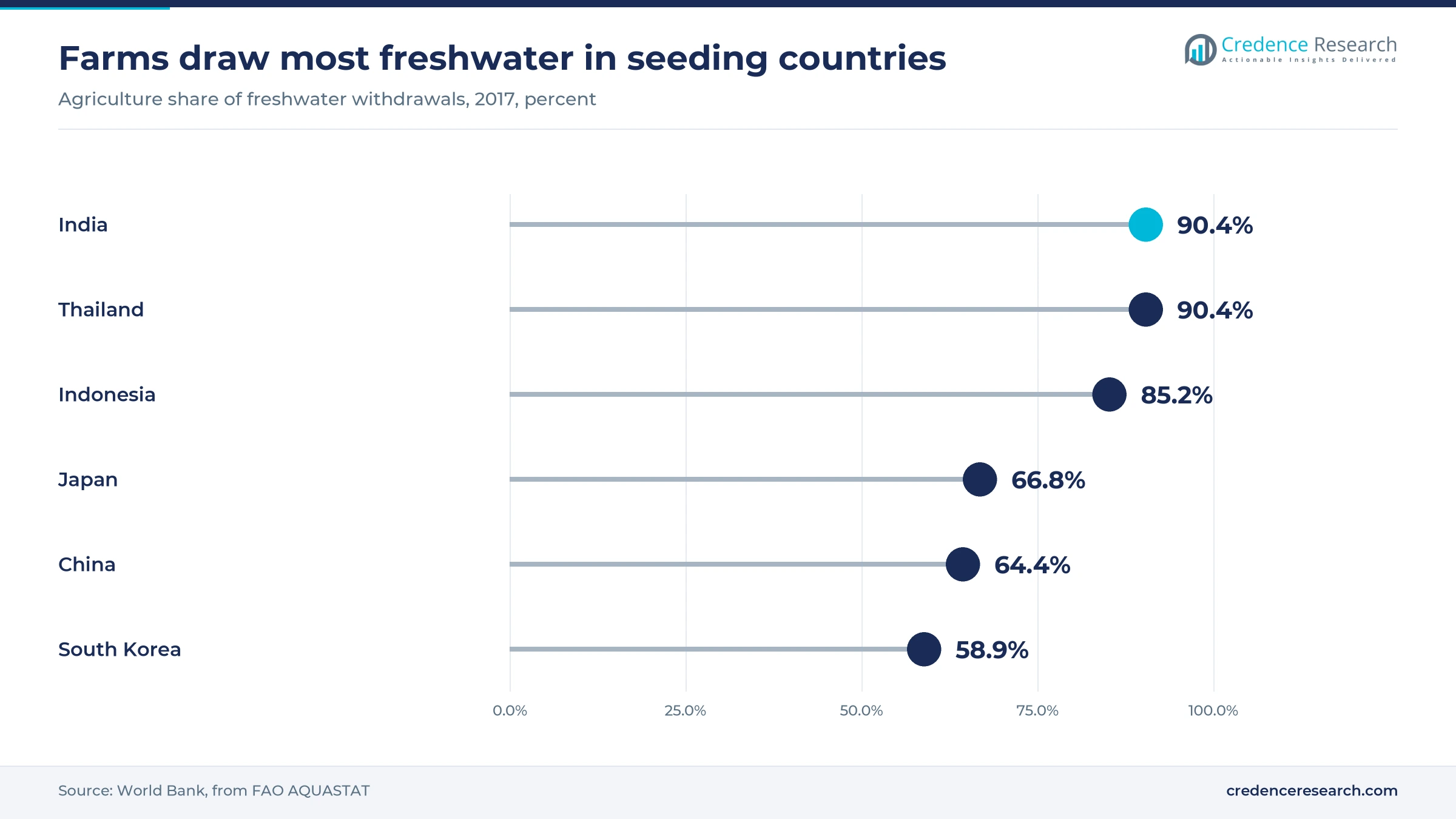
Agriculture draws most of the region's freshwater, so rainfall deficits translate directly into public demand for rain enhancement over farmland and reservoir catchments. Farms accounted for 90.4% of freshwater withdrawals in India and Thailand and 64.4% in China in 2017, according to World Bank data compiled from FAO AQUASTAT. Thailand's 2025 missions eased drought on more than 141 million rai of farmland across 63 provinces, the Thai Public Relations Department said. Karnataka placed its 2026 program under the state irrigation company Karnataka Neeravari Nigam, with priority for reservoir catchments and districts under farm stress, IANS reported. Irrigation and water agencies with fixed seasonal mandates buy repeat service seasons, which favors operators that hold aircraft and crews ready before the monsoon ends.
Platform and decision-support development improves targeting
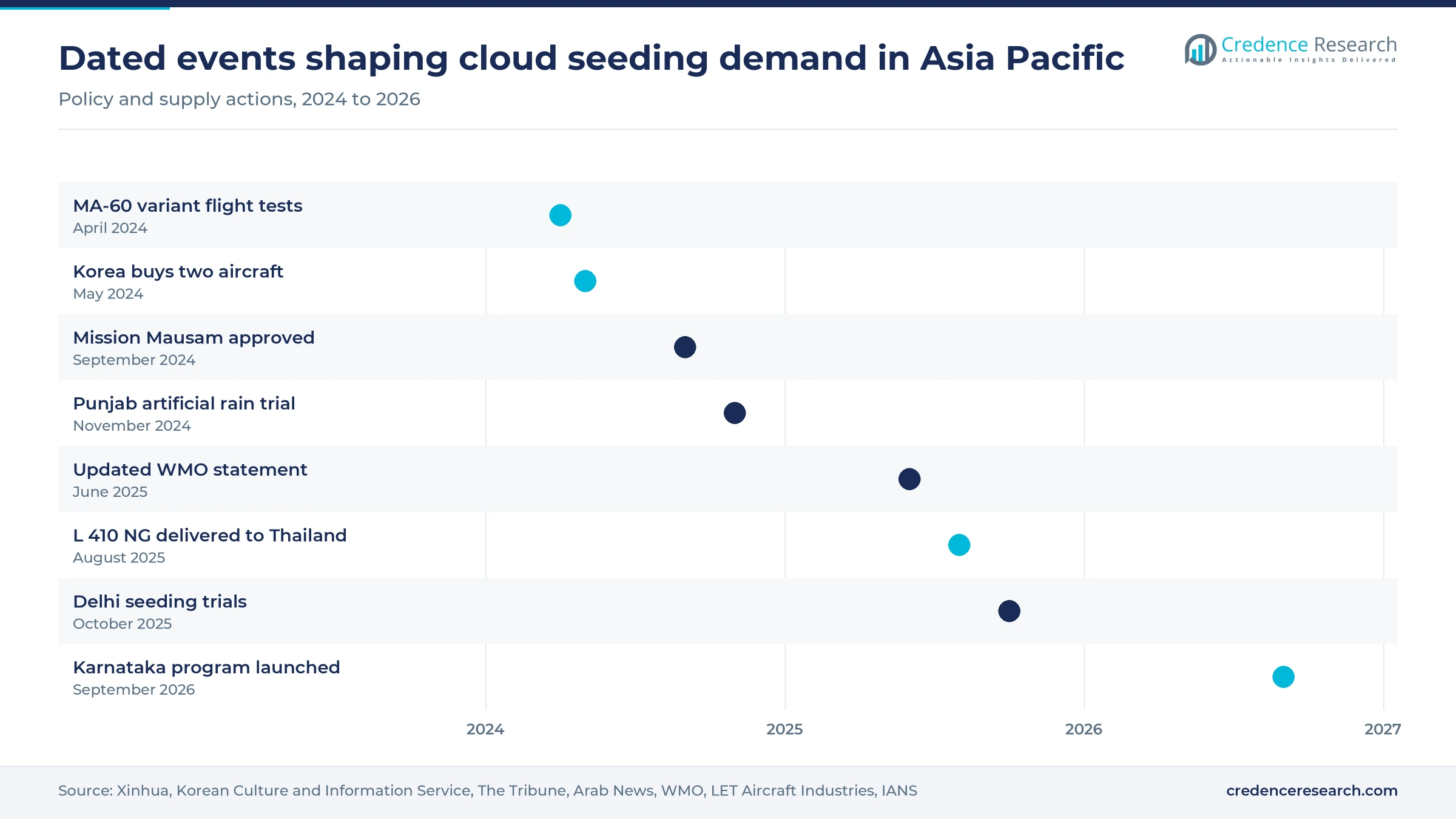
Better aircraft and measurement tools let agencies pick seedable clouds and document results, which supports longer contracts. AVIC began airworthiness flight tests of a new MA-60 weather modification variant in late April 2024, fitted with detection equipment built to China Meteorological Administration requirements, Xinhua reported. India's cabinet approved Mission Mausam with a first-phase outlay of Rs 2,000 crore in September 2024, including a cloud chamber to be built at the Indian Institute of Tropical Meteorology within about 1.5 years to test which clouds can be seeded, The Tribune reported. Korea's meteorological agency reports that the effectiveness of its seeding experiments rose more than 20% between 2020 and 2023, according to the Korean Culture and Information Service. Makers that bundle sensors, dispensers and data links win share over operators flying unequipped charter aircraft.
Controlled trial results lower the risk for public buyers
Published trial results give finance ministries a measurable basis for funding seeding, which moves programs from emergency use toward planned seasons. The CAIPEEX experiment over Solapur in Maharashtra found an average rainfall gain of about 18% downwind of seeding across 100 square kilometers, according to the Indian Institute of Tropical Meteorology. A Chinese drone trial in Xinjiang added more than 70,000 cubic meters of rain from 1 kg of silver iodide over 8,000 square kilometers, Business Standard reported in May 2025, a volume too small to price, which shows why buyers fund evaluation rather than agent tonnage. Such figures favor suppliers of hygroscopic and glaciogenic agents and vendors of evaluation software. Results still vary with cloud type, so buyers increasingly ask for randomized designs before they sign multiyear contracts.
Drones and smog missions reshape how agencies buy seeding
Agencies shift toward large drones for high-altitude work
Meteorological agencies are shifting part of their flying to large unmanned aerial vehicles to reach cold, high clouds without exposing crews to icing. The Ganlin-1, developed by the Gansu Meteorological Bureau with AVIC's Chengdu design institute and AVIC (Chengdu) Unmanned Aircraft System, combines atmospheric sounding with catalyst release over the Qilian Mountains, Inside Unmanned Systems reported. Zhongtian Rocket lists weather modification drones, airborne flare dispensers and smoke generators alongside its rockets, according to its company profile on the financial portal 10jqka. In Xinjiang, a drone ignited seeding flares at 4,200 meters during a January 2025 experiment, Xinhua reported. Drone makers and flare suppliers stand to gain, while small charter operators face lower utilization in western China.
Seeding work expands into smog, haze and wildfire control
Governments are shifting part of their seeding budgets toward air quality and fire prevention, which adds winter and dry-season missions to the monsoon calendar. The Delhi government and IIT Kanpur ran pollution trials on Oct. 23 and Oct. 28, 2025, The Tribune reported. Indonesia's BMKG ran weather modification against wildfires in Riau, Jambi, South Sumatra and South Kalimantan in August 2025, Metro TV reported. South Korea plans to induce rain over dry mountain areas to lower wildfire risk, according to the Korean Culture and Information Service. These missions favor operators that can fly at short notice, and they raise demand for weather forecasting services that identify humid windows in otherwise dry seasons.
Opportunity in commercial service contracts in Korea and ASEAN
Agencies that have run seeding as research now plan to buy it as a service, which creates openings for private operators and aircraft integrators. The Korea Meteorological Administration acquired two aircraft from Weather Modification International in 2024 and aims to make cloud seeding commercially available by 2028, according to Korea's culture ministry. ASEAN members set up the ASEAN Weather Modification Centre secretariat in 2024 to share procedures, training and joint research, according to its website. Malaysia's National Disaster Management Agency coordinates funding for dam-refill flights, The Star reported in September 2026. Operators that offer crews, aircraft and evaluation under one contract can bid across several ASEAN states, because few ASEAN agencies outside Thailand hold dedicated fleets.
Opportunity in Indian state contracts for monsoon seasons
Indian states are moving from one-off trials toward seasonal contracts, which opens a market for private operators with aircraft, radar access and seeding agents. Karnataka launched a Rs 28.52 crore program from HAL Airport in Bengaluru on Sept. 4, 2026, and awarded it to Kyathi Climate Modification Consultants under an exemption from the state's procurement transparency law, IANS reported. The second phase of Mission Mausam is planned to add aircraft and satellites, The Tribune reported, which could widen national flying capacity. Radar networks and hydrological and meteorological equipment already run by state disaster centers lower the entry cost of new programs. Operators with Indian flight permits and silver iodide supply can bid for rain-shadow districts every monsoon.
Dry air, cost exits and thin budgets limit seeding programs
Dry air and weak attribution undermine trial results
Seeding cannot create rain from dry air, so trials run in unsuitable conditions expose sponsors to visible failures. The Delhi trials noted above cost Rs 1.07 crore across three attempts, yet humidity of 10% to 15% sat far below the 50% to 60% needed, and no significant rainfall followed, The Tribune reported in October 2025. City governments that seek quick pollution relief are the most exposed buyers. Contractors also carry reputational risk when missions are launched for public visibility rather than cloud suitability.
Rising program costs push utilities to exit seeding
Utilities that fund seeding from their own budgets drop programs when the extra water cannot be shown to cover costs. Snowy Hydro paused operations in 2024 and decided in 2025 to cease cloud seeding permanently, citing escalating costs to resource the program, according to its January 2026 operations report. Hydro Tasmania, once a second utility source of demand, last flew seeding missions in June 2016, its website states. Suppliers of ground generators and agents in Australia are the most exposed, because the utility customer base there has largely closed.
Budget gaps delay fleet upkeep and research in Thailand
Budget shortfalls constrain Thailand's dedicated national rainmaking fleet and the vendors that service it. Thailand's royal rainmaking department requested 7 billion baht for 2024 but was allocated 2.16 billion baht, and a 10 million baht research request drew only 500,000 baht, The Nation reported in August 2023. Aviation fuel funds had run out by June of that year. Aircraft maintenance contractors and agent suppliers face deferred orders whenever drought budgets arrive late in the fiscal year.
Scarce dedicated aircraft tie missions to air forces
Many countries lack dedicated seeding aircraft, so missions depend on air force schedules and spare capacity. Malaysia's dam-refill flight on Sept. 3, 2026, used a Royal Malaysian Air Force C-130H carrying four tanks of salt solution, The Star reported. Specialized cloud seeding aircraft were not available in India during the Delhi trials, The Tribune reported. Private operators struggle to build fleets without multiyear contracts, while agencies lose seeding windows whenever military aircraft are tasked elsewhere.
China holds two-thirds of value as South Asia grows fastest
China holds about two-thirds of regional value, Southeast Asia ranks second on Thai and Indonesian national programs, and the Japan, South Korea and Australia group is the smallest after Australian utility exits. Country group shares are Credence Research estimates, because no official statistic separates seeding spending by country.
| Country | Value, 2025 (USD million) | Share, 2025 | CAGR, 2026–2035 |
|---|---|---|---|
| China | 195.4 | 66.0% | 6.7% |
| Southeast Asia | 45.9 | 15.5% | 7.8% |
| South Asia | 32.6 | 11.0% | 8.9% |
| Japan, South Korea and Australia | 22.2 | 7.5% | 6.1% |
China leads on plan budgets and domestic hardware supply
China held 66.0% of 2025 value and grows at 6.7% a year, supported by the largest public weather modification network in the region. Rain enhancement and hail suppression are bought at county, provincial and national levels, and local governments supplied about CNY 7.64 billion of program funds between 2012 and 2017, Yicai Global reported. Domestic makers supply rockets, aircraft and drones, which keeps import exposure low. Growth follows the 2026 to 2030 plan more than the weather, so suppliers with approved products receive steady orders.
Southeast Asia buys salt seeding and aircraft hours
Southeast Asia held 15.5% of 2025 value and grows at 7.8% a year. Thailand runs a dedicated national rainmaking fleet and is building five dry ice plants in Tak, Phitsanulok, Khon Kaen, Buriram and Phetchaburi, each making one ton an hour, the Thai Public Relations Department said. Indonesian demand rests on BMKG's weather modification budget shown in the price table, while Malaysia relies on air force aircraft. Consumables and flying hours take a larger share of spending here than in China.
South Asia grows fastest as states contract seasons
South Asia held 11.0% of 2025 value and is the fastest-growing country group at 8.9% a year. Indian state contracts and national research funding, both described above, are turning trials into seasonal programs. Pakistan's Punjab used locally developed technology from army research teams, Army Aviation and the refiner PARCO in its November 2024 trial, Arab News reported. Demand starts from a small base, so the pace depends on aircraft availability and on published evaluation from Indian field experiments.
Japan, South Korea and Australia grow slowest
Japan, South Korea and Australia held 7.5% of 2025 value and grow at 6.1% a year, the slowest pace in the region. South Korea is the most active buyer, using research aircraft, drones and ground combustors against drought and wildfire risk. Australian utility seeding programs have closed for the cost reasons noted above. Public data on Japanese seeding spending is also too thin to support a separate figure. South Korea's 7.3 billion won experiment budget is the largest verified line, so the group's small share rests on Credence Research estimates of research aircraft, instruments and agent purchases.
Aircraft deliveries, flight tests and state contracts
| Development | Status and market relevance |
|---|---|
| In April 2024, AVIC began airworthiness compliance flight tests of a new MA-60 weather modification variant at Suining in Sichuan | Testing milestone, with detection equipment built to China Meteorological Administration requirements |
| In May 2024, the Korea Meteorological Administration reported that it had acquired two seeding aircraft from Weather Modification International | Completed purchase, with multi-aircraft experiments running from 2024 toward commercial service |
| In August 2025, LET Aircraft Industries delivered two L 410 NG aircraft to Thailand's Department of Royal Rainmaking and Agricultural Aviation | Completed delivery at Tak Airport for rainfall enhancement flights |
| In November 2025, the Indian Institute of Tropical Meteorology in Pune hosted the 11th WMO Scientific Conference on Weather Modification | Completed event, held after the updated WMO statement on weather modification |
| In September 2026, Karnataka launched its state cloud seeding program with Kyathi Climate Modification Consultants as operator | Contract awarded and operations launched from HAL Airport in Bengaluru |
Flares, salt, drones and radar targeting change operations
- Glaciogenic flares and rockets disperse silver iodide into supercooled clouds, where ice crystals grow and fall as rain or snow, and ground rockets also serve hail suppression over orchards and grain fields.
- Hygroscopic salt seeding uses sodium chloride particles to speed droplet growth in warm tropical clouds, the main method in Southeast Asia.
- Large weather modification drones carry flares and sensors into cold, high clouds for long periods without crews on board, which suits high plateaus and mountain catchments.
- Radar-guided targeting and evaluation software selects seedable cells and compares seeded with unseeded samples to estimate added rainfall.
Need a Custom Version of This Report?
Tailor the scope, geography, or segments to your exact requirements.
- Custom geography or segment scope
- Direct access to our analyst team
Approved platforms and permits decide supplier position
Competition in the Asia Pacific cloud seeding market sorts suppliers by platform, approval status and access to public buyers rather than by price alone. AVIC supplies the purpose-built MA-60 weather modification aircraft and, through its Chengdu units, the Ganlin-1 drone, which ties it closely to Chinese meteorological programs. Shaanxi Zhongtian Rocket Technology sells rain enhancement and hail suppression rockets, flare dispensers and support equipment to Chinese operators. Weather Modification International competes on aircraft conversion and operating know-how, shown by its sale of two aircraft to South Korea. Kyathi Climate Modification Consultants competes on Indian flight permits and season delivery for state governments. LET Aircraft Industries sells the L 410 NG turboprop flown on Thai rainmaking missions. Public agencies such as the China Meteorological Administration and Thailand's rainmaking department remain buyers and operators rather than vendors, and they set the specifications every supplier must meet.
Public agencies buy while few specialists sell
Supply is concentrated because public agencies are the main buyers and, in several countries, also the in-house operators. China buys from domestic state-linked makers such as AVIC for aircraft and drones and Zhongtian Rocket, which says it holds the leading domestic share in weather modification rockets. Thailand, South Korea and Indonesia run programs through national agencies and buy aircraft, agents and services around them. Private operators such as Weather Modification International and Kyathi win work where agencies lack fleets. Entry barriers sit in aviation permits, flare licensing and evaluation credibility, and margins are richest in dedicated equipment and multi-season contracts.
Suppliers and operators active in the region
| Company | Type | Role in the market |
|---|---|---|
| Aviation Industry Corporation of China (AVIC) | Aircraft and drone maker | Builds MA-60 weather modification aircraft and the Ganlin-1 seeding drone |
| Shaanxi Zhongtian Rocket Technology Co., Ltd. | Equipment and consumables maker | Sells rain enhancement and hail suppression rockets, flare dispensers and seeding drones |
| Weather Modification International | Specialist operator and integrator | Supplied two seeding aircraft to the Korea Meteorological Administration in 2024 |
| Kyathi Climate Modification Consultants LLP | Specialist operator | Runs the Karnataka state cloud seeding program under a 2026 contract |
| LET Aircraft Industries, a.s. | Aircraft maker | Delivered L 410 NG rainmaking aircraft to Thailand in August 2025 |
Evaluated trials, not rainfall, will decide seeding budgets
Credence Research's view is that cloud seeding in the region is moving from emergency drought response toward contracted, evaluated programs. China will keep most of the value, because its plan-based budgets buy domestic rockets, aircraft and drones at scale. The faster change is in South Asia and Southeast Asia, where states and agencies outsource flying hours and add haze and wildfire missions. Suppliers that can document added rainfall through radar evaluation and randomized trials will win the longer contracts. Programs that cannot show results face closure regardless of drought, as the Australian exits show.
Budgets, mission counts and prices drive the estimate
The report uses 2025 as the base year and forecasts value to 2035. Market values come from the Credence Research model, which links public weather modification budgets, mission counts, aircraft and rocket supply and seeding agent use to the prices of services, equipment, consumables and software. Country group, solution type, application and delivery splits are Credence Research estimates, because official statistics do not separate seeding spending by country. Sources include government budgets and plans, meteorological agency releases, research institute reports, company and exchange disclosures and press reports. No interviews or surveys were used to prepare this edition of the report.
Plan budgets and evaluated contracts carry demand to 2035
Through 2035, regional demand will rest on China's planned weather modification budgets, Indian and ASEAN drought and reservoir programs, and a growing share of haze and wildfire missions. Drones will take a larger share of flying in western China and mountain catchments, while turboprops remain the workhorse over tropical farmland. South Korea's move toward commercial service could add a private service layer after 2028. UAV-based operations grow at 10.1% a year in the base case, the fastest of the three delivery models. The main risks are failed trials that erode political support, late budget releases and utility exits wherever added water cannot be proven.
Budget continuity and trial evidence set the 2035 range
The range of outcomes depends on whether China's 2026 to 2030 plan keeps funding near recent levels and whether Indian and ASEAN trials publish convincing results. Repeated failed trials or further utility exits would slow growth. Faster outsourcing by Indian states, commercial services in South Korea and wider drone use would lift it. Seeding agents remain a small share of spending in every case, so fleet and service pricing decides the spread.
| Scenario | CAGR, 2026–2035 | Value, 2035 | What has to hold |
|---|---|---|---|
| Downside | 5.5% | USD 512.8 million | Chinese local budgets tighten and more failed trials erode political support |
| Base | 7.09% | USD 587.5 million | Plan budgets hold and Indian and ASEAN programs follow recent contracting patterns |
| Upside | 8.4% | USD 654.6 million | Indian states outsource full seasons and South Korea launches commercial service on time |
Frequently Asked Questions
How big is the Asia Pacific cloud seeding market?
Which country group leads regional cloud seeding demand?
Which country group grows fastest?
Which solution type leads the market?
Why do UAV-based operations grow fastest?
How is cloud seeding priced?
What holds the market back?
Who are the main companies in this market?
Table of Content
Chapter 1 Market Segmentation
- 1.1 Segmentation Framework
- 1.1.1 Product and Service Classification
- 1.1.2 Application and End-Use Classification
- 1.1.3 Technology and Solution Classification
- 1.1.4 Customer and Distribution Channel Classification
- 1.1.5 Geographic Segmentation
- 1.1.6 Market Segment Definitions and Boundaries
- 1.2 By Solution Type
- 1.2.1 Operational Services
- 1.2.2 Dedicated Equipment
- 1.2.3 Seeding Consumables
- 1.2.4 Seeding-Specific Software
- 1.3 By Application
- 1.3.1 Agricultural Rainfall Enhancement
- 1.3.2 Catchment Water Augmentation
- 1.3.3 Hail Suppression
- 1.3.4 Atmospheric and Visibility Management
- 1.4 By Delivery Model
- 1.4.1 Aircraft-Based Operations
- 1.4.2 Ground-Based Operations
- 1.4.3 UAV-Based Operations
- 1.5 By Country
- 1.5.1 China
- 1.5.2 Southeast Asia
- 1.5.3 South Asia
- 1.5.4 Japan, South Korea and Australia
Chapter 2 Introduction
- 2.1 Report Objectives and Scope
- 2.2 Product Definition and Industry Terminology
- 2.3 Market Inclusions and Exclusions
- 2.4 Research Process
- 2.4.1 Primary Research and Expert Interviews
- 2.4.2 Secondary Research and Source Review
- 2.4.3 Top-Down and Bottom-Up Estimation
- 2.4.4 Data Triangulation and Verification
- 2.5 Market Size Measurement Basis
- 2.5.1 2025: USD 296.0 million → 2035: USD 587.5 million
- 2.6 Historical and Forecast Reference Periods
- 2.6.1 Historical Period: 2018-2025
- 2.6.2 Base Year: 2025
- 2.6.3 Forecast Period: 2025-2035
- 2.7 Research Assumptions and Limitations
Chapter 3 Executive Summary
- 3.1 Market Snapshot and Key Findings
- 3.2 Base-Year Market Size, 2025
- 3.3 Forecast Market Size, 2035
- 3.4 Revenue and Volume Growth Outlook
- 3.5 Key Demand and Supply Indicators
- 3.6 Leading Market Segments
- 3.7 Fastest-Growing Market Opportunities
- 3.8 Regional Performance Highlights
- 3.9 Technology and Industry Transformation
- 3.10 Competitive Landscape Summary
- 3.11 Analyst View and Strategic Implications
Chapter 4 Asia Pacific Cloud Seeding Market Trends and Developments
- 4.1 Historical Industry Development, 2018-2025
- 4.2 Recent Market Trends and Developments
- 4.3 Demand and Customer Behavior Trends
- 4.4 Technology and Product Innovation
- 4.5 Artificial Intelligence, Automation and Digitalization
- 4.6 Local Manufacturing and Supply Chain Realignment
- 4.7 Industry Partnerships, Mergers and Acquisitions
- 4.8 Sustainability and Circular Economy Developments
- 4.9 Government and Private Sector Investment Trends
- 4.10 Emerging Business Models and Commercialization
- 4.11 Industry Developments and Announcements
Chapter 5 Asia Pacific Cloud Seeding Market Production, Supply and Demand Analysis
- 5.1 Demand Trend and Consumption Analysis, 2018-2025
- 5.2 Demand Forecast, 2025-2035
- 5.3 Production and Output Trend, 2018-2025
- 5.4 Production and Output Forecast, 2025-2035
- 5.5 Installed Capacity and Capacity Utilization
- 5.6 Company-Wise Production Plants and Statistics
- 5.6.1 Installed Production Capacity
- 5.6.2 Actual Production
- 5.6.3 Planned Capacity and Expansion Targets
- 5.7 Supply Chain Structure and Procurement Trends
- 5.8 Supply-Demand Gap and Bottlenecks
- 5.9 Import Dependence and Sourcing Structure
- 5.10 Contract Manufacturing and Outsourcing
- 5.11 Regional Supply and Demand Concentration
Chapter 6 Asia Pacific Cloud Seeding Market Pricing Analysis
- 6.1 Pricing Structure and Measurement
- 6.2 Historical Pricing Trends, 2018-2025
- 6.3 Pricing Outlook, 2025-2035
- 6.4 Average Selling Price and Unit Economics
- 6.5 Pricing by Product and Market Segment
- 6.6 Geographic Pricing Differences
- 6.7 Key Input, Energy, Labor and Logistics Costs
- 6.8 Contract Pricing and Purchasing Models
- 6.9 Pricing Sensitivity and Competitive Positioning
- 6.10 Price, Margin and Profitability Implications
Chapter 7 Asia Pacific Cloud Seeding Market Dynamics
- 7.1 Market Growth Drivers
- 7.1.1 Demand-Side Drivers
- 7.1.2 Technology and Innovation Drivers
- 7.1.3 Infrastructure and Investment Drivers
- 7.1.4 Regulatory and Policy Drivers
- 7.2 Market Restraints
- 7.2.1 Cost and Affordability Constraints
- 7.2.2 Technology and Adoption Barriers
- 7.2.3 Supply Chain and Operational Constraints
- 7.3 Market Challenges
- 7.3.1 Competitive Pressure and Margin Erosion
- 7.3.2 Skills, Infrastructure and Implementation Gaps
- 7.4 Emerging Market Opportunities
- 7.5 Market Dynamics Impact and Time-Horizon Assessment
Chapter 8 Asia Pacific Cloud Seeding Value Chain Analysis
- 8.1 Industry Value Chain Overview
- 8.2 Upstream Suppliers and Critical Inputs
- 8.3 Technology and Component Providers
- 8.4 Manufacturing or Service Delivery
- 8.5 Distribution, Channel Partners and Integrators
- 8.6 Downstream Applications and End Users
- 8.7 Value Addition and Profit Pools
- 8.8 Vertical Integration and Outsourcing
- 8.9 Supplier Concentration and Risk
- 8.10 Supply Chain Localization and Resilience
Chapter 9 Asia Pacific Cloud Seeding Market Regulations and Policies
- 9.1 Relevant Laws, Standards and Compliance Frameworks
- 9.2 Product, Service, Safety and Quality Requirements
- 9.3 Government Policies, Incentives and Subsidies
- 9.4 Imports, Exports and Trade Barriers
- 9.5 Public Procurement and Local Content Requirements
- 9.6 Environmental and Sustainability Compliance
- 9.7 Upcoming Policy Changes and Market Implications
Chapter 10 Asia Pacific Cloud Seeding Market Hotspots and Opportunities
- 10.1 Market Opportunity Mapping and Growth Hotspots
- 10.2 High-Growth Applications and Customer Groups
- 10.3 Underserved Markets and White-Space Opportunities
- 10.4 Emerging Technology and Product Opportunities
- 10.5 New Capacity and Investment Hotspots
- 10.6 Market Entry and Expansion Opportunities
- 10.7 Distribution and Partnership Opportunities
- 10.8 Near-Term and Long-Term Commercial Potential
- 10.9 Opportunity Attractiveness and Execution Risks
Chapter 11 Asia Pacific Cloud Seeding Market Outlook, 2025-2035
- 11.1 Market Size and Analysis
- 11.1.1 Revenue (Market Measurement: 2025: USD 296.0 million → 2035: USD 587.5 million)
- 11.1.2 Market Volume and Quantity Sold
- 11.1.3 Historical Market Size, 2018-2025
- 11.1.4 Base-Year Market Size, 2025
- 11.2 Market Forecast, 2025-2035
- 11.2.1 Revenue Forecast to 2035
- 11.2.2 Volume Forecast to 2035
- 11.2.3 CAGR and Year-on-Year Growth
- 11.2.4 Incremental Revenue Opportunity
- 11.3 Forecast Assumptions and Scenario Analysis
- 11.3.1 Base-Case Forecast
- 11.3.2 Optimistic and Conservative Scenarios
- 11.3.3 Technology, Pricing and Policy Sensitivities
- 11.4 Market Attractiveness and Growth Outlook
Chapter 12 Asia Pacific Cloud Seeding Market Segmentation and Outlook
- 12.1 Segmentation Summary and Market Shares, 2025
- 12.2 Largest and Fastest-Growing Segments
- 12.3 By Solution Type - Market Size and Forecast, 2025-2035
- 12.3.1 Segment Definition and Scope
- 12.3.2 Historical Market Size, 2018-2025
- 12.3.3 Revenue Forecast, 2025-2035
- 12.3.4 Volume Forecast, 2025-2035
- 12.3.5 Base-Year Market Share, 2025
- 12.3.6 Segment CAGR and Growth Drivers
- 12.3.7 Subsegment Market Size and Forecast
- 12.3.7.1 Operational Services
- 12.3.7.2 Dedicated Equipment
- 12.3.7.3 Seeding Consumables
- 12.3.7.4 Seeding-Specific Software
- 12.3.8 Subsegment Pricing and Adoption Trends
- 12.3.9 Leading Suppliers and Competition
- 12.3.10 Regional Demand and Opportunities
- 12.4 By Application - Market Size and Forecast, 2025-2035
- 12.4.1 Segment Definition and Scope
- 12.4.2 Historical Market Size, 2018-2025
- 12.4.3 Revenue Forecast, 2025-2035
- 12.4.4 Volume Forecast, 2025-2035
- 12.4.5 Base-Year Market Share, 2025
- 12.4.6 Segment CAGR and Growth Drivers
- 12.4.7 Subsegment Market Size and Forecast
- 12.4.7.1 Agricultural Rainfall Enhancement
- 12.4.7.2 Catchment Water Augmentation
- 12.4.7.3 Hail Suppression
- 12.4.7.4 Atmospheric and Visibility Management
- 12.4.8 Subsegment Pricing and Adoption Trends
- 12.4.9 Leading Suppliers and Competition
- 12.4.10 Regional Demand and Opportunities
- 12.5 By Delivery Model - Market Size and Forecast, 2025-2035
- 12.5.1 Segment Definition and Scope
- 12.5.2 Historical Market Size, 2018-2025
- 12.5.3 Revenue Forecast, 2025-2035
- 12.5.4 Volume Forecast, 2025-2035
- 12.5.5 Base-Year Market Share, 2025
- 12.5.6 Segment CAGR and Growth Drivers
- 12.5.7 Subsegment Market Size and Forecast
- 12.5.7.1 Aircraft-Based Operations
- 12.5.7.2 Ground-Based Operations
- 12.5.7.3 UAV-Based Operations
- 12.5.8 Subsegment Pricing and Adoption Trends
- 12.5.9 Leading Suppliers and Competition
- 12.5.10 Regional Demand and Opportunities
- 12.6 By Country - Market Size and Forecast, 2025-2035
- 12.6.1 Segment Definition and Scope
- 12.6.2 Historical Market Size, 2018-2025
- 12.6.3 Revenue Forecast, 2025-2035
- 12.6.4 Volume Forecast, 2025-2035
- 12.6.5 Base-Year Market Share, 2025
- 12.6.6 Segment CAGR and Growth Drivers
- 12.6.7 Subsegment Market Size and Forecast
- 12.6.7.1 China
- 12.6.7.2 Southeast Asia
- 12.6.7.3 South Asia
- 12.6.7.4 Japan, South Korea and Australia
- 12.6.8 Subsegment Pricing and Adoption Trends
- 12.6.9 Leading Suppliers and Competition
- 12.6.10 Regional Demand and Opportunities
- 12.7 Segment Growth Comparison
- 12.8 Segment Attractiveness and Priority Matrix
Chapter 13 Asia Pacific Cloud Seeding End-Use and Application Market Outlook
- 13.1 End-Use Industry and Customer Demand Structure
- 13.2 Leading Applications and Customer Groups
- 13.3 End-Use Market Size, Share and Forecast
- 13.4 Major End-Use Industry Deep Dives
- 13.4.1 Customer Requirements and Use Cases
- 13.4.2 Demand and Replacement Cycles
- 13.4.3 Technical and Regulatory Considerations
- 13.4.4 Purchasing and Procurement Models
- 13.4.5 Leading Vendors and Distribution Channels
- 13.4.6 Forecast and Commercial Opportunities
- 13.5 Emerging Applications and Cross-Segment Demand
- 13.6 End-Use Industry Investment Priorities
Chapter 14 Asia Pacific Cloud Seeding Geographic Market Outlook, 2025-2035
- 14.1 Regional Market Size and Country-Level Shares, 2025
- 14.2 Country Market Size Comparison, 2025
- 14.3 Country Market Forecasts, 2025-2035
- 14.4 Subregional Industrial and Demand Clusters
- 14.5 Intra-Regional Pricing and Cost Differences
- 14.6 Cross-Border Trade and Supply Networks
- 14.7 Regional Supply and Demand Balances
- 14.8 Country Opportunity Comparison and Prioritization
Note: Every listed country is covered on the structure shown under the first country.
Chapter 15 Asia Pacific Cloud Seeding Technology, Innovation and Sustainability Outlook
- 15.1 Technology Landscape and Maturity
- 15.2 Product, Process and Service Innovation
- 15.3 AI, Automation and Digital Tools in the Industry
- 15.4 Technology Adoption and Performance Benchmarking
- 15.5 Innovation Pipeline and R&D Investment
- 15.6 Patent and Intellectual Property Trends
- 15.7 Energy Efficiency and Resource Management
- 15.8 Sustainability, Recycling and Circularity
- 15.9 Technology Roadmap, 2025-2035
- 15.10 Risks of Obsolescence and Technology Substitution
Chapter 16 Asia Pacific Cloud Seeding Market Key Strategic Imperatives
- 16.1 Growth and Market Entry Priorities
- 16.2 High-Return Products and Segments
- 16.3 Pricing, Profitability and Cost Optimization
- 16.4 Technology Investment and Product Differentiation
- 16.5 Supply Chain Localization and Resilience
- 16.6 Distribution and Customer Acquisition
- 16.7 Partnership, Acquisition and Capacity Strategy
- 16.8 Regional Expansion Priorities
- 16.9 Short-, Medium- and Long-Term Actions
Chapter 17 Competition Outlook
- 17.1 Industry Competition Characteristics
- 17.2 Market Structure and Concentration
- 17.3 Market Share and Competitive Positioning, 2025
- 17.4 Company-Wise Revenue and Product Benchmarking
- 17.5 Production and Service Capacity Benchmarking
- 17.6 Technology, Pricing and Differentiation
- 17.7 Regional Footprint and Distribution Strength
- 17.8 Mergers, Acquisitions and Strategic Alliances
- 17.9 New Entrants and Competitive Threats
- 17.10 Porter's Five Forces and Industry Attractiveness
- 17.11 Competitive Outlook, 2025-2035
Chapter 18 Company Profiles
- 18.1 Company Coverage and Selection Criteria
- 18.2 Aviation Industry Corporation of China (AVIC)
- 18.2.1 Business Description
- 18.2.2 Company Ownership and Geographic Presence
- 18.2.3 Product and Service Portfolio
- 18.2.4 Manufacturing and Operating Footprint
- 18.2.5 Production Capacity and Expansion Plans
- 18.2.6 Financial Performance and Investment
- 18.2.7 Market Share and Competitive Position
- 18.2.8 Technology and Innovation Capabilities
- 18.2.9 Strategic Alliances or Partnerships
- 18.2.10 Recent Developments
- 18.2.11 Growth Strategy and Outlook
- 18.3 Shaanxi Zhongtian Rocket Technology Co., Ltd.
- 18.4 Weather Modification International
- 18.5 Kyathi Climate Modification Consultants LLP
- 18.6 LET Aircraft Industries, a.s.
- 18.7 Other Relevant Market Participants
Note: Every listed company is profiled on the structure shown under the first company. The company list is preliminary and may change based on research findings, market developments, data availability and client requirements.
Chapter 19 Disclaimer
- 19.1 Research and Forecast Disclaimer
- 19.2 Data Source and Estimation Limitations
Note: The depth of individual sections depends on data availability for this market. Volume, capacity, trade and other unit-based metrics are included where applicable.

