
Greenhouse genetics and certified cereals split seed value
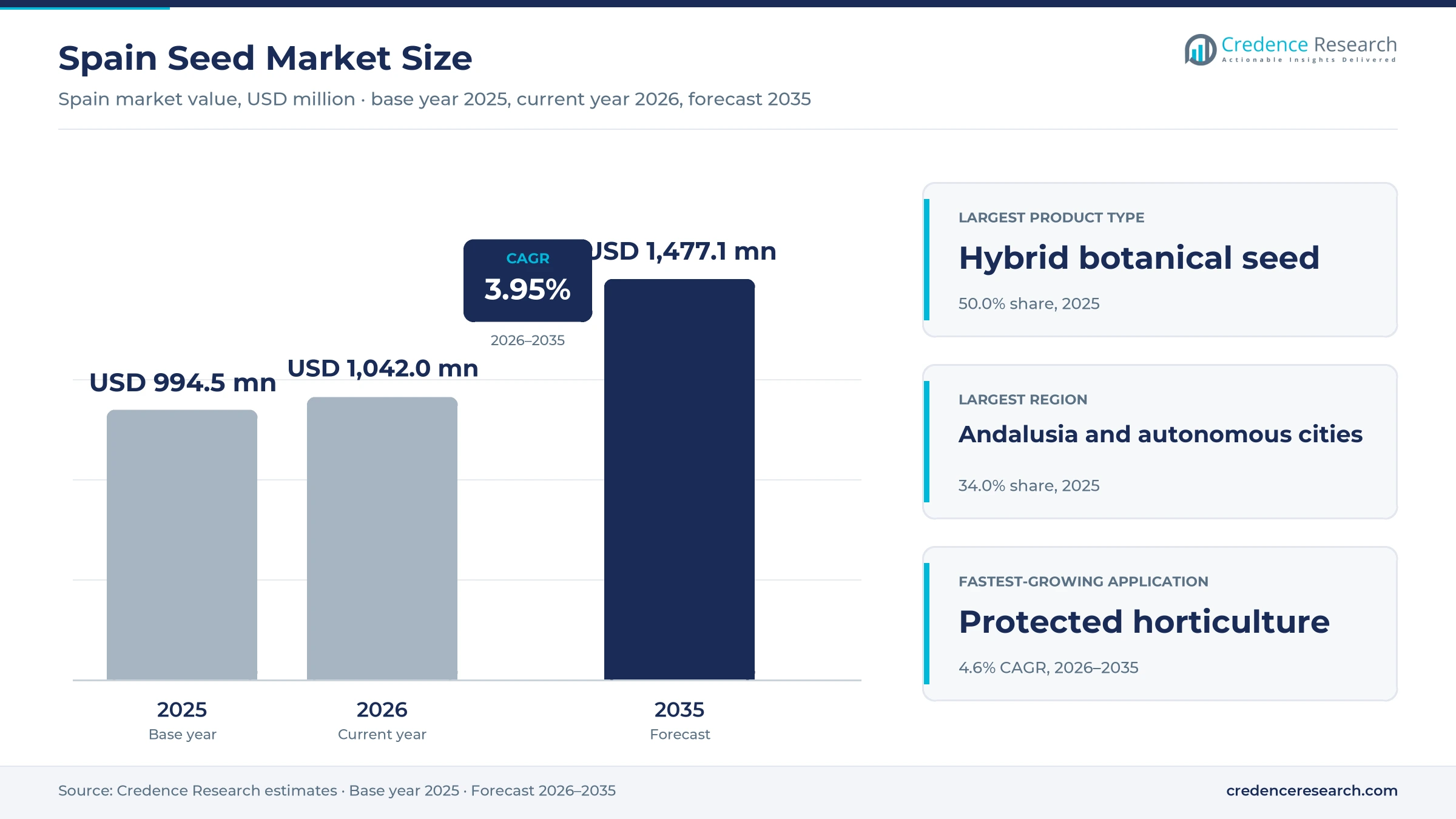
The Spain seed market was valued at USD 994.5 million in 2025 and is projected to increase from USD 1.04 billion in 2026 to USD 1.48 billion by 2035, registering a CAGR of 3.95% during 2026–2035. Seed value in Spain is concentrated in a few high-margin crops and buyers. Greenhouse growers in Almería and Granada pay thousands of euros per hectare for hybrid tomato and pepper seed, while cereal farmers in the two Castiles buy certified wheat and barley at a small premium over grain. Andalusia and autonomous cities held the largest regional share, 34.0% in 2025, because the Almería greenhouse cluster and the Guadalquivir arable belt sit in the same region. Northern Spain is the fastest-growing region at 4.8% a year, as irrigated maize in the Ebro valley takes up new hybrid systems. The main regulatory change is the EU deal of December 2025 on new genomic techniques, which will let edited varieties reach conventional farms from about 2028.
Where seed spending in Spain concentrates by crop and buyer
The market counts the value paid by growers, nurseries, cooperatives, landscapers and households for botanical seed and certified seed potatoes used in Spain, including the Balearic and Canary Islands and the autonomous cities of Ceuta and Melilla. Hybrid and open-pollinated vegetable seed sold to plant-raising nurseries is counted at the price the nursery pays the breeder.
Farm-saved grain, young plants resold by nurseries, fruit tree stock and seed produced in Spain for export are excluded. The chain runs from breeders and multiplying farmers through conditioning and treatment plants to cooperatives, distributors, nurseries and garden centers, with certification by the autonomous communities under national rules.
Spain Seed Market Insights
- The Spain seed market rises from USD 994.5 million in 2025 to USD 1.48 billion by 2035, a 3.95% CAGR, as greenhouse genetics and certified cereal seed gain value.
- Andalusia and autonomous cities held 34.0% of 2025 value, as Almería alone keeps about 33,000 hectares under greenhouses.
- Hybrid botanical seed held 50.0% of 2025 value, because tomato, pepper, lettuce and maize growers buy new hybrid seed every season.
- The EU reached a provisional deal on new genomic techniques on Dec. 4, 2025, opening a route for edited varieties outside organic farming.
- BASF Nunhems, Syngenta and Bayer are expanding vegetable breeding sites in Almería, which keeps the highest-value seed decisions close to growers.
Hybrids lead as protected horticulture grows fastest
Why hybrid botanical seed takes half of seed value
Based on product type, the market is categorized into hybrid botanical seed, non-hybrid botanical seed and seed potato. Hybrid botanical seed led with 50.0% of 2025 value because greenhouse tomato and pepper, lettuce and maize are sown with fresh hybrid seed each cycle, and a MAPA cost study put seed at 6,299 euros per hectare for Almería vine tomato in 2022/23. Non-hybrid seed is large in volume but cheap per kilogram, since MAPA counted 442.5 million kg of domestically produced cereal seed marketed in 2024/25. Hybrid botanical seed also grows fastest at 4.4% a year as breeders add disease-resistance packages for greenhouses.
Vegetables outspend cereals despite far smaller acreage
Based on crop type, the market is categorized into cereals and maize, vegetables, oilseed crops and forage and specialty crops. Vegetables led with 41.0% of 2025 value, because a vegetable hectare carries a seed bill dozens of times that of a cereal hectare, as the pricing table shows. Lettuce area also grew 70.9% between 2015 and 2025 while grain cereal area shrank, according to MAPA crop surveys reported by Interempresas in January 2026, so the crop mix keeps tilting toward high-value seed. Forage and specialty crops grow fastest at 4.5% a year as legume and fodder seed multiplication holds up, with 12,140 hectares of alfalfa entered for certification in 2025/26, according to MAPA.
Protected horticulture grows fastest on rising produce values
Based on application, the market is categorized into protected horticulture, open-field crop establishment, forage and amenity establishment and ornamental and household cultivation. Open-field crop establishment led with 61.0% of 2025 value because it covers cereals, maize, sunflower, potatoes and outdoor vegetables on millions of hectares. Protected horticulture grows fastest at 4.6% a year as Almería marketed produce worth 4,501 million euros in 2024/25, up 22%, which lets greenhouse growers pay for premium resistant hybrids. Ornamental and household cultivation stays a small, seasonal niche sold through garden retail.
Breeders sell direct while distributors gain on bundles
Based on distribution channel, the market is categorized into direct breeder sales, agricultural distributors, cooperative procurement and garden retail. Direct breeder sales led with 37.0% of 2025 value because vegetable breeders sell to nurseries and large growers through their own technical teams, and at least ten seed houses ran lettuce field days in the Campo de Cartagena in February 2025. Agricultural distributors grow fastest at 4.3% a year as they bundle seed with treatments and agronomy, as when Grupo Mercoguadiana co-hosted the first Corteva Pioneer forum in Mérida in February 2025.
| Segment Group | Leading Sub-segment | Share, 2025 | Fastest-growing Sub-segment | CAGR, 2026–2035 |
|---|---|---|---|---|
| By Product Type | Hybrid botanical seed | 50.0% | Hybrid botanical seed | 4.4% |
| By Crop Type | Vegetables | 41.0% | Forage and specialty crops | 4.5% |
| By Application | Open-field crop establishment | 61.0% | Protected horticulture | 4.6% |
| By Distribution Channel | Direct breeder sales | 37.0% | Agricultural distributors | 4.3% |
Seed costs range from tens to thousands of euros a hectare
Seed is priced per hectare of crop rather than per kilogram, and the spread is wide. Greenhouse growers treat seed as a minor cost line against a high-value crop. In the MAPA study of Almería vine tomato, seed and nursery raising together were 9.3% of a total cost of 77,160 euros per hectare. Certified cereal seed competes with farm-saved grain, which caps its premium close to the grain price plus conditioning. Supplier margins therefore sit in proprietary vegetable and maize hybrids, while cereal multipliers earn on volume and service. Seed for one hectare of Almería tomato costs more than seed for 50 hectares of certified wheat, which explains the large value share of vegetables.
| Crop and seed type | Typical price or fee | Basis |
|---|---|---|
| Greenhouse vine tomato hybrid seed, Almería | EUR 6,299 per hectare | MAPA food chain observatory cost study, 2022/23 |
| Tomato nursery raising, ungrafted | EUR 858 per hectare | MAPA food chain observatory cost study, 2022/23 |
| Certified seed potato, Castilla y León | EUR 3,225 per hectare, about 40% of growing cost | Castilla y León regional cost study, 2024/25 |
| Hybrid grain maize seed | EUR 250 to 330 per hectare | Credence Research estimate from 80,000 to 90,000 seeds per hectare |
| Certified winter wheat or barley seed | EUR 80 to 110 per hectare | Credence Research estimate from 180 to 200 kg per hectare at EUR 0.45 to 0.55 per kg |
Request a Free Sample
Fill in your details and we'll send you a free sample report.
- Sample data tables & charts
- Research methodology
Almería genetics, certification and organic rules lift value
Protected horticulture rewards resistant greenhouse hybrids
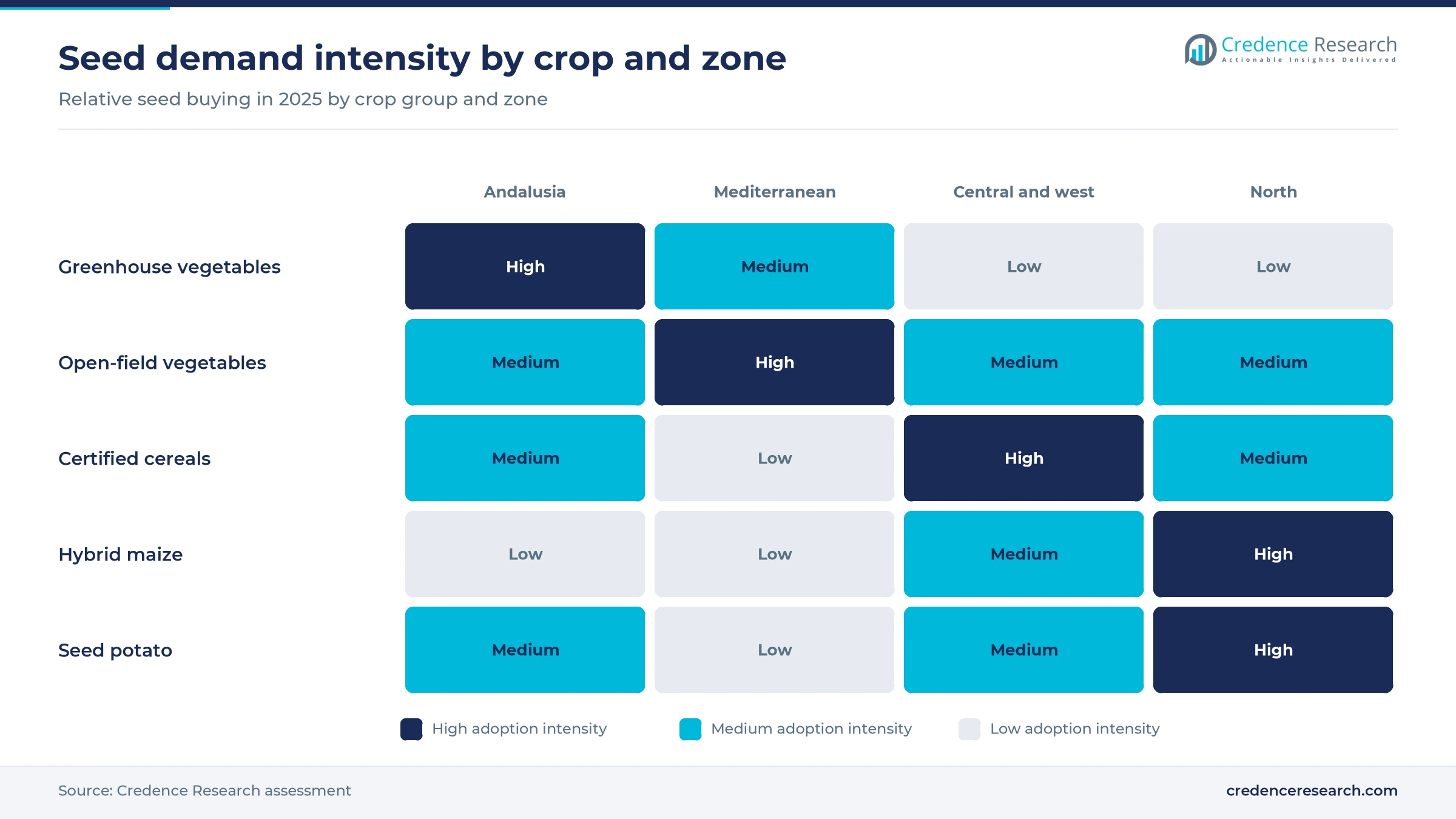
Greenhouse vegetable growing is the single largest source of seed value, because each hectare is sown with expensive hybrids every season. Almería keeps about 33,000 hectares under plastic, and its 2024/25 campaign produced 4.03 million metric tons, with pepper and tomato as the two largest crops by area. Exports from the province rose 14% in the same campaign, which keeps growers willing to pay for resistance to viruses and heat. Syngenta reopened its upgraded El Ejido breeding center in February 2024 with a new seed processing area and expanded germplasm bank. These conditions keep Hybrid botanical seed at 50.0% of value and make greenhouses the first stop for each new variety.
Certified-seed conversion widens the paid cereal base
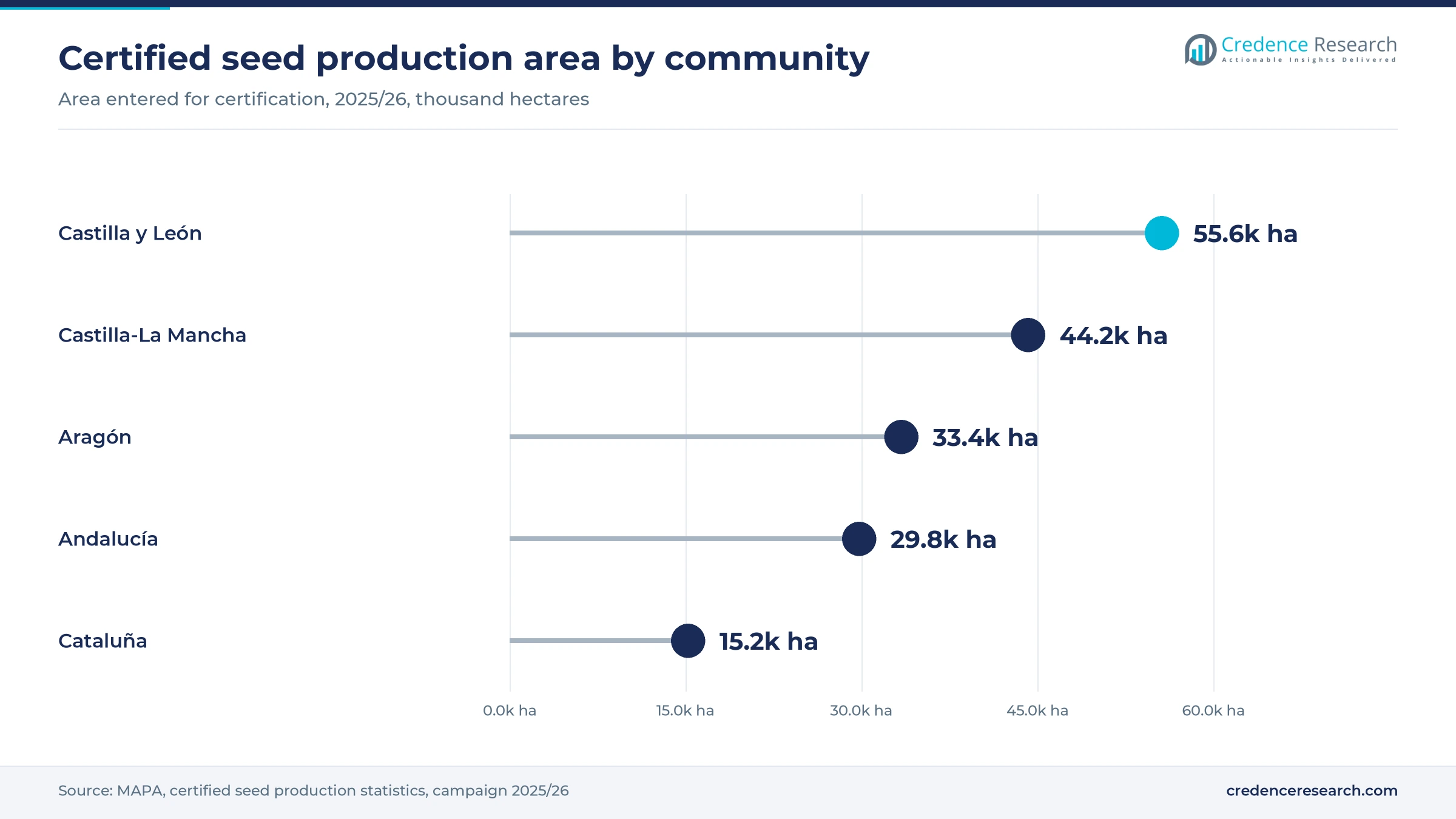
Spanish cereal growers still sow much farm-saved grain, so every shift to certified seed adds paid volume without new acreage. MAPA recorded 202,918 hectares entered for certified seed production in 2025/26, led by barley and soft wheat multiplication in the two Castiles and Aragón. The ministry's 2026 bulletin shows soft wheat seed stocks rising from 23.83 million kg in January to 51.33 million kg in August 2026, ready for autumn sowing. The 2025 cereal harvest was the second largest on record, according to Cooperativas Agro-alimentarias, which left farmers with more cash for inputs. Certification gives buyers varietal purity and traceability, which matters more as processors and malt buyers specify varieties.
Organic rules require a segregated seed supply
Spain and France hold the two largest organic areas in the EU, and organic farms must use organic seed wherever it is available. Organic land reached 2,944,941 hectares in 2024, or 12.31% of farmland, with 62,621 registered operators, according to MAPA in October 2025. The European Environment Agency still rates Spain as needing to accelerate toward the EU goal of 25% organic farmland. Under Regulation (EU) 2018/848, derogations for non-organic plant reproductive material expire on Dec. 31, 2036, inside the forecast window. Suppliers that multiply organic vegetable and cereal seed in Spain can therefore win contracts that today rely on derogations and imported organic lots. Organic seed demand now has a fixed 2036 deadline that buyers and breeders cannot ignore.
A record maize crop supports hybrid field-crop demand
Maize is the main hybrid field crop, and its recovery in 2025 supports seed purchases in the irrigated north and center. Spanish maize output rose 19.96% to 3.92 million metric tons on 332,934 hectares in 2025, and Aragón supplied 30.22% of the national crop, according to Agronews Castilla y León in May 2026. Average yields of 11,760 kg per hectare reward premium hybrids that hold up under heat stress. Maize area still stood about 10% below its 2015 level, according to MAPA crop surveys, so seed sales rise through higher hybrid value rather than more land. Growers who earn more per irrigated hectare can afford the newer hybrid systems described below.
Short maize, gene editing and breeder hubs reshape supply
Short-stature maize systems shift Ebro seed buying
Maize seed is shifting from a bag of genetics toward a system sold with agronomy and data. Bayer said in October 2024 that its Preceon hybrids grow up to 30% shorter than traditional maize and can add up to 1 metric ton per hectare of grain when well managed. The company planned a concentrated launch in the Ebro valley in 2025 and a wider rollout across Spain in 2026 or 2027. Corteva promoted its LumiGEN seed treatment and the Granular Link data tool at its Mérida forum in February 2025, which drew more than 300 farmers and technicians. This shift raises seed revenue per hectare and favors suppliers that can deliver field agronomy.
Gene-edited varieties near approval under the EU deal
Gene editing is emerging as the next breeding route for Spanish vegetable and field crops. The EU reached a provisional deal on Dec. 4, 2025 that treats simple edited plants much like conventional varieties, while herbicide-tolerant traits and any use in organic farming stay excluded. Seed of these plants must still be labeled on the bag, though not on final food. The deal still needs formal approval by member states and the European Parliament, so edited varieties are unlikely on Spanish farms before about 2028, when BASF Nunhems plans to open its new El Ejido center. Breeders that already run gene editing tools can then bring trait updates to greenhouses faster than with crossing alone.
Domestic seed potato multiplication can replace imports
Spain depends almost entirely on imported seed potatoes, which leaves room for domestic multipliers. PotatoPro reported in December 2024 that the Netherlands supplies 67% of seed potatoes, the United Kingdom 14% and France 11%. Imports exceeded 63,600 metric tons in 2023/24, while Castilla y León grew only about 1,200 hectares of seed potato, nearly two-thirds of the national area, according to ASAJA Palencia. Ware growers planted 61,175 hectares in 2024, so each locally certified lot replaces a costly import. Burgos and Palencia had 774 and 392 hectares of seed potato in 2024, and their cool uplands suit the healthy tubers this demand needs.
Almería breeder hubs can serve the Mediterranean basin
Almería is becoming a breeding and logistics hub, which gives suppliers based there an export as well as a domestic role. BASF Nunhems moved its registered office to El Ejido in May 2026 and plans a 25-hectare research and logistics site there, with operation expected in 2028. Bayer invested more than 5 million euros in 2021 to expand its San Nicolás center, which it describes as the only one in Europe specialized in solanaceous and cucurbit crops. Semillas Fitó, present in more than 90 countries, is remodeling its Barcelona headquarters for completion in October 2026. Investment of this kind keeps plant breeding decisions close to Spanish growers.
Water cuts, farm-saved grain and imports limit growth
Drought and irrigation cuts shrink sown area
Water shortages directly cut the area sown with high-value irrigated seed in dry years. Catalonia declared a drought emergency on Feb. 1, 2024, for 202 municipalities and ordered an 80% cut in agricultural irrigation, according to Catalan News. Cooperativas Agro-alimentarias described 2023 as one of the worst years for cereals, with 2025 wheat output almost double the 2023 level. Growers respond by leaving land fallow or choosing shorter-cycle varieties, which makes seed demand swing with rainfall.
Farm-saved grain still undercuts certified cereal seed
Unlicensed farm-saved grain keeps a large share of cereal sowing outside the paid market. MAPA counted 442.5 million kg of certified cereal seed of national origin marketed in 2024/25, against roughly 1.0 to 1.15 billion kg needed to sow the national grain cereal area at normal seed rates. Credence Research thus estimates that well under half of cereal area is sown with certified seed. Breeders lose royalties that fund variety trials, so enforcement of plant variety rights and buyer specifications decides how fast certified volumes rise.
Shrinking cereal and maize area caps volume
The arable base for non-hybrid seed is contracting, which limits volume growth in the largest tonnage segment. MAPA crop surveys show grain cereal area fell 4.7% to 5.74 million hectares between 2015 and 2025, with durum wheat down 25.4% and maize down 10%. Processing tomato area also fell 12.5% to 26,240 hectares over the decade. For that reason, seed demand in field crops after 2025 has to grow through better varieties and value per hectare, not through more sown land.
Import dependence exposes seed potato buyers
Seed potato supply rests on imports, so Spanish growers absorb foreign harvest and freight risks. With most seed potatoes imported, as noted above, seed made up about 40% of a potato grower's cost of 8,024 euros per hectare in Castilla y León in 2024/25. A poor Dutch harvest therefore lifts seed prices in Spain within one season. Domestic certified output of about 22.7 million kg in 2024/25 covers only a small part of national needs.
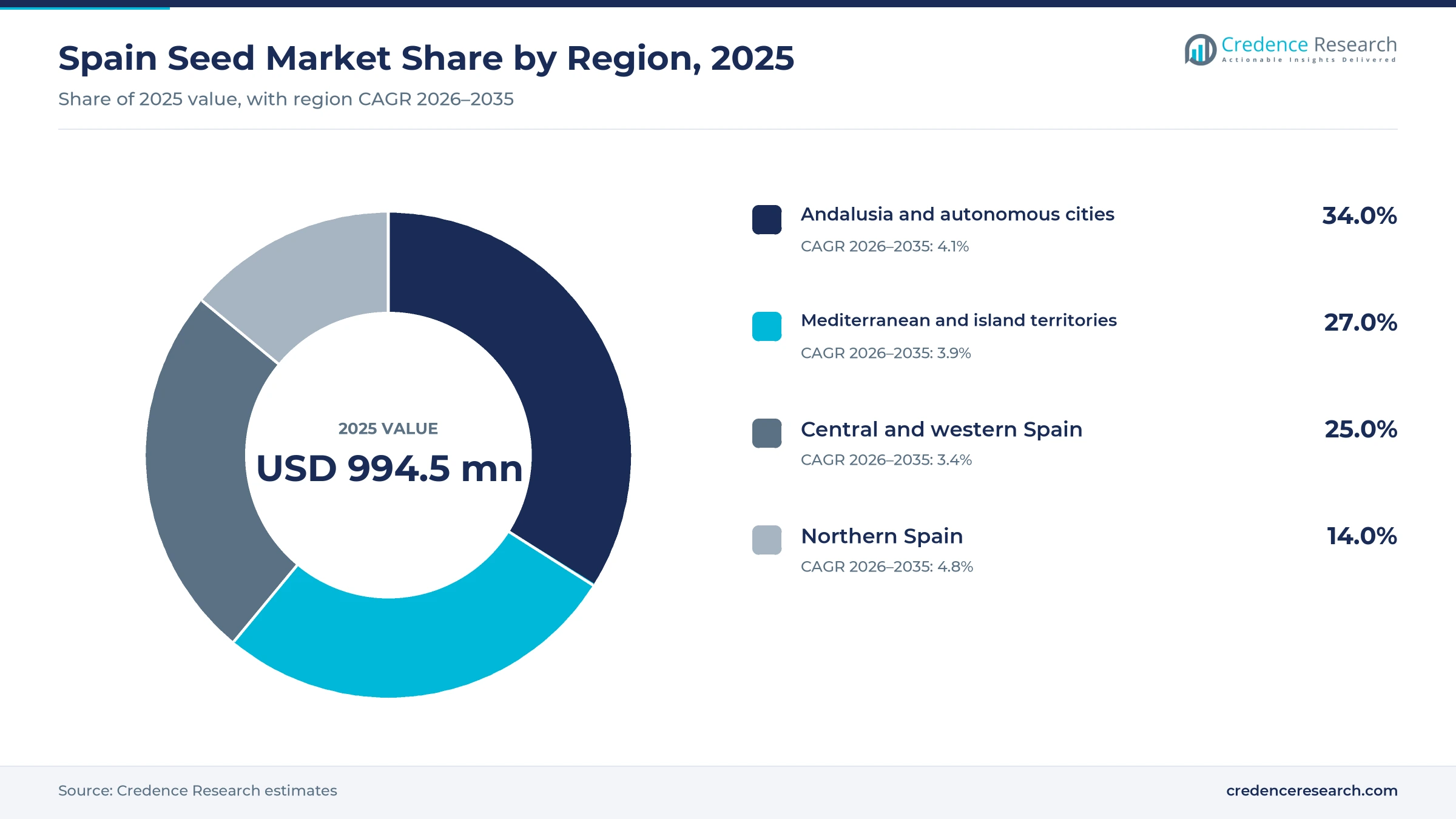
Andalusia leads while the Ebro maize belt gains pace
| Region | Value, 2025 (USD million) | Share, 2025 | CAGR, 2026–2035 |
|---|---|---|---|
| Andalusia and autonomous cities | 338.1 | 34.0% | 4.1% |
| Mediterranean and island territories | 268.5 | 27.0% | 3.9% |
| Central and western Spain | 248.6 | 25.0% | 3.4% |
| Northern Spain | 139.2 | 14.0% | 4.8% |
Andalusia and autonomous cities lead on greenhouse hybrids
Andalusia and autonomous cities held 34.0% of 2025 value and grow at 4.1% a year. The greenhouse cluster described above anchors this lead, since Almería and Granada buy most of the country's premium tomato and pepper hybrids. The Guadalquivir valley adds wheat, sunflower and cotton, and Andalusia entered 29,789 hectares for certified seed production in 2025/26, according to MAPA. Breeders keep their densest research and sales teams in this zone, so new varieties launch here first.
Mediterranean and island territories rely on leafy greens
Mediterranean and island territories held 27.0% of 2025 value and grow at 3.9% a year. Murcia grew 15,420 hectares of lettuce, 46% of the national area of about 32,000 hectares, which makes the Campo de Cartagena the main trial ground for leafy-green seed. Valencia, Catalonia and the Balearic and Canary Islands add open-field vegetables for local and export markets. Water limits in Catalonia and the Segura basin favor short-cycle lettuce and brassica varieties that need fewer irrigation turns, which gives breeders with drought-tolerant lines an edge.
Central and western Spain anchors certified cereal seed
Central and western Spain held 25.0% of 2025 value and grows at 3.4% a year, the slowest pace among the four zones. Castilla y León entered 55,584 hectares and Castilla-La Mancha 44,219 hectares for certified seed production in 2025/26, the two largest totals, according to MAPA. Extremadura adds processing tomato, rice and maize along the Guadiana. Most value here comes from wheat and barley, where seed prices track grain and growth depends on certified conversion.
Northern Spain gains on irrigated maize hybrids
Northern Spain held 14.0% of 2025 value and is the fastest-growing zone at 4.8% a year. Aragón supplied the largest regional share of the 2025 maize crop and entered 33,437 hectares for certified seed production in 2025/26, according to MAPA. One Ebro valley farmer in the Preceon trials reported about 500 kg per hectare more grain, half the gain Bayer cites for well-managed fields. The zone also covers the Cantabrian dairy belt, where forage maize and grass seed serve livestock farms. New maize systems give this zone the largest gain in seed value per hectare.
Breeding centers and EU gene-editing deal mark 2024–2026
| Development | Status and market relevance |
|---|---|
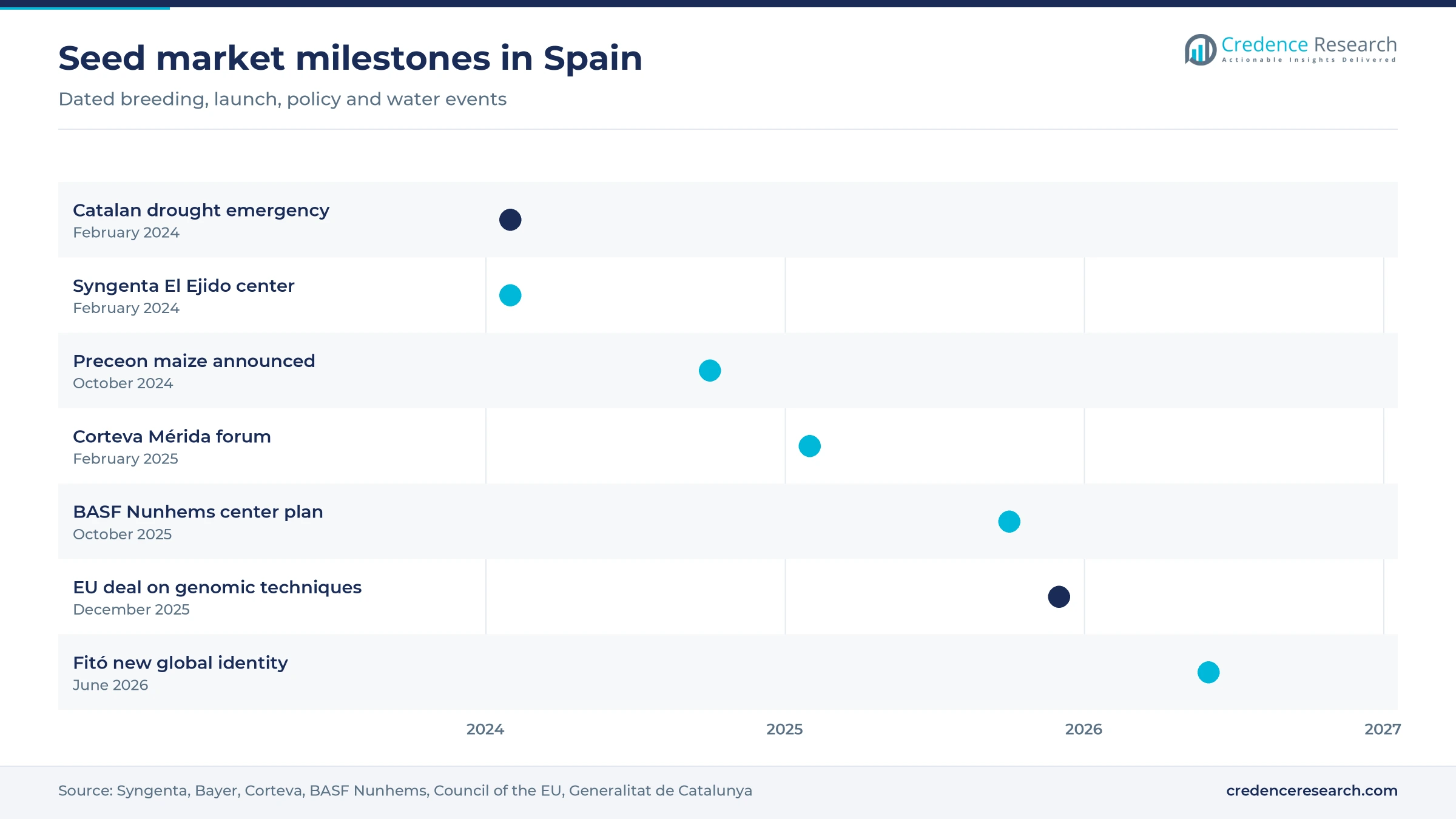
| In February 2024, Syngenta inaugurated the upgraded El Ejido breeding center in Almería, which has 145 staff and a new seed processing area. | Completed; strengthens vegetable breeding next to growers |
| In October 2024, Bayer announced its Preceon short-stature maize for Spain, with a concentrated launch in the Ebro valley in 2025. | Launch under way; wider rollout planned for 2026 or 2027 |
| In February 2025, Corteva held its first Pioneer forum in Mérida, presenting the LumiGEN seed treatment to more than 300 attendees. | Event; promotes treated maize seed in Extremadura |
| In October 2025, BASF Nunhems announced a 25-hectare vegetable seed research center in El Ejido, due to operate fully in 2028. | Construction from 2026; adds breeding and logistics capacity |
| In June 2026, Semillas Fitó introduced a new global identity and began remodeling its Barcelona headquarters for October 2026. | In progress; supports international expansion from Spain |
Treatments, short-stature maize and edits add seed value
- Seed treatments such as Corteva's LumiGEN protect maize from germination onward and are sold alongside fungicide programs for field crops.
- Short-stature maize from Bayer's Preceon system allows higher sowing density and easier machine access, with FieldView data tools guiding management.
- Gene editing under the EU framework expected from about 2028 will let breeders add disease and stress traits without transgenic labels for conventional farms.
- Breeding greenhouses and germplasm banks in Almería, such as Syngenta's upgraded El Ejido site, isolate breeding projects year-round and speed variety release.
Need a Custom Version of This Report?
Tailor the scope, geography, or segments to your exact requirements.
- Custom geography or segment scope
- Direct access to our analyst team
Vegetable breeders cluster in Almería and Murcia
Competition in Spanish seed separates into two arenas, vegetable genetics and field-crop hybrids. In vegetables, Syngenta España, Bayer CropScience España, BASF Nunhems and Semillas Fitó compete on disease resistance, shelf life and yield in greenhouse tomato, pepper, cucumber and lettuce, and they place varieties through trials run with growers and nurseries in Almería and Murcia. Bayer works from its San Nicolás center, Syngenta from El Ejido, and Fitó from Cabrera de Mar near Barcelona. In maize and sunflower, Corteva Agriscience España sells Pioneer hybrids with LumiGEN treatment, while Bayer counters with the Preceon system and digital agronomy. Cereal varieties reach farmers through cooperatives and licensed multipliers, and breeders compete on royalty collection as much as on yield. Field results, technical support and nursery relationships decide most purchases.
How the Spanish seed supply side is organized
The Spanish seed supply side splits into two very different businesses. Vegetable seed is concentrated among multinational breeders and a few Spanish family firms that run research sites in Almería, Murcia and Barcelona, where breeding costs, germplasm and variety registration form high entry barriers. Semillas Fitó, for example, spends 29% of its horticultural turnover on research across nine centers. Cereal and legume seed is fragmented, multiplied on about 203,000 hectares by many conditioners and cooperatives under license. Margins are richest in proprietary hybrids and thinnest in certified cereal seed, where farm-saved grain sets the price ceiling.
Companies profiled and their roles in this market
| Company | Type | Role in the market |
|---|---|---|
| Bayer CropScience España | Global breeder | San Nicolás vegetable seed center and Preceon short-stature maize launched in the Ebro valley |
| Corteva Agriscience España | Global breeder | Pioneer maize hybrids with LumiGEN treatment, promoted at the Mérida forum in 2025 |
| Syngenta España | Global breeder | Upgraded El Ejido breeding center with 145 staff, reopened in February 2024 |
| Semillas Fitó | Spanish breeder | Vegetable breeding from Cabrera de Mar, present in more than 90 countries |
Vegetable genetics, not cereal acres, set the pace
Credence Research's view is that Spanish seed value will be set by greenhouse genetics rather than by arable acreage. Cereal area is shrinking, yet growers who stay in wheat and barley increasingly buy certified seed as processors specify varieties. The bigger gain comes from protected horticulture, where seed is a small cost against high crop values and breeders are building new Almería sites. Organic rules ending in 2036 and the EU gene-editing framework add two new reasons to renew varieties. Suppliers that combine local breeding, treated seed and strong nursery ties should outgrow the market. Protected horticulture, growing at 4.6% a year, is where that advantage counts most.
Crop area and certification data anchor the estimates
The report uses 2025 as the base year and forecasts value to 2035 in USD million from the Credence Research market model. Segment and regional splits are Credence Research estimates built from MAPA certified seed statistics, MAPA crop surveys and cost studies, Almería campaign data, organic farming statistics from MAPA and the European Environment Agency, and company releases. Regional shares follow the Credence Research regional model for Spanish agriculture. No interviews or surveys were used for this edition of the report.
Greenhouse genetics and certified seed carry growth to 2035
The market reaches USD 1.48 billion by 2035, growing at 3.95% a year from USD 1.04 billion in 2026. Hybrid botanical seed keeps the largest share as greenhouse and maize growers renew seed every cycle, while protected horticulture remains the fastest application. Andalusia and autonomous cities stay the largest zone, and Northern Spain gains share as new maize systems spread through the Ebro valley. Gene-edited varieties and the 2036 end of organic derogations should lift renewal rates late in the decade, while drought remains the main risk to volumes.
Water and certification decide the range to 2035
The spread between cases depends on two things that seed companies only partly control. The first is water, because emergencies like the 2024 Catalan cut remove irrigated area within one season. The second is how quickly cereal growers move from farm-saved grain to certified seed. A run of dry years with weak enforcement produces the downside. Steady irrigation, wider certification and early gene-edited greenhouse varieties produce the upside.
| Scenario | CAGR, 2026–2035 | Value, 2035 | What has to hold |
|---|---|---|---|
| Downside | 2.8% | USD 1.33 billion | Repeated drought cuts irrigated sowing and certified cereal use stays near current levels |
| Base | 4.0% | USD 1.48 billion | Greenhouse area holds near 33,000 hectares in Almería and certified seed volumes rise gradually |
| Upside | 5.0% | USD 1.61 billion | Edited varieties reach greenhouses after 2028 and certified cereal seed gains share every season |
Frequently Asked Questions
How big is the Spain seed market?
Which product type leads the Spain seed market?
Which application grows fastest?
Which region leads seed demand in Spain?
Which region grows fastest?
How do organic rules affect seed demand in Spain?
What are the main challenges for seed suppliers in Spain?
Who are the key companies in the Spain seed market?
Table of Content
Chapter 1 Market Segmentation
- 1.1 Segmentation Framework
- 1.1.1 Product and Service Classification
- 1.1.2 Application and End-Use Classification
- 1.1.3 Technology and Solution Classification
- 1.1.4 Customer and Distribution Channel Classification
- 1.1.5 Geographic Segmentation
- 1.1.6 Market Segment Definitions and Boundaries
- 1.2 By Product Type
- 1.2.1 Hybrid botanical seed
- 1.2.2 Non-hybrid botanical seed
- 1.2.3 Seed potato
- 1.3 By Crop Type
- 1.3.1 Cereals and maize
- 1.3.2 Vegetables
- 1.3.3 Oilseed crops
- 1.3.4 Forage and specialty crops
- 1.4 By Application
- 1.4.1 Protected horticulture
- 1.4.2 Open-field crop establishment
- 1.4.3 Forage and amenity establishment
- 1.4.4 Ornamental and household cultivation
Chapter 2 Introduction
- 2.1 Report Objectives and Scope
- 2.2 Product Definition and Industry Terminology
- 2.3 Market Inclusions and Exclusions
- 2.4 Research Process
- 2.4.1 Primary Research and Expert Interviews
- 2.4.2 Secondary Research and Source Review
- 2.4.3 Top-Down and Bottom-Up Estimation
- 2.4.4 Data Triangulation and Verification
- 2.5 Market Size Measurement Basis
- 2.5.1 2025: USD 994.5 million → 2035: USD 1.48 billion
- 2.6 Historical and Forecast Reference Periods
- 2.6.1 Historical Period: 2018-2025
- 2.6.2 Base Year: 2025
- 2.6.3 Forecast Period: 2025-2035
- 2.7 Research Assumptions and Limitations
Chapter 3 Executive Summary
- 3.1 Market Snapshot and Key Findings
- 3.2 Base-Year Market Size, 2025
- 3.3 Forecast Market Size, 2035
- 3.4 Revenue and Volume Growth Outlook
- 3.5 Key Demand and Supply Indicators
- 3.6 Leading Market Segments
- 3.7 Fastest-Growing Market Opportunities
- 3.8 Regional Performance Highlights
- 3.9 Technology and Industry Transformation
- 3.10 Competitive Landscape Summary
- 3.11 Analyst View and Strategic Implications
Chapter 4 Spain Seed Market Trends and Developments
- 4.1 Historical Industry Development, 2018-2025
- 4.2 Recent Market Trends and Developments
- 4.3 Demand and Customer Behavior Trends
- 4.4 Technology and Product Innovation
- 4.5 Artificial Intelligence, Automation and Digitalization
- 4.6 Local Manufacturing and Supply Chain Realignment
- 4.7 Industry Partnerships, Mergers and Acquisitions
- 4.8 Sustainability and Circular Economy Developments
- 4.9 Government and Private Sector Investment Trends
- 4.10 Emerging Business Models and Commercialization
- 4.11 Industry Developments and Announcements
Chapter 5 Spain Seed Market Production, Supply and Demand Analysis
- 5.1 Demand Trend and Consumption Analysis, 2018-2025
- 5.2 Demand Forecast, 2025-2035
- 5.3 Production and Output Trend, 2018-2025
- 5.4 Production and Output Forecast, 2025-2035
- 5.5 Installed Capacity and Capacity Utilization
- 5.6 Company-Wise Production Plants and Statistics
- 5.6.1 Installed Production Capacity
- 5.6.2 Actual Production
- 5.6.3 Planned Capacity and Expansion Targets
- 5.7 Supply Chain Structure and Procurement Trends
- 5.8 Supply-Demand Gap and Bottlenecks
- 5.9 Import Dependence and Sourcing Structure
- 5.10 Contract Manufacturing and Outsourcing
- 5.11 Regional Supply and Demand Concentration
Chapter 6 Spain Seed Market Pricing Analysis
- 6.1 Pricing Structure and Measurement
- 6.2 Historical Pricing Trends, 2018-2025
- 6.3 Pricing Outlook, 2025-2035
- 6.4 Average Selling Price and Unit Economics
- 6.5 Pricing by Product and Market Segment
- 6.6 Geographic Pricing Differences
- 6.7 Key Input, Energy, Labor and Logistics Costs
- 6.8 Contract Pricing and Purchasing Models
- 6.9 Pricing Sensitivity and Competitive Positioning
- 6.10 Price, Margin and Profitability Implications
Chapter 7 Spain Seed Market Dynamics
- 7.1 Market Growth Drivers
- 7.1.1 Demand-Side Drivers
- 7.1.2 Technology and Innovation Drivers
- 7.1.3 Infrastructure and Investment Drivers
- 7.1.4 Regulatory and Policy Drivers
- 7.2 Market Restraints
- 7.2.1 Cost and Affordability Constraints
- 7.2.2 Technology and Adoption Barriers
- 7.2.3 Supply Chain and Operational Constraints
- 7.3 Market Challenges
- 7.3.1 Competitive Pressure and Margin Erosion
- 7.3.2 Skills, Infrastructure and Implementation Gaps
- 7.4 Emerging Market Opportunities
- 7.5 Market Dynamics Impact and Time-Horizon Assessment
Chapter 8 Spain Seed Value Chain Analysis
- 8.1 Industry Value Chain Overview
- 8.2 Upstream Suppliers and Critical Inputs
- 8.3 Technology and Component Providers
- 8.4 Manufacturing or Service Delivery
- 8.5 Distribution, Channel Partners and Integrators
- 8.6 Downstream Applications and End Users
- 8.7 Value Addition and Profit Pools
- 8.8 Vertical Integration and Outsourcing
- 8.9 Supplier Concentration and Risk
- 8.10 Supply Chain Localization and Resilience
Chapter 9 Spain Seed Market Regulations and Policies
- 9.1 Relevant Laws, Standards and Compliance Frameworks
- 9.2 Product, Service, Safety and Quality Requirements
- 9.3 Government Policies, Incentives and Subsidies
- 9.4 Imports, Exports and Trade Barriers
- 9.5 Public Procurement and Local Content Requirements
- 9.6 Environmental and Sustainability Compliance
- 9.7 Upcoming Policy Changes and Market Implications
Chapter 10 Spain Seed Market Hotspots and Opportunities
- 10.1 Market Opportunity Mapping and Growth Hotspots
- 10.2 High-Growth Applications and Customer Groups
- 10.3 Underserved Markets and White-Space Opportunities
- 10.4 Emerging Technology and Product Opportunities
- 10.5 New Capacity and Investment Hotspots
- 10.6 Market Entry and Expansion Opportunities
- 10.7 Distribution and Partnership Opportunities
- 10.8 Near-Term and Long-Term Commercial Potential
- 10.9 Opportunity Attractiveness and Execution Risks
Chapter 11 Spain Seed Market Outlook, 2025-2035
- 11.1 Market Size and Analysis
- 11.1.1 Revenue (Market Measurement: 2025: USD 994.5 million → 2035: USD 1.48 billion)
- 11.1.2 Market Volume and Quantity Sold
- 11.1.3 Historical Market Size, 2018-2025
- 11.1.4 Base-Year Market Size, 2025
- 11.2 Market Forecast, 2025-2035
- 11.2.1 Revenue Forecast to 2035
- 11.2.2 Volume Forecast to 2035
- 11.2.3 CAGR and Year-on-Year Growth
- 11.2.4 Incremental Revenue Opportunity
- 11.3 Forecast Assumptions and Scenario Analysis
- 11.3.1 Base-Case Forecast
- 11.3.2 Optimistic and Conservative Scenarios
- 11.3.3 Technology, Pricing and Policy Sensitivities
- 11.4 Market Attractiveness and Growth Outlook
Chapter 12 Spain Seed Market Segmentation and Outlook
- 12.1 Segmentation Summary and Market Shares, 2025
- 12.2 Largest and Fastest-Growing Segments
- 12.3 By Product Type - Market Size and Forecast, 2025-2035
- 12.3.1 Segment Definition and Scope
- 12.3.2 Historical Market Size, 2018-2025
- 12.3.3 Revenue Forecast, 2025-2035
- 12.3.4 Volume Forecast, 2025-2035
- 12.3.5 Base-Year Market Share, 2025
- 12.3.6 Segment CAGR and Growth Drivers
- 12.3.7 Subsegment Market Size and Forecast
- 12.3.7.1 Hybrid botanical seed
- 12.3.7.2 Non-hybrid botanical seed
- 12.3.7.3 Seed potato
- 12.3.8 Subsegment Pricing and Adoption Trends
- 12.3.9 Leading Suppliers and Competition
- 12.3.10 Regional Demand and Opportunities
- 12.4 By Crop Type - Market Size and Forecast, 2025-2035
- 12.4.1 Segment Definition and Scope
- 12.4.2 Historical Market Size, 2018-2025
- 12.4.3 Revenue Forecast, 2025-2035
- 12.4.4 Volume Forecast, 2025-2035
- 12.4.5 Base-Year Market Share, 2025
- 12.4.6 Segment CAGR and Growth Drivers
- 12.4.7 Subsegment Market Size and Forecast
- 12.4.7.1 Cereals and maize
- 12.4.7.2 Vegetables
- 12.4.7.3 Oilseed crops
- 12.4.7.4 Forage and specialty crops
- 12.4.8 Subsegment Pricing and Adoption Trends
- 12.4.9 Leading Suppliers and Competition
- 12.4.10 Regional Demand and Opportunities
- 12.5 By Application - Market Size and Forecast, 2025-2035
- 12.5.1 Segment Definition and Scope
- 12.5.2 Historical Market Size, 2018-2025
- 12.5.3 Revenue Forecast, 2025-2035
- 12.5.4 Volume Forecast, 2025-2035
- 12.5.5 Base-Year Market Share, 2025
- 12.5.6 Segment CAGR and Growth Drivers
- 12.5.7 Subsegment Market Size and Forecast
- 12.5.7.1 Protected horticulture
- 12.5.7.2 Open-field crop establishment
- 12.5.7.3 Forage and amenity establishment
- 12.5.7.4 Ornamental and household cultivation
- 12.5.8 Subsegment Pricing and Adoption Trends
- 12.5.9 Leading Suppliers and Competition
- 12.5.10 Regional Demand and Opportunities
- 12.6 Segment Growth Comparison
- 12.7 Segment Attractiveness and Priority Matrix
Chapter 13 Spain Seed End-Use and Application Market Outlook
- 13.1 End-Use Industry and Customer Demand Structure
- 13.2 Leading Applications and Customer Groups
- 13.3 End-Use Market Size, Share and Forecast
- 13.4 Major End-Use Industry Deep Dives
- 13.4.1 Customer Requirements and Use Cases
- 13.4.2 Demand and Replacement Cycles
- 13.4.3 Technical and Regulatory Considerations
- 13.4.4 Purchasing and Procurement Models
- 13.4.5 Leading Vendors and Distribution Channels
- 13.4.6 Forecast and Commercial Opportunities
- 13.5 Emerging Applications and Cross-Segment Demand
- 13.6 End-Use Industry Investment Priorities
Chapter 14 Spain Seed Geographic Market Outlook, 2025-2035
- 14.1 Domestic Market Distribution and Demand Clusters
- 14.2 State- or Province-Wise Market Size and Forecast, 2025-2035
- 14.3 City and Metropolitan Market Outlook
- 14.4 Industrial, Manufacturing and Commercial Clusters
- 14.5 Geographic Concentration of Key End Users
- 14.6 Local Pricing and Purchasing Differences
- 14.7 Domestic Production Facilities and Capacity Map
- 14.8 Local Infrastructure and Project Pipeline
- 14.9 State-Level Policy and Incentive Differences
- 14.10 Subnational Investment Hotspots and Opportunities
- 14.11 Distribution and Logistics Networks
- 14.12 Domestic Competitive Footprint
Chapter 15 Spain Seed Technology, Innovation and Sustainability Outlook
- 15.1 Technology Landscape and Maturity
- 15.2 Product, Process and Service Innovation
- 15.3 AI, Automation and Digital Tools in the Industry
- 15.4 Technology Adoption and Performance Benchmarking
- 15.5 Innovation Pipeline and R&D Investment
- 15.6 Patent and Intellectual Property Trends
- 15.7 Energy Efficiency and Resource Management
- 15.8 Sustainability, Recycling and Circularity
- 15.9 Technology Roadmap, 2025-2035
- 15.10 Risks of Obsolescence and Technology Substitution
Chapter 16 Spain Seed Market Key Strategic Imperatives
- 16.1 Growth and Market Entry Priorities
- 16.2 High-Return Products and Segments
- 16.3 Pricing, Profitability and Cost Optimization
- 16.4 Technology Investment and Product Differentiation
- 16.5 Supply Chain Localization and Resilience
- 16.6 Distribution and Customer Acquisition
- 16.7 Partnership, Acquisition and Capacity Strategy
- 16.8 Regional Expansion Priorities
- 16.9 Short-, Medium- and Long-Term Actions
Chapter 17 Competition Outlook
- 17.1 Industry Competition Characteristics
- 17.2 Market Structure and Concentration
- 17.3 Market Share and Competitive Positioning, 2025
- 17.4 Company-Wise Revenue and Product Benchmarking
- 17.5 Production and Service Capacity Benchmarking
- 17.6 Technology, Pricing and Differentiation
- 17.7 Regional Footprint and Distribution Strength
- 17.8 Mergers, Acquisitions and Strategic Alliances
- 17.9 New Entrants and Competitive Threats
- 17.10 Porter's Five Forces and Industry Attractiveness
- 17.11 Competitive Outlook, 2025-2035
Chapter 18 Company Profiles
- 18.1 Company Coverage and Selection Criteria
- 18.2 Bayer CropScience España
- 18.2.1 Business Description
- 18.2.2 Company Ownership and Geographic Presence
- 18.2.3 Product and Service Portfolio
- 18.2.4 Manufacturing and Operating Footprint
- 18.2.5 Production Capacity and Expansion Plans
- 18.2.6 Financial Performance and Investment
- 18.2.7 Market Share and Competitive Position
- 18.2.8 Technology and Innovation Capabilities
- 18.2.9 Strategic Alliances or Partnerships
- 18.2.10 Recent Developments
- 18.2.11 Growth Strategy and Outlook
- 18.3 Corteva Agriscience España
- 18.4 Syngenta España
- 18.5 Semillas Fitó
- 18.6 Other Relevant Market Participants
Note: Every listed company is profiled on the structure shown under the first company. The company list is preliminary and may change based on research findings, market developments, data availability and client requirements.
Chapter 19 Disclaimer
- 19.1 Research and Forecast Disclaimer
- 19.2 Data Source and Estimation Limitations
Note: The depth of individual sections depends on data availability for this market. Volume, capacity, trade and other unit-based metrics are included where applicable.

