
Maize, tomato and pastures shape Portuguese seed demand
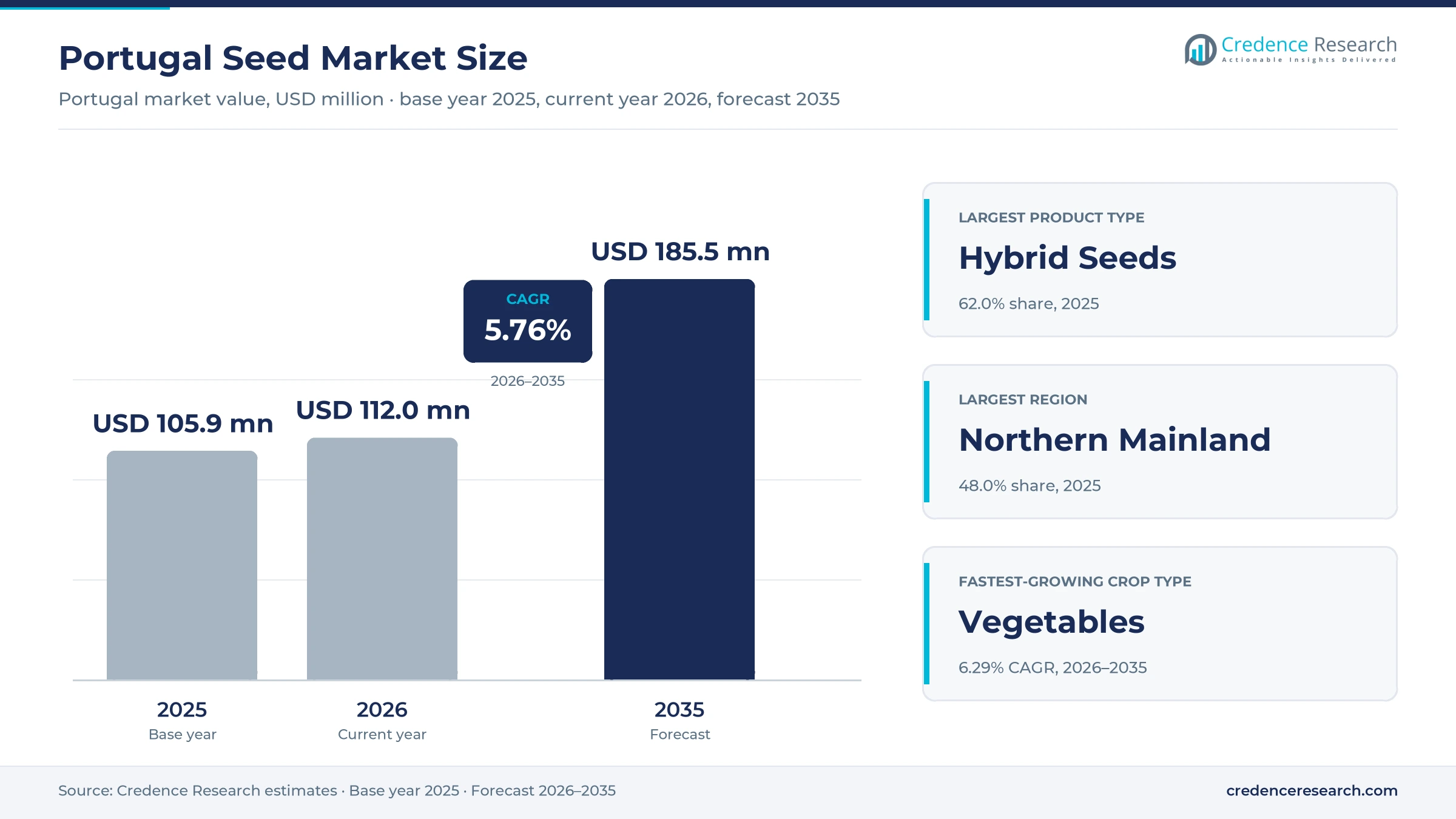
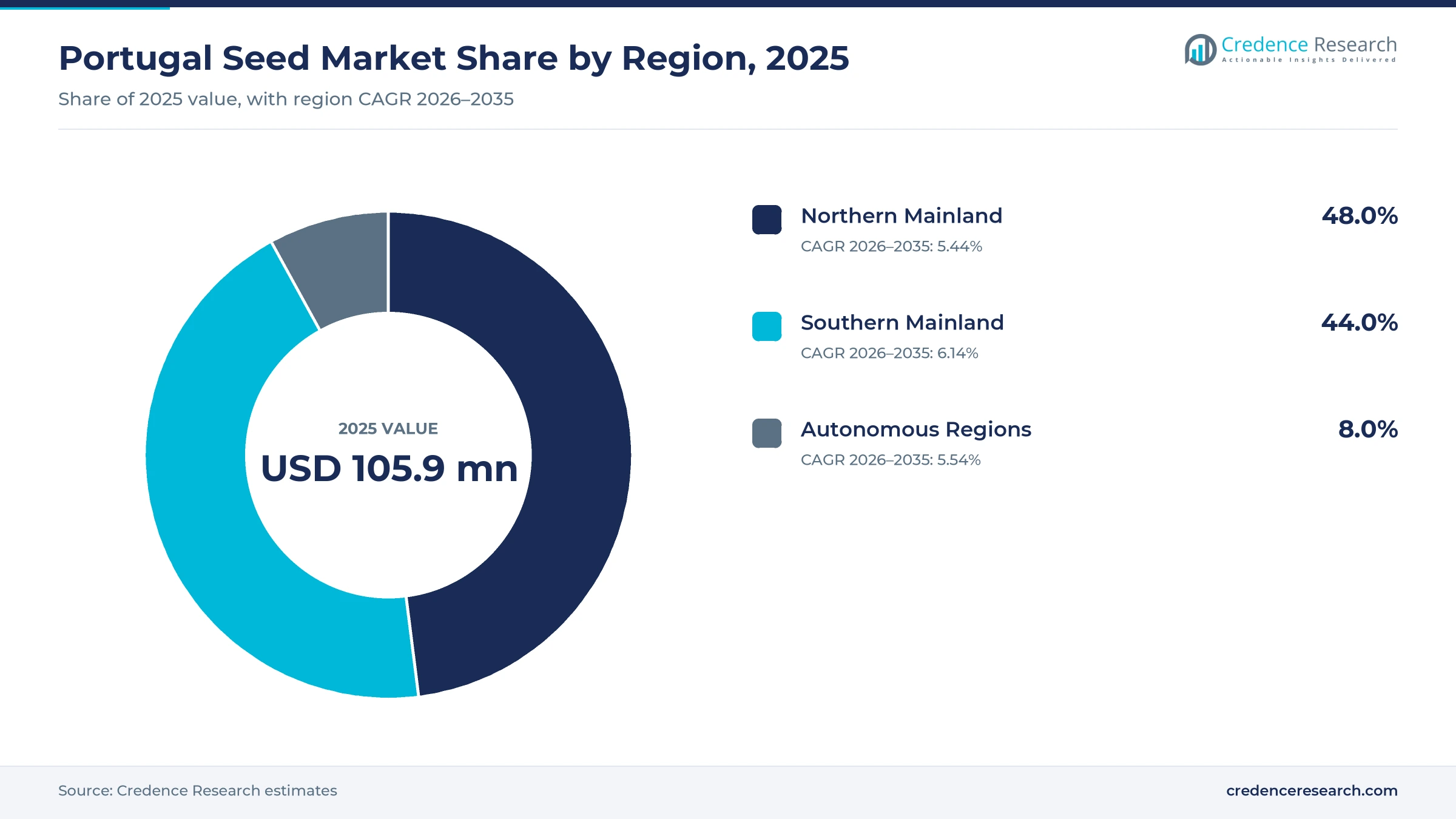
The Portugal seed market was valued at USD 105.9 million in 2025 and is projected to increase from USD 112.0 million in 2026 to USD 185.5 million by 2035, registering a CAGR of 5.76% during 2026–2035. Demand comes from maize growers who renew hybrid seed every season, processing tomato farms in the Ribatejo and Alentejo, and livestock farms that resow silage maize and pasture. Northern Mainland held the largest regional share, 48.0% in 2025, because dairy farms in the north and center buy most silage hybrids. Southern Mainland is the fastest-growing region at 6.14% a year, as new irrigation blocks linked to Alqueva open land for hybrid maize and vegetables. Organic farming adds a separate buying stream, since EU rules end derogations for non-organic seed at the close of 2036. Breeders also prepare for EU rules on new genomic techniques agreed in December 2025, which will treat simple edits like conventional varieties.
Which seeds, buyers and sales routes are counted here?
The market counts certified and commercial seed sold to farms, nurseries and public growers in mainland Portugal, the Azores and Madeira, valued at the price paid by the buyer. It covers hybrid and open-pollinated seed for field crops, vegetables, forage and ornamentals, plus ready-made pasture and cover mixtures, bought directly from breeders, through merchants, cooperatives or online shops.
Seed potatoes, tree nursery stock, cuttings and grain sold for feed or milling are excluded. The value chain runs from breeders and seed multipliers through conditioning, treatment and coating plants to merchants and cooperatives that reach growers before each sowing window.
Portugal Seed Market Insights
- The Portugal seed market grows from USD 105.9 million in 2025 to USD 185.5 million by 2035, a 5.76% CAGR, as maize and tomato growers keep renewing hybrids.
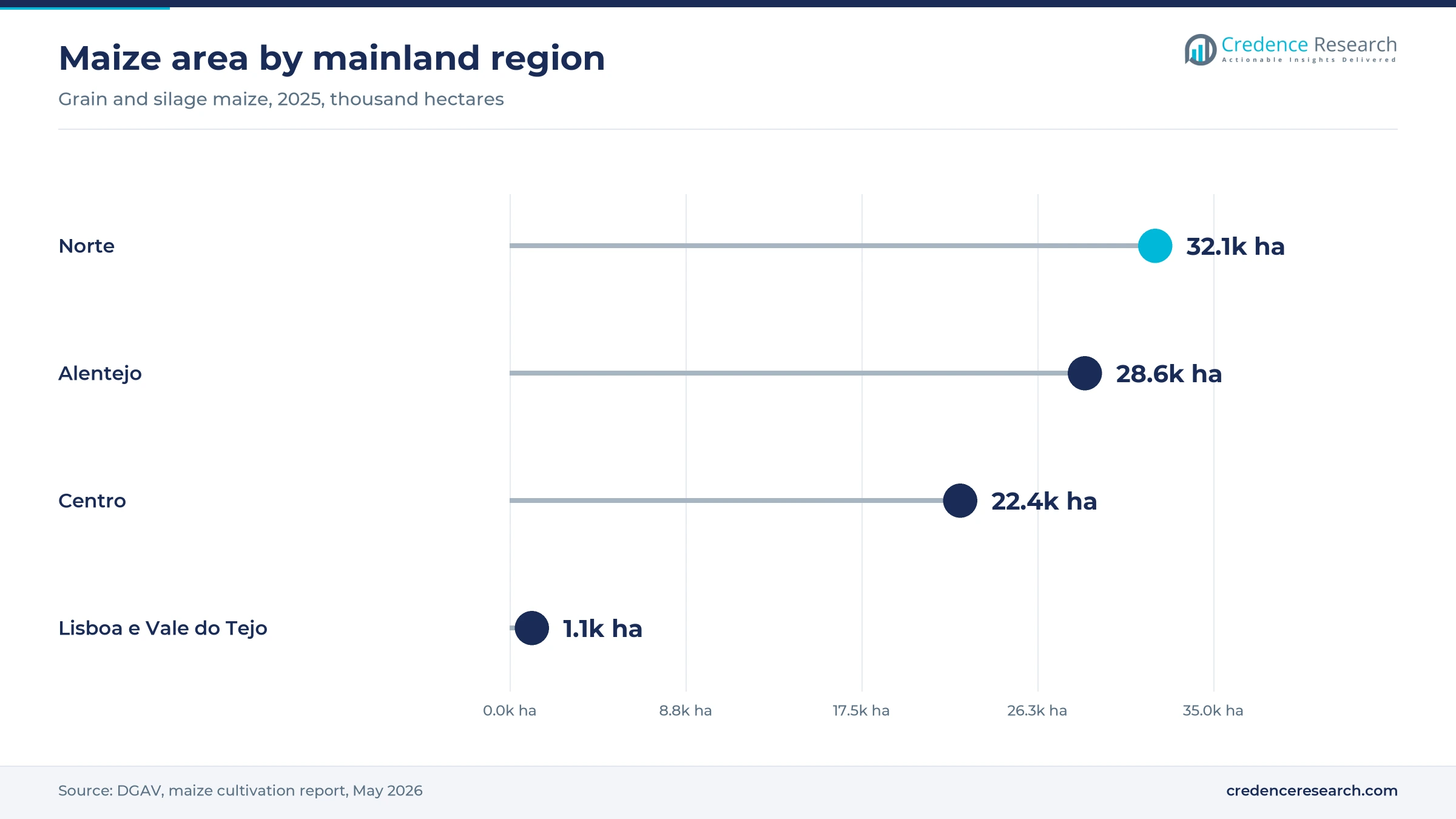
- Northern Mainland held 48.0% of 2025 value, because Norte and Centro farmed about 65% of mainland maize area in 2025.
- Hybrid seeds held 62.0% of 2025 value, since maize and processing tomato growers buy new hybrid seed every season.
- The EU agreed rules on new genomic techniques in December 2025, opening a path for edited varieties outside organic farming.
- Global breeders such as KWS, Corteva and Limagrain sell through local merchants and cooperatives, with field trials guiding hybrid choice.
Hybrids lead while pasture mixtures grow fastest
Why do hybrid seeds dominate seed spending in Portugal?
Based on product type, the market is categorized into hybrid seeds, open-pollinated seeds and seed mixtures. Hybrid Seeds led with 62.0% of 2025 value because maize and tomato growers replace hybrid seed every season, and the KWS 2025 Portuguese catalogue alone lists 19 maize hybrids for silage and grain. Open-pollinated seed stays relevant in winter cereals, rice and traditional vegetable lines. Seed Mixtures grow fastest at 6.63% a year as legume-rich pastures spread, and Vida Rural reported on April 16, 2026, that Fertiprado and the InnovPlantProtect laboratory in Elvas developed a biostimulant coating for pasture seed.
Which crop groups buy the most seed in Portugal?
Based on crop type, the market is categorized into field crops, vegetables, forage crops and ornamentals. Field Crops led with 50.0% of 2025 value because maize remains the main arable crop, and DGAV counted 84,318 hectares of grain and silage maize on the mainland in 2025, while rice covers about 25,000 hectares in the Tejo, Sado and Mondego valleys, according to Novarroz. Vegetables grow fastest at 6.29% a year as horticultural area rose 8.7% to 39,600 hectares in 2024, according to Statistics Portugal. Ornamentals remain a small niche served mostly through garden and nursery buyers.
How do farm and nursery buyers differ in seed demand?
Based on customer type, the market is categorized into crop-producing farms, livestock farms, plant-raising nurseries and public growing institutions. Crop-Producing Farms led with 68.0% of 2025 value because arable and vegetable growers buy most certified seed, and the Agromais cooperative in the Tejo valley handles about 65,000 metric tons of maize a year from 300 producers, according to ANPROMIS. Livestock Farms grow fastest at 6.21% a year as dairy and beef herds depend on silage maize and sown pastures, and meadows and pastures made up 71.3% of organic area in 2022, according to the Portuguese Environment Agency.
How does farm size shape seed purchases in Portugal?
Based on farm size, the market is categorized into below 10 hectares, 10 to below 50 hectares and 50 hectares and above. 50 Hectares and Above led with 47.0% of 2025 value because large irrigated maize, tomato and rice holdings buy hybrid seed in volume, and the Maizoryza group farms about 1,000 hectares of maize across its members, according to ANPROMIS. Small holdings stay numerous, since the 2019 agricultural census counted about 290,000 farms averaging 13.7 hectares. Holdings of 50 hectares and above also grow fastest at 6.20% a year as new Alqueva blocks such as Messejana add about 2,330 irrigated hectares, according to EDIA.
| Segment Group | Leading Sub-segment | Share, 2025 | Fastest-growing Sub-segment | CAGR, 2026–2035 |
|---|---|---|---|---|
| By Product Type | Hybrid Seeds | 62.0% | Seed Mixtures | 6.63% |
| By Crop Type | Field Crops | 50.0% | Vegetables | 6.29% |
| By Customer Type | Crop-Producing Farms | 68.0% | Livestock Farms | 6.21% |
| By Farm Size | 50 Hectares and Above | 47.0% | 50 Hectares and Above | 6.20% |
Request a Free Sample
Fill in your details and we'll send you a free sample report.
- Sample data tables & charts
- Research methodology
Hybrid renewal and organic rules lift seed spending
Recurring hybrid purchases anchor maize and tomato demand
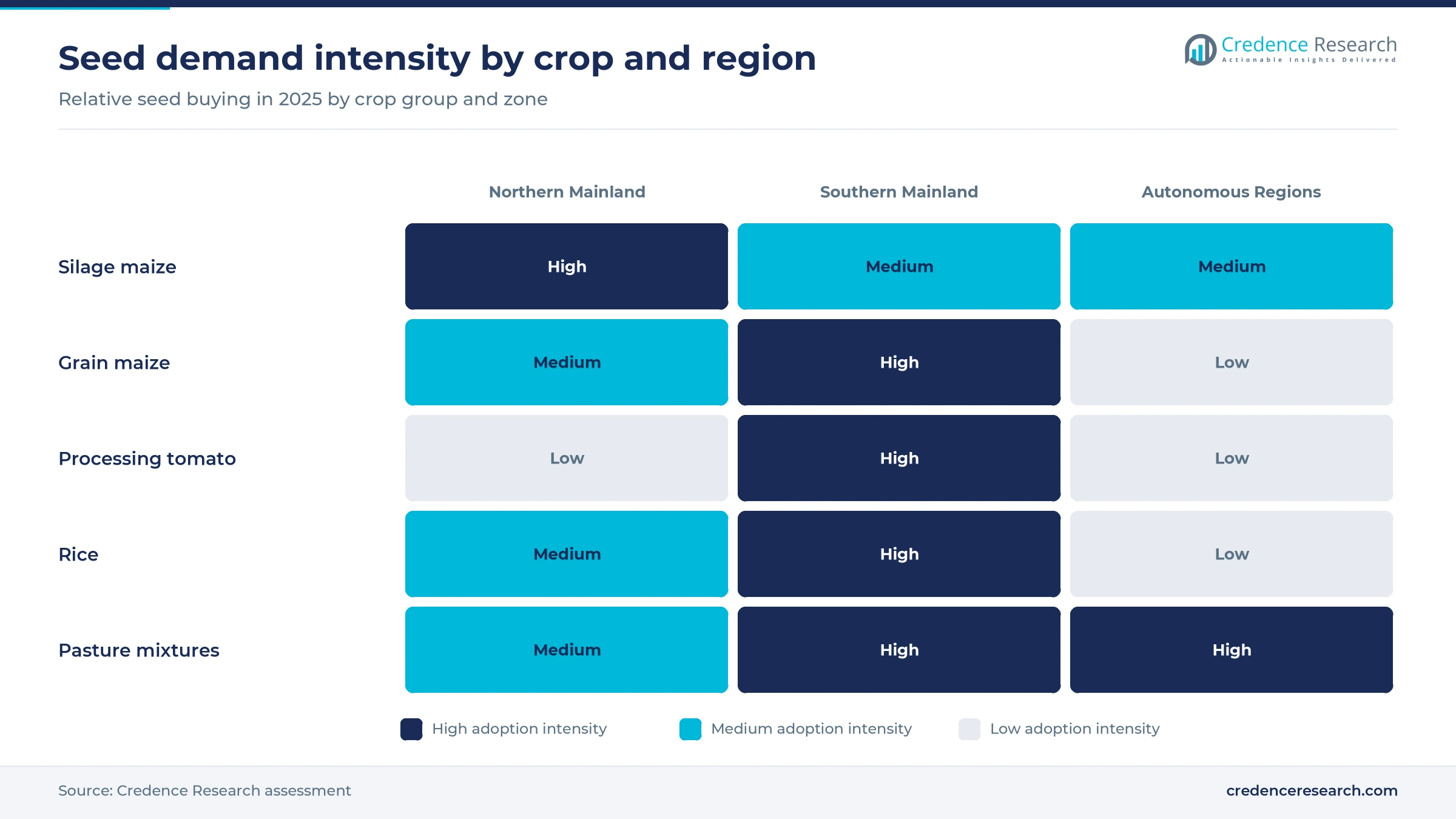
Hybrid seed loses vigor when farm-saved, so maize and processing tomato growers return to suppliers every season, which gives the market a stable replacement base. DGAV recorded 84,318 hectares of grain and silage maize on the mainland in 2025, and processing tomato covered more than 15,000 hectares in the same campaign. The 2025 national variety catalogue lists 110 maize and 236 tomato varieties, which keeps breeders competing on yield and disease packages each year. KWS alone offers 19 maize hybrids in its 2025 Portuguese catalogue, split between silage, grain and poultry feed types. As a result, Hybrid Seeds held 62.0% of 2025 value, and annual renewal keeps that share stable through the forecast period.
Organic procurement rules pull certified organic seed
Organic farms must source organic seed wherever it exists, and that requirement creates a dedicated procurement stream for suppliers. Organic area reached 759,977 hectares in 2022 after more than tripling in five years, according to the 2024 State of the Environment Report of the Portuguese Environment Agency. The European Environment Agency rates Portugal on track toward the EU target of 25% organic farmland, which signals more conversions ahead. EU Regulation 2018/848 lets derogations for non-organic plant reproductive material run only until Dec. 31, 2036, so buyers and breeders must build organic seed supply within the forecast window. Because 71.3% of organic area is meadow and pasture, mixtures for grazing systems gain most from this requirement.
Processors buy tomato hybrids on yield and quality results
Tomato processors and vegetable packers select varieties on measured field performance, which favors premium hybrids with disease resistance and uniform ripening. Processing tomato yields reached 94.5 metric tons per hectare in 2025, 11% above 2010, on more than 15,000 hectares, according to the Ministry of Agriculture and Sea. Portugal also ranks as the fifth-largest exporter of processing tomatoes, so factories compete on paste quality and steady supply. Statistics Portugal reported horticultural area of 39,600 hectares in 2024, up 8.7%, while potato area rose 13.7% to 16,500 hectares. In turn, Vegetables grow fastest at 6.29% a year through 2035, the quickest pace among crop groups.
Alqueva irrigation blocks widen the hybrid-ready area
Irrigation decides where high-value hybrid crops can be grown in southern Portugal, so every new block widens the addressable seed area. EDIA reported in July 2024 that works were underway on the Messejana block, which adds about 2,330 irrigated hectares through the Alqueva link to the Monte da Rocha reservoir. The same link reinforces the Alto Sado scheme of about 3,700 hectares, while the Reguengos de Monsaraz circuit serves about 4,000 hectares. Statistics Portugal also recorded record almond output of 91,000 metric tons in 2024 from new orchards, which shows how quickly irrigated land changes use. As a result, Southern Mainland is the fastest-growing zone in the forecast, as more farms fit micro-irrigation systems on maize and vegetable fields.
Coatings and gene editing reshape the seed offer
Shift toward layered seed treatments and coatings
Seed companies are shifting value into the coating around the seed, as growers want early vigor without extra field passes. The KWS 2025 Portuguese maize catalogue markets its INITIO layered treatment in standard, Insect+ and BirdPROTECT versions with biostimulants and micronutrients. Vida Rural reported on April 16, 2026, that Fertiprado and the InnovPlantProtect laboratory in Elvas developed a coating with a biostimulant effect for pasture seed. Corteva also tested the SullicaB biofertilizer in maize for the first time in Portugal at Agroglobal in September 2025. These products tie seed sales to biostimulant products, which raises the value of each bag sold to growers.
Rise of gene-edited varieties under new EU rules
New breeding rules are emerging as a medium-term trend for Portuguese seed buyers and breeders alike. The European Parliament and Council reached a provisional agreement on new genomic techniques in December 2025, according to Agriland, and NGT-1 plants will be treated like conventional varieties once verified. The rules apply two years after publication, and plants engineered for herbicide tolerance cannot qualify for that category. No NGT plants will be allowed in organic production, which splits the pipeline between organic and conventional buyers. Portugal grew only 574.93 hectares of GM maize in 2025, down 37%, according to DGAV, so gene editing tools offer breeders a route to new traits without GMO-style segregation.
Opening for domestically multiplied organic seed
Domestic organic seed production is a clear opening, because supply has long relied on imports from other European producers. Paulo Martinho of Sementes Vivas told Diario de Noticias in October 2017 that Portugal imported 90% of its farm seed and all of its organic seed. The Idanha-a-Nova company produces on 25 hectares at Herdade do Couto da Varzea and offers about 125 varieties, over 70% of them Portuguese. With EU derogations for non-organic seed ending on Dec. 31, 2036, and organic area at 759,977 hectares in 2022, local multipliers can win supply contracts that importers find hard to serve. This favors suppliers that sell directly to organic farms across the country.
Opportunity in biodiverse pasture mixtures for carbon
Legume-rich pasture mixtures offer suppliers an opening tied to soil carbon and livestock feed. A 615-hectare farm installed 42 hectares of the sown biodiverse pastures developed by Fertiprado in 2010, and its environmental services were paid by the Portuguese Carbon Fund, according to a case study by the EU CAP Network. Organic area more than tripled in the five years to 2022, which gives mixtures a wider base of farms that must renew swards with organic seed. The 2025 national catalogue also lists 41 annual ryegrass and 15 alfalfa varieties for such mixtures. Syngenta and Fertiprado also signed a protocol in July 2019 to develop new mixtures under Operation Pollinator, according to Vida Rural. As livestock farms rebuild drought-hit swards, Seed Mixtures grow fastest at 6.63% a year.
Drought and shrinking maize area test suppliers
Drought and water cuts limit irrigated sowing
Water scarcity directly limits how much irrigated maize, rice and vegetable seed farmers can sow each spring. The government ordered a 25% cut in agricultural water use in the Algarve on Jan. 17, 2024, according to The Brussels Times. IPMA meteorologists said in September 2025 that rainfall since January sat 40% below the 30-year norm, according to The Portugal Post. Growers respond by cutting sown area or choosing shorter-cycle hybrids, which trims seed volume in dry years.
Falling maize area squeezes field crop volumes
Maize area is shrinking, which removes volume from the largest field crop segment. Statistics Portugal reported a 13.6% fall in grain maize area in 2024, and DGAV counted 84,318 hectares of grain and silage maize in 2025, down from 86,861 hectares a year earlier. ANPROMIS says domestic output covers only about a quarter of national needs, with imports from Ukraine and Brazil setting prices. Its president, Jorge Neves, called for a quick review of support under the national CAP strategic plan.
Fragmented small holdings raise the cost to serve
The farm structure is fragmented, which makes certified seed costly to distribute to small buyers across the interior. The 2019 agricultural census counted about 290,000 farms averaging 13.7 hectares, and individual producers ran 94.5% of them with an average of 8.5 hectares, according to Statistics Portugal. Small buyers order low volumes, so suppliers rely on merchants and cooperatives such as the Cooperativa Agricola de Coimbra, which handles about 14,000 metric tons of maize a year, according to ANPROMIS.
Unsettled EU seed marketing rules weigh on planning
Seed firms face regulatory uncertainty because the EU plant reproductive material law is still being negotiated. The European Parliament adopted its position on April 24, 2024, and Euroseeds warned that its many derogations and exemptions weaken quality assurance for farmers. Trilogue talks with the Council were expected to follow, so certification rules were not final at that point. Breeders listing in the national catalogue, which held more than 1,000 denominations in 2025, must plan launches without the final text.
Northern dairy belt leads as the irrigated south gains
| Region | Value, 2025 (USD million) | Share, 2025 | CAGR, 2026–2035 |
|---|---|---|---|
| Northern Mainland | 50.8 | 48.0% | 5.44% |
| Southern Mainland | 46.6 | 44.0% | 6.14% |
| Autonomous Regions | 8.5 | 8.0% | 5.54% |
Northern Mainland leads on silage maize for dairy farms
Northern Mainland held 48.0% of 2025 value and grows at 5.44% a year, led by silage maize for dairy farms in Entre Douro e Minho and the Centro region. DGAV counted 32,120 hectares of maize in Norte and 22,405 hectares in Centro in 2025, together about 65% of the mainland total. Limagrain Iberica recruits technical advisors in Minho to sell LG silage hybrids to dairy clients, which shows how suppliers target this zone. The Mondego valley adds rice, while small holdings keep merchants important.
Southern mainland grows fastest on irrigated tomato and maize
Southern Mainland held 44.0% of 2025 value and is the fastest-growing zone at 6.14% a year. The Ribatejo, where the agriculture minister visited the tomato harvest in Cartaxo on Aug. 13, 2026, and Alentejo host the processing tomato crop, while the Tejo and Sado valleys grow much of the rice. Alentejo also recorded 28,622 hectares of maize in 2025, according to DGAV. The minister urged the EU to fund research before withdrawing plant protection substances, a concern for growers that pair hybrid resistance with fungicide programs.
Autonomous regions rely on pasture and forage maize
Autonomous Regions held 8.0% of 2025 value and grow at 5.54% a year, with demand centered on Azores dairy pastures and forage maize. The regional statistics service SREA reported that July 2025 weather left maize stunted and uneven on Sao Jorge, Pico, Santa Maria, Graciosa and Faial. Lower pastures also suffered water stress that month, and farmers needed extra feed for livestock. Such episodes drive resowing of grass and forage mixtures in the following autumn on the islands.
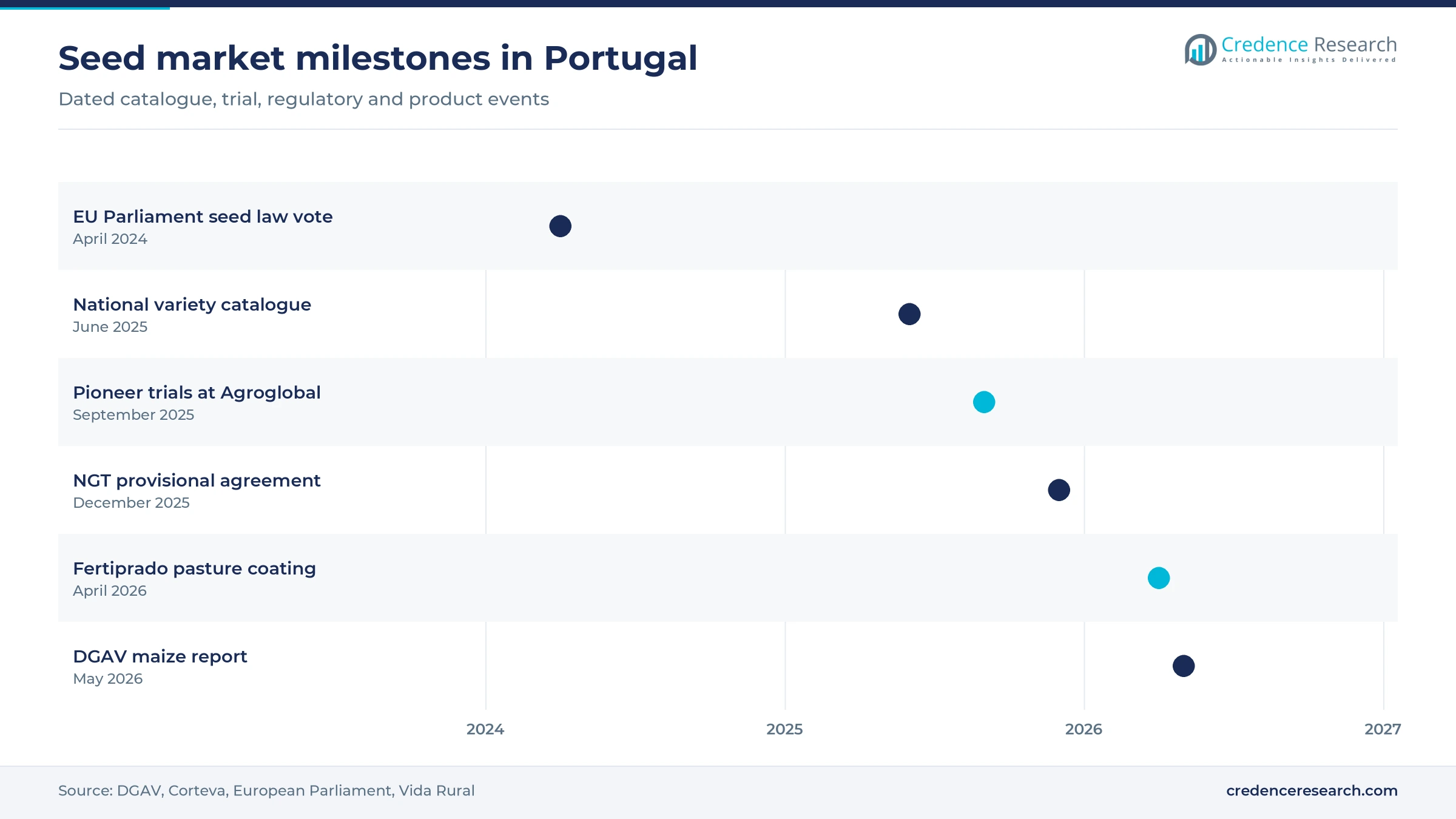
Trials, catalogue listings and EU rules mark 2025–2026
| Development | Status and market relevance |
|---|---|
| In June 2025, the national variety catalogue listed more than 1,000 denominations, with 236 tomato, 111 sunflower and 110 maize varieties. | Published by DGAV; wider choice keeps breeders competing on performance |
| In September 2025, Corteva showed Pioneer forage and grain maize trials at Agroglobal in Quinta da Alorna and previewed the Lortama herbicide for 2026. | Field trial; supports hybrid choice by Ribatejo growers |
| In December 2025, the European Parliament and Council reached a provisional agreement on new genomic techniques for plants. | Provisional agreement; rules apply two years after publication |
| In April 2026, Vida Rural reported a biostimulant seed coating for pastures developed by Fertiprado with InnovPlantProtect in Elvas. | Product development; adds value to pasture mixtures |
| In May 2026, DGAV reported that GM maize fell 37% to 574.93 hectares in 2025, while total maize area reached 84,318 hectares. | Official report; confirms shrinking GM use and maize base |
Seed treatments and pasture coatings add value
- Layered seed treatments such as KWS INITIO combine fungicide, insecticide, biostimulant and micronutrient layers, and the Insect+ version adds soil pest protection that complements insecticide programs on maize.
- Pasture seed coatings developed by Fertiprado with InnovPlantProtect in 2026 aim to improve establishment of legume-rich mixtures in poor soils.
- Demonstration field trials such as the 7-hectare Pioneer forage maize trial at Agroglobal in 2025 let growers compare hybrids before ordering.
- National variety registration through the DGAV catalogue gives each variety legal access to the market, with more than 1,000 denominations listed in 2025.
Need a Custom Version of This Report?
Tailor the scope, geography, or segments to your exact requirements.
- Custom geography or segment scope
- Direct access to our analyst team
Global breeders compete through local merchants
Competition is led by global breeders that sell hybrid maize, sunflower and vegetable seed through local merchants, cooperatives and their own technical teams. KWS publishes a Portuguese maize catalogue of 19 hybrids and positions its INITIO treatment as a point of difference. Corteva runs Pioneer forage and grain maize trials at Agroglobal, which places hybrids in front of Ribatejo growers before each season. Limagrain sells LG silage hybrids to dairy farms in Minho through a distributor and its own field advisors. Bayer reaches vegetable growers through Seminis and De Ruiter, which Sementibrida has distributed exclusively since 2016. Syngenta works with Fertiprado on pasture mixtures under a 2019 protocol. Domestic firms such as Fertiprado and Sementes Vivas compete on local adaptation and organic supply rather than scale. Field results, disease packages and merchant credit decide most purchases.
Companies profiled and their roles in this market
| Company | Type | Role in the market |
|---|---|---|
| Syngenta | Global breeder | Partner of Fertiprado since a July 2019 protocol on new pasture mixtures |
| Corteva Agriscience | Global breeder | Pioneer forage and grain maize hybrids shown in Agroglobal trials in 2025 |
| Bayer | Global breeder | Seminis and De Ruiter vegetable seed distributed by Sementibrida since 2016 |
| KWS | Global breeder | Portuguese 2025 catalogue of 19 maize hybrids with INITIO treatment |
| Limagrain | Global breeder | LG silage maize hybrids sold to dairy farms in Minho |
Irrigated hybrids and organic supply set the pace
Credence Research's view is that Portuguese seed demand will be decided by water and by organic rules more than by farm numbers. Maize area is shrinking, yet each irrigated hectare that stays in maize or tomato buys hybrid seed every season at rising value. The irrigated south gains most, because new Alqueva blocks add land that suits premium hybrids. Organic farms and pasture renewal create the fastest new demand, as the 2036 end of derogations pushes buyers toward certified organic seed. Suppliers that pair local multiplication, treated seed and trial data with merchant reach should outgrow the market.
How Credence Research sized Portuguese seed demand
The report uses 2025 as the base year and forecasts value to 2035 in USD million from the Credence Research market model. Segment and regional splits are Credence Research estimates built from crop area statistics by DGAV and Statistics Portugal, irrigation data from EDIA, organic farming data from the Portuguese Environment Agency and the European Environment Agency, and company catalogues and releases. Regional shares follow the Credence Research regional model for Portuguese agriculture. No interviews or surveys were used for this edition of the report.
Seed demand grows with irrigation and organic rules
The market reaches USD 185.5 million by 2035, growing at 5.76% a year from USD 112.0 million in 2026. Hybrid seeds keep the largest share as maize and tomato growers renew seed each season, while pasture mixtures and organic seed grow fastest. Southern Mainland gains share as Alqueva irrigation spreads, and Northern Mainland stays the largest zone because of its dairy silage base. New EU rules on gene-edited plants could bring the first edited varieties to conventional farms before the forecast ends, while drought remains the main risk to volumes.
Frequently Asked Questions
How big is the Portugal seed market?
Which product type leads the Portugal seed market?
Which product type grows fastest?
Which region leads seed demand in Portugal?
Which region grows fastest?
How do organic rules affect seed demand in Portugal?
What are the main challenges for seed suppliers in Portugal?
Who are the key companies in the Portugal seed market?
Table of Content
Chapter 1 Market Segmentation
- 1.1 Segmentation Framework
- 1.1.1 Product and Service Classification
- 1.1.2 Application and End-Use Classification
- 1.1.3 Technology and Solution Classification
- 1.1.4 Customer and Distribution Channel Classification
- 1.1.5 Geographic Segmentation
- 1.1.6 Market Segment Definitions and Boundaries
- 1.2 By Product Type
- 1.2.1 Hybrid Seeds
- 1.2.2 Open-Pollinated Seeds
- 1.2.3 Seed Mixtures
- 1.3 By Crop Type
- 1.3.1 Field Crops
- 1.3.2 Vegetables
- 1.3.3 Forage Crops
- 1.3.4 Ornamentals
- 1.4 By Customer Type
- 1.4.1 Crop-Producing Farms
- 1.4.2 Livestock Farms
- 1.4.3 Plant-Raising Nurseries
- 1.4.4 Public Growing Institutions
- 1.5 By Farm Size
- 1.5.1 Below 10 Hectares
- 1.5.2 10 to Below 50 Hectares
- 1.5.3 50 Hectares and Above
Chapter 2 Introduction
- 2.1 Report Objectives and Scope
- 2.2 Product Definition and Industry Terminology
- 2.3 Market Inclusions and Exclusions
- 2.4 Research Process
- 2.4.1 Primary Research and Expert Interviews
- 2.4.2 Secondary Research and Source Review
- 2.4.3 Top-Down and Bottom-Up Estimation
- 2.4.4 Data Triangulation and Verification
- 2.5 Market Size Measurement Basis
- 2.5.1 2025: USD 105.9 million → 2035: USD 185.5 million
- 2.6 Historical and Forecast Reference Periods
- 2.6.1 Historical Period: 2018-2025
- 2.6.2 Base Year: 2025
- 2.6.3 Forecast Period: 2025-2035
- 2.7 Research Assumptions and Limitations
Chapter 3 Executive Summary
- 3.1 Market Snapshot and Key Findings
- 3.2 Base-Year Market Size, 2025
- 3.3 Forecast Market Size, 2035
- 3.4 Revenue and Volume Growth Outlook
- 3.5 Key Demand and Supply Indicators
- 3.6 Leading Market Segments
- 3.7 Fastest-Growing Market Opportunities
- 3.8 Regional Performance Highlights
- 3.9 Technology and Industry Transformation
- 3.10 Competitive Landscape Summary
- 3.11 Analyst View and Strategic Implications
Chapter 4 Portugal Seed Market Trends and Developments
- 4.1 Historical Industry Development, 2018-2025
- 4.2 Recent Market Trends and Developments
- 4.3 Demand and Customer Behavior Trends
- 4.4 Technology and Product Innovation
- 4.5 Artificial Intelligence, Automation and Digitalization
- 4.6 Local Manufacturing and Supply Chain Realignment
- 4.7 Industry Partnerships, Mergers and Acquisitions
- 4.8 Sustainability and Circular Economy Developments
- 4.9 Government and Private Sector Investment Trends
- 4.10 Emerging Business Models and Commercialization
- 4.11 Industry Developments and Announcements
Chapter 5 Portugal Seed Market Production, Supply and Demand Analysis
- 5.1 Demand Trend and Consumption Analysis, 2018-2025
- 5.2 Demand Forecast, 2025-2035
- 5.3 Production and Output Trend, 2018-2025
- 5.4 Production and Output Forecast, 2025-2035
- 5.5 Installed Capacity and Capacity Utilization
- 5.6 Company-Wise Production Plants and Statistics
- 5.6.1 Installed Production Capacity
- 5.6.2 Actual Production
- 5.6.3 Planned Capacity and Expansion Targets
- 5.7 Supply Chain Structure and Procurement Trends
- 5.8 Supply-Demand Gap and Bottlenecks
- 5.9 Import Dependence and Sourcing Structure
- 5.10 Contract Manufacturing and Outsourcing
- 5.11 Regional Supply and Demand Concentration
Chapter 6 Portugal Seed Market Pricing Analysis
- 6.1 Pricing Structure and Measurement
- 6.2 Historical Pricing Trends, 2018-2025
- 6.3 Pricing Outlook, 2025-2035
- 6.4 Average Selling Price and Unit Economics
- 6.5 Pricing by Product and Market Segment
- 6.6 Geographic Pricing Differences
- 6.7 Key Input, Energy, Labor and Logistics Costs
- 6.8 Contract Pricing and Purchasing Models
- 6.9 Pricing Sensitivity and Competitive Positioning
- 6.10 Price, Margin and Profitability Implications
Chapter 7 Portugal Seed Market Dynamics
- 7.1 Market Growth Drivers
- 7.1.1 Demand-Side Drivers
- 7.1.2 Technology and Innovation Drivers
- 7.1.3 Infrastructure and Investment Drivers
- 7.1.4 Regulatory and Policy Drivers
- 7.2 Market Restraints
- 7.2.1 Cost and Affordability Constraints
- 7.2.2 Technology and Adoption Barriers
- 7.2.3 Supply Chain and Operational Constraints
- 7.3 Market Challenges
- 7.3.1 Competitive Pressure and Margin Erosion
- 7.3.2 Skills, Infrastructure and Implementation Gaps
- 7.4 Emerging Market Opportunities
- 7.5 Market Dynamics Impact and Time-Horizon Assessment
Chapter 8 Portugal Seed Value Chain Analysis
- 8.1 Industry Value Chain Overview
- 8.2 Upstream Suppliers and Critical Inputs
- 8.3 Technology and Component Providers
- 8.4 Manufacturing or Service Delivery
- 8.5 Distribution, Channel Partners and Integrators
- 8.6 Downstream Applications and End Users
- 8.7 Value Addition and Profit Pools
- 8.8 Vertical Integration and Outsourcing
- 8.9 Supplier Concentration and Risk
- 8.10 Supply Chain Localization and Resilience
Chapter 9 Portugal Seed Market Regulations and Policies
- 9.1 Relevant Laws, Standards and Compliance Frameworks
- 9.2 Product, Service, Safety and Quality Requirements
- 9.3 Government Policies, Incentives and Subsidies
- 9.4 Imports, Exports and Trade Barriers
- 9.5 Public Procurement and Local Content Requirements
- 9.6 Environmental and Sustainability Compliance
- 9.7 Upcoming Policy Changes and Market Implications
Chapter 10 Portugal Seed Market Hotspots and Opportunities
- 10.1 Market Opportunity Mapping and Growth Hotspots
- 10.2 High-Growth Applications and Customer Groups
- 10.3 Underserved Markets and White-Space Opportunities
- 10.4 Emerging Technology and Product Opportunities
- 10.5 New Capacity and Investment Hotspots
- 10.6 Market Entry and Expansion Opportunities
- 10.7 Distribution and Partnership Opportunities
- 10.8 Near-Term and Long-Term Commercial Potential
- 10.9 Opportunity Attractiveness and Execution Risks
Chapter 11 Portugal Seed Market Outlook, 2025-2035
- 11.1 Market Size and Analysis
- 11.1.1 Revenue (Market Measurement: 2025: USD 105.9 million → 2035: USD 185.5 million)
- 11.1.2 Market Volume and Quantity Sold
- 11.1.3 Historical Market Size, 2018-2025
- 11.1.4 Base-Year Market Size, 2025
- 11.2 Market Forecast, 2025-2035
- 11.2.1 Revenue Forecast to 2035
- 11.2.2 Volume Forecast to 2035
- 11.2.3 CAGR and Year-on-Year Growth
- 11.2.4 Incremental Revenue Opportunity
- 11.3 Forecast Assumptions and Scenario Analysis
- 11.3.1 Base-Case Forecast
- 11.3.2 Optimistic and Conservative Scenarios
- 11.3.3 Technology, Pricing and Policy Sensitivities
- 11.4 Market Attractiveness and Growth Outlook
Chapter 12 Portugal Seed Market Segmentation and Outlook
- 12.1 Segmentation Summary and Market Shares, 2025
- 12.2 Largest and Fastest-Growing Segments
- 12.3 By Product Type - Market Size and Forecast, 2025-2035
- 12.3.1 Segment Definition and Scope
- 12.3.2 Historical Market Size, 2018-2025
- 12.3.3 Revenue Forecast, 2025-2035
- 12.3.4 Volume Forecast, 2025-2035
- 12.3.5 Base-Year Market Share, 2025
- 12.3.6 Segment CAGR and Growth Drivers
- 12.3.7 Subsegment Market Size and Forecast
- 12.3.7.1 Hybrid Seeds
- 12.3.7.2 Open-Pollinated Seeds
- 12.3.7.3 Seed Mixtures
- 12.3.8 Subsegment Pricing and Adoption Trends
- 12.3.9 Leading Suppliers and Competition
- 12.3.10 Regional Demand and Opportunities
- 12.4 By Crop Type - Market Size and Forecast, 2025-2035
- 12.4.1 Segment Definition and Scope
- 12.4.2 Historical Market Size, 2018-2025
- 12.4.3 Revenue Forecast, 2025-2035
- 12.4.4 Volume Forecast, 2025-2035
- 12.4.5 Base-Year Market Share, 2025
- 12.4.6 Segment CAGR and Growth Drivers
- 12.4.7 Subsegment Market Size and Forecast
- 12.4.7.1 Field Crops
- 12.4.7.2 Vegetables
- 12.4.7.3 Forage Crops
- 12.4.7.4 Ornamentals
- 12.4.8 Subsegment Pricing and Adoption Trends
- 12.4.9 Leading Suppliers and Competition
- 12.4.10 Regional Demand and Opportunities
- 12.5 By Customer Type - Market Size and Forecast, 2025-2035
- 12.5.1 Segment Definition and Scope
- 12.5.2 Historical Market Size, 2018-2025
- 12.5.3 Revenue Forecast, 2025-2035
- 12.5.4 Volume Forecast, 2025-2035
- 12.5.5 Base-Year Market Share, 2025
- 12.5.6 Segment CAGR and Growth Drivers
- 12.5.7 Subsegment Market Size and Forecast
- 12.5.7.1 Crop-Producing Farms
- 12.5.7.2 Livestock Farms
- 12.5.7.3 Plant-Raising Nurseries
- 12.5.7.4 Public Growing Institutions
- 12.5.8 Subsegment Pricing and Adoption Trends
- 12.5.9 Leading Suppliers and Competition
- 12.5.10 Regional Demand and Opportunities
- 12.6 By Farm Size - Market Size and Forecast, 2025-2035
- 12.6.1 Segment Definition and Scope
- 12.6.2 Historical Market Size, 2018-2025
- 12.6.3 Revenue Forecast, 2025-2035
- 12.6.4 Volume Forecast, 2025-2035
- 12.6.5 Base-Year Market Share, 2025
- 12.6.6 Segment CAGR and Growth Drivers
- 12.6.7 Subsegment Market Size and Forecast
- 12.6.7.1 Below 10 Hectares
- 12.6.7.2 10 to Below 50 Hectares
- 12.6.7.3 50 Hectares and Above
- 12.6.8 Subsegment Pricing and Adoption Trends
- 12.6.9 Leading Suppliers and Competition
- 12.6.10 Regional Demand and Opportunities
- 12.7 Segment Growth Comparison
- 12.8 Segment Attractiveness and Priority Matrix
Chapter 13 Portugal Seed End-Use and Application Market Outlook
- 13.1 End-Use Industry and Customer Demand Structure
- 13.2 Leading Applications and Customer Groups
- 13.3 End-Use Market Size, Share and Forecast
- 13.4 Major End-Use Industry Deep Dives
- 13.4.1 Customer Requirements and Use Cases
- 13.4.2 Demand and Replacement Cycles
- 13.4.3 Technical and Regulatory Considerations
- 13.4.4 Purchasing and Procurement Models
- 13.4.5 Leading Vendors and Distribution Channels
- 13.4.6 Forecast and Commercial Opportunities
- 13.5 Emerging Applications and Cross-Segment Demand
- 13.6 End-Use Industry Investment Priorities
Chapter 14 Portugal Seed Geographic Market Outlook, 2025-2035
- 14.1 Domestic Market Distribution and Demand Clusters
- 14.2 State- or Province-Wise Market Size and Forecast, 2025-2035
- 14.3 City and Metropolitan Market Outlook
- 14.4 Industrial, Manufacturing and Commercial Clusters
- 14.5 Geographic Concentration of Key End Users
- 14.6 Local Pricing and Purchasing Differences
- 14.7 Domestic Production Facilities and Capacity Map
- 14.8 Local Infrastructure and Project Pipeline
- 14.9 State-Level Policy and Incentive Differences
- 14.10 Subnational Investment Hotspots and Opportunities
- 14.11 Distribution and Logistics Networks
- 14.12 Domestic Competitive Footprint
Chapter 15 Portugal Seed Technology, Innovation and Sustainability Outlook
- 15.1 Technology Landscape and Maturity
- 15.2 Product, Process and Service Innovation
- 15.3 AI, Automation and Digital Tools in the Industry
- 15.4 Technology Adoption and Performance Benchmarking
- 15.5 Innovation Pipeline and R&D Investment
- 15.6 Patent and Intellectual Property Trends
- 15.7 Energy Efficiency and Resource Management
- 15.8 Sustainability, Recycling and Circularity
- 15.9 Technology Roadmap, 2025-2035
- 15.10 Risks of Obsolescence and Technology Substitution
Chapter 16 Portugal Seed Market Key Strategic Imperatives
- 16.1 Growth and Market Entry Priorities
- 16.2 High-Return Products and Segments
- 16.3 Pricing, Profitability and Cost Optimization
- 16.4 Technology Investment and Product Differentiation
- 16.5 Supply Chain Localization and Resilience
- 16.6 Distribution and Customer Acquisition
- 16.7 Partnership, Acquisition and Capacity Strategy
- 16.8 Regional Expansion Priorities
- 16.9 Short-, Medium- and Long-Term Actions
Chapter 17 Competition Outlook
- 17.1 Industry Competition Characteristics
- 17.2 Market Structure and Concentration
- 17.3 Market Share and Competitive Positioning, 2025
- 17.4 Company-Wise Revenue and Product Benchmarking
- 17.5 Production and Service Capacity Benchmarking
- 17.6 Technology, Pricing and Differentiation
- 17.7 Regional Footprint and Distribution Strength
- 17.8 Mergers, Acquisitions and Strategic Alliances
- 17.9 New Entrants and Competitive Threats
- 17.10 Porter's Five Forces and Industry Attractiveness
- 17.11 Competitive Outlook, 2025-2035
Chapter 18 Company Profiles
- 18.1 Company Coverage and Selection Criteria
- 18.2 Syngenta
- 18.2.1 Business Description
- 18.2.2 Company Ownership and Geographic Presence
- 18.2.3 Product and Service Portfolio
- 18.2.4 Manufacturing and Operating Footprint
- 18.2.5 Production Capacity and Expansion Plans
- 18.2.6 Financial Performance and Investment
- 18.2.7 Market Share and Competitive Position
- 18.2.8 Technology and Innovation Capabilities
- 18.2.9 Strategic Alliances or Partnerships
- 18.2.10 Recent Developments
- 18.2.11 Growth Strategy and Outlook
- 18.3 Corteva Agriscience
- 18.4 Bayer
- 18.5 KWS
- 18.6 Limagrain
- 18.7 Other Relevant Market Participants
Note: Every listed company is profiled on the structure shown under the first company. The company list is preliminary and may change based on research findings, market developments, data availability and client requirements.
Chapter 19 Disclaimer
- 19.1 Research and Forecast Disclaimer
- 19.2 Data Source and Estimation Limitations
Note: The depth of individual sections depends on data availability for this market. Volume, capacity, trade and other unit-based metrics are included where applicable.

