
Contract washing, rental and sterile textiles set the scope
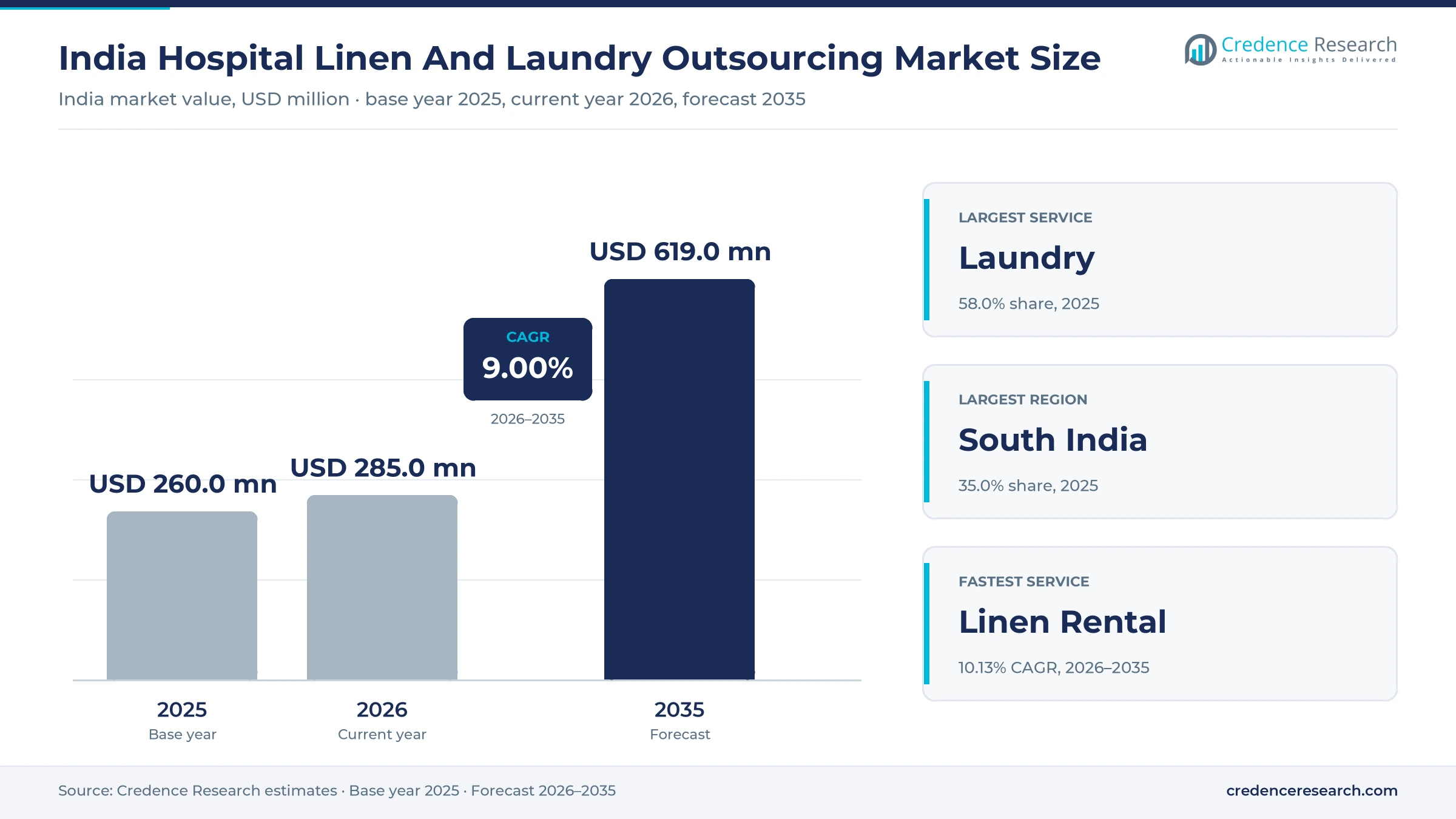
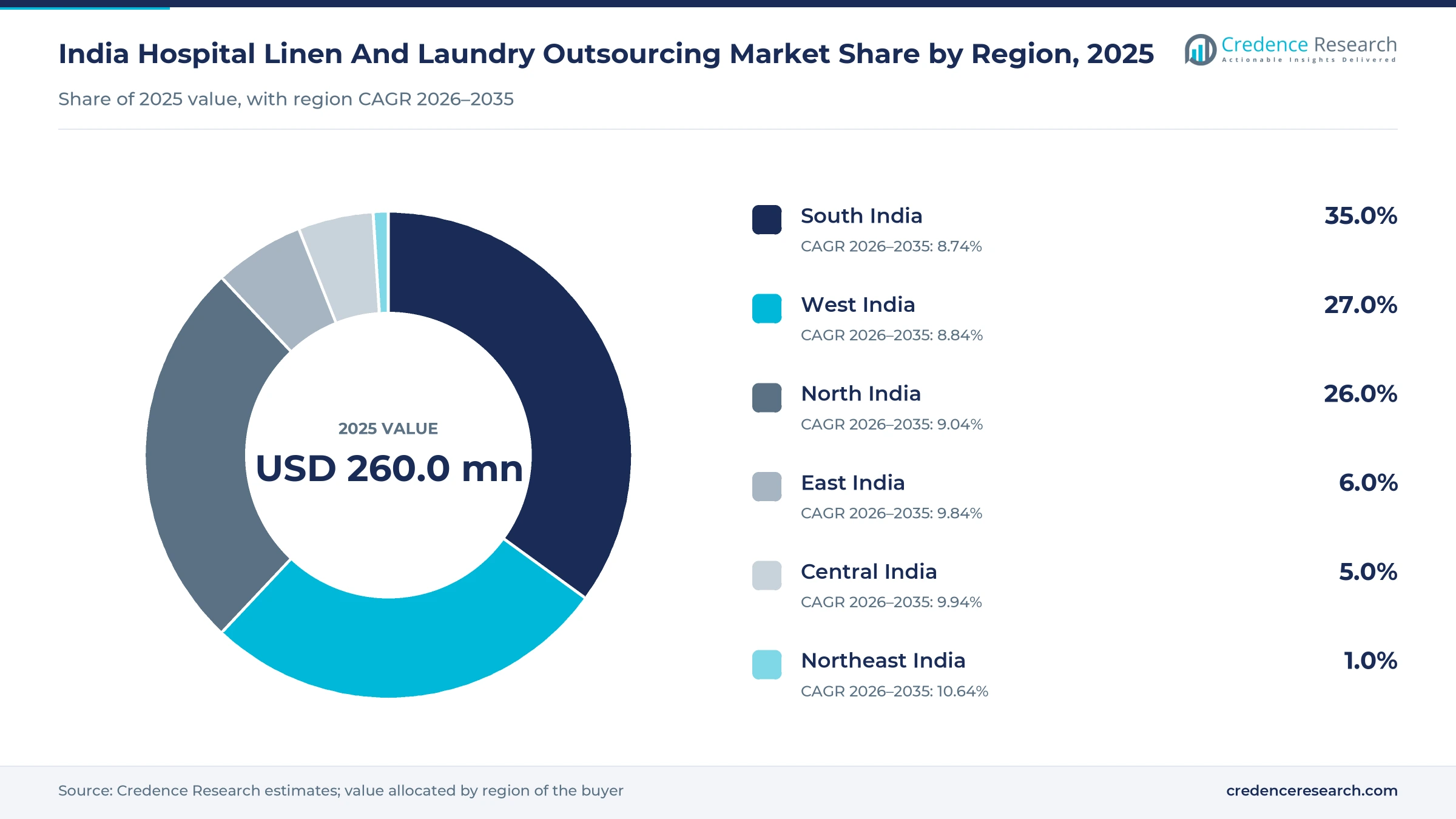
The India hospital linen and laundry outsourcing market was valued at USD 260.0 million in 2025 and is projected to increase from USD 285.0 million in 2026 to USD 619.0 million by 2035, registering a CAGR of 9.00% during 2026–2035. Demand comes from private hospital chains, government hospitals and standalone hospitals that hand bedsheets, gowns, theater drapes and staff uniforms to outside processors for washing, rental supply and sterile packing. South India held the largest regional share, 35.0% in 2025, because its five states hold close to 29% of the country's government hospital beds and host dense private chain networks. Northeast India is the fastest-growing region at 10.64% a year, starting from a very small base. Public buyers are also changing their rules, since Maharashtra launched mechanized linen washing across 593 government health institutions in October 2025, and Delhi government hospitals adopted a daily color-coded bedsheet rotation in November 2025 under the Kayakalp program.
What counts as an outsourced linen or laundry service for hospitals?
The market counts fees that hospitals pay outside companies to collect, wash, disinfect, iron and return bedsheets, pillow covers, blankets, patient gowns, theater clothing and staff uniforms. It also covers linen rental on a pay-per-use basis and the processing of reusable surgical textiles into sterile packs, whether the work happens in a central plant or in an on-site laundry run by a contractor.
The market excludes laundry that hospitals run with their own staff and machines, the purchase of new linen, and the sale of washing machines, detergents and consumables. Value flows from hospitals and state health societies to processors, which then pay for labor, water, energy, chemicals, transport and linen stock.
India Hospital Linen And Laundry Outsourcing Market Insights
- Outsourced hospital linen and laundry revenue in India rises from USD 260.0 million in 2025 to USD 619.0 million by 2035 at a 9.00% CAGR, as beds grow and hygiene audits tighten.
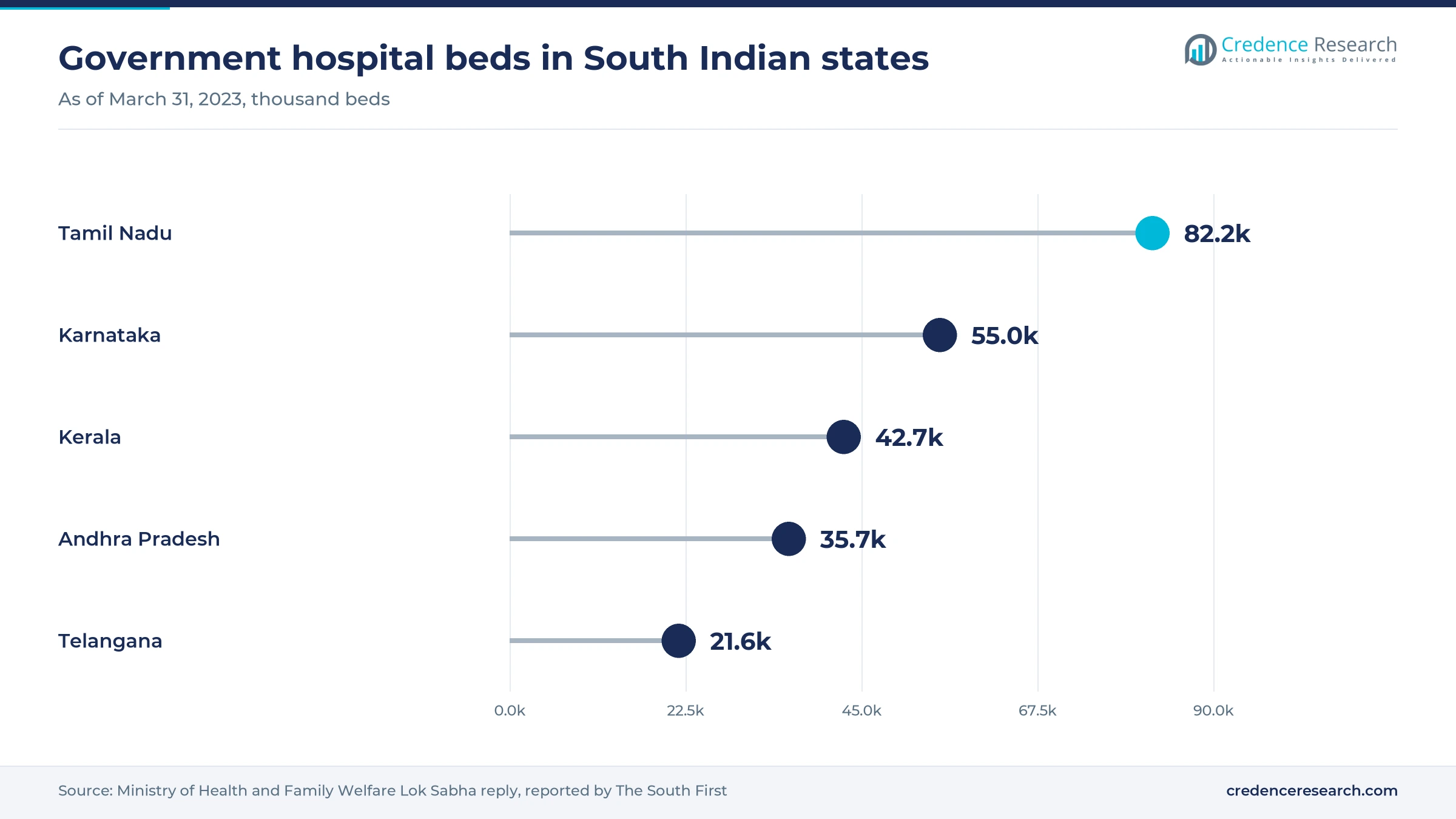
- South India held 35.0% of 2025 value, because Tamil Nadu, Karnataka, Kerala, Andhra Pradesh and Telangana held 237,236 government hospital beds in March 2023.
- Laundry contracts accounted for 58.0% of 2025 value, as public buyers such as Bargarh district pay per kilogram of washed linen.
- Maharashtra launched mechanized linen washing in 593 government health institutions in October 2025, moving a large public bed base to contract processing.
- Quick Clean raised US$14 million in July 2026 while processing over 100,000 kg of linen a day for clients that include AIIMS.
Laundry contracts and private chains lead spending
Why per-kilogram laundry contracts hold the largest share
Based on service, the market is categorized into laundry, linen rental and sterilization of textiles. Laundry led with 58.0% of 2025 value because most buyers pay processors to wash linen they already own, and the Bargarh district health society in Odisha pays its contractor per kilogram of washed, calendered linen across 47 facilities. Linen Rental grows fastest at 10.13% a year as hospitals move linen from capital to operating budgets, and Quick Smart Wash offers hospital linen on a pay-per-use basis while serving more than 30,000 beds daily, according to the company. Sterile packing of theater gowns and drapes adds a smaller, higher-value stream.
Private chains lead while government buyers grow faster
Based on hospital, the market is categorized into private chains, government and standalone hospitals. Private Chains led with 47.0% of 2025 value because chains sign multi-site contracts, and Apollo Laundry and Linen Services named Fortis, Max Healthcare, Narayana Health, Artemis and CMRI among its hospital clients in October 2020. Government hospitals grow fastest at 9.54% a year as states tender mechanized washing, and Maharashtra launched the service in 593 public health institutions on Oct. 15, 2025, Free Press Journal reported. Standalone hospitals such as Lilavati and Bombay Hospital also buy from Quick Clean, according to Entrepreneur India.
Metros lead as tier-2 cities gain chain hospitals
Based on city tier, the market is categorized into metro and tier-2 cities. Metro cities led with 68.0% of 2025 value because central plants need dense bed clusters, and Quick Smart Wash ran processing units in Delhi NCR, Hyderabad and Bengaluru in September 2023, YourStory reported. Tier-2 cities grow fastest at 10.07% a year as chains move outward, and Business Today reported in July 2026 that healthcare demand in tier-II and tier-III cities is projected to grow 16% to 18% a year, against 12% to 14% in metros. Park Medi World plans 1,450 more beds by FY28 with a tier-2 focus.
| Segment Group | Leading Sub-segment | Share, 2025 | Fastest-growing Sub-segment | CAGR, 2026–2035 |
|---|---|---|---|---|
| By Service | Laundry | 58.0% | Linen Rental | 10.13% |
| By Hospital | Private Chains | 47.0% | Government | 9.54% |
| By City Tier | Metro | 68.0% | Tier-2 | 10.07% |
Request a Free Sample
Fill in your details and we'll send you a free sample report.
- Sample data tables & charts
- Research methodology
Infection rules, chain growth and automation lift contracts
Infection-control rules push linen out of hospital basements
Infection control is the main reason hospitals outsource linen, because contract plants can hold wash temperatures, chemical doses and clean-dirty separation that small in-house rooms cannot. The WHO reported in May 2022 that 15 of every 100 patients in acute-care hospitals in low- and middle-income countries acquire at least one health care-associated infection. The Kayakalp scorecard gives laundry 10 points for district hospitals and checks that bedsheets are changed daily. Delhi government hospitals adopted a seven-color bedsheet rotation in November 2025 so that daily changes can be verified. In the Credence Research model this adds about 3.51 percentage points to annual growth to 2035.
Larger hospital networks favor multi-site contracts
Hospital networks are getting larger, which lets one processor serve many sites under a single contract and price. Business Today reported in July 2025 that Manipal Hospitals agreed to buy Sahyadri Hospitals, taking its network to about 12,000 beds in 49 hospitals, while Aster DM Healthcare planned 38 hospitals across 27 cities. Max Healthcare entered Lucknow in December 2023 by buying the 550-bed Sahara Hospital, which added linen demand in a new city. Processors already sell to such groups, since Apollo Laundry and Linen Services offers on-site, equipment-only and central plant models for chains such as Fortis and Narayana Health. As a result, Private Chains hold 47.0% of 2025 value. In the Credence Research model this adds about 2.43 percentage points to annual growth to 2035.
Automated laundries improve quality and renewal odds
Automated plants make contracts easier to renew, because they cut turnaround time, losses and rewash rates that hospitals track. Entrepreneur India reported in July 2026 that Quick Clean processed over 100,000 kg of linen a day through more than 140 on-premise laundries in 38 cities, after raising US$14 million. In March 2026, Quick Clean founder Anshul Gupta told BioSpectrum India that the company served AIIMS Nagpur and Patna Medical College and Hospital. Sorterz in Bengaluru cut linen reception time from close to two hours by adding RFID, YourStory reported. In the Credence Research model this adds about 1.62 percentage points to annual growth to 2035.
New hospital beds widen the processed linen base
Every new bed adds sheets, gowns and drapes to be processed daily, so bed growth translates directly into contract volume. ICRA said in February 2026 that 18 large chains plan more than 34,000 beds over FY2026 to FY2030, with about Rs 40,000 crore of investment that will add linen demand. In August 2025, ICRA expected about 14,500 beds over FY2026 and FY2027 alone, with occupancy of 62% to 64%, Medical Dialogues reported. India still had only 1.59 hospital beds per 1,000 people in 2021, World Bank data show, which leaves a long runway of additions. New wings usually open with contracted linen service rather than in-house laundries.
On-site plants, RFID and rental reshape linen service
Shift to contractor-run laundries inside hospitals
Processing is shifting into contractor-run laundries inside hospital campuses, which avoids long transport and keeps the hospital in control of linen stock. Quick Clean ran more than 110 on-premise installations in 38 cities in March 2026, BioSpectrum India reported, and the count passed 140 by July 2026. Apollo Laundry and Linen Services offers a build, operate and transfer setup on hospital premises, alongside central plant washing. Goa Medical College outsourced its centralized laundry to Ecoclean Systems and Solutions, with capacity of 6,000 items a day, CINET reported. The model also lifts demand for commercial washer-extractors, which contractors install and run on site.
Rise of RFID tracking and barrier washing systems
Tracking and barrier technology are rising because hospitals want proof that every item was washed, counted and kept away from soiled areas. Apollo Laundry said in October 2020 that it had introduced barrier washers to India, with separate doors for soiled and clean linen. Sorterz added RFID to speed up inventory reception for clients such as Apollo Hospital, Cloud Nine and Manipal Hospital, YourStory reported in June 2021. However, ADD Laundry Concepts managing director Akash Dharamsey said in February 2026 that tunnel washers, barrier washers and RFID tracking still see minimal uptake in India, CINET reported. Wider use of RFID tags would cut losses and support per-item billing.
Opening for pay-per-use rental in smaller cities
Linen rental is an opening for processors because smaller hospitals often lack the cash to keep three sets of linen for every bed. Quick Smart Wash markets its rental model as moving hospitals from capital to operating spending, and it says it serves more than 30,000 beds daily from 23 central units. In Odisha, the Bargarh district tender asks the contractor to supply bedsheets made to IS 17630:2021 as well as wash them. Apollo Hospitals already has nearly 30% of its capacity outside metro hubs, Business Today reported in July 2025, which shows where rental demand will widen. As a result, rental fits new tier-2 wings that open without a linen stock of their own.
Opening in state-wide public health contracts
State health departments are an opening because they are moving whole districts to mechanized contracts at once. Maharashtra launched the service in 593 government health institutions on Oct. 15, 2025, with ministers Prakash Abitkar and Meghna Sakore-Bordikar at the launch. The Bargarh RFP of August 2024 covers 47 facilities with about 1,128 beds under a three-year contract. In Assam, the state health infrastructure portal issued corrigenda in September and October 2025 for a laundry system at AMCH. Such tenders fit the wider push for infection control programs in public hospitals. Contractors that win one district can then bid for neighboring districts using the same plant and staff.
Payment delays, rate caps and thin automation strain vendors
Payment delays and contract lapses disrupt service
Payment delays in public contracts can break service quality, which then hurts trust in outsourcing. At Maharaja Yeshwantrao Hospital in Indore, the laundry operator said Rs 3.25 lakh of monthly dues had been stalled for six months, Free Press Journal reported in February 2025. The PPP laundry, privatized in 2018, ran after its contract expired in November 2023, and patients were asked to bring their own linen. Vendors respond by seeking escrow-style payment terms and shorter billing cycles with state buyers.
Capped per-kilogram rates squeeze vendor margins
Public buyers cap rates tightly, which leaves little room for automation or better linen. The Bargarh district tender of August 2024 sets a ceiling of Rs 45 per kilogram including 18% GST, and limits the service charge to 3.85% to 7% of cost per kilogram. The same contractor must also supply bedsheets and run the service round the clock. Low caps favor manual washer-extractor setups over barrier or tunnel lines, and processors must win volume across many facilities to earn a return.
Thin automation and skills slow quality upgrades
Skills and equipment lag behind what hospital accreditation now expects, which slows the move to higher-value services. ADD Laundry Concepts managing director Akash Dharamsey said in February 2026 that tunnel washers, barrier washers and RFID see minimal uptake in India, CINET reported. He also pointed to workforce skill shortages, limited training on wash chemistry and gaps in PPE discipline. As a result, many contractors still run small machines, and hospitals hesitate to hand over theater textiles for sterile processing.
Low bed density limits plant scale outside metros
Low bed density outside large cities makes central plants hard to fill, which raises unit costs for every kilogram processed. World Bank data put India at 1.59 hospital beds per 1,000 people in 2021, against 5.63 in China in 2023. In Bargarh district, the 47 facilities in the tender include 28 primary health centers with six beds each. Processors therefore cluster plants near metros and serve smaller towns with on-site setups or longer routes, which adds transport costs.
Southern bed density keeps South India in front
| Region | Value, 2025 (USD million) | Share, 2025 | CAGR, 2026–2035 |
|---|---|---|---|
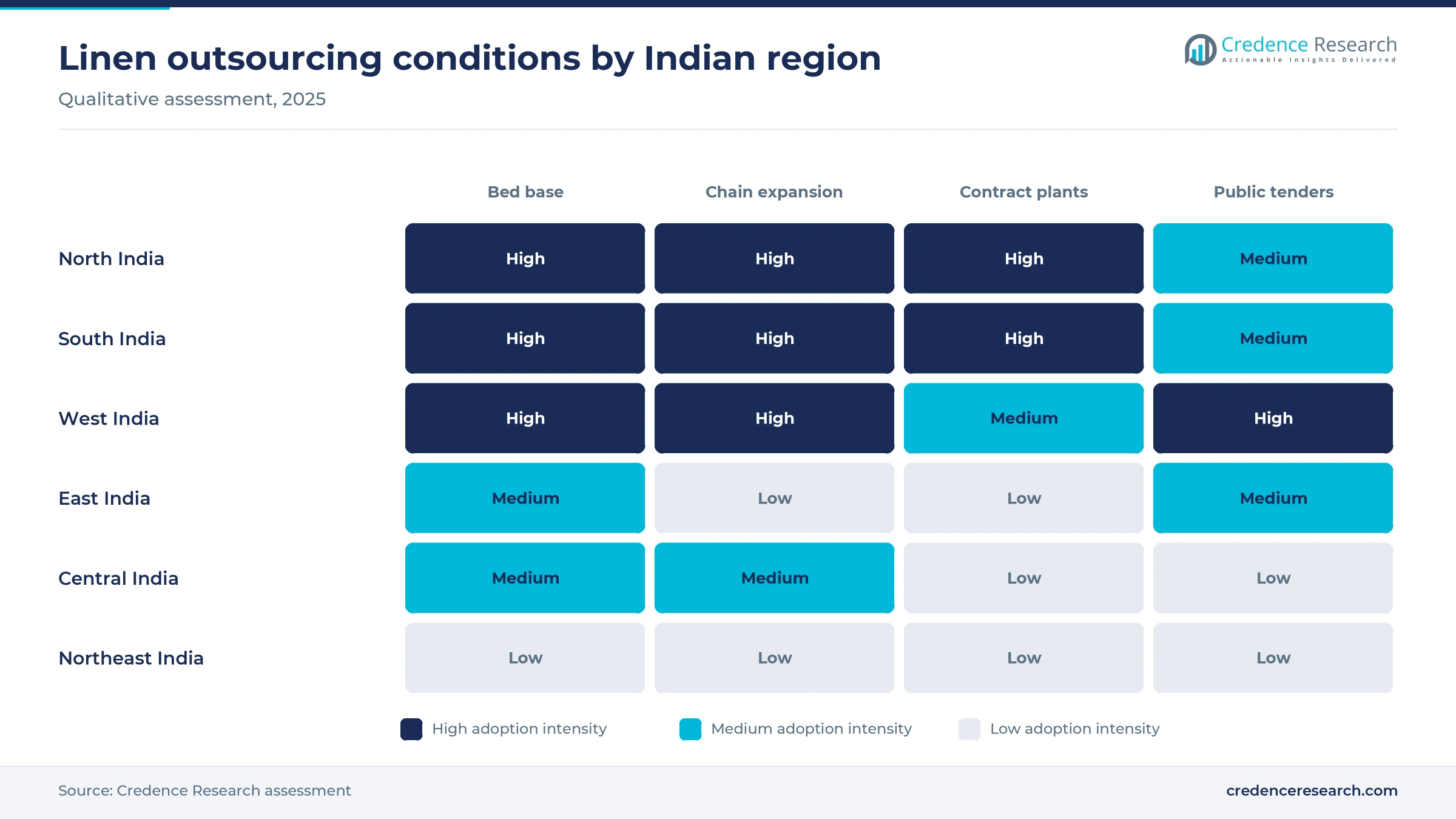
| South India | 91.0 | 35.0% | 8.74% |
| West India | 70.2 | 27.0% | 8.84% |
| North India | 67.6 | 26.0% | 9.04% |
| East India | 15.6 | 6.0% | 9.84% |
| Central India | 13.0 | 5.0% | 9.94% |
| Northeast India | 2.6 | 1.0% | 10.64% |
South India leads on dense public and private bed networks
South India held 35.0% of 2025 value and grows at 8.74% a year, the largest zone in the India hospital linen and laundry outsourcing market. Its five states held 237,236 government hospital beds on March 31, 2023, or 28.98% of the national total, The South First reported from a Lok Sabha reply. Toyota Tsusho and Tokai set up Valabhi Hospital Services in Bengaluru in 2022 to supply hospital linen, and Quick Smart Wash runs units in Bengaluru, Hyderabad and Manipal-Udupi. KIMS Hospitals also plans 4,000 more beds, which will add private contract volume in Telangana.
West India grows on Maharashtra public contracts
West India held 27.0% of 2025 value and grows at 8.84% a year, led by Maharashtra and Gujarat. Maharashtra moved 593 government health institutions to mechanized washing in October 2025, the largest single public program and a new source of contract demand. Quick Clean serves Lilavati Hospital and Bombay Hospital in Mumbai and AIIMS Nagpur, according to Entrepreneur India and BioSpectrum India. Manipal Hospitals is also adding the Sahyadri network across Pune, Nashik, Ahilya Nagar and Karad, while Quick Smart Wash planned a plant in Ahmedabad.
North India builds on Delhi hygiene rules and chain wings
North India held 26.0% of 2025 value and grows at 9.04% a year, with Delhi NCR as its core. Delhi government hospitals adopted daily color-coded bedsheet changes in November 2025, which raises linen turns per bed. Fortis is adding 2,000 beds in Noida, Faridabad and Gurugram, and Max Healthcare plans a 500-bed hospital in Lucknow, Business Today reported. Quick Smart Wash runs units in Jaipur, Delhi NCR and Jalandhar-Amritsar, and Park Medi World plans 1,450 beds across the zone by FY28.
East India grows on district tenders in Odisha and Bihar
East India held 6.0% of 2025 value and grows at 9.84% a year, faster than the national pace from a smaller base. The Bargarh district health society in Odisha tendered mechanized laundry with bedsheet supply for 47 facilities in August 2024, a model other districts can copy. Quick Clean also serves Patna Medical College and Hospital in Bihar, BioSpectrum India reported in March 2026. Most other hospitals in the zone still wash linen in house or through local washermen, so each district contract adds new volume.
Central India depends on Indore and Chhattisgarh capacity
Central India held 5.0% of 2025 value and grows at 9.94% a year from a small base. Indore shows both the demand and the risk, since Maharaja Yeshwantrao Hospital privatized its laundry in 2018 and then issued an eviction notice to the operator in February 2025 after service complaints. A new tender had already been completed by then, Free Press Journal reported. Manipal Hospitals also has beds under development in Chhattisgarh, which should add private contract volume in Raipur.
Assam tender gives Northeast India a processing foothold
Northeast India held 1.0% of 2025 value and grows at 10.64% a year, the fastest pace in the model. The base is very small because few mechanized processors operate in the hill states. In Assam, the state health infrastructure portal issued a technical corrigendum on Sept. 25, 2025, and date extensions in October 2025 for the supply and commissioning of a laundry system at AMCH. That project gives contractors a reference site for other public hospitals across the northeastern states.
Funding rounds and state laundry moves from 2024 to 2026
| Development | Status and market relevance |
|---|---|
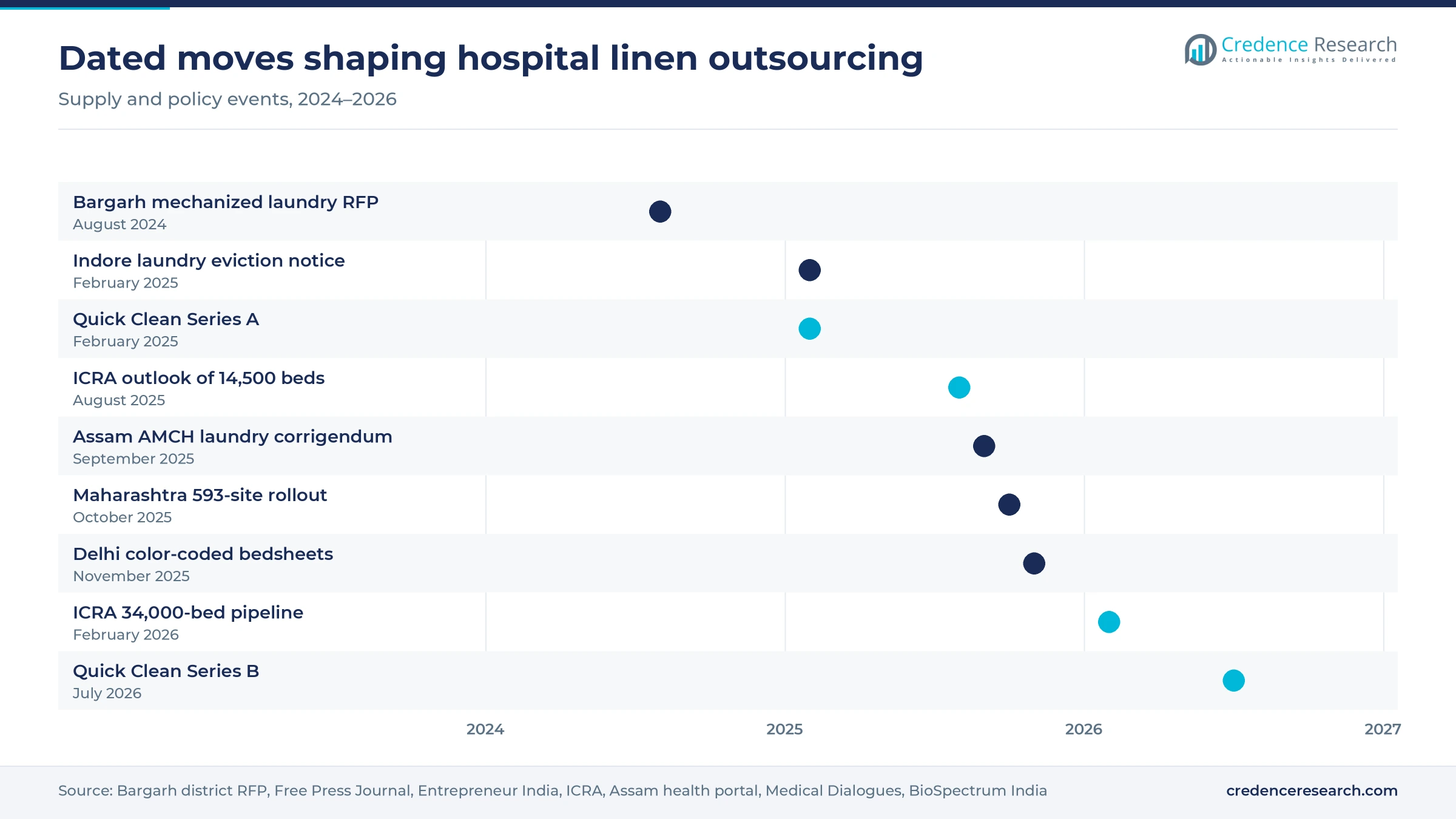
| In August 2024, the Bargarh district health society in Odisha tendered mechanized laundry with bedsheet supply for 47 public health facilities. | Tendered, three-year per-kilogram contract |
| In February 2025, Quick Clean raised a Rs 50 crore Series A led by Alkemi Growth Capital and Blue Ashva Capital. | Funded, expands healthcare laundry |
| In October 2025, Maharashtra launched mechanized linen washing across 593 government health institutions. | Launched, largest state program |
| In November 2025, Delhi government hospitals adopted a seven-color daily bedsheet rotation under the Kayakalp program. | Adopted, raises daily linen turns |
| In July 2026, Quick Clean raised US$14 million in a Series B led by Stakeboat Capital. | Funded, adds automation and new markets |
Barrier washers, RFID and sterilizers change processing
- Barrier washers separate soiled and clean sides with two doors, and Apollo Laundry and Linen Services said in October 2020 that it introduced them to India.
- RFID tracking counts each item in and out, and Sorterz used it to cut linen reception time for its Bengaluru hospital clients.
- On-premise managed laundries put contractor machines and staff inside hospitals, and Quick Clean ran more than 140 such facilities in July 2026.
- Steam sterilization of textiles treats theater linen at 121 degrees Celsius and 15 pounds of pressure for 30 minutes, the standard set in the Kayakalp guidelines.
Need a Custom Version of This Report?
Tailor the scope, geography, or segments to your exact requirements.
- Custom geography or segment scope
- Direct access to our analyst team
Funded processors compete with local mechanized laundries
The India hospital linen and laundry outsourcing market is fragmented, with a few funded processors competing against many district-level mechanized laundries and washermen. Quick Clean is the most visible scaled player, running on-premise laundries for AIIMS, Lilavati Hospital and Bombay Hospital and raising fresh capital in July 2026. Quick Smart Wash competes through central plants and pay-per-use rental, backed by Japan-based Elan Corporation, which invested US$5.15 million in September 2023. Valabhi Hospital Services, the Toyota Tsusho and Tokai venture, brings Japanese infection-control methods to Bengaluru hospitals. Apollo Laundry and Linen Services serves chains such as Fortis and Max Healthcare, while Sorterz and Ecoclean Systems and Solutions work city by city. Sodexo India bundles laundry with food and facility services for hospitals. Competition turns on turnaround time, loss rates, price per kilogram and the ability to serve many sites, and some vendors also supply antimicrobial textiles as part of rental deals.
Companies profiled and their roles in this market
| Company | Type | Role in the market |
|---|---|---|
| Quick Clean | Healthcare laundry processor | Runs more than 140 on-premise laundries in 38 cities for AIIMS, Lilavati and Bombay Hospital |
| Quick Smart Wash | Linen management company | Offers central plant washing and pay-per-use linen rental from units in six regions |
| Valabhi Hospital Services | Joint venture of Toyota Tsusho and Tokai | Supplies end-to-end hospital linen management in Bengaluru |
| Apollo Laundry and Linen Services | Laundry service provider | Offers barrier washing, on-site BOT setups and rental for chains such as Fortis and Max |
| Sorterz | Hospital linen startup | Processes linen with RFID tracking for Bengaluru hospitals |
| Ecoclean Systems and Solutions | Mechanized laundry operator | Runs the outsourced centralized laundry at Goa Medical College |
| Sodexo India | Integrated facility services | Bundles laundry with food and facility services for hospital clients |
Reliable volume contracts will decide the winners
Credence Research's view is that the India hospital linen and laundry outsourcing market will reward processors that can win large, reliable contracts and run them with measurable hygiene. Demand is secure because beds keep growing and audits such as Kayakalp now check daily linen changes. Chain hospitals and state programs such as Maharashtra's 593-institution rollout give scale, while rental and sterile textile packs lift revenue per bed. The constraint is cash and skills, since the Indore payment dispute and capped district rates show how thin public margins can be, and automation is still rare outside a few funded players.
How the bed and linen volume model was built
The report uses 2025 as the base year and forecasts to 2035. Market values come from the Credence Research model, checked against hospital beds multiplied by occupancy, linen weight per occupied bed-day, published per-kilogram contract rates and the share of work done by outside processors. Segment and regional splits are Credence Research estimates informed by government bed statistics, hospital chain expansion plans, public tender documents and company announcements. Sources used include World Bank and WHO data, government tender and program documents, parliamentary replies, rating agency releases, trade and business press, and company websites. No interviews or surveys were conducted in preparing this report.
More beds and stricter hygiene keep outsourcing rising
Outsourced hospital linen and laundry revenue in India is forecast to reach USD 619.0 million by 2035 at a 9.00% CAGR, with new beds and stricter daily-change rules doing most of the work. South India should remain the largest region, while Northeast India, Central India and East India grow faster as state contracts spread. Linen rental is expected to grow at 10.13% a year, while laundry contracts remain the largest service. Government buyers and tier-2 cities should keep gaining share, and processors that automate, track every item and get paid on time are likely to capture most renewals.
Frequently Asked Questions
How big is the India hospital linen and laundry outsourcing market?
Which region leads the market?
Which service is largest?
Which service grows fastest?
What do public hospitals pay for laundry?
Why are hospitals outsourcing linen?
Who are the main service providers?
What is the biggest risk for the market?
Table of Content
Chapter 1 Market Segmentation
- 1.1 Segmentation Framework
- 1.1.1 Product and Service Classification
- 1.1.2 Application and End-Use Classification
- 1.1.3 Technology and Solution Classification
- 1.1.4 Customer and Distribution Channel Classification
- 1.1.5 Geographic Segmentation
- 1.1.6 Market Segment Definitions and Boundaries
- 1.2 By Service
- 1.2.1 Laundry
- 1.2.2 Linen Rental
- 1.2.3 Sterilization of Textiles
- 1.3 By Hospital
- 1.3.1 Private Chains
- 1.3.2 Government
- 1.3.3 Standalone
- 1.4 By City Tier
- 1.4.1 Metro
- 1.4.2 Tier-2
Chapter 2 Introduction
- 2.1 Report Objectives and Scope
- 2.2 Product Definition and Industry Terminology
- 2.3 Market Inclusions and Exclusions
- 2.4 Research Process
- 2.4.1 Primary Research and Expert Interviews
- 2.4.2 Secondary Research and Source Review
- 2.4.3 Top-Down and Bottom-Up Estimation
- 2.4.4 Data Triangulation and Verification
- 2.5 Market Size Measurement Basis
- 2.5.1 2025: USD 260.0 million → 2035: USD 619.0 million
- 2.6 Historical and Forecast Reference Periods
- 2.6.1 Historical Period: 2018-2025
- 2.6.2 Base Year: 2025
- 2.6.3 Forecast Period: 2025-2035
- 2.7 Research Assumptions and Limitations
Chapter 3 Executive Summary
- 3.1 Market Snapshot and Key Findings
- 3.2 Base-Year Market Size, 2025
- 3.3 Forecast Market Size, 2035
- 3.4 Revenue and Volume Growth Outlook
- 3.5 Key Demand and Supply Indicators
- 3.6 Leading Market Segments
- 3.7 Fastest-Growing Market Opportunities
- 3.8 Regional Performance Highlights
- 3.9 Technology and Industry Transformation
- 3.10 Competitive Landscape Summary
- 3.11 Analyst View and Strategic Implications
Chapter 4 India Hospital Linen And Laundry Outsourcing Market Trends and Developments
- 4.1 Historical Industry Development, 2018-2025
- 4.2 Recent Market Trends and Developments
- 4.3 Demand and Customer Behavior Trends
- 4.4 Technology and Product Innovation
- 4.5 Artificial Intelligence, Automation and Digitalization
- 4.6 Local Manufacturing and Supply Chain Realignment
- 4.7 Industry Partnerships, Mergers and Acquisitions
- 4.8 Sustainability and Circular Economy Developments
- 4.9 Government and Private Sector Investment Trends
- 4.10 Emerging Business Models and Commercialization
- 4.11 Industry Developments and Announcements
Chapter 5 India Hospital Linen And Laundry Outsourcing Market Supply and Demand Analysis
- 5.1 Demand Trend and Consumption Analysis, 2018-2025
- 5.2 Demand Forecast, 2025-2035
- 5.3 Supply Chain Structure and Procurement Trends
- 5.4 Supply-Demand Gap and Bottlenecks
- 5.5 Import Dependence and Sourcing Structure
- 5.6 Regional Supply and Demand Concentration
Chapter 6 India Hospital Linen And Laundry Outsourcing Market Pricing Analysis
- 6.1 Pricing Structure and Measurement
- 6.2 Historical Pricing Trends, 2018-2025
- 6.3 Pricing Outlook, 2025-2035
- 6.4 Pricing by Product and Market Segment
- 6.5 Geographic Pricing Differences
- 6.6 Key Input, Energy, Labor and Logistics Costs
- 6.7 Contract Pricing and Purchasing Models
- 6.8 Pricing Sensitivity and Competitive Positioning
- 6.9 Price, Margin and Profitability Implications
Chapter 7 India Hospital Linen And Laundry Outsourcing Market Dynamics
- 7.1 Market Growth Drivers
- 7.1.1 Demand-Side Drivers
- 7.1.2 Technology and Innovation Drivers
- 7.1.3 Infrastructure and Investment Drivers
- 7.1.4 Regulatory and Policy Drivers
- 7.2 Market Restraints
- 7.2.1 Cost and Affordability Constraints
- 7.2.2 Technology and Adoption Barriers
- 7.2.3 Supply Chain and Operational Constraints
- 7.3 Market Challenges
- 7.3.1 Competitive Pressure and Margin Erosion
- 7.3.2 Skills, Infrastructure and Implementation Gaps
- 7.4 Emerging Market Opportunities
- 7.5 Market Dynamics Impact and Time-Horizon Assessment
Chapter 8 India Hospital Linen And Laundry Outsourcing Value Chain Analysis
- 8.1 Industry Value Chain Overview
- 8.2 Upstream Suppliers and Critical Inputs
- 8.3 Technology and Component Providers
- 8.4 Manufacturing or Service Delivery
- 8.5 Distribution, Channel Partners and Integrators
- 8.6 Downstream Applications and End Users
- 8.7 Value Addition and Profit Pools
- 8.8 Vertical Integration and Outsourcing
- 8.9 Supplier Concentration and Risk
- 8.10 Supply Chain Localization and Resilience
Chapter 9 India Hospital Linen And Laundry Outsourcing Market Regulations and Policies
- 9.1 Relevant Laws, Standards and Compliance Frameworks
- 9.2 Product, Service, Safety and Quality Requirements
- 9.3 Government Policies, Incentives and Subsidies
- 9.4 Imports, Exports and Trade Barriers
- 9.5 Public Procurement and Local Content Requirements
- 9.6 Data Protection, AI and Cybersecurity Compliance
- 9.7 Upcoming Policy Changes and Market Implications
Chapter 10 India Hospital Linen And Laundry Outsourcing Market Hotspots and Opportunities
- 10.1 Market Opportunity Mapping and Growth Hotspots
- 10.2 High-Growth Applications and Customer Groups
- 10.3 Underserved Markets and White-Space Opportunities
- 10.4 Emerging Technology and Product Opportunities
- 10.5 New Capacity and Investment Hotspots
- 10.6 Market Entry and Expansion Opportunities
- 10.7 Distribution and Partnership Opportunities
- 10.8 Near-Term and Long-Term Commercial Potential
- 10.9 Opportunity Attractiveness and Execution Risks
Chapter 11 India Hospital Linen And Laundry Outsourcing Market Outlook, 2025-2035
- 11.1 Market Size and Analysis
- 11.1.1 Revenue (Market Measurement: 2025: USD 260.0 million → 2035: USD 619.0 million)
- 11.1.2 Historical Market Size, 2018-2025
- 11.1.3 Base-Year Market Size, 2025
- 11.2 Market Forecast, 2025-2035
- 11.2.1 Revenue Forecast to 2035
- 11.2.2 CAGR and Year-on-Year Growth
- 11.2.3 Incremental Revenue Opportunity
- 11.3 Forecast Assumptions and Scenario Analysis
- 11.3.1 Base-Case Forecast
- 11.3.2 Optimistic and Conservative Scenarios
- 11.3.3 Technology, Pricing and Policy Sensitivities
- 11.4 Market Attractiveness and Growth Outlook
Chapter 12 India Hospital Linen And Laundry Outsourcing Market Segmentation and Outlook
- 12.1 Segmentation Summary and Market Shares, 2025
- 12.2 Largest and Fastest-Growing Segments
- 12.3 By Service - Market Size and Forecast, 2025-2035
- 12.3.1 Segment Definition and Scope
- 12.3.2 Historical Market Size, 2018-2025
- 12.3.3 Revenue Forecast, 2025-2035
- 12.3.4 Base-Year Market Share, 2025
- 12.3.5 Segment CAGR and Growth Drivers
- 12.3.6 Subsegment Market Size and Forecast
- 12.3.6.1 Laundry
- 12.3.6.2 Linen Rental
- 12.3.6.3 Sterilization of Textiles
- 12.3.7 Subsegment Pricing and Adoption Trends
- 12.3.8 Leading Suppliers and Competition
- 12.3.9 Regional Demand and Opportunities
- 12.4 By Hospital - Market Size and Forecast, 2025-2035
- 12.4.1 Segment Definition and Scope
- 12.4.2 Historical Market Size, 2018-2025
- 12.4.3 Revenue Forecast, 2025-2035
- 12.4.4 Base-Year Market Share, 2025
- 12.4.5 Segment CAGR and Growth Drivers
- 12.4.6 Subsegment Market Size and Forecast
- 12.4.6.1 Private Chains
- 12.4.6.2 Government
- 12.4.6.3 Standalone
- 12.4.7 Subsegment Pricing and Adoption Trends
- 12.4.8 Leading Suppliers and Competition
- 12.4.9 Regional Demand and Opportunities
- 12.5 By City Tier - Market Size and Forecast, 2025-2035
- 12.5.1 Segment Definition and Scope
- 12.5.2 Historical Market Size, 2018-2025
- 12.5.3 Revenue Forecast, 2025-2035
- 12.5.4 Base-Year Market Share, 2025
- 12.5.5 Segment CAGR and Growth Drivers
- 12.5.6 Subsegment Market Size and Forecast
- 12.5.6.1 Metro
- 12.5.6.2 Tier-2
- 12.5.7 Subsegment Pricing and Adoption Trends
- 12.5.8 Leading Suppliers and Competition
- 12.5.9 Regional Demand and Opportunities
- 12.6 Segment Growth Comparison
- 12.7 Segment Attractiveness and Priority Matrix
Chapter 13 India Hospital Linen And Laundry Outsourcing Geographic Market Outlook, 2025-2035
- 13.1 Domestic Market Distribution and Demand Clusters
- 13.2 State- or Province-Wise Market Size and Forecast, 2025-2035
- 13.3 City and Metropolitan Market Outlook
- 13.4 Industrial, Manufacturing and Commercial Clusters
- 13.5 Geographic Concentration of Key End Users
- 13.6 Local Pricing and Purchasing Differences
- 13.7 Domestic Production Facilities and Capacity Map
- 13.8 Local Infrastructure and Project Pipeline
- 13.9 State-Level Policy and Incentive Differences
- 13.10 Subnational Investment Hotspots and Opportunities
- 13.11 Distribution and Logistics Networks
- 13.12 Domestic Competitive Footprint
Chapter 14 India Hospital Linen And Laundry Outsourcing Technology, Innovation and Sustainability Outlook
- 14.1 Technology Landscape and Maturity
- 14.2 Product, Process and Service Innovation
- 14.3 AI, Automation and Digital Tools in the Industry
- 14.4 Technology Adoption and Performance Benchmarking
- 14.5 Innovation Pipeline and R&D Investment
- 14.6 Energy Efficiency and Resource Management
- 14.7 Sustainability, Recycling and Circularity
- 14.8 Technology Roadmap, 2025-2035
- 14.9 Risks of Obsolescence and Technology Substitution
Chapter 15 India Hospital Linen And Laundry Outsourcing Market Key Strategic Imperatives
- 15.1 Growth and Market Entry Priorities
- 15.2 High-Return Products and Segments
- 15.3 Pricing, Profitability and Cost Optimization
- 15.4 Technology Investment and Product Differentiation
- 15.5 Supply Chain Localization and Resilience
- 15.6 Distribution and Customer Acquisition
- 15.7 Partnership, Acquisition and Capacity Strategy
- 15.8 Regional Expansion Priorities
- 15.9 Short-, Medium- and Long-Term Actions
Chapter 16 Competition Outlook
- 16.1 Industry Competition Characteristics
- 16.2 Market Structure and Concentration
- 16.3 Market Share and Competitive Positioning, 2025
- 16.4 Company-Wise Revenue and Product Benchmarking
- 16.5 Production and Service Capacity Benchmarking
- 16.6 Technology, Pricing and Differentiation
- 16.7 Regional Footprint and Distribution Strength
- 16.8 Mergers, Acquisitions and Strategic Alliances
- 16.9 New Entrants and Competitive Threats
- 16.10 Porter's Five Forces and Industry Attractiveness
- 16.11 Competitive Outlook, 2025-2035
Chapter 17 Company Profiles
- 17.1 Company Coverage and Selection Criteria
- 17.2 Sodexo India
- 17.2.1 Business Description
- 17.2.2 Company Ownership and Geographic Presence
- 17.2.3 Product and Service Portfolio
- 17.2.4 Manufacturing and Operating Footprint
- 17.2.5 Financial Performance and Investment
- 17.2.6 Market Share and Competitive Position
- 17.2.7 Technology and Innovation Capabilities
- 17.2.8 Strategic Alliances or Partnerships
- 17.2.9 Recent Developments
- 17.2.10 Growth Strategy and Outlook
- 17.3 Quick Clean
- 17.4 Quick Smart Wash
- 17.5 Valabhi Hospital Services
- 17.6 Apollo Laundry and Linen Services
- 17.7 Sorterz
- 17.8 Ecoclean Systems and Solutions
- 17.9 Other Relevant Market Participants
Note: Every listed company is profiled on the structure shown under the first company. The company list is preliminary and may change based on research findings, market developments, data availability and client requirements.
Chapter 18 Disclaimer
- 18.1 Research and Forecast Disclaimer
- 18.2 Data Source and Estimation Limitations
Note: The depth of individual sections depends on data availability for this market. Volume, capacity, trade and other unit-based metrics are included where applicable.

