
Branded Ayurvedic hospitals move from campuses to chains
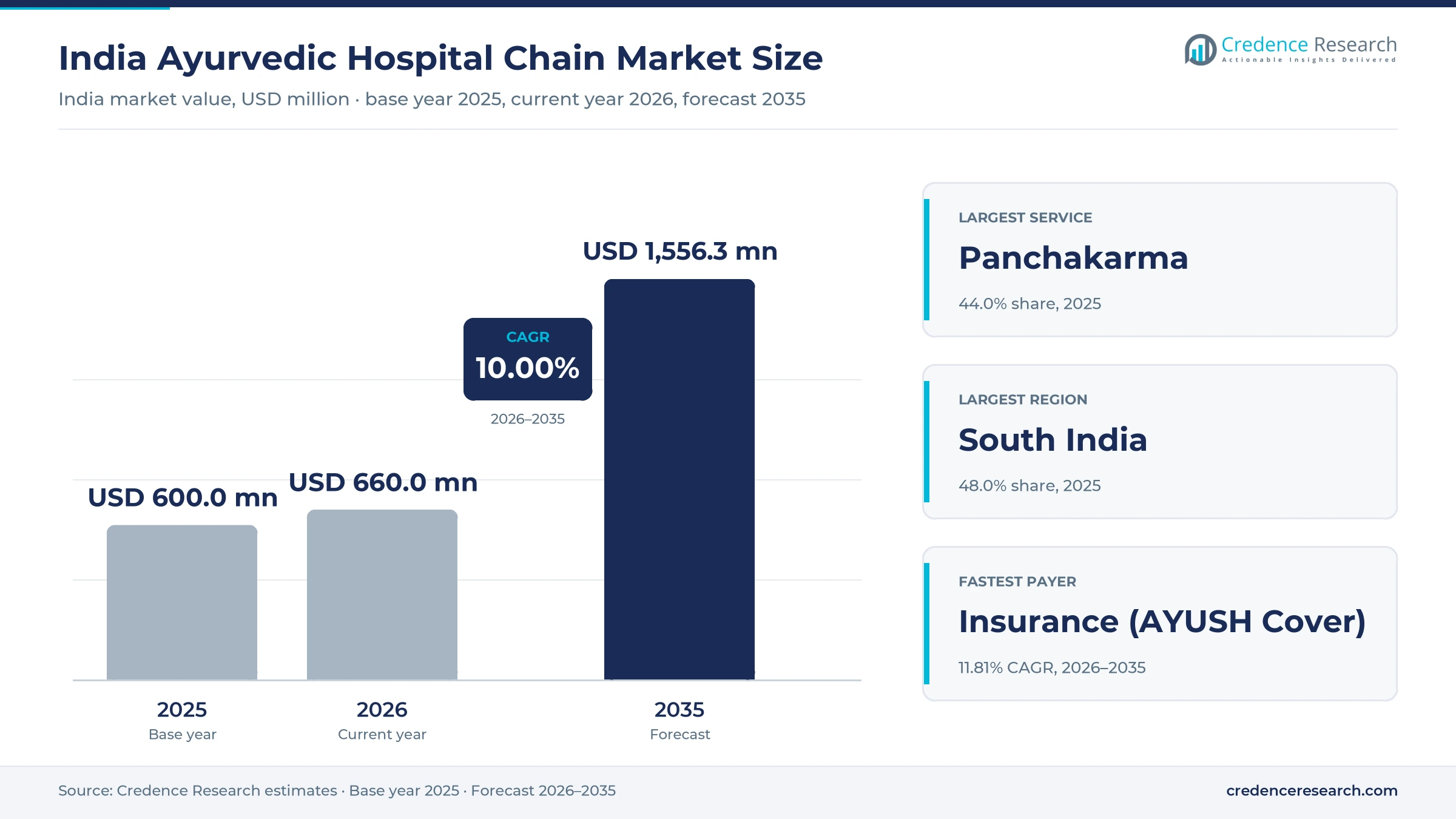
The India Ayurvedic hospital chain market was valued at USD 600.0 million in 2025 and is projected to increase from USD 660.0 million in 2026 to USD 1.56 billion by 2035, registering a CAGR of 10.00% during 2026–2035. Demand comes from patients seeking supervised panchakarma, rehabilitation and chronic-care stays, together with insured admissions that insurers must now cover on par with other treatment. South India held the largest regional share, 48.0% in 2025, because Kerala, Karnataka and Tamil Nadu host the oldest branded hospitals and the deepest base of accredited centers. Northeast India is the fastest-growing region at 10.85% a year, although it starts from a very small private base. Apollo AyurVAID reported 185 operating beds at the end of fiscal 2025 and set a target of 1,000 beds by 2028. That plan, along with newly listed operators, marks a shift from single-campus hospitals toward multi-city chains with standard protocols and cashless insurance desks.
Which fees and care settings do branded Ayurvedic operators earn from?
The India Ayurvedic hospital chain market counts treatment, room and package fees earned by private Ayurvedic hospitals and day-care therapy centers that operate under one brand at several sites or run accredited inpatient facilities. Patients buy panchakarma courses, chronic-disease programs and wellness stays, paying directly or through health insurance and employer schemes. Typical inpatient courses last 7, 14 or 21 days, which makes package pricing the usual way these operators sell care.
The market excludes sales of packaged Ayurvedic medicines, government Ayush hospitals and dispensaries, spa resorts without a medical license and platforms that offer only teleconsultation. Value flows from patients and insurers to hospital operators, who then pay vaidyas, trained therapists, pharmacy suppliers and property owners, while medicines dispensed during a stay are counted only when billed as part of treatment.
India Ayurvedic Hospital Chain Market Insights
- Revenue rises from USD 600.0 million in 2025 to USD 1.56 billion by 2035 at a 10.00% CAGR, as insured admissions and new multi-city operators widen access beyond Kerala.
- South India held 48.0% of 2025 value, because Kerala, Tamil Nadu and Karnataka host the longest-running branded hospitals and the deepest accreditation base.
- Panchakarma accounted for 44.0% of 2025 value, since multi-week purification courses remain the core inpatient product at branded hospitals.
- IRDAI directions issued in January 2024 placed Ayush treatment on par with other care, which made cashless hospital networks a commercial priority for operators.
- Apollo AyurVAID added four facilities in late 2025, while KRM Ayurveda opened its public issue on NSE SME in January 2026 to fund telemedicine and staff.
Panchakarma and hospital stays hold the largest shares
Panchakarma leads while chronic-disease care grows fastest
Based on service, the market is categorized into panchakarma, chronic disease and wellness. Panchakarma led with 44.0% of 2025 value because purification courses fill most inpatient days, and the National Institute of Ayurveda in Jaipur ran about 1.33 lakh procedures for some 68,000 patients in 2025, Medical Dialogues reported. Chronic Disease programs grow fastest at 10.56% a year as chains build rehabilitation lines, since Apollo AyurVAID treats stroke, cancer rehabilitation, Parkinsonism and diabetes, according to Business Standard in July 2025. Wellness stays draw overseas visitors, and Kerala recorded 821,999 foreign tourist arrivals in 2025, Onmanorama reported.
Hospitals hold most value as day-care centers widen reach
Based on setting, the market is categorized into hospitals and day-care clinics. Hospitals led with 70.0% of 2025 value because insurers pay inpatient claims only at facilities with at least five beds and round-the-clock Ayush doctors, according to an August 2025 consumer guide from the All India Institute of Ayurveda. Day-Care Clinics grow fastest at 10.69% a year as entry rules ease, since a February 2026 CGHS corrigendum halved the minimum therapy-room area for private day-care centers to 200 square feet. Jiva Ayurveda runs more than 80 clinics across Delhi, Indore and Pune, YourStory reported.
Self-pay dominates while Ayush insurance cover expands
Based on payer, the market is categorized into out-of-pocket and insurance (AYUSH cover). Out-of-Pocket led with 80.0% of 2025 value because many patients pay for planned courses directly, and the MoSPI survey on Ayush put average yearly Ayurveda spending at Rs 499 per urban person in 2022-23. Insurance (AYUSH Cover) grows fastest at 11.81% a year as IRDAI directions dated Jan. 31, 2024 required insurers to cover Ayush treatment on par with other care from April 1, 2024. Public schemes also matter, since CGHS and ECHS made up 46.80% of KRM Ayurveda revenue in the first half of fiscal 2026, Planify reported.
| Segment Group | Leading Sub-segment | Share, 2025 | Fastest-growing Sub-segment | CAGR, 2026–2035 |
|---|---|---|---|---|
| By Service | Panchakarma | 44.0% | Chronic Disease | 10.56% |
| By Setting | Hospitals | 70.0% | Day-Care Clinics | 10.69% |
| By Payer | Out-of-Pocket | 80.0% | Insurance (AYUSH Cover) | 11.81% |
Request a Free Sample
Fill in your details and we'll send you a free sample report.
- Sample data tables & charts
- Research methodology
Integrative care and insured stays lift patient volumes
Integrative care preference favors organized hospitals
Patients increasingly combine Ayurvedic and conventional care, and organized hospitals capture that preference because they offer doctors, records and protocols in one place. The MoSPI survey on Ayush released on June 13, 2024 found that 45.5% of urban persons and 40.5% of rural persons had used Ayurveda in the previous 365 days. Apollo Hospitals bought 60% of AyurVAID in 2022 for Rs 26.4 crore, Business Standard reported, which brought a large allopathic group into the field. SOUKYA announced a Rs 125 crore, 100-bed integrative hospital at Hoskote near Bengaluru in November 2025, according to Indian Pharma Post. In the Credence Research model this preference adds about 3.90 percentage points to annual growth to 2035.
Chronic-condition and wellness packages drive repeat visits
Packaged programs for chronic conditions turn one-time visitors into repeat patients, because courses run for weeks and often recur each year. Panchakarma stays commonly run 7, 14 or 21 days, Siddham reported in November 2025, which lifts revenue per admission. Demand at public centers shows the depth of interest, as the National Institute of Ayurveda in Jaipur reported waits of three to four months for panchakarma in April 2026, with about 200 such patients arriving each day. Apollo AyurVAID handles 40,000 to 42,000 patients a year and targets 200,000 within five years, Business Standard reported. In the Credence Research model these packages add about 2.80 percentage points to annual growth to 2035.
Standard facilities and online booking widen access
Standard facilities and online booking make Ayurvedic care easier to find and compare, especially for patients outside Kerala. Kerala reached 250 NABH-accredited Ayush institutions by September 2025, Medical Dialogues reported, which gives insurers and referring doctors a recognized quality benchmark. KRM Ayurveda plans to expand its telemedicine center from about 200 to 500 seats with proceeds from its January 2026 public issue, according to Planify, linking remote consultations to admissions at its six hospitals. At the national level, eSanjeevani passed 43 crore teleconsultations by Nov. 23, 2025, IANS reported, which shows how widely patients now accept remote first visits. In the Credence Research model this access gain adds about 1.70 percentage points to annual growth to 2035.
Public investment and Ayush visas build referral demand
Government spending on Ayush institutions and medical travel builds referral volume that private operators can serve. The Ministry of Ayush received Rs 4,500 crore in the 2026-27 budget, more than 10% above the prior year, Minister Prataprao Jadhav told IANS on Feb. 1, 2026. The same budget proposed three new All India Institutes of Ayurveda and five regional medical hubs that include Ayush centers. A Lok Sabha reply dated Feb. 7, 2025, said 1,646 regular and e-Ayush visas were issued to nationals of 75 countries between Jan. 1, 2024, and Feb. 4, 2025. Because the visa requires treatment at an accredited hospital or wellness center, these patients add to medical travel that favors NABH-accredited operators.
Multi-city networks and insurance readiness reshape care
Shift toward multi-city Ayurvedic networks
Operators are shifting from single flagship campuses toward networks of mid-size hospitals in several cities. Apollo AyurVAID ran 12 hospitals with 185 beds at the end of fiscal 2025 and aims for 1,000 beds by 2028, Business Standard reported. Whalesbook reported on Nov. 3, 2025, that the group was adding four facilities, including Mumbai and Kolkata, to lift capacity to about 350 beds after a 35-bed Chennai opening. KRM Ayurveda raised installed beds from 38 in fiscal 2023 to 100 in fiscal 2025 across seven states, according to Planify. These additions keep Hospitals at 70.0% of 2025 value while the bed base spreads north and west.
Rise of insurance-ready protocols and records
Insurance parity is pushing hospitals to adopt clinical records and standard billing that resemble those of conventional hospitals. IRDAI asked insurers to set quality parameters for enrolling Ayush hospitals and day-care centers as cashless network providers from April 1, 2024, Medical Dialogues reported in February 2024. An eligible hospital needs at least five inpatient beds, a qualified doctor on duty around the clock and daily records open to the insurer under the IRDAI master circular of July 22, 2020, as the All India Institute of Ayurveda summarizes it. Due.com reported in June 2025 that rejected claims often cited incomplete records and nonstandard bills. CGHS required its March 2025 shortlist of four Ayurveda hospitals to join the National Health Authority platform within 30 days, which ties scheme admissions to digital claim records.
Opening for rehabilitation and oncology support programs
Post-acute rehabilitation offers an opening, because stroke, cancer and neurological patients need long, supervised recovery that acute hospitals rarely provide. Apollo AyurVAID had trials planned or under way in cancer, pre-diabetes and sleep health while running 12 hospitals, Business Standard reported in July 2025. Its 35-bed Chennai facility and four newer sites offer neurology, oncology and palliative care, Whalesbook reported in November 2025. The clinical wing of the Arya Vaidya Pharmacy in Coimbatore, founded in 1957, hosted a clinical study funded by the U.S. National Institutes of Health, Entrepreneur India reported in September 2024. Chronic Disease programs grow at 10.56% a year in the Credence Research model, ahead of Panchakarma courses.
Opening in regional hubs and global traditional medicine ties
International recognition opens a referral channel for operators that can meet foreign clinical expectations. The WHO Global Summit on Traditional Medicine in New Delhi closed on Dec. 22, 2025, with about 800 delegates from more than 100 countries and commitments from 26 member states to integrate traditional medicine into primary care. India then proposed in its 2026-27 budget to upgrade the WHO global center for traditional medicine in Jamnagar and to place Ayush centers in five regional medical hubs, IANS reported. Kerala recorded 821,999 foreign tourist arrivals in 2025, according to Onmanorama, a ready base of overseas visitors near the oldest hospitals. Operators with accreditation and structured records are best placed to win these patients.
Claim rejections and therapist gaps slow expansion
Claim rejections slow the insured patient pipeline
Insured volume grows more slowly than the rules suggest, because many claims still fail at the documentation stage. Siddham reported in November 2025 that insurers question whether long panchakarma admissions are medically necessary and often deny claims for insufficient records. A Bengaluru policyholder told Due.com in June 2025 that his claim was rejected twice for insufficient documentation. Smaller hospitals are the most exposed, since they often lack the case sheets and daily notes that insurers request before they pay.
Shortage of trained panchakarma therapists limits capacity
Therapist supply limits how fast hospitals can add beds, because each panchakarma procedure needs trained hands. Himachal Pradesh plans to raise one-year panchakarma technician seats from 36 to 252, The Tribune reported on Nov. 17, 2025, which shows how thin training capacity has been. At the National Institute of Ayurveda in Jaipur, 48 general beds and five cottages serve about 200 daily panchakarma patients, Medical Dialogues reported in April 2026. Chains therefore compete for staff and often train their own therapists.
Government scheme rates and payment delays strain cash
Government scheme business brings volume but strains cash, because the payer sets both tariffs and payment cycles. The CGHS schedule set in July 2015 paid Rs 5,000 for a Karma Vasti package of 30 enemas and Rs 1,000 for a Vamana package, GConnect reported. KRM Ayurveda drew 46.80% of its revenue from CGHS and ECHS in the first half of fiscal 2026 and cited longer payment cycles for its higher working capital, Planify reported. Operators that rely on these schemes must manage receivables tightly.
Thin accreditation outside Kerala limits patient trust
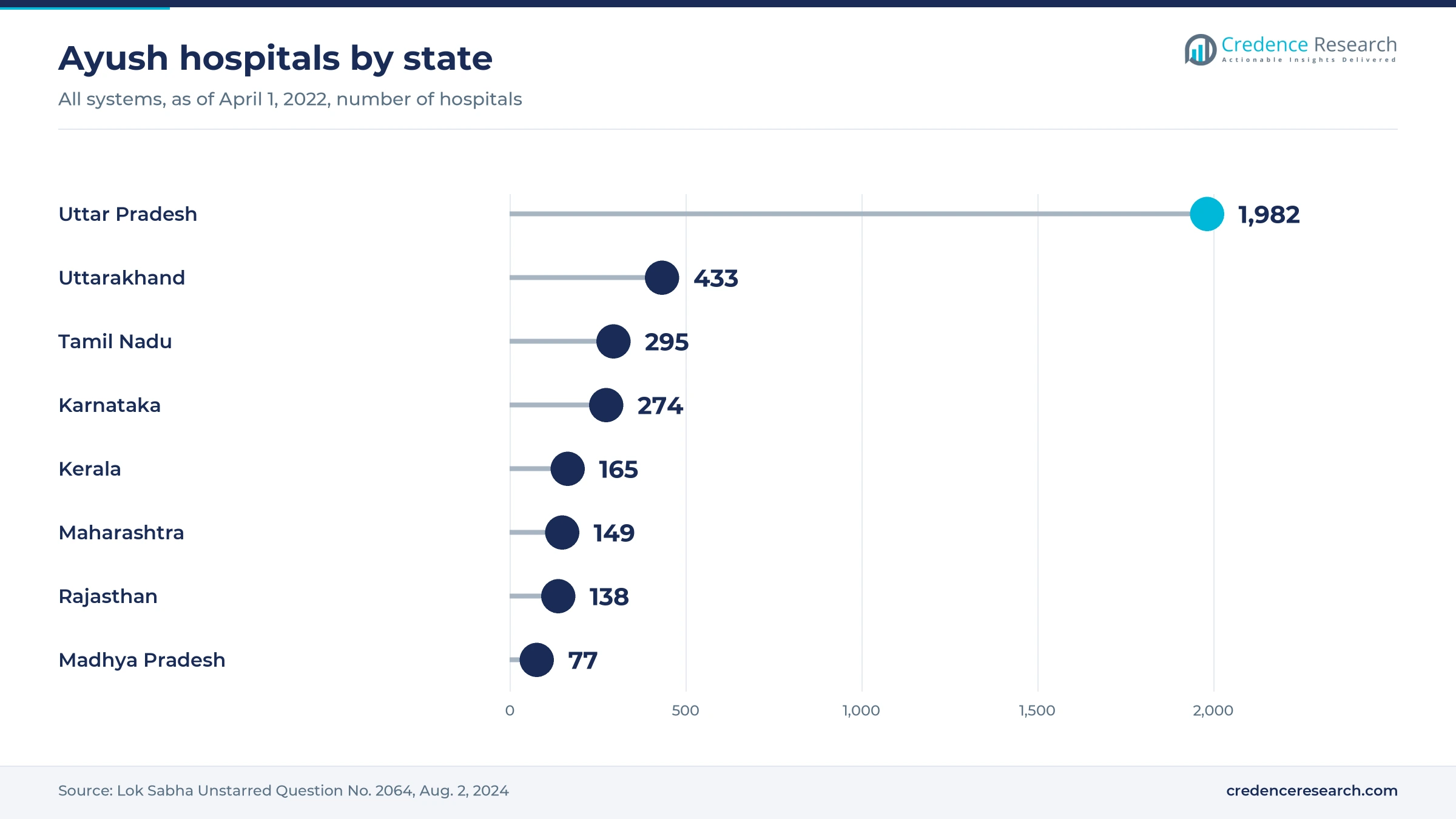
Accreditation remains concentrated, which limits trust and insurer enrollment outside the southern states. Kerala alone had 250 NABH-accredited Ayush institutions by September 2025, Medical Dialogues reported. By contrast, a Lok Sabha reply dated Aug. 2, 2024 counted 20 Ayush hospitals in West Bengal, eight in Bihar and four in Assam as of April 1, 2022, against 1,982 in Uttar Pradesh. Chains entering eastern cities therefore must build referral networks and quality credentials largely from scratch.
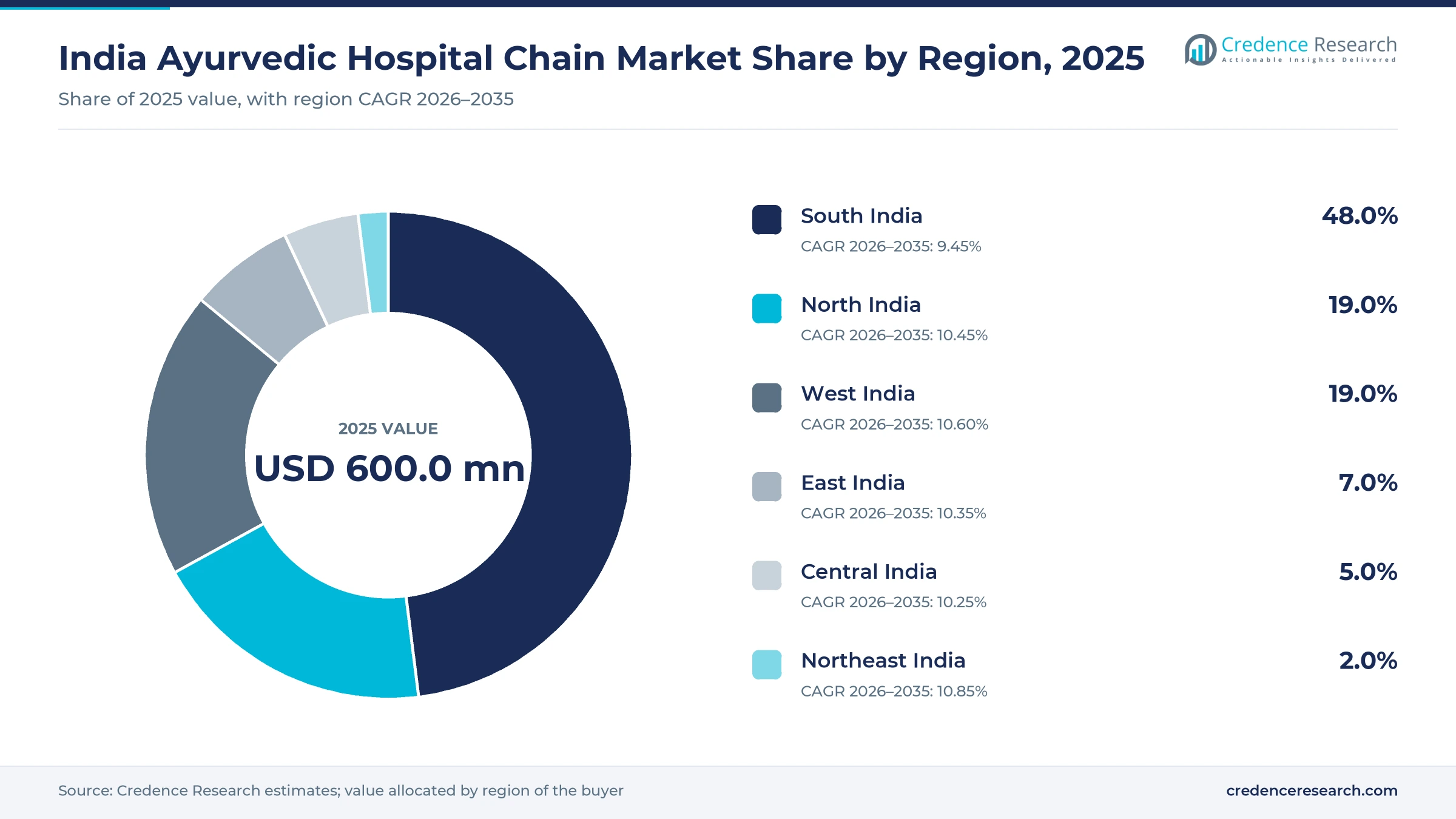
South India leads as chains move north, west and east
| Region | Value, 2025 (USD million) | Share, 2025 | CAGR, 2026–2035 |
|---|---|---|---|
| South India | 288.0 | 48.0% | 9.45% |
| North India | 114.0 | 19.0% | 10.45% |
| West India | 114.0 | 19.0% | 10.60% |
| East India | 42.0 | 7.0% | 10.35% |
| Central India | 30.0 | 5.0% | 10.25% |
| Northeast India | 12.0 | 2.0% | 10.85% |
South India keeps the oldest and deepest hospital base
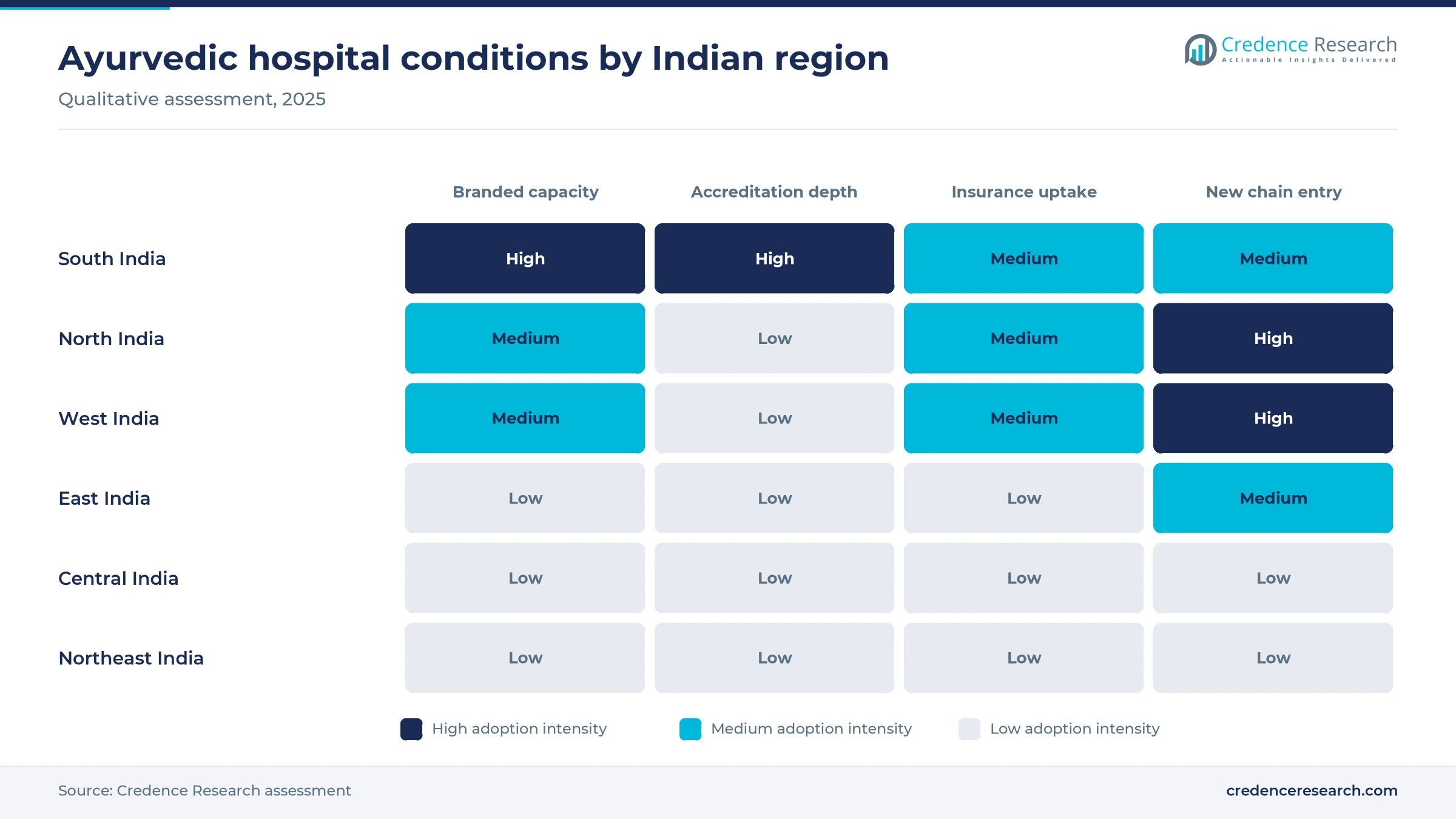
South India held a 48.0% share of 2025 hospital chain value and grows at 9.45% a year. Growth runs below the national pace because the southern base is mature. Tamil Nadu, Karnataka and Kerala reported 295, 274 and 165 Ayush hospitals as of April 1, 2022, in the Lok Sabha count. Arya Vaidya Sala runs a hospital at Kottakkal East, where a tariff notice effective Aug. 21, 2023, charges 30% of room rent for each occupant beyond two in a room. The Arya Vaidya Pharmacy runs a clinical wing in Coimbatore founded in 1957, and SOUKYA is building a new integrative hospital near Bengaluru.
North India gains new private capacity around Delhi
North India held a 19.0% share of 2025 value and grows at 10.45% a year in this market. New private capacity around Delhi and its satellite cities supports that pace. KRM Ayurveda runs six hospitals and five clinics across states including Delhi, Haryana, Uttar Pradesh and Rajasthan, according to Planify. Apollo AyurVAID operates in Delhi and Almora, Deccan Herald reported. Jiva Ayurveda, which began with a clinic in Faridabad in 1992, also has deep roots in the zone, YourStory noted. Uttar Pradesh leads the Lok Sabha hospital count, although 3,403 of the 3,844 Ayush hospitals counted nationally in December 2024 were government facilities outside this market.
West India draws chains into Mumbai and Pune
West India held a 19.0% share of 2025 value and grows at 10.60% a year in this market. Growth runs ahead of the national rate as chains enter Mumbai and Pune. Apollo AyurVAID added a Mumbai facility among four new sites, Whalesbook reported in November 2025, after studying Navi Mumbai and Pune, according to Deccan Herald. Jiva Ayurveda also runs clinics in Pune, according to YourStory, which widens day-care access in the city. Maharashtra reported 149 Ayush hospitals and Gujarat 40 in the Lok Sabha count, while the 2026-27 budget proposed upgrading the WHO center at Jamnagar.
East India sees the first branded entries in Kolkata
East India held a 7.0% share of 2025 value and grows at 10.35% a year in this market. The first branded chains are now arriving in Kolkata from the south. Apollo AyurVAID named Kolkata among its 2025 expansion cities, Business Standard reported. Whalesbook later listed the city among the four new facilities announced in November 2025. KRM Ayurveda also lists Bihar among the seven states where it operates, according to Planify. The base remains thin, since Odisha reported only nine Ayush hospitals as of April 1, 2022, in the same Lok Sabha count.
Central India relies on Indore clinics and public sites
Central India held a 5.0% share of 2025 value and grows at 10.25% a year, with Indore as the main private center in the zone. Jiva Ayurveda runs clinics in Indore, YourStory reported, which feed day-care therapy and referrals. Madhya Pradesh reported 77 Ayush hospitals and Chhattisgarh 16 as of April 1, 2022, in the Lok Sabha count. Most of these facilities are public, so branded inpatient capacity remains small relative to the population of the two states.
Northeast India grows fastest from a very small base
Northeast India held a 2.0% share of 2025 value and grows at 10.85% a year in this market. That is the fastest pace in the model, because private capacity starts close to zero. Manipur reported 25 Ayush hospitals and Meghalaya 12 as of April 1, 2022, in the Lok Sabha count. The same reply listed 40 integrated Ayush hospitals approved under the National Ayush Mission in the eight northeastern states between 2014-15 and 2023-24. These public sites build familiarity that private day-care operators can later serve.
Expansion and policy moves from 2024 to 2026
| Development | Status and market relevance |
|---|---|
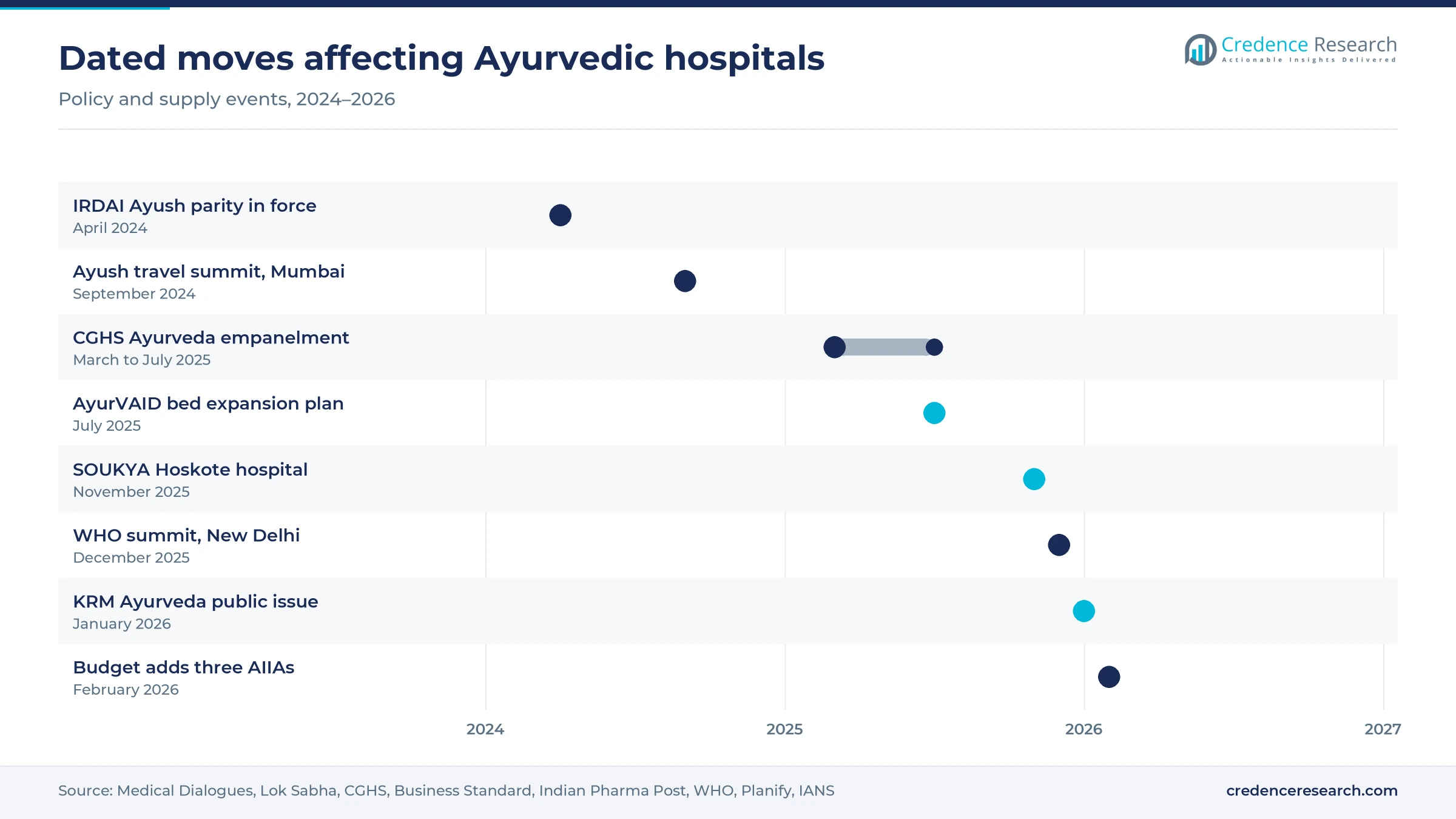
| In July 2025, Apollo AyurVAID set out a multi-city bed expansion plan to 2028, with Chennai, Hyderabad and Kolkata in the first wave, Business Standard reported. | Under way, extends the chain beyond South India |
| In November 2025, Apollo AyurVAID announced four new facilities including Mumbai and Kolkata, to lift capacity to about 350 beds, Whalesbook reported. | Rolling out over three to four months |
| In November 2025, SOUKYA announced a Rs 125 crore integrative Ayush hospital at Hoskote near Bengaluru, according to Indian Pharma Post. | Planned, 50 beds in the first phase |
| In January 2026, KRM Ayurveda opened its public issue on NSE SME to fund telemedicine capacity and clinical hiring, Planify reported. | Issue closed Jan. 21, 2026 |
| In February 2026, CGHS issued a corrigendum that halved the minimum therapy-room area for private Ayush day-care centers. | In force, existing centers comply after March 31, 2026 |
Accreditation and telemedicine shape patient access
- NABH Ayush standards give hospitals and day-care centers a recognized quality benchmark, and insurers may not refuse cashless listing to accredited facilities, according to the All India Institute of Ayurveda guide.
- Telemedicine desks let chains screen patients before admission, and KRM Ayurveda is using its public issue proceeds to build a company-owned center.
- The WHO Traditional Medicine Global Library launched in December 2025 and consolidates 1.6 million resources that clinicians can use for evidence checks.
- Online product listings extend hospital brands beyond the ward, since Apollo AyurVAID began selling three products on Amazon in 2025 in a field crowded with herbal supplements.
Need a Custom Version of This Report?
Tailor the scope, geography, or segments to your exact requirements.
- Custom geography or segment scope
- Direct access to our analyst team
Legacy houses compete with hospital-backed chains
Competition splits between century-old medicine houses that run flagship hospitals and newer chains built on hospital management methods. Arya Vaidya Sala, founded in 1902, and the Arya Vaidya Pharmacy in Coimbatore anchor the southern market and draw on their traditional medicine products businesses for formulations. Apollo AyurVAID brings the governance of Apollo Hospitals, which bought 60% of the company in 2022, and competes on clinical programs, insurance desks and fast city entry. KRM Ayurveda competes through government scheme empanelment and high occupancy, which reached 84.87% in fiscal 2025, Planify reported. Jiva Ayurveda relies on its clinic network and teleconsultation reach rather than large inpatient campuses. SOUKYA targets integrative care near Bengaluru with a new hospital at Hoskote. Because no operator holds a large national share, rivals compete on accreditation, outcomes data, specialist programs and the number of insurers that list them for cashless care.
Companies profiled and their roles in this market
| Company | Type | Role in the market |
|---|---|---|
| Apollo AyurVAID | Multi-city chain | Apollo Hospitals subsidiary expanding into Mumbai, Kolkata and Chennai with rehabilitation programs |
| Kottakkal Arya Vaidya Sala | Legacy hospital and medicine maker | Runs Ayurvedic hospital and research centers including Kottakkal East |
| Arya Vaidya Pharmacy | Legacy hospital and medicine maker | Runs the Arya Vaidya Chikitsalayam clinical wing in Coimbatore |
| Jiva Ayurveda | Clinic and teleconsultation network | Clinics across Delhi, Indore and Pune with over 500 doctors |
| KRM Ayurveda | Listed hospital operator | Six hospitals and five clinics across seven states, strong in government schemes |
| SOUKYA | Integrative operator | Building an integrative Ayush hospital at Hoskote, Bengaluru |
Insurance readiness will decide which chains scale
Credence Research's view is that in the Ayurvedic hospital chain business, insurance readiness, not bed count alone, will decide which operators scale. Parity rules created the demand, but claim rejections show that records and protocols still lag behind conventional hospitals. Insurance (AYUSH Cover) grows at 11.81% a year in the model, and chains that pair NABH accreditation with structured case sheets and pre-authorization desks should capture most of it. Southern legacy hospitals keep their reputational lead, though multi-city chains in Mumbai, Kolkata and Delhi should take a larger part of new demand. Therapist training is the main bottleneck to watch through 2030.
How the Ayurvedic hospital revenue model was built
The report uses 2025 as the base year and forecasts to 2035. Market values come from the Credence Research model, checked against national Ayurveda spending from the MoSPI survey on Ayush and against bed and patient counts that operators have made public. Segment and regional splits are Credence Research estimates informed by Lok Sabha hospital counts, accreditation data, insurance rules and company announcements. Sources used include government replies, regulator and ministry material, WHO releases, trade press and company announcements. No interviews or surveys were conducted in preparing this report.
Chain capacity and insured stays set growth to 2035
Ayurvedic hospital chain revenue is forecast to reach USD 1.56 billion by 2035 as multi-city operators, insured admissions and day-care formats widen access. South India should remain the largest region, although its share eases as West India, North India and East India add branded hospitals. The 2028 bed target at Apollo AyurVAID and the SOUKYA project at Hoskote will show whether chain capacity can be filled at high occupancy. Budget support for three new All India Institutes of Ayurveda should add trained staff and referral demand later in the decade. Claim settlement practice and therapist supply will set the pace of growth more than patient interest.
Frequently Asked Questions
How big is the India Ayurvedic hospital chain market?
Which region leads the market?
Which service is largest?
Does health insurance cover Ayurvedic hospital treatment in India?
Which companies operate in this market?
How fast is Apollo AyurVAID expanding?
Why are day-care clinics growing faster?
What is the largest risk for operators?
Table of Content
Chapter 1 Market Segmentation
- 1.1 Segmentation Framework
- 1.1.1 Product and Service Classification
- 1.1.2 Application and End-Use Classification
- 1.1.3 Technology and Solution Classification
- 1.1.4 Customer and Distribution Channel Classification
- 1.1.5 Geographic Segmentation
- 1.1.6 Market Segment Definitions and Boundaries
- 1.2 By Service
- 1.2.1 Panchakarma
- 1.2.2 Chronic Disease
- 1.2.3 Wellness
- 1.3 By Setting
- 1.3.1 Hospitals
- 1.3.2 Day-Care Clinics
- 1.4 By Payer
- 1.4.1 Out-of-Pocket
- 1.4.2 Insurance (AYUSH Cover)
Chapter 2 Introduction
- 2.1 Report Objectives and Scope
- 2.2 Product Definition and Industry Terminology
- 2.3 Market Inclusions and Exclusions
- 2.4 Research Process
- 2.4.1 Primary Research and Expert Interviews
- 2.4.2 Secondary Research and Source Review
- 2.4.3 Top-Down and Bottom-Up Estimation
- 2.4.4 Data Triangulation and Verification
- 2.5 Market Size Measurement Basis
- 2.5.1 2025: USD 600.0 million → 2035: USD 1.56 billion
- 2.6 Historical and Forecast Reference Periods
- 2.6.1 Historical Period: 2018-2025
- 2.6.2 Base Year: 2025
- 2.6.3 Forecast Period: 2025-2035
- 2.7 Research Assumptions and Limitations
Chapter 3 Executive Summary
- 3.1 Market Snapshot and Key Findings
- 3.2 Base-Year Market Size, 2025
- 3.3 Forecast Market Size, 2035
- 3.4 Revenue and Volume Growth Outlook
- 3.5 Key Demand and Supply Indicators
- 3.6 Leading Market Segments
- 3.7 Fastest-Growing Market Opportunities
- 3.8 Regional Performance Highlights
- 3.9 Technology and Industry Transformation
- 3.10 Competitive Landscape Summary
- 3.11 Analyst View and Strategic Implications
Chapter 4 India Ayurvedic Hospital Chain Market Trends and Developments
- 4.1 Historical Industry Development, 2018-2025
- 4.2 Recent Market Trends and Developments
- 4.3 Demand and Customer Behavior Trends
- 4.4 Technology and Product Innovation
- 4.5 Artificial Intelligence, Automation and Digitalization
- 4.6 Local Manufacturing and Supply Chain Realignment
- 4.7 Industry Partnerships, Mergers and Acquisitions
- 4.8 Sustainability and Circular Economy Developments
- 4.9 Government and Private Sector Investment Trends
- 4.10 Emerging Business Models and Commercialization
- 4.11 Industry Developments and Announcements
Chapter 5 India Ayurvedic Hospital Chain Market Production, Supply and Demand Analysis
- 5.1 Demand Trend and Consumption Analysis, 2018-2025
- 5.2 Demand Forecast, 2025-2035
- 5.3 Production and Output Trend, 2018-2025
- 5.4 Production and Output Forecast, 2025-2035
- 5.5 Installed Capacity and Capacity Utilization
- 5.6 Company-Wise Production Plants and Statistics
- 5.6.1 Installed Production Capacity
- 5.6.2 Actual Production
- 5.6.3 Planned Capacity and Expansion Targets
- 5.7 Supply Chain Structure and Procurement Trends
- 5.8 Supply-Demand Gap and Bottlenecks
- 5.9 Import Dependence and Sourcing Structure
- 5.10 Contract Manufacturing and Outsourcing
- 5.11 Regional Supply and Demand Concentration
Chapter 6 India Ayurvedic Hospital Chain Market Pricing Analysis
- 6.1 Pricing Structure and Measurement
- 6.2 Historical Pricing Trends, 2018-2025
- 6.3 Pricing Outlook, 2025-2035
- 6.4 Average Selling Price and Unit Economics
- 6.5 Pricing by Product and Market Segment
- 6.6 Geographic Pricing Differences
- 6.7 Key Input, Energy, Labor and Logistics Costs
- 6.8 Contract Pricing and Purchasing Models
- 6.9 Pricing Sensitivity and Competitive Positioning
- 6.10 Price, Margin and Profitability Implications
Chapter 7 India Ayurvedic Hospital Chain Market Dynamics
- 7.1 Market Growth Drivers
- 7.1.1 Demand-Side Drivers
- 7.1.2 Technology and Innovation Drivers
- 7.1.3 Infrastructure and Investment Drivers
- 7.1.4 Regulatory and Policy Drivers
- 7.2 Market Restraints
- 7.2.1 Cost and Affordability Constraints
- 7.2.2 Technology and Adoption Barriers
- 7.2.3 Supply Chain and Operational Constraints
- 7.3 Market Challenges
- 7.3.1 Competitive Pressure and Margin Erosion
- 7.3.2 Skills, Infrastructure and Implementation Gaps
- 7.4 Emerging Market Opportunities
- 7.5 Market Dynamics Impact and Time-Horizon Assessment
Chapter 8 India Ayurvedic Hospital Chain Value Chain Analysis
- 8.1 Industry Value Chain Overview
- 8.2 Upstream Suppliers and Critical Inputs
- 8.3 Technology and Component Providers
- 8.4 Manufacturing or Service Delivery
- 8.5 Distribution, Channel Partners and Integrators
- 8.6 Downstream Applications and End Users
- 8.7 Value Addition and Profit Pools
- 8.8 Vertical Integration and Outsourcing
- 8.9 Supplier Concentration and Risk
- 8.10 Supply Chain Localization and Resilience
Chapter 9 India Ayurvedic Hospital Chain Market Regulations and Policies
- 9.1 Relevant Laws, Standards and Compliance Frameworks
- 9.2 Product, Service, Safety and Quality Requirements
- 9.3 Government Policies, Incentives and Subsidies
- 9.4 Imports, Exports and Trade Barriers
- 9.5 Public Procurement and Local Content Requirements
- 9.6 Environmental and Sustainability Compliance
- 9.7 Upcoming Policy Changes and Market Implications
Chapter 10 India Ayurvedic Hospital Chain Market Hotspots and Opportunities
- 10.1 Market Opportunity Mapping and Growth Hotspots
- 10.2 High-Growth Applications and Customer Groups
- 10.3 Underserved Markets and White-Space Opportunities
- 10.4 Emerging Technology and Product Opportunities
- 10.5 New Capacity and Investment Hotspots
- 10.6 Market Entry and Expansion Opportunities
- 10.7 Distribution and Partnership Opportunities
- 10.8 Near-Term and Long-Term Commercial Potential
- 10.9 Opportunity Attractiveness and Execution Risks
Chapter 11 India Ayurvedic Hospital Chain Market Outlook, 2025-2035
- 11.1 Market Size and Analysis
- 11.1.1 Revenue (Market Measurement: 2025: USD 600.0 million → 2035: USD 1.56 billion)
- 11.1.2 Market Volume and Quantity Sold
- 11.1.3 Historical Market Size, 2018-2025
- 11.1.4 Base-Year Market Size, 2025
- 11.2 Market Forecast, 2025-2035
- 11.2.1 Revenue Forecast to 2035
- 11.2.2 Volume Forecast to 2035
- 11.2.3 CAGR and Year-on-Year Growth
- 11.2.4 Incremental Revenue Opportunity
- 11.3 Forecast Assumptions and Scenario Analysis
- 11.3.1 Base-Case Forecast
- 11.3.2 Optimistic and Conservative Scenarios
- 11.3.3 Technology, Pricing and Policy Sensitivities
- 11.4 Market Attractiveness and Growth Outlook
Chapter 12 India Ayurvedic Hospital Chain Market Segmentation and Outlook
- 12.1 Segmentation Summary and Market Shares, 2025
- 12.2 Largest and Fastest-Growing Segments
- 12.3 By Service - Market Size and Forecast, 2025-2035
- 12.3.1 Segment Definition and Scope
- 12.3.2 Historical Market Size, 2018-2025
- 12.3.3 Revenue Forecast, 2025-2035
- 12.3.4 Volume Forecast, 2025-2035
- 12.3.5 Base-Year Market Share, 2025
- 12.3.6 Segment CAGR and Growth Drivers
- 12.3.7 Subsegment Market Size and Forecast
- 12.3.7.1 Panchakarma
- 12.3.7.2 Chronic Disease
- 12.3.7.3 Wellness
- 12.3.8 Subsegment Pricing and Adoption Trends
- 12.3.9 Leading Suppliers and Competition
- 12.3.10 Regional Demand and Opportunities
- 12.4 By Setting - Market Size and Forecast, 2025-2035
- 12.4.1 Segment Definition and Scope
- 12.4.2 Historical Market Size, 2018-2025
- 12.4.3 Revenue Forecast, 2025-2035
- 12.4.4 Volume Forecast, 2025-2035
- 12.4.5 Base-Year Market Share, 2025
- 12.4.6 Segment CAGR and Growth Drivers
- 12.4.7 Subsegment Market Size and Forecast
- 12.4.7.1 Hospitals
- 12.4.7.2 Day-Care Clinics
- 12.4.8 Subsegment Pricing and Adoption Trends
- 12.4.9 Leading Suppliers and Competition
- 12.4.10 Regional Demand and Opportunities
- 12.5 By Payer - Market Size and Forecast, 2025-2035
- 12.5.1 Segment Definition and Scope
- 12.5.2 Historical Market Size, 2018-2025
- 12.5.3 Revenue Forecast, 2025-2035
- 12.5.4 Volume Forecast, 2025-2035
- 12.5.5 Base-Year Market Share, 2025
- 12.5.6 Segment CAGR and Growth Drivers
- 12.5.7 Subsegment Market Size and Forecast
- 12.5.7.1 Out-of-Pocket
- 12.5.7.2 Insurance (AYUSH Cover)
- 12.5.8 Subsegment Pricing and Adoption Trends
- 12.5.9 Leading Suppliers and Competition
- 12.5.10 Regional Demand and Opportunities
- 12.6 Segment Growth Comparison
- 12.7 Segment Attractiveness and Priority Matrix
Chapter 13 India Ayurvedic Hospital Chain Geographic Market Outlook, 2025-2035
- 13.1 Domestic Market Distribution and Demand Clusters
- 13.2 State- or Province-Wise Market Size and Forecast, 2025-2035
- 13.3 City and Metropolitan Market Outlook
- 13.4 Industrial, Manufacturing and Commercial Clusters
- 13.5 Geographic Concentration of Key End Users
- 13.6 Local Pricing and Purchasing Differences
- 13.7 Domestic Production Facilities and Capacity Map
- 13.8 Local Infrastructure and Project Pipeline
- 13.9 State-Level Policy and Incentive Differences
- 13.10 Subnational Investment Hotspots and Opportunities
- 13.11 Distribution and Logistics Networks
- 13.12 Domestic Competitive Footprint
Chapter 14 India Ayurvedic Hospital Chain Technology, Innovation and Sustainability Outlook
- 14.1 Technology Landscape and Maturity
- 14.2 Product, Process and Service Innovation
- 14.3 AI, Automation and Digital Tools in the Industry
- 14.4 Technology Adoption and Performance Benchmarking
- 14.5 Innovation Pipeline and R&D Investment
- 14.6 Patent and Intellectual Property Trends
- 14.7 Energy Efficiency and Resource Management
- 14.8 Sustainability, Recycling and Circularity
- 14.9 Technology Roadmap, 2025-2035
- 14.10 Risks of Obsolescence and Technology Substitution
Chapter 15 India Ayurvedic Hospital Chain Market Key Strategic Imperatives
- 15.1 Growth and Market Entry Priorities
- 15.2 High-Return Products and Segments
- 15.3 Pricing, Profitability and Cost Optimization
- 15.4 Technology Investment and Product Differentiation
- 15.5 Supply Chain Localization and Resilience
- 15.6 Distribution and Customer Acquisition
- 15.7 Partnership, Acquisition and Capacity Strategy
- 15.8 Regional Expansion Priorities
- 15.9 Short-, Medium- and Long-Term Actions
Chapter 16 Competition Outlook
- 16.1 Industry Competition Characteristics
- 16.2 Market Structure and Concentration
- 16.3 Market Share and Competitive Positioning, 2025
- 16.4 Company-Wise Revenue and Product Benchmarking
- 16.5 Production and Service Capacity Benchmarking
- 16.6 Technology, Pricing and Differentiation
- 16.7 Regional Footprint and Distribution Strength
- 16.8 Mergers, Acquisitions and Strategic Alliances
- 16.9 New Entrants and Competitive Threats
- 16.10 Porter's Five Forces and Industry Attractiveness
- 16.11 Competitive Outlook, 2025-2035
Chapter 17 Company Profiles
- 17.1 Company Coverage and Selection Criteria
- 17.2 Apollo AyurVAID
- 17.2.1 Business Description
- 17.2.2 Company Ownership and Geographic Presence
- 17.2.3 Product and Service Portfolio
- 17.2.4 Manufacturing and Operating Footprint
- 17.2.5 Production Capacity and Expansion Plans
- 17.2.6 Financial Performance and Investment
- 17.2.7 Market Share and Competitive Position
- 17.2.8 Technology and Innovation Capabilities
- 17.2.9 Strategic Alliances or Partnerships
- 17.2.10 Recent Developments
- 17.2.11 Growth Strategy and Outlook
- 17.3 Kottakkal Arya Vaidya Sala
- 17.4 Arya Vaidya Pharmacy
- 17.5 Jiva Ayurveda
- 17.6 KRM Ayurveda
- 17.7 SOUKYA
- 17.8 Other Relevant Market Participants
Note: Every listed company is profiled on the structure shown under the first company. The company list is preliminary and may change based on research findings, market developments, data availability and client requirements.
Chapter 18 Disclaimer
- 18.1 Research and Forecast Disclaimer
- 18.2 Data Source and Estimation Limitations
Note: The depth of individual sections depends on data availability for this market. Volume, capacity, trade and other unit-based metrics are included where applicable.

