
Out-of-pocket FUE procedures anchor clinic income
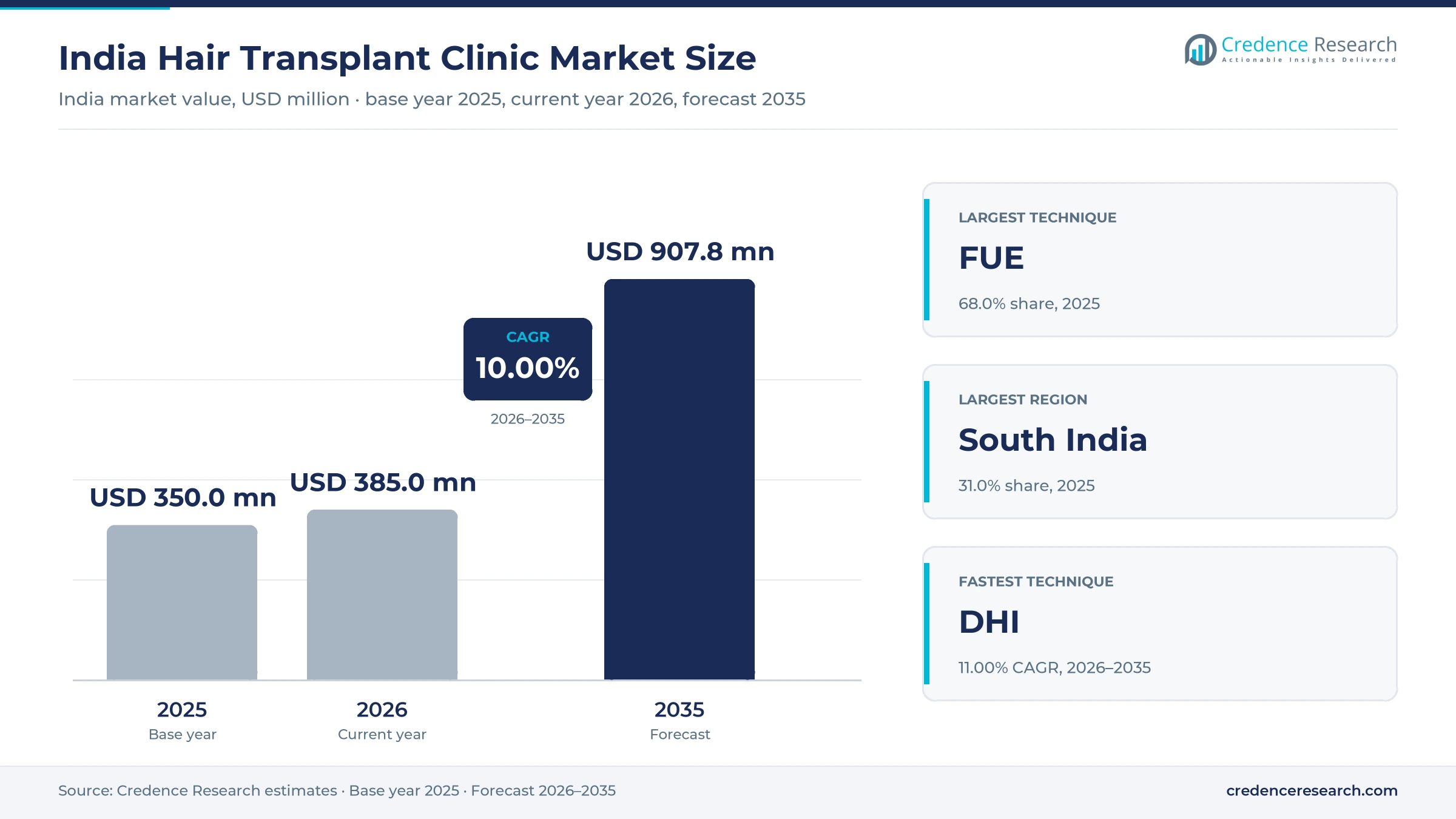
The India hair transplant clinic market was valued at USD 350.0 million in 2025 and is projected to increase from USD 385.0 million in 2026 to USD 907.8 million by 2035, registering a CAGR of 10.00% during 2026–2035. Demand comes from young urban men paying out of pocket for FUE, FUT and DHI procedures, and from overseas patients buying package treatment. South India held the largest regional share, 31.0% in 2025, because Bengaluru and Hyderabad host dense chain networks, including 19 Advanced GroHair & GloSkin branches in Andhra Pradesh and Telangana by September 2025. Northeast India is the fastest-growing region at 10.99% a year, starting from a very small base around Guwahati. India performs about 350,000 procedures a year, according to Finshots in January 2026. Regulation is also tightening, because Tamil Nadu brought restoration centers under its clinical establishments act in February 2026, a change that favors surgeon-led clinics with anesthesia support.
What does India hair transplant clinic revenue include?
The market counts fees that patients pay to clinics and day-care centers for surgical hair restoration, including FUE, FUT and DHI sessions, consultations and the post-operative care bundled with the procedure. Prices are usually quoted per graft or as packages by graft count, and overseas patients often buy bundles that include hotel nights and airport transfers.
The market excludes standalone medicines, shampoos and oils sold at retail, wigs and hair systems, and salon services without surgery. Value flows from patients to clinic owners, who then pay surgeons, technicians, anesthesia staff, consumables suppliers and lead-generation platforms.
India Hair Transplant Clinic Market Insights
- Clinic revenue rises from USD 350.0 million in 2025 to USD 907.8 million by 2035 at a 10.00% CAGR, as cheaper FUE and new chain branches bring more first-time patients.
- South India held 31.0% of 2025 value, because Bengaluru and Hyderabad host dense chain networks and new multi-theater surgical centers.
- FUE accounted for 68.0% of 2025 value, as the ISHRS 2025 Practice Census found FUE in 85.4% of male procedures among members.
- Tamil Nadu brought restoration centers under its clinical establishments act in February 2026, with specialist and anesthesia rules that small operators must now meet.
- Advanced GroHair & GloSkin grew from its 23rd branch in August 2023 to more than 150 clinics by May 2026, showing how quickly chains are scaling.
FUE and domestic patients hold the largest shares
Why FUE holds the largest technique share
Based on technique, the market is categorized into FUE, FUT and DHI. FUE led with 68.0% of 2025 value because extraction without a linear scar is now the default, and the ISHRS 2025 Practice Census found FUE in 85.4% of male procedures among its members. Delhi pricing also favors the method, since AK Clinics listed Rs 45–90 per graft in December 2025. DHI grows fastest at 11.00% a year as implanter methods move into flagship centers, with Eugenix Hair Sciences reporting graft out-of-body time under 30 minutes for its direct technique in May 2026. FUT stays in use where patients need large coverage at lower cost.
Domestic patients lead while medical tourists grow faster
Based on customer, the market is categorized into domestic and medical tourists. Domestic patients led with 82.0% of 2025 value because India performs about 350,000 procedures a year, according to Finshots in January 2026, and most are booked by residents paying Rs 40,000 to Rs 2.5 lakh. Medical Tourists grow fastest at 10.81% a year as package pricing draws overseas buyers, with DHI India quoting USD 2,500 to USD 7,000 bundles that include hotel nights and airport transfers. Eugenix Hair Sciences told PTI in November 2023 that over 40% of its patients each year came from the United States or Europe.
Smaller cities together outweigh any single metro
Based on city, the market is categorized into Delhi NCR, Mumbai, Bengaluru, Hyderabad and other cities. Other Cities led with 41.0% of 2025 value because chains now reach well beyond the metros, and Advanced GroHair & GloSkin opened its 105th branch in Guntur in September 2025 before passing 150 clinics by May 2026. Delhi NCR remains the largest single city, and PTI reported in November 2023 that it led successful transplant volumes with Jaipur and Mumbai. Bengaluru grows fastest at 11.11% a year as surgical capacity arrives, with Eugenix opening a six-theater center at Domlur on Sept. 28, 2026.
| Segment Group | Leading Sub-segment | Share, 2025 | Fastest-growing Sub-segment | CAGR, 2026–2035 |
|---|---|---|---|---|
| By Technique | FUE | 68.0% | DHI | 11.00% |
| By Customer | Domestic | 82.0% | Medical Tourists | 10.81% |
| By City | Other Cities | 41.0% | Bengaluru | 11.11% |
Request a Free Sample
Fill in your details and we'll send you a free sample report.
- Sample data tables & charts
- Research methodology
Spending, cheaper FUE and chain growth lift procedure volume
Appearance-focused spending lifts restoration demand
Hair restoration is paid out of pocket, so it rises with discretionary household budgets rather than with insurance cover. The Household Consumption Expenditure Survey 2023-24 released by MoSPI put average urban monthly per capita spending at Rs 6,996, up from Rs 6,459 a year earlier, with non-food items taking about 60% of the urban total. That spare spending supports elective care, and Finshots reported in January 2026 that GST on hair transplants had been cut from 18% to 5% the previous year. Eugenix Hair Sciences lists 5% GST on its Bhubaneswar fees, which confirms the lower rate at the counter. In the Credence Research model this adds about 3.90 percentage points to annual growth to 2035.
Lower FUE prices widen access for younger patients
FUE has become cheaper and easier to buy, which brings first-time patients into clinics that once served mainly older, higher-income men. AK Clinics listed Delhi rates of Rs 45–90 per graft in December 2025, with sessions of 1,000–1,500 grafts priced from Rs 40,000. Chains have pushed the method into smaller cities, since Advanced GroHair & GloSkin offers percutaneous FUE across a network that passed 150 clinics in May 2026. The ISHRS 2025 Practice Census found that FUE accounted for 85.4% of male procedures among members worldwide. As a result, FUE held 68.0% of 2025 value across clinics in the country. In the Credence Research model this adds about 2.80 percentage points to annual growth to 2035.
Medical tourism and chain expansion raise throughput
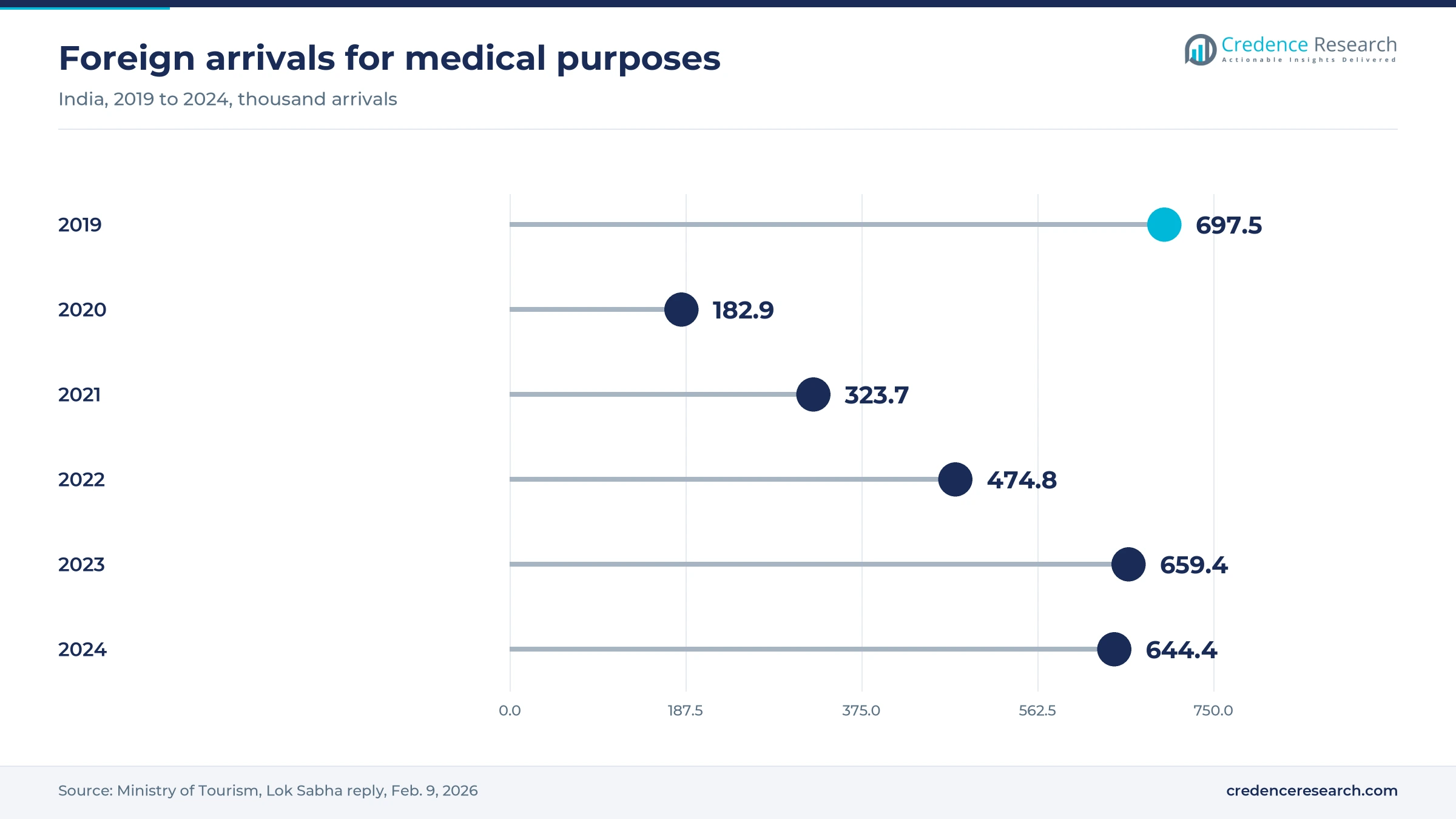
Overseas patients and multi-site chains both add procedures per surgeon, which raises clinic utilization. India recorded 644,387 foreign arrivals for medical purposes in 2024, according to a Ministry of Tourism reply in the Lok Sabha dated Feb. 9, 2026, against 182,945 in 2020. Eugenix Hair Sciences says it has treated patients from more than 90 countries, and DHI India sells packages from USD 2,500 that bundle hotel nights and transfers. Domestic chains are scaling too, with Mister Hair Clinics planning to grow from 16 to 100 sites by 2031. This medical travel flow lets Medical Tourists grow at 10.81% a year. In the Credence Research model this adds about 1.70 percentage points to annual growth to 2035.
Early-onset hair loss widens the patient pool
Hair loss now starts earlier, which lengthens the period over which a man may seek surgery and follow-up care. Traya reported on Oct. 19, 2023, that 50.31% of more than 500,000 Indian men it assessed with hair loss were under 25. A study of 200 North Indian men with androgenetic alopecia in the International Journal of Trichology found a mean age of 32, with 44.5% aged 21 to 30. The ISHRS 2025 census also placed 58.7% of male surgical patients between 30 and 49. Many patients begin with alopecia drugs and move to grafting once medicine stops working, which keeps clinic consultation funnels full.
Licensing rules and flagship centers are reshaping supply
Shift toward stricter licensing of restoration centers
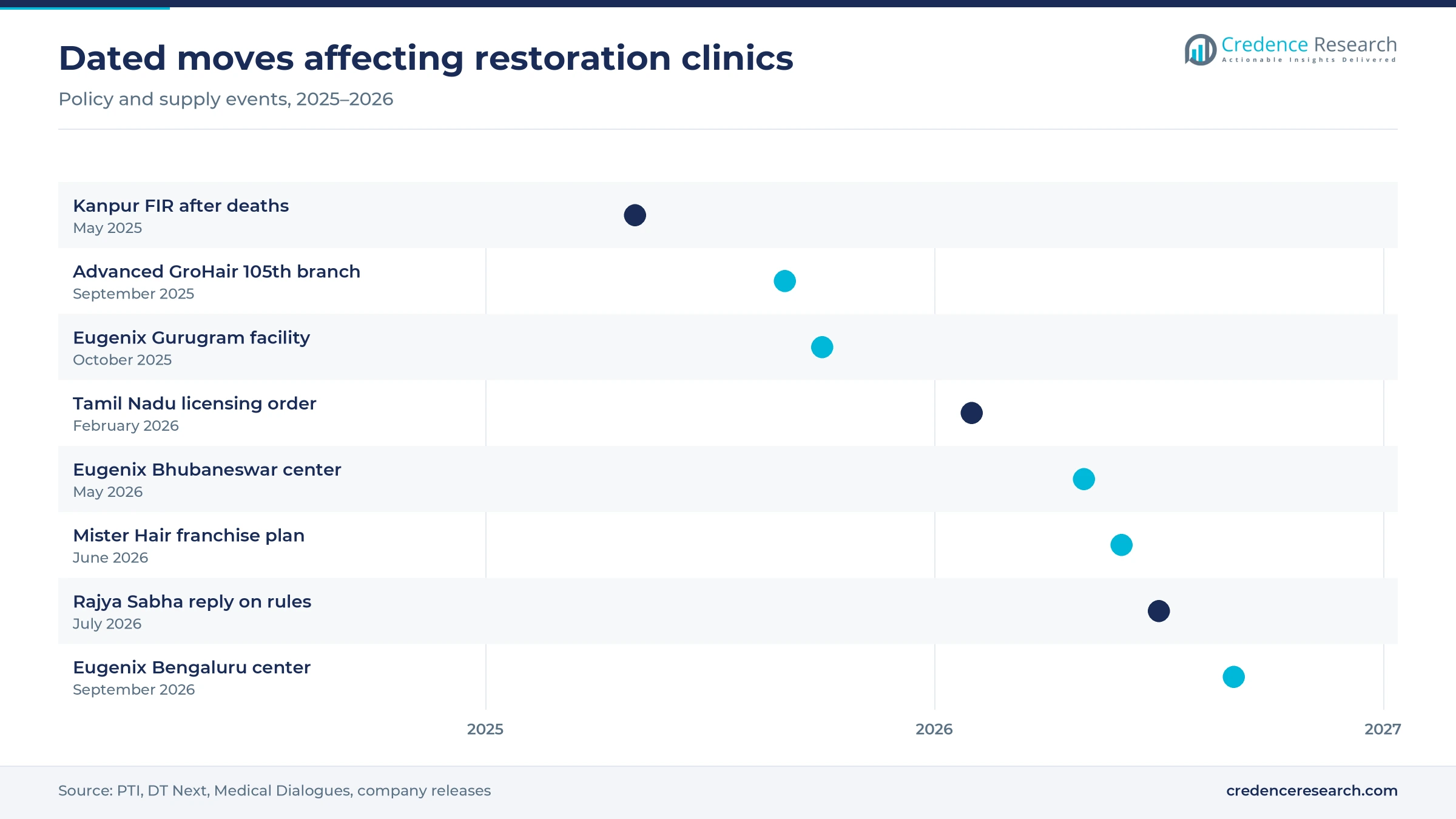
States are moving from advisories to licensing, which raises the bar for who can open and run a surgical center. The National Medical Commission issued guidelines on Sept. 20, 2022, saying procedures should preferably be done by MCh or DNB plastic surgeons or MD or DNB dermatologists. Tamil Nadu went further, and DT Next reported in February 2026 that a Government Order brought these centers under the state clinical establishments act with an anesthetist on site. Minister of State Anupriya Patel told the Rajya Sabha in July 2026 that 19 states and union territories had adopted the Clinical Establishments Act, 2010. In October 2026, UNI reported fresh NMC guidance defining any skin incision for harvesting as surgery, which favors surgeon-led chains.
Rise of multi-theater flagship centers in large cities
Leading chains are building larger surgical floors, which concentrates volume in fewer, better-equipped sites. Eugenix Hair Sciences opened a global facility in Gurugram on Oct. 15, 2025, and then a three-story center with three operation theaters in Bhubaneswar on May 21, 2026. Its Domlur center in Bengaluru, opened on Sept. 28, 2026, spans over 6,000 square feet with six theaters. The company also expanded its Bandra West site in Mumbai in August 2026 and now claims more than 22,000 procedures. Larger floors let surgeons run parallel cases and keep anesthesia cover on site, which fits the Tamil Nadu and NMC rules. As a result, Bengaluru grows at 11.11% a year in the Credence Research model.
Franchise roll-outs open tier-2 cities to new clinics
Smaller cities offer an opening because many residents still travel to metros for surgery. Mister Hair Clinics said on June 3, 2026, that it had 16 sites in Karnataka, Andhra Pradesh and Telangana and wanted 100 across India by 2031 through franchise partners. Advanced GroHair & GloSkin shows how fast that model can scale, rising from its 23rd branch at Gachibowli in August 2023 to a 105th in Guntur in September 2025. It then opened in Guwahati in May 2026, extending the network into the Northeast. Franchise playbooks cover site design, equipment, staff training and lead generation, which shortens the path for local doctors. In the Credence Research model, Other Cities held 41.0% of 2025 value.
Opening in bundled non-surgical follow-up care
Non-surgical care after grafting offers an opening to lift revenue per patient over several years. Neo Follicle in Bengaluru reported more than 10,000 transplants alongside more than 60,000 tricho treatments such as PRP, GFC and exosome sessions, according to an ANI release carried by Editorji. Advanced GroHair & GloSkin sells its Stem X 27 Pro platelet-rich plasma program next to percutaneous FUE in each new branch. Eugenix Hair Sciences monitors patients daily for the first seven days through its E-Care program and follows them for five years. DHI India includes GFC therapy in every tourist package from USD 2,500. These add-ons keep patients tied to one provider between procedures, which supports steady demand for clinic services through 2035.
Unsafe operators and price gaps test patient trust
Unqualified operators create fatal safety risks
Unsafe operators remain the gravest problem, because a few deaths damage trust across the whole category. PTI reported on May 16, 2025, that two engineers died in Kanpur after procedures at the Empire clinic, on Nov. 19, 2024, and March 14, 2025. In Chennai, three people were arrested and one Anna Nagar center was sealed in February 2026. The NMC advisory of September 2022 says workshops or YouTube videos are not adequate training. Qualified chains gain from this scrutiny, although patient hesitation hurts every operator.
Wide price gaps encourage risky low-cost choices
Prices vary so widely that patients struggle to compare quality, which pushes some toward the cheapest offer. AK Clinics listed Rs 40,000 to Rs 1.35 lakh for 1,000–1,500 grafts and Rs 85,000 to Rs 2.5 lakh for 2,200–2,800 grafts in Delhi in December 2025. The IADVL and APSI warned at a Delhi press conference, reported in March 2026, that paid ads list some people as dermatologists without verified qualifications. Established clinics must therefore spend more on proof of credentials and results.
Medical tourist flows swing with regional events
Foreign demand is volatile, which makes theater capacity hard to plan for clinics that rely on tourists. Medical arrivals fell from 659,356 in 2023 to 644,387 in 2024, according to Ministry of Tourism data, and Factly reported that medical visas dropped about 22% in 2024 as Bangladesh unrest cut issuance. Arrivals reached 450,633 from January to November 2025 on provisional data. Clinics can offset part of this by courting patients from the United States, the United Kingdom, Australia and the UAE.
New compliance rules raise fixed costs for small centers
Licensing rules add fixed costs that small, single-surgeon centers find hard to carry. Tamil Nadu's February 2026 order requires life-support equipment, emergency drugs, monitoring systems and an anesthetist available in the theater complex. Registration under the state act also needs a fire safety license, a biomedical waste agreement, a building stability certificate and pollution clearance. Smaller operators may close or join franchise networks, as Mister Hair Clinics invited partners to do in June 2026, which concentrates supply.
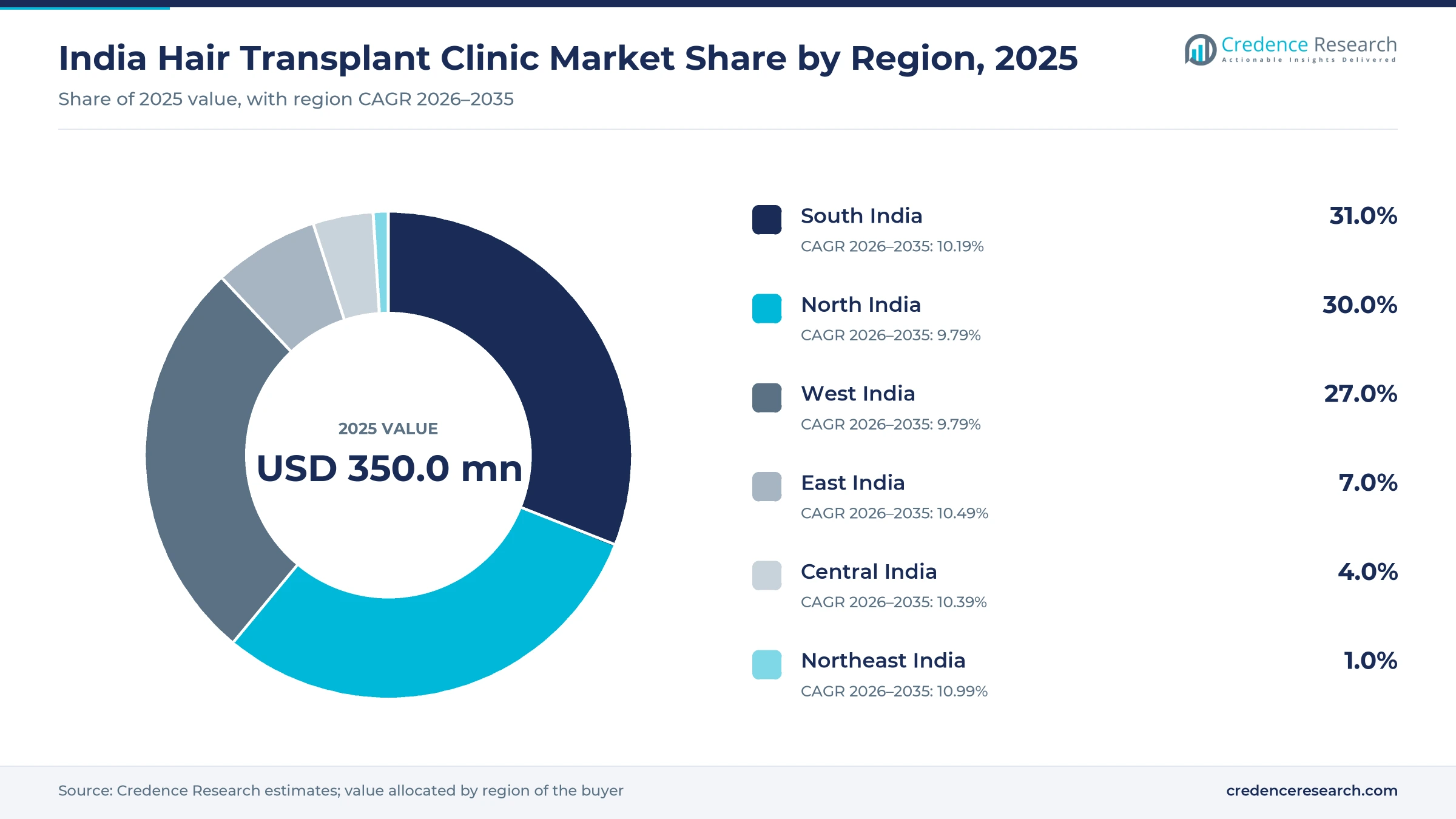
South India leads and the Northeast grows fastest
| Region | Value, 2025 (USD million) | Share, 2025 | CAGR, 2026–2035 |
|---|---|---|---|
| South India | 108.5 | 31.0% | 10.19% |
| North India | 105.0 | 30.0% | 9.79% |
| West India | 94.5 | 27.0% | 9.79% |
| East India | 24.5 | 7.0% | 10.49% |
| Central India | 14.0 | 4.0% | 10.39% |
| Northeast India | 3.5 | 1.0% | 10.99% |
South India leads on dense chain networks
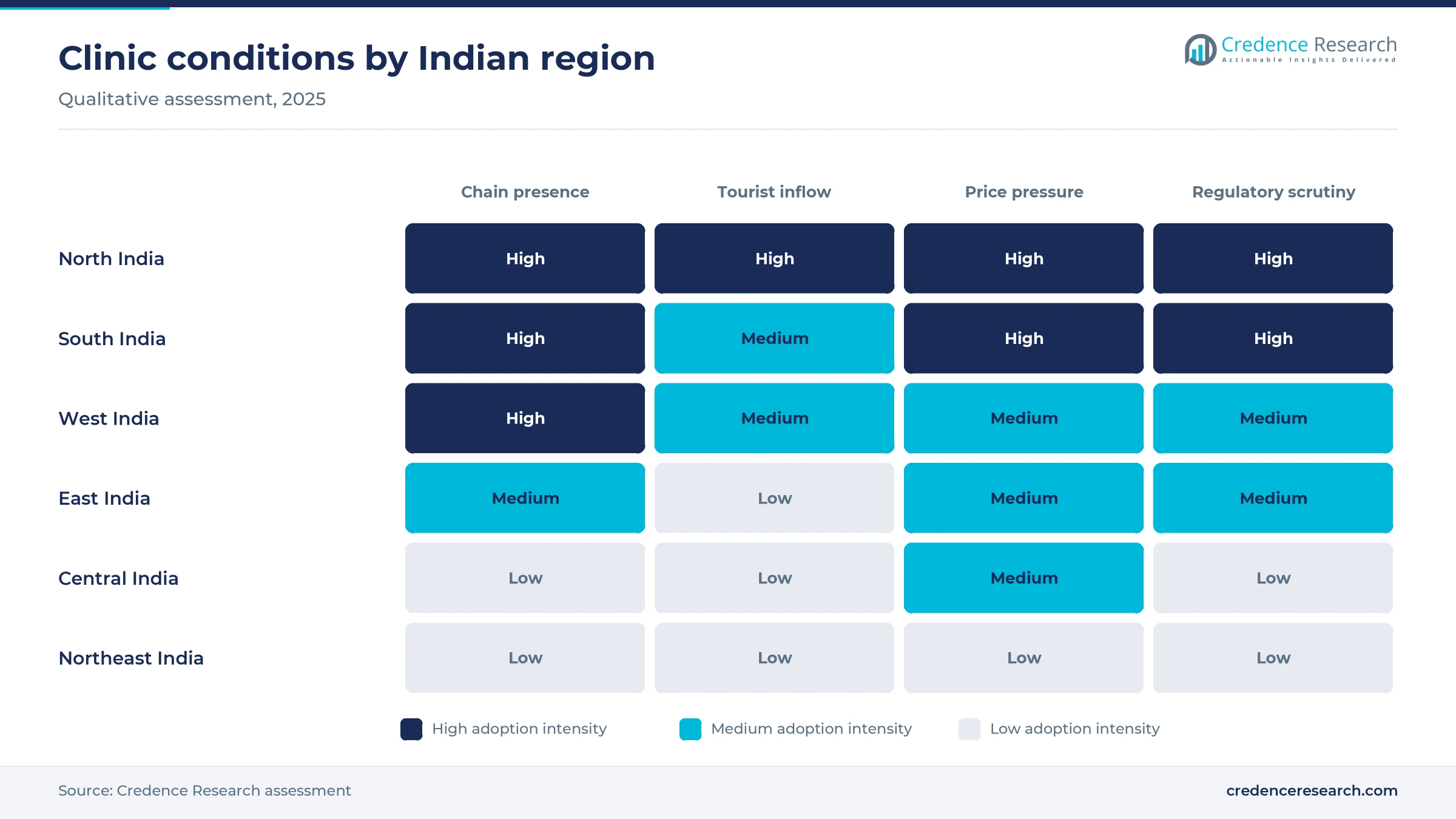
South India held 31.0% of 2025 value and grows at 10.19% a year, the largest zone in the India hair transplant clinic market. Bengaluru and Hyderabad anchor it, and Advanced GroHair & GloSkin counted 19 branches in Andhra Pradesh and Telangana in September 2025. Eugenix added six theaters in Bengaluru in September 2026, while Mister Hair Clinics runs 16 sites across three southern states. Tamil Nadu's stricter licensing from February 2026 should push volume toward compliant centers in Chennai and Coimbatore.
North India centers on Delhi NCR surgical hubs
North India held 30.0% of 2025 value and grows at 9.79% a year, with Delhi NCR as its surgical and tourist hub. Eugenix opened its global facility in Gurugram in October 2025, and DHI India runs clinics in Delhi, Gurgaon, Noida, Chandigarh and Lucknow. PTI reported in November 2023 that Delhi NCR and Jaipur were among the cities with the most successful transplants. The Kanpur deaths of 2024 and 2025, however, showed that poorly supervised centers still operate in smaller northern cities.
West India relies on Mumbai and Pune demand
West India held 27.0% of 2025 value and grows at 9.79% a year, led by Mumbai and Pune. Eugenix expanded its Bandra West center in Mumbai with a new third floor in August 2026, and DHI India operates a Mumbai clinic among its 14 listed cities. Advanced GroHair & GloSkin opened its 25th and 26th branches in Baner and Kalyani Nagar, Pune, in October 2023. Mumbai also ranked among the top three cities for successful transplants in the PTI report of November 2023.
East India adds surgical capacity in Bhubaneswar
East India held 7.0% of 2025 value and grows at 10.49% a year from a smaller base. Eugenix opened a three-theater center at Nayapalli in Bhubaneswar on May 21, 2026, giving Odisha patients a surgical option without travel to Delhi. DHI India lists Kolkata among its flagship clinics, which serves West Bengal and nearby states. Growth runs above the national rate because surgical capacity in the zone is still limited compared with the metro hubs.
Central India depends on local dermatologists
Central India held 4.0% of 2025 value and grows at 10.39% a year in the Credence Research model. The zone has few chain centers, and the list of 14 DHI India cities includes none in Madhya Pradesh or Chhattisgarh. Local dermatologists fill the gap, as SkinLife Clinic in Indore promoted FUE under local anesthesia in a February 2026 release. Patients who want larger sessions with chain surgeons may still travel to Delhi NCR or Mumbai.
Northeast India grows fastest from Guwahati
Northeast India held 1.0% of 2025 value and grows at 10.99% a year, the fastest pace in the model. The base is very small, and Guwahati is the main entry point for chains. DHI India lists a Guwahati clinic, and Advanced GroHair & GloSkin opened a Guwahati branch in May 2026 offering percutaneous FUE and PRP programs. Patients from neighboring states can now be treated closer to home, which keeps more demand inside the region.
Clinic openings and rules from 2024 to 2026
| Development | Status and market relevance |
|---|---|
| In May 2025, police in Kanpur lodged an FIR over deaths after procedures at a private clinic, PTI reported. | Under investigation, raised scrutiny of unqualified operators |
| In October 2025, Eugenix Hair Sciences unveiled a global facility for restoration surgery in Gurugram, according to a PTI release. | Operating, serves domestic and overseas patients |
| In February 2026, Tamil Nadu brought restoration centers under its clinical establishments act with specialist and anesthesia rules, DT Next reported. | In force, existing centers must comply |
| In June 2026, Mister Hair Clinics announced a plan to grow from 16 to 100 sites by 2031 through franchise partners. | Open for franchise applications |
| In September 2026, Eugenix Hair Sciences opened a six-theater center at Domlur in Bengaluru. | Operating, its fifth center in the country |
Extraction and implanter tools shape graft survival
- Motorized FUE punches extract single follicular units without a linear scar, and they account for most of the restoration surgery performed worldwide according to the ISHRS 2025 census.
- Implanter pens place grafts directly after extraction in DHI-style methods, and Eugenix reports out-of-body time under 30 minutes against three to four hours for traditional FUE.
- Strip harvesting remains the FUT approach for large coverage in one session, which keeps it relevant for patients with advanced loss and limited budgets.
- Growth factor concentrates such as GFC and PRP are bundled after surgery by DHI India and Advanced GroHair & GloSkin to support recovery and retention.
Need a Custom Version of This Report?
Tailor the scope, geography, or segments to your exact requirements.
- Custom geography or segment scope
- Direct access to our analyst team
Surgeon-led chains compete with thousands of local centers
The India hair transplant clinic market is fragmented, with thousands of local dermatology and cosmetic centers competing against a few surgeon-led chains. Eugenix Hair Sciences competes on large flagship centers with multiple theaters in Gurugram, Mumbai, Hyderabad, Bhubaneswar and Bengaluru. DHI India uses a branded technique and fixed-price tourist packages across 14 cities. Advanced GroHair & GloSkin competes on reach and price, and its network passed 150 clinics by May 2026 to lift its share of demand in smaller cities. Meanwhile, Mister Hair Clinics is building a franchise network from its southern base. AK Clinics publishes per-graft prices in Delhi, which sets a visible benchmark for local rivals. Competition increasingly turns on proof of qualified surgeons, because the Tamil Nadu order and NMC guidance make credentials a selling point. Lead generation through online platforms remains a large cost for every operator.
Companies profiled and their roles in this market
| Company | Type | Role in the market |
|---|---|---|
| Eugenix Hair Sciences | Surgeon-led chain | Runs multi-theater centers in Gurugram, Mumbai, Hyderabad, Bhubaneswar and Bengaluru |
| DHI India | Branded technique chain | Operates clinics in 14 listed cities and sells tourist packages from USD 2,500 |
| Advanced GroHair & GloSkin | Multi-city chain | Offers percutaneous FUE and PRP programs across more than 150 clinics |
| Mister Hair Clinics | Franchise chain | Runs 16 southern sites and targets 100 by 2031 |
| AK Clinics | Delhi specialist | Publishes per-graft FUE prices that act as a local benchmark |
| Neo Follicle | Bengaluru specialist | Combines transplants with non-surgical tricho treatments in Marathahalli |
Compliance will decide which clinic networks scale
Credence Research's view is that the India hair transplant clinic market will reward clinic networks that can prove surgical credentials and run compliant theaters at scale. Volume will keep rising because hair loss starts early and FUE prices are low, but the Kanpur deaths and the Tamil Nadu order show that regulators are now watching closely. Chains with anesthesia cover, published prices and long aftercare programs should take share from small operators over the forecast. Medical tourism adds margin, although foreign medical arrivals fell in 2024, which shows the flow can stall. Its demand growth to 2035 therefore depends more on domestic first-time patients than on overseas buyers.
How the procedure-based market model was built
The report uses 2025 as the base year and forecasts to 2035. Market values come from the Credence Research model, checked against annual procedure volume multiplied by published per-graft and package prices. Segment and regional splits are Credence Research estimates informed by chain footprints, city-level clinic counts and medical arrival data. Sources used include government statistics, parliamentary replies, regulator advisories, a peer-reviewed study, trade press and company announcements. No interviews or surveys were conducted in preparing this report.
Volume and package sales drive growth through 2035
India hair transplant clinic revenue is forecast to reach USD 907.8 million by 2035, with domestic first-time patients and chain expansion doing most of the work. South India should remain the largest region, while Northeast India and East India grow faster as chains open in Guwahati and Bhubaneswar. DHI is expected to grow at 11.00% a year and gain share inside large centers, while FUE remains the default. Licensing rules are likely to spread beyond Tamil Nadu, which will close some small operators and push others into franchise networks. Medical tourism should add steady demand, although overseas flows stay exposed to visa and regional disruptions.
Frequently Asked Questions
How big is the India hair transplant clinic market?
Which region leads the market?
Which technique is most common?
How much does a procedure cost in Delhi?
How many procedures does India perform each year?
Why do medical tourists grow faster?
What rules apply to clinics in Tamil Nadu?
What is the biggest risk for the market?
Table of Content
Chapter 1 Market Segmentation
- 1.1 Segmentation Framework
- 1.1.1 Product and Service Classification
- 1.1.2 Application and End-Use Classification
- 1.1.3 Technology and Solution Classification
- 1.1.4 Customer and Distribution Channel Classification
- 1.1.5 Geographic Segmentation
- 1.1.6 Market Segment Definitions and Boundaries
- 1.2 By Technique
- 1.2.1 FUE
- 1.2.2 DHI
- 1.2.3 FUT
- 1.3 By Customer
- 1.3.1 Domestic
- 1.3.2 Medical Tourists
- 1.4 By City
- 1.4.1 Other Cities
- 1.4.2 Delhi NCR
- 1.4.3 Mumbai
- 1.4.4 Bengaluru
- 1.4.5 Hyderabad
Chapter 2 Introduction
- 2.1 Report Objectives and Scope
- 2.2 Product Definition and Industry Terminology
- 2.3 Market Inclusions and Exclusions
- 2.4 Research Process
- 2.4.1 Primary Research and Expert Interviews
- 2.4.2 Secondary Research and Source Review
- 2.4.3 Top-Down and Bottom-Up Estimation
- 2.4.4 Data Triangulation and Verification
- 2.5 Market Size Measurement Basis
- 2.5.1 2025: USD 350.0 million → 2035: USD 907.8 million
- 2.6 Historical and Forecast Reference Periods
- 2.6.1 Historical Period: 2018-2025
- 2.6.2 Base Year: 2025
- 2.6.3 Forecast Period: 2025-2035
- 2.7 Research Assumptions and Limitations
Chapter 3 Executive Summary
- 3.1 Market Snapshot and Key Findings
- 3.2 Base-Year Market Size, 2025
- 3.3 Forecast Market Size, 2035
- 3.4 Revenue and Volume Growth Outlook
- 3.5 Key Demand and Supply Indicators
- 3.6 Leading Market Segments
- 3.7 Fastest-Growing Market Opportunities
- 3.8 Regional Performance Highlights
- 3.9 Technology and Industry Transformation
- 3.10 Competitive Landscape Summary
- 3.11 Analyst View and Strategic Implications
Chapter 4 India Hair Transplant Clinic Market Trends and Developments
- 4.1 Historical Industry Development, 2018-2025
- 4.2 Recent Market Trends and Developments
- 4.3 Demand and Customer Behavior Trends
- 4.4 Technology and Product Innovation
- 4.5 Artificial Intelligence, Automation and Digitalization
- 4.6 Local Manufacturing and Supply Chain Realignment
- 4.7 Industry Partnerships, Mergers and Acquisitions
- 4.8 Sustainability and Circular Economy Developments
- 4.9 Government and Private Sector Investment Trends
- 4.10 Emerging Business Models and Commercialization
- 4.11 Industry Developments and Announcements
Chapter 5 India Hair Transplant Clinic Market Production, Supply and Demand Analysis
- 5.1 Demand Trend and Consumption Analysis, 2018-2025
- 5.2 Demand Forecast, 2025-2035
- 5.3 Production and Output Trend, 2018-2025
- 5.4 Production and Output Forecast, 2025-2035
- 5.5 Installed Capacity and Capacity Utilization
- 5.6 Company-Wise Production Plants and Statistics
- 5.6.1 Installed Production Capacity
- 5.6.2 Actual Production
- 5.6.3 Planned Capacity and Expansion Targets
- 5.7 Supply Chain Structure and Procurement Trends
- 5.8 Supply-Demand Gap and Bottlenecks
- 5.9 Import Dependence and Sourcing Structure
- 5.10 Contract Manufacturing and Outsourcing
- 5.11 Regional Supply and Demand Concentration
Chapter 6 India Hair Transplant Clinic Market Pricing Analysis
- 6.1 Pricing Structure and Measurement
- 6.2 Historical Pricing Trends, 2018-2025
- 6.3 Pricing Outlook, 2025-2035
- 6.4 Average Selling Price and Unit Economics
- 6.5 Pricing by Product and Market Segment
- 6.6 Geographic Pricing Differences
- 6.7 Key Input, Energy, Labor and Logistics Costs
- 6.8 Contract Pricing and Purchasing Models
- 6.9 Pricing Sensitivity and Competitive Positioning
- 6.10 Price, Margin and Profitability Implications
Chapter 7 India Hair Transplant Clinic Market Dynamics
- 7.1 Market Growth Drivers
- 7.1.1 Demand-Side Drivers
- 7.1.2 Technology and Innovation Drivers
- 7.1.3 Infrastructure and Investment Drivers
- 7.1.4 Regulatory and Policy Drivers
- 7.2 Market Restraints
- 7.2.1 Cost and Affordability Constraints
- 7.2.2 Technology and Adoption Barriers
- 7.2.3 Supply Chain and Operational Constraints
- 7.3 Market Challenges
- 7.3.1 Competitive Pressure and Margin Erosion
- 7.3.2 Skills, Infrastructure and Implementation Gaps
- 7.4 Emerging Market Opportunities
- 7.5 Market Dynamics Impact and Time-Horizon Assessment
Chapter 8 India Hair Transplant Clinic Value Chain Analysis
- 8.1 Industry Value Chain Overview
- 8.2 Upstream Suppliers and Critical Inputs
- 8.3 Technology and Component Providers
- 8.4 Manufacturing or Service Delivery
- 8.5 Distribution, Channel Partners and Integrators
- 8.6 Downstream Applications and End Users
- 8.7 Value Addition and Profit Pools
- 8.8 Vertical Integration and Outsourcing
- 8.9 Supplier Concentration and Risk
- 8.10 Supply Chain Localization and Resilience
Chapter 9 India Hair Transplant Clinic Market Regulations and Policies
- 9.1 Relevant Laws, Standards and Compliance Frameworks
- 9.2 Product, Service, Safety and Quality Requirements
- 9.3 Government Policies, Incentives and Subsidies
- 9.4 Imports, Exports and Trade Barriers
- 9.5 Public Procurement and Local Content Requirements
- 9.6 Environmental and Sustainability Compliance
- 9.7 Upcoming Policy Changes and Market Implications
Chapter 10 India Hair Transplant Clinic Market Hotspots and Opportunities
- 10.1 Market Opportunity Mapping and Growth Hotspots
- 10.2 High-Growth Applications and Customer Groups
- 10.3 Underserved Markets and White-Space Opportunities
- 10.4 Emerging Technology and Product Opportunities
- 10.5 New Capacity and Investment Hotspots
- 10.6 Market Entry and Expansion Opportunities
- 10.7 Distribution and Partnership Opportunities
- 10.8 Near-Term and Long-Term Commercial Potential
- 10.9 Opportunity Attractiveness and Execution Risks
Chapter 11 India Hair Transplant Clinic Market Outlook, 2025-2035
- 11.1 Market Size and Analysis
- 11.1.1 Revenue (Market Measurement: 2025: USD 350.0 million → 2035: USD 907.8 million)
- 11.1.2 Market Volume and Quantity Sold
- 11.1.3 Historical Market Size, 2018-2025
- 11.1.4 Base-Year Market Size, 2025
- 11.2 Market Forecast, 2025-2035
- 11.2.1 Revenue Forecast to 2035
- 11.2.2 Volume Forecast to 2035
- 11.2.3 CAGR and Year-on-Year Growth
- 11.2.4 Incremental Revenue Opportunity
- 11.3 Forecast Assumptions and Scenario Analysis
- 11.3.1 Base-Case Forecast
- 11.3.2 Optimistic and Conservative Scenarios
- 11.3.3 Technology, Pricing and Policy Sensitivities
- 11.4 Market Attractiveness and Growth Outlook
Chapter 12 India Hair Transplant Clinic Market Segmentation and Outlook
- 12.1 Segmentation Summary and Market Shares, 2025
- 12.2 Largest and Fastest-Growing Segments
- 12.3 By Technique - Market Size and Forecast, 2025-2035
- 12.3.1 Segment Definition and Scope
- 12.3.2 Historical Market Size, 2018-2025
- 12.3.3 Revenue Forecast, 2025-2035
- 12.3.4 Volume Forecast, 2025-2035
- 12.3.5 Base-Year Market Share, 2025
- 12.3.6 Segment CAGR and Growth Drivers
- 12.3.7 Subsegment Market Size and Forecast
- 12.3.7.1 FUE
- 12.3.7.2 DHI
- 12.3.7.3 FUT
- 12.3.8 Subsegment Pricing and Adoption Trends
- 12.3.9 Leading Suppliers and Competition
- 12.3.10 Regional Demand and Opportunities
- 12.4 By Customer - Market Size and Forecast, 2025-2035
- 12.4.1 Segment Definition and Scope
- 12.4.2 Historical Market Size, 2018-2025
- 12.4.3 Revenue Forecast, 2025-2035
- 12.4.4 Volume Forecast, 2025-2035
- 12.4.5 Base-Year Market Share, 2025
- 12.4.6 Segment CAGR and Growth Drivers
- 12.4.7 Subsegment Market Size and Forecast
- 12.4.7.1 Domestic
- 12.4.7.2 Medical Tourists
- 12.4.8 Subsegment Pricing and Adoption Trends
- 12.4.9 Leading Suppliers and Competition
- 12.4.10 Regional Demand and Opportunities
- 12.5 By City - Market Size and Forecast, 2025-2035
- 12.5.1 Segment Definition and Scope
- 12.5.2 Historical Market Size, 2018-2025
- 12.5.3 Revenue Forecast, 2025-2035
- 12.5.4 Volume Forecast, 2025-2035
- 12.5.5 Base-Year Market Share, 2025
- 12.5.6 Segment CAGR and Growth Drivers
- 12.5.7 Subsegment Market Size and Forecast
- 12.5.7.1 Other Cities
- 12.5.7.2 Delhi NCR
- 12.5.7.3 Mumbai
- 12.5.7.4 Bengaluru
- 12.5.7.5 Hyderabad
- 12.5.8 Subsegment Pricing and Adoption Trends
- 12.5.9 Leading Suppliers and Competition
- 12.5.10 Regional Demand and Opportunities
- 12.6 Segment Growth Comparison
- 12.7 Segment Attractiveness and Priority Matrix
Chapter 13 India Hair Transplant Clinic End-Use and Application Market Outlook
- 13.1 End-Use Industry and Customer Demand Structure
- 13.2 Leading Applications and Customer Groups
- 13.3 End-Use Market Size, Share and Forecast
- 13.4 Major End-Use Industry Deep Dives
- 13.4.1 Customer Requirements and Use Cases
- 13.4.2 Demand and Replacement Cycles
- 13.4.3 Technical and Regulatory Considerations
- 13.4.4 Purchasing and Procurement Models
- 13.4.5 Leading Vendors and Distribution Channels
- 13.4.6 Forecast and Commercial Opportunities
- 13.5 Emerging Applications and Cross-Segment Demand
- 13.6 End-Use Industry Investment Priorities
Chapter 14 India Hair Transplant Clinic Geographic Market Outlook, 2025-2035
- 14.1 Domestic Market Distribution and Demand Clusters
- 14.2 State- or Province-Wise Market Size and Forecast, 2025-2035
- 14.3 City and Metropolitan Market Outlook
- 14.4 Industrial, Manufacturing and Commercial Clusters
- 14.5 Geographic Concentration of Key End Users
- 14.6 Local Pricing and Purchasing Differences
- 14.7 Domestic Production Facilities and Capacity Map
- 14.8 Local Infrastructure and Project Pipeline
- 14.9 State-Level Policy and Incentive Differences
- 14.10 Subnational Investment Hotspots and Opportunities
- 14.11 Distribution and Logistics Networks
- 14.12 Domestic Competitive Footprint
Chapter 15 India Hair Transplant Clinic Technology, Innovation and Sustainability Outlook
- 15.1 Technology Landscape and Maturity
- 15.2 Product, Process and Service Innovation
- 15.3 AI, Automation and Digital Tools in the Industry
- 15.4 Technology Adoption and Performance Benchmarking
- 15.5 Innovation Pipeline and R&D Investment
- 15.6 Patent and Intellectual Property Trends
- 15.7 Energy Efficiency and Resource Management
- 15.8 Sustainability, Recycling and Circularity
- 15.9 Technology Roadmap, 2025-2035
- 15.10 Risks of Obsolescence and Technology Substitution
Chapter 16 India Hair Transplant Clinic Market Key Strategic Imperatives
- 16.1 Growth and Market Entry Priorities
- 16.2 High-Return Products and Segments
- 16.3 Pricing, Profitability and Cost Optimization
- 16.4 Technology Investment and Product Differentiation
- 16.5 Supply Chain Localization and Resilience
- 16.6 Distribution and Customer Acquisition
- 16.7 Partnership, Acquisition and Capacity Strategy
- 16.8 Regional Expansion Priorities
- 16.9 Short-, Medium- and Long-Term Actions
Chapter 17 Competition Outlook
- 17.1 Industry Competition Characteristics
- 17.2 Market Structure and Concentration
- 17.3 Market Share and Competitive Positioning, 2025
- 17.4 Company-Wise Revenue and Product Benchmarking
- 17.5 Production and Service Capacity Benchmarking
- 17.6 Technology, Pricing and Differentiation
- 17.7 Regional Footprint and Distribution Strength
- 17.8 Mergers, Acquisitions and Strategic Alliances
- 17.9 New Entrants and Competitive Threats
- 17.10 Porter's Five Forces and Industry Attractiveness
- 17.11 Competitive Outlook, 2025-2035
Chapter 18 Company Profiles
- 18.1 Company Coverage and Selection Criteria
- 18.2 DHI India
- 18.2.1 Business Description
- 18.2.2 Company Ownership and Geographic Presence
- 18.2.3 Product and Service Portfolio
- 18.2.4 Manufacturing and Operating Footprint
- 18.2.5 Production Capacity and Expansion Plans
- 18.2.6 Financial Performance and Investment
- 18.2.7 Market Share and Competitive Position
- 18.2.8 Technology and Innovation Capabilities
- 18.2.9 Strategic Alliances or Partnerships
- 18.2.10 Recent Developments
- 18.2.11 Growth Strategy and Outlook
- 18.3 Eugenix Hair Sciences
- 18.4 Advanced GroHair & GloSkin
- 18.5 AK Clinics
- 18.6 Mister Hair Clinics
- 18.7 Neo Follicle
- 18.8 Other Relevant Market Participants
Note: Every listed company is profiled on the structure shown under the first company. The company list is preliminary and may change based on research findings, market developments, data availability and client requirements.
Chapter 19 Disclaimer
- 19.1 Research and Forecast Disclaimer
- 19.2 Data Source and Estimation Limitations
Note: The depth of individual sections depends on data availability for this market. Volume, capacity, trade and other unit-based metrics are included where applicable.

