Italy Air Conditioner Market Overview:
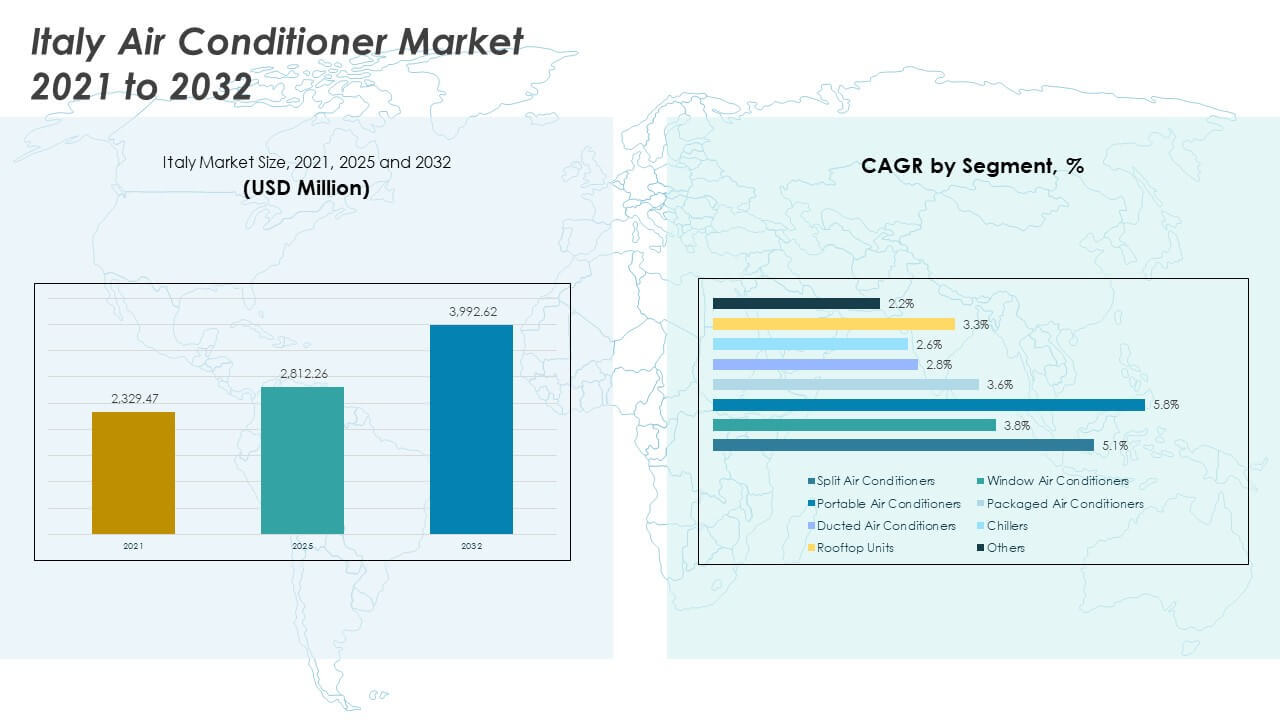
The Italy Air Conditioner Market size was valued at USD 2,329.47 MN in 2021 and reached USD 2,812.26 MN in 2025. It is anticipated to reach USD 3,992.62 MN by 2032, growing at a CAGR of 5.13% from 2025 to 2032.
| REPORT ATTRIBUTE | DETAILS |
|---|---|
| Historical Period | 2021-2024 |
| Base Year | 2025 |
| Forecast Period | 2025-2032 |
| Italy Air Conditioner Market Size 2025 | USD 2,812.26 million |
| Italy Air Conditioner Market, CAGR | 3.67% |
| Italy Air Conditioner Market Size 2032 | USD 3,992.62 million |
Italy Air Conditioner Market Insights
- Market growth is supported by rising summer heat exposure, residential replacement demand, energy efficiency upgrades, smart cooling adoption and stronger use of inverter air conditioners.
- Split Air Conditioners hold the strongest product position, supported by broad residential use, flexible installation, efficient room-level cooling and steady replacement of older systems.
- Portable Air Conditioners are projected to record the fastest listed segment CAGR at 5.8%, supported by rental housing, retrofit limitations, heatwave-led purchases and lower installation complexity.
- Residential demand remains strong because Italian households increasingly use air conditioning for comfort, health protection and efficient indoor cooling during longer warm seasons.
Italy Air Conditioner Market Segment Insights
By product type
By product type, Split Air Conditioners held the strongest position in 2025, supported by broad use across apartments, independent homes, offices, small retail spaces and hospitality facilities. The segment is projected to grow at a CAGR of 5.1%, driven by replacement demand, inverter technology adoption and wider use of efficient room-level cooling. Portable Air Conditioners are expected to grow fastest at a CAGR of 5.8% because they serve renters, temporary users and buildings where fixed installation is difficult. Window Air Conditioners remain relevant in selective price-sensitive applications and are projected to grow at a CAGR of 3.8%. Packaged Air Conditioners, Ducted Air Conditioners, Chillers and Rooftop Units serve commercial buildings, hotels, offices, public facilities and larger residential projects, but their adoption depends on renovation budgets, building design and contractor-led installation.
By technology
By technology, Inverter Air Conditioners led the Italy Air Conditioner Market in 2025 because customers prioritize lower electricity use, improved cooling comfort and better temperature control. Inverter systems are gaining share as households and commercial users replace older non-inverter models with more efficient solutions. Non-inverter Air Conditioners remain present in cost-sensitive demand, but their share is expected to decline as energy efficiency expectations rise. Smart / Connected Air Conditioners are gaining traction because users seek app-based control, scheduling, energy monitoring and integration with connected home systems. Solar-powered and Hybrid Air Conditioners remain emerging categories, but they offer long-term opportunities as Italy expands renewable power use and customers seek lower-carbon cooling options.
By end user
By end user, Residential customers held the stronger position in 2025 because household cooling demand continues to rise across apartments, villas and renovated housing. Hotter summers, aging housing stock, remote work habits and rising comfort expectations support installation and replacement demand. Residential customers favor split and portable units because these products offer flexible cooling and easier adoption than centralized HVAC systems. Commercial users represent a steady demand base across hotels, restaurants, offices, retail stores, hospitals, schools and public buildings. Commercial adoption is shaped by indoor comfort needs, energy efficiency goals, tourism demand and building modernization. Demand from both end users is expected to rise through 2032 as cooling becomes more essential across Italy.
By sales channel
By sales channel, Distributor / Dealer Sales held a strong position in 2025 because air conditioner purchases often require product guidance, installation coordination, regional inventory and after-sales support. HVAC Contractors remain important because system sizing, refrigerant handling, electrical compatibility and installation quality directly affect performance. Retail Stores continue to serve residential customers seeking split, window and portable air conditioners. Online / E-commerce is growing as consumers compare prices, read reviews and buy portable or room units through digital platforms. Direct Sales remain important for commercial buyers, public institutions, developers and large accounts that require project-based procurement. Channel performance will depend on installer availability, seasonal inventory planning and service network strength.
Key market drivers
Rising heat exposure and cooling demand
Rising heat exposure is becoming a powerful demand trigger in Italy, where air conditioning is steadily moving from a seasonal convenience to a more essential indoor climate solution for apartments, hotels, offices, shops, and public facilities that must stay usable during longer hot spells. Southern cities, dense urban neighborhoods, and tourism-heavy destinations are especially important because they combine higher summer exposure with heavier occupancy and stronger expectations around comfort, sleep quality, and heat protection. The strongest pull is toward split systems, portable units, and connected models that offer practical installation and better room-level control, helping households and businesses react quickly when heat peaks and indoor conditions become harder to manage. The climatic urgency is becoming clearer, with the national climate report showing that Italy’s average temperature in 2025 was 1.03C above the 1991 to 2020 norm, reinforcing why cooling purchases are becoming more necessity-driven rather than discretionary across much of the country.
Energy efficiency and inverter replacement
Energy efficiency and inverter replacement are supporting steady market expansion in Italy because buyers increasingly want cooling systems that can control summer temperatures without exposing homes or businesses to avoidable electricity waste. Inverter air conditioners are well positioned in this environment since they modulate compressor output, stabilize room conditions, and align with the growing preference for equipment that lowers bills while improving everyday comfort in residences, hotels, restaurants, and offices. ENEA has underlined how mainstream the efficiency issue has become, noting that 48.8 percent of Italian families use air conditioning, mostly mono-splits, for an average of six hours a day, which strengthens the incentive to replace older units with more efficient inverter-based alternatives. That replacement cycle also favors brands with trusted installer networks and after-sales service, because customers are not just purchasing a machine but seeking dependable guidance on sizing, maintenance, and long-term operating cost control in a market where energy awareness is now central to the buying decision.media.
Housing renovation and commercial modernization
Housing renovation and commercial modernization continue to reinforce air conditioner demand in Italy because older apartments, refurbished homes, rental upgrades, and second-property improvements all create practical openings for new split, ducted, and smarter cooling systems that fit tighter spaces and modern efficiency expectations. The hospitality economy adds a second layer of demand, since hotels, serviced apartments, restaurants, and tourist facilities need reliable climate control to protect guest comfort, reduce summer service disruption, and keep properties competitive during peak travel periods. The operational importance of this channel is clear in Istat’s provisional tourism data, which showed 216.7 million overnight stays in Italian accommodation establishments during the third quarter of 2025 alone, underscoring how heavily commercial operators depend on functioning cooling infrastructure during the hottest and busiest part of the year. This modernization trend also supports larger packaged systems, chillers, and contractor-led HVAC upgrades across offices, hospitals, schools, and retail spaces that are improving indoor comfort and maintenance resilience.
Smart and connected cooling adoption
Smart and connected cooling adoption is becoming a stronger differentiator in Italy as households and commercial users increasingly prefer air conditioners that can be managed remotely, scheduled more precisely, and integrated with wider home or building routines instead of being operated only through basic on-site controls. These features matter because they turn cooling into a more transparent system, letting users monitor consumption, adjust settings before arriving on site, and respond faster to comfort or maintenance issues without sacrificing convenience. A useful company benchmark comes from Daikin, which states that its Residential Controller can manage up to 50 air-conditioning units simultaneously while also providing remote access, temperature scheduling, and energy-use visibility, illustrating how connected functionality is moving beyond premium novelty into practical building management. As electricity awareness rises and customers expect simpler control, brands that combine inverter efficiency, intuitive apps, and dependable installer support should strengthen their competitive position across both residential and commercial cooling projects in Italy.
Key Trends and Opportunities
Portable and retrofit cooling demand rises
Portable and retrofit cooling demand is becoming a major opportunity because many older buildings in Italy were not designed for fixed air conditioning systems. Portable Air Conditioners are projected to grow at a CAGR of 5.8%, the fastest among listed product types. These systems appeal to renters, students, temporary residents and consumers who need immediate cooling without permanent installation. Retrofit demand also supports split systems that can be installed in apartments, small offices and older buildings where central HVAC is impractical. Retail Stores and Online / E-commerce are expected to benefit because consumers often buy portable units during summer heat events. Suppliers that offer lower-noise, energy-efficient and easy-to-use portable systems will capture stronger demand.
Smart, inverter and connected systems gain share
Smart, inverter and connected systems are gaining share as customers seek more efficient and controllable cooling. Inverter Air Conditioners support lower running costs and better temperature stability, while connected features allow users to schedule operation and monitor energy use. These products are attractive in Italy because consumers and commercial users remain sensitive to electricity costs. Smart controls also support residential comfort, hospitality service quality and commercial energy management. Manufacturers that combine efficient compressors, low-GWP refrigerant systems and connected platforms can strengthen premium positioning. This trend will support replacement demand and higher average selling prices through 2032.
Commercial HVAC upgrades create premium opportunities
Commercial HVAC upgrades create premium opportunities for Packaged Air Conditioners, Ducted Air Conditioners, Chillers, Rooftop Units and Hybrid Air Conditioners. Hotels, retail centers, offices, hospitals, public buildings and industrial facilities need reliable systems that support comfort and energy performance. Chillers are projected to grow at a CAGR of 2.6%, while Ducted Air Conditioners are projected to grow at a CAGR of 2.8%, reflecting moderate but stable project-linked demand. Rooftop Units are projected to grow at a CAGR of 3.3%, supported by selected commercial and industrial installations. Direct Sales and HVAC Contractors will remain important because commercial projects require sizing, engineering, commissioning and maintenance support.
Key Market Challenges
High installation cost and building constraints
High installation cost and building constraints remain key challenges for the Italy Air Conditioner Market. Many older apartments, historic buildings and dense urban properties require careful planning for outdoor units, refrigerant lines, electrical capacity and structural compatibility. Fixed systems can face installation barriers in protected buildings or properties with limited exterior space. These issues can delay purchases or shift demand toward Portable Air Conditioners. Customers also need qualified HVAC Contractors to install systems safely and efficiently. Brands and installers that simplify retrofit installation and provide clear cost guidance will be better positioned to reduce this barrier.
Seasonal demand spikes and supply pressure
Seasonal demand spikes create operational challenges for manufacturers, distributors, dealers and installers. Heatwaves can trigger sudden demand for Portable Air Conditioners and Split Air Conditioners, which may strain inventory, delivery capacity and installation schedules. Retailers and e-commerce platforms need accurate seasonal planning to avoid stockouts during peak summer periods. HVAC Contractors may face labor bottlenecks when installation requests increase sharply. Seasonal concentration also affects promotional planning and working capital for distributors. Companies with strong demand forecasting, regional stock planning and installer networks can manage these pressures more effectively.
Energy regulation and refrigerant transition
Energy regulation and refrigerant transition create compliance and cost challenges for the market. Manufacturers must align product portfolios with efficiency standards, refrigerant rules and low-global-warming-potential technology requirements. These shifts support sustainability but can increase product development, certification and training costs. Installers also need updated skills to handle newer refrigerants and advanced inverter systems safely. Customers may face higher upfront prices for efficient and compliant models. Companies with strong European regulatory expertise, technical training and low-emission product portfolios will manage this challenge more effectively.
Regional Analysis
Northern Italy
Northern Italy represents a major demand area because the region combines dense population, industrial activity, commercial buildings and strong household purchasing power. Cities such as Milan, Turin, Bologna and Venice support steady demand for residential split systems, commercial HVAC upgrades and smart cooling solutions. Office buildings, retail facilities, hotels and industrial sites create demand for packaged systems, chillers and contractor-led services. Replacement of older systems with inverter models remains important because customers seek lower operating costs and better performance. Distributor / Dealer Sales and HVAC Contractors play a major role in serving both residential and commercial buyers. Northern Italy is expected to remain one of the most important demand centers through 2032.
Central Italy
Central Italy supports steady air conditioner demand through residential upgrades, tourism activity, public buildings, offices and commercial facilities. Rome and surrounding areas create strong demand for split systems, portable units and smart cooling systems due to dense housing and hot summer conditions. Retrofit installations remain important because many buildings require flexible cooling solutions that fit existing layouts. Commercial users in hospitality, retail and public services also invest in efficient HVAC systems to improve comfort and manage operating costs. Distributor / Dealer Sales and HVAC Contractors are important because many installations require local technical support. Demand is expected to remain steady through 2032.
Southern Italy
Southern Italy shows strong cooling demand because longer warm seasons increase the need for air conditioning across homes, hotels, restaurants, offices and public facilities. Residential adoption is supported by high summer temperatures and stronger awareness of heat-related comfort and health needs. Split Air Conditioners and Portable Air Conditioners see broad use among households and small businesses. Commercial demand is supported by tourism, retail, health care and public building applications. Seasonal demand spikes can create pressure on product availability and installation capacity during summer. Southern Italy is expected to remain a high-priority region for room air conditioning and energy-efficient replacement systems.
Italian islands
Italian islands, including Sicily and Sardinia, represent attractive cooling markets because tourism, coastal housing and extended warm seasons support sustained demand. Hotels, rental properties, restaurants and retail spaces need reliable cooling during peak travel periods. Residential demand is also rising as households seek more efficient systems for comfort and heat protection. Split systems and portable models remain widely relevant, while commercial facilities require packaged systems, ducted units and HVAC contractor support. Energy efficiency matters because cooling systems often operate for long periods during summer. Demand is expected to remain strong, especially in tourism-linked locations and coastal towns.
Report Attribute Details
| Report Attribute | Details |
| Historical Period | 2021–2024 |
| Base Year | 2025 |
| Forecast Period | 2025–2032 |
| Market Size in 2021 | USD 2,329.47 MN |
| Market Size in 2025 | USD 2,812.26 MN |
| Market Size in 2032 | USD 3,992.62 MN |
| CAGR | 5.13% |
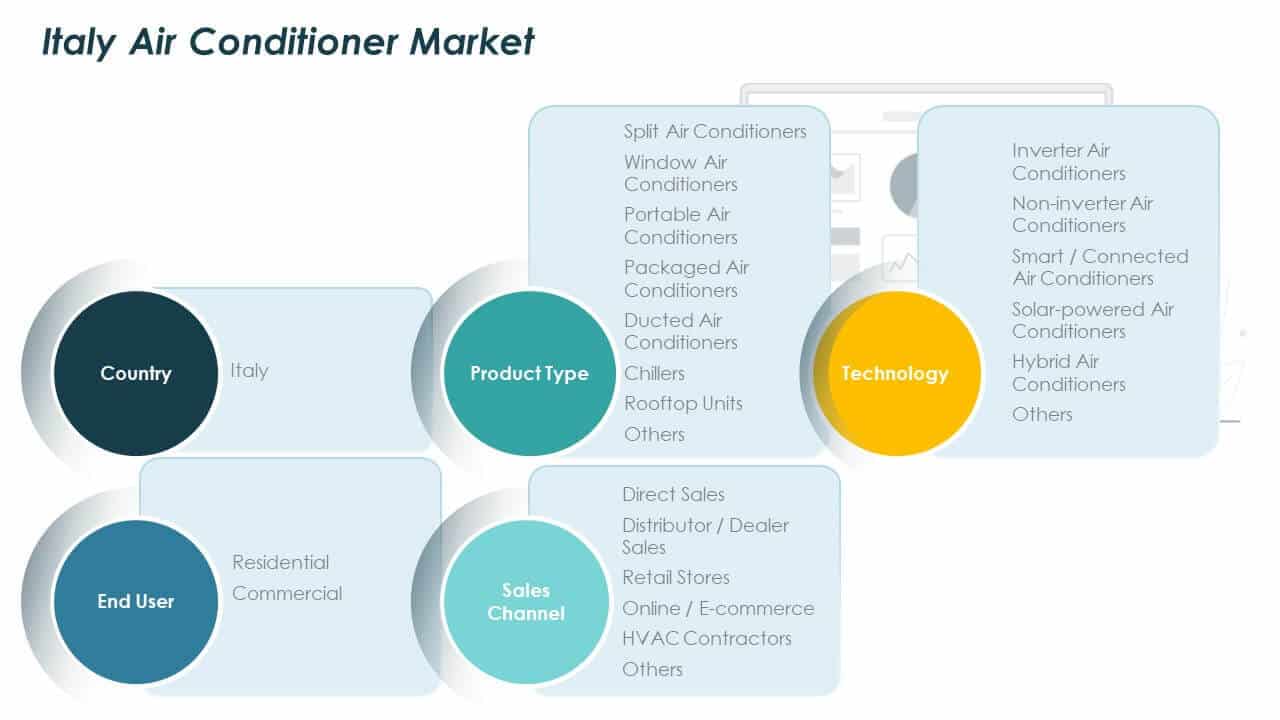
| Segments Covered | Product Type, Technology, End User and Sales Channel |
| Key Companies Covered | Daikin Industries Ltd., Carrier Global Corporation, Mitsubishi Electric Corporation, Panasonic Corporation, Mitsubishi Heavy Industries Ltd., Johnson Controls International plc, LG Electronics Inc., Samsung Electronics Co. Ltd., Trane Technologies plc and Haier Group Corporation |
Company
- Daikin Industries Ltd.
- Carrier Global Corporation
- Mitsubishi Electric Corporation
- Panasonic Corporation
- Mitsubishi Heavy Industries Ltd.
- Johnson Controls International plc
- LG Electronics Inc.
- Samsung Electronics Co. Ltd.
- Trane Technologies plc
- Haier Group Corporation
Italy Air Conditioner Market Segmentations
By Product Type
- Split Air Conditioners
- Window Air Conditioners
- Portable Air Conditioners
- Packaged Air Conditioners
- Ducted Air Conditioners
- Chillers
- Rooftop Units
- Others
By Technology
- Inverter Air Conditioners
- Non-inverter Air Conditioners
- Smart / Connected Air Conditioners
- Solar-powered Air Conditioners
- Hybrid Air Conditioners
- Others
By End User
- Residential
- Commercial
By Sales Channel
- Direct Sales
- Distributor / Dealer Sales
- Retail Stores
- Online / E-commerce
- HVAC Contractors
- Others
Recent Developments
- In January 2025, Daikin presented its future heating and cooling portfolio for ISH25, including Daikin Altherma 4 and commercial innovations such as CO2 VRV for the European market.
- In July 2025, LG Electronics expanded global availability of its air-cooled Inverter Scroll Chiller using R32 refrigerant for commercial HVAC applications.
- In May 2025, Samsung Electronics announced an agreement to acquire FläktGroup for 1.5 billion euros to strengthen its global HVAC business.
- In 2025, Trane Technologies introduced 110 new products, services and solutions designed to help customers reduce energy use and carbon emissions.
Report Coverage
The research report offers an in-depth analysis based on product type, technology, end user, sales channel and geography. It details leading market players, providing an overview of their business positioning, product offerings, revenue relevance and strategic role in the Italy Air Conditioner Market. The report includes insights into the competitive environment, market trends, growth drivers, restraints and opportunities. It also examines heat exposure, energy efficiency, inverter replacement, smart cooling, housing renovation, commercial modernization and seasonal demand patterns as major factors shaping market development. The report assesses the impact of building constraints, installation capacity, energy regulation and refrigerant transition on market growth. It provides strategic recommendations for manufacturers, distributors, HVAC contractors, retailers, commercial building owners, investors and new entrants seeking to navigate Italy’s residential and commercial cooling market.
Future Outlook
- Demand for air conditioners in Italy will continue to rise as warmer summers increase residential and commercial cooling needs.
- Split Air Conditioners will remain the leading product type because they offer flexible installation, high efficiency and broad residential suitability.
- Portable Air Conditioners will record the fastest listed segment growth at a CAGR of 5.8%, supported by retrofit demand and heatwave-led purchases.
- Inverter Air Conditioners will gain wider adoption as customers prioritize lower electricity use and better temperature control.
- Smart / Connected Air Conditioners will grow as users seek app-based controls, energy monitoring and connected home integration.
- Residential demand will remain strong because households increasingly use cooling for comfort and heat protection.
- Commercial demand will remain steady across hotels, offices, retail stores, health care facilities and public buildings.
- Distributor / Dealer Sales and HVAC Contractors will remain critical because installation support, sizing advice and after-sales service influence purchasing decisions.
- Chillers and Ducted Air Conditioners will grow at moderate rates because demand remains project-linked and capital-intensive.
- Competitive intensity will increase as leading HVAC companies compete on efficiency, refrigerants, smart controls, service networks and installer partnerships.

Request a Free Sample
Fill in your details and we'll send you a free sample report.
- Sample data tables & charts
- Research methodology
Need a Custom Version of This Report?
Tailor the scope, geography, or segments to your exact requirements.
- Custom geography or segment scope
- Direct access to our analyst team
Frequently Asked Questions
What is the current market size for the Italy Air Conditioner Market and what is its projected size in 2032?
At what CAGR is the Italy Air Conditioner Market projected to grow?
Which product type segment is expected to lead the Italy Air Conditioner Market?
Which product type segment is projected to grow fastest?
Which technology segment holds the strongest position in the market?
Who are the leading companies in the Italy Air Conditioner Market?
Which end user segment supports strong market demand?
Table of Content
Chapter 1 Market Segmentation
- 1.1 Segmentation Framework
- 1.1.1 Product and Service Classification
- 1.1.2 Application and End-Use Classification
- 1.1.3 Technology and Solution Classification
- 1.1.4 Customer and Distribution Channel Classification
- 1.1.5 Geographic Segmentation
- 1.1.6 Market Segment Definitions and Boundaries
Chapter 2 Introduction
- 2.1 Report Objectives and Scope
- 2.2 Product Definition and Industry Terminology
- 2.3 Market Inclusions and Exclusions
- 2.4 Research Process
- 2.4.1 Primary Research and Expert Interviews
- 2.4.2 Secondary Research and Source Review
- 2.4.3 Top-Down and Bottom-Up Estimation
- 2.4.4 Data Triangulation and Verification
- 2.5 Market Size Measurement Basis
- 2.5.1 2025: USD 2,812.26 MN → 2032: USD 3,992.62 MN
- 2.6 Historical and Forecast Reference Periods
- 2.6.1 Base Year: 2025
- 2.6.2 Forecast Period: 2025-2032
- 2.7 Research Assumptions and Limitations
Chapter 3 Executive Summary
- 3.1 Market Snapshot and Key Findings
- 3.2 Base-Year Market Size, 2025
- 3.3 Forecast Market Size, 2032
- 3.4 Revenue and Volume Growth Outlook
- 3.5 Key Demand and Supply Indicators
- 3.6 Leading Market Segments
- 3.7 Fastest-Growing Market Opportunities
- 3.8 Regional Performance Highlights
- 3.9 Technology and Industry Transformation
- 3.10 Competitive Landscape Summary
- 3.11 Analyst View and Strategic Implications
Chapter 4 Italy Air Conditioner Market Trends and Developments
- 4.1 Historical Industry Development
- 4.2 Recent Market Trends and Developments
- 4.3 Demand and Customer Behavior Trends
- 4.4 Technology and Product Innovation
- 4.5 Artificial Intelligence, Automation and Digitalization
- 4.6 Local Manufacturing and Supply Chain Realignment
- 4.7 Industry Partnerships, Mergers and Acquisitions
- 4.8 Sustainability and Circular Economy Developments
- 4.9 Government and Private Sector Investment Trends
- 4.10 Emerging Business Models and Commercialization
- 4.11 Industry Developments and Announcements
Chapter 5 Italy Air Conditioner Market Production, Supply and Demand Analysis
- 5.1 Demand Trend and Consumption Analysis
- 5.2 Demand Forecast, 2025-2032
- 5.3 Production and Output Trend
- 5.4 Production and Output Forecast, 2025-2032
- 5.5 Installed Capacity and Capacity Utilization
- 5.6 Company-Wise Production Plants and Statistics
- 5.6.1 Installed Production Capacity
- 5.6.2 Actual Production
- 5.6.3 Planned Capacity and Expansion Targets
- 5.7 Supply Chain Structure and Procurement Trends
- 5.8 Supply-Demand Gap and Bottlenecks
- 5.9 Import Dependence and Sourcing Structure
- 5.10 Contract Manufacturing and Outsourcing
- 5.11 Regional Supply and Demand Concentration
Chapter 6 Italy Air Conditioner Market Pricing Analysis
- 6.1 Pricing Structure and Measurement
- 6.2 Historical Pricing Trends
- 6.3 Pricing Outlook, 2025-2032
- 6.4 Average Selling Price and Unit Economics
- 6.5 Pricing by Product and Market Segment
- 6.6 Geographic Pricing Differences
- 6.7 Key Input, Energy, Labor and Logistics Costs
- 6.8 Contract Pricing and Purchasing Models
- 6.9 Pricing Sensitivity and Competitive Positioning
- 6.10 Price, Margin and Profitability Implications
Chapter 7 Italy Air Conditioner Market Dynamics
- 7.1 Market Growth Drivers
- 7.1.1 Demand-Side Drivers
- 7.1.2 Technology and Innovation Drivers
- 7.1.3 Infrastructure and Investment Drivers
- 7.1.4 Regulatory and Policy Drivers
- 7.2 Market Restraints
- 7.2.1 Cost and Affordability Constraints
- 7.2.2 Technology and Adoption Barriers
- 7.2.3 Supply Chain and Operational Constraints
- 7.3 Market Challenges
- 7.3.1 Competitive Pressure and Margin Erosion
- 7.3.2 Skills, Infrastructure and Implementation Gaps
- 7.4 Emerging Market Opportunities
- 7.5 Market Dynamics Impact and Time-Horizon Assessment
Chapter 8 Italy Air Conditioner Value Chain Analysis
- 8.1 Industry Value Chain Overview
- 8.2 Upstream Suppliers and Critical Inputs
- 8.3 Technology and Component Providers
- 8.4 Manufacturing or Service Delivery
- 8.5 Distribution, Channel Partners and Integrators
- 8.6 Downstream Applications and End Users
- 8.7 Value Addition and Profit Pools
- 8.8 Vertical Integration and Outsourcing
- 8.9 Supplier Concentration and Risk
- 8.10 Supply Chain Localization and Resilience
Chapter 9 Italy Air Conditioner Market Regulations and Policies
- 9.1 Relevant Laws, Standards and Compliance Frameworks
- 9.2 Product, Service, Safety and Quality Requirements
- 9.3 Government Policies, Incentives and Subsidies
- 9.4 Imports, Exports and Trade Barriers
- 9.5 Public Procurement and Local Content Requirements
- 9.6 Environmental and Sustainability Compliance
- 9.7 Upcoming Policy Changes and Market Implications
Chapter 10 Italy Air Conditioner Market Hotspots and Opportunities
- 10.1 Market Opportunity Mapping and Growth Hotspots
- 10.2 High-Growth Applications and Customer Groups
- 10.3 Underserved Markets and White-Space Opportunities
- 10.4 Emerging Technology and Product Opportunities
- 10.5 New Capacity and Investment Hotspots
- 10.6 Market Entry and Expansion Opportunities
- 10.7 Distribution and Partnership Opportunities
- 10.8 Near-Term and Long-Term Commercial Potential
- 10.9 Opportunity Attractiveness and Execution Risks
Chapter 11 Italy Air Conditioner Market Outlook, 2025-2032
- 11.1 Market Size and Analysis
- 11.1.1 Revenue (Market Measurement: 2025: USD 2,812.26 MN → 2032: USD 3,992.62 MN)
- 11.1.2 Market Volume and Quantity Sold
- 11.1.3 Historical Market Size
- 11.1.4 Base-Year Market Size, 2025
- 11.2 Market Forecast, 2025-2032
- 11.2.1 Revenue Forecast to 2032
- 11.2.2 Volume Forecast to 2032
- 11.2.3 CAGR and Year-on-Year Growth
- 11.2.4 Incremental Revenue Opportunity
- 11.3 Forecast Assumptions and Scenario Analysis
- 11.3.1 Base-Case Forecast
- 11.3.2 Optimistic and Conservative Scenarios
- 11.3.3 Technology, Pricing and Policy Sensitivities
- 11.4 Market Attractiveness and Growth Outlook
Chapter 12 Italy Air Conditioner Market Segmentation and Outlook
- 12.1 Segmentation Summary and Market Shares, 2025
- 12.2 Largest and Fastest-Growing Segments
- 12.3 Segment Growth Comparison
- 12.4 Segment Attractiveness and Priority Matrix
Chapter 13 Italy Air Conditioner Geographic Market Outlook, 2025-2032
- 13.1 Domestic Market Distribution and Demand Clusters
- 13.2 State- or Province-Wise Market Size and Forecast, 2025-2032
- 13.3 City and Metropolitan Market Outlook
- 13.4 Industrial, Manufacturing and Commercial Clusters
- 13.5 Geographic Concentration of Key End Users
- 13.6 Local Pricing and Purchasing Differences
- 13.7 Domestic Production Facilities and Capacity Map
- 13.8 Local Infrastructure and Project Pipeline
- 13.9 State-Level Policy and Incentive Differences
- 13.10 Subnational Investment Hotspots and Opportunities
- 13.11 Distribution and Logistics Networks
- 13.12 Domestic Competitive Footprint
Chapter 14 Italy Air Conditioner Technology, Innovation and Sustainability Outlook
- 14.1 Technology Landscape and Maturity
- 14.2 Product, Process and Service Innovation
- 14.3 AI, Automation and Digital Tools in the Industry
- 14.4 Technology Adoption and Performance Benchmarking
- 14.5 Innovation Pipeline and R&D Investment
- 14.6 Patent and Intellectual Property Trends
- 14.7 Energy Efficiency and Resource Management
- 14.8 Sustainability, Recycling and Circularity
- 14.9 Technology Roadmap, 2025-2032
- 14.10 Risks of Obsolescence and Technology Substitution
Chapter 15 Italy Air Conditioner Market Key Strategic Imperatives
- 15.1 Growth and Market Entry Priorities
- 15.2 High-Return Products and Segments
- 15.3 Pricing, Profitability and Cost Optimization
- 15.4 Technology Investment and Product Differentiation
- 15.5 Supply Chain Localization and Resilience
- 15.6 Distribution and Customer Acquisition
- 15.7 Partnership, Acquisition and Capacity Strategy
- 15.8 Regional Expansion Priorities
- 15.9 Short-, Medium- and Long-Term Actions
Chapter 16 Competition Outlook
- 16.1 Industry Competition Characteristics
- 16.2 Market Structure and Concentration
- 16.3 Market Share and Competitive Positioning, 2025
- 16.4 Company-Wise Revenue and Product Benchmarking
- 16.5 Production and Service Capacity Benchmarking
- 16.6 Technology, Pricing and Differentiation
- 16.7 Regional Footprint and Distribution Strength
- 16.8 Mergers, Acquisitions and Strategic Alliances
- 16.9 New Entrants and Competitive Threats
- 16.10 Porter's Five Forces and Industry Attractiveness
- 16.11 Competitive Outlook, 2025-2032
Chapter 17 Company Profiles
- 17.1 Company Coverage and Selection Criteria
- 17.2 Leading Market Participants – Standard Profile Structure
- 17.2.1 Business Description
- 17.2.2 Company Ownership and Geographic Presence
- 17.2.3 Product and Service Portfolio
- 17.2.4 Manufacturing and Operating Footprint
- 17.2.5 Production Capacity and Expansion Plans
- 17.2.6 Financial Performance and Investment
- 17.2.7 Market Share and Competitive Position
- 17.2.8 Technology and Innovation Capabilities
- 17.2.9 Strategic Alliances or Partnerships
- 17.2.10 Recent Developments
- 17.2.11 Growth Strategy and Outlook
- 17.3 Other Relevant Market Participants
Note: Every listed company is profiled on the structure shown under the first company. The company list is preliminary and may change based on research findings, market developments, data availability and client requirements.
Chapter 18 Disclaimer
- 18.1 Research and Forecast Disclaimer
- 18.2 Data Source and Estimation Limitations
Note: The depth of individual sections depends on data availability for this market. Volume, capacity, trade and other unit-based metrics are included where applicable.