
| REPORT ATTRIBUTE | DETAILS |
|---|---|
| Historical Period | 2020-2023 |
| Base Year | 2024 |
| Forecast Period | 2025-2032 |
| Latin America Digital Signature Market Size 2024 | USD 319.35 million |
| Latin America Digital Signature Market, CAGR | 31.04% |
| Latin America Digital Signature Market Size 2032 | USD 2,775.68 million |
Market Overview:
The Latin America Digital Signature Market is projected to grow from USD 319.35 million in 2024 to an estimated USD 2,775.68 million by 2032, with a compound annual growth rate (CAGR) of 31.04% from 2024 to 2032.
Several factors are fueling the growth of the digital signature market in Latin America. The widespread adoption of digital signatures across various sectors, including legal and financial services, healthcare, and education, is a primary driver. Additionally, the growing demand for e-businesses and paperless workflows is likely to drive the digital signature market. The increasing adoption of smartphones and growing penetration of the internet are also significant factors affecting the growth of the digital signature market. Furthermore, the increase in demand for multifactor authentication across businesses accelerates market growth. Government mandates promoting data protection and secure communications are reinforcing the adoption of digital signature technologies. Increasing awareness of cybersecurity risks has also led organizations to prioritize secure digital authentication solutions.
Within Latin America, Brazil stands out as a significant market for digital signatures, driven by the widespread adoption of digital certificates and the implementation of legal frameworks supporting their use. Mexico, Argentina, and Colombia are also emerging as key markets, with governments and private organizations embracing digital transformation initiatives. The region’s regulatory evolution, including mandates for e-invoicing and digital identity, is creating a favorable environment for digital signature providers. Additionally, collaboration between public and private sectors is helping to standardize digital practices and foster interoperability across borders. This regional momentum is further strengthened by increasing investments in digital infrastructure and cybersecurity frameworks.
Market Insights:
- The Latin America Digital Signature Market is projected to grow from USD 319.35 million in 2024 to USD 2,775.68 million by 2032, registering a strong CAGR of 31.04% during the forecast period.
- The Global Digital Signature Market is projected to grow significantly, from USD 7,885.08 million in 2024 to USD 76,046.14 million by 2032, reflecting a strong CAGR of 32.75% during the forecast period.
- Accelerated adoption across sectors such as BFSI, legal, education, and healthcare is driving demand for secure, verifiable digital transactions.
- Government regulations recognizing electronic signatures and promoting digital transformation are creating a favorable policy environment for market expansion.
- Technological advancements, including cloud integration, mobile authentication, and improved encryption, are enhancing accessibility and security.
- Rapid e-commerce growth and increased cross-border digital trade are intensifying the need for efficient and compliant digital signature tools.
- Key challenges include low digital literacy in rural areas and fragmented regulatory frameworks that hinder seamless regional adoption.
- Brazil leads the regional market, followed by Mexico, Argentina, and Colombia, supported by legal frameworks, public-private collaborations, and investment in digital infrastructure.
Report Scope
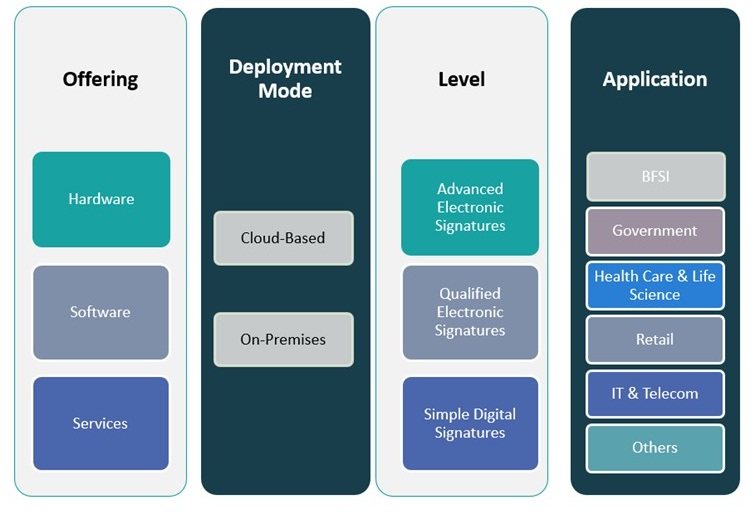
This report segments the Latin America Digital Signature Market as follows:
Market Drivers:
Rising Demand for Secure Digital Transactions
The growing emphasis on secure digital communication and transaction processes across industries is a primary driver of the Latin America digital signature market. Organizations in sectors such as banking, legal, and healthcare are increasingly turning to digital signatures to ensure the integrity, authenticity, and non-repudiation of electronic documents. For example, Zoho reports that “thousands of documents are being digitally signed every day” by businesses in the region, helping them enhance collaboration and strengthen relationships with partners and clients. The digital shift enables faster and more secure operations, especially in environments that demand stringent data privacy and compliance with electronic documentation standards. As businesses pursue paperless workflows and digital efficiency, digital signatures are becoming an essential component of secure and streamlined transactions.
Government Regulations and Digital Transformation Initiatives
The proactive involvement of governments in Latin America is significantly accelerating digital signature adoption. Several countries have introduced legal frameworks and regulatory mandates that recognize the validity of electronic signatures in official documents and contracts. These regulations have paved the way for public institutions and private organizations to implement digital signature solutions with confidence. Moreover, government-backed digital transformation initiatives are promoting the use of secure authentication technologies to modernize public administration and service delivery. This regulatory support fosters trust in digital signature platforms and drives broader adoption across the region.
Technological Advancements and Cloud Integration
Advancements in cloud computing, mobile technology, and cybersecurity are enhancing the scalability and accessibility of digital signature solutions. The integration of digital signatures with cloud platforms enables organizations to deploy secure document workflows without heavy infrastructure investments. For instance, GSE offers the Firma Central service, which stores and manages qualified electronic signatures in the cloud, leveraging the Cloud Signature Consortium (CSC) API for seamless integration with platforms like Adobe Acrobat Sign. Additionally, mobile-based authentication and remote signature capabilities are expanding access to digital signature tools for remote workers and field professionals. These innovations are reducing barriers to adoption and supporting widespread usage in both large enterprises and small-to-medium-sized businesses. The continuous improvement of encryption and identity verification methods further strengthens user trust and system reliability.
Expansion of E-commerce and Cross-border Trade
The rapid growth of e-commerce and the increasing volume of cross-border trade activities in Latin America are creating strong incentives for the adoption of digital signature technologies. Businesses engaged in digital transactions across borders require legally binding, secure, and fast verification methods to execute agreements and maintain operational efficiency. Digital signatures offer a reliable solution that meets the demands of international commerce by ensuring document authenticity and compliance with global data security standards. As more companies participate in the digital economy, the need for secure and standardized signature mechanisms continues to rise, reinforcing market growth.
Market Trends:
Integration of Biometrics and Advanced Authentication
A prominent trend in the Latin America digital signature market is the integration of biometric authentication methods such as fingerprint, facial recognition, and iris scans. These technologies are being incorporated into digital signature platforms to enhance identity verification and reduce the risk of unauthorized access. For instance, in Brazil, facial recognition technology is now used at airports for passenger identification, and the National Civil Registry, together with the Colombian Union of Notaries, introduced biometric facial recognition for remote processes. The adoption of such multi-factor authentication tools is rising, particularly in sectors that manage sensitive information like healthcare, finance, and legal services. Biometric-based digital signatures are gaining traction due to their ability to provide a higher level of assurance in identity validation while aligning with regional efforts to combat digital fraud and cybercrime.
Increased Adoption Among SMEs and Startups
Small and medium-sized enterprises (SMEs) across Latin America are increasingly adopting digital signature solutions as part of broader digital transformation strategies. Unlike large enterprises, SMEs are often more agile in embracing new technologies that improve operational efficiency and reduce costs. Digital signatures are enabling these businesses to digitize contract management, onboarding, and approval processes without the overhead of physical documentation. The availability of cloud-based subscription models and scalable digital tools has made it easier for startups and SMEs to access and implement secure signature solutions, accelerating their market participation.
Rising Popularity of Industry-Specific Solutions
Digital signature providers in Latin America are increasingly tailoring their offerings to meet the specific compliance and workflow requirements of individual industries. For instance, in the financial services sector, solutions are being designed to support Know Your Customer (KYC) protocols and electronic consent for transactions. In the education sector, digital signatures are being used for issuing transcripts and certifying academic records. This vertical-specific customization is enabling businesses to meet industry regulations more effectively while enhancing user convenience and operational control. The trend toward specialization is contributing to more widespread adoption and deeper integration of digital signature technologies across multiple domains.
Expansion of Remote Work and Cross-Functional Collaboration
The rise of remote and hybrid work models in Latin America is reinforcing the demand for seamless digital documentation tools, with digital signatures playing a key role in enabling business continuity. Organizations are leveraging these technologies to authorize contracts, approvals, and policy documents without requiring in-person meetings. This shift is also supporting real-time collaboration among geographically dispersed teams, enhancing efficiency and reducing turnaround times. As digital workspaces become the norm, digital signatures are evolving from a compliance necessity to a strategic tool for enhancing productivity and agility in cross-functional operations.
Market Challenges Analysis:
Lack of Digital Literacy and Awareness
One of the primary challenges hindering the growth of the Latin America digital signature market is the limited digital literacy among a significant portion of the population. Many small businesses and individual users remain unaware of the benefits, legal standing, and operational efficiency that digital signatures can offer. This gap in understanding creates reluctance to adopt digital tools and slows down market penetration. In rural and underserved regions, the lack of digital education and minimal exposure to secure online practices further restricts the implementation of digital signature technologies. Overcoming this barrier requires widespread awareness campaigns, training programs, and government-led initiatives aimed at educating users about the value and safety of digital authentication systems.
Infrastructure Limitations and Regulatory Disparities
The market also faces structural challenges stemming from uneven technological infrastructure and inconsistent regulatory frameworks across Latin American countries. For example, Peru’s Law No. 27269 and Colombia’s Law 527 both recognize digital signatures as legally binding, but technical and security requirements differ by country. While some nations have made significant progress in developing robust digital identity systems and legal recognition for digital signatures, others lag behind due to underdeveloped IT ecosystems and fragmented policy landscapes. These disparities make it difficult for digital signature providers to offer seamless, region-wide solutions. In addition, limited internet connectivity in remote areas impedes real-time access to cloud-based signature services, reducing their effectiveness. To address these issues, a coordinated regional approach is needed to harmonize legal standards and invest in improving digital infrastructure across borders.
Market Opportunities:
The Latin America digital signature market presents significant growth opportunities driven by the region’s increasing commitment to digital transformation and e-governance. As governments across Latin America continue to modernize public services, digital signature solutions are being integrated into administrative workflows, legal systems, and identity management processes. These developments create a favorable environment for solution providers to offer secure, scalable, and compliant technologies that support electronic documentation and identity verification. Furthermore, the growing trend of cross-border digital trade and electronic invoicing demands standardized and legally recognized digital signature systems, opening opportunities for vendors to develop interoperable platforms tailored to regional needs.
Additionally, the expansion of remote work and digital banking across Latin America presents a vast opportunity to promote digital signature adoption. Financial institutions, insurance companies, and fintech startups are increasingly adopting e-signature technologies to enhance customer onboarding, contract processing, and regulatory compliance. As more organizations migrate operations to digital channels, the demand for secure, user-friendly signature solutions is expected to grow. The emergence of blockchain-based signature platforms and the integration of artificial intelligence for identity authentication also offer new avenues for innovation and market differentiation. Companies that can offer multilingual, mobile-compatible, and industry-specific digital signature tools stand to gain a competitive advantage in this evolving market landscape.
Market Segmentation Analysis:
The Latin America digital signature market is segmented into offering, deployment mode, level, and application.
By offering, the market comprises hardware, software, and services. Among these, software dominates the segment due to its ease of integration, scalability, and adaptability across various industries. Service-based solutions are also growing steadily as businesses seek support in implementation, customization, and compliance consulting, while hardware adoption remains niche, primarily in sectors with heightened security demands.
By deployment mode, the market is divided into cloud-based and on-premises solutions. Cloud-based deployment holds a larger share due to its cost-efficiency, remote accessibility, and minimal infrastructure requirements. Cloud solutions also enable businesses to manage signatures at scale while ensuring regulatory compliance. On-premises deployment, however, continues to attract organizations with stringent data sovereignty and internal control needs, particularly in banking and government sectors.
By signature level, the market includes advanced electronic signatures, qualified electronic signatures, and simple digital signatures. Advanced electronic signatures are gaining momentum for their balance between legal validity and operational flexibility. Qualified electronic signatures, though limited by regulatory constraints, are used in high-assurance environments, while simple digital signatures are commonly applied in low-risk, internal communications.
By application, the market serves diverse industries such as BFSI, government, healthcare and life sciences, retail, IT and telecom, and others. BFSI and government sectors are leading adopters due to their need for secure, compliant documentation processes. Meanwhile, healthcare, IT, and retail sectors are rapidly integrating digital signatures to enhance operational efficiency and digital customer experiences.
Segmentation:
By Offering Segment:
- Hardware
- Software
- Services
By Deployment Mode Segment:
- Cloud-Based
- On-Premises
By Level Segment:
- Advanced Electronic Signatures
- Qualified Electronic Signatures
- Simple Digital Signatures
By Application Segment:
- BFSI (Banking, Financial Services, and Insurance)
- Government
- Healthcare & Life Sciences
- Retail
- IT & Telecom
- Others
Regional Analysis:
The Latin America digital signature market exhibits diverse growth patterns across its key economies, driven by varying degrees of digital infrastructure development, regulatory frameworks, and industry adoption rates. Brazil leads the region, accounting for the largest market share, attributed to its advanced digital certificate infrastructure and robust legal frameworks supporting electronic signatures. The country's emphasis on digital transformation across sectors such as finance, healthcare, and government services has significantly contributed to the widespread adoption of digital signature solutions.
Mexico follows closely, emerging as a significant market due to its proactive government initiatives promoting e-governance and digitalization of public services. The country's focus on enhancing cybersecurity measures and the increasing need for secure electronic transactions have further fueled the demand for digital signature technologies.
Argentina and Colombia are also witnessing notable growth in the adoption of digital signature solutions. In Argentina, the government's efforts to modernize administrative processes and implement electronic documentation have paved the way for increased utilization of digital signatures. Colombia's emphasis on improving digital literacy and expanding internet connectivity has facilitated the integration of digital signature technologies, particularly in the financial and legal sectors.
Other countries, including Chile and Peru, are gradually embracing digital signature solutions, driven by the need for efficient and secure document management systems. These nations are investing in enhancing their digital infrastructure and aligning regulatory policies to support the adoption of electronic signatures. The collective efforts across Latin America indicate a regional momentum towards embracing digital signature technologies, with each country contributing uniquely to the market's overall growth trajectory.
Key Player Analysis:
- Soluti
- Certisign
- EcertChile
- Firma Virtual
- IFX Networks
Competitive Analysis:
The Latin America digital signature market is moderately fragmented, with a mix of global leaders and regional players competing on technological innovation, compliance capabilities, and industry-specific solutions. Companies such as Adobe Inc., DocuSign Inc., and OneSpan Inc. maintain a strong presence due to their scalable cloud-based platforms, robust encryption standards, and extensive integration capabilities. Regional providers like Certisign and eSignLive are gaining traction by offering localized solutions that comply with national regulations and cater to the unique operational needs of Latin American businesses. Strategic partnerships with government bodies and financial institutions are a key competitive tactic, enabling vendors to secure large-scale deployments. As the demand for digital transformation grows, market players are investing in advanced authentication technologies, multilingual support, and mobile compatibility to enhance user experience and gain a competitive edge in the evolving regulatory and technological landscape of Latin America.
Recent Developments:
- In Nov 2024, eID Easy, a digital signature platform provider, announced a strategic partnership with Gestión de Seguridad Electrónica S.A. (GSE), Colombia’s leading digital certification authority. This collaboration aims to make secure digital signatures more accessible across Latin America by integrating GSE’s legally compliant digital certificates into eID Easy’s platform. The partnership is designed to help businesses transition from paper-based to fully digital workflows, ensuring signatures meet all local legal standards and regulatory requirements.
- In May 2024, DocuSign agreed to acquire Lexion, an AI-powered agreement management software company, for $165 million. This acquisition is set to enhance DocuSign’s Intelligent Agreement Management (IAM) platform with advanced AI capabilities, streamlining contract workflows and centralizing agreement processes for enterprise customers. Lexion’s team will join DocuSign, further strengthening its AI and engineering expertise.
- In March 2025, Adobe launched the Adobe Experience Platform Agent Orchestrator, a tool that enables businesses to build and manage AI agents for customer experiences and marketing workflows. This launch is supported by strategic partnerships with major technology companies, including Microsoft, SAP, and ServiceNow, ensuring seamless integration and execution across various AI-driven use cases.
Market Concentration & Characteristics:
The Latin America digital signature market is characterized by moderate concentration, featuring a blend of global technology providers and regional firms. Leading international companies such as DocuSign, Adobe, and OneSpan maintain a strong presence, offering scalable cloud-based platforms and robust encryption standards. Simultaneously, regional players like Certisign and eSignLive have gained traction by delivering localized solutions that comply with national regulations and cater to the unique operational needs of Latin American businesses. This competitive landscape fosters innovation and ensures a diverse range of offerings tailored to various industry requirements. The market exhibits dynamic characteristics driven by the region's accelerating digital transformation and increasing demand for secure electronic transactions. Adoption is particularly prominent in sectors such as banking, government, healthcare, and legal services, where the need for compliance and data integrity is paramount. The proliferation of cloud computing and mobile technologies has further facilitated the integration of digital signature solutions, enabling remote authentication and streamlined workflows. As organizations continue to prioritize efficiency and security, the Latin America digital signature market is poised for sustained growth, with opportunities for both established and emerging players to expand their footprint.
Report Coverage:
The research report offers an in-depth analysis based on Offering, Deployment Mode, Level and Application. It details leading market players, providing an overview of their business, product offerings, investments, revenue streams, and key applications. Additionally, the report includes insights into the competitive environment, SWOT analysis, current market trends, as well as the primary drivers and constraints. Furthermore, it discusses various factors that have driven market expansion in recent years. The report also explores market dynamics, regulatory scenarios, and technological advancements that are shaping the industry. It assesses the impact of external factors and global economic changes on market growth. Lastly, it provides strategic recommendations for new entrants and established companies to navigate the complexities of the market.
Future Outlook:
- The market is expected to witness sustained growth due to increasing digitalization across public and private sectors.
- Adoption will expand in SMEs as cloud-based, subscription-friendly solutions become more accessible.
- Advancements in AI and blockchain will enhance signature verification and tamper-proof documentation.
- Governments are likely to strengthen regulatory frameworks, increasing trust in digital signatures.
- Remote work trends will drive demand for mobile-compatible and real-time e-signature solutions.
- Financial services will continue leading adoption, with healthcare and education following closely.
- Localization of software offerings will become a key strategy for gaining market share.
- Interoperability across Latin American countries may improve through regional policy harmonization.
- Increased investment in cybersecurity will support broader digital signature integration.
- Competition will intensify, encouraging innovation and strategic partnerships among vendors.

Request a Free Sample
Fill in your details and we'll send you a free sample report.
- Sample data tables & charts
- Research methodology
Market Dynamics
Government Regulations and Digital Transformation Initiatives
Proactive government policies and legal frameworks across Latin America are recognizing the validity of electronic signatures, encouraging both public and private sectors to adopt digital signature solutions for official documentation and service delivery.
Technological Advancements and Cloud Integration
The integration of digital signatures with cloud platforms and mobile authentication is making secure document workflows more accessible and scalable, reducing infrastructure costs and enabling remote and real-time signature capabilities.
Expansion of E-commerce and Cross-border Trade
The rapid growth of e-commerce and increased cross-border digital transactions in Latin America are driving demand for secure, legally binding, and efficient digital signature solutions to support international business and compliance.
Rising Demand for Secure Digital Transactions
Industries such as banking, legal, and healthcare are increasingly adopting digital signatures to ensure the integrity, authenticity, and non-repudiation of electronic documents, supporting the shift to paperless and secure operations.
Increased Adoption Among SMEs and Startups
Small and medium-sized enterprises are embracing digital signature solutions to digitize contract management and approval processes, leveraging cloud-based and subscription-friendly models to enhance operational efficiency and reduce costs.
Need a Custom Version of This Report?
Tailor the scope, geography, or segments to your exact requirements.
- Custom geography or segment scope
- Direct access to our analyst team
Frequently Asked Questions
What is the current size of the Latin America Digital Signature Market?
What factors are driving the growth of the Latin America Digital Signature Market?
What are the key segments within the Latin America Digital Signature Market?
Who are the major players in the Latin America Digital Signature Market?
Table of Content
Chapter 1 Market Segmentation
- 1.1 Segmentation Framework
- 1.1.1 Product and Service Classification
- 1.1.2 Application and End-Use Classification
- 1.1.3 Technology and Solution Classification
- 1.1.4 Customer and Distribution Channel Classification
- 1.1.5 Geographic Segmentation
- 1.1.6 Market Segment Definitions and Boundaries
- 1.2 By Level
- 1.2.1 Advanced Electronic Signatures
- 1.2.2 Qualified Electronic Signatures
- 1.2.3 Simple Digital Signatures
- 1.3 By Offering
- 1.3.1 Hardware
- 1.3.2 Software
- 1.3.3 Services
- 1.4 By Application
- 1.4.1 BFSI (Banking, Financial Services, and Insurance)
- 1.4.2 Government
- 1.4.3 Healthcare & Life Sciences
- 1.4.4 Retail
- 1.4.5 IT & Telecom
- 1.4.6 Others
- 1.5 By Deployment Mode
- 1.5.1 Cloud-Based
- 1.5.2 On-Premises
Chapter 2 Introduction
- 2.1 Report Objectives and Scope
- 2.2 Product Definition and Industry Terminology
- 2.3 Market Inclusions and Exclusions
- 2.4 Research Process
- 2.4.1 Primary Research and Expert Interviews
- 2.4.2 Secondary Research and Source Review
- 2.4.3 Top-Down and Bottom-Up Estimation
- 2.4.4 Data Triangulation and Verification
- 2.5 Market Size Measurement Basis
- 2.5.1 2024: USD 319.35 million → 2032: USD 2,775.68 million
- 2.6 Historical and Forecast Reference Periods
- 2.6.1 Base Year: 2024
- 2.6.2 Forecast Period: 2024-2032
- 2.7 Research Assumptions and Limitations
Chapter 3 Executive Summary
- 3.1 Market Snapshot and Key Findings
- 3.2 Base-Year Market Size, 2024
- 3.3 Forecast Market Size, 2032
- 3.4 Revenue and Volume Growth Outlook
- 3.5 Key Demand and Supply Indicators
- 3.6 Leading Market Segments
- 3.7 Fastest-Growing Market Opportunities
- 3.8 Regional Performance Highlights
- 3.9 Technology and Industry Transformation
- 3.10 Competitive Landscape Summary
- 3.11 Analyst View and Strategic Implications
Chapter 4 Latin America Digital Signature Market Trends and Developments
- 4.1 Historical Industry Development
- 4.2 Recent Market Trends and Developments
- 4.3 Demand and Customer Behavior Trends
- 4.4 Technology and Product Innovation
- 4.5 Artificial Intelligence, Automation and Digitalization
- 4.6 Local Manufacturing and Supply Chain Realignment
- 4.7 Industry Partnerships, Mergers and Acquisitions
- 4.8 Sustainability and Circular Economy Developments
- 4.9 Government and Private Sector Investment Trends
- 4.10 Emerging Business Models and Commercialization
- 4.11 Industry Developments and Announcements
Chapter 5 Latin America Digital Signature Market Production, Supply and Demand Analysis
- 5.1 Demand Trend and Consumption Analysis
- 5.2 Demand Forecast, 2024-2032
- 5.3 Production and Output Trend
- 5.4 Production and Output Forecast, 2024-2032
- 5.5 Installed Capacity and Capacity Utilization
- 5.6 Company-Wise Production Plants and Statistics
- 5.6.1 Installed Production Capacity
- 5.6.2 Actual Production
- 5.6.3 Planned Capacity and Expansion Targets
- 5.7 Supply Chain Structure and Procurement Trends
- 5.8 Supply-Demand Gap and Bottlenecks
- 5.9 Import Dependence and Sourcing Structure
- 5.10 Contract Manufacturing and Outsourcing
- 5.11 Regional Supply and Demand Concentration
Chapter 6 Latin America Digital Signature Market Pricing Analysis
- 6.1 Pricing Structure and Measurement
- 6.2 Historical Pricing Trends
- 6.3 Pricing Outlook, 2024-2032
- 6.4 Average Selling Price and Unit Economics
- 6.5 Pricing by Product and Market Segment
- 6.6 Geographic Pricing Differences
- 6.7 Key Input, Energy, Labor and Logistics Costs
- 6.8 Contract Pricing and Purchasing Models
- 6.9 Pricing Sensitivity and Competitive Positioning
- 6.10 Price, Margin and Profitability Implications
Chapter 7 Latin America Digital Signature Market Dynamics
- 7.1 Market Growth Drivers
- 7.1.1 Demand-Side Drivers
- 7.1.2 Technology and Innovation Drivers
- 7.1.3 Infrastructure and Investment Drivers
- 7.1.4 Regulatory and Policy Drivers
- 7.2 Market Restraints
- 7.2.1 Cost and Affordability Constraints
- 7.2.2 Technology and Adoption Barriers
- 7.2.3 Supply Chain and Operational Constraints
- 7.3 Market Challenges
- 7.3.1 Competitive Pressure and Margin Erosion
- 7.3.2 Skills, Infrastructure and Implementation Gaps
- 7.4 Emerging Market Opportunities
- 7.5 Market Dynamics Impact and Time-Horizon Assessment
Chapter 8 Latin America Digital Signature Value Chain Analysis
- 8.1 Industry Value Chain Overview
- 8.2 Upstream Suppliers and Critical Inputs
- 8.3 Technology and Component Providers
- 8.4 Manufacturing or Service Delivery
- 8.5 Distribution, Channel Partners and Integrators
- 8.6 Downstream Applications and End Users
- 8.7 Value Addition and Profit Pools
- 8.8 Vertical Integration and Outsourcing
- 8.9 Supplier Concentration and Risk
- 8.10 Supply Chain Localization and Resilience
Chapter 9 Latin America Digital Signature Market Regulations and Policies
- 9.1 Relevant Laws, Standards and Compliance Frameworks
- 9.2 Product, Service, Safety and Quality Requirements
- 9.3 Government Policies, Incentives and Subsidies
- 9.4 Imports, Exports and Trade Barriers
- 9.5 Public Procurement and Local Content Requirements
- 9.6 Environmental and Sustainability Compliance
- 9.7 Data Protection, AI and Cybersecurity Compliance
- 9.8 Upcoming Policy Changes and Market Implications
Chapter 10 Latin America Digital Signature Market Hotspots and Opportunities
- 10.1 Market Opportunity Mapping and Growth Hotspots
- 10.2 High-Growth Applications and Customer Groups
- 10.3 Underserved Markets and White-Space Opportunities
- 10.4 Emerging Technology and Product Opportunities
- 10.5 New Capacity and Investment Hotspots
- 10.6 Market Entry and Expansion Opportunities
- 10.7 Distribution and Partnership Opportunities
- 10.8 Near-Term and Long-Term Commercial Potential
- 10.9 Opportunity Attractiveness and Execution Risks
Chapter 11 Latin America Digital Signature Market Outlook, 2024-2032
- 11.1 Market Size and Analysis
- 11.1.1 Revenue (Market Measurement: 2024: USD 319.35 million → 2032: USD 2,775.68 million)
- 11.1.2 Market Volume and Quantity Sold
- 11.1.3 Historical Market Size
- 11.1.4 Base-Year Market Size, 2024
- 11.2 Market Forecast, 2024-2032
- 11.2.1 Revenue Forecast to 2032
- 11.2.2 Volume Forecast to 2032
- 11.2.3 CAGR and Year-on-Year Growth
- 11.2.4 Incremental Revenue Opportunity
- 11.3 Forecast Assumptions and Scenario Analysis
- 11.3.1 Base-Case Forecast
- 11.3.2 Optimistic and Conservative Scenarios
- 11.3.3 Technology, Pricing and Policy Sensitivities
- 11.4 Market Attractiveness and Growth Outlook
Chapter 12 Latin America Digital Signature Market Segmentation and Outlook
- 12.1 Segmentation Summary and Market Shares, 2024
- 12.2 Largest and Fastest-Growing Segments
- 12.3 By Level - Market Size and Forecast, 2024-2032
- 12.3.1 Segment Definition and Scope
- 12.3.2 Historical Market Size
- 12.3.3 Revenue Forecast, 2024-2032
- 12.3.4 Volume Forecast, 2024-2032
- 12.3.5 Base-Year Market Share, 2024
- 12.3.6 Segment CAGR and Growth Drivers
- 12.3.7 Subsegment Market Size and Forecast
- 12.3.7.1 Advanced Electronic Signatures
- 12.3.7.2 Qualified Electronic Signatures
- 12.3.7.3 Simple Digital Signatures
- 12.3.8 Subsegment Pricing and Adoption Trends
- 12.3.9 Leading Suppliers and Competition
- 12.3.10 Regional Demand and Opportunities
- 12.4 By Offering - Market Size and Forecast, 2024-2032
- 12.4.1 Segment Definition and Scope
- 12.4.2 Historical Market Size
- 12.4.3 Revenue Forecast, 2024-2032
- 12.4.4 Volume Forecast, 2024-2032
- 12.4.5 Base-Year Market Share, 2024
- 12.4.6 Segment CAGR and Growth Drivers
- 12.4.7 Subsegment Market Size and Forecast
- 12.4.7.1 Hardware
- 12.4.7.2 Software
- 12.4.7.3 Services
- 12.4.8 Subsegment Pricing and Adoption Trends
- 12.4.9 Leading Suppliers and Competition
- 12.4.10 Regional Demand and Opportunities
- 12.5 By Application - Market Size and Forecast, 2024-2032
- 12.5.1 Segment Definition and Scope
- 12.5.2 Historical Market Size
- 12.5.3 Revenue Forecast, 2024-2032
- 12.5.4 Volume Forecast, 2024-2032
- 12.5.5 Base-Year Market Share, 2024
- 12.5.6 Segment CAGR and Growth Drivers
- 12.5.7 Subsegment Market Size and Forecast
- 12.5.7.1 BFSI (Banking, Financial Services, and Insurance)
- 12.5.7.2 Government
- 12.5.7.3 Healthcare & Life Sciences
- 12.5.7.4 Retail
- 12.5.7.5 IT & Telecom
- 12.5.7.6 Others
- 12.5.8 Subsegment Pricing and Adoption Trends
- 12.5.9 Leading Suppliers and Competition
- 12.5.10 Regional Demand and Opportunities
- 12.6 By Deployment Mode - Market Size and Forecast, 2024-2032
- 12.6.1 Segment Definition and Scope
- 12.6.2 Historical Market Size
- 12.6.3 Revenue Forecast, 2024-2032
- 12.6.4 Volume Forecast, 2024-2032
- 12.6.5 Base-Year Market Share, 2024
- 12.6.6 Segment CAGR and Growth Drivers
- 12.6.7 Subsegment Market Size and Forecast
- 12.6.7.1 Cloud-Based
- 12.6.7.2 On-Premises
- 12.6.8 Subsegment Pricing and Adoption Trends
- 12.6.9 Leading Suppliers and Competition
- 12.6.10 Regional Demand and Opportunities
- 12.7 Segment Growth Comparison
- 12.8 Segment Attractiveness and Priority Matrix
Chapter 13 Latin America Digital Signature End-Use and Application Market Outlook
- 13.1 End-Use Industry and Customer Demand Structure
- 13.2 Leading Applications and Customer Groups
- 13.3 End-Use Market Size, Share and Forecast
- 13.4 Major End-Use Industry Deep Dives
- 13.4.1 Customer Requirements and Use Cases
- 13.4.2 Demand and Replacement Cycles
- 13.4.3 Technical and Regulatory Considerations
- 13.4.4 Purchasing and Procurement Models
- 13.4.5 Leading Vendors and Distribution Channels
- 13.4.6 Forecast and Commercial Opportunities
- 13.5 Emerging Applications and Cross-Segment Demand
- 13.6 End-Use Industry Investment Priorities
Chapter 14 Latin America Digital Signature Geographic Market Outlook, 2024-2032
- 14.1 Regional Market Size and Country-Level Shares, 2024
- 14.2 Country Market Size Comparison, 2024
- 14.3 Country Market Forecasts, 2024-2032
- 14.4 Subregional Industrial and Demand Clusters
- 14.5 Intra-Regional Pricing and Cost Differences
- 14.6 Cross-Border Trade and Supply Networks
- 14.7 Regional Supply and Demand Balances
- 14.8 Country Opportunity Comparison and Prioritization
Note: Every listed country is covered on the structure shown under the first country.
Chapter 15 Latin America Digital Signature Technology, Innovation and Sustainability Outlook
- 15.1 Technology Landscape and Maturity
- 15.2 Product, Process and Service Innovation
- 15.3 AI, Automation and Digital Tools in the Industry
- 15.4 Technology Adoption and Performance Benchmarking
- 15.5 Innovation Pipeline and R&D Investment
- 15.6 Patent and Intellectual Property Trends
- 15.7 Energy Efficiency and Resource Management
- 15.8 Sustainability, Recycling and Circularity
- 15.9 Technology Roadmap, 2024-2032
- 15.10 Risks of Obsolescence and Technology Substitution
Chapter 16 Latin America Digital Signature Market Key Strategic Imperatives
- 16.1 Growth and Market Entry Priorities
- 16.2 High-Return Products and Segments
- 16.3 Pricing, Profitability and Cost Optimization
- 16.4 Technology Investment and Product Differentiation
- 16.5 Supply Chain Localization and Resilience
- 16.6 Distribution and Customer Acquisition
- 16.7 Partnership, Acquisition and Capacity Strategy
- 16.8 Regional Expansion Priorities
- 16.9 Short-, Medium- and Long-Term Actions
Chapter 17 Competition Outlook
- 17.1 Industry Competition Characteristics
- 17.2 Market Structure and Concentration
- 17.3 Market Share and Competitive Positioning, 2024
- 17.4 Company-Wise Revenue and Product Benchmarking
- 17.5 Production and Service Capacity Benchmarking
- 17.6 Technology, Pricing and Differentiation
- 17.7 Regional Footprint and Distribution Strength
- 17.8 Mergers, Acquisitions and Strategic Alliances
- 17.9 New Entrants and Competitive Threats
- 17.10 Porter's Five Forces and Industry Attractiveness
- 17.11 Competitive Outlook, 2024-2032
Chapter 18 Company Profiles
- 18.1 Company Coverage and Selection Criteria
- 18.2 DocuSign
- 18.2.1 Business Description
- 18.2.2 Company Ownership and Geographic Presence
- 18.2.3 Product and Service Portfolio
- 18.2.4 Manufacturing and Operating Footprint
- 18.2.5 Production Capacity and Expansion Plans
- 18.2.6 Financial Performance and Investment
- 18.2.7 Market Share and Competitive Position
- 18.2.8 Technology and Innovation Capabilities
- 18.2.9 Strategic Alliances or Partnerships
- 18.2.10 Recent Developments
- 18.2.11 Growth Strategy and Outlook
- 18.3 Adobe
- 18.4 OneSpan
- 18.5 Certisign
- 18.6 Soluti
- 18.7 EcertChile
- 18.8 Firma Virtual
- 18.9 IFX Networks
- 18.10 eSignLive
- 18.11 Zoho
- 18.12 Other Relevant Market Participants
Note: Every listed company is profiled on the structure shown under the first company. The company list is preliminary and may change based on research findings, market developments, data availability and client requirements.
Chapter 19 Disclaimer
- 19.1 Research and Forecast Disclaimer
- 19.2 Data Source and Estimation Limitations
Note: The depth of individual sections depends on data availability for this market. Volume, capacity, trade and other unit-based metrics are included where applicable.

