
Market Overview:
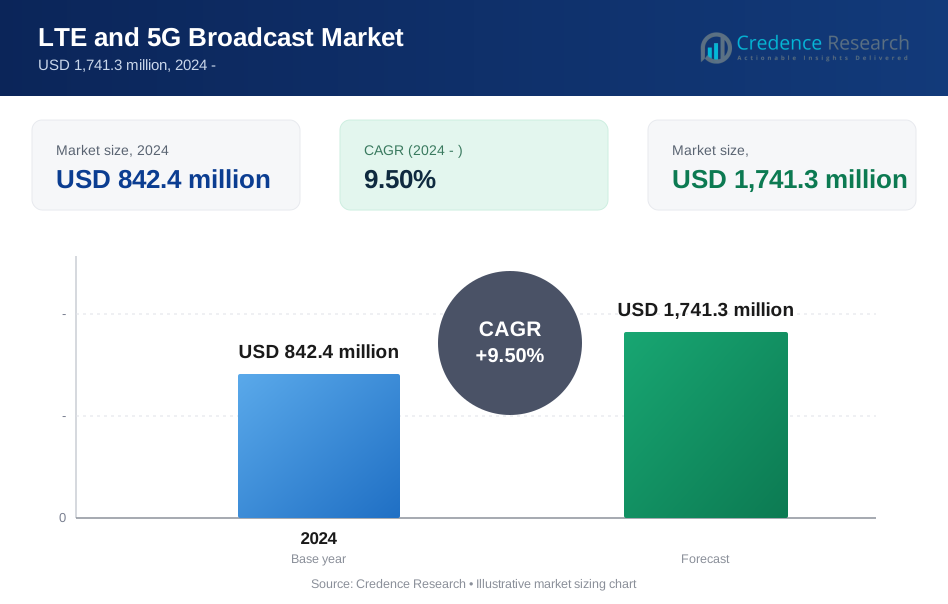
The LTE and 5G Broadcast market size was valued at USD 842.4 million in 2024 and is anticipated to reach USD 1,741.3 million by 2032, at a CAGR of 9.5% during the forecast period.
| REPORT ATTRIBUTE | DETAILS |
|---|---|
| Historical Period | 2020-2023 |
| Base Year | 2024 |
| Forecast Period | 2025-2032 |
| LTE and 5G Broadcast Market Size 2024 | USD 842.4 million |
| LTE and 5G Broadcast Market, CAGR | 9.5% |
| LTE and 5G Broadcast Market Size 2032 | USD 1,741.3 million |
The LTE and 5G Broadcast market is led by prominent players such as Huawei Technologies, Ericsson, Nokia, Qualcomm, and Samsung Electronics, each contributing significantly through advanced R&D and large-scale 5G infrastructure deployments. These companies focus on enhancing spectrum efficiency and enabling high-quality content delivery across networks. Other key participants include Intel, Cisco, Broadcom, ZTE, and telecom operators like Verizon Wireless, AT&T Inc., China Mobile, and SK Telecom, who are integrating broadcast technologies into their offerings. Regionally, Asia Pacific dominates the market with a 34% share, driven by rapid 5G adoption and government-backed initiatives in countries like China, South Korea, and Japan. North America follows with a 30% market share, supported by strong telecom infrastructure and early commercialization of 5G services. Europe holds a 26% share, benefiting from regulatory support and increasing demand for broadcast solutions in public and media sectors. These regions collectively shape the competitive dynamics of the global market.
Market Insights
- The LTE and 5G Broadcast market was valued at USD 842.4 million in 2024 and is projected to reach USD 1,741.3 million by 2032, growing at a CAGR of 9.5% during the forecast period.
- Growth is driven by increasing demand for high-quality video streaming, rising mobile data traffic, and the need for spectrum-efficient content delivery across telecom and media industries.
- A key trend includes the rapid adoption of 5G Broadcast for live events, sports broadcasting, and public safety, along with growing integration into transportation and infotainment systems.
- The market features strong competition from players like Huawei, Nokia, Ericsson, Qualcomm, and Samsung, who are investing in infrastructure, partnerships, and next-gen broadcast trials; however, high initial costs and device compatibility limitations act as restraints.
- Asia Pacific leads with a 34% market share, followed by North America (30%) and Europe (26%); the 5G Broadcast segment dominates by technology, and video streaming leads by application.
Market Segmentation Analysis:
By Technology
The 5G Broadcast segment held the dominant market share in 2024 due to its superior bandwidth, low latency, and ability to serve a massive number of users simultaneously. This technology is increasingly adopted across media and telecom industries for delivering high-quality content without network congestion. It is gaining momentum in live sports and real-time applications, especially with growing 5G infrastructure rollouts globally. In contrast, LTE Broadcast and Dynamic Adaptive Streaming continue to support legacy systems and adaptive content delivery but are gradually being overshadowed by 5G’s efficiency and scalability in high-traffic environments.
- For instance, in February 2023, Qualcomm successfully demonstrated 5G Broadcast capability on the Snapdragon X75 Modem-RF System using Release 17, achieving a throughput of 61 Mbps in a 10 MHz broadcast channel with near-zero latency during a live video streaming test.
By Application:
Video Streaming emerged as the leading application segment, accounting for the largest market share in 2024, driven by the surging demand for on-demand and high-definition content. The proliferation of smartphones, smart TVs, and OTT platforms has significantly increased video consumption across demographics. Furthermore, advancements in mobile networks and the introduction of 5G have enhanced streaming quality, further fueling adoption. Live Events Broadcasting is also expanding, particularly in sports and entertainment sectors, while Content Distribution benefits from improved spectrum utilization and multicast capabilities of broadcast technologies.
- For instance, in March 2024, KT Corporation deployed 5G Broadcast for live streaming the 2024 Seoul Marathon to 350,000 concurrent users without network buffering, leveraging SFN (Single Frequency Network) mode for seamless real-time delivery.
By End Use:
The Media & Entertainment segment dominated the LTE and 5G Broadcast market in 2024, owing to its rapid adoption of high-bandwidth technologies to deliver immersive and interactive content experiences. Broadcasters and content providers are leveraging 5G broadcast to reach wider audiences without additional network load, especially during major live events and festivals. The Telecommunications sector follows closely, investing in infrastructure to support seamless multimedia delivery. Transportation is an emerging end-use area, with increasing use of broadcast solutions for infotainment and passenger engagement systems in vehicles, trains, and public transit networks.
Market Overview
Rising Demand for High-Quality Video Content
The rapid proliferation of smart devices, coupled with increased consumer preference for high-definition (HD) and ultra-high-definition (UHD) video streaming, is significantly boosting the demand for efficient broadcast technologies. LTE and 5G Broadcast offer scalable, reliable solutions for content distribution, particularly in congested urban environments and live event scenarios. These technologies reduce network load and improve user experience, making them highly suitable for media platforms, sports broadcasters, and entertainment providers. This demand is a major driver of technology adoption, especially in regions with high internet penetration.
- For instance, Verizon’s 5G Ultra Wideband network supported 4K streaming to over 500,000 users during the 2023 Super Bowl LVII, using dynamic broadcast techniques to reduce backhaul pressure by 38% compared to traditional unicast models.
Expansion of 5G Infrastructure Worldwide
Governments and telecom operators are heavily investing in the rollout of 5G infrastructure, accelerating the deployment of 5G Broadcast capabilities. Unlike unicast, which struggles under high user density, 5G Broadcast enables one-to-many content delivery, making it ideal for real-time applications. As 5G coverage expands, it creates a fertile environment for broadcast technologies to thrive, particularly in sectors like public safety, automotive infotainment, and smart cities. This infrastructure expansion provides the technical backbone necessary for scaling broadcast solutions and meeting growing user expectations.
- For instance, as of December 2023, China Mobile deployed 1.9 million 5G base stations across the country, supporting nationwide 5G Broadcast trials across 47 cities, enabling efficient delivery of multimedia content in high-density public areas.
Growing Need for Efficient Spectrum Utilization
Traditional content delivery models consume significant spectrum, especially during high-traffic events. LTE and 5G Broadcast optimize spectrum usage by transmitting data simultaneously to multiple users, significantly reducing redundancy. This efficiency is increasingly critical as spectrum resources become more regulated and costly. Enterprises and broadcasters are shifting toward these technologies to minimize costs while maximizing delivery quality. In addition, regulatory support in regions like Europe and Asia-Pacific is creating favorable conditions for spectrum-efficient broadcast deployment, further driving market growth.
Key Trends & Opportunities
Integration with Emerging Technologies
The convergence of LTE/5G Broadcast with technologies like edge computing, AI-based content delivery, and network slicing is enhancing real-time responsiveness and personalization. These integrations enable dynamic content adaptation based on user behavior, location, or device type. This trend opens new opportunities for targeted advertising, localized broadcasting, and interactive media, allowing service providers to monetize their networks more effectively. As digital transformation accelerates, the fusion of broadcast technologies with intelligent systems represents a significant opportunity for competitive differentiation.
- For instance, in 2024, Ericsson partnered with Swisscom to deploy an AI-assisted 5G Broadcast system integrated with edge computing, achieving sub-15 millisecond latency and delivering localized sports highlights to 1.2 million users during live event coverage.
Increased Adoption in Automotive and Transportation
An emerging opportunity lies in the automotive and public transportation sectors, where 5G Broadcast is being explored for infotainment delivery, traffic updates, and emergency alerts. Connected vehicles benefit from uninterrupted content delivery without consuming cellular data, which is especially valuable in remote or bandwidth-limited areas. As autonomous driving technologies mature, continuous high-quality content streams will become essential for passenger engagement and vehicle-to-everything (V2X) communications, opening a new growth frontier for broadcast services.
- For instance, in 2023, Samsung Electronics collaborated with BMW Group to test 5G Broadcast-enabled infotainment in autonomous vehicles, achieving consistent video delivery at speeds up to 130 km/h with zero packet loss over a 25 km highway test route.
Key Challenges
High Initial Deployment Costs
Despite long-term cost savings, the initial investment required for deploying LTE and 5G Broadcast infrastructure remains high. This includes upgrades to transmission towers, integration with existing mobile networks, and compliance with regional broadcasting standards. Smaller telecom operators and broadcasters often struggle to justify these capital expenditures, especially in emerging economies. The need for significant upfront spending can delay adoption and limit market penetration, particularly among mid-tier service providers.
Regulatory and Standardization Barriers
The global adoption of LTE and 5G Broadcast faces hurdles due to inconsistent regulatory frameworks and lack of harmonized standards across countries. Variations in spectrum allocation, licensing requirements, and technical protocols complicate cross-border deployments and inhibit global scalability. These discrepancies create uncertainty for investors and stakeholders, slowing down innovation and commercial rollouts. Addressing regulatory fragmentation remains essential for seamless integration and widespread acceptance of broadcast solutions.
Limited Device Compatibility and Consumer Awareness
Another major barrier is the limited availability of consumer devices that support LTE or 5G Broadcast functionality. Most smartphones and connected devices are not yet equipped to receive broadcast signals without additional hardware or software upgrades. Moreover, end-user awareness about the benefits of broadcast technologies is still low, reducing demand and slowing market uptake. Without broad device ecosystem support and consumer education, even well-established infrastructure may fail to deliver expected returns.
Regional Analysis
North America
North America held a significant share of approximately 30% in the LTE and 5G Broadcast market in 2024, driven by strong investment in 5G infrastructure and rapid adoption across the media and entertainment sectors. The United States leads the region due to early 5G trials, favorable regulatory policies, and collaboration among telecom operators and broadcasters. The region's high smartphone penetration and increasing demand for high-definition video content continue to support market expansion. Additionally, North America's focus on technological innovation and real-time content delivery further accelerates the integration of 5G Broadcast in public safety and transportation sectors.
Europe
Europe accounted for nearly 26% of the global LTE and 5G Broadcast market share in 2024. The region benefits from stringent spectrum efficiency regulations and widespread digital transformation initiatives. Countries like Germany, the UK, and France are actively deploying 5G networks and conducting pilot projects in 5G Broadcast, particularly for live event streaming and public information services. The EU's push for a harmonized digital broadcasting standard supports cohesive infrastructure development across member states. As demand grows for reliable, high-quality mobile broadcasting in densely populated urban areas, Europe continues to emerge as a key region in shaping the market's long-term growth.
Asia Pacific
Asia Pacific dominated the global LTE and 5G Broadcast market in 2024 with a market share of approximately 34%, fueled by aggressive 5G rollouts and a large consumer base for mobile video services. China, South Korea, and Japan are leading adopters, leveraging advanced telecom ecosystems and government-backed 5G initiatives. High smartphone usage, digital entertainment demand, and investments in smart cities contribute to the region’s leadership. Moreover, broadcasters and telecom operators are collaborating to develop cost-effective broadcast services, especially for rural connectivity. Asia Pacific is expected to remain the most dynamic and fastest-growing region throughout the forecast period.
Latin America
Latin America held a modest share of around 5% in the LTE and 5G Broadcast market in 2024. Countries such as Brazil and Mexico are gradually deploying 5G infrastructure and exploring broadcast applications for educational content, emergency alerts, and sports broadcasting. Although slower in adoption due to economic constraints and regulatory challenges, the region presents potential for future growth as governments and telecom providers invest in digital infrastructure. Rising internet penetration and mobile video consumption are likely to create favorable conditions for broadcast technologies. Targeted public-private initiatives may further support the development of regional broadcast services in coming years.
Middle East & Africa
The Middle East & Africa region captured approximately 5% of the LTE and 5G Broadcast market in 2024. Countries like the UAE and Saudi Arabia are at the forefront, investing heavily in smart city projects and 5G integration. These nations are exploring 5G Broadcast for public safety communications, large-scale events, and infotainment services. Africa, although still in early stages of 5G deployment, shows promise as governments aim to improve rural connectivity and reduce digital inequality. The region’s market is expected to grow steadily, supported by telecom reforms, increasing demand for mobile content, and strategic collaborations with global technology providers.
Market Segmentations:
By Technology:
- LTE Broadcast
- 5G Broadcast
- Dynamic Adaptive Streaming
By Application:
- Video Streaming
- Live Events Broadcasting
- Content Distribution
By End Use:
- Telecommunications
- Media & Entertainment
- Transportation
By Deployment Type:
- Cloud-Based
- On-Premises
- Hybrid
By Geography
- North America
- U.S.
- Canada
- Mexico
- Europe
- Germany
- France
- U.K.
- Italy
- Spain
- Rest of Europe
- Asia Pacific
- China
- Japan
- India
- South Korea
- South-east Asia
- Rest of Asia Pacific
- Latin America
- Brazil
- Argentina
- Rest of Latin America
- Middle East & Africa
- GCC Countries
- South Africa
- Rest of the Middle East and Africa
Competitive Landscape
The competitive landscape of the LTE and 5G Broadcast market is characterized by the presence of several established players and technology innovators actively investing in next-generation broadcasting solutions. Key companies such as Huawei Technologies, Ericsson, Nokia, Qualcomm, and Samsung Electronics are leading the market through strategic partnerships, R&D investments, and large-scale 5G infrastructure deployments. Telecom operators like Verizon Wireless, AT&T Inc., China Mobile, and SK Telecom are also playing a critical role by integrating broadcast technologies into their service offerings to improve spectrum efficiency and content delivery. Vendors such as Mavenir, Broadcom, Intel, ZTE, and Cisco are contributing through advancements in chipsets, network components, and broadcast software solutions. Competitive strategies include alliances with broadcasters, trials of 5G Broadcast for live sports and public safety applications, and participation in global standardization efforts. As the market matures, differentiation will hinge on performance, scalability, and seamless integration with evolving mobile ecosystems.
Key Player Analysis
- Mavenir
- SK Telecom Co. Ltd.
- Qualcomm
- Intel
- China Mobile
- Broadcom
- KT Corporation
- Cisco
- ZTE
- Samsung Electronics
- Nokia
- Verizon Wireless
- Huawei Technologies Co. Ltd.
- AT&T Inc.
- Ericsson
Recent Developments
- In June 2025, China Unicom targeted seamless 5G-Advanced with multicast across 300 cities for UHD tourism streaming and logistics tracking.
- In April 2025, Verizon Business unveiled an AI-driven private 5G broadcast suite at NAB 2025, integrating C-band, CBRS, and mmWave.
- In April 2025, Nokia secured a multi-year T-Mobile US RAN deal to expand nationwide broadcast capability.
- In March 2025, China Mobile launched the first commercial 5G-Advanced broadcast service across 100 cities, expecting 300 by year-end.
- In March 2025, FirstNet Authority and AT&T committed over USD 8 billion to transform public-safety broadband with full 5G multicast.
- In December 2024, Nokia introduced the 5G Banshee Flex Radio to deliver secure battlefield connectivity. It was developed to combine multiple networking technologies into one platform. The device offered 5G speeds using 100MHz carriers and supported dual private 5G/LTE bands to ensure secure and reliable communication for military operations.
- In October 2024, NEC and Cisco collaboratively launched a new private 5G network solution for customers. The system included Cisco’s 5G SA Core and Cloud Control Centre, integrated with NEC’s validated radio network and system services. By combining the wireless expertise with Cisco’s core network capabilities, the company aimed to support and maintain private 5G networks for enterprises, beginning with deployments across Europe and the Middle East.
Market Concentration & Characteristics
The LTE and 5G Broadcast Market exhibits moderate to high market concentration, with a few dominant players holding a significant share of global deployments and innovation pipelines. Companies such as Huawei, Ericsson, Nokia, Qualcomm, and Samsung Electronics lead in infrastructure development, technology integration, and strategic alliances with telecom operators. It remains technology-driven, shaped by rapid advancements in mobile networks, spectrum efficiency requirements, and rising video content demand. The market is characterized by strong capital intensity, high entry barriers, and a growing need for standardized protocols across regions. It serves a range of applications from video streaming to public safety and transportation, pushing vendors to focus on scalability, latency reduction, and integration with existing telecom systems. It also depends heavily on supportive regulatory frameworks and spectrum availability, which vary across countries and influence deployment speed. Demand is strongest in Asia Pacific, North America, and Europe, where 5G infrastructure expansion and content consumption continue to fuel adoption.
Report Coverage
The research report offers an in-depth analysis based on Technology, Application, End Use, Deployment Type and Geography. It details leading market players, providing an overview of their business, product offerings, investments, revenue streams, and key applications. Additionally, the report includes insights into the competitive environment, SWOT analysis, current market trends, as well as the primary drivers and constraints. Furthermore, it discusses various factors that have driven market expansion in recent years. The report also explores market dynamics, regulatory scenarios, and technological advancements that are shaping the industry. It assesses the impact of external factors and global economic changes on market growth. Lastly, it provides strategic recommendations for new entrants and established companies to navigate the complexities of the market.
Future Outlook
- The LTE and 5G Broadcast market will experience steady growth driven by rising demand for high-quality mobile video content.
- 5G Broadcast is expected to replace traditional unicast models in high-traffic applications like live sports and public events.
- Telecom operators will increasingly adopt broadcast solutions to reduce network congestion and improve spectrum efficiency.
- Government support for 5G deployment and spectrum allocation will accelerate commercial rollouts across developed and emerging markets.
- Integration of 5G Broadcast with smart transportation systems and connected vehicles will open new revenue streams.
- Media and entertainment sectors will continue to dominate usage, with broadcasters leveraging new formats for content delivery.
- Cloud-based and hybrid deployment models will gain traction due to their scalability and cost-efficiency.
- Partnerships between telecom companies, device manufacturers, and broadcasters will strengthen the broadcast technology ecosystem.
- Emerging regions will adopt LTE-based broadcast as a transitional solution while preparing for 5G.
- Device compatibility and consumer awareness will improve, supporting broader adoption of 5G Broadcast technology.
Request a Free Sample
Fill in your details and we'll send you a free sample report.
- Sample data tables & charts
- Research methodology
Need a Custom Version of This Report?
Tailor the scope, geography, or segments to your exact requirements.
- Custom geography or segment scope
- Direct access to our analyst team
Frequently Asked Questions
What is the current size of the LTE and 5G Broadcast Market?
What factors are driving the growth of the LTE and 5G Broadcast Market?
What are some challenges faced by the LTE and 5G Broadcast Market?
Who are the major players in the LTE and 5G Broadcast Market?
Table of Content
Chapter 1. Report Introduction
- 1.1 Report Description & Purpose
- 1.1.1 Report Title & Market Definition
- 1.1.2 Unique Selling Propositions (USP) & Key Differentiators
- 1.1.3 Value Proposition for Stakeholders
- 1.2 Research Objectives
- 1.2.1 Market Sizing Objectives (Volume & Revenue)
- 1.2.2 Segmentation Objectives
- 1.2.3 Competitive Intelligence Objectives
- 1.2.4 Forecast & Scenario Objectives
- 1.3 Report Scope
- 1.3.1 LTE and 5G Broadcast Scope – Types & Subtypes Covered
- 1.3.2 Geographic Scope – Regions & Countries Covered
- 1.3.3 Historical Period, Base Year & Forecast Period (2024; forecast to the forecast period)
- 1.3.4 Inclusions & Exclusions
- 1.4 HS Code & Classification Framework
- 1.5 Currency, Units & Pricing Basis
- 1.6 Target Stakeholders
- 1.7 Limitations & Assumptions
Chapter 2. Executive Summary
- 2.1 Global LTE and 5G Broadcast Market Snapshot
- 2.1.1 Market Size – Historical (2024) & Forecast (the forecast period) (2024: USD 842.4 million → forecast year: USD 1,741.3 million)
- 2.1.2 Volume & Revenue – Global Totals
- 2.1.3 Key Market Highlights – Top Five Facts
- 2.2 LTE and 5G Broadcast Market Segmentation Snapshot
- 2.2.1 Market Split by Region – 2024 vs.
- 2.3 Competitive Snapshot
- 2.3.1 Top 10 Players by Revenue Share – 2024
- 2.3.2 Top 10 Players by Volume Share – 2024
- 2.3.3 Recent Strategic Developments (18-Month Summary)
- 2.4 Key Investment Highlights & Strategic Conclusions
Chapter 3. LTE and 5G Broadcast Market Dynamics & Industry Analysis
- 3.1 Market Overview & Context
- 3.1.1 LTE and 5G Broadcast Market Position in the Broader Automotive Value Chain
- 3.1.2 OEM vs. Replacement Market Dynamics
- 3.1.3 Market Maturity & Development Stage by Region
- 3.2 LTE and 5G Broadcast Market Drivers
- 3.3 LTE and 5G Broadcast Market Restraints & Challenges
- 3.4 LTE and 5G Broadcast Market Opportunities
- 3.5 Porter's Five Forces Analysis
- 3.5.1 Threat of New Entrants
- 3.5.2 Bargaining Power of Suppliers
- 3.5.3 Bargaining Power of Buyers
- 3.5.4 Threat of Substitutes
- 3.5.5 Competitive Rivalry – Intensity Assessment
- 3.6 LTE and 5G Broadcast Value Chain Analysis
- 3.6.1 Upstream – Raw Material/Input Suppliers
- 3.6.1.1 Raw Material/Input 1
- 3.6.1.2 Raw Material/Input 2
- 3.6.1.3 Raw Material/Input 3
- 3.6.2 Midstream – Production/Manufacturing/Service Delivery
- 3.6.2.1 Production/Process Overview
- 3.6.2.2 Key Facility Locations & Capacity by Manufacturer
- 3.6.3 Downstream – Distribution & End Consumer
- 3.6.3.1 Primary Channel – B2B/OEM
- 3.6.3.2 Secondary Channels – Dealer, Retail, Online, Direct
- 3.6.4 Value Chain Profitability Analysis
- 3.6.1 Upstream – Raw Material/Input Suppliers
- 3.7 PESTEL Analysis
- 3.7.1 Political Factors
- 3.7.2 Economic Factors
- 3.7.3 Social Factors
- 3.7.4 Technological Factors
- 3.7.5 Environmental Factors
- 3.7.6 Legal Factors
- 3.8 LTE and 5G Broadcast Supply Chain Analysis
- 3.8.1 Raw Material/Input Supply Risk Assessment
- 3.8.2 Manufacturing Concentration Risk (Geographic Exposure)
- 3.8.3 Trade Disruption Impact Analysis
- 3.9 Regulatory & Policy Landscape
Note: The regulatory and policy landscape section covers regulations based on their applicability to the market, LTE and 5G Broadcast category, geography, and scope of the study. Only regulatory frameworks with a material impact on operations, compliance, trade, sustainability, or market access are analyzed in detail.
Chapter 4. Key Investment Pockets & Opportunity Analysis
- 4.1 LTE and 5G Broadcast Market Attractiveness Analysis
- 4.1.1 By Region – Investment Attractiveness Matrix (Volume × CAGR)
- 4.2 Absolute Revenue Growth Opportunity
- 4.2.1 By Region – Absolute USD Growth Through the forecast period
- 4.3 Incremental Volume Opportunity
- 4.3.1 By Region – Incremental Volume Through the forecast period
- 4.3.2 Segment – Incremental Volume
- 4.4 Emerging Submarket Opportunity Deep Dive (Subject to Applicability)
- 4.5 Emerging Market Opportunity Scorecards
- 4.5.1 United States
- 4.5.2 Europe
- 4.5.3 Asia
- 4.5.4 Middle East & Africa
Note: Emerging Market Opportunity Scorecards will be included based on relevance and strategic importance. Regions listed are indicative and may vary depending on data availability and market dynamics.
Chapter 5. LTE and 5G Broadcast Import-Export Analysis & Trade Flows
- 5.1 Global Trade Overview
- 5.1.1 Global Export Value by Country (2024)
- 5.1.2 Global Export Volume by Country (2024)
- 5.1.3 Global Import Value by Country (2024)
- 5.1.4 Global Import Volume by Country (2024)
- 5.1.5 Net Trade Balance by Country (2024)
- 5.2 Export Analysis – Segment
- 5.2.1 Type 1 (HS Code)
- 5.2.2 Type 2 (HS Code)
- 5.2.3 Type 3 (HS Code)
- 5.2.4 Type 4 (HS Code)
- 5.2.5 Type 5 (HS Code)
- 5.3 Import Analysis – Segment
- 5.3.1 Type 1 (HS Code)
- 5.3.2 Type 2 (HS Code)
- 5.3.3 Type 3 (HS Code)
- 5.3.4 Type 4 (HS Code)
- 5.3.5 Type 5 (HS Code)
- 5.4 Average Unit Trade Prices
- 5.4.1 Average Export Price – Segment & Country
- 5.4.2 Average Import Price – Segment & Source Country
- 5.4.3 Price Trends (2024)
- 5.5 Key Trade Route Analysis
- 5.5.1 Trade Route 1
- 5.5.2 Trade Route 2
- 5.5.3 Trade Route 3
- 5.5.4 Trade Route 4
- 5.5.5 Trade Route 5
- 5.6 Trade Policy Impact Assessment
- 5.6.1 US Anti-Dumping & Section 301 Tariffs
- 5.6.2 EU Customs Union Impact
- 5.6.3 Major Free Trade Agreements
- 5.6.4 USMCA Rules of Origin
Note: Trade policy analysis will be included only where relevant to the LTE and 5G Broadcast market.
Chapter 6. Competitive Landscape & Company Benchmarking
- 6.1 LTE and 5G Broadcast Market Concentration & Structure
- 6.1.1 Herfindahl-Hirschman Index (HHI) – vs. 2024
- 6.1.2 Tier 1, Tier 2 & Tier 3 Market Structure
- 6.1.3 Global, Regional & Local Player Dynamics
- 6.2 LTE and 5G Broadcast Market Share Analysis – 2024
- 6.2.1 Global Revenue Share by Company
- 6.2.2 Global Volume Share by Company
- 6.2.3 Regional Revenue Share
- 6.2.4 Market Share Evolution ( vs. 2024)
- 6.2.5 OEM Segment Share by Company
- 6.2.6 Replacement Segment Share by Company
- 6.3 Production/Delivery Capacity & Facility Analysis
- 6.3.1 Global Installed Capacity
- 6.3.2 Capacity Utilization Rates
- 6.3.3 Production/Output Volume
- 6.3.4 Facility Locations & Capacity Map
- 6.3.5 Planned Capacity Additions
- 6.4 LTE and 5G Broadcast Competitive Benchmarking Matrix
- 6.4.1 Revenue, Volume, CAGR & Profitability Comparison
- 6.4.2 Channel Revenue Mix
- 6.4.3 Geographic Revenue Exposure
- 6.4.4 R&D Intensity
- 6.4.5 Sustainability Maturity
- 6.5 Strategic Developments in LTE and 5G Broadcast (Last 24 Months)
- 6.5.1 Mergers, Acquisitions & Divestments
- 6.5.2 New LTE and 5G Broadcast Launches
- 6.5.3 Facility Expansions
- 6.5.4 Strategic Alliances, Joint Ventures & Partnerships
- 6.5.5 Distribution Expansion & Market Entry
- 6.5.6 Sustainability & ESG Initiatives
- 6.6 Competitive Strategy Mapping
- 6.6.1 Leader, Challenger, Follower & Niche Classification
- 6.6.2 Pricing Strategy Comparison
- 6.6.3 Channel Strategy Matrix
Note: Strategic developments are included based on their materiality and the availability of reliable information.
Chapter 7. Global LTE and 5G Broadcast Market – By Distribution Channel
- 7.1 Segment Overview
- 7.1.1 Volume & Revenue Split by Channel (2024 & )
- 7.1.2 Channel Mix Evolution (the forecast period)
Chapter 8. Regional Market Analysis – Global Overview
- 8.1 Global Regional Overview
- 8.1.1 Regional Volume Share
- 8.1.2 Regional Revenue Share
- 8.1.3 Regional Volume by Region
- 8.1.4 Regional Revenue by Region
- 8.1.5 Regional Forecast Through the forecast period
- 8.2 Cross-Regional Segment Analysis
- 8.2.1 By Distribution Channel
- 8.2.2 By Brand/Price Tier
Chapter 9. North America LTE and 5G Broadcast Market
- 9.1 United States
- 9.2 Canada
- 9.3 Mexico
Chapter 10. Europe LTE and 5G Broadcast Market
- 10.1 Germany
- 10.2 France
- 10.3 Italy
- 10.4 United Kingdom
- 10.5 Spain
- 10.6 Poland
- 10.7 Russia
- 10.8 Netherlands
- 10.9 Belgium
- 10.10 Sweden
- 10.11 Denmark
- 10.12 Norway
- 10.13 Rest of Europe
Chapter 11. Asia Pacific LTE and 5G Broadcast Market
- 11.1 China
- 11.2 India
- 11.3 Japan
- 11.4 South Korea
- 11.5 Thailand
- 11.6 Indonesia
- 11.7 Vietnam
- 11.8 Malaysia
- 11.9 Australia
- 11.10 Rest of Asia Pacific
Chapter 12. Latin America LTE and 5G Broadcast Market
- 12.1 Brazil
- 12.2 Argentina
- 12.3 Colombia
- 12.4 Chile
- 12.5 Rest of Latin America
Chapter 13. Middle East LTE and 5G Broadcast Market
- 13.1 Saudi Arabia
- 13.2 United Arab Emirates
- 13.3 Turkey
- 13.4 Israel
- 13.5 Iran
- 13.6 Rest of the Middle East
Chapter 14. Africa LTE and 5G Broadcast Market
- 14.1 South Africa
- 14.2 Egypt
- 14.3 Nigeria
- 14.4 Morocco
- 14.5 Rest of Africa
Chapter 15. LTE and 5G Broadcast Company Profiles
- 15.1 [Company 01]
- 15.1.1 Company Overview
- 15.1.2 Key Management Personnel
- 15.1.3 Products & Services Portfolio
- 15.1.4 Financial Performance
- 15.1.5 Key Market Focus & Geographic Presence
- 15.1.6 Recent Developments & Strategic Initiatives
Note: The company profile list is preliminary and may change based on research findings, market developments, data availability, and client requirements.
Chapter 16. Appendices
- Appendix A – List of Abbreviations & Acronyms
- Appendix B – Industry Classification Code Reference – Full Series
- Appendix C – Production & Capacity Data Tables
- Appendix D – End-Use & Demand Base Tables
- Appendix E – Consumption & Replacement Rate Assumptions
- Appendix F – ASP Reference Tables
- Appendix G – Manufacturing & Facility Database
- Appendix H – Import-Export Data Tables
- Appendix I – Regulatory Summary Tables
- Appendix J – Primary Research Participant List (Anonymized)
- Appendix K – Primary Research Questionnaire Framework
- Appendix L – Data Sources & Bibliography
- Appendix M – Market Size Divergence & Source Comparison
Chapter 17. Research Methodology
- 17.1 Research Framework & Philosophy
- 17.2 Secondary Research – Sources, Hierarchy & Data Extraction
- 17.3 Data Modeling – Bottom-Up & Top-Down Market Sizing
- 17.4 Primary Research – Stakeholder Framework, LOI & Sample Sizes
- 17.5 Forecast Methodology – Regression, Scenario & Sensitivity Analysis
- 17.6 Quality Control – Four-Layer Validation Framework
- 17.7 Limitations & Standard Assumptions
- 17.8 Disclaimer
