
| REPORT ATTRIBUTE | DETAILS |
|---|---|
| Historical Period | 2020-2023 |
| Base Year | 2024 |
| Forecast Period | 2025-2032 |
| 5G Infrastructure Market Size 2024 | USD 16,473.40 million |
| 5G Infrastructure Market, CAGR | 22.18% |
| 5G Infrastructure Market Size 2032 | USD 81,547.15 million |
Market Overview
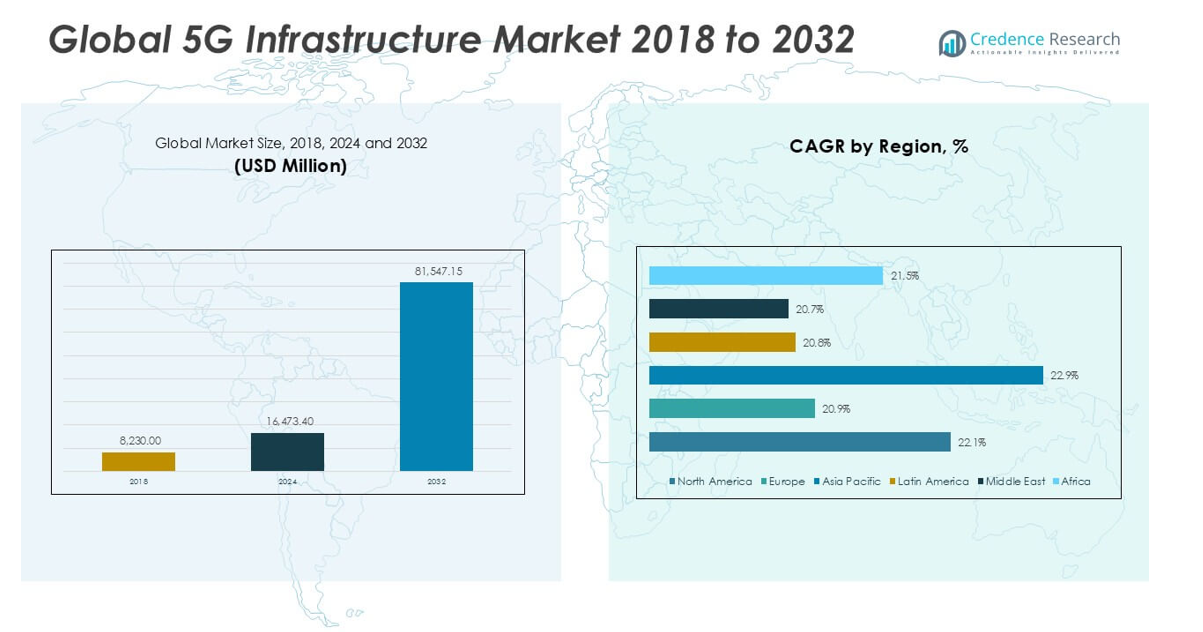
The Global 5G Infrastructure Market is projected to grow from USD 16,473.40 million in 2024 to an estimated USD 81,547.15 million based on 2032, with a compound annual growth rate (CAGR) 22.18% from 2025 to 2032.
The market is driven by surging data traffic, accelerated rollout of smart cities, and a strong push for industrial automation through IoT and edge computing. Governments and telecom operators worldwide are investing heavily in spectrum auctions and network deployment to enable 5G connectivity across urban and rural areas. Trends such as network slicing, virtualization, and private 5G networks for enterprises are gaining traction, further propelling infrastructure demand across sectors such as healthcare, automotive, and manufacturing.
Geographically, North America holds a dominant share due to early adoption, large-scale operator investments, and robust regulatory support. Asia Pacific is expected to witness the fastest growth, driven by extensive rollouts in China, South Korea, and India. Europe follows with strategic initiatives to modernize its digital ecosystem. Key players shaping the competitive landscape include Huawei Technologies Co., Ltd., Ericsson, Nokia Corporation, Samsung Electronics Co., Ltd., ZTE Corporation, Qualcomm Technologies, Inc., and Cisco Systems, Inc., among others.
Market Insights
- The Global 5G Infrastructure Market is projected to grow significantly from USD 16,473.40 million in 2024 to USD 81,547.15 million by 2032, reflecting a CAGR of 22.18%.
- Increasing demand for high-speed connectivity, ultra-low latency, and massive machine-type communications drives rapid 5G network deployments worldwide.
- Expansion of smart cities and industrial automation through IoT and edge computing further accelerates infrastructure investments.
- High capital expenditure and complex regulatory approvals remain key restraints, slowing the pace of network rollout in some regions.
- North America leads the market with early technology adoption, robust operator investments, and supportive regulatory frameworks.
- Asia Pacific is the fastest-growing region due to extensive 5G rollouts in China, South Korea, and India, capturing the largest regional market share.
- Key players focus on innovation, partnerships, and geographic expansion to capitalize on growing demand and address market challenges.
Market Drivers
Rapid Data Growth and Need for Enhanced Network Capacity
The Global 5G Infrastructure Market is expanding due to the exponential rise in mobile data consumption and connected devices. Video streaming, real-time communication, and cloud applications are generating immense traffic that current 4G networks cannot handle efficiently. Telecom operators are under pressure to improve network capacity and reduce latency. 5G infrastructure offers high bandwidth and ultra-reliable connectivity, making it the preferred solution. The deployment of small cells, massive MIMO, and advanced antenna systems supports these goals. It helps maintain seamless service across urban and high-density areas.
- For instance, in countries with widespread 5G coverage such as the US, South Korea, and China, average monthly data usage has surpassed 30GB per user, with 5G networks handling up to 100 times more traffic per unit area than 4G networks.
Industrial Automation and Emergence of Smart Ecosystems
Industries are accelerating automation, IoT integration, and real-time data exchange to optimize operations and boost productivity. The Global 5G Infrastructure Market plays a key role in enabling this shift. Manufacturing, logistics, and energy sectors demand ultra-low latency networks to support machine-to-machine communication and autonomous operations. 5G infrastructure supports private networks tailored to industrial environments. It facilitates predictive maintenance, remote diagnostics, and robotics. Smart cities and intelligent transport systems further rely on strong 5G connectivity.
- For instance, Bosch’s smart factory in Germany uses 5G technology for real-time analytics and automation, which has helped boost production efficiency by 20% and reduce manufacturing waste
Government Initiatives and Spectrum Allocation Programs
Government support in the form of spectrum allocation, subsidies, and policy frameworks is influencing market growth. Countries are aggressively conducting spectrum auctions and removing regulatory bottlenecks to accelerate infrastructure development. The Global 5G Infrastructure Market benefits from national-level strategies aimed at digitization and competitiveness. Investments in rural coverage, public-private partnerships, and digital economy initiatives are reinforcing market expansion. It supports telecom operators by lowering entry barriers and operational risks. Policymaker alignment with technology stakeholders ensures faster deployment cycles.
Advancement in Network Technologies and Virtualization Trends
The shift toward cloud-native architectures and virtualized network functions is transforming traditional telecom infrastructure. The Global 5G Infrastructure Market is embracing technologies like SDN, NFV, and edge computing to build flexible and scalable networks. These innovations reduce hardware dependency and improve network efficiency. It allows operators to deliver tailored services for diverse user needs. Enhanced security, network slicing, and orchestration capabilities drive enterprise adoption. Virtualization helps reduce cost, improve agility, and enable innovation
Market Trends
Growing Demand for Private 5G Networks Across Enterprises
The Global 5G Infrastructure Market is witnessing strong interest from enterprises seeking dedicated, secure, and high-performance networks. Companies in sectors like manufacturing, healthcare, and transportation are moving toward private 5G networks to improve operational control and data security. It offers reliable connectivity for mission-critical applications, supporting real-time communication and automation. Private networks allow businesses to customize performance parameters based on specific needs. This trend is encouraging telecom providers and infrastructure vendors to develop enterprise-centric 5G solutions. The shift toward private deployments is expanding the market scope beyond public mobile networks.
- For instance, by 2024, over 1,800 enterprises globally had deployed private 5G networks across industries such as manufacturing, logistics, and healthcare to enhance operational efficiency and security
Increased Focus on Edge Computing and Decentralized Network Models
Edge computing is becoming a central element in the evolution of 5G infrastructure. The Global 5G Infrastructure Market is aligning with this trend by integrating edge nodes closer to end users to reduce latency. It supports faster processing and enhances real-time decision-making for connected devices. Decentralized network models are transforming service delivery in industries such as autonomous vehicles, smart cities, and remote healthcare. The growing need for localized data processing is driving investment in micro data centers and distributed architecture. Telecom operators and cloud providers are collaborating to strengthen edge infrastructure capabilities.
- For instance, according to IDC, worldwide spending on edge computing reached $228 billion in 2024, with companies like EdgeMicro expanding their network by adding five new micro data centers in underserved U.S. cities to improve low-latency connectivity and support decentralized 5G deployments.
Rise of Network Slicing to Support Diverse Application Needs
Network slicing is gaining traction as a key feature in the Global 5G Infrastructure Market to address multiple use cases within a single physical network. It enables the creation of virtual network segments that cater to specific service requirements, such as ultra-reliable low latency or massive IoT connectivity. It improves network efficiency by allocating resources based on individual application demands. Network slicing supports the deployment of differentiated services without interference. This trend is pushing operators to adopt more sophisticated management tools and orchestration platforms. It enhances flexibility and supports the monetization of specialized services.
Accelerating Adoption of mmWave Spectrum for Enhanced Performance
The adoption of millimeter wave (mmWave) spectrum is gaining momentum in the Global 5G Infrastructure Market due to its ability to deliver high-speed data transmission. It provides significant bandwidth capacity suitable for dense urban areas and high-demand environments. mmWave deployment enables enhanced mobile broadband services and supports applications like virtual reality and 4K video streaming. It faces challenges related to coverage limitations, but continuous advancements in beamforming and antenna technologies are improving its viability. Telecom operators are deploying mmWave infrastructure in stadiums, airports, and city centers to maximize performance. This spectrum is becoming an essential part of 5G expansion strategies.
Market Challenges
High Deployment Costs and Complex Infrastructure Requirements Restrain Growth
The Global 5G Infrastructure Market faces significant challenges due to the high capital expenditure required for network deployment. Building dense small cell networks, upgrading backhaul systems, and securing spectrum licenses demand substantial investment. It creates financial pressure on telecom operators, especially in regions with limited funding or uncertain returns. Complex site acquisition processes and lengthy regulatory approvals further delay infrastructure rollouts. The need for large-scale fiber connectivity and advanced antenna systems adds to the cost burden. These factors collectively slow down the speed of 5G adoption in several markets.
- For instance, the average cost per 5G base station ranges from $100,000 to $200,000, while deploying each kilometer of fiber optic backhaul can require between $25,000 and $100,000, highlighting the substantial financial commitment needed for comprehensive 5G rollout.
Spectrum Availability, Security Concerns, and Technical Barriers Limit Expansion
Spectrum fragmentation and inconsistent regulatory policies across countries hinder the seamless expansion of the Global 5G Infrastructure Market. It faces technical barriers related to interoperability, coverage gaps, and limited device support for higher frequency bands. Security risks increase with the proliferation of connected devices and open network interfaces. Addressing cybersecurity threats demands additional resources and advanced protection strategies. Lack of skilled professionals in network virtualization and 5G-specific technologies creates operational challenges. These obstacles require coordinated industry efforts to ensure reliable and secure network deployment.
Market Opportunities
Expansion into Rural and Underserved Areas Creates New Growth Potential
The Global 5G Infrastructure Market holds strong opportunities in expanding coverage to rural and underserved regions. Governments and telecom operators are focusing on bridging the digital divide to improve connectivity in remote areas. It benefits from public funding programs and rural deployment incentives that support infrastructure development. Extending 5G services to these regions can unlock new revenue streams and enable advanced applications like telemedicine and remote education. The demand for reliable broadband in agricultural and low-density industrial zones further strengthens this opportunity. Expanding rural coverage also supports long-term national digital strategies.
Enterprise Demand for Specialized 5G Solutions Drives Market Expansion
Enterprises across manufacturing, logistics, healthcare, and transportation are seeking tailored 5G solutions to support digital transformation. The Global 5G Infrastructure Market can capture these opportunities by providing private networks, network slicing, and edge computing solutions. It enables low-latency, high-reliability connectivity for specific industrial applications. Customized deployments for smart factories, autonomous systems, and critical communication networks are gaining importance. Growing interest in automation, IoT, and data-driven operations is creating strong demand for enterprise-grade 5G infrastructure. Building targeted solutions for diverse industries allows vendors to diversify offerings and secure long-term contracts.
Market Segmentation Analysis
By Component
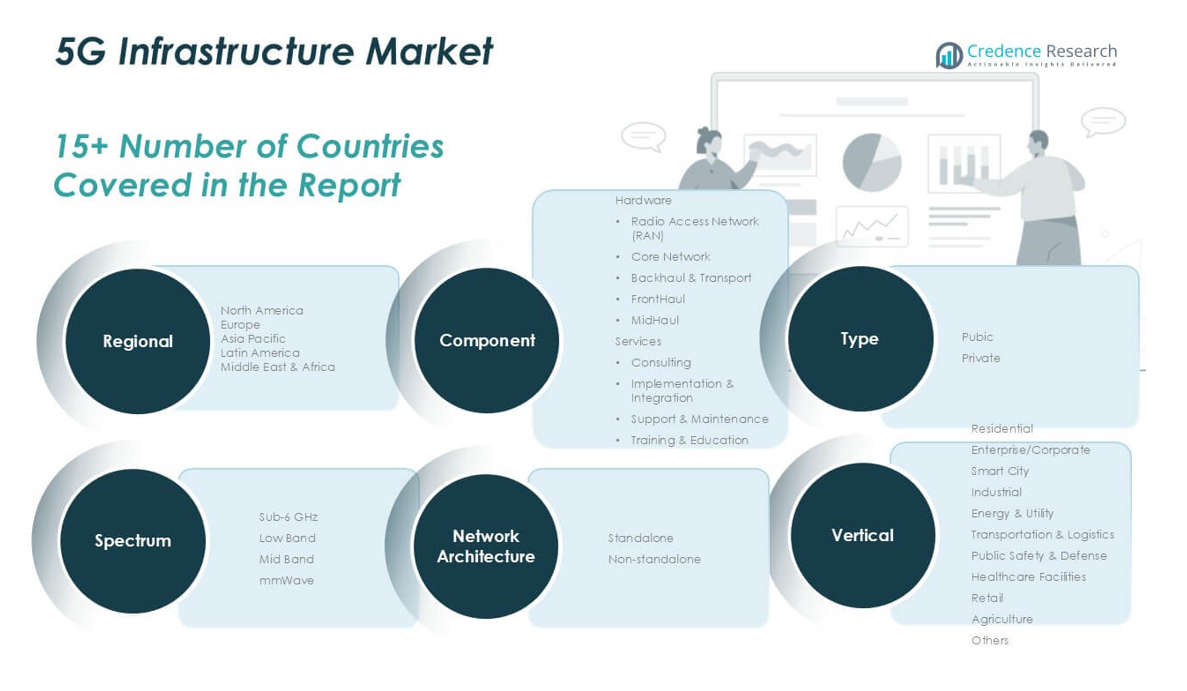
The Global 5G Infrastructure Market is segmented into hardware and services. Hardware dominates the market and includes key elements such as Radio Access Network (RAN), Core Network, Backhaul & Transport, Fronthaul, and Midhaul. These components are critical for building robust, high-capacity 5G networks. The services segment covers consulting, implementation & integration, support & maintenance, and training & education, which help telecom operators deploy and manage complex infrastructure. It supports the efficient rollout and maintenance of 5G systems while enhancing network performance and reliability. Strong demand for both hardware upgrades and specialized services is shaping market dynamics.
- For instance, Ericsson reported that in 2024, it delivered over 1,800,000 5G RAN hardware units and completed more than 2,500 service projects related to 5G implementation and integration worldwide.
By Type
The Global 5G Infrastructure Market includes public and private network types. Public 5G networks hold a larger revenue share due to widespread consumer access and national deployments by telecom operators. Private networks are gaining importance across industries seeking secure, high-performance connectivity for specific applications. It offers tailored solutions for enterprises needing reliable, low-latency communication. The growing use of private networks in manufacturing, healthcare, and smart factories is supporting segment growth. Both public and private networks are expanding rapidly across global markets.
- For instance, a 2024 GSMA Intelligence survey found that more than 250 public 5G networks were operational globally, while over 4,000 private 5G networks had been deployed for enterprise and industrial use.
By Spectrum
The spectrum segment in the Global 5G Infrastructure Market includes Sub-6 GHz, Low Band, Mid Band, and mmWave frequencies. Sub-6 GHz bands dominate due to their balanced coverage and capacity advantages. Low Band supports wide-area coverage, while Mid Band offers higher data speeds with moderate coverage. It leverages mmWave spectrum for ultra-high-speed data transmission in dense urban environments. Each spectrum band plays a specific role in enabling diverse 5G applications. The combination of these frequencies strengthens global deployment strategies.
By Network Architecture
The Global 5G Infrastructure Market is segmented into standalone and non-standalone architectures. Non-standalone networks currently lead due to faster deployment timelines using existing 4G infrastructure. Standalone networks are gaining momentum for their ability to deliver full 5G capabilities, including ultra-low latency and network slicing. It supports the evolution toward more flexible and efficient network designs. The shift to standalone architecture is critical for enabling future 5G applications. Both architectures continue to play essential roles in current market development.
By Vertical
The Global 5G Infrastructure Market serves a wide range of verticals including residential, enterprise/corporate, smart city, industrial, energy & utility, transportation & logistics, public safety & defense, healthcare facilities, retail, agriculture, and others. Enterprise and industrial sectors are major contributors to market growth due to rising demand for automation and high-speed connectivity. It enables smart city solutions, autonomous transportation, and critical healthcare applications. Energy, public safety, and logistics sectors are also expanding their 5G use to enhance efficiency and reliability. The wide adoption across diverse industries is accelerating overall market expansion.
Segments
Based on Component
- Hardware
- Radio Access Network (RAN)
- Core Network
- Backhaul & Transport
- FrontHaul
- MidHaul
- Services
- Consulting
- Implementation & Integration
- Support & Maintenance
- Training & Education
Based on Type
- Public
- Private
Based on Spectrum
- Sub-6 GHz
- Low Band
- Mid Band
- mmWave
Based on Network Architecture
- Standalone
- Non-standalone
Based on Vertical
- Residential
- Enterprise/Corporate
- Smart City
- Industrial
- Energy & Utility
- Transportation & Logistics
- Public Safety & Defense
- Healthcare Facilities
- Retail
- Agriculture
- Others
Based on Region
- North America
- U.S.
- Canada
- Mexico
- Europe
- UK
- France
- Germany
- Italy
- Spain
- Russia
- Belgium
- Netherlands
- Austria
- Sweden
- Poland
- Denmark
- Switzerland
- Rest of Europe
- Asia Pacific
- China
- Japan
- South Korea
- India
- Australia
- Thailand
- Indonesia
- Vietnam
- Malaysia
- Philippines
- Taiwan
- Rest of Asia Pacific
- Latin America
- Brazil
- Argentina
- Peru
- Chile
- Colombia
- Rest of Latin America
- Middle East
- UAE
- KSA
- Israel
- Turkey
- Iran
- Rest of Middle East
- Africa
- Egypt
- Nigeria
- Algeria
- Morocco
- Rest of Africa
Regional Analysis
North America 5G Infrastructure Market
The North America 5G Infrastructure Market is the largest globally, valued at USD 3,963.40 million in 2024 and projected to reach USD 19,521.57 million by 2032, growing at a CAGR of 22.1%. The region commands a significant market share due to early adoption, extensive investments by major telecom operators, and strong government support. It benefits from advanced technology infrastructure and rapid spectrum allocation. The U.S. leads the market with aggressive 5G deployments in urban and suburban areas. Canada also contributes through expanding network coverage and enterprise adoption. The mature market dynamics enable North America to maintain its dominance through innovation and service expansion.
Europe 5G Infrastructure Market
Europe holds a substantial share of the Global 5G Infrastructure Market, valued at USD 2,921.93 million in 2024 and expected to reach USD 13,320.94 million by 2032, reflecting a CAGR of 20.9%. It benefits from coordinated policies by the European Union to accelerate 5G rollout across member countries. Germany, the UK, and France drive demand with significant operator investments and infrastructure upgrades. It sees rising adoption of private 5G networks in industrial and smart city applications. Regulatory harmonization and spectrum availability continue to support market expansion. The region remains a key player with a balanced mix of public and enterprise deployments.
Asia Pacific 5G Infrastructure Market
The Asia Pacific 5G Infrastructure Market is growing rapidly, valued at USD 7,624.64 million in 2024 and forecast to reach USD 39,706.84 million by 2032, at a CAGR of 22.9%. It commands the largest regional market share, driven by China, South Korea, and India. Massive population density and government initiatives fuel extensive network deployments. China leads globally in infrastructure investment and subscriber base expansion. The demand for smart city projects, industrial automation, and IoT integration propels growth. It focuses heavily on mmWave and mid-band spectrum adoption. Asia Pacific continues to set benchmarks for scale and speed in 5G infrastructure development.
Latin America 5G Infrastructure Market
Latin America’s 5G Infrastructure Market is valued at USD 830.09 million in 2024 and projected to reach USD 3,740.57 million by 2032, with a CAGR of 20.8%. Brazil, Mexico, and Argentina are key contributors, advancing network modernization and spectrum auctions. The region’s market share remains modest compared to others but shows steady growth potential. It addresses challenges such as infrastructure gaps and regulatory hurdles through increased public-private collaborations. The expansion of mobile broadband services and rising enterprise interest supports gradual market penetration. The market is poised for accelerated development in the coming years.
Middle East 5G Infrastructure Market
The Middle East 5G Infrastructure Market stands at USD 616.00 million in 2024 and is expected to grow to USD 2,764.90 million by 2032, growing at a CAGR of 20.7%. Countries like the UAE, Saudi Arabia, and Qatar lead investments in 5G deployment and smart infrastructure projects. It benefits from government-led digital transformation initiatives and increasing telecom operator competition. The region’s strategic location supports innovation hubs and cross-border connectivity. Market share is growing steadily due to rising adoption in urban centers and industrial zones. Focus on 5G-enabled smart city and energy applications drives infrastructure demand.
Africa 5G Infrastructure Market
Africa’s 5G Infrastructure Market is valued at USD 517.33 million in 2024 and projected to reach USD 2,492.33 million by 2032, with a CAGR of 21.5%. The region’s market share remains smaller but reflects strong growth opportunities fueled by expanding mobile internet penetration. South Africa, Nigeria, and Kenya are key markets advancing 5G trials and initial deployments. Investments in network modernization and spectrum allocation improve connectivity. It focuses on bridging the digital divide by enhancing rural and urban infrastructure. The increasing demand for digital services and government support are driving infrastructure development
Key players
- Huawei Technologies Co., Ltd.
- Samsung Electronics Co., Ltd.
- Nokia Corporation
- Telefonaktiebolaget LM Ericsson
- ZTE Corporation
- NEC Corporation
- Cisco Systems, Inc.
- Fujitsu Limited
- Comba Telecom Systems Holdings Ltd.
- Airspan Networks
- Mavenir
- Parallel Wireless
- Ceragon
- Aviat Networks, Inc.
Competitive Analysis
The 5G Infrastructure Market is highly competitive, with major players focusing on innovation, strategic partnerships, and geographic expansion to maintain leadership. Huawei Technologies Co., Ltd. leverages its extensive R\&D capabilities and broad product portfolio to secure significant market share. Samsung and Nokia emphasize technological advancements and collaborations with telecom operators for rapid deployment. Ericsson and ZTE focus on diversified solutions and customer-centric services to strengthen their presence. It witnesses increasing competition from emerging players like Mavenir and Parallel Wireless, which offer software-driven and open architecture solutions. The market demands continuous investment in technology upgrades and network scalability, driving companies to enhance efficiency and reduce deployment costs. Strong emphasis on 5G standards compliance and security differentiates key players and shapes their competitive strategies.
Recent Developments
- In June 2025, Huawei showcased advancements in 5G Advanced (5G-A) experience monetization and scenario-based services powered by AI agents .
- In March 2025, Fujitsu did implement a global launch of the world's first AI application designed to prevent quality degradation in 5G wireless networks. This application utilizes AI to estimate user experience in real-time and automatically switches users to better network areas when degradation is detected. It also proactively activates dormant base stations to handle increased traffic and maintain smooth connections.
Market Concentration and Characteristics
The 5G Infrastructure Market exhibits a moderately concentrated structure, dominated by a few global leaders such as Huawei, Ericsson, Nokia, and Samsung. These key players control a significant portion of the market through extensive product portfolios, strong R&D capabilities, and wide geographic reach. It features high entry barriers due to the substantial capital investment required for network deployment and technological expertise. The market emphasizes continuous innovation, interoperability, and compliance with evolving 5G standards. Collaboration between telecom operators and infrastructure providers shapes competitive dynamics. Emerging companies focus on software-centric solutions and network virtualization to challenge incumbents. The market’s characteristics include rapid technology adoption, stringent regulatory environments, and diverse application needs across public and private sectors, driving sustained growth and competitive differentiation.
Report Coverage
The research report offers an in-depth analysis based on Component, Type, Spectrum, Network Architecture, Vertical and Region. It details leading market players, providing an overview of their business, product offerings, investments, revenue streams, and key applications. Additionally, the report includes insights into the competitive environment, SWOT analysis, current market trends, as well as the primary drivers and constraints. Furthermore, it discusses various factors that have driven market expansion in recent years. The report also explores market dynamics, regulatory scenarios, and technological advancements that are shaping the industry. It assesses the impact of external factors and global economic changes on market growth. Lastly, it provides strategic recommendations for new entrants and established companies to navigate the complexities of the market.
Future Outlook
- The 5G Infrastructure Market will experience rapid expansion driven by increasing demand for high-speed, low-latency connectivity across industries. Telecom operators will accelerate network rollouts to meet growing data traffic.
- Private 5G networks will gain traction as enterprises seek secure, reliable connectivity tailored to specific industrial and commercial applications. This shift will diversify revenue streams for infrastructure providers.
- Adoption of edge computing will become integral, enabling real-time data processing closer to end-users and enhancing network efficiency. This integration will support critical applications like autonomous vehicles and remote healthcare.
- Network slicing will evolve to become a standard feature, allowing operators to create multiple virtual networks on a single physical infrastructure. This capability will optimize resource allocation and support diverse use cases.
- The mmWave spectrum will see broader deployment despite coverage challenges, providing ultra-high-speed data transmission in dense urban and high-demand areas. Advances in antenna technology will improve its viability.
- Standalone 5G architecture adoption will increase, unlocking full 5G potential including ultra-reliable low latency and massive IoT connectivity. It will enable new service models and innovative applications.
- Rural and underserved regions will witness accelerated 5G infrastructure development supported by government initiatives and funding programs. Expanding coverage will bridge the digital divide and stimulate local economies.
- Integration of AI and automation in network management will enhance operational efficiency, reduce costs, and improve fault detection. These technologies will support self-optimizing networks and predictive maintenance.
- Security measures will become more sophisticated to address rising cyber threats associated with increased device connectivity and network complexity. Investments in cybersecurity will be critical for market trust.
- Collaboration among telecom operators, technology providers, and regulatory bodies will strengthen to ensure seamless spectrum allocation, standardization, and faster deployment. This cooperation will drive sustainable market growth.

Request a Free Sample
Fill in your details and we'll send you a free sample report.
- Sample data tables & charts
- Research methodology
Market Dynamics
Surging Data Traffic and Network Capacity Demands
The exponential increase in mobile data consumption, driven by video streaming, cloud applications, and IoT devices, is overwhelming existing 4G networks. 5G infrastructure provides the necessary bandwidth, ultra-low latency, and reliability to support this surge, prompting telecom operators to accelerate investments in network upgrades and densification.
Industrial Automation and IoT Integration
Manufacturing, logistics, and energy sectors are rapidly adopting automation and IoT solutions that require ultra-reliable, low-latency connectivity. 5G infrastructure enables real-time machine-to-machine communication, predictive maintenance, and robotics, making it essential for smart factories and industrial digital transformation.
Government Spectrum Allocation and Policy Support
Governments worldwide are actively conducting spectrum auctions, offering subsidies, and streamlining regulatory frameworks to facilitate 5G deployment. These initiatives lower entry barriers for telecom operators, accelerate network rollouts, and ensure broader coverage, especially in rural and underserved regions.
Advancements in Network Virtualization and Edge Computing
The adoption of cloud-native architectures, SDN, NFV, and edge computing is transforming traditional telecom infrastructure. These technologies enable flexible, scalable, and cost-efficient 5G networks, allowing operators to deliver tailored services, improve agility, and support diverse application requirements.
Enterprise Demand for Private and Customized 5G Networks
Enterprises across sectors such as healthcare, transportation, and manufacturing are increasingly deploying private 5G networks to achieve secure, high-performance connectivity for mission-critical applications. This trend is expanding the market beyond public networks and driving demand for specialized infrastructure solutions.
Need a Custom Version of This Report?
Tailor the scope, geography, or segments to your exact requirements.
- Custom geography or segment scope
- Direct access to our analyst team
Frequently Asked Questions
What is the current and projected market size of the Global 5G Infrastructure Market?
What are the key factors driving growth in the 5G Infrastructure Market?
Which regions hold the largest market share and fastest growth in the 5G Infrastructure Market?
Who are the major players in the Global 5G Infrastructure Market?
Table of Content
Chapter 1 Market Segmentation
- 1.1 Segmentation Framework
- 1.1.1 Product and Service Classification
- 1.1.2 Application and End-Use Classification
- 1.1.3 Technology and Solution Classification
- 1.1.4 Customer and Distribution Channel Classification
- 1.1.5 Geographic Segmentation
- 1.1.6 Market Segment Definitions and Boundaries
- 1.2 By Type
- 1.2.1 Public
- 1.2.2 Private
- 1.3 By Spectrum
- 1.3.1 Sub-6 GHz
- 1.3.2 Low Band
- 1.3.3 Mid Band
- 1.3.4 mmWave
- 1.4 By Component
- 1.4.1 Hardware
- 1.4.2 Services
- 1.5 By Network Architecture
- 1.5.1 Standalone
- 1.5.2 Non-standalone
Chapter 2 Introduction
- 2.1 Report Objectives and Scope
- 2.2 Product Definition and Industry Terminology
- 2.3 Market Inclusions and Exclusions
- 2.4 Research Process
- 2.4.1 Primary Research and Expert Interviews
- 2.4.2 Secondary Research and Source Review
- 2.4.3 Top-Down and Bottom-Up Estimation
- 2.4.4 Data Triangulation and Verification
- 2.5 Market Size Measurement Basis
- 2.5.1 2024: USD 16,473.40 million → 2032: USD 81,547.15 million
- 2.6 Historical and Forecast Reference Periods
- 2.6.1 Base Year: 2024
- 2.6.2 Forecast Period: 2024-2032
- 2.7 Research Assumptions and Limitations
Chapter 3 Executive Summary
- 3.1 Market Snapshot and Key Findings
- 3.2 Base-Year Market Size, 2024
- 3.3 Forecast Market Size, 2032
- 3.4 Revenue and Volume Growth Outlook
- 3.5 Key Demand and Supply Indicators
- 3.6 Leading Market Segments
- 3.7 Fastest-Growing Market Opportunities
- 3.8 Regional Performance Highlights
- 3.9 Technology and Industry Transformation
- 3.10 Competitive Landscape Summary
- 3.11 Analyst View and Strategic Implications
Chapter 4 Global 5G Infrastructure Market Trends and Developments
- 4.1 Historical Industry Development
- 4.2 Recent Market Trends and Developments
- 4.3 Demand and Customer Behavior Trends
- 4.4 Technology and Product Innovation
- 4.5 Artificial Intelligence, Automation and Digitalization
- 4.6 Local Manufacturing and Supply Chain Realignment
- 4.7 Industry Partnerships, Mergers and Acquisitions
- 4.8 Sustainability and Circular Economy Developments
- 4.9 Government and Private Sector Investment Trends
- 4.10 Emerging Business Models and Commercialization
- 4.11 Industry Developments and Announcements
Chapter 5 Global 5G Infrastructure Market Production, Supply and Demand Analysis
- 5.1 Demand Trend and Consumption Analysis
- 5.2 Demand Forecast, 2024-2032
- 5.3 Production and Output Trend
- 5.4 Production and Output Forecast, 2024-2032
- 5.5 Installed Capacity and Capacity Utilization
- 5.6 Company-Wise Production Plants and Statistics
- 5.6.1 Installed Production Capacity
- 5.6.2 Actual Production
- 5.6.3 Planned Capacity and Expansion Targets
- 5.7 Supply Chain Structure and Procurement Trends
- 5.8 Supply-Demand Gap and Bottlenecks
- 5.9 Import Dependence and Sourcing Structure
- 5.10 Contract Manufacturing and Outsourcing
- 5.11 Regional Supply and Demand Concentration
Chapter 6 Global 5G Infrastructure Market Pricing Analysis
- 6.1 Pricing Structure and Measurement
- 6.2 Historical Pricing Trends
- 6.3 Pricing Outlook, 2024-2032
- 6.4 Average Selling Price and Unit Economics
- 6.5 Pricing by Product and Market Segment
- 6.6 Geographic Pricing Differences
- 6.7 Key Input, Energy, Labor and Logistics Costs
- 6.8 Contract Pricing and Purchasing Models
- 6.9 Pricing Sensitivity and Competitive Positioning
- 6.10 Price, Margin and Profitability Implications
Chapter 7 Global 5G Infrastructure Market Dynamics
- 7.1 Market Growth Drivers
- 7.1.1 Demand-Side Drivers
- 7.1.2 Technology and Innovation Drivers
- 7.1.3 Infrastructure and Investment Drivers
- 7.1.4 Regulatory and Policy Drivers
- 7.2 Market Restraints
- 7.2.1 Cost and Affordability Constraints
- 7.2.2 Technology and Adoption Barriers
- 7.2.3 Supply Chain and Operational Constraints
- 7.3 Market Challenges
- 7.3.1 Competitive Pressure and Margin Erosion
- 7.3.2 Skills, Infrastructure and Implementation Gaps
- 7.4 Emerging Market Opportunities
- 7.5 Market Dynamics Impact and Time-Horizon Assessment
Chapter 8 Global 5G Infrastructure Value Chain Analysis
- 8.1 Industry Value Chain Overview
- 8.2 Upstream Suppliers and Critical Inputs
- 8.3 Technology and Component Providers
- 8.4 Manufacturing or Service Delivery
- 8.5 Distribution, Channel Partners and Integrators
- 8.6 Downstream Applications and End Users
- 8.7 Value Addition and Profit Pools
- 8.8 Vertical Integration and Outsourcing
- 8.9 Supplier Concentration and Risk
- 8.10 Supply Chain Localization and Resilience
Chapter 9 Global 5G Infrastructure Market Regulations and Policies
- 9.1 Relevant Laws, Standards and Compliance Frameworks
- 9.2 Product, Service, Safety and Quality Requirements
- 9.3 Government Policies, Incentives and Subsidies
- 9.4 Imports, Exports and Trade Barriers
- 9.5 Public Procurement and Local Content Requirements
- 9.6 Environmental and Sustainability Compliance
- 9.7 Data Protection, AI and Cybersecurity Compliance
- 9.8 Upcoming Policy Changes and Market Implications
Chapter 10 Global 5G Infrastructure Market Hotspots and Opportunities
- 10.1 Market Opportunity Mapping and Growth Hotspots
- 10.2 High-Growth Applications and Customer Groups
- 10.3 Underserved Markets and White-Space Opportunities
- 10.4 Emerging Technology and Product Opportunities
- 10.5 New Capacity and Investment Hotspots
- 10.6 Market Entry and Expansion Opportunities
- 10.7 Distribution and Partnership Opportunities
- 10.8 Near-Term and Long-Term Commercial Potential
- 10.9 Opportunity Attractiveness and Execution Risks
Chapter 11 Global 5G Infrastructure Market Outlook, 2024-2032
- 11.1 Market Size and Analysis
- 11.1.1 Revenue (Market Measurement: 2024: USD 16,473.40 million → 2032: USD 81,547.15 million)
- 11.1.2 Market Volume and Quantity Sold
- 11.1.3 Historical Market Size
- 11.1.4 Base-Year Market Size, 2024
- 11.2 Market Forecast, 2024-2032
- 11.2.1 Revenue Forecast to 2032
- 11.2.2 Volume Forecast to 2032
- 11.2.3 CAGR and Year-on-Year Growth
- 11.2.4 Incremental Revenue Opportunity
- 11.3 Forecast Assumptions and Scenario Analysis
- 11.3.1 Base-Case Forecast
- 11.3.2 Optimistic and Conservative Scenarios
- 11.3.3 Technology, Pricing and Policy Sensitivities
- 11.4 Market Attractiveness and Growth Outlook
Chapter 12 Global 5G Infrastructure Market Segmentation and Outlook
- 12.1 Segmentation Summary and Market Shares, 2024
- 12.2 Largest and Fastest-Growing Segments
- 12.3 By Type - Market Size and Forecast, 2024-2032
- 12.3.1 Segment Definition and Scope
- 12.3.2 Historical Market Size
- 12.3.3 Revenue Forecast, 2024-2032
- 12.3.4 Volume Forecast, 2024-2032
- 12.3.5 Base-Year Market Share, 2024
- 12.3.6 Segment CAGR and Growth Drivers
- 12.3.7 Subsegment Market Size and Forecast
- 12.3.7.1 Public
- 12.3.7.2 Private
- 12.3.8 Subsegment Pricing and Adoption Trends
- 12.3.9 Leading Suppliers and Competition
- 12.3.10 Regional Demand and Opportunities
- 12.4 By Spectrum - Market Size and Forecast, 2024-2032
- 12.4.1 Segment Definition and Scope
- 12.4.2 Historical Market Size
- 12.4.3 Revenue Forecast, 2024-2032
- 12.4.4 Volume Forecast, 2024-2032
- 12.4.5 Base-Year Market Share, 2024
- 12.4.6 Segment CAGR and Growth Drivers
- 12.4.7 Subsegment Market Size and Forecast
- 12.4.7.1 Sub-6 GHz
- 12.4.7.2 Low Band
- 12.4.7.3 Mid Band
- 12.4.7.4 mmWave
- 12.4.8 Subsegment Pricing and Adoption Trends
- 12.4.9 Leading Suppliers and Competition
- 12.4.10 Regional Demand and Opportunities
- 12.5 By Component - Market Size and Forecast, 2024-2032
- 12.5.1 Segment Definition and Scope
- 12.5.2 Historical Market Size
- 12.5.3 Revenue Forecast, 2024-2032
- 12.5.4 Volume Forecast, 2024-2032
- 12.5.5 Base-Year Market Share, 2024
- 12.5.6 Segment CAGR and Growth Drivers
- 12.5.7 Subsegment Market Size and Forecast
- 12.5.7.1 Hardware
- 12.5.7.2 Services
- 12.5.8 Subsegment Pricing and Adoption Trends
- 12.5.9 Leading Suppliers and Competition
- 12.5.10 Regional Demand and Opportunities
- 12.6 By Network Architecture - Market Size and Forecast, 2024-2032
- 12.6.1 Segment Definition and Scope
- 12.6.2 Historical Market Size
- 12.6.3 Revenue Forecast, 2024-2032
- 12.6.4 Volume Forecast, 2024-2032
- 12.6.5 Base-Year Market Share, 2024
- 12.6.6 Segment CAGR and Growth Drivers
- 12.6.7 Subsegment Market Size and Forecast
- 12.6.7.1 Standalone
- 12.6.7.2 Non-standalone
- 12.6.8 Subsegment Pricing and Adoption Trends
- 12.6.9 Leading Suppliers and Competition
- 12.6.10 Regional Demand and Opportunities
- 12.7 Segment Growth Comparison
- 12.8 Segment Attractiveness and Priority Matrix
Chapter 13 Global 5G Infrastructure Geographic Market Outlook, 2024-2032
- 13.1 Regional Market Size and Share, 2024
- 13.2 Regional Market Forecast, 2024-2032
- 13.3 Regional Pricing, Production and Demand Differences
- 13.4 North America
- 13.4.1 United States
- 13.4.2 Canada
- 13.4.3 Mexico
- 13.5 Europe
- 13.5.1 Germany
- 13.5.2 France
- 13.5.3 Italy
- 13.5.4 United Kingdom
- 13.5.5 Spain
- 13.5.6 Poland
- 13.5.7 Russia
- 13.5.8 Netherlands
- 13.5.9 Belgium
- 13.5.10 Sweden
- 13.5.11 Denmark
- 13.5.12 Norway
- 13.5.13 Rest of Europe
- 13.6 Asia Pacific
- 13.6.1 China
- 13.6.2 India
- 13.6.3 Japan
- 13.6.4 South Korea
- 13.6.5 Thailand
- 13.6.6 Indonesia
- 13.6.7 Vietnam
- 13.6.8 Malaysia
- 13.6.9 Australia
- 13.6.10 Rest of Asia Pacific
- 13.7 Latin America
- 13.7.1 Brazil
- 13.7.2 Argentina
- 13.7.3 Colombia
- 13.7.4 Chile
- 13.7.5 Rest of Latin America
- 13.8 Middle East
- 13.8.1 Saudi Arabia
- 13.8.2 United Arab Emirates
- 13.8.3 Turkey
- 13.8.4 Israel
- 13.8.5 Iran
- 13.8.6 Rest of the Middle East
- 13.9 Africa
- 13.9.1 South Africa
- 13.9.2 Egypt
- 13.9.3 Nigeria
- 13.9.4 Morocco
- 13.9.5 Rest of Africa
- 13.10 Regional Investment, Policy and Supply Chain Differences
- 13.11 Regional Competitive Landscape
- 13.12 Geographic Growth Hotspots
Chapter 14 Global 5G Infrastructure Technology, Innovation and Sustainability Outlook
- 14.1 Technology Landscape and Maturity
- 14.2 Product, Process and Service Innovation
- 14.3 AI, Automation and Digital Tools in the Industry
- 14.4 Technology Adoption and Performance Benchmarking
- 14.5 Innovation Pipeline and R&D Investment
- 14.6 Patent and Intellectual Property Trends
- 14.7 Energy Efficiency and Resource Management
- 14.8 Sustainability, Recycling and Circularity
- 14.9 Technology Roadmap, 2024-2032
- 14.10 Risks of Obsolescence and Technology Substitution
Chapter 15 Global 5G Infrastructure Market Key Strategic Imperatives
- 15.1 Growth and Market Entry Priorities
- 15.2 High-Return Products and Segments
- 15.3 Pricing, Profitability and Cost Optimization
- 15.4 Technology Investment and Product Differentiation
- 15.5 Supply Chain Localization and Resilience
- 15.6 Distribution and Customer Acquisition
- 15.7 Partnership, Acquisition and Capacity Strategy
- 15.8 Regional Expansion Priorities
- 15.9 Short-, Medium- and Long-Term Actions
Chapter 16 Competition Outlook
- 16.1 Industry Competition Characteristics
- 16.2 Market Structure and Concentration
- 16.3 Market Share and Competitive Positioning, 2024
- 16.4 Company-Wise Revenue and Product Benchmarking
- 16.5 Production and Service Capacity Benchmarking
- 16.6 Technology, Pricing and Differentiation
- 16.7 Regional Footprint and Distribution Strength
- 16.8 Mergers, Acquisitions and Strategic Alliances
- 16.9 New Entrants and Competitive Threats
- 16.10 Porter's Five Forces and Industry Attractiveness
- 16.11 Competitive Outlook, 2024-2032
Chapter 17 Company Profiles
- 17.1 Company Coverage and Selection Criteria
- 17.2 Huawei Technologies Co., Ltd.
- 17.2.1 Business Description
- 17.2.2 Company Ownership and Geographic Presence
- 17.2.3 Product and Service Portfolio
- 17.2.4 Manufacturing and Operating Footprint
- 17.2.5 Production Capacity and Expansion Plans
- 17.2.6 Financial Performance and Investment
- 17.2.7 Market Share and Competitive Position
- 17.2.8 Technology and Innovation Capabilities
- 17.2.9 Strategic Alliances or Partnerships
- 17.2.10 Recent Developments
- 17.2.11 Growth Strategy and Outlook
- 17.3 Samsung Electronics Co., Ltd.
- 17.4 Nokia Corporation
- 17.5 Telefonaktiebolaget LM Ericsson
- 17.6 ZTE Corporation
- 17.7 NEC Corporation
- 17.8 Cisco Systems, Inc.
- 17.9 Fujitsu Limited
- 17.10 Mavenir
- 17.11 Airspan Networks
- 17.12 Other Relevant Market Participants
Note: Every listed company is profiled on the structure shown under the first company. The company list is preliminary and may change based on research findings, market developments, data availability and client requirements.
Chapter 18 Disclaimer
- 18.1 Research and Forecast Disclaimer
- 18.2 Data Source and Estimation Limitations
Note: The depth of individual sections depends on data availability for this market. Volume, capacity, trade and other unit-based metrics are included where applicable.

