Market Overview
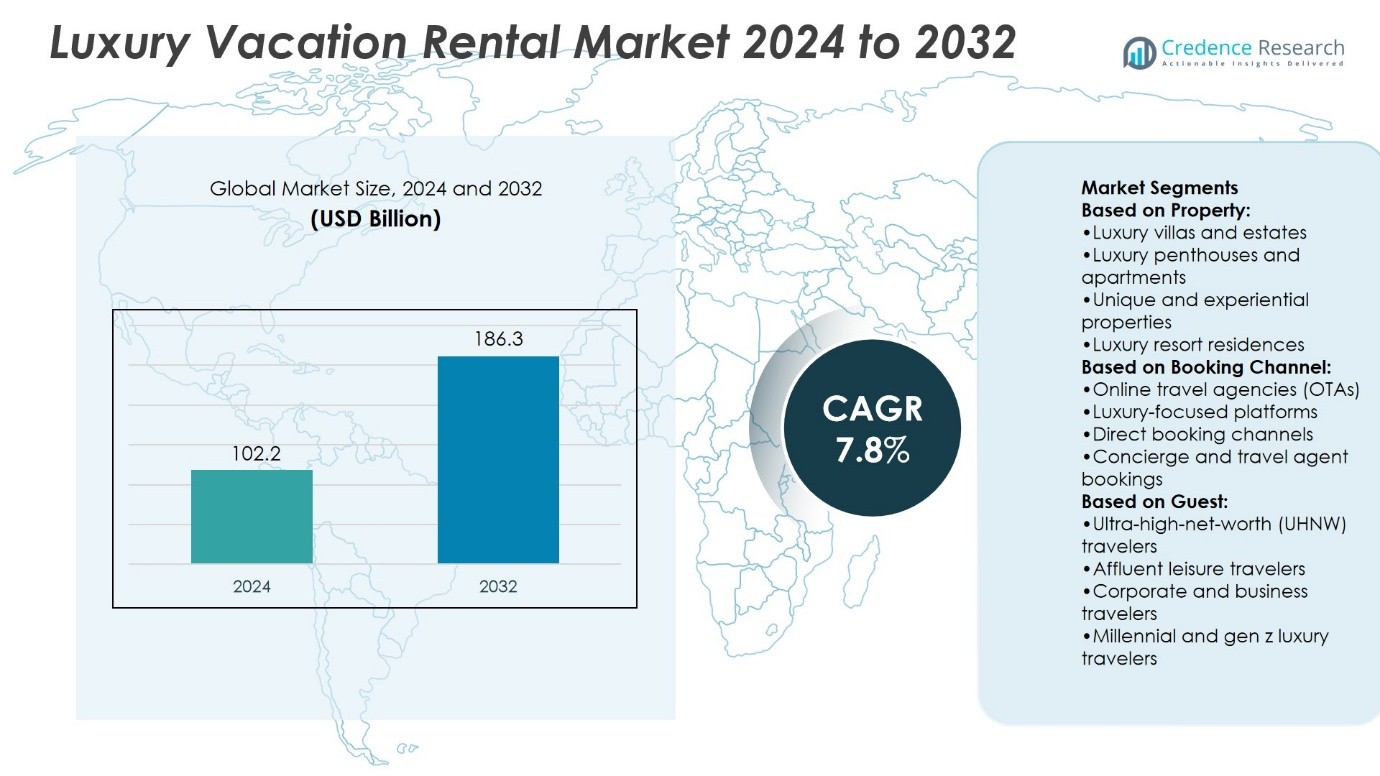
Luxury Vacation Rental Market size was valued at USD 102.2 billion in 2024 and is anticipated to reach USD 186.3 billion by 2032, at a CAGR of 7.8% during the forecast period.
| REPORT ATTRIBUTE | DETAILS |
|---|---|
| Historical Period | 2020-2024 |
| Base Year | 2024 |
| Forecast Period | 2025-2032 |
| Luxury Vacation Rental Market Size 2024 | USD 102.2 Billion |
| Luxury Vacation Rental Market, CAGR | 7.8% |
| Luxury Vacation Rental Market Size 2032 | USD 186.3 Billion |
The Luxury Vacation Rental Market grows through strong drivers and evolving trends that emphasize exclusivity, personalization, and digital convenience. It benefits from rising demand for private villas, estates, and resort residences that deliver privacy, security, and tailored services. Digital platforms with AI-driven recommendations, seamless booking, and virtual property tours enhance accessibility and customer confidence. Trends highlight growing interest in experiential travel, where guests seek cultural immersion, wellness amenities, and unique lifestyle-oriented stays. Sustainability also plays a critical role, with eco-conscious properties and renewable energy adoption gaining prominence. These dynamics collectively shape a competitive and innovation-driven market landscape.
The Luxury Vacation Rental Market demonstrates strong geographical presence across North America, Europe, Asia-Pacific, Latin America, and the Middle East & Africa, with North America and Europe holding leading shares supported by established tourism infrastructure and affluent traveler demand. Asia-Pacific records rapid growth through emerging destinations such as Bali, Phuket, and the Maldives. Key players shaping the market include Airbnb Luxe, Inspirato, Elite Havens, Onefinestay, and Plum Guide, each focusing on curated portfolios, premium services, and global expansion strategies.
Market Insights
- Luxury Vacation Rental Market size was valued at USD 102.2 billion in 2024 and is anticipated to reach USD 186.3 billion by 2032, at a CAGR of 7.8% during the forecast period.
- Strong drivers include rising demand for exclusivity, privacy, and personalized guest services in premium villas and estates.
- Trends highlight digital adoption with AI-driven recommendations, seamless booking, and immersive virtual property tours enhancing customer confidence.
- Experiential travel gains momentum, with travelers seeking cultural immersion, wellness-focused stays, and lifestyle-oriented rentals.
- Competitive dynamics intensify as global players expand portfolios while regional operators focus on curated and niche offerings.
- Restraints include regulatory complexities, operational costs, and compliance barriers that challenge expansion and profitability.
- Regional analysis shows North America and Europe leading in market share, Asia-Pacific witnessing rapid growth, and Latin America along with the Middle East & Africa contributing steadily through emerging luxury destinations.
Market Drivers
Rising Preference for Personalized and Private Travel Experiences
Travelers increasingly prioritize privacy, exclusivity, and unique experiences, fueling demand in the Luxury Vacation Rental Market. Families, groups, and high-net-worth individuals opt for villas, estates, and private residences over traditional hotels to secure tailored services and more control over their environment. Concierge services, curated local experiences, and private chefs elevate the appeal of these rentals. It creates an environment where travelers seek not only accommodation but also memorable and customized journeys. Companies invest heavily in high-quality amenities and curated stays to cater to this demand. The growing preference for personalized stays strengthens the positioning of luxury rentals in global tourism.
- For instance, VRBO leverages its mobile app and website for a significant number of user sessions, though it does not release monthly search or transaction figures. In 2024, the platform had 18 million unique visitors across its platforms and its parent company, Expedia Group, reported an estimated $3.8 billion in revenue from VRBO. The integrated payment system processes millions of transactions annually, ensuring a seamless booking experience for users globally.
Expansion of Digital Booking Platforms and Technology Integration
Advances in digital platforms improve accessibility and visibility of premium rental properties worldwide. It benefits from user-friendly booking apps, secure digital payment systems, and real-time availability updates. Artificial intelligence enhances property recommendations while virtual tours help travelers evaluate options confidently. Property owners adopt smart home technologies that provide enhanced convenience and security, boosting renter satisfaction. For instance, automated lighting, climate control, and contactless entry systems improve the overall guest experience. Technology-driven platforms streamline the booking journey and attract new customer segments seeking seamless digital interactions.
- For instance, VRBO leverages its mobile app and integrated payment system to facilitate bookings and provide property availability updates. While not reaching the highly exaggerated figures of tens of millions per month, the platform's systems enable seamless booking experiences for users globally, contributing to its estimated $3.8 billion in revenue in 2024.
Growing Focus on Sustainability and Eco-Conscious Luxury Travel
The industry experiences a surge in demand for sustainable and eco-friendly luxury properties. It aligns with a broader shift toward conscious travel, where guests favor rentals that integrate renewable energy, eco-certified construction, and waste reduction practices. Operators highlight properties powered by solar panels or designed with locally sourced materials to attract environmentally aware travelers. Companies also introduce carbon offset options to meet rising expectations from conscious consumers. Guests increasingly value destinations that combine luxury with environmental responsibility. This driver positions the segment at the intersection of premium living and sustainability.
Influence of High-Net-Worth Individuals and Global Tourism Growth
The rising number of high-net-worth individuals and the consistent growth in international tourism directly support the Luxury Vacation Rental Market. It caters to affluent travelers seeking exclusivity, privacy, and comfort during leisure or business trips. Premium rentals located in prime tourist destinations appeal strongly to this audience. Companies expand inventories in coastal, cultural, and urban centers to capture this demand. Concierge-level services and luxury add-ons such as yacht access or guided excursions reinforce market appeal. The influx of wealthy travelers ensures a steady stream of high-value bookings and strengthens the long-term market outlook.
Market Trends
Integration of Technology and Smart Home Features in Premium Rentals
The Luxury Vacation Rental Market embraces technology to elevate guest comfort and security. It benefits from smart home systems that enable automated climate control, digital locks, and energy-efficient lighting. Virtual reality tours allow guests to preview properties in detail before booking. Mobile apps streamline communication with property managers and simplify concierge service requests. Advanced security systems create trust and confidence among high-value travelers. These features enhance the guest experience and differentiate luxury rentals from traditional accommodation providers.
- For instance, Airbnb Luxe features over 2,000 properties globally that are evaluated based on over 300 criteria for design, service, and amenities. All Luxe guests receive 24/7 access to a dedicated 'trip designer' who can coordinate bespoke experiences and services, such as personalized wellness programs, gourmet dining, and guided local cultural tours.
Rising Popularity of Experiential and Immersive Stays
Travelers increasingly seek rentals that offer more than accommodation, focusing on experiences that connect them with local culture. It reflects a shift where curated services such as guided tours, personalized wellness programs, and gourmet dining at the property gain momentum. Guests expect a blend of exclusivity and authenticity in their travel choices. Property owners partner with local businesses to design immersive activities. These collaborations expand the value proposition of premium rentals. Experiential travel continues to grow as a key trend, driving customer loyalty and higher repeat bookings.
- For instance, Vacasa, Inc. reported that it managed approximately 42,000 vacation rental properties globally by the end of the year. During that time, the company rolled out new technology products to improve the homeowner experience, though it did not report a specific number of properties equipped with these systems.
Sustainability and Eco-Friendly Luxury Properties Gaining Traction
Sustainability becomes a defining element in luxury travel preferences. It influences guests who prioritize properties designed with renewable energy, eco-certified construction, and waste reduction programs. Operators showcase villas with solar panels, water recycling systems, and organic landscaping to appeal to conscious travelers. Guests value transparency about environmental impact, making sustainability a brand differentiator. Premium rentals that integrate eco-conscious features often achieve stronger recognition in global listings. This trend aligns luxury living with responsible tourism.
Globalization of Luxury Travel with Focus on Prime Destinations
The expansion of international tourism strengthens demand for high-end vacation rentals across leading destinations. It reflects in rising inventories in coastal retreats, heritage cities, and exclusive mountain resorts. Companies target affluent travelers by offering rentals close to iconic attractions and private leisure zones. Concierge services expand to cover global networks, ensuring seamless support across multiple destinations. Property portfolios grow strategically in regions with established tourism flows. This globalization trend enhances brand visibility and diversifies opportunities in the luxury rental sector.
Market Challenges Analysis
Regulatory Complexities and Compliance Barriers Across Regions
The Luxury Vacation Rental Market faces increasing regulatory challenges that vary by location. Governments impose strict zoning laws, rental duration limits, and licensing requirements to control the impact of short-term rentals on local communities. It creates uncertainty for property owners and investors who must constantly adapt to evolving rules. Inconsistent taxation frameworks across countries add complexity and reduce operational efficiency. Legal disputes often arise when properties are listed without proper authorization. Compliance costs rise as companies allocate resources to legal teams and digital monitoring systems. These barriers hinder expansion and create friction for market participants.
Operational Costs and Rising Competition Affecting Profitability
Managing luxury properties requires significant investment in maintenance, staffing, and security, which increases operational expenses. It challenges operators to maintain profitability while delivering premium guest experiences. High expectations from affluent travelers demand personalized services, creating further cost pressure. Intense competition from luxury hotels, branded residences, and peer-to-peer platforms increases the need for differentiation. Marketing expenses rise as companies compete for visibility on digital platforms. Smaller operators often struggle to match the service standards and technology adoption of larger players. This competitive landscape drives consolidation and creates barriers for new entrants.
Market Opportunities
Expansion into Emerging Travel Destinations and Untapped Markets
The Luxury Vacation Rental Market holds strong opportunities in emerging destinations that attract high-net-worth travelers seeking exclusivity. Coastal regions in Asia-Pacific, cultural hubs in Latin America, and remote islands in Africa offer untapped potential for premium rental developments. It benefits from rising global tourism demand in secondary cities and less commercialized destinations. Operators who invest early in these regions can capture market share before saturation. Local partnerships with hospitality providers and travel agencies strengthen entry strategies. This expansion creates opportunities for both portfolio diversification and global brand visibility.
Integration of Wellness, Workcation, and Lifestyle-Oriented Travel
Shifts in consumer behavior open new avenues for luxury rentals that combine leisure, wellness, and work. It reflects growing demand for properties designed with wellness amenities such as private spas, yoga decks, and eco-friendly interiors. The rise of remote work encourages extended stays, creating a niche for villas and estates equipped with high-speed connectivity and dedicated workspaces. Companies that integrate lifestyle-driven offerings into premium rentals gain a competitive edge. Collaboration with wellness brands, chefs, and fitness experts enhances the guest experience. This trend allows operators to attract affluent travelers seeking holistic living environments beyond traditional vacation models.
Market Segmentation Analysis:
By Property
The Luxury Vacation Rental Market demonstrates strong segmentation by property type, reflecting diverse traveler preferences. Luxury villas and estates dominate due to demand from families and groups seeking privacy, exclusivity, and high-end amenities. It also includes luxury penthouses and apartments located in prime urban centers, which attract business travelers and short-stay guests desiring city convenience with premium living standards. Unique and experiential properties, such as heritage homes, themed villas, or eco-lodges, appeal to travelers prioritizing distinctive and memorable stays. Luxury resort residences bridge the gap between private rentals and traditional hospitality, offering personalized services within resort ecosystems. This variety highlights the flexibility of luxury rentals in catering to different traveler expectations.
- For instance, TUI Group reported that its hotel portfolio consisted of 424 hotels, which includes properties owned by the company and those belonging to its international concept brands.
By Booking Channel
Booking channels shape accessibility and visibility of premium rental properties. Online travel agencies (OTAs) hold a wide reach by aggregating listings across destinations, giving travelers diverse options in one platform. Luxury-focused platforms refine this approach, curating properties that meet stringent standards and deliver concierge-level services. It expands credibility by emphasizing exclusivity and brand trust. Direct booking channels gain importance as property owners build relationships with loyal customers and reduce commission expenses. Concierge and travel agent bookings remain relevant, particularly for ultra-wealthy clients who value customized itineraries and personal recommendations. This segmentation underscores how technology and service integration influence guest acquisition.
- For instance, in its Q4 2023 Shareholder Letter, Airbnb reported over 7.7 million active listings globally, a 18% increase year-over-year, with the host community growing to over 5 million hosts.
By Guest
Guest segmentation provides insight into the varied demand drivers in the luxury segment. Ultra-high-net-worth (UHNW) travelers prioritize privacy, security, and bespoke services, making them critical to sustained demand for exclusive villas and estates. Affluent leisure travelers focus on family-oriented and experiential stays, often booking premium properties during holiday seasons. It caters to corporate and business travelers who combine work and leisure, seeking penthouses or resort residences in global hubs. Millennial and Gen Z luxury travelers represent a fast-growing segment, driving interest in digital booking platforms and eco-conscious, experiential rentals. Their preference for authenticity and social media appeal influences property presentation and service strategies. This diverse guest mix strengthens the overall market ecosystem.
Segments:
Based on Property:
- Luxury villas and estates
- Luxury penthouses and apartments
- Unique and experiential properties
- Luxury resort residences
Based on Booking Channel:
- Online travel agencies (OTAs)
- Luxury-focused platforms
- Direct booking channels
- Concierge and travel agent bookings
Based on Guest:
- Ultra-high-net-worth (UHNW) travelers
- Affluent leisure travelers
- Corporate and business travelers
- Millennial and gen z luxury travelers
Based on the Geography:
- North America
- U.S.
- Canada
- Mexico
- Europe
- Germany
- France
- U.K.
- Italy
- Spain
- Rest of Europe
- Asia Pacific
- China
- Japan
- India
- South Korea
- South-east Asia
- Rest of Asia Pacific
- Latin America
- Brazil
- Argentina
- Rest of Latin America
- Middle East & Africa
- GCC Countries
- South Africa
- Rest of the Middle East and Africa
Regional Analysis
North America
North America holds the largest share of the Luxury Vacation Rental Market, accounting for around 35% of the global revenue. The region benefits from a mature tourism ecosystem, strong presence of ultra-high-net-worth individuals, and robust infrastructure that supports luxury property development. It shows consistent demand in destinations such as California, Florida, New York, and Hawaii, where private villas, penthouses, and resort residences remain highly sought after. The United States leads regional adoption with travelers opting for personalized stays over traditional luxury hotels. Canada contributes steadily, with destinations like British Columbia and Quebec attracting affluent leisure travelers. Technology integration through leading booking platforms and the presence of strong property management companies further strengthen North America’s position.
Europe
Europe represents nearly 30% of the Luxury Vacation Rental Market, driven by the continent’s cultural richness, architectural heritage, and exclusive coastal destinations. Italy, France, Spain, and Greece dominate, with luxury villas, heritage estates, and experiential properties appealing to wealthy tourists. It attracts significant interest from both intra-regional and international travelers who prioritize authenticity and exclusivity. The Mediterranean remains a hub for summer rentals, while alpine destinations in Switzerland and Austria drive winter demand. Luxury penthouses in London, Paris, and Barcelona also serve business and leisure travelers seeking urban sophistication. Europe’s strong regulatory frameworks and emphasis on sustainability push property owners to adopt eco-friendly measures, reinforcing long-term market stability.
Asia-Pacific
Asia-Pacific captures close to 20% of the Luxury Vacation Rental Market, reflecting its rapid growth potential and expanding affluent traveler base. It benefits from strong demand in destinations like Bali, Phuket, the Maldives, and Japan, which combine natural beauty with luxury living standards. Rising incomes across China, India, and Southeast Asia boost intra-regional travel, while international tourists contribute significantly to demand. Luxury resort residences and experiential properties are particularly strong in this region, aligning with preferences for wellness, privacy, and unique cultural immersion. Digital adoption in Asia-Pacific enhances visibility, with travelers relying heavily on mobile platforms for booking. The region is expected to strengthen its share through investments in tourism infrastructure and premium hospitality services.
Latin America
Latin America holds about 8% of the global Luxury Vacation Rental Market, supported by growing tourism in countries such as Mexico, Brazil, Costa Rica, and Argentina. Coastal villas, jungle lodges, and eco-conscious luxury properties appeal to travelers seeking both exclusivity and natural beauty. It benefits from proximity to North American markets, where affluent travelers often choose second homes or rentals in Mexican resort towns. Brazil’s coastal cities and Argentina’s wine regions contribute to steady growth. Challenges remain in terms of infrastructure and regulatory alignment, but the region’s appeal for experiential and adventure-based luxury travel continues to strengthen its position.
Middle East and Africa
The Middle East and Africa collectively account for roughly 7% of the Luxury Vacation Rental Market. The Middle East attracts high-spending travelers with luxury penthouses and villas in Dubai, Abu Dhabi, and Doha, supported by modern infrastructure and strong air connectivity. Africa sees demand focused on safari lodges, coastal villas, and heritage properties in South Africa, Kenya, and Morocco. It benefits from rising interest in experiential and nature-based luxury travel, with wellness-oriented properties gaining momentum. Political and regulatory uncertainties in some areas remain a challenge, but the region’s unique offerings sustain steady demand. The growth of high-net-worth individuals in Gulf countries also underpins luxury rental adoption.
Key Player Analysis
- Plum Guide
- Sonder
- VRBO
- Rental Escapes
- Le Collectionist
- Onefinestay
- Luxury Retreats
- Elite Havens
- Inspirato
- Airbnb Luxe
Competitive Analysis
The competitive landscape of the Luxury Vacation Rental Market players such as Plum Guide, Sonder, VRBO, Rental Escapes, Le Collectionist, Onefinestay, Luxury Retreats, Elite Havens, Inspirato, and Airbnb Luxe. The Luxury Vacation Rental Market is characterized by intense competition, with companies striving to differentiate through curated property portfolios, advanced digital platforms, and personalized guest services. Operators increasingly adopt technology-driven solutions such as virtual tours, AI-powered recommendations, and secure booking systems to enhance customer confidence and streamline experiences. Strong emphasis is placed on exclusive property standards, with many platforms implementing rigorous vetting processes to ensure consistency and quality. The market also reflects a clear shift toward concierge-driven services, where luxury rentals are positioned not only as accommodations but as holistic travel experiences. Regional expertise and destination-specific customization play a crucial role in securing loyal clients, while subscription models and lifestyle integration provide opportunities for repeat engagement. Competition continues to intensify as brands expand into new destinations and align offerings with evolving expectations around sustainability, privacy, and experiential travel.
Recent Developments
- In May 2025, Airbnb released its Summer Release, revealing 260 cities' worth of Airbnb Services, including anything from expert chefs and photographers to yoga teachers and massage therapists, as well as an entirely revamped app and improved Airbnb Experiences.
- In September 2024, Stayflexi announced their integration with Google. This will enable Stayflexi to get direct bookings for vacation rentals through Google.
- In March 2024, Plum Guide announced a partnership with the Global Hotel Alliance's loyalty program, enabling DISCOVERY members to accrue rewards while staying with Plum Guide. This transition between typical hotel loyalty programs and luxury house rentals highlights Plum Guide's standing as a reliable, upscale lodging choice.
Report Coverage
The research report offers an in-depth analysis based on Property, Booking Channel, Guest and Geography. It details leading market players, providing an overview of their business, product offerings, investments, revenue streams, and key applications. Additionally, the report includes insights into the competitive environment, SWOT analysis, current market trends, as well as the primary drivers and constraints. Furthermore, it discusses various factors that have driven market expansion in recent years. The report also explores market dynamics, regulatory scenarios, and technological advancements that are shaping the industry. It assesses the impact of external factors and global economic changes on market growth. Lastly, it provides strategic recommendations for new entrants and established companies to navigate the complexities of the market.
Future Outlook
- The market will expand further with growing demand for privacy and exclusivity in premium travel.
- Digital platforms will strengthen their role through AI-driven recommendations and seamless booking experiences.
- Sustainability will become a defining feature, with eco-certified villas and green practices gaining more attention.
- High-net-worth individuals will continue to drive demand for ultra-luxury villas and estates in prime destinations.
- Experiential travel will influence property offerings, combining luxury with cultural and wellness-focused activities.
- Direct booking channels will gain traction as property owners strengthen loyalty programs and reduce reliance on intermediaries.
- Technology integration such as smart home systems and contactless services will enhance guest satisfaction.
- Emerging destinations in Asia-Pacific, Latin America, and Africa will capture greater market share through new investments.
- Younger affluent travelers will shape future demand by prioritizing authenticity, sustainability, and digital convenience.
- The competitive landscape will intensify with global players expanding portfolios and regional operators focusing on niche strengths.

Request a Free Sample
Fill in your details and we'll send you a free sample report.
- Sample data tables & charts
- Research methodology
Market Dynamics
Preference for Personalized and Private Travel Experiences
Affluent travelers increasingly seek privacy, exclusivity, and tailored services, driving demand for luxury villas, estates, and unique properties that offer bespoke amenities and curated local experiences.
Expansion of Digital Booking Platforms and Technology Integration
The adoption of AI-driven recommendations, seamless booking systems, and virtual property tours on digital platforms has made luxury rentals more accessible and trustworthy, attracting new customer segments and enhancing the booking experience.
Growing Focus on Sustainability and Eco-Conscious Luxury Travel
Eco-friendly luxury properties with renewable energy, eco-certified construction, and waste reduction practices are gaining traction among environmentally conscious travelers, positioning sustainability as a key differentiator in the market.
Influence of High-Net-Worth Individuals and Global Tourism Growth
The rising number of high-net-worth individuals and robust international tourism are fueling demand for premium rentals in prime destinations, with companies expanding inventories and services to cater to this lucrative segment.
Rising Popularity of Experiential and Immersive Stays
Travelers are increasingly seeking rentals that offer cultural immersion, wellness amenities, and unique lifestyle-oriented experiences, prompting operators to partner with local businesses and enhance the value proposition of luxury vacation rentals.
Need a Custom Version of This Report?
Tailor the scope, geography, or segments to your exact requirements.
- Custom geography or segment scope
- Direct access to our analyst team
Frequently Asked Questions
What is the current market size for Luxury Vacation Rental Market, and what is its projected size in 2032?
At what Compound Annual Growth Rate is the Luxury Vacation Rental Market projected to grow between 2025 and 2032?
Which Luxury Vacation Rental Market segment held the largest share in 2024?
What are the primary factors fueling the growth of the Luxury Vacation Rental Market?
Who are the leading companies in the Luxury Vacation Rental Market?
Which region commanded the largest share of the Luxury Vacation Rental Market in 2024?
Table of Content
Chapter 1 Market Segmentation
- 1.1 Segmentation Framework
- 1.1.1 Product and Service Classification
- 1.1.2 Application and End-Use Classification
- 1.1.3 Technology and Solution Classification
- 1.1.4 Customer and Distribution Channel Classification
- 1.1.5 Geographic Segmentation
- 1.1.6 Market Segment Definitions and Boundaries
- 1.2 By Guest
- 1.2.1 Ultra-high-net-worth (UHNW) travelers
- 1.2.2 Affluent leisure travelers
- 1.2.3 Corporate and business travelers
- 1.2.4 Millennial and Gen Z luxury travelers
- 1.3 By Property
- 1.3.1 Luxury villas and estates
- 1.3.2 Luxury penthouses and apartments
- 1.3.3 Unique and experiential properties
- 1.3.4 Luxury resort residences
- 1.4 By Booking Channel
- 1.4.1 Online travel agencies (OTAs)
- 1.4.2 Luxury-focused platforms
- 1.4.3 Direct booking channels
- 1.4.4 Concierge and travel agent bookings
Chapter 2 Introduction
- 2.1 Report Objectives and Scope
- 2.2 Product Definition and Industry Terminology
- 2.3 Market Inclusions and Exclusions
- 2.4 Research Process
- 2.4.1 Primary Research and Expert Interviews
- 2.4.2 Secondary Research and Source Review
- 2.4.3 Top-Down and Bottom-Up Estimation
- 2.4.4 Data Triangulation and Verification
- 2.5 Market Size Measurement Basis
- 2.5.1 2024: USD 102.2 billion → 2032: USD 186.3 billion
- 2.6 Historical and Forecast Reference Periods
- 2.6.1 Base Year: 2024
- 2.6.2 Forecast Period: 2024-2032
- 2.7 Research Assumptions and Limitations
Chapter 3 Executive Summary
- 3.1 Market Snapshot and Key Findings
- 3.2 Base-Year Market Size, 2024
- 3.3 Forecast Market Size, 2032
- 3.4 Revenue and Volume Growth Outlook
- 3.5 Key Demand and Supply Indicators
- 3.6 Leading Market Segments
- 3.7 Fastest-Growing Market Opportunities
- 3.8 Regional Performance Highlights
- 3.9 Technology and Industry Transformation
- 3.10 Competitive Landscape Summary
- 3.11 Analyst View and Strategic Implications
Chapter 4 Global Luxury Vacation Rental Market Trends and Developments
- 4.1 Historical Industry Development
- 4.2 Recent Market Trends and Developments
- 4.3 Demand and Customer Behavior Trends
- 4.4 Technology and Product Innovation
- 4.5 Artificial Intelligence, Automation and Digitalization
- 4.6 Local Manufacturing and Supply Chain Realignment
- 4.7 Industry Partnerships, Mergers and Acquisitions
- 4.8 Sustainability and Circular Economy Developments
- 4.9 Government and Private Sector Investment Trends
- 4.10 Emerging Business Models and Commercialization
- 4.11 Industry Developments and Announcements
Chapter 5 Global Luxury Vacation Rental Market Supply and Demand Analysis
- 5.1 Demand Trend and Consumption Analysis
- 5.2 Demand Forecast, 2024-2032
- 5.3 Supply Chain Structure and Procurement Trends
- 5.4 Supply-Demand Gap and Bottlenecks
- 5.5 Import Dependence and Sourcing Structure
- 5.6 Regional Supply and Demand Concentration
Chapter 6 Global Luxury Vacation Rental Market Pricing Analysis
- 6.1 Pricing Structure and Measurement
- 6.2 Historical Pricing Trends
- 6.3 Pricing Outlook, 2024-2032
- 6.4 Pricing by Product and Market Segment
- 6.5 Geographic Pricing Differences
- 6.6 Key Input, Energy, Labor and Logistics Costs
- 6.7 Contract Pricing and Purchasing Models
- 6.8 Pricing Sensitivity and Competitive Positioning
- 6.9 Price, Margin and Profitability Implications
Chapter 7 Global Luxury Vacation Rental Market Dynamics
- 7.1 Market Growth Drivers
- 7.1.1 Demand-Side Drivers
- 7.1.2 Technology and Innovation Drivers
- 7.1.3 Infrastructure and Investment Drivers
- 7.1.4 Regulatory and Policy Drivers
- 7.2 Market Restraints
- 7.2.1 Cost and Affordability Constraints
- 7.2.2 Technology and Adoption Barriers
- 7.2.3 Supply Chain and Operational Constraints
- 7.3 Market Challenges
- 7.3.1 Competitive Pressure and Margin Erosion
- 7.3.2 Skills, Infrastructure and Implementation Gaps
- 7.4 Emerging Market Opportunities
- 7.5 Market Dynamics Impact and Time-Horizon Assessment
Chapter 8 Global Luxury Vacation Rental Value Chain Analysis
- 8.1 Industry Value Chain Overview
- 8.2 Upstream Suppliers and Critical Inputs
- 8.3 Technology and Component Providers
- 8.4 Manufacturing or Service Delivery
- 8.5 Distribution, Channel Partners and Integrators
- 8.6 Downstream Applications and End Users
- 8.7 Value Addition and Profit Pools
- 8.8 Vertical Integration and Outsourcing
- 8.9 Supplier Concentration and Risk
- 8.10 Supply Chain Localization and Resilience
Chapter 9 Global Luxury Vacation Rental Market Regulations and Policies
- 9.1 Relevant Laws, Standards and Compliance Frameworks
- 9.2 Product, Service, Safety and Quality Requirements
- 9.3 Government Policies, Incentives and Subsidies
- 9.4 Imports, Exports and Trade Barriers
- 9.5 Public Procurement and Local Content Requirements
- 9.6 Data Protection, AI and Cybersecurity Compliance
- 9.7 Upcoming Policy Changes and Market Implications
Chapter 10 Global Luxury Vacation Rental Market Hotspots and Opportunities
- 10.1 Market Opportunity Mapping and Growth Hotspots
- 10.2 High-Growth Applications and Customer Groups
- 10.3 Underserved Markets and White-Space Opportunities
- 10.4 Emerging Technology and Product Opportunities
- 10.5 New Capacity and Investment Hotspots
- 10.6 Market Entry and Expansion Opportunities
- 10.7 Distribution and Partnership Opportunities
- 10.8 Near-Term and Long-Term Commercial Potential
- 10.9 Opportunity Attractiveness and Execution Risks
Chapter 11 Global Luxury Vacation Rental Market Outlook, 2024-2032
- 11.1 Market Size and Analysis
- 11.1.1 Revenue (Market Measurement: 2024: USD 102.2 billion → 2032: USD 186.3 billion)
- 11.1.2 Historical Market Size
- 11.1.3 Base-Year Market Size, 2024
- 11.2 Market Forecast, 2024-2032
- 11.2.1 Revenue Forecast to 2032
- 11.2.2 CAGR and Year-on-Year Growth
- 11.2.3 Incremental Revenue Opportunity
- 11.3 Forecast Assumptions and Scenario Analysis
- 11.3.1 Base-Case Forecast
- 11.3.2 Optimistic and Conservative Scenarios
- 11.3.3 Technology, Pricing and Policy Sensitivities
- 11.4 Market Attractiveness and Growth Outlook
Chapter 12 Global Luxury Vacation Rental Market Segmentation and Outlook
- 12.1 Segmentation Summary and Market Shares, 2024
- 12.2 Largest and Fastest-Growing Segments
- 12.3 By Guest - Market Size and Forecast, 2024-2032
- 12.3.1 Segment Definition and Scope
- 12.3.2 Historical Market Size
- 12.3.3 Revenue Forecast, 2024-2032
- 12.3.4 Base-Year Market Share, 2024
- 12.3.5 Segment CAGR and Growth Drivers
- 12.3.6 Subsegment Market Size and Forecast
- 12.3.6.1 Ultra-high-net-worth (UHNW) travelers
- 12.3.6.2 Affluent leisure travelers
- 12.3.6.3 Corporate and business travelers
- 12.3.6.4 Millennial and Gen Z luxury travelers
- 12.3.7 Subsegment Pricing and Adoption Trends
- 12.3.8 Leading Suppliers and Competition
- 12.3.9 Regional Demand and Opportunities
- 12.4 By Property - Market Size and Forecast, 2024-2032
- 12.4.1 Segment Definition and Scope
- 12.4.2 Historical Market Size
- 12.4.3 Revenue Forecast, 2024-2032
- 12.4.4 Base-Year Market Share, 2024
- 12.4.5 Segment CAGR and Growth Drivers
- 12.4.6 Subsegment Market Size and Forecast
- 12.4.6.1 Luxury villas and estates
- 12.4.6.2 Luxury penthouses and apartments
- 12.4.6.3 Unique and experiential properties
- 12.4.6.4 Luxury resort residences
- 12.4.7 Subsegment Pricing and Adoption Trends
- 12.4.8 Leading Suppliers and Competition
- 12.4.9 Regional Demand and Opportunities
- 12.5 By Booking Channel - Market Size and Forecast, 2024-2032
- 12.5.1 Segment Definition and Scope
- 12.5.2 Historical Market Size
- 12.5.3 Revenue Forecast, 2024-2032
- 12.5.4 Base-Year Market Share, 2024
- 12.5.5 Segment CAGR and Growth Drivers
- 12.5.6 Subsegment Market Size and Forecast
- 12.5.6.1 Online travel agencies (OTAs)
- 12.5.6.2 Luxury-focused platforms
- 12.5.6.3 Direct booking channels
- 12.5.6.4 Concierge and travel agent bookings
- 12.5.7 Subsegment Pricing and Adoption Trends
- 12.5.8 Leading Suppliers and Competition
- 12.5.9 Regional Demand and Opportunities
- 12.6 Segment Growth Comparison
- 12.7 Segment Attractiveness and Priority Matrix
Chapter 13 Global Luxury Vacation Rental Geographic Market Outlook, 2024-2032
- 13.1 Regional Market Size and Share, 2024
- 13.2 Regional Market Forecast, 2024-2032
- 13.3 Regional Pricing, Production and Demand Differences
- 13.4 North America
- 13.4.1 United States
- 13.4.2 Canada
- 13.4.3 Mexico
- 13.5 Europe
- 13.5.1 Germany
- 13.5.2 France
- 13.5.3 Italy
- 13.5.4 United Kingdom
- 13.5.5 Spain
- 13.5.6 Poland
- 13.5.7 Russia
- 13.5.8 Netherlands
- 13.5.9 Belgium
- 13.5.10 Sweden
- 13.5.11 Denmark
- 13.5.12 Norway
- 13.5.13 Rest of Europe
- 13.6 Asia Pacific
- 13.6.1 China
- 13.6.2 India
- 13.6.3 Japan
- 13.6.4 South Korea
- 13.6.5 Thailand
- 13.6.6 Indonesia
- 13.6.7 Vietnam
- 13.6.8 Malaysia
- 13.6.9 Australia
- 13.6.10 Rest of Asia Pacific
- 13.7 Latin America
- 13.7.1 Brazil
- 13.7.2 Argentina
- 13.7.3 Colombia
- 13.7.4 Chile
- 13.7.5 Rest of Latin America
- 13.8 Middle East
- 13.8.1 Saudi Arabia
- 13.8.2 United Arab Emirates
- 13.8.3 Turkey
- 13.8.4 Israel
- 13.8.5 Iran
- 13.8.6 Rest of the Middle East
- 13.9 Africa
- 13.9.1 South Africa
- 13.9.2 Egypt
- 13.9.3 Nigeria
- 13.9.4 Morocco
- 13.9.5 Rest of Africa
- 13.10 Regional Investment, Policy and Supply Chain Differences
- 13.11 Regional Competitive Landscape
- 13.12 Geographic Growth Hotspots
Chapter 14 Global Luxury Vacation Rental Technology, Innovation and Sustainability Outlook
- 14.1 Technology Landscape and Maturity
- 14.2 Product, Process and Service Innovation
- 14.3 AI, Automation and Digital Tools in the Industry
- 14.4 Technology Adoption and Performance Benchmarking
- 14.5 Innovation Pipeline and R&D Investment
- 14.6 Energy Efficiency and Resource Management
- 14.7 Sustainability, Recycling and Circularity
- 14.8 Technology Roadmap, 2024-2032
- 14.9 Risks of Obsolescence and Technology Substitution
Chapter 15 Global Luxury Vacation Rental Market Key Strategic Imperatives
- 15.1 Growth and Market Entry Priorities
- 15.2 High-Return Products and Segments
- 15.3 Pricing, Profitability and Cost Optimization
- 15.4 Technology Investment and Product Differentiation
- 15.5 Supply Chain Localization and Resilience
- 15.6 Distribution and Customer Acquisition
- 15.7 Partnership, Acquisition and Capacity Strategy
- 15.8 Regional Expansion Priorities
- 15.9 Short-, Medium- and Long-Term Actions
Chapter 16 Competition Outlook
- 16.1 Industry Competition Characteristics
- 16.2 Market Structure and Concentration
- 16.3 Market Share and Competitive Positioning, 2024
- 16.4 Company-Wise Revenue and Product Benchmarking
- 16.5 Production and Service Capacity Benchmarking
- 16.6 Technology, Pricing and Differentiation
- 16.7 Regional Footprint and Distribution Strength
- 16.8 Mergers, Acquisitions and Strategic Alliances
- 16.9 New Entrants and Competitive Threats
- 16.10 Porter's Five Forces and Industry Attractiveness
- 16.11 Competitive Outlook, 2024-2032
Chapter 17 Company Profiles
- 17.1 Company Coverage and Selection Criteria
- 17.2 Airbnb Luxe
- 17.2.1 Business Description
- 17.2.2 Company Ownership and Geographic Presence
- 17.2.3 Product and Service Portfolio
- 17.2.4 Manufacturing and Operating Footprint
- 17.2.5 Financial Performance and Investment
- 17.2.6 Market Share and Competitive Position
- 17.2.7 Technology and Innovation Capabilities
- 17.2.8 Strategic Alliances or Partnerships
- 17.2.9 Recent Developments
- 17.2.10 Growth Strategy and Outlook
- 17.3 Inspirato
- 17.4 Elite Havens
- 17.5 Onefinestay
- 17.6 Plum Guide
- 17.7 VRBO
- 17.8 Sonder
- 17.9 Rental Escapes
- 17.10 Le Collectionist
- 17.11 Luxury Retreats
- 17.12 Other Relevant Market Participants
Note: Every listed company is profiled on the structure shown under the first company. The company list is preliminary and may change based on research findings, market developments, data availability and client requirements.
Chapter 18 Disclaimer
- 18.1 Research and Forecast Disclaimer
- 18.2 Data Source and Estimation Limitations
Note: The depth of individual sections depends on data availability for this market. Volume, capacity, trade and other unit-based metrics are included where applicable.