Market Overview
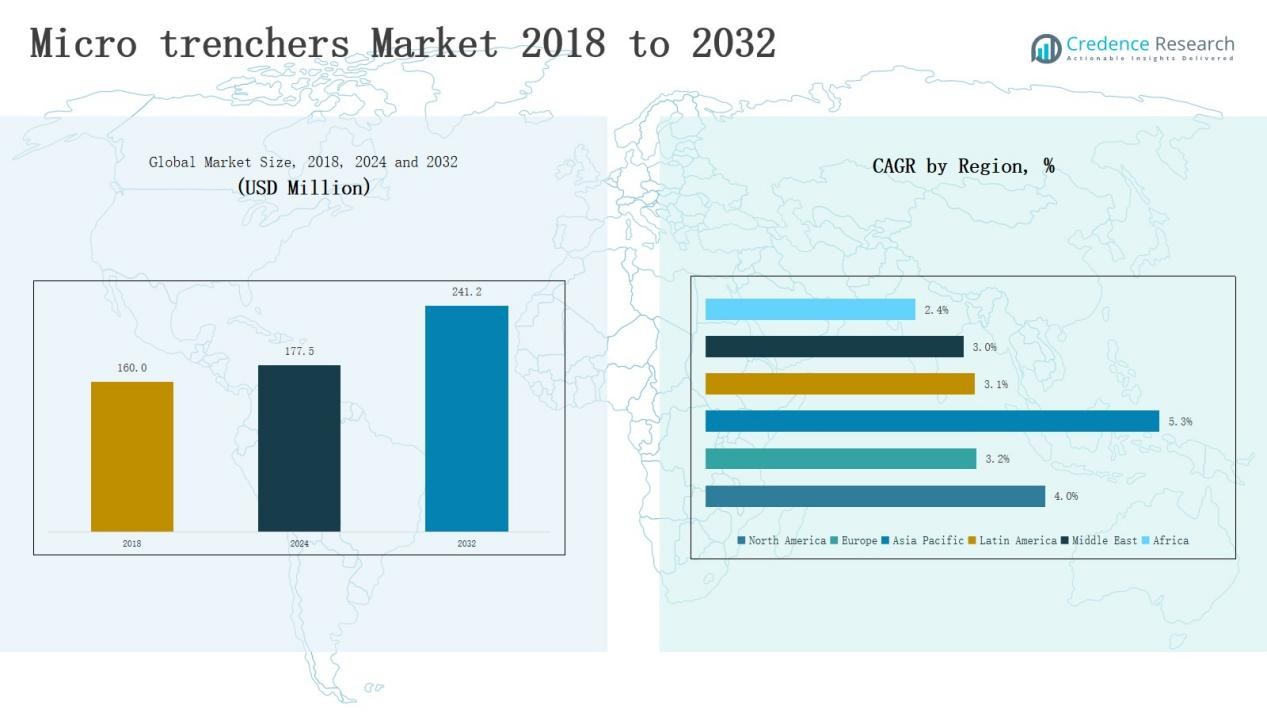
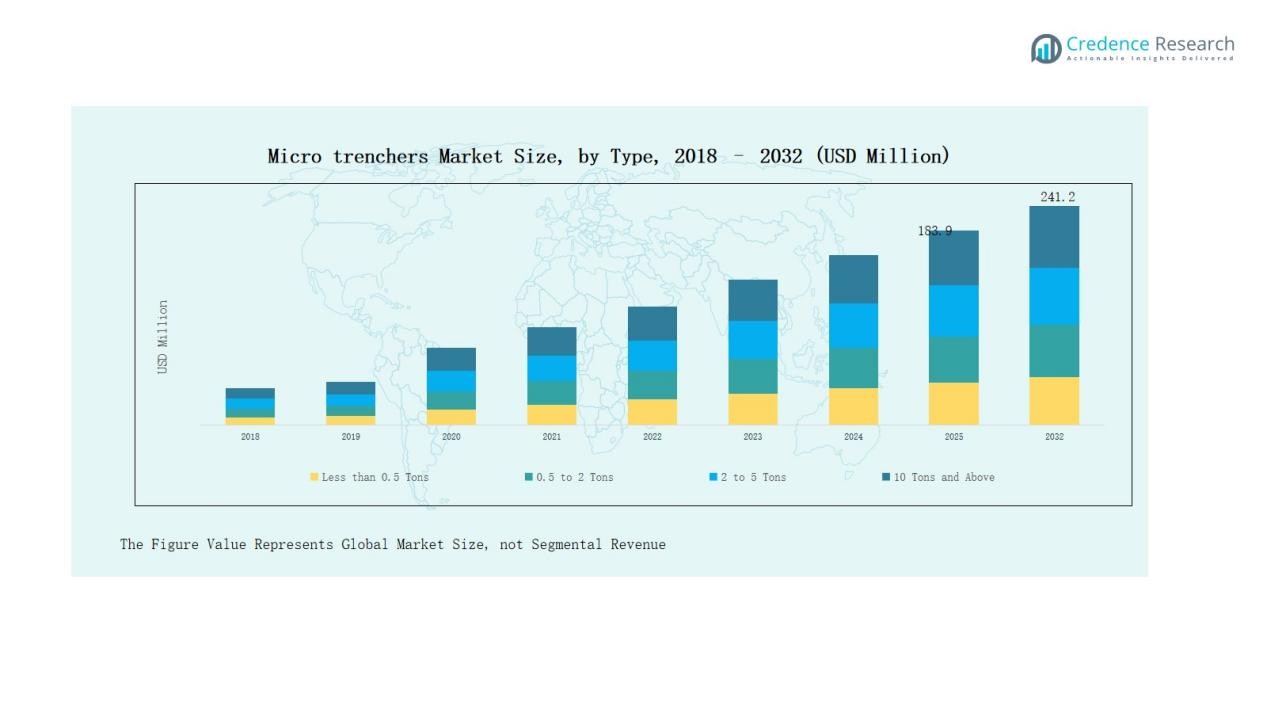
Microtrenchers Market size was valued at USD 160.0 million in 2018 to USD 177.5 million in 2024 and is anticipated to reach USD 241.2 million by 2032, at a CAGR of 4.0 % during the forecast period.
| REPORT ATTRIBUTE | DETAILS |
|---|---|
| Historical Period | 2020-2023 |
| Base Year | 2024 |
| Forecast Period | 2025-2032 |
| Microtrenchers Market Size 2024 | USD 177.5 Million |
| Microtrenchers Market, CAGR | 4.0 % |
| Microtrenchers Market Size 2032 | USD 241.2 Million |
The Micro Trenchers Market features a competitive landscape shaped by global and regional players focused on innovation, cost efficiency, and customer support. Leading companies such as Ditch Witch, Vermeer Corporation, Tesmec, Barreto, Toro, Simex Engineering SRL, E-Z Trench, Soni Agrotech, Changzhou Jiehe Machinery, Ground Hog, Mastenbroek, Marais, and Crary dominate through advanced product portfolios, strategic partnerships, and expanding distribution networks. These firms emphasize compact designs, automation, and eco-friendly features to address the rising demand for fiber optic and utility projects. North America emerged as the leading region in 2024 with a 34% market share, driven by large-scale fiber optic deployments, urban infrastructure upgrades, and the strong presence of key manufacturers.
Market Insights
- The Microtrenchers Market grew from USD 160.0 million in 2018 to USD 177.5 million in 2024 and will reach USD 241.2 million by 2032.
- The 5 to 2 Tons segment dominates by type with 38% share in 2024, driven by fiber optic and utility projects requiring compact, maneuverable trenching solutions.
- By application, fiber optic trenchers lead with 41% share in 2024, supported by global FTTH expansion and 5G rollouts across urban and semi-urban areas.
- The direct sales channel accounts for 56% share in 2024, favored for aftersales support, tailored configurations, and long-term service contracts with contractors and utilities.
- North America leads with 34% share in 2024, followed by Europe at 21% and Asia Pacific at 26%, highlighting strong regional demand for fiber and utility upgrades.
Market Segment Insights
By Type
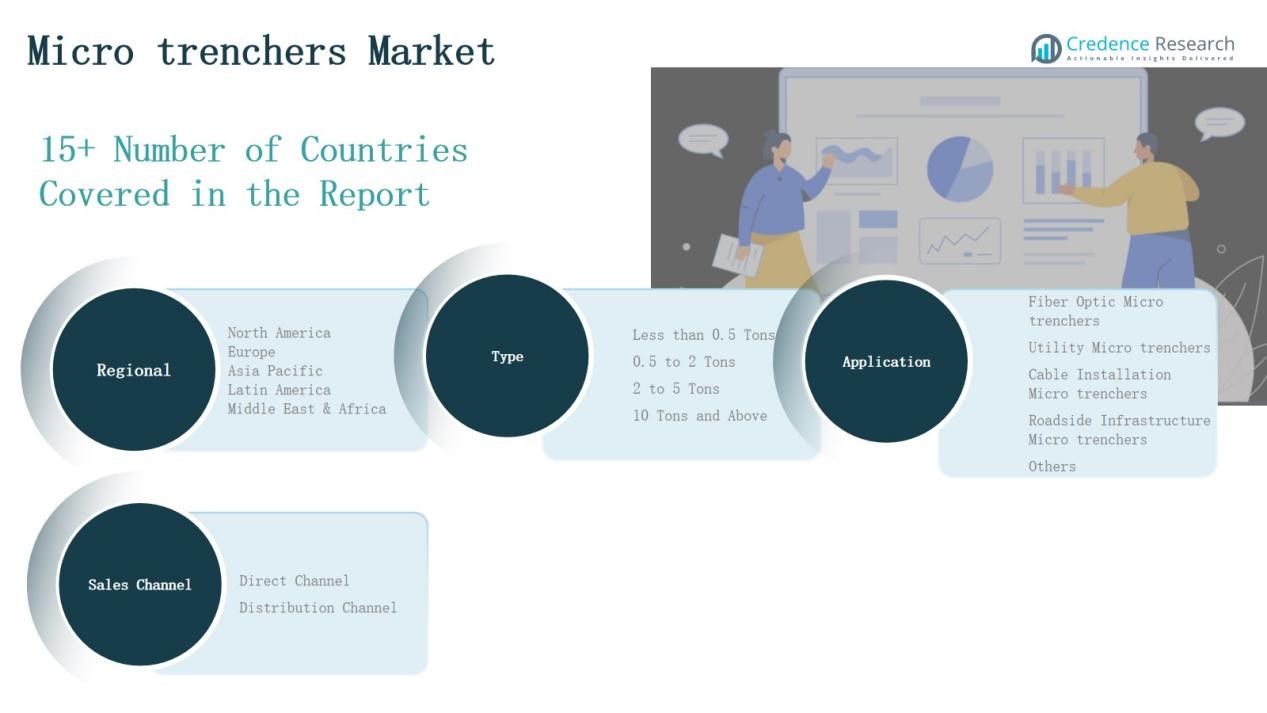
The 0.5 to 2 Tons segment dominates the micro trenchers market, accounting for 38% share in 2024. Its balance of maneuverability and cutting power makes it ideal for urban fiber optic and utility projects. Growing demand for compact machines suited for narrow streets and residential zones drives this segment’s leadership. Meanwhile, the 2 to 5 Tons category follows with 27% share, supported by wider adoption in medium-scale infrastructure and roadside trenching. Lighter models under 0.5 Tons remain niche at 12%, while heavy-duty 10 Tons and above hold 23% share, used in specialized industrial trenching applications.
- For instance, Ditch Witch’s MT26 micro trencher, launched in 2022, can cut up to 26 inches deep, making it a preferred choice for utility companies upgrading 5G backhaul networks along roadways.
By Application
Fiber Optic micro trenchers lead the market with 41% share in 2024, reflecting the global surge in fiber-to-the-home (FTTH) deployments and 5G network expansion. Telecom operators prefer these machines for their precision, minimal disruption, and cost efficiency in dense urban areas. Utility trenchers follow with 28% share, driven by underground utility cabling and water pipeline installations. Cable installation applications hold 16%, while roadside infrastructure projects contribute 10% as smart city developments progress. The others category, including defense and small municipal projects, accounts for 5% share.
- For instance, Tesmec S.p.A., a prominent trencher manufacturer, supplies high-efficiency trenching machines integrated with advanced telematics and 3D-GPS automatic guidance (TrenchIntel) to support utility duct installations, including those for smart city fiber optic and electric networks, globally.
By Sales Channel
The direct channel remains the leading sales model, holding 56% share in 2024, as manufacturers and contractors prefer direct purchases for tailored machine configurations, aftersales support, and long-term service agreements. Direct relationships also help buyers secure training and maintenance, critical for operational uptime. The distribution channel follows with 44% share, favored by small and mid-sized construction firms seeking faster availability, localized support, and flexible procurement. Distributors play a key role in reaching emerging markets and smaller infrastructure players, particularly in Asia Pacific and Latin America.
Key Growth Drivers
Expansion of Fiber Optic Networks
The rapid expansion of fiber optic networks remains the strongest driver for the micro trenchers market. With rising demand for high-speed internet and 5G rollouts, telecom providers are deploying micro trenchers to install fiber-to-the-home (FTTH) connections quickly and efficiently. These machines enable narrow and shallow trenching, minimizing surface disruption and reducing restoration costs. Governments and private telecom operators are investing heavily in digital infrastructure, further boosting demand. This trend positions fiber optic trenching as the leading growth contributor across developed and emerging economies.
- For instance, Google Fiber expanded into Mesa, Arizona, starting in 2022, using micro-trenching techniques that allowed installations at a significantly deeper average depth than two inches, reducing build-time
Urban Infrastructure Modernization
Growing urbanization and modernization of utility networks create significant demand for micro trenchers. Cities worldwide are upgrading power lines, water pipelines, and underground cables to support smart city initiatives and sustainable infrastructure. Micro trenchers are increasingly preferred for these upgrades, as they minimize traffic disruption and reduce labor costs compared to traditional trenching methods. Their compact design and ability to operate in tight spaces make them essential for dense urban environments. This urban infrastructure push directly supports market expansion in both developed and fast-growing regions.
- For instance, Verizon deployed micro trenching for its 5G fiber backhaul in Sacramento, California, demonstrating the method’s efficiency in enhancing next-generation urban connectivity.
Cost Efficiency and Operational Productivity
The need for cost-effective and time-efficient construction solutions drives adoption of micro trenchers. These machines reduce project timelines by delivering faster trenching with less manual intervention. Operators benefit from lower labor costs, minimal surface damage, and quicker restoration of roads, which improves public acceptance of construction works. Contractors also gain higher return on investment due to reduced downtime and efficient fuel consumption. The focus on operational productivity and sustainable trenching practices underpins steady growth in demand from both large infrastructure projects and smaller-scale municipal applications.
Key Trends & Opportunities
Integration of Advanced Technologies
Technological integration is shaping the next phase of growth for the micro trenchers market. Manufacturers are incorporating GPS tracking, automation, and smart controls to enhance precision and operator efficiency. Advanced cutting tools designed for varied soil conditions expand machine versatility. The integration of telematics for real-time performance monitoring is also gaining traction. These innovations align with the construction industry’s move toward digitalization and smart equipment, creating opportunities for players to differentiate through technology-driven solutions while meeting evolving customer needs.
- For instance, Vermeer Corporation offers its RTX550 ride-on tractor with interchangeable micro trencher attachments and the Vermeer Telematics system, enabling remote performance tracking and maintenance scheduling.
Rising Adoption in Emerging Markets
Emerging economies present untapped opportunities for the micro trenchers market. Countries in Asia Pacific, Latin America, and Africa are investing in broadband expansion, power distribution, and water management projects. With governments prioritizing digital connectivity and smart city development, micro trenchers are becoming essential for cost-efficient underground infrastructure deployment. Increasing construction activities and the entry of regional equipment manufacturers are expected to drive adoption. This rising demand from emerging markets not only expands the global customer base but also accelerates competition and innovation across the industry.
- For instance, India's BharatNet project aims to connect 250,000 village councils with high-speed broadband, where various technologies including compact trenching are being used to install fiber with minimal land disruption.
Key Challenges
High Initial Investment Costs
Despite operational advantages, the high initial cost of micro trenchers poses a barrier to adoption. Small and medium-sized contractors often face budget constraints that limit direct purchases of advanced equipment. Leasing options and distributor-based sales help ease this challenge, but many buyers remain hesitant to invest due to uncertain project pipelines. This capital-intensive nature slows penetration in cost-sensitive markets. Manufacturers must develop flexible financing models and affordable entry-level machines to overcome the challenge and tap into broader demand potential.
Limited Awareness and Technical Expertise
Awareness gaps and lack of skilled operators hinder wider adoption of micro trenchers, especially in developing regions. Many contractors remain accustomed to traditional trenching practices and are hesitant to shift to advanced alternatives. Limited technical expertise in handling precision trenchers results in underutilization of machine efficiency. Training programs and demonstration projects are needed to address these barriers. Expanding technical education and providing aftersales support are essential strategies for manufacturers to increase adoption and improve user confidence globally.
Regulatory and Environmental Constraints
Strict regulatory frameworks and environmental concerns create operational challenges for the micro trenchers market. Projects in urban and ecologically sensitive areas often face restrictions on noise, vibration, and dust emissions. Obtaining permits for trenching activities can delay deployments, particularly for large-scale telecom or utility upgrades. Compliance with evolving environmental standards also increases costs for manufacturers who must redesign machines to reduce emissions and enhance sustainability. Addressing these regulatory hurdles requires continuous innovation and collaboration with policymakers to ensure smoother project execution.
Regional Analysis
North America
North America leads the micro trenchers market with a 34% share in 2024, supported by strong demand from the U.S. and Canada. Market value increased from USD 61.6 million in 2018 to USD 67.6 million in 2024, projected to reach USD 91.7 million by 2032 at a CAGR of 4.0%. Expansion of fiber optic networks, smart city initiatives, and rapid adoption of trenchless technologies underpin growth. Contractors in this region prefer advanced models with high efficiency, and the presence of key players further strengthens North America’s leadership.
Europe
Europe accounts for 21% market share in 2024, making it the second-largest region. Market value rose from USD 38.6 million in 2018 to USD 41.0 million in 2024, with projections of USD 52.3 million by 2032 at a CAGR of 3.2%. Demand is driven by utility upgrades, energy-efficient infrastructure projects, and regulatory compliance for underground installations. Countries like Germany, France, and the UK remain major contributors due to investments in broadband and power distribution networks. Growing preference for low-disruption construction methods sustains steady adoption across the region.
Asia Pacific
Asia Pacific holds a 26% market share in 2024 and is the fastest-growing region. The market expanded from USD 35.7 million in 2018 to USD 41.5 million in 2024, projected to reach USD 62.6 million by 2032 at a CAGR of 5.3%. Rapid urbanization, large-scale fiber optic deployments, and infrastructure modernization across China, India, and Southeast Asia drive growth. Governments are prioritizing broadband connectivity and smart city initiatives, creating strong demand for compact and cost-effective micro trenchers. Local manufacturers and rising investments further enhance regional competitiveness.
Latin America
Latin America contributes 7% share in 2024, with the market rising from USD 11.7 million in 2018 to USD 12.9 million in 2024. It is projected to reach USD 16.4 million by 2032 at a CAGR of 3.1%. Countries like Brazil and Argentina lead adoption, supported by investments in digital connectivity and energy infrastructure. However, budget constraints and limited technical expertise slow wider uptake. Distributor networks play a crucial role in supplying affordable models, making micro trenchers increasingly accessible to mid-sized contractors and municipal projects.
Middle East
The Middle East holds a 6% market share in 2024, with values growing from USD 8.2 million in 2018 to USD 8.6 million in 2024, projected at USD 10.9 million by 2032 at a CAGR of 3.0%. Demand is driven by investments in telecom infrastructure, utility expansion, and smart city projects in GCC countries, Israel, and Turkey. Government-backed initiatives to enhance broadband penetration create opportunities. Still, adoption remains moderate due to high costs and reliance on imports, though demand for compact trenching solutions is expected to strengthen.
Africa
Africa represents 6% market share in 2024, reflecting steady but limited adoption. The market grew from USD 4.3 million in 2018 to USD 6.0 million in 2024, expected to reach USD 7.4 million by 2032 at a CAGR of 2.4%. Growth is supported by infrastructure projects in South Africa, Egypt, and Nigeria, particularly in fiber optic connectivity and power distribution. However, market expansion is constrained by financial limitations, lack of skilled operators, and limited awareness of advanced trenching methods. Distributor-led sales channels remain vital to regional growth.
Market Segmentations:
By Type
- Less than 0.5 Tons
- 5 to 2 Tons
- 2 to 5 Tons
- 10 Tons and Above
By Application
- Fiber Optic Micro Trenchers
- Utility Micro Trenchers
- Cable Installation Micro Trenchers
- Roadside Infrastructure Micro Trenchers
- Others
By Sales Channel
- Direct Channel
- Distribution Channel
By Region
North America
- U.S.
- Canada
- Mexico
Europe
- UK
- France
- Germany
- Italy
- Spain
- Russia
- Rest of Europe
Asia Pacific
- China
- Japan
- South Korea
- India
- Australia
- Southeast Asia
- Rest of Asia Pacific
Latin America
- Brazil
- Argentina
- Rest of Latin America
Middle East
- GCC Countries
- Israel
- Turkey
- Rest of Middle East
Africa
- South Africa
- Egypt
- Rest of Africa
Competitive Landscape
The micro trenchers market is moderately consolidated, with leading players competing on innovation, product reliability, and service support. Companies such as Ditch Witch, Vermeer Corporation, Tesmec, Barreto, Toro, and Simex Engineering SRL hold strong market positions through extensive product portfolios and global distribution networks. These players focus on developing compact, fuel-efficient, and technologically advanced trenchers tailored for fiber optic installations and urban infrastructure projects. Mid-sized firms like E-Z Trench, Soni Agrotech, and Ground Hog strengthen regional presence by offering cost-effective machines and flexible sales models. Strategic partnerships with telecom operators and construction firms enhance market penetration, while aftersales services and operator training programs remain crucial competitive differentiators. New entrants from Asia are introducing lower-priced alternatives, intensifying price competition. The industry’s growth trajectory is increasingly shaped by innovation in automation, telematics, and eco-friendly designs, positioning established companies to maintain dominance while creating opportunities for emerging players in cost-sensitive regions.
Key Players
- Ditch Witch
- Vermeer Corporation
- Tesmec
- Barreto
- Soni Agrotech
- E-Z Trench
- Changzhou Jiehe Machinery Co., Ltd.
- Ground Hog
- Toro
- Mastenbroek
- Marais
- Crary
- Simex Engineering SRL
Recent Developments
- In February 2025, Barreto Manufacturing revealed four new products, including the 30RTK Track Trencher. This compact, track-driven machine offers enhanced traction, stability, and hydraulically adjustable trench depth-fitting tough terrains and confined job sites.
- In June 2025, Vermeer Corporation launched the MTR516 microtrencher attachment. It cuts up to 17 inches deep and 1–2 inches wide. The design features a shrouded cutting wheel with vacuum suction and easy servicing-ideal for clean, precise fiber installations.
- In January 2025, Vermeer Corporation formed an exclusive partnership with Tecniwell, an Italian pump maker. This alliance allows Vermeer to distribute Tecniwell’s high-pressure pump packages through its EMEA (Europe, Middle East, Africa) dealer network.
Report Coverage
The research report offers an in-depth analysis based on Type, Application, Sales Channel and Region. It details leading market players, providing an overview of their business, product offerings, investments, revenue streams, and key applications. Additionally, the report includes insights into the competitive environment, SWOT analysis, current market trends, as well as the primary drivers and constraints. Furthermore, it discusses various factors that have driven market expansion in recent years. The report also explores market dynamics, regulatory scenarios, and technological advancements that are shaping the industry. It assesses the impact of external factors and global economic changes on market growth. Lastly, it provides strategic recommendations for new entrants and established companies to navigate the complexities of the market.
Future Outlook
- Demand for fiber optic trenchers will continue to grow with global 5G expansion.
- Urban infrastructure upgrades will drive adoption of compact and efficient trenching solutions.
- Automation and smart controls will increasingly enhance machine precision and usability.
- Manufacturers will focus on eco-friendly designs to meet stricter environmental standards.
- Emerging markets in Asia, Africa, and Latin America will provide new growth opportunities.
- Direct sales channels will remain dominant, but distributors will expand reach in smaller markets.
- Partnerships with telecom and utility providers will strengthen competitive positioning.
- Training and aftersales support will play a larger role in customer retention.
- Localized manufacturing in cost-sensitive regions will intensify price competition.
- Integration of telematics and remote monitoring will redefine efficiency and fleet management.

Request a Free Sample
Fill in your details and we'll send you a free sample report.
- Sample data tables & charts
- Research methodology
Market Dynamics
Expansion of Fiber Optic Networks
The rapid deployment of fiber-to-the-home (FTTH) and 5G infrastructure is fueling demand for micro trenchers, as these machines enable fast, minimally disruptive installation of underground fiber cables in urban and suburban environments.
Urban Infrastructure Modernization
Cities worldwide are upgrading utility networks and implementing smart city projects, which require compact and precise trenching solutions to minimize traffic disruption and surface restoration costs, directly boosting micro trencher adoption.
Cost Efficiency and Operational Productivity
Micro trenchers offer significant reductions in labor, project timelines, and surface restoration expenses compared to traditional trenching, making them attractive for contractors and utilities seeking higher return on investment and operational efficiency.
Integration of Advanced Technologies
Manufacturers are incorporating automation, telematics, and smart controls into micro trenchers, enhancing precision, ease of use, and real-time monitoring, which increases machine appeal and supports adoption in technologically advanced and emerging markets.
Rising Adoption in Emerging Markets
Government initiatives for broadband expansion and infrastructure modernization in Asia Pacific, Latin America, and Africa are driving demand for affordable, compact trenching solutions, expanding the global customer base for micro trenchers.
Need a Custom Version of This Report?
Tailor the scope, geography, or segments to your exact requirements.
- Custom geography or segment scope
- Direct access to our analyst team
Frequently Asked Questions
What is the current market size for Microtrenchers Market, and what is its projected size in 2032?
At what Compound Annual Growth Rate is the Microtrenchers Market projected to grow between 2025 and 2032?
Which Microtrenchers Market segment held the largest share in 2024?
What are the primary factors fueling the growth of the Microtrenchers Market?
Who are the leading companies in the Microtrenchers Market?
Which region commanded the largest share of the Microtrenchers Market in 2024?
Table of Content
Chapter 1 Market Segmentation
- 1.1 Segmentation Framework
- 1.1.1 Product and Service Classification
- 1.1.2 Application and End-Use Classification
- 1.1.3 Technology and Solution Classification
- 1.1.4 Customer and Distribution Channel Classification
- 1.1.5 Geographic Segmentation
- 1.1.6 Market Segment Definitions and Boundaries
- 1.2 By Type
- 1.2.1 Less than 0.5 Tons
- 1.2.2 0.5 to 2 Tons
- 1.2.3 2 to 5 Tons
- 1.2.4 10 Tons and Above
- 1.3 By Application
- 1.3.1 Fiber Optic Micro Trenchers
- 1.3.2 Utility Micro Trenchers
- 1.3.3 Cable Installation Micro Trenchers
- 1.3.4 Roadside Infrastructure Micro Trenchers
- 1.3.5 Others
- 1.4 By Sales Channel
- 1.4.1 Direct Channel
- 1.4.2 Distribution Channel
Chapter 2 Introduction
- 2.1 Report Objectives and Scope
- 2.2 Product Definition and Industry Terminology
- 2.3 Market Inclusions and Exclusions
- 2.4 Research Process
- 2.4.1 Primary Research and Expert Interviews
- 2.4.2 Secondary Research and Source Review
- 2.4.3 Top-Down and Bottom-Up Estimation
- 2.4.4 Data Triangulation and Verification
- 2.5 Market Size Measurement Basis
- 2.5.1 2024: USD 177.5 million → 2032: USD 241.2 million
- 2.6 Historical and Forecast Reference Periods
- 2.6.1 Base Year: 2024
- 2.6.2 Forecast Period: 2024-2032
- 2.7 Research Assumptions and Limitations
Chapter 3 Executive Summary
- 3.1 Market Snapshot and Key Findings
- 3.2 Base-Year Market Size, 2024
- 3.3 Forecast Market Size, 2032
- 3.4 Revenue and Volume Growth Outlook
- 3.5 Key Demand and Supply Indicators
- 3.6 Leading Market Segments
- 3.7 Fastest-Growing Market Opportunities
- 3.8 Regional Performance Highlights
- 3.9 Technology and Industry Transformation
- 3.10 Competitive Landscape Summary
- 3.11 Analyst View and Strategic Implications
Chapter 4 Global Microtrenchers Market Trends and Developments
- 4.1 Historical Industry Development
- 4.2 Recent Market Trends and Developments
- 4.3 Demand and Customer Behavior Trends
- 4.4 Technology and Product Innovation
- 4.5 Artificial Intelligence, Automation and Digitalization
- 4.6 Local Manufacturing and Supply Chain Realignment
- 4.7 Industry Partnerships, Mergers and Acquisitions
- 4.8 Sustainability and Circular Economy Developments
- 4.9 Government and Private Sector Investment Trends
- 4.10 Emerging Business Models and Commercialization
- 4.11 Industry Developments and Announcements
Chapter 5 Global Microtrenchers Market Production, Supply and Demand Analysis
- 5.1 Demand Trend and Consumption Analysis
- 5.2 Demand Forecast, 2024-2032
- 5.3 Production and Output Trend
- 5.4 Production and Output Forecast, 2024-2032
- 5.5 Installed Capacity and Capacity Utilization
- 5.6 Company-Wise Production Plants and Statistics
- 5.6.1 Installed Production Capacity
- 5.6.2 Actual Production
- 5.6.3 Planned Capacity and Expansion Targets
- 5.7 Supply Chain Structure and Procurement Trends
- 5.8 Supply-Demand Gap and Bottlenecks
- 5.9 Import Dependence and Sourcing Structure
- 5.10 Contract Manufacturing and Outsourcing
- 5.11 Regional Supply and Demand Concentration
Chapter 6 Global Microtrenchers Market Pricing Analysis
- 6.1 Pricing Structure and Measurement
- 6.2 Historical Pricing Trends
- 6.3 Pricing Outlook, 2024-2032
- 6.4 Average Selling Price and Unit Economics
- 6.5 Pricing by Product and Market Segment
- 6.6 Geographic Pricing Differences
- 6.7 Key Input, Energy, Labor and Logistics Costs
- 6.8 Contract Pricing and Purchasing Models
- 6.9 Pricing Sensitivity and Competitive Positioning
- 6.10 Price, Margin and Profitability Implications
Chapter 7 Global Microtrenchers Market Dynamics
- 7.1 Market Growth Drivers
- 7.1.1 Demand-Side Drivers
- 7.1.2 Technology and Innovation Drivers
- 7.1.3 Infrastructure and Investment Drivers
- 7.1.4 Regulatory and Policy Drivers
- 7.2 Market Restraints
- 7.2.1 Cost and Affordability Constraints
- 7.2.2 Technology and Adoption Barriers
- 7.2.3 Supply Chain and Operational Constraints
- 7.3 Market Challenges
- 7.3.1 Competitive Pressure and Margin Erosion
- 7.3.2 Skills, Infrastructure and Implementation Gaps
- 7.4 Emerging Market Opportunities
- 7.5 Market Dynamics Impact and Time-Horizon Assessment
Chapter 8 Global Microtrenchers Value Chain Analysis
- 8.1 Industry Value Chain Overview
- 8.2 Upstream Suppliers and Critical Inputs
- 8.3 Technology and Component Providers
- 8.4 Manufacturing or Service Delivery
- 8.5 Distribution, Channel Partners and Integrators
- 8.6 Downstream Applications and End Users
- 8.7 Value Addition and Profit Pools
- 8.8 Vertical Integration and Outsourcing
- 8.9 Supplier Concentration and Risk
- 8.10 Supply Chain Localization and Resilience
Chapter 9 Global Microtrenchers Market Regulations and Policies
- 9.1 Relevant Laws, Standards and Compliance Frameworks
- 9.2 Product, Service, Safety and Quality Requirements
- 9.3 Government Policies, Incentives and Subsidies
- 9.4 Imports, Exports and Trade Barriers
- 9.5 Public Procurement and Local Content Requirements
- 9.6 Environmental and Sustainability Compliance
- 9.7 Upcoming Policy Changes and Market Implications
Chapter 10 Global Microtrenchers Market Hotspots and Opportunities
- 10.1 Market Opportunity Mapping and Growth Hotspots
- 10.2 High-Growth Applications and Customer Groups
- 10.3 Underserved Markets and White-Space Opportunities
- 10.4 Emerging Technology and Product Opportunities
- 10.5 New Capacity and Investment Hotspots
- 10.6 Market Entry and Expansion Opportunities
- 10.7 Distribution and Partnership Opportunities
- 10.8 Near-Term and Long-Term Commercial Potential
- 10.9 Opportunity Attractiveness and Execution Risks
Chapter 11 Global Microtrenchers Market Outlook, 2024-2032
- 11.1 Market Size and Analysis
- 11.1.1 Revenue (Market Measurement: 2024: USD 177.5 million → 2032: USD 241.2 million)
- 11.1.2 Market Volume and Quantity Sold
- 11.1.3 Historical Market Size
- 11.1.4 Base-Year Market Size, 2024
- 11.2 Market Forecast, 2024-2032
- 11.2.1 Revenue Forecast to 2032
- 11.2.2 Volume Forecast to 2032
- 11.2.3 CAGR and Year-on-Year Growth
- 11.2.4 Incremental Revenue Opportunity
- 11.3 Forecast Assumptions and Scenario Analysis
- 11.3.1 Base-Case Forecast
- 11.3.2 Optimistic and Conservative Scenarios
- 11.3.3 Technology, Pricing and Policy Sensitivities
- 11.4 Market Attractiveness and Growth Outlook
Chapter 12 Global Microtrenchers Market Segmentation and Outlook
- 12.1 Segmentation Summary and Market Shares, 2024
- 12.2 Largest and Fastest-Growing Segments
- 12.3 By Type - Market Size and Forecast, 2024-2032
- 12.3.1 Segment Definition and Scope
- 12.3.2 Historical Market Size
- 12.3.3 Revenue Forecast, 2024-2032
- 12.3.4 Volume Forecast, 2024-2032
- 12.3.5 Base-Year Market Share, 2024
- 12.3.6 Segment CAGR and Growth Drivers
- 12.3.7 Subsegment Market Size and Forecast
- 12.3.7.1 Less than 0.5 Tons
- 12.3.7.2 0.5 to 2 Tons
- 12.3.7.3 2 to 5 Tons
- 12.3.7.4 10 Tons and Above
- 12.3.8 Subsegment Pricing and Adoption Trends
- 12.3.9 Leading Suppliers and Competition
- 12.3.10 Regional Demand and Opportunities
- 12.4 By Application - Market Size and Forecast, 2024-2032
- 12.4.1 Segment Definition and Scope
- 12.4.2 Historical Market Size
- 12.4.3 Revenue Forecast, 2024-2032
- 12.4.4 Volume Forecast, 2024-2032
- 12.4.5 Base-Year Market Share, 2024
- 12.4.6 Segment CAGR and Growth Drivers
- 12.4.7 Subsegment Market Size and Forecast
- 12.4.7.1 Fiber Optic Micro Trenchers
- 12.4.7.2 Utility Micro Trenchers
- 12.4.7.3 Cable Installation Micro Trenchers
- 12.4.7.4 Roadside Infrastructure Micro Trenchers
- 12.4.7.5 Others
- 12.4.8 Subsegment Pricing and Adoption Trends
- 12.4.9 Leading Suppliers and Competition
- 12.4.10 Regional Demand and Opportunities
- 12.5 By Sales Channel - Market Size and Forecast, 2024-2032
- 12.5.1 Segment Definition and Scope
- 12.5.2 Historical Market Size
- 12.5.3 Revenue Forecast, 2024-2032
- 12.5.4 Volume Forecast, 2024-2032
- 12.5.5 Base-Year Market Share, 2024
- 12.5.6 Segment CAGR and Growth Drivers
- 12.5.7 Subsegment Market Size and Forecast
- 12.5.7.1 Direct Channel
- 12.5.7.2 Distribution Channel
- 12.5.8 Subsegment Pricing and Adoption Trends
- 12.5.9 Leading Suppliers and Competition
- 12.5.10 Regional Demand and Opportunities
- 12.6 Segment Growth Comparison
- 12.7 Segment Attractiveness and Priority Matrix
Chapter 13 Global Microtrenchers End-Use and Application Market Outlook
- 13.1 End-Use Industry and Customer Demand Structure
- 13.2 Leading Applications and Customer Groups
- 13.3 End-Use Market Size, Share and Forecast
- 13.4 Major End-Use Industry Deep Dives
- 13.4.1 Customer Requirements and Use Cases
- 13.4.2 Demand and Replacement Cycles
- 13.4.3 Technical and Regulatory Considerations
- 13.4.4 Purchasing and Procurement Models
- 13.4.5 Leading Vendors and Distribution Channels
- 13.4.6 Forecast and Commercial Opportunities
- 13.5 Emerging Applications and Cross-Segment Demand
- 13.6 End-Use Industry Investment Priorities
Chapter 14 Global Microtrenchers Geographic Market Outlook, 2024-2032
- 14.1 Regional Market Size and Share, 2024
- 14.2 Regional Market Forecast, 2024-2032
- 14.3 Regional Pricing, Production and Demand Differences
- 14.4 North America
- 14.4.1 United States
- 14.4.2 Canada
- 14.4.3 Mexico
- 14.5 Europe
- 14.5.1 Germany
- 14.5.2 France
- 14.5.3 Italy
- 14.5.4 United Kingdom
- 14.5.5 Spain
- 14.5.6 Poland
- 14.5.7 Russia
- 14.5.8 Netherlands
- 14.5.9 Belgium
- 14.5.10 Sweden
- 14.5.11 Denmark
- 14.5.12 Norway
- 14.5.13 Rest of Europe
- 14.6 Asia Pacific
- 14.6.1 China
- 14.6.2 India
- 14.6.3 Japan
- 14.6.4 South Korea
- 14.6.5 Thailand
- 14.6.6 Indonesia
- 14.6.7 Vietnam
- 14.6.8 Malaysia
- 14.6.9 Australia
- 14.6.10 Rest of Asia Pacific
- 14.7 Latin America
- 14.7.1 Brazil
- 14.7.2 Argentina
- 14.7.3 Colombia
- 14.7.4 Chile
- 14.7.5 Rest of Latin America
- 14.8 Middle East
- 14.8.1 Saudi Arabia
- 14.8.2 United Arab Emirates
- 14.8.3 Turkey
- 14.8.4 Israel
- 14.8.5 Iran
- 14.8.6 Rest of the Middle East
- 14.9 Africa
- 14.9.1 South Africa
- 14.9.2 Egypt
- 14.9.3 Nigeria
- 14.9.4 Morocco
- 14.9.5 Rest of Africa
- 14.10 Regional Investment, Policy and Supply Chain Differences
- 14.11 Regional Competitive Landscape
- 14.12 Geographic Growth Hotspots
Chapter 15 Global Microtrenchers Technology, Innovation and Sustainability Outlook
- 15.1 Technology Landscape and Maturity
- 15.2 Product, Process and Service Innovation
- 15.3 AI, Automation and Digital Tools in the Industry
- 15.4 Technology Adoption and Performance Benchmarking
- 15.5 Innovation Pipeline and R&D Investment
- 15.6 Patent and Intellectual Property Trends
- 15.7 Energy Efficiency and Resource Management
- 15.8 Sustainability, Recycling and Circularity
- 15.9 Technology Roadmap, 2024-2032
- 15.10 Risks of Obsolescence and Technology Substitution
Chapter 16 Global Microtrenchers Market Key Strategic Imperatives
- 16.1 Growth and Market Entry Priorities
- 16.2 High-Return Products and Segments
- 16.3 Pricing, Profitability and Cost Optimization
- 16.4 Technology Investment and Product Differentiation
- 16.5 Supply Chain Localization and Resilience
- 16.6 Distribution and Customer Acquisition
- 16.7 Partnership, Acquisition and Capacity Strategy
- 16.8 Regional Expansion Priorities
- 16.9 Short-, Medium- and Long-Term Actions
Chapter 17 Competition Outlook
- 17.1 Industry Competition Characteristics
- 17.2 Market Structure and Concentration
- 17.3 Market Share and Competitive Positioning, 2024
- 17.4 Company-Wise Revenue and Product Benchmarking
- 17.5 Production and Service Capacity Benchmarking
- 17.6 Technology, Pricing and Differentiation
- 17.7 Regional Footprint and Distribution Strength
- 17.8 Mergers, Acquisitions and Strategic Alliances
- 17.9 New Entrants and Competitive Threats
- 17.10 Porter's Five Forces and Industry Attractiveness
- 17.11 Competitive Outlook, 2024-2032
Chapter 18 Company Profiles
- 18.1 Company Coverage and Selection Criteria
- 18.2 Ditch Witch
- 18.2.1 Business Description
- 18.2.2 Company Ownership and Geographic Presence
- 18.2.3 Product and Service Portfolio
- 18.2.4 Manufacturing and Operating Footprint
- 18.2.5 Production Capacity and Expansion Plans
- 18.2.6 Financial Performance and Investment
- 18.2.7 Market Share and Competitive Position
- 18.2.8 Technology and Innovation Capabilities
- 18.2.9 Strategic Alliances or Partnerships
- 18.2.10 Recent Developments
- 18.2.11 Growth Strategy and Outlook
- 18.3 Vermeer Corporation
- 18.4 Tesmec
- 18.5 Barreto
- 18.6 Toro
- 18.7 Simex Engineering SRL
- 18.8 E-Z Trench
- 18.9 Soni Agrotech
- 18.10 Changzhou Jiehe Machinery Co., Ltd.
- 18.11 Ground Hog
- 18.12 Other Relevant Market Participants
Note: Every listed company is profiled on the structure shown under the first company. The company list is preliminary and may change based on research findings, market developments, data availability and client requirements.
Chapter 19 Disclaimer
- 19.1 Research and Forecast Disclaimer
- 19.2 Data Source and Estimation Limitations
Note: The depth of individual sections depends on data availability for this market. Volume, capacity, trade and other unit-based metrics are included where applicable.