
CGRP therapies reshape acute and preventive care
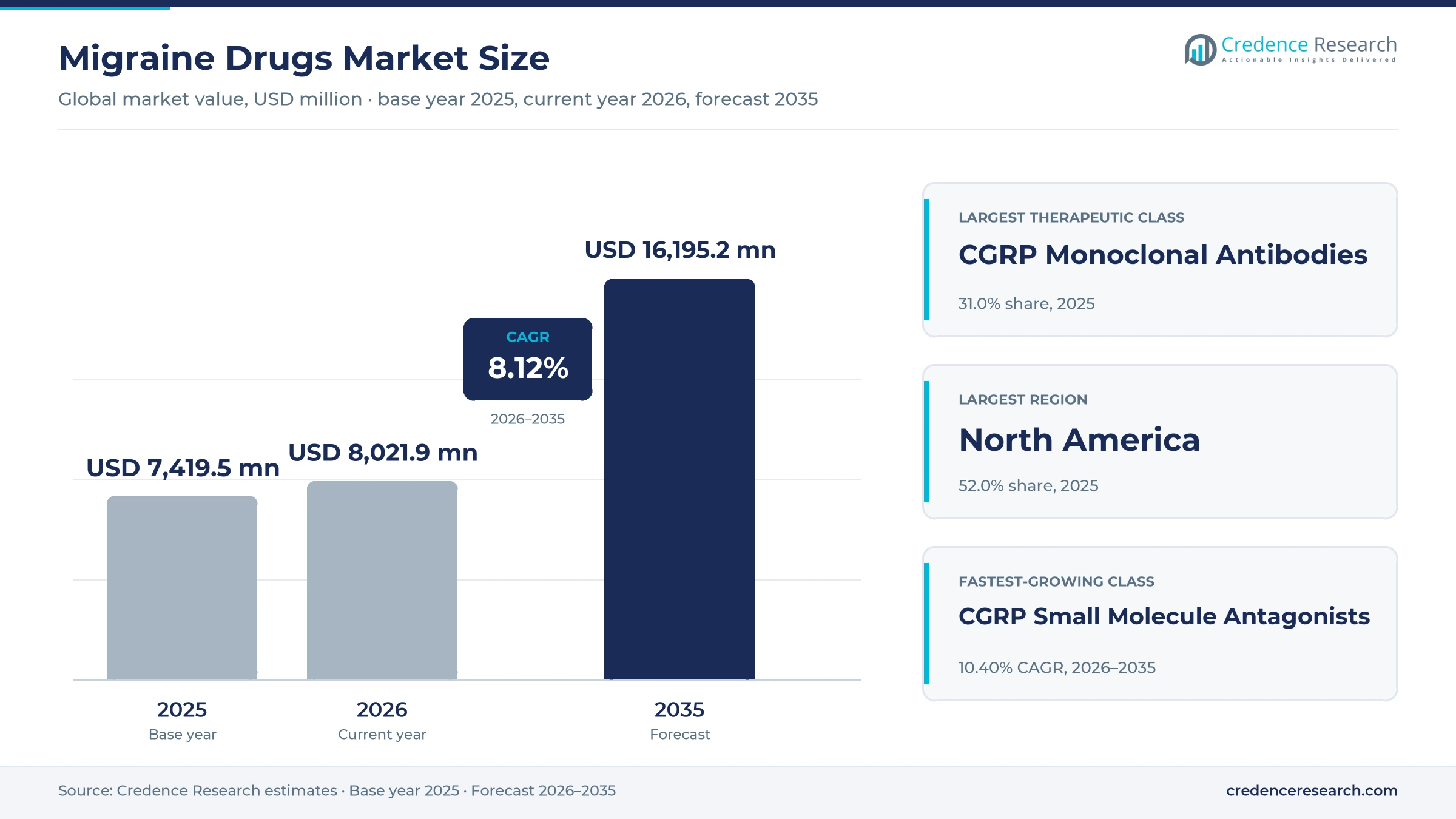
The global migraine drugs market was valued at USD 7.42 billion in 2025 and is projected to increase from USD 8.02 billion in 2026 to USD 16.20 billion by 2035, registering a CAGR of 8.12% during 2026–2035. Demand comes from a very large patient population, better diagnosis by neurologists and primary care doctors, and a steady shift from older generic pills toward CGRP-targeted medicines for acute and preventive use. North America held the largest regional share, 52.0% in 2025, because U.S. payers cover branded antibodies and gepants for many insured adults. Asia Pacific is the fastest-growing region at 9.75% a year, as Japan, China and South Korea review new CGRP antibody filings. The treatment picture changed in August 2025, when the FDA cleared the first CGRP antagonist for pediatric episodic prevention. As a result, treatment options now reach patients from age 6 to adulthood.
Which medicines and treatment approaches does this analysis cover?
The analysis counts prescription and branded over-the-counter medicines used for acute attacks and for prevention, including CGRP antibodies, gepants, botulinum toxin injections, triptans, ditans, ergot alkaloids and NSAIDs. Values reflect manufacturer selling prices after typical discounts, and patients obtain most products through retail and specialty pharmacies.
Neuromodulation devices, behavioral therapy and generic pain relievers bought without a headache indication sit outside this scope. The value chain runs from originator and generic manufacturers through wholesalers and pharmacy benefit managers to hospital, retail and online pharmacies, which dispense medicines prescribed by neurologists and primary care doctors.
Migraine Drugs Market Insights
- The migraine drugs market grows from USD 7.42 billion in 2025 to USD 16.20 billion by 2035, an 8.12% CAGR as CGRP antibodies and gepants replace older generic therapies.
- North America held 52.0% of global headache therapy value in 2025, supported by broad insurance coverage for branded CGRP medicines.
- CGRP monoclonal antibodies led therapeutic classes with 31.0% of 2025 value, while small molecule antagonists grow fastest at 10.40% a year.
- In August 2025, Teva announced FDA approval of fremanezumab for episodic prevention in children aged 6 to 17 who weigh at least 45 kg.
- In September 2026, Lundbeck announced Japanese approval of eptinezumab, its first launch in Japan as marketing authorization holder.
CGRP antibodies lead as oral gepants gain ground
Why does acute treatment still hold the larger share?
Based on type, the market is categorized into acute migraine treatment and preventive migraine treatment. Acute Migraine Treatment led with a 55.0% share of 2025 value, because nearly every diagnosed patient uses an attack medicine, from generic triptans to branded gepants. Preventive Migraine Treatment grows fastest at 8.98% a year, as doctors move patients with frequent attacks onto monthly antibodies, daily oral gepants and regular injections of botulinum toxin.
How do oral and injectable medicines divide spending?
Based on route of administration, the market is categorized into oral, injection and others. Oral led with a 58.0% share of 2025 value, because triptans, NSAIDs, ditans and gepants are taken as tablets or dissolving wafers. This route also grows fastest at 8.46% a year, as daily oral prevention gains payer acceptance. Injections cover antibodies, toxin treatment and dihydroergotamine, while nasal sprays sit in others.
Why are online pharmacies gaining share?
Based on distribution channel, the market is categorized into hospital pharmacy, retail pharmacy and online pharmacy. Retail Pharmacy led with a 58.0% share of 2025 value, because most patients refill attack and prevention medicines close to home. Online Pharmacy grows fastest at 9.89% a year, as telehealth prescribing and online pharmacies make monthly refills easier for younger working adults.
Which medicine classes capture most of the value?
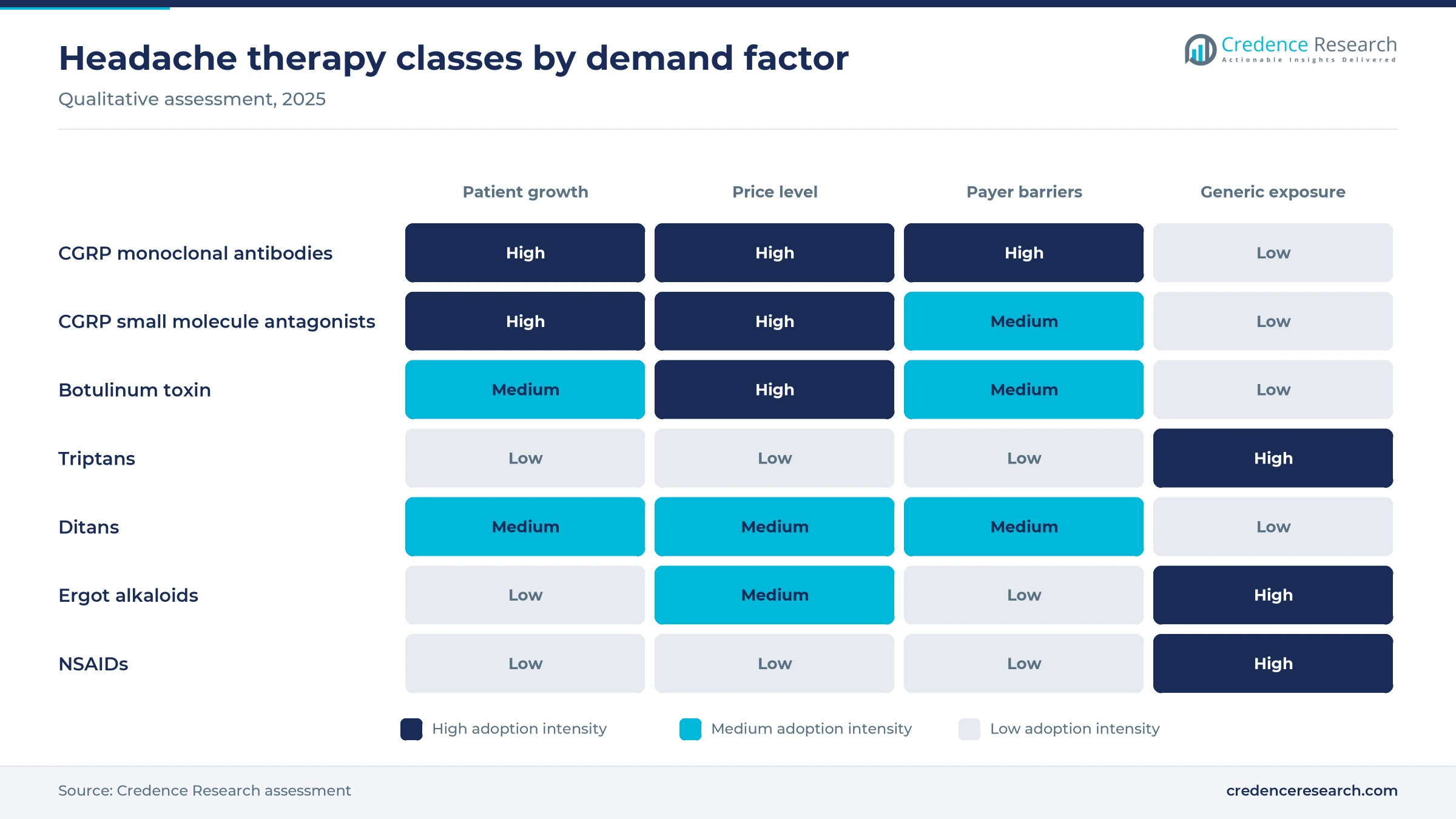
Based on therapeutic class, the market is categorized into CGRP monoclonal antibodies, CGRP small molecule antagonists, acetylcholine inhibitors and neurotoxins, triptans, ditans, ergot alkaloids and NSAIDs. CGRP Monoclonal Antibodies led with a 31.0% share of 2025 value, because branded prices remain high and monthly dosing keeps patients on therapy. CGRP Small Molecule Antagonists grow fastest at 10.40% a year, as gepants serve both acute and preventive needs. Triptans keep large volumes but low prices after generic entry.
| Segment Group | Leading Sub-segment | Share, 2025 | Fastest-growing Sub-segment | CAGR, 2026–2035 |
|---|---|---|---|---|
| By Type | Acute Migraine Treatment | 55.0% | Preventive Migraine Treatment | 8.98% |
| By Route of Administration | Oral | 58.0% | Oral | 8.46% |
| By Distribution Channel | Retail Pharmacy | 58.0% | Online Pharmacy | 9.89% |
| By Therapeutic Class | CGRP Monoclonal Antibodies | 31.0% | CGRP Small Molecule Antagonists | 10.40% |
Request a Free Sample
Fill in your details and we'll send you a free sample report.
- Sample data tables & charts
- Research methodology
High disease burden and new approvals lift spending
How does the scale of the disease burden sustain demand?
The scale of the disease burden sustains demand, because headache disorders affect a large share of adults in every region. The World Health Organization estimated in October 2025 that headache disorders affected about 40% of the global population, or 3.1 billion people, in 2021. The agency also notes that the condition is more common in women, possibly because of hormonal influences. As a result, even modest gains in diagnosis rates add millions of new patients who need acute or preventive therapy each year.
Why does the rising count of diagnosed cases matter?
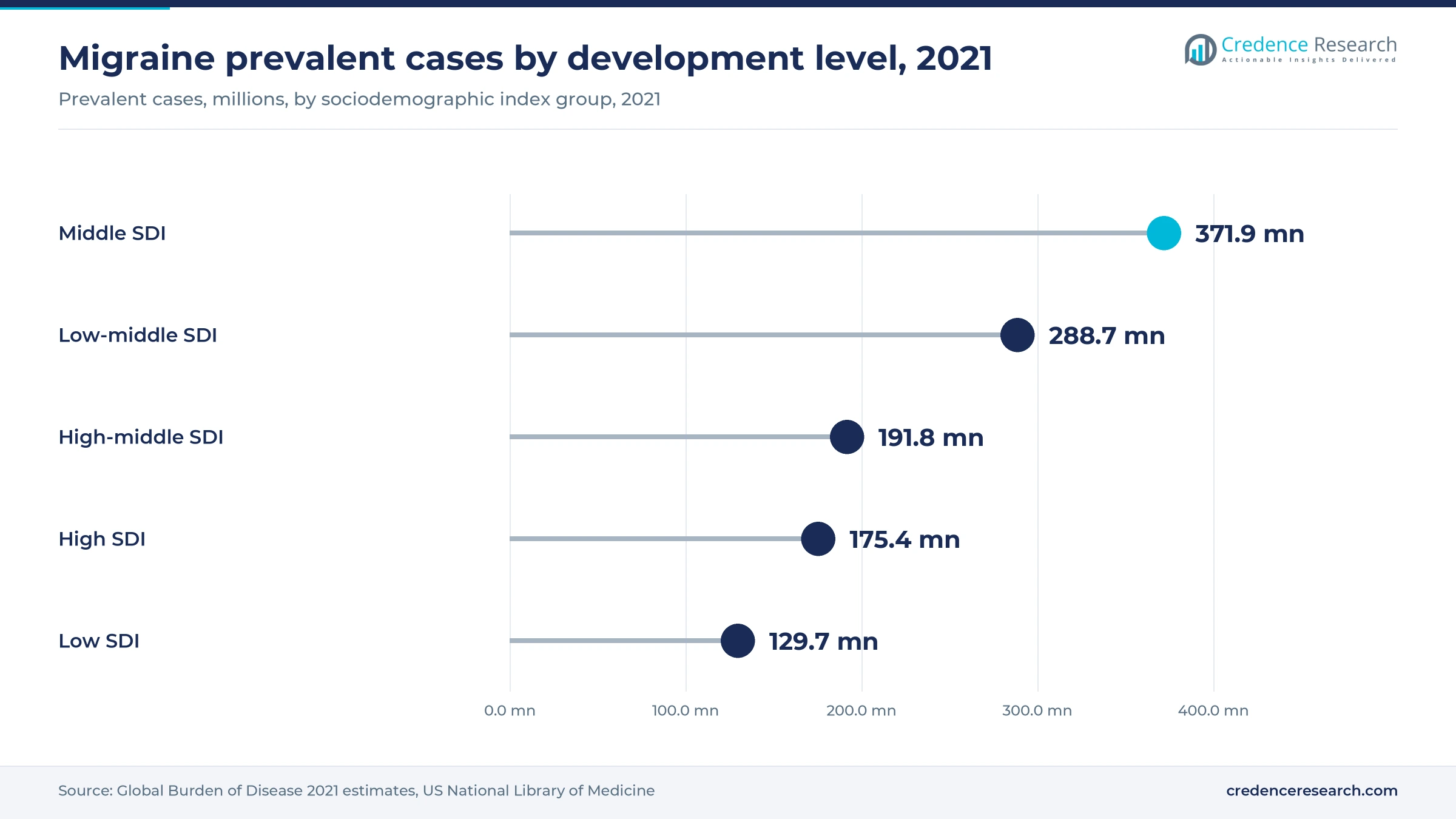
The rising count of diagnosed cases matters, because more patients reach doctors who can prescribe targeted therapy. A Global Burden of Disease 2021 analysis published through the U.S. National Library of Medicine put migraine prevalent cases at 1.158 billion in 2021, a 58% increase compared with 1990. Middle sociodemographic index regions held about 30% of global cases, with 371.9 million people affected. In turn, population growth and aging in these regions expand the treatable base through 2035.
How do new CGRP approvals widen treatment choices?
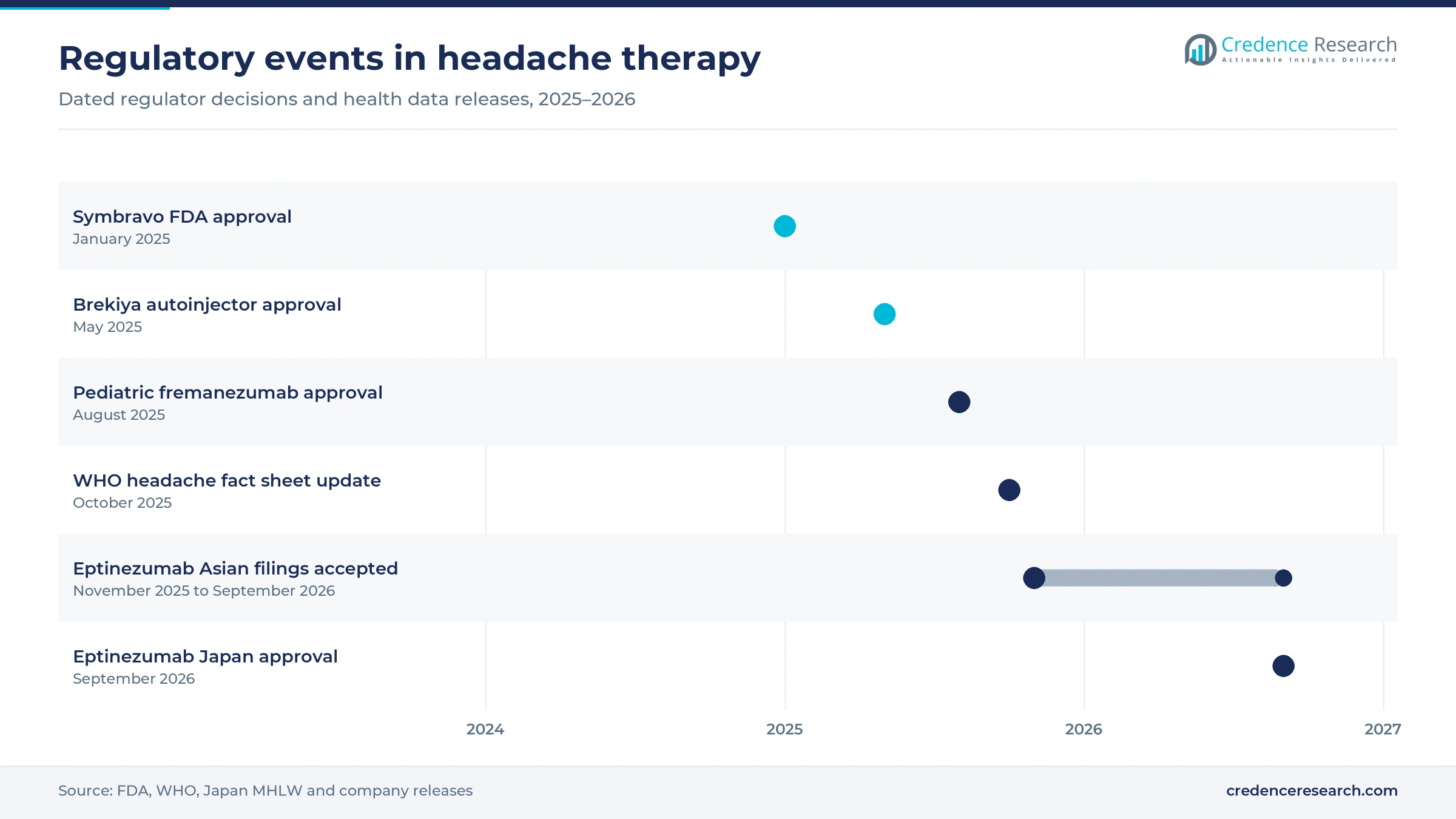
New CGRP approvals widen treatment choices, because doctors can now match medicines to attack frequency, age and dosing preference. In August 2025, Teva announced FDA approval of fremanezumab for episodic prevention in patients aged 6 to 17 who weigh 45 kg or more. The company described it as the first CGRP antagonist approved for this pediatric use. As a result, pediatric neurologists gained a monthly option that families can give at home or in the clinic.
Why do new acute formulations lift spending per patient?
New acute formulations lift spending per patient, because they offer faster relief for people who do not respond to standard tablets. In January 2025, the FDA approved Symbravo from Axsome Therapeutics, which combines meloxicam and rizatriptan for attacks with or without aura. In May 2025, Amneal received approval for Brekiya, the first dihydroergotamine autoinjector, for adults with migraine or cluster headache. In turn, branded acute products keep gaining share despite strong and growing generic triptan competition.
Pediatric labels and new delivery formats widen use
How is pediatric labeling shifting prescribing patterns?
Pediatric labeling is shifting prescribing patterns, because many patients first develop attacks during childhood or the teenage years. Before 2025, doctors relied mostly on off-label older medicines for children with frequent attacks. The fremanezumab pediatric label now gives specialists an approved CGRP antibody for patients aged 6 to 17. Families can give the monthly injection at home or have it administered in the clinic, according to Teva. As a result, other originators are expected to pursue pediatric studies to protect their positions in younger patient groups.
Why are Asian approvals rising for CGRP antibodies?
Asian approvals are rising for CGRP antibodies, because regulators in Japan, China and South Korea now review data from trials with mainly Asian patients. In November 2025, Lundbeck announced that marketing applications for eptinezumab had been accepted in Japan, China and South Korea. In September 2026, Lundbeck announced Japanese approval of eptinezumab for preventing attacks in adults. In turn, Asia Pacific is becoming a larger target for branded launches, and the Japanese approval is the first Lundbeck launch there as marketing authorization holder.
Can self-injection devices open new demand for acute care?
Device makers and originators have a clear opening in self-injection, because some patients need fast relief when tablets fail or nausea prevents swallowing. Prefilled autoinjectors let patients give dihydroergotamine and other medicines at home instead of visiting emergency departments. This format also suits monthly antibody dosing for prevention, which patients often handle without a clinic visit. Brekiya became the first dihydroergotamine autoinjector approved in the United States in May 2025. As a result, companies that pair medicines with easy devices can win loyal patients.
Where can earlier prevention add value for originators?
Earlier prevention gives originators room to add value, because many patients with frequent attacks still receive no preventive treatment. Guidelines increasingly support CGRP medicines as early options rather than last-line choices after older pills fail. Daily oral gepants and monthly monoclonal antibodies both fit this approach. Botulinum toxin injections remain another preventive option for adults with chronic attacks. In turn, wider prevention use raises the number of patients on long-term therapy.
Payer step rules and generic triptans limit pricing
How do payer step rules delay access to CGRP medicines?
Payer step rules delay access to CGRP medicines, because many insurers require patients to fail two or more older generic medicines first. These rules add months before patients can start antibodies or gepants, even when attacks are frequent and disabling. Prior authorization paperwork also takes time from neurologists and primary care offices. Patients who switch insurers often restart the approval process from the beginning. As a result, uptake remains slower than clinical guidelines alone would suggest.
Why does generic triptan competition limit pricing?
Generic triptan competition limits pricing, because sumatriptan, rizatriptan and other triptans now sell at very low prices. Many patients get adequate relief from these tablets and never move to branded products. Payers use cheap triptans as the standard first-line option in most health systems. Generic producers in India and other countries supply large volumes of these tablets to pharmacies worldwide. In turn, branded acute medicines must show clear advantages to justify their higher prices.
How do cardiovascular cautions restrict some therapies?
Cardiovascular cautions restrict some therapies, because triptans and ergot alkaloids narrow blood vessels and carry warnings for patients with heart disease. Older adults and people with vascular risk factors therefore need alternatives such as gepants or ditans. Ditans can cause dizziness and driving restrictions, which limits their use. Medication-overuse headache, which the World Health Organization says may affect up to 5% of some populations, adds another risk. As a result, doctors must review each patient carefully before choosing an acute medicine.
Why does underdiagnosis keep many patients untreated?
Underdiagnosis keeps many patients untreated, because many people manage attacks with pain relievers bought without a prescription. The World Health Organization notes that headache disorders are often underrecognized and undertreated in many countries. Limited specialist capacity in low and middle income countries adds to this gap. Many patients also never consult a doctor because they see attacks as ordinary headaches rather than a treatable disease. In turn, a large share of potential demand remains outside the prescription market.
North America leads as Asia Pacific gains pace
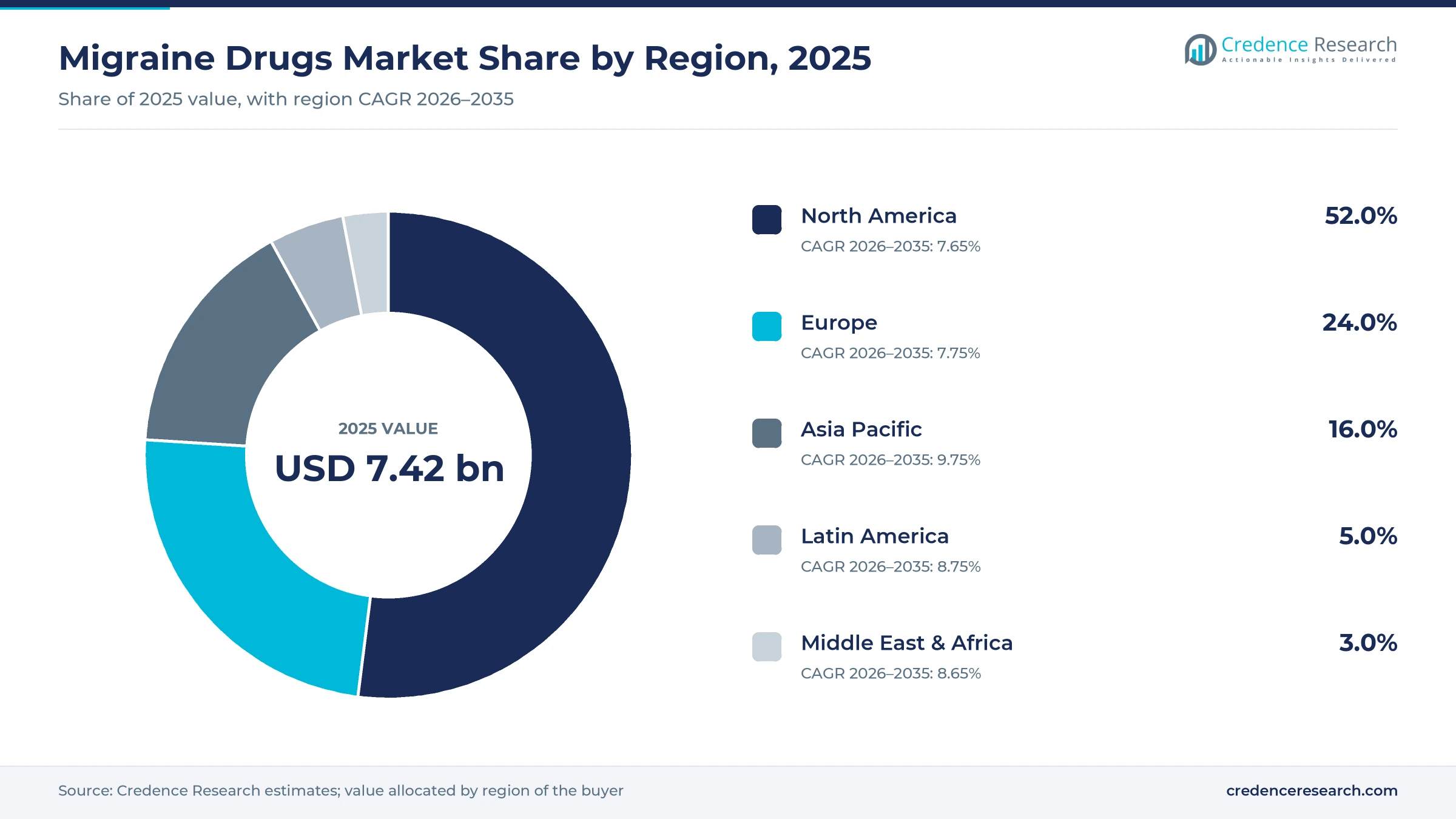
| Region | Value, 2025 (USD billion) | Share, 2025 | CAGR, 2026–2035 |
|---|---|---|---|
| North America | 3.86 | 52.0% | 7.65% |
| Europe | 1.78 | 24.0% | 7.75% |
| Asia Pacific | 1.19 | 16.0% | 9.75% |
| Latin America | 0.37 | 5.0% | 8.75% |
| Middle East & Africa | 0.22 | 3.0% | 8.65% |
Why does North America hold the largest regional share?
North America held a 52.0% share of 2025 value and grows at 7.65% a year through 2035. The United States drives this position, because commercial and government insurers cover branded antibodies and gepants for many adults. The FDA approved Symbravo in January 2025 and Brekiya in May 2025, which added new branded acute options. Direct-to-consumer advertising and telehealth prescribing also raise awareness and diagnosis among working-age adults.
How fast is Asia Pacific adding patients?
Asia Pacific held a 16.0% share of 2025 value and is the fastest-growing region at 9.75% a year. Japan, China and South Korea are reviewing or approving CGRP antibodies, which opens branded markets that relied on older medicines. East Asia counted about 191.7 million prevalent migraine cases in 2021, according to the Global Burden of Disease analysis. Rising specialist capacity in China and India adds to this growth.
What shapes demand across Europe?
Europe held a 24.0% share of 2025 value and grows at 7.75% a year through 2035. Germany, France, the United Kingdom, Italy and Spain account for most spending, because national health systems reimburse CGRP medicines under defined criteria. In June 2023, European regulators gave a positive opinion for atogepant from AbbVie Inc. for preventive use in adults. However, strict reimbursement criteria keep growth below the global average.
Where is Latin America adding demand?
Latin America held a 5.0% share of 2025 value and grows at 8.75% a year through 2035. Brazil and Mexico lead regional spending, because private insurers and specialist clinics adopt branded medicines in major cities. Public systems still depend mainly on generic triptans and NSAIDs.
What limits growth in the Middle East and Africa?
The Middle East and Africa held a 3.0% share of 2025 value and grows at 8.65% a year through 2035. Gulf states fund branded neurology care, while much of Africa relies on low-cost pain relievers. This gap limits the use of branded preventive therapy outside major cities and private hospitals.
FDA and Japanese approvals since 2025
| Development | Status and market relevance |
|---|---|
| In January 2025, the FDA approved Symbravo from Axsome Therapeutics for acute treatment of attacks with or without aura in adults. | Approved; combines meloxicam and rizatriptan in one tablet |
| In May 2025, the FDA approved Brekiya from Amneal, the first dihydroergotamine autoinjector, for migraine and cluster headache. | Approved; allows self-administered acute treatment at home |
| In August 2025, Teva Pharmaceutical Industries Ltd. announced FDA approval of fremanezumab for pediatric episodic prevention. | Approved; first CGRP antagonist for patients aged 6 to 17 |
| In November 2025, Lundbeck announced that eptinezumab filings were accepted in Japan, China and South Korea. | Under review; first biologic filings by Lundbeck in China and South Korea |
| In September 2026, Lundbeck announced Japanese marketing authorization for eptinezumab in adults. | Approved; first Lundbeck launch in Japan as marketing authorization holder |
Receptor blockers and autoinjectors lead innovation
- CGRP monoclonal antibodies block the peptide or its receptor for weeks after one dose, which supports monthly or quarterly prevention with few daily tasks.
- Oral gepants block the CGRP receptor without narrowing blood vessels, which suits patients with cardiovascular risk who cannot take triptans.
- Combination tablets pair an NSAID with a triptan in one dose, which targets several pain pathways during a single attack.
- Prefilled autoinjectors deliver dihydroergotamine or antibodies under the skin, which lets patients treat at home instead of clinics.
- Nasal and intravenous delivery bypass the stomach during nausea, which speeds relief and supports infusion-based prevention in clinics.
Need a Custom Version of This Report?
Tailor the scope, geography, or segments to your exact requirements.
- Custom geography or segment scope
- Direct access to our analyst team
Originators compete on efficacy, dosing and access
Competition is led by originators with CGRP portfolios, large neurology sales teams and strong payer contracts. AbbVie Inc. competes with ubrogepant, atogepant and botulinum toxin, while Pfizer Inc. markets rimegepant for acute and preventive use. Amgen Inc., Teva Pharmaceutical Industries Ltd., Eli Lilly and Company and Lundbeck compete with CGRP antibodies across adult prevention. Lundbeck markets eptinezumab, described by the company as the only intravenous CGRP-targeted preventive treatment, in more than 30 countries. GSK plc remains associated with the original sumatriptan brand, which now faces generic competition. Bausch Health Companies Inc., Impel Pharmaceuticals Inc. and Currax Pharmaceuticals LLC focus on specialty and alternative delivery products for acute treatment. As a result, competition centers on efficacy data, convenient dosing and payer access rather than list price alone.
Companies profiled and their roles in this market
| Company | Type | Role in the market |
|---|---|---|
| AbbVie Inc. | Originator | Ubrogepant, atogepant and botulinum toxin for chronic prevention |
| Pfizer Inc. | Originator | Rimegepant for acute and preventive treatment |
| Amgen Inc. | Originator | Erenumab CGRP receptor antibody |
| Teva Pharmaceutical Industries Ltd. | Originator and generics | Fremanezumab with adult and pediatric labels |
| Eli Lilly and Company | Originator | Galcanezumab CGRP antibody for prevention |
| Lundbeck | Originator | Eptinezumab intravenous CGRP antibody |
| GSK plc | Originator | Original sumatriptan brand |
| Bausch Health Companies Inc. | Specialty pharmaceutical | Specialty neurology and established brands |
| Impel Pharmaceuticals Inc. | Specialty pharmaceutical | Nasal delivery for acute treatment |
| Currax Pharmaceuticals LLC | Specialty pharmaceutical | Specialty acute treatment products |
CGRP uptake sets the growth pace to 2035
Credence Research's view is that CGRP uptake will set the pace of growth through 2035, because doctors increasingly use gepants and antibodies earlier in treatment. The overall market grows at 8.12% a year, supported by a large patient base, pediatric labels and new approvals in Asia. Preventive therapy grows faster than acute care as payers ease step rules over time. Companies that combine strong efficacy data, convenient dosing and broad payer access will capture the most new patients.
How Credence Research sized headache therapy spending
The report uses 2025 as the base year and 2026 to 2035 as the forecast period. Market values come from the Credence Research model, which builds spending by type, route of administration, distribution channel, therapeutic class and region. Regional and segment splits are Credence Research estimates informed by World Health Organization data, Global Burden of Disease estimates, regulator decisions and company press releases. No primary interviews or surveys were used in preparing this edition of the report.
Headache therapy spending outlook to 2035
By 2035, the migraine drugs market is projected to reach USD 16.20 billion, with growth led by CGRP antibodies, oral gepants and new acute formulations. Acute treatment remains a large share of value, while prevention gains ground as doctors start therapy earlier. North America keeps the highest spending per patient, while Asia Pacific adds the most new patients after recent approvals. Online pharmacies will take a larger share of refills as telehealth prescribing spreads. As a result, advantage will depend on efficacy, dosing convenience and payer access.
Frequently Asked Questions
How big is the global migraine drugs market?
Which therapeutic class leads migraine drug spending?
Which region leads migraine drug demand?
Why is preventive treatment growing faster than acute care?
How do online pharmacies affect migraine drug sales?
What recent approvals affect migraine drugs?
Who are the leading migraine drug companies?
What restrains growth in migraine drugs?
Table of Content
Chapter 1 Market Segmentation
- 1.1 Segmentation Framework
- 1.1.1 Product and Service Classification
- 1.1.2 Application and End-Use Classification
- 1.1.3 Technology and Solution Classification
- 1.1.4 Customer and Distribution Channel Classification
- 1.1.5 Geographic Segmentation
- 1.1.6 Market Segment Definitions and Boundaries
- 1.2 By Type
- 1.2.1 Acute Migraine Treatment
- 1.2.2 Preventive Migraine Treatment
- 1.3 By Route of Administration
- 1.3.1 Oral
- 1.3.2 Injection
- 1.3.3 Others
- 1.4 By Therapeutic Class
- 1.4.1 CGRP Monoclonal Antibodies
- 1.4.2 CGRP Small Molecule Antagonists
- 1.4.3 Acetylcholine Inhibitors/Neurotoxins
- 1.4.4 Triptans
- 1.4.5 Ditans
- 1.4.6 Ergot Alkaloids
- 1.4.7 NSAIDs
Chapter 2 Introduction
- 2.1 Report Objectives and Scope
- 2.2 Product Definition and Industry Terminology
- 2.3 Market Inclusions and Exclusions
- 2.4 Research Process
- 2.4.1 Primary Research and Expert Interviews
- 2.4.2 Secondary Research and Source Review
- 2.4.3 Top-Down and Bottom-Up Estimation
- 2.4.4 Data Triangulation and Verification
- 2.5 Market Size Measurement Basis
- 2.5.1 2025: USD 7.42 billion → 2035: USD 16.20 billion
- 2.6 Historical and Forecast Reference Periods
- 2.6.1 Historical Period: 2018-2025
- 2.6.2 Base Year: 2025
- 2.6.3 Forecast Period: 2025-2035
- 2.7 Research Assumptions and Limitations
Chapter 3 Executive Summary
- 3.1 Market Snapshot and Key Findings
- 3.2 Base-Year Market Size, 2025
- 3.3 Forecast Market Size, 2035
- 3.4 Revenue and Volume Growth Outlook
- 3.5 Key Demand and Supply Indicators
- 3.6 Leading Market Segments
- 3.7 Fastest-Growing Market Opportunities
- 3.8 Regional Performance Highlights
- 3.9 Technology and Industry Transformation
- 3.10 Competitive Landscape Summary
- 3.11 Analyst View and Strategic Implications
Chapter 4 Global Migraine Drugs Market Trends and Developments
- 4.1 Historical Industry Development, 2018-2025
- 4.2 Recent Market Trends and Developments
- 4.3 Demand and Customer Behavior Trends
- 4.4 Technology and Product Innovation
- 4.5 Artificial Intelligence, Automation and Digitalization
- 4.6 Local Manufacturing and Supply Chain Realignment
- 4.7 Industry Partnerships, Mergers and Acquisitions
- 4.8 Sustainability and Circular Economy Developments
- 4.9 Government and Private Sector Investment Trends
- 4.10 Emerging Business Models and Commercialization
- 4.11 Industry Developments and Announcements
Chapter 5 Global Migraine Drugs Market Production, Supply and Demand Analysis
- 5.1 Demand Trend and Consumption Analysis, 2018-2025
- 5.2 Demand Forecast, 2025-2035
- 5.3 Production and Output Trend, 2018-2025
- 5.4 Production and Output Forecast, 2025-2035
- 5.5 Installed Capacity and Capacity Utilization
- 5.6 Company-Wise Production Plants and Statistics
- 5.6.1 Installed Production Capacity
- 5.6.2 Actual Production
- 5.6.3 Planned Capacity and Expansion Targets
- 5.7 Supply Chain Structure and Procurement Trends
- 5.8 Supply-Demand Gap and Bottlenecks
- 5.9 Import Dependence and Sourcing Structure
- 5.10 Contract Manufacturing and Outsourcing
- 5.11 Regional Supply and Demand Concentration
Chapter 6 Global Migraine Drugs Market Pricing Analysis
- 6.1 Pricing Structure and Measurement
- 6.2 Historical Pricing Trends, 2018-2025
- 6.3 Pricing Outlook, 2025-2035
- 6.4 Average Selling Price and Unit Economics
- 6.5 Pricing by Product and Market Segment
- 6.6 Geographic Pricing Differences
- 6.7 Key Input, Energy, Labor and Logistics Costs
- 6.8 Contract Pricing and Purchasing Models
- 6.9 Pricing Sensitivity and Competitive Positioning
- 6.10 Price, Margin and Profitability Implications
Chapter 7 Global Migraine Drugs Market Dynamics
- 7.1 Market Growth Drivers
- 7.1.1 Demand-Side Drivers
- 7.1.2 Technology and Innovation Drivers
- 7.1.3 Infrastructure and Investment Drivers
- 7.1.4 Regulatory and Policy Drivers
- 7.2 Market Restraints
- 7.2.1 Cost and Affordability Constraints
- 7.2.2 Technology and Adoption Barriers
- 7.2.3 Supply Chain and Operational Constraints
- 7.3 Market Challenges
- 7.3.1 Competitive Pressure and Margin Erosion
- 7.3.2 Skills, Infrastructure and Implementation Gaps
- 7.4 Emerging Market Opportunities
- 7.5 Market Dynamics Impact and Time-Horizon Assessment
Chapter 8 Global Migraine Drugs Value Chain Analysis
- 8.1 Industry Value Chain Overview
- 8.2 Upstream Suppliers and Critical Inputs
- 8.3 Technology and Component Providers
- 8.4 Manufacturing or Service Delivery
- 8.5 Distribution, Channel Partners and Integrators
- 8.6 Downstream Applications and End Users
- 8.7 Value Addition and Profit Pools
- 8.8 Vertical Integration and Outsourcing
- 8.9 Supplier Concentration and Risk
- 8.10 Supply Chain Localization and Resilience
Chapter 9 Global Migraine Drugs Market Regulations and Policies
- 9.1 Relevant Laws, Standards and Compliance Frameworks
- 9.2 Product, Service, Safety and Quality Requirements
- 9.3 Government Policies, Incentives and Subsidies
- 9.4 Imports, Exports and Trade Barriers
- 9.5 Public Procurement and Local Content Requirements
- 9.6 Environmental and Sustainability Compliance
- 9.7 Upcoming Policy Changes and Market Implications
Chapter 10 Global Migraine Drugs Market Hotspots and Opportunities
- 10.1 Market Opportunity Mapping and Growth Hotspots
- 10.2 High-Growth Applications and Customer Groups
- 10.3 Underserved Markets and White-Space Opportunities
- 10.4 Emerging Technology and Product Opportunities
- 10.5 New Capacity and Investment Hotspots
- 10.6 Market Entry and Expansion Opportunities
- 10.7 Distribution and Partnership Opportunities
- 10.8 Near-Term and Long-Term Commercial Potential
- 10.9 Opportunity Attractiveness and Execution Risks
Chapter 11 Global Migraine Drugs Market Outlook, 2025-2035
- 11.1 Market Size and Analysis
- 11.1.1 Revenue (Market Measurement: 2025: USD 7.42 billion → 2035: USD 16.20 billion)
- 11.1.2 Market Volume and Quantity Sold
- 11.1.3 Historical Market Size, 2018-2025
- 11.1.4 Base-Year Market Size, 2025
- 11.2 Market Forecast, 2025-2035
- 11.2.1 Revenue Forecast to 2035
- 11.2.2 Volume Forecast to 2035
- 11.2.3 CAGR and Year-on-Year Growth
- 11.2.4 Incremental Revenue Opportunity
- 11.3 Forecast Assumptions and Scenario Analysis
- 11.3.1 Base-Case Forecast
- 11.3.2 Optimistic and Conservative Scenarios
- 11.3.3 Technology, Pricing and Policy Sensitivities
- 11.4 Market Attractiveness and Growth Outlook
Chapter 12 Global Migraine Drugs Market Segmentation and Outlook
- 12.1 Segmentation Summary and Market Shares, 2025
- 12.2 Largest and Fastest-Growing Segments
- 12.3 By Type - Market Size and Forecast, 2025-2035
- 12.3.1 Segment Definition and Scope
- 12.3.2 Historical Market Size, 2018-2025
- 12.3.3 Revenue Forecast, 2025-2035
- 12.3.4 Volume Forecast, 2025-2035
- 12.3.5 Base-Year Market Share, 2025
- 12.3.6 Segment CAGR and Growth Drivers
- 12.3.7 Subsegment Market Size and Forecast
- 12.3.7.1 Acute Migraine Treatment
- 12.3.7.2 Preventive Migraine Treatment
- 12.3.8 Subsegment Pricing and Adoption Trends
- 12.3.9 Leading Suppliers and Competition
- 12.3.10 Regional Demand and Opportunities
- 12.4 By Route of Administration - Market Size and Forecast, 2025-2035
- 12.4.1 Segment Definition and Scope
- 12.4.2 Historical Market Size, 2018-2025
- 12.4.3 Revenue Forecast, 2025-2035
- 12.4.4 Volume Forecast, 2025-2035
- 12.4.5 Base-Year Market Share, 2025
- 12.4.6 Segment CAGR and Growth Drivers
- 12.4.7 Subsegment Market Size and Forecast
- 12.4.7.1 Oral
- 12.4.7.2 Injection
- 12.4.7.3 Others
- 12.4.8 Subsegment Pricing and Adoption Trends
- 12.4.9 Leading Suppliers and Competition
- 12.4.10 Regional Demand and Opportunities
- 12.5 By Therapeutic Class - Market Size and Forecast, 2025-2035
- 12.5.1 Segment Definition and Scope
- 12.5.2 Historical Market Size, 2018-2025
- 12.5.3 Revenue Forecast, 2025-2035
- 12.5.4 Volume Forecast, 2025-2035
- 12.5.5 Base-Year Market Share, 2025
- 12.5.6 Segment CAGR and Growth Drivers
- 12.5.7 Subsegment Market Size and Forecast
- 12.5.7.1 CGRP Monoclonal Antibodies
- 12.5.7.2 CGRP Small Molecule Antagonists
- 12.5.7.3 Acetylcholine Inhibitors/Neurotoxins
- 12.5.7.4 Triptans
- 12.5.7.5 Ditans
- 12.5.7.6 Ergot Alkaloids
- 12.5.7.7 NSAIDs
- 12.5.8 Subsegment Pricing and Adoption Trends
- 12.5.9 Leading Suppliers and Competition
- 12.5.10 Regional Demand and Opportunities
- 12.6 Segment Growth Comparison
- 12.7 Segment Attractiveness and Priority Matrix
Chapter 13 Global Migraine Drugs Geographic Market Outlook, 2025-2035
- 13.1 Regional Market Size and Share, 2025
- 13.2 Regional Market Forecast, 2025-2035
- 13.3 Regional Pricing, Production and Demand Differences
- 13.4 North America
- 13.4.1 United States
- 13.4.2 Canada
- 13.4.3 Mexico
- 13.5 Europe
- 13.5.1 Germany
- 13.5.2 France
- 13.5.3 Italy
- 13.5.4 United Kingdom
- 13.5.5 Spain
- 13.5.6 Poland
- 13.5.7 Russia
- 13.5.8 Netherlands
- 13.5.9 Belgium
- 13.5.10 Sweden
- 13.5.11 Denmark
- 13.5.12 Norway
- 13.5.13 Rest of Europe
- 13.6 Asia Pacific
- 13.6.1 China
- 13.6.2 India
- 13.6.3 Japan
- 13.6.4 South Korea
- 13.6.5 Thailand
- 13.6.6 Indonesia
- 13.6.7 Vietnam
- 13.6.8 Malaysia
- 13.6.9 Australia
- 13.6.10 Rest of Asia Pacific
- 13.7 Latin America
- 13.7.1 Brazil
- 13.7.2 Argentina
- 13.7.3 Colombia
- 13.7.4 Chile
- 13.7.5 Rest of Latin America
- 13.8 Middle East
- 13.8.1 Saudi Arabia
- 13.8.2 United Arab Emirates
- 13.8.3 Turkey
- 13.8.4 Israel
- 13.8.5 Iran
- 13.8.6 Rest of the Middle East
- 13.9 Africa
- 13.9.1 South Africa
- 13.9.2 Egypt
- 13.9.3 Nigeria
- 13.9.4 Morocco
- 13.9.5 Rest of Africa
- 13.10 Regional Investment, Policy and Supply Chain Differences
- 13.11 Regional Competitive Landscape
- 13.12 Geographic Growth Hotspots
Chapter 14 Global Migraine Drugs Technology, Innovation and Sustainability Outlook
- 14.1 Technology Landscape and Maturity
- 14.2 Product, Process and Service Innovation
- 14.3 AI, Automation and Digital Tools in the Industry
- 14.4 Technology Adoption and Performance Benchmarking
- 14.5 Innovation Pipeline and R&D Investment
- 14.6 Patent and Intellectual Property Trends
- 14.7 Energy Efficiency and Resource Management
- 14.8 Sustainability, Recycling and Circularity
- 14.9 Technology Roadmap, 2025-2035
- 14.10 Risks of Obsolescence and Technology Substitution
Chapter 15 Global Migraine Drugs Market Key Strategic Imperatives
- 15.1 Growth and Market Entry Priorities
- 15.2 High-Return Products and Segments
- 15.3 Pricing, Profitability and Cost Optimization
- 15.4 Technology Investment and Product Differentiation
- 15.5 Supply Chain Localization and Resilience
- 15.6 Distribution and Customer Acquisition
- 15.7 Partnership, Acquisition and Capacity Strategy
- 15.8 Regional Expansion Priorities
- 15.9 Short-, Medium- and Long-Term Actions
Chapter 16 Competition Outlook
- 16.1 Industry Competition Characteristics
- 16.2 Market Structure and Concentration
- 16.3 Market Share and Competitive Positioning, 2025
- 16.4 Company-Wise Revenue and Product Benchmarking
- 16.5 Production and Service Capacity Benchmarking
- 16.6 Technology, Pricing and Differentiation
- 16.7 Regional Footprint and Distribution Strength
- 16.8 Mergers, Acquisitions and Strategic Alliances
- 16.9 New Entrants and Competitive Threats
- 16.10 Porter's Five Forces and Industry Attractiveness
- 16.11 Competitive Outlook, 2025-2035
Chapter 17 Company Profiles
- 17.1 Company Coverage and Selection Criteria
- 17.2 AbbVie Inc.
- 17.2.1 Business Description
- 17.2.2 Company Ownership and Geographic Presence
- 17.2.3 Product and Service Portfolio
- 17.2.4 Manufacturing and Operating Footprint
- 17.2.5 Production Capacity and Expansion Plans
- 17.2.6 Financial Performance and Investment
- 17.2.7 Market Share and Competitive Position
- 17.2.8 Technology and Innovation Capabilities
- 17.2.9 Strategic Alliances or Partnerships
- 17.2.10 Recent Developments
- 17.2.11 Growth Strategy and Outlook
- 17.3 Amgen Inc.
- 17.4 Teva Pharmaceutical Industries Ltd.
- 17.5 GSK plc
- 17.6 Eli Lilly and Company
- 17.7 Pfizer Inc.
- 17.8 Bausch Health Companies Inc.
- 17.9 Impel Pharmaceuticals Inc.
- 17.10 Currax Pharmaceuticals LLC
- 17.11 Lundbeck
- 17.12 Other Relevant Market Participants
Note: Every listed company is profiled on the structure shown under the first company. The company list is preliminary and may change based on research findings, market developments, data availability and client requirements.
Chapter 18 Disclaimer
- 18.1 Research and Forecast Disclaimer
- 18.2 Data Source and Estimation Limitations
Note: The depth of individual sections depends on data availability for this market. Volume, capacity, trade and other unit-based metrics are included where applicable.

