Market Overview
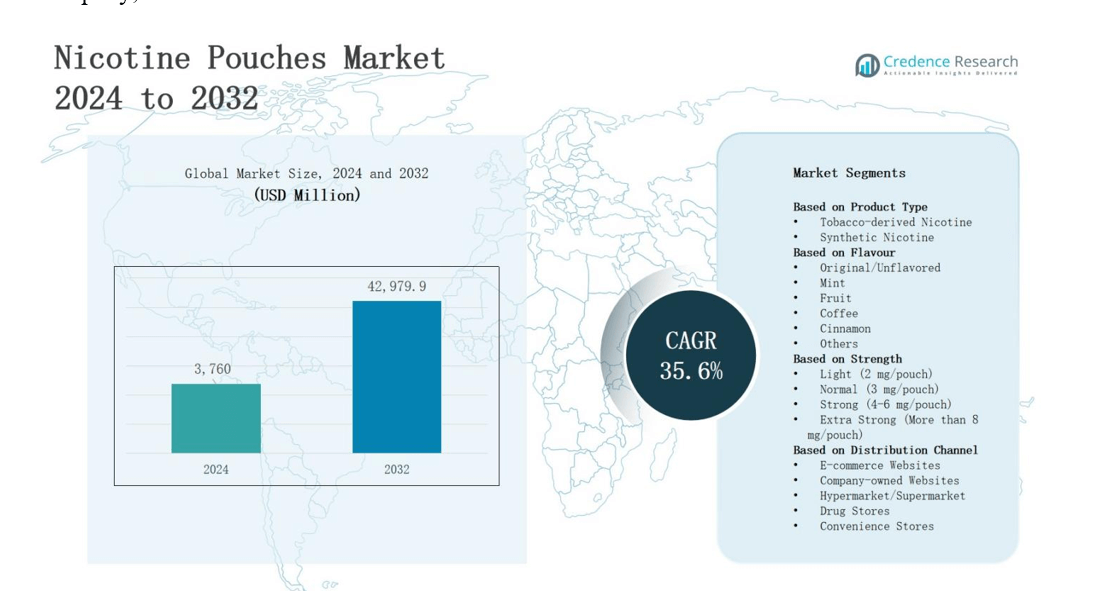
The global nicotine pouches market is projected to grow from USD 3,760 million in 2024 to USD 42,979.9 million by 2032, registering a strong CAGR of 35.6% during the forecast period.
| REPORT ATTRIBUTE | DETAILS |
|---|---|
| Historical Period | 2020-2023 |
| Base Year | 2024 |
| Forecast Period | 2025-2032 |
| Nicotine Pouches Market Size 2024 | USD 3,760 million |
| Nicotine Pouches Market, CAGR | 35.6% |
| Nicotine Pouches Market Size 2032 | USD 42,979.9 million |
The nicotine pouches market is driven by rising demand for smoke-free alternatives, growing awareness of health risks linked to smoking, and regulatory support for reduced-risk products. Consumers prefer pouches for their convenience, discreet use, and variety of flavors, which strengthens adoption among young adults and working populations. Key players invest in innovation and marketing strategies to expand consumer reach and brand loyalty. Market trends highlight rapid penetration in emerging economies, premiumization of product offerings, and increasing online retail presence. Strong growth also stems from shifting cultural attitudes that favor harm-reduction products and healthier lifestyle choices.
The nicotine pouches market shows strong geographical diversity, with North America holding the largest share, followed by Europe driven by strict anti-smoking regulations and cultural acceptance. Asia-Pacific is witnessing rapid growth due to rising urbanization and lifestyle shifts, while Latin America and Middle East & Africa remain emerging markets with increasing awareness and digital retail penetration. Key players shaping the market include Swedish Match AB, British American Tobacco Plc, Altria Group, Inc., Japan Tobacco International, Swisher International Group Inc., Nicopods ehf., Setas Group AB, NIQO Co., Swedish Smokeless Company, and SnusCentral MaKe WeBo AB.
Market Insights
- The global nicotine pouches market is set to grow from USD 3,760 million in 2024 to USD 42,979.9 million by 2032, registering a robust CAGR of 35.6%.
- Tobacco-derived nicotine dominates with over 70% share in 2024, while synthetic nicotine with 30% is expanding rapidly, appealing to health-conscious users and gaining traction with regulatory flexibility.
- Mint leads flavors with 40% share, followed by fruit at 25% and unflavored at 15%, while coffee, cinnamon, and other niche blends account for the remaining 20%.
- Strong variants (4–6 mg/pouch) hold 45% share, followed by normal strength at 25%, extra strong at 20%, and light at 10%, supporting broad consumer adoption across demographics.
- Regionally, North America leads with 45% share, Europe follows at 30%, Asia-Pacific holds 15%, and Latin America along with Middle East & Africa account for 5% each.
Market Drivers
Rising Demand for Smoke-Free Alternatives
The nicotine pouches market is expanding due to a growing preference for smoke-free products. Consumers seek healthier alternatives to traditional cigarettes, which drives significant adoption of pouches. It appeals to users aiming to avoid harmful effects of combustion while maintaining nicotine intake. Smoke-free features also enhance convenience in public spaces. Strong marketing campaigns highlight the discreet and odorless nature of these products. This demand accelerates industry growth across developed and developing markets.
- For instance, Scandinavian Tobacco Group UK launched XQS pouches in 2024 in four flavors packaged for convenience and recyclability, catering to user demand for discrete, odorless alternatives in public spaces.
Regulatory Support and Public Health Initiatives
Government policies supporting harm reduction play a major role in driving the nicotine pouches market. It benefits from regulatory bodies encouraging reduced-risk nicotine delivery methods. Countries impose strict smoking bans that create strong incentives for consumers to shift. Public health initiatives highlight reduced exposure to carcinogens, which builds trust. Awareness campaigns reinforce the safety perception among adults. These combined efforts fuel higher adoption and expand the consumer base for pouches globally.
- For instance, the U.S. FDA authorized Swedish Match’s General snus as a Modified Risk Tobacco Product (MRTP) in 2019, recognizing it as presenting lower risks than cigarettes, which helped strengthen consumer trust in oral nicotine products.
Product Innovation and Flavor Diversity
Continuous product development shapes the nicotine pouches market by attracting diverse consumer groups. Companies introduce new flavors, strength levels, and packaging to build loyalty. It caters to varying preferences, from tobacco-free to mint and fruit options. Innovation in formulation improves oral comfort and longevity, enhancing user experience. Brand competition emphasizes design and differentiation to capture market share. These advancements strengthen consumer retention and stimulate repeat purchases across multiple regions worldwide.
Expansion of Online Retail and Accessibility
E-commerce growth significantly supports the nicotine pouches market by broadening availability. Online platforms provide consumers with access to a wide range of brands and flavors. It simplifies purchasing, particularly in regions with limited retail penetration. Subscription models and digital promotions strengthen visibility and consumer loyalty. Expanding global logistics enables faster deliveries, reinforcing convenience. Enhanced accessibility through online channels fuels rapid growth and ensures consistent exposure to evolving consumer demands.
Market Trends
Shift Toward Tobacco-Free Nicotine Solutions
The nicotine pouches market is witnessing a growing trend toward tobacco-free formulations. Consumers are increasingly drawn to products that eliminate tobacco leaf content while still delivering nicotine satisfaction. It aligns with health-conscious lifestyles and regulatory pressure against tobacco-based items. Tobacco-free solutions reduce stigma, offering cleaner alternatives in public spaces. This trend is shaping consumer preferences among younger demographics. Leading brands highlight tobacco-free claims in marketing, further accelerating adoption and reshaping competitive dynamics in global markets.
- For instance, Imperial Brands has documented the development of tobacco-free nicotine pouches that deliver nicotine without combustion or tobacco leaf, with scientific assessments showing significantly reduced toxicant exposure and supporting harm reduction efforts among smokers switching to these products.
Rising Popularity of Flavored and Customized Products
A strong trend in the nicotine pouches market is the rising demand for flavored and customizable options. Consumers seek variety in flavors ranging from mint, citrus, and berry to unique blends. It provides differentiation, enhancing user experience and satisfaction. Younger consumers especially value novelty, driving brands to expand portfolios. Customized strength levels also meet varying preferences and reduce barriers for first-time users. These developments expand market reach and foster stronger loyalty among evolving consumer groups.
- For instance, Snowman, known for its bold flavor lineup, features over 20 flavors including Arctic Kick, Raspberry Blast, and Tropical Punch with nicotine strengths ranging from 9 mg to 12 mg, appealing to users who seek both novelty and versatility.
Premiumization and Brand Differentiation Strategies
Premiumization is shaping the nicotine pouches market as consumers seek high-quality and branded experiences. It is evident through advanced packaging, enhanced pouch comfort, and long-lasting flavors. Companies focus on building premium categories that highlight quality assurance and design appeal. Strong emphasis on brand differentiation supports pricing power and competitiveness. Growth in premium demand reflects willingness of consumers to pay more for perceived value. This trend positions established players to capture significant market share across regions.
Digital Marketing and Expanding Online Distribution
The nicotine pouches market is significantly influenced by rapid growth in digital marketing and online retail. Brands leverage targeted campaigns on social media and e-commerce platforms to reach younger, tech-savvy users. It enables broader consumer education and product discovery. Online sales expand access, especially in areas with limited retail availability. Subscription models and promotions further strengthen adoption. The digital ecosystem has become a key driver of growth, supporting long-term expansion and higher consumer engagement worldwide.
Market Challenges Analysis
Regulatory Uncertainty and Compliance Pressures
The nicotine pouches market faces significant challenges due to evolving regulatory landscapes across regions. Governments continue to debate product classification, taxation, and labeling requirements, creating uncertainty for manufacturers. It forces companies to adapt quickly to differing compliance standards, which increases operational costs. Restrictions on advertising and flavored products in some markets limit growth potential. Regulatory ambiguity also affects consumer trust, slowing adoption in sensitive regions. These factors collectively restrain long-term expansion and demand strategic navigation by industry players.
Health Concerns and Social Acceptance Barriers
Public perception and health concerns remain critical challenges for the nicotine pouches market. While marketed as safer alternatives to smoking, some consumers remain cautious about long-term health effects. It creates resistance among healthcare groups and policymakers, who often call for stricter oversight. Social acceptance is also mixed, particularly in markets with strong anti-nicotine movements. Negative media coverage influences consumer behavior, reducing adoption rates in certain demographics. These challenges highlight the importance of awareness campaigns and transparent communication from brands.
Market Opportunities
Expansion in Emerging Economies and Untapped Demographics
The nicotine pouches market holds strong opportunities in emerging economies where smoking prevalence remains high. Growing urbanization, rising disposable incomes, and increasing awareness of harm-reduction products create favorable conditions for adoption. It can attract younger demographics seeking discreet and convenient alternatives to cigarettes. Untapped rural populations also offer potential once accessibility improves through online and retail distribution. Global players expanding into Asia-Pacific, Latin America, and Africa can leverage these factors to strengthen penetration and long-term growth.
Innovation in Product Development and Distribution Models
Continuous innovation presents significant opportunities for the nicotine pouches market as consumer preferences evolve. It benefits from advancements in flavors, pouch texture, and nicotine strength that improve satisfaction and expand appeal. Development of organic and plant-based formulations further enhances differentiation among brands. Expanding digital sales channels, including subscription-based services, increases accessibility and retention. Direct-to-consumer models reduce dependency on traditional retail. These opportunities allow companies to expand customer bases and reinforce competitiveness across diverse regions worldwide.
Market Segmentation Analysis:
Based on Product Type
In the nicotine pouches market, tobacco-derived nicotine dominates with over 70% share in 2024. It leads due to established consumer trust and wider availability across global brands. Synthetic nicotine, holding around 30% share, is expanding as regulations tighten around tobacco-based products. It appeals to health-conscious users seeking cleaner alternatives. Growing innovation in lab-created formulations will strengthen synthetic nicotine’s position, though tobacco-derived options remain the preferred choice due to familiarity and cost advantages.
- For instance, NIIN Pouches launched in the U.S. as one of the first 100% synthetic nicotine pouches, highlighting demand for “tobacco-free” positioning among younger adult consumers.
Based on Flavour
Mint flavor accounts for the largest share at nearly 40% of the nicotine pouches market. It remains dominant due to strong consumer preference for freshness and smoother taste. Fruit flavors follow with about 25%, driven by younger demographics seeking variety. Original/unflavored products hold close to 15%, appealing to traditional users. Coffee and cinnamon together contribute around 10%, while others, including niche blends, capture the remaining 10%. Flavor innovation continues to drive adoption and brand differentiation.
- For instance, Swedish Match (a Philip Morris International company) has confirmed that ZYN Cool Mint and Spearmint are among its most purchased variants in the U.S., reflecting mint’s enduring dominance.
Based on Strength
Strong variants (4–6 mg/pouch) dominate the nicotine pouches market with nearly 45% share. These products balance satisfaction with accessibility, attracting both new and experienced users. Normal strength (3 mg/pouch) follows with around 25%, preferred by moderate consumers. Extra strong options, above 8 mg, hold about 20%, appealing to heavy users seeking intense effects. Light strength (2 mg/pouch) represents 10%, serving entry-level customers. The variety of strengths ensures wide adoption, but strong pouches remain the market’s growth driver.
Segments:
Based on Product Type
- Tobacco-derived Nicotine
- Synthetic Nicotine
Based on Flavour
- Original/Unflavored
- Mint
- Fruit
- Coffee
- Cinnamon
- Others
Based on Strength
- Light (2 mg/pouch)
- Normal (3 mg/pouch)
- Strong (4-6 mg/pouch)
- Extra Strong (More than 8 mg/pouch)
Based on Distribution Channel
- E-commerce Websites
- Company-owned Websites
- Hypermarket/Supermarket
- Drug Stores
- Convenience Stores
Based on the Geography:
- North America
- U.S.
- Canada
- Mexico
- Europe
- Germany
- France
- U.K.
- Italy
- Spain
- Rest of Europe
- Asia Pacific
- China
- Japan
- India
- South Korea
- South-east Asia
- Rest of Asia Pacific
- Latin America
- Brazil
- Argentina
- Rest of Latin America
- Middle East & Africa
- GCC Countries
- South Africa
- Rest of the Middle East and Africa
Regional Analysis
North America
North America leads the nicotine pouches market with a 45% share in 2024. The region benefits from strong consumer awareness of smoke-free alternatives and high adoption among younger demographics. It continues to grow with regulatory support for reduced-risk products and effective marketing campaigns by global brands. Flavored and strong nicotine variants drive sales, particularly in the United States. Online retail channels strengthen availability and accessibility across urban areas. The dominance of established players ensures market maturity and sustained expansion.
Europe
Europe holds a 30% share of the nicotine pouches market, driven by strict anti-smoking regulations and rising consumer demand for harm-reduction products. Countries such as Sweden, Norway, and Denmark are leading adopters, supported by cultural acceptance of oral nicotine products. It benefits from flavor innovations and premiumization strategies by leading brands. Strong distribution through supermarkets, convenience stores, and e-commerce platforms sustains demand. Growing health awareness and regulatory clarity continue to push the market forward across Western and Northern Europe.
Asia-Pacific
Asia-Pacific accounts for 15% share of the nicotine pouches market, with rapid growth potential fueled by large populations and increasing urbanization. Rising disposable incomes and lifestyle changes are creating demand for discreet, smoke-free products. It gains traction among younger consumers seeking alternatives to traditional tobacco products. Countries such as Japan, China, and India are witnessing expanding availability through online and retail platforms. Strong growth opportunities exist due to low current penetration and significant consumer base. Regulatory developments will influence future adoption.
Latin America
Latin America represents 5% share of the nicotine pouches market, with growth centered in Brazil, Mexico, and Argentina. The region experiences rising interest due to increasing awareness of harm-reduction products. It remains in an early adoption stage, with limited product availability compared to North America and Europe. Marketing campaigns and online distribution are gradually expanding reach. Rising middle-class income and shifting smoking habits create opportunities for international players. Local acceptance and evolving regulation will shape growth trends in the region.
Middle East & Africa
Middle East & Africa hold a 5% share in the nicotine pouches market, marked by early adoption and regulatory complexities. Consumer interest is growing in Gulf countries where smoking alternatives are gaining attention. It is supported by the expansion of premium international brands and e-commerce platforms. Affluent consumers prefer tobacco-free and flavored options, aligning with global trends. Limited retail penetration remains a challenge, but digital channels enhance visibility. Rising awareness and increasing urban populations present long-term growth potential.
Key Player Analysis
- Swedish Smokeless Company
- Setas Group AB (SnusMe)
- Nicopods ehf.
- Swisher International Group Inc. (Rogue Holdings, LLC)
- NIQO Co.
- SnusCentral MaKe WeBo AB
- British American Tobacco (BAT) Plc
- Altria Group, Inc.
- Japan Tobacco International (Nordic Spirit)
- Swedish Match AB
Competitive Analysis
The nicotine pouches market is highly competitive with established tobacco companies and emerging brands driving growth through product innovation, distribution expansion, and strong marketing strategies. Swedish Match AB, British American Tobacco Plc, and Altria Group, Inc. lead the market with extensive portfolios and global reach, supported by significant investments in brand positioning. Japan Tobacco International with Nordic Spirit and Swisher International Group Inc. through Rogue Holdings, LLC, continue to expand their consumer base with diverse flavor profiles and strength options. Companies such as Nicopods ehf., Setas Group AB with SnusMe, NIQO Co., and Swedish Smokeless Company strengthen competition by targeting niche segments and introducing unique offerings. SnusCentral MaKe WeBo AB enhances accessibility through e-commerce, which remains a key channel for smaller and regional players. It remains characterized by intense brand rivalry, continuous innovation in synthetic nicotine formulations, and strong emphasis on premiumization. Market leaders focus on maintaining dominance through mergers, acquisitions, and regulatory adaptation, while smaller entrants compete on differentiation, price competitiveness, and targeted distribution strategies.
Recent Developments
- In January 2025, the U.S. Food and Drug Administration (FDA) granted marketing authorization for 20 Zyn nicotine pouch products, marking the first approval of nicotine pouches in the United States. The authorization allows Swedish Match, owned by Philip Morris International, to expand production and strengthen Zyn’s leadership in the market.
- In May 2025, ALP Supply Co., co-founded by Tucker Carlson, announced a partnership with Gopuff to enable instant delivery of ALP nicotine pouches through its website using Gopuff’s micro-distribution network in the U.S. This collaboration represents a first-of-its-kind distribution move in the industry.
- In October 2024, British American Tobacco (BAT) announced plans to launch Velo Plus, a synthetic nicotine pouch with expanded strength options. The product is set to be released in 2025.
Market Concentration & Characteristics
The nicotine pouches market is moderately concentrated with a mix of global leaders and regional challengers competing for share through innovation, brand positioning, and distribution strategies. Swedish Match AB, British American Tobacco Plc, and Altria Group, Inc. dominate with strong portfolios, established consumer trust, and expansive retail networks. It remains highly competitive, with companies such as Japan Tobacco International, Swisher International Group Inc., Nicopods ehf., and Setas Group AB focusing on flavor variety, synthetic nicotine offerings, and digital sales. Market characteristics highlight strong growth in premium segments, rapid penetration in online retail, and increased emphasis on regulatory compliance. Consumer preference for smoke-free and discreet products drives demand, while rising health awareness and lifestyle shifts reinforce adoption across regions. The industry continues to evolve through mergers, acquisitions, and product diversification, ensuring sustained momentum and reinforcing competitive intensity across established and emerging markets.
Report Coverage
The research report offers an in-depth analysis based on Product Type, Flavour, Strength, Distribution Channel and Geography. It details leading market players, providing an overview of their business, product offerings, investments, revenue streams, and key applications. Additionally, the report includes insights into the competitive environment, SWOT analysis, current market trends, as well as the primary drivers and constraints. Furthermore, it discusses various factors that have driven market expansion in recent years. The report also explores market dynamics, regulatory scenarios, and technological advancements that are shaping the industry. It assesses the impact of external factors and global economic changes on market growth. Lastly, it provides strategic recommendations for new entrants and established companies to navigate the complexities of the market.
Future Outlook
- Demand for smoke-free alternatives will continue to drive widespread adoption among global consumers.
- Regulatory clarity in major markets will shape growth opportunities and brand positioning.
- Flavored and premium product lines will expand further to attract younger demographics.
- Synthetic nicotine offerings will gain traction as tobacco restrictions become stricter worldwide.
- Online retail and subscription models will strengthen consumer reach and brand loyalty.
- Product innovation in pouch comfort, strength, and natural ingredients will remain a priority.
- Expansion into Asia-Pacific, Latin America, and Africa will create new revenue streams.
- Strategic mergers and acquisitions will reshape competition and consolidate market presence.
- Public health campaigns supporting harm reduction will support broader consumer acceptance.
- Stronger brand differentiation and marketing will be key to sustaining long-term market leadership.

Request a Free Sample
Fill in your details and we'll send you a free sample report.
- Sample data tables & charts
- Research methodology
Market Dynamics
Preference for Smoke-Free Alternatives
Consumers are increasingly seeking alternatives to traditional cigarettes due to health concerns and restrictions on smoking in public spaces. Nicotine pouches offer a discreet, odorless, and convenient way to consume nicotine, driving rapid adoption among young adults and working populations.
Regulatory Support for Reduced-Risk Products
Government policies and public health initiatives are encouraging the use of reduced-risk nicotine delivery systems. Regulatory clarity and support, such as modified risk product authorizations, are building consumer trust and accelerating market growth.
Product Innovation and Flavor Diversity
Continuous innovation in flavors, strength levels, and pouch design is attracting a broad range of consumers. The availability of diverse and customizable options enhances user experience, supports brand differentiation, and drives repeat purchases.
Expansion of Online Retail and Digital Distribution
The growth of e-commerce and digital marketing is making nicotine pouches more accessible, especially in regions with limited traditional retail infrastructure. Online channels enable broader reach, subscription models, and targeted promotions, fueling market expansion.
Shift Toward Tobacco-Free and Synthetic Nicotine Solutions
Rising health consciousness and regulatory pressures against tobacco-based products are increasing demand for synthetic and tobacco-free nicotine pouches. These products appeal to consumers seeking cleaner alternatives and support market penetration in new demographics.
Need a Custom Version of This Report?
Tailor the scope, geography, or segments to your exact requirements.
- Custom geography or segment scope
- Direct access to our analyst team
Frequently Asked Questions
What is the current market size for nicotine pouches market, and what is its projected size in 2032?
Which nicotine pouches market segment held the largest share in 2024?
What are the primary factors fueling the growth of the nicotine pouches market?
Who are the leading companies in the nicotine pouches market?
Table of Content
Chapter 1 Market Segmentation
- 1.1 Segmentation Framework
- 1.1.1 Product and Service Classification
- 1.1.2 Application and End-Use Classification
- 1.1.3 Technology and Solution Classification
- 1.1.4 Customer and Distribution Channel Classification
- 1.1.5 Geographic Segmentation
- 1.1.6 Market Segment Definitions and Boundaries
- 1.2 By Flavour
- 1.2.1 Original/Unflavored
- 1.2.2 Mint
- 1.2.3 Fruit
- 1.2.4 Coffee
- 1.2.5 Cinnamon
- 1.2.6 Others
- 1.3 By Strength
- 1.3.1 Light (2 mg/pouch)
- 1.3.2 Normal (3 mg/pouch)
- 1.3.3 Strong (4-6 mg/pouch)
- 1.3.4 Extra Strong (More than 8 mg/pouch)
- 1.4 By Product Type
- 1.4.1 Tobacco-derived Nicotine
- 1.4.2 Synthetic Nicotine
Chapter 2 Introduction
- 2.1 Report Objectives and Scope
- 2.2 Product Definition and Industry Terminology
- 2.3 Market Inclusions and Exclusions
- 2.4 Research Process
- 2.4.1 Primary Research and Expert Interviews
- 2.4.2 Secondary Research and Source Review
- 2.4.3 Top-Down and Bottom-Up Estimation
- 2.4.4 Data Triangulation and Verification
- 2.5 Market Size Measurement Basis
- 2.5.1 2024: USD 3,760 million → 2032: USD 42,979.9 million
- 2.6 Historical and Forecast Reference Periods
- 2.6.1 Base Year: 2024
- 2.6.2 Forecast Period: 2024-2032
- 2.7 Research Assumptions and Limitations
Chapter 3 Executive Summary
- 3.1 Market Snapshot and Key Findings
- 3.2 Base-Year Market Size, 2024
- 3.3 Forecast Market Size, 2032
- 3.4 Revenue and Volume Growth Outlook
- 3.5 Key Demand and Supply Indicators
- 3.6 Leading Market Segments
- 3.7 Fastest-Growing Market Opportunities
- 3.8 Regional Performance Highlights
- 3.9 Technology and Industry Transformation
- 3.10 Competitive Landscape Summary
- 3.11 Analyst View and Strategic Implications
Chapter 4 Global Nicotine Pouches Market Trends and Developments
- 4.1 Historical Industry Development
- 4.2 Recent Market Trends and Developments
- 4.3 Demand and Customer Behavior Trends
- 4.4 Technology and Product Innovation
- 4.5 Artificial Intelligence, Automation and Digitalization
- 4.6 Local Manufacturing and Supply Chain Realignment
- 4.7 Industry Partnerships, Mergers and Acquisitions
- 4.8 Sustainability and Circular Economy Developments
- 4.9 Government and Private Sector Investment Trends
- 4.10 Emerging Business Models and Commercialization
- 4.11 Industry Developments and Announcements
Chapter 5 Global Nicotine Pouches Market Production, Supply and Demand Analysis
- 5.1 Demand Trend and Consumption Analysis
- 5.2 Demand Forecast, 2024-2032
- 5.3 Production and Output Trend
- 5.4 Production and Output Forecast, 2024-2032
- 5.5 Installed Capacity and Capacity Utilization
- 5.6 Company-Wise Production Plants and Statistics
- 5.6.1 Installed Production Capacity
- 5.6.2 Actual Production
- 5.6.3 Planned Capacity and Expansion Targets
- 5.7 Supply Chain Structure and Procurement Trends
- 5.8 Supply-Demand Gap and Bottlenecks
- 5.9 Import Dependence and Sourcing Structure
- 5.10 Contract Manufacturing and Outsourcing
- 5.11 Regional Supply and Demand Concentration
Chapter 6 Global Nicotine Pouches Market Pricing Analysis
- 6.1 Pricing Structure and Measurement
- 6.2 Historical Pricing Trends
- 6.3 Pricing Outlook, 2024-2032
- 6.4 Average Selling Price and Unit Economics
- 6.5 Pricing by Product and Market Segment
- 6.6 Geographic Pricing Differences
- 6.7 Key Input, Energy, Labor and Logistics Costs
- 6.8 Contract Pricing and Purchasing Models
- 6.9 Pricing Sensitivity and Competitive Positioning
- 6.10 Price, Margin and Profitability Implications
Chapter 7 Global Nicotine Pouches Market Dynamics
- 7.1 Market Growth Drivers
- 7.1.1 Demand-Side Drivers
- 7.1.2 Technology and Innovation Drivers
- 7.1.3 Infrastructure and Investment Drivers
- 7.1.4 Regulatory and Policy Drivers
- 7.2 Market Restraints
- 7.2.1 Cost and Affordability Constraints
- 7.2.2 Technology and Adoption Barriers
- 7.2.3 Supply Chain and Operational Constraints
- 7.3 Market Challenges
- 7.3.1 Competitive Pressure and Margin Erosion
- 7.3.2 Skills, Infrastructure and Implementation Gaps
- 7.4 Emerging Market Opportunities
- 7.5 Market Dynamics Impact and Time-Horizon Assessment
Chapter 8 Global Nicotine Pouches Value Chain Analysis
- 8.1 Industry Value Chain Overview
- 8.2 Upstream Suppliers and Critical Inputs
- 8.3 Technology and Component Providers
- 8.4 Manufacturing or Service Delivery
- 8.5 Distribution, Channel Partners and Integrators
- 8.6 Downstream Applications and End Users
- 8.7 Value Addition and Profit Pools
- 8.8 Vertical Integration and Outsourcing
- 8.9 Supplier Concentration and Risk
- 8.10 Supply Chain Localization and Resilience
Chapter 9 Global Nicotine Pouches Market Regulations and Policies
- 9.1 Relevant Laws, Standards and Compliance Frameworks
- 9.2 Product, Service, Safety and Quality Requirements
- 9.3 Government Policies, Incentives and Subsidies
- 9.4 Imports, Exports and Trade Barriers
- 9.5 Public Procurement and Local Content Requirements
- 9.6 Environmental and Sustainability Compliance
- 9.7 Upcoming Policy Changes and Market Implications
Chapter 10 Global Nicotine Pouches Market Hotspots and Opportunities
- 10.1 Market Opportunity Mapping and Growth Hotspots
- 10.2 High-Growth Applications and Customer Groups
- 10.3 Underserved Markets and White-Space Opportunities
- 10.4 Emerging Technology and Product Opportunities
- 10.5 New Capacity and Investment Hotspots
- 10.6 Market Entry and Expansion Opportunities
- 10.7 Distribution and Partnership Opportunities
- 10.8 Near-Term and Long-Term Commercial Potential
- 10.9 Opportunity Attractiveness and Execution Risks
Chapter 11 Global Nicotine Pouches Market Outlook, 2024-2032
- 11.1 Market Size and Analysis
- 11.1.1 Revenue (Market Measurement: 2024: USD 3,760 million → 2032: USD 42,979.9 million)
- 11.1.2 Market Volume and Quantity Sold
- 11.1.3 Historical Market Size
- 11.1.4 Base-Year Market Size, 2024
- 11.2 Market Forecast, 2024-2032
- 11.2.1 Revenue Forecast to 2032
- 11.2.2 Volume Forecast to 2032
- 11.2.3 CAGR and Year-on-Year Growth
- 11.2.4 Incremental Revenue Opportunity
- 11.3 Forecast Assumptions and Scenario Analysis
- 11.3.1 Base-Case Forecast
- 11.3.2 Optimistic and Conservative Scenarios
- 11.3.3 Technology, Pricing and Policy Sensitivities
- 11.4 Market Attractiveness and Growth Outlook
Chapter 12 Global Nicotine Pouches Market Segmentation and Outlook
- 12.1 Segmentation Summary and Market Shares, 2024
- 12.2 Largest and Fastest-Growing Segments
- 12.3 By Flavour - Market Size and Forecast, 2024-2032
- 12.3.1 Segment Definition and Scope
- 12.3.2 Historical Market Size
- 12.3.3 Revenue Forecast, 2024-2032
- 12.3.4 Volume Forecast, 2024-2032
- 12.3.5 Base-Year Market Share, 2024
- 12.3.6 Segment CAGR and Growth Drivers
- 12.3.7 Subsegment Market Size and Forecast
- 12.3.7.1 Original/Unflavored
- 12.3.7.2 Mint
- 12.3.7.3 Fruit
- 12.3.7.4 Coffee
- 12.3.7.5 Cinnamon
- 12.3.7.6 Others
- 12.3.8 Subsegment Pricing and Adoption Trends
- 12.3.9 Leading Suppliers and Competition
- 12.3.10 Regional Demand and Opportunities
- 12.4 By Strength - Market Size and Forecast, 2024-2032
- 12.4.1 Segment Definition and Scope
- 12.4.2 Historical Market Size
- 12.4.3 Revenue Forecast, 2024-2032
- 12.4.4 Volume Forecast, 2024-2032
- 12.4.5 Base-Year Market Share, 2024
- 12.4.6 Segment CAGR and Growth Drivers
- 12.4.7 Subsegment Market Size and Forecast
- 12.4.7.1 Light (2 mg/pouch)
- 12.4.7.2 Normal (3 mg/pouch)
- 12.4.7.3 Strong (4-6 mg/pouch)
- 12.4.7.4 Extra Strong (More than 8 mg/pouch)
- 12.4.8 Subsegment Pricing and Adoption Trends
- 12.4.9 Leading Suppliers and Competition
- 12.4.10 Regional Demand and Opportunities
- 12.5 By Product Type - Market Size and Forecast, 2024-2032
- 12.5.1 Segment Definition and Scope
- 12.5.2 Historical Market Size
- 12.5.3 Revenue Forecast, 2024-2032
- 12.5.4 Volume Forecast, 2024-2032
- 12.5.5 Base-Year Market Share, 2024
- 12.5.6 Segment CAGR and Growth Drivers
- 12.5.7 Subsegment Market Size and Forecast
- 12.5.7.1 Tobacco-derived Nicotine
- 12.5.7.2 Synthetic Nicotine
- 12.5.8 Subsegment Pricing and Adoption Trends
- 12.5.9 Leading Suppliers and Competition
- 12.5.10 Regional Demand and Opportunities
- 12.6 Segment Growth Comparison
- 12.7 Segment Attractiveness and Priority Matrix
Chapter 13 Global Nicotine Pouches Geographic Market Outlook, 2024-2032
- 13.1 Regional Market Size and Share, 2024
- 13.2 Regional Market Forecast, 2024-2032
- 13.3 Regional Pricing, Production and Demand Differences
- 13.4 North America
- 13.4.1 United States
- 13.4.2 Canada
- 13.4.3 Mexico
- 13.5 Europe
- 13.5.1 Germany
- 13.5.2 France
- 13.5.3 Italy
- 13.5.4 United Kingdom
- 13.5.5 Spain
- 13.5.6 Poland
- 13.5.7 Russia
- 13.5.8 Netherlands
- 13.5.9 Belgium
- 13.5.10 Sweden
- 13.5.11 Denmark
- 13.5.12 Norway
- 13.5.13 Rest of Europe
- 13.6 Asia Pacific
- 13.6.1 China
- 13.6.2 India
- 13.6.3 Japan
- 13.6.4 South Korea
- 13.6.5 Thailand
- 13.6.6 Indonesia
- 13.6.7 Vietnam
- 13.6.8 Malaysia
- 13.6.9 Australia
- 13.6.10 Rest of Asia Pacific
- 13.7 Latin America
- 13.7.1 Brazil
- 13.7.2 Argentina
- 13.7.3 Colombia
- 13.7.4 Chile
- 13.7.5 Rest of Latin America
- 13.8 Middle East
- 13.8.1 Saudi Arabia
- 13.8.2 United Arab Emirates
- 13.8.3 Turkey
- 13.8.4 Israel
- 13.8.5 Iran
- 13.8.6 Rest of the Middle East
- 13.9 Africa
- 13.9.1 South Africa
- 13.9.2 Egypt
- 13.9.3 Nigeria
- 13.9.4 Morocco
- 13.9.5 Rest of Africa
- 13.10 Regional Investment, Policy and Supply Chain Differences
- 13.11 Regional Competitive Landscape
- 13.12 Geographic Growth Hotspots
Chapter 14 Global Nicotine Pouches Technology, Innovation and Sustainability Outlook
- 14.1 Technology Landscape and Maturity
- 14.2 Product, Process and Service Innovation
- 14.3 AI, Automation and Digital Tools in the Industry
- 14.4 Technology Adoption and Performance Benchmarking
- 14.5 Innovation Pipeline and R&D Investment
- 14.6 Patent and Intellectual Property Trends
- 14.7 Energy Efficiency and Resource Management
- 14.8 Sustainability, Recycling and Circularity
- 14.9 Technology Roadmap, 2024-2032
- 14.10 Risks of Obsolescence and Technology Substitution
Chapter 15 Global Nicotine Pouches Market Key Strategic Imperatives
- 15.1 Growth and Market Entry Priorities
- 15.2 High-Return Products and Segments
- 15.3 Pricing, Profitability and Cost Optimization
- 15.4 Technology Investment and Product Differentiation
- 15.5 Supply Chain Localization and Resilience
- 15.6 Distribution and Customer Acquisition
- 15.7 Partnership, Acquisition and Capacity Strategy
- 15.8 Regional Expansion Priorities
- 15.9 Short-, Medium- and Long-Term Actions
Chapter 16 Competition Outlook
- 16.1 Industry Competition Characteristics
- 16.2 Market Structure and Concentration
- 16.3 Market Share and Competitive Positioning, 2024
- 16.4 Company-Wise Revenue and Product Benchmarking
- 16.5 Production and Service Capacity Benchmarking
- 16.6 Technology, Pricing and Differentiation
- 16.7 Regional Footprint and Distribution Strength
- 16.8 Mergers, Acquisitions and Strategic Alliances
- 16.9 New Entrants and Competitive Threats
- 16.10 Porter's Five Forces and Industry Attractiveness
- 16.11 Competitive Outlook, 2024-2032
Chapter 17 Company Profiles
- 17.1 Company Coverage and Selection Criteria
- 17.2 Swedish Match AB
- 17.2.1 Business Description
- 17.2.2 Company Ownership and Geographic Presence
- 17.2.3 Product and Service Portfolio
- 17.2.4 Manufacturing and Operating Footprint
- 17.2.5 Production Capacity and Expansion Plans
- 17.2.6 Financial Performance and Investment
- 17.2.7 Market Share and Competitive Position
- 17.2.8 Technology and Innovation Capabilities
- 17.2.9 Strategic Alliances or Partnerships
- 17.2.10 Recent Developments
- 17.2.11 Growth Strategy and Outlook
- 17.3 British American Tobacco Plc
- 17.4 Altria Group, Inc.
- 17.5 Japan Tobacco International
- 17.6 Swisher International Group Inc.
- 17.7 Nicopods ehf.
- 17.8 Setas Group AB
- 17.9 NIQO Co.
- 17.10 Swedish Smokeless Company
- 17.11 SnusCentral MaKe WeBo AB
- 17.12 Other Relevant Market Participants
Note: Every listed company is profiled on the structure shown under the first company. The company list is preliminary and may change based on research findings, market developments, data availability and client requirements.
Chapter 18 Disclaimer
- 18.1 Research and Forecast Disclaimer
- 18.2 Data Source and Estimation Limitations
Note: The depth of individual sections depends on data availability for this market. Volume, capacity, trade and other unit-based metrics are included where applicable.