
Collectible IP now sits beside family play in China
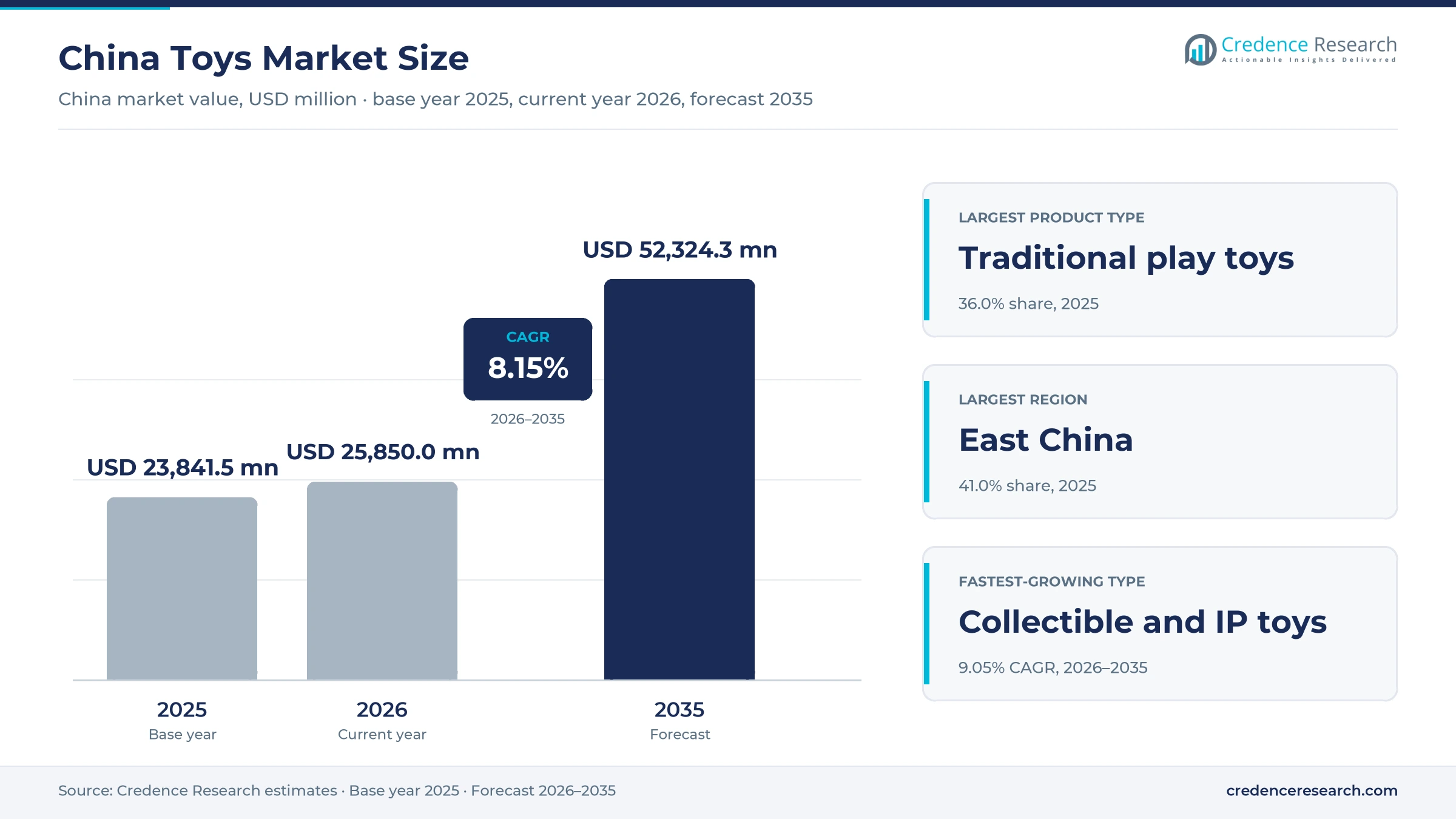
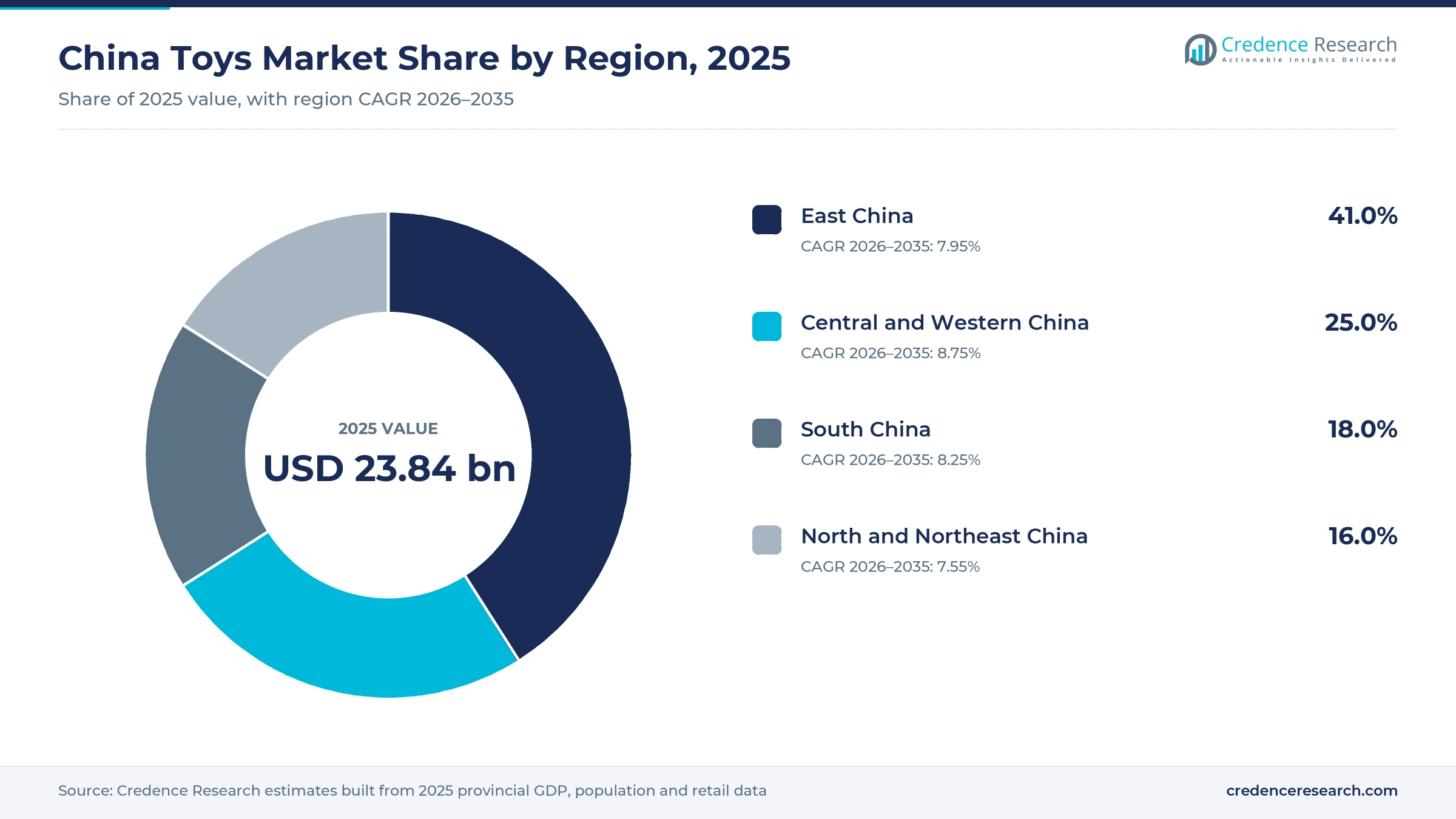
The China toys market was valued at USD 23.84 billion in 2025 and is projected to increase from USD 25.85 billion in 2026 to USD 52.32 billion by 2035, registering a CAGR of 8.15% during 2026–2035. Demand comes from parents who buy play and learning products for a shrinking number of children, and from teens and adults who buy blind boxes, figures and plush characters for themselves. East China held the largest regional share, 41.0% in 2025, because Jiangsu, Zhejiang, Shandong and Shanghai combine high incomes with dense retail networks. Central and Western China is the fastest-growing region at 8.75% a year, as brand stores and fast delivery reach Sichuan, Henan, Hubei and Hunan. Products are also changing, because toymakers now add large language models to plush companions and character figures. As a result, interactive models sell at higher prices than the plain toys they replace.
Which products and buyers does the China estimate cover?
The estimate measures the retail value of traditional play toys, construction and STEM sets, collectible and IP products and plush toys sold in mainland China. Values are stated at the prices that families, teens, adult collectors and institutions pay through online marketplaces, brand stores, specialty shops and mass retailers.
The estimate excludes toy exports, video games and consoles, and nonplay merchandise such as stationery and apparel. The value chain runs from IP owners and designers through molding, assembly and packaging plants, mostly in Guangdong, Zhejiang and Jiangsu, to brand retailers, platforms and the households that buy for play or display.
China Toys Market Insights
- The China toys market was valued at USD 23.84 billion in 2025 and is projected to reach USD 52.32 billion by 2035, registering a CAGR of 8.15% during 2026–2035.
- East China held a 41.0% share of 2025 value, because Jiangsu, Zhejiang, Shandong and Shanghai together produced more than 39 trillion yuan of GDP in 2025.
- Traditional play toys led with a 36.0% share of 2025 value, while collectible and IP toys grow fastest at 9.05% a year to 2035.
- The Ministry of Industry and Information Technology expected the domestic AI toy market to reach about 29 billion yuan in 2025, up from 24.6 billion yuan in 2024.
- Domestic retail sales of trendy and collectible toys and related merchandise reached 55.83 billion yuan in 2024, according to the Ministry of Industry and Information Technology.
Traditional play leads as collectible lines grow fastest
Why do traditional play products still lead value?
Based on product type, the market is categorized into traditional play toys, construction and STEM toys, collectible and IP toys, and plush and soft toys. Traditional Play Toys led with a 36.0% share of 2025 value, because dolls, vehicles, ride-ons and games remain the core purchase for young children. Collectible and IP Toys grow fastest at 9.05% a year, as teens and adults buy blind boxes and figures tied to original characters.
How does the mass-market tier hold the largest share?
Based on price tier, the market is categorized into value, mass market, premium and collector premium products. Mass Market products led with 40.0% of 2025 value, because most family purchases fall between low-cost impulse buys and branded sets. Collector Premium products grow fastest at 9.61% a year, as limited editions, large figures and AI-enabled companions command several times the price of standard items.
Which buyer groups account for most spending?
Based on customer type, the market is categorized into parents and family buyers, teen consumers, adult collectors and institutional buyers. Parents and Family Buyers led with 55.0% of 2025 value, because parents and grandparents still buy most products for children under 12. Adult Collectors grow fastest at 9.30% a year, as young professionals spend on blind boxes, plush characters and display figures.
Where do Chinese buyers purchase their products?
Based on distribution channel, the market is categorized into e-commerce marketplaces, brand-owned retail, specialty toy retail and mass and department retail. E-Commerce Marketplaces led with 46.0% of 2025 value, because shopping festivals and livestream selling reach buyers in every city tier. Brand-Owned Retail grows fastest at 8.87% a year, as IP companies open flagship stores and vending machines in malls.
| Segment Group | Leading Sub-segment | Share, 2025 | Fastest-growing Sub-segment | CAGR, 2026–2035 |
|---|---|---|---|---|
| By Product Type | Traditional Play Toys | 36.0% | Collectible and IP Toys | 9.05% |
| By Price Tier | Mass Market | 40.0% | Collector Premium | 9.61% |
| By Customer Type | Parents and Family Buyers | 55.0% | Adult Collectors | 9.30% |
| By Distribution Channel | E-Commerce Marketplaces | 46.0% | Brand-Owned Retail | 8.87% |
Request a Free Sample
Fill in your details and we'll send you a free sample report.
- Sample data tables & charts
- Research methodology
IP spending, AI play and fast factories lift demand
How does collectible and IP-led spending expand demand?
Spending on character-driven collectibles has become a second engine of demand alongside children's play, because teens and adults now buy figures and plush for themselves. Domestic retail sales of trendy and collectible toys and related merchandise reached 55.83 billion yuan in 2024, according to Ministry of Industry and Information Technology data reported by China News Service. Plush products overtook figurines as Pop Mart's largest category in the first half of 2025, led by THE MONSTERS characters, according to Jing Daily. Bloks Group then rose about 82% on its Hong Kong debut on Jan. 10, 2025, according to The Edge Malaysia. As a result, collectible and IP toys grow fastest by product type at 9.05% a year.
Why does AI-enabled interactive play raise prices?
Toymakers are adding voice chat and large language models to plush companions and figures, which lifts the average price of a purchase. The Ministry of Industry and Information Technology put the domestic AI toy market at about 24.6 billion yuan in 2024 and expected about 29 billion yuan in 2025. Shenzhen Haivivi Technology launched its BubblePal conversation pendant in July 2024 and sold more than 250,000 units by August 2024, according to Caixin. Alpha Group's AI versions of Pleasant Goat and Big Big Wolf characters sell at nearly four times the price of comparable plush, the same report said. In turn, collector premium products grow at 9.61% a year.
How do dense factories speed new product launches?
China's clustered toy factories let brands move from design to shelf within weeks, which keeps new characters and formats reaching buyers quickly. Chenghai district in Shantou accounts for more than half of China's plastic toy output and exported toys worth 10.24 billion yuan in 2024, according to the China Council for the Promotion of International Trade. One Chenghai trader said U.S. buyers rushing to stock up during the 2025 tariff pause had cut the usual three-month lead time to two. The LEGO Group added about 42,000 square meters of built-up area to its Jiaxing factory in Zhejiang, with completion slated for 2024, according to Retail Insight Network. As a result, fast building-brick set launches and limited drops keep shelves fresh.
Can childcare subsidies support family toy budgets?
National support for young families adds disposable income for households that buy toys for infants and toddlers. China announced a subsidy of 3,600 yuan a year for each child under 3 on July 28, 2025, backdated to Jan. 1, 2025, according to the Henan provincial government. One economist quoted in the same report estimated that the payments could benefit more than 20 million households each year. Per capita disposable income also rose 5.0% to 43,377 yuan in 2025, according to the National Bureau of Statistics. In turn, parents and family buyers kept the largest customer share at 55.0% of 2025 value, even as births declined.
Plush collectibles, online drops and new listings
How is the rise of plush collectibles reshaping demand?
Plush characters are emerging as the most visible collectible format, which pulls soft toys out of the nursery and onto bags and desks. Plush became Pop Mart's largest product category in the first half of 2025, and THE MONSTERS line, which includes Labubu, became the franchise that anchors its business. The company also ran 2,637 robo shops at the end of 2025, according to KrASIA. Robopoet's Fuzozo electronic pet was a top seller in its category during the Double 11 festival in November 2025, according to Caixin. As a result, plush and soft toys grow faster than the market, and plush products now reach adult buyers as well.
Why is the shift to online drops and livestream selling notable?
More purchases now happen on platforms, which favors limited drops, livestream launches and festival discounts. Online retail sales of physical goods reached 13.09 trillion yuan in 2025, about 26.1% of total retail sales of consumer goods, according to the National Bureau of Statistics. Total retail sales grew 3.7% in 2025, while retail sales of sports and recreational articles by larger enterprises rose 15.7%, the same communique showed. Fuzozo and BubblePal both built early sales through online platforms, according to Caixin. In turn, e-commerce marketplaces led channels with 46.0% of 2025 value, and brand-owned retail grows fastest at 8.87% a year.
Is the adult collector base an opening for new IP owners?
Adult buyers form a growing pool that new character owners can reach with original designs, which opens room beyond the established leaders. Beijing-based 52TOYS had 35 proprietary product lines and about 80 licensed designs at the end of 2024, according to The Bamboo Works. Wanda Cinemas and a partner paid 144 million yuan for a 7% stake in 52TOYS on May 12, 2025, the same report said. Shanghai startup Link-X Technology also targets 18- to 35-year-olds with its AiMOON zodiac toy, according to Caixin. As a result, adult collectors grow fastest by customer type at 9.30% a year, and wider collectibles spending supports new launches.
Can AI companions and learning products open premium demand?
Learning-focused AI companions open a premium segment for parents who want play that teaches, which lifts spending per child as families shrink. Shifeng Cultural Development released Feifei Rabbit, a bunny that answers academic questions with a hybrid AI model, in 2026, according to Caixin. Robopoet also co-designed Smart Hanhan with Huawei on the Pangu model, the same report said. Caixin also reported a brokerage forecast that AI toys could reach about 85 billion yuan by 2030, nearly three times the ministry's 2025 estimate. In turn, AI-enabled learning products support the premium tier, which sits between mass-market items and collector editions and gains share as parents trade up for products that teach.
Falling births, export strain and AI privacy risks
How do falling births shrink the core child market?
China recorded 7.92 million births in 2025, according to the National Bureau of Statistics, compared with 9.54 million in 2024 as cited by the Henan provincial government. Because fewer infants enter the market each year, baby and preschool categories face a smaller buyer base. As a result, brands must lift spending per child or sell to teens and adults. Many respond with premium learning products and collectible lines that appeal to older buyers. However, the national childcare subsidy only partly offsets the loss of volume in infant and preschool categories.
Why do export headwinds pressure domestic makers?
Toy exports fell 12.1% to 249.3 billion yuan in 2025, according to the National Bureau of Statistics, after U.S. tariff threats unsettled orders in early 2025. Because many factories serve both export and domestic buyers, weaker overseas orders squeeze margins and cash flow. In turn, some makers cut prices at home to fill idle capacity, which adds pressure on domestic shelf prices. Others shift toward their own brands and IP licensing to protect returns over the longer term.
How do privacy and safety concerns slow AI products?
AI toys collect voice data from children, which raises privacy and content risks that regulators now watch closely. A U.S. consumer group found safety problems with some AI toys in November 2025, and one Chinese maker pulled its products from overseas markets, according to Caixin. As a result, many parents may hesitate before buying connected products for young children. The ministry said it would set standards for the quality, safety and privacy of AI toys, which should give compliant brands an advantage.
Why does dependence on a few hit characters add risk?
Collectible demand often clusters around a small number of characters, which makes sales vulnerable when interest fades. Pop Mart shares fell in March 2026 on concerns over limited IP diversification, according to KrASIA. Because resale prices and hype cycles move quickly, retailers can be left with slow-moving stock after a craze cools. Brands reduce the risk by building broad portfolios of artist characters and licensed properties, and by releasing new series at a steady pace.
East China leads as Central and Western China gains
| Region | Value, 2025 (USD billion) | Share, 2025 | CAGR, 2026–2035 |
|---|---|---|---|
| East China | 9.78 | 41.0% | 7.95% |
| Central and Western China | 5.96 | 25.0% | 8.75% |
| South China | 4.29 | 18.0% | 8.25% |
| North and Northeast China | 3.81 | 16.0% | 7.55% |
How do Jiangsu, Zhejiang and Shanghai keep East China first?
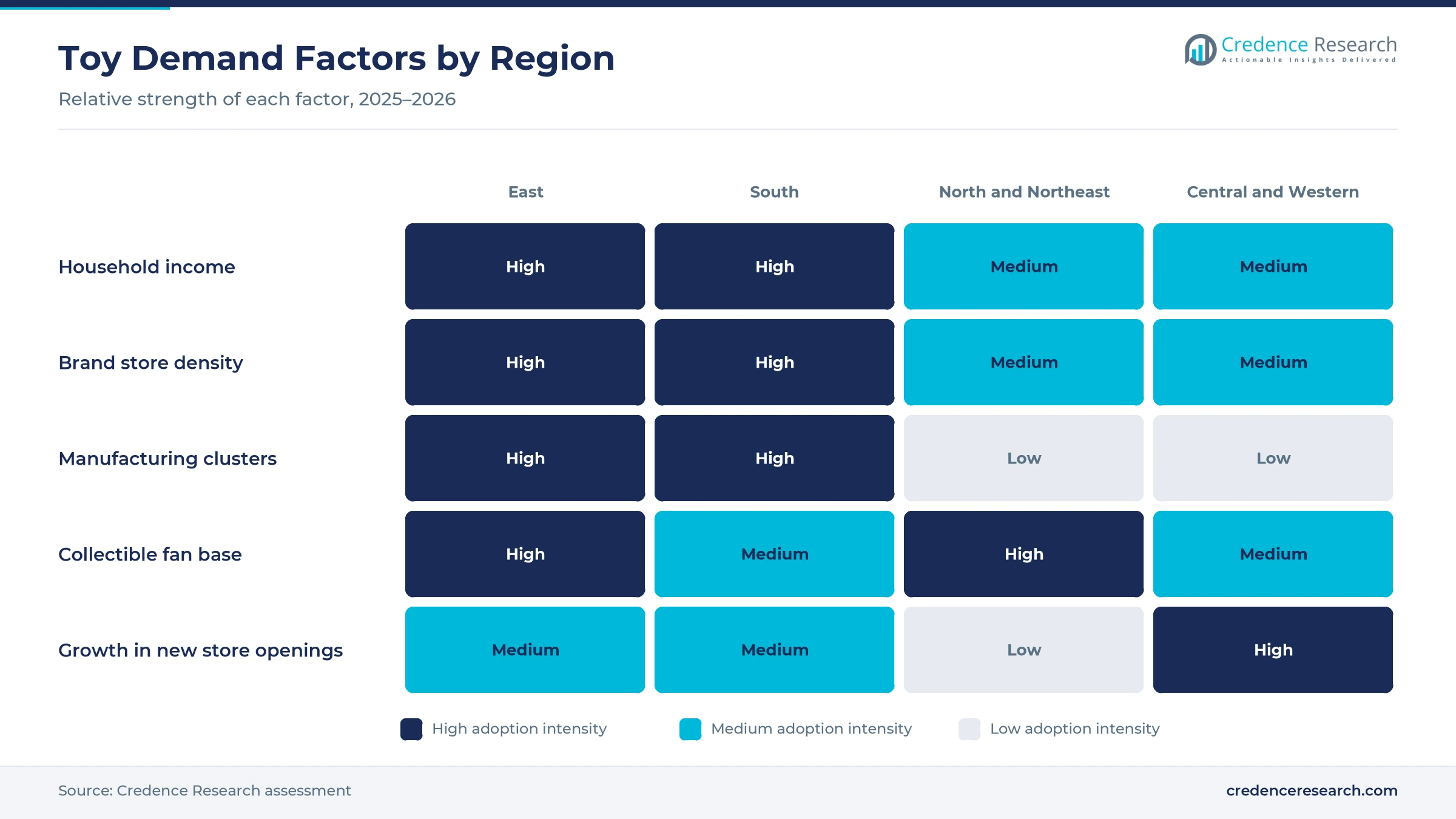
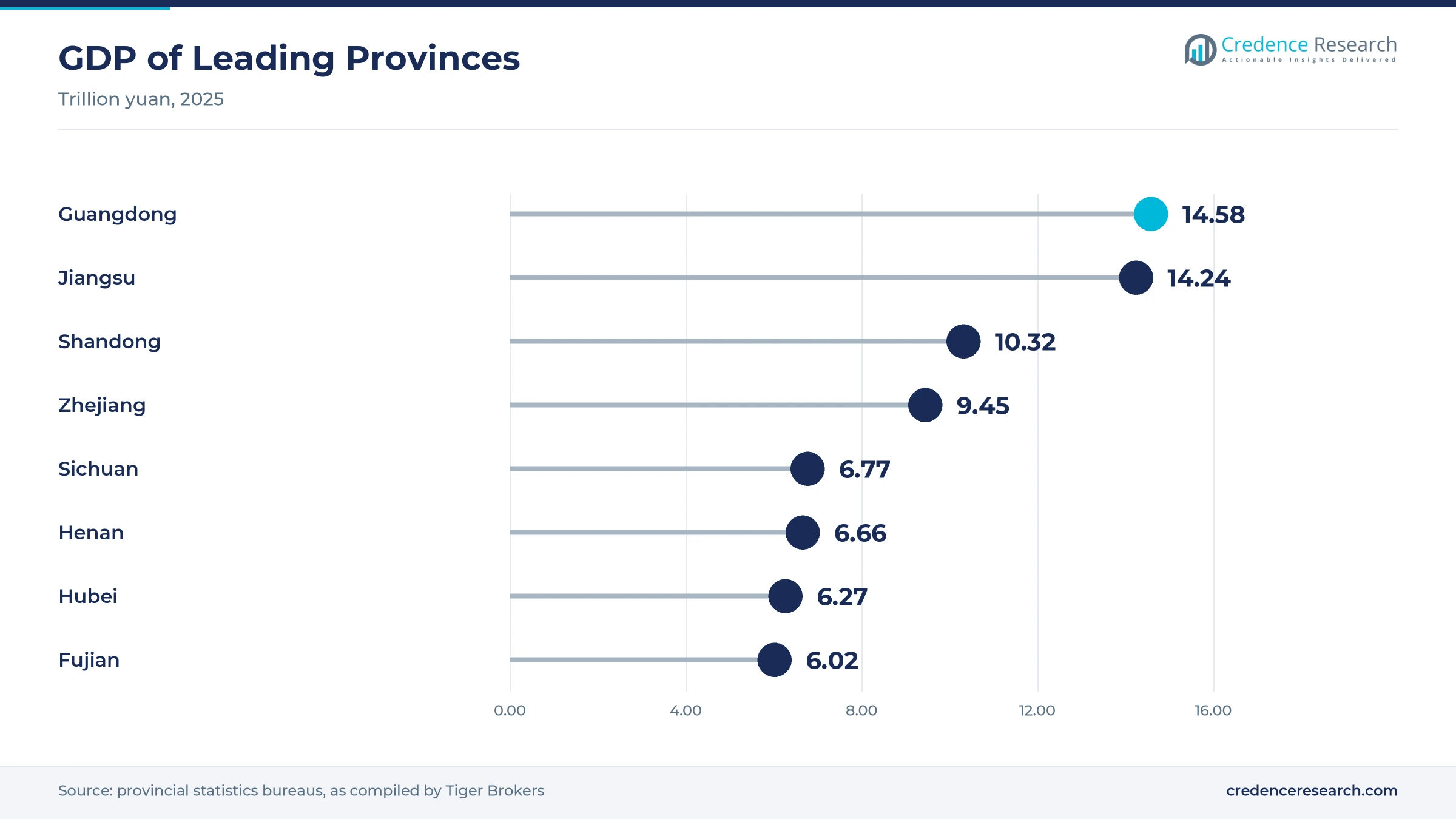
East China held 41.0% of 2025 value and grows at 7.95% a year, because Jiangsu, Shandong, Zhejiang and Shanghai produced about 14.24, 10.32, 9.45 and 5.67 trillion yuan of GDP in 2025. Shanghai and Hangzhou host dense networks of brand stores and malls that launch new collectible series first. The LEGO Group also makes bricks for China and Asia at its Jiaxing factory in Zhejiang. As a result, the zone remains the largest source of premium spending.
Why do Central and Western provinces grow fastest?
Central and Western China held 25.0% of 2025 value and grows fastest at 8.75% a year, because Sichuan, Henan, Hubei and Hunan each produced between 5.5 and 6.8 trillion yuan of GDP in 2025. Brand-owned stores and vending machines are spreading into provincial capitals such as Chengdu, Wuhan, Zhengzhou and Changsha. Fast online delivery also brings limited drops to smaller cities, which lifts spending by teens and young adults.
How does Guangdong make South China a production and retail hub?
South China held 18.0% of 2025 value and grows at 8.25% a year, because Guangdong was the largest provincial economy in 2025 at about 14.58 trillion yuan of GDP. Chenghai in Shantou produces more than half of China's plastic toys, so new products often reach local shops first. Bandai Namco opened its ninth mainland Gundam Base, a 490-square-meter flagship, in Guangzhou in June 2025, according to China Daily.
Why does Beijing anchor North and Northeast China?
North and Northeast China held 16.0% of 2025 value and grows at 7.55% a year, because Beijing and Tianjin combine high incomes with large student and office populations. Beijing is home to 52TOYS, which began with a toy store in the Drum Tower area. However, slower population growth in the three northeastern provinces holds the zone below the national rate.
Listings, stores and policy milestones, 2024 to 2026
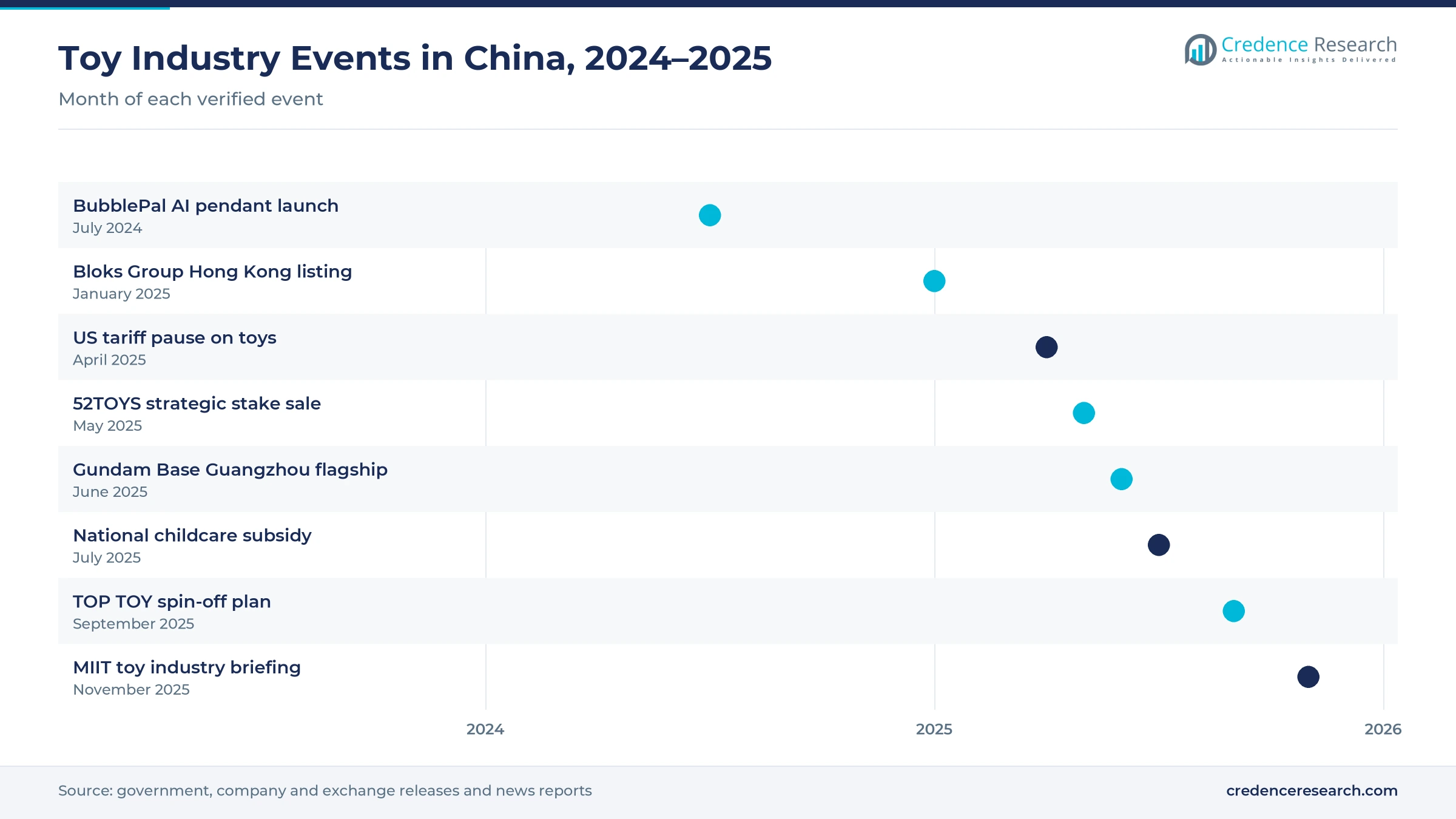
| Development | Status and market relevance |
|---|---|
| In July 2024, Shenzhen Haivivi Technology launched the BubblePal AI conversation pendant. | More than 250,000 units sold by August 2024 |
| In January 2025, Bloks Group listed on the Hong Kong stock exchange, and its shares rose about 82% on debut. | Raised about $215 million for licensed figure and brick products |
| In June 2025, Bandai Namco opened its ninth mainland Gundam Base, a 490-square-meter flagship in Guangzhou. | Largest Gundam Base store in mainland China |
| In July 2025, China announced a national childcare subsidy of 3,600 yuan a year for each child under 3. | Backdated to Jan. 1, 2025 |
| In September 2025, MINISO Group moved to spin off TOP TOY and seek a Hong Kong listing. | UBS, J.P. Morgan and CLSA named to coordinate the offering |
Licensing, smart chips and molding shape new products
- Original and licensed IP gives products a story and a fan base, which is why character design now drives most collectible launches.
- Large language model chips let plush companions and figures hold conversations, which supports higher prices for AI companions.
- Precision injection molding produces bricks and figures with tight tolerances, which supports fast production in Chenghai and Jiaxing.
- Blind-box packaging hides the exact figure inside each box, which encourages repeat buying and trading among collectors.
- Vending and robo shops sell collectibles in malls and transit hubs around the clock, which extends brand reach at low cost.
Need a Custom Version of This Report?
Tailor the scope, geography, or segments to your exact requirements.
- Custom geography or segment scope
- Direct access to our analyst team
Original IP and retail reach separate the leaders
Competition centers on original characters, licensing access, store networks and speed to shelf, because Chinese buyers follow characters across platforms and stores. Pop Mart builds artist characters such as Labubu and sells through stores, robo shops and online platforms. Bloks Group sells licensed figures and brick sets based on properties such as Ultraman and Transformers. The LEGO Group serves China and Asia from its factory in Jiaxing. Alpha Group adds AI features to its own animated characters, while 52TOYS combines proprietary lines with about 80 licensed designs. Bandai Namco expands its Gundam Base stores, and MINISO plans a separate listing for TOP TOY. As a result, companies that own characters and control their own retail space win the most repeat buyers.
Companies profiled and their roles in this market
| Company | Type | Role in the market |
|---|---|---|
| Pop Mart | IP owner and retailer | Artist characters such as Labubu; stores and robo shops |
| Bloks Group | Licensed figure maker | Ultraman and Transformers figures; Hong Kong listing in January 2025 |
| The LEGO Group | Brick set maker | Jiaxing factory in Zhejiang serving China and Asia |
| Alpha Group | IP owner and toymaker | AI versions of Pleasant Goat and Big Big Wolf characters |
| 52TOYS | Collectible brand | Proprietary lines and licensed designs; Beijing base |
| Bandai Namco Holdings | Licensed model maker | Gundam Base stores, including a Guangzhou flagship |
| TOP TOY (MINISO Group) | Collectible retailer | Spin-off and Hong Kong listing plan from September 2025 |
Credence Research view on Chinese play spending
Credence Research's view is that the China toys market will keep growing even as births fall, because teens and adults now buy collectible characters for themselves and AI features lift prices. Traditional play keeps the largest share, while collectible and IP products gain ground through 2035. East China stays the largest zone, while Central and Western China grows fastest as brand stores spread inland. Companies that own characters, control retail space and meet new AI safety standards should win the most buyers.
Official statistics and company data anchor the model
The report uses 2025 as the base year on a calendar basis, and market values come from the Credence Research model. That model combines official toy retail data, provincial GDP and population, birth statistics, typical retail prices and company announcements. Segment splits and zone shares and growth rates are Credence Research estimates. Sources used are government and ministry releases, National Bureau of Statistics data, company releases and news reports, and no interviews or surveys were used.
Adult collectors and AI companions carry growth to 2035
The China toys market is expected to reach USD 52.32 billion by 2035, an 8.15% CAGR during 2026–2035, as collectible characters and AI companions add spending beyond children's play. Growth should stay firm through 2028 as new listings fund IP development and brand stores open inland. After that, premium pricing and adult collectors will set the pace. Clear AI safety standards would build parent trust, while fading interest in hit characters would slow sales. Collector premium products are expected to gain the most share through 2035.
Frequently Asked Questions
How big is the China toys market?
Which product type leads demand in China?
Which region leads the China market?
How large are trendy and collectible toy sales in China?
How fast is the AI toy segment growing?
How do falling births affect toy demand?
Who are the leading toy companies in China?
What are the main challenges for the market?
Table of Content
Chapter 1 Market Segmentation
- 1.1 Segmentation Framework
- 1.1.1 Product and Service Classification
- 1.1.2 Application and End-Use Classification
- 1.1.3 Technology and Solution Classification
- 1.1.4 Customer and Distribution Channel Classification
- 1.1.5 Geographic Segmentation
- 1.1.6 Market Segment Definitions and Boundaries
- 1.2 By Product Type
- 1.2.1 Traditional Play Toys
- 1.2.2 Construction and STEM Toys
- 1.2.3 Collectible and IP Toys
- 1.2.4 Plush and Soft Toys
- 1.3 By Price Tier
- 1.3.1 Value
- 1.3.2 Mass Market
- 1.3.3 Premium
- 1.3.4 Collector Premium
- 1.4 By Customer Type
- 1.4.1 Parents and Family Buyers
- 1.4.2 Teen Consumers
- 1.4.3 Adult Collectors
- 1.4.4 Institutional Buyers
Chapter 2 Introduction
- 2.1 Report Objectives and Scope
- 2.2 Product Definition and Industry Terminology
- 2.3 Market Inclusions and Exclusions
- 2.4 Research Process
- 2.4.1 Primary Research and Expert Interviews
- 2.4.2 Secondary Research and Source Review
- 2.4.3 Top-Down and Bottom-Up Estimation
- 2.4.4 Data Triangulation and Verification
- 2.5 Market Size Measurement Basis
- 2.5.1 2025: USD 23.84 billion → 2035: USD 52.32 billion
- 2.6 Historical and Forecast Reference Periods
- 2.6.1 Historical Period: 2018-2025
- 2.6.2 Base Year: 2025
- 2.6.3 Forecast Period: 2025-2035
- 2.7 Research Assumptions and Limitations
Chapter 3 Executive Summary
- 3.1 Market Snapshot and Key Findings
- 3.2 Base-Year Market Size, 2025
- 3.3 Forecast Market Size, 2035
- 3.4 Revenue and Volume Growth Outlook
- 3.5 Key Demand and Supply Indicators
- 3.6 Leading Market Segments
- 3.7 Fastest-Growing Market Opportunities
- 3.8 Regional Performance Highlights
- 3.9 Technology and Industry Transformation
- 3.10 Competitive Landscape Summary
- 3.11 Analyst View and Strategic Implications
Chapter 4 China Toys Market Trends and Developments
- 4.1 Historical Industry Development, 2018-2025
- 4.2 Recent Market Trends and Developments
- 4.3 Demand and Customer Behavior Trends
- 4.4 Technology and Product Innovation
- 4.5 Artificial Intelligence, Automation and Digitalization
- 4.6 Local Manufacturing and Supply Chain Realignment
- 4.7 Industry Partnerships, Mergers and Acquisitions
- 4.8 Sustainability and Circular Economy Developments
- 4.9 Government and Private Sector Investment Trends
- 4.10 Emerging Business Models and Commercialization
- 4.11 Industry Developments and Announcements
Chapter 5 China Toys Market Production, Supply and Demand Analysis
- 5.1 Demand Trend and Consumption Analysis, 2018-2025
- 5.2 Demand Forecast, 2025-2035
- 5.3 Production and Output Trend, 2018-2025
- 5.4 Production and Output Forecast, 2025-2035
- 5.5 Installed Capacity and Capacity Utilization
- 5.6 Company-Wise Production Plants and Statistics
- 5.6.1 Installed Production Capacity
- 5.6.2 Actual Production
- 5.6.3 Planned Capacity and Expansion Targets
- 5.7 Supply Chain Structure and Procurement Trends
- 5.8 Supply-Demand Gap and Bottlenecks
- 5.9 Import Dependence and Sourcing Structure
- 5.10 Contract Manufacturing and Outsourcing
- 5.11 Regional Supply and Demand Concentration
Chapter 6 China Toys Market Pricing Analysis
- 6.1 Pricing Structure and Measurement
- 6.2 Historical Pricing Trends, 2018-2025
- 6.3 Pricing Outlook, 2025-2035
- 6.4 Average Selling Price and Unit Economics
- 6.5 Pricing by Product and Market Segment
- 6.6 Geographic Pricing Differences
- 6.7 Key Input, Energy, Labor and Logistics Costs
- 6.8 Contract Pricing and Purchasing Models
- 6.9 Pricing Sensitivity and Competitive Positioning
- 6.10 Price, Margin and Profitability Implications
Chapter 7 China Toys Market Dynamics
- 7.1 Market Growth Drivers
- 7.1.1 Demand-Side Drivers
- 7.1.2 Technology and Innovation Drivers
- 7.1.3 Infrastructure and Investment Drivers
- 7.1.4 Regulatory and Policy Drivers
- 7.2 Market Restraints
- 7.2.1 Cost and Affordability Constraints
- 7.2.2 Technology and Adoption Barriers
- 7.2.3 Supply Chain and Operational Constraints
- 7.3 Market Challenges
- 7.3.1 Competitive Pressure and Margin Erosion
- 7.3.2 Skills, Infrastructure and Implementation Gaps
- 7.4 Emerging Market Opportunities
- 7.5 Market Dynamics Impact and Time-Horizon Assessment
Chapter 8 China Toys Value Chain Analysis
- 8.1 Industry Value Chain Overview
- 8.2 Upstream Suppliers and Critical Inputs
- 8.3 Technology and Component Providers
- 8.4 Manufacturing or Service Delivery
- 8.5 Distribution, Channel Partners and Integrators
- 8.6 Downstream Applications and End Users
- 8.7 Value Addition and Profit Pools
- 8.8 Vertical Integration and Outsourcing
- 8.9 Supplier Concentration and Risk
- 8.10 Supply Chain Localization and Resilience
Chapter 9 China Toys Market Regulations and Policies
- 9.1 Relevant Laws, Standards and Compliance Frameworks
- 9.2 Product, Service, Safety and Quality Requirements
- 9.3 Government Policies, Incentives and Subsidies
- 9.4 Imports, Exports and Trade Barriers
- 9.5 Public Procurement and Local Content Requirements
- 9.6 Environmental and Sustainability Compliance
- 9.7 Upcoming Policy Changes and Market Implications
Chapter 10 China Toys Market Hotspots and Opportunities
- 10.1 Market Opportunity Mapping and Growth Hotspots
- 10.2 High-Growth Applications and Customer Groups
- 10.3 Underserved Markets and White-Space Opportunities
- 10.4 Emerging Technology and Product Opportunities
- 10.5 New Capacity and Investment Hotspots
- 10.6 Market Entry and Expansion Opportunities
- 10.7 Distribution and Partnership Opportunities
- 10.8 Near-Term and Long-Term Commercial Potential
- 10.9 Opportunity Attractiveness and Execution Risks
Chapter 11 China Toys Market Outlook, 2025-2035
- 11.1 Market Size and Analysis
- 11.1.1 Revenue (Market Measurement: 2025: USD 23.84 billion → 2035: USD 52.32 billion)
- 11.1.2 Market Volume and Quantity Sold
- 11.1.3 Historical Market Size, 2018-2025
- 11.1.4 Base-Year Market Size, 2025
- 11.2 Market Forecast, 2025-2035
- 11.2.1 Revenue Forecast to 2035
- 11.2.2 Volume Forecast to 2035
- 11.2.3 CAGR and Year-on-Year Growth
- 11.2.4 Incremental Revenue Opportunity
- 11.3 Forecast Assumptions and Scenario Analysis
- 11.3.1 Base-Case Forecast
- 11.3.2 Optimistic and Conservative Scenarios
- 11.3.3 Technology, Pricing and Policy Sensitivities
- 11.4 Market Attractiveness and Growth Outlook
Chapter 12 China Toys Market Segmentation and Outlook
- 12.1 Segmentation Summary and Market Shares, 2025
- 12.2 Largest and Fastest-Growing Segments
- 12.3 By Product Type - Market Size and Forecast, 2025-2035
- 12.3.1 Segment Definition and Scope
- 12.3.2 Historical Market Size, 2018-2025
- 12.3.3 Revenue Forecast, 2025-2035
- 12.3.4 Volume Forecast, 2025-2035
- 12.3.5 Base-Year Market Share, 2025
- 12.3.6 Segment CAGR and Growth Drivers
- 12.3.7 Subsegment Market Size and Forecast
- 12.3.7.1 Traditional Play Toys
- 12.3.7.2 Construction and STEM Toys
- 12.3.7.3 Collectible and IP Toys
- 12.3.7.4 Plush and Soft Toys
- 12.3.8 Subsegment Pricing and Adoption Trends
- 12.3.9 Leading Suppliers and Competition
- 12.3.10 Regional Demand and Opportunities
- 12.4 By Price Tier - Market Size and Forecast, 2025-2035
- 12.4.1 Segment Definition and Scope
- 12.4.2 Historical Market Size, 2018-2025
- 12.4.3 Revenue Forecast, 2025-2035
- 12.4.4 Volume Forecast, 2025-2035
- 12.4.5 Base-Year Market Share, 2025
- 12.4.6 Segment CAGR and Growth Drivers
- 12.4.7 Subsegment Market Size and Forecast
- 12.4.7.1 Value
- 12.4.7.2 Mass Market
- 12.4.7.3 Premium
- 12.4.7.4 Collector Premium
- 12.4.8 Subsegment Pricing and Adoption Trends
- 12.4.9 Leading Suppliers and Competition
- 12.4.10 Regional Demand and Opportunities
- 12.5 By Customer Type - Market Size and Forecast, 2025-2035
- 12.5.1 Segment Definition and Scope
- 12.5.2 Historical Market Size, 2018-2025
- 12.5.3 Revenue Forecast, 2025-2035
- 12.5.4 Volume Forecast, 2025-2035
- 12.5.5 Base-Year Market Share, 2025
- 12.5.6 Segment CAGR and Growth Drivers
- 12.5.7 Subsegment Market Size and Forecast
- 12.5.7.1 Parents and Family Buyers
- 12.5.7.2 Teen Consumers
- 12.5.7.3 Adult Collectors
- 12.5.7.4 Institutional Buyers
- 12.5.8 Subsegment Pricing and Adoption Trends
- 12.5.9 Leading Suppliers and Competition
- 12.5.10 Regional Demand and Opportunities
- 12.6 Segment Growth Comparison
- 12.7 Segment Attractiveness and Priority Matrix
Chapter 13 China Toys End-Use and Application Market Outlook
- 13.1 End-Use Industry and Customer Demand Structure
- 13.2 Leading Applications and Customer Groups
- 13.3 End-Use Market Size, Share and Forecast
- 13.4 Major End-Use Industry Deep Dives
- 13.4.1 Customer Requirements and Use Cases
- 13.4.2 Demand and Replacement Cycles
- 13.4.3 Technical and Regulatory Considerations
- 13.4.4 Purchasing and Procurement Models
- 13.4.5 Leading Vendors and Distribution Channels
- 13.4.6 Forecast and Commercial Opportunities
- 13.5 Emerging Applications and Cross-Segment Demand
- 13.6 End-Use Industry Investment Priorities
Chapter 14 China Toys Geographic Market Outlook, 2025-2035
- 14.1 Domestic Market Distribution and Demand Clusters
- 14.2 State- or Province-Wise Market Size and Forecast, 2025-2035
- 14.3 City and Metropolitan Market Outlook
- 14.4 Industrial, Manufacturing and Commercial Clusters
- 14.5 Geographic Concentration of Key End Users
- 14.6 Local Pricing and Purchasing Differences
- 14.7 Domestic Production Facilities and Capacity Map
- 14.8 Local Infrastructure and Project Pipeline
- 14.9 State-Level Policy and Incentive Differences
- 14.10 Subnational Investment Hotspots and Opportunities
- 14.11 Distribution and Logistics Networks
- 14.12 Domestic Competitive Footprint
Chapter 15 China Toys Technology, Innovation and Sustainability Outlook
- 15.1 Technology Landscape and Maturity
- 15.2 Product, Process and Service Innovation
- 15.3 AI, Automation and Digital Tools in the Industry
- 15.4 Technology Adoption and Performance Benchmarking
- 15.5 Innovation Pipeline and R&D Investment
- 15.6 Patent and Intellectual Property Trends
- 15.7 Energy Efficiency and Resource Management
- 15.8 Sustainability, Recycling and Circularity
- 15.9 Technology Roadmap, 2025-2035
- 15.10 Risks of Obsolescence and Technology Substitution
Chapter 16 China Toys Market Key Strategic Imperatives
- 16.1 Growth and Market Entry Priorities
- 16.2 High-Return Products and Segments
- 16.3 Pricing, Profitability and Cost Optimization
- 16.4 Technology Investment and Product Differentiation
- 16.5 Supply Chain Localization and Resilience
- 16.6 Distribution and Customer Acquisition
- 16.7 Partnership, Acquisition and Capacity Strategy
- 16.8 Regional Expansion Priorities
- 16.9 Short-, Medium- and Long-Term Actions
Chapter 17 Competition Outlook
- 17.1 Industry Competition Characteristics
- 17.2 Market Structure and Concentration
- 17.3 Market Share and Competitive Positioning, 2025
- 17.4 Company-Wise Revenue and Product Benchmarking
- 17.5 Production and Service Capacity Benchmarking
- 17.6 Technology, Pricing and Differentiation
- 17.7 Regional Footprint and Distribution Strength
- 17.8 Mergers, Acquisitions and Strategic Alliances
- 17.9 New Entrants and Competitive Threats
- 17.10 Porter's Five Forces and Industry Attractiveness
- 17.11 Competitive Outlook, 2025-2035
Chapter 18 Company Profiles
- 18.1 Company Coverage and Selection Criteria
- 18.2 Pop Mart
- 18.2.1 Business Description
- 18.2.2 Company Ownership and Geographic Presence
- 18.2.3 Product and Service Portfolio
- 18.2.4 Manufacturing and Operating Footprint
- 18.2.5 Production Capacity and Expansion Plans
- 18.2.6 Financial Performance and Investment
- 18.2.7 Market Share and Competitive Position
- 18.2.8 Technology and Innovation Capabilities
- 18.2.9 Strategic Alliances or Partnerships
- 18.2.10 Recent Developments
- 18.2.11 Growth Strategy and Outlook
- 18.3 The LEGO Group
- 18.4 Bloks Group
- 18.5 Alpha Group
- 18.6 52TOYS
- 18.7 Bandai Namco Holdings
- 18.8 Mattel
- 18.9 Hasbro
- 18.10 TOP TOY (MINISO Group)
- 18.11 Rastar Group
- 18.12 Other Relevant Market Participants
Note: Every listed company is profiled on the structure shown under the first company. The company list is preliminary and may change based on research findings, market developments, data availability and client requirements.
Chapter 19 Disclaimer
- 19.1 Research and Forecast Disclaimer
- 19.2 Data Source and Estimation Limitations
Note: The depth of individual sections depends on data availability for this market. Volume, capacity, trade and other unit-based metrics are included where applicable.

