
Online sales, city incomes and imports lift botanical care
The Vietnam natural skincare market was valued at USD 290.5 million in 2025 and is projected to increase from USD 325.0 million in 2026 to USD 737.2 million by 2035, registering a CAGR of 9.53% during 2026–2035. Demand comes from urban millennials and Gen Z shoppers who buy plant-based cleansers, toners, serums, body care and sunscreen through marketplaces, livestreams and specialty beauty chains. Ho Chi Minh City held the largest regional share, 30.0% in 2025, because the enlarged city has more than 14 million residents and the second-highest income per head in the country. Da Nang is the fastest-growing region at 10.51% a year, as the merged city of about 3 million people draws new chain stores. Regulation also shifted, because Decree 342/2025 took effect on Feb. 15, 2026, ending advertising pre-approval for cosmetics and moving enforcement to post-market checks, which raises the cost of unsupported herbal claims.
Which products does the Vietnam natural estimate count?
The estimate measures retail value of facial care, body care, hair care and sun protection products that are formulated mainly with plant-based, mineral-based or animal-derived ingredients and sold to consumers in Vietnam. It counts sales through e-commerce platforms, specialty beauty chains, department stores and pharmacies.
The estimate excludes conventional synthetic skin care, color cosmetics, fragrances, prescription dermatology products and salon treatments. The value chain runs from ingredient growers, extract suppliers and contract manufacturers through local brand owners, importers and distributors to retailers, which then sell to young urban buyers and higher-income households.
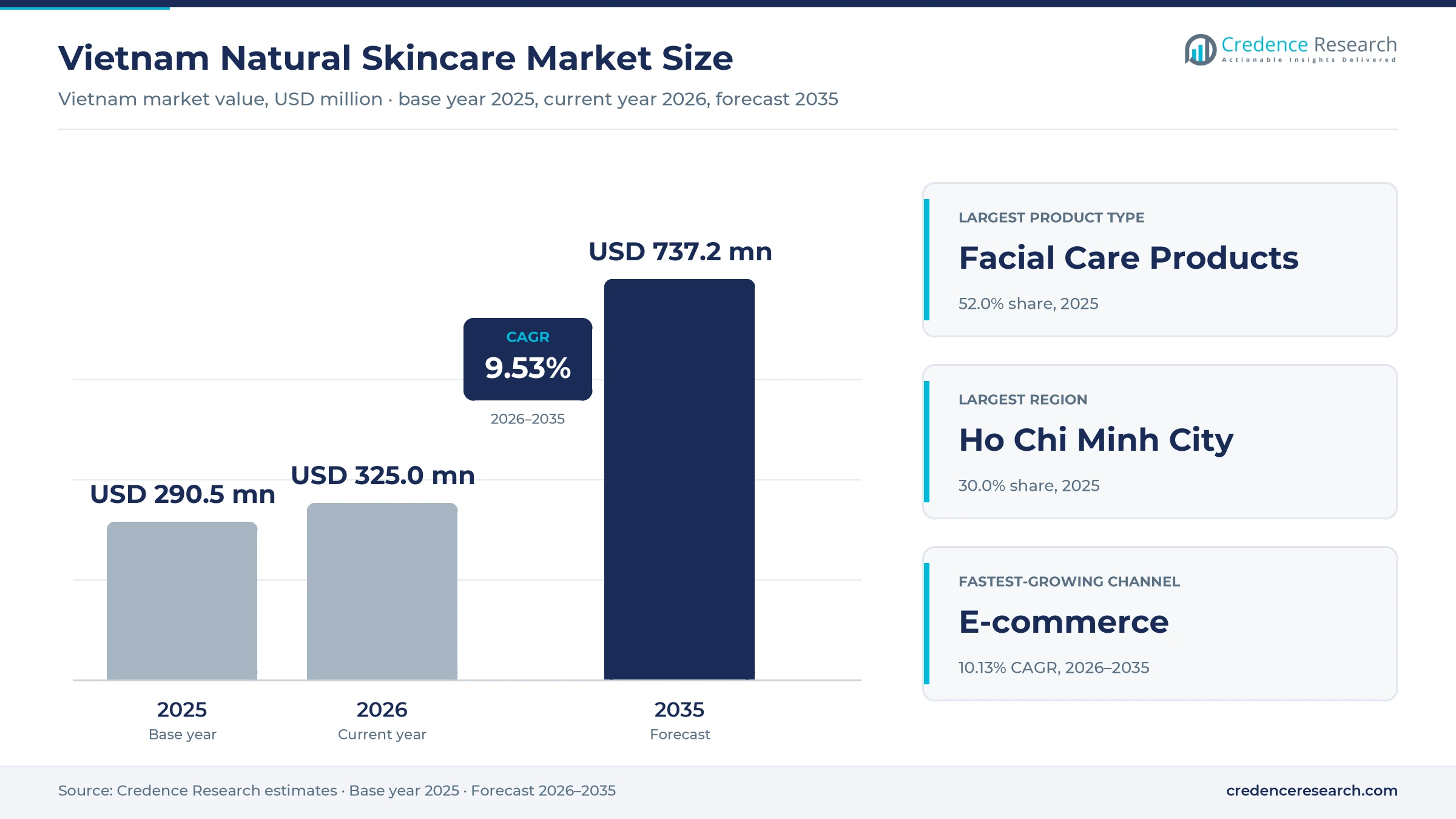
Vietnam Natural Skincare Market Insights
- The Vietnam natural skincare market was valued at USD 290.5 million in 2025 and is projected to reach USD 737.2 million by 2035, registering a CAGR of 9.53% during 2026–2035.
- Ho Chi Minh City held a 30.0% share of 2025 value, because the enlarged city is the most populous locality and has high incomes.
- Facial care products led with a 52.0% share of 2025 value, because cleansers, toners and serums anchor daily routines for urban buyers.
- Decree 342/2025 took effect on Feb. 15, 2026, ending advertising pre-approval for cosmetics and setting legal duties for social media influencers.
- E-commerce grows fastest by channel at 10.13% a year during 2026–2035, as online beauty spending rose about 30% in 2025.
Facial care leads while sun protection grows fastest
Why do facial care products hold the largest value?
Based on product type, the market is categorized into facial care products, body care products, hair care products and sun protection products. Facial Care Products led with a 52.0% share of 2025 value, because cleansers, toners, masks and serums are bought most often and carry the highest unit prices. Sun Protection Products grow fastest at 10.63% a year, as regulators tighten SPF testing and buyers look for gentle filters suited to a hot, humid climate.
How do plant-based formulas shape buyer trust?
Based on ingredient source, the market is categorized into plant-based ingredients, mineral-based ingredients and animal-derived ingredients. Plant-Based Ingredients led with a 72.0% share of 2025 value, because local brands build products around coffee, lotus, pomelo and turmeric that buyers already know. Mineral-Based Ingredients grow fastest at 10.12% a year, as zinc oxide sunscreens and clay cleansers gain shelf space in specialty chains.
Why does e-commerce lead natural beauty sales?
Based on distribution channel, the market is categorized into e-commerce, specialty stores, department stores and pharmacies. E-commerce led with a 46.0% share of 2025 value, because official brand stores on marketplaces and livestream sellers reach buyers across the country at low cost. E-commerce also grows fastest at 10.13% a year, as mobile checkout and creator content shorten the time from discovery to purchase.
Which consumer groups spend most on botanical routines?
Based on consumer group, the market is categorized into millennial consumers, Gen Z consumers, high-income households and middle-income households. Millennial Consumers led with a 38.0% share of 2025 value, because working adults in their thirties run multi-step routines and buy repeat sizes. Gen Z Consumers grow fastest at 10.44% a year, as students and young workers discover local vegan brands through short videos and buy trial sizes online.
| Segment Group | Leading Sub-segment | Share, 2025 | Fastest-growing Sub-segment | CAGR, 2026–2035 |
|---|---|---|---|---|
| By Product Type | Facial Care Products | 52.0% | Sun Protection Products | 10.63% |
| By Ingredient Source | Plant-Based Ingredients | 72.0% | Mineral-Based Ingredients | 10.12% |
| By Distribution Channel | E-commerce | 46.0% | E-commerce | 10.13% |
| By Consumer Group | Millennial Consumers | 38.0% | Gen Z Consumers | 10.44% |
Request a Free Sample
Fill in your details and we'll send you a free sample report.
- Sample data tables & charts
- Research methodology
Digital commerce, urban income and trade access drive sales
How do marketplaces and livestreams speed up purchases?
Digital beauty commerce widens reach and shortens conversion cycles, because shoppers can now discover a botanical cleanser in a livestream and pay for it within minutes. Vietnamese consumers spent nearly VND 74.4 trillion, about USD 3 billion, on beauty and personal care products through e-commerce platforms in 2025, up about 30% from 2024, according to Viet Nam News. TikTok Shop took about half of fourth-quarter 2025 online beauty sales, while official brand stores generated 64% of revenue. Most online beauty sales also fell between VND 200,000 and VND 500,000 per item, which suits trial sizes of natural products. As a result, e-commerce holds 46.0% of 2025 value and grows fastest at 10.13% a year.
Why do Hanoi and Ho Chi Minh City buyers pay more?
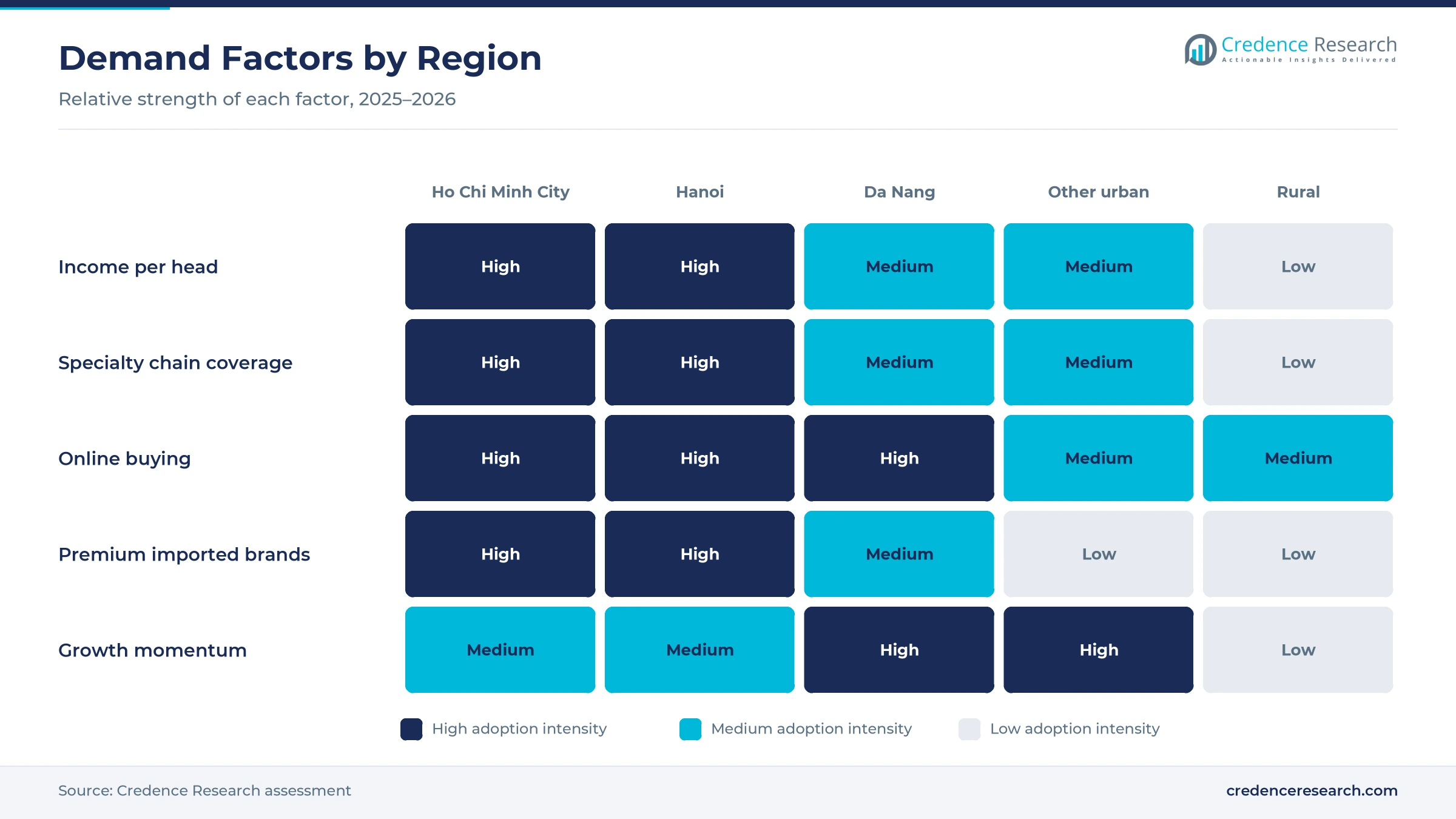
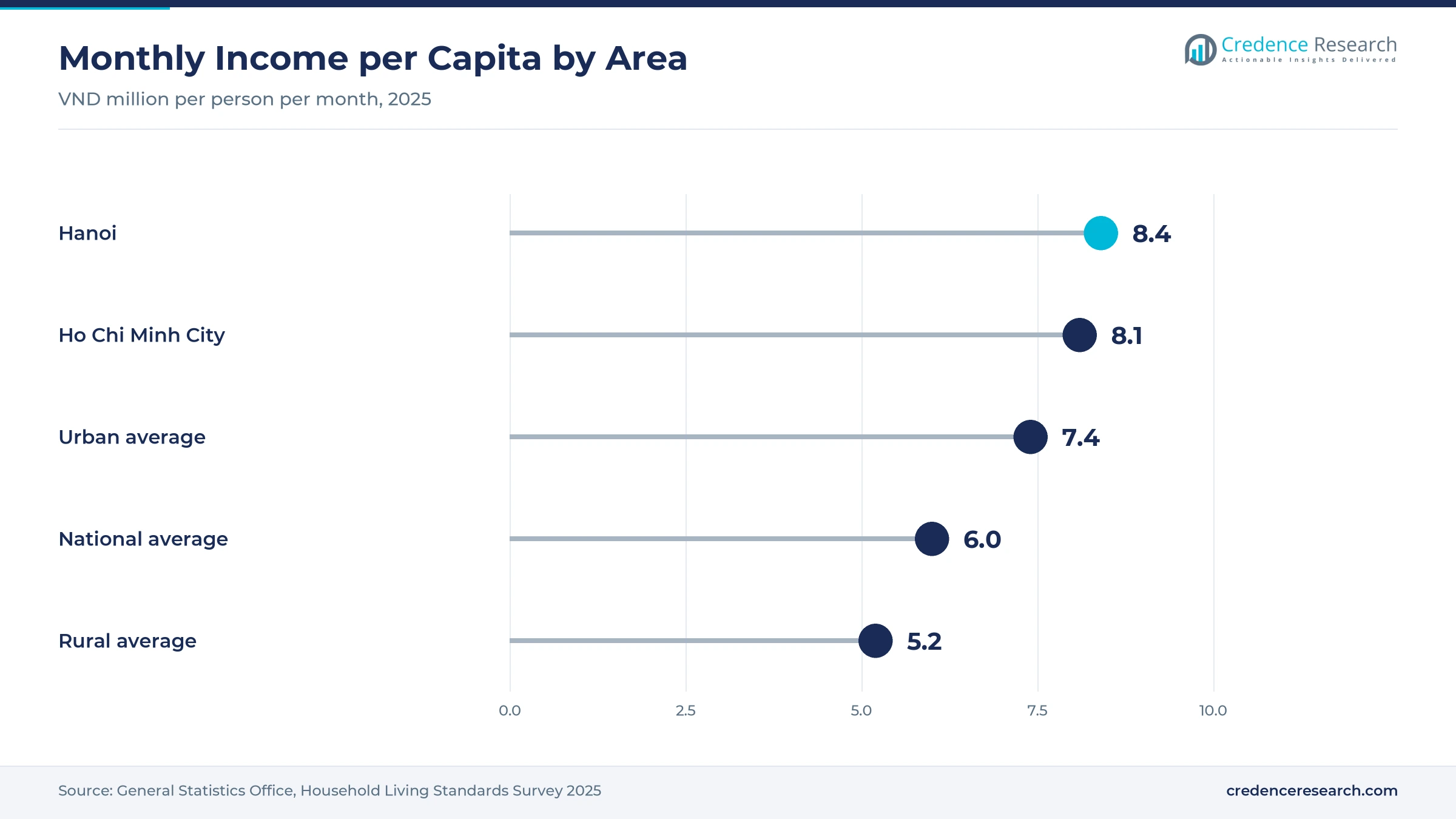
Urban income concentration supports premium natural positioning, because botanical brands price above mass cleansers and need buyers who can repeat purchases every month. Hanoi recorded average monthly income per capita of VND 8.374 million in 2025 and Ho Chi Minh City VND 8.064 million, against a national average of VND 6 million, according to General Statistics Office survey data reported by DTiNews. Ho Chi Minh City also became the most populous locality, with more than 14 million residents, after the National Assembly approved its merger on June 12, 2025. GDP per capita reached about USD 5,066 in 2025, according to World Bank data. In turn, the two largest cities together hold more than half of 2025 value, because premium botanical brands depend on these salaried buyers.
How do tariff cuts and imports keep formulas affordable?
Trade openness keeps imported actives, finished products and packaging accessible, because many natural brands sold in the country rely on foreign formulas, extracts or containers. Foreign brands hold more than 90% of the cosmetics market, with Korean brands at about 30% and European brands at about 23%, according to the U.S. International Trade Administration. Under the EU-Vietnam Free Trade Agreement, several beauty and skin care tariff lines carry 2026 rates between 1.2% and 3.1%, compared with most-favored-nation rates of up to 18% on some creams and lotions, according to Team France Export. Imports of beauty and skin care preparations reached about USD 271 million in 2022, with Korea supplying 36%, according to UN Comtrade data. As a result, plant-based ingredients hold 72.0% of 2025 value.
Why do Hasaki and other chains widen physical access?
Specialty beauty retail expansion widens physical access, because many buyers still want to test texture and scent before committing to a natural regimen. Hasaki Beauty & Clinic had 252 stores in 2025 and was projected to reach 304 in 2026, according to The Investor. Co Mem, a local natural brand, was projected to grow from 62 to 80 stores on provincial demand, while Guardian was forecast to move from 125 to 127 stores. The tracked beauty chains operated 574 stores as of March 2026, up 4.5% from 2025. In turn, specialty stores rank second among channels, because these chains bring sampling, trained advisers and loyalty programs into secondary cities.
Ad rules, local botanicals and SPF checks reshape demand
How are new advertising rules changing claim marketing?
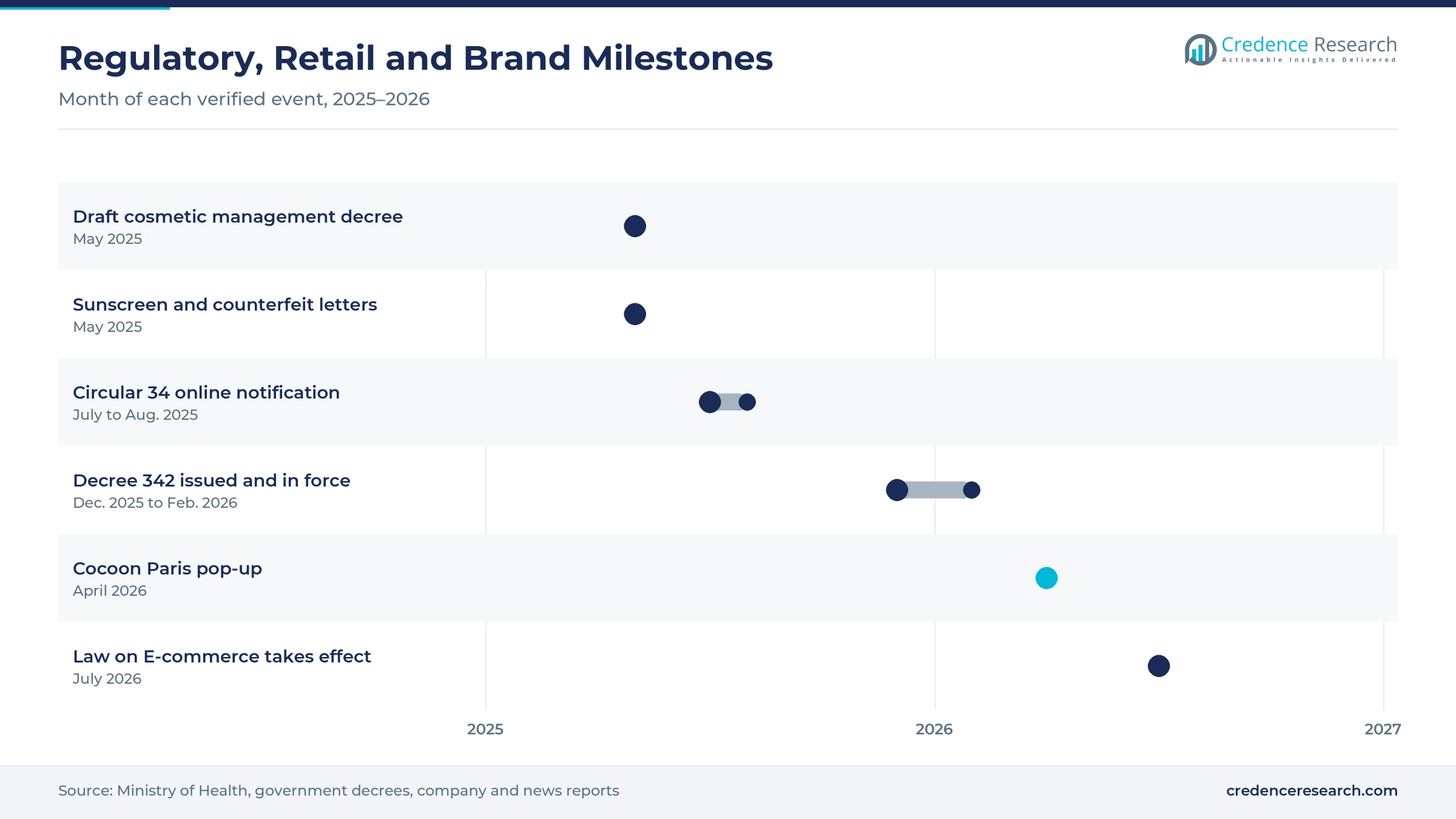
The shift to post-market advertising control is changing how natural brands present claims, because approval before publication has ended and enforcement now happens after campaigns run. Decree 342/2025/ND-CP, issued on Dec. 26, 2025, and Circular 03/2026/TT-BYT took effect on Feb. 15, 2026, removing the advertising content confirmation procedure for cosmetics, according to REACH24H. The rules still ban claims that a cosmetic works like a medicine, and they set legal duties for social media influencers. Platforms and advertisers must also remove illegal content within 24 hours of a request from the authorities. As a result, brands selling through live commerce channels need claim review and creator briefs, because one misleading herbal claim can trigger a recall.
Why do named Vietnamese ingredients matter more now?
The rise of local botanical provenance is notable, because Vietnamese brands now sell named regional ingredients as proof of authenticity rather than generic plant claims. Cocoon builds products around Dak Lak coffee, Ben Tre pomelo, Hau Giang lotus and Hung Yen turmeric, and it opened a Paris pop-up in April 2026 after about two years of preparation, according to IBTimes U.K. Skinlosophy, founded in 2013, uses Vietnamese herbal ingredients and traditional medicine recipes across more than 30 products, according to Vietcetera. Cocoon also says it operates in 45 countries and territories. In turn, local botanical lines compete directly with imported K-beauty products that also lean on plant extracts, which keeps price and provenance at the center of competition.
Can SPF-verified sunscreens open a premium niche?
Verified sun protection can become a growth opening, because regulators are tightening SPF checks just as natural brands add mineral and plant-based filters. The Drug Administration of Vietnam sent a letter on May 20, 2025, urging stricter compliance for sunscreen and more SPF verification testing, according to ChemLinked. Provincial health departments were also told to revoke notification numbers for products whose sun protection claims do not comply. Circular 34/2025/TT-BYT added online notification from Aug. 18, 2025, with five working days for approval after a complete dossier, which shortens launch timelines. As a result, sun protection products grow fastest by product type at 10.63% a year, while mineral-based ingredients grow at 10.12%.
Where outside Hanoi and Ho Chi Minh City is demand rising?
Secondary cities offer room to grow, because incomes outside Hanoi and Ho Chi Minh City are rising faster from a lower base. Rural monthly income per capita rose 14.5% in 2025 to almost VND 5.2 million, while urban income rose 6.7%, narrowing the urban-rural gap to 1.42 times. Da Nang merged with parts of Quang Nam on July 1, 2025, creating a city of about 3 million people with GRDP per capita of about USD 4,287, according to Vietnam Briefing. The urban population share also rose from 34.6% in 2019 to 38.8% in 2025, according to the World Bank. As a result, Da Nang and Other Urban Areas grow faster than the national average, as chains follow rising incomes into new city markets.
Counterfeits, claim recalls and price limits slow growth
Why do fake creams and sunscreens hurt local brands?
Counterfeit and unknown-origin goods erode trust, because fake creams and sunscreens circulate through social media sellers and informal shops. The Drug Administration of Vietnam asked provincial health departments on May 16, 2025 to step up sampling, recalls and destruction of counterfeit, smuggled and substandard cosmetics. As a result, careful buyers shift to official brand stores and chains, while small local brands struggle to prove authenticity. Brands respond with QR verification, tamper seals and exclusive marketplace flagships.
What happens when labels suggest a medicinal effect?
Misleading claims lead to recalls, because natural products often drift into language that suggests a medicinal effect. In July 2025, the Ministry of Health ordered the recall of 13 cosmetic batches distributed by Minh Khuong, including skin care products whose ingredient lists did not match their dossiers. In turn, distributors face write-offs and lost listings when a batch is pulled. Brands respond with dossier audits, label checks before printing and claim wording reviewed against the notified product function.
Why do most shoppers stay below VND 500,000 per item?
Price sensitivity caps premium natural lines, because national monthly income per capita was about VND 6 million in 2025 and most online beauty items sell for under VND 500,000. As a result, imported botanical brands sell mainly in Hanoi and Ho Chi Minh City, while rural buyers stay with mass cleansers and soaps. Many shoppers also wait for marketplace sale days before buying. Brands respond with travel sizes, refill packs and local sourcing that keeps shelf prices closer to mass products.
How does the draft cosmetic decree add costs for brands?
Regulatory transition raises compliance costs, because the Ministry of Health published a draft decree on cosmetic management on May 15, 2025 with 10 chapters and 68 articles covering notification, recalls and manufacturing. Producers must also register annual recycling plans for cosmetics packaging under extended producer rules. In turn, small local brands spend more on dossiers and testing. Larger firms respond with in-house regulatory teams, while distributors help smaller brands prepare product information files.
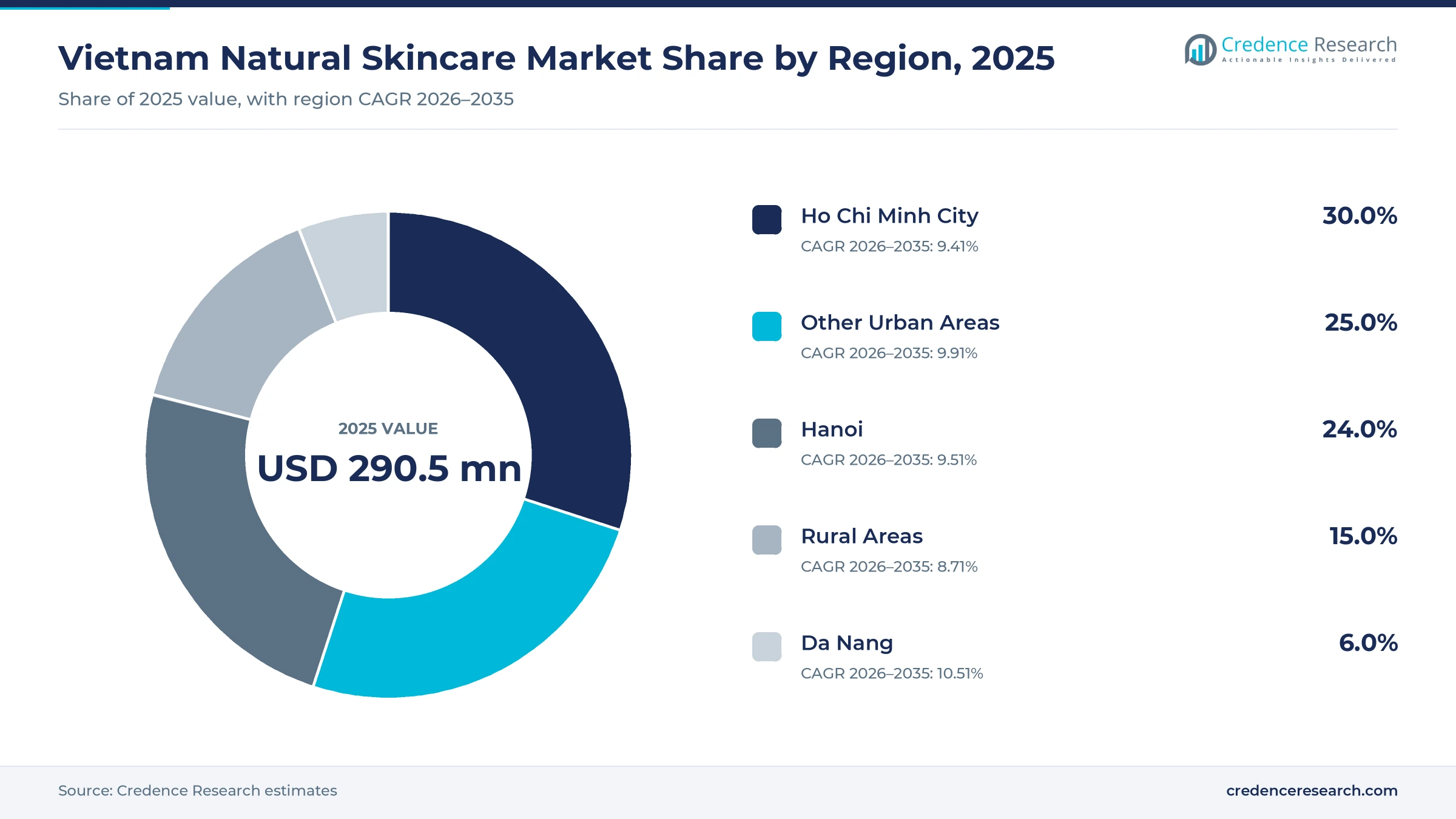
Ho Chi Minh City leads as Da Nang grows fastest
| Region | Value, 2025 (USD million) | Share, 2025 | CAGR, 2026–2035 |
|---|---|---|---|
| Ho Chi Minh City | 87.2 | 30.0% | 9.41% |
| Other Urban Areas | 72.6 | 25.0% | 9.91% |
| Hanoi | 69.7 | 24.0% | 9.51% |
| Rural Areas | 43.6 | 15.0% | 8.71% |
| Da Nang | 17.4 | 6.0% | 10.51% |
What makes the southern hub the largest buyer base?
Ho Chi Minh City held a 30.0% share of 2025 value and grows at 9.41% a year, because its merger with Binh Duong and Ba Ria-Vung Tau created the country's most populous locality. Monthly income per capita reached VND 8.064 million in 2025, the second highest in the country. As a result, the city concentrates brand flagships, specialty chains and importers, and office workers there buy botanical serums, cleansers and sunscreen through malls and marketplaces.
How does the capital support premium botanical demand?
Hanoi held a 24.0% share of 2025 value and grows at 9.51% a year, because the capital recorded the highest monthly income per capita in the country at VND 8.374 million in 2025. The city has more than 8.8 million residents across about 3,360 square kilometers. In turn, Hanoi supports premium imported lines and local herbal brands, and Skinlosophy runs a showroom in the Dong Da district for buyers who want advice before they purchase.
Why is the central coast city expanding fastest?
Da Nang held a 6.0% share of 2025 value and grows fastest at 10.51% a year, because the city formed on July 1, 2025 added parts of Quang Nam. Its GRDP per capita of about USD 4,287 leaves room for higher spending as tourism and services expand. As a result, specialty chains and brand counters are adding stores in Da Nang to reach both residents and visitors who buy sunscreen and facial care.
What role do provincial cities play?
Other Urban Areas accounted for 25.0% of 2025 value and grow at 9.91% a year, because provincial cities such as Haiphong, Dong Nai and Quang Ninh now report monthly income per capita above VND 6.9 million. Co Mem planned to reach 80 stores on provincial demand, and Hasaki was projected to reach 304 stores in 2026. As a result, specialty chains and delivery networks are bringing natural facial and body care into cities that once relied on traditional markets.
How do village and small-town buyers purchase?
Rural Areas accounted for 15.0% of 2025 value and grow at 8.71% a year, because rural income per capita was almost VND 5.2 million a month in 2025 and buyers favor lower-priced mass products. However, rural income rose 14.5% in 2025, faster than urban income, and internet use keeps widening. In turn, small pack sizes, marketplace delivery and pharmacy distribution are the main routes for natural products in these areas.
Regulatory, retail and brand milestones, 2025 to 2026
| Development | Status and market relevance |
|---|---|
| In May 2025, the Drug Administration of Vietnam told provincial health departments to tighten action on counterfeit cosmetics and to increase SPF verification of sunscreens. | Raises compliance pressure on sun protection claims |
| In July 2025, the Ministry of Health issued Circular 34/2025/TT-BYT, adding online cosmetic notification from Aug. 18, 2025. | Shortens filing for new natural product launches |
| In December 2025, the government issued Decree 342/2025/ND-CP, which took effect on Feb. 15, 2026 and ended advertising pre-approval for cosmetics. | Moves claim enforcement to post-market checks |
| In April 2026, Cocoon opened a pop-up in Paris to start its European expansion with Vietnamese botanical ingredients. | Signals export credibility for local natural brands |
| In July 2026, the Law on E-commerce took effect, requiring verification before livestream selling and affiliate marketing. | Brings online beauty sellers under clearer duties |
Extraction, UV filters and digital filing shape products
- Botanical extraction and stabilization turns coffee, lotus, pomelo and turmeric into extracts with consistent active content, which lets local brands keep texture, scent and color stable in a hot, humid climate.
- Mineral UV filters and SPF testing combine zinc oxide or titanium dioxide with plant oils, and verified SPF tests now matter more because health departments can revoke notifications for noncompliant claims.
- Online notification filing through the National Public Service Portal accepts electronic signatures from August 2025, which cuts paperwork for brands that launch several seasonal products each year.
- Livestream and marketplace tools connect creator videos, official brand stores and mobile payment in one flow, which explains why official stores generated 64% of online beauty revenue in 2025.
Need a Custom Version of This Report?
Tailor the scope, geography, or segments to your exact requirements.
- Custom geography or segment scope
- Direct access to our analyst team
Local botanical brands compete with imported labels
Competition combines local botanical brands, imported natural labels and global groups with premium lines. Cocoon, which entered the market in 2018, competes with vegan formulas built on regional Vietnamese ingredients and now sells in Europe. Skinlosophy competes with herbal recipes drawn from traditional medicine and a Hanoi showroom. Innisfree, present since 2006, and The Body Shop, present since 2009, compete through mall stores and marketplace flagships. L'Oreal, established in Vietnam in 2007, distributes Kiehl's among its luxury brands. Rivals compete on ingredient story, price per milliliter, creator reach and store presence in specialty chains such as Hasaki and Guardian. Because regulators now enforce claims after publication, brands with clean dossiers and verified SPF data hold an advantage over small online sellers that rely on unsupported herbal promises.
Which companies lead natural skin care sales in Vietnam?
| Company | Type | Role in the market |
|---|---|---|
| Cocoon Vietnam | Local vegan brand | Entered in 2018, uses Dak Lak coffee and Hau Giang lotus, Paris pop-up in April 2026 |
| Skinlosophy Vietnam | Local herbal brand | Founded in 2013, over 30 products based on traditional recipes |
| Innisfree Vietnam | Imported botanical brand | Present since 2006 with mall stores and online flagships |
| The Body Shop Vietnam | Imported natural brand | Present since 2009, about 29 stores in 2026 |
| Kiehl's Vietnam | Premium imported brand | Distributed by L'Oreal Vietnam among its luxury brands |
Credence Research view on botanical beauty demand
Credence Research's view is that the Vietnam natural skincare market will keep growing faster than total beauty spending, because younger buyers prefer botanical formulas and buy them through marketplaces and specialty chains. Facial care remains the largest value pool, while sun protection, mineral-based formulas and Gen Z buyers add the fastest growth. Post-market enforcement of claims favors brands with clean dossiers and tested SPF values. Companies that pair local ingredient stories with official online stores and affordable trial sizes should gain the most share.
How the national estimate for botanical care was built
The report uses 2025 as the base year on a calendar basis, and market values come from the Credence Research model. That model combines income and population statistics, e-commerce and retail data, trade data and regulatory filings. Segment splits and regional shares and growth rates are Credence Research estimates, with regional shares based on General Statistics Office population and income data by city. Sources used are official statistics, government decrees and ministry guidance, trade agency reports, news reports and company information, and no interviews or surveys were used.
E-commerce and sun care carry growth to 2035
The Vietnam natural skincare market is expected to reach USD 737.2 million by 2035, a 9.53% CAGR during 2026–2035, as urban buyers add botanical cleansers, serums and sunscreen to daily routines. Growth should be strongest in e-commerce, sun protection, Gen Z consumers and Da Nang, because these areas gain the most from mobile commerce, stricter SPF checks and new city markets. Post-market claim enforcement and verified livestream selling will support trusted brands, while counterfeits, price sensitivity and compliance costs could slow smaller sellers.
Frequently Asked Questions
How big is the Vietnam natural skincare market?
Which product type leads the market?
Which region leads natural skin care demand in Vietnam?
Which channel is growing fastest?
How did Decree 342/2025 change cosmetic advertising?
Which ingredient source dominates natural skin care?
Who are the leading companies in the Vietnam natural skincare market?
What are the main challenges for natural skin care brands?
Table of Content
Chapter 1 Market Segmentation
- 1.1 Segmentation Framework
- 1.1.1 Product and Service Classification
- 1.1.2 Application and End-Use Classification
- 1.1.3 Technology and Solution Classification
- 1.1.4 Customer and Distribution Channel Classification
- 1.1.5 Geographic Segmentation
- 1.1.6 Market Segment Definitions and Boundaries
- 1.2 By Product Type
- 1.2.1 Facial Care Products
- 1.2.2 Body Care Products
- 1.2.3 Hair Care Products
- 1.2.4 Sun Protection Products
- 1.3 By Ingredient Source
- 1.3.1 Plant-Based Ingredients
- 1.3.2 Mineral-Based Ingredients
- 1.3.3 Animal-Derived Ingredients
- 1.4 By Consumer Group
- 1.4.1 Millennial Consumers
- 1.4.2 Gen Z Consumers
- 1.4.3 High-Income Households
- 1.4.4 Middle-Income Households
Chapter 2 Introduction
- 2.1 Report Objectives and Scope
- 2.2 Product Definition and Industry Terminology
- 2.3 Market Inclusions and Exclusions
- 2.4 Research Process
- 2.4.1 Primary Research and Expert Interviews
- 2.4.2 Secondary Research and Source Review
- 2.4.3 Top-Down and Bottom-Up Estimation
- 2.4.4 Data Triangulation and Verification
- 2.5 Market Size Measurement Basis
- 2.5.1 2025: USD 290.5 million → 2035: USD 737.2 million
- 2.6 Historical and Forecast Reference Periods
- 2.6.1 Historical Period: 2018-2025
- 2.6.2 Base Year: 2025
- 2.6.3 Forecast Period: 2025-2035
- 2.7 Research Assumptions and Limitations
Chapter 3 Executive Summary
- 3.1 Market Snapshot and Key Findings
- 3.2 Base-Year Market Size, 2025
- 3.3 Forecast Market Size, 2035
- 3.4 Revenue and Volume Growth Outlook
- 3.5 Key Demand and Supply Indicators
- 3.6 Leading Market Segments
- 3.7 Fastest-Growing Market Opportunities
- 3.8 Regional Performance Highlights
- 3.9 Technology and Industry Transformation
- 3.10 Competitive Landscape Summary
- 3.11 Analyst View and Strategic Implications
Chapter 4 Vietnam Natural Skincare Market Trends and Developments
- 4.1 Historical Industry Development, 2018-2025
- 4.2 Recent Market Trends and Developments
- 4.3 Demand and Customer Behavior Trends
- 4.4 Technology and Product Innovation
- 4.5 Artificial Intelligence, Automation and Digitalization
- 4.6 Local Manufacturing and Supply Chain Realignment
- 4.7 Industry Partnerships, Mergers and Acquisitions
- 4.8 Sustainability and Circular Economy Developments
- 4.9 Government and Private Sector Investment Trends
- 4.10 Emerging Business Models and Commercialization
- 4.11 Industry Developments and Announcements
Chapter 5 Vietnam Natural Skincare Market Production, Supply and Demand Analysis
- 5.1 Demand Trend and Consumption Analysis, 2018-2025
- 5.2 Demand Forecast, 2025-2035
- 5.3 Production and Output Trend, 2018-2025
- 5.4 Production and Output Forecast, 2025-2035
- 5.5 Installed Capacity and Capacity Utilization
- 5.6 Company-Wise Production Plants and Statistics
- 5.6.1 Installed Production Capacity
- 5.6.2 Actual Production
- 5.6.3 Planned Capacity and Expansion Targets
- 5.7 Supply Chain Structure and Procurement Trends
- 5.8 Supply-Demand Gap and Bottlenecks
- 5.9 Import Dependence and Sourcing Structure
- 5.10 Contract Manufacturing and Outsourcing
- 5.11 Regional Supply and Demand Concentration
Chapter 6 Vietnam Natural Skincare Market Pricing Analysis
- 6.1 Pricing Structure and Measurement
- 6.2 Historical Pricing Trends, 2018-2025
- 6.3 Pricing Outlook, 2025-2035
- 6.4 Average Selling Price and Unit Economics
- 6.5 Pricing by Product and Market Segment
- 6.6 Geographic Pricing Differences
- 6.7 Key Input, Energy, Labor and Logistics Costs
- 6.8 Contract Pricing and Purchasing Models
- 6.9 Pricing Sensitivity and Competitive Positioning
- 6.10 Price, Margin and Profitability Implications
Chapter 7 Vietnam Natural Skincare Market Dynamics
- 7.1 Market Growth Drivers
- 7.1.1 Demand-Side Drivers
- 7.1.2 Technology and Innovation Drivers
- 7.1.3 Infrastructure and Investment Drivers
- 7.1.4 Regulatory and Policy Drivers
- 7.2 Market Restraints
- 7.2.1 Cost and Affordability Constraints
- 7.2.2 Technology and Adoption Barriers
- 7.2.3 Supply Chain and Operational Constraints
- 7.3 Market Challenges
- 7.3.1 Competitive Pressure and Margin Erosion
- 7.3.2 Skills, Infrastructure and Implementation Gaps
- 7.4 Emerging Market Opportunities
- 7.5 Market Dynamics Impact and Time-Horizon Assessment
Chapter 8 Vietnam Natural Skincare Value Chain Analysis
- 8.1 Industry Value Chain Overview
- 8.2 Upstream Suppliers and Critical Inputs
- 8.3 Technology and Component Providers
- 8.4 Manufacturing or Service Delivery
- 8.5 Distribution, Channel Partners and Integrators
- 8.6 Downstream Applications and End Users
- 8.7 Value Addition and Profit Pools
- 8.8 Vertical Integration and Outsourcing
- 8.9 Supplier Concentration and Risk
- 8.10 Supply Chain Localization and Resilience
Chapter 9 Vietnam Natural Skincare Market Regulations and Policies
- 9.1 Relevant Laws, Standards and Compliance Frameworks
- 9.2 Product, Service, Safety and Quality Requirements
- 9.3 Government Policies, Incentives and Subsidies
- 9.4 Imports, Exports and Trade Barriers
- 9.5 Public Procurement and Local Content Requirements
- 9.6 Environmental and Sustainability Compliance
- 9.7 Upcoming Policy Changes and Market Implications
Chapter 10 Vietnam Natural Skincare Market Hotspots and Opportunities
- 10.1 Market Opportunity Mapping and Growth Hotspots
- 10.2 High-Growth Applications and Customer Groups
- 10.3 Underserved Markets and White-Space Opportunities
- 10.4 Emerging Technology and Product Opportunities
- 10.5 New Capacity and Investment Hotspots
- 10.6 Market Entry and Expansion Opportunities
- 10.7 Distribution and Partnership Opportunities
- 10.8 Near-Term and Long-Term Commercial Potential
- 10.9 Opportunity Attractiveness and Execution Risks
Chapter 11 Vietnam Natural Skincare Market Outlook, 2025-2035
- 11.1 Market Size and Analysis
- 11.1.1 Revenue (Market Measurement: 2025: USD 290.5 million → 2035: USD 737.2 million)
- 11.1.2 Market Volume and Quantity Sold
- 11.1.3 Historical Market Size, 2018-2025
- 11.1.4 Base-Year Market Size, 2025
- 11.2 Market Forecast, 2025-2035
- 11.2.1 Revenue Forecast to 2035
- 11.2.2 Volume Forecast to 2035
- 11.2.3 CAGR and Year-on-Year Growth
- 11.2.4 Incremental Revenue Opportunity
- 11.3 Forecast Assumptions and Scenario Analysis
- 11.3.1 Base-Case Forecast
- 11.3.2 Optimistic and Conservative Scenarios
- 11.3.3 Technology, Pricing and Policy Sensitivities
- 11.4 Market Attractiveness and Growth Outlook
Chapter 12 Vietnam Natural Skincare Market Segmentation and Outlook
- 12.1 Segmentation Summary and Market Shares, 2025
- 12.2 Largest and Fastest-Growing Segments
- 12.3 By Product Type - Market Size and Forecast, 2025-2035
- 12.3.1 Segment Definition and Scope
- 12.3.2 Historical Market Size, 2018-2025
- 12.3.3 Revenue Forecast, 2025-2035
- 12.3.4 Volume Forecast, 2025-2035
- 12.3.5 Base-Year Market Share, 2025
- 12.3.6 Segment CAGR and Growth Drivers
- 12.3.7 Subsegment Market Size and Forecast
- 12.3.7.1 Facial Care Products
- 12.3.7.2 Body Care Products
- 12.3.7.3 Hair Care Products
- 12.3.7.4 Sun Protection Products
- 12.3.8 Subsegment Pricing and Adoption Trends
- 12.3.9 Leading Suppliers and Competition
- 12.3.10 Regional Demand and Opportunities
- 12.4 By Ingredient Source - Market Size and Forecast, 2025-2035
- 12.4.1 Segment Definition and Scope
- 12.4.2 Historical Market Size, 2018-2025
- 12.4.3 Revenue Forecast, 2025-2035
- 12.4.4 Volume Forecast, 2025-2035
- 12.4.5 Base-Year Market Share, 2025
- 12.4.6 Segment CAGR and Growth Drivers
- 12.4.7 Subsegment Market Size and Forecast
- 12.4.7.1 Plant-Based Ingredients
- 12.4.7.2 Mineral-Based Ingredients
- 12.4.7.3 Animal-Derived Ingredients
- 12.4.8 Subsegment Pricing and Adoption Trends
- 12.4.9 Leading Suppliers and Competition
- 12.4.10 Regional Demand and Opportunities
- 12.5 By Consumer Group - Market Size and Forecast, 2025-2035
- 12.5.1 Segment Definition and Scope
- 12.5.2 Historical Market Size, 2018-2025
- 12.5.3 Revenue Forecast, 2025-2035
- 12.5.4 Volume Forecast, 2025-2035
- 12.5.5 Base-Year Market Share, 2025
- 12.5.6 Segment CAGR and Growth Drivers
- 12.5.7 Subsegment Market Size and Forecast
- 12.5.7.1 Millennial Consumers
- 12.5.7.2 Gen Z Consumers
- 12.5.7.3 High-Income Households
- 12.5.7.4 Middle-Income Households
- 12.5.8 Subsegment Pricing and Adoption Trends
- 12.5.9 Leading Suppliers and Competition
- 12.5.10 Regional Demand and Opportunities
- 12.6 Segment Growth Comparison
- 12.7 Segment Attractiveness and Priority Matrix
Chapter 13 Vietnam Natural Skincare Geographic Market Outlook, 2025-2035
- 13.1 Domestic Market Distribution and Demand Clusters
- 13.2 State- or Province-Wise Market Size and Forecast, 2025-2035
- 13.3 City and Metropolitan Market Outlook
- 13.4 Industrial, Manufacturing and Commercial Clusters
- 13.5 Geographic Concentration of Key End Users
- 13.6 Local Pricing and Purchasing Differences
- 13.7 Domestic Production Facilities and Capacity Map
- 13.8 Local Infrastructure and Project Pipeline
- 13.9 State-Level Policy and Incentive Differences
- 13.10 Subnational Investment Hotspots and Opportunities
- 13.11 Distribution and Logistics Networks
- 13.12 Domestic Competitive Footprint
Chapter 14 Vietnam Natural Skincare Technology, Innovation and Sustainability Outlook
- 14.1 Technology Landscape and Maturity
- 14.2 Product, Process and Service Innovation
- 14.3 AI, Automation and Digital Tools in the Industry
- 14.4 Technology Adoption and Performance Benchmarking
- 14.5 Innovation Pipeline and R&D Investment
- 14.6 Patent and Intellectual Property Trends
- 14.7 Energy Efficiency and Resource Management
- 14.8 Sustainability, Recycling and Circularity
- 14.9 Technology Roadmap, 2025-2035
- 14.10 Risks of Obsolescence and Technology Substitution
Chapter 15 Vietnam Natural Skincare Market Key Strategic Imperatives
- 15.1 Growth and Market Entry Priorities
- 15.2 High-Return Products and Segments
- 15.3 Pricing, Profitability and Cost Optimization
- 15.4 Technology Investment and Product Differentiation
- 15.5 Supply Chain Localization and Resilience
- 15.6 Distribution and Customer Acquisition
- 15.7 Partnership, Acquisition and Capacity Strategy
- 15.8 Regional Expansion Priorities
- 15.9 Short-, Medium- and Long-Term Actions
Chapter 16 Competition Outlook
- 16.1 Industry Competition Characteristics
- 16.2 Market Structure and Concentration
- 16.3 Market Share and Competitive Positioning, 2025
- 16.4 Company-Wise Revenue and Product Benchmarking
- 16.5 Production and Service Capacity Benchmarking
- 16.6 Technology, Pricing and Differentiation
- 16.7 Regional Footprint and Distribution Strength
- 16.8 Mergers, Acquisitions and Strategic Alliances
- 16.9 New Entrants and Competitive Threats
- 16.10 Porter's Five Forces and Industry Attractiveness
- 16.11 Competitive Outlook, 2025-2035
Chapter 17 Company Profiles
- 17.1 Company Coverage and Selection Criteria
- 17.2 Cocoon Vietnam
- 17.2.1 Business Description
- 17.2.2 Company Ownership and Geographic Presence
- 17.2.3 Product and Service Portfolio
- 17.2.4 Manufacturing and Operating Footprint
- 17.2.5 Production Capacity and Expansion Plans
- 17.2.6 Financial Performance and Investment
- 17.2.7 Market Share and Competitive Position
- 17.2.8 Technology and Innovation Capabilities
- 17.2.9 Strategic Alliances or Partnerships
- 17.2.10 Recent Developments
- 17.2.11 Growth Strategy and Outlook
- 17.3 Skinlosophy Vietnam
- 17.4 The Body Shop Vietnam
- 17.5 Innisfree Vietnam
- 17.6 L'Occitane Vietnam
- 17.7 Bioessence Vietnam
- 17.8 Botaneco Garden
- 17.9 Kiehl's Vietnam
- 17.10 La Jolie Cosmetic
- 17.11 Senka Vietnam
- 17.12 Other Relevant Market Participants
Note: Every listed company is profiled on the structure shown under the first company. The company list is preliminary and may change based on research findings, market developments, data availability and client requirements.
Chapter 18 Disclaimer
- 18.1 Research and Forecast Disclaimer
- 18.2 Data Source and Estimation Limitations
Note: The depth of individual sections depends on data availability for this market. Volume, capacity, trade and other unit-based metrics are included where applicable.

