
Market Overview:
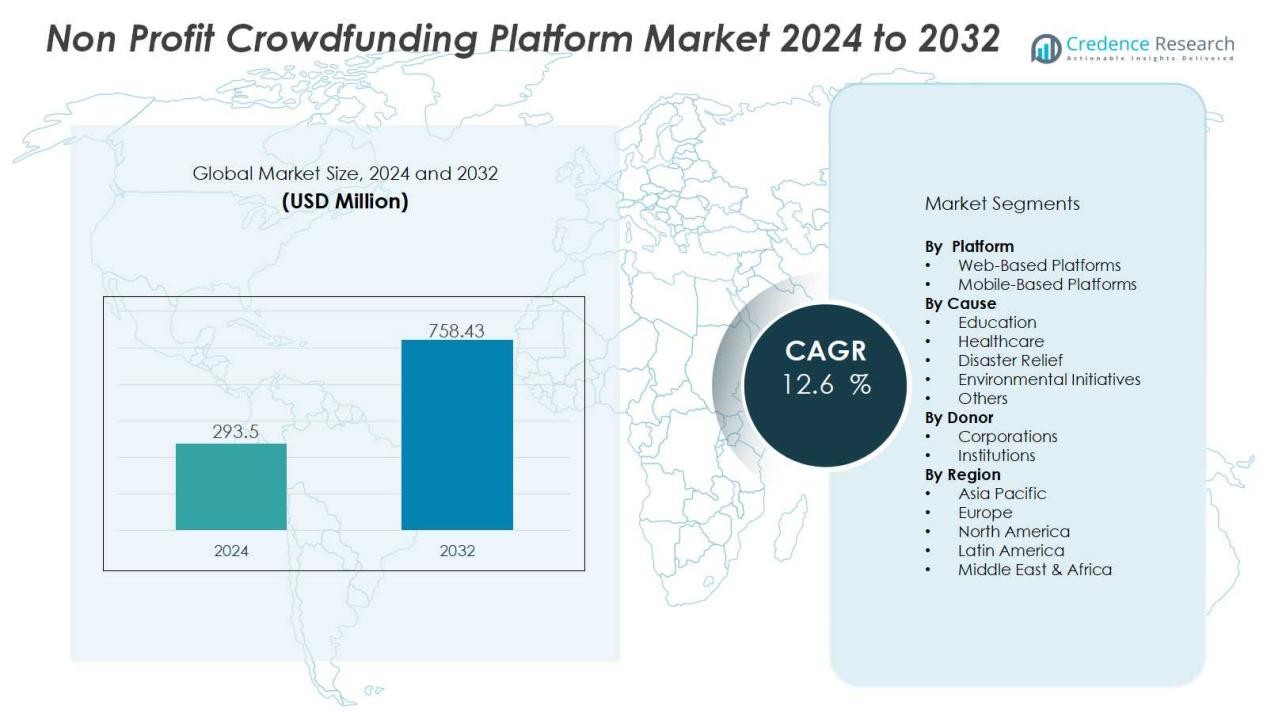
The non profit crowdfunding platform market size was valued at USD 293.5 million in 2024 and is anticipated to reach USD 758.43 million by 2032, at a CAGR of 12.6% during the forecast period.
| REPORT ATTRIBUTE | DETAILS |
|---|---|
| Historical Period | 2020-2023 |
| Base Year | 2024 |
| Forecast Period | 2025-2032 |
| Non Profit Crowdfunding Platform Market Size 2024 | USD 293.5 Million |
| Non Profit Crowdfunding Platform Market, CAGR | 12.6% |
| Non Profit Crowdfunding Platform Market Size 2032 | USD 758.43 Million |
Key market drivers include the growing reliance of non-profits on digital platforms to raise funds efficiently and reach global audiences. Social media integration, mobile payment adoption, and real-time campaign tracking enhance visibility and trust among donors. Additionally, rising philanthropic activity, coupled with the need for low-cost fundraising alternatives compared to traditional methods, further accelerates demand. Platforms offering secure transactions, easy campaign setup, and data-driven donor engagement tools are gaining strong traction across the sector.
Regionally, North America leads the non-profit crowdfunding platform market due to advanced digital infrastructure, high internet penetration, and an active culture of charitable giving. Europe follows closely, supported by government-backed initiatives promoting online donations and increasing cross-border philanthropy. Asia Pacific is expected to witness the fastest growth, fueled by expanding internet access, smartphone adoption, and rising awareness of digital donation channels in countries such as India and China. Latin America and the Middle East & Africa are emerging markets, supported by improving digital ecosystems and growing non-profit activities.
Market Insights:
- The non profit crowdfunding platform market was valued at USD 293.5 million in 2024 and is expected to reach USD 758.43 million by 2032 at a CAGR of 12.6%.
- Digital transformation is a major driver, with mobile payments, online banking, and secure wallets supporting growth.
- Non-profits adopt these platforms due to their cost-effective structures and transparent fundraising processes.
- Philanthropic activity is rising, with individuals, corporations, and institutions contributing strongly to global causes.
- Emerging economies such as India, China, and Brazil are fueling adoption through internet expansion and government-backed digital initiatives.
- Regulatory challenges, fraud risks, and donor trust issues remain barriers that require strict compliance and secure systems.
- North America led with 38% market share in 2024, followed by Europe at 28%, supported by advanced infrastructure.
- Asia Pacific, holding 22% share in 2024, is projected to grow fastest, while Latin America and Middle East & Africa show untapped long-term potential.
Market Drivers:
Growing Digital Transformation in Fundraising:
The non profit crowdfunding platform market is driven by the widespread digitalization of fundraising activities. It is supported by the rise of mobile payments, online banking, and secure digital wallets. Organizations are shifting from traditional fundraising methods to online platforms for greater reach and efficiency. Social media integration further enhances campaign visibility and donor interaction. This transformation strengthens donor trust and accelerates campaign success.
- For Instance, Non-GMO Project continued its mission through various initiatives, including a campaign around Earth Day and Non-GMO Month, to raise public awareness and drive engagement. While the organization employs a digital lead generation strategy utilizing social media and online platforms, the specific figure of '3,000 new leads' from its Earth Day campaign.
Rising Demand for Low-Cost and Transparent Fundraising:
Non-profits increasingly prefer crowdfunding platforms due to their cost-effective structure and transparency. It allows organizations to avoid the high expenses linked with physical events and traditional campaigns. Donors value clear reporting, real-time progress updates, and visible impact. Transparent processes foster stronger relationships between non-profits and contributors. This driver continues to encourage widespread adoption across diverse regions.
- For Instance, Transparent Hands Foundation uses a 100% transparency model where donors receive hospital bills and treatment updates. The organization has funded over 20,000 surgeries and treated over 264,000 patients through surgeries, medical procedures, and medical camps since its inception in 2014.
Increasing Philanthropic Activities and Social Awareness:
The market is also supported by rising global interest in philanthropy and social responsibility. It benefits from individual donors, corporations, and institutions contributing to causes such as healthcare, education, and disaster relief. Younger demographics influenced by social awareness campaigns are highly active online contributors. Corporate social responsibility programs further boost participation through structured giving initiatives. Growing awareness of global issues directly fuels digital donation activities.
Expansion of Emerging Economies and Internet Penetration:
The non profit crowdfunding platform market is expanding rapidly in emerging regions due to improved internet infrastructure. It gains momentum from rising smartphone adoption and financial inclusion programs. Countries such as India, China, and Brazil are key growth centers with supportive government policies for digital payments. Localized platforms with multilingual and region-specific features attract diverse donor bases. The expansion of these economies ensures long-term growth for digital fundraising platforms.
Market Trends:
Rising Digital Transformation and Donor Engagement Innovations:
The non profit crowdfunding platform market is witnessing rapid transformation through advanced digital tools and engagement features. It is adopting mobile-first solutions that enable seamless campaign creation and donations through smartphones. Integration of artificial intelligence and analytics is enhancing donor insights, allowing organizations to tailor appeals and improve campaign effectiveness. Social media connectivity is strengthening visibility, enabling real-time sharing and expanding campaign reach globally. Blockchain-based solutions are gaining attention for transparent donation tracking and enhanced trust among contributors. Personalized donor experiences, such as automated acknowledgments and progress updates, are improving retention and loyalty. This trend is reshaping fundraising strategies by emphasizing speed, transparency, and global accessibility.
- For instance, Giveth, a real blockchain-based platform for public goods funding, has facilitated over $2 million in donations for social impact projects since its inception, providing a transparent and community-driven ecosystem
Growing Focus on Niche Platforms and Regional Expansion:
The market is shifting toward niche-focused platforms that cater to specific causes, such as disaster relief, education, or healthcare. It is encouraging specialized solutions that provide higher campaign success rates for targeted audiences. Regional platforms are emerging strongly in Asia Pacific and Latin America, supported by growing smartphone penetration and rising awareness of digital donations. Partnerships between crowdfunding platforms and financial service providers are improving payment security and donor confidence. Integration with local payment methods, including mobile wallets and regional gateways, is boosting adoption in developing markets. Non-profits are prioritizing platforms with multilingual support and region-specific compliance features to broaden participation. This trend reflects the market’s evolution toward localized, cause-specific solutions that complement global platforms.
- For Instance, Alibaba’s Alipay (formerly Ant Financial) and Tencent’s WeChat Pay have revolutionized digital payments in China, dominating the mobile payments market with over a billion active users across their platforms.
Market Challenges Analysis:
Regulatory Compliance and Trust-Related Barriers:
The non profit crowdfunding platform market faces significant challenges due to varying regulations across regions. It must comply with strict financial reporting standards, anti-money laundering policies, and data protection laws. Non-compliance risks can reduce donor confidence and limit platform adoption. Fraudulent campaigns and misuse of funds also create skepticism, pressuring platforms to strengthen verification and transparency mechanisms. Building trust requires consistent monitoring, secure payment systems, and clear accountability practices. The lack of standardized global regulations makes scaling operations across borders difficult for many platforms.
Competition, Costs, and Donor Fatigue:
The market also struggles with high competition from established fundraising platforms and traditional donation channels. It requires continuous investment in technology, security, and user experience, which increases operational costs for smaller providers. Donor fatigue presents another concern, with individuals receiving multiple appeals that reduce willingness to contribute. Non-profits often struggle to differentiate campaigns in crowded digital spaces, limiting overall visibility. Limited digital literacy in developing regions further restricts adoption among smaller charities. Economic downturns also reduce disposable income, directly affecting donation volumes. This combination of competitive and financial pressures challenges sustained growth and scalability.
Market Opportunities:
Expansion Through Technology Integration and Global Reach:
The non profit crowdfunding platform market presents strong opportunities through advanced technology adoption and international expansion. It can leverage artificial intelligence and big data to provide predictive donor insights and optimize campaign performance. Integration of blockchain can further improve transparency, boosting donor confidence. Mobile-first solutions and social media connectivity enable wider global reach, making campaigns accessible to larger audiences. Partnerships with payment providers and fintech companies can enhance transaction security and efficiency. Offering tailored dashboards and multilingual support will help platforms penetrate diverse regions and donor bases. These advancements position crowdfunding platforms as central tools for modern philanthropy.
Growing Demand for Cause-Specific and Community-Centric Platforms:
The market is experiencing rising opportunities from specialized platforms designed for targeted causes such as education, healthcare, and disaster relief. It enables organizations to build strong emotional connections with niche donor groups. Localized platforms in Asia Pacific, Africa, and Latin America are gaining traction as internet and smartphone adoption grows. Community-driven campaigns supported by influencers and local networks further expand reach and credibility. Partnerships with corporations under corporate social responsibility programs offer additional fundraising avenues. Non-profits can also benefit from subscription-based donor models that provide recurring contributions. This shift creates long-term growth prospects by aligning campaigns with social impact priorities.
Market Segmentation Analysis:
By Platform:
The non profit crowdfunding platform market is segmented into web-based and mobile-based platforms. It is witnessing strong demand for mobile platforms due to rising smartphone adoption and ease of access. Web-based platforms remain significant, offering detailed campaign management and broad donor reach. Mobile applications provide faster transactions, push notifications, and personalized donor experiences. Integration of social media and payment gateways further enhances mobile platform growth. The trend indicates a shift toward mobile-first fundraising strategies across regions.
By Cause:
The market is segmented by cause into education, healthcare, disaster relief, environmental initiatives, and others. It is seeing healthcare and disaster relief campaigns gain strong traction due to urgent donor response needs. Education-focused campaigns also play a vital role, supported by global emphasis on literacy and skill development. Environmental campaigns are expanding as sustainability and climate change issues attract rising attention. Platforms targeting multiple causes gain wider appeal by accommodating diverse donor interests. Specialized cause-based platforms are expected to improve donor trust and campaign success rates.
- For instance, environmental platform Cool Effect reported offsetting over 7.6 million metric tons of CO2 through triple-verified projects between 2020 and 2024.
By Donor:
The donor segment includes individuals, corporations, and institutions. It is driven largely by individual donors, who form the backbone of online crowdfunding campaigns. Corporations are expanding contributions under CSR initiatives, providing stable fundraising opportunities. Institutions such as foundations and trusts are leveraging platforms for transparent and measurable impact. Younger donors, influenced by social media, are playing a growing role in shaping digital philanthropy. The combination of individual passion and corporate responsibility is strengthening market momentum.
- For instance, Crowdfunder Connect facilitated the distribution of £8 million of partner funding in 2024, matched by the crowd to achieve a total community impact of over £15 million, supporting 1,218 successful projects across the UK.
Segmentations:
By Platform:
- Web-Based Platforms
- Mobile-Based Platforms
By Cause:
- Education
- Healthcare
- Disaster Relief
- Environmental Initiatives
- Others
By Donor:
- Corporations
- Institutions
By Region:
- North America
- U.S.
- Canada
- Mexico
- Europe
- Germany
- France
- U.K.
- Italy
- Spain
- Rest of Europe
- Asia Pacific
- China
- Japan
- India
- South Korea
- South-east Asia
- Rest of Asia Pacific
- Latin America
- Brazil
- Argentina
- Rest of Latin America
- Middle East & Africa
- GCC Countries
- South Africa
- Rest of the Middle East and Africa
Regional Analysis:
North America and Europe:
North America held 38% market share in 2024, making it the leading region in the non profit crowdfunding platform market. Europe followed with 28% market share, driven by high digital penetration and supportive regulatory frameworks. It benefits from strong philanthropic cultures, government incentives, and integration of advanced financial technologies. The U.S. dominates North America with well-established platforms and a robust culture of charitable giving. In Europe, the UK and Germany are major contributors due to strong non-profit ecosystems. Widespread use of mobile payments and integration with social media platforms further enhance adoption. The region continues to drive innovation, setting global benchmarks for digital fundraising.
Asia Pacific:
Asia Pacific accounted for 22% market share in 2024, with projections showing the fastest growth during the forecast period. It is fueled by rising internet penetration, smartphone adoption, and growing awareness of digital donations. Countries such as India, China, and Indonesia are key contributors with expanding middle-class populations and strong digital ecosystems. Government initiatives to promote financial inclusion and cashless transactions strengthen the environment for crowdfunding adoption. Social media platforms and influencer-driven campaigns are also enhancing donor engagement across the region. Expanding local platforms tailored for community-based causes further boosts participation. Asia Pacific is set to emerge as a dominant hub for future expansion.
Latin America and Middle East & Africa:
Latin America held 7% market share in 2024, supported by increasing adoption of mobile payments and social media fundraising. The Middle East & Africa accounted for 5% market share, driven by expanding digital ecosystems and charitable traditions. It is supported by growing non-profit activities, particularly in education and healthcare. Brazil and Mexico lead adoption in Latin America, while the UAE and South Africa play central roles in their regions. Regulatory support for digital transactions further accelerates growth in these markets. The rise of community-focused campaigns highlights the potential for rapid expansion. These regions represent untapped opportunities with significant long-term potential.
Key Player Analysis:
- Kickstarter, PBC
- GoFundMe
- Fundable
- Indiegogo, Inc.
- Crowdcube
- Fundly
- RealCrowd
- Wefunder
- SeedInvest Technology, LLC
- RM Technologies LLC.
Competitive Analysis:
The non profit crowdfunding platform market is highly competitive, with global and regional players focusing on innovation, trust, and donor engagement. Leading companies include Kickstarter PBC, GoFundMe, Fundable, Indiegogo Inc., Crowdcube, and Fundly, each offering distinct strengths in campaign reach, user experience, and technology adoption. It is shaped by intense rivalry where platforms emphasize secure payment systems, transparent reporting, and social media integration to attract both non-profits and donors. Companies are investing in AI-driven analytics, blockchain for transparency, and mobile-first solutions to strengthen their market presence. Partnerships with fintech providers and regional payment gateways are also enhancing scalability and accessibility. The market continues to expand through localization strategies, cause-specific platforms, and corporate social responsibility collaborations. It demands constant adaptation, pushing both established players and new entrants to differentiate services and build stronger trust to secure long-term growth.
Recent Developments:
- In July 2025, Indiegogo was acquired by Polish startup Gamefound, combining Indiegogo's 38 million users and $3 billion raised with Gamefound's technology to create an upgraded crowdfunding platform set to launch in October 2025.
- In September 2025, Cairnspring Mills raised $1 million on Wefunder from over 500 investors, showcasing the platform's active role in facilitating significant fundraising campaigns.
Report Coverage:
The research report offers an in-depth analysis based on Platform, Cause, Donor and Region. It details leading Market players, providing an overview of their business, product offerings, investments, revenue streams, and key applications. Additionally, the report includes insights into the competitive environment, SWOT analysis, current Market trends, as well as the primary drivers and constraints. Furthermore, it discusses various factors that have driven Market expansion in recent years. The report also explores Market dynamics, regulatory scenarios, and technological advancements that are shaping the industry. It assesses the impact of external factors and global economic changes on Market growth. Lastly, it provides strategic recommendations for new entrants and established companies to navigate the complexities of the Market.
Future Outlook:
- Digital fundraising platforms will continue to evolve with advanced analytics and AI-driven personalization.
- Blockchain adoption will strengthen transparency in donations and enhance donor trust.
- Mobile-first platforms will dominate as smartphone-based donations gain further traction globally.
- Integration with social media will expand campaign reach and foster real-time donor engagement.
- Cause-specific platforms will rise, focusing on healthcare, education, and disaster relief.
- Partnerships with fintech companies will improve transaction security and broaden payment options.
- Recurring donation models will grow, providing non-profits with stable and predictable funding streams.
- Localized platforms will expand in emerging markets, offering multilingual and region-specific features.
- Corporate collaborations under CSR initiatives will create new fundraising opportunities for non-profits.
- Regulatory alignment across regions will shape cross-border growth and international campaign scalability.

Request a Free Sample
Fill in your details and we'll send you a free sample report.
- Sample data tables & charts
- Research methodology
Market Dynamics
Digital Transformation in Fundraising
Non-profits are increasingly adopting digital platforms for fundraising due to the efficiency, global reach, and integration with mobile payments and social media, which enhance campaign visibility and donor engagement.
Demand for Low-Cost and Transparent Fundraising
Crowdfunding platforms offer non-profits a cost-effective alternative to traditional fundraising, with transparent processes and real-time updates that build donor trust and encourage repeat contributions.
Rising Philanthropic Activity and Social Awareness
Growing global interest in philanthropy, especially among younger, digitally active donors and corporations with CSR initiatives, is fueling the adoption of online crowdfunding for causes like healthcare, education, and disaster relief.
Expansion in Emerging Economies and Internet Penetration
Rapid internet and smartphone adoption in emerging markets such as India, China, and Brazil, combined with supportive government policies for digital payments, are driving strong growth in digital fundraising platforms.
Technological Innovations and Donor Engagement Tools
The integration of AI, analytics, and blockchain is enabling platforms to offer personalized donor experiences, transparent donation tracking, and improved campaign effectiveness, further accelerating market growth.
Need a Custom Version of This Report?
Tailor the scope, geography, or segments to your exact requirements.
- Custom geography or segment scope
- Direct access to our analyst team
Frequently Asked Questions
What is the current market size for the Non Profit Crowdfunding Platform Market, and what is its projected size in 2032?
At what Compound Annual Growth Rate is the Non Profit Crowdfunding Platform Market projected to grow between 2024 and 2032?
Which Non Profit Crowdfunding Platform Market segment held the largest share in 2024?
What are the primary factors fueling the growth of the Non Profit Crowdfunding Platform Market?
Who are the leading companies in the Non Profit Crowdfunding Platform Market?
Which region commanded the largest share of the Non Profit Crowdfunding Platform Market in 2024?
Table of Content
Chapter 1 Market Segmentation
- 1.1 Segmentation Framework
- 1.1.1 Product and Service Classification
- 1.1.2 Application and End-Use Classification
- 1.1.3 Technology and Solution Classification
- 1.1.4 Customer and Distribution Channel Classification
- 1.1.5 Geographic Segmentation
- 1.1.6 Market Segment Definitions and Boundaries
- 1.2 By Cause
- 1.2.1 Education
- 1.2.2 Healthcare
- 1.2.3 Disaster Relief
- 1.2.4 Environmental Initiatives
- 1.2.5 Others
- 1.3 By Donor
- 1.3.1 Individuals
- 1.3.2 Corporations
- 1.3.3 Institutions
- 1.4 By Platform
- 1.4.1 Web-Based Platforms
- 1.4.2 Mobile-Based Platforms
Chapter 2 Introduction
- 2.1 Report Objectives and Scope
- 2.2 Product Definition and Industry Terminology
- 2.3 Market Inclusions and Exclusions
- 2.4 Research Process
- 2.4.1 Primary Research and Expert Interviews
- 2.4.2 Secondary Research and Source Review
- 2.4.3 Top-Down and Bottom-Up Estimation
- 2.4.4 Data Triangulation and Verification
- 2.5 Market Size Measurement Basis
- 2.5.1 2024: USD 293.5 million → 2032: USD 758.43 million
- 2.6 Historical and Forecast Reference Periods
- 2.6.1 Base Year: 2024
- 2.6.2 Forecast Period: 2024-2032
- 2.7 Research Assumptions and Limitations
Chapter 3 Executive Summary
- 3.1 Market Snapshot and Key Findings
- 3.2 Base-Year Market Size, 2024
- 3.3 Forecast Market Size, 2032
- 3.4 Revenue and Volume Growth Outlook
- 3.5 Key Demand and Supply Indicators
- 3.6 Leading Market Segments
- 3.7 Fastest-Growing Market Opportunities
- 3.8 Regional Performance Highlights
- 3.9 Technology and Industry Transformation
- 3.10 Competitive Landscape Summary
- 3.11 Analyst View and Strategic Implications
Chapter 4 Global Non-Profit Crowdfunding Platform Market Trends and Developments
- 4.1 Historical Industry Development
- 4.2 Recent Market Trends and Developments
- 4.3 Demand and Customer Behavior Trends
- 4.4 Technology and Product Innovation
- 4.5 Artificial Intelligence, Automation and Digitalization
- 4.6 Local Manufacturing and Supply Chain Realignment
- 4.7 Industry Partnerships, Mergers and Acquisitions
- 4.8 Sustainability and Circular Economy Developments
- 4.9 Government and Private Sector Investment Trends
- 4.10 Emerging Business Models and Commercialization
- 4.11 Industry Developments and Announcements
Chapter 5 Global Non-Profit Crowdfunding Platform Market Production, Supply and Demand Analysis
- 5.1 Demand Trend and Consumption Analysis
- 5.2 Demand Forecast, 2024-2032
- 5.3 Production and Output Trend
- 5.4 Production and Output Forecast, 2024-2032
- 5.5 Installed Capacity and Capacity Utilization
- 5.6 Company-Wise Production Plants and Statistics
- 5.6.1 Installed Production Capacity
- 5.6.2 Actual Production
- 5.6.3 Planned Capacity and Expansion Targets
- 5.7 Supply Chain Structure and Procurement Trends
- 5.8 Supply-Demand Gap and Bottlenecks
- 5.9 Import Dependence and Sourcing Structure
- 5.10 Contract Manufacturing and Outsourcing
- 5.11 Regional Supply and Demand Concentration
Chapter 6 Global Non-Profit Crowdfunding Platform Market Pricing Analysis
- 6.1 Pricing Structure and Measurement
- 6.2 Historical Pricing Trends
- 6.3 Pricing Outlook, 2024-2032
- 6.4 Average Selling Price and Unit Economics
- 6.5 Pricing by Product and Market Segment
- 6.6 Geographic Pricing Differences
- 6.7 Key Input, Energy, Labor and Logistics Costs
- 6.8 Contract Pricing and Purchasing Models
- 6.9 Pricing Sensitivity and Competitive Positioning
- 6.10 Price, Margin and Profitability Implications
Chapter 7 Global Non-Profit Crowdfunding Platform Market Dynamics
- 7.1 Market Growth Drivers
- 7.1.1 Demand-Side Drivers
- 7.1.2 Technology and Innovation Drivers
- 7.1.3 Infrastructure and Investment Drivers
- 7.1.4 Regulatory and Policy Drivers
- 7.2 Market Restraints
- 7.2.1 Cost and Affordability Constraints
- 7.2.2 Technology and Adoption Barriers
- 7.2.3 Supply Chain and Operational Constraints
- 7.3 Market Challenges
- 7.3.1 Competitive Pressure and Margin Erosion
- 7.3.2 Skills, Infrastructure and Implementation Gaps
- 7.4 Emerging Market Opportunities
- 7.5 Market Dynamics Impact and Time-Horizon Assessment
Chapter 8 Global Non-Profit Crowdfunding Platform Value Chain Analysis
- 8.1 Industry Value Chain Overview
- 8.2 Upstream Suppliers and Critical Inputs
- 8.3 Technology and Component Providers
- 8.4 Manufacturing or Service Delivery
- 8.5 Distribution, Channel Partners and Integrators
- 8.6 Downstream Applications and End Users
- 8.7 Value Addition and Profit Pools
- 8.8 Vertical Integration and Outsourcing
- 8.9 Supplier Concentration and Risk
- 8.10 Supply Chain Localization and Resilience
Chapter 9 Global Non-Profit Crowdfunding Platform Market Regulations and Policies
- 9.1 Relevant Laws, Standards and Compliance Frameworks
- 9.2 Product, Service, Safety and Quality Requirements
- 9.3 Government Policies, Incentives and Subsidies
- 9.4 Imports, Exports and Trade Barriers
- 9.5 Public Procurement and Local Content Requirements
- 9.6 Environmental and Sustainability Compliance
- 9.7 Upcoming Policy Changes and Market Implications
Chapter 10 Global Non-Profit Crowdfunding Platform Market Hotspots and Opportunities
- 10.1 Market Opportunity Mapping and Growth Hotspots
- 10.2 High-Growth Applications and Customer Groups
- 10.3 Underserved Markets and White-Space Opportunities
- 10.4 Emerging Technology and Product Opportunities
- 10.5 New Capacity and Investment Hotspots
- 10.6 Market Entry and Expansion Opportunities
- 10.7 Distribution and Partnership Opportunities
- 10.8 Near-Term and Long-Term Commercial Potential
- 10.9 Opportunity Attractiveness and Execution Risks
Chapter 11 Global Non-Profit Crowdfunding Platform Market Outlook, 2024-2032
- 11.1 Market Size and Analysis
- 11.1.1 Revenue (Market Measurement: 2024: USD 293.5 million → 2032: USD 758.43 million)
- 11.1.2 Market Volume and Quantity Sold
- 11.1.3 Historical Market Size
- 11.1.4 Base-Year Market Size, 2024
- 11.2 Market Forecast, 2024-2032
- 11.2.1 Revenue Forecast to 2032
- 11.2.2 Volume Forecast to 2032
- 11.2.3 CAGR and Year-on-Year Growth
- 11.2.4 Incremental Revenue Opportunity
- 11.3 Forecast Assumptions and Scenario Analysis
- 11.3.1 Base-Case Forecast
- 11.3.2 Optimistic and Conservative Scenarios
- 11.3.3 Technology, Pricing and Policy Sensitivities
- 11.4 Market Attractiveness and Growth Outlook
Chapter 12 Global Non-Profit Crowdfunding Platform Market Segmentation and Outlook
- 12.1 Segmentation Summary and Market Shares, 2024
- 12.2 Largest and Fastest-Growing Segments
- 12.3 By Cause - Market Size and Forecast, 2024-2032
- 12.3.1 Segment Definition and Scope
- 12.3.2 Historical Market Size
- 12.3.3 Revenue Forecast, 2024-2032
- 12.3.4 Volume Forecast, 2024-2032
- 12.3.5 Base-Year Market Share, 2024
- 12.3.6 Segment CAGR and Growth Drivers
- 12.3.7 Subsegment Market Size and Forecast
- 12.3.7.1 Education
- 12.3.7.2 Healthcare
- 12.3.7.3 Disaster Relief
- 12.3.7.4 Environmental Initiatives
- 12.3.7.5 Others
- 12.3.8 Subsegment Pricing and Adoption Trends
- 12.3.9 Leading Suppliers and Competition
- 12.3.10 Regional Demand and Opportunities
- 12.4 By Donor - Market Size and Forecast, 2024-2032
- 12.4.1 Segment Definition and Scope
- 12.4.2 Historical Market Size
- 12.4.3 Revenue Forecast, 2024-2032
- 12.4.4 Volume Forecast, 2024-2032
- 12.4.5 Base-Year Market Share, 2024
- 12.4.6 Segment CAGR and Growth Drivers
- 12.4.7 Subsegment Market Size and Forecast
- 12.4.7.1 Individuals
- 12.4.7.2 Corporations
- 12.4.7.3 Institutions
- 12.4.8 Subsegment Pricing and Adoption Trends
- 12.4.9 Leading Suppliers and Competition
- 12.4.10 Regional Demand and Opportunities
- 12.5 By Platform - Market Size and Forecast, 2024-2032
- 12.5.1 Segment Definition and Scope
- 12.5.2 Historical Market Size
- 12.5.3 Revenue Forecast, 2024-2032
- 12.5.4 Volume Forecast, 2024-2032
- 12.5.5 Base-Year Market Share, 2024
- 12.5.6 Segment CAGR and Growth Drivers
- 12.5.7 Subsegment Market Size and Forecast
- 12.5.7.1 Web-Based Platforms
- 12.5.7.2 Mobile-Based Platforms
- 12.5.8 Subsegment Pricing and Adoption Trends
- 12.5.9 Leading Suppliers and Competition
- 12.5.10 Regional Demand and Opportunities
- 12.6 Segment Growth Comparison
- 12.7 Segment Attractiveness and Priority Matrix
Chapter 13 Global Non-Profit Crowdfunding Platform Geographic Market Outlook, 2024-2032
- 13.1 Regional Market Size and Share, 2024
- 13.2 Regional Market Forecast, 2024-2032
- 13.3 Regional Pricing, Production and Demand Differences
- 13.4 North America
- 13.4.1 United States
- 13.4.2 Canada
- 13.4.3 Mexico
- 13.5 Europe
- 13.5.1 Germany
- 13.5.2 France
- 13.5.3 Italy
- 13.5.4 United Kingdom
- 13.5.5 Spain
- 13.5.6 Poland
- 13.5.7 Russia
- 13.5.8 Netherlands
- 13.5.9 Belgium
- 13.5.10 Sweden
- 13.5.11 Denmark
- 13.5.12 Norway
- 13.5.13 Rest of Europe
- 13.6 Asia Pacific
- 13.6.1 China
- 13.6.2 India
- 13.6.3 Japan
- 13.6.4 South Korea
- 13.6.5 Thailand
- 13.6.6 Indonesia
- 13.6.7 Vietnam
- 13.6.8 Malaysia
- 13.6.9 Australia
- 13.6.10 Rest of Asia Pacific
- 13.7 Latin America
- 13.7.1 Brazil
- 13.7.2 Argentina
- 13.7.3 Colombia
- 13.7.4 Chile
- 13.7.5 Rest of Latin America
- 13.8 Middle East
- 13.8.1 Saudi Arabia
- 13.8.2 United Arab Emirates
- 13.8.3 Turkey
- 13.8.4 Israel
- 13.8.5 Iran
- 13.8.6 Rest of the Middle East
- 13.9 Africa
- 13.9.1 South Africa
- 13.9.2 Egypt
- 13.9.3 Nigeria
- 13.9.4 Morocco
- 13.9.5 Rest of Africa
- 13.10 Regional Investment, Policy and Supply Chain Differences
- 13.11 Regional Competitive Landscape
- 13.12 Geographic Growth Hotspots
Chapter 14 Global Non-Profit Crowdfunding Platform Technology, Innovation and Sustainability Outlook
- 14.1 Technology Landscape and Maturity
- 14.2 Product, Process and Service Innovation
- 14.3 AI, Automation and Digital Tools in the Industry
- 14.4 Technology Adoption and Performance Benchmarking
- 14.5 Innovation Pipeline and R&D Investment
- 14.6 Patent and Intellectual Property Trends
- 14.7 Energy Efficiency and Resource Management
- 14.8 Sustainability, Recycling and Circularity
- 14.9 Technology Roadmap, 2024-2032
- 14.10 Risks of Obsolescence and Technology Substitution
Chapter 15 Global Non-Profit Crowdfunding Platform Market Key Strategic Imperatives
- 15.1 Growth and Market Entry Priorities
- 15.2 High-Return Products and Segments
- 15.3 Pricing, Profitability and Cost Optimization
- 15.4 Technology Investment and Product Differentiation
- 15.5 Supply Chain Localization and Resilience
- 15.6 Distribution and Customer Acquisition
- 15.7 Partnership, Acquisition and Capacity Strategy
- 15.8 Regional Expansion Priorities
- 15.9 Short-, Medium- and Long-Term Actions
Chapter 16 Competition Outlook
- 16.1 Industry Competition Characteristics
- 16.2 Market Structure and Concentration
- 16.3 Market Share and Competitive Positioning, 2024
- 16.4 Company-Wise Revenue and Product Benchmarking
- 16.5 Production and Service Capacity Benchmarking
- 16.6 Technology, Pricing and Differentiation
- 16.7 Regional Footprint and Distribution Strength
- 16.8 Mergers, Acquisitions and Strategic Alliances
- 16.9 New Entrants and Competitive Threats
- 16.10 Porter's Five Forces and Industry Attractiveness
- 16.11 Competitive Outlook, 2024-2032
Chapter 17 Company Profiles
- 17.1 Company Coverage and Selection Criteria
- 17.2 Kickstarter, PBC
- 17.2.1 Business Description
- 17.2.2 Company Ownership and Geographic Presence
- 17.2.3 Product and Service Portfolio
- 17.2.4 Manufacturing and Operating Footprint
- 17.2.5 Production Capacity and Expansion Plans
- 17.2.6 Financial Performance and Investment
- 17.2.7 Market Share and Competitive Position
- 17.2.8 Technology and Innovation Capabilities
- 17.2.9 Strategic Alliances or Partnerships
- 17.2.10 Recent Developments
- 17.2.11 Growth Strategy and Outlook
- 17.3 GoFundMe
- 17.4 Fundable
- 17.5 Indiegogo, Inc.
- 17.6 Crowdcube
- 17.7 Fundly
- 17.8 RealCrowd
- 17.9 Wefunder
- 17.10 SeedInvest Technology, LLC
- 17.11 RM Technologies LLC.
- 17.12 Other Relevant Market Participants
Note: Every listed company is profiled on the structure shown under the first company. The company list is preliminary and may change based on research findings, market developments, data availability and client requirements.
Chapter 18 Disclaimer
- 18.1 Research and Forecast Disclaimer
- 18.2 Data Source and Estimation Limitations
Note: The depth of individual sections depends on data availability for this market. Volume, capacity, trade and other unit-based metrics are included where applicable.

