
Market Overview
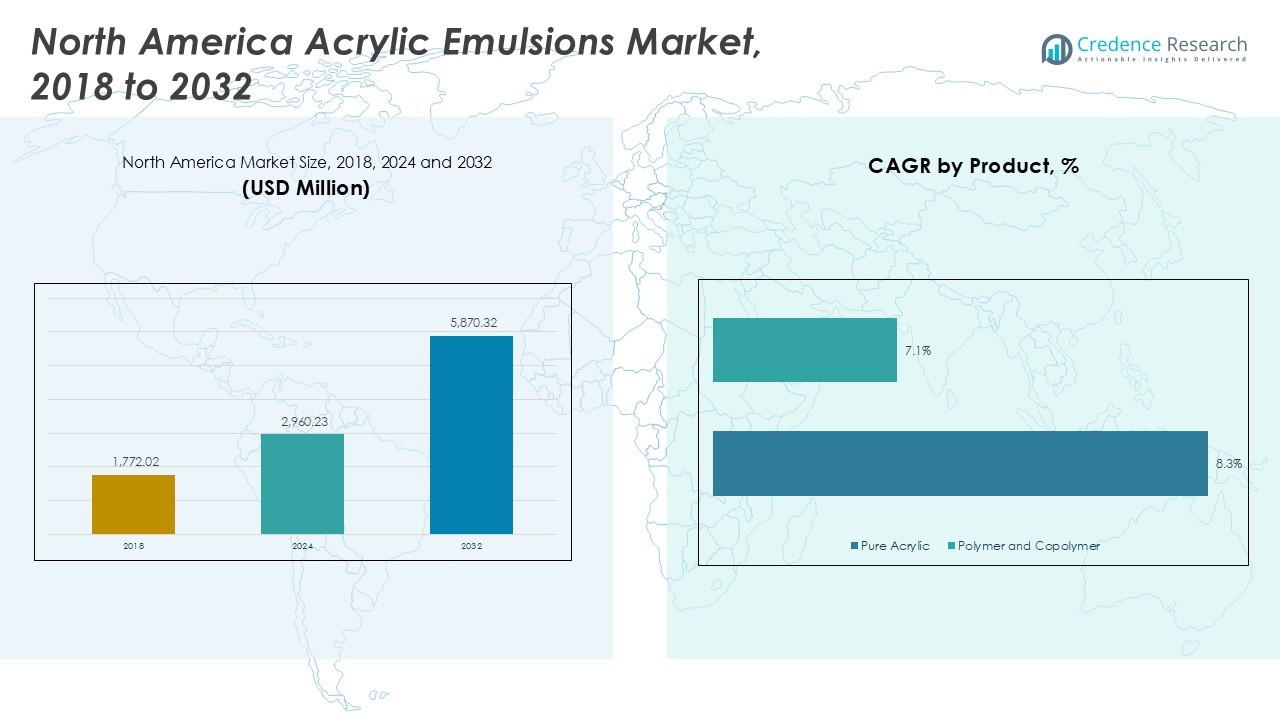
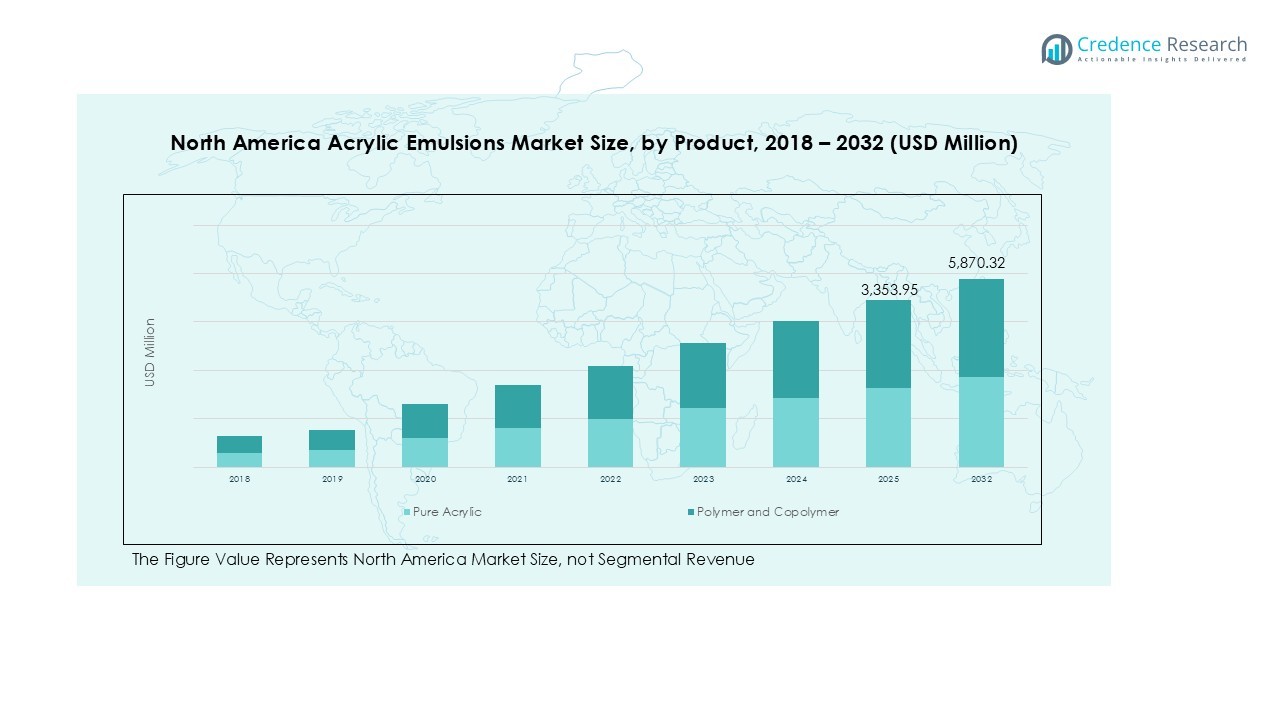
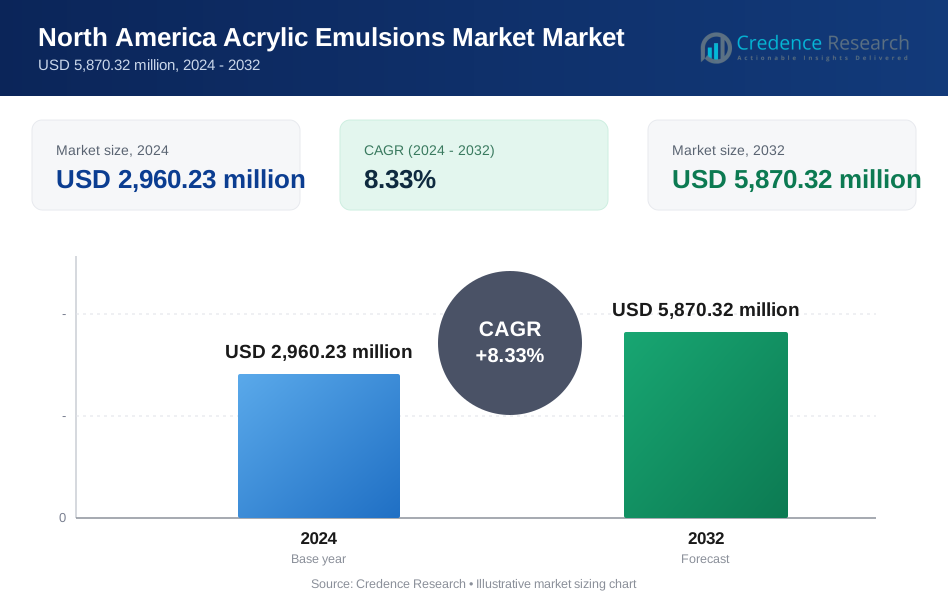
The North America Acrylic Emulsions Market has shown consistent growth, increasing from USD 1,772.02 million in 2018 to USD 2,960.23 million in 2024. The market is anticipated to reach USD 5,870.32 million by 2032, registering a CAGR of 8.33% during the forecast period.
| REPORT ATTRIBUTE | DETAILS |
|---|---|
| Historical Period | 2020-2023 |
| Base Year | 2024 |
| Forecast Period | 2025-2032 |
| North America Acrylic Emulsions Market Size 2024 | USD 2,960.23 Million |
| North America Acrylic Emulsions Market, CAGR | 8.33% |
| North America Acrylic Emulsions Market Size 2032 | USD 5,870.32 Million |
The North America Acrylic Emulsions Market is dominated by key players including BASF SE, Arkema, Dow, Celanese Corporation, Ashland, The Lubrizol Corporation, H.B. Fuller, and Synthomer plc, who collectively drive innovation and market expansion through advanced formulations and strategic partnerships. The United States leads the regional market with a 60% share, fueled by strong demand from architectural coatings, adhesives, and industrial applications. Canada follows with a 25% share, supported by construction growth and sustainable product adoption, while Mexico holds 15% of the market, driven by urbanization and increasing industrial usage. These companies focus on low-VOC and water-based acrylic emulsions, enhanced durability, and eco-friendly solutions, strengthening their market position and addressing diverse application segments, including paints and coatings, construction material additives, and paper coating.
Market Insights
- The North America Acrylic Emulsions Market was valued at USD 2,960.23 million in 2024 and is projected to reach USD 5,870.32 million by 2032, growing at a CAGR of 8.33%.
- Strong demand in paints and coatings, construction material additives, and adhesives is driving market growth, supported by residential, commercial, and industrial construction activities across the region.
- Key trends include increasing adoption of low-VOC and water-based emulsions, growth of DIY and home improvement projects, and technological innovations in copolymers and specialty formulations.
- Competitive landscape is dominated by BASF SE, Arkema, Dow, Celanese Corporation, Ashland, The Lubrizol Corporation, H.B. Fuller, and Synthomer plc, focusing on product innovation, strategic partnerships, and regional expansion to strengthen market presence.
- Regionally, the United States leads with a 60% share, Canada holds 25%, and Mexico accounts for 15%, while Pure Acrylic dominates the product segment with 45% revenue share, and paints and coatings represent 50% of application demand.
Market Segmentation Analysis:
By Product Segment:
In the North America Acrylic Emulsions Market, Pure Acrylic dominates the product segment, accounting for approximately 45% of the total market share in 2024. Its superior durability, weather resistance, and adhesion properties drive widespread adoption across coatings, adhesives, and construction materials. Polymers and Copolymers hold smaller shares, yet they are increasingly used in specialized applications requiring flexibility and chemical resistance. The strong preference for Pure Acrylic is supported by ongoing infrastructure projects and the expanding demand for high-performance paints and coatings across both residential and commercial sectors.
- For instance, Lubrizol manufactures water-borne pure acrylic emulsions used in high-performance architectural coatings that offer excellent UV stability and environmental compliance.
By Application Segment:
Paints and Coatings represent the leading application in the North America market, capturing around 50% of revenue in 2024. Acrylic emulsions’ excellent gloss, color retention, and low VOC characteristics make them ideal for architectural and industrial coatings. Construction Material Additives and Adhesives are growing steadily due to rising construction activities and DIY trends. Paper coating applications contribute modestly to the market but benefit from the packaging industry's focus on sustainable and durable materials. The demand is further fueled by strict environmental regulations promoting water-based and low-emission formulations.
- For instance, Dow's acrylic systems capture significant market share by combining balanced cost and weatherability, powering premium architectural and industrial coatings.
By End User Segment:
The Architectural end-user segment is the most significant, representing roughly 48% of the North America market in 2024. Growth is driven by residential and commercial construction, renovation projects, and increased demand for decorative and protective coatings. Industrial users follow closely, utilizing acrylic emulsions in specialty coatings, adhesives, and paper products. Commercial and residential segments are witnessing steady expansion as sustainability and aesthetic requirements influence material selection. Overall, the end-user demand is supported by evolving construction trends, urbanization, and the need for durable, low-maintenance solutions.
Key Growth Drivers
Rising Demand in Paints and Coatings
The North America Acrylic Emulsions Market is primarily driven by strong demand from the paints and coatings sector, which accounts for a significant portion of revenue. Acrylic emulsions offer superior adhesion, color retention, and weather resistance, making them ideal for architectural and industrial coatings. Increasing residential and commercial construction projects, coupled with renovation activities, are expanding the market. Additionally, the shift toward water-based and low-VOC coatings, driven by environmental regulations, further strengthens demand for acrylic emulsions across North American markets.
- For instance, BASF’s Joncryl® functional packaging coatings utilize water-based acrylic emulsions designed for low-VOC applications, providing mild water and grease resistance, which supports sustainable packaging solutions in compliance with evolving regulatory frameworks.
Expansion in Construction and Infrastructure
Ongoing infrastructure development and construction growth across North America are key drivers for acrylic emulsion consumption. These materials are extensively used as construction material additives and adhesives, enhancing durability, flexibility, and moisture resistance in building applications. Government investments in urban development and smart city initiatives contribute to increased adoption. Rising construction activity in residential, commercial, and industrial projects ensures a steady requirement for high-performance, sustainable materials, supporting long-term market growth and encouraging manufacturers to expand production capacities.
- For instance, EPS CCA offers acrylic emulsions specifically formulated for architectural and industrial roof coatings, providing enhanced protection against corrosion and environmental damage.
Technological Advancements and Product Innovation
Technological innovations in acrylic emulsions, such as enhanced copolymers and specialty formulations, are fueling market growth. Manufacturers are developing products with improved durability, chemical resistance, and eco-friendly properties to meet evolving industry standards. These innovations support diverse applications in paints, adhesives, and paper coatings, enabling better performance and longer lifecycle. Continuous research and development investments allow companies to differentiate their product portfolios, address specific end-user requirements, and capture emerging opportunities in premium and high-performance segments.
Key Trends & Opportunities
Shift Toward Sustainable and Low-VOC Products
Sustainability is a prominent trend in the North America market, with increasing adoption of low-VOC and water-based acrylic emulsions. Regulatory pressures and consumer preference for environmentally friendly solutions are encouraging manufacturers to innovate greener products. This trend opens opportunities for premium, eco-conscious coatings and adhesives in architectural and industrial sectors. Companies that prioritize sustainable formulations are positioned to capture higher market share, as environmentally compliant products gain preference among contractors, developers, and end users seeking long-term performance and reduced environmental impact.
- For instance, Sherwin-Williams has advanced its Scuff Tuff® Interior Waterbased Enamel Paint, recognized as a 2024 Green Builder Sustainable Product of the Year, which delivers high durability and low VOC content for residential and commercial interiors.
Growth in DIY and Home Improvement Projects
The rise of DIY projects and home improvement activities presents a significant opportunity for the acrylic emulsions market. Consumers increasingly prefer easy-to-use, water-based paints, adhesives, and coatings for residential applications. Retail expansion, online distribution, and educational campaigns on product benefits are supporting this trend. This growing consumer awareness and accessibility stimulate demand for high-quality acrylic emulsions in smaller packaging, creating potential for niche products tailored to end users and enabling manufacturers to diversify revenue streams beyond large-scale industrial or commercial contracts.
- For instance, Jenson and Nicholson emphasize their acrylic emulsion paints’ durability and ease of application for homes, highlighting their moisture resistance and long-lasting color retention in high humidity areas like kitchens and bathrooms.
Key Challenges
Volatility in Raw Material Prices
Fluctuating prices of key raw materials such as acrylic monomers and emulsifiers pose a significant challenge for market players. Price volatility impacts manufacturing costs and profit margins, potentially leading to increased product prices that may affect demand. Companies must strategically manage supply chains, adopt cost-effective production processes, or secure long-term contracts to mitigate risk. This challenge can limit growth, particularly for smaller players, while larger companies with integrated supply chains may sustain competitive pricing and stable revenue streams despite market fluctuations.
Stringent Environmental and Regulatory Norms
The North America Acrylic Emulsions Market faces challenges from strict environmental regulations, including limits on VOC emissions and chemical usage. Compliance requires continuous innovation in product formulations and may increase production costs. Non-compliance risks penalties, recalls, or market access restrictions. While regulations promote safer and sustainable products, they can act as a barrier for smaller manufacturers. Companies must invest in research, adapt production processes, and educate end users to maintain compliance while continuing to meet performance expectations across diverse applications.
Regional Analysis
United States
The United States dominates the North America Acrylic Emulsions Market, accounting for 60% of regional revenue in 2024. Strong demand from the paints and coatings industry, driven by residential and commercial construction, fuels growth. The architectural segment is the largest end-user, supported by renovation projects and urban infrastructure development. Industrial applications in adhesives and specialty coatings further contribute to the market. Innovation in low-VOC and water-based formulations aligns with regulatory requirements and sustainability trends. Growing DIY and home improvement activities also enhance demand, positioning the U.S. as the leading contributor to the North American acrylic emulsions market.
Canada
Canada holds a 25% share of the North America Acrylic Emulsions Market in 2024, driven by rising construction and infrastructure projects. Demand is particularly strong in architectural coatings and adhesives, supported by government investments in residential and commercial developments. Industrial applications, including paper coating and specialty coatings, also contribute to growth. The market benefits from increased adoption of eco-friendly, low-VOC acrylic emulsions to meet environmental regulations. Urbanization and modernization of industrial facilities encourage manufacturers to introduce innovative products with enhanced durability and chemical resistance, solidifying Canada’s position as a key regional player in the North American acrylic emulsions market.
Mexico
Mexico accounts for 15% of the North America Acrylic Emulsions Market in 2024, supported by expanding construction and industrial sectors. Rapid urbanization and rising residential development drive demand for paints, coatings, and construction material additives. The architectural and industrial segments dominate usage, with adhesives and paper coatings gaining traction in commercial applications. Increasing awareness of sustainable and low-VOC products encourages manufacturers to offer water-based emulsions, enhancing market growth. Mexico’s favorable manufacturing environment and cost-effective production capabilities attract regional suppliers and global companies, reinforcing its contribution to the North American acrylic emulsions market while providing opportunities for continued expansion.
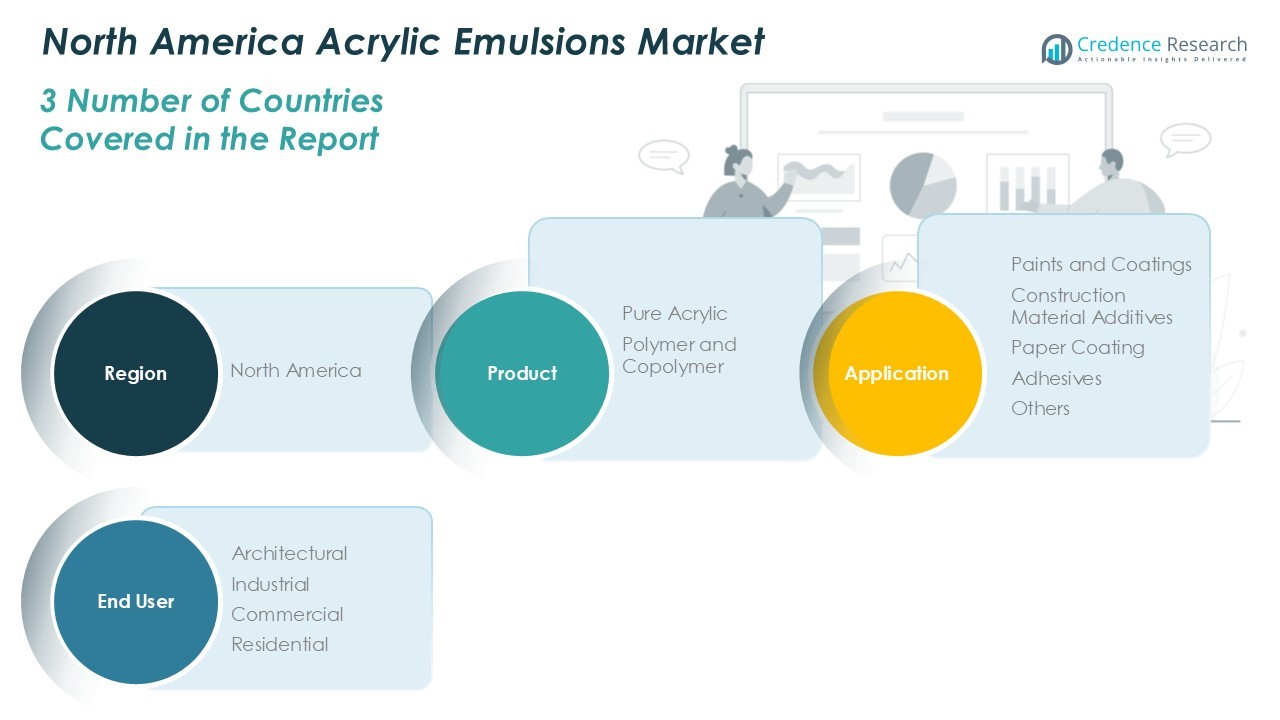
Market Segmentations:
By Product
- Pure Acrylic
- Polymer
- Copolymer
By Application
- Paints and Coatings
- Construction Material Additives
- Paper Coating
- Adhesives
- Others
By End User
- Architectural
- Industrial
- Commercial
- Residential
By Region
- North America
- U.S.
- Canada
- Mexico
Competitive Landscape
The competitive landscape of the North America Acrylic Emulsions Market includes key players such as BASF SE, Arkema, Dow, Celanese Corporation, Ashland, The Lubrizol Corporation, H.B. Fuller, and Synthomer plc. Market competition is intense, with companies focusing on product innovation, sustainable formulations, and strategic partnerships to enhance market share. Players are investing in advanced acrylic emulsions with low-VOC and water-based properties to meet stringent environmental regulations and evolving customer preferences. Expansion of production capacities, acquisitions, and regional collaborations are common strategies to strengthen distribution networks and address growing demand in architectural, industrial, and commercial segments. Additionally, companies emphasize research and development to introduce high-performance emulsions catering to paints, coatings, adhesives, and paper coating applications, ensuring differentiation and long-term growth in the North American market.
Key Player Analysis
- BASF SE
- Arkema
- Dow
- Celanese Corporation
- Ashland
- The Lubrizol Corporation
- B. Fuller
- Synthomer plc
- KAMSONS CHEMICALS PVT. LTD.
- Astra Chem Tech Private Limited
Recent Developments
- In April 2024, The Lubrizol Corporation announced a $20 million investment to enhance acrylic emulsion production at its Gastonia, North Carolina facility. This strategic move aims to bolster the company's capabilities in manufacturing innovative acrylic emulsions, supporting the growing demand in the coatings industry.
- In September 2025, Arkema partnered with Catalyxx to develop low-carbon, bio-based acrylic resins, leveraging proprietary technology to strengthen sustainability across the acrylics value chain.
- In September 2025, Dow Chemical launched a next-generation acrylic polymer emulsion designed for coatings and adhesives. This product offers enhanced durability and weather resistance while reducing volatile organic compound (VOC) emissions.
Report Coverage
The research report offers an in-depth analysis based on Product, Application, End Use and Region. It details leading market players, providing an overview of their business, product offerings, investments, revenue streams, and key applications. Additionally, the report includes insights into the competitive environment, SWOT analysis, current market trends, as well as the primary drivers and constraints. Furthermore, it discusses various factors that have driven market expansion in recent years. The report also explores market dynamics, regulatory scenarios, and technological advancements that are shaping the industry. It assesses the impact of external factors and global economic changes on market growth. Lastly, it provides strategic recommendations for new entrants and established companies to navigate the complexities of the market.
Future Outlook
- Demand for water-based and low-VOC acrylic emulsions is expected to increase.
- Growth in residential and commercial construction will drive market expansion.
- Architectural coatings will remain the largest end-user segment.
- Industrial applications, including adhesives and paper coating, will see steady growth.
- Technological innovations in copolymers and specialty emulsions will enhance product performance.
- Manufacturers will focus on eco-friendly and sustainable formulations to meet regulations.
- DIY and home improvement trends will create additional consumer-driven demand.
- Strategic partnerships and regional expansions will strengthen key players’ market positions.
- Adoption of acrylic emulsions in emerging industrial applications will create new opportunities.
- Competitive pressures will encourage continuous R&D and product portfolio diversification.
Request a Free Sample
Fill in your details and we'll send you a free sample report.
- Sample data tables & charts
- Research methodology
Need a Custom Version of This Report?
Tailor the scope, geography, or segments to your exact requirements.
- Custom geography or segment scope
- Direct access to our analyst team
Frequently Asked Questions
What is the current market size for North America Acrylic Emulsions market, and what is its projected size in 2032?
At what Compound Annual Growth Rate is the North America Acrylic Emulsions market projected to grow between 2025 and 2032?
Which North America Acrylic Emulsions market segment held the largest share in 2024?
What are the primary factors fueling the growth of the North America Acrylic Emulsions market?
Who are the leading companies in the North America Acrylic Emulsions market?
Which region commanded the largest share of the North America Acrylic Emulsions market in 2024?
Table of Content
Chapter 1 Market Segmentation
- 1.1 Segmentation Framework
- 1.1.1 Product and Service Classification
- 1.1.2 Application and End-Use Classification
- 1.1.3 Technology and Solution Classification
- 1.1.4 Customer and Distribution Channel Classification
- 1.1.5 Geographic Segmentation
- 1.1.6 Market Segment Definitions and Boundaries
Chapter 2 Introduction
- 2.1 Report Objectives and Scope
- 2.2 Product Definition and Industry Terminology
- 2.3 Market Inclusions and Exclusions
- 2.4 Research Process
- 2.4.1 Primary Research and Expert Interviews
- 2.4.2 Secondary Research and Source Review
- 2.4.3 Top-Down and Bottom-Up Estimation
- 2.4.4 Data Triangulation and Verification
- 2.5 Market Size Measurement Basis
- 2.5.1 2024: USD 2,960.23 million → 2032: USD 5,870.32 million
- 2.6 Historical and Forecast Reference Periods
- 2.6.1 Base Year: 2024
- 2.6.2 Forecast Period: 2024-2032
- 2.7 Research Assumptions and Limitations
Chapter 3 Executive Summary
- 3.1 Market Snapshot and Key Findings
- 3.2 Base-Year Market Size, 2024
- 3.3 Forecast Market Size, 2032
- 3.4 Revenue and Volume Growth Outlook
- 3.5 Key Demand and Supply Indicators
- 3.6 Leading Market Segments
- 3.7 Fastest-Growing Market Opportunities
- 3.8 Regional Performance Highlights
- 3.9 Technology and Industry Transformation
- 3.10 Competitive Landscape Summary
- 3.11 Analyst View and Strategic Implications
Chapter 4 North America Acrylic Emulsions Market Market Trends and Developments
- 4.1 Historical Industry Development
- 4.2 Recent Market Trends and Developments
- 4.3 Demand and Customer Behavior Trends
- 4.4 Technology and Product Innovation
- 4.5 Artificial Intelligence, Automation and Digitalization
- 4.6 Local Manufacturing and Supply Chain Realignment
- 4.7 Industry Partnerships, Mergers and Acquisitions
- 4.8 Sustainability and Circular Economy Developments
- 4.9 Government and Private Sector Investment Trends
- 4.10 Emerging Business Models and Commercialization
- 4.11 Industry Developments and Announcements
Chapter 5 North America Acrylic Emulsions Market Market Production, Supply and Demand Analysis
- 5.1 Demand Trend and Consumption Analysis
- 5.2 Demand Forecast, 2024-2032
- 5.3 Production and Output Trend
- 5.4 Production and Output Forecast, 2024-2032
- 5.5 Installed Capacity and Capacity Utilization
- 5.6 Company-Wise Production Plants and Statistics
- 5.6.1 Installed Production Capacity
- 5.6.2 Actual Production
- 5.6.3 Planned Capacity and Expansion Targets
- 5.7 Supply Chain Structure and Procurement Trends
- 5.8 Supply-Demand Gap and Bottlenecks
- 5.9 Import Dependence and Sourcing Structure
- 5.10 Contract Manufacturing and Outsourcing
- 5.11 Regional Supply and Demand Concentration
Chapter 6 North America Acrylic Emulsions Market Market Pricing Analysis
- 6.1 Pricing Structure and Measurement
- 6.2 Historical Pricing Trends
- 6.3 Pricing Outlook, 2024-2032
- 6.4 Average Selling Price and Unit Economics
- 6.5 Pricing by Product and Market Segment
- 6.6 Geographic Pricing Differences
- 6.7 Key Input, Energy, Labor and Logistics Costs
- 6.8 Contract Pricing and Purchasing Models
- 6.9 Pricing Sensitivity and Competitive Positioning
- 6.10 Price, Margin and Profitability Implications
Chapter 7 North America Acrylic Emulsions Market Market Dynamics
- 7.1 Market Growth Drivers
- 7.1.1 Demand-Side Drivers
- 7.1.2 Technology and Innovation Drivers
- 7.1.3 Infrastructure and Investment Drivers
- 7.1.4 Regulatory and Policy Drivers
- 7.2 Market Restraints
- 7.2.1 Cost and Affordability Constraints
- 7.2.2 Technology and Adoption Barriers
- 7.2.3 Supply Chain and Operational Constraints
- 7.3 Market Challenges
- 7.3.1 Competitive Pressure and Margin Erosion
- 7.3.2 Skills, Infrastructure and Implementation Gaps
- 7.4 Emerging Market Opportunities
- 7.5 Market Dynamics Impact and Time-Horizon Assessment
Chapter 8 North America Acrylic Emulsions Market Value Chain Analysis
- 8.1 Industry Value Chain Overview
- 8.2 Upstream Suppliers and Critical Inputs
- 8.3 Technology and Component Providers
- 8.4 Manufacturing or Service Delivery
- 8.5 Distribution, Channel Partners and Integrators
- 8.6 Downstream Applications and End Users
- 8.7 Value Addition and Profit Pools
- 8.8 Vertical Integration and Outsourcing
- 8.9 Supplier Concentration and Risk
- 8.10 Supply Chain Localization and Resilience
Chapter 9 North America Acrylic Emulsions Market Market Regulations and Policies
- 9.1 Relevant Laws, Standards and Compliance Frameworks
- 9.2 Product, Service, Safety and Quality Requirements
- 9.3 Government Policies, Incentives and Subsidies
- 9.4 Imports, Exports and Trade Barriers
- 9.5 Public Procurement and Local Content Requirements
- 9.6 Environmental and Sustainability Compliance
- 9.7 Upcoming Policy Changes and Market Implications
Chapter 10 North America Acrylic Emulsions Market Market Hotspots and Opportunities
- 10.1 Market Opportunity Mapping and Growth Hotspots
- 10.2 High-Growth Applications and Customer Groups
- 10.3 Underserved Markets and White-Space Opportunities
- 10.4 Emerging Technology and Product Opportunities
- 10.5 New Capacity and Investment Hotspots
- 10.6 Market Entry and Expansion Opportunities
- 10.7 Distribution and Partnership Opportunities
- 10.8 Near-Term and Long-Term Commercial Potential
- 10.9 Opportunity Attractiveness and Execution Risks
Chapter 11 North America Acrylic Emulsions Market Market Outlook, 2024-2032
- 11.1 Market Size and Analysis
- 11.1.1 Revenue (Market Measurement: 2024: USD 2,960.23 million → 2032: USD 5,870.32 million)
- 11.1.2 Market Volume and Quantity Sold
- 11.1.3 Historical Market Size
- 11.1.4 Base-Year Market Size, 2024
- 11.2 Market Forecast, 2024-2032
- 11.2.1 Revenue Forecast to 2032
- 11.2.2 Volume Forecast to 2032
- 11.2.3 CAGR and Year-on-Year Growth
- 11.2.4 Incremental Revenue Opportunity
- 11.3 Forecast Assumptions and Scenario Analysis
- 11.3.1 Base-Case Forecast
- 11.3.2 Optimistic and Conservative Scenarios
- 11.3.3 Technology, Pricing and Policy Sensitivities
- 11.4 Market Attractiveness and Growth Outlook
Chapter 12 North America Acrylic Emulsions Market Market Segmentation and Outlook
- 12.1 Segmentation Summary and Market Shares, 2024
- 12.2 Largest and Fastest-Growing Segments
- 12.3 Segment Growth Comparison
- 12.4 Segment Attractiveness and Priority Matrix
Chapter 13 North America Acrylic Emulsions Market Geographic Market Outlook, 2024-2032
- 13.1 Regional Market Size and Country-Level Shares, 2024
- 13.2 Country Market Size Comparison, 2024
- 13.3 Country Market Forecasts, 2024-2032
- 13.4 Subregional Industrial and Demand Clusters
- 13.5 Intra-Regional Pricing and Cost Differences
- 13.6 Cross-Border Trade and Supply Networks
- 13.7 Regional Supply and Demand Balances
- 13.8 Country Opportunity Comparison and Prioritization
Note: Every listed country is covered on the structure shown under the first country.
Chapter 14 North America Acrylic Emulsions Market Technology, Innovation and Sustainability Outlook
- 14.1 Technology Landscape and Maturity
- 14.2 Product, Process and Service Innovation
- 14.3 AI, Automation and Digital Tools in the Industry
- 14.4 Technology Adoption and Performance Benchmarking
- 14.5 Innovation Pipeline and R&D Investment
- 14.6 Patent and Intellectual Property Trends
- 14.7 Energy Efficiency and Resource Management
- 14.8 Sustainability, Recycling and Circularity
- 14.9 Technology Roadmap, 2024-2032
- 14.10 Risks of Obsolescence and Technology Substitution
Chapter 15 North America Acrylic Emulsions Market Market Key Strategic Imperatives
- 15.1 Growth and Market Entry Priorities
- 15.2 High-Return Products and Segments
- 15.3 Pricing, Profitability and Cost Optimization
- 15.4 Technology Investment and Product Differentiation
- 15.5 Supply Chain Localization and Resilience
- 15.6 Distribution and Customer Acquisition
- 15.7 Partnership, Acquisition and Capacity Strategy
- 15.8 Regional Expansion Priorities
- 15.9 Short-, Medium- and Long-Term Actions
Chapter 16 Competition Outlook
- 16.1 Industry Competition Characteristics
- 16.2 Market Structure and Concentration
- 16.3 Market Share and Competitive Positioning, 2024
- 16.4 Company-Wise Revenue and Product Benchmarking
- 16.5 Production and Service Capacity Benchmarking
- 16.6 Technology, Pricing and Differentiation
- 16.7 Regional Footprint and Distribution Strength
- 16.8 Mergers, Acquisitions and Strategic Alliances
- 16.9 New Entrants and Competitive Threats
- 16.10 Porter's Five Forces and Industry Attractiveness
- 16.11 Competitive Outlook, 2024-2032
Chapter 17 Company Profiles
- 17.1 Company Coverage and Selection Criteria
- 17.2 Leading Market Participants – Standard Profile Structure
- 17.2.1 Business Description
- 17.2.2 Company Ownership and Geographic Presence
- 17.2.3 Product and Service Portfolio
- 17.2.4 Manufacturing and Operating Footprint
- 17.2.5 Production Capacity and Expansion Plans
- 17.2.6 Financial Performance and Investment
- 17.2.7 Market Share and Competitive Position
- 17.2.8 Technology and Innovation Capabilities
- 17.2.9 Strategic Alliances or Partnerships
- 17.2.10 Recent Developments
- 17.2.11 Growth Strategy and Outlook
- 17.3 Other Relevant Market Participants
Note: Every listed company is profiled on the structure shown under the first company. The company list is preliminary and may change based on research findings, market developments, data availability and client requirements.
Chapter 18 Disclaimer
- 18.1 Research and Forecast Disclaimer
- 18.2 Data Source and Estimation Limitations
Note: The depth of individual sections depends on data availability for this market. Volume, capacity, trade and other unit-based metrics are included where applicable.

