
Packaging specs and domestic lines set the regional pace
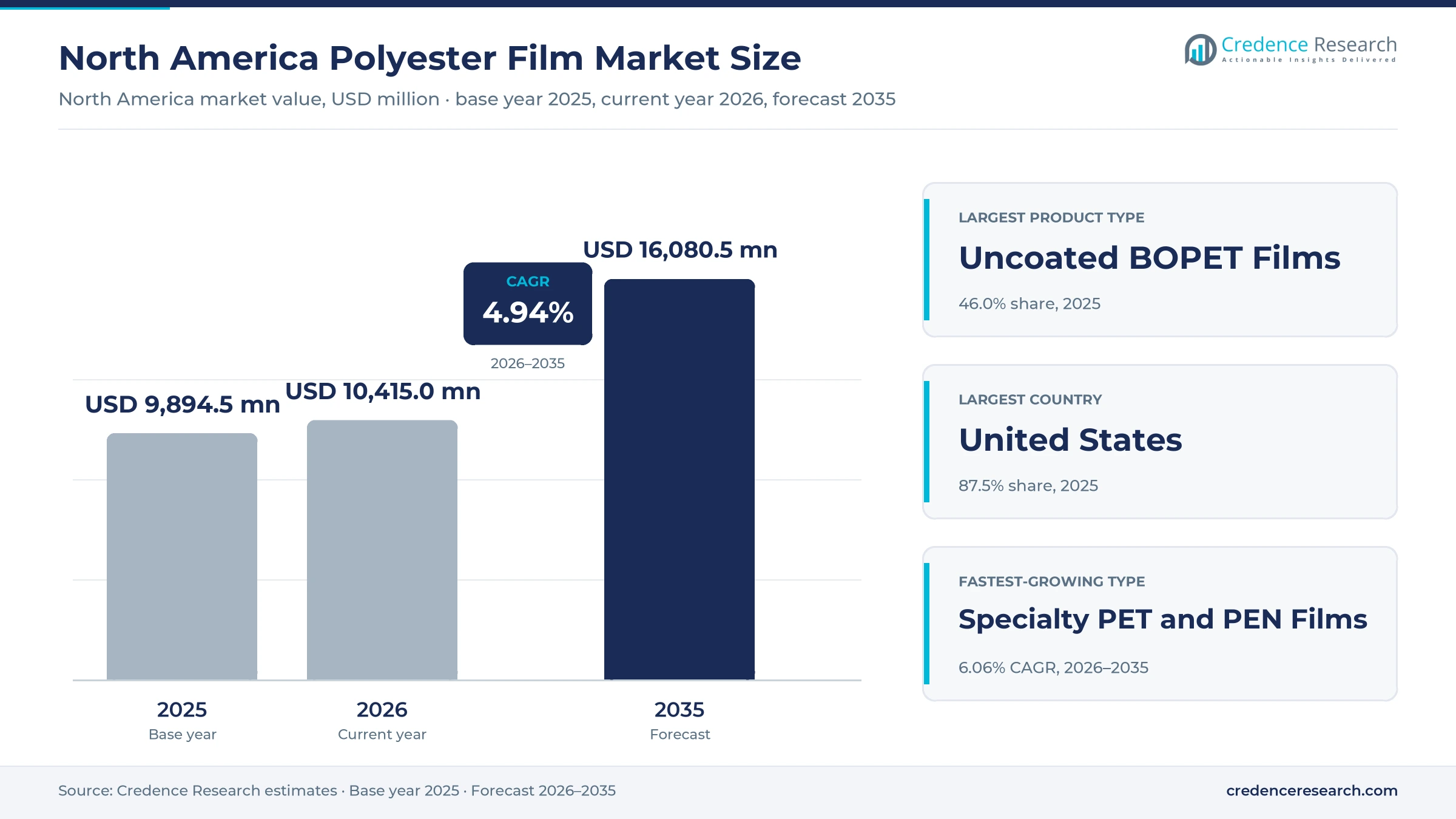
The North America polyester film market was valued at USD 9.89 billion in 2025 and is projected to increase from USD 10.42 billion in 2026 to USD 16.08 billion by 2035, registering a CAGR of 4.94% during 2026–2035. Demand comes from converters of snack, coffee and pouch laminates, from electrical and display component makers, and from coated industrial and medical substrates. United States held the largest share, 87.5% in 2025, because the region's largest film plants and most of its packaging converters operate there. Mexico is the fastest-growing country at 6.00% a year, helped by Evertis México adding more than 9,600 metric tons of PET-based film capacity at Pesquería in August 2026. On the supply side, Polyplex began commercial output on a 50,000-metric-ton thin film line in Decatur, Alabama, in March 2025. Trade policy also supports domestic producers, since federal regulators kept antidumping orders on film from China, India, Taiwan and the United Arab Emirates in place during March 2026.
What counts as polyester film in this North American estimate?
The estimate counts polyester film, sheet and strip sold in the United States, Canada and Mexico, including uncoated BOPET, metallised and coated grades and specialty PET and PEN films from below 15 microns up to 500 microns. Buyers purchase in master rolls from film plants, in slit rolls and sheets from processors, or through importers, and large accounts usually qualify each grade before placing regular orders.
Polyester fiber, bottle resin, polypropylene and cast polyethylene films fall outside the estimate, even when they share a laminate with polyester. The value chain runs from PTA, glycol and resin suppliers through film producers, metallizers and coaters, then on to converters, component manufacturers, solar module plants and brand owners in food, healthcare and electronics.
North America Polyester Film Market Insights
- The market grows from USD 9.89 billion in 2025 to USD 16.08 billion by 2035, a 4.94% CAGR over 2026–2035, as packaging specifications tighten and domestic film capacity expands.
- The United States held 87.5% of value in 2025, while Mexico is the fastest-growing country at 6.00% a year on new film capacity at Pesquería.
- Uncoated BOPET films led product types with 46.0% of 2025 value, supported by thin film lines such as the Polyplex expansion in Decatur, Alabama.
- California SB 54 regulations took effect on May 1, 2026, and they set a 65% recycling goal for single-use plastic packaging by 2032, which pressures laminate design.
- Oben Group completed its purchase of Terphane in November 2024, while Commerce kept reviewing Indian film duties, with margins ranging from 0.00% to 24.14% in 2025.
Base BOPET and food packaging anchor 2025 value
Why uncoated BOPET leads and specialty grades grow fastest
Based on product type, the market is categorized into uncoated BOPET films, metallised polyester films, coated polyester films and specialty PET and PEN films. Uncoated BOPET Films led with 46.0% of 2025 value because base film feeds most converter laminates, and Polyplex lifted its U.S. film capacity to 81,000 metric tons in March 2025, according to a filing reported by Tiger Brokers. Specialty PET and PEN Films grow fastest at 6.06% a year as Mitsubishi Polyester Film sells grades for EV batteries, transdermal patches and diagnostic strips, according to Packaging Insights in May 2026. Those end uses carry tighter qualification requirements than general packaging film does.
How packaging keeps the lead as electrical uses gain
Based on application, the market is categorized into packaging, electrical and electronic components, industrial and medical substrates and solar module components. Packaging led with 58.0% of 2025 value because the Flexible Packaging Association put U.S. flexible packaging sales at $42.6 billion in 2024, up 2.9%, and laminators of flexible packaging specify polyester as a printable outer layer. Electrical and Electronic Components grow fastest at 5.85% a year as Tekra sells heat-stabilized Melinex ST film for flexible circuitry and Mylar EL dielectric film for electronics. Those grades must resist shrinkage at high cure temperatures, which limits substitution by general packaging film.
Why food and beverage dominates end-use purchasing
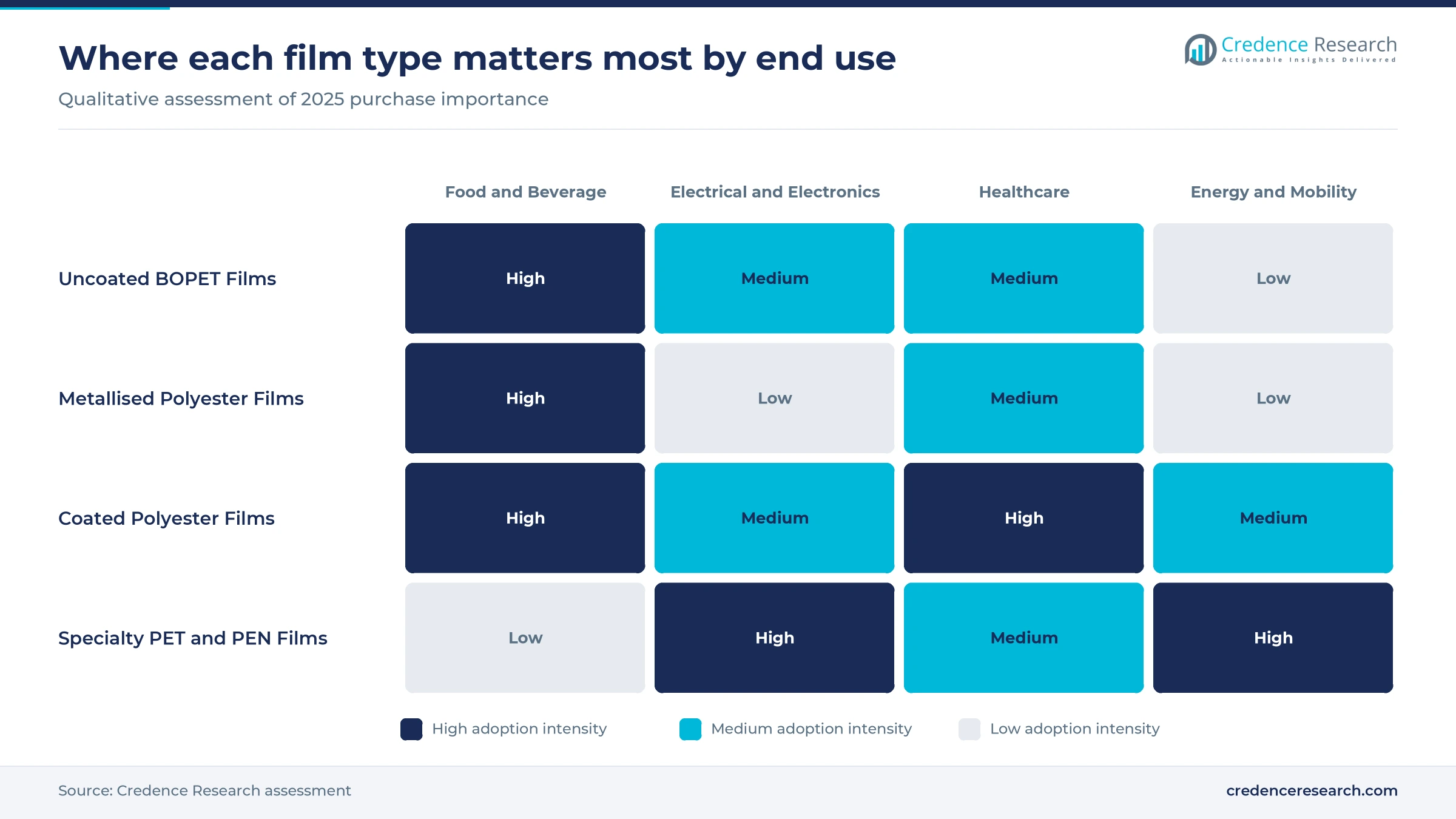
Based on end-use industry, the market is categorized into food and beverage, electrical and electronics, healthcare, industrial and energy and mobility. Food and Beverage led with 44.0% of 2025 value because food took 44.5% of U.S. flexible packaging demand, with medical and pharmaceutical uses near 17%, according to Packaging World coverage of the 2025 FlexForward Conference. Energy and Mobility grows fastest at 6.02% a year as Mercom reported U.S. solar module capacity above 50 GW in February 2025, citing the Solar Energy Industries Association. Buyers also use polyester in EV battery assemblies, although American EV demand weakened after federal credits ended in 2025.
How direct sales lead while processors gain ground
Based on sales channel, the market is categorized into direct manufacturer sales, processor sales and importer sales. Direct Manufacturer Sales led with 62.0% of 2025 value because large converters buy master rolls from nearby plants, including the Greer, South Carolina, complex that Trade & Industry Development called the largest U.S. polyester film plant in September 2015. Processor Sales grow fastest at 5.61% a year as Tekra converts large Mylar rolls into custom slit rolls and sheets, stocking gauges from 0.48 to 14 mil. Tekra also serves as the exclusive North American distributor of those films for medical diagnostics, which rewards service over tonnage.
| Segment Group | Leading Sub-segment | Share, 2025 | Fastest-growing Sub-segment | CAGR, 2026–2035 |
|---|---|---|---|---|
| By Product Type | Uncoated BOPET Films | 46.0% | Specialty PET and PEN Films | 6.06% |
| By Application | Packaging | 58.0% | Electrical and Electronic Components | 5.85% |
| By End-Use Industry | Food and Beverage | 44.0% | Energy and Mobility | 6.02% |
| By Sales Channel | Direct Manufacturer Sales | 62.0% | Processor Sales | 5.61% |
Request a Free Sample
Fill in your details and we'll send you a free sample report.
- Sample data tables & charts
- Research methodology
Barrier needs and new U.S. lines lift regional demand
Qualified packaging performance keeps polyester in laminates
Packaging buyers keep specifying polyester because qualified barrier, print and heat-resistance properties are costly to requalify once a laminate is approved. The Flexible Packaging Association reported U.S. flexible packaging sales of $42.6 billion in 2024 against $41.4 billion in 2023, while Packaging World reported that flexibles held 20% of the $213.4 billion U.S. packaging total. Toray Plastics (America) markets its Lumirror MK61HB metallized and PA1HB clear-barrier films for pouches, lidding, coffee, snacks and pet food, according to Packaging World. Its GA10, GA25 and GA66 films also hold their strength and appearance for up to two years after gamma sterilization, according to Packaging Gateway. As a result, uncoated BOPET retains 46.0% of value while coated grades add margin.
Domestic supply expansion shortens lead times for converters
Local capacity additions give converters shorter replenishment cycles, which raises the appeal of American film against long ocean shipments. Polyplex started commercial production in March 2025 on a new thin film line that added 50,000 metric tons a year, taking its U.S. film total to 81,000 metric tons, according to a filing reported by Tiger Brokers. The same filing showed resin capacity rising from 58,000 to 86,000 metric tons, which gives the site captive feedstock. Labels & Labeling reported that the Flex Films plant in Elizabethtown, Kentucky, runs an 8.7-meter line producing over 30,000 metric tons a year, with a second phase planned to double output. Direct sales therefore hold 62.0% of 2025 value across the three channels.
Electrical and optical upgrades raise the value of each roll
Component makers are moving toward film with tighter shrinkage, dielectric and optical limits, and those grades sell for more than general packaging film. Tekra stocks PET film from 0.48 to 14 mil, and it lists heat-stabilized Melinex ST film for flexible circuitry, Mylar EL dielectric film and high-clarity optical film coated for displays in its clean room facility. Mylar Specialty Films groups Mylar and Melinex PET with Kaladex PEN under its global rebrand, according to Interplas Insights, which keeps higher-temperature PEN in the same supplier range. Mitsubishi Polyester Film also lists EV battery uses among its markets, according to Packaging Insights in May 2026. As a result, Electrical and Electronic Components grow at 5.85% a year, ahead of packaging through 2035.
Federal trade orders protect investment in American lines
Duty protection supports domestic capital plans because it limits the lowest-priced offers that converters could otherwise use as benchmarks. The U.S. International Trade Commission determined on March 11, 2026 to keep antidumping orders on PET film from China, India, Taiwan and the United Arab Emirates, along with the countervailing order on India. Commerce found in February 2026 that revocation would likely bring dumping margins of up to 24.10% for India and 8.99% for Taiwan, according to the Federal Register. USITC Publication 5110 also named five domestic producers in 2019, including Mitsubishi, SKC, Toray, Terphane and the former DuPont Teijin Films. These orders matter most to the United States share of regional value, because most protected capacity sits in American plants.
Recycling rules and Mexican lines reshape supply plans
Emerging recycling rules shift how laminates are designed
State recycling law is becoming a design input for polyester laminates, because mixed-material structures are hard to sort and reprocess. California SB 54 regulations took effect on May 1, 2026, and Mayer Brown lists 2032 goals of 100% recyclable or compostable single-use packaging, 65% recycling of plastic packaging and a 25% reduction in packaging. Full program implementation begins on Jan. 1, 2027, which puts brand owners under fee and reporting pressure during current laminate reviews. Canada added a parallel reporting duty when its Federal Plastics Registry began Phase 1 in September 2025 for packaging and electrical equipment producers. Dunmore launched a sustainable PET printable film in January 2024, an early supplier response. Converters therefore ask film makers for thinner gauges and simpler structures.
Ownership shifts bring new global owners to regional supply
Ownership in the region is moving toward groups that want polyester film as a platform across several continents. Oben Group completed its purchase of Terphane on Nov. 12, 2024, according to Healthcare Packaging, gaining a producer with operations in Brazil and the United States and exports to more than 30 countries. DuPont Teijin Films became Mylar Specialty Films under a global rebrand, while ownership stayed with Celanese and Teijin, according to Interplas Insights. Mitsubishi Polyester Film opened a 27,000-ton Hostaphan line in Wiesbaden, Germany, in May 2026, according to Packaging Insights, and it counts the United States among five production countries. Regional buyers therefore face suppliers that can compare American output against sister plants abroad.
Opportunity for Mexican film capacity to serve local converters
Mexico offers an opening for producers that can serve food converters from inside the country instead of relying on imported rolls. Evertis México completed a coex cast line at Pesquería, Nuevo León, in August 2026, adding more than 9,600 metric tons and lifting the site past 44,000 metric tons, according to the Flexible Packaging Association. Uflex also planned an 18,000-ton cast polypropylene line and a coating line in Mexico, according to Converting Quarterly in February 2025, which deepens local laminate supply around polyester. World Bank data put Mexican manufacturing value added at $368.5 billion in 2024, a sizable industrial base. Mexico therefore records the fastest growth pace among the three countries in this report.
Opportunity in coated films for solar, space and medical uses
Coaters have an opening in low-volume applications where a qualified structure commands more value than base film tonnage. Dunmore, a brand with more than 50 years of history, serves aerospace insulation and solar backsheets from Bristol, Pennsylvania, according to Steel Partners, and it announced a multilayer insulation partnership with ICEYE in April 2024. PV Tech reported in July 2024 that Endurans Solar was producing backsheets and planning a major expansion in the United States. Transcendia lists PET film datasheets for photovoltaic, casting and release, and electrical wire and cable uses on its product pages. Producers of medical pouches also need radiation-stable film, as the Toray GA range shows. Coated polyester films consequently add value beyond the share held by base film.
Duties, EV credits and new capacity test margins
Antidumping margins leave importers with uneven costs
Importers cannot price Indian film consistently because margins vary widely across producers and review periods. Commerce set 24.14% for Jindal Poly Films and 0.00% for SRF Limited in May 2025, then issued a preliminary 0.61% for SRF in October 2026, according to Federal Register notices. Importer sales carry the most exposure because duties can change after goods have landed. Buyers respond by qualifying several origins and holding more safety stock, which raises working capital and slows spot purchasing.
The end of EV credits clouds battery and electrical orders
Electrical film forecasts now carry more risk because American EV demand fell after federal support ended. The International Energy Agency counted about 1.5 million U.S. EV sales in 2025, yet sales dropped about 45% in the fourth quarter after the $7,500 credit expired, according to Industrial Info Resources in May 2026. Suppliers of battery and power electronics film therefore face uneven order timing. They can reduce that exposure by spreading qualified grades across displays, flexible circuitry and industrial uses.
Packaging producer rules add cost and redesign work
Multilayer polyester laminates face redesign pressure because producer rules target exactly those structures that are hard to recycle. California set a 65% plastic packaging recycling goal and a 25% reduction goal for 2032 in rules effective May 1, 2026, according to Mayer Brown. Brand owners must then fund compliance while they test new structures, and each new structure needs fresh shelf-life work. Film makers can mitigate this by offering thinner gauges and simpler grades, although qualification can slow near-term orders.
New domestic capacity could outrun near-term demand
New lines can weaken pricing when they start faster than end markets absorb them. The 50,000-metric-ton Polyplex line in Alabama alone equals about 26% of the 419.2 million pounds of 2019 capacity reported by responding domestic producers in USITC Publication 5110, though that count was incomplete. Flex Films also holds a planned second phase in Kentucky, according to Labels & Labeling. Thin commodity gauges feel this first, so producers are moving volume toward coated and specialty grades.
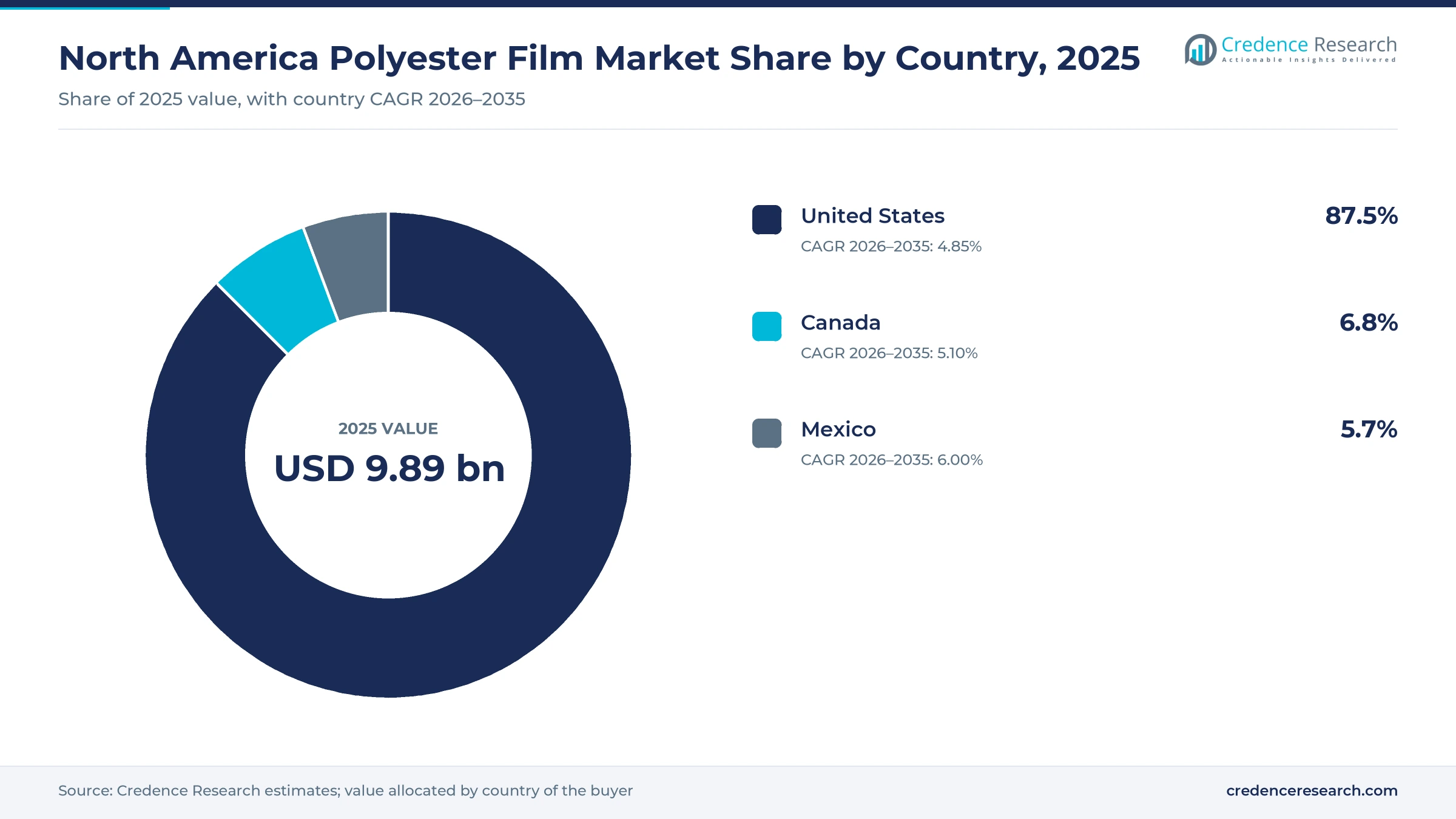
The United States dominates while Mexico grows fastest
| Country | Value, 2025 (USD billion) | Share, 2025 | CAGR, 2026–2035 |
|---|---|---|---|
| United States | 8.66 | 87.5% | 4.85% |
| Canada | 0.67 | 6.8% | 5.10% |
| Mexico | 0.56 | 5.7% | 6.00% |
United States holds most plants and most converter demand
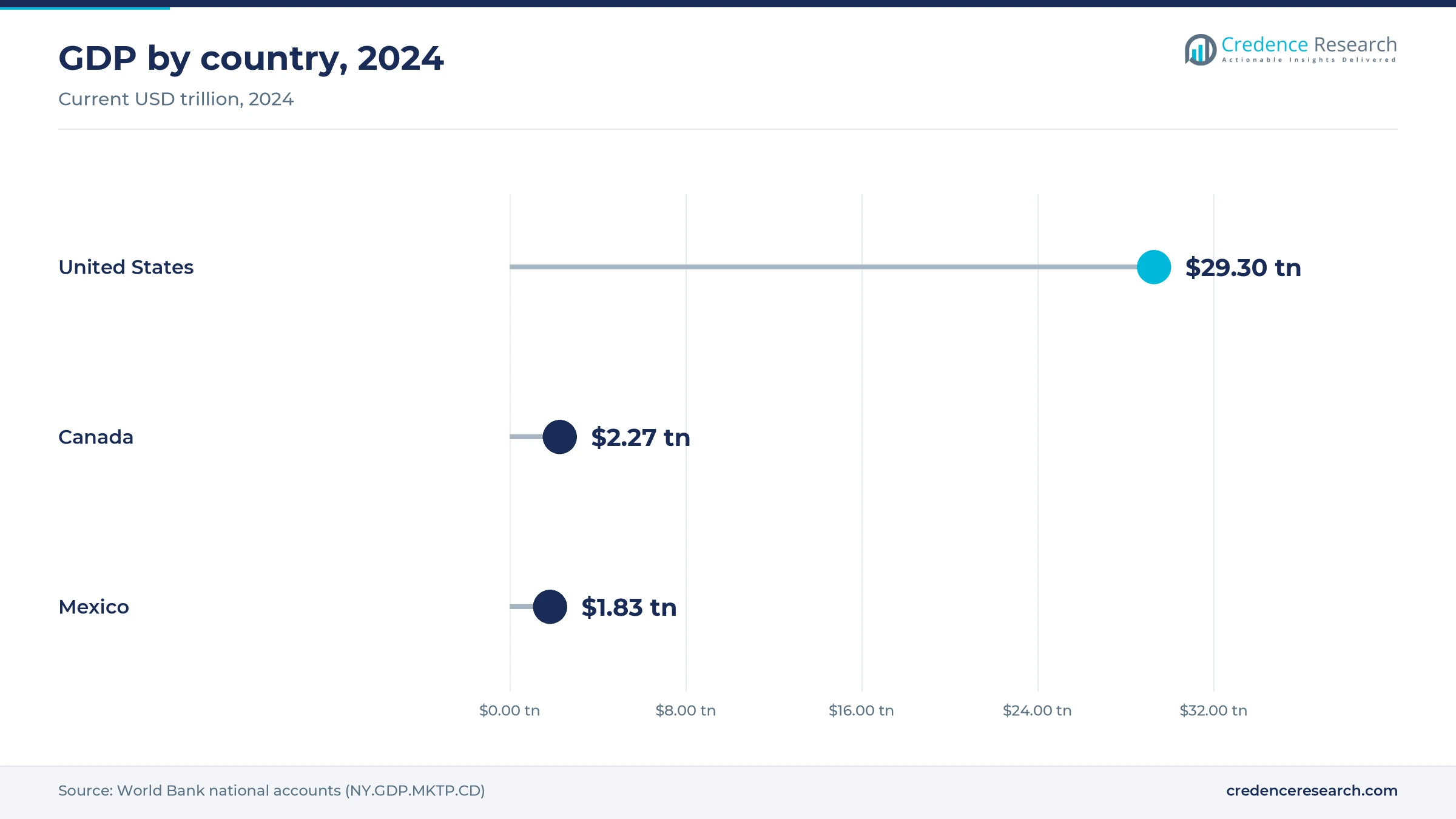
The United States held 87.5% of 2025 value and grows at 4.85% a year, which reflects its concentration of plants in Alabama, Georgia, Kentucky and South Carolina. World Bank national accounts put U.S. GDP at $29.3 trillion in 2024, about 13 times the Canadian figure. Federal duty orders retained in March 2026 also protect this base, and domestic plastic packaging converters remain close to their film suppliers. Growth stays near the regional average because the base is large.
Canada tracks plastic quantities under new reporting duties
Canada held 6.8% of 2025 value and grows at 5.10% a year, and the Credence Research model assumes that its food and electrical converters rely largely on film from outside the country. The World Bank put Canadian GDP at $2.27 trillion in 2024, which frames a smaller but steady demand base. Federal registry reporting began in September 2025 for packaging producers placing at least 1,000 kilograms on the market, so Canadian brand owners are now tracking plastic quantities in greater detail than before.
Mexico gains from new capacity and a large factory base
Mexico held 5.7% of 2025 value and is the fastest-growing country at 6.00% a year, because local film capacity is rising alongside food and export manufacturing. Evertis México lifted its Pesquería site past 44,000 metric tons in August 2026, according to the Flexible Packaging Association. World Bank data show Mexican GDP of $1.83 trillion and manufacturing value added of $368.5 billion in 2024. Uflex also expanded local cast film and coating plans in 2025, which adds laminate supply near food converters.
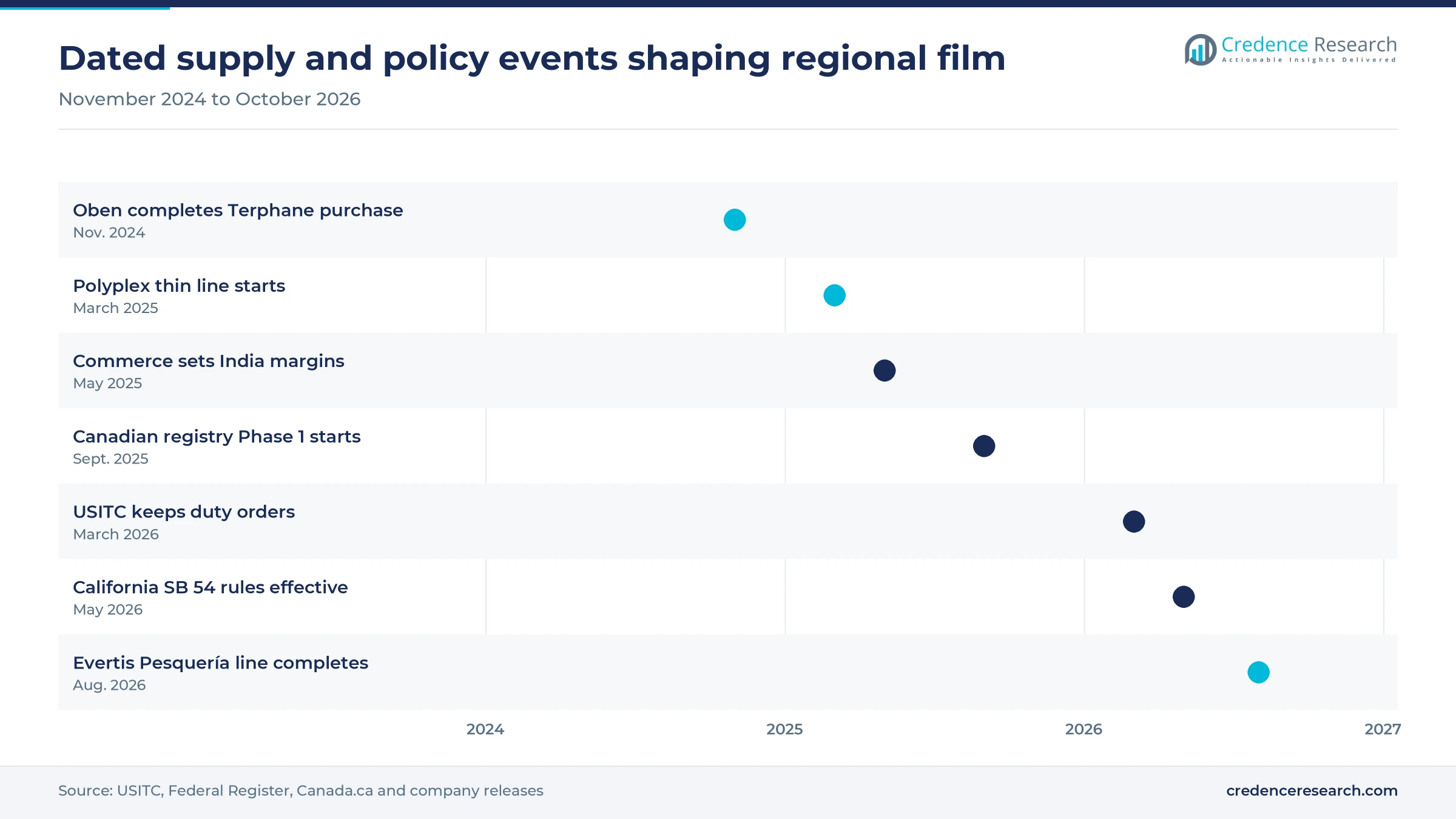
Duty rulings and plant starts set the 2024-2026 agenda
| Development | Status and market relevance |
|---|---|
| In November 2024, Oben Group completed its acquisition of Terphane, according to Healthcare Packaging | Adds Brazilian and U.S. polyester film operations to a packaging film group |
| In March 2025, Polyplex began commercial production on a 50,000-metric-ton BOPET thin film line in the United States | Raises its U.S. film capacity to 81,000 metric tons and resin capacity to 86,000 metric tons |
| In March 2026, the U.S. International Trade Commission kept antidumping and countervailing orders on PET film | Maintains duties on China, India, Taiwan and the United Arab Emirates |
| In May 2026, California SB 54 regulations took effect after state approval | Sets 2032 goals that influence polyester laminate design across suppliers |
| In August 2026, Evertis México completed a coex cast line at Pesquería, Nuevo León | Adds more than 9,600 metric tons of PET-based flexible film capacity |
Thin lines, barrier coatings and PEN define competition
- Wide thin film lines lower unit cost at thin gauges, and the Flex Films line in Kentucky runs at 8.7 meters wide and 500 meters per minute.
- Inline barrier coating applies barrier during orientation in one production step, as Toray describes for its Lumirror PA1HB and MK61HB films.
- PEN and heat-stabilized grades hold dimensions at high cure temperatures, which suits flexible circuitry, as Tekra describes for its Melinex ST line.
- Hard and functional coatings add scratch resistance and custom surface behavior, and Tekra applies them in its clean room coating facility.
Need a Custom Version of This Report?
Tailor the scope, geography, or segments to your exact requirements.
- Custom geography or segment scope
- Direct access to our analyst team
Ten suppliers compete on plants, grades and converting
Competition divides into three groups, and each one wins business differently. Base film producers such as Polyplex, Mitsubishi Polyester Film, Flex Films, SK Microworks America, Terphane, Toray and Mylar Specialty Films compete on line width, gauge range, delivered lead time and qualified grades. Coaters and processors such as Dunmore, Transcendia and Tekra compete on application knowledge, slitting, sheeting and small lot service, and Tekra, for example, buys large rolls from Mylar Specialty Films. Ownership also matters, because Oben Group now holds Terphane and Celanese and Teijin jointly own Mylar Specialty Films. Federal duty orders keep several low-priced origins at a disadvantage, which strengthens domestic producers during contract talks. Buyers still benchmark against imports from nonsubject countries, which accounted for 68.1% of apparent 2019 consumption on the broad import category used in USITC Publication 5110.
Companies profiled and their roles in this market
| Company | Type | Role in the market |
|---|---|---|
| Mylar Specialty Films | Film producer | Sells Mylar and Melinex PET and Kaladex PEN; joint venture of Celanese and Teijin |
| Mitsubishi Polyester Film, Inc. | Film producer | Operates a large polyester film complex in Greer, South Carolina |
| Polyplex USA LLC | Film producer | Runs an 81,000-metric-ton film operation and captive resin in Decatur, Alabama |
| Toray Plastics (America), Inc. | Film producer | Sells Lumirror barrier, matte and sterilization-stable PET films; based in North Kingstown, Rhode Island |
| SK Microworks America, Inc. | Film producer | Sells Skyrol polyester film for printing and laminating, with a Covington, Georgia, history |
| Terphane | Film producer | Polyester film maker with U.S. and Brazilian operations, owned by Oben Group since 2024 |
| Flex Films (USA) Inc. | Film producer | Operates a BOPET line of over 30,000 metric tons in Elizabethtown, Kentucky |
| Dunmore Corporation | Coater and metallizer | Supplies coated, laminated and metallized films for aerospace, solar and labels |
| Transcendia, Inc. | Specialty film processor | Lists PET grades for food, photovoltaic, release and electrical uses |
| Tekra, LLC | Distributor and converter | Converts and coats Mylar and Melinex film; exclusive medical diagnostics distributor |
Specification mix matters more than tonnage through 2035
Credence Research's view is that specification mix will shape value more than tonnage through 2035. Base film faces fresh domestic capacity, including 50,000 metric tons at Decatur, so thin commodity gauges are likely to see the most price pressure. Specialty grades can hold their value because qualification takes considerable time. Mexico offers the clearest regional opening after the 9,600-metric-ton Pesquería expansion, although its demand base remains small. Demand for specialty PET and PEN film should grow at 6.06% a year through 2035, well ahead of base film gauges. Suppliers that pair coating, slitting and technical service with reliable rolls should keep their accounts as recycling rules change laminate designs.
How the estimate was built
The report uses 2025 as the base year and 2026 to 2035 as the forecast period. Market values come from the Credence Research model, and country and segment splits are Credence Research estimates informed by public data. Sources used were U.S. International Trade Commission publications, Federal Register notices, World Bank national accounts, government pages from Canada, trade association statements, company announcements and trade press. No interviews or surveys were conducted for this edition of the report. Share estimates carry more uncertainty than dated events because few suppliers publish film sales by country or grade.
Specialty grades and Mexico gain share by 2035
From USD 10.42 billion in 2026, the market is expected to reach USD 16.08 billion by 2035 at a 4.94% CAGR. U.S. flexible packaging sales of $42.6 billion in 2024 give packaging film demand a broad base for the decade. Packaging will remain the largest application, although specialty and electrical grades should take a rising part of value as component makers tighten shrinkage and dielectric limits. California rules become fully active on Jan. 1, 2027, and they will push simpler laminates during the first half of the forecast. The largest swing factors are duty review outcomes, American EV policy and how quickly new thin film lines are absorbed.
Frequently Asked Questions
How big is the North America polyester film market?
Which country leads the North America polyester film market?
Which country grows fastest?
Which product type holds the largest share?
What is the largest application for polyester film?
How do trade duties affect film supply in the region?
How are recycling rules affecting polyester film demand?
Who are the main companies in this market?
Table of Content
Chapter 1 Market Segmentation
- 1.1 Segmentation Framework
- 1.1.1 Product and Service Classification
- 1.1.2 Application and End-Use Classification
- 1.1.3 Technology and Solution Classification
- 1.1.4 Customer and Distribution Channel Classification
- 1.1.5 Geographic Segmentation
- 1.1.6 Market Segment Definitions and Boundaries
- 1.2 By Product Type
- 1.2.1 Uncoated BOPET Films
- 1.2.2 Metallised Polyester Films
- 1.2.3 Coated Polyester Films
- 1.2.4 Specialty PET and PEN Films
- 1.3 By Application
- 1.3.1 Packaging
- 1.3.2 Electrical and Electronic Components
- 1.3.3 Industrial and Medical Substrates
- 1.3.4 Solar Module Components
- 1.4 By End-Use Industry
- 1.4.1 Food and Beverage
- 1.4.2 Electrical and Electronics
- 1.4.3 Healthcare
- 1.4.4 Industrial
- 1.4.5 Energy and Mobility
- 1.5 By Sales Channel
- 1.5.1 Direct Manufacturer Sales
- 1.5.2 Processor Sales
- 1.5.3 Importer Sales
- 1.6 By Country
- 1.6.1 United States
- 1.6.2 Canada
- 1.6.3 Mexico
Chapter 2 Introduction
- 2.1 Report Objectives and Scope
- 2.2 Product Definition and Industry Terminology
- 2.3 Market Inclusions and Exclusions
- 2.4 Research Process
- 2.4.1 Primary Research and Expert Interviews
- 2.4.2 Secondary Research and Source Review
- 2.4.3 Top-Down and Bottom-Up Estimation
- 2.4.4 Data Triangulation and Verification
- 2.5 Market Size Measurement Basis
- 2.5.1 2025: USD 9.89 billion → 2035: USD 16.08 billion
- 2.6 Historical and Forecast Reference Periods
- 2.6.1 Historical Period: 2018-2025
- 2.6.2 Base Year: 2025
- 2.6.3 Forecast Period: 2025-2035
- 2.7 Research Assumptions and Limitations
Chapter 3 Executive Summary
- 3.1 Market Snapshot and Key Findings
- 3.2 Base-Year Market Size, 2025
- 3.3 Forecast Market Size, 2035
- 3.4 Revenue and Volume Growth Outlook
- 3.5 Key Demand and Supply Indicators
- 3.6 Leading Market Segments
- 3.7 Fastest-Growing Market Opportunities
- 3.8 Regional Performance Highlights
- 3.9 Technology and Industry Transformation
- 3.10 Competitive Landscape Summary
- 3.11 Analyst View and Strategic Implications
Chapter 4 North America Polyester Film Market Trends and Developments
- 4.1 Historical Industry Development, 2018-2025
- 4.2 Recent Market Trends and Developments
- 4.3 Demand and Customer Behavior Trends
- 4.4 Technology and Product Innovation
- 4.5 Artificial Intelligence, Automation and Digitalization
- 4.6 Local Manufacturing and Supply Chain Realignment
- 4.7 Industry Partnerships, Mergers and Acquisitions
- 4.8 Sustainability and Circular Economy Developments
- 4.9 Government and Private Sector Investment Trends
- 4.10 Emerging Business Models and Commercialization
- 4.11 Industry Developments and Announcements
Chapter 5 North America Polyester Film Market Production, Supply and Demand Analysis
- 5.1 Demand Trend and Consumption Analysis, 2018-2025
- 5.2 Demand Forecast, 2025-2035
- 5.3 Production and Output Trend, 2018-2025
- 5.4 Production and Output Forecast, 2025-2035
- 5.5 Installed Capacity and Capacity Utilization
- 5.6 Company-Wise Production Plants and Statistics
- 5.6.1 Installed Production Capacity
- 5.6.2 Actual Production
- 5.6.3 Planned Capacity and Expansion Targets
- 5.7 Supply Chain Structure and Procurement Trends
- 5.8 Supply-Demand Gap and Bottlenecks
- 5.9 Import Dependence and Sourcing Structure
- 5.10 Contract Manufacturing and Outsourcing
- 5.11 Regional Supply and Demand Concentration
Chapter 6 North America Polyester Film Market Pricing Analysis
- 6.1 Pricing Structure and Measurement
- 6.2 Historical Pricing Trends, 2018-2025
- 6.3 Pricing Outlook, 2025-2035
- 6.4 Average Selling Price and Unit Economics
- 6.5 Pricing by Product and Market Segment
- 6.6 Geographic Pricing Differences
- 6.7 Key Input, Energy, Labor and Logistics Costs
- 6.8 Contract Pricing and Purchasing Models
- 6.9 Pricing Sensitivity and Competitive Positioning
- 6.10 Price, Margin and Profitability Implications
Chapter 7 North America Polyester Film Market Dynamics
- 7.1 Market Growth Drivers
- 7.1.1 Demand-Side Drivers
- 7.1.2 Technology and Innovation Drivers
- 7.1.3 Infrastructure and Investment Drivers
- 7.1.4 Regulatory and Policy Drivers
- 7.2 Market Restraints
- 7.2.1 Cost and Affordability Constraints
- 7.2.2 Technology and Adoption Barriers
- 7.2.3 Supply Chain and Operational Constraints
- 7.3 Market Challenges
- 7.3.1 Competitive Pressure and Margin Erosion
- 7.3.2 Skills, Infrastructure and Implementation Gaps
- 7.4 Emerging Market Opportunities
- 7.5 Market Dynamics Impact and Time-Horizon Assessment
Chapter 8 North America Polyester Film Value Chain Analysis
- 8.1 Industry Value Chain Overview
- 8.2 Upstream Suppliers and Critical Inputs
- 8.3 Technology and Component Providers
- 8.4 Manufacturing or Service Delivery
- 8.5 Distribution, Channel Partners and Integrators
- 8.6 Downstream Applications and End Users
- 8.7 Value Addition and Profit Pools
- 8.8 Vertical Integration and Outsourcing
- 8.9 Supplier Concentration and Risk
- 8.10 Supply Chain Localization and Resilience
Chapter 9 North America Polyester Film Market Regulations and Policies
- 9.1 Relevant Laws, Standards and Compliance Frameworks
- 9.2 Product, Service, Safety and Quality Requirements
- 9.3 Government Policies, Incentives and Subsidies
- 9.4 Imports, Exports and Trade Barriers
- 9.5 Public Procurement and Local Content Requirements
- 9.6 Environmental and Sustainability Compliance
- 9.7 Upcoming Policy Changes and Market Implications
Chapter 10 North America Polyester Film Market Hotspots and Opportunities
- 10.1 Market Opportunity Mapping and Growth Hotspots
- 10.2 High-Growth Applications and Customer Groups
- 10.3 Underserved Markets and White-Space Opportunities
- 10.4 Emerging Technology and Product Opportunities
- 10.5 New Capacity and Investment Hotspots
- 10.6 Market Entry and Expansion Opportunities
- 10.7 Distribution and Partnership Opportunities
- 10.8 Near-Term and Long-Term Commercial Potential
- 10.9 Opportunity Attractiveness and Execution Risks
Chapter 11 North America Polyester Film Market Outlook, 2025-2035
- 11.1 Market Size and Analysis
- 11.1.1 Revenue (Market Measurement: 2025: USD 9.89 billion → 2035: USD 16.08 billion)
- 11.1.2 Market Volume and Quantity Sold
- 11.1.3 Historical Market Size, 2018-2025
- 11.1.4 Base-Year Market Size, 2025
- 11.2 Market Forecast, 2025-2035
- 11.2.1 Revenue Forecast to 2035
- 11.2.2 Volume Forecast to 2035
- 11.2.3 CAGR and Year-on-Year Growth
- 11.2.4 Incremental Revenue Opportunity
- 11.3 Forecast Assumptions and Scenario Analysis
- 11.3.1 Base-Case Forecast
- 11.3.2 Optimistic and Conservative Scenarios
- 11.3.3 Technology, Pricing and Policy Sensitivities
- 11.4 Market Attractiveness and Growth Outlook
Chapter 12 North America Polyester Film Market Segmentation and Outlook
- 12.1 Segmentation Summary and Market Shares, 2025
- 12.2 Largest and Fastest-Growing Segments
- 12.3 By Product Type - Market Size and Forecast, 2025-2035
- 12.3.1 Segment Definition and Scope
- 12.3.2 Historical Market Size, 2018-2025
- 12.3.3 Revenue Forecast, 2025-2035
- 12.3.4 Volume Forecast, 2025-2035
- 12.3.5 Base-Year Market Share, 2025
- 12.3.6 Segment CAGR and Growth Drivers
- 12.3.7 Subsegment Market Size and Forecast
- 12.3.7.1 Uncoated BOPET Films
- 12.3.7.2 Metallised Polyester Films
- 12.3.7.3 Coated Polyester Films
- 12.3.7.4 Specialty PET and PEN Films
- 12.3.8 Subsegment Pricing and Adoption Trends
- 12.3.9 Leading Suppliers and Competition
- 12.3.10 Regional Demand and Opportunities
- 12.4 By Application - Market Size and Forecast, 2025-2035
- 12.4.1 Segment Definition and Scope
- 12.4.2 Historical Market Size, 2018-2025
- 12.4.3 Revenue Forecast, 2025-2035
- 12.4.4 Volume Forecast, 2025-2035
- 12.4.5 Base-Year Market Share, 2025
- 12.4.6 Segment CAGR and Growth Drivers
- 12.4.7 Subsegment Market Size and Forecast
- 12.4.7.1 Packaging
- 12.4.7.2 Electrical and Electronic Components
- 12.4.7.3 Industrial and Medical Substrates
- 12.4.7.4 Solar Module Components
- 12.4.8 Subsegment Pricing and Adoption Trends
- 12.4.9 Leading Suppliers and Competition
- 12.4.10 Regional Demand and Opportunities
- 12.5 By End-Use Industry - Market Size and Forecast, 2025-2035
- 12.5.1 Segment Definition and Scope
- 12.5.2 Historical Market Size, 2018-2025
- 12.5.3 Revenue Forecast, 2025-2035
- 12.5.4 Volume Forecast, 2025-2035
- 12.5.5 Base-Year Market Share, 2025
- 12.5.6 Segment CAGR and Growth Drivers
- 12.5.7 Subsegment Market Size and Forecast
- 12.5.7.1 Food and Beverage
- 12.5.7.2 Electrical and Electronics
- 12.5.7.3 Healthcare
- 12.5.7.4 Industrial
- 12.5.7.5 Energy and Mobility
- 12.5.8 Subsegment Pricing and Adoption Trends
- 12.5.9 Leading Suppliers and Competition
- 12.5.10 Regional Demand and Opportunities
- 12.6 By Sales Channel - Market Size and Forecast, 2025-2035
- 12.6.1 Segment Definition and Scope
- 12.6.2 Historical Market Size, 2018-2025
- 12.6.3 Revenue Forecast, 2025-2035
- 12.6.4 Volume Forecast, 2025-2035
- 12.6.5 Base-Year Market Share, 2025
- 12.6.6 Segment CAGR and Growth Drivers
- 12.6.7 Subsegment Market Size and Forecast
- 12.6.7.1 Direct Manufacturer Sales
- 12.6.7.2 Processor Sales
- 12.6.7.3 Importer Sales
- 12.6.8 Subsegment Pricing and Adoption Trends
- 12.6.9 Leading Suppliers and Competition
- 12.6.10 Regional Demand and Opportunities
- 12.7 By Country - Market Size and Forecast, 2025-2035
- 12.7.1 Segment Definition and Scope
- 12.7.2 Historical Market Size, 2018-2025
- 12.7.3 Revenue Forecast, 2025-2035
- 12.7.4 Volume Forecast, 2025-2035
- 12.7.5 Base-Year Market Share, 2025
- 12.7.6 Segment CAGR and Growth Drivers
- 12.7.7 Subsegment Market Size and Forecast
- 12.7.7.1 United States
- 12.7.7.2 Canada
- 12.7.7.3 Mexico
- 12.7.8 Subsegment Pricing and Adoption Trends
- 12.7.9 Leading Suppliers and Competition
- 12.7.10 Regional Demand and Opportunities
- 12.8 Segment Growth Comparison
- 12.9 Segment Attractiveness and Priority Matrix
Chapter 13 North America Polyester Film End-Use and Application Market Outlook
- 13.1 End-Use Industry and Customer Demand Structure
- 13.2 Leading Applications and Customer Groups
- 13.3 End-Use Market Size, Share and Forecast
- 13.4 Major End-Use Industry Deep Dives
- 13.4.1 Customer Requirements and Use Cases
- 13.4.2 Demand and Replacement Cycles
- 13.4.3 Technical and Regulatory Considerations
- 13.4.4 Purchasing and Procurement Models
- 13.4.5 Leading Vendors and Distribution Channels
- 13.4.6 Forecast and Commercial Opportunities
- 13.5 Emerging Applications and Cross-Segment Demand
- 13.6 End-Use Industry Investment Priorities
Chapter 14 North America Polyester Film Geographic Market Outlook, 2025-2035
- 14.1 Regional Market Size and Country-Level Shares, 2025
- 14.2 Country Market Size Comparison, 2025
- 14.3 Country Market Forecasts, 2025-2035
- 14.4 Subregional Industrial and Demand Clusters
- 14.5 Intra-Regional Pricing and Cost Differences
- 14.6 Cross-Border Trade and Supply Networks
- 14.7 Regional Supply and Demand Balances
- 14.8 Country Opportunity Comparison and Prioritization
Note: Every listed country is covered on the structure shown under the first country.
Chapter 15 North America Polyester Film Technology, Innovation and Sustainability Outlook
- 15.1 Technology Landscape and Maturity
- 15.2 Product, Process and Service Innovation
- 15.3 AI, Automation and Digital Tools in the Industry
- 15.4 Technology Adoption and Performance Benchmarking
- 15.5 Innovation Pipeline and R&D Investment
- 15.6 Patent and Intellectual Property Trends
- 15.7 Energy Efficiency and Resource Management
- 15.8 Sustainability, Recycling and Circularity
- 15.9 Technology Roadmap, 2025-2035
- 15.10 Risks of Obsolescence and Technology Substitution
Chapter 16 North America Polyester Film Market Key Strategic Imperatives
- 16.1 Growth and Market Entry Priorities
- 16.2 High-Return Products and Segments
- 16.3 Pricing, Profitability and Cost Optimization
- 16.4 Technology Investment and Product Differentiation
- 16.5 Supply Chain Localization and Resilience
- 16.6 Distribution and Customer Acquisition
- 16.7 Partnership, Acquisition and Capacity Strategy
- 16.8 Regional Expansion Priorities
- 16.9 Short-, Medium- and Long-Term Actions
Chapter 17 Competition Outlook
- 17.1 Industry Competition Characteristics
- 17.2 Market Structure and Concentration
- 17.3 Market Share and Competitive Positioning, 2025
- 17.4 Company-Wise Revenue and Product Benchmarking
- 17.5 Production and Service Capacity Benchmarking
- 17.6 Technology, Pricing and Differentiation
- 17.7 Regional Footprint and Distribution Strength
- 17.8 Mergers, Acquisitions and Strategic Alliances
- 17.9 New Entrants and Competitive Threats
- 17.10 Porter's Five Forces and Industry Attractiveness
- 17.11 Competitive Outlook, 2025-2035
Chapter 18 Company Profiles
- 18.1 Company Coverage and Selection Criteria
- 18.2 Mylar Specialty Films
- 18.2.1 Business Description
- 18.2.2 Company Ownership and Geographic Presence
- 18.2.3 Product and Service Portfolio
- 18.2.4 Manufacturing and Operating Footprint
- 18.2.5 Production Capacity and Expansion Plans
- 18.2.6 Financial Performance and Investment
- 18.2.7 Market Share and Competitive Position
- 18.2.8 Technology and Innovation Capabilities
- 18.2.9 Strategic Alliances or Partnerships
- 18.2.10 Recent Developments
- 18.2.11 Growth Strategy and Outlook
- 18.3 Mitsubishi Polyester Film, Inc.
- 18.4 Polyplex USA LLC
- 18.5 Toray Plastics (America), Inc.
- 18.6 SK Microworks America, Inc.
- 18.7 Terphane
- 18.8 Flex Films (USA) Inc.
- 18.9 Dunmore Corporation
- 18.10 Transcendia, Inc.
- 18.11 Tekra, LLC
- 18.12 Other Relevant Market Participants
Note: Every listed company is profiled on the structure shown under the first company. The company list is preliminary and may change based on research findings, market developments, data availability and client requirements.
Chapter 19 Disclaimer
- 19.1 Research and Forecast Disclaimer
- 19.2 Data Source and Estimation Limitations
Note: The depth of individual sections depends on data availability for this market. Volume, capacity, trade and other unit-based metrics are included where applicable.

