
Building permits and local plants anchor UAE bonding demand
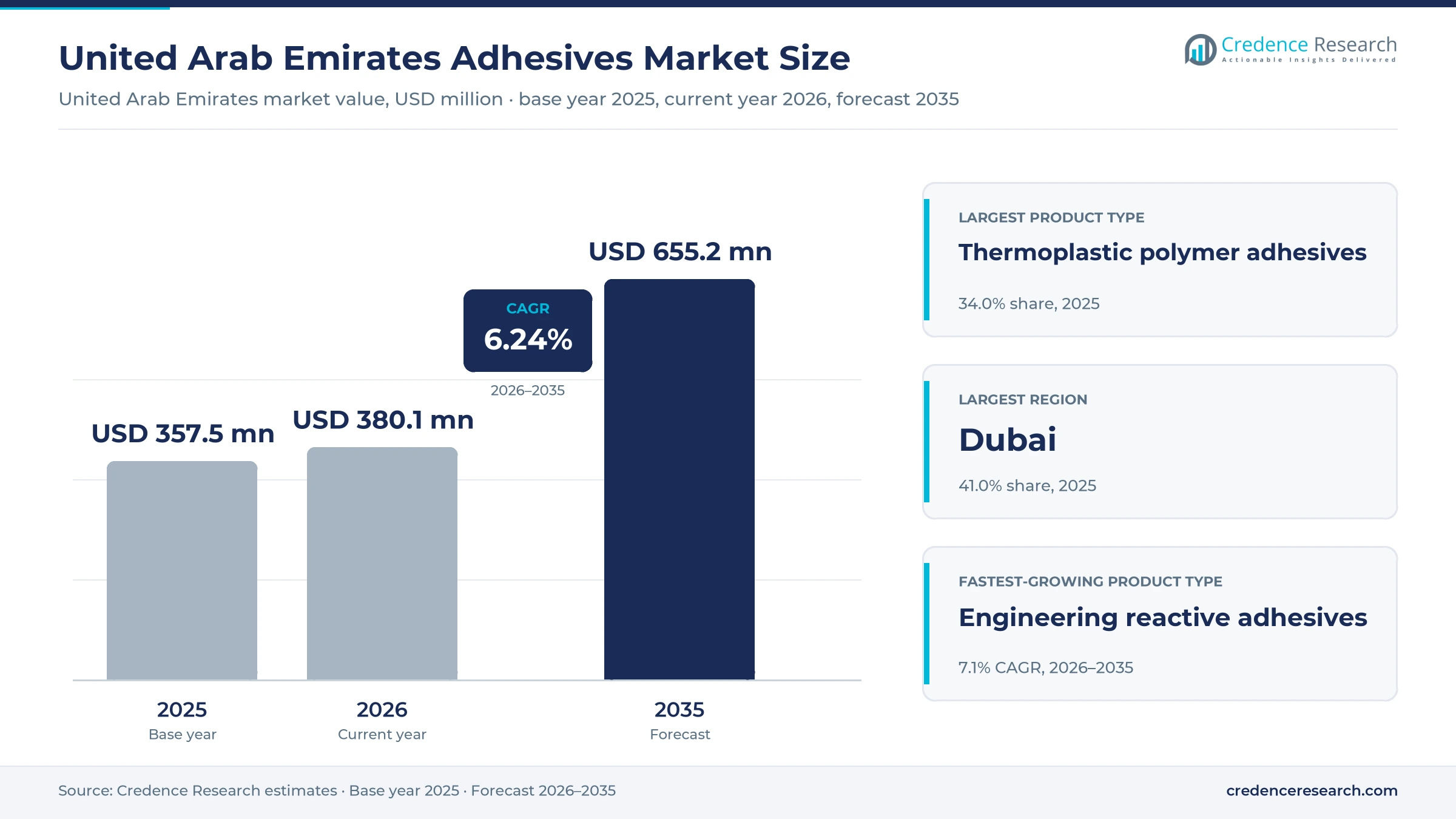
The United Arab Emirates adhesives market was valued at USD 357.5 million in 2025 and is projected to increase from USD 380.1 million in 2026 to USD 655.2 million by 2035, registering a CAGR of 6.24% during 2026–2035. Demand comes from tile and stone fixing, flooring, roofing and facade work on a construction pipeline that is among the busiest in the Gulf, and from packaging, furniture and repair users who buy polymer and reactive grades. Dubai held the largest regional share, 41.0% in 2025, because it licenses the most new floor area and hosts the main distribution hubs in Jebel Ali and Dubai Investments Park. The Northern and Eastern Emirates are the fastest-growing region at 6.8% a year, as resort, housing and industrial projects spread north and east. The main commercial change is local manufacture, with a global adhesive maker opening a dedicated plant in Ras Al Khaimah in 2025, while Dubai's green building system makes certified low-emission products a condition of supply on new buildings.
Which bonding products the UAE market counts
The market counts the value paid by contractors, manufacturers, converters, maintenance firms and households for adhesives used across the UAE. It covers cement-based tile and bonding mortars, thermoplastic polymer adhesives such as PVA, acrylic dispersions and hot-melts, elastomeric contact adhesives and engineering reactive grades based on epoxy, polyurethane, silane and acrylic chemistry, sold for surface installation, assembly, conversion and repair work.
Sealants, grouts, waterproofing membranes, adhesive tapes and labels are excluded unless sold as a bonding product. The chain runs from imported resins and polymers through plants in Ras Al Khaimah, Dubai and Abu Dhabi and from importers to direct project and factory supply, building materials distributors, specialty industrial distributors and retail and online stores.
United Arab Emirates Adhesives Market Insights
- The United Arab Emirates adhesives market grows from USD 357.5 million in 2025 to USD 655.2 million by 2035, a 6.24% CAGR, as construction volume and local manufacture expand together.
- Dubai held 41.0% of 2025 value, because it licensed more than 5.5 million square meters of built-up area in the first half of 2025 alone.
- Thermoplastic polymer adhesives held 34.0% of 2025 value, as packaging, furniture and flooring users consume the largest volume of PVA, acrylic and hot-melt grades.
- H.B. Fuller opened a 15,000-square-meter adhesive and sealant plant in Ras Al Khaimah in June 2025, built on the XCHEM International site acquired in July 2023.
- Imported building materials cost 20% to 25% more than before the 2026 Hormuz disruption, according to developers cited by Moody's, which favors suppliers with UAE plants.
Polymer grades lead as reactive bonding grows fastest
Why polymer grades lead and reactive grades grow fastest
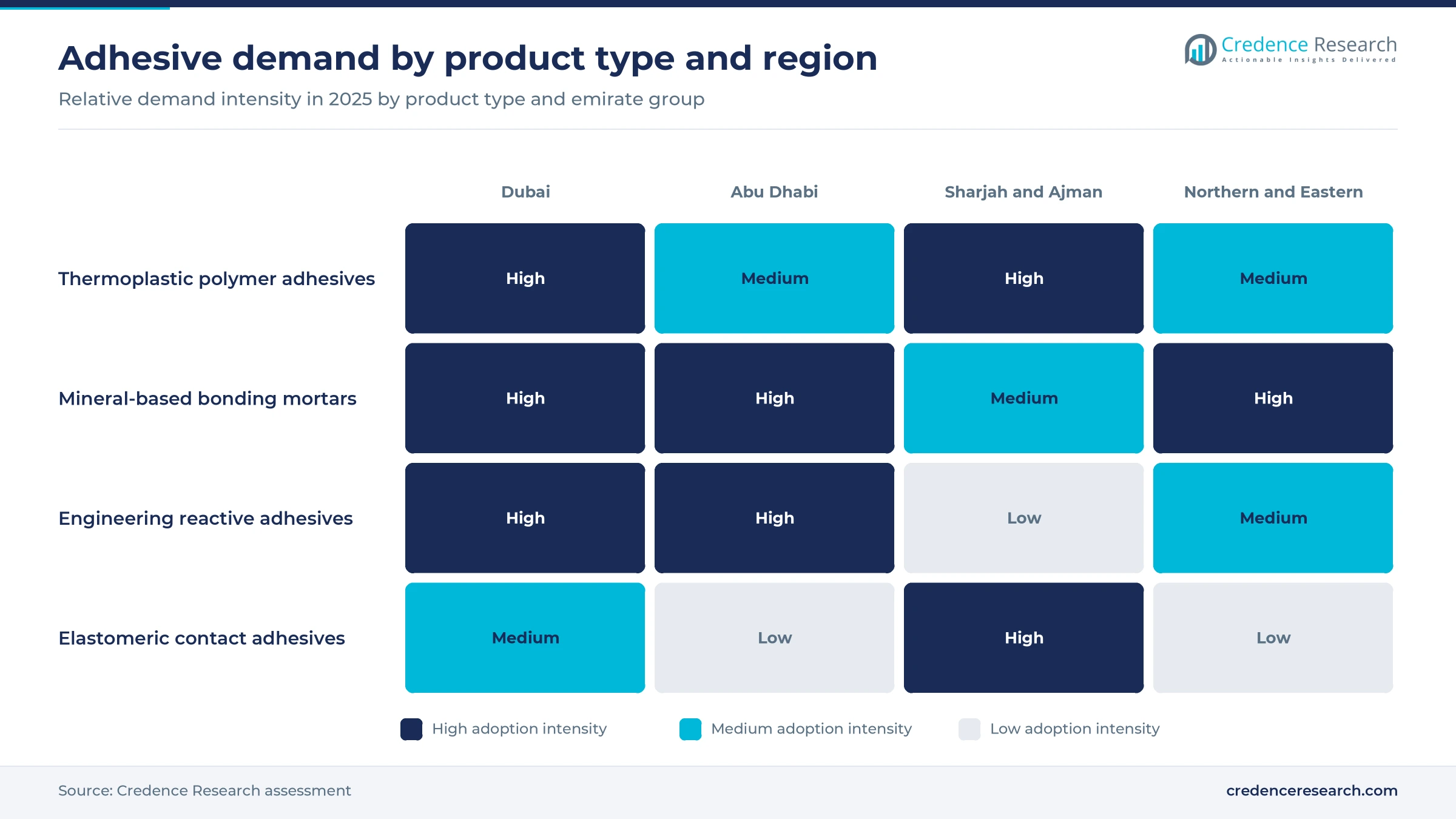
Based on product type, the market is categorized into mineral-based bonding mortars, thermoplastic polymer adhesives, elastomeric contact adhesives and engineering reactive adhesives. Thermoplastic polymer adhesives led with 34.0% of 2025 value because packaging, furniture and flooring users buy them in volume, and the UAE imported 29,187 metric tons of rubber- and plastic-based adhesives in 2023, according to World Bank trade data. Engineering reactive adhesives grow fastest at 7.1% a year as building envelope, roofing and infrastructure work specifies epoxy and polyurethane grades, the focus of the Ras Al Khaimah plant that H.B. Fuller opened in June 2025. Cement-based mortars carry large tonnage at the lowest value per kilogram.
Construction leads as packaging grows fastest
Based on end-use industry, the market is categorized into construction, packaging, woodworking and furniture, transport and specialty manufacturing and household repair. Construction led with 46.0% of 2025 value because tile fixing, flooring and facade work dominate consumption, and construction output grew 11.1% in 2025, according to the Federal Competitiveness and Statistics Centre. Packaging grows fastest at 7.0% a year as the national single-use plastic ban moves food service toward paper and board formats, with plastic cups, plates and cutlery banned from Jan. 1, 2026. Furniture demand gains from local production, including a Dh450 million Sobha Furniture plant in Dubai Industrial City.
Water-based systems lead while hot-melt grows fastest
Based on technology, the market is categorized into water-based systems, reactive curing systems, solvent-based systems and hot-melt systems. Water-Based Systems led with 36.0% of 2025 value because Dubai's low-emitting materials rules cap the VOC content of products used on new buildings, and a Dubai Central Laboratory certificate issued in August 2024 lists limits of 65 g/L for ceramic tile adhesives and 70 g/L for multipurpose construction adhesives. Hot-Melt Systems grow fastest at 7.0% a year as carton sealing, paper cup and furniture edge-banding lines adopt solvent-free bonding. Solvent-based systems lose share to both, as certified buildings and food-contact converters move away from them.
| Segment Group | Leading Sub-segment | Share, 2025 | Fastest-growing Sub-segment | CAGR, 2026–2035 |
|---|---|---|---|---|
| By Product Type | Thermoplastic polymer adhesives | 34.0% | Engineering reactive adhesives | 7.1% |
| By End-Use Industry | Construction | 46.0% | Packaging | 7.0% |
| By Technology | Water-Based Systems | 36.0% | Hot-Melt Systems | 7.0% |
Shelf prices span bulk mortar bags to specialty tubes
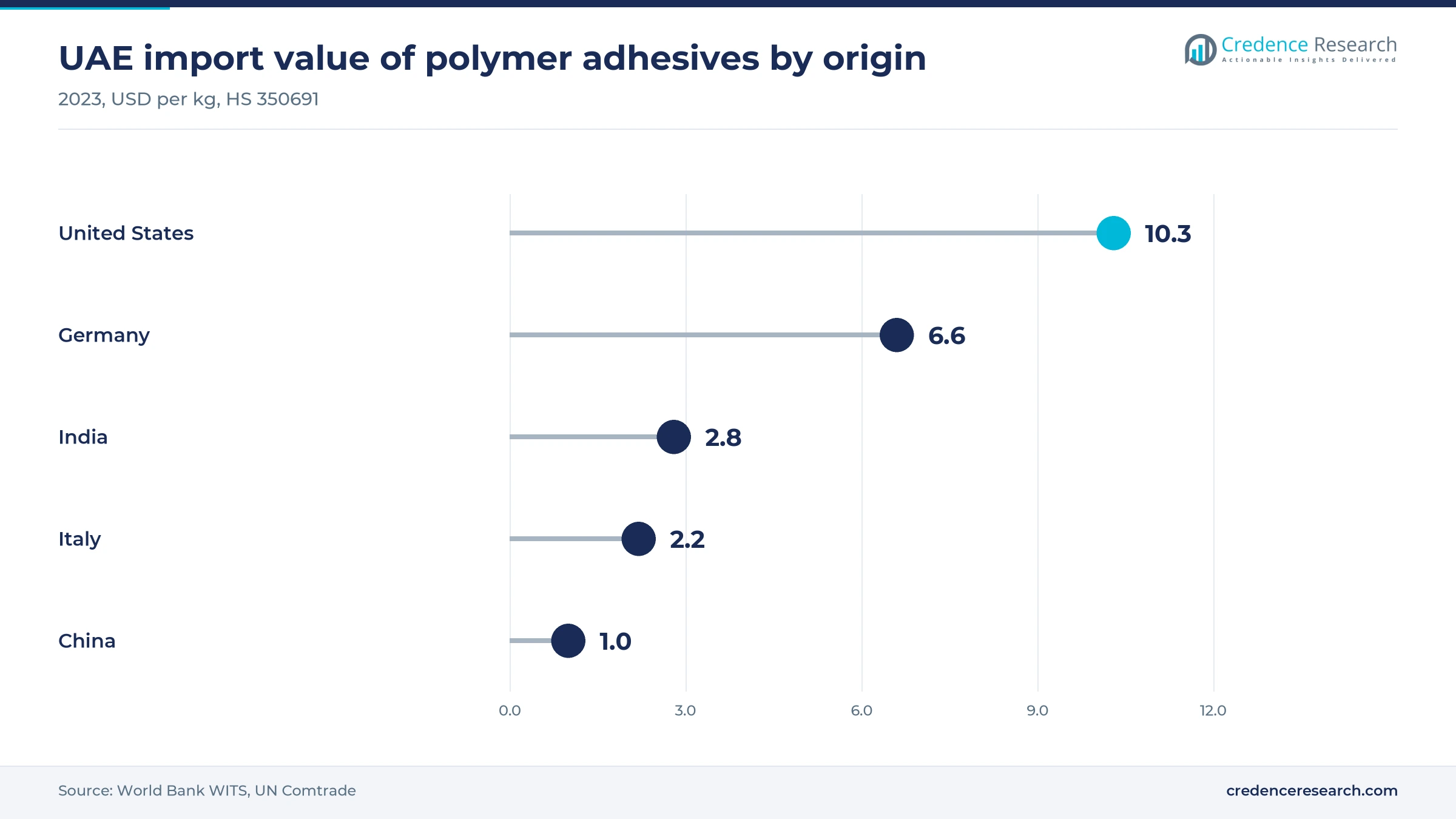
Adhesive pricing in the UAE is set per bag, cartridge or tube at retail and per kilogram or per project in direct supply, and value per kilogram varies more than fiftyfold across the range. A 20 kg bag of cement-based tile adhesive sells for about AED 0.63 a kilogram, while a 380 g construction adhesive cartridge works out near AED 35 a kilogram. Imported origin moves the floor as well, because Chinese polymer adhesives landed at about USD 1.0 a kilogram in 2023 against more than USD 10 from the United States. Suppliers with local plants earn their margins on reactive and certified grades, while commodity mortars compete on freight and price.
| Product and pack | Typical price or fee | Basis |
|---|---|---|
| Cement-based tile adhesive, 20 kg bag | AED 12.50 per bag | Fepy online listing for Webercol Fix, November 2026 |
| Construction adhesive, 380 g cartridge | AED 13.13 per cartridge | Fepy online listing for Pattex PL100, November 2026 |
| Contact adhesive, 50 g tube | AED 12.00 per tube | ACE UAE online listing for Pattex Contact, November 2026 |
| Premium wood glue, 3.8 liter | AED 129.00 per bottle | ACE UAE online listing for Titebond Premium, November 2026 |
| Imported rubber- and plastic-based adhesive, bulk | USD 1.0 to 10.3 per kg by origin | Credence Research estimate from World Bank WITS 2023 import values |
Request a Free Sample
Fill in your details and we'll send you a free sample report.
- Sample data tables & charts
- Research methodology
Permits, factories and low-emission rules widen demand
Construction installation pipeline lifts tile and floor bonding
Every new tower, villa and fit-out in the UAE consumes tile mortars, flooring adhesives and facade bonding agents, so permits are the earliest signal of adhesive orders. Dubai Municipality processed more than 30,000 building permit applications in the first half of 2025, 20% more than a year earlier, covering more than 5.5 million square meters of built-up area. Abu Dhabi completed 12,309 buildings in the same half, according to the Statistics Centre Abu Dhabi. Cushman & Wakefield Core expected Dubai to hand over about 44,000 homes in 2025 and more than 69,000 in 2026, which keeps Construction near half of national adhesive value through the forecast.
Manufacturing diversification adds factory bonding demand
The federal industrial strategy is raising the number of plants that bond, laminate and assemble products inside the UAE. The industrial sector contributed Dh205 billion to GDP in 2024 against a target of Dh300 billion by 2031 under Operation 300bn, according to The National, and In-Country Value spending reached Dh110 billion in 2024. At the Make it in the Emirates event in May 2026, the Ministry of Industry and Advanced Technology listed AED 180 billion of procurement and more than 5,000 products for localization. Each new packaging, furniture or assembly line adds steady repeat orders for hot-melt, dispersion and reactive grades, which favors Packaging and factory direct sales.
Low-emission product qualification shapes what contractors buy
Green building rules now decide which adhesives can be used on new buildings, so certified products command more value. Dubai's green building regulations have applied to all new buildings since March 1, 2014, and under the Al Sa'fat system, updated in 2020 and 2023, Dubai Municipality certifies adhesives, adhesive primers and sealants for VOC content under its low-emitting materials clause. Pidilite MEA Chemicals holds such a certificate for tile, carpet and construction adhesives made in Dubai Investments Park, reissued in August 2024. In Abu Dhabi, the Estidama Pearl system requires at least one pearl for private and two for government buildings before a permit is issued. These rules push specifiers toward Water-Based Systems, which carry a price premium over solvent grades.
Housing and resort projects spread beyond Dubai and Abu Dhabi
Building activity is widening across the smaller emirates, which brings new contractors and distributors into the adhesive market. Ajman construction contracts rose 62.5% to more than AED 9.655 billion in 2024, according to the Ajman Municipality and Planning Department. Sharjah recorded real estate trading of AED 65.6 billion in 2025, 64.3% above 2024, according to Sharjah Update. Ras Al Khaimah posted residential sales of Dh12.4 billion across about 6,600 deals in 2025, with 85% off-plan, according to Cavendish Maxwell, ahead of the Wynn Al Marjan resort opening due in 2027. This spread gives the Northern and Eastern Emirates the fastest growth of the four emirate groups in the forecast.
Local supply, paper packaging and rail reshape the market
Global makers shift from importing to producing in the UAE
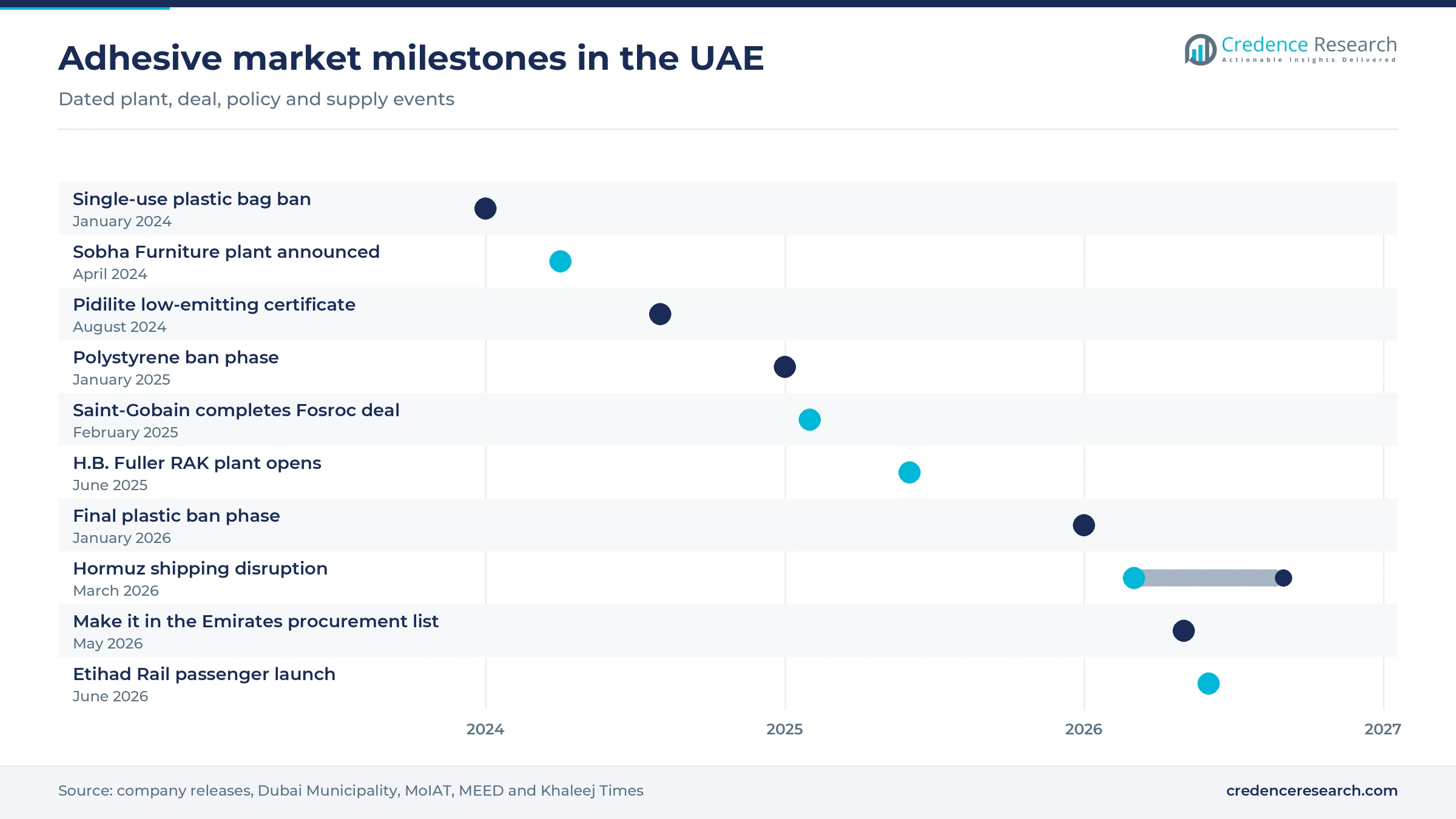
Adhesive supply is shifting from import and distribution toward production inside the country. H.B. Fuller bought XCHEM International, a Ras Al Khaimah maker, in July 2023, and opened a 15,000-square-meter adhesive and sealant plant in Al Hamra Industrial Zone in June 2025 to serve building envelopes, roofing and infrastructure across the Middle East and North Africa. Saint-Gobain completed its acquisition of Fosroc in February 2025, adding 20 plants and adhesive and sealant lines to its Weber range. Mapei runs a factory on a 40,000-square-meter plot in Dubai Investments Park. Local output shortens lead times for contractors and favors Engineering reactive adhesives, the fastest-growing product type.
Paper packaging rise follows the single-use plastic ban
The phased ban on single-use products is shifting food service and retail packaging from plastic to paper and board, which needs carton sealing, cup forming and lamination adhesives. Under Cabinet Resolution 380 of 2022, single-use plastic bags were banned from Jan. 1, 2024, polystyrene cups, plates and containers from Jan. 1, 2025, and plastic plates, cutlery and cups from Jan. 1, 2026, according to Dubai Municipality. Converters replacing these items buy hot-melt and water-based grades rather than heat-sealed plastics. This shift favors Hot-Melt Systems, the fastest-growing technology, because paper cups and cartons are bonded on high-speed lines that need fast-setting, solvent-free adhesives.
Rail and transport assembly open a reactive bonding niche
Rail, bus and aviation work is opening a small but high-value niche for structural adhesives and sealing systems. Etihad Rail began passenger trains between Fujairah and Abu Dhabi on June 30, 2026, and plans to add Dubai and Al Dhaid from Sept. 30, 2026, and Sharjah in March 2027 on an 11-station network, Arab News reported. The National reported in October 2025 that passenger numbers are expected to reach 36 million by 2030, and that a separate high-speed line between Abu Dhabi and Dubai has six planned stations. Stations, depots and interior refits need epoxy and polyurethane grades that pass fire and durability tests. Suppliers with certified reactive ranges can win specification early, before contractors are appointed.
Factory localization opens long-term supply contracts
The localization program gives adhesive makers an opening to win long-term supply contracts with new UAE factories. Manufacturing made up 12.8% of non-oil GDP in 2025, according to the Federal Competitiveness and Statistics Centre, and industrial exports reached AED 262 billion that year, according to Khaleej Times in June 2026. Furniture makers are following, including the Sobha plant noted in the segment section. Industrial and public buildings also took 15% of the floor area Dubai licensed in the first half of 2025. Each new line needs contact, hot-melt and dispersion adhesives on contract terms, a demand that favors makers able to certify local content and deliver within days.
Import costs, price-led tenders and solvent rules weigh
The Hormuz disruption raises landed costs
Shipping disruption around the Strait of Hormuz in 2026 has raised the cost of imported building inputs. Moody's said in July 2026 that imported building material costs had risen roughly 20% to 25% above pre-conflict levels, with inventories covering two to six months. Adhesive importers face the same freight premium on resins and finished goods, and contractors on fixed-price contracts resist pass-through, which squeezes distributor margins until trade routes normalize.
Import dependence leaves resins exposed to currency and freight
Most polymer adhesive volume still arrives from abroad, so local prices follow freight and supplier pricing in India and China. India supplied USD 30.3 million and China USD 10.0 million of the USD 78.1 million in rubber- and plastic-based adhesive imports in 2023, according to World Bank trade data. Local plants also buy most base polymers abroad, which limits how far domestic production can cut costs.
Price-led tenders compress margins on mortars
Tile mortars and general bonding products are bought on price in large project tenders, which keeps margins thin. A 20 kg bag of cement-based tile adhesive lists at AED 12.50 online, as shown in the pricing table, and building material prices rose between 1.5% and 14% from late April to mid-May 2026, according to Enterprise. Mortar makers absorb cement and freight increases they cannot pass on, so profit sits mainly in certified polymer and reactive grades.
Emission limits squeeze solvent-based ranges
Low-emitting materials rules restrict the solvent contact and construction adhesives that many small importers and repair shops still sell. Dubai certificates cap multipurpose construction adhesives at 70 g/L of VOC and carpet pad adhesives at 50 g/L, as noted above and products without a conformity mark cannot be used on certified buildings. Importers of industrial solvents and solvent glues must reformulate or retreat to repair and retail channels, which lowers their growth.
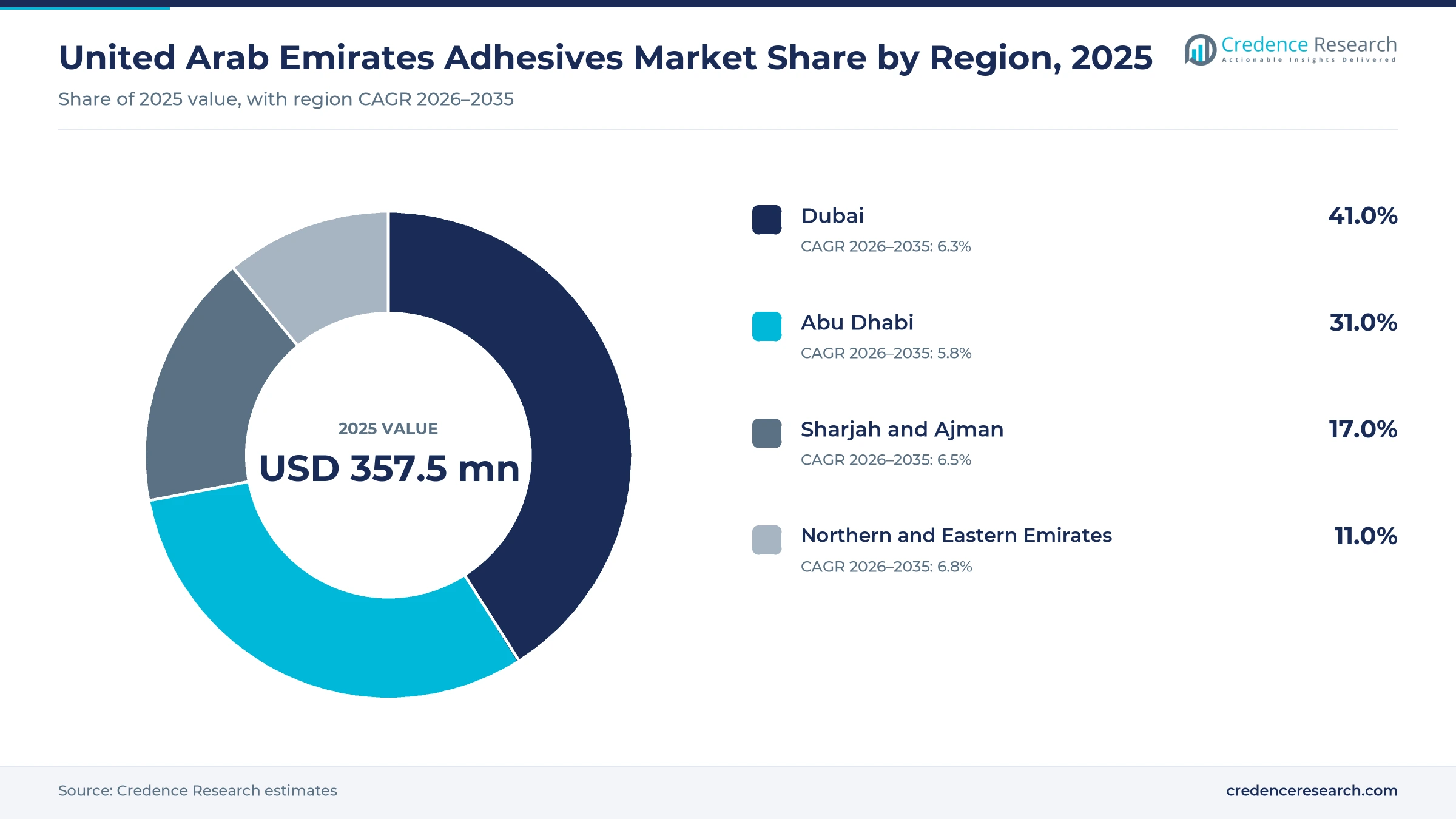
Dubai leads while the northern emirates grow fastest
| Region | Value, 2025 (USD million) | Share, 2025 | CAGR, 2026–2035 |
|---|---|---|---|
| Dubai | 146.6 | 41.0% | 6.3% |
| Abu Dhabi | 110.8 | 31.0% | 5.8% |
| Sharjah and Ajman | 60.8 | 17.0% | 6.5% |
| Northern and Eastern Emirates | 39.3 | 11.0% | 6.8% |
Dubai leads on licensed floor area and distribution hubs
Dubai held a 41.0% share of 2025 value and grows at 6.3% a year. It issued 10,776 building permits in the first quarter of 2026, 12% more than a year earlier, and 3,154 completion certificates, according to the Dubai Media Office. Multi-story commercial buildings took 45% of the area licensed in the first half of 2025, which favors facade, flooring and commercial fit-out bonding. Jebel Ali and Dubai Investments Park also serve as stock points for the whole country.
Abu Dhabi grows on public and industrial projects
Abu Dhabi held a 31.0% share of 2025 value and grows at 5.8% a year, the slowest of the four groups. The emirate issued 4,994 building permits in the first half of 2025, according to the Statistics Centre Abu Dhabi, and in the second quarter alone 1,438 permits were residential and 208 industrial. Estidama ratings tie its government projects to certified low-emission products. Large public and industrial jobs are bought through direct project supply, so prices stay competitive and growth sits below the national rate.
Sharjah and Ajman gain on housing and industry
Sharjah and Ajman held a 17.0% share of 2025 value and grow at 6.5% a year. Both emirates host dense industrial areas with furniture, packaging and metal workshops that buy contact, hot-melt and dispersion adhesives in small lots through specialty distributors. Housing demand is strong, as the Sharjah and Ajman property and contract figures noted above show, and Etihad Rail plans a Sharjah station at University City from March 2027. Lower land costs keep workshops and warehouses moving north from Dubai.
The northern and eastern emirates grow fastest
The northern and eastern emirates held an 11.0% share of 2025 value and grow fastest at 6.8% a year. Ras Al Khaimah is home to the H.B. Fuller plant in Al Hamra and to the Wynn Al Marjan resort, while Fujairah is the eastern end of the first Etihad Rail passenger route, which opened on June 30, 2026. Resort, housing and port logistics projects in these emirates use tile mortars, roofing adhesives and thermal insulation materials bonded with reactive grades.
Plant openings, mergers and rules mark 2024 to 2026
| Development | Status and market relevance |
|---|---|
| In April 2024, Sobha Group announced a Dh450 million Sobha Furniture plant in Dubai Industrial City on an 84,000-square-meter plot. | Announced; adds furniture and seating lines that use contact and hot-melt adhesives |
| In February 2025, Saint-Gobain completed its acquisition of Fosroc, adding 20 plants and about 3,000 employees to its construction chemicals business. | Completed; merges Fosroc adhesives with the Weber range |
| In June 2025, H.B. Fuller opened its 15,000-square-meter adhesive and sealant plant in Al Hamra Industrial Zone, Ras Al Khaimah. | Operating; supplies construction grades across the region |
| In June 2026, Etihad Rail began passenger trains between Fujairah and Abu Dhabi. | Operating; stations, depots and refits add demand for certified reactive grades |
| In May 2026, the Ministry of Industry and Advanced Technology listed AED 180 billion in procurement opportunities at Make it in the Emirates. | Announced; more than 5,000 products identified for localization |
Low-VOC water-based and reactive systems set the pace
- Water-based systems use PVA, acrylic and polymer-modified dispersions, and they meet Dubai VOC limits for tile, floor and wood bonding with little reformulation.
- Reactive curing systems cure through epoxy, polyurethane or silane chemistry and give the strength and heat resistance needed for facades, roofs and transport parts.
- Solvent-based systems still supply many contact and repair adhesives, but rising VOC limits are shrinking their use on certified buildings.
- Hot-melt systems bond cartons, paper cups and furniture edges in seconds without solvents, and they suit the high-speed lines being added by local converters.
Need a Custom Version of This Report?
Tailor the scope, geography, or segments to your exact requirements.
- Custom geography or segment scope
- Direct access to our analyst team
Global groups now compete from plants inside the UAE
Competition in the UAE adhesive market turns on three things, namely specification on large projects, certified low-emission ranges and the speed of local delivery. Global construction chemical groups compete for consultant approval on towers, infrastructure and public buildings, where one specification can carry a product through several years of supply. Saint-Gobain now sells both Weber and Fosroc ranges, and H.B. Fuller pairs its Ras Al Khaimah plant with the former XCHEM portfolio. Henkel leads in packaging and retail through Technomelt, Pattex and Loctite, while Pidilite sells Fevicol and Roff products made in Dubai. Sika supplies epoxy flooring resins and concrete chemicals from its Dubai production site. Smaller importers win repair and retail sales on price, but they lack the certificates and local stock that project buyers require, particularly where adhesives are specified together with construction sealants and joint systems.
How the UAE supply side is organized
The UAE supply side is organized in three tiers of very different scale. Global groups with UAE plants, including H.B. Fuller in Ras Al Khaimah, Mapei and Pidilite in Dubai Investments Park, and Saint-Gobain through Fosroc and Weber, lead in certified construction grades and win most project specifications. Henkel supplies packaging, industrial and retail brands through its Gulf organization. A large tier of importers and regional makers competes on price in mortars, contact glues and repair products. Certification and local stock are the main barriers, and margins sit in reactive and certified grades.
Companies profiled and their roles in this market
| Company | Type | Role in the market |
|---|---|---|
| H.B. Fuller (XCHEM International) | Global adhesive maker | Ras Al Khaimah plant opened June 2025; XCHEM acquired July 2023 with more than 150 products |
| Saint-Gobain (Fosroc and Weber) | Construction chemicals group | Completed Fosroc acquisition in February 2025; Weber tile adhesives sold through UAE distributors |
| Mapei | Construction chemicals maker | Factory on a 40,000-square-meter plot in Dubai Investments Park making tile and floor adhesives |
| Henkel | Adhesive and consumer brands group | Technomelt, Polybit, Pritt, Pattex and Loctite brands; more than 850 Gulf employees |
| Pidilite MEA Chemicals | Adhesive and chemicals maker | Dubai Investments Park site with Dubai Central Laboratory low-emitting certificate |
| Sika | Construction chemicals maker | Dubai site producing concrete admixtures and epoxy flooring resins |
Local manufacture is becoming the decisive advantage
Credence Research's view is that local manufacture is becoming the decisive advantage in the United Arab Emirates adhesives market. Demand is secure while permits and handovers stay near record levels, but the 2026 freight shock showed how quickly imported supply can lose its price edge. Suppliers with UAE plants, certified low-emission ranges and In-Country Value scores are best placed to win project and factory contracts. Importers can still compete in repair and retail, yet they should expect slower growth as solvent grades lose ground. Engineering reactive adhesives, growing at 7.1% a year, carry the highest value per kilogram.
Trade data and permit statistics anchor the estimates
The report uses 2025 as the base year and forecasts value to 2035 in USD million from the Credence Research market model. Segment and regional splits are Credence Research estimates built from World Bank WITS trade data, Federal Competitiveness and Statistics Centre output data, permit and completion statistics from Dubai Municipality, the Statistics Centre Abu Dhabi and the Ajman Municipality, Dubai Central Laboratory certificates, company releases and online retail price listings. No interviews or surveys were used for this edition of the report.
Construction volume and local plants carry growth to 2035
The United Arab Emirates adhesives market reaches USD 655.2 million by 2035, growing at 6.24% a year from USD 380.1 million in 2026. Thermoplastic polymer adhesives keep the largest share as packaging and furniture lines expand, while engineering reactive adhesives grow fastest on facade, roofing and transport work. Dubai stays the largest region, and the northern and eastern emirates gain share as resort and housing projects move north. The length of the construction cycle and the cost of imported resins are the two factors most likely to move the forecast, while local plants reduce exposure to freight shocks.
Construction pace and freight costs set the range to 2035
The range of outcomes depends on how long the construction cycle lasts and how quickly shipping costs settle. A slowdown in Dubai handovers after 2027, combined with a longer freight shock, would cut project volumes and margins and produce the downside. A steady pipeline, local plants running at full rate and wider low-emission rules in the northern emirates would lift demand for certified grades and produce the upside.
| Scenario | CAGR, 2026–2035 | Value, 2035 | What has to hold |
|---|---|---|---|
| Downside | 4.6% | USD 571.6 million | Dubai handovers fall after 2027 and freight costs stay high into 2028 |
| Base | 6.24% | USD 655.2 million | Permits stay near 2025 levels and local plants replace part of imports |
| Upside | 7.6% | USD 737.2 million | Rail, resort and factory projects add volume and low-emission rules spread nationwide |
Frequently Asked Questions
How big is the United Arab Emirates adhesives market?
Which product type leads the market?
Which product type grows fastest?
Which region leads UAE adhesive demand?
Which region grows fastest?
How do green building rules affect adhesive sales?
What are the main challenges for suppliers?
Who are the key companies in the market?
Table of Content
Chapter 1 Market Segmentation
- 1.1 Segmentation Framework
- 1.1.1 Product and Service Classification
- 1.1.2 Application and End-Use Classification
- 1.1.3 Technology and Solution Classification
- 1.1.4 Customer and Distribution Channel Classification
- 1.1.5 Geographic Segmentation
- 1.1.6 Market Segment Definitions and Boundaries
- 1.2 By Product Type
- 1.2.1 Thermoplastic polymer adhesives
- 1.2.2 Mineral-based bonding mortars
- 1.2.3 Engineering reactive adhesives
- 1.2.4 Elastomeric contact adhesives
- 1.3 By End-Use Industry
- 1.3.1 Construction
- 1.3.2 Packaging
- 1.3.3 Woodworking and Furniture
- 1.3.4 Transport
- 1.3.5 Specialty Manufacturing and Household Repair
- 1.4 By Technology
- 1.4.1 Water-Based Systems
- 1.4.2 Reactive Curing Systems
- 1.4.3 Solvent-Based Systems
- 1.4.4 Hot-Melt Systems
Chapter 2 Introduction
- 2.1 Report Objectives and Scope
- 2.2 Product Definition and Industry Terminology
- 2.3 Market Inclusions and Exclusions
- 2.4 Research Process
- 2.4.1 Primary Research and Expert Interviews
- 2.4.2 Secondary Research and Source Review
- 2.4.3 Top-Down and Bottom-Up Estimation
- 2.4.4 Data Triangulation and Verification
- 2.5 Market Size Measurement Basis
- 2.5.1 2025: USD 357.5 million → 2035: USD 655.2 million
- 2.6 Historical and Forecast Reference Periods
- 2.6.1 Historical Period: 2018-2025
- 2.6.2 Base Year: 2025
- 2.6.3 Forecast Period: 2025-2035
- 2.7 Research Assumptions and Limitations
Chapter 3 Executive Summary
- 3.1 Market Snapshot and Key Findings
- 3.2 Base-Year Market Size, 2025
- 3.3 Forecast Market Size, 2035
- 3.4 Revenue and Volume Growth Outlook
- 3.5 Key Demand and Supply Indicators
- 3.6 Leading Market Segments
- 3.7 Fastest-Growing Market Opportunities
- 3.8 Regional Performance Highlights
- 3.9 Technology and Industry Transformation
- 3.10 Competitive Landscape Summary
- 3.11 Analyst View and Strategic Implications
Chapter 4 United Arab Emirates Adhesives Market Trends and Developments
- 4.1 Historical Industry Development, 2018-2025
- 4.2 Recent Market Trends and Developments
- 4.3 Demand and Customer Behavior Trends
- 4.4 Technology and Product Innovation
- 4.5 Artificial Intelligence, Automation and Digitalization
- 4.6 Local Manufacturing and Supply Chain Realignment
- 4.7 Industry Partnerships, Mergers and Acquisitions
- 4.8 Sustainability and Circular Economy Developments
- 4.9 Government and Private Sector Investment Trends
- 4.10 Emerging Business Models and Commercialization
- 4.11 Industry Developments and Announcements
Chapter 5 United Arab Emirates Adhesives Market Production, Supply and Demand Analysis
- 5.1 Demand Trend and Consumption Analysis, 2018-2025
- 5.2 Demand Forecast, 2025-2035
- 5.3 Production and Output Trend, 2018-2025
- 5.4 Production and Output Forecast, 2025-2035
- 5.5 Installed Capacity and Capacity Utilization
- 5.6 Company-Wise Production Plants and Statistics
- 5.6.1 Installed Production Capacity
- 5.6.2 Actual Production
- 5.6.3 Planned Capacity and Expansion Targets
- 5.7 Supply Chain Structure and Procurement Trends
- 5.8 Supply-Demand Gap and Bottlenecks
- 5.9 Import Dependence and Sourcing Structure
- 5.10 Contract Manufacturing and Outsourcing
- 5.11 Regional Supply and Demand Concentration
Chapter 6 United Arab Emirates Adhesives Market Pricing Analysis
- 6.1 Pricing Structure and Measurement
- 6.2 Historical Pricing Trends, 2018-2025
- 6.3 Pricing Outlook, 2025-2035
- 6.4 Average Selling Price and Unit Economics
- 6.5 Pricing by Product and Market Segment
- 6.6 Geographic Pricing Differences
- 6.7 Key Input, Energy, Labor and Logistics Costs
- 6.8 Contract Pricing and Purchasing Models
- 6.9 Pricing Sensitivity and Competitive Positioning
- 6.10 Price, Margin and Profitability Implications
Chapter 7 United Arab Emirates Adhesives Market Dynamics
- 7.1 Market Growth Drivers
- 7.1.1 Demand-Side Drivers
- 7.1.2 Technology and Innovation Drivers
- 7.1.3 Infrastructure and Investment Drivers
- 7.1.4 Regulatory and Policy Drivers
- 7.2 Market Restraints
- 7.2.1 Cost and Affordability Constraints
- 7.2.2 Technology and Adoption Barriers
- 7.2.3 Supply Chain and Operational Constraints
- 7.3 Market Challenges
- 7.3.1 Competitive Pressure and Margin Erosion
- 7.3.2 Skills, Infrastructure and Implementation Gaps
- 7.4 Emerging Market Opportunities
- 7.5 Market Dynamics Impact and Time-Horizon Assessment
Chapter 8 United Arab Emirates Adhesives Value Chain Analysis
- 8.1 Industry Value Chain Overview
- 8.2 Upstream Suppliers and Critical Inputs
- 8.3 Technology and Component Providers
- 8.4 Manufacturing or Service Delivery
- 8.5 Distribution, Channel Partners and Integrators
- 8.6 Downstream Applications and End Users
- 8.7 Value Addition and Profit Pools
- 8.8 Vertical Integration and Outsourcing
- 8.9 Supplier Concentration and Risk
- 8.10 Supply Chain Localization and Resilience
Chapter 9 United Arab Emirates Adhesives Market Regulations and Policies
- 9.1 Relevant Laws, Standards and Compliance Frameworks
- 9.2 Product, Service, Safety and Quality Requirements
- 9.3 Government Policies, Incentives and Subsidies
- 9.4 Imports, Exports and Trade Barriers
- 9.5 Public Procurement and Local Content Requirements
- 9.6 Environmental and Sustainability Compliance
- 9.7 Upcoming Policy Changes and Market Implications
Chapter 10 United Arab Emirates Adhesives Market Hotspots and Opportunities
- 10.1 Market Opportunity Mapping and Growth Hotspots
- 10.2 High-Growth Applications and Customer Groups
- 10.3 Underserved Markets and White-Space Opportunities
- 10.4 Emerging Technology and Product Opportunities
- 10.5 New Capacity and Investment Hotspots
- 10.6 Market Entry and Expansion Opportunities
- 10.7 Distribution and Partnership Opportunities
- 10.8 Near-Term and Long-Term Commercial Potential
- 10.9 Opportunity Attractiveness and Execution Risks
Chapter 11 United Arab Emirates Adhesives Market Outlook, 2025-2035
- 11.1 Market Size and Analysis
- 11.1.1 Revenue (Market Measurement: 2025: USD 357.5 million → 2035: USD 655.2 million)
- 11.1.2 Market Volume and Quantity Sold
- 11.1.3 Historical Market Size, 2018-2025
- 11.1.4 Base-Year Market Size, 2025
- 11.2 Market Forecast, 2025-2035
- 11.2.1 Revenue Forecast to 2035
- 11.2.2 Volume Forecast to 2035
- 11.2.3 CAGR and Year-on-Year Growth
- 11.2.4 Incremental Revenue Opportunity
- 11.3 Forecast Assumptions and Scenario Analysis
- 11.3.1 Base-Case Forecast
- 11.3.2 Optimistic and Conservative Scenarios
- 11.3.3 Technology, Pricing and Policy Sensitivities
- 11.4 Market Attractiveness and Growth Outlook
Chapter 12 United Arab Emirates Adhesives Market Segmentation and Outlook
- 12.1 Segmentation Summary and Market Shares, 2025
- 12.2 Largest and Fastest-Growing Segments
- 12.3 By Product Type - Market Size and Forecast, 2025-2035
- 12.3.1 Segment Definition and Scope
- 12.3.2 Historical Market Size, 2018-2025
- 12.3.3 Revenue Forecast, 2025-2035
- 12.3.4 Volume Forecast, 2025-2035
- 12.3.5 Base-Year Market Share, 2025
- 12.3.6 Segment CAGR and Growth Drivers
- 12.3.7 Subsegment Market Size and Forecast
- 12.3.7.1 Thermoplastic polymer adhesives
- 12.3.7.2 Mineral-based bonding mortars
- 12.3.7.3 Engineering reactive adhesives
- 12.3.7.4 Elastomeric contact adhesives
- 12.3.8 Subsegment Pricing and Adoption Trends
- 12.3.9 Leading Suppliers and Competition
- 12.3.10 Regional Demand and Opportunities
- 12.4 By End-Use Industry - Market Size and Forecast, 2025-2035
- 12.4.1 Segment Definition and Scope
- 12.4.2 Historical Market Size, 2018-2025
- 12.4.3 Revenue Forecast, 2025-2035
- 12.4.4 Volume Forecast, 2025-2035
- 12.4.5 Base-Year Market Share, 2025
- 12.4.6 Segment CAGR and Growth Drivers
- 12.4.7 Subsegment Market Size and Forecast
- 12.4.7.1 Construction
- 12.4.7.2 Packaging
- 12.4.7.3 Woodworking and Furniture
- 12.4.7.4 Transport
- 12.4.7.5 Specialty Manufacturing and Household Repair
- 12.4.8 Subsegment Pricing and Adoption Trends
- 12.4.9 Leading Suppliers and Competition
- 12.4.10 Regional Demand and Opportunities
- 12.5 By Technology - Market Size and Forecast, 2025-2035
- 12.5.1 Segment Definition and Scope
- 12.5.2 Historical Market Size, 2018-2025
- 12.5.3 Revenue Forecast, 2025-2035
- 12.5.4 Volume Forecast, 2025-2035
- 12.5.5 Base-Year Market Share, 2025
- 12.5.6 Segment CAGR and Growth Drivers
- 12.5.7 Subsegment Market Size and Forecast
- 12.5.7.1 Water-Based Systems
- 12.5.7.2 Reactive Curing Systems
- 12.5.7.3 Solvent-Based Systems
- 12.5.7.4 Hot-Melt Systems
- 12.5.8 Subsegment Pricing and Adoption Trends
- 12.5.9 Leading Suppliers and Competition
- 12.5.10 Regional Demand and Opportunities
- 12.6 Segment Growth Comparison
- 12.7 Segment Attractiveness and Priority Matrix
Chapter 13 United Arab Emirates Adhesives End-Use and Application Market Outlook
- 13.1 End-Use Industry and Customer Demand Structure
- 13.2 Leading Applications and Customer Groups
- 13.3 End-Use Market Size, Share and Forecast
- 13.4 Major End-Use Industry Deep Dives
- 13.4.1 Customer Requirements and Use Cases
- 13.4.2 Demand and Replacement Cycles
- 13.4.3 Technical and Regulatory Considerations
- 13.4.4 Purchasing and Procurement Models
- 13.4.5 Leading Vendors and Distribution Channels
- 13.4.6 Forecast and Commercial Opportunities
- 13.5 Emerging Applications and Cross-Segment Demand
- 13.6 End-Use Industry Investment Priorities
Chapter 14 United Arab Emirates Adhesives Geographic Market Outlook, 2025-2035
- 14.1 Domestic Market Distribution and Demand Clusters
- 14.2 State- or Province-Wise Market Size and Forecast, 2025-2035
- 14.3 City and Metropolitan Market Outlook
- 14.4 Industrial, Manufacturing and Commercial Clusters
- 14.5 Geographic Concentration of Key End Users
- 14.6 Local Pricing and Purchasing Differences
- 14.7 Domestic Production Facilities and Capacity Map
- 14.8 Local Infrastructure and Project Pipeline
- 14.9 State-Level Policy and Incentive Differences
- 14.10 Subnational Investment Hotspots and Opportunities
- 14.11 Distribution and Logistics Networks
- 14.12 Domestic Competitive Footprint
Chapter 15 United Arab Emirates Adhesives Technology, Innovation and Sustainability Outlook
- 15.1 Technology Landscape and Maturity
- 15.2 Product, Process and Service Innovation
- 15.3 AI, Automation and Digital Tools in the Industry
- 15.4 Technology Adoption and Performance Benchmarking
- 15.5 Innovation Pipeline and R&D Investment
- 15.6 Patent and Intellectual Property Trends
- 15.7 Energy Efficiency and Resource Management
- 15.8 Sustainability, Recycling and Circularity
- 15.9 Technology Roadmap, 2025-2035
- 15.10 Risks of Obsolescence and Technology Substitution
Chapter 16 United Arab Emirates Adhesives Market Key Strategic Imperatives
- 16.1 Growth and Market Entry Priorities
- 16.2 High-Return Products and Segments
- 16.3 Pricing, Profitability and Cost Optimization
- 16.4 Technology Investment and Product Differentiation
- 16.5 Supply Chain Localization and Resilience
- 16.6 Distribution and Customer Acquisition
- 16.7 Partnership, Acquisition and Capacity Strategy
- 16.8 Regional Expansion Priorities
- 16.9 Short-, Medium- and Long-Term Actions
Chapter 17 Competition Outlook
- 17.1 Industry Competition Characteristics
- 17.2 Market Structure and Concentration
- 17.3 Market Share and Competitive Positioning, 2025
- 17.4 Company-Wise Revenue and Product Benchmarking
- 17.5 Production and Service Capacity Benchmarking
- 17.6 Technology, Pricing and Differentiation
- 17.7 Regional Footprint and Distribution Strength
- 17.8 Mergers, Acquisitions and Strategic Alliances
- 17.9 New Entrants and Competitive Threats
- 17.10 Porter's Five Forces and Industry Attractiveness
- 17.11 Competitive Outlook, 2025-2035
Chapter 18 Company Profiles
- 18.1 Company Coverage and Selection Criteria
- 18.2 H.B. Fuller (XCHEM International)
- 18.2.1 Business Description
- 18.2.2 Company Ownership and Geographic Presence
- 18.2.3 Product and Service Portfolio
- 18.2.4 Manufacturing and Operating Footprint
- 18.2.5 Production Capacity and Expansion Plans
- 18.2.6 Financial Performance and Investment
- 18.2.7 Market Share and Competitive Position
- 18.2.8 Technology and Innovation Capabilities
- 18.2.9 Strategic Alliances or Partnerships
- 18.2.10 Recent Developments
- 18.2.11 Growth Strategy and Outlook
- 18.3 Saint-Gobain (Fosroc and Weber)
- 18.4 Mapei
- 18.5 Henkel
- 18.6 Pidilite MEA Chemicals
- 18.7 Sika
- 18.8 Other Relevant Market Participants
Note: Every listed company is profiled on the structure shown under the first company. The company list is preliminary and may change based on research findings, market developments, data availability and client requirements.
Chapter 19 Disclaimer
- 19.1 Research and Forecast Disclaimer
- 19.2 Data Source and Estimation Limitations
Note: The depth of individual sections depends on data availability for this market. Volume, capacity, trade and other unit-based metrics are included where applicable.

