
Puja tablets anchor a pine-based aroma chemical trade
The India camphor market was valued at USD 300.0 million in 2025 and is projected to increase from USD 320.0 million in 2026 to USD 540.6 million by 2035, registering a CAGR of 6.00% during 2026–2035. Demand comes from households and temples that burn camphor during aarti and daily puja, from balm and vapor rub makers that use it as an active ingredient, and from home fragrance and insect-repellent products. North India and West India shared the lead in 2025, the first on pilgrim footfall in Uttar Pradesh and the second on the Maharashtra plants and tablet makers that supply the country. Northeast India is the fastest-growing region at 7.01% a year, from a small base. The main commercial change is a squeeze on costs, as alpha-pinene feedstock rose sharply in 2026 and makers passed on double-digit price increases to buyers.
What camphor sales are counted in this market?
The market counts the value of camphor sold in India as tablets, powder and refined crystal or slab, whether made from imported turpentine and alpha-pinene by domestic plants, imported in finished form, or pressed into small packs by regional converters. It covers puja and household use, pharmaceutical and over-the-counter balm and rub supply, and aroma uses such as cones, fresheners and repellent formats.
The scope excludes camphor oil distilled from leaves, the finished value of balms, rubs and incense sticks, and export sales by Indian makers. Value is counted once at the point of sale to the end buyer, so a pack sold through a kirana shop or a supermarket is included, while bulk transfers between converters are not counted again.
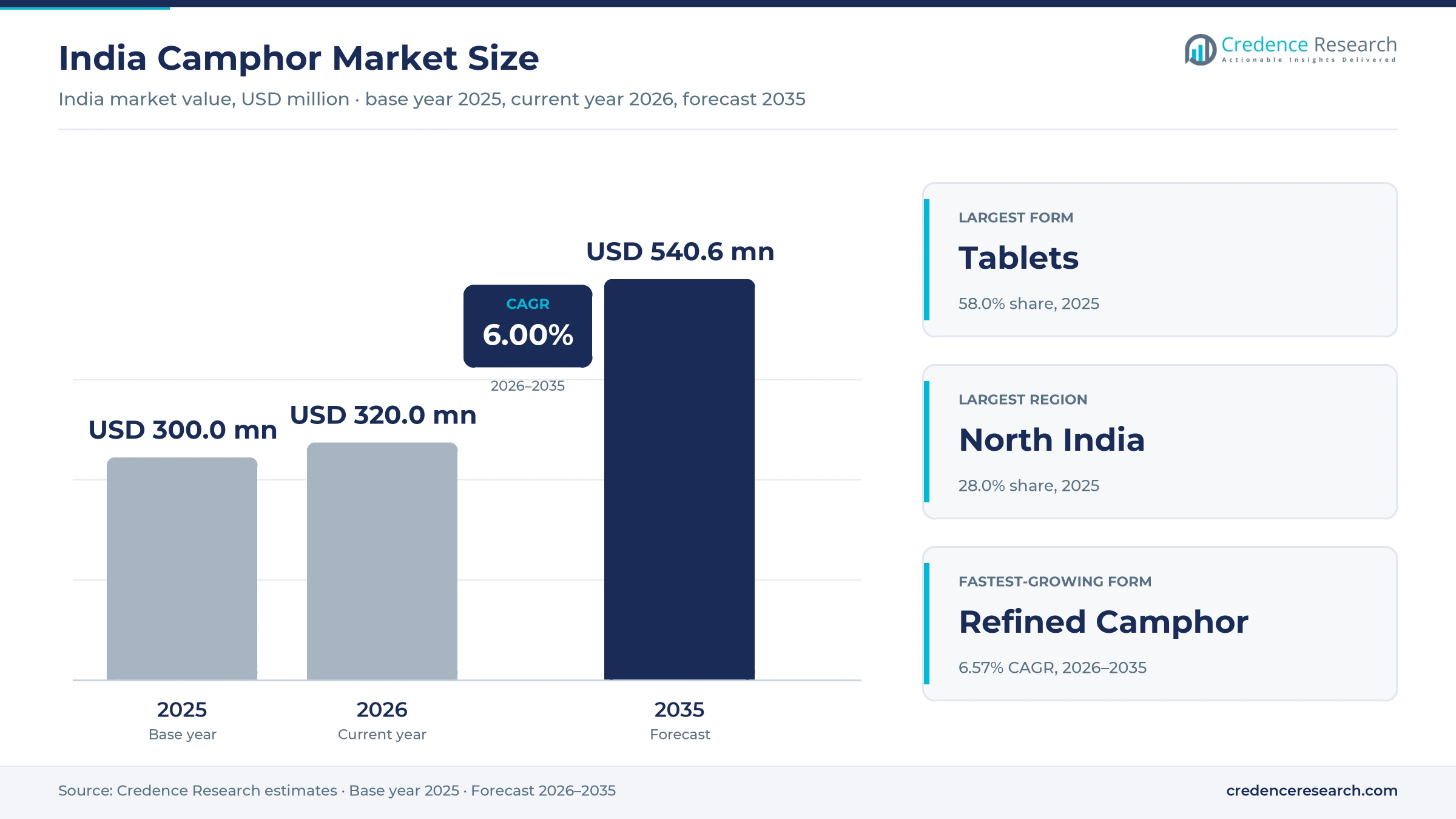
India Camphor Market Insights
- The market grows from USD 300.0 million in 2025 to USD 540.6 million by 2035 at a 6.00% CAGR, as ritual use stays steady and home care formats add value.
- North India held 28.0% of 2025 value, as the Maha Kumbh drew 66.21 crore devotees to Prayagraj by Feb. 26, 2025.
- Tablets led the form split with 58.0% in 2025, as small puja packs priced from Rs 10 to Rs 90 sell strongly.
- Oriental Aromatics said in its first-quarter call for FY27 that alpha-pinene feedstock costs rose sharply over five months to mid-2026.
- Mangalam Organics doubled camphor capacity to 10,000 metric tons a year from Jan. 31, 2022, at its Khopoli plant.
Tablets, ritual use and kirana shelves hold most value
Why do tablets lead camphor sales by form?
Based on form, the market is categorized into tablets, powder and refined camphor. Tablets led with 58.0% of 2025 value because daily aarti uses small pressed pieces, and Sangli traders told Sugandh India that packs priced at Rs 10, Rs 20, Rs 50 and Rs 90 sell strongly. Refined Camphor grows fastest at 6.57% a year as pharma buyers need certified grades, and Oriental Aromatics runs its Bareilly camphor plant under WHO-GMP and USFDA accreditation, according to its November 2024 investor presentation. Powder serves tablet pressing and puja mixes, and Kanchi Karpooram listed powders in its April 2026 online sales plan.
How do ritual, pharma and aroma uses compare?
Based on use, the market is categorized into religious, pharma/OTC and aroma. Religious use led with 72.0% of 2025 value because Kanchi Karpooram's management discussion for FY26, dated Aug. 12, 2026, says religious and traditional uses make up the major segment of demand. Aroma uses grow fastest at 7.40% a year as Mangalam Organics sells CamPure cones, automatic fresheners and car fragrance products based on camphor, according to its July 2026 investor presentation. Pharma and OTC demand comes from balms and rubs such as Vicks VapoRub, which Tata 1mg lists at Rs 45 for 10 milliliters with camphor as an active ingredient.
Why do kirana shops still sell most camphor?
Based on channel, the market is categorized into general trade and modern trade. General Trade led with 78.0% of 2025 value because camphor is bought with flowers and incense at neighborhood and temple-side shops, and Mangalam Organics serves them with 190 salespeople while it extends distribution to 14 states, according to its July 2026 presentation. Modern Trade grows fastest at 7.19% a year as supermarket and app networks widen, and Avenue Supermarts opened its 512th DMart store at Narmadapuram on Sept. 20, 2026, Sahi reported. Zepto handled over 2 million daily orders during the Diwali week of 2025, Angel One reported.
| Segment Group | Leading Sub-segment | Share, 2025 | Fastest-growing Sub-segment | CAGR, 2026–2035 |
|---|---|---|---|---|
| By Form | Tablets | 58.0% | Refined Camphor | 6.57% |
| By Use | Religious | 72.0% | Aroma | 7.40% |
| By Channel | General Trade | 78.0% | Modern Trade | 7.19% |
Request a Free Sample
Fill in your details and we'll send you a free sample report.
- Sample data tables & charts
- Research methodology
Pilgrim crowds, branded packs and home care lift sales
Ritual and household fragrance demand sustain use
Ritual use is the base of demand, because camphor is lit during aarti in homes, temples and at large religious gatherings. Uttar Pradesh Chief Minister Yogi Adityanath said on Feb. 26, 2025 that more than 66.21 crore devotees took part in the 45-day Maha Kumbh at Prayagraj, Morung Express reported. Ayodhya drew about 20.36 crore visitors in the first three months of 2025, The Statesman reported, citing state tourism minister Jaiveer Singh. Oriental Aromatics describes camphor as primarily used in India for religious purposes, and Kanchi Karpooram calls ritual use the major segment of demand. In the Credence Research model this adds about 2.2 percentage points to annual growth to 2035.
Branded puja packs widen organized retail reach
Branded packs are moving camphor from loose sales into organized retail, where buyers pay more for consistent burn and clean residue. Mangalam Organics lists its camphor on Amazon, BigBasket, JioMart and Flipkart and runs 190 salespeople, according to its July 2026 investor presentation. BigBasket sells the Mangalam Bhimseni 100 gram jar at an MRP of Rs 280, or Rs 2,800 a kilogram. Kanchi Karpooram's board resolved in April 2026 to sell camphor tablets, cones, powders and pooja kits online, StockScans noted. ITC's Mangaldeep, a branded puja products label, ran devotee programs in Ayodhya in January 2024, exchange4media reported. In the Credence Research model this adds about 1.6 percentage points to annual growth to 2035.
Wellness and repellent formulations add new uses
New formats extend camphor beyond the puja shelf, because its scent and insect-repelling properties suit home care products. CamPure, Mangalam Organics' consumer brand, ran a billboard campaign in Indian cities from Jan. 29, 2025 for cone-shaped air fresheners and camphor-based mosquito repellents, Lokmat Times reported. India recorded 1,13,440 dengue cases and 94 deaths till November 2025, Minister of State for Health Anupriya Patel told the Rajya Sabha, IANS reported, which keeps repellent demand high. Balms add steady volume, and Apollo Pharmacy lists Amrutanjan Aromatic Balm with camphor at Rs 165 for 50 milliliters. In the Credence Research model this adds about 1.2 percentage points to annual growth to 2035.
Festive spending lifts puja basket sales each year
Festive spending concentrates camphor sales in a few months, because Diwali, Navratri and Ganesh Chaturthi baskets include it with diyas and incense. Diwali 2025 trade reached Rs 6.05 lakh crore, 25% above Rs 4.25 lakh crore a year earlier, with 87% of buyers choosing Indian-made products, Business Today reported, citing CAIT. Oriental Aromatics reported strong camphor volume growth in the first quarter of FY27, supported by seasonal inventory building ahead of festive demand in the second and third quarters. ITC Mangaldeep raised its jalbatti handout at the Maha Kumbh to 100,000 from 10,000 in February 2025, ITC said. As a result, religious use keeps 72.0% of 2025 value in the Credence Research model.
Cost pass-through, home care formats and pharma grades rise
Shift to faster cost pass-through as feedstock rises
Makers are shifting to faster price pass-through, because feedstock now swings more than retail buyers expect. Oriental Aromatics said in its first-quarter call for FY27 that alpha-pinene costs rose 70% to 80% over five months that Indian camphor sale prices rose by a double-digit percentage, and that it uses a step-up pass-through process to offset raw material and currency moves. ICRA noted in a July 16, 2024 rating rationale that raw materials make up about 60% of the company's sales and that alpha-pinene prices have been volatile. At retail, the Mangalam Bhimseni 100 gram jar lists at Rs 280 on BigBasket. In turn, branded packs absorb price moves more easily than loose camphor.
Rise of camphor-based home care and fragrance formats
Home care formats are rising as makers look for value beyond puja tablets. Mangalam Organics' July 2026 presentation lists CamPure cones, Insta pouches, surface cleaners, automatic fresheners and car fragrance products, all based on camphor. CamPure began a humorous outdoor campaign on Jan. 29, 2025 to reach urban buyers, Lokmat Times reported. Kanchi Karpooram added cones to its April 2026 online range, StockScans noted. These products sit close to the wider market for aroma chemicals, where Oriental Aromatics also sells. As a result, aroma use grows at 7.40% a year in the Credence Research model.
Pharma-grade supply offers an opening for certified plants
Certified pharma grades are an opening for plants that meet drug-maker standards, because balm and rub buyers pay more than puja buyers. Oriental Aromatics says its Bareilly plant was the first synthetic camphor plant in India, built with DuPont technology in 1964, and holds WHO-GMP and USFDA accreditation, according to its November 2024 investor presentation. Tata 1mg lists Vicks VapoRub by Procter & Gamble Hygiene and Health Care as an Ayurvedic proprietary medicine with camphor, at Rs 45 for 10 milliliters. Oriental Aromatics named pharmaceutical-grade camphor as a focus area in its first-quarter FY27 call. As a result, refined camphor becomes the fastest-growing form in the Credence Research model.
Repellent and export demand opens new volume
Repellent products and export shelves open new volume for camphor makers with brands. Dengue cases in 2025 were highest in Tamil Nadu at 20,866, then Maharashtra at 13,333 and Kerala at 10,239, IANS reported from a December 2025 Rajya Sabha reply, which supports demand in South and West India. Camphor formats compete with mosquito repellent wristbands and vaporizers for this spending. Mangalam Organics said in July 2026 that it has started selling products in the USA and U.K. In the Credence Research model, repellent and fragrance uses lift aroma demand faster than the overall market.
Overcapacity, pinene costs and plant safety test makers
Overcapacity and Chinese supply press prices
Domestic capacity has outrun demand, which keeps prices under pressure. Oriental Aromatics said in its first-quarter FY27 call that the domestic camphor market faces structural overcapacity after large capacity additions. ICRA's July 16, 2024 rationale cited a significant influx of camphor from China, and Kanchi Karpooram's FY26 management discussion names Chinese dumping and new players. Smaller makers without brands therefore sell at thin margins in most seasons.
Volatile alpha-pinene costs squeeze margins
Feedstock costs move faster than retail prices, which squeezes makers between purchase and sale. Alpha-pinene costs rose 70% to 80% over five months to mid-2026, Oriental Aromatics said. Raw materials also take about 60% of its sales, according to ICRA. Small converters that buy at spot prices before the festive season carry the largest risk. Longer supply contracts and faster pack price changes reduce the gap.
Plant fires interrupt supply and tie up capital
Camphor and turpentine are flammable, so a single fire can stop a large share of organized output. Fire hit the camphor division of Mangalam Organics at Khopoli on July 16, 2025 and the division was shut, Indian Chemical News reported. The company's insurance claim of Rs 12.58 crore was still unpaid, its July 3, 2026 disclosure to the National Stock Exchange said. Plants need better fire separation and insurance cover to limit such losses.
Child poisoning risk raises safety concerns
Camphor is toxic when swallowed, which exposes products to safety scrutiny. A study in Indian Pediatrics in January 2021 from Rainbow Children's Hospital in Hyderabad reported 15 children with seizures after herbal products, 13 of them linked to a liquid listing camphor among its ingredients, and eight were hospitalized. Child-resistant packs and clear warnings on household and balm products would lower this risk.
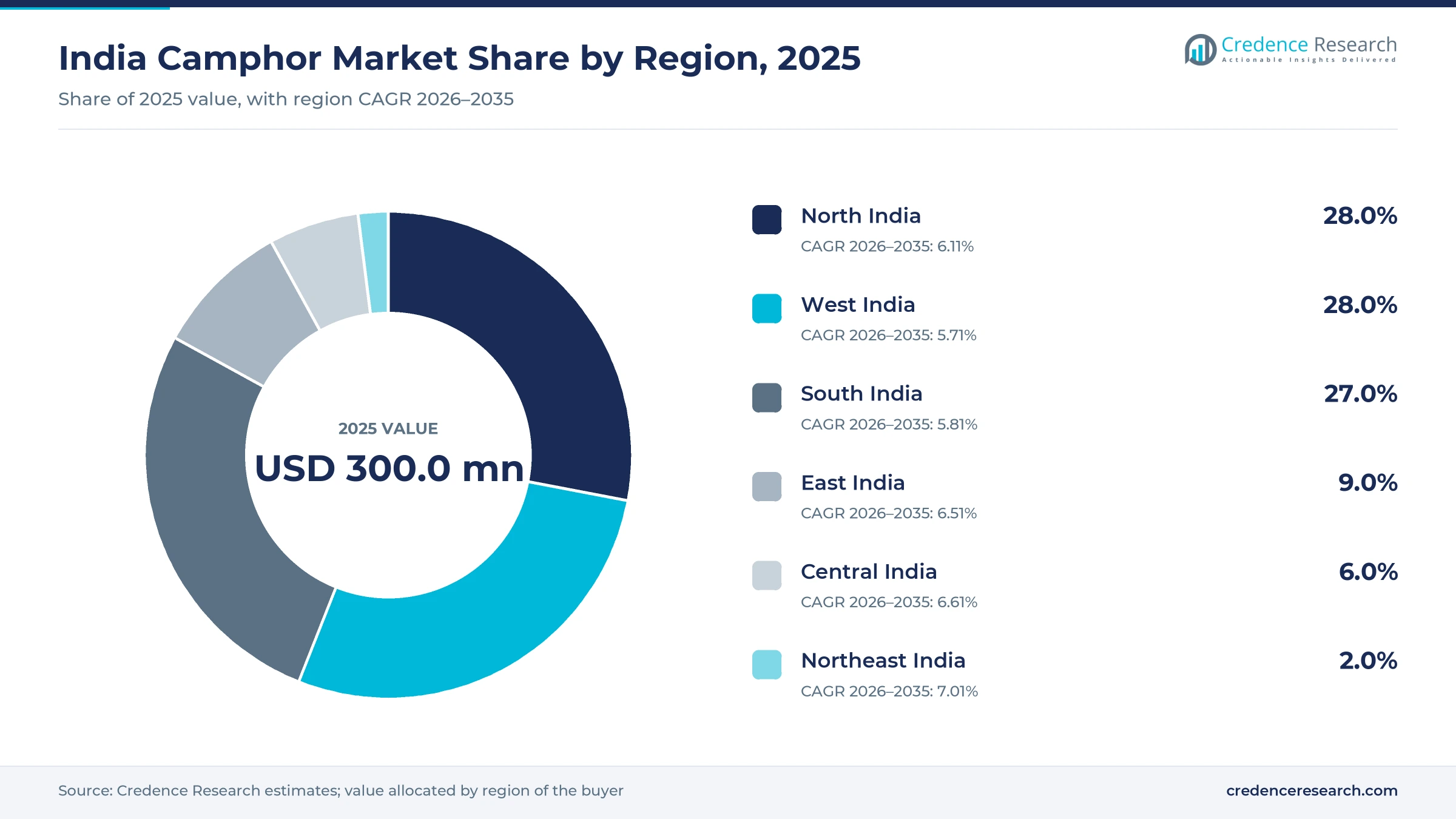
North and West India share the lead on temple and plant hubs
| Region | Value, 2025 (USD million) | Share, 2025 | CAGR, 2026–2035 |
|---|---|---|---|
| North India | 84.0 | 28.0% | 6.11% |
| West India | 84.0 | 28.0% | 5.71% |
| South India | 81.0 | 27.0% | 5.81% |
| East India | 27.0 | 9.0% | 6.51% |
| Central India | 18.0 | 6.0% | 6.61% |
| Northeast India | 6.0 | 2.0% | 7.01% |
North India leads on pilgrim footfall in Uttar Pradesh
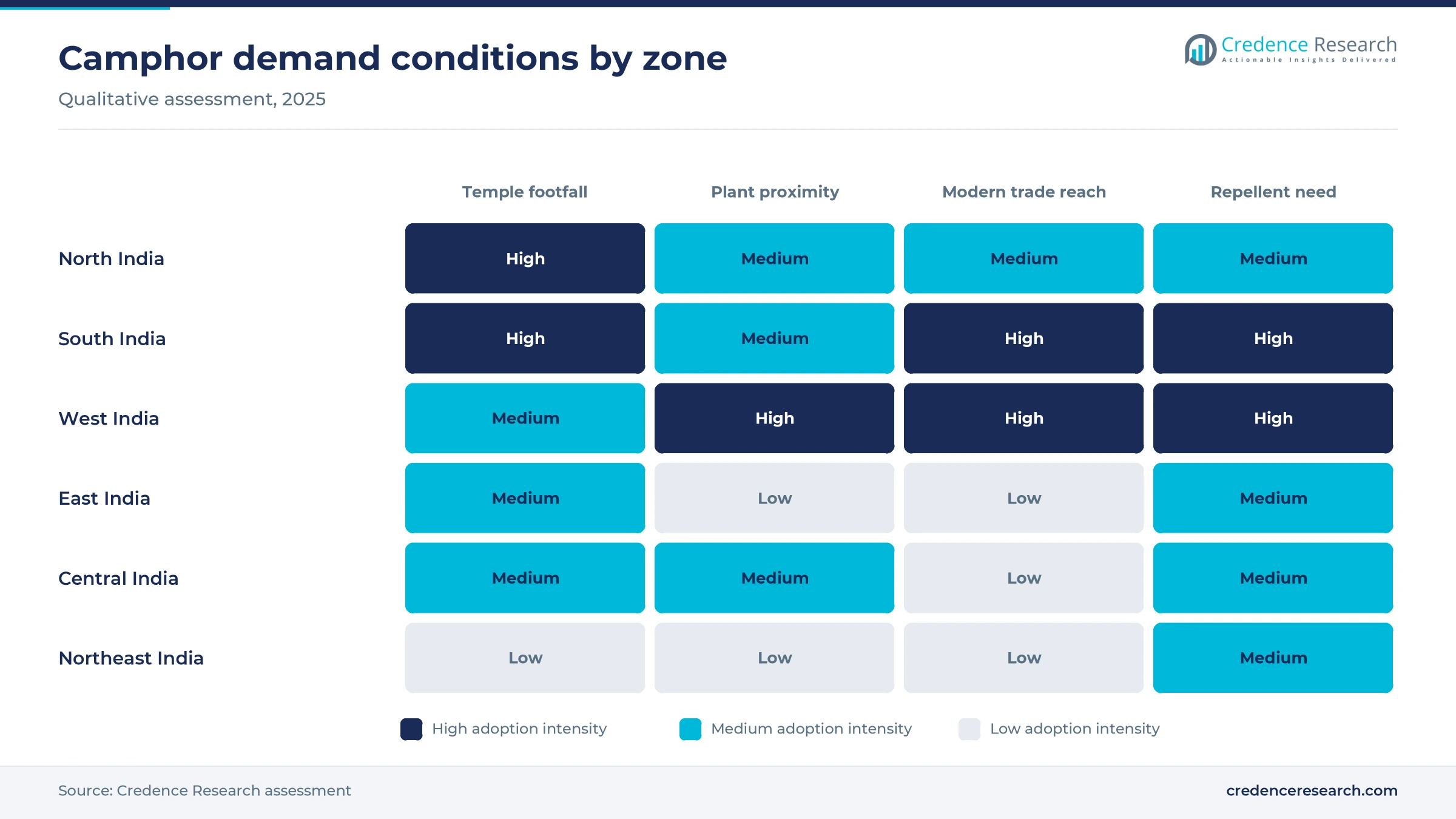
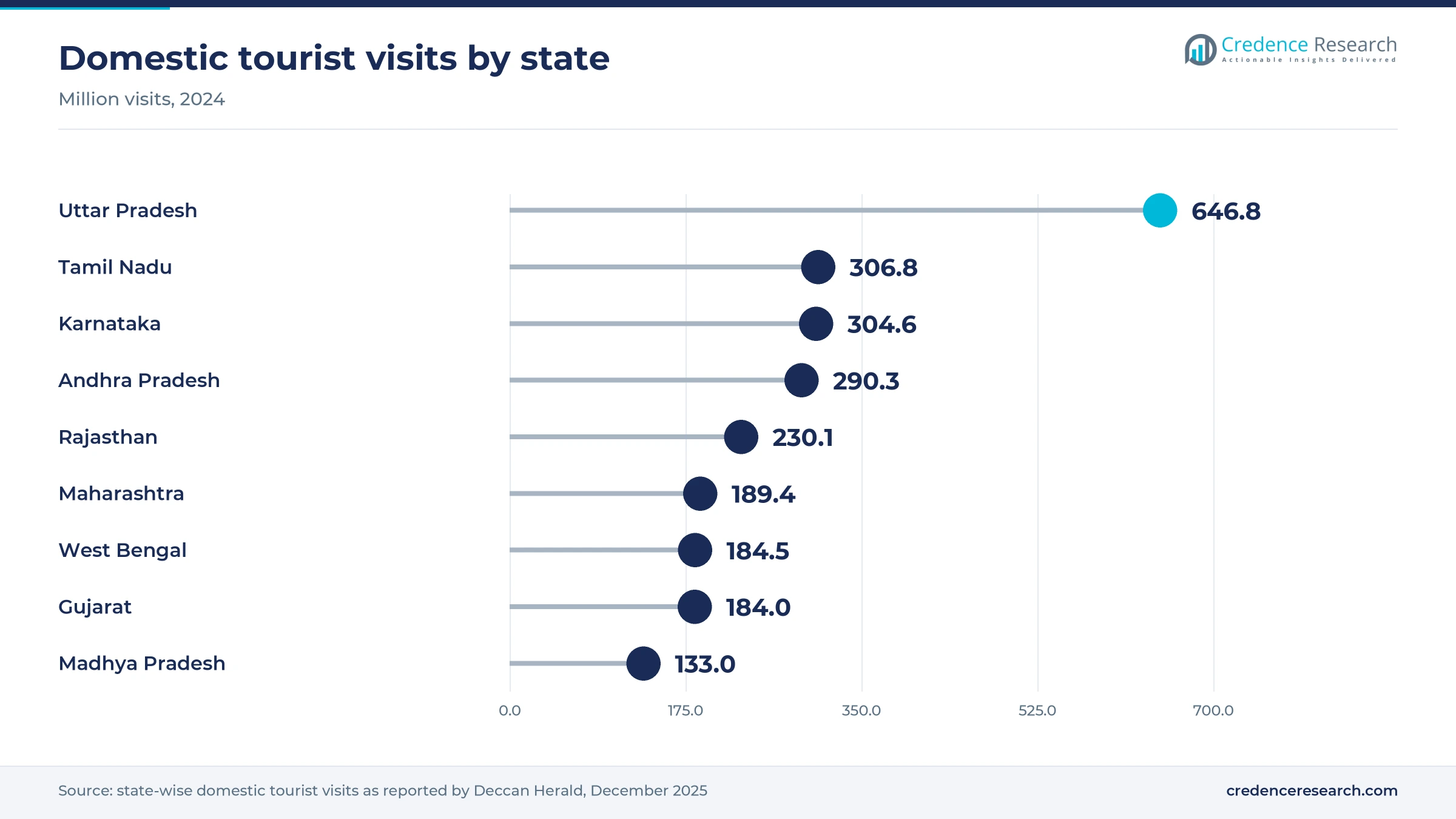
North India held a 28.0% share of 2025 value and grows at 6.11% a year. Uttar Pradesh recorded 646.8 million domestic tourist visits in 2024, the most of any state, Deccan Herald reported. The Maha Kumbh and Ayodhya then added large temple crowds in 2025. Oriental Aromatics makes camphor at its Bareilly plant, which supplies the zone directly. Temple trade and festival buying keep demand broad across the zone.
West India gains on Maharashtra plants and converters
West India held a 28.0% share of 2025 value and grows at 5.71% a year. Mangalam Organics runs 10,000 metric tons a year of camphor capacity at Khopoli, and Sangli and Kolhapur host many small tablet makers, Sugandh India reported. Maharashtra recorded 189.4 million domestic tourist visits in 2024 and Gujarat 184 million, Deccan Herald reported. Local supply keeps freight costs low, although the July 2025 Khopoli fire showed how concentrated output is.
South India grows on temple states and Kanchipuram supply
South India held a 27.0% share of 2025 value and grows at 5.81% a year. Tamil Nadu recorded 306.8 million domestic tourist visits in 2024, Karnataka 304.6 million and Andhra Pradesh 290.3 million, Deccan Herald reported. Kanchi Karpooram supplies camphor tablets from its Kanchipuram plant, and Chennai-based Amrutanjan Health Care sells balms that list camphor as a key ingredient. Tamil Nadu also reported the most dengue cases in 2025, which supports repellent use.
East India grows on Durga Puja and Bengal temple trade
East India held a 9.0% share of 2025 value and grows at 6.51% a year, faster than the national rate. West Bengal recorded 184.5 million domestic tourist visits in 2024, Deccan Herald reported, and Durga Puja in the autumn concentrates puja purchases in a few weeks. None of the three organized plants, at Khopoli, Bareilly and Kanchipuram, is in the zone, so packs travel long distances to shops. Branded packs have room to gain share as stores spread.
Central India rises with new stores in Madhya Pradesh
Central India held a 6.0% share of 2025 value and grows at 6.61% a year. The state of Madhya Pradesh recorded 133 million domestic tourist visits in 2024, Deccan Herald reported, which gives a wide base of temple visitors. Avenue Supermarts opened a DMart store in Narmadapuram on Sept. 20, 2026, taking its network to 512 stores. New stores bring branded camphor packs to smaller towns in the zone.
Northeast India starts from a small base
Northeast India held a 2.0% share of 2025 value and grows at 7.01% a year, the fastest of any zone. No northeastern state appears in the top 10 for domestic tourist visits in 2024, where Himachal Pradesh ranks tenth at 18 million, according to Deccan Herald. The nearest organized plants are at Bareilly, Khopoli and Kanchipuram, far from Guwahati and the hill states. Growth comes from a small base as online and modern retail reach more towns.
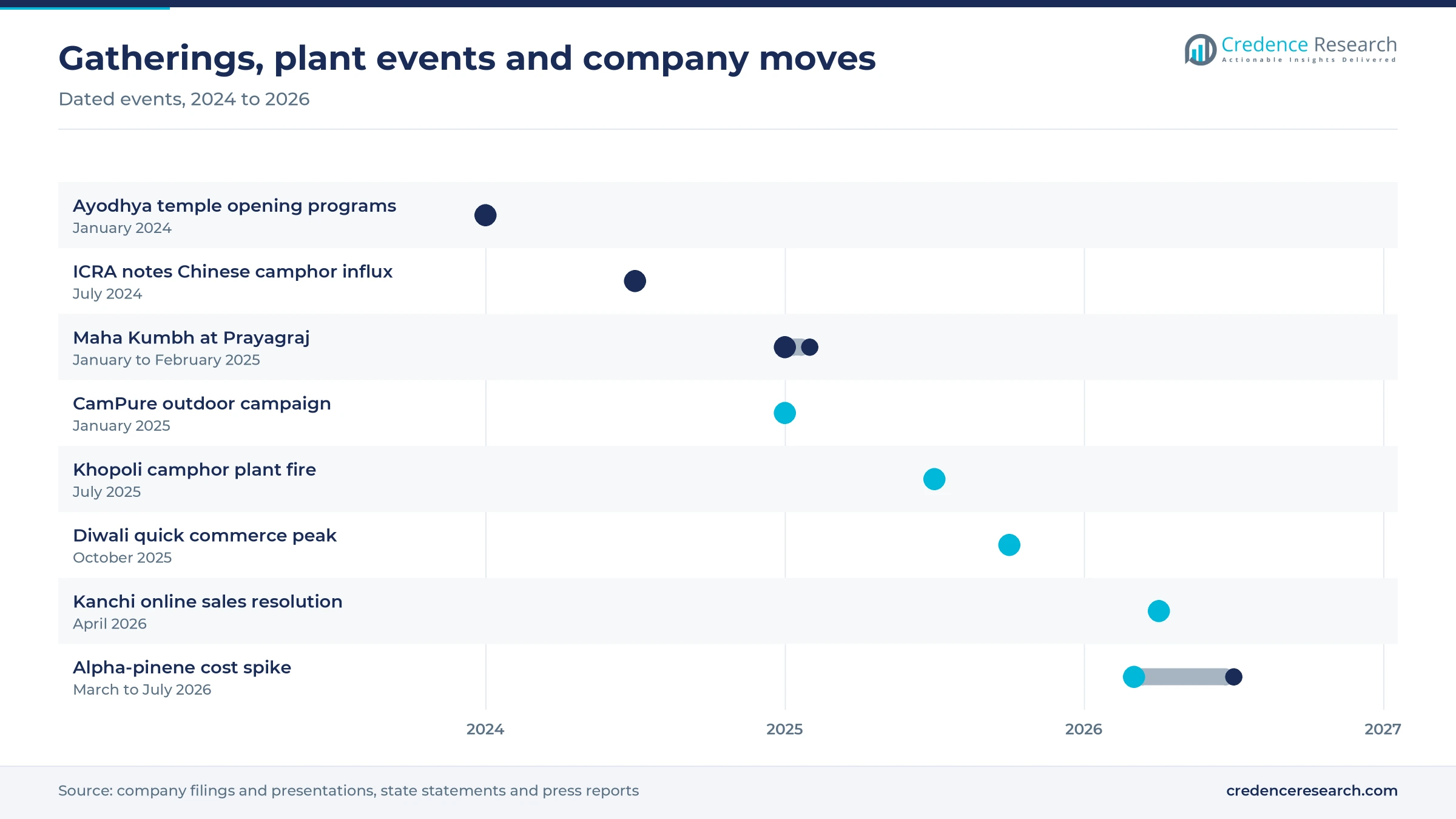
Plant fire, online moves and festive orders mark 2025-26
| Development | Status and market relevance |
|---|---|
| In January 2025, CamPure, the consumer brand of Mangalam Organics, began an outdoor campaign for camphor cones and repellents. | Live; billboards in major Indian cities |
| In July 2025, a fire shut the camphor division of Mangalam Organics at Khopoli in Raigad district, Maharashtra. | Operations being restored; Rs 12.58 crore insurance claim pending in July 2026 |
| In October 2025, Zepto handled over 2 million daily orders during Diwali week, including festive puja baskets. | Completed; quick commerce peak for festive buying |
| In April 2026, the Kanchi Karpooram board resolved to sell camphor tablets, cones, powders and pooja kits online. | Approved; direct online sales planned |
| In July 2026, Mangalam Organics outlined distribution expansion to 14 states with 190 salespeople and e-commerce listings. | Under way; sales started in the USA and U.K. |
Pinene conversion and pressing lines shape product quality
- Alpha-pinene conversion turns turpentine-derived pinene into synthetic camphor, the route Oriental Aromatics describes for its Bareilly plant and part of the wider pine-derived chemicals chain.
- Tablet pressing lines compress camphor into uniform pieces that burn without residue, the main format for small puja packs.
- Refining and sublimation raise purity for pharma grades, which Oriental Aromatics supplies from a plant with WHO-GMP and USFDA accreditation.
- By-product recovery turns turpentine residues into dipentene, isoborneol and gum rosin, which Kanchi Karpooram sells alongside its camphor tablets.
Need a Custom Version of This Report?
Tailor the scope, geography, or segments to your exact requirements.
- Custom geography or segment scope
- Direct access to our analyst team
Three organized makers face Chinese and local supply
Competition in the India camphor market centers on three organized makers that convert imported turpentine and alpha-pinene, plus imports and many small regional converters. Mangalam Organics runs 10,000 metric tons a year of capacity at Khopoli and sells the Mangalam and CamPure brands through 190 salespeople and four large online platforms. Oriental Aromatics makes camphor at Bareilly and sells the Saraswati and 3 Pine consumer brands while focusing on pharma grades and business buyers. Kanchi Karpooram supplies tablets from Kanchipuram and plans direct online sales. Local brands such as Giri, launched by Dipali Traders in Sangli in 2019, compete on price in small packs. Balm makers such as Procter & Gamble Hygiene and Health Care and Amrutanjan Health Care are large industrial buyers.
Companies profiled and their roles in this market
| Company | Type | Role in the market |
|---|---|---|
| Mangalam Organics | Camphor maker and brand owner | Khopoli plant; Mangalam and CamPure brands |
| Oriental Aromatics | Camphor and aroma maker | Bareilly plant; Saraswati and 3 Pine brands; pharma grade |
| Kanchi Karpooram | Camphor maker | Kanchipuram plant; tablets, by-products and online sales plan |
| Dipali Traders (Giri) | Regional converter | Giri brand camphor from Sangli district since 2019 |
| Procter & Gamble Hygiene and Health Care | OTC buyer | Vicks VapoRub with camphor |
| Amrutanjan Health Care | OTC buyer | Chennai-based maker of camphor balms |
Branded packs and pharma grades will set winners
Credence Research's view is that branded packs and certified pharma grades will decide who gains share as the India camphor market grows from USD 300.0 million in 2025. Overcapacity and a sharp rise in alpha-pinene costs in 2026 hurt unbranded makers most, because they cannot raise prices as quickly. Makers with online listings, modern trade reach and home care lines can spread costs across more products. Refined camphor grows fastest by form at 6.57% a year, so pharma accreditation becomes a clear advantage by 2035.
How the volume and price model was built
The report uses 2025 as the base year and forecasts to 2035. Market values come from the Credence Research model, built from estimated consumption volumes and retail and bulk prices per kilogram. Regional, form, use and channel splits are Credence Research estimates. Inputs include company exchange filings and investor presentations, a credit rating rationale, retail price listings, pilgrim and tourism counts reported in the press, parliamentary health data and World Bank population data. The report did not conduct interviews or surveys, and it relies only on published sources.
Ritual demand stays steady as new formats add value
Through 2035 the India camphor market grows at a 6.00% CAGR to reach USD 540.6 million, as ritual use holds steady and new formats add value. World Bank data put India's population at about 1.46 billion in 2025, a large base of households that buy camphor for daily puja. Modern trade grows faster than kirana sales, and aroma uses gain share from cones, fresheners and repellents. Feedstock costs and plant safety remain the main risks for makers.
Frequently Asked Questions
How big is the India camphor market?
Which region leads the market?
Which form holds the largest share?
Which use grows fastest?
Why did camphor prices rise in 2026?
Which companies are active in the market?
What are the main challenges for makers?
How does camphor reach buyers?
Table of Content
Chapter 1 Market Segmentation
- 1.1 Segmentation Framework
- 1.1.1 Product and Service Classification
- 1.1.2 Application and End-Use Classification
- 1.1.3 Technology and Solution Classification
- 1.1.4 Customer and Distribution Channel Classification
- 1.1.5 Geographic Segmentation
- 1.1.6 Market Segment Definitions and Boundaries
- 1.2 By Form
- 1.2.1 Tablets
- 1.2.2 Powder
- 1.2.3 Refined Camphor
- 1.3 By Use
- 1.3.1 Religious
- 1.3.2 Pharma/OTC
- 1.3.3 Aroma
- 1.4 By Channel
- 1.4.1 General Trade
- 1.4.2 Modern Trade
Chapter 2 Introduction
- 2.1 Report Objectives and Scope
- 2.2 Product Definition and Industry Terminology
- 2.3 Market Inclusions and Exclusions
- 2.4 Research Process
- 2.4.1 Primary Research and Expert Interviews
- 2.4.2 Secondary Research and Source Review
- 2.4.3 Top-Down and Bottom-Up Estimation
- 2.4.4 Data Triangulation and Verification
- 2.5 Market Size Measurement Basis
- 2.5.1 2025: USD 300.0 million → 2035: USD 540.6 million
- 2.6 Historical and Forecast Reference Periods
- 2.6.1 Historical Period: 2018-2025
- 2.6.2 Base Year: 2025
- 2.6.3 Forecast Period: 2025-2035
- 2.7 Research Assumptions and Limitations
Chapter 3 Executive Summary
- 3.1 Market Snapshot and Key Findings
- 3.2 Base-Year Market Size, 2025
- 3.3 Forecast Market Size, 2035
- 3.4 Revenue and Volume Growth Outlook
- 3.5 Key Demand and Supply Indicators
- 3.6 Leading Market Segments
- 3.7 Fastest-Growing Market Opportunities
- 3.8 Regional Performance Highlights
- 3.9 Technology and Industry Transformation
- 3.10 Competitive Landscape Summary
- 3.11 Analyst View and Strategic Implications
Chapter 4 India Camphor Market Trends and Developments
- 4.1 Historical Industry Development, 2018-2025
- 4.2 Recent Market Trends and Developments
- 4.3 Demand and Customer Behavior Trends
- 4.4 Technology and Product Innovation
- 4.5 Artificial Intelligence, Automation and Digitalization
- 4.6 Local Manufacturing and Supply Chain Realignment
- 4.7 Industry Partnerships, Mergers and Acquisitions
- 4.8 Sustainability and Circular Economy Developments
- 4.9 Government and Private Sector Investment Trends
- 4.10 Emerging Business Models and Commercialization
- 4.11 Industry Developments and Announcements
Chapter 5 India Camphor Market Production, Supply and Demand Analysis
- 5.1 Demand Trend and Consumption Analysis, 2018-2025
- 5.2 Demand Forecast, 2025-2035
- 5.3 Production and Output Trend, 2018-2025
- 5.4 Production and Output Forecast, 2025-2035
- 5.5 Installed Capacity and Capacity Utilization
- 5.6 Company-Wise Production Plants and Statistics
- 5.6.1 Installed Production Capacity
- 5.6.2 Actual Production
- 5.6.3 Planned Capacity and Expansion Targets
- 5.7 Supply Chain Structure and Procurement Trends
- 5.8 Supply-Demand Gap and Bottlenecks
- 5.9 Import Dependence and Sourcing Structure
- 5.10 Contract Manufacturing and Outsourcing
- 5.11 Regional Supply and Demand Concentration
Chapter 6 India Camphor Market Pricing Analysis
- 6.1 Pricing Structure and Measurement
- 6.2 Historical Pricing Trends, 2018-2025
- 6.3 Pricing Outlook, 2025-2035
- 6.4 Average Selling Price and Unit Economics
- 6.5 Pricing by Product and Market Segment
- 6.6 Geographic Pricing Differences
- 6.7 Key Input, Energy, Labor and Logistics Costs
- 6.8 Contract Pricing and Purchasing Models
- 6.9 Pricing Sensitivity and Competitive Positioning
- 6.10 Price, Margin and Profitability Implications
Chapter 7 India Camphor Market Dynamics
- 7.1 Market Growth Drivers
- 7.1.1 Demand-Side Drivers
- 7.1.2 Technology and Innovation Drivers
- 7.1.3 Infrastructure and Investment Drivers
- 7.1.4 Regulatory and Policy Drivers
- 7.2 Market Restraints
- 7.2.1 Cost and Affordability Constraints
- 7.2.2 Technology and Adoption Barriers
- 7.2.3 Supply Chain and Operational Constraints
- 7.3 Market Challenges
- 7.3.1 Competitive Pressure and Margin Erosion
- 7.3.2 Skills, Infrastructure and Implementation Gaps
- 7.4 Emerging Market Opportunities
- 7.5 Market Dynamics Impact and Time-Horizon Assessment
Chapter 8 India Camphor Value Chain Analysis
- 8.1 Industry Value Chain Overview
- 8.2 Upstream Suppliers and Critical Inputs
- 8.3 Technology and Component Providers
- 8.4 Manufacturing or Service Delivery
- 8.5 Distribution, Channel Partners and Integrators
- 8.6 Downstream Applications and End Users
- 8.7 Value Addition and Profit Pools
- 8.8 Vertical Integration and Outsourcing
- 8.9 Supplier Concentration and Risk
- 8.10 Supply Chain Localization and Resilience
Chapter 9 India Camphor Market Regulations and Policies
- 9.1 Relevant Laws, Standards and Compliance Frameworks
- 9.2 Product, Service, Safety and Quality Requirements
- 9.3 Government Policies, Incentives and Subsidies
- 9.4 Imports, Exports and Trade Barriers
- 9.5 Public Procurement and Local Content Requirements
- 9.6 Environmental and Sustainability Compliance
- 9.7 Upcoming Policy Changes and Market Implications
Chapter 10 India Camphor Market Hotspots and Opportunities
- 10.1 Market Opportunity Mapping and Growth Hotspots
- 10.2 High-Growth Applications and Customer Groups
- 10.3 Underserved Markets and White-Space Opportunities
- 10.4 Emerging Technology and Product Opportunities
- 10.5 New Capacity and Investment Hotspots
- 10.6 Market Entry and Expansion Opportunities
- 10.7 Distribution and Partnership Opportunities
- 10.8 Near-Term and Long-Term Commercial Potential
- 10.9 Opportunity Attractiveness and Execution Risks
Chapter 11 India Camphor Market Outlook, 2025-2035
- 11.1 Market Size and Analysis
- 11.1.1 Revenue (Market Measurement: 2025: USD 300.0 million → 2035: USD 540.6 million)
- 11.1.2 Market Volume and Quantity Sold
- 11.1.3 Historical Market Size, 2018-2025
- 11.1.4 Base-Year Market Size, 2025
- 11.2 Market Forecast, 2025-2035
- 11.2.1 Revenue Forecast to 2035
- 11.2.2 Volume Forecast to 2035
- 11.2.3 CAGR and Year-on-Year Growth
- 11.2.4 Incremental Revenue Opportunity
- 11.3 Forecast Assumptions and Scenario Analysis
- 11.3.1 Base-Case Forecast
- 11.3.2 Optimistic and Conservative Scenarios
- 11.3.3 Technology, Pricing and Policy Sensitivities
- 11.4 Market Attractiveness and Growth Outlook
Chapter 12 India Camphor Market Segmentation and Outlook
- 12.1 Segmentation Summary and Market Shares, 2025
- 12.2 Largest and Fastest-Growing Segments
- 12.3 By Form - Market Size and Forecast, 2025-2035
- 12.3.1 Segment Definition and Scope
- 12.3.2 Historical Market Size, 2018-2025
- 12.3.3 Revenue Forecast, 2025-2035
- 12.3.4 Volume Forecast, 2025-2035
- 12.3.5 Base-Year Market Share, 2025
- 12.3.6 Segment CAGR and Growth Drivers
- 12.3.7 Subsegment Market Size and Forecast
- 12.3.7.1 Tablets
- 12.3.7.2 Powder
- 12.3.7.3 Refined Camphor
- 12.3.8 Subsegment Pricing and Adoption Trends
- 12.3.9 Leading Suppliers and Competition
- 12.3.10 Regional Demand and Opportunities
- 12.4 By Use - Market Size and Forecast, 2025-2035
- 12.4.1 Segment Definition and Scope
- 12.4.2 Historical Market Size, 2018-2025
- 12.4.3 Revenue Forecast, 2025-2035
- 12.4.4 Volume Forecast, 2025-2035
- 12.4.5 Base-Year Market Share, 2025
- 12.4.6 Segment CAGR and Growth Drivers
- 12.4.7 Subsegment Market Size and Forecast
- 12.4.7.1 Religious
- 12.4.7.2 Pharma/OTC
- 12.4.7.3 Aroma
- 12.4.8 Subsegment Pricing and Adoption Trends
- 12.4.9 Leading Suppliers and Competition
- 12.4.10 Regional Demand and Opportunities
- 12.5 By Channel - Market Size and Forecast, 2025-2035
- 12.5.1 Segment Definition and Scope
- 12.5.2 Historical Market Size, 2018-2025
- 12.5.3 Revenue Forecast, 2025-2035
- 12.5.4 Volume Forecast, 2025-2035
- 12.5.5 Base-Year Market Share, 2025
- 12.5.6 Segment CAGR and Growth Drivers
- 12.5.7 Subsegment Market Size and Forecast
- 12.5.7.1 General Trade
- 12.5.7.2 Modern Trade
- 12.5.8 Subsegment Pricing and Adoption Trends
- 12.5.9 Leading Suppliers and Competition
- 12.5.10 Regional Demand and Opportunities
- 12.6 Segment Growth Comparison
- 12.7 Segment Attractiveness and Priority Matrix
Chapter 13 India Camphor Geographic Market Outlook, 2025-2035
- 13.1 Domestic Market Distribution and Demand Clusters
- 13.2 State- or Province-Wise Market Size and Forecast, 2025-2035
- 13.3 City and Metropolitan Market Outlook
- 13.4 Industrial, Manufacturing and Commercial Clusters
- 13.5 Geographic Concentration of Key End Users
- 13.6 Local Pricing and Purchasing Differences
- 13.7 Domestic Production Facilities and Capacity Map
- 13.8 Local Infrastructure and Project Pipeline
- 13.9 State-Level Policy and Incentive Differences
- 13.10 Subnational Investment Hotspots and Opportunities
- 13.11 Distribution and Logistics Networks
- 13.12 Domestic Competitive Footprint
Chapter 14 India Camphor Technology, Innovation and Sustainability Outlook
- 14.1 Technology Landscape and Maturity
- 14.2 Product, Process and Service Innovation
- 14.3 AI, Automation and Digital Tools in the Industry
- 14.4 Technology Adoption and Performance Benchmarking
- 14.5 Innovation Pipeline and R&D Investment
- 14.6 Patent and Intellectual Property Trends
- 14.7 Energy Efficiency and Resource Management
- 14.8 Sustainability, Recycling and Circularity
- 14.9 Technology Roadmap, 2025-2035
- 14.10 Risks of Obsolescence and Technology Substitution
Chapter 15 India Camphor Market Key Strategic Imperatives
- 15.1 Growth and Market Entry Priorities
- 15.2 High-Return Products and Segments
- 15.3 Pricing, Profitability and Cost Optimization
- 15.4 Technology Investment and Product Differentiation
- 15.5 Supply Chain Localization and Resilience
- 15.6 Distribution and Customer Acquisition
- 15.7 Partnership, Acquisition and Capacity Strategy
- 15.8 Regional Expansion Priorities
- 15.9 Short-, Medium- and Long-Term Actions
Chapter 16 Competition Outlook
- 16.1 Industry Competition Characteristics
- 16.2 Market Structure and Concentration
- 16.3 Market Share and Competitive Positioning, 2025
- 16.4 Company-Wise Revenue and Product Benchmarking
- 16.5 Production and Service Capacity Benchmarking
- 16.6 Technology, Pricing and Differentiation
- 16.7 Regional Footprint and Distribution Strength
- 16.8 Mergers, Acquisitions and Strategic Alliances
- 16.9 New Entrants and Competitive Threats
- 16.10 Porter's Five Forces and Industry Attractiveness
- 16.11 Competitive Outlook, 2025-2035
Chapter 17 Company Profiles
- 17.1 Company Coverage and Selection Criteria
- 17.2 Mangalam Organics
- 17.2.1 Business Description
- 17.2.2 Company Ownership and Geographic Presence
- 17.2.3 Product and Service Portfolio
- 17.2.4 Manufacturing and Operating Footprint
- 17.2.5 Production Capacity and Expansion Plans
- 17.2.6 Financial Performance and Investment
- 17.2.7 Market Share and Competitive Position
- 17.2.8 Technology and Innovation Capabilities
- 17.2.9 Strategic Alliances or Partnerships
- 17.2.10 Recent Developments
- 17.2.11 Growth Strategy and Outlook
- 17.3 Oriental Aromatics
- 17.4 Kanchi Karpooram
- 17.5 Dipali Traders (Giri)
- 17.6 Procter & Gamble Hygiene and Health Care
- 17.7 Amrutanjan Health Care
- 17.8 Other Relevant Market Participants
Note: Every listed company is profiled on the structure shown under the first company. The company list is preliminary and may change based on research findings, market developments, data availability and client requirements.
Chapter 18 Disclaimer
- 18.1 Research and Forecast Disclaimer
- 18.2 Data Source and Estimation Limitations
Note: The depth of individual sections depends on data availability for this market. Volume, capacity, trade and other unit-based metrics are included where applicable.

