Record air traffic turns into rental days at Polish airports
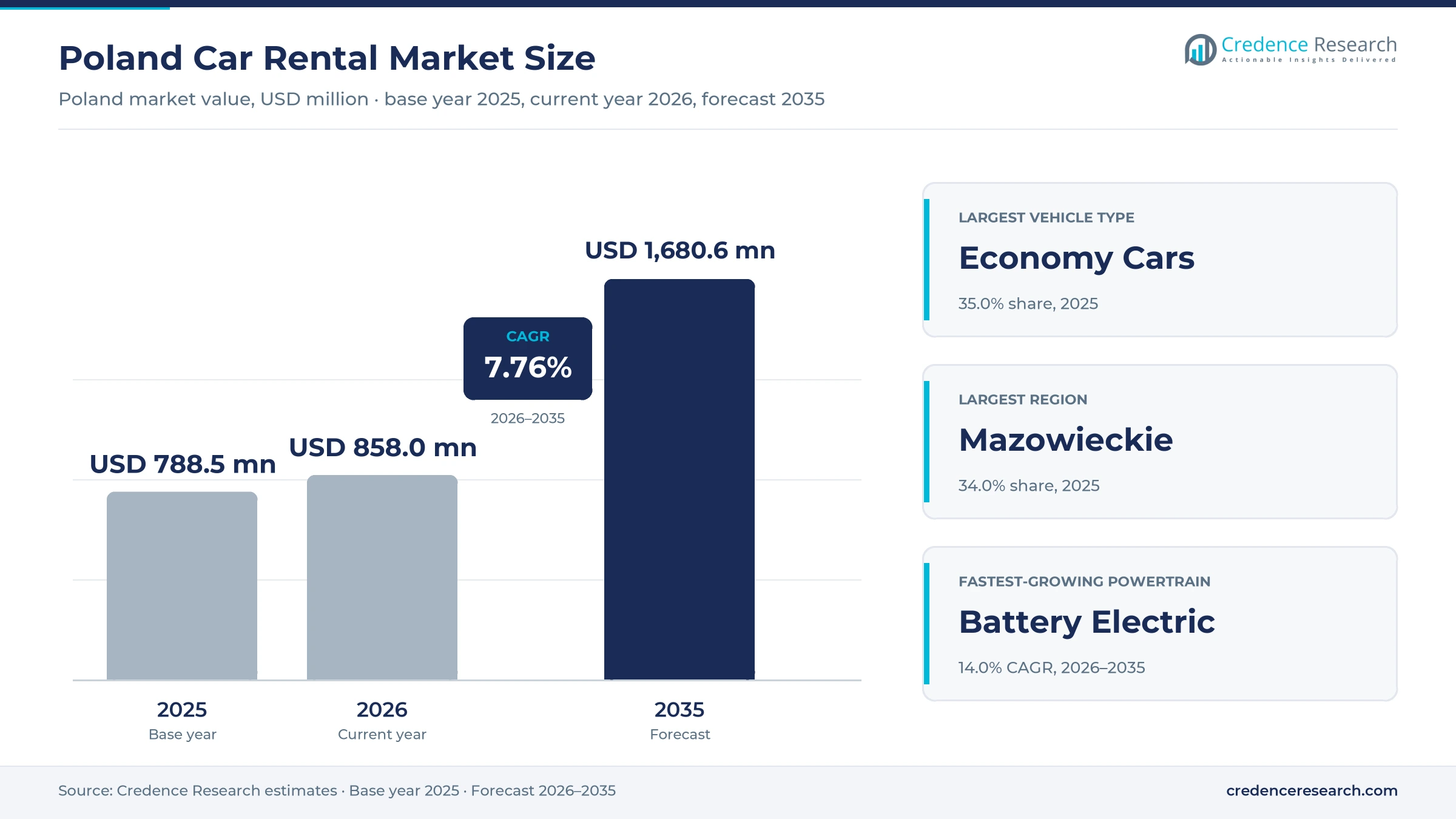
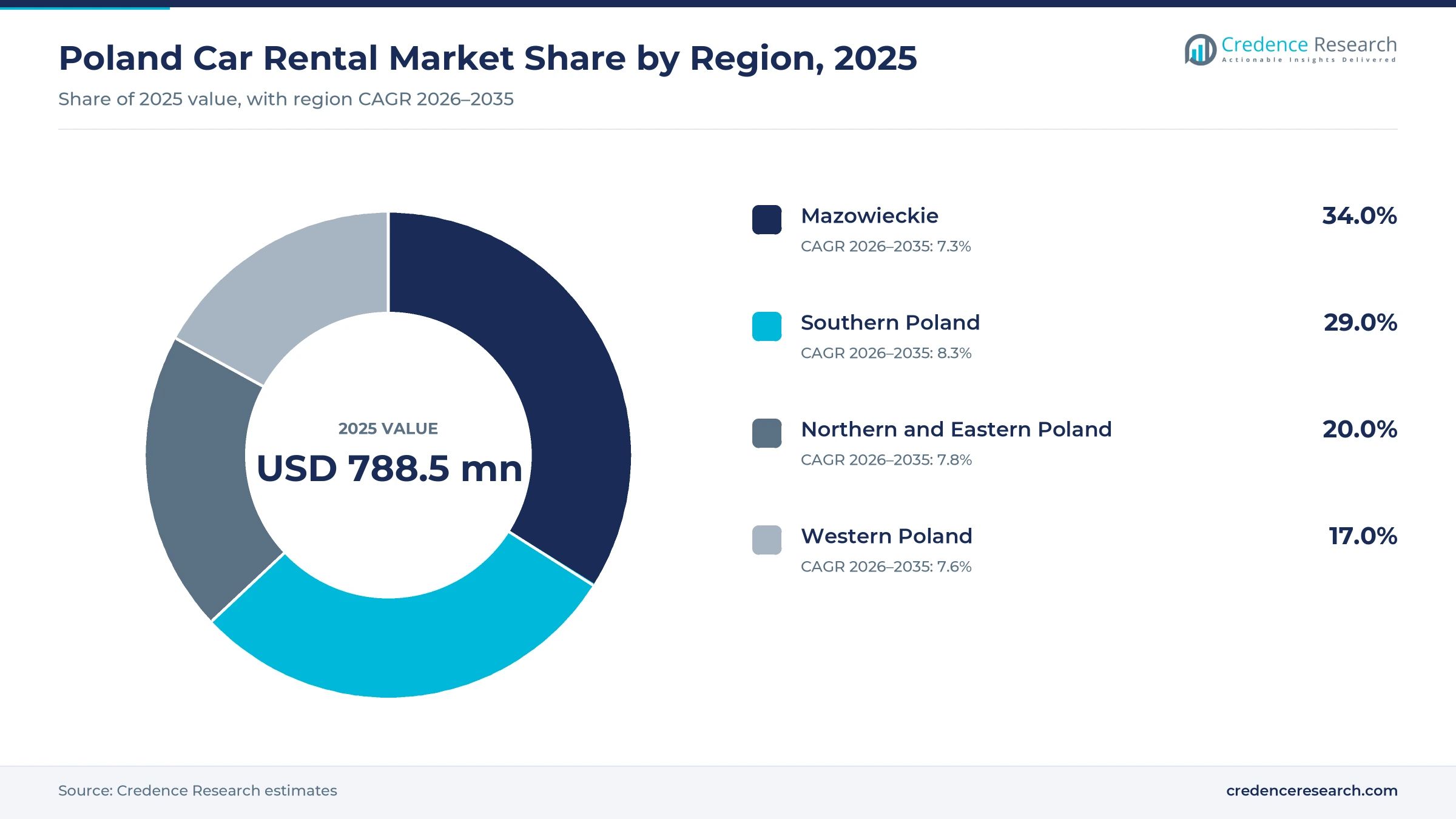
The Poland car rental market was valued at USD 788.5 million in 2025 and is projected to increase from USD 858.0 million in 2026 to USD 1.68 billion by 2035, registering a CAGR of 7.76% during 2026–2035. Demand comes from foreign visitors landing at Polish airports, from residents who rent for holidays and weekend trips, from companies that need cars for weeks or months without a lease, and from insurers that pay for replacement cars after accidents. Mazowieckie held the largest regional share, 34.0% in 2025, because Warsaw combines the busiest airport with most corporate head offices. Southern Poland is the fastest-growing region at 8.3% a year, as Kraków and Katowice add low-cost and charter flights. The main commercial change is a new tax regime for company cars from January 2026, which makes short and mid-term rental of cheaper and electric models more attractive for business users.
Which rentals the Poland market counts
The market counts the value paid by individuals, companies, insurers, assistance providers and public bodies for passenger cars rented in Poland for periods from one day to about two years. It includes airport and city rentals, mid-term contracts paid by the month and replacement cars provided after a collision or breakdown.
Long-term full-service leasing of new fleet cars, per-minute car sharing, chauffeur services, vans and trucks are excluded. Rentals are sold through brand websites and apps, travel brokers and online travel agencies, corporate account managers and branch counters, and by insurers that book cars for their claimants.
Poland Car Rental Market Insights
- The Poland car rental market grows from USD 788.5 million in 2025 to USD 1.68 billion by 2035, a 7.76% CAGR, as more flights and visitors feed airport rentals.
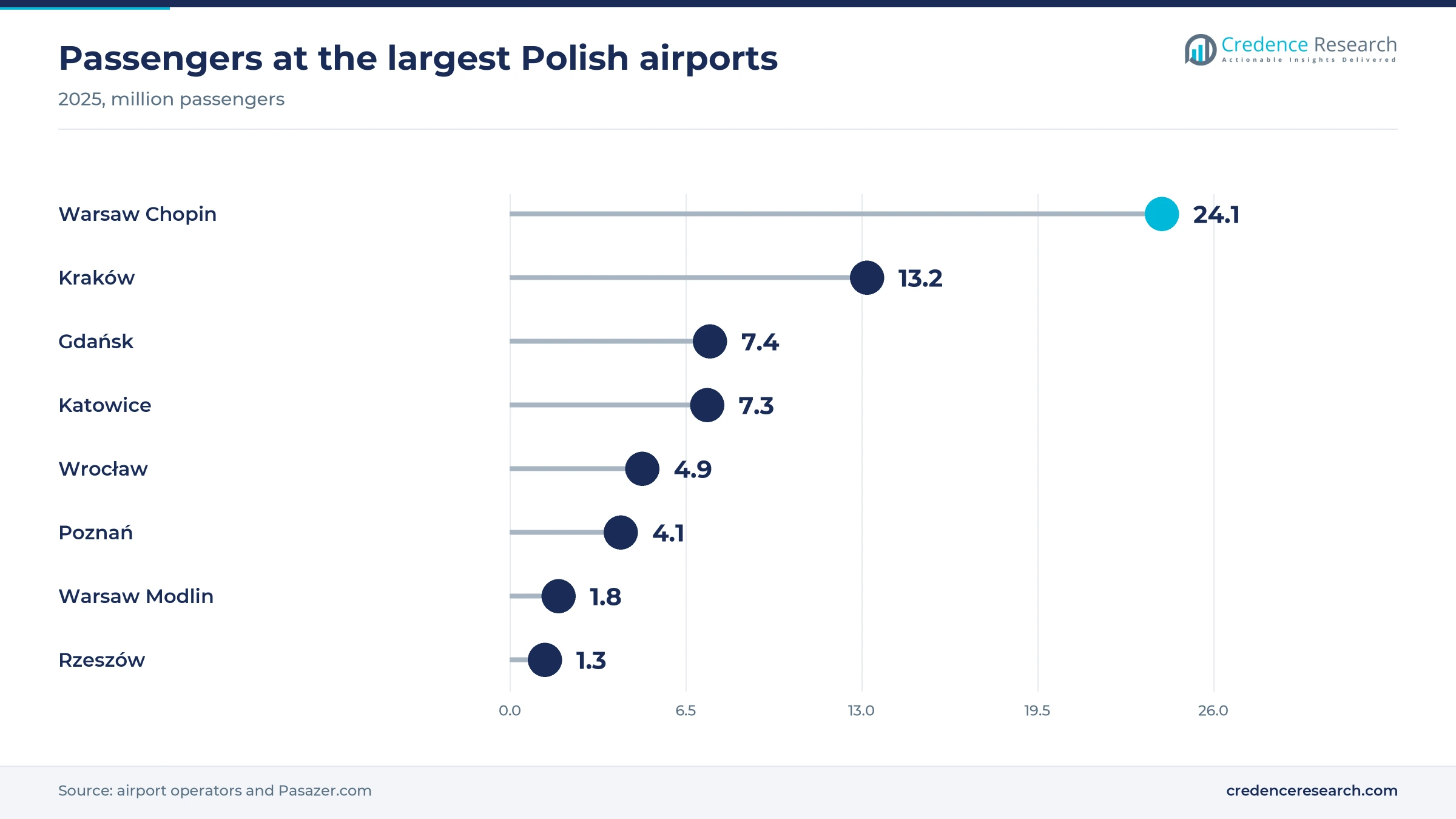
- Mazowieckie held 34.0% of 2025 value, because Warsaw Chopin Airport handled 24.1 million passengers in 2025, more than a third of national traffic.
- Economy cars held 35.0% of 2025 value, because leisure renters and insurer rate cards both favor the lowest daily price.
- From Jan. 1, 2026, Polish tax rules cap deductible costs at PLN 100,000 for most combustion cars, including rented ones, which favors renting cheaper models.
- Polish airports handled 66.1 million passengers in 2025, up 11.7%, and Ryanair bases nine aircraft in Katowice for summer 2026.
Economy cars and leisure renters still carry most value
Why economy cars lead and SUVs grow fastest
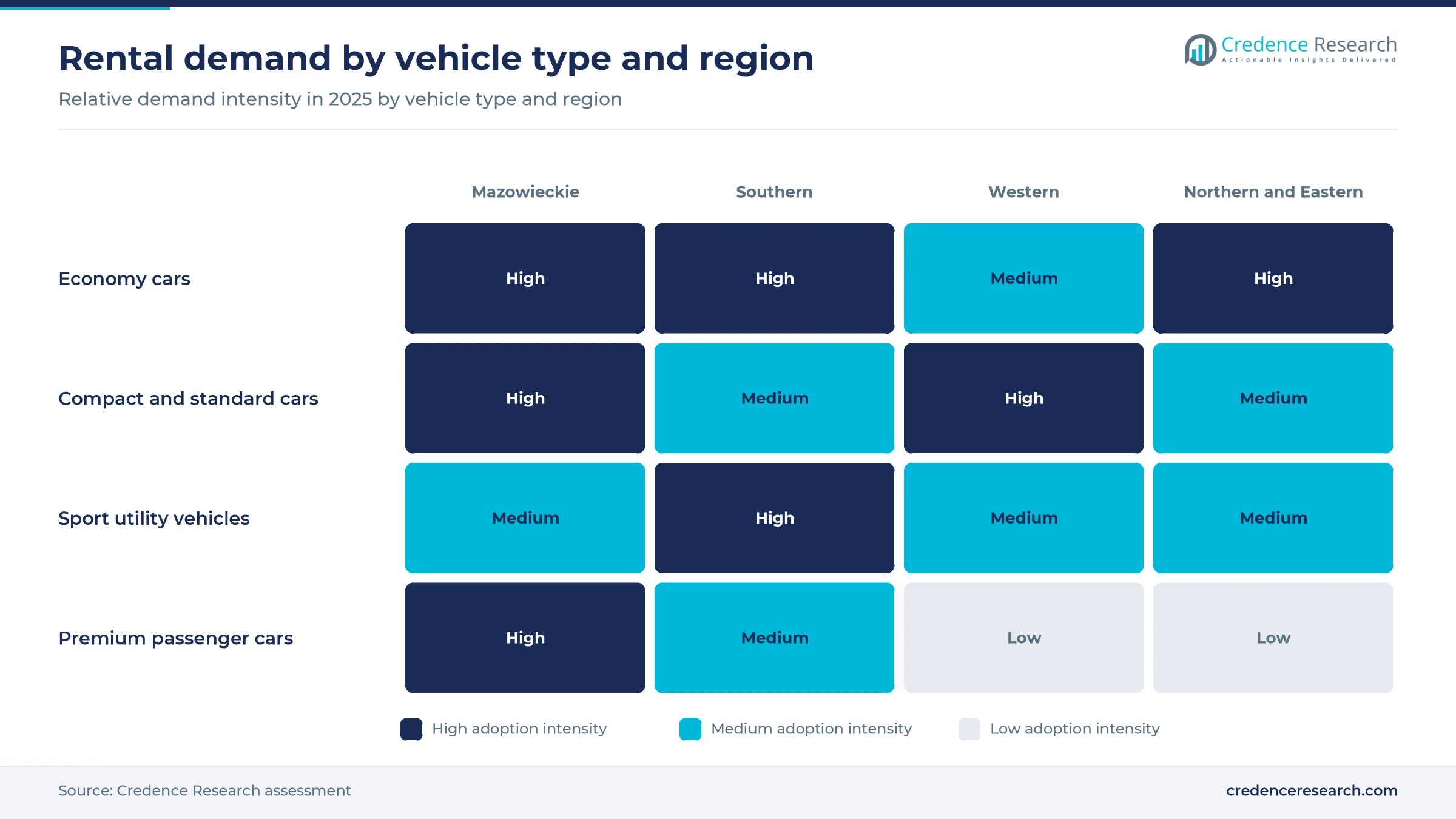
Based on vehicle type, the market is categorized into economy cars, compact and standard cars, sport utility vehicles and premium passenger cars. Economy cars led with 35.0% of 2025 value because the two largest payers buy on price, and insurer TUZ lists replacement rates of only PLN 73 to 77 net a day for class A and B cars in its November 2025 rules. Sport utility vehicles grow fastest at 8.8% a year as families and business renters trade up, and TUZ pays PLN 119 a day for a compact SUV against PLN 86 for a compact hatchback. Operators earn more per day from each SUV they add.
Individuals lead while corporate accounts grow fastest
Based on customer type, the market is categorized into individual renters, corporate accounts, insurers and assistance payers, and public-sector and nonprofit accounts. Individual renters led with 46.0% of 2025 value because Polish residents made 54.5 million domestic tourist trips in 2025, up 3.2%, according to Statistics Poland, and foreign visitors add airport demand. Corporate accounts grow fastest at 8.7% a year as tax limits introduced on Jan. 1, 2026 also apply to rented cars, which pushes firms toward flexible rentals of cheaper models instead of buying them outright.
Direct digital bookings lead as travel intermediaries gain
Based on sales channel, the market is categorized into direct digital bookings, travel intermediaries and account and branch sales. Direct digital bookings led with 42.0% of 2025 value because Polish chains sell through their own apps and websites, and Panek offered app users a 20% discount on daily rentals until the end of 2025. Travel intermediaries grow fastest at 8.2% a year as foreign guests in Polish accommodation rose 13.1% to 15.2 million in 2025, according to Statistics Poland, and many of them book cars on the same travel sites they use for flights and hotels.
Petrol leads while battery electric cars grow fastest
Based on powertrain, the market is categorized into petrol vehicles, diesel vehicles, hybrid vehicles and battery electric vehicles. Petrol vehicles led with 46.0% of 2025 value because economy fleets rely on small petrol models, and battery electric cars took only 7.2% of the 597,428 new passenger cars registered in 2025, according to IBRM Samar. Battery electric vehicles grow fastest at 14.0% a year as the NaszEauto program, opened in February 2025 with PLN 1.6 billion, also funds electric cars taken on lease or long-term rental.
| Segment Group | Leading Sub-segment | Share, 2025 | Fastest-growing Sub-segment | CAGR, 2026–2035 |
|---|---|---|---|---|
| By Vehicle Type | Economy cars | 35.0% | Sport utility vehicles | 8.8% |
| By Customer Type | Individual renters | 46.0% | Corporate accounts | 8.7% |
| By Sales Channel | Direct digital bookings | 42.0% | Travel intermediaries | 8.2% |
| By Powertrain | Petrol vehicles | 46.0% | Battery electric vehicles | 14.0% |
Insurer rate cards set the floor for daily rental prices
Pricing in Poland is set per day, with lower daily rates for longer bookings and a flat monthly price for mid-term use. Insurer rate cards matter more than in most markets, because they fix what a replacement car earns, and TUZ pays PLN 73 net a day for the smallest class and PLN 1,399 for a 20 to 30 day rental. Leisure prices move with the season and with airport demand, so operators earn their margin in summer and lean on insurer and corporate volume in winter. One-way and young driver fees add margin on leisure bookings.
| Rental type and class | Typical price or fee | Basis |
|---|---|---|
| Insurance replacement, class A city car | PLN 73 net per day | TUZ replacement vehicle rules, November 2025 |
| Insurance replacement, class C compact | PLN 86 net per day | TUZ replacement vehicle rules, November 2025 |
| Insurance replacement, compact SUV | PLN 119 net per day | TUZ replacement vehicle rules, November 2025 |
| Insurance replacement, class E premium | PLN 229 net per day | TUZ replacement vehicle rules, November 2025 |
| Airport leisure rental, small car | From PLN 100 per day, PLN 100 to 400 for 24 hours | CarFree Katowice Airport listing, November 2026 |
| Domestic one-way fee | EUR 40 net per rental | Sixt Polska terms, version of Feb. 24, 2025 |
Request a Free Sample
Fill in your details and we'll send you a free sample report.
- Sample data tables & charts
- Research methodology
Airports, company tax rules and EVs widen rental demand
Airport growth turns arrivals into rental days
More flights put more potential renters at the airport counter, which is where most leisure rentals start. Polish airports handled 66.1 million passengers in 2025, up 11.7% from 2024 and 26.6% from 2023, according to the Civil Aviation Authority as reported by Dlapilota. Kraków Airport alone handled 13.2 million passengers, a record, according to Radio Kraków. Airlines keep adding capacity, as Ryanair said on Feb. 24, 2026 that it would base nine aircraft in Katowice for summer 2026 and fly 26 routes. Wizz Air announced a sixth A321neo for Kraków and a seventh for Katowice, with new routes starting from October 2025. Operators with airport desks convert this traffic into rental days.
Company car tax limits favor flexible rentals
Polish companies are rethinking how they get cars, and new tax rules make flexible rental more attractive. From Jan. 1, 2026, deductible costs are capped at PLN 100,000 for cars emitting 50 grams of CO2 per kilometer or more, down from PLN 150,000, while the cap is PLN 225,000 for electric cars, and the limits also apply to rented cars. The finance ministry confirmed that the caps cover rental contracts signed before that date. Firms already outsource fleets, as the long-term rental fleet tracked by PZWLP reached 288,700 vehicles at the end of 2025. Mid-term rental from one month to two years lets these firms add cars for projects without new contracts.
Electric fleets give rental brands a new edge
Electric cars let rental firms offer something private buyers still find hard to try, which supports higher daily rates. Poland had 121,606 battery electric passenger cars at the end of 2025, according to the PZPM and PSNM Electromobility Counter, and the combined fleet of electric passenger and commercial vehicles more than doubled during the year, rising 118% to 132,775. Public charging reached 11,762 points, of which 4,399 were fast DC chargers. Public money also lowers fleet costs, because the NaszEauto program noted above covers leased and rented cars, and the higher tax cap for electric cars favors them in corporate accounts. Rental firms that run electric fleets can serve companies with emission targets and renters who want a trial before buying.
Record tourism widens the leisure customer base
Tourism in Poland is growing faster than in almost any other EU country, and visitors who tour beyond the main cities need cars. Eurostat reported a 7.2% rise in nights spent in Polish tourist accommodation in 2025, the second largest increase in the EU after Malta. Statistics Poland counted 21.4 million foreign tourist arrivals in 2025, and those visitors spent PLN 41.5 billion, so each extra flight brings guests who travel beyond the city where they land. Visitors heading to the Tatra Mountains, the Masurian lakes or the Baltic coast often rent a car at the airport, so individual renters keep the largest share of value.
Hybrid fleets and delivery models reshape the counter
Hybrid cars rise to become the rental fleet default
Rental fleets renew cars quickly, so they follow the new-car market, and that market is shifting fast toward hybrids. Hybrid and electric cars took 58.6% of new car registrations in the first nine months of 2025, according to PZPM data reported by PAP. In long-term rental, eco-vehicles reached 18.9% of the fleet in 2025, up 47%, and battery electric cars reached 6.6%, according to PZWLP. CarFree already lists Toyota Yaris Cross, Lexus NX350h and Tesla models for rent at Katowice Airport. Hybrid vehicles grow quickly because they cut fuel costs for renters without the charging worries that keep some foreign visitors away from battery electric models.
Delivery and no-deposit models rise with digital booking
Polish operators are shifting rental from the counter to the phone, with delivery and fewer conditions for the renter. CarFree offers no deposit, no mileage limit and full insurance on every car, runs a 24-hour desk at Katowice Airport, and charges PLN 160 to deliver a car for rentals of up to three days. Kaizen Rent says it runs more than 30 branches across Poland, including at airports. Panek moved its app users to daily rentals after closing per-minute sharing in March 2025. These models raise conversion and lower the staff cost of each booking, as competition from peer-to-peer sharing platforms grows.
Charter flights open demand at regional airports
Charter and low-cost traffic is growing fastest at regional airports, which opens space for rental desks outside Warsaw. Katowice Airport handled 7.3 million passengers in 2025, up 14.3%, and charter flights carried 3.7 million, about 51% of the total, according to the airport as reported by Dlapilota. The airport expects nearly 7.9 million passengers in 2026, which adds more summer renters. Ryanair said on Dec. 3, 2025 that it would base a sixth aircraft in Gdańsk and offer about 2.3 million seats in summer 2026, 16% more. Operators that staff these airports early can win the inbound leisure renters these flights bring.
Insurance replacement offers a steady year-round opening
Replacement cars paid by insurers give operators volume that does not depend on the holiday season. Payouts from compulsory motor liability insurance reached PLN 3.1 billion in the first quarter of 2025, up 3.5%, according to the Polish Chamber of Insurance as reported by Bankier. The average liability premium rose 5.4% to PLN 555, which shows how claim costs are climbing. The TUZ rules in the pricing table say a replacement should match the damaged car and cover the repair period, which sets a clear daily price. Operators with dense branch networks win this business through fast delivery.
Fleet financing and sector debt slow the supply side
Fleet financing tightened after rental failures
Rental firms need constant credit to renew cars, and banks have become more cautious. The rent-a-car fleet of PZWLP members shrank 5.1% in 2025, which the association linked to tighter bank financing after several large rental firms failed, high operating costs and weaker consumer sentiment. Smaller operators feel this most, so capacity may lag demand in peak summer weeks. Chains with group or bank credit can keep renewing cars, so fleet share is likely to shift toward them.
Rising debt weakens smaller operators
Debt is building among Polish vehicle rental and leasing firms, which raises the risk of further exits. Overdue debt of these firms reached PLN 250.9 million in June 2025, up 29.7% in a year, according to BIG InfoMonitor data reported by Poland Insight. Some 1,906 firms, nearly one in seven in the sector, had payment problems. Banks respond by asking for more equity, so undercapitalized local firms struggle to renew cars and lose insurer and corporate contracts to larger chains.
Airport disruption shifts demand between regions
Rental desks depend on traffic at one airport, and that traffic can fall quickly. Warsaw Modlin handled 1.8 million passengers in 2025, down 37.2%, while Wrocław Airport was closed for the whole of November 2025, according to Pasazer.com. Operators that had cars and staff at these airports had to move fleets or absorb idle days. Firms with branches at several airports and city locations can shift cars, but single-site operators carry the full loss.
Urban sharing shows the limits of short rentals
Very short urban rentals have proved hard to run at a profit in Poland. Panek suspended its car sharing service on March 29, 2025, citing economic factors, after operating in six Polish cities, according to Otomoto. The company kept its daily rental business and moved app users to it. The exit shows that cleaning, parking and damage costs weigh heavily on short city trips, so operators now focus on daily and monthly rentals where each car earns more per handover.
Mazowieckie leads while the south grows fastest
| Region | Value, 2025 (USD million) | Share, 2025 | CAGR, 2026–2035 |
|---|---|---|---|
| Mazowieckie | 268.1 | 34.0% | 7.3% |
| Southern Poland | 228.7 | 29.0% | 8.3% |
| Northern and Eastern Poland | 157.7 | 20.0% | 7.8% |
| Western Poland | 134.0 | 17.0% | 7.6% |
Mazowieckie leads on Warsaw air traffic and offices
Mazowieckie held a 34.0% share of 2025 value and grows at 7.3% a year. Warsaw Chopin Airport handled 24.1 million passengers in 2025, according to Pasazer.com, and Statistics Poland counted 8.7 million tourists in Warsaw. The capital also hosts most corporate head offices and ministries, so corporate and public accounts are larger here than anywhere else. Most flights to the capital use Chopin after the Modlin traffic fall noted below, so demand concentrates at the largest airport desks.
Southern Poland grows fastest on Kraków and Katowice
Southern Poland held a 29.0% share of 2025 value and grows fastest at 8.3% a year. Kraków Airport had its record year and Katowice its charter boom, both noted above and Rzeszów handled 1.3 million passengers. Statistics Poland counted 5.2 million tourists in Kraków in 2025. Visitors use rentals for trips to Zakopane, the Tatra Mountains and the Silesian cities, and Katowice-based operators such as CarFree compete for them with delivery and no-deposit offers.
Western Poland rests on business travel and industry
Western Poland held a 17.0% share of 2025 value and grows at 7.6% a year. Poznań Airport handled 4.1 million passengers in 2025, up 14.9%, and Wrocław 4.9 million in only 11 months, according to Pasazer.com. The region has a dense base of manufacturing and logistics employers that rent cars for staff and projects, and Kaizen Rent is based in Lubin. Business demand keeps rentals steadier through the year than in the more seasonal coastal regions.
Northern and Eastern Poland gains on the Baltic coast
Northern and Eastern Poland held a 20.0% share of 2025 value and grows at 7.8% a year. Gdańsk Airport handled 7.4 million passengers in 2025, the third highest in Poland, and Statistics Poland counted 2.9 million tourists in Gdańsk. The Ryanair expansion in Gdańsk noted above adds summer capacity. Demand peaks in summer on the Baltic coast and the Masurian lakes, while Lublin, Białystok and Olsztyn add smaller, more business-led volumes.
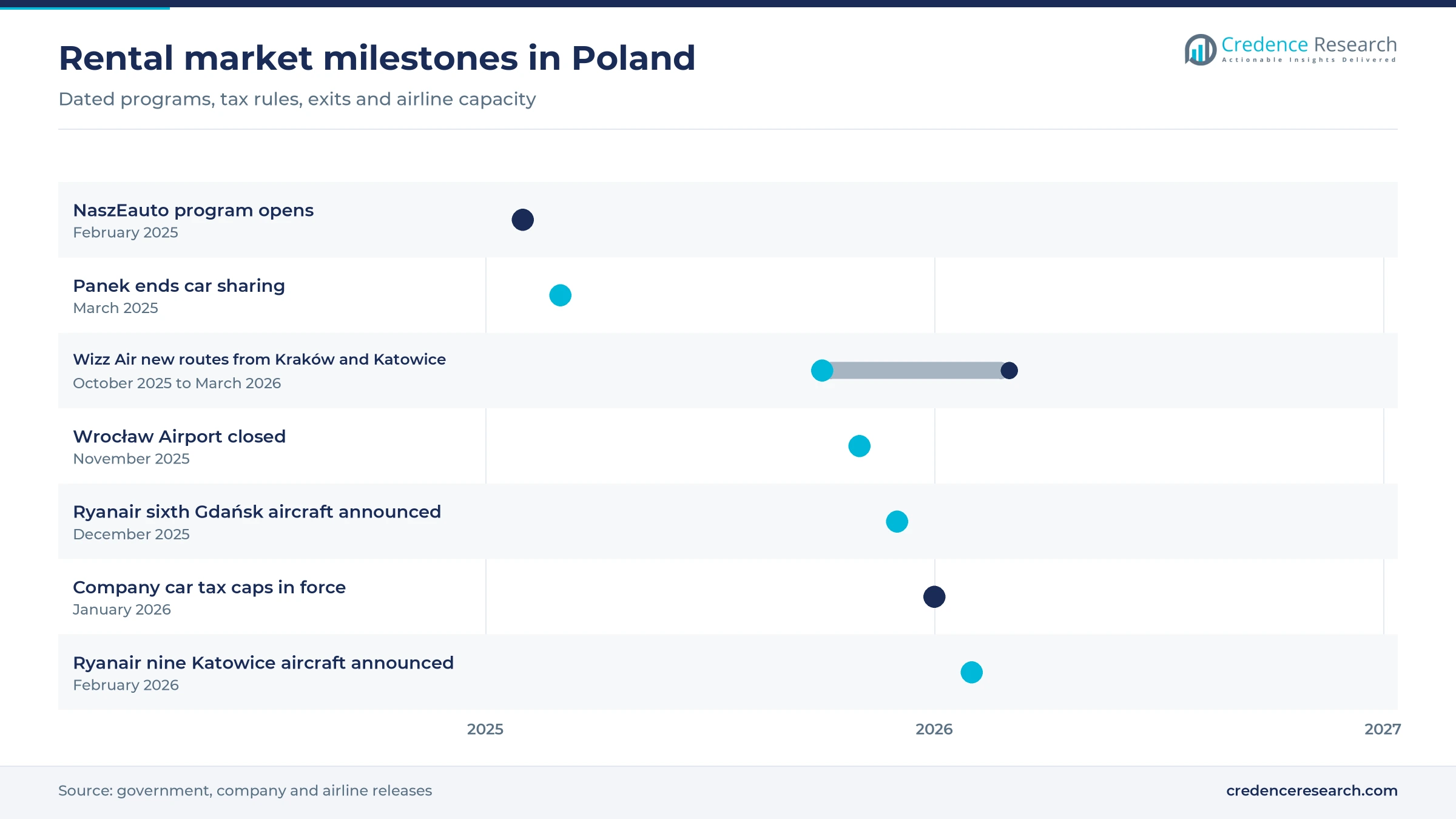
Airline bases, tax limits and an exit mark 2025 and 2026
| Development | Status and market relevance |
|---|---|
| In February 2025, the government opened applications for NaszEauto, a PLN 1.6 billion program paying up to PLN 40,000 toward a new electric car, including leased and rented ones. | Running; lowers the cost of adding electric cars to rental fleets |
| In March 2025, Panek announced that it would suspend its car sharing service from March 29, 2025 and keep its daily rental business. | Completed; shifts the brand fully to daily rental |
| In December 2025, Ryanair said it would base a sixth aircraft in Gdańsk for summer 2026 and offer about 2.3 million seats. | Announced; adds inbound leisure renters on the Baltic coast |
| In January 2026, new caps on deductible costs for company cars took effect, set at PLN 100,000 for most combustion cars and PLN 225,000 for electric cars. | In force; applies to operating leases and rentals, including older contracts |
| In February 2026, Ryanair said it would base nine aircraft in Katowice for summer 2026 and fly 26 routes. | Announced; strengthens leisure rental demand in Southern Poland |
Digital keys and connected fleets cut the cost per rental
- Online booking engines let chains such as Express, Panek and CarFree sell without brokers and adjust prices by season and airport.
- Telematics units report location, mileage and fuel or charge levels, which cuts disputes and speeds up returns at airports.
- Digital damage inspection uses photos taken in an app at pickup and return, so insurers and renters can settle claims faster.
- Charging access cards give renters of electric cars access to public chargers, which matters for foreign visitors unfamiliar with local networks.
Need a Custom Version of This Report?
Tailor the scope, geography, or segments to your exact requirements.
- Custom geography or segment scope
- Direct access to our analyst team
Franchised global brands face Polish national chains
Competition in Polish car rental turns on airport presence, fleet cost and the ability to serve insurers and companies at the same time. Franchised global brands win foreign leisure renters through international booking systems and loyalty programs, while Polish chains compete on branch density, delivery and price. Express runs city and rental point locations and also offers monthly and multi-year rentals, and its holding group also includes EVP Electric Vehicles Poland. Panek concentrates on daily rental after leaving car sharing, while CarFree and Kaizen Rent win customers with no-deposit terms and airport desks. Operators that link rentals with fleet management services for business accounts win longer contracts. Price competition is strongest in summer at the airports, where brokers compare every offer side by side.
How the Polish supply side is organized
Most global rental brands enter Poland through local franchise or license partners, unlike the company-owned networks common in German vehicle hire. Eurorent runs Sixt as a franchisee of SIXT GmbH, Motorent holds the Hertz license, and Car Hire Poland, majority-owned by 99rent since May 2018, holds the Enterprise, National and Alamo brands. Avis Budget Group bought its Polish Avis licensee in 2015. Polish chains such as Express, Panek, 99rent and Kaizen Rent compete with national branch networks, and hundreds of local firms serve insurers and regional airports. Fleet funding and airport concessions are the main barriers, and margins sit in premium and mid-term rentals.
Companies profiled and their roles in this market
| Company | Type | Role in the market |
|---|---|---|
| SIXT Polska / EuroRent | Global brand franchisee | Eurorent Sp. z o.o. in Warsaw operates Sixt in Poland as franchisee of SIXT GmbH |
| Europcar Polska | Global brand network | Markets rental locations across Poland through the Europcar booking system |
| Hertz Polska / Motorent | Global brand licensee | Motorent Sp. z o.o. is the licensee of Hertz International in Poland |
| Avis Budget Poland | Global brand, company owned | Avis Budget Group bought its Polish Avis licensee, with more than 50 locations, in 2015 |
| Enterprise Rent-A-Car Poland | Global brand licensee | Operated by Car Hire Poland at Polish airports, majority-owned by 99rent since 2018 |
| Panek S.A. | Polish rental chain | Kept daily rental after suspending car sharing on March 29, 2025; rents in six countries |
| Express Car Rental | Polish rental chain | City and rental point network with daily, monthly and multi-year rentals |
| 99RENT | Polish rental chain | About 40 branches and majority owner of the Enterprise licensee Car Hire Poland |
| CarFree | Regional operator | Katowice Airport desk open 24 hours, no deposit and city delivery across Silesia |
| Kaizen Rent | Polish rental chain | Lubin-based company with more than 30 branches, including airports |
Utilization and fleet funding now decide margins
Credence Research's view is that utilization and the cost of fleet funding now decide who earns money in Polish car rental. Demand is secure while flights and tourism keep growing, but the 2025 fleet contraction shows that capital, not customers, is the scarce input. Chains with access to cheap funding and a mix of leisure, insurer and corporate customers can keep cars busy all year. Corporate accounts, growing at 8.7% a year, are the clearest opening, because the 2026 tax caps make renting cheaper and electric models more attractive than buying.
Fleet counts, rate cards and air traffic anchor the model
The report uses 2025 as the base year and forecasts value to 2035 in USD million from the Credence Research market model. Segment and regional splits are Credence Research estimates built from PZWLP fleet data, Civil Aviation Authority and airport passenger data, Statistics Poland and Eurostat tourism data, PZPM and IBRM Samar registration data, insurer rate cards, tax guidance and company websites and releases. No interviews or surveys were used for this edition of the report.
Air traffic and corporate demand carry growth to 2035
The Poland car rental market reaches USD 1.68 billion by 2035, growing at 7.76% a year from USD 858.0 million in 2026. Economy cars keep the largest share, while sport utility vehicles gain as renters trade up. Mazowieckie stays the largest region, and Southern Poland grows fastest on new airline bases in Kraków and Katowice. Battery electric cars grow from a small base as charging networks expand and tax caps favor them. Air traffic growth and the return of bank funding for fleets are the two factors most likely to move the forecast in either direction.
Air traffic and fleet funding set the range to 2035
The range of outcomes depends mainly on how fast air traffic keeps growing and whether banks fund fleet renewal again. A slowdown in tourism, more rental firm failures and weaker corporate hiring would hold growth down and produce the downside. Continued airline base openings in the regions, faster corporate use of mid-term rental under the new tax caps and cheaper electric fleets would lift utilization and prices and produce the upside.
| Scenario | CAGR, 2026–2035 | Value, 2035 | What has to hold |
|---|---|---|---|
| Downside | 6.2% | USD 1.47 billion | Tourism slows, bank funding stays tight and more small operators exit |
| Base | 7.76% | USD 1.68 billion | Air traffic grows at recent rates and corporate mid-term rental keeps gaining |
| Upside | 9.2% | USD 1.89 billion | New airline bases, faster corporate switching and cheaper electric fleets lift utilization |
Frequently Asked Questions
How big is the Poland car rental market?
Which cars do renters in Poland choose most?
Which rental companies operate in Poland?
How much does a replacement car cost an insurer in Poland?
How do the 2026 tax rules affect company car rental?
Are electric rental cars available in Poland?
Why did the rental fleet shrink in 2025?
Which region leads car rental demand in Poland?
Table of Content
Chapter 1 Market Segmentation
- 1.1 Segmentation Framework
- 1.1.1 Product and Service Classification
- 1.1.2 Application and End-Use Classification
- 1.1.3 Technology and Solution Classification
- 1.1.4 Customer and Distribution Channel Classification
- 1.1.5 Geographic Segmentation
- 1.1.6 Market Segment Definitions and Boundaries
- 1.2 By Vehicle Type
- 1.2.1 Economy cars
- 1.2.2 Compact and standard cars
- 1.2.3 Sport utility vehicles
- 1.2.4 Premium passenger cars
- 1.3 By Customer Type
- 1.3.1 Individual renters
- 1.3.2 Corporate accounts
- 1.3.3 Insurers and assistance payers
- 1.3.4 Public-sector and nonprofit accounts
- 1.4 By Sales Channel
- 1.4.1 Direct digital bookings
- 1.4.2 Travel intermediaries
- 1.4.3 Account and branch sales
- 1.5 By Powertrain
- 1.5.1 Petrol vehicles
- 1.5.2 Diesel vehicles
- 1.5.3 Hybrid vehicles
- 1.5.4 Battery electric vehicles
Chapter 2 Introduction
- 2.1 Report Objectives and Scope
- 2.2 Product Definition and Industry Terminology
- 2.3 Market Inclusions and Exclusions
- 2.4 Research Process
- 2.4.1 Primary Research and Expert Interviews
- 2.4.2 Secondary Research and Source Review
- 2.4.3 Top-Down and Bottom-Up Estimation
- 2.4.4 Data Triangulation and Verification
- 2.5 Market Size Measurement Basis
- 2.5.1 2025: USD 788.5 million → 2035: USD 1.68 billion
- 2.6 Historical and Forecast Reference Periods
- 2.6.1 Historical Period: 2018-2025
- 2.6.2 Base Year: 2025
- 2.6.3 Forecast Period: 2025-2035
- 2.7 Research Assumptions and Limitations
Chapter 3 Executive Summary
- 3.1 Market Snapshot and Key Findings
- 3.2 Base-Year Market Size, 2025
- 3.3 Forecast Market Size, 2035
- 3.4 Revenue and Volume Growth Outlook
- 3.5 Key Demand and Supply Indicators
- 3.6 Leading Market Segments
- 3.7 Fastest-Growing Market Opportunities
- 3.8 Regional Performance Highlights
- 3.9 Technology and Industry Transformation
- 3.10 Competitive Landscape Summary
- 3.11 Analyst View and Strategic Implications
Chapter 4 Poland Car Rental Market Trends and Developments
- 4.1 Historical Industry Development, 2018-2025
- 4.2 Recent Market Trends and Developments
- 4.3 Demand and Customer Behavior Trends
- 4.4 Technology and Product Innovation
- 4.5 Artificial Intelligence, Automation and Digitalization
- 4.6 Local Manufacturing and Supply Chain Realignment
- 4.7 Industry Partnerships, Mergers and Acquisitions
- 4.8 Sustainability and Circular Economy Developments
- 4.9 Government and Private Sector Investment Trends
- 4.10 Emerging Business Models and Commercialization
- 4.11 Industry Developments and Announcements
Chapter 5 Poland Car Rental Market Production, Supply and Demand Analysis
- 5.1 Demand Trend and Consumption Analysis, 2018-2025
- 5.2 Demand Forecast, 2025-2035
- 5.3 Production and Output Trend, 2018-2025
- 5.4 Production and Output Forecast, 2025-2035
- 5.5 Installed Capacity and Capacity Utilization
- 5.6 Company-Wise Production Plants and Statistics
- 5.6.1 Installed Production Capacity
- 5.6.2 Actual Production
- 5.6.3 Planned Capacity and Expansion Targets
- 5.7 Supply Chain Structure and Procurement Trends
- 5.8 Supply-Demand Gap and Bottlenecks
- 5.9 Import Dependence and Sourcing Structure
- 5.10 Contract Manufacturing and Outsourcing
- 5.11 Regional Supply and Demand Concentration
Chapter 6 Poland Car Rental Market Pricing Analysis
- 6.1 Pricing Structure and Measurement
- 6.2 Historical Pricing Trends, 2018-2025
- 6.3 Pricing Outlook, 2025-2035
- 6.4 Average Selling Price and Unit Economics
- 6.5 Pricing by Product and Market Segment
- 6.6 Geographic Pricing Differences
- 6.7 Key Input, Energy, Labor and Logistics Costs
- 6.8 Contract Pricing and Purchasing Models
- 6.9 Pricing Sensitivity and Competitive Positioning
- 6.10 Price, Margin and Profitability Implications
Chapter 7 Poland Car Rental Market Dynamics
- 7.1 Market Growth Drivers
- 7.1.1 Demand-Side Drivers
- 7.1.2 Technology and Innovation Drivers
- 7.1.3 Infrastructure and Investment Drivers
- 7.1.4 Regulatory and Policy Drivers
- 7.2 Market Restraints
- 7.2.1 Cost and Affordability Constraints
- 7.2.2 Technology and Adoption Barriers
- 7.2.3 Supply Chain and Operational Constraints
- 7.3 Market Challenges
- 7.3.1 Competitive Pressure and Margin Erosion
- 7.3.2 Skills, Infrastructure and Implementation Gaps
- 7.4 Emerging Market Opportunities
- 7.5 Market Dynamics Impact and Time-Horizon Assessment
Chapter 8 Poland Car Rental Value Chain Analysis
- 8.1 Industry Value Chain Overview
- 8.2 Upstream Suppliers and Critical Inputs
- 8.3 Technology and Component Providers
- 8.4 Manufacturing or Service Delivery
- 8.5 Distribution, Channel Partners and Integrators
- 8.6 Downstream Applications and End Users
- 8.7 Value Addition and Profit Pools
- 8.8 Vertical Integration and Outsourcing
- 8.9 Supplier Concentration and Risk
- 8.10 Supply Chain Localization and Resilience
Chapter 9 Poland Car Rental Market Regulations and Policies
- 9.1 Relevant Laws, Standards and Compliance Frameworks
- 9.2 Product, Service, Safety and Quality Requirements
- 9.3 Government Policies, Incentives and Subsidies
- 9.4 Imports, Exports and Trade Barriers
- 9.5 Public Procurement and Local Content Requirements
- 9.6 Environmental and Sustainability Compliance
- 9.7 Upcoming Policy Changes and Market Implications
Chapter 10 Poland Car Rental Market Hotspots and Opportunities
- 10.1 Market Opportunity Mapping and Growth Hotspots
- 10.2 High-Growth Applications and Customer Groups
- 10.3 Underserved Markets and White-Space Opportunities
- 10.4 Emerging Technology and Product Opportunities
- 10.5 New Capacity and Investment Hotspots
- 10.6 Market Entry and Expansion Opportunities
- 10.7 Distribution and Partnership Opportunities
- 10.8 Near-Term and Long-Term Commercial Potential
- 10.9 Opportunity Attractiveness and Execution Risks
Chapter 11 Poland Car Rental Market Outlook, 2025-2035
- 11.1 Market Size and Analysis
- 11.1.1 Revenue (Market Measurement: 2025: USD 788.5 million → 2035: USD 1.68 billion)
- 11.1.2 Market Volume and Quantity Sold
- 11.1.3 Historical Market Size, 2018-2025
- 11.1.4 Base-Year Market Size, 2025
- 11.2 Market Forecast, 2025-2035
- 11.2.1 Revenue Forecast to 2035
- 11.2.2 Volume Forecast to 2035
- 11.2.3 CAGR and Year-on-Year Growth
- 11.2.4 Incremental Revenue Opportunity
- 11.3 Forecast Assumptions and Scenario Analysis
- 11.3.1 Base-Case Forecast
- 11.3.2 Optimistic and Conservative Scenarios
- 11.3.3 Technology, Pricing and Policy Sensitivities
- 11.4 Market Attractiveness and Growth Outlook
Chapter 12 Poland Car Rental Market Segmentation and Outlook
- 12.1 Segmentation Summary and Market Shares, 2025
- 12.2 Largest and Fastest-Growing Segments
- 12.3 By Vehicle Type - Market Size and Forecast, 2025-2035
- 12.3.1 Segment Definition and Scope
- 12.3.2 Historical Market Size, 2018-2025
- 12.3.3 Revenue Forecast, 2025-2035
- 12.3.4 Volume Forecast, 2025-2035
- 12.3.5 Base-Year Market Share, 2025
- 12.3.6 Segment CAGR and Growth Drivers
- 12.3.7 Subsegment Market Size and Forecast
- 12.3.7.1 Economy cars
- 12.3.7.2 Compact and standard cars
- 12.3.7.3 Sport utility vehicles
- 12.3.7.4 Premium passenger cars
- 12.3.8 Subsegment Pricing and Adoption Trends
- 12.3.9 Leading Suppliers and Competition
- 12.3.10 Regional Demand and Opportunities
- 12.4 By Customer Type - Market Size and Forecast, 2025-2035
- 12.4.1 Segment Definition and Scope
- 12.4.2 Historical Market Size, 2018-2025
- 12.4.3 Revenue Forecast, 2025-2035
- 12.4.4 Volume Forecast, 2025-2035
- 12.4.5 Base-Year Market Share, 2025
- 12.4.6 Segment CAGR and Growth Drivers
- 12.4.7 Subsegment Market Size and Forecast
- 12.4.7.1 Individual renters
- 12.4.7.2 Corporate accounts
- 12.4.7.3 Insurers and assistance payers
- 12.4.7.4 Public-sector and nonprofit accounts
- 12.4.8 Subsegment Pricing and Adoption Trends
- 12.4.9 Leading Suppliers and Competition
- 12.4.10 Regional Demand and Opportunities
- 12.5 By Sales Channel - Market Size and Forecast, 2025-2035
- 12.5.1 Segment Definition and Scope
- 12.5.2 Historical Market Size, 2018-2025
- 12.5.3 Revenue Forecast, 2025-2035
- 12.5.4 Volume Forecast, 2025-2035
- 12.5.5 Base-Year Market Share, 2025
- 12.5.6 Segment CAGR and Growth Drivers
- 12.5.7 Subsegment Market Size and Forecast
- 12.5.7.1 Direct digital bookings
- 12.5.7.2 Travel intermediaries
- 12.5.7.3 Account and branch sales
- 12.5.8 Subsegment Pricing and Adoption Trends
- 12.5.9 Leading Suppliers and Competition
- 12.5.10 Regional Demand and Opportunities
- 12.6 By Powertrain - Market Size and Forecast, 2025-2035
- 12.6.1 Segment Definition and Scope
- 12.6.2 Historical Market Size, 2018-2025
- 12.6.3 Revenue Forecast, 2025-2035
- 12.6.4 Volume Forecast, 2025-2035
- 12.6.5 Base-Year Market Share, 2025
- 12.6.6 Segment CAGR and Growth Drivers
- 12.6.7 Subsegment Market Size and Forecast
- 12.6.7.1 Petrol vehicles
- 12.6.7.2 Diesel vehicles
- 12.6.7.3 Hybrid vehicles
- 12.6.7.4 Battery electric vehicles
- 12.6.8 Subsegment Pricing and Adoption Trends
- 12.6.9 Leading Suppliers and Competition
- 12.6.10 Regional Demand and Opportunities
- 12.7 Segment Growth Comparison
- 12.8 Segment Attractiveness and Priority Matrix
Chapter 13 Poland Car Rental End-Use and Application Market Outlook
- 13.1 End-Use Industry and Customer Demand Structure
- 13.2 Leading Applications and Customer Groups
- 13.3 End-Use Market Size, Share and Forecast
- 13.4 Major End-Use Industry Deep Dives
- 13.4.1 Customer Requirements and Use Cases
- 13.4.2 Demand and Replacement Cycles
- 13.4.3 Technical and Regulatory Considerations
- 13.4.4 Purchasing and Procurement Models
- 13.4.5 Leading Vendors and Distribution Channels
- 13.4.6 Forecast and Commercial Opportunities
- 13.5 Emerging Applications and Cross-Segment Demand
- 13.6 End-Use Industry Investment Priorities
Chapter 14 Poland Car Rental Geographic Market Outlook, 2025-2035
- 14.1 Domestic Market Distribution and Demand Clusters
- 14.2 State- or Province-Wise Market Size and Forecast, 2025-2035
- 14.3 City and Metropolitan Market Outlook
- 14.4 Industrial, Manufacturing and Commercial Clusters
- 14.5 Geographic Concentration of Key End Users
- 14.6 Local Pricing and Purchasing Differences
- 14.7 Domestic Production Facilities and Capacity Map
- 14.8 Local Infrastructure and Project Pipeline
- 14.9 State-Level Policy and Incentive Differences
- 14.10 Subnational Investment Hotspots and Opportunities
- 14.11 Distribution and Logistics Networks
- 14.12 Domestic Competitive Footprint
Chapter 15 Poland Car Rental Technology, Innovation and Sustainability Outlook
- 15.1 Technology Landscape and Maturity
- 15.2 Product, Process and Service Innovation
- 15.3 AI, Automation and Digital Tools in the Industry
- 15.4 Technology Adoption and Performance Benchmarking
- 15.5 Innovation Pipeline and R&D Investment
- 15.6 Patent and Intellectual Property Trends
- 15.7 Energy Efficiency and Resource Management
- 15.8 Sustainability, Recycling and Circularity
- 15.9 Technology Roadmap, 2025-2035
- 15.10 Risks of Obsolescence and Technology Substitution
Chapter 16 Poland Car Rental Market Key Strategic Imperatives
- 16.1 Growth and Market Entry Priorities
- 16.2 High-Return Products and Segments
- 16.3 Pricing, Profitability and Cost Optimization
- 16.4 Technology Investment and Product Differentiation
- 16.5 Supply Chain Localization and Resilience
- 16.6 Distribution and Customer Acquisition
- 16.7 Partnership, Acquisition and Capacity Strategy
- 16.8 Regional Expansion Priorities
- 16.9 Short-, Medium- and Long-Term Actions
Chapter 17 Competition Outlook
- 17.1 Industry Competition Characteristics
- 17.2 Market Structure and Concentration
- 17.3 Market Share and Competitive Positioning, 2025
- 17.4 Company-Wise Revenue and Product Benchmarking
- 17.5 Production and Service Capacity Benchmarking
- 17.6 Technology, Pricing and Differentiation
- 17.7 Regional Footprint and Distribution Strength
- 17.8 Mergers, Acquisitions and Strategic Alliances
- 17.9 New Entrants and Competitive Threats
- 17.10 Porter's Five Forces and Industry Attractiveness
- 17.11 Competitive Outlook, 2025-2035
Chapter 18 Company Profiles
- 18.1 Company Coverage and Selection Criteria
- 18.2 SIXT Polska / EuroRent
- 18.2.1 Business Description
- 18.2.2 Company Ownership and Geographic Presence
- 18.2.3 Product and Service Portfolio
- 18.2.4 Manufacturing and Operating Footprint
- 18.2.5 Production Capacity and Expansion Plans
- 18.2.6 Financial Performance and Investment
- 18.2.7 Market Share and Competitive Position
- 18.2.8 Technology and Innovation Capabilities
- 18.2.9 Strategic Alliances or Partnerships
- 18.2.10 Recent Developments
- 18.2.11 Growth Strategy and Outlook
- 18.3 Europcar Polska
- 18.4 Hertz Polska / Motorent
- 18.5 Avis Budget Poland
- 18.6 Enterprise Rent-A-Car Poland
- 18.7 Panek S.A.
- 18.8 Express Car Rental
- 18.9 99RENT
- 18.10 CarFree
- 18.11 Kaizen Rent
- 18.12 Other Relevant Market Participants
Note: Every listed company is profiled on the structure shown under the first company. The company list is preliminary and may change based on research findings, market developments, data availability and client requirements.
Chapter 19 Disclaimer
- 19.1 Research and Forecast Disclaimer
- 19.2 Data Source and Estimation Limitations
Note: The depth of individual sections depends on data availability for this market. Volume, capacity, trade and other unit-based metrics are included where applicable.