
Market Overview
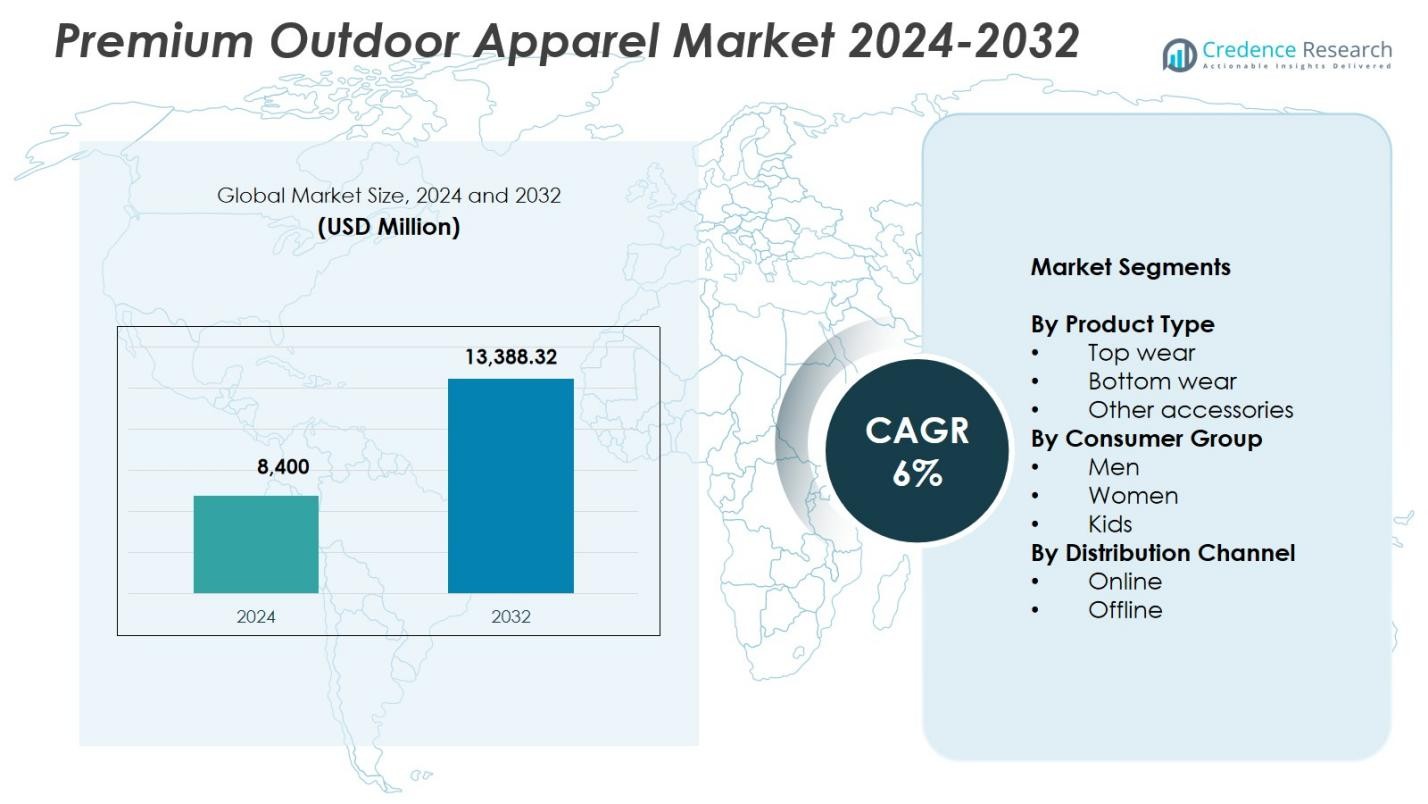
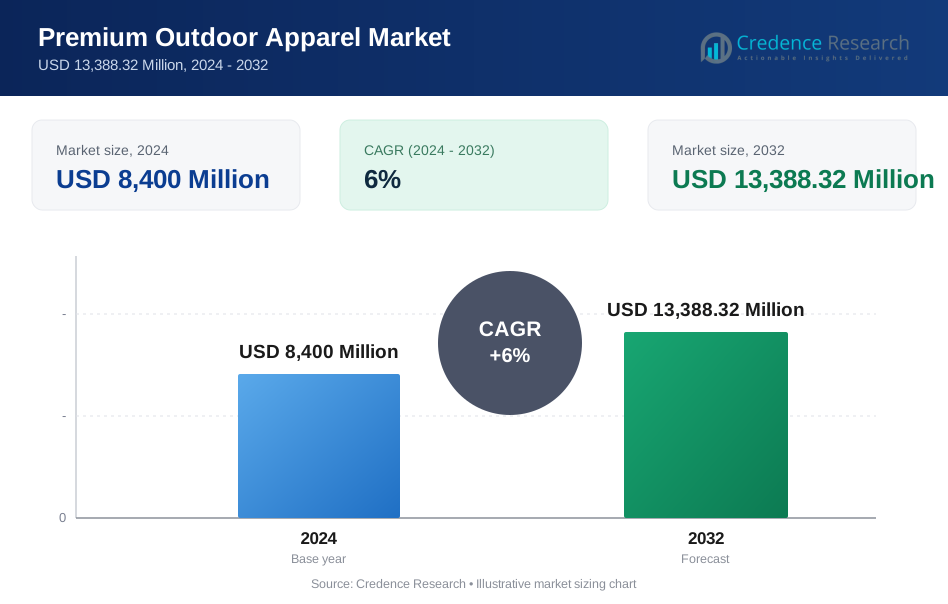
Premium Outdoor Apparel Market size was valued at USD 8,400 Million in 2024 and is anticipated to reach USD 13,388.32 Million by 2032, at a CAGR of 6% during the forecast period.
| REPORT ATTRIBUTE | DETAILS |
|---|---|
| Historical Period | 2020-2023 |
| Base Year | 2024 |
| Forecast Period | 2025-2032 |
| Premium Outdoor Apparel Market Size 2024 | USD 8,400 Million |
| Premium Outdoor Apparel Market, CAGR | 6% |
| Premium Outdoor Apparel Market Size 2032 | USD 13,388.32 Million |
Premium Outdoor Apparel Market features leading players such as Adidas, Amer Sports, Anta Sports, Black Diamond Equipment, Canadian Tire, Columbia Sportswear, Equip Outdoor Technologies, Fenix Outdoor, Haglofs, and Jack Wolfskin, each strengthening their position through innovation in performance fabrics, sustainable materials, and multi-season outdoor gear. These companies focus on expanding product portfolios and enhancing retail reach to meet rising global demand for high-quality technical apparel. North America emerged as the leading region with a 37.8% share, supported by strong outdoor participation and high spending on premium gear, followed by Europe with a 32.5% share, driven by established outdoor culture and demand for high-performance, eco-friendly apparel.
Market Insights
- Premium Outdoor Apparel Market is valued at USD 8,400 Million in 2024 and will reach USD 13,388.32 Million by 2032 at a CAGR of 6%.
- Strong market drivers include rising outdoor recreation and high demand for top wear, which held a 48.6% share, supported by innovations in lightweight, weather-resistant, and sustainable materials.
- Key trends include growing adoption of smart apparel, sustainability-focused production, and increasing consumer preference for multifunctional premium outdoor clothing across global markets.
- Leading players such as Adidas, Amer Sports, Columbia Sportswear, Fenix Outdoor, and Jack Wolfskin expand product portfolios while North America leads with a 37.8% share and Europe follows with 32.5%.
- Market restraints include high production costs for advanced materials, while Asia-Pacific with a 21.4% share, along with Latin America and Middle East & Africa, reflects rising adoption driven by expanding outdoor tourism and improved retail access.
 Market Segmentation Analysis:
By Product Type
Top wear dominated the Premium Outdoor Apparel Market with a 48.6% share, driven by rising demand for high-performance jackets, insulated layers, and technical tops designed for hiking, trekking, and alpine sports. Consumers increasingly prefer weather-resistant and breathable materials that enhance comfort during multi-season outdoor activities. Innovations in lightweight fabrics, moisture-management technologies, and sustainable materials further strengthen top wear adoption across premium categories. Bottom wear held a steady presence due to growth in softshell pants and thermal leggings, while other accessories expanded with increasing uptake of gloves, gaiters, and headgear supporting performance-oriented outdoor use.
- For instance, Patagonia's Better Sweater Fleece Jacket uses 100% recycled polyester knit fleece, dyed with a low-impact process that cuts dyestuffs, energy, and water use versus standard methods, offering warmth and a sweater-like exterior for versatile layering in cool hikes.
By Consumer Group
Men represented the dominant consumer segment with a 52.4% share, supported by strong participation in mountaineering, trail running, and adventure travel, which drives consistent spending on technical outdoor clothing. This group shows high preference for durable materials, multifunctional garments, and performance-enhancing features such as insulation, advanced fit, and abrasion resistance. The women’s segment grew steadily with increasing involvement in outdoor recreation and rising demand for ergonomic, style-oriented designs. Kids' premium outdoor apparel advanced as parents prioritized safety, comfort, and thermal protection in specialized clothing for outdoor learning and adventure activities.
- For instance, Patagonia’s Women’s Nano Puff® Jacket combines lightweight recycled insulation with a slim silhouette to appeal to active and eco-conscious consumers, and Columbia’s Women’s Omni‑Heat Infinity™ collection enhances thermal efficiency by integrating gold‑dot reflective lining designed for cold-weather endurance.
By Distribution Channel
Offline channels led the market with a 61.7% share, fueled by consumers’ preference for in-store evaluation of fit, fabric quality, and performance attributes before purchase. Specialty outdoor retailers, premium brand outlets, and sporting goods stores remain essential for expert guidance, product trials, and immediate availability of high-end technical apparel. Strong brand visibility and experiential retail formats further enhance segment dominance. Online channels expanded rapidly due to broader product access, digital promotions, and improved delivery networks, attracting tech-savvy consumers seeking convenience and detailed product information for premium outdoor apparel purchases.
Key Growth Drivers
Rising Participation in Outdoor Recreation
Growing global participation in hiking, trekking, camping, and adventure sports strongly accelerates demand for premium outdoor apparel. Consumers prioritize durability, comfort, and technical performance, driving brands to offer high-quality insulated jackets, breathable layers, and all-weather gear. Increased spending on recreational travel and wellness-focused lifestyles further supports market expansion. The surge in nature-based tourism, supported by improved outdoor infrastructure and promotional initiatives, strengthens the need for premium outdoor clothing designed to perform across varying terrains and climatic conditions.
- For instance, Patagonia's Nano Puff Insulated Jacket uses 60 g PrimaLoft Gold Insulation Eco with a 100% recycled ripstop polyester shell featuring DWR finish, weighing just 13 ounces for lightweight packability during hikes.
Advancements in High-Performance Materials
Continuous innovation in advanced fabrics significantly fuels market growth as manufacturers develop lightweight, moisture-wicking, and thermally efficient materials. Technologies such as environmentally friendly membranes, biobased textiles, and enhanced water-repellent coatings improve apparel performance in extreme weather. These advancements increase consumer trust in premium outdoor clothing for prolonged outdoor exposure. Strong R&D investments by leading brands support the expansion of multifunctional designs that deliver improved mobility, breathability, and long-term durability, widening adoption across recreational and professional outdoor users.
- For instance, Gore introduces next-generation ePE Gore-Tex Pro membranes in rugged outerwear, providing durably waterproof, windproof, and breathable protection without per- and polyfluorinated substances for extreme conditions.
Growth of Sustainability-Driven Consumer Preferences
Rapidly rising environmental awareness encourages consumers to choose sustainably produced outdoor apparel made from recycled fibers, organic materials, and responsibly sourced insulation. Brands integrating circular economy practices-such as repair programs, recycled collections, and low-impact manufacturing-gain strong market traction. Transparent sourcing and traceability further strengthen consumer loyalty toward eco-focused premium apparel. Government regulations promoting sustainable production also push manufacturers to adopt greener technologies, enhancing market growth and positioning eco-friendly premium outdoor clothing as a mainstream demand driver.
Key Trends & Opportunities
Expansion of Smart and Tech-Enabled Outdoor Apparel
Integration of wearable technologies in premium outdoor clothing creates major growth opportunities. Smart fabrics with temperature regulation, biometric monitoring, and adaptive insulation enhance outdoor safety and performance. Brands increasingly explore sensor-embedded garments and connectivity features targeting athletes, mountaineers, and long-distance trekkers. This trend strengthens product differentiation and opens new avenues for innovation-focused companies. As consumer interest in functional yet technologically advanced apparel rises, smart outdoor wear positions itself as a high-value growth frontier within premium segments.
- For instance, Hexoskin offers biometric smart shirts with textile sensors in a CC5 lead configuration that capture 1-lead ECG data at 256 Hz, alongside respiratory inductance plethysmography for breathing rate and tidal volume monitoring during high-intensity activities.
Rapid Growth of Direct-to-Consumer and Omnichannel Strategies
Brands increasingly adopt direct-to-consumer (D2C) and omnichannel models to strengthen customer engagement, optimize pricing, and enhance product personalization. Premium outdoor apparel companies invest in digital storefronts, virtual fitting tools, and integrated retail experiences that merge online and offline interactions. This shift allows deeper understanding of consumer preferences and faster product launches. Improved logistics, personalized recommendations, and subscription-based gear programs further support revenue expansion while offering customers convenient access to premium outdoor clothing across global markets.
- For instance, Arc'teryx offers Virtual Advisor appointments where product guides provide personalized gear and fit recommendations via video, helping customers select items like the Beta AR Jacket for specific activities such as skiing.
Key Challenges
High Cost of Premium Materials and Technologies
The use of advanced fabrics, sustainable materials, and technical design elements elevates production costs, making premium outdoor apparel more expensive for a wide consumer base. High labor expenses, material sourcing complexity, and continuous R&D investment further increase pricing pressures. These cost challenges limit affordability in emerging markets and restrict adoption among cost-sensitive buyers. Manufacturers must balance innovation with cost-effective production methods to maintain competitiveness while delivering the technical performance expected in premium outdoor clothing.
Intense Market Competition and Brand Saturation
The market faces increasing competitive pressure as global outdoor brands, fashion labels, and new entrants expand their premium collections. High product similarity across categories-such as insulated jackets, base layers, and waterproof shells-complicates differentiation and intensifies price-based competition. Brand saturation reduces customer loyalty and challenges smaller players attempting to secure shelf space and digital visibility. Companies must invest in unique value propositions, sustainable innovations, and targeted marketing strategies to build strong brand identity and maintain long-term market relevance.
Regional Analysis
North America
North America held a 37.8% share in the Premium Outdoor Apparel Market, driven by strong consumer participation in hiking, skiing, mountaineering, and outdoor travel across the U.S. and Canada. High spending on performance-driven apparel, combined with the presence of leading brands and specialty retailers, reinforces market dominance. The region benefits from extensive outdoor infrastructure, national parks, and year-round adventure tourism. Growing emphasis on sustainability and recycled materials further boosts demand for premium technical wear, while digital retail expansion enhances accessibility for diverse consumer segments.
Europe
Europe accounted for a 32.5% share, supported by longstanding outdoor traditions in countries such as Germany, Switzerland, Sweden, and Norway. Strong interest in trekking, climbing, trail running, and winter sports continues to drive premium apparel adoption. The region’s focus on quality craftsmanship, eco-friendly materials, and functional design strengthens consumer loyalty toward premium brands. Robust distribution networks, including specialty outdoor retailers and flagship stores, further accelerate sales. Increasing environmental awareness and the rise of performance-lifestyle apparel also enhance Europe’s position as a key market for premium outdoor clothing.
Asia-Pacific
Asia-Pacific captured a 21.4% share, fueled by rising disposable incomes, expanding adventure tourism, and growing adoption of outdoor recreation in China, Japan, South Korea, and Australia. Rapid urbanization and increasing participation in hiking, backpacking, and camping among younger consumers drive premium apparel demand. International brands continue to expand retail footprints, while domestic companies strengthen their presence through affordable premium-quality offerings. Climate diversity across the region promotes continuous demand for insulated, waterproof, and UV-protective clothing, reinforcing Asia-Pacific’s strong growth potential in the premium outdoor apparel segment.
Latin America
Latin America accounted for a 5.2% share, supported by increasing outdoor sports participation in countries such as Brazil, Chile, and Argentina. The region’s diverse landscapes, including mountains, rainforests, and coastal trails, drive demand for durable and multifunctional premium apparel. Growth is driven by expanding adventure tourism, rising interest in fitness-oriented lifestyles, and gradual improvements in retail infrastructure. Although purchasing power variations limit premium adoption, increasing availability of international brands and the growth of e-commerce platforms strengthen the region’s long-term market outlook.
Middle East & Africa
The Middle East & Africa region held a 3.1% share, driven by growing interest in desert trekking, safari tourism, and endurance sports across the UAE, South Africa, and Kenya. Premium outdoor apparel demand increases as consumers prioritize protection against extreme temperatures and harsh environmental conditions. Expanding adventure tourism, coupled with higher adoption of high-quality UV-resistant and moisture-management clothing, supports market growth. Limited retail penetration and higher product prices remain challenges, but rising e-commerce accessibility and tourism-led outdoor activities contribute to gradual market expansion.
Market Segmentations:
By Product Type
- Top wear
- Bottom wear
- Other accessories
By Consumer Group
- Men
- Women
- Kids
By Distribution Channel
- Online
- Offline
By Geography
- North America
- U.S.
- Canada
- Mexico
- Europe
- Germany
- France
- U.K.
- Italy
- Spain
- Rest of Europe
- Asia Pacific
- China
- Japan
- India
- South Korea
- South-east Asia
- Rest of Asia Pacific
- Latin America
- Brazil
- Argentina
- Rest of Latin America
- Middle East & Africa
- GCC Countries
- South Africa
- Rest of the Middle East and Africa
Competitive Landscape
The competitive landscape of the Premium Outdoor Apparel Market features key players such as Adidas, Amer Sports, Anta Sports, Black Diamond Equipment, Canadian Tire, Columbia Sportswear, Equip Outdoor Technologies, Fenix Outdoor, Haglofs, and Jack Wolfskin, all of which actively strengthen their portfolios through product innovation and sustainability-led strategies. These companies prioritize high-performance materials, eco-friendly fabrics, and advanced insulation technologies to address rising consumer expectations for durability and comfort in outdoor environments. Many brands invest heavily in R&D to introduce lightweight, weather-resistant, and multifunctional products tailored for hiking, mountaineering, and multi-season use. Digital transformation plays a crucial role as firms expand omnichannel capabilities, enhance online shopping experiences, and leverage direct-to-consumer models to improve customer engagement. Strategic partnerships, brand collaborations, and geographic expansion further support competitive strength, enabling leading companies to capture a growing share of the premium outdoor apparel market across global regions.
Key Player Analysis
- Canadian Tire
- Haglofs
- Fenix Outdoor
- Adidas
- Jack Wolfskin
- Amer Sports
- Equip Outdoor Technologies
- Columbia Sportswear
- Black Diamond Equipment
- Anta Sports
Recent Developments
- In March 2025, Fenix Outdoor acquired a 65% stake in the Norwegian wool specialist brand Devold, strengthening its premium textile portfolio.
- In August 2025, Columbia Sportswear launched its global brand-refresh campaign “Engineered for Whatever,” aiming to reposition its outdoor apparel for extreme conditions and boost engagement.
- In September 2025, Black Diamond Equipment launched its Fall/Winter 2025–26 collection featuring “Recon Stretch Kit” and “Dawn Patrol Softshell Kit” built for backcountry performance.
Report Coverage
The research report offers an in-depth analysis based on Product Type, Consumer Group, Distribution Channel and Geography. It details leading market players, providing an overview of their business, product offerings, investments, revenue streams, and key applications. Additionally, the report includes insights into the competitive environment, SWOT analysis, current market trends, as well as the primary drivers and constraints. Furthermore, it discusses various factors that have driven market expansion in recent years. The report also explores market dynamics, regulatory scenarios, and technological advancements that are shaping the industry. It assesses the impact of external factors and global economic changes on market growth. Lastly, it provides strategic recommendations for new entrants and established companies to navigate the complexities of the market.
Future Outlook
- The market will grow steadily as outdoor recreation continues to increase across global regions.
- Brands will prioritize sustainable materials and circular production models to meet rising eco-conscious consumer demand.
- Smart and tech-integrated apparel will gain traction, offering enhanced safety, comfort, and performance features.
- Direct-to-consumer and omnichannel strategies will expand, strengthening brand visibility and customer engagement.
- Demand for lightweight, weather-resistant, and multifunctional garments will rise as consumers seek versatile outdoor wear.
- Premiumization will intensify as consumers prefer high-quality products with advanced material technologies.
- Asia-Pacific will emerge as a key growth hub due to rising incomes and expanding adventure tourism activities.
- Customization and personalized fitting options will become more common as brands adopt digital sizing tools.
- Collaborations with athletes, explorers, and outdoor influencers will shape new product lines and marketing strategies.
- Supply-chain optimization and nearshoring will become critical as companies reduce lead times and improve sustainability performance.
Request a Free Sample
Fill in your details and we'll send you a free sample report.
- Sample data tables & charts
- Research methodology
Need a Custom Version of This Report?
Tailor the scope, geography, or segments to your exact requirements.
- Custom geography or segment scope
- Direct access to our analyst team
Frequently Asked Questions
What is the current market size for the Premium Outdoor Apparel Market, and what is its projected size in 2032?
At what Compound Annual Growth Rate is the Premium Outdoor Apparel Market projected to grow between 2025 and 2032?
Which Premium Outdoor Apparel Market segment held the largest share in 2024?
What are the primary factors fueling the growth of the Premium Outdoor Apparel Market?
Who are the leading companies in the Premium Outdoor Apparel Market?
Which region commanded the largest share of the Premium Outdoor Apparel Market in 2024?
Table of Content
Chapter 1. Report Introduction
- 1.1 Report Description & Purpose
- 1.1.1 Report Title & Market Definition
- 1.1.2 Unique Selling Propositions (USP) & Key Differentiators
- 1.1.3 Value Proposition for Stakeholders
- 1.2 Research Objectives
- 1.2.1 Market Sizing Objectives (Volume & Revenue) (Volume Where Applicable)
- 1.2.2 Segmentation Objectives
- 1.2.3 Competitive Intelligence Objectives
- 1.2.4 Forecast & Scenario Objectives
- 1.3 Report Scope
- 1.3.1 Premium Outdoor Apparel Scope – Segments & Subsegments Covered
- 1.3.2 Geographic Scope – Regions & Countries Covered
- 1.3.3 Historical Period, Base Year & Forecast Period (2024; forecast to 2032)
- 1.3.4 Inclusions & Exclusions
- 1.4 Industry Classification & Applicable Codes
- 1.5 Currency, Measurement Units & Valuation Basis
- 1.6 Target Stakeholders
- 1.7 Limitations & Assumptions
Chapter 2. Executive Summary
- 2.1 Global Premium Outdoor Apparel Market Snapshot
- 2.1.1 Market Size – Historical (2024) & Forecast (2024-2032) (2024: USD 8,400 Million → 2032: USD 13,388.32 Million)
- 2.1.2 Volume & Revenue – Global Totals (Volume Where Applicable)
- 2.1.3 Key Market Highlights – Top Five Facts
- 2.2 Premium Outdoor Apparel Market Segmentation Snapshot
- 2.2.1 Market Split by Region – 2024 vs. 2032
- 2.3 Competitive Snapshot
- 2.3.1 Top 10 Players by Revenue Share – 2024
- 2.3.2 Top 10 Players by Volume Share – 2024 (Volume Where Applicable)
- 2.3.3 Recent Strategic Developments (18-Month Summary)
- 2.4 Key Investment Highlights & Strategic Conclusions
Chapter 3. Premium Outdoor Apparel Market Dynamics & Industry Analysis
- 3.1 Market Overview & Context
- 3.1.1 Premium Outdoor Apparel Market Position in the Broader Industry Value Chain
- 3.1.2 Demand Structure & Purchasing Dynamics
- 3.1.3 Market Maturity & Development Stage by Region
- 3.2 Premium Outdoor Apparel Market Drivers
- 3.3 Premium Outdoor Apparel Market Restraints & Challenges
- 3.4 Premium Outdoor Apparel Market Opportunities
- 3.5 Porter's Five Forces Analysis
- 3.5.1 Threat of New Entrants
- 3.5.2 Bargaining Power of Suppliers
- 3.5.3 Bargaining Power of Buyers
- 3.5.4 Threat of Substitutes
- 3.5.5 Competitive Rivalry – Intensity Assessment
- 3.6 Premium Outdoor Apparel Value Chain Analysis
- 3.6.1 Upstream – Key Inputs, Resources & Suppliers
- 3.6.1.1 Key Input/Resource 1
- 3.6.1.2 Key Input/Resource 2
- 3.6.1.3 Key Input/Resource 3
- 3.6.2 Midstream – Core Operations & Value Creation
- 3.6.2.1 Operating Model & Process Overview
- 3.6.2.2 Key Operating Locations & Capabilities by Company
- 3.6.3 Downstream – Market Channels & End Users
- 3.6.3.1 Direct Sales & Customer Engagement Channels
- 3.6.3.2 Indirect Sales, Intermediaries & Partner Channels
- 3.6.4 Value Chain Profitability Analysis
- 3.6.1 Upstream – Key Inputs, Resources & Suppliers
- 3.7 PESTEL Analysis
- 3.7.1 Political Factors
- 3.7.2 Economic Factors
- 3.7.3 Social Factors
- 3.7.4 Technological Factors
- 3.7.5 Environmental Factors
- 3.7.6 Legal Factors
- 3.8 Premium Outdoor Apparel Supply Chain Analysis
- 3.8.1 Critical Input & Resource Availability Risk Assessment
- 3.8.2 Supplier & Operational Concentration Risk (Geographic Exposure)
- 3.8.3 Supply & Service Disruption Impact Analysis
- 3.9 Regulatory & Policy Landscape
Note: The regulatory and policy landscape section covers regulations based on their applicability to the market, Premium Outdoor Apparel category, geography, and scope of the study. Only regulatory frameworks with a material impact on operations, compliance, trade, sustainability, or market access are analyzed in detail.
Chapter 4. Key Investment Pockets & Opportunity Analysis
- 4.1 Premium Outdoor Apparel Market Attractiveness Analysis
- 4.1.1 By Region – Investment Attractiveness Matrix (Market Size × CAGR)
- 4.2 Absolute Revenue Growth Opportunity
- 4.2.1 By Region – Absolute Revenue Growth Through 2032
- 4.3 Incremental Demand Opportunity
- 4.3.1 By Region – Incremental Demand Through 2032
- 4.3.2 Segment – Incremental Demand
- 4.4 Emerging Submarket Opportunity Deep Dive (Subject to Applicability)
- 4.5 Priority Market Opportunity Scorecards
- 4.5.1 United States
- 4.5.2 Europe
- 4.5.3 Asia
- 4.5.4 Middle East & Africa
Note: Priority market opportunity scorecards reflect the geographic scope and strategic relevance of the study. Listed markets are indicative and may be adapted to the industry.
Chapter 5. Premium Outdoor Apparel Cross-Border Trade & Market Access Analysis
- 5.1 International Trade & Cross-Border Activity Overview
- 5.1.1 Global Export Value by Country (2024)
- 5.1.2 Global Export Volume by Country (2024) (Volume Where Applicable)
- 5.1.3 Global Import Value by Country (2024)
- 5.1.4 Global Import Volume by Country (2024) (Volume Where Applicable)
- 5.1.5 Net Trade Balance by Country (2024)
- 5.2 Export Analysis – Segment
- 5.2.1 Category 1 (Applicable Classification Code)
- 5.2.2 Category 2 (Applicable Classification Code)
- 5.2.3 Category 3 (Applicable Classification Code)
- 5.2.4 Category 4 (Applicable Classification Code)
- 5.2.5 Category 5 (Applicable Classification Code)
- 5.3 Import Analysis – Segment
- 5.3.1 Category 1 (Applicable Classification Code)
- 5.3.2 Category 2 (Applicable Classification Code)
- 5.3.3 Category 3 (Applicable Classification Code)
- 5.3.4 Category 4 (Applicable Classification Code)
- 5.3.5 Category 5 (Applicable Classification Code)
- 5.4 Cross-Border Pricing & Transaction Benchmarks
- 5.4.1 Export Pricing – Segment & Country
- 5.4.2 Import Pricing – Segment & Source Country
- 5.4.3 Price Trends (2024)
- 5.5 Key Cross-Border Trade & Delivery Routes
- 5.5.1 Cross-Border Trade/Delivery Route 1
- 5.5.2 Cross-Border Trade/Delivery Route 2
- 5.5.3 Cross-Border Trade/Delivery Route 3
- 5.5.4 Cross-Border Trade/Delivery Route 4
- 5.5.5 Cross-Border Trade/Delivery Route 5
- 5.6 Trade Policy & Market Access Impact Assessment
- 5.6.1 Tariff & Non-Tariff Barriers
- 5.6.2 Regional Trade & Economic Integration Frameworks
- 5.6.3 Bilateral & Multilateral Trade Agreements
- 5.6.4 Cross-Border Operating, Licensing & Localization Requirements
Note: This chapter applies where cross-border trade or delivery is relevant to Premium Outdoor Apparel. Goods, services, and digital offerings are assessed using applicable classifications and transaction measures. Import-export volumes, trade balances, and route analyses are included only where meaningful to the market.
Chapter 6. Competitive Landscape & Company Benchmarking
- 6.1 Premium Outdoor Apparel Market Concentration & Structure
- 6.1.1 Herfindahl-Hirschman Index (HHI) – the historical period vs. 2024
- 6.1.2 Leading, Mid-Sized & Emerging Player Structure
- 6.1.3 Global, Regional & Local Player Dynamics
- 6.2 Premium Outdoor Apparel Market Share Analysis – 2024
- 6.2.1 Global Revenue Share by Company
- 6.2.2 Global Volume Share by Company (Volume Where Applicable)
- 6.2.3 Regional Revenue Share
- 6.2.4 Market Share Evolution (the historical period vs. 2024)
- 6.2.5 Company Market Share by Key Segment
- 6.2.6 Company Market Share by Customer Group
- 6.3 Operating Scale, Capacity & Infrastructure Analysis
- 6.3.1 Global Operating Scale & Supply Capacity
- 6.3.2 Resource Utilization & Operating Efficiency
- 6.3.3 Output, Service Delivery & Activity Metrics
- 6.3.4 Operating Footprint & Infrastructure Map
- 6.3.5 Planned Operational & Capacity Expansion
- 6.4 Premium Outdoor Apparel Competitive Benchmarking Matrix
- 6.4.1 Revenue, Growth, Profitability & Operating Metric Comparison
- 6.4.2 Channel Revenue Mix
- 6.4.3 Geographic Revenue Exposure
- 6.4.4 R&D Intensity
- 6.4.5 Sustainability Maturity
- 6.5 Strategic Developments in Premium Outdoor Apparel (Last 24 Months)
- 6.5.1 Mergers, Acquisitions & Divestments
- 6.5.2 New Products, Services & Solutions in Premium Outdoor Apparel
- 6.5.3 Operational & Infrastructure Expansions
- 6.5.4 Strategic Alliances, Joint Ventures & Partnerships
- 6.5.5 Distribution Expansion & Market Entry
- 6.5.6 Sustainability & ESG Initiatives
- 6.6 Competitive Strategy Mapping
- 6.6.1 Leader, Challenger, Follower & Niche Classification
- 6.6.2 Pricing Strategy Comparison
- 6.6.3 Channel Strategy Matrix
Note: Strategic developments are included based on their materiality and the availability of reliable information.
Chapter 7. Global Premium Outdoor Apparel Market – By Sales & Delivery Channel
- 7.1 Segment Overview
- 7.1.1 Volume & Revenue Split by Channel (2024 & 2032) (Volume Where Applicable)
- 7.1.2 Channel Mix Evolution (2024-2032)
Chapter 8. Regional Market Analysis – Global Overview
- 8.1 Global Regional Overview
- 8.1.1 Regional Volume Share (Volume Where Applicable)
- 8.1.2 Regional Revenue Share
- 8.1.3 Regional Volume by Region (Volume Where Applicable)
- 8.1.4 Regional Revenue by Region
- 8.1.5 Regional Forecast Through 2032
- 8.2 Cross-Regional Segment Analysis
- 8.2.1 By Sales & Delivery Channel
- 8.2.2 By Competitive Positioning & Price Tier
Chapter 9. North America Premium Outdoor Apparel Market
- 9.1 United States
- 9.2 Canada
- 9.3 Mexico
Chapter 10. Europe Premium Outdoor Apparel Market
- 10.1 Germany
- 10.2 France
- 10.3 Italy
- 10.4 United Kingdom
- 10.5 Spain
- 10.6 Poland
- 10.7 Russia
- 10.8 Netherlands
- 10.9 Belgium
- 10.10 Sweden
- 10.11 Denmark
- 10.12 Norway
- 10.13 Rest of Europe
Chapter 11. Asia Pacific Premium Outdoor Apparel Market
- 11.1 China
- 11.2 India
- 11.3 Japan
- 11.4 South Korea
- 11.5 Thailand
- 11.6 Indonesia
- 11.7 Vietnam
- 11.8 Malaysia
- 11.9 Australia
- 11.10 Rest of Asia Pacific
Chapter 12. Latin America Premium Outdoor Apparel Market
- 12.1 Brazil
- 12.2 Argentina
- 12.3 Colombia
- 12.4 Chile
- 12.5 Rest of Latin America
Chapter 13. Middle East Premium Outdoor Apparel Market
- 13.1 Saudi Arabia
- 13.2 United Arab Emirates
- 13.3 Turkey
- 13.4 Israel
- 13.5 Iran
- 13.6 Rest of the Middle East
Chapter 14. Africa Premium Outdoor Apparel Market
- 14.1 South Africa
- 14.2 Egypt
- 14.3 Nigeria
- 14.4 Morocco
- 14.5 Rest of Africa
Chapter 15. Premium Outdoor Apparel Company Profiles
- 15.1 [Company 01]
- 15.1.1 Company Overview
- 15.1.2 Key Management Personnel
- 15.1.3 Products & Services Portfolio
- 15.1.4 Financial Performance
- 15.1.5 Key Market Focus & Geographic Presence
- 15.1.6 Recent Developments & Strategic Initiatives
Note: The company profile list is preliminary and may change based on research findings, market developments, data availability, and client requirements.
Chapter 16. Appendices
- Appendix A – List of Abbreviations & Acronyms
- Appendix B – Industry Classification Code Reference – Full Series
- Appendix C – Supply, Output & Operating Capacity Data Tables
- Appendix D – End-Use & Demand Base Tables
- Appendix E – Demand, Adoption & Usage Assumptions
- Appendix F – Pricing & Revenue Metric Reference Tables
- Appendix G – Company Operations & Infrastructure Database
- Appendix H – Cross-Border Trade & Activity Data Tables (Where Applicable)
- Appendix I – Regulatory Summary Tables
- Appendix J – Primary Research Participant List (Anonymized)
- Appendix K – Primary Research Questionnaire Framework
- Appendix L – Data Sources & Bibliography
- Appendix M – Market Size Divergence & Source Comparison
Chapter 17. Research Methodology
- 17.1 Research Framework & Philosophy
- 17.2 Secondary Research – Sources, Hierarchy & Data Extraction
- 17.3 Data Modeling – Bottom-Up & Top-Down Market Sizing
- 17.4 Primary Research – Stakeholder Framework, LOI & Sample Sizes
- 17.5 Forecast Methodology – Regression, Scenario & Sensitivity Analysis
- 17.6 Quality Control – Four-Layer Validation Framework
- 17.7 Limitations & Standard Assumptions
- 17.8 Disclaimer
