Market Overview
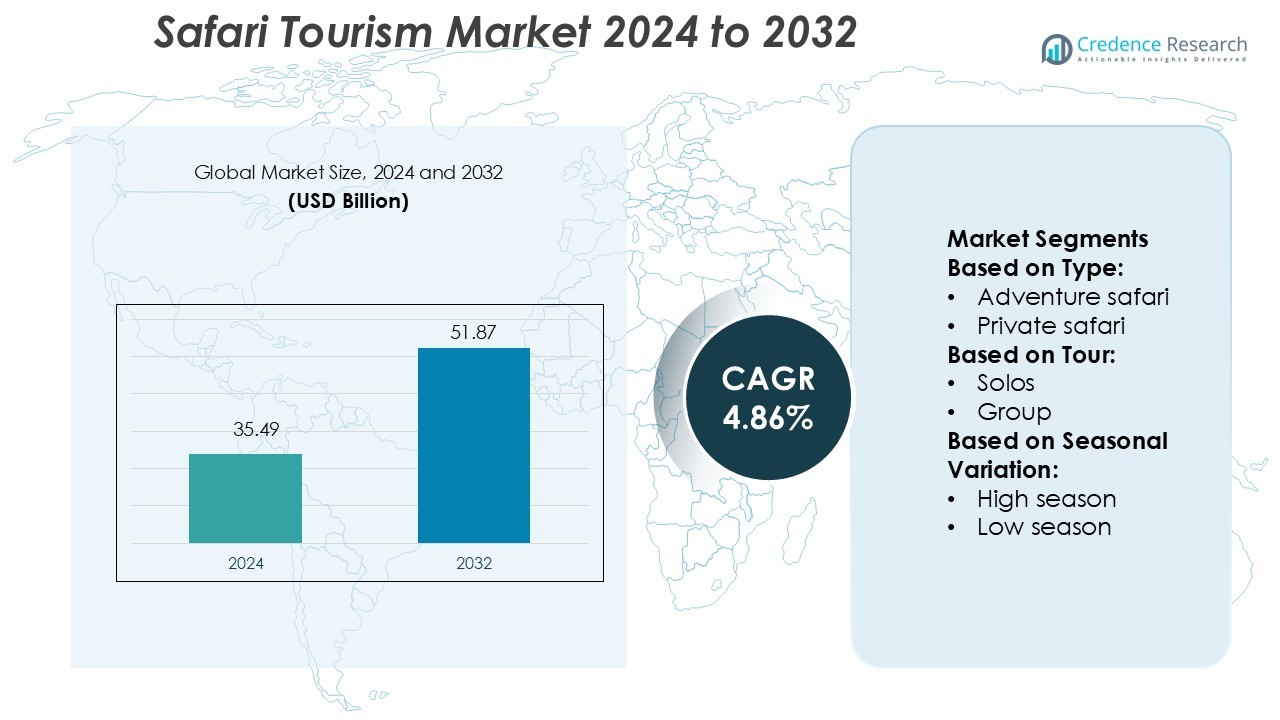
Safari Tourism Market size was valued USD 35.49 billion in 2024 and is anticipated to reach USD 51.87 billion by 2032, at a CAGR of 4.86% during the forecast period.
| REPORT ATTRIBUTE | DETAILS |
|---|---|
| Historical Period | 2020-2023 |
| Base Year | 2024 |
| Forecast Period | 2025-2032 |
| Safari Tourism Market Size 2024 | USD 35.49 Billion |
| Safari Tourism Market, CAGR | 4.86% |
| Safari Tourism Market Size 2032 | USD 51.87 Billion |
The safari tourism market is shaped by prominent players such as Micato Safari, Backroads, Singita, Abercrombie & Kent Ltd., Rothchild Safaris, Great Plains, Scott Dunn, Gamewatchers Safaris, Butterfield & Robinson, and Enchanting Travels. These companies focus on luxury travel experiences, sustainable tourism practices, and personalized itineraries to strengthen their competitive position. They leverage digital platforms, strategic partnerships, and exclusive lodge offerings to attract high-value travelers worldwide. Europe leads the market with a 32% share, driven by strong outbound travel, high spending capacity, and a growing preference for eco-tourism. This regional dominance is supported by well-developed travel infrastructure, seamless connectivity, and rising demand for premium adventure experiences.
Market Insights
- The Safari Tourism Market was valued at USD 35.49 billion in 2024 and is expected to reach USD 51.87 billion by 2032, growing at a CAGR of 4.86%.
- Rising demand for sustainable travel, wildlife conservation experiences, and luxury safari packages is driving strong market growth.
- Digital transformation, eco-friendly lodges, and exclusive tour offerings are shaping key trends, with leading operators focusing on premium personalized travel.
- High travel costs, strict wildlife regulations, and environmental challenges may restrain expansion in some destinations.
- Europe leads the market with a 32% share, followed by North America at 27% and Asia Pacific at 22%, while luxury safari tours dominate the segment share with strong demand from high-spending travelers.
Market Segmentation Analysis:
By Type
Adventure safari holds the dominant share in the Safari Tourism Market. Travelers prefer immersive wildlife experiences, off-road explorations, and guided treks in national parks. This segment benefits from rising demand for authentic, nature-based adventures. Operators focus on customized routes and sustainable practices to attract eco-conscious tourists. Adventure safari packages often include expert-led game drives and overnight stays in lodges or camps. The segment grows steadily due to strong international interest in African and Asian safari destinations. Private safari follows, appealing to luxury travelers seeking exclusivity and privacy during their trips.
- For instance, Singita is a leader in sustainable tourism that uses solar power and other eco-friendly practices across its lodges and reserves. The company has a 2025 target to power its off-grid lodges with 80% on-site renewable energy.
By Tour
Group tours account for the largest market share in the Safari Tourism Market. These tours offer cost-effective packages, shared experiences, and guided schedules. Travelers often prefer group safaris for enhanced safety, structured itineraries, and cultural interaction. Tour operators design group packages with fixed routes and professional guides, ensuring smooth coordination. The growing popularity of organized travel and wildlife photography tours drives this segment. Solo tours remain a niche but growing segment, attracting independent travelers seeking flexibility and personalized experiences in remote locations.
- For instance, Sitatunga Private Island camp is powered by 146 high-performance solar panels, delivering 220 volts to run the entire camp’s operations, including guest suites and main amenities.
By Seasonal Variation
High season dominates the Safari Tourism Market due to favorable weather and better wildlife viewing. Tourists prefer this period for clear visibility, dry landscapes, and increased animal activity near water sources. Operators maximize capacity and offer premium experiences during peak months, boosting revenue. National parks also see higher visitor numbers and longer average stays in this season. Low season, though less crowded, attracts budget travelers and adventure seekers interested in quieter safaris. Dynamic pricing and targeted promotions help operators maintain demand throughout the year.
Key Growth Drivers
Rising Demand for Wildlife and Nature Experiences
Growing interest in authentic wildlife experiences fuels safari tourism growth. Travelers seek close encounters with animals and natural habitats, driving bookings for guided safaris and conservation tours. Governments and private operators invest in sustainable infrastructure to support this demand. National parks and reserves benefit from increased tourism revenue, strengthening preservation efforts. Improved accessibility and eco-friendly lodges enhance visitor experiences, encouraging repeat travel. This shift in tourist behavior boosts the global appeal of safari destinations, making wildlife-based tourism a strong economic driver.
- For instance, Scott Dunn increased its global conversion rate by 48 % after integrating call-tracking technology and cut cost-per-acquisition by 35 %. National parks and reserves benefit from increased tourism revenue, strengthening preservation efforts.
Expansion of Sustainable and Eco-Tourism Initiatives
Safari operators adopt sustainable practices to meet the rising demand for responsible travel. Governments and NGOs promote eco-tourism through protected area management, community partnerships, and conservation projects. These efforts attract environmentally conscious travelers seeking low-impact experiences. Investment in renewable energy, eco-lodges, and conservation-led safaris strengthens destination competitiveness. Tourism policies focused on sustainability increase visitor trust and brand value. This trend positions safari tourism as a key segment in the broader eco-tourism landscape, driving market growth.
- For instance, Butterfield & Robinson invests in community and conservation technology innovation. It directs roughly 5 % of annual profits into projects that support biodiversity, cultural heritage, education and community equity.
Technological Advancements in Safari Operations
Technology enhances the safari experience and operational efficiency. Digital booking platforms, virtual previews, and mobile apps simplify planning for travelers. Advanced tracking systems and AI-based wildlife monitoring improve safety and wildlife visibility. Tour operators use drones and GPS for guided routes, reducing environmental impact. Virtual safaris expand access to remote audiences, creating new revenue streams. Data-driven insights help optimize tourist flows and protect fragile ecosystems. These innovations increase customer satisfaction and boost market expansion.
Key Trends & Opportunities
Growth of Luxury and Customized Safari Experiences
Luxury safari tourism is gaining traction among high-spending travelers. Premium lodges, private guides, and exclusive wildlife tours attract niche markets. Personalized itineraries enhance customer satisfaction and loyalty. Operators focus on offering unique experiences such as hot-air balloon safaris and private conservancies. These offerings increase revenue margins and support community-based conservation. Luxury tourism also drives investment in infrastructure and service quality, improving the overall safari ecosystem.
- For instance, Levare's product brochures specify that its Harsh Duty ESP systems, which can feature Packet pumps, use TC bearings spaced at 1.1 ft (0.35 m) intervals along the shaft.
Integration of Digital and Immersive Experiences
Digital innovations enhance the safari tourism experience before, during, and after trips. Virtual reality previews allow travelers to explore destinations remotely, building interest and trust. Real-time wildlife tracking apps provide guided navigation and educational content. Tour operators use AI and analytics to personalize travel itineraries. This integration of digital tools boosts engagement, reduces operational costs, and broadens market reach. It also creates opportunities for hybrid experiences combining physical tours and virtual access.
- For instance, JJ Tech’s ULTRA-FLOW® system pairs a downhole jet pump (with no moving parts) and surface diaphragm pump, allowing retrieval via reverse circulation and enabling run-times of 3 to 5 years without a full workover.
Community-Based Tourism Opportunities
Local communities play a growing role in safari tourism. Community-managed conservancies and cultural programs create immersive experiences for travelers. Revenue-sharing models support livelihoods and wildlife conservation. Tourists increasingly prefer experiences that benefit local communities, enhancing destination appeal. These partnerships promote cultural preservation and sustainable development. Community engagement also strengthens conservation outcomes, making it a core element of future safari strategies.
Key Challenges
Environmental and Conservation Concerns
Safari tourism depends heavily on fragile ecosystems, making environmental protection crucial. Over-tourism, habitat degradation, and poaching threaten wildlife populations. Uncontrolled vehicle access and infrastructure expansion can disrupt ecosystems. Climate change worsens these risks, reducing wildlife visibility and damaging biodiversity. Conservation measures often require high investments, limiting growth for smaller operators. Addressing these concerns is critical to sustaining long-term market expansion.
Political Instability and Safety Risks
Many popular safari destinations face political instability, safety concerns, or poor infrastructure. Conflicts, natural disasters, and health crises can rapidly reduce tourist arrivals. Unpredictable regulations and weak governance add operational challenges for tour operators. Insurance costs and travel advisories discourage travelers from high-risk areas. Ensuring traveler safety and stability remains a major hurdle for market growth. These factors make risk management essential for sustained investment and tourism development.
 Regional Analysis
North America
North America holds a 27% market share in the safari tourism market. The region benefits from a high concentration of outbound travelers and strong demand for luxury experiences. U.S. and Canadian tourists prefer well-organized, sustainable safari tours in Africa and Asia. Growing interest in wildlife photography and personalized tours drives market expansion. The presence of specialized tour operators and digital booking platforms enhances accessibility. Increased disposable income and vacation preferences for adventure tourism further boost regional demand. Airlines and hospitality providers strengthen the safari tourism value chain through strategic partnerships and bundled travel packages.
Europe
Europe accounts for a 32% market share, making it the leading region in safari tourism. The strong market position comes from a large outbound travel base, particularly from the UK, Germany, and France. European travelers show a strong preference for eco-friendly safaris and cultural experiences. High awareness of wildlife conservation encourages bookings in African destinations. The region benefits from advanced travel infrastructure, seamless flight connectivity, and experienced tour operators. Marketing campaigns promoting sustainable travel further boost participation. Luxury safari lodges and exclusive tour packages enhance travel experiences, attracting high-spending tourists from the region.
Asia Pacific
Asia Pacific captures a 22% market share in the safari tourism market. The region is witnessing rapid growth due to rising middle-class income and expanding travel infrastructure. Countries like China, Japan, India, and Australia contribute significantly to outbound safari travel. Younger travelers increasingly seek adventure experiences, driving strong demand for affordable safari packages. Digital platforms and flexible itineraries make booking easier. Governments and private operators invest in eco-tourism initiatives that attract interest in African and domestic wildlife reserves. Travel influencers and online campaigns are also helping to increase awareness and participation.
Latin America
Latin America represents a 4% market share in the global safari tourism market. While smaller in volume, the region is showing steady growth driven by adventure travel demand. Brazil, Costa Rica, and Argentina are emerging as eco-tourism hotspots. Rich biodiversity and rainforest reserves offer alternative safari experiences. Local governments are promoting wildlife tourism through conservation programs and infrastructure improvements. The growing number of specialized tour operators and adventure agencies is expanding access to safari-style experiences. Increased global marketing and flight connectivity are expected to boost the region’s participation in the market.
Middle East & Africa
The Middle East & Africa region holds a 15% market share but plays a dominant role as the primary safari destination. Countries such as Kenya, South Africa, Tanzania, and Botswana attract millions of tourists annually. Strong conservation efforts and wildlife diversity make the region a global safari hub. High-value experiences, including luxury lodges and exclusive game drives, drive revenue. Investments in airport connectivity and security have improved accessibility. Safari parks offer year-round attractions, increasing tourist inflow. Local operators collaborate with international agencies to expand tour packages and enhance travel experiences.
Market Segmentations:
By Type:
- Adventure safari
- Private safari
By Tour:
- Solos
- Group
By Seasonal Variation:
- High season
- Low season
By Geography
- North America
- U.S.
- Canada
- Mexico
- Europe
- Germany
- France
- U.K.
- Italy
- Spain
- Rest of Europe
- Asia Pacific
- China
- Japan
- India
- South Korea
- South-east Asia
- Rest of Asia Pacific
- Latin America
- Brazil
- Argentina
- Rest of Latin America
- Middle East & Africa
- GCC Countries
- South Africa
- Rest of the Middle East and Africa
Competitive Landscape
The safari tourism market features strong competition with key players such as Micato Safari, Backroads, Singita, Abercrombie & Kent Ltd., Rothchild Safaris, Great Plains, Scott Dunn, Gamewatchers Safaris, Butterfield & Robinson, and Enchanting Travels. The safari tourism market is becoming increasingly competitive as operators focus on differentiation through unique experiences, sustainable practices, and premium service offerings. Companies are investing in advanced digital platforms to enhance booking convenience and improve customer engagement. Strategic collaborations with airlines, hospitality providers, and local communities help expand tour options and strengthen market reach. Many operators are emphasizing eco-tourism, luxury lodges, and guided wildlife tours to attract high-value travelers. Personalized travel itineraries, conservation-focused packages, and immersive cultural experiences are driving customer loyalty. This competitive landscape encourages continuous innovation, service quality enhancement, and global expansion strategies.
Key Player Analysis
- Micato Safari
- Backroads
- Singita
- Abercrombie & Kent Ltd.
- Rothchild Safaris
- Great Plains
- Scott Dunn
- Gamewatchers Safaris
- Butterfield & Robinson
- Enchanting Travels
Recent Developments
- In May 2025, Westin Resort and Spa Ubud promoted slower, more immersive wellness travel with a new extended-stay offer anchored in nature and local tradition. Westin Ubud is putting ‘slow wellness’ in focus.
- In May 2025, Marriott and Hilton announced their plans to expand their spa presence across Asia in response to the region’s rapid surge in wellness tourism, driven by rising disposable incomes, health-conscious travelers, and growing preference for holistic, preventive care.
- In April 2025, Thailand expanded into the Middle East market, highlighting luxury and wellness tourism at the Arabian Travel Market 2025. The business expansion is a beneficial contribution to the wellness tourism market.
- In September 2024, EaseMyTrip announced its entry into the rapidly growing wellness tourism sector through acquisitions of Pflege Home Healthcare and Rollins International with a total investment of Rs. 90 crores.
Report Coverage
The research report offers an in-depth analysis based on Type, Tour, Seasonal Variation and Geography. It details leading market players, providing an overview of their business, product offerings, investments, revenue streams, and key applications. Additionally, the report includes insights into the competitive environment, SWOT analysis, current market trends, as well as the primary drivers and constraints. Furthermore, it discusses various factors that have driven market expansion in recent years. The report also explores market dynamics, regulatory scenarios, and technological advancements that are shaping the industry. It assesses the impact of external factors and global economic changes on market growth. Lastly, it provides strategic recommendations for new entrants and established companies to navigate the complexities of the market.
Future Outlook
- The market will see rising demand for sustainable and eco-friendly safari experiences.
- Luxury safari packages will gain traction among high-net-worth travelers.
- Digital booking platforms will enhance accessibility and customer engagement.
- Wildlife conservation initiatives will drive responsible travel practices.
- Emerging destinations in Asia and Latin America will expand global safari offerings.
- Personalized and small-group tours will become a preferred travel format.
- Strategic partnerships with airlines and hotels will boost package diversity.
- Government support and conservation funding will strengthen destination infrastructure.
- Immersive technology will enhance traveler experiences through virtual previews and smart tours.
- Community-based tourism will play a larger role in sustainable safari growth.

Request a Free Sample
Fill in your details and we'll send you a free sample report.
- Sample data tables & charts
- Research methodology
Need a Custom Version of This Report?
Tailor the scope, geography, or segments to your exact requirements.
- Custom geography or segment scope
- Direct access to our analyst team
Frequently Asked Questions
What is the current market size for Safari Tourism Market, and what is its projected size in 2032?
At what Compound Annual Growth Rate is the Safari Tourism Market projected to grow between 2025 and 2032?
Which Safari Tourism Market segment held the largest share in 2024?
What are the primary factors fueling the growth of the Safari Tourism Market?
Who are the leading companies in the Safari Tourism Market?
Which region commanded the largest share of the Safari Tourism Market in 2024?
Table of Content
Chapter 1 Market Segmentation
- 1.1 Segmentation Framework
- 1.1.1 Product and Service Classification
- 1.1.2 Application and End-Use Classification
- 1.1.3 Technology and Solution Classification
- 1.1.4 Customer and Distribution Channel Classification
- 1.1.5 Geographic Segmentation
- 1.1.6 Market Segment Definitions and Boundaries
Chapter 2 Introduction
- 2.1 Report Objectives and Scope
- 2.2 Product Definition and Industry Terminology
- 2.3 Market Inclusions and Exclusions
- 2.4 Research Process
- 2.4.1 Primary Research and Expert Interviews
- 2.4.2 Secondary Research and Source Review
- 2.4.3 Top-Down and Bottom-Up Estimation
- 2.4.4 Data Triangulation and Verification
- 2.5 Market Size Measurement Basis
- 2.5.1 2024: USD 35.49 billion → 2032: USD 51.87 billion
- 2.6 Historical and Forecast Reference Periods
- 2.6.1 Base Year: 2024
- 2.6.2 Forecast Period: 2024-2032
- 2.7 Research Assumptions and Limitations
Chapter 3 Executive Summary
- 3.1 Market Snapshot and Key Findings
- 3.2 Base-Year Market Size, 2024
- 3.3 Forecast Market Size, 2032
- 3.4 Revenue and Volume Growth Outlook
- 3.5 Key Demand and Supply Indicators
- 3.6 Leading Market Segments
- 3.7 Fastest-Growing Market Opportunities
- 3.8 Regional Performance Highlights
- 3.9 Technology and Industry Transformation
- 3.10 Competitive Landscape Summary
- 3.11 Analyst View and Strategic Implications
Chapter 4 Global Safari Tourism Market Trends and Developments
- 4.1 Historical Industry Development
- 4.2 Recent Market Trends and Developments
- 4.3 Demand and Customer Behavior Trends
- 4.4 Technology and Product Innovation
- 4.5 Artificial Intelligence, Automation and Digitalization
- 4.6 Local Manufacturing and Supply Chain Realignment
- 4.7 Industry Partnerships, Mergers and Acquisitions
- 4.8 Sustainability and Circular Economy Developments
- 4.9 Government and Private Sector Investment Trends
- 4.10 Emerging Business Models and Commercialization
- 4.11 Industry Developments and Announcements
Chapter 5 Global Safari Tourism Market Supply and Demand Analysis
- 5.1 Demand Trend and Consumption Analysis
- 5.2 Demand Forecast, 2024-2032
- 5.3 Supply Chain Structure and Procurement Trends
- 5.4 Supply-Demand Gap and Bottlenecks
- 5.5 Import Dependence and Sourcing Structure
- 5.6 Regional Supply and Demand Concentration
Chapter 6 Global Safari Tourism Market Pricing Analysis
- 6.1 Pricing Structure and Measurement
- 6.2 Historical Pricing Trends
- 6.3 Pricing Outlook, 2024-2032
- 6.4 Pricing by Product and Market Segment
- 6.5 Geographic Pricing Differences
- 6.6 Key Input, Energy, Labor and Logistics Costs
- 6.7 Contract Pricing and Purchasing Models
- 6.8 Pricing Sensitivity and Competitive Positioning
- 6.9 Price, Margin and Profitability Implications
Chapter 7 Global Safari Tourism Market Dynamics
- 7.1 Market Growth Drivers
- 7.1.1 Demand-Side Drivers
- 7.1.2 Technology and Innovation Drivers
- 7.1.3 Infrastructure and Investment Drivers
- 7.1.4 Regulatory and Policy Drivers
- 7.2 Market Restraints
- 7.2.1 Cost and Affordability Constraints
- 7.2.2 Technology and Adoption Barriers
- 7.2.3 Supply Chain and Operational Constraints
- 7.3 Market Challenges
- 7.3.1 Competitive Pressure and Margin Erosion
- 7.3.2 Skills, Infrastructure and Implementation Gaps
- 7.4 Emerging Market Opportunities
- 7.5 Market Dynamics Impact and Time-Horizon Assessment
Chapter 8 Global Safari Tourism Value Chain Analysis
- 8.1 Industry Value Chain Overview
- 8.2 Upstream Suppliers and Critical Inputs
- 8.3 Technology and Component Providers
- 8.4 Manufacturing or Service Delivery
- 8.5 Distribution, Channel Partners and Integrators
- 8.6 Downstream Applications and End Users
- 8.7 Value Addition and Profit Pools
- 8.8 Vertical Integration and Outsourcing
- 8.9 Supplier Concentration and Risk
- 8.10 Supply Chain Localization and Resilience
Chapter 9 Global Safari Tourism Market Regulations and Policies
- 9.1 Relevant Laws, Standards and Compliance Frameworks
- 9.2 Product, Service, Safety and Quality Requirements
- 9.3 Government Policies, Incentives and Subsidies
- 9.4 Imports, Exports and Trade Barriers
- 9.5 Public Procurement and Local Content Requirements
- 9.6 Data Protection, AI and Cybersecurity Compliance
- 9.7 Upcoming Policy Changes and Market Implications
Chapter 10 Global Safari Tourism Market Hotspots and Opportunities
- 10.1 Market Opportunity Mapping and Growth Hotspots
- 10.2 High-Growth Applications and Customer Groups
- 10.3 Underserved Markets and White-Space Opportunities
- 10.4 Emerging Technology and Product Opportunities
- 10.5 New Capacity and Investment Hotspots
- 10.6 Market Entry and Expansion Opportunities
- 10.7 Distribution and Partnership Opportunities
- 10.8 Near-Term and Long-Term Commercial Potential
- 10.9 Opportunity Attractiveness and Execution Risks
Chapter 11 Global Safari Tourism Market Outlook, 2024-2032
- 11.1 Market Size and Analysis
- 11.1.1 Revenue (Market Measurement: 2024: USD 35.49 billion → 2032: USD 51.87 billion)
- 11.1.2 Historical Market Size
- 11.1.3 Base-Year Market Size, 2024
- 11.2 Market Forecast, 2024-2032
- 11.2.1 Revenue Forecast to 2032
- 11.2.2 CAGR and Year-on-Year Growth
- 11.2.3 Incremental Revenue Opportunity
- 11.3 Forecast Assumptions and Scenario Analysis
- 11.3.1 Base-Case Forecast
- 11.3.2 Optimistic and Conservative Scenarios
- 11.3.3 Technology, Pricing and Policy Sensitivities
- 11.4 Market Attractiveness and Growth Outlook
Chapter 12 Global Safari Tourism Market Segmentation and Outlook
- 12.1 Segmentation Summary and Market Shares, 2024
- 12.2 Largest and Fastest-Growing Segments
- 12.3 Segment Growth Comparison
- 12.4 Segment Attractiveness and Priority Matrix
Chapter 13 Global Safari Tourism Geographic Market Outlook, 2024-2032
- 13.1 Regional Market Size and Share, 2024
- 13.2 Regional Market Forecast, 2024-2032
- 13.3 Regional Pricing, Production and Demand Differences
- 13.4 North America
- 13.4.1 United States
- 13.4.2 Canada
- 13.4.3 Mexico
- 13.5 Europe
- 13.5.1 Germany
- 13.5.2 France
- 13.5.3 Italy
- 13.5.4 United Kingdom
- 13.5.5 Spain
- 13.5.6 Poland
- 13.5.7 Russia
- 13.5.8 Netherlands
- 13.5.9 Belgium
- 13.5.10 Sweden
- 13.5.11 Denmark
- 13.5.12 Norway
- 13.5.13 Rest of Europe
- 13.6 Asia Pacific
- 13.6.1 China
- 13.6.2 India
- 13.6.3 Japan
- 13.6.4 South Korea
- 13.6.5 Thailand
- 13.6.6 Indonesia
- 13.6.7 Vietnam
- 13.6.8 Malaysia
- 13.6.9 Australia
- 13.6.10 Rest of Asia Pacific
- 13.7 Latin America
- 13.7.1 Brazil
- 13.7.2 Argentina
- 13.7.3 Colombia
- 13.7.4 Chile
- 13.7.5 Rest of Latin America
- 13.8 Middle East
- 13.8.1 Saudi Arabia
- 13.8.2 United Arab Emirates
- 13.8.3 Turkey
- 13.8.4 Israel
- 13.8.5 Iran
- 13.8.6 Rest of the Middle East
- 13.9 Africa
- 13.9.1 South Africa
- 13.9.2 Egypt
- 13.9.3 Nigeria
- 13.9.4 Morocco
- 13.9.5 Rest of Africa
- 13.10 Regional Investment, Policy and Supply Chain Differences
- 13.11 Regional Competitive Landscape
- 13.12 Geographic Growth Hotspots
Chapter 14 Global Safari Tourism Technology, Innovation and Sustainability Outlook
- 14.1 Technology Landscape and Maturity
- 14.2 Product, Process and Service Innovation
- 14.3 AI, Automation and Digital Tools in the Industry
- 14.4 Technology Adoption and Performance Benchmarking
- 14.5 Innovation Pipeline and R&D Investment
- 14.6 Energy Efficiency and Resource Management
- 14.7 Sustainability, Recycling and Circularity
- 14.8 Technology Roadmap, 2024-2032
- 14.9 Risks of Obsolescence and Technology Substitution
Chapter 15 Global Safari Tourism Market Key Strategic Imperatives
- 15.1 Growth and Market Entry Priorities
- 15.2 High-Return Products and Segments
- 15.3 Pricing, Profitability and Cost Optimization
- 15.4 Technology Investment and Product Differentiation
- 15.5 Supply Chain Localization and Resilience
- 15.6 Distribution and Customer Acquisition
- 15.7 Partnership, Acquisition and Capacity Strategy
- 15.8 Regional Expansion Priorities
- 15.9 Short-, Medium- and Long-Term Actions
Chapter 16 Competition Outlook
- 16.1 Industry Competition Characteristics
- 16.2 Market Structure and Concentration
- 16.3 Market Share and Competitive Positioning, 2024
- 16.4 Company-Wise Revenue and Product Benchmarking
- 16.5 Production and Service Capacity Benchmarking
- 16.6 Technology, Pricing and Differentiation
- 16.7 Regional Footprint and Distribution Strength
- 16.8 Mergers, Acquisitions and Strategic Alliances
- 16.9 New Entrants and Competitive Threats
- 16.10 Porter's Five Forces and Industry Attractiveness
- 16.11 Competitive Outlook, 2024-2032
Chapter 17 Company Profiles
- 17.1 Company Coverage and Selection Criteria
- 17.2 Leading Market Participants – Standard Profile Structure
- 17.2.1 Business Description
- 17.2.2 Company Ownership and Geographic Presence
- 17.2.3 Product and Service Portfolio
- 17.2.4 Manufacturing and Operating Footprint
- 17.2.5 Financial Performance and Investment
- 17.2.6 Market Share and Competitive Position
- 17.2.7 Technology and Innovation Capabilities
- 17.2.8 Strategic Alliances or Partnerships
- 17.2.9 Recent Developments
- 17.2.10 Growth Strategy and Outlook
- 17.3 Other Relevant Market Participants
Note: Every listed company is profiled on the structure shown under the first company. The company list is preliminary and may change based on research findings, market developments, data availability and client requirements.
Chapter 18 Disclaimer
- 18.1 Research and Forecast Disclaimer
- 18.2 Data Source and Estimation Limitations
Note: The depth of individual sections depends on data availability for this market. Volume, capacity, trade and other unit-based metrics are included where applicable.