
| REPORT ATTRIBUTE | DETAILS |
|---|---|
| Historical Period | 2020-2023 |
| Base Year | 2024 |
| Forecast Period | 2025-2032 |
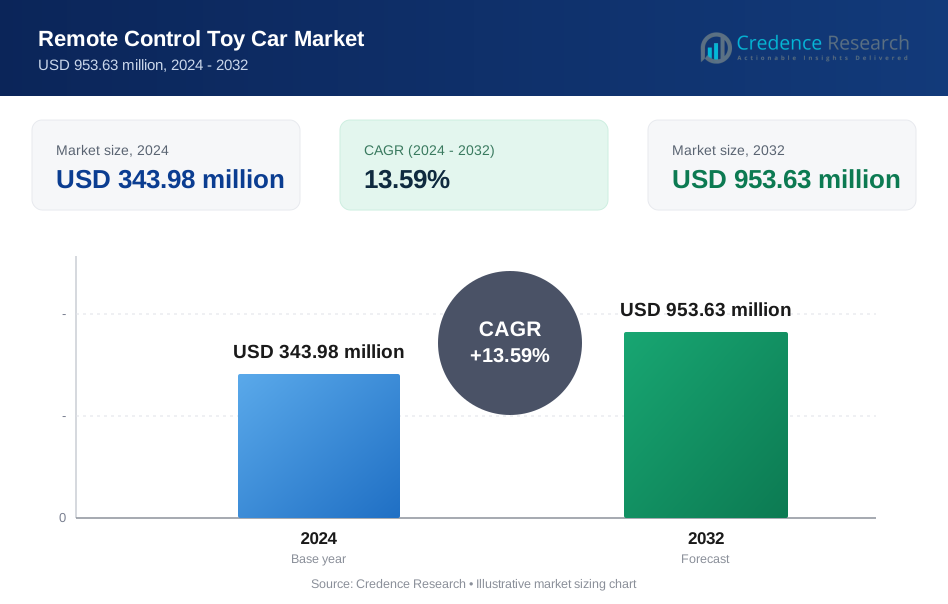
| Remote Control Toy Car Market Size 2024 | USD 343.98 million |
| Remote Control Toy Car Market, CAGR | 13.59% |
| Remote Control Toy Car Market Size 2032 | USD 953.63 million |
Market Overview
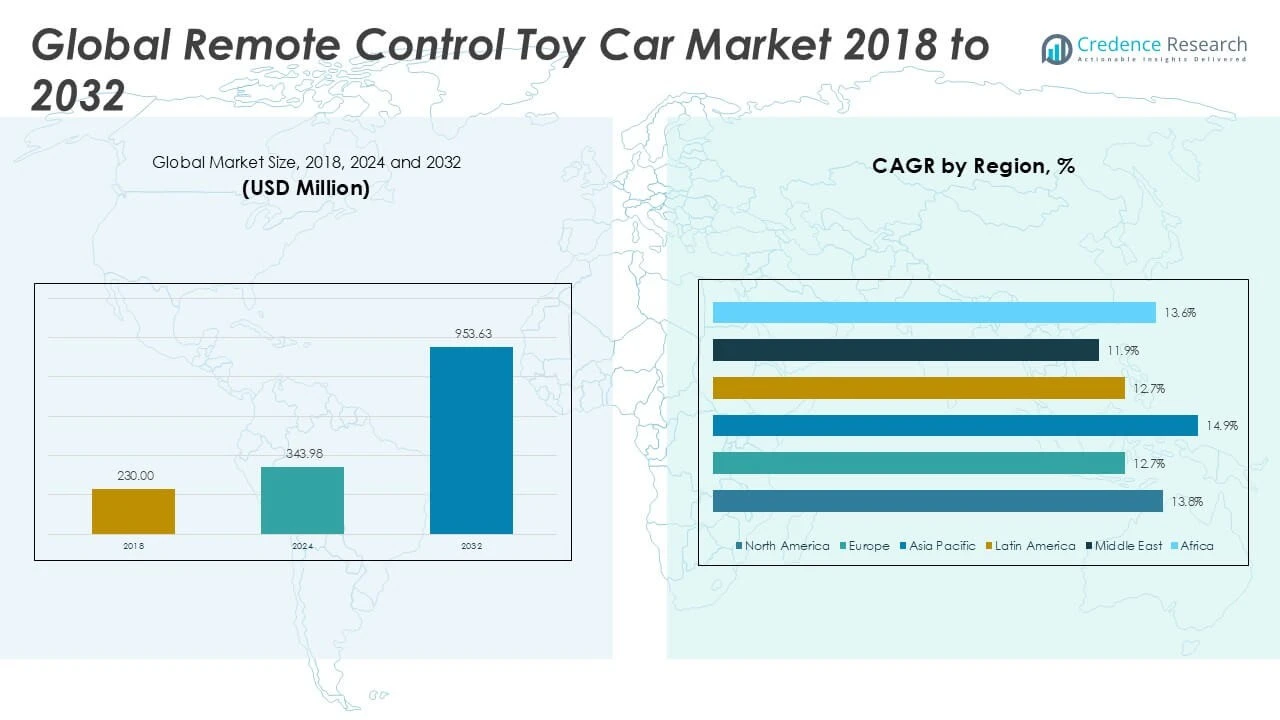
The Global Remote Control Toy Car Market is projected to grow from USD 343.98 million in 2024 to an estimated USD 953.63 million by 2032, registering a compound annual growth rate (CAGR) of 13.59% from 2025 to 2032.
Key drivers fueling the Remote Control Toy Car Market include increasing disposable income, the rising popularity of interactive and engaging toys among children, and the influence of social media platforms showcasing innovative and customizable toy cars. Trends such as the integration of Bluetooth and smartphone control, the development of eco-friendly and durable materials, and the surge in demand for off-road and high-speed models are shaping market dynamics. Manufacturers are focusing on product innovation, incorporating realistic designs and advanced features like 3D motion sensing and app connectivity to attract tech-savvy customers.
Regionally, North America and Europe hold substantial shares of the market, supported by strong consumer spending and established retail channels. The Asia-Pacific region is expected to witness the fastest growth, driven by increasing urbanization, rising middle-class populations, and expanding e-commerce platforms. Prominent key players in this market include Traxxas, Axial Racing, HPI Racing, New Bright Industrial, and Nikko RC, all actively investing in research and development to enhance product offerings and capture larger market shares.
Market Insights
- The Global Remote Control Toy Car Market is projected to grow from USD 343.98 million in 2024 to USD 953.63 million by 2032, registering a CAGR of 13.59% during 2025-2032.
- Technological advancements, such as improved battery life and smart connectivity, drive consumer interest and expand the product range.
- Rising disposable income and growing popularity of interactive and customizable toys among children fuel market demand.
- High production costs and stringent safety regulations present challenges for manufacturers in maintaining competitive pricing.
- North America and Europe hold significant market shares, driven by strong consumer spending and established retail infrastructure.
- Asia Pacific exhibits the fastest growth, supported by urbanization, expanding middle-class populations, and rising e-commerce adoption.
- Increasing focus on eco-friendly materials and sustainable manufacturing practices shapes product development across regions.
Market Drivers
Rising Disposable Income and Consumer Spending
The increasing disposable income across emerging and developed economies significantly drives the Global Remote Control Toy Car Market. Consumers allocate more budget toward entertainment and leisure products, including remote control toys. Parents and hobbyists are willing to invest in high-quality, technologically advanced toy cars. This trend boosts demand for premium and customizable models. Retailers and manufacturers respond by offering diverse price ranges to attract a broad customer base. The availability of financing options and online purchasing convenience further supports consumer spending.
- For instance, over 1,200 new remote control toy car models were launched globally in 2024, with 350 models featuring advanced AI-powered controls and 500 models incorporating eco-friendly materials
Technological Advancements and Innovation
Technological improvements enhance product appeal and functionality, fueling market growth. Companies incorporate features like smartphone connectivity, Bluetooth controls, and realistic design elements. These innovations improve user experience and attract tech-savvy customers. Better battery performance and durable materials increase product lifespan, encouraging repeat purchases. It also stimulates competition among manufacturers to introduce innovative models regularly. The incorporation of eco-friendly materials addresses environmental concerns, attracting environmentally conscious consumers.
- For instance, in 2024, over 600 remote control toy car models integrated Bluetooth and smartphone connectivity, while 200 models featured AI-assisted driving capabilities
Growing Popularity of Interactive and Educational Toys
Remote control toy cars gain traction due to their interactive nature and potential educational benefits. They promote hand-eye coordination, spatial awareness, and problem-solving skills among children. Parents increasingly seek toys that combine entertainment with learning value. It encourages manufacturers to develop models tailored for various age groups and skill levels. Interactive features like customizable speed settings and obstacle navigation enhance engagement. This driver maintains steady demand in both recreational and educational segments.
Expansion of E-commerce and Online Retail Platforms
The rise of e-commerce plays a crucial role in expanding market reach. Online platforms provide extensive product variety and easy comparison for consumers worldwide. It reduces geographical barriers, enabling customers from remote areas to access niche products. Digital marketing strategies and social media campaigns raise awareness and attract new buyers. Online reviews and ratings help consumers make informed decisions, increasing purchase confidence. This growth channel complements traditional retail, accelerating market penetration.
Market Trends
Emerging Technological Innovations Driving the Global Remote Control Toy Car Market
The Global Remote Control Toy Car Market experiences rapid transformation through the incorporation of cutting-edge technologies. Manufacturers integrate features such as smartphone connectivity, Bluetooth controls, and app-based customization to enhance user interaction. Improved battery technologies extend playtime, while brushless motors increase speed and durability. It also adopts 3D motion sensors and gyroscopic stabilization for better control and realism. These innovations cater to tech-savvy consumers seeking immersive experiences, expanding the market beyond traditional users. The continuous development of smart features remains a key trend shaping product offerings.
- For instance, the Global Remote Control Toy Car Market had 364 industry report pages and 60 major market players in 2024.
Increasing Demand for Eco-Friendly and Sustainable Materials in Toy Manufacturing
Sustainability trends strongly influence the Global Remote Control Toy Car Market, with growing consumer preference for environmentally friendly products. Manufacturers shift toward biodegradable plastics, recycled materials, and non-toxic paints to meet regulatory and consumer expectations. It reduces the environmental footprint of toys while ensuring safety and durability. This approach appeals to environmentally conscious buyers and parents concerned about product safety. The demand for sustainable toys encourages industry-wide adoption of green manufacturing practices. It also helps brands differentiate themselves in a competitive market.
- For instance, the Global Sustainable Toys Market had 128 tables and 66 charts in its industry report in 2023.
Growing Popularity of High-Performance and Off-Road Remote Control Cars Among Hobbyists
The market sees a surge in interest for specialized high-performance and off-road remote control cars. Enthusiasts seek models capable of handling rough terrains, offering powerful motors, and advanced suspension systems. It fuels product diversification and drives innovation focused on speed, durability, and design. Competitive racing and hobby clubs enhance consumer engagement and brand loyalty. Manufacturers respond with premium product lines targeting this niche segment. This trend increases the market’s appeal among teenagers and adults, broadening its demographic scope.
Expansion of Online Sales Channels and Digital Marketing Strategies Enhancing Market Reach
E-commerce platforms and social media channels significantly impact the Global Remote Control Toy Car Market’s distribution and promotion. It facilitates direct-to-consumer sales and widens geographic reach, especially in emerging markets. Digital marketing campaigns leverage influencer partnerships and interactive content to build brand awareness and engagement. Online reviews and detailed product information empower consumers to make informed purchases. This trend reduces reliance on traditional retail and enables faster market penetration. Companies continuously optimize their online presence to capitalize on evolving consumer behaviors.
Market Challenges
High Production Costs and Regulatory Compliance Affecting the Global Remote Control Toy Car Market
The Global Remote Control Toy Car Market faces challenges related to high production costs driven by the incorporation of advanced technologies and eco-friendly materials. Manufacturers invest heavily in research and development to deliver innovative features such as improved battery systems and smart controls, which increase overall expenses. It complicates pricing strategies, limiting affordability for some consumer segments. Compliance with stringent safety and environmental regulations across different regions adds complexity and cost to manufacturing processes. These regulatory requirements demand rigorous testing and certification, which can delay product launches. The combination of rising costs and regulatory hurdles restricts market accessibility and growth potential.
- For instance, the industry witnessed over 2,500 new product launches globally in 2023, with more than 70 major manufacturers investing in sustainability-driven innovations.
Supply Chain Disruptions and Intense Competition Impacting Market Stability and Profitability
Supply chain disruptions, including shortages of raw materials and logistical delays, present significant challenges for the Global Remote Control Toy Car Market. It leads to production delays and increased operational costs, affecting timely product availability. Fluctuating component prices further strain profit margins for manufacturers and distributors. Intense competition among established brands and new entrants pressures companies to constantly innovate while controlling costs. Market saturation in mature regions limits growth opportunities and increases marketing expenses to retain customers. Managing these challenges requires strategic sourcing, efficient logistics, and strong brand differentiation to maintain market position and profitability.
Market Opportunities
Expansion of Emerging Markets and Rising Consumer Spending Fueling Growth Opportunities in the Global Remote Control Toy Car Market
The Global Remote Control Toy Car Market benefits from rapid urbanization and increasing disposable incomes in emerging economies. Growing middle-class populations with higher purchasing power create new consumer segments eager for innovative and premium toys. It presents opportunities for manufacturers to introduce diverse product lines tailored to regional preferences and price sensitivities. Expanding e-commerce penetration in these regions further enhances accessibility and sales potential. Companies can leverage localized marketing strategies and partnerships with regional retailers to strengthen market presence. This growth potential encourages investments in product customization and affordable yet feature-rich models to capture wider audiences.
Technological Advancements and Increasing Popularity of Competitive RC Racing Driving Market Expansion
Advances in technology offer significant growth prospects for the Global Remote Control Toy Car Market by enabling the development of sophisticated and interactive products. It allows manufacturers to design cars with enhanced speed, durability, and connectivity features, appealing to both casual users and hobbyists. The rising popularity of competitive remote control car racing events creates a dedicated community that drives demand for high-performance models. Companies can capitalize on this trend by sponsoring events and creating specialized product ranges. Integrating augmented reality (AR) and virtual reality (VR) features can further enrich user engagement. These opportunities promote innovation and long-term consumer loyalty within the market.
Market Segmentation Analysis
By Type
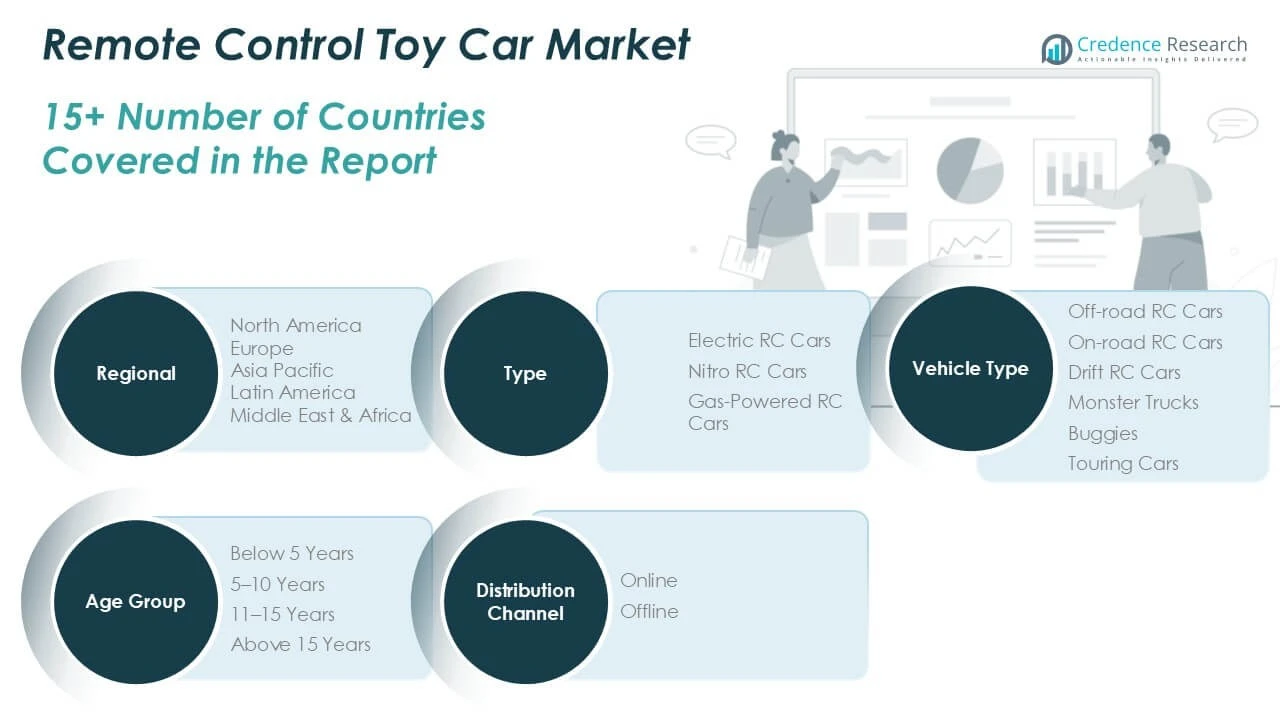
The Global Remote Control Toy Car Market divides into three primary types: Electric RC Cars, Nitro RC Cars, and Gas-Powered RC Cars. Electric RC Cars dominate due to their ease of use, lower maintenance, and quieter operation, appealing to beginners and casual users. Nitro RC Cars attract hobbyists seeking higher speeds and realistic engine sounds, while Gas-Powered RC Cars cater to advanced users demanding maximum power and longer run times. Each type offers distinct advantages, influencing consumer preference based on performance needs and budget considerations
By Vehicle Type
The market segments by vehicle type include Off-road RC Cars, On-road RC Cars, Drift RC Cars, Monster Trucks, Buggies, and Touring Cars. Off-road RC Cars and Monster Trucks gain popularity for their robust build and ability to navigate rough terrains, targeting outdoor enthusiasts. On-road and Drift RC Cars focus on speed and precision on smooth surfaces, appealing to racing aficionados. Buggies and Touring Cars provide balanced performance for varied terrains and user skill levels. This segmentation allows manufacturers to tailor products to diverse consumer demands and driving conditions.
By Age Group
The Global Remote Control Toy Car Market categorizes consumers into age groups: Below 5 Years, 5–10 Years, 11–15 Years, and Above 15 Years. Products designed for younger children emphasize safety, simplicity, and durability, while models for older age groups incorporate advanced features and higher speeds. Teenagers and adults represent a growing segment of hobbyists and competitive racers, driving demand for sophisticated and customizable RC cars. Age-specific designs and marketing strategies enhance user engagement across demographics.
By Distribution Channel
Distribution channels in the market consist of Online and Offline sales. Online platforms experience rapid growth due to convenience, broader product selections, and detailed customer reviews influencing purchase decisions. Offline channels, including specialty hobby stores and mass retailers, remain important for hands-on experiences and immediate availability. Manufacturers leverage both channels to maximize reach and cater to varying consumer preferences for purchasing remote control toy cars.
Segments
Based on Type
- Electric RC Cars
- Nitro RC Cars
- Gas-Powered RC Cars
Based on Vehicle Type
- Off-road RC Cars
- On-road RC Cars
- Drift RC Cars
- Monster Trucks
- Buggies
- Touring Cars
Based on Age Group
- Below 5 Years
- 5–10 Years
- 11–15 Years
- Above 15 Years
Based on Distribution Channel
- Online
- Offline
Based on Region
- North America
- U.S.
- Canada
- Mexico
- Europe
- UK
- France
- Germany
- Italy
- Spain
- Russia
- Belgium
- Netherlands
- Austria
- Sweden
- Poland
- Denmark
- Switzerland
- Rest of Europe
- Asia Pacific
- China
- Japan
- South Korea
- India
- Australia
- Thailand
- Indonesia
- Vietnam
- Malaysia
- Philippines
- Taiwan
- Rest of Asia Pacific
- Latin America
- Brazil
- Argentina
- Peru
- Chile
- Colombia
- Rest of Latin America
- Middle East
- UAE
- KSA
- Israel
- Turkey
- Iran
- Rest of Middle East
- Africa
- Egypt
- Nigeria
- Algeria
- Morocco
- Rest of Africa
Regional Analysis
North America Remote Control Toy Car Market
The North America Remote Control Toy Car Market holds the largest regional share, accounting for approximately 28.5% of the global market in 2024 with a value of USD 124.25 million. It is expected to grow to USD 346.22 million by 2032, registering a CAGR of 13.8%. The region benefits from strong consumer purchasing power, established retail networks, and significant e-commerce penetration. Leading manufacturers and active hobbyist communities drive sustained demand. It maintains its dominance by focusing on innovation and appealing to both children and adult enthusiasts. The United States and Canada are key contributors to this market’s robust performance.
Europe Remote Control Toy Car Market
Europe commands around 17% market share in 2024, with a market value of USD 73.88 million, expected to reach USD 189.56 million by 2032 at a CAGR of 12.7%. Germany, the U.K., and France are major contributors, supported by high disposable incomes and a strong outdoor recreation culture. Stringent safety and environmental regulations shape product offerings and encourage the use of sustainable materials. It continues to expand its online sales channels to improve market accessibility. European consumers demand quality and innovation, pushing manufacturers to align with these expectations.
Asia Pacific Remote Control Toy Car Market
Asia Pacific represents about 22.6% of the global market share in 2024, with a value of USD 98.53 million, and it is projected to grow to USD 296.33 million by 2032, reflecting the highest CAGR of 14.9%. Rapid urbanization, growing middle-class populations, and increased internet penetration fuel market expansion in China, India, Japan, and other countries. It experiences strong demand for affordable, feature-rich models through growing e-commerce platforms. This region offers significant growth opportunities for manufacturers tageting emerging consumers.
Latin America Remote Control Toy Car Market
Latin America accounts for 5.6% of the global market with a value of USD 24.59 million in 2024, expected to grow to USD 63.06 million by 2032 at a CAGR of 12.7%. The region shows steady interest driven by improving infrastructure and expanding retail networks. The Middle East and Africa together hold smaller shares showing consistent growth potential due to rising internet penetration and consumer spending. These regions present opportunities for market penetration through tailored marketing and localized product offerings.
Key players
- Carrera Toys GmbH
- GigoToys
- Hasbro India LLP
- Horizon Hobby, LLC
- HPI Racing A/S
- Kyosho Corporation
- Maisto International Inc.
- Mattel, Inc
- Mugen Seiki Co., Ltd.
- PLAYMOBIL USA, INC.
- Rastar (HK) Industrial Co., Ltd.
- Redcat Racing
- Tamiya, Inc.
- Tekno RC, LLC
Competitive Analysis
The Global Remote Control Toy Car Market features intense competition among established players and emerging brands focused on innovation and market expansion. Companies such as Carrera Toys GmbH, Horizon Hobby, and Kyosho Corporation maintain leadership through continuous product development and diversified portfolios catering to various consumer segments. It emphasizes technological advancements, including improved battery life, connectivity, and realistic designs to differentiate offerings. The market’s competitive landscape drives pricing strategies and marketing initiatives aimed at enhancing brand visibility. Smaller and niche players like Redcat Racing and Tekno RC capitalize on specialized high-performance models to target hobbyists and racing enthusiasts. Overall, competition compels manufacturers to invest in R\&D, strategic partnerships, and geographic expansion to sustain growth and capture larger market shares
Recent Developments
- On May 20, 2025, Mattel, Inc. (NASDAQ: MAT) and TriStar Pictures announced plans to develop a live-action/animated hybrid feature film based on Mattel’s classic Whac-A-Mole game.
- In March 2025, Tamiya, Inc. announced collaborations with anime franchises for plush toys, aimed at expanding market reach in Japan and overseas.
Market Concentration and Characteristics
The Global Remote Control Toy Car Market demonstrates a moderately concentrated structure with a mix of established multinational corporations and specialized niche players. It features key companies like Carrera Toys GmbH, Horizon Hobby, and Kyosho Corporation, which dominate through extensive product portfolios, strong brand recognition, and robust distribution networks. The market emphasizes innovation, with leading players investing in technology to improve performance, connectivity, and design. Smaller manufacturers focus on high-performance and customized models to capture specific segments. Competitive dynamics encourage continuous product differentiation and aggressive marketing strategies. The presence of diverse regional players contributes to varied consumer preferences and pricing strategies. Overall, it maintains a balanced competitive environment, fostering growth through innovation and strategic partnerships.
Report Coverage
The research report offers an in-depth analysis based on Type, Vehicle Type, Age Group, Distribution Channel and Region. It details leading market players, providing an overview of their business, product offerings, investments, revenue streams, and key applications. Additionally, the report includes insights into the competitive environment, SWOT analysis, current market trends, as well as the primary drivers and constraints. Furthermore, it discusses various factors that have driven market expansion in recent years. The report also explores market dynamics, regulatory scenarios, and technological advancements that are shaping the industry. It assesses the impact of external factors and global economic changes on market growth. Lastly, it provides strategic recommendations for new entrants and established companies to navigate the complexities of the market.
Future Outlook
- The Global Remote Control Toy Car Market will continue expanding driven by technological advancements, including enhanced battery life and smart connectivity features.
- Increasing urbanization and disposable incomes in emerging economies will open new growth opportunities for affordable and feature-rich remote control cars.
- Manufacturers will focus on eco-friendly materials and sustainable production to align with evolving consumer preferences and regulatory requirements.
- Integration of augmented reality (AR) and virtual reality (VR) technologies will enhance user engagement, creating immersive play experiences.
- Online sales channels will dominate market distribution, supported by growing e-commerce adoption and digital marketing strategies.
- Demand for high-performance and off-road models will rise, fueled by growing interest in hobbyist communities and competitive RC racing events.
- Customized and modular remote control cars will gain traction, allowing consumers to personalize features and upgrade components easily.
- Collaborations between toy manufacturers and technology firms will accelerate innovation and introduce next-generation products.
- Regional markets in Asia Pacific will lead growth due to rapid digital penetration, expanding middle-class populations, and increasing youth demographics.
- Market players will invest in strategic partnerships, mergers, and acquisitions to enhance product portfolios and expand global reach.
Request a Free Sample
Fill in your details and we'll send you a free sample report.
- Sample data tables & charts
- Research methodology
Need a Custom Version of This Report?
Tailor the scope, geography, or segments to your exact requirements.
- Custom geography or segment scope
- Direct access to our analyst team
Frequently Asked Questions
What was the market size of the Global Remote Control Toy Car Market in 2023, and what is its projected size by 2032?
What are the main factors driving growth in the remote control toy car market?
Which regions hold the largest shares in the Global Remote Control Toy Car Market?
What trends are shaping the future of the remote control toy car market?
Table of Content
Chapter 1. Report Introduction
- 1.1 Report Description & Purpose
- 1.1.1 Report Title & Market Definition
- 1.1.2 Unique Selling Propositions (USP) & Key Differentiators
- 1.1.3 Value Proposition for Stakeholders
- 1.2 Research Objectives
- 1.2.1 Market Sizing Objectives (Volume & Revenue) (Volume Where Applicable)
- 1.2.2 Segmentation Objectives
- 1.2.3 Competitive Intelligence Objectives
- 1.2.4 Forecast & Scenario Objectives
- 1.3 Report Scope
- 1.3.1 Remote Control Toy Car Scope – Segments & Subsegments Covered
- 1.3.2 Geographic Scope – Regions & Countries Covered
- 1.3.3 Historical Period, Base Year & Forecast Period (2024; forecast to 2032)
- 1.3.4 Inclusions & Exclusions
- 1.4 Industry Classification & Applicable Codes
- 1.5 Currency, Measurement Units & Valuation Basis
- 1.6 Target Stakeholders
- 1.7 Limitations & Assumptions
Chapter 2. Executive Summary
- 2.1 Global Remote Control Toy Car Market Snapshot
- 2.1.1 Market Size – Historical (2024) & Forecast (2024-2032) (2024: USD 343.98 million → 2032: USD 953.63 million)
- 2.1.2 Volume & Revenue – Global Totals (Volume Where Applicable)
- 2.1.3 Key Market Highlights – Top Five Facts
- 2.2 Remote Control Toy Car Market Segmentation Snapshot
- 2.2.1 Market Split by Region – 2024 vs. 2032
- 2.3 Competitive Snapshot
- 2.3.1 Top 10 Players by Revenue Share – 2024
- 2.3.2 Top 10 Players by Volume Share – 2024 (Volume Where Applicable)
- 2.3.3 Recent Strategic Developments (18-Month Summary)
- 2.4 Key Investment Highlights & Strategic Conclusions
Chapter 3. Remote Control Toy Car Market Dynamics & Industry Analysis
- 3.1 Market Overview & Context
- 3.1.1 Remote Control Toy Car Market Position in the Broader Industry Value Chain
- 3.1.2 Demand Structure & Purchasing Dynamics
- 3.1.3 Market Maturity & Development Stage by Region
- 3.2 Remote Control Toy Car Market Drivers
- 3.3 Remote Control Toy Car Market Restraints & Challenges
- 3.4 Remote Control Toy Car Market Opportunities
- 3.5 Porter's Five Forces Analysis
- 3.5.1 Threat of New Entrants
- 3.5.2 Bargaining Power of Suppliers
- 3.5.3 Bargaining Power of Buyers
- 3.5.4 Threat of Substitutes
- 3.5.5 Competitive Rivalry – Intensity Assessment
- 3.6 Remote Control Toy Car Value Chain Analysis
- 3.6.1 Upstream – Key Inputs, Resources & Suppliers
- 3.6.1.1 Key Input/Resource 1
- 3.6.1.2 Key Input/Resource 2
- 3.6.1.3 Key Input/Resource 3
- 3.6.2 Midstream – Core Operations & Value Creation
- 3.6.2.1 Operating Model & Process Overview
- 3.6.2.2 Key Operating Locations & Capabilities by Company
- 3.6.3 Downstream – Market Channels & End Users
- 3.6.3.1 Direct Sales & Customer Engagement Channels
- 3.6.3.2 Indirect Sales, Intermediaries & Partner Channels
- 3.6.4 Value Chain Profitability Analysis
- 3.6.1 Upstream – Key Inputs, Resources & Suppliers
- 3.7 PESTEL Analysis
- 3.7.1 Political Factors
- 3.7.2 Economic Factors
- 3.7.3 Social Factors
- 3.7.4 Technological Factors
- 3.7.5 Environmental Factors
- 3.7.6 Legal Factors
- 3.8 Remote Control Toy Car Supply Chain Analysis
- 3.8.1 Critical Input & Resource Availability Risk Assessment
- 3.8.2 Supplier & Operational Concentration Risk (Geographic Exposure)
- 3.8.3 Supply & Service Disruption Impact Analysis
- 3.9 Regulatory & Policy Landscape
Note: The regulatory and policy landscape section covers regulations based on their applicability to the market, Remote Control Toy Car category, geography, and scope of the study. Only regulatory frameworks with a material impact on operations, compliance, trade, sustainability, or market access are analyzed in detail.
Chapter 4. Key Investment Pockets & Opportunity Analysis
- 4.1 Remote Control Toy Car Market Attractiveness Analysis
- 4.1.1 By Region – Investment Attractiveness Matrix (Market Size × CAGR)
- 4.2 Absolute Revenue Growth Opportunity
- 4.2.1 By Region – Absolute Revenue Growth Through 2032
- 4.3 Incremental Demand Opportunity
- 4.3.1 By Region – Incremental Demand Through 2032
- 4.3.2 Segment – Incremental Demand
- 4.4 Emerging Submarket Opportunity Deep Dive (Subject to Applicability)
- 4.5 Priority Market Opportunity Scorecards
- 4.5.1 United States
- 4.5.2 Europe
- 4.5.3 Asia
- 4.5.4 Middle East & Africa
Note: Priority market opportunity scorecards reflect the geographic scope and strategic relevance of the study. Listed markets are indicative and may be adapted to the industry.
Chapter 5. Remote Control Toy Car Cross-Border Trade & Market Access Analysis
- 5.1 International Trade & Cross-Border Activity Overview
- 5.1.1 Global Export Value by Country (2024)
- 5.1.2 Global Export Volume by Country (2024) (Volume Where Applicable)
- 5.1.3 Global Import Value by Country (2024)
- 5.1.4 Global Import Volume by Country (2024) (Volume Where Applicable)
- 5.1.5 Net Trade Balance by Country (2024)
- 5.2 Export Analysis – Segment
- 5.2.1 Category 1 (Applicable Classification Code)
- 5.2.2 Category 2 (Applicable Classification Code)
- 5.2.3 Category 3 (Applicable Classification Code)
- 5.2.4 Category 4 (Applicable Classification Code)
- 5.2.5 Category 5 (Applicable Classification Code)
- 5.3 Import Analysis – Segment
- 5.3.1 Category 1 (Applicable Classification Code)
- 5.3.2 Category 2 (Applicable Classification Code)
- 5.3.3 Category 3 (Applicable Classification Code)
- 5.3.4 Category 4 (Applicable Classification Code)
- 5.3.5 Category 5 (Applicable Classification Code)
- 5.4 Cross-Border Pricing & Transaction Benchmarks
- 5.4.1 Export Pricing – Segment & Country
- 5.4.2 Import Pricing – Segment & Source Country
- 5.4.3 Price Trends (2024)
- 5.5 Key Cross-Border Trade & Delivery Routes
- 5.5.1 Cross-Border Trade/Delivery Route 1
- 5.5.2 Cross-Border Trade/Delivery Route 2
- 5.5.3 Cross-Border Trade/Delivery Route 3
- 5.5.4 Cross-Border Trade/Delivery Route 4
- 5.5.5 Cross-Border Trade/Delivery Route 5
- 5.6 Trade Policy & Market Access Impact Assessment
- 5.6.1 Tariff & Non-Tariff Barriers
- 5.6.2 Regional Trade & Economic Integration Frameworks
- 5.6.3 Bilateral & Multilateral Trade Agreements
- 5.6.4 Cross-Border Operating, Licensing & Localization Requirements
Note: This chapter applies where cross-border trade or delivery is relevant to Remote Control Toy Car. Goods, services, and digital offerings are assessed using applicable classifications and transaction measures. Import-export volumes, trade balances, and route analyses are included only where meaningful to the market.
Chapter 6. Competitive Landscape & Company Benchmarking
- 6.1 Remote Control Toy Car Market Concentration & Structure
- 6.1.1 Herfindahl-Hirschman Index (HHI) – vs. 2024
- 6.1.2 Leading, Mid-Sized & Emerging Player Structure
- 6.1.3 Global, Regional & Local Player Dynamics
- 6.2 Remote Control Toy Car Market Share Analysis – 2024
- 6.2.1 Global Revenue Share by Company
- 6.2.2 Global Volume Share by Company (Volume Where Applicable)
- 6.2.3 Regional Revenue Share
- 6.2.4 Market Share Evolution ( vs. 2024)
- 6.2.5 Company Market Share by Key Segment
- 6.2.6 Company Market Share by Customer Group
- 6.3 Operating Scale, Capacity & Infrastructure Analysis
- 6.3.1 Global Operating Scale & Supply Capacity
- 6.3.2 Resource Utilization & Operating Efficiency
- 6.3.3 Output, Service Delivery & Activity Metrics
- 6.3.4 Operating Footprint & Infrastructure Map
- 6.3.5 Planned Operational & Capacity Expansion
- 6.4 Remote Control Toy Car Competitive Benchmarking Matrix
- 6.4.1 Revenue, Growth, Profitability & Operating Metric Comparison
- 6.4.2 Channel Revenue Mix
- 6.4.3 Geographic Revenue Exposure
- 6.4.4 R&D Intensity
- 6.4.5 Sustainability Maturity
- 6.5 Strategic Developments in Remote Control Toy Car (Last 24 Months)
- 6.5.1 Mergers, Acquisitions & Divestments
- 6.5.2 New Products, Services & Solutions in Remote Control Toy Car
- 6.5.3 Operational & Infrastructure Expansions
- 6.5.4 Strategic Alliances, Joint Ventures & Partnerships
- 6.5.5 Distribution Expansion & Market Entry
- 6.5.6 Sustainability & ESG Initiatives
- 6.6 Competitive Strategy Mapping
- 6.6.1 Leader, Challenger, Follower & Niche Classification
- 6.6.2 Pricing Strategy Comparison
- 6.6.3 Channel Strategy Matrix
Note: Strategic developments are included based on their materiality and the availability of reliable information.
Chapter 7. Global Remote Control Toy Car Market – By Sales & Delivery Channel
- 7.1 Segment Overview
- 7.1.1 Volume & Revenue Split by Channel (2024 & 2032) (Volume Where Applicable)
- 7.1.2 Channel Mix Evolution (2024-2032)
Chapter 8. Regional Market Analysis – Global Overview
- 8.1 Global Regional Overview
- 8.1.1 Regional Volume Share (Volume Where Applicable)
- 8.1.2 Regional Revenue Share
- 8.1.3 Regional Volume by Region (Volume Where Applicable)
- 8.1.4 Regional Revenue by Region
- 8.1.5 Regional Forecast Through 2032
- 8.2 Cross-Regional Segment Analysis
- 8.2.1 By Sales & Delivery Channel
- 8.2.2 By Competitive Positioning & Price Tier
Chapter 9. North America Remote Control Toy Car Market
- 9.1 United States
- 9.2 Canada
- 9.3 Mexico
Chapter 10. Europe Remote Control Toy Car Market
- 10.1 Germany
- 10.2 France
- 10.3 Italy
- 10.4 United Kingdom
- 10.5 Spain
- 10.6 Poland
- 10.7 Russia
- 10.8 Netherlands
- 10.9 Belgium
- 10.10 Sweden
- 10.11 Denmark
- 10.12 Norway
- 10.13 Rest of Europe
Chapter 11. Asia Pacific Remote Control Toy Car Market
- 11.1 China
- 11.2 India
- 11.3 Japan
- 11.4 South Korea
- 11.5 Thailand
- 11.6 Indonesia
- 11.7 Vietnam
- 11.8 Malaysia
- 11.9 Australia
- 11.10 Rest of Asia Pacific
Chapter 12. Latin America Remote Control Toy Car Market
- 12.1 Brazil
- 12.2 Argentina
- 12.3 Colombia
- 12.4 Chile
- 12.5 Rest of Latin America
Chapter 13. Middle East Remote Control Toy Car Market
- 13.1 Saudi Arabia
- 13.2 United Arab Emirates
- 13.3 Turkey
- 13.4 Israel
- 13.5 Iran
- 13.6 Rest of the Middle East
Chapter 14. Africa Remote Control Toy Car Market
- 14.1 South Africa
- 14.2 Egypt
- 14.3 Nigeria
- 14.4 Morocco
- 14.5 Rest of Africa
Chapter 15. Remote Control Toy Car Company Profiles
- 15.1 [Company 01]
- 15.1.1 Company Overview
- 15.1.2 Key Management Personnel
- 15.1.3 Products & Services Portfolio
- 15.1.4 Financial Performance
- 15.1.5 Key Market Focus & Geographic Presence
- 15.1.6 Recent Developments & Strategic Initiatives
Note: The company profile list is preliminary and may change based on research findings, market developments, data availability, and client requirements.
Chapter 16. Appendices
- Appendix A – List of Abbreviations & Acronyms
- Appendix B – Industry Classification Code Reference – Full Series
- Appendix C – Supply, Output & Operating Capacity Data Tables
- Appendix D – End-Use & Demand Base Tables
- Appendix E – Demand, Adoption & Usage Assumptions
- Appendix F – Pricing & Revenue Metric Reference Tables
- Appendix G – Company Operations & Infrastructure Database
- Appendix H – Cross-Border Trade & Activity Data Tables (Where Applicable)
- Appendix I – Regulatory Summary Tables
- Appendix J – Primary Research Participant List (Anonymized)
- Appendix K – Primary Research Questionnaire Framework
- Appendix L – Data Sources & Bibliography
- Appendix M – Market Size Divergence & Source Comparison
Chapter 17. Research Methodology
- 17.1 Research Framework & Philosophy
- 17.2 Secondary Research – Sources, Hierarchy & Data Extraction
- 17.3 Data Modeling – Bottom-Up & Top-Down Market Sizing
- 17.4 Primary Research – Stakeholder Framework, LOI & Sample Sizes
- 17.5 Forecast Methodology – Regression, Scenario & Sensitivity Analysis
- 17.6 Quality Control – Four-Layer Validation Framework
- 17.7 Limitations & Standard Assumptions
- 17.8 Disclaimer
