
Market Overview:
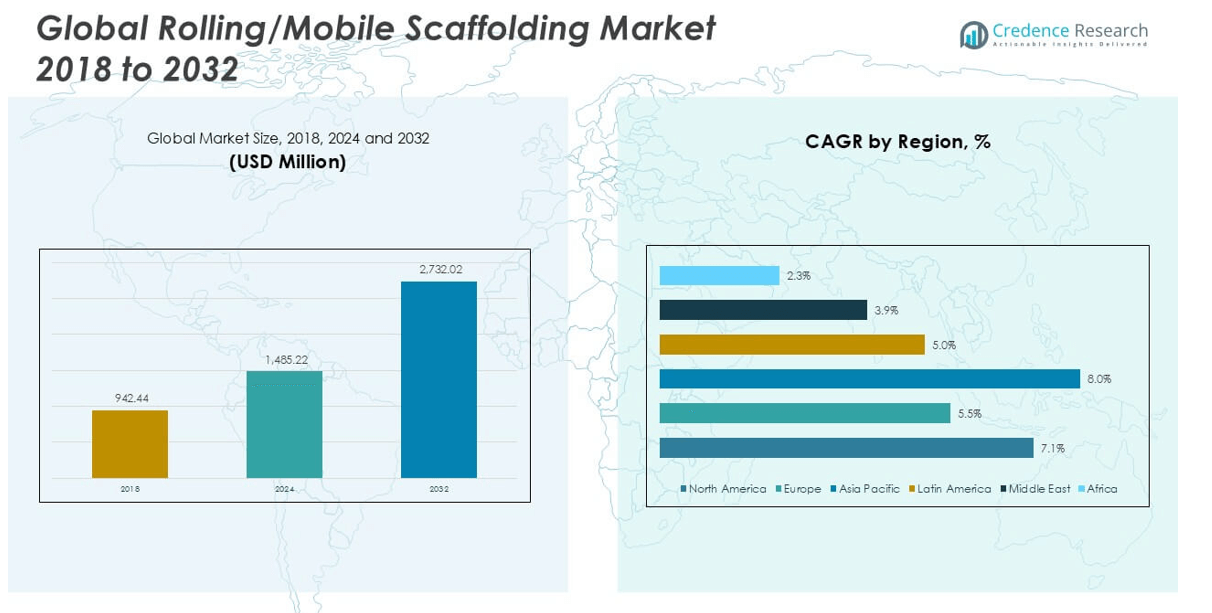
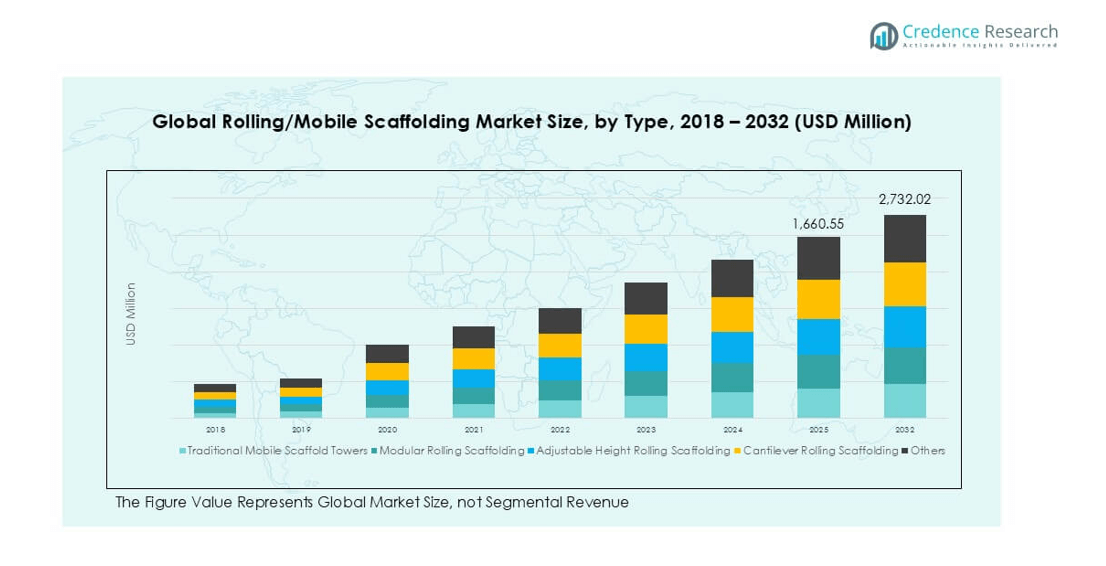
The Rolling/Mobile Scaffolding market size was valued at USD 942.44 million in 2018, increased to USD 1,485.22 million in 2024, and is anticipated to reach USD 2,732.02 million by 2032, at a CAGR of 7.37% during the forecast period.
| REPORT ATTRIBUTE | DETAILS |
|---|---|
| Historical Period | 2020-2023 |
| Base Year | 2024 |
| Forecast Period | 2025-2032 |
| Rolling/Mobile Scaffolding Market Size 2024 | USD 1,485.22 million |
| Rolling/Mobile Scaffolding Market, CAGR | 7.37% |
| Rolling/Mobile Scaffolding Market Size 2032 | USD 2,732.02 million |
The Rolling/Mobile Scaffolding market is led by prominent players such as ADTO Industrial Group, Altrad Group, BrandSafway, PERI Group, and Wilhelm Layher, all of which maintain a strong global presence through expansive product portfolios and continuous innovation. These companies focus on lightweight, modular scaffolding systems that meet evolving construction and safety standards. Other notable players include ULMA C y E, MJ Gerüst GmbH, and KHK Scaffolding & Formwork LLC, which emphasize regional growth and tailored solutions. Geographically, Asia Pacific dominates the market, accounting for 45.6% of the global revenue in 2024, driven by rapid urbanization, infrastructure development, and increased construction activities across China, India, and Southeast Asia.
Market Insights
- The Rolling/Mobile Scaffolding market was valued at USD 1,485.22 million in 2024 and is projected to reach USD 2,732.02 million by 2032, growing at a CAGR of 7.37% during the forecast period.
- Growth is primarily driven by rising demand in the construction industry, increasing focus on worker safety, and ongoing infrastructure development projects worldwide.
- A key trend is the rising adoption of lightweight, modular scaffolding systems made from aluminum and composites, along with growing interest in ergonomic and smart safety features.
- The market is moderately consolidated, with major players such as ADTO Industrial Group, BrandSafway, PERI Group, and Wilhelm Layher competing through innovation, partnerships, and expansion in emerging markets.
- Regionally, Asia Pacific held the largest share at 45.6% in 2024, followed by North America (28.8%) and Europe (17.6%). By type, Traditional Mobile Scaffold Towers dominate due to ease of use and wide applicability across construction segments.
Market Segmentation Analysis:
By Type
The Rolling/Mobile Scaffolding market, segmented by type, is dominated by Traditional Mobile Scaffold Towers, accounting for the largest market share due to their widespread use in residential and commercial construction. These towers offer ease of assembly, portability, and versatility, making them a preferred choice across various project scales. Modular Rolling Scaffolding is gaining traction due to its customizable configurations and suitability for complex structures. Adjustable Height and Cantilever Rolling Scaffolding segments cater to tasks requiring flexibility and reach, especially in maintenance and industrial operations. The "Others" category includes niche variants used for specialized applications with limited market penetration.
- For instance, Wilhelm Layher GmbH offers its Allround Scaffolding Lightweight system, which integrates over 2,800 components and supports assembly without the need for tools, reducing setup time by up to 30% in comparison to traditional scaffolding systems.
By Material:
Among material types, Aluminum-based scaffolding holds the highest market share, driven by its lightweight properties, corrosion resistance, and ease of transport and installation. These features make aluminum scaffolding particularly advantageous for quick setup and frequent relocations in urban construction and maintenance projects. Steel scaffolding follows, valued for its superior strength and load-bearing capacity, making it suitable for heavy-duty industrial and infrastructure applications. Composite materials, though currently a smaller segment, are emerging due to growing demand for eco-friendly and high-performance alternatives, particularly in high-humidity environments where both weight and durability are critical considerations.
- For instance, PERI Group’s Alu UP Rosett Flex aluminum scaffold weighs just 7.5 kg per meter, offering a 22% reduction in transport weight, while maintaining load class 5 strength classification (4.5 kN per m²).
By Application:
In terms of application, the Construction segment leads the market, contributing the largest share due to ongoing global urbanization and infrastructure development projects. Rolling/Mobile Scaffolding is extensively used in both new construction and renovation work for ease of access and safety. The Maintenance and Repairs segment also holds a significant portion, driven by increased investment in the upkeep of aging buildings and industrial facilities. Industrial Operations utilize mobile scaffolding for equipment maintenance in plants and factories, while the Warehousing and Logistics segment demands mobile platforms for high-reach shelving and inventory tasks. "Others" include events and temporary setups, contributing marginally to the overall market.
Market Overview
Surging Demand from the Construction Industry
The global boom in residential, commercial, and infrastructure construction is a major driver for the rolling/mobile scaffolding market. These scaffolding systems are preferred due to their mobility, flexibility, and ease of assembly, which enhances productivity on construction sites. As urbanization accelerates in emerging economies and renovation activities increase in developed regions, the demand for safe and efficient access equipment continues to rise. This trend is especially strong in high-rise construction, where mobile scaffolding offers a cost-effective alternative to fixed scaffolds.
- For instance, BrandSafway deployed its QuikDeck® Suspended Access System across 35 floors of the Hudson Yards development in New York, reducing project duration by 12 weeks through faster vertical scaffold transport and repositioning
Stringent Safety Regulations Boosting Adoption
Increasing enforcement of occupational safety standards across industries is propelling the demand for rolling/mobile scaffolding systems. Regulatory bodies such as OSHA and EU-OSHA emphasize safe working conditions at elevated heights, leading companies to adopt mobile scaffold solutions that meet compliance requirements. These systems offer built-in safety features such as guardrails, locking mechanisms, and anti-slip platforms, thereby reducing workplace accidents. As companies strive to avoid legal liabilities and enhance worker safety, the adoption of certified scaffolding systems is expected to grow significantly.
- For instance, ULMA Construction’s MEGAFRAME system complies with EN 12810 and EN 12811 standards and has been adopted in over 2,400 infrastructure and industrial projects in Europe with zero reported structural failures since deployment.
Growth in Maintenance and Industrial Applications
Expanding industrial operations, particularly in manufacturing, warehousing, and oil & gas sectors, are creating new avenues for mobile scaffolding systems. These industries frequently require elevated access for equipment installation, inspection, and maintenance, where mobility and adjustability are critical. Additionally, the growing trend of periodic facility maintenance to improve asset longevity further boosts the use of these systems. The ability to quickly relocate and adjust the height of scaffolding makes it ideal for dynamic operational environments, fueling market expansion beyond traditional construction applications.
Key Trends & Opportunities
Shift Toward Lightweight and Modular Scaffolding
There is a noticeable industry shift toward lightweight, modular rolling scaffolding systems made from aluminum and composite materials. These materials not only reduce the overall weight but also enhance corrosion resistance and ease of handling. The modular nature allows for faster assembly and disassembly, which improves turnaround time on job sites. As construction firms seek greater flexibility and cost-efficiency, manufacturers are innovating product designs to meet evolving customer expectations, opening up opportunities for product differentiation and market competitiveness.
- For instance, MJ Gerüst GmbH developed its MJ Optima 70 system, consisting of 70 mm aluminum frames and universal modular joints, allowing a 40% faster assembly time and 30% lower logistics costs per project phase.
Integration of Smart Features and Ergonomic Design
Emerging technologies are beginning to influence scaffold design, with manufacturers incorporating ergonomic enhancements and smart safety features such as load sensors and mobility locks. These innovations are aimed at increasing operator safety and efficiency, aligning with the growing demand for advanced equipment in high-risk environments. Furthermore, digital platforms for tracking scaffold usage and maintenance are being explored. As the industry leans into digitalization, early adopters of smart scaffolding solutions stand to gain a competitive edge in both commercial and industrial markets.
- For instance, ADTO Industrial Group introduced its Smart Scaffold Monitoring System in 2023, capable of detecting load anomalies and vibrational patterns in real time across 300 scaffold joints, reducing structural failure risk by over 60% through predictive alerts.
Key Challenges
High Initial Investment and Maintenance Costs
Despite long-term cost benefits, the initial investment required for high-quality rolling/mobile scaffolding systems can be a barrier for small and medium enterprises. Premium materials like aluminum and composite increase upfront costs, and regular inspections, replacements, or maintenance add to ongoing expenses. These financial concerns often lead companies to opt for traditional or rental scaffolding, limiting market penetration for advanced mobile solutions. Manufacturers must address cost concerns through pricing strategies or rental business models to expand market reach.
Lack of Skilled Labor for Proper Installation and Use
The effectiveness and safety of rolling/mobile scaffolding heavily depend on proper assembly and usage. However, a lack of adequately trained personnel, particularly in developing regions, poses a significant challenge. Improper installation can lead to accidents, liability issues, and loss of productivity. This challenge is exacerbated by the high turnover in construction and maintenance workforces. Addressing this issue will require investment in training programs, certification standards, and user-friendly scaffold designs to ensure safe deployment.
Regulatory Complexities Across Regions
Navigating the complex and varying regulatory landscape across different countries and regions presents a significant challenge for market players. Compliance requirements differ in terms of design specifications, load capacities, and safety certifications, which increases production costs and slows down market entry. Manufacturers operating globally must adapt their offerings to meet local standards, complicating logistics and inventory management. Harmonizing product lines while maintaining regulatory compliance remains a critical hurdle for companies looking to scale operations across multiple markets.
Regional Analysis
North America
North America accounted for approximately 28.8% of the global Rolling/Mobile Scaffolding market in 2024, with a market value rising from USD 271.75 million in 2018 to USD 421.52 million in 2024, and is projected to reach USD 778.65 million by 2032, growing at a CAGR of 7.4%. The growth is driven by increasing investments in residential and commercial construction projects, along with stringent occupational safety regulations promoting the use of mobile scaffolds. The presence of established construction firms and a high demand for maintenance and industrial scaffolding systems further contribute to market expansion in this region.
Europe
Europe held a 17.6% market share in 2024, with the Rolling/Mobile Scaffolding market increasing from USD 175.51 million in 2018 to USD 261.41 million in 2024, and is forecasted to reach USD 437.14 million by 2032, expanding at a CAGR of 6.1%. The region’s growth is primarily supported by infrastructure refurbishment in Western Europe and a steady rise in urban housing developments. Regulatory emphasis on safe construction practices and sustainability has also prompted greater adoption of aluminum and modular scaffolding systems across EU member states, aiding steady market development despite the region's comparatively moderate growth rate.
Asia Pacific
Asia Pacific dominates the global market with a 45.6% share in 2024, reflecting rapid infrastructure development and booming construction activities across China, India, and Southeast Asia. The market surged from USD 414.16 million in 2018 to USD 676.64 million in 2024, and is projected to reach USD 1,320.18 million by 2032, registering the highest CAGR of 8.2%. Rapid urbanization, industrial expansion, and government-led housing projects are fueling demand for cost-efficient and scalable scaffolding solutions. Additionally, rising labor safety awareness and preference for lightweight mobile systems are expected to support sustained growth throughout the forecast period.
Latin America
Latin America contributed 4.7% to the global Rolling/Mobile Scaffolding market in 2024, growing from USD 44.52 million in 2018 to USD 69.28 million in 2024, and is expected to reach USD 112.80 million by 2032, at a CAGR of 5.7%. Market growth is primarily supported by emerging urban construction activities in countries like Brazil, Mexico, and Chile. Infrastructure modernization programs and gradual industrial growth are creating a favorable environment for mobile scaffolding adoption. However, economic instability and a lack of stringent safety regulations in certain parts of the region may moderate the pace of adoption in some submarkets.
Middle East
The Middle East represented 2.2% of the global market in 2024, with the market rising from USD 22.73 million in 2018 to USD 32.25 million in 2024, and is projected to reach USD 48.40 million by 2032, growing at a CAGR of 4.6%. Although the region's growth is relatively modest, ongoing infrastructure investments, particularly in Saudi Arabia and the UAE under programs like Vision 2030, are expected to create long-term opportunities. The demand for modular and mobile scaffolding in large-scale commercial and entertainment developments continues to increase, although adoption remains restrained due to cost considerations and fluctuating oil-dependent economies.
Africa
Africa accounted for the smallest share at 1.6% of the global market in 2024, with the market size increasing from USD 13.77 million in 2018 to USD 24.11 million in 2024, and projected to reach USD 34.85 million by 2032, expanding at a CAGR of 4.1%. Market growth is supported by improving construction activity in urban centers across Nigeria, South Africa, and Kenya. However, infrastructural challenges, low per capita investment in construction tools, and limited awareness about advanced scaffolding systems pose barriers to widespread adoption. The market is expected to gradually expand as regional economies invest more in infrastructure and worker safety practices.
Market Segmentations:
By Type:
- Traditional Mobile Scaffold Towers
- Modular Rolling Scaffolding
- Adjustable Height Rolling Scaffolding
- Cantilever Rolling Scaffolding
- Others
By Material:
- Aluminum
- Steel
- Composite Materials
By Application:
- Construction
- Maintenance and Repairs
- Industrial Operations
- Warehousing and Logistics
- Others
By End User:
- Residential Construction
- Commercial Construction
- Industrial Sectors
- Municipal and Infrastructure Projects
- Others
By Geography:
- North America
- Europe
- Asia Pacific
- Latin America
- Middle East
- Africa
Competitive Landscape
The competitive landscape of the Rolling/Mobile Scaffolding market is characterized by the presence of both global and regional players focusing on product innovation, strategic partnerships, and geographic expansion. Key companies such as ADTO Industrial Group, Altrad Group, BrandSafway, PERI Group, and Wilhelm Layher dominate the market through diversified product portfolios, strong distribution networks, and consistent investments in R&D. These players are enhancing their market position by developing lightweight, modular, and ergonomic scaffolding systems to meet evolving customer needs across construction, industrial, and maintenance sectors. Additionally, companies like ULMA C y E, MJ Gerüst GmbH, and KHK Scaffolding & Formwork LLC are targeting niche segments and emerging economies through localized manufacturing and competitive pricing strategies. Mergers, acquisitions, and collaborations are common as companies aim to increase operational efficiency and market penetration. The market is moderately consolidated, with a focus on compliance with safety standards and customization to gain a competitive edge in both developed and developing regions.
Key Player Analysis
- ADTO Industrial Group
- Altrad Group
- Atlantic Pacific Equipment
- BrandSafway
- Cangzhou Weisitai Scaffolding Co.
- Changli XMWY Formwork Scaffolding Co.
- MJ Gerüst GmbH
- PERI Group
- Stepup Scaffold
- ULMA C y E, S. Coop.
- Wilhelm Layher
- KHK Scaffolding & Formwork LLC
Recent Developments
- In May 2025, Layher continues its focus on lightweight aluminum scaffolding systems, particularly for the European and North American markets, with a strong emphasis on advanced, modular, and mobile solutions. While no specific new product launches are mentioned in the provided information for 2025, Layher's ongoing research and development efforts are consistently highlighted for their contributions to quicker and safer assembly, especially concerning rolling and mobile scaffolding systems.
- In April 2025, PERI showcased further development and expansion of the PERI UP Scaffolding Kit, including the introduction of "PERI UP Public" components. These focus on quick installation and safety, specifically for public sector needs, with stairs and access points that meet strict safety standards and require minimal additional components. The modular logic allows more with fewer components, improving efficiency for rolling/mobile scaffolding use. The company also emphasized sustainability and introduced digital solutions (e.g., SYFIT, VEMAVENTURI) for management and safety on construction sites.
- In January 2025, BrandSafway showcased several innovations at the World of Concrete 2025, including enhancements to the QuikDeck® Suspended Access System, new multi-level platform options, and the launch of Flexi Deck, a lightweight, manually movable slab formwork system designed for faster early dismantling and improved site coverage.
Market Concentration & Characteristics
The Rolling/Mobile Scaffolding Market demonstrates moderate market concentration, with a mix of global leaders and regional players shaping its competitive dynamics. Leading companies such as BrandSafway, ADTO Industrial Group, PERI Group, and Wilhelm Layher hold significant shares due to their strong distribution networks, broad product portfolios, and compliance with international safety standards. It is characterized by steady product innovation focused on lightweight materials, modular designs, and ease of mobility to meet evolving demands in construction, maintenance, and industrial operations. The market remains highly responsive to regulatory changes, particularly in developed regions where safety norms are stringent. Entry barriers exist due to technical specifications, certification requirements, and capital investments. Regional manufacturers continue to cater to localized demands by offering cost-effective solutions, especially in Asia Pacific and Latin America. It supports a growing preference for scaffolding systems that balance safety, flexibility, and efficiency across diverse end-user applications, including residential, commercial, and infrastructure projects.
Report Coverage
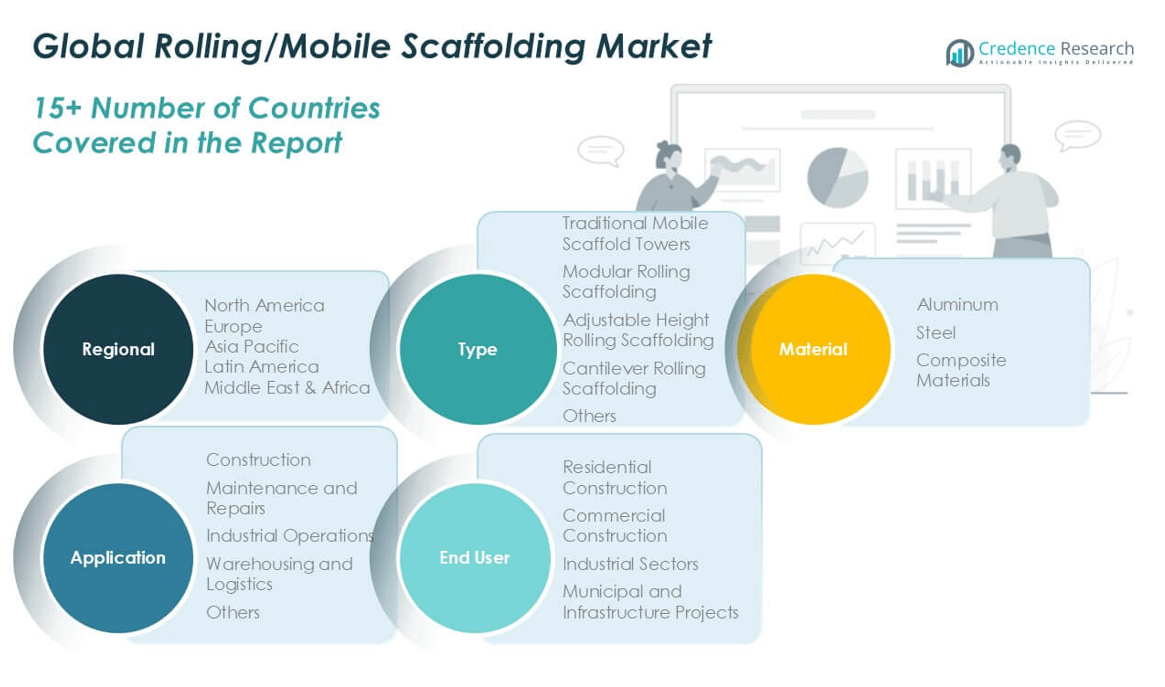
The research report offers an in-depth analysis based on Type, Material, Application, End User and Geography. It details leading market players, providing an overview of their business, product offerings, investments, revenue streams, and key applications. Additionally, the report includes insights into the competitive environment, SWOT analysis, current market trends, as well as the primary drivers and constraints. Furthermore, it discusses various factors that have driven market expansion in recent years. The report also explores market dynamics, regulatory scenarios, and technological advancements that are shaping the industry. It assesses the impact of external factors and global economic changes on market growth. Lastly, it provides strategic recommendations for new entrants and established companies to navigate the complexities of the market.
Future Outlook
- The Rolling/Mobile Scaffolding market is expected to witness steady growth driven by continued urbanization and infrastructure development globally.
- Adoption of lightweight and modular scaffolding systems will increase due to their ease of transport, assembly, and safety features.
- Demand for mobile scaffolding will rise in industrial maintenance and repair activities, especially in manufacturing and logistics sectors.
- Increased regulatory focus on worker safety will encourage construction firms to invest in certified and advanced scaffolding solutions.
- Asia Pacific will continue to dominate the market, supported by large-scale construction projects and industrial expansion.
- North America and Europe will see steady demand, driven by renovation, retrofit activities, and strict safety standards.
- Technological innovations such as ergonomic designs and integrated safety locks will gain more traction among end users.
- Rental services for mobile scaffolding will grow, especially among small contractors seeking cost-effective access solutions.
- Manufacturers will expand their presence in emerging markets through strategic partnerships and localized production.
- Training and skill development initiatives will become essential to ensure proper use and handling of mobile scaffolding systems.

Request a Free Sample
Fill in your details and we'll send you a free sample report.
- Sample data tables & charts
- Research methodology
Market Dynamics
Surging Construction and Infrastructure Development
Rapid urbanization and large-scale infrastructure projects, especially in Asia Pacific, are fueling demand for rolling/mobile scaffolding due to their flexibility, mobility, and efficiency on construction sites.
Stringent Safety Regulations
Increasing enforcement of occupational safety standards by regulatory bodies such as OSHA and EU-OSHA is driving adoption of certified mobile scaffolding systems with advanced safety features, reducing workplace accidents and legal liabilities.
Shift Toward Lightweight and Modular Systems
The industry is moving toward lightweight, modular scaffolding made from aluminum and composites, which offer easier transport, faster assembly, and improved corrosion resistance, meeting the needs of modern construction and maintenance projects.
Growth in Maintenance and Industrial Applications
Expanding industrial operations and the need for regular maintenance in manufacturing, warehousing, and logistics sectors are creating new opportunities for mobile scaffolding, which is valued for its adjustability and ease of relocation.
Technological Innovation and Smart Features
Manufacturers are integrating ergonomic designs and smart safety features such as load sensors and digital monitoring, enhancing operator safety and efficiency, and appealing to customers seeking advanced, future-ready scaffolding solutions.
Need a Custom Version of This Report?
Tailor the scope, geography, or segments to your exact requirements.
- Custom geography or segment scope
- Direct access to our analyst team
Frequently Asked Questions
What is the current market size for Rolling/Mobile Scaffolding, and what is its projected size in 2032?
Which Rolling/Mobile Scaffolding market segment held the largest share in 2024?
Who are the leading companies in the Rolling/Mobile Scaffolding market?
Which region commanded the largest share of the Rolling/Mobile Scaffolding market in 2024?
Table of Content
Chapter 1 Market Segmentation
- 1.1 Segmentation Framework
- 1.1.1 Product and Service Classification
- 1.1.2 Application and End-Use Classification
- 1.1.3 Technology and Solution Classification
- 1.1.4 Customer and Distribution Channel Classification
- 1.1.5 Geographic Segmentation
- 1.1.6 Market Segment Definitions and Boundaries
- 1.2 By Type
- 1.2.1 Traditional Mobile Scaffold Towers
- 1.2.2 Modular Rolling Scaffolding
- 1.2.3 Adjustable Height Rolling Scaffolding
- 1.2.4 Cantilever Rolling Scaffolding
- 1.2.5 Others
- 1.3 By End User
- 1.3.1 Residential Construction
- 1.3.2 Commercial Construction
- 1.3.3 Industrial Sectors
- 1.3.4 Municipal and Infrastructure Projects
- 1.3.5 Others
- 1.4 By Material
- 1.4.1 Aluminum
- 1.4.2 Steel
- 1.4.3 Composite Materials
- 1.5 By Application
- 1.5.1 Construction
- 1.5.2 Maintenance and Repairs
- 1.5.3 Industrial Operations
- 1.5.4 Warehousing and Logistics
- 1.5.5 Others
Chapter 2 Introduction
- 2.1 Report Objectives and Scope
- 2.2 Product Definition and Industry Terminology
- 2.3 Market Inclusions and Exclusions
- 2.4 Research Process
- 2.4.1 Primary Research and Expert Interviews
- 2.4.2 Secondary Research and Source Review
- 2.4.3 Top-Down and Bottom-Up Estimation
- 2.4.4 Data Triangulation and Verification
- 2.5 Market Size Measurement Basis
- 2.5.1 2018: USD 1,485.22 million → 2032: USD 2,732.02 million
- 2.6 Historical and Forecast Reference Periods
- 2.6.1 Base Year: 2018
- 2.6.2 Forecast Period: 2018-2032
- 2.7 Research Assumptions and Limitations
Chapter 3 Executive Summary
- 3.1 Market Snapshot and Key Findings
- 3.2 Base-Year Market Size, 2018
- 3.3 Forecast Market Size, 2032
- 3.4 Revenue and Volume Growth Outlook
- 3.5 Key Demand and Supply Indicators
- 3.6 Leading Market Segments
- 3.7 Fastest-Growing Market Opportunities
- 3.8 Regional Performance Highlights
- 3.9 Technology and Industry Transformation
- 3.10 Competitive Landscape Summary
- 3.11 Analyst View and Strategic Implications
Chapter 4 Global Rolling/Mobile Scaffolding Market Trends and Developments
- 4.1 Historical Industry Development
- 4.2 Recent Market Trends and Developments
- 4.3 Demand and Customer Behavior Trends
- 4.4 Technology and Product Innovation
- 4.5 Artificial Intelligence, Automation and Digitalization
- 4.6 Local Manufacturing and Supply Chain Realignment
- 4.7 Industry Partnerships, Mergers and Acquisitions
- 4.8 Sustainability and Circular Economy Developments
- 4.9 Government and Private Sector Investment Trends
- 4.10 Emerging Business Models and Commercialization
- 4.11 Industry Developments and Announcements
Chapter 5 Global Rolling/Mobile Scaffolding Market Production, Supply and Demand Analysis
- 5.1 Demand Trend and Consumption Analysis
- 5.2 Demand Forecast, 2018-2032
- 5.3 Production and Output Trend
- 5.4 Production and Output Forecast, 2018-2032
- 5.5 Installed Capacity and Capacity Utilization
- 5.6 Company-Wise Production Plants and Statistics
- 5.6.1 Installed Production Capacity
- 5.6.2 Actual Production
- 5.6.3 Planned Capacity and Expansion Targets
- 5.7 Supply Chain Structure and Procurement Trends
- 5.8 Supply-Demand Gap and Bottlenecks
- 5.9 Import Dependence and Sourcing Structure
- 5.10 Contract Manufacturing and Outsourcing
- 5.11 Regional Supply and Demand Concentration
Chapter 6 Global Rolling/Mobile Scaffolding Market Pricing Analysis
- 6.1 Pricing Structure and Measurement
- 6.2 Historical Pricing Trends
- 6.3 Pricing Outlook, 2018-2032
- 6.4 Average Selling Price and Unit Economics
- 6.5 Pricing by Product and Market Segment
- 6.6 Geographic Pricing Differences
- 6.7 Key Input, Energy, Labor and Logistics Costs
- 6.8 Contract Pricing and Purchasing Models
- 6.9 Pricing Sensitivity and Competitive Positioning
- 6.10 Price, Margin and Profitability Implications
Chapter 7 Global Rolling/Mobile Scaffolding Market Dynamics
- 7.1 Market Growth Drivers
- 7.1.1 Demand-Side Drivers
- 7.1.2 Technology and Innovation Drivers
- 7.1.3 Infrastructure and Investment Drivers
- 7.1.4 Regulatory and Policy Drivers
- 7.2 Market Restraints
- 7.2.1 Cost and Affordability Constraints
- 7.2.2 Technology and Adoption Barriers
- 7.2.3 Supply Chain and Operational Constraints
- 7.3 Market Challenges
- 7.3.1 Competitive Pressure and Margin Erosion
- 7.3.2 Skills, Infrastructure and Implementation Gaps
- 7.4 Emerging Market Opportunities
- 7.5 Market Dynamics Impact and Time-Horizon Assessment
Chapter 8 Global Rolling/Mobile Scaffolding Value Chain Analysis
- 8.1 Industry Value Chain Overview
- 8.2 Upstream Suppliers and Critical Inputs
- 8.3 Technology and Component Providers
- 8.4 Manufacturing or Service Delivery
- 8.5 Distribution, Channel Partners and Integrators
- 8.6 Downstream Applications and End Users
- 8.7 Value Addition and Profit Pools
- 8.8 Vertical Integration and Outsourcing
- 8.9 Supplier Concentration and Risk
- 8.10 Supply Chain Localization and Resilience
Chapter 9 Global Rolling/Mobile Scaffolding Market Regulations and Policies
- 9.1 Relevant Laws, Standards and Compliance Frameworks
- 9.2 Product, Service, Safety and Quality Requirements
- 9.3 Government Policies, Incentives and Subsidies
- 9.4 Imports, Exports and Trade Barriers
- 9.5 Public Procurement and Local Content Requirements
- 9.6 Environmental and Sustainability Compliance
- 9.7 Upcoming Policy Changes and Market Implications
Chapter 10 Global Rolling/Mobile Scaffolding Market Hotspots and Opportunities
- 10.1 Market Opportunity Mapping and Growth Hotspots
- 10.2 High-Growth Applications and Customer Groups
- 10.3 Underserved Markets and White-Space Opportunities
- 10.4 Emerging Technology and Product Opportunities
- 10.5 New Capacity and Investment Hotspots
- 10.6 Market Entry and Expansion Opportunities
- 10.7 Distribution and Partnership Opportunities
- 10.8 Near-Term and Long-Term Commercial Potential
- 10.9 Opportunity Attractiveness and Execution Risks
Chapter 11 Global Rolling/Mobile Scaffolding Market Outlook, 2018-2032
- 11.1 Market Size and Analysis
- 11.1.1 Revenue (Market Measurement: 2018: USD 1,485.22 million → 2032: USD 2,732.02 million)
- 11.1.2 Market Volume and Quantity Sold
- 11.1.3 Historical Market Size
- 11.1.4 Base-Year Market Size, 2018
- 11.2 Market Forecast, 2018-2032
- 11.2.1 Revenue Forecast to 2032
- 11.2.2 Volume Forecast to 2032
- 11.2.3 CAGR and Year-on-Year Growth
- 11.2.4 Incremental Revenue Opportunity
- 11.3 Forecast Assumptions and Scenario Analysis
- 11.3.1 Base-Case Forecast
- 11.3.2 Optimistic and Conservative Scenarios
- 11.3.3 Technology, Pricing and Policy Sensitivities
- 11.4 Market Attractiveness and Growth Outlook
Chapter 12 Global Rolling/Mobile Scaffolding Market Segmentation and Outlook
- 12.1 Segmentation Summary and Market Shares, 2018
- 12.2 Largest and Fastest-Growing Segments
- 12.3 By Type - Market Size and Forecast, 2018-2032
- 12.3.1 Segment Definition and Scope
- 12.3.2 Historical Market Size
- 12.3.3 Revenue Forecast, 2018-2032
- 12.3.4 Volume Forecast, 2018-2032
- 12.3.5 Base-Year Market Share, 2018
- 12.3.6 Segment CAGR and Growth Drivers
- 12.3.7 Subsegment Market Size and Forecast
- 12.3.7.1 Traditional Mobile Scaffold Towers
- 12.3.7.2 Modular Rolling Scaffolding
- 12.3.7.3 Adjustable Height Rolling Scaffolding
- 12.3.7.4 Cantilever Rolling Scaffolding
- 12.3.7.5 Others
- 12.3.8 Subsegment Pricing and Adoption Trends
- 12.3.9 Leading Suppliers and Competition
- 12.3.10 Regional Demand and Opportunities
- 12.4 By End User - Market Size and Forecast, 2018-2032
- 12.4.1 Segment Definition and Scope
- 12.4.2 Historical Market Size
- 12.4.3 Revenue Forecast, 2018-2032
- 12.4.4 Volume Forecast, 2018-2032
- 12.4.5 Base-Year Market Share, 2018
- 12.4.6 Segment CAGR and Growth Drivers
- 12.4.7 Subsegment Market Size and Forecast
- 12.4.7.1 Residential Construction
- 12.4.7.2 Commercial Construction
- 12.4.7.3 Industrial Sectors
- 12.4.7.4 Municipal and Infrastructure Projects
- 12.4.7.5 Others
- 12.4.8 Subsegment Pricing and Adoption Trends
- 12.4.9 Leading Suppliers and Competition
- 12.4.10 Regional Demand and Opportunities
- 12.5 By Material - Market Size and Forecast, 2018-2032
- 12.5.1 Segment Definition and Scope
- 12.5.2 Historical Market Size
- 12.5.3 Revenue Forecast, 2018-2032
- 12.5.4 Volume Forecast, 2018-2032
- 12.5.5 Base-Year Market Share, 2018
- 12.5.6 Segment CAGR and Growth Drivers
- 12.5.7 Subsegment Market Size and Forecast
- 12.5.7.1 Aluminum
- 12.5.7.2 Steel
- 12.5.7.3 Composite Materials
- 12.5.8 Subsegment Pricing and Adoption Trends
- 12.5.9 Leading Suppliers and Competition
- 12.5.10 Regional Demand and Opportunities
- 12.6 By Application - Market Size and Forecast, 2018-2032
- 12.6.1 Segment Definition and Scope
- 12.6.2 Historical Market Size
- 12.6.3 Revenue Forecast, 2018-2032
- 12.6.4 Volume Forecast, 2018-2032
- 12.6.5 Base-Year Market Share, 2018
- 12.6.6 Segment CAGR and Growth Drivers
- 12.6.7 Subsegment Market Size and Forecast
- 12.6.7.1 Construction
- 12.6.7.2 Maintenance and Repairs
- 12.6.7.3 Industrial Operations
- 12.6.7.4 Warehousing and Logistics
- 12.6.7.5 Others
- 12.6.8 Subsegment Pricing and Adoption Trends
- 12.6.9 Leading Suppliers and Competition
- 12.6.10 Regional Demand and Opportunities
- 12.7 Segment Growth Comparison
- 12.8 Segment Attractiveness and Priority Matrix
Chapter 13 Global Rolling/Mobile Scaffolding End-Use and Application Market Outlook
- 13.1 End-Use Industry and Customer Demand Structure
- 13.2 Leading Applications and Customer Groups
- 13.3 End-Use Market Size, Share and Forecast
- 13.4 Major End-Use Industry Deep Dives
- 13.4.1 Customer Requirements and Use Cases
- 13.4.2 Demand and Replacement Cycles
- 13.4.3 Technical and Regulatory Considerations
- 13.4.4 Purchasing and Procurement Models
- 13.4.5 Leading Vendors and Distribution Channels
- 13.4.6 Forecast and Commercial Opportunities
- 13.5 Emerging Applications and Cross-Segment Demand
- 13.6 End-Use Industry Investment Priorities
Chapter 14 Global Rolling/Mobile Scaffolding Geographic Market Outlook, 2018-2032
- 14.1 Regional Market Size and Share, 2018
- 14.2 Regional Market Forecast, 2018-2032
- 14.3 Regional Pricing, Production and Demand Differences
- 14.4 North America
- 14.4.1 United States
- 14.4.2 Canada
- 14.4.3 Mexico
- 14.5 Europe
- 14.5.1 Germany
- 14.5.2 France
- 14.5.3 Italy
- 14.5.4 United Kingdom
- 14.5.5 Spain
- 14.5.6 Poland
- 14.5.7 Russia
- 14.5.8 Netherlands
- 14.5.9 Belgium
- 14.5.10 Sweden
- 14.5.11 Denmark
- 14.5.12 Norway
- 14.5.13 Rest of Europe
- 14.6 Asia Pacific
- 14.6.1 China
- 14.6.2 India
- 14.6.3 Japan
- 14.6.4 South Korea
- 14.6.5 Thailand
- 14.6.6 Indonesia
- 14.6.7 Vietnam
- 14.6.8 Malaysia
- 14.6.9 Australia
- 14.6.10 Rest of Asia Pacific
- 14.7 Latin America
- 14.7.1 Brazil
- 14.7.2 Argentina
- 14.7.3 Colombia
- 14.7.4 Chile
- 14.7.5 Rest of Latin America
- 14.8 Middle East
- 14.8.1 Saudi Arabia
- 14.8.2 United Arab Emirates
- 14.8.3 Turkey
- 14.8.4 Israel
- 14.8.5 Iran
- 14.8.6 Rest of the Middle East
- 14.9 Africa
- 14.9.1 South Africa
- 14.9.2 Egypt
- 14.9.3 Nigeria
- 14.9.4 Morocco
- 14.9.5 Rest of Africa
- 14.10 Regional Investment, Policy and Supply Chain Differences
- 14.11 Regional Competitive Landscape
- 14.12 Geographic Growth Hotspots
Chapter 15 Global Rolling/Mobile Scaffolding Technology, Innovation and Sustainability Outlook
- 15.1 Technology Landscape and Maturity
- 15.2 Product, Process and Service Innovation
- 15.3 AI, Automation and Digital Tools in the Industry
- 15.4 Technology Adoption and Performance Benchmarking
- 15.5 Innovation Pipeline and R&D Investment
- 15.6 Patent and Intellectual Property Trends
- 15.7 Energy Efficiency and Resource Management
- 15.8 Sustainability, Recycling and Circularity
- 15.9 Technology Roadmap, 2018-2032
- 15.10 Risks of Obsolescence and Technology Substitution
Chapter 16 Global Rolling/Mobile Scaffolding Market Key Strategic Imperatives
- 16.1 Growth and Market Entry Priorities
- 16.2 High-Return Products and Segments
- 16.3 Pricing, Profitability and Cost Optimization
- 16.4 Technology Investment and Product Differentiation
- 16.5 Supply Chain Localization and Resilience
- 16.6 Distribution and Customer Acquisition
- 16.7 Partnership, Acquisition and Capacity Strategy
- 16.8 Regional Expansion Priorities
- 16.9 Short-, Medium- and Long-Term Actions
Chapter 17 Competition Outlook
- 17.1 Industry Competition Characteristics
- 17.2 Market Structure and Concentration
- 17.3 Market Share and Competitive Positioning, 2018
- 17.4 Company-Wise Revenue and Product Benchmarking
- 17.5 Production and Service Capacity Benchmarking
- 17.6 Technology, Pricing and Differentiation
- 17.7 Regional Footprint and Distribution Strength
- 17.8 Mergers, Acquisitions and Strategic Alliances
- 17.9 New Entrants and Competitive Threats
- 17.10 Porter's Five Forces and Industry Attractiveness
- 17.11 Competitive Outlook, 2018-2032
Chapter 18 Company Profiles
- 18.1 Company Coverage and Selection Criteria
- 18.2 ADTO Industrial Group
- 18.2.1 Business Description
- 18.2.2 Company Ownership and Geographic Presence
- 18.2.3 Product and Service Portfolio
- 18.2.4 Manufacturing and Operating Footprint
- 18.2.5 Production Capacity and Expansion Plans
- 18.2.6 Financial Performance and Investment
- 18.2.7 Market Share and Competitive Position
- 18.2.8 Technology and Innovation Capabilities
- 18.2.9 Strategic Alliances or Partnerships
- 18.2.10 Recent Developments
- 18.2.11 Growth Strategy and Outlook
- 18.3 Altrad Group
- 18.4 BrandSafway
- 18.5 PERI Group
- 18.6 Wilhelm Layher
- 18.7 ULMA C y E
- 18.8 MJ Gerüst GmbH
- 18.9 KHK Scaffolding & Formwork LLC
- 18.10 Atlantic Pacific Equipment
- 18.11 Stepup Scaffold
- 18.12 Other Relevant Market Participants
Note: Every listed company is profiled on the structure shown under the first company. The company list is preliminary and may change based on research findings, market developments, data availability and client requirements.
Chapter 19 Disclaimer
- 19.1 Research and Forecast Disclaimer
- 19.2 Data Source and Estimation Limitations
Note: The depth of individual sections depends on data availability for this market. Volume, capacity, trade and other unit-based metrics are included where applicable.

