Sewing Thread Market Overview:
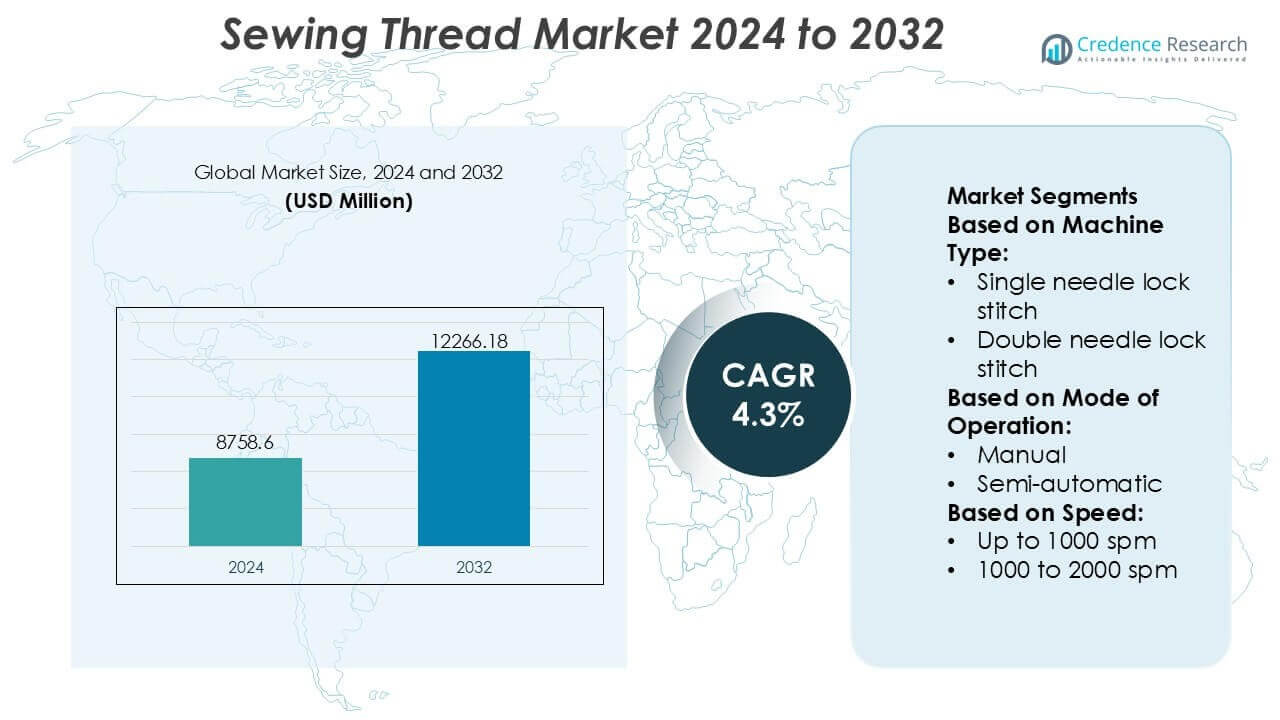
Sewing Thread Market size was valued USD 8758.6 million in 2024 and is anticipated to reach USD 12266.18 million by 2032, at a CAGR of 4.3% during the forecast period. (Credence Research)
| REPORT ATTRIBUTE | DETAILS |
|---|---|
| Historical Period | 2020-2023 |
| Base Year | 2024 |
| Forecast Period | 2025-2032 |
| Sewing Thread Market Size 2024 | USD 8758.6 million |
| Sewing Thread Market, CAGR | 4.3% |
| Sewing Thread Market Size 2032 | USD 12266.18 million |
Sewing Thread Market Insights
- Market growth is primarily driven by rising apparel production, increasing adoption of automated sewing machines, and strong demand from automotive and industrial textile applications requiring high-tenacity threads.
- Key trends include growing use of recycled polyester threads, demand for colorfast and abrasion-resistant products, and innovation in threads compatible with high-speed and fully automatic sewing systems.
- The competitive landscape is marked by global leaders and regional players competing on fiber technology, quality consistency, specialty thread portfolios, and long-term partnerships with garment manufacturers.
- Asia-Pacific dominates the market with an exact 38% share, while polyester threads remain the leading segment, accounting for approximately 46% share due to cost efficiency, durability, and wide application use.
Sewing Thread Market Segmentation Analysis:
By Machine Type
By machine type, single needle lock stitch machines dominate the sewing thread market, accounting for around 38% market share due to their versatility, cost efficiency, and widespread use across apparel, home textiles, and light industrial sewing. These machines support consistent stitch formation with low thread breakage, making them suitable for cotton, polyester, and blended threads. Strong adoption by small and medium garment units further reinforces demand. Overlock and zigzag stitching machines follow, driven by rising demand for stretch fabrics and seam finishing, while flatlock and specialty machines serve niche, high-value applications.
- For instance, FUJIX Ltd. has engineered its industrial polyester threads to maintain tensile strength above 8.5 cN/dtex and elongation control within 18–22 mm over a 250 mm test length, enabling stable performance on single needle lock stitch machines operating beyond 4,000 stitches per minute with documented reductions in thread break events per 10,000 stitches during factory trials.
By Mode of Operation
By mode of operation, semi-automatic machines hold a leading approximately 41% market share, supported by their balance between productivity, affordability, and operational control. These systems enable automated thread tensioning, needle positioning, and stitch consistency while retaining manual flexibility, making them highly attractive to mid-scale garment manufacturers. Fully automatic machines are gaining momentum in large factories due to labor reduction and uniform output, whereas manual machines continue to serve cottage industries and tailoring units, particularly in developing regions where low capital investment and skilled labor availability remain key drivers.
- For instance, Threads (India) Private Limited manufactures industrial polyester sewing threads in ticket ranges such as 40 and 60 with linear densities around 29 tex and 18 tex, delivering measured tenacity values exceeding 6.5 cN/tex and controlled elongation below 20 mm over a 250 mm gauge length, which enables stable stitch formation on semi-automatic machines running at speeds above 3,500 stitches per minute with consistent needle heat resistance during extended production shifts.
By Speed
By speed, machines operating at 2000 to 4000 stitches per minute (spm) dominate the segment with an estimated around 44% market share, driven by their optimal balance between high throughput and thread stability. This speed range minimizes thread overheating and breakage while supporting mass garment production. Machines above 4000 spm are increasingly adopted in industrial apparel lines requiring ultra-high productivity, while systems below 2000 spm remain relevant for precision stitching, delicate fabrics, and customization-focused applications where stitch quality outweighs production speed.
Key Growth Drivers
Rising Demand from Apparel and Fast-Fashion Manufacturing
The expansion of global apparel production remains a primary growth driver for the sewing thread market. Fast-fashion brands emphasize rapid design turnover, shorter production cycles, and high-volume output, all of which increase consumption of sewing threads across stitching, seaming, and finishing operations. Growing apparel manufacturing hubs in Asia-Pacific and parts of Latin America continue to scale capacity, driving steady demand for polyester and blended threads. Additionally, increased outsourcing by global brands to cost-efficient regions strengthens bulk thread procurement by garment manufacturers.
- For instance, AMANN & Söhne GmbH & Co KG has developed high-tenacity polyester threads such as its industrial-grade corespun ranges that achieve breaking forces above 9.0 N at linear densities near 27 tex, while maintaining abrasion resistance exceeding 5,000 cycles in standardized needle friction tests, enabling stable performance on high-speed apparel production lines operating continuously across multiple shifts.
Growth of Technical Textiles and Functional Applications
The increasing adoption of technical textiles significantly supports sewing thread demand beyond conventional apparel. Automotive interiors, footwear, home furnishings, medical textiles, and protective clothing require high-performance threads with enhanced tensile strength, abrasion resistance, and chemical stability. Applications such as airbags, seat covers, medical sutures, and industrial fabrics rely on engineered threads that meet strict performance standards. This diversification into non-apparel segments improves volume stability, reduces seasonality risks, and supports premium pricing for specialty and coated sewing threads.
- For instance, Ningbo MH Industry Co., Ltd. produces bonded nylon and high-tenacity polyester threads with measured breaking strengths exceeding 11.0 N at linear densities around 30 tex, abrasion resistance above 6,000 cycles in standardized Martindale testing, and heat resistance validated at needle temperatures reaching 260 °C, enabling reliable performance in automotive upholstery, footwear uppers, and industrial fabric stitching applications.
Automation and Industrial Sewing Machine Penetration
Rising penetration of automated and high-speed industrial sewing machines is accelerating demand for precision-engineered sewing threads. Manufacturers increasingly prefer threads with consistent thickness, low lint formation, and high heat resistance to maintain productivity at elevated stitching speeds. Automation in garment factories reduces labor dependency while increasing stitch accuracy, thereby favoring standardized, defect-free thread inputs. As factories upgrade machinery to improve throughput and quality consistency, thread suppliers benefit from long-term supply contracts and higher technical qualification requirements.
Key Trends & Opportunities
Shift Toward Sustainable and Recycled Sewing Threads
Sustainability is emerging as a key trend shaping purchasing decisions in the sewing thread market. Brands and manufacturers increasingly adopt recycled polyester threads, bio-based fibers, and low-impact dyeing processes to align with environmental compliance goals. Demand is growing for threads certified under sustainability standards related to recycled content, carbon reduction, and chemical safety. This shift creates opportunities for thread manufacturers to differentiate portfolios, command premium pricing, and establish long-term partnerships with sustainability-focused apparel and home textile brands.
- For instance, AURIFIL Srl produces long-staple cotton and recycled-polyester sewing threads manufactured using fibers spun to linear densities near 28 tex, achieving tensile strengths above 7.0 cN/tex, while its low-impact dyeing process operates at bath temperatures below 60 °C and reduces freshwater consumption to under 45 liters per kilogram of dyed thread, supporting compliance with certified sustainable textile standards and consistent performance on precision sewing applications.
Customization and Color Matching for Brand Differentiation
Customization is becoming a strong opportunity as apparel and footwear brands demand precise color matching, specialty finishes, and application-specific thread properties. Shorter fashion cycles and smaller production batches require flexible dyeing capabilities and quick turnaround times from thread suppliers. Manufacturers that offer rapid color development, low minimum order quantities, and application-specific thread solutions gain competitive advantage. This trend supports higher margins while strengthening supplier-buyer relationships through value-added services rather than volume-based competition.
- For instance, Vardhman Yarns & Threads Ltd. operates ring and compact spinning systems capable of producing polyester sewing threads with linear densities around 20–30 tex, achieving tenacity levels above 6.8 cN/tex and U% yarn evenness values below 10.5, while its continuous dyeing lines process more than 30,000 kg of thread per day with controlled shade deviation within ΔE 0.8, enabling stable performance on industrial sewing lines running beyond 4,000 stitches per minute.
Expansion of E-commerce and DIY Sewing Segments
The growth of e-commerce platforms and home-based sewing activities presents incremental opportunities for the sewing thread market. DIY fashion, embroidery, quilting, and small tailoring businesses increasingly source threads through online retail channels. This trend drives demand for small-spool packaging, premium aesthetic threads, and multi-color assortments. Enhanced digital visibility allows thread brands to reach hobbyists and micro-entrepreneurs directly, expanding addressable markets beyond industrial buyers and improving brand recognition at the consumer level.
Key Challenges
Volatility in Raw Material Prices
Fluctuations in raw material prices pose a significant challenge for sewing thread manufacturers. Polyester, nylon, and cotton prices are influenced by crude oil movements, agricultural yield variability, and supply-chain disruptions. Sudden cost increases pressure profit margins, particularly for suppliers operating under long-term fixed-price contracts with apparel manufacturers. Limited ability to pass on cost increases in highly competitive markets further intensifies margin risks, making cost optimization and supply diversification critical operational priorities.
Intense Price Competition and Product Commoditization
The sewing thread market faces strong price competition, especially in low-to-mid quality segments where product differentiation is limited. A large number of regional and local manufacturers compete primarily on pricing, creating margin pressure for established players. Commoditization restricts brand loyalty and increases buyer switching behavior. To counter this challenge, manufacturers must invest in technical differentiation, quality consistency, and service-oriented offerings, which require sustained capital investment and operational discipline.
Regional Analysis
North America
North America accounts for around 18% market share in the sewing thread market, supported by strong demand from apparel manufacturing, automotive interiors, and home textiles. The region benefits from advanced textile machinery adoption, consistent replacement demand, and high usage of specialty threads such as bonded nylon, polyester, and flame-retardant variants. Growth is reinforced by reshoring initiatives in the U.S. and Mexico, which are increasing localized garment and industrial textile production. Additionally, rising demand for premium upholstery, outdoor fabrics, and technical textiles continues to sustain stable consumption across both commercial and industrial end-use segments.
Europe
Europe holds approximately 22% of the global sewing thread market, driven by its well-established apparel, luxury fashion, and automotive upholstery industries. Countries such as Germany, Italy, France, and Turkey remain key production hubs for high-quality garments and technical textiles, supporting steady thread demand. The region emphasizes precision stitching, durability, and sustainability, accelerating the adoption of recycled polyester and organic cotton threads. Stringent quality standards and strong exports of finished apparel and automotive components further reinforce thread consumption, while automation in sewing operations sustains demand for high-performance and low-breakage thread types.
Asia-Pacific
Asia-Pacific dominates the sewing thread market with around 45% market share, supported by its massive garment manufacturing base and cost-efficient textile production ecosystem. China, India, Bangladesh, Vietnam, and Indonesia collectively drive high-volume consumption across apparel, footwear, and home textiles. The region benefits from abundant labor, vertically integrated supply chains, and expanding export-oriented manufacturing. Rapid industrialization, rising domestic apparel consumption, and government support for textile clusters continue to strengthen demand. Additionally, increasing adoption of high-speed sewing machines is boosting the use of consistent-quality synthetic threads across large-scale production facilities.
Latin America
Latin America represents nearly 8% of the sewing thread market, led by Brazil, Mexico, and Colombia. The region’s growth is supported by expanding regional apparel manufacturing, particularly for domestic consumption and near-shore exports to North America. Rising demand for affordable clothing, uniforms, and home textiles sustains steady thread usage. Improvements in textile infrastructure and increasing participation of small and mid-sized garment manufacturers further support market expansion. While price sensitivity remains high, gradual adoption of polyester and blended threads is improving stitching efficiency and durability across apparel and industrial textile applications.
Middle East & Africa
The Middle East & Africa account for around 7% market share in the sewing thread market, driven by growing apparel manufacturing, traditional garment production, and expanding home textile demand. Countries such as Turkey, Egypt, and Ethiopia are emerging as regional textile hubs, supported by favorable labor costs and export-oriented policies. Rising urbanization and population growth are increasing clothing consumption, while investments in textile parks are strengthening local production capacity. Demand remains concentrated on cost-effective polyester and cotton threads, with gradual uptake of higher-strength threads for uniforms and industrial textiles.
Sewing Thread Market Segmentations:
By Machine Type:
- Single needle lock stitch
- Double needle lock stitch
By Mode of Operation:
- Manual
- Semi-automatic
By Speed:
- Up to 1000 spm
- 1000 to 2000 spm
By Geography
- North America
- U.S.
- Canada
- Mexico
- Europe
- Germany
- France
- U.K.
- Italy
- Spain
- Rest of Europe
- Asia Pacific
- China
- Japan
- India
- South Korea
- South-east Asia
- Rest of Asia Pacific
- Latin America
- Brazil
- Argentina
- Rest of Latin America
- Middle East & Africa
- GCC Countries
- South Africa
- Rest of the Middle East and Africa
Competitive Landscape
The sewing thread market players such as FUJIX Ltd.; Threads (India) Private Limited; AMANN & Söhne GmbH & Co KG; Ningbo MH Industry Co., Ltd.; AURIFIL Srl; Vardhman Yarns & Threads Ltd.; Durak Tekstil San. Ve Tic. A.Ş.; Coats Group PLC; Gunze Limited; American & Efird LLC. The sewing thread market exhibits a moderately consolidated competitive landscape characterized by a balance between global manufacturers and strong regional specialists. Companies compete primarily on thread strength, consistency, color performance, and compatibility with high-speed and automated sewing machines across apparel, footwear, automotive, and home textile applications. Product differentiation is driven by continuous improvements in fiber engineering, twist control, and surface finishes that reduce breakage and enhance stitch quality. Manufacturers increasingly emphasize sustainability through recycled polyester, eco-certified cotton, and low-impact dyeing processes to align with brand and regulatory expectations. Competitive positioning is further influenced by supply reliability, pricing efficiency, and long-term partnerships with garment producers, while investments in capacity expansion and process automation support scalability and operational efficiency.
Key Player Analysis
- FUJIX Ltd.
- Threads (India) Private Limited
- AMANN & Söhne GmbH & Co KG
- Ningbo MH Industry Co., Ltd.
- AURIFIL Srl
- Vardhman Yarns & Threads Ltd.
- Durak Tekstil San. Ve Tic. A.Ş.
- Coats Group PLC
- Gunze Limited
- American & Efird LLC
Recent Developments
- In May 2024, Coloreel and Juki America partnered to bring Coloreel's real-time, on-demand thread dyeing tech to the sewing market via Juki machines, allowing instant color changes for design flexibility, with Juki distributing in the Americas, starting at FABRIC Incubator, a major step beyond embroidery into broader sewing applications.
- In September 2023, JUKI has decided to open a new manufacturing factory in a suburb of Ahmedabad in the state of Gujarat located in Western India. Rising demand for industrial sewing machines in Southwest Asia (India, Bangladesh, Pakistan, Sri Lanka), the Middle East, and Africa has driven this move. The new facility aims to enhance JUKI's manufacturing capabilities to meet the needs of these growing markets.
- In August 2023, Brother International Corporation introduced its 2023 product lineup for Authorized Dealers, featuring advancements in printing, sewing, embroidery, and quilting machines, including its first Fabric Printer. The lineup includes five new machines with diverse features and accessories.
Report Coverage
The research report offers an in-depth analysis based on Machine Type, Mode of Operation, Speed and Geography. It details leading market players, providing an overview of their business, product offerings, investments, revenue streams, and key applications. Additionally, the report includes insights into the competitive environment, SWOT analysis, current market trends, as well as the primary drivers and constraints. Furthermore, it discusses various factors that have driven market expansion in recent years. The report also explores market dynamics, regulatory scenarios, and technological advancements that are shaping the industry. It assesses the impact of external factors and global economic changes on market growth. Lastly, it provides strategic recommendations for new entrants and established companies to navigate the complexities of the market.
Future Outlook
- The sewing thread market will increasingly integrate high-tenacity synthetic fibers to support durability requirements in technical apparel, automotive interiors, and industrial textiles.
- Manufacturers will accelerate adoption of recycled polyester and bio-based polymers to align product portfolios with sustainability and circular-economy objectives.
- Automation compatibility will remain a priority, with thread designs optimized for high-speed, fully automatic sewing machines and reduced breakage rates.
- Demand for specialty threads with enhanced properties such as heat resistance, flame retardancy, and chemical stability will expand across protective and functional applications.
- Smart manufacturing practices, including digital quality control and process monitoring, will improve consistency and reduce production waste.
- Customization of thread thickness, finish, and color performance will gain traction to meet brand-specific and application-driven requirements.
- Growth in technical textiles and medical stitching applications will support innovation in antimicrobial and low-lint thread variants.
- Expansion of apparel manufacturing in Asia-Pacific will continue to influence global supply chains and capacity investments.
- Strategic collaborations between thread producers and sewing machine manufacturers will enhance performance alignment and application efficiency.
- Continuous R&D investment will focus on balancing cost efficiency with performance, sustainability, and compliance with evolving textile standards.

Request a Free Sample
Fill in your details and we'll send you a free sample report.
- Sample data tables & charts
- Research methodology
Need a Custom Version of This Report?
Tailor the scope, geography, or segments to your exact requirements.
- Custom geography or segment scope
- Direct access to our analyst team
Frequently Asked Questions
What is the current market size for the Sewing Thread Market, and what is its projected size in 2032?
At what Compound Annual Growth Rate is the Sewing Thread Market projected to grow between 2024 and 2032?
Which Sewing Thread Market segment held the largest share in 2024?
What are the primary factors fueling the growth of the Sewing Thread Market?
Who are the leading companies in the Sewing Thread Market?
Which region commanded the largest share of the Sewing Thread Market in 2024?
Table of Content
Chapter 1 Market Segmentation
- 1.1 Segmentation Framework
- 1.1.1 Product and Service Classification
- 1.1.2 Application and End-Use Classification
- 1.1.3 Technology and Solution Classification
- 1.1.4 Customer and Distribution Channel Classification
- 1.1.5 Geographic Segmentation
- 1.1.6 Market Segment Definitions and Boundaries
Chapter 2 Introduction
- 2.1 Report Objectives and Scope
- 2.2 Product Definition and Industry Terminology
- 2.3 Market Inclusions and Exclusions
- 2.4 Research Process
- 2.4.1 Primary Research and Expert Interviews
- 2.4.2 Secondary Research and Source Review
- 2.4.3 Top-Down and Bottom-Up Estimation
- 2.4.4 Data Triangulation and Verification
- 2.5 Market Size Measurement Basis
- 2.5.1 2024: USD 8,758.6 million → 2032: USD 12,266.18 million
- 2.6 Historical and Forecast Reference Periods
- 2.6.1 Base Year: 2024
- 2.6.2 Forecast Period: 2024-2032
- 2.7 Research Assumptions and Limitations
Chapter 3 Executive Summary
- 3.1 Market Snapshot and Key Findings
- 3.2 Base-Year Market Size, 2024
- 3.3 Forecast Market Size, 2032
- 3.4 Revenue and Volume Growth Outlook
- 3.5 Key Demand and Supply Indicators
- 3.6 Leading Market Segments
- 3.7 Fastest-Growing Market Opportunities
- 3.8 Regional Performance Highlights
- 3.9 Technology and Industry Transformation
- 3.10 Competitive Landscape Summary
- 3.11 Analyst View and Strategic Implications
Chapter 4 Global Sewing Thread Market Trends and Developments
- 4.1 Historical Industry Development
- 4.2 Recent Market Trends and Developments
- 4.3 Demand and Customer Behavior Trends
- 4.4 Technology and Product Innovation
- 4.5 Artificial Intelligence, Automation and Digitalization
- 4.6 Local Manufacturing and Supply Chain Realignment
- 4.7 Industry Partnerships, Mergers and Acquisitions
- 4.8 Sustainability and Circular Economy Developments
- 4.9 Government and Private Sector Investment Trends
- 4.10 Emerging Business Models and Commercialization
- 4.11 Industry Developments and Announcements
Chapter 5 Global Sewing Thread Market Production, Supply and Demand Analysis
- 5.1 Demand Trend and Consumption Analysis
- 5.2 Demand Forecast, 2024-2032
- 5.3 Production and Output Trend
- 5.4 Production and Output Forecast, 2024-2032
- 5.5 Installed Capacity and Capacity Utilization
- 5.6 Company-Wise Production Plants and Statistics
- 5.6.1 Installed Production Capacity
- 5.6.2 Actual Production
- 5.6.3 Planned Capacity and Expansion Targets
- 5.7 Supply Chain Structure and Procurement Trends
- 5.8 Supply-Demand Gap and Bottlenecks
- 5.9 Import Dependence and Sourcing Structure
- 5.10 Contract Manufacturing and Outsourcing
- 5.11 Regional Supply and Demand Concentration
Chapter 6 Global Sewing Thread Market Pricing Analysis
- 6.1 Pricing Structure and Measurement
- 6.2 Historical Pricing Trends
- 6.3 Pricing Outlook, 2024-2032
- 6.4 Average Selling Price and Unit Economics
- 6.5 Pricing by Product and Market Segment
- 6.6 Geographic Pricing Differences
- 6.7 Key Input, Energy, Labor and Logistics Costs
- 6.8 Contract Pricing and Purchasing Models
- 6.9 Pricing Sensitivity and Competitive Positioning
- 6.10 Price, Margin and Profitability Implications
Chapter 7 Global Sewing Thread Market Dynamics
- 7.1 Market Growth Drivers
- 7.1.1 Demand-Side Drivers
- 7.1.2 Technology and Innovation Drivers
- 7.1.3 Infrastructure and Investment Drivers
- 7.1.4 Regulatory and Policy Drivers
- 7.2 Market Restraints
- 7.2.1 Cost and Affordability Constraints
- 7.2.2 Technology and Adoption Barriers
- 7.2.3 Supply Chain and Operational Constraints
- 7.3 Market Challenges
- 7.3.1 Competitive Pressure and Margin Erosion
- 7.3.2 Skills, Infrastructure and Implementation Gaps
- 7.4 Emerging Market Opportunities
- 7.5 Market Dynamics Impact and Time-Horizon Assessment
Chapter 8 Global Sewing Thread Value Chain Analysis
- 8.1 Industry Value Chain Overview
- 8.2 Upstream Suppliers and Critical Inputs
- 8.3 Technology and Component Providers
- 8.4 Manufacturing or Service Delivery
- 8.5 Distribution, Channel Partners and Integrators
- 8.6 Downstream Applications and End Users
- 8.7 Value Addition and Profit Pools
- 8.8 Vertical Integration and Outsourcing
- 8.9 Supplier Concentration and Risk
- 8.10 Supply Chain Localization and Resilience
Chapter 9 Global Sewing Thread Market Regulations and Policies
- 9.1 Relevant Laws, Standards and Compliance Frameworks
- 9.2 Product, Service, Safety and Quality Requirements
- 9.3 Government Policies, Incentives and Subsidies
- 9.4 Imports, Exports and Trade Barriers
- 9.5 Public Procurement and Local Content Requirements
- 9.6 Environmental and Sustainability Compliance
- 9.7 Upcoming Policy Changes and Market Implications
Chapter 10 Global Sewing Thread Market Hotspots and Opportunities
- 10.1 Market Opportunity Mapping and Growth Hotspots
- 10.2 High-Growth Applications and Customer Groups
- 10.3 Underserved Markets and White-Space Opportunities
- 10.4 Emerging Technology and Product Opportunities
- 10.5 New Capacity and Investment Hotspots
- 10.6 Market Entry and Expansion Opportunities
- 10.7 Distribution and Partnership Opportunities
- 10.8 Near-Term and Long-Term Commercial Potential
- 10.9 Opportunity Attractiveness and Execution Risks
Chapter 11 Global Sewing Thread Market Outlook, 2024-2032
- 11.1 Market Size and Analysis
- 11.1.1 Revenue (Market Measurement: 2024: USD 8,758.6 million → 2032: USD 12,266.18 million)
- 11.1.2 Market Volume and Quantity Sold
- 11.1.3 Historical Market Size
- 11.1.4 Base-Year Market Size, 2024
- 11.2 Market Forecast, 2024-2032
- 11.2.1 Revenue Forecast to 2032
- 11.2.2 Volume Forecast to 2032
- 11.2.3 CAGR and Year-on-Year Growth
- 11.2.4 Incremental Revenue Opportunity
- 11.3 Forecast Assumptions and Scenario Analysis
- 11.3.1 Base-Case Forecast
- 11.3.2 Optimistic and Conservative Scenarios
- 11.3.3 Technology, Pricing and Policy Sensitivities
- 11.4 Market Attractiveness and Growth Outlook
Chapter 12 Global Sewing Thread Market Segmentation and Outlook
- 12.1 Segmentation Summary and Market Shares, 2024
- 12.2 Largest and Fastest-Growing Segments
- 12.3 Segment Growth Comparison
- 12.4 Segment Attractiveness and Priority Matrix
Chapter 13 Global Sewing Thread Geographic Market Outlook, 2024-2032
- 13.1 Regional Market Size and Share, 2024
- 13.2 Regional Market Forecast, 2024-2032
- 13.3 Regional Pricing, Production and Demand Differences
- 13.4 North America
- 13.4.1 United States
- 13.4.2 Canada
- 13.4.3 Mexico
- 13.5 Europe
- 13.5.1 Germany
- 13.5.2 France
- 13.5.3 Italy
- 13.5.4 United Kingdom
- 13.5.5 Spain
- 13.5.6 Poland
- 13.5.7 Russia
- 13.5.8 Netherlands
- 13.5.9 Belgium
- 13.5.10 Sweden
- 13.5.11 Denmark
- 13.5.12 Norway
- 13.5.13 Rest of Europe
- 13.6 Asia Pacific
- 13.6.1 China
- 13.6.2 India
- 13.6.3 Japan
- 13.6.4 South Korea
- 13.6.5 Thailand
- 13.6.6 Indonesia
- 13.6.7 Vietnam
- 13.6.8 Malaysia
- 13.6.9 Australia
- 13.6.10 Rest of Asia Pacific
- 13.7 Latin America
- 13.7.1 Brazil
- 13.7.2 Argentina
- 13.7.3 Colombia
- 13.7.4 Chile
- 13.7.5 Rest of Latin America
- 13.8 Middle East
- 13.8.1 Saudi Arabia
- 13.8.2 United Arab Emirates
- 13.8.3 Turkey
- 13.8.4 Israel
- 13.8.5 Iran
- 13.8.6 Rest of the Middle East
- 13.9 Africa
- 13.9.1 South Africa
- 13.9.2 Egypt
- 13.9.3 Nigeria
- 13.9.4 Morocco
- 13.9.5 Rest of Africa
- 13.10 Regional Investment, Policy and Supply Chain Differences
- 13.11 Regional Competitive Landscape
- 13.12 Geographic Growth Hotspots
Chapter 14 Global Sewing Thread Technology, Innovation and Sustainability Outlook
- 14.1 Technology Landscape and Maturity
- 14.2 Product, Process and Service Innovation
- 14.3 AI, Automation and Digital Tools in the Industry
- 14.4 Technology Adoption and Performance Benchmarking
- 14.5 Innovation Pipeline and R&D Investment
- 14.6 Patent and Intellectual Property Trends
- 14.7 Energy Efficiency and Resource Management
- 14.8 Sustainability, Recycling and Circularity
- 14.9 Technology Roadmap, 2024-2032
- 14.10 Risks of Obsolescence and Technology Substitution
Chapter 15 Global Sewing Thread Market Key Strategic Imperatives
- 15.1 Growth and Market Entry Priorities
- 15.2 High-Return Products and Segments
- 15.3 Pricing, Profitability and Cost Optimization
- 15.4 Technology Investment and Product Differentiation
- 15.5 Supply Chain Localization and Resilience
- 15.6 Distribution and Customer Acquisition
- 15.7 Partnership, Acquisition and Capacity Strategy
- 15.8 Regional Expansion Priorities
- 15.9 Short-, Medium- and Long-Term Actions
Chapter 16 Competition Outlook
- 16.1 Industry Competition Characteristics
- 16.2 Market Structure and Concentration
- 16.3 Market Share and Competitive Positioning, 2024
- 16.4 Company-Wise Revenue and Product Benchmarking
- 16.5 Production and Service Capacity Benchmarking
- 16.6 Technology, Pricing and Differentiation
- 16.7 Regional Footprint and Distribution Strength
- 16.8 Mergers, Acquisitions and Strategic Alliances
- 16.9 New Entrants and Competitive Threats
- 16.10 Porter's Five Forces and Industry Attractiveness
- 16.11 Competitive Outlook, 2024-2032
Chapter 17 Company Profiles
- 17.1 Company Coverage and Selection Criteria
- 17.2 Leading Market Participants – Standard Profile Structure
- 17.2.1 Business Description
- 17.2.2 Company Ownership and Geographic Presence
- 17.2.3 Product and Service Portfolio
- 17.2.4 Manufacturing and Operating Footprint
- 17.2.5 Production Capacity and Expansion Plans
- 17.2.6 Financial Performance and Investment
- 17.2.7 Market Share and Competitive Position
- 17.2.8 Technology and Innovation Capabilities
- 17.2.9 Strategic Alliances or Partnerships
- 17.2.10 Recent Developments
- 17.2.11 Growth Strategy and Outlook
- 17.3 Other Relevant Market Participants
Note: Every listed company is profiled on the structure shown under the first company. The company list is preliminary and may change based on research findings, market developments, data availability and client requirements.
Chapter 18 Disclaimer
- 18.1 Research and Forecast Disclaimer
- 18.2 Data Source and Estimation Limitations
Note: The depth of individual sections depends on data availability for this market. Volume, capacity, trade and other unit-based metrics are included where applicable.