
| REPORT ATTRIBUTE | DETAILS |
|---|---|
| Historical Period | 2020-2023 |
| Base Year | 2024 |
| Forecast Period | 2025-2032 |
| Sign Language Apps market Size 2024 | USD 1,407.34 million |
| Sign Language Apps market, CAGR | 9.67% |
| Sign Language Apps market Size 2032 | USD 3,101.19 million |
Market Overview:
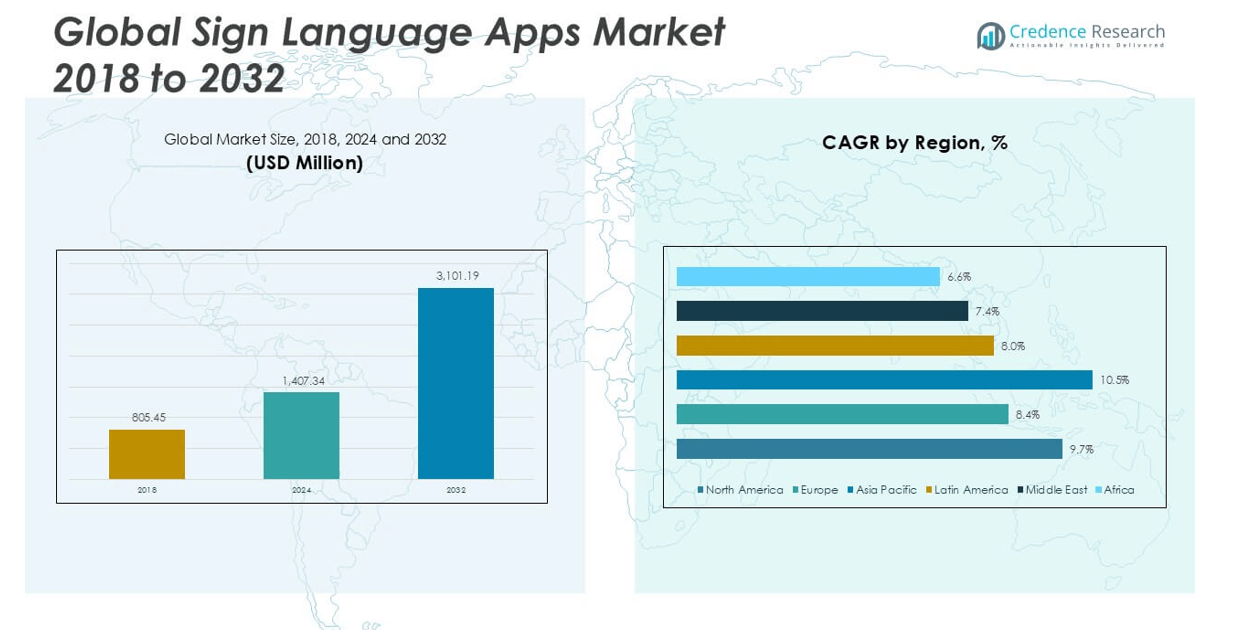
The Sign Language Apps market size was valued at USD 805.45 million in 2018 and increased to USD 1,407.34 million in 2024. It is anticipated to reach USD 3,101.19 million by 2032, growing at a CAGR of 9.67% during the forecast period.
The Sign Language Apps market is led by prominent players such as Google, Microsoft, ProDeaf, Hand Talk, and SignSchool, each leveraging advanced technologies to enhance user accessibility and engagement. These companies focus on integrating AI-powered translation, gesture recognition, and culturally specific sign language content to expand their global footprint. Among them, Google and Microsoft dominate through strong R&D capabilities and expansive digital ecosystems. Regionally, Asia Pacific holds the largest share of the global market, accounting for 44.2% in 2024, driven by high smartphone penetration, rising digital literacy, and strong government support for accessibility solutions. North America follows with a 29.1% share, supported by favorable regulations, widespread awareness, and the presence of leading technology firms. As competition intensifies, key players continue to invest in cloud-based platforms, multilingual support, and strategic partnerships to strengthen their regional and global presence.
Market Insights
- The Sign Language Apps market was valued at USD 1,407.34 million in 2024 and is projected to reach USD 3,101.19 million by 2032, growing at a CAGR of 9.67% during the forecast period.
- Growth is primarily driven by rising demand for digital accessibility, government regulations supporting inclusion, and increasing adoption of smartphones and mobile applications across diverse user groups.
- A notable trend is the integration of AI and machine learning for real-time gesture recognition and translation, enhancing app performance and user experience, especially in education and communication segments.
- The market features strong competition among global tech firms like Google and Microsoft and specialized players such as Hand Talk and Lingvano, focusing on language learning, accessibility, and freemium-based models.
- Asia Pacific dominates the market with a 44.2% share, followed by North America at 29.1%; platform-wise, Android apps lead, while cloud-based deployment and freemium subscription models hold the highest segment shares.
Market Segmentation Analysis:
By Platform
The Sign Language Apps market, segmented by platform, includes iOS apps, Android apps, and web-based deployments. Among these, Android apps dominate the market with the highest revenue share due to Android’s wider global user base and affordability across emerging economies. The growing adoption of Android devices in schools, accessibility programs, and low-income communities further accelerates market penetration. Additionally, increased availability of sign language apps on the Google Play Store and greater device compatibility enhances user engagement and accessibility, contributing significantly to segment growth.
- For instance, Google’s Android operating system powers over 3 billion active devices globally as of 2023, enabling broader distribution of accessibility apps like Hand Talk, which saw over 1 million installs on Google Play. This scale facilitates quick and cost-effective user access to sign language resources worldwide.
By Deployment
Within the deployment segment, the market is classified into cloud-based and on-premises solutions. Cloud-based deployments lead the market, accounting for a significant share due to their scalability, cost-effectiveness, and ease of remote access. The demand for real-time updates, minimal maintenance, and multi-device synchronization is pushing organizations and developers toward cloud-based platforms. These solutions are especially beneficial in educational institutions and assistive communication services where centralized data access and collaborative features are essential, driving broader adoption and sustained revenue growth.
- For instance, Microsoft Azure supports over 95% of Fortune 500 companies and hosts accessibility-focused applications like ProDeaf, which uses Azure’s cloud infrastructure for real-time sign language translation and AI-driven updates across user devices. This capability ensures continuous performance and streamlined deployment at scale.
By Subscription
The subscription segment consists of free apps, paid apps, subscription-based services, and freemium models. Freemium models hold the dominant market share, as they offer basic services at no cost while enabling users to upgrade to premium features. This model attracts a large user base initially and then monetizes through added value content. The rising demand for affordable learning solutions, especially among students and families of the deaf and hard-of-hearing community, boosts adoption. Additionally, flexible pricing tiers and targeted in-app purchases help developers expand revenue while ensuring accessibility and user retention.
Market Overview
Rising Demand for Accessibility and Inclusion
The growing global emphasis on accessibility and inclusion is a major driver for the sign language apps market. Government regulations and advocacy for equal communication access have increased the adoption of digital solutions that support the deaf and hard-of-hearing communities. Educational institutions, healthcare providers, and public services are integrating sign language apps to enhance inclusivity. As awareness expands and policies continue to promote accessibility rights, the demand for user-friendly sign language applications is expected to grow significantly, especially in education and communication-oriented sectors.
- For instance, Google introduced Live Transcribe and Sound Notifications in 2020, which now support over 80 languages and dialects, with more than 500 million downloads across Android devices, reflecting widespread adoption of real-time communication tools for the hearing impaired.
Increasing Smartphone Penetration and Internet Access
Widespread smartphone usage and enhanced internet connectivity have significantly expanded the reach of sign language apps. Affordable smartphones, particularly in developing economies, allow broader access to learning and communication tools for users with hearing impairments. App developers are capitalizing on this by launching Android- and iOS-compatible solutions with multilingual support and offline functionality. This growing digital infrastructure provides fertile ground for market growth, as more users can conveniently access sign language education and communication support through mobile apps.
- For instance, Hand Talk, a Brazilian startup recognized by Google Play as one of the best social impact apps, has surpassed 1.5 million downloads on Android, offering Portuguese and Brazilian Sign Language (Libras) translation using AI-driven 3D avatars.
Integration of AI and Machine Learning Technologies
Technological advancements, particularly in artificial intelligence (AI) and machine learning (ML), are transforming sign language apps into more interactive and accurate platforms. Real-time gesture recognition, facial tracking, and automatic translation features are becoming increasingly sophisticated, improving user experience and educational outcomes. These innovations enhance app performance and reduce communication gaps, making the apps more attractive for institutions and individuals. As AI technology continues to evolve, it is expected to drive the development of more intuitive and responsive sign language solutions.
Key Trends & Opportunities
Adoption in Educational and Corporate Training Settings
An emerging trend in the sign language apps market is their integration into mainstream education and corporate training programs. Schools, universities, and companies are embracing inclusive communication practices by incorporating sign language learning into their curriculums and diversity initiatives. This trend creates opportunities for developers to customize apps for institutional use, including features like progress tracking and multilingual support. As inclusive education gains traction, demand for scalable and adaptive sign language tools continues to grow across global markets.
- For instance, Microsoft integrated American Sign Language (ASL) into its Microsoft Teams platform for over 280 million active monthly users in 2023, enabling interpreters to be pinned in meetings and offering enhanced accessibility features for hybrid workplace training and education.
Expansion into Multilingual and Regional Sign Language Support
A key opportunity lies in developing apps that cater to regional and culturally specific sign languages. While American Sign Language (ASL) and British Sign Language (BSL) dominate the market, there is increasing demand for support in other regional variations. Developers who incorporate localized language databases and culturally relevant content can tap into underserved markets. This expansion not only broadens user bases but also aligns with global digital inclusion goals, encouraging greater app adoption in linguistically diverse regions.
- For instance, Hand Talk supports Brazilian Sign Language (Libras) and has translated over 100 million words using its AI avatar Hugo, making it one of the most localized and widely used sign language tools in Portuguese-speaking countries.
Key Challenges
Lack of Standardization Across Sign Languages
One of the primary challenges in the sign language apps market is the lack of global standardization. Each region or country may use a distinct form of sign language, making it difficult for developers to create universally applicable solutions. This fragmentation requires additional resources to localize and update content, slowing scalability and increasing development costs. The absence of standardized guidelines also limits user interoperability and poses challenges for cross-border educational or professional communication initiatives.
Limited Awareness and Digital Literacy
Despite technological advancements, limited awareness about available sign language apps and low digital literacy levels in certain populations hinder market growth. Many potential users, particularly in remote or underserved areas, may be unaware of the tools at their disposal or lack the skills to effectively use them. This digital divide restricts the market’s outreach and prevents optimal utilization. Addressing this issue requires targeted awareness campaigns, partnerships with community organizations, and simplified app interfaces to enhance accessibility.
Data Privacy and Ethical Concerns
With increased use of AI and camera-based recognition features, data privacy and ethical concerns are emerging as significant challenges. Users may hesitate to adopt apps that require constant access to video input or personal data, particularly in sensitive environments like healthcare or education. Developers must ensure stringent data protection measures, transparent user policies, and compliance with regulations like GDPR. Failing to address these concerns can hinder user trust and limit widespread adoption of advanced sign language technologies.
Regional Analysis
North America
In 2024, the North American sign language apps market reached a value of USD 409.11 million, growing from USD 237.80 million in 2018, and is projected to hit USD 905.23 million by 2032, expanding at a CAGR of 9.7%. The region accounted for approximately 29.1% of the global market share in 2024. Growth is driven by advanced digital infrastructure, strong government support for accessibility initiatives, and widespread adoption of assistive technologies in education and healthcare. The presence of leading app developers and increasing awareness about inclusivity further contribute to North America’s strong market position.
Europe
The European sign language apps market was valued at USD 249.11 million in 2024, up from USD 150.81 million in 2018, and is forecasted to reach USD 499.31 million by 2032, growing at a CAGR of 8.4%. In 2024, Europe represented around 17.7% of the global market share. The region benefits from robust public policies promoting digital accessibility and inclusion. Demand is particularly strong in countries like Germany, France, and the UK, where educational institutions and healthcare systems are adopting sign language tools to enhance communication with individuals with hearing disabilities.
Asia Pacific
Asia Pacific leads the global market with a 44.2% share in 2024, valued at USD 622.57 million, rising from USD 343.31 million in 2018, and is projected to reach USD 1,457.59 million by 2032 at a CAGR of 10.5%. The region’s dominance is fueled by rapid smartphone adoption, expanding internet penetration, and large populations in countries like China, India, and Japan. Government initiatives to support digital learning and accessibility, along with rising awareness of sign language as a communication tool, are key drivers. The growing number of regional sign language variants also creates opportunities for localized app development.
Latin America
The Latin American sign language apps market stood at USD 65.64 million in 2024, increasing from USD 38.04 million in 2018, and is estimated to reach USD 128.03 million by 2032, growing at a CAGR of 8.0%. This region captured approximately 4.7% of the global market share in 2024. Growth is supported by increased mobile device usage and a growing focus on inclusive education and communication. Countries such as Brazil and Mexico are witnessing a gradual rise in app adoption, driven by non-profit initiatives, government programs, and the availability of affordable digital learning platforms targeting the hearing-impaired population.
Middle East
The Middle East market reached USD 36.19 million in 2024, up from USD 22.65 million in 2018, and is projected to grow to USD 67.34 million by 2032, with a CAGR of 7.4%. In 2024, the region accounted for 2.6% of the global market share. Although smaller in size, the Middle East shows potential due to increasing investments in digital transformation and accessibility reforms. The UAE and Saudi Arabia are leading the adoption of assistive technologies through education modernization programs and disability inclusion initiatives, gradually raising awareness and demand for sign language learning applications across the region.
Africa
Africa’s sign language apps market was valued at USD 24.73 million in 2024, growing from USD 12.85 million in 2018, and is expected to reach USD 43.69 million by 2032, expanding at a CAGR of 6.6%. The region held a 1.8% market share globally in 2024. Market growth is moderate due to challenges such as limited digital infrastructure and lower awareness of accessibility solutions. However, ongoing efforts to improve digital literacy, along with support from NGOs and international organizations promoting inclusive education, are gradually improving adoption rates. The potential for mobile-based learning solutions remains high, especially in urban centers.
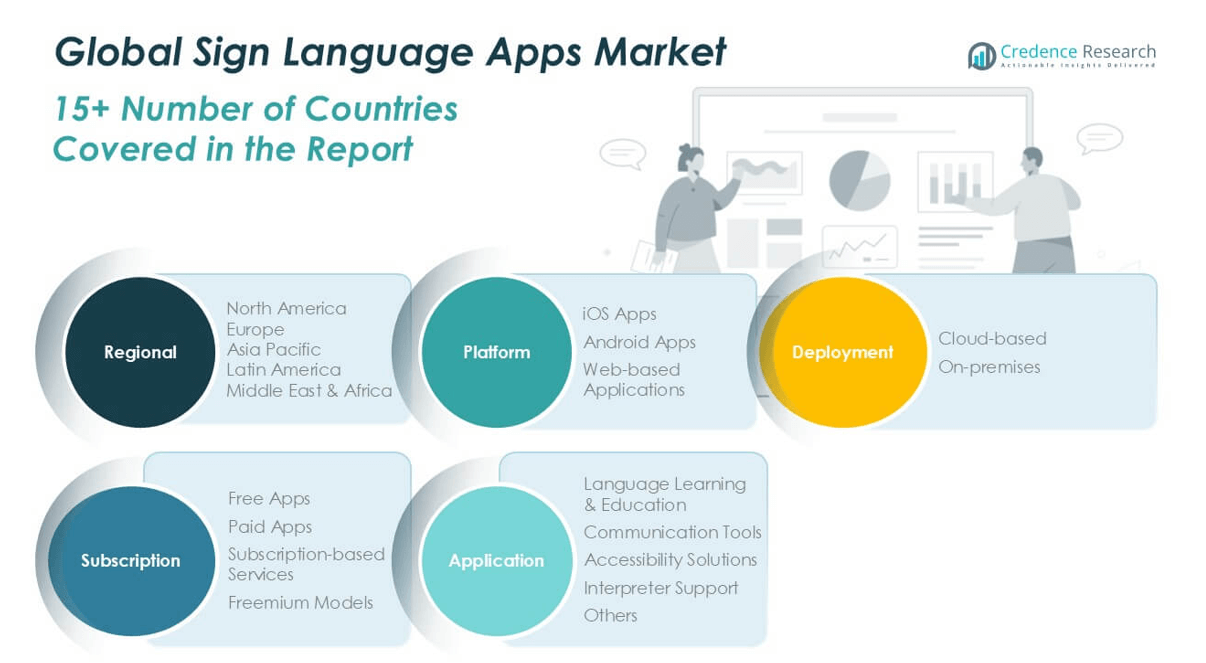
Market Segmentations:
By Platform
- iOS Apps
- Android Apps
- Web-based Deployments
By Deployment
- Cloud-based
- On-premises
By Subscription
- Free Apps
- Paid Apps
- Subscription-based Services
- Freemium Models
By Application
- Language Learning & Education
- Communication Tools
- Accessibility Solutions
- Interpreter Support
- Others
By Geography
- North America
- U.S.
- Canada
- Mexico
- Europe
- Germany
- France
- U.K.
- Italy
- Spain
- Rest of Europe
- Asia Pacific
- China
- Japan
- India
- South Korea
- South-east Asia
- Rest of Asia Pacific
- Latin America
- Brazil
- Argentina
- Rest of Latin America
- Middle East & Africa
- GCC Countries
- South Africa
- Rest of the Middle East and Africa
Competitive Landscape
The competitive landscape of the Sign Language Apps market is characterized by a mix of tech giants, specialized startups, and accessibility-focused developers striving to innovate in the assistive communication space. Key players such as Google and Microsoft leverage their extensive AI and machine learning capabilities to enhance real-time translation and gesture recognition features. Companies like ProDeaf, Hand Talk, and SignSchool are gaining traction through their culturally tailored content and intuitive user interfaces, while The ASL App and Lingvano focus on educational engagement and community-driven learning. Startups such as Deafmobi and Signily cater to niche segments by providing keyboard integration and localized communication tools. These players are increasingly investing in cloud-based deployments, multilingual support, and subscription-based monetization models to expand market presence. Strategic collaborations, continuous product upgrades, and regional language integration are central to their growth strategies, as competition intensifies to meet rising global demand for inclusive digital solutions.
Key Player Analysis
- Microsoft
- ProDeaf
- SignSchool
- Hand Talk
- ASL App / The ASL App
- GestureTek
- Signily
- Lingvano
- Deafmobi
Recent Developments
- In April 2025, Microsoft launched Signly Sign Language as a Service (SLaaS), an Azure-based platform that provides synchronous, in-vision sign language translations on websites. This service allows organizations to make their online content accessible to deaf users by offering sign language translation, with daily updates and on-demand translation capabilities.
- In December 2023, Lingvano introduced a B2B program aimed at professionals across the health, education, customer service, and tourism sectors to improve their communication skills. The user base for Austrian Sign Language surged from 170 to 10,000 between 2018 and 2023. American Sign Language, launched in 2020, saw impressive growth from 53,000 users that year to 1.06 million by October 2023. British Sign Language, introduced in the spring of 2022, reached 81,400 users by the end of that year.
- In September 2022, ASL Now launched a mobile app that connects users of American Sign Language (ASL) directly with trained ASL-fluent customer service agents, eliminating the need for interpreters or captions. This first-of-its-kind app aims to provide equal communication opportunities for individuals who are Deaf, DeafBlind, DeafDisabled, hard-of-hearing, or late-deafened. The app provides a directory of companies that offer customer support in ASL, allowing users to easily connect with agents via video.
Market Concentration & Characteristics
The Sign Language Apps Market exhibits moderate concentration with a blend of global technology leaders and emerging niche players. It features both well-established companies like Google and Microsoft and specialized developers such as Hand Talk, Lingvano, and SignSchool. The market supports diverse use cases including education, communication, and accessibility, creating opportunities for both mass-market and targeted applications. It remains fragmented by platform, subscription model, and deployment type, with Android-based and cloud-deployed apps holding dominant shares. Freemium and subscription-based services attract a wide user base by balancing accessibility and monetization. Regional dynamics strongly influence competition, with Asia Pacific leading in user volume due to smartphone penetration, and North America driving innovation. Companies focus on AI-driven features, real-time translation, and regional sign language support to gain competitive advantage. The market continues to evolve through app upgrades, strategic partnerships, and inclusion initiatives, while user expectations for intuitive, accurate, and culturally relevant solutions shape product development.
Report Coverage
The research report offers an in-depth analysis based on Platform, Deployment, Subscription, Application and Geography. It details leading market players, providing an overview of their business, product offerings, investments, revenue streams, and key applications. Additionally, the report includes insights into the competitive environment, SWOT analysis, current market trends, as well as the primary drivers and constraints. Furthermore, it discusses various factors that have driven market expansion in recent years. The report also explores market dynamics, regulatory scenarios, and technological advancements that are shaping the industry. It assesses the impact of external factors and global economic changes on market growth. Lastly, it provides strategic recommendations for new entrants and established companies to navigate the complexities of the market.
Future Outlook
- The market will continue expanding as digital accessibility becomes a global priority in education and communication.
- AI-powered real-time gesture recognition will become a standard feature in most leading sign language apps.
- Regional sign language support will grow, with developers localizing content for culturally specific needs.
- Cloud-based platforms will dominate deployment, offering scalability and cross-device synchronization.
- Subscription and freemium models will drive monetization, attracting both individual and institutional users.
- Schools and universities will increasingly integrate sign language apps into inclusive learning programs.
- Government policies promoting disability inclusion will stimulate adoption across public sectors.
- Partnerships between app developers and non-profit organizations will enhance community outreach and trust.
- Mobile-first development will remain a core focus, especially in emerging markets with high smartphone penetration.
- User demand for offline access, multilingual options, and intuitive interfaces will shape product design and innovation.

Request a Free Sample
Fill in your details and we'll send you a free sample report.
- Sample data tables & charts
- Research methodology
Market Dynamics
Government Regulations and Accessibility Mandates
Policies and regulations promoting digital accessibility and inclusion are compelling educational institutions, public services, and businesses to adopt sign language apps, driving market growth as compliance becomes mandatory in many regions.
Smartphone Penetration and Internet Access
The widespread adoption of affordable smartphones and improved internet connectivity, especially in emerging markets, is enabling broader access to sign language apps, making digital communication and learning tools available to a larger population of deaf and hard-of-hearing users.
Integration of AI and Machine Learning
Advancements in AI and machine learning are enabling real-time gesture recognition, facial tracking, and automatic translation in sign language apps, significantly improving user experience and expanding the range of applications in education, communication, and accessibility.
Expansion of Multilingual and Regional Sign Language Support
Growing demand for apps that support regional and culturally specific sign languages is encouraging developers to localize content, tapping into underserved markets and increasing adoption among diverse linguistic communities.
Adoption in Education and Corporate Training
The integration of sign language apps into mainstream education and corporate training programs is creating new opportunities for market expansion, as institutions seek scalable, adaptive tools to foster inclusive learning and workplace environments.
Need a Custom Version of This Report?
Tailor the scope, geography, or segments to your exact requirements.
- Custom geography or segment scope
- Direct access to our analyst team
Frequently Asked Questions
What is the current size of the Sign Language Apps Market?
What factors are driving the growth of the Sign Language Apps Market?
What are the key segments within the Sign Language Apps Market?
Who are the major players in the Sign Language Apps Market?
Table of Content
Chapter 1 Market Segmentation
- 1.1 Segmentation Framework
- 1.1.1 Product and Service Classification
- 1.1.2 Application and End-Use Classification
- 1.1.3 Technology and Solution Classification
- 1.1.4 Customer and Distribution Channel Classification
- 1.1.5 Geographic Segmentation
- 1.1.6 Market Segment Definitions and Boundaries
- 1.2 By Platform
- 1.2.1 iOS Apps
- 1.2.2 Android Apps
- 1.2.3 Web-based Deployments
- 1.3 By Deployment
- 1.3.1 Cloud-based
- 1.3.2 On-premises
- 1.4 By Application
- 1.4.1 Language Learning & Education
- 1.4.2 Communication Tools
- 1.4.3 Accessibility Solutions
- 1.4.4 Interpreter Support
- 1.4.5 Others
- 1.5 By Subscription
- 1.5.1 Free Apps
- 1.5.2 Paid Apps
- 1.5.3 Subscription-based Services
- 1.5.4 Freemium Models
Chapter 2 Introduction
- 2.1 Report Objectives and Scope
- 2.2 Product Definition and Industry Terminology
- 2.3 Market Inclusions and Exclusions
- 2.4 Research Process
- 2.4.1 Primary Research and Expert Interviews
- 2.4.2 Secondary Research and Source Review
- 2.4.3 Top-Down and Bottom-Up Estimation
- 2.4.4 Data Triangulation and Verification
- 2.5 Market Size Measurement Basis
- 2.5.1 2024: USD 1,407.34 million → 2032: USD 3,101.19 million
- 2.6 Historical and Forecast Reference Periods
- 2.6.1 Base Year: 2024
- 2.6.2 Forecast Period: 2024-2032
- 2.7 Research Assumptions and Limitations
Chapter 3 Executive Summary
- 3.1 Market Snapshot and Key Findings
- 3.2 Base-Year Market Size, 2024
- 3.3 Forecast Market Size, 2032
- 3.4 Revenue and Volume Growth Outlook
- 3.5 Key Demand and Supply Indicators
- 3.6 Leading Market Segments
- 3.7 Fastest-Growing Market Opportunities
- 3.8 Regional Performance Highlights
- 3.9 Technology and Industry Transformation
- 3.10 Competitive Landscape Summary
- 3.11 Analyst View and Strategic Implications
Chapter 4 Global Sign Language Apps Market Trends and Developments
- 4.1 Historical Industry Development
- 4.2 Recent Market Trends and Developments
- 4.3 Demand and Customer Behavior Trends
- 4.4 Technology and Product Innovation
- 4.5 Artificial Intelligence, Automation and Digitalization
- 4.6 Local Manufacturing and Supply Chain Realignment
- 4.7 Industry Partnerships, Mergers and Acquisitions
- 4.8 Sustainability and Circular Economy Developments
- 4.9 Government and Private Sector Investment Trends
- 4.10 Emerging Business Models and Commercialization
- 4.11 Industry Developments and Announcements
Chapter 5 Global Sign Language Apps Market Production, Supply and Demand Analysis
- 5.1 Demand Trend and Consumption Analysis
- 5.2 Demand Forecast, 2024-2032
- 5.3 Production and Output Trend
- 5.4 Production and Output Forecast, 2024-2032
- 5.5 Installed Capacity and Capacity Utilization
- 5.6 Company-Wise Production Plants and Statistics
- 5.6.1 Installed Production Capacity
- 5.6.2 Actual Production
- 5.6.3 Planned Capacity and Expansion Targets
- 5.7 Supply Chain Structure and Procurement Trends
- 5.8 Supply-Demand Gap and Bottlenecks
- 5.9 Import Dependence and Sourcing Structure
- 5.10 Contract Manufacturing and Outsourcing
- 5.11 Regional Supply and Demand Concentration
Chapter 6 Global Sign Language Apps Market Pricing Analysis
- 6.1 Pricing Structure and Measurement
- 6.2 Historical Pricing Trends
- 6.3 Pricing Outlook, 2024-2032
- 6.4 Average Selling Price and Unit Economics
- 6.5 Pricing by Product and Market Segment
- 6.6 Geographic Pricing Differences
- 6.7 Key Input, Energy, Labor and Logistics Costs
- 6.8 Contract Pricing and Purchasing Models
- 6.9 Pricing Sensitivity and Competitive Positioning
- 6.10 Price, Margin and Profitability Implications
Chapter 7 Global Sign Language Apps Market Dynamics
- 7.1 Market Growth Drivers
- 7.1.1 Demand-Side Drivers
- 7.1.2 Technology and Innovation Drivers
- 7.1.3 Infrastructure and Investment Drivers
- 7.1.4 Regulatory and Policy Drivers
- 7.2 Market Restraints
- 7.2.1 Cost and Affordability Constraints
- 7.2.2 Technology and Adoption Barriers
- 7.2.3 Supply Chain and Operational Constraints
- 7.3 Market Challenges
- 7.3.1 Competitive Pressure and Margin Erosion
- 7.3.2 Skills, Infrastructure and Implementation Gaps
- 7.4 Emerging Market Opportunities
- 7.5 Market Dynamics Impact and Time-Horizon Assessment
Chapter 8 Global Sign Language Apps Value Chain Analysis
- 8.1 Industry Value Chain Overview
- 8.2 Upstream Suppliers and Critical Inputs
- 8.3 Technology and Component Providers
- 8.4 Manufacturing or Service Delivery
- 8.5 Distribution, Channel Partners and Integrators
- 8.6 Downstream Applications and End Users
- 8.7 Value Addition and Profit Pools
- 8.8 Vertical Integration and Outsourcing
- 8.9 Supplier Concentration and Risk
- 8.10 Supply Chain Localization and Resilience
Chapter 9 Global Sign Language Apps Market Regulations and Policies
- 9.1 Relevant Laws, Standards and Compliance Frameworks
- 9.2 Product, Service, Safety and Quality Requirements
- 9.3 Government Policies, Incentives and Subsidies
- 9.4 Imports, Exports and Trade Barriers
- 9.5 Public Procurement and Local Content Requirements
- 9.6 Environmental and Sustainability Compliance
- 9.7 Data Protection, AI and Cybersecurity Compliance
- 9.8 Upcoming Policy Changes and Market Implications
Chapter 10 Global Sign Language Apps Market Hotspots and Opportunities
- 10.1 Market Opportunity Mapping and Growth Hotspots
- 10.2 High-Growth Applications and Customer Groups
- 10.3 Underserved Markets and White-Space Opportunities
- 10.4 Emerging Technology and Product Opportunities
- 10.5 New Capacity and Investment Hotspots
- 10.6 Market Entry and Expansion Opportunities
- 10.7 Distribution and Partnership Opportunities
- 10.8 Near-Term and Long-Term Commercial Potential
- 10.9 Opportunity Attractiveness and Execution Risks
Chapter 11 Global Sign Language Apps Market Outlook, 2024-2032
- 11.1 Market Size and Analysis
- 11.1.1 Revenue (Market Measurement: 2024: USD 1,407.34 million → 2032: USD 3,101.19 million)
- 11.1.2 Market Volume and Quantity Sold
- 11.1.3 Historical Market Size
- 11.1.4 Base-Year Market Size, 2024
- 11.2 Market Forecast, 2024-2032
- 11.2.1 Revenue Forecast to 2032
- 11.2.2 Volume Forecast to 2032
- 11.2.3 CAGR and Year-on-Year Growth
- 11.2.4 Incremental Revenue Opportunity
- 11.3 Forecast Assumptions and Scenario Analysis
- 11.3.1 Base-Case Forecast
- 11.3.2 Optimistic and Conservative Scenarios
- 11.3.3 Technology, Pricing and Policy Sensitivities
- 11.4 Market Attractiveness and Growth Outlook
Chapter 12 Global Sign Language Apps Market Segmentation and Outlook
- 12.1 Segmentation Summary and Market Shares, 2024
- 12.2 Largest and Fastest-Growing Segments
- 12.3 By Platform - Market Size and Forecast, 2024-2032
- 12.3.1 Segment Definition and Scope
- 12.3.2 Historical Market Size
- 12.3.3 Revenue Forecast, 2024-2032
- 12.3.4 Volume Forecast, 2024-2032
- 12.3.5 Base-Year Market Share, 2024
- 12.3.6 Segment CAGR and Growth Drivers
- 12.3.7 Subsegment Market Size and Forecast
- 12.3.7.1 iOS Apps
- 12.3.7.2 Android Apps
- 12.3.7.3 Web-based Deployments
- 12.3.8 Subsegment Pricing and Adoption Trends
- 12.3.9 Leading Suppliers and Competition
- 12.3.10 Regional Demand and Opportunities
- 12.4 By Deployment - Market Size and Forecast, 2024-2032
- 12.4.1 Segment Definition and Scope
- 12.4.2 Historical Market Size
- 12.4.3 Revenue Forecast, 2024-2032
- 12.4.4 Volume Forecast, 2024-2032
- 12.4.5 Base-Year Market Share, 2024
- 12.4.6 Segment CAGR and Growth Drivers
- 12.4.7 Subsegment Market Size and Forecast
- 12.4.7.1 Cloud-based
- 12.4.7.2 On-premises
- 12.4.8 Subsegment Pricing and Adoption Trends
- 12.4.9 Leading Suppliers and Competition
- 12.4.10 Regional Demand and Opportunities
- 12.5 By Application - Market Size and Forecast, 2024-2032
- 12.5.1 Segment Definition and Scope
- 12.5.2 Historical Market Size
- 12.5.3 Revenue Forecast, 2024-2032
- 12.5.4 Volume Forecast, 2024-2032
- 12.5.5 Base-Year Market Share, 2024
- 12.5.6 Segment CAGR and Growth Drivers
- 12.5.7 Subsegment Market Size and Forecast
- 12.5.7.1 Language Learning & Education
- 12.5.7.2 Communication Tools
- 12.5.7.3 Accessibility Solutions
- 12.5.7.4 Interpreter Support
- 12.5.7.5 Others
- 12.5.8 Subsegment Pricing and Adoption Trends
- 12.5.9 Leading Suppliers and Competition
- 12.5.10 Regional Demand and Opportunities
- 12.6 By Subscription - Market Size and Forecast, 2024-2032
- 12.6.1 Segment Definition and Scope
- 12.6.2 Historical Market Size
- 12.6.3 Revenue Forecast, 2024-2032
- 12.6.4 Volume Forecast, 2024-2032
- 12.6.5 Base-Year Market Share, 2024
- 12.6.6 Segment CAGR and Growth Drivers
- 12.6.7 Subsegment Market Size and Forecast
- 12.6.7.1 Free Apps
- 12.6.7.2 Paid Apps
- 12.6.7.3 Subscription-based Services
- 12.6.7.4 Freemium Models
- 12.6.8 Subsegment Pricing and Adoption Trends
- 12.6.9 Leading Suppliers and Competition
- 12.6.10 Regional Demand and Opportunities
- 12.7 Segment Growth Comparison
- 12.8 Segment Attractiveness and Priority Matrix
Chapter 13 Global Sign Language Apps End-Use and Application Market Outlook
- 13.1 End-Use Industry and Customer Demand Structure
- 13.2 Leading Applications and Customer Groups
- 13.3 End-Use Market Size, Share and Forecast
- 13.4 Major End-Use Industry Deep Dives
- 13.4.1 Customer Requirements and Use Cases
- 13.4.2 Demand and Replacement Cycles
- 13.4.3 Technical and Regulatory Considerations
- 13.4.4 Purchasing and Procurement Models
- 13.4.5 Leading Vendors and Distribution Channels
- 13.4.6 Forecast and Commercial Opportunities
- 13.5 Emerging Applications and Cross-Segment Demand
- 13.6 End-Use Industry Investment Priorities
Chapter 14 Global Sign Language Apps Geographic Market Outlook, 2024-2032
- 14.1 Regional Market Size and Share, 2024
- 14.2 Regional Market Forecast, 2024-2032
- 14.3 Regional Pricing, Production and Demand Differences
- 14.4 North America
- 14.4.1 United States
- 14.4.2 Canada
- 14.4.3 Mexico
- 14.5 Europe
- 14.5.1 Germany
- 14.5.2 France
- 14.5.3 Italy
- 14.5.4 United Kingdom
- 14.5.5 Spain
- 14.5.6 Poland
- 14.5.7 Russia
- 14.5.8 Netherlands
- 14.5.9 Belgium
- 14.5.10 Sweden
- 14.5.11 Denmark
- 14.5.12 Norway
- 14.5.13 Rest of Europe
- 14.6 Asia Pacific
- 14.6.1 China
- 14.6.2 India
- 14.6.3 Japan
- 14.6.4 South Korea
- 14.6.5 Thailand
- 14.6.6 Indonesia
- 14.6.7 Vietnam
- 14.6.8 Malaysia
- 14.6.9 Australia
- 14.6.10 Rest of Asia Pacific
- 14.7 Latin America
- 14.7.1 Brazil
- 14.7.2 Argentina
- 14.7.3 Colombia
- 14.7.4 Chile
- 14.7.5 Rest of Latin America
- 14.8 Middle East
- 14.8.1 Saudi Arabia
- 14.8.2 United Arab Emirates
- 14.8.3 Turkey
- 14.8.4 Israel
- 14.8.5 Iran
- 14.8.6 Rest of the Middle East
- 14.9 Africa
- 14.9.1 South Africa
- 14.9.2 Egypt
- 14.9.3 Nigeria
- 14.9.4 Morocco
- 14.9.5 Rest of Africa
- 14.10 Regional Investment, Policy and Supply Chain Differences
- 14.11 Regional Competitive Landscape
- 14.12 Geographic Growth Hotspots
Chapter 15 Global Sign Language Apps Technology, Innovation and Sustainability Outlook
- 15.1 Technology Landscape and Maturity
- 15.2 Product, Process and Service Innovation
- 15.3 AI, Automation and Digital Tools in the Industry
- 15.4 Technology Adoption and Performance Benchmarking
- 15.5 Innovation Pipeline and R&D Investment
- 15.6 Patent and Intellectual Property Trends
- 15.7 Energy Efficiency and Resource Management
- 15.8 Sustainability, Recycling and Circularity
- 15.9 Technology Roadmap, 2024-2032
- 15.10 Risks of Obsolescence and Technology Substitution
Chapter 16 Global Sign Language Apps Market Key Strategic Imperatives
- 16.1 Growth and Market Entry Priorities
- 16.2 High-Return Products and Segments
- 16.3 Pricing, Profitability and Cost Optimization
- 16.4 Technology Investment and Product Differentiation
- 16.5 Supply Chain Localization and Resilience
- 16.6 Distribution and Customer Acquisition
- 16.7 Partnership, Acquisition and Capacity Strategy
- 16.8 Regional Expansion Priorities
- 16.9 Short-, Medium- and Long-Term Actions
Chapter 17 Competition Outlook
- 17.1 Industry Competition Characteristics
- 17.2 Market Structure and Concentration
- 17.3 Market Share and Competitive Positioning, 2024
- 17.4 Company-Wise Revenue and Product Benchmarking
- 17.5 Production and Service Capacity Benchmarking
- 17.6 Technology, Pricing and Differentiation
- 17.7 Regional Footprint and Distribution Strength
- 17.8 Mergers, Acquisitions and Strategic Alliances
- 17.9 New Entrants and Competitive Threats
- 17.10 Porter's Five Forces and Industry Attractiveness
- 17.11 Competitive Outlook, 2024-2032
Chapter 18 Company Profiles
- 18.1 Company Coverage and Selection Criteria
- 18.2 Google
- 18.2.1 Business Description
- 18.2.2 Company Ownership and Geographic Presence
- 18.2.3 Product and Service Portfolio
- 18.2.4 Manufacturing and Operating Footprint
- 18.2.5 Production Capacity and Expansion Plans
- 18.2.6 Financial Performance and Investment
- 18.2.7 Market Share and Competitive Position
- 18.2.8 Technology and Innovation Capabilities
- 18.2.9 Strategic Alliances or Partnerships
- 18.2.10 Recent Developments
- 18.2.11 Growth Strategy and Outlook
- 18.3 Microsoft
- 18.4 ProDeaf
- 18.5 Hand Talk
- 18.6 SignSchool
- 18.7 ASL App
- 18.8 Lingvano
- 18.9 GestureTek
- 18.10 Signily
- 18.11 Deafmobi
- 18.12 Other Relevant Market Participants
Note: Every listed company is profiled on the structure shown under the first company. The company list is preliminary and may change based on research findings, market developments, data availability and client requirements.
Chapter 19 Disclaimer
- 19.1 Research and Forecast Disclaimer
- 19.2 Data Source and Estimation Limitations
Note: The depth of individual sections depends on data availability for this market. Volume, capacity, trade and other unit-based metrics are included where applicable.

